

Submitted:
02 October 2025
Posted:
02 October 2025
You are already at the latest version
Abstract
This paper proposes Organizational Emotional Materiality (OEM) framework that specifies how emotions influence organizational value through three distinct pathways: Emotion-Decision pathway, Emotion-Social capital pathway and Emotion-Market signaling pathway. It integrates Affective Events Theory, Social Exchange Theory, Emotion Regulation Theory and organizational capability perspectives to develop five testable propositions that advance understanding of when, how and why emotions become strategically material for organizations. The OEM framework addresses gaps in organizational behavior literature by providing a systematic theoretical model linking micro-level emotional processes to macro-level organizational outcomes, while specifying boundary conditions and measurement considerations for empirical validation. The theoretical contribution lies in reconceptualizing emotions from peripheral organizational factors to measurable strategic resources that systematically influence competitive advantage through identifiable causal mechanisms. The paper offers evidence-based recommendations for embedding emotional awareness into strategic management while acknowledging the risks of dysfunctional emotional manipulation.
Keywords:
Organizational Emotional Materiality
; Affective Events Theory
; Emotion Regulation
; Organizational Behavior
; Organizational Emotional Capability
; Organizational Performance
; Strategic Management
; Strategic Resources
1. Introduction
While traditional organizational research treated emotions as irrational disruptions to decision-making, emerging evidence demonstrates emotions as measurable, manageable resources materially consequential for value creation (Vuori & Huy, 2022). Current research addresses emotions primarily as individual phenomena or contextual factors rather than systematic organizational resources strategically developed and deployed (Huy, 1999; Humphrey et al., 2016). Though emotions profoundly influence strategic outcomes, theoretical understanding remains fragmented across psychological, behavioral and economic literatures (Ashkanasy & Dorris, 2017; Barsade & Knight, 2015). Emotional intelligence research focuses on individual competencies (Goleman, 1995), while organizational behavior examines discrete phenomena like emotional labor (Grandey, 2000) or workplace affect (Barsade, 2002). This fragmentation prevents development of integrative frameworks specifying how emotions translate into measurable business value.
Organizational emotional materiality (OEM) advances beyond emotional intelligence frameworks by positioning emotions as strategic assets, challenging traditional views of emotions as peripheral "soft factors" (Fineman, 2000). The framework theorizes emotions as measurable resources generating competitive advantages through enhanced decision-making, stronger social capital and improved stakeholder relationships. Materiality, in financial accounting, refers to information whose omission could influence economic decisions (Financial Accounting Standards Board, 2010). By extension, emotional materiality captures how affective phenomena substantively impact performance metrics including innovation capacity, retention, customer loyalty and market valuation – a novel synthesis building on resource-based view logic while incorporating affective organizational behavior insights.
Contemporary challenges including digital transformation, remote work and environmental volatility have heightened emotional capabilities' strategic importance (Parker et al., 2020). Organizations developing emotional resources demonstrate superior adaptation compared to those treating emotions as incidental. Yet existing frameworks lack precision to guide strategic emotional investments or predict organizational impact, focusing primarily on individual emotional intelligence or organizational capability without articulating financial outcome mechanisms (Akgün et al., 2009).
Three theoretical gaps persist: absence of comprehensive frameworks integrating emotional processes across levels explaining value creation; insufficient attention to measurement and ethical challenges; and lack of testable propositions advancing theory while providing empirical guidance.
This paper addresses these gaps by developing the OEM framework specifying three pathways through which emotions create value via decision quality, social capital and market perceptions; deriving five testable propositions providing empirical guidance; and critically examining measurement challenges and ethical boundaries of organizational emotional management.
2. Theoretical Foundations and Literature Review
2.1. The Evolution of Emotion in Organizational Theory
Early organizational theory ignored emotions – rational choice models assumed decision-making through information and logical analysis alone (Simon, 1947). The human relations movement acknowledged emotional factors but viewed them as efficiency obstacles, not strategic resources (Mayo, 1933). Contemporary research recognizes emotions as fundamental to organizational functioning, yet lacks integrative frameworks.
Neuroscience reveals emotions not as cognitive disruptions but as effective decision-making components (Damasio, 1994). Emotions provide environmental information, guide attention, influence memory – findings challenging traditional emotion-rationality dichotomies.
2.2. Affective Events Theory (AET)
AET provides foundational logic for understanding how workplace events generate emotional responses influencing attitudes and behaviors (Weiss & Cropanzano, 1996). The theory demonstrates workplace emotions as systematic responses to organizational events, accumulating over time to shape satisfaction, performance and commitment through predictable patterns.
AET distinguishes between work environment features (demands, policies, leadership) and affective work events (daily hassles, uplifts) occurring within those environments. Environment features have stable attitudinal effects while affective events create emotional responses influencing behavior – explaining why employees with similar characteristics exhibit different performance patterns. Positive events generate emotions enhancing engagement; negative events undermine organizational functioning.
Operating at individual levels limits AET's applicability to organizational phenomena. Barsade & Knight (2015) extended AET by theorizing event aggregation across members creating collective emotional patterns. This occurs through emotional contagion spreading individual emotions organizationally, creating shared experiences shaping collective behavior (Hatfield et al., 1994). Meta-analysis shows positive daily events correlate with helping behaviors (r=.31), creative performance (r=.24) and task performance (r=.18), while negative events demonstrate opposite effects (Fisher & To, 2012).
Contemporary extensions incorporate emotion regulation whereby individuals and organizations actively manage responses optimizing outcomes (Madrid et al., 2020). Regulation occurs through antecedent-focused strategies (cognitive reappraisal, attentional deployment) and response-focused strategies (expression modification) (Gross & John, 2003). Organizations influence both through training, cultural norms and leadership practices.
AET highlights workplace characteristics moderating affective event-outcome relationships. Autonomy, support and justice influence how employees interpret and respond to emotional events. The theory's focus on discrete events proves valuable for understanding how interventions influence emotional climates – recognition ceremonies create positive events while layoffs create negative ones.
2.3. Social Exchange Theory (SET)
SET suggests emotional support creates reciprocal obligations between organizational members (Cropanzano & Mitchell, 2005). When organizations invest in emotional resources through supportive climates, recognition and empathetic leadership, employees reciprocate through increased commitment, citizenship behaviors and performance (Rhoades & Eisenberger, 2002).
The emotional dimension operates through perceived organizational support signaling care for employee wellbeing (Eisenberger et al., 1986). Employees perceiving high support develop stronger emotional attachments, enhancing willingness to contribute beyond formal requirements – creating sustainable advantages through enhanced human capital utilization and reduced coordination costs.
Emotional climate becomes conceptualized as social capital facilitating coordination, trust and knowledge sharing. While traditional social capital emphasizes network structures, emotional social capital focuses on relationship quality influencing collaboration and innovation, reducing cooperation costs by increasing trust while enhancing benefits through improved knowledge transfer.
2.4. Organizational Emotional Capability Theory (OEC)
OEC represents collective capacity to perceive, understand, regulate and leverage emotions strategically (Huy, 1999; Peng et al., 2022). Unlike individual emotional intelligence, OEC operates systematically through structures, processes and cultures shaping emotional experiences across members.
While individual EI focuses on personal competencies, organizational capability emphasizes systemic capacity leveraging emotions strategically across levels and stakeholder relationships. Meta-analytic evidence demonstrates organizations with higher OEC achieve superior innovation (ρ=.34), engagement (ρ=.41) and financial returns (ρ=.23) compared to those with lower capabilities (Akgün et al., 2009).
Environmental factors moderate OEC-performance relationships including industry characteristics, competitive intensity and technological change. Service organizations in high-contact environments demonstrate stronger relationships than manufacturing organizations with limited customer interaction. Organizations facing uncertainty benefit more from emotional capabilities than those in stable environments.
Huy's (1999) conceptualization identified six dimensions – Harmony, Experience, Identity, Game, Expression and Inspiration dynamics – each requiring specific cultivation. Research identifies antecedents including transformational leadership, psychological capital, learning orientation and cultural values emphasizing expression (He et al., 2017). Organizations develop OEC through deliberate practices: awareness training, reflection processes and systems capturing emotional insights.
However, frameworks lack specificity regarding how capabilities translate into performance or when they become strategically valuable. Our framework addresses gaps by specifying pathways influencing outcomes, establishing boundary conditions and identifying moderating variables enhancing or diminishing emotional materiality.
2.5. Emotion Regulation Theory (ERT)
ERT explains how individuals and organizations manage emotional experiences achieving desired outcomes (Gross & John, 2003). The process model identifies five sequential stages: situation selection, modification, attentional deployment, cognitive change and response modulation – each presenting regulatory intervention opportunities.
Research demonstrates employees with greater work control experience more positive emotions and higher performance (Bakker & Demerouti, 2017), while those using adaptive regulation strategies experience better psychological health, performance and relationships (Torrence et al., 2019). Organizations implementing situation selection through job design and workspace configuration considering emotional implications observe reduced burnout, increased engagement and improved service quality. However, strategies must match situational demands – excessive suppression leads to decreased authenticity and increased stress.
2.6. Emotional Contagion Theory (ECT)
ECT explains emotional spread through organizations via automatic mimicry of expressions, tones and behavioral cues (Hatfield et al., 1994). This occurs through mimicry, convergence and contagion – individuals automatically mimic emotional expressions triggering corresponding experiences, leading to organizational convergence.
Factors influencing contagion strength include social similarity, interaction frequency, relationship quality and expression intensity (Barsade, 2002). Network density influences contagion, with tightly connected networks facilitating rapid transmission. Organizational factors include workspace design, communication patterns, leadership expression and cultural norms. Open offices facilitate contagion through increased cues; remote work may attenuate it.
Positive contagion enhances cohesion, cooperation and collective performance, while negative contagion propagates stress, conflict and burnout (Petitta et al., 2021). Organizations leverage positive contagion through strategic placement of emotionally positive individuals, leader modeling emphasizing optimism and structured positive interactions.
2.7. Resource-Based View and Emotional Resources
The resource-based view suggests sustainable advantages emerge from valuable, rare, inimitable, non-substitutable resources (Barney, 1991). Emotional resources possess these characteristics when systematically developed and strategically deployed. They're valuable – enhancing decision-making, collaboration and stakeholder relationships. They're rare – most organizations lack systematic approaches. They're inimitable – due to social complexity and causal ambiguity. They're non-substitutable – technological solutions cannot replace human emotional competencies.
Yet emotional resources present unique management challenges: intangibility, measurement difficulties and context-dependent effectiveness. Organizations must develop sophisticated capabilities recognizing, developing and deploying emotional resources effectively across contexts and stakeholder relationships.
3. Organizational Emotional Materiality Framework
3.1. Core Constructs and Definitions
Organizational Emotional Materiality (OEM) denotes the degree emotions influence value creation through measurable impacts on decision quality, social capital formation and market signaling effectiveness – capturing strategic significance by linking emotional processes to tangible outcomes influencing competitive position and financial performance.
Emotional Climate represents shared perceptions of emotional norms, support systems and expression patterns shaping collective behavior (Glomb & Tews, 2004) – encompassing valence and intensity of shared experiences plus organizational systems shaping expression and regulation.
Emotional Capability encompasses organizational systems, processes and competencies for recognizing, regulating and leveraging emotions strategically across levels – including individual competencies, group management processes and organizational development infrastructure.
Emotional Events are discrete workplace occurrences triggering emotional responses among members, ranging from interpersonal interactions and achievements to organizational changes and external crises – serving as primary drivers of climate and capability development over time.
3.2. The Three Pathways Model
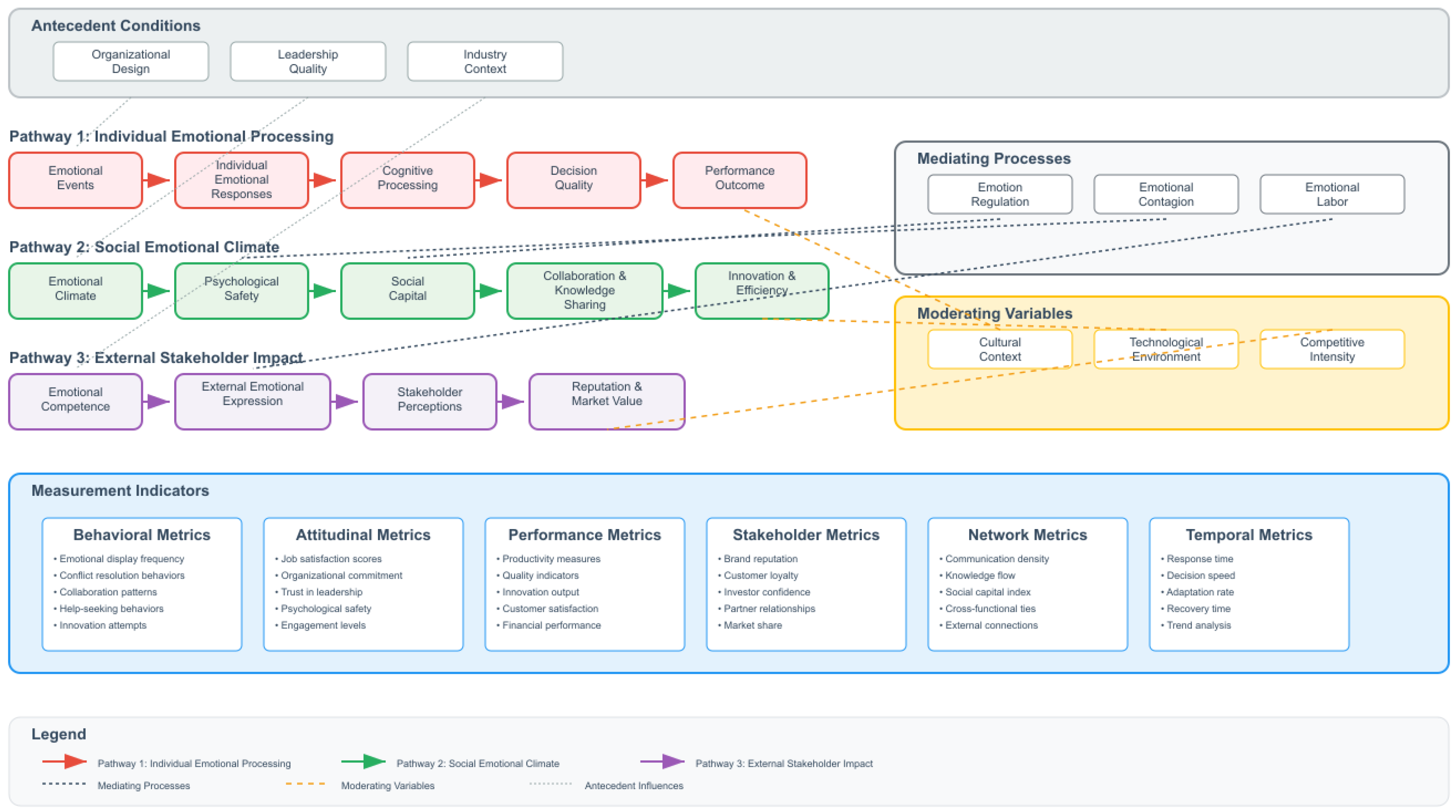
The OEM framework proposes organizational emotions create value through three pathways transforming affective experiences into measurable business outcomes. The framework integrates these mechanisms within a comprehensive model specifying antecedents, processes, mediators, outcomes and boundary conditions.
Positioning emotions as strategic variables requiring systematic measurement and management, emotional materiality emerges when affective processes significantly influence key indicators including innovation metrics, retention, satisfaction scores and financial returns – challenging traditional views of emotions as immeasurable soft factors. Recognizing emotional processes operate simultaneously at individual, team and organizational levels; the model incorporates multiple analytical levels requiring sophisticated approaches capturing cross-level effects and temporal dynamics.
Figure 1.
The Organizational Emotional Materiality (OEM) Framework.
Pathway 1: Emotion-Decision Pathway
This mechanism operates through decision-making processes at individual, team and strategic levels. Emotions influence cognitive processes – attention allocation, memory retrieval, information processing, risk perception, judgment formation – affecting decision quality across contexts (Forgas & George, 2001; Seo & Barrett, 2007). The emotion-cognition relationship proves complex and context-dependent, with different states producing distinct cognitive patterns influencing quality predictably.
Individually, positive emotions broaden cognitive scope, enhancing creative problem-solving by reducing constraints and enhancing associative thinking through flexibility (Isen, 2001). Broaden-and-build theory suggests positive emotions expand thought-action repertoires, enabling consideration of more alternatives and innovative connections. Yet extreme positive emotions lead to overconfidence and inadequate risk evaluation, reducing analytical rigor in contexts requiring precision (Forgas & George, 2001).
Negative emotions impair judgment through anxiety, stress and pessimism narrowing attention and reducing flexibility – but also improve quality by promoting careful analysis and risk awareness. Negative emotions focus attention, increase systematic processing, yet may limit innovative thinking (Schwarz & Clore, 2003).
The key factor becomes emotional intensity and regulation capability rather than valence alone. Organizations must develop management capabilities optimizing emotional states for different decisions. Strategic decisions requiring creativity benefit from positive climates; operational decisions requiring analytical precision benefit from neutral states enhancing focused attention.
Teams experiencing positive climates demonstrate creative problem-solving, information sharing and effective perspective integration. Positive emotions reduce social barriers, create psychological safety – improving knowledge sharing, encouraging risk-taking.
Organizationally, collective states influence strategic decision-making in boardrooms and innovation teams. Emotionally intelligent leadership teams make superior strategic choices, particularly under uncertainty (Vuori & Huy, 2022).
Organizations with superior capabilities create differentiated environments optimizing cognitive performance for specific contexts. They develop systems recognizing decision requirements, assessing climates, implementing interventions aligning emotional states with cognitive demands – enabling systematic enhancement across contexts.
Integrating analytical approaches with cognitive benefits of regulation translates into improved strategic decision-making, enhanced innovation capacity and superior problem-solving organizationally.
Pathway 2: Emotion-Social Capital Pathway
This mechanism operates through social capital formation and maintenance. Emotional climate directly influences trust formation, cooperation, knowledge sharing and relationship quality constituting organizational social capital (Coleman, 1988; Barsade & Knight, 2015) – the collective value of networks and inclinations arising to do things for each other.
Positive climates facilitate social capital development by reducing interpersonal risk perceptions, increasing collaboration openness, enhancing commitment to collective goals. Shared positive emotions create in-group identification through similarity-attraction, mood congruence, reciprocity. Employees experiencing positive emotions in supervisor and colleague interactions develop stronger trust, enhancing performance through increased cooperation and knowledge sharing (Dirks & Ferrin, 2002).
Organizations with positive climates enable individuals to feel safe expressing ideas, admitting mistakes, asking questions, engaging in learning behaviors (Edmondson, 2019). Psychological safety enhances knowledge sharing, innovation and collaborative problem-solving by reducing defensive behaviors, increasing productive risk-taking – a primary pathway through which climate influences social capital (Edmondson, 1999).
Trust formation represents another critical mechanism (McAllister, 1995). Positive emotional interactions generate affect-based trust complementing cognitive trust, creating bonds between members, increasing cooperation willingness and interdependence.
Knowledge sharing operates through climate effects on transfer capability and motivation (Wang & Noe, 2010). Climates where sharing becomes emotionally rewarding; increase intrinsic motivation, reducing barriers to absorption and application.
Organizations investing in positive climates develop superior social capital enhancing operational efficiency through improved knowledge utilization, collaborative capacity and reduced coordination costs – particularly valuable in knowledge-intensive contexts where competitive advantage depends on effective creation, transfer and application.
Pathway 3: Emotion-Market Signaling Pathway
This mechanism involves market signaling whereby emotional capabilities communicate intangible value to external stakeholders. Customers, investors, partners and regulatory bodies form perceptions of organizational competence partly through emotional signals conveyed by members and leaders (Elfenbein, 2007) – reflecting growing importance of intangible assets and stakeholder capitalism.
These signals through impression management processes influence stakeholder trust, confidence and commitment to ongoing relationships.
Customer relationships prove particularly sensitive to emotional signaling, with authenticity and competence influencing satisfaction, loyalty and premium price willingness (Hennig-Thurau et al., 2006). Emotionally engaged employees demonstrate genuine care, responsiveness and problem-solving commitment during service – translating into satisfaction, loyalty, brand perception enhancement and positive word-of-mouth driving revenue growth. Companies with highly engaged employees achieve 10% higher customer ratings, 20% sales increases and 21% higher profitability (Gallup, 2020).
Investor relationships respond to emotional signaling, particularly regarding leadership credibility and organizational resilience (Vuori & Huy, 2016). Leaders demonstrating emotional competence during presentations, crisis responses and stakeholder interactions generate confidence in capability and strategic direction – influencing risk perceptions, valuations and investment decisions.
Brand reputation reflects perceptions of emotional intelligence and employee treatment. Companies perceived as caring, authentic and emotionally intelligent attract talent, customer loyalty and investor confidence.
Partnership relationships depend heavily on emotional signaling for trust and collaborative effectiveness (Gulati et al., 2012). Organizations demonstrating emotional competence in partnership interactions create conditions for effective knowledge sharing, coordination and joint value creation – particularly valuable in strategic alliances where success depends on effective collaboration.
The signaling mechanism operates through contagion processes where organizational emotional states influence stakeholder states and behavioral responses (Hatfield et al., 1994). Social media and employer review platforms amplify organizational emotional climate visibility, making it increasingly material to market perceptions and stakeholder decision-making. Organizations with positive internal climates generate positive stakeholder emotional responses, creating favorable conditions for value creation and capture.
3.3. Theoretical Propositions
Based on the OEM framework, five testable propositions specify relationships between emotional processes and organizational outcomes – advancing theory through specific, falsifiable predictions identifying boundary conditions and providing empirical guidance.
Proposition 1
Organizations with higher emotional capability will demonstrate superior decision quality under high uncertainty conditions, with this relationship stronger in knowledge-intensive versus routine-based industries.
This integrates organizational capability theory with cognitive processing research predicting when emotional capabilities most strongly influence decision outcomes. High uncertainty requires cognitive flexibility, creative problem-solving and diverse information integration – capabilities enhanced by positive emotional states (Isen, 2001). Knowledge-intensive industries depend more heavily on creative and analytical decision-making compared to routine-based industries where standardized procedures predominate.
Boundary condition specification recognizes differential value across industry contexts. Knowledge work benefits more from emotional climate investments; routine-based contexts may find excessive emotional focus counterproductive to efficiency.
This enables empirical testing through cross-industry comparative studies measuring emotional capability, decision quality and performance outcomes under varying uncertainty conditions.
Proposition 2
Positive emotional climate will mediate the relationship between supportive organizational practices and employee innovative behavior, with mediation stronger in collectivistic versus individualistic cultures.
Drawing on SET and cultural psychology, this predicts how investments in employee support generate innovation through emotional climate mechanisms. Supportive practices – recognition systems, development opportunities, participative decision-making – create positive climates enhancing psychological safety and intrinsic motivation for innovative behavior (Amabile et al., 1996).
Cultural moderation recognizes emotional climate effects vary across cultures. Collectivistic cultures value group harmony and emotional climate, making individuals more responsive to emotional investments. Individualistic cultures' weaker response stems from greater emphasis on individual autonomy and achievement.
This enables cross-cultural validation of emotional climate mechanisms in innovation processes.
Proposition 3
The relationship between emotional climate and organizational performance will be moderated by leadership emotional intelligence, with high EI leadership strengthening positive effects.
This recognizes dependency of emotional climate effects on leadership capability leveraging emotional resources. Leaders with higher EI better recognize climate and implement interventions amplifying positive effects (Goleman, 1995). They manage emotional crises effectively, preventing negative spirals.
Moderation operates through multiple mechanisms including leader-follower contagion and capability managing emotional events.
This enables testing through multilevel studies measuring leadership EI, emotional climate and performance outcomes across organizations.
Proposition 4
Emotional capability will demonstrate diminishing returns on organizational performance beyond optimal thresholds, with excessive emotional focus reducing analytical rigor and decision efficiency in technical contexts.
Acknowledging negative effects of excessive emotional emphasis provides theoretical balance and practical guidance for optimal investment. While capabilities generally enhance performance, excessive focus reduces analytical rigor, delays decision-making, diverts resources from technical competence development.
Diminishing returns reflect opportunity costs and interference with other organizational capabilities. Technical context performance requires emotional investment moderate enough maintaining analytical focus while preserving engagement and collaboration.
Proposition 5
Positive effects of organizational emotional materiality on market valuation will be stronger during environmental uncertainty than stability and more prominent for service-based than manufacturing organizations.
This specifies boundary conditions for when emotional capabilities most strongly influence external stakeholder relationships and market outcomes. Service organizations depend more heavily on customer interaction quality and emotional labor, making capabilities more strategically valuable (Humphrey et al., 2016). Manufacturing organizations emphasize technical efficiency and product quality.
Environmental uncertainty increases emotional capability value by creating conditions where stakeholder confidence and organizational resilience become more important for valuation. During stable periods, technical and financial capabilities predominate; uncertainty periods highlight adaptation and stakeholder relationship management value.
4. Boundary Conditions and Contingency Factors
4.1. Industry Context and Competitive Dynamics
Emotional materiality varies across industries based on human capital, customer interaction and knowledge creation importance. Service industries where customer experience provides primary competitive advantage show stronger emotional materiality compared to manufacturing where technical competence and operational efficiency predominate (Humphrey et al., 2016).
Knowledge-intensive industries – consulting, research – depend on creative problem-solving, coordination and client relationship management. These capabilities, enhanced by positive emotional environments, yield greater benefits from emotional climate investments.
Capital-intensive industries – manufacturing, transportation – may find optimal performance through moderate emotional investments supporting employee engagement. These require substantial investments in physical assets, technical systems and operational processes rather than emotional capability. However, even these industries benefit from emotional capabilities in change management, customer service and safety.
Highly competitive industries requiring differentiation strategies benefit from emotional capability development. Low-competition industries find less value from emotional investments due to reduced pressure for differentiation and superior performance.
4.2. Cultural Context and National Variations
National and organizational cultures significantly moderate emotional management strategy effectiveness through variations in expression norms, collectivism-individualism orientations and power distance preferences (Kitayama & Park, 2007). Cultural variations influence both emotional capability development and translation into organizational outcomes.
Power distance dimensions influence different emotional management approach effectiveness. High power distance cultures require top-down emotional leadership and formal management systems; low power distance cultures benefit from participative management and peer-based support systems. Organizations must adapt emotional capability development strategies to cultural contexts for optimal effectiveness.
4.3. Technology and Automation Effects
Increasing automation and artificial intelligence deployment changes emotional capability strategic value by eliminating routine cognitive tasks, highlighting uniquely human emotional competencies (Huang & Rust, 2018). As organizations automate analytical and procedural tasks, competitive advantage increasingly depends on capabilities – leadership, creativity, interpersonal relationships, emotional intelligence – remaining difficult to automate.
This technological shift creates opportunities and challenges for emotional materiality. Organizations achieve greater returns from emotional capability investments as human work focuses on emotionally intensive tasks like strategy, innovation and leadership. However, displacement anxiety from automation poses change management challenges requiring sophisticated emotional management capabilities.
Remote work technologies influence emotional materiality by reducing face-to-face interaction, creating new challenges for emotional climate maintenance. Organizations must develop virtual emotional management capabilities including digital communication competence, remote relationship building and technology-mediated support systems.
4.4. Temporal Dynamics and Life Cycle Effects
Organizational life cycle stages influence emotional capability development value. Startups benefit most from emotional capabilities supporting innovation, risk-taking and rapid adaptation. These organizations require high uncertainty and failure tolerance, making emotional resilience and positive climate particularly valuable.
Growth-stage organizations face scaling, coordination and cultural preservation challenges requiring sophisticated emotional capabilities. These must develop systems maintaining emotional climate and culture during operational and workforce expansion.
Mature organizations face rigidity, complacency and competitive pressure challenges requiring emotional capabilities for change management, organizational renewal, innovation, differentiation and adaptation.
Declining organizations face difficult periods and challenging emotional environments requiring emotional leadership capabilities managing crisis, maintaining morale during downsizing and implementing turnaround strategies.
5. Measurement and Methodological Considerations
5.1. Construct Measurement Challenges and Solutions
Measuring organizational emotional materiality requires sophisticated approaches capturing emotional phenomena across multiple levels while maintaining psychometric rigor and practical applicability. Current approaches face challenges including construct validity concerns, social desirability bias, cultural measurement equivalence and multilevel aggregation issues requiring careful methodological consideration. Self-report emotional intelligence measures suffer from insufficient self-awareness, social desirability bias, faking and poor predictive validity (O'Connor et al., 2019).
Individual-level measurement advanced through ability-based EI measures demonstrating superior predictive validity compared to self-reports (Mayer et al., 2008). However, incremental validity remains limited beyond personality traits and cognitive ability; consensus-based scoring may measure conformity rather than competence (Maul, 2012). The widely used Mayer-Salovey-Caruso Emotional Intelligence Test (MSCEIT) faces criticism for consensus scoring potentially rewarding conventional conformance rather than genuine insight – problematic in diverse organizational contexts.
Emergent properties – emotional contagion effects, collective sensemaking, cultural amplification mechanisms – create organizational emotional phenomena uncaptured through individual measures alone. The Organizational Climate Measure (OCM) and related instruments provide validated approaches assessing shared perceptions of emotional norms and support systems. Yet organizational-level measurement presents additional complexities requiring aggregated individual responses validated through within-group agreement statistics and cross-level validation procedures. Complex aggregation requires theoretical and empirical justification for emergence processes. Surveys capture perceptions but may not reflect actual dynamics or fluctuations.
Behavioral indicators provide complementary approaches avoiding self-report bias – capturing observable phenomena like facial expressions, vocal patterns and physiological markers. These enable measurement but raise privacy concerns and may lack ecological validity organizationally (Roemmich et al., 2023). Objective indicators include turnover patterns, absenteeism rates, grievance filings, collaboration metrics, innovation outputs, satisfaction scores and financial performance. Behavioral indicators require careful validation ensuring they reflect emotional phenomena rather than alternative factors.
Physiological and neurological measures – heart rate variability, cortisol levels, brain imaging – provide direct measurement of emotional arousal and regulation. Organizational application remains limited due to practical and ethical constraints, requiring specialized equipment and expertise.
5.2. Multi-Level Analytical Approaches
Given measurement limitations, multi-method approaches triangulating across indicators and sources provide comprehensive assessment of organizational emotional phenomena. Testing OEM propositions requires multilevel analytical approaches accounting for nested data structures and cross-level relationships between individual experiences and organizational outcomes. Hierarchical linear modeling and structural equation modeling enable simultaneous analysis of individual, group and organizational effects.
Cross-cultural validation studies establish OEM propositions across different national and organizational cultures. Measurement equivalence testing ensures emotional constructs have similar meaning and psychometric properties across contexts. Multi-group structural equation modeling enables testing cultural moderation hypotheses and identifying culture-specific relationships.
Instruments like the Workplace Emotional Climate Scale provide reliable organizational emotional environment measures across trust, hope and security dimensions (Yurtsever & De Rivera, 2010). The Korean Emotional Labor Scale (KELS-11) offers validated assessment of emotional labor intensity and support systems across regulation, dissonance, monitoring and protective dimensions (Liu et al., 2023).
Longitudinal designs prove essential for testing causal relationships and temporal dynamics. Cross-sectional studies cannot establish causal direction or capture dynamic processes through which events accumulate into climate and performance outcomes. Panel studies with multiple measurement occasions enable analysis of reciprocal relationships, temporal lag effects and developmental processes in capability formation.
Experimental and quasi-experimental designs provide stronger causal inference capabilities testing specific OEM mechanisms. Field experiments implementing climate interventions or intelligence training programs establish causal relationships between emotional investments and organizational outcomes.
5.3. Ethical Implications and Critical Perspectives
Measurement and management of organizational emotions raises significant ethical concerns regarding employee privacy, autonomy and dignity requiring careful consideration, ethical oversight and employee consent procedures (Roemmich et al., 2023).
Proliferation of emotional surveillance technologies raises privacy and manipulation concerns requiring theoretical consideration (Roemmich et al., 2023). Emotional surveillance – sentiment analysis of communications, facial recognition, physiological monitoring – raises particular concerns about privacy and autonomy. Organizations must establish clear policies regarding data collection, storage, usage and employee access rights to prevent discriminatory usage or surveillance.
Professional guidelines should address data ownership, storage duration, access rights, third-party sharing, practitioner training, validation standards for measurement instruments and procedures handling ethical dilemmas in assessment and intervention.
Transparency about measurement purposes proves important. Employees must understand how data will be used, who accesses information and what protections exist against misuse.
Emotional labor requirements demanding employees suppress authentic emotions or display organizationally mandated emotions lead to exhaustion, burnout, psychological strain and alienation from authentic self (Grandey, 2000). Surface acting – modifying expression without changing inner feelings – proves particularly harmful to wellbeing and performance.
Commodification of emotions treats human affective experiences as organizational resources optimized for performance rather than respecting intrinsic value as aspects of human dignity and authentic self-expression. Organizations must balance emotional performance requirements with employee wellbeing, authenticity and psychological safety.
Excessive organizational focus on positive emotions creates dysfunctional cultures suppressing necessary negative emotions – appropriate concern, critical evaluation, ethical vigilance, legitimate dissent. Some negative emotions serve important organizational functions that shouldn't be eliminated (George, 2000).
Cultural differences in emotional expression and regulation mean universal emotional management approaches may prove inappropriate or counterproductive in multicultural organizations. Western emphasis on expression may conflict with Eastern values of restraint and harmony, creating cultural imperialism in emotional management practices.
5.4. Practical Implementation Guidelines
The OEM framework offers actionable recommendations for organizational leaders leveraging emotional materiality for strategic advantage while maintaining ethical standards and employee wellbeing.
Strategic Implementation Framework
Organizations should implement systematic emotional capability development through integrated approaches. Implementation begins with assessment of current capabilities, identification of strategic priorities for emotional development and systematic intervention planning addressing individual, group and organizational levels.
Phase 1: Emotional Capability Assessment and Diagnostic
Implementation begins with comprehensive diagnostic assessment of current capabilities across levels and domains. Assessment should combine multiple measurement approaches providing robust evaluation of climate, individual competencies and organizational systems.
Level 1: Individual Emotional Intelligence Assessment. Use validated instruments including MSCEIT for ability-based measurement and EQ-i 2.0 for self-report assessment, supplemented by 360-degree feedback identifying individual strengths and development needs, providing baseline measures.
Level 2: Team and Group Emotional Climate Assessment. Measure psychological safety, contagion patterns, conflict management effectiveness and collaborative emotional competence through surveys, behavioral observations and performance metrics analysis. Identify high-performing climates for replication and problematic patterns requiring intervention.
Level 3: Organizational Emotional Capability Assessment. Evaluate leadership emotional competence, cultural emotional norms, management systems and climate consistency across units. Identify organizational strengths in emotional management and opportunities for system-level improvements.
Phase 2: Strategic Priority Setting and Resource Allocation
Link capability development with specific performance objectives – innovation, satisfaction, retention and competitive positioning. Prioritize considering resources, implementation feasibility and expected return on investment. Allocate resources balancing development investments across individual skill, group process and organizational system creating synergistic effects.
Phase 3: Systematic Intervention Implementation
Rollout coordinated programs addressing capability development through multilevel intervention including selection, recruitment, training, performance management, reward and organizational design. Intervention design should consider organizational context, cultural factors and resource constraints while maintaining focus on measurable outcomes and sustainable change.
Selection for emotionally intensive roles should incorporate competence assessments through interviews, situational judgment tests and assessment center exercises. Executive selection and succession planning should incorporate competence assessment through multiple evaluation approaches including 360-degree feedback, behavioral interviewing, assessment centers and performance-based testing. Organizations should avoid promoting technically competent individuals lacking emotional leadership capabilities increasingly important at senior levels.
Training should address individual EI and group management capabilities. Individual Development Interventions provide EI training, coaching, mentoring and skill-building experiences enhancing personal competencies. Training programs combine didactic learning with experiential practice and feedback enabling behavioral change and competence development. Executive coaching addresses emotional leadership competencies through individualized development planning, behavioral feedback and skill practice in authentic contexts. Coaching helps leaders develop self-awareness while building capabilities managing organizational climate and stakeholder relationships. Group and Team Development Interventions focus on climate enhancement, conflict management skill development and collaborative competence building. Team development programs address emotional communication, psychological safety creation and collective regulation capabilities enhancing group performance.
Leadership Development programs include EI as core competency. Emotional leadership competencies – self-awareness, regulation, empathy, social awareness, relationship management – enable effective climate creation and management.
Performance management incorporates emotional competence evaluation and development planning. Emotional competencies should be recognized and rewarded through compensation, promotion and recognition. Recognition systems acknowledge emotional contributions in teamwork, customer service, mentoring and cultural leadership potentially uncaptured through traditional performance measures.
Phase 4: Monitoring, Evaluation and Continuous Improvement
Track capability development and organizational impact through ongoing measurement and feedback systems. Establish emotional capability metrics linked to strategic objectives. Continuous Monitoring Systems provide ongoing climate assessment through regular pulse surveys, behavioral indicators and performance metrics enabling proactive intervention before problems become severe. Monitoring identifies climate trends and early warning signs requiring management attention.
Outcome Evaluation Systems measure organizational impact of capability investments through multiple indicators – engagement, turnover rates, satisfaction, innovation metrics and financial performance. Evaluation establishes clear linkages between emotional investments and business outcomes justifying continued investment and guiding resource allocation decisions.
Dashboards provide leaders real-time information about climate indicators, individual competence development and intervention effectiveness enabling data-driven decision-making about capability investments and adjustments.
Return on investment analysis quantifies business value generated by capability development programs, identifying optimal investment and intervention for different contexts and strategic objectives.
5.5. Organizational Design Implications
Organizational processes, structure and systems affect development and deployment of emotional capabilities. Traditional hierarchical structures may impede climate development – power distances limit authentic expression and psychological safety. Structural modifications toward flatter hierarchies, cross-functional teams and participative decision-making enhance emotional communication and support.
Organizational design should consider emotional implications of workspace configuration. Physical environments facilitating positive social interactions enhance organizational climate. Open workspace designs enhance collaboration and contagion but may increase stress and reduce privacy for regulation. Organizations should balance collaboration benefits with individual emotional needs through flexible workspace options.
6. Limitations, Future Research and Empirical Validation
6.1. Limitations
Several limitations suggest directions for future theoretical development. The framework remains primarily conceptual requiring extensive empirical validation through systematic research programs. While propositions build on existing theory and evidence, they haven't been directly tested comprehensively.
The framework focuses primarily on positive emotional outcomes, potentially underestimating functional value of negative emotions organizationally. Future development should examine when negative emotions serve important purposes – error detection, risk management, ethical vigilance.
Drawing primarily from Western research traditions may not generalize to other cultural contexts. Cross-cultural validation proves essential establishing universal versus culture-specific aspects of emotional materiality.
Static frameworks cannot capture temporal dynamics. Emotions fluctuate across time scales – future work must develop sophisticated models of emotional change processes and organizational implications.
Individual differences in emotional sensitivity, regulation capability and expression preferences remain acknowledged but not fully integrated. Person-organization fit perspectives could enhance understanding of when and for whom emotional management approaches prove most effective.
The framework's emphasis on measurable outcomes may not capture all important aspects of human emotional experience having intrinsic rather than instrumental value. Balancing performance orientation with humanistic concerns requires ongoing theoretical attention.
6.2. Priority Research Questions and Methodological Approaches
Future research should address critical methodological and theoretical questions emerging from the OEM framework – generating numerous opportunities advancing both theoretical understanding and practical application. Priority questions address fundamental mechanisms, boundary conditions, measurement approaches and intervention effectiveness.
Research Question 1
What specific emotional events most strongly influence organizational climate and performance outcomes across contexts? Detailed event-sampling studies tracking emotional events and consequences over extended periods prove necessary. Mechanisms through which individual emotions become collective properties require theoretical development and empirical investigation. Experience sampling methodology, ecological momentary assessment and daily diary studies capture temporal dynamics of event accumulation and organizational impact.
Research Question 2
How do emotional capabilities interact with technological, analytical and other organizational capabilities driving competitive advantage? Configurational research approaches examine capability combinations and performance effects. Qualitative comparative analysis and fuzzy-set methods identify optimal capability configurations for different strategic contexts and organizational environments.
Research Question 3
What measurement approaches capture organizational emotional materiality accurately while maintaining practical and ethical applicability? This requires psychometric research validating emotional measurement approaches across organizational contexts. Multi-trait multi-method studies assess convergent and discriminant validity of different approaches while identifying optimal measurement strategies for different research and practical applications.
Research Question 4
How do emotional capabilities develop over time and what factors accelerate or impede development? This requires longitudinal research designs tracking capability development processes. Growth curve modeling and developmental trajectory analysis identify patterns of emotional capability development and organizational antecedents.
6.3. Cross-Cultural and International Validation
The OEM framework requires extensive validation across cultural, national and institutional contexts establishing theoretical generalizability and practical applicability. Cross-cultural research should examine both universal and culture-specific aspects of emotional materiality while identifying optimal adaptation strategies for different cultural environments. Studies should examine both climate development processes and organizational impact across cultural boundaries.
International validation must address institutional effects – labor market regulations, educational systems, business practice norms – influencing emotional capability development and deployment.
6.4. Methodological Innovation and Technology Integration
Future research should explore innovative methodological approaches enhancing precision and practicality of emotional materiality measurement and analysis. Digital technologies – smartphone apps, wearable sensors, artificial intelligence analytics – provide new possibilities for continuous, unobtrusive emotional assessment capturing dynamic processes in real organizational contexts.
Machine learning approaches identify complex patterns in emotional data traditional statistical methods might miss, providing predictive capabilities for proactive interventions. Natural language processing of organizational communications assesses emotional climate through sentiment analysis while respecting privacy and ethics.
Virtual and augmented reality technologies provide controlled environments for emotional competence training and assessment supplementing traditional development approaches. These create standardized emotional scenarios for competence evaluation while providing safe environments for skill practice and development.
Research should examine optimal combinations of technological and interpersonal approaches to emotional capability development maximizing effectiveness, authenticity and trust.
7. Conclusions and Theoretical Contribution
The OEM framework advances organizational behavior theory by providing systematic, testable models linking emotions to organizational performance through three distinct pathways with specified boundary conditions and measurement approaches. This theoretical contribution addresses fragmentation in emotion-organization research while establishing comprehensive research agendas for empirical validation and practical application.
The primary theoretical contribution lies in conceptualizing emotions as measurable strategic resources influencing competitive advantage through identifiable causal mechanisms. By specifying emotional-cognitive pathways, social capital pathways and market signaling pathways, the framework provides precision regarding how and when emotions become strategically material for organizations.
Integration of individual, group and organizational levels addresses significant gaps in emotion research traditionally focusing on single levels while neglecting cross-level relationships and multilevel dynamics. The framework provides theoretical understanding of individual emotional experiences aggregating into organizational capabilities influencing strategic outcomes.
Specification of five testable propositions with clear boundary conditions enables empirical validation while providing practical guidance for organizations seeking to leverage emotional materiality for competitive advantage.
Organizations mastering emotional materiality through capability development, measurement and management will develop sustainable competitive advantages in complex and volatile business environments. Successful implementation requires understanding emotional dynamics, ethical oversight of emotional measurement and intervention and integration with broader organizational capabilities.
Future empirical validation of OEM propositions across organizations, cultures and industry conditions will determine practical value of treating emotions as material organizational assets worthy of strategic attention and investment. The framework provides theoretical foundation and practical guidance for organizations harnessing emotional capabilities for enhanced performance and value creation.
The OEM framework ultimately contributes to broader understanding of organizational effectiveness by illuminating emotional mechanisms complementing analytical and technical capabilities driving organizational success. As business environments become increasingly complex and human-centered, criticality of emotional capabilities will soar for adaptation, innovation and sustainability in the 21st century economy.
References
- Akgün, A. E. , Keskin, H., Byrnes, J. C., & Imamoglu, S. Z. (2009). Antecedents and consequences of organizational emotional capability in new product development projects. Journal of Product Innovation Management 26(5), 544–560.
- Ashkanasy, N. M. , & Dorris, A. D. (2017). Emotions in organizations: Theory and research. Annual Review of Organizational Psychology and Organizational Behavior, 4, 67–90.
- Amabile, T. M. , Conti, R., Coon, H., Lazenby, J., & Herron, M. (1996). Assessing the work environment for creativity. Academy of Management Journal 39(5), 1154–1184. [CrossRef]
- Bakker, A. B. , & Demerouti, E. (2017). Job demands–resources theory: Taking stock and looking forward. Journal of Occupational Health Psychology, 22, 273–285. [CrossRef]
- Barney, J. (1991). Firm resources and sustained competitive advantage. Journal of Management, 17, 99–120. [CrossRef]
- Barsade, S. G. (2002). The ripple effect: Emotional contagion and its influence on group behavior. Administrative Science Quarterly, 47, 644–675. [CrossRef]
- Barsade, S. G. , & Knight, A. P. (2015). Group affect. Annual Review of Organizational Psychology and Organizational Behavior 2, 21–46.
- Coleman, J. S. (1988). Social capital in the creation of human capital. American Journal of Sociology, 94, S95–S120.
- Cropanzano, R. , & Mitchell, M. S. (2005). Social exchange theory: An interdisciplinary review. Journal of Management, 31, 874–900. [CrossRef]
- Damasio, A. R. (1994). Descartes' error: Emotion, reason and the human brain, Putnam.
- Dirks, K. T. , & Ferrin, D. L. (2002). Trust in leadership: Meta-analytic findings and implications for research and practice. Journal of Applied Psychology, 87, 611–628. [CrossRef]
- Edmondson, A. (1999). Psychological safety and learning behavior in work teams. Administrative Science Quarterly, 44, 350–383. [CrossRef]
- Edmondson, A. C. (2019). The fearless organization: Creating psychological safety in the workplace for learning, innovation and growth. Wiley.
- Eisenberger, R. , Huntington, R., Hutchison, S., & Sowa, D. (1986). Perceived organizational support. Journal of Applied Psychology 71(3), 500–507.
- Elfenbein, H. A. (2007). Emotion in organizations: A review and theoretical integration. Academy of Management Annals, 1, 315–386.
- Financial Accounting Standards Board. (2010). Statement of Financial Accounting Concepts No. 8: Conceptual framework for financial reporting. FASB.
- Fineman, S. (2000). Emotion in organizations, 2nd ed. Sage Publications.
- Fisher, C. D. , & To, M. L. (2012). Using experience sampling methodology in organizational behavior. Journal of Organizational Behavior 33(7), 865–877. [CrossRef]
- Forgas, J. P. , & George, J. M. (2001). Affective influences on judgments and behavior in organizations: An information processing perspective. Organizational Behavior and Human Decision Processes, 86, 3–34. [CrossRef]
- Gallup. (2020). State of the global workplace, Gallup Press.
- George, J. M. (2000). Emotions and leadership: The role of emotional intelligence. Human Relations, 53, 1027–1055.
- Glomb, T. M. , & Tews, M. J. (2004). Emotional labor: A conceptualization and scale development. Journal of Vocational Behavior, 64, 1–23. [CrossRef]
- Goleman, D. (1995). Emotional intelligence: Why it can matter more than IQ, Bantam Books.
- Grandey, A. A. (2000). Emotional regulation in the workplace: A new way to conceptualize emotional labor. Journal of Occupational Health Psychology, 5, 95–110.
- Gross, J. J. , & John, O. P. (2003). Individual differences in two emotion regulation processes: Implications for affect, relationships and well-being. Journal of Personality and Social Psychology, 85, 348–362. [CrossRef]
- Gulati, R. , Lavie, D., & Madhavan, R. (2012). How do networks matter? The performance effects of interorganizational networks. Research in Organizational Behavior, 31, 207–224. [CrossRef]
- Hatfield, E. , Cacioppo, J. T., & Rapson, R. L. (1994). Emotional contagion, Cambridge University Press.
- He, H. , Zhu, W., & Zheng, X. (2017). Procedural justice and employee engagement: Roles of organizational identification and moral identity centrality. Journal of Business Ethics, 122, 681–695. [CrossRef]
- Hennig-Thurau, T. , Groth, M., Paul, M., & Gremler, D.D. (2006). Are all smiles created equal? How emotional contagion and emotional labor affect service relationships. Journal of Marketing, 70, 58–73.
- Heskett, J. L. , Jones, T. O., Loveman, G. W., Sasser, W. E., & Schlesinger, L. A. (1994). Putting the service-profit chain to work. Harvard Business Review, 72, 164–174.
- Huang, M. H. , & Rust, R. T. (2018). Artificial intelligence in service. Journal of Service Research 21(2), 155–172.
- Humphrey, R. H. , Burch, G. F., & Adams, L. L. (2016). The benefits of merging leadership research and emotions research. Frontiers in Psychology 7, 1022. [CrossRef] [PubMed]
- Huy, Q. N. (1999). Emotional capability, emotional intelligence and radical change. Academy of Management Review, 24, 325–345.
- Isen, A. M. (2001). An influence of positive affect on decision making in complex situations: Theoretical issues with practical implications. Journal of Consumer Psychology, 11, 75–85.
- Kitayama, S. , & Park, J. (2007). Cultural shaping of self, emotion and well-being: How does it work? Social and Personality Psychology Compass, 1, 202–222.
- Liu, P. , Yang, L., Chen, S., & Wang, Y. (2023). Emotional labor (KELS®11): Scale development and validation for workplace emotional assessment. International Journal of Environmental Research and Public Health, 20, 5691.
- Madrid, H. P. , Totterdell, P., Niven, K., & Barros, E. (2020). The emotion regulation roots of job satisfaction. Applied Psychology 69(4), 1208–1233.
- Maul, A. (2012). The validity of the Mayer-Salovey-Caruso Emotional Intelligence Test (MSCEIT) as a measure of emotional intelligence. Emotion Review, 4, 394–402. [CrossRef]
- Mayo, E. (1933). The human problems of an industrial civilization, Macmillan.
- Mayer, J. D. , Roberts, R. D., & Barsade, S. G. (2008). Human abilities: Emotional intelligence. Annual Review of Psychology, 59, 507–536. [CrossRef]
- McAllister, D. J. (1995). Affect- and cognition-based trust as foundations for interpersonal cooperation in organizations. Academy of Management Journal, 38, 24–59. [CrossRef]
- O'Connor, P. J. , Hill, A., Kaya, M., & Martin, B. (2019). The measurement of emotional intelligence: A critical review of the literature and recommendations for researchers and practitioners. Frontiers in Psychology, 10, 1116. [CrossRef]
- Parker, S. K. , Knight, C., & Keller, A. (2020). Remote managers are having trust issues. Harvard Business Review 98(4), 96–103.
- Peng, C. , Li, N., & He, J. (2022). Organizational emotional capability and innovation: A multilevel perspective. Journal of Business Research, 142, 123–134.
- Petitta, L. , Jiang, L., & Mazzetti, G. (2021). The impact of emotional contagion on workplace safety: A multilevel study. Safety Science, 136, 105160.
- Rhoades, L. , & Eisenberger, R. (2002). Perceived organizational support: A review of the literature. Journal of Applied Psychology, 87, 698–714.
- Roemmich, K. , Baek, Y., Yildirim, I., & Cakmak, M. (2023). Emotion AI at work: Implications for workplace surveillance and emotional labor. Proceedings of the 2023 CHI Conference on Human Factors in Computing Systems, 1–18.
- Schwarz, N. , & Clore, G. L. (2003). Mood as information: 20 years later. Psychological Inquiry, 14, 296–303.
- Seo, M. G. , & Barrett, L. F. (2007). Being emotional during decision making – Good or bad? An empirical investigation. Academy of Management Journal, 50, 923–940. [CrossRef]
- Shiller, R. J. (2015). Irrational exuberance, 3rd ed. Princeton University Press.
- Simon, H. A. (1947). Administrative behavior: A study of decision-making processes in administrative organization, Macmillan.
- Torrence, B. S. , Connelly, S., Ruark, G. A., & Hickman, J. S. (2019). Emotion regulation tendencies and leadership performance: An examination of cognitive reappraisal and expressive suppression. The Leadership Quarterly, 30, 411–426.
- Vuori, T. O. , & Huy, Q. N. (2016). Distributed attention and shared emotions in the innovation process: How Nokia lost the smartphone battle. Administrative Science Quarterly, 61, 9–51.
- Vuori, T. O. , & Huy, Q. N. (2022). Emotions and decision-making in boardrooms: A systematic review. Frontiers in Psychology, 13, 853694.
- Wang, S. , & Noe, R. A. (2010). Knowledge sharing: A review and directions for future research. Human Resource Management Review, 20, 115–131. [CrossRef]
- Weiss, H. M. , & Cropanzano, R. (1996). Affective events theory: A theoretical discussion of the structure, causes and consequences of affective experiences at work. Research in Organizational Behavior, 18, 1–74.
- Yurtsever, G. , & De Rivera, J. (2010). Measuring the emotional climate of an organization. Perceptual and Motor Skills, 110, 501–516.
Disclaimer/Publisher’s Note: The statements, opinions and data contained in all publications are solely those of the individual author(s) and contributor(s) and not of MDPI and/or the editor(s). MDPI and/or the editor(s) disclaim responsibility for any injury to people or property resulting from any ideas, methods, instructions or products referred to in the content. |
© 2025 by the authors. Licensee MDPI, Basel, Switzerland. This article is an open access article distributed under the terms and conditions of the Creative Commons Attribution (CC BY) license (http://creativecommons.org/licenses/by/4.0/).
Copyright: This open access article is published under a Creative Commons CC BY 4.0 license, which permit the free download, distribution, and reuse, provided that the author and preprint are cited in any reuse.


