

Submitted:
01 October 2025
Posted:
02 October 2025
You are already at the latest version
Abstract
This study investigates the central role of speech and words in shaping leadership within Islamic religious institutions. It explores how Imams, as leaders, employ the power of speech and the influence of words to guide, inspire, and communicate with congregants. By focusing on contextual factors such as language comprehension, visual cues, education level, and the timing of interactions, the study highlights how these elements shape the effectiveness of spoken messages and their interpretation. In doing so, it emphasizes the Imam’s role not only as a religious authority but also as a communicator whose leadership is deeply rooted in the ability to use words persuasively, meaningfully, and motivationally.A survey conducted with one hundred eighteen participants who attended the discourses of Imams gathered insights into their experiences and perceptions of communication during these interactions within the mosque. The study found that visual engagement with the Imam enhances comprehension, attention to discourse fosters behavioral change, and good comprehension is linked with emotional engagement. Discourse is a key tool in religious leadership, fostering engagement, understanding, and behavioral transformation, with most congregants preparing for and attentively engaging during the Imam's guidance. The findings demonstrate that leadership in Islamic institutions is marked by a balance of spiritual authority, interpersonal engagement, and adaptive communication strategies that strengthen the connection between the Imam and the congregants.
Keywords:
religious leadership
; leadership strategies
; interpersonal leadership in religious institutions
; dialogic interactivity
; leadership communication
; congregants reception
; mosques discours
Introduction
Religious teachings often find their way to people through the various tools, styles, and channels of communication, which act as carriers of meaning and guidance. Beyond serving as a vehicle, however, religion also enriches the content of the message, reinforcing its authority and amplifying its capacity to persuade. In this sense, communication is not a neutral process; it becomes infused with the spiritual weight and moral legitimacy of religion itself. This interaction plays a decisive role when religious discourse touches on delicate subjects or challenges beliefs already rooted in an individual’s worldview. In such situations, the spoken word does not merely transmit ideas but works to reduce resistance, encourage openness, and cultivate a sense of inner harmony. Speech and words, therefore, function both as instruments of delivery and as forces that shape understanding, acceptance, and transformation within the listener.
By referring to the principles of the Islamic religion, the continuous reliance on the imam’s discourse as a fixed means of communication becomes clear, regardless of its circumstances and message and regardless of the diversity of its audiences and times. This is an interest linked to the Islamic vision of communication in general, which had an impact on the ethics of the communication process and its rationalization, from urging it to avoid rumors and taking into account the context, conditions, language, and other contributions of religion in controlling one of the most important human activities, which is communication.
Born out of this renewed relationship, every time a means of communication appears and the religious message it conveys changes, the scientific need to study the phenomenon of religious communication and its extensions has increased. Although the efforts of contemporary researchers have been devoted to analyzing the religious content in the media and the renewed media, today, they are more likely to focus seriously on the efficiency and effectiveness of the traditional means - from face-to-face communication and discourse, etc. - in conveying the religious message that represents an existing challenge to its modern counterpart.
The verbal discourse in the mosque is one of the representations of those challenges, the sources of whose strength must be addressed, and the secret of its continuity and performance of its functions, at least, with the same pace of research interest that is devoted to traditional or new media, as long as it is more closely connected to the reality of the people - Muslims - and their daily lives, in addition to the intensity of the demand for it and listening to its message.
Succeeding developments in the media and communication, and the means of disseminating religious information in particular, have not eliminated the function of the imam’s discourse associated with the mosque, nor have they ended the importance of the communication processes that arise through it. Its association with a unique religious circumstance makes considering it one of the forms of ordinary face-to-face communication a superficial matter.(Cheriti & Mehiri, 2025, p. 134)
Discourse productivity is defined as the degree to which a given method performs its tasks and roles, yields the desired consequences, and accomplishes its objectives. The imam’s speech stays on topic while simultaneously being an efficient integration of the speaker, the audience, and the many parts of the communication process. We examined the imam’s speech within the mosque from the perspective of the concept of that distinction in order to determine the most salient aspects of the communication process and its efficiency features. Here are the key points:
(1) How may the imam’s speech be made more effective and efficient?
(2) Are the components of interaction the virtues of listening to the imam’s speech and rulings, which make up the religious framework?
(3) How does the dialog between imams and congregations vary when they meet face to face?
(4) Compared to other aspects of communication, does the imam’s person have a greater impact on the efficacy of the discourse?
Background and Literature Review
When analyzing the formation of discourse within Islamic culture and its structural features, it becomes evident that spoken language occupies a central and foundational role in the communication process. Other aspects of discourse play only a secondary function, either by strengthening its impact and effectiveness or, at times, by limiting the clarity and reception of its message. Despite this centrality, the spoken word has not been the subject of sufficient exploration or in-depth study regarding its hidden power and complexities. Much of the existing literature, both from religious and secular scholars, tends to focus primarily on linguistic rules—such as grammar, morphology, and rhetorical guidelines—that support the spoken word, without fully engaging with its deeper communicative force as the primary medium of expression.
However, in contrast, we find the writings of Socrates, Aristotle, Plato, Ibn Khaldun, Al-Jahiz, Ibn Qutaybah, and others contributions - there is insufficient scope to mention or include in this context - which contain a previous detail of a considerable number of results arising from the work of their contemporary counterparts, from the defects of speech in the speaker to the conditions of reception /recipient, and from the means of the tongue with its defects to the means of the sign and its advantages. Nevertheless, these efforts also did not find sufficient attention - at least - to analyze, revitalize, and adapt their findings.
Al-Jahiz (776–868) was interested in what was related to the science of theology in general, and he devoted several discourses in his writings, analyzing and comparing, criticizing, and praising. Arguably, the most eloquent thing he mentioned about the significance of the word was his saying, “A word may suffice for a discourse and replace a message.” (Al-Jahiz, 1998, p. 7) This description is more closely related to the limited means of communication in his time and his intention, which may describe the importance of the powerful word that includes precise meanings that the recipient can comprehend. Al-Jahiz advised whoever wanted to attain the art of discourse, eloquence, noble words, and honorable meanings to look into the biographies of kings and their speeches, the letters of the Persians and Greeks and their causes and wisdom, the books of India and their secrets, noting that every speech and every meaning of is only the result of long thought, an effort of opinion, and long contemplation. At the same time, according to him, all of that results from improvisation and spontaneity in the speaker’s person (Noori and Omed, 2020, p. 504).
The ancient Arabs’ and later Islamic cultures’ interest in the word may have been an implicit awareness of its centrality in the making of their civilization, and this was later clear in their writings in poetry and prose. Ibn Jinni (c. 932– c. 1002) mentioned that since words served as a source of meanings, provided evidence, were intrinsically connected to their concepts, and reflected intended purposes, the Arabs valued and interpreted verbal words as a suitable foundation for education and reform.(Ṣāliḥ, 1999, p. 78).
After more than eleven centuries, Al-Jahiz’s visions in the science of communication and discourse have not lost their academic value, nor has the word lost its power and status during modern communication processes, despite its shortcomings, according to him, compared to the means of the pen or writing; communication by verbal word, in his view, is limited and does not extend beyond the council in which it is delivered. A set of challenges has emerged that forcefully question the prestige of the word in front of the image and the stability of the image in front of the video.
Within the evolving landscape of communication studies, the Canadian scholar Harold Innis stood out for his unique focus on a fundamental dimension of speech that earlier thinkers had largely overlooked. He emphasized the remarkable creative potential embedded in spoken language. Innis argued that speech itself holds a generative force, referencing the Gospel of John, which declares that all things were brought into existence through the divine word. To illustrate this idea further, he pointed to the inscriptions and symbolic figures found within the Egyptian pyramids, interpreting them as representations of the spoken word’s capacity to embody both creative and productive power.. He posits that the word became the essential power of all existence and action. With this proposal, Harold crystallized his theory in the media and communication sciences, which views spoken speech as a basis for shaping the culture of previous civilizations (Innis, 2007, p. 33). Harold’s approach to glorifying the role of the word is consistent with being religious and historical as well as communicative par excellence. However, a number of his predecessors may differ with him when addressing the weaknesses of the word and the superiority of the written text over it, in addition to the means of sign, which may fulfill the purpose of speech or be more formal, as Aristotle (Valenzano and Braden, 2015) had considered that the power of spoken speech had declined sharply and had become a source of confusion.
On the other hand, some experienced contemporary researchers, such as Dale Carnegie, believe that the essential element in discourse is not related to the word itself as much as to the speaker orator’s person. His self-confidence is considered the most important element that helps convey the message’s content and the success of the communication process. In this context, he mentions that among more than 500,000 men and women who had studied at his institute for the art of public speaking, they wrote him letters after their graduation, the content of which was their confusion, fear, loss of self-confidence, and the ability to think correctly, and other things related to the speaker himself, not to his words and message (Carnegie, 2001, p. 11).
Hence, several scholars include the element of language and its eloquence alongside a large number of elements that must be present in the orator’s equipment and qualities - which may be equal to or more prominent in importance - such as the orator’s innate readiness, the breadth of his culture, the quickness of his wit, the warmth of his emotions, and knowledge of the psychology of the listeners, as well as other things related to his appearance and the circumstances of his communicative activity, from his posture and the beauty of his character (Al-Houfi, 1983, p. 9).
Leadership and the Art of Discourse
In classical Arabic, the term discourse or khitab carries deep cultural weight. Ibn Manzur (1233–1311) traces it to the root khatab, which denotes an affair or matter, whether major or minor, and can also signify the underlying reason or cause—as in the expression “Ma khatbouka?” meaning “What is your concern?” The related word khutbah refers to an address delivered to an audience, while the title imam (preacher) was often associated with eloquence in speech. Ibn Manzur further notes that the term embraces a range of other meanings in Arabic (2005, p. 681). This reveals how central communication was in Arab culture, as the word circulated not merely as a linguistic form but as a key instrument for conveying, informing, and transmitting messages.
Although there are many ways to convey the teachings of Islam, the discourse stands out as one of the areas of calling to God, providing advice, guidance among Muslims, spreading religious and social awareness, as it is considered a weekly opportunity or an occasion on holidays or momentous events in society, of great benefit and a strong practical educational impact. Although the importance of the discourse is based on facts and jurisprudential texts, it also stems from an awareness of the importance of the content of the discourse and its necessity in Islamic society.
This importance had a clear impact on the religious research reality in particular; The efforts of scholars, both ancient and modern, have been devoted to the jurisprudential foundation and the elaboration of texts and traces, or their explanation and interpretation according to specific points of view or doctrinal references, while some have shown another interest in preparing and recording discourse dedicated to specific occasions and topics, while the lack of modern academic interest in the subject of the Friday discourse seemed limited, and the efforts of some contemporary researchers focused on its importance in calling and communicating with the masses, or its media impact from the Islamic perspective, as we encounter in this context (Cheriti & Mehiri, 2025, p. 137). the efforts of researcher Asghar Fathi, Asghar, who studied the role of the pulpit from which guidance discourses are launched in mosques, and the Friday discourses as a form of political communication in the Abbasid era, the Ottoman Empire, and even in a number of contemporary anti-colonial movements in North Africa (Algeria), which made its institutional nature a form of the most effective and coordinated form of confrontational communication of information, and that the message launched from the pulpit was widely spread among the various classes of society, characterized by Its audience is not identified and is not homogeneous (Aslam, 2017, p. 93).
Concerning communication, the opposition between discussion and face-to-face conversation has been the subject of academic debate since both forms possess distinct properties. Matthew’s dictionary-outlined definition of discourse refers to the coherent flow of connected sentences that may be spoken or written and deliver a message which is distinguishable without recourse to the grammatical layout of the sentences (Aliyeva, 2022). This means that discourse has roles larger than the organization of the linguistic units at the above-mentioned sentence level, including contextual and functional relationships between what is communicated.
On the other hand, face to face communication is a direct, unmediated or digital interaction that happens on the spot where two or more people are physically present. Discourse analysis, on the other hand, has adopted the models of language usage and has concentrated on the textual and discursive features of texts yet it has always acknowledged also the social and cultural uses for creating and interpreting messages (Schiffrin, 1990). This implies that discourse in the broad sense captures not only the discursive features but also the discursive surrounds that underpin language use.
Various perspectives on the nature of discourse and its connection to face-to-face communication have been shaped by debates between linguistic form and linguistic function. While some scholars emphasize the importance of identifying structural patterns within discourse, others focus on the cultural and social significance embedded in modes of speaking. Research on discourse and direct interpersonal communication has broad implications across multiple disciplines, particularly in language education, where communicative approaches have become central in recent decades. As discourse analysis continues to develop, the distinctions and intersections between discourse and face-to-face interaction remain a vital area of exploration and ongoing scholarly debate. This treats the task of examining the link between discourse and face-to-face communication as deserving further discussion and investigation because both share various similarities as well as differences that need to be studied in depth (Abugharsa, 2020; Schiffrin, 1990; Ghafar, 2023). The study of religious discourse and social discourse offers numerous examples of how cultural, social, and linguistic factors may influence communication practices, shaping both the form and content of messages exchanged within these contexts.
However, the role of the communicator in the Islamic religion is not just aboutconveying the message, but also about embodying the message and living it, which isa key difference from the Christian perspective. This is not considered a conditionthat stops the communication process in and of itself. Some consider communicatorsto be the fourth element of mass communication, in addition to the audience,message, and the means of communication or media. In this context, communicatorsrepresent the last element of the mass communication components (Cheriti, 2024, p. 911)
Methodology
This study adopted the survey approach, in which respondents were asked questions about various aspects of their lives, including experiences, practices, and perspectives. The information gathered from the sample allows the researcher to draw conclusions about the broader population (Asha et al., 2024). A stratified random sampling technique was applied, whereby the population was divided into distinct categories, and participants were randomly selected from each group. This method ensures that the resulting sample accurately represents the population and enables unbiased estimation of population variance (Triveni et al., 2024).
Sampling Procedure:
The research community and its relationship to the religious guidance discourse in mosques - as a message received in the classical language - prompted us to divide it into three categories (the category of highly educated people, the educated people with an average level, and the uneducated people), relying on the questionnaire tool to obtain the required data and responses from the respondents of the study sample. Each category was allocated an equal sample size of 40 participants, resulting in an initial total sample size of 120 individuals.
Women were excluded due to cultural and logistical constraints, focusing on male attendees to respect norms. A validated, expert-reviewed survey was piloted, ensuring reliability and internal consistency. Future research should include female perspectives for a comprehensive understanding of mosque discourse dynamics.(Cheriti & Mehiri, 2025, p. 134).
Data Collection and Response Rate
Participants were given a questionnaire to gather insights relevant to the study objectives. Of the 120 distributed questionnaires, 115 responses were received, yielding an overall response rate calculated as follows:
(a) Response Rate (%) = (Number of Responses / Total Distributed Questionnaires) × 100
(b) Substituting the values: Response Rate (%) = (115 / 120) × 100 = 95.83%
(c) High-level educated individuals: Response Rate (%) = (37 / 40) × 100 = 92.5%
(d) Medium-level educated individuals: Response Rate (%) = (38 / 40) × 100 = 95%
(e) Uneducated individuals: Response Rate (%) = (40 / 40) × 100 = 100%
Handling of Non-Responses:
Non-responses, limited to high and medium-education groups, were accounted for by adjusting percentages based on the effective sample size (n = 115).
Adjusted Percentage (%) = (Adjusted Category Count / Total Responses (n)) × 100
Adjusted Percentage (High-level Educated) = (37 / 115) × 100 ≈ 32.17%
Adjusted Percentage (Medium-level Educated) = (38 / 115) × 100 ≈ 33.04%
Adjusted Percentage (Uneducated) = (40 / 115) × 100 ≈ 34.78%
Findings and Analysis
This study focuses on presenting and discussing the results of the most relevant survey questions. These were selected based on their alignment with the research objectives and their significance to the study’s findings.

Table 1.
Speech as Leadership: Congregants’ Reception and Comprehension of the Imam’s Message.
| Category | Parameter | Frequency | Percentage (%) |
|---|---|---|---|
| Understanding (language) | Understood | 100 | 86.95 |
| Not Understood | 15 | 13.04 | |
| Understanding (discourse) | Understand Most | 80 | 69.56 |
| Do Not Understand | 35 | 30.43 | |
| Face-to-face communication | facing the imam /Understanding the Discourse | 60 | 52.17 |
| Do Not face the imam /Understand the Discourse | 55 | 47.82 | |
| Analysis | Pearson Correlation Coefficient | 1 | 0.01 |
| Preparation for attending the Imam discourse | Prepare for Prayer | 105 | 91.30 |
| Do Not Prepare for Prayer | 10 | 8.69 | |
| Listening to the imam’s discourse | Listen Consciously | 105 | 91.30 |
| Do Not Listen Consciously | 10 | 8.69 | |
| Arriving Early at the mosque ( imams discourse) |
Arrive Early | 55 | 47.82 |
| Do Not Arrive Early | 60 | 52.17 | |
| Duration of imam discourse | 15 Minutes | 40 | 34.78 |
| 30 Minutes | 60 | 52.17 | |
| More than 30 Minutes | 15 | 13.04 | |
| Emotional Impact of the Imam Discourse | Imam Influences | 100 | 86.95 |
| Imam Does Not Influence | 15 | 13.04 | |
| Behavior Change after the discourse | Yes | 100 | 86.95 |
| No | 15 | 13.04 |
This study examines whether and how congregants engage comprehend, and respond behaviourally, to Imam discourse in mosques. Findings concerning high levels of understanding, attentiveness, and emotional resonance are offered, as well as variations that would merit exploration and improvement.
The majority of respondents (86.95%) demonstrated an adequate understanding of the language used during the Imam’s discourse, reflecting minimal linguistic barriers among the congregation. However, comprehension of the discourse content itself was slightly lower, with 69.56% reporting they understood most of the content, while 30.43% struggled to follow the message. This disparity suggests that while linguistic accessibility is relatively high, enhancements in content delivery methods may be necessary to address variations in comprehension.
Visual engagement also emerged as a factor influencing comprehension. Slightly more than half of the participants (52.17%) faced the Imam during the guidance discourses, associating this with better understanding. However, 47.82% of congregants who did not face the Imam also reported comprehension, suggesting that auditory engagement can compensate for the lack of visual focus. This highlights the need for inclusive communication strategies to cater to diverse engagement styles within the congregation.
Preparation and attentiveness were notable characteristics of the congregants. An overwhelming 91.30% reported preparing for prayer before attending the discourse, and the same percentage consciously listened to it. These findings underscore the intentionality and focus with which congregants approached the religious gatherings, emphasizing the significance they place on the Imam’s messages.
Despite the high levels of engagement, punctuality exhibited variability. Only 47.82% of attendees arrived early, whereas 52.17% arrived later. This split suggests that while some congregants prioritize timely arrival, others may face logistical constraints or different motivations influencing their timing. Addressing this issue through scheduling adjustments or emphasizing punctuality in outreach efforts could help improve consistency.
Preferences regarding the duration of discourse were also examined. A majority (52.17%) preferred a 30-minute discourse, with shorter (15 minutes) and longer (more than 30 minutes) durations favored by 34.78% and 13.04%, respectively. These results point to the effectiveness of moderately timed discourse, which balances depth and attention span, making them more accessible and impactful.
The emotional and behavioral impact of the Imam’s discourse was particularly profound. Most respondents (86.95%) reported being emotionally influenced by the discourse, underscoring the Imam’s role in fostering spiritual and emotional connections. Similarly, 86.95% indicated behavioral changes following the discourse, highlighting the transformative potential of religious messages in shaping personal and social behaviors.
Statistical analysis further supports these findings. The Pearson Correlation Coefficient (1, 0.01) reveals a strong association between understanding, engagement, and behavioral impact. This suggests a consistent pattern, where higher levels of attentiveness and emotional resonance correlate with greater comprehension and subsequent behavioral change.
Results summarize that Imam dialogue in the mosques is strong in involving congregants, creating understanding, and producing behavioral transformation. Although for the most part attendees were highly attentive and prepared, differences in visual engagement, timeliness, and discussion length preferences show opportunities for future research and optimization. Our findings underscore the need for a flexible approach to communication such that the religious discourse maintains deep resonance and inclusivity for the congregation.
Figure 1.
Key Elements of Leadership in Mosque Discourse: Face-to-Face Communication Between the Imam and Congregants (Self-Designed Framework).
Figure 1.
Key Elements of Leadership in Mosque Discourse: Face-to-Face Communication Between the Imam and Congregants (Self-Designed Framework).
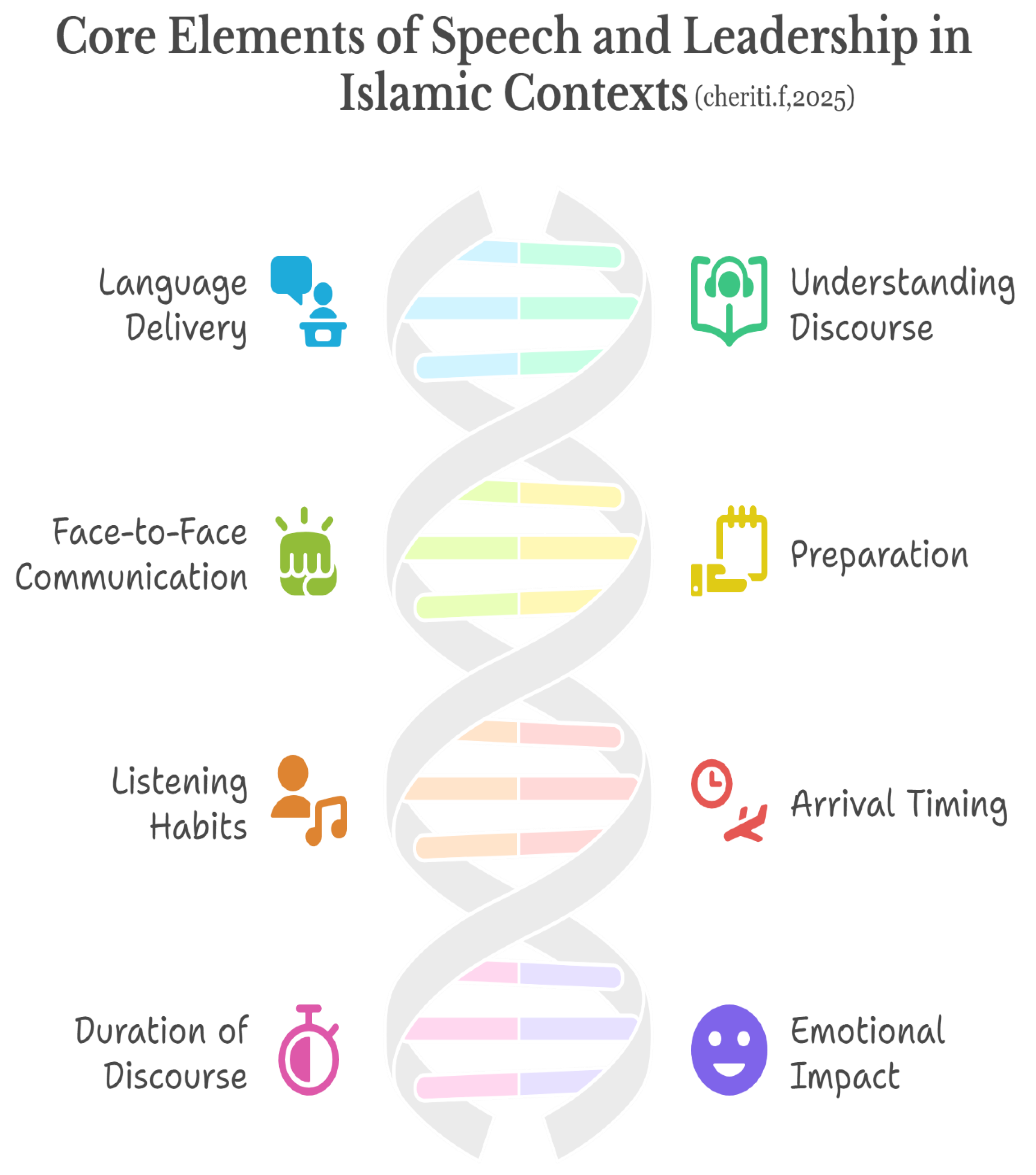
Additionally, through this study, we were able to identify the most important axes and coordinates of communication efficiency and effectiveness in the Imam’s discourse and ultimately arrive at the answer to the sub-questions that were raised at the beginning, as the study revealed:
1. Effectiveness of Discourse in Communication
This study identified the key elements and coordinates of communication efficiency and effectiveness in Mosque Discourse. Communication effectiveness during discourse surpasses other forms of communication due to the collective prior agreement in the communicative process between the (Imam) and the audience (worshippers). This is evident as their understanding and interaction with the discourse go beyond emotional responses, extending to changes in their behaviors and attitudes toward specific issues or practices. Face-to-face communication in discourse is differentiated from other forms of community in terms of b its components and effectiveness. Furthermore, over half of the worshippers believe 30 minutes is sufficient to understand the discourse content and message. The effectiveness of the communication process is achieved through interrelated factors associated with the preacher’s persona, the worshippers’ condition, the prayer space, and other influencing factors, most notably the significance of Friday itself and its spiritual value to both parties in the communication process.
2. Audience Engagement and Response to Friday Sermons
The study showed that most respondents understand the Imam’s language despite varying educational levels. The Imam’s voice and delivery style capture the audience’s attention, as they differ significantly in method and style from other speeches. Additionally, most of the audience is emotionally influenced by the Imam’simam’s message, as the sermons often include prophetic sayings or Quranic verses that enhance their conviction and adoption of the message’s content. However, more than half of the worshippers cannot see the imam face-to-face due to overcrowding and the limited space and architecture of the mosque (e.g., multiple floors). Most respondents prepare mentally and physically to receive the sermon, often choosing the nearest mosque and arriving early, indicating the significance they place on the sermon. Overcrowding within the mosque, the large number of worshippers exceeding the mosque’s capacity, and external noise are not seen as barriers to listening to the discourse by most attendees.
3. Impact of discourse on Behavior and Community Interaction
The impact of discourse extends to worshippers’ behavior, attitudes, and prior opinions, as the sermons influence, modify, or reinforce these elements. The topics of discourse often reflect the reality and daily lives of the respondents. They enhance religious knowledge and culture among worshippers, enriching its communicative functions in information dissemination, education, and cultural enrichment. More than half of the respondents discuss the discourse content with their friends after leaving the mosque, showcasing the extended and more intricate communication process among worshippers. Furthermore, half of the respondents believe that sermons and lessons broadcast on television channels, YouTube, and social media platforms are not more impactful than those attended in person at the mosque. Most also show little interest in following sermons on social media platforms.
4. Engagement Dynamics in Religious Discourses: Insights and Correlations
Individuals’ engagement with religious discourses, particularly in communal and digital contexts, highlights essential dynamics of participation, accessibility, and digital influence. This analysis explores six key aspects of interaction with the Imam’s discourse, using patterns and correlations to understand how individuals engage with these messages.
5. Encouragement and Post-Discourse Interaction
Individuals were encouraged to ask questions after the Imam’s discourse, which displayed a significantly higher likelihood of participating in discussions. For instance, approximately 75% of those who reported feeling encouraged to ask questions also engaged in group discussions afterward. This suggests that fostering a supportive post-discourse environment enhances cognitive and emotional engagement. However, 50% of respondents reported refraining from discussions, potentially due to barriers such as cultural norms, shyness, or perceived irrelevance of their queries.
6. Role of Social Media in Engagement
Social media emerges as a critical factor influencing participation. Respondents who followed the Imam on platforms such as Facebook, Instagram, or YouTube showed a positive correlation (r = 0.72) with higher levels of discussion engagement. Among these followers, 68% actively participated in post-discourse conversations, compared to 32% of non-followers. This underscores the role of digital exposure in reinforcing message retention and fostering dialogue. Social media also bridges accessibility gaps for individuals unable to attend in person, offering an alternative channel to remain connected.
7. Impact of Digital Media and TV
The influence of the Imam’s discourse extends beyond the physical setting. Respondents exposed to the Imam’s messages via television or digital media were 1.4 times more likely to discuss the content actively. This interplay between digital and in-person engagement creates a cohesive experience where digital reinforcement amplifies the impact of live sermons
8. Preferences for Recorded Sessions
Recorded sessions cater to individuals facing mobility challenges or time constraints. Communities with higher access to recorded sermons reported a 15% increase in overall engagement compared to those relying solely on live sermons. YouTube emerged as the most preferred platform (62%) for recorded content, followed by Facebook (23%). Notably, generational distinctions influence platform preferences, with younger audiences gravitating toward Instagram while older demographics favor Facebook.
9. Statistical Correlations and Trends
Quantitative analysis reveals transparent relationships between variables. Social media following exhibits a strong positive correlation (r = 0.72) with discussion participation, suggesting that targeted digital campaigns can significantly enhance communal learning. Similarly, individuals perceiving a substantial impact from the Imam’s media-based discourse were 2.3 times more likely to engage in questioning and discussions. These findings emphasize the value of relatable and impactful messaging that resonates across diverse audiences.
10. Optimizing Engagement Strategies
Platform usage trends suggest actionable strategies for religious leaders and community organizers. Investing in high-quality video recordings, particularly for YouTube, and managing tailored digital content for Instagram and Facebook can optimize engagement. Structured opportunities for post-discourse interaction, such as Q&A sessions or online forums, can further bridge gaps in accessibility and inclusivity.
By leveraging insights from these engagement patterns and correlations, religious leaders can enhance participation and accessibility in communal discourses. When utilized effectively, digital platforms offer unprecedented opportunities to reach broader audiences, tailor communication strategies, and foster meaningful interactions. Structured and inclusive approaches, bolstered by robust digital campaigns, can ensure the Imam’s messages resonate deeply within diverse community segments. Also, one central insight concerns the role of context and mediation. Studies consistently show that the quality of content and the degree of adult involvement strongly shape outcomes (Cheriti, 2025, p. 11)
Discussion
Rhetorical Approaches
The structure and architecture of the mosque, particularly the Mihrab and Minbar, where the Imam or religious leader delivers their discourse, play a crucial role in shaping the message conveyed to the congregation. (Gazi, 2020). The discourse within the mosque can be seen as a reflection of the community’s understanding and interpretation of Islamic teachings (Gazi, 2020), as the Imam’s sermons and lectures serve as a means of disseminating knowledge and fostering a sense of unity among the believers (AbulQaraya, 2015). Beyond its primary function as a place of worship, the mosque assumes a multifaceted role, serving as a social, cultural, and educational center for the Muslim community (Islami, K. and Enggarwati, 2019).
Understanding the message conveyed through verbal discourse inside the mosque is crucial for gaining insights into the depth and nuance of Islamic teachings and their practical application within the community. the imam’s sermons and lectures, rooted in the Quranic principles and the Prophet’s teachings, are instrumental in guiding the faithful. study shows mosque discourse serves three key functions: (a) monotheistic function, (b) socialization function, and (c) communicative function (AbulQaraya, 2015). these functions collectively contribute to the mosque’s pivotal role in shaping the religious, social, and cultural fabric of the Muslim community.
In this context, language expresses the basis and foundation of the communication process. Through speech (classical Arabic or mixed with colloquial language), the imam conveys his message to the recipients (worshippers). Although sign language is used to clarify a particular situation or describe and interpret a situation, spoken language constitutes the most significant space of message formulas in the imam discourse.
Addressing recipients in Arabic does not mean resorting to vulgar or colloquial words, but rather it must be understandable and take into account the elements of eloquence and fluency. Some scholars of Islamic discourse have pointed out the importance of voice and body language, as it requires adapting the voice according to the circumstances surrounding the communication process, such as the number of recipients, the narrowness of the mosque, the seriousness of the topic, and the condition of the recipients. The voice in mosque speech is different from others, and it is more eloquent if it comes gradually and not harshly. The imam’s discourse opens with calm, not rising above the usual, nor lowering it so that the congregation of worshippers does not hear it, and other controls that achieve understanding in the preacher’s speech, such as speed in delivery, adopting a single tone, and not pronouncing letters from their points of articulation.(Al-Dhubeibi, 2018, pp. 38-54).
However, the results of our study show us that the percentage of understanding The imam’s language and almost complete knowledge regarding the content of mosque speeches - even though a third of them do not have an academic level - suggests that the imam has overcome these potential errors. However, it confirms, on the other hand, that several extraneous factors may not be directly related to the imam’s language as much as they relate to how he delivers the message. For example, repetition strengthens the consolidation of the message’s content and understanding of what is in it, and the recipients’ (worshippers’) habituation to expressive formulas that may be fixed in the mosque speech may not require more mental processes to master them each time. Thus, this memorization process helps understand the imam’s discourse, language, and religious practice methods by memorizing the Qur’an or hadiths included in the imam’s speech. However, they do not require an academic level to comprehend them.
In addition to the apparent convergence between what the recipients understand of the speaker’s language (86.95%) and the level of comprehension of the topic of his discourse (69.56%), which is a high percentage when compared to the results of other studies, perhaps the most important and widespread in research circles, especially French ones, is what researcher Patricia Delahaie confirmed that the average normal conversation is 130 words per minute and that we receive only 80% of the message that reaches us, while our interlocutor hears only 60%, understands 40%, and can retrieve only 20% (Delahaie, 2008, p. 150). While we can attribute the high rate of understanding to the features of the spoken communication process itself, it does not require an educational level. It is characterized by its speed and weak interpretation of its content, in addition to reviewing it (the imam’s speech) before delivering it, unlike verbal communication in different communication processes. Echo remains possible, and the imam’s interaction with the worshiper is possible, albeit indirectly, especially since recording the mosque speech has become one of the standard good practices of the imam preacher to improve his performance and evaluate the content of his message while a third of the recipients (worshipers) confirmed that they had previously recorded the imam’s speech using their phones or other means and devices.
Communicative Authority through Foresight and Oratory
The vision of the sender (the Imam) in the context of the communication process is one of the pillars that enhance the understanding of the spoken message, in addition to including unspoken messages, which the hearing may not perceive in most cases. The researcher Mehrabian Albert proved in one of his popular studies (1971) in communication circles until today - despite the criticism it faced - that human communication includes only 7% written speech, while 93% of it is other forms such as signs, hints, gestures and body language, which constitute (55%), while the voice accounts for (38%) (Mehrabian, 2009, p. 82).
According to several experts, the effectiveness of communication is attributed to the forms of the latter. Written communication accounts for 07%, while tones of voice represent 38% of the effectiveness of the communication process, while non-verbal movements and other gestures constitute 55% of the efficacy (Palta, 2007, p. 2). Effective communication is achieved when the message delivered is the same as received. However, they acknowledge this rarely happens (Fielding, 2006, p. 20). This is the concept we encounter when we examine the writings of media and communication sciences students and other researchers who talk about communication obstacles and confusion, usually regarding effective communication. They then confirm that the effective communication process is the one that achieves all its goals by delivering all its messages. In addition, we believe that the effectiveness of mosque discourse is not innate human nature; that is, it requires prior effort and preparation. The principle of balance between delivery and reception, providing their conditions and reconciling them, is necessary to achieve effectiveness in it, in addition to the optimal use of various forms of communication to present a specific message and the harmonization between time and place.
The discourse of imam in the mosque does not only contain words, but also includes the way these words are pronounced, using the speaker’s entire being, and requires an understanding that certainly includes more than just distinguishing words. In this context, the British neurologist and writer Oliver Sacks points out that the secret of understanding mentally ill people is not only the words or verbal combinations, which do not mean anything - according to him - in themselves, but rather the speaker’s tone, which imbues the speech with much of its content, which is higher in value than notional words (Sacks, 1998, p. 81).
Re-examining the jurisprudential principles that inform the concept of the Imam’s vision and the practice of performing prayer behind him, we come across many visions and orientations that differ in their sectarian reference and interpretations but intersect in the importance of the presence of the discourse in the mosque, from which one of the meanings of its name was derived in a place or space for the gathering of worshippers, bringing together the imam preacher (the sender) with the followers (the recipients). However, the inability of nearly half of the respondents to see the Imam did not have that great an impact on understanding the discourse and listening to it, while some mosques employ technology (cameras, TV screens, professional loudspeakers, etc.) so that the message of the imam preacher and his image reaches its recipient. The vision of the Imam is one of the descriptions of face-to-face communication, which initially assumes that the two faces and two sides of the communication meet each other. The precision of the Islamic view was evident in this context, as it recommended that the Imams aim to face each other during their time, not turning to the right or the left as the Prophet Mouhamed did. It was narrated from Ibn Masoud that he said: When the Prophet Mouhamed stood on the pulpit, he would face us. The jurists agreed on the dislike of turning around. It also recommended that the Imam face the Congregants during his discourse. It is the same case for worshippers unless it is challenging because it is more effective in preaching (Khuzaym, 2017, p. 27). That communication is most interactive and intimate when the preacher stands on the pulpit facing the worshippers (Alkhairo, 1998, p. 33).
The discourse of guidance, a multifaceted concept that encompasses the intricate interplay between individuals seeking direction and those providing it, is a crucial aspect of human communication. This discourse involves the collaborative articulation of sensibilities and subject positions, where individuals navigate the nuances of self-expression and the negotiation of social realities. (Taha, 2017).
As stated by Fairclough, discourse is a “process of social interaction” that extends beyond just the text itself, encompassing the very processes of production and interpretation that give rise to and shape communication (Kostić & Slavković, 2020). In the context of guidance, this discourse is characterized by a unique dynamic where the authority figure, often perceived as the “producer” of the communication, engages with an audience that may be large, indeterminate, and personalized, yet ultimately asymmetrical in their relationship.
The discourse of guidance is not merely a one-way transmission of information; rather, it is a complex negotiation of power dynamics, trust, and ethical considerations. As observed in the study of Muslim women’s discourse in halaqas (study circles), the process of claiming and reframing difference is central to the discourse of guidance, where individuals navigate the balance between self-expression and the perceived gaze of the dominant society.(Taha, 2017)
The discourse of guidance, therefore, is a multifaceted phenomenon that extends beyond the superficial aspects of communication, delving into the deeper realms of social interaction, power dynamics, and the negotiation of identity and difference.
Leadership through Presence: Appearance and Engagement
One of the characteristics that distinguishes mosque discourse - as a communication process - is that most of the respondents in our study expressed their readiness to undertake this process and listen to its set of messages and signals. Despite the scarcity of studies that focused on the recipient’s appearance and physical condition when carrying out communication activities, many researchers and studies have directed their attention to the appearance of the communicator in this context, incredibly persuasive communication processes.
The psychological and physical preparation for the imam’s discourse in the mosque, despite its purely religious motivation (the prophetic hadiths), is a strong indicator of the recipient’s readiness and prior engagement in the communication process – about half of the Congregants arrive early to hear the weekly speech – and thus contributes to the smooth transmission of messages despite their diversity from the speaker, and enhances the processes of perception, conviction, and influence in the recipient. In addition, many hadiths of the Prophet reveal the status of the imam’s weekly discourse. Standing on the pulpit, he said, “Washing on Friday is for every adult, and using a toothpick and applying as much perfume as possible.” Regarding listening to the discourse and its content, a group of hadith was narrated, the most important of which is “If you say to your companion: Listen, on Friday, while the imam is delivering the discourse, then you have engaged in the idle talk” (Al-Naysaburi, 1991, p. 579). This clearly indicates the value of the imam’s message and the necessity of respecting it and elevating its status. These texts came to control and direct the function of the recipient in the imam’s speech as a communication process. This way, it is unique from other ordinary (natural) or official communication processes (political discourse, lectures, etc.).
Effective communication is a critical aspect of our daily lives, and it is influenced by various factors, including our physical appearance and dress. The way we present ourselves through our attire and grooming can have a significant impact on how others perceive us and how we interact with them.
Physical appearance has long been recognized as a crucial factor in shaping interpersonal interactions and perceptions. (Woodley, 2020) Research suggests that individuals who are perceived as more physically attractive are often attributed with more positive qualities, such as intelligence, competence, and social skills. (Bull and Rumsey, 1988) This phenomenon, known as “appearance stereotyping,” can lead to biases in how people evaluate and respond to others. (Tang, Hao and Li, 2024). In the context of face-to-face communication, our dress and appearance can serve as powerful cues that shape others’ impressions and judgments.
Conclusions
This study emphasizes the dynamic and multifaceted nature of mosque discourse, recognizing it as a complex form of communication that unfolds across different moments of the religious service. The Imam’s leadership is expressed not only through spoken language but also through nonverbal elements such as gestures, tone of voice, rhythm, and repetition—all of which enhance the clarity, appeal, and impact of the message. Together, these elements demonstrate how effective leadership in the mosque relies on both verbal and nonverbal strategies of communication.
The physical setting of the Mihrab and Minbar further symbolizes the Imam’s authority as a communicator and leader within the religious community. Rooted in ritual and tradition, mosque communication progresses through distinct phases that provide spiritual guidance, religious instruction, and communal solidarity, making it a holistic process of leadership in action. The Imam’s discourse blends classical Arabic with colloquial expressions to ensure accessibility, while the use of repetition, memorization, and reference to familiar texts enables comprehension across different levels of literacy. In this way, communication in the mosque not only conveys religious knowledge but also fosters unity, inclusion, and collective identity.
Viewed through the lens of leadership, mosque discourse emerges as a sophisticated integration of verbal and nonverbal techniques capable of influencing both the spiritual and social dimensions of the congregation. The study argues for the continuous assessment and adaptation of these communicative practices so that Imams, as leaders, can maintain relevance and effectiveness in a rapidly changing social and technological environment.
Limitations and Future Directions
This study acknowledges limitations, including a small sample size, reliance on self-reported data, and exclusion of factors like mosque architecture, sensory differences, and technological aids. Future research should examine larger, more diverse samples and explore how environmental, cultural, and technological factors impact discourse and communication in mosque settings.
Funding
This research received no financial support or grants from universities, government agencies, funding organizations, or other entities.
Conflicts of Interest
The author declares no conflicts of interest related to this study.
References
- Abugharsa, A. “A Discourse Analysis of English-Arabic Cross-Culture Interactions Between Arabic-Speaking Mother and an English-Speaking Daughter: An Interactional Sociolinguistics Approach to ESL Teaching.” 2020. p. 45. [CrossRef]
- AbulQaraya, B. “The Civic and Cultural Role of the Sheikh Zayed Grand Mosque.” Procedia - Social and Behavioral Sciences. Elsevier BV, 2015, p. 488. [CrossRef]
- Al-Dhubeibi, A. Tahdhir al-Khutaba’ min Akhta’ Sha’i’a fi Fann al-Khutba wa al-Ilaqaa. 1st ed. Sana’a: Dar al-Hadith li-l-‘Uloom al-Shari’ah, 2018, pp. 38-54.
- Al-Houfi, A. M. فن الخطابة [The Art of Public Speaking]. Cairo: Nahdat Misr, 1983, p. 9.
- Aliyeva, N. A. “The Interpretation of the ‘Discourse’ as a Term.” Path of Science. Altezoro s.r.o. (Slovak Republic) and Publishing Center “Dialog” (Ukraine), 2022, p. 3015. [CrossRef]
- Al-Jahiz. Al-Bayan wa al-Tabyin, vol. 2. Cairo: Al-Khanji Library, 1998.
- Alkhairo, W. Speaking for Change: A Guide to Making Effective Friday Sermons (Khutbahs). New York: Amana Publications, 1998, p. 33.
- Al-Naysaburi, A. H. Sahih Muslim. 1st ed. Vol. 2. Beirut: Dar Al-Kutub Al-Ilmiyyah, 1991, p. 579.
- Asha, Rao, D. L. Shrivastava, and Priyanka Pandey. “Use of Survey Method in Research.” International Journal For Multidisciplinary Research, 6, no. 4 (2024). [CrossRef]
- Aslam, A. Ordinary Democracy: Sovereignty and Citizenship Beyond the Neoliberal Impasse. New York: Oxford University Press, 2017, p. 93.
- Brown, G. and Yule, G. Discourse Analysis. 1983. [CrossRef]
- Bull, R. , and Rumsey, N. The Social Psychology of Facial Appearance. Springer eBooks. Springer Nature, 1988. [CrossRef]
- Carnegie, D. فن الخطابة [The Art of Public Speaking]. Beirut: Al-Ahliya, 2001, p. 11.
- Delahaie, P. Comment plaire en 3 minutes en tête-à-tête, au travail, en groupe. 1st ed. Paris: Leduc, 2008, p. 150.
- Fielding, M. Effective Communication in Organisations: Preparing Messages That Communicate. 3rd ed. Cape Town: JUTA Academic, 2006, p. 20.
- G., Triveni, Faizan Danish, and Olayan Albalawi. “Optimizing Variance Estimation in Stratified Random Sampling Through a Log-Type Estimator for Finite Populations.” Symmetry 16, no. 5 (2024): 540–540. [CrossRef]
- Gazi, A. K. “The Livelihood Patterns of the Imams in Rural Bangladesh: A Qualitative Analysis.” International Journal on Integrated Education, 2020, p. 37. [CrossRef]
- Ghafar, Z. N. “Discourse Analysis in Language Education: Implications for English Language Training and Learning: An Overview.” European Journal of Theoretical and Applied Sciences, 2023, p. 65. [CrossRef]
- Ibn Manzur, J. al-D. al-Ansari. Lisan al-Arab, vol. 8. 1st ed. Beirut: Dar al-Kutub al-Ilmiyyah, 2005, p. 681.
- Innis, H. A. Empire and Communications. New York: Rowman & Littlefield, 2007, p. 33.
- Islami, M. E. N. K., N. E., and Enggarwati, D. “The Role of Mosque in the Development of Halal Tourism (Case Study in Masjid Gedhe Kauman, Yogyakarta).” 2019. [CrossRef]
- Mehrabian, A. Nonverbal Communication. 3rd ed. New York: Aldine Transaction, 2009, p. 82.
- Palta, D. The Art of Effective Communication. New Delhi: Lotus Press, 2007, p. 2.
- Sacks, O. The Man Who Mistook His Wife for a Hat and Other Clinical Tales. New York: Simon and Schuster, 1998, p. 81.
- Ṣāliḥ Khalīl Aw Iṣbaʿ. Al-Ittiṣāl al-Jamāhīrī. Cairo: Dār al-Shurūq, 1999, p. 78.
- Schiffrin, D. “Conversation Analysis.” Annual Review of Applied Linguistics. Cambridge University Press, 1990, p. 3. [CrossRef]
- Taha, M. C. “Discourse as Virtue Ethics: Muslim Women in the American Southwest.” In Palgrave Communications, vol. 3, issue 1. Palgrave Macmillan, 2017. [CrossRef]
- Tang, X. , Hao, Z., and Li, X. “The Influence of Streamers’ Physical Attractiveness on Consumer Response Behavior: Based on Eye-Tracking Experiments.” Frontiers in Psychology. Frontiers Media, 2024. [CrossRef]
- Valenzano, J. M. III, and Braden, S. W. The Speaker: The Tradition and Practice of Public Speaking. University of Dayton eCommons Communication Faculty Publications, 2015. https://ecommons.udayton.edu/communication_fac_pub/2015.
- Woodley, A. “Exploring the Relationship Between Young People, Body Dissatisfaction and Aesthetic Procedures.” Journal of Aesthetic Nursing. Mark Allen Group, 2020, p. 340. [CrossRef]
- Noori, S. , and Omed, M. B. “History of Rhetoric in Dari Persian Language.” International Journal of Advanced Academic Studies, 2020, p. 504. [CrossRef]
- Cheriti, F. , & Mehiri, D. (2025). Discourses of guidance: Exploring contextual face-to-face communication between Imams and congregants. Akofena, 1(16), 134–145. [CrossRef]
- Cheriti, F. (2024). Breaking the gate: Gender dynamics in digital media contributions—A content analysis study. Psychology and Education, 61(12), 908–930. Available online: https://www.researchgate.net/publication/387054093_Breaking_the_Gate_Gender_Dynamics_in_Digital_Media_Contributions_A_Content_Analysis_Study.
- Cheriti, F. (2025). Unsupervised Smartphone Use and Its Impacts on Children’s Development, Risks and Opportunities. Preprints. [CrossRef]
Disclaimer/Publisher’s Note: The statements, opinions and data contained in all publications are solely those of the individual author(s) and contributor(s) and not of MDPI and/or the editor(s). MDPI and/or the editor(s) disclaim responsibility for any injury to people or property resulting from any ideas, methods, instructions or products referred to in the content. |
© 2025 by the authors. Licensee MDPI, Basel, Switzerland. This article is an open access article distributed under the terms and conditions of the Creative Commons Attribution (CC BY) license (http://creativecommons.org/licenses/by/4.0/).
Copyright: This open access article is published under a Creative Commons CC BY 4.0 license, which permit the free download, distribution, and reuse, provided that the author and preprint are cited in any reuse.


