

Submitted:
03 December 2025
Posted:
04 December 2025
You are already at the latest version
Abstract
As corporations increasingly integrate artificial intelligence (AI) into everyday life, particularly with the emergence of GenAI tools such as ChatGPT, the inability to integrate these tools into school curricula leaves students unprepared for the future job market and societal demands. Moreover, without a foundation in writing prompts and evaluating models' responses, students may not recognize ethical concerns, such as deepfakes, which may contribute to misinformation and irresponsible use of technology in personal and professional settings. This article introduces AMERH, a structured framework for writing prompts. The framework includes five principles: Ask, Museful, Evaluate, React, and Chain/Refine, to optimize interactions with GenAI models, such as ChatGPT. While various frameworks have been introduced to help learners craft prompts, addressing the role of these learners in evaluating their prompts and model responses remains underexplored in these frameworks. Crafting prompt writing within the AMERH framework aligns with Vygotsky's Zone of Proximal Development (ZPD) by providing learners with scaffolded support as they develop their skills. This framework provides learners with step-by-step guidance and serves as a support tool for diverse learners regardless of prior experiences. This framework enables learners to think critically and creatively, preparing them to transition from guided to independent prompt designers.
Keywords:
prompt
; prompt engineering
; AMERH framework
; ChatGPT
; LLM
; framework
; prompt design
; pedagogical framework
1. Introduction
GenAI tools such as Google Gemini and ChatGPT have sparked global attention since their release. For example, ChatGPT accumulated around 15.5 million subscribers within its first week, surging to 58 million in its second week (Carr, 2023). This increase highlights the importance of adopting GenAI tools, suggesting that higher education institutions must reassess the integration of these advancements within their educational curricula. According to (Lo, 2023), 89% of leaders ranked AI and GenAI as a priority for 2024. Similarly, (Hernholm, 2025) pointed out that companies are increasingly implementing AI to boost performance by up to 40% yet most students lack AI literacy upon graduation.
Generative AI (GenAI), a specific form of AI capable of generating multiple forms of media, including text, images, sounds, and video (Huang, Wang, & Zhang, 2024,Vartiainen & Tedre, 2024), has led to the creation of a diverse array of educational opportunities, from providing personalized feedback on writing to creating language learning partners and aiding in brainstorming creative projects. ChatGPT by OpenAI and Gemini by Google are examples of multimodal AI large language models (MLLMs) that illustrate how GenAI can engage in a natural, human-like conversation (Baidoo-Anu & Owusu Ansah, 2023,Pichai & Hassabis, 2023).
While GenAI presents a transformative potential for personalized learning experiences, concerns regarding its integration into the classroom environment necessitate exploration. Several challenges were introduced, including the potential for increased plagiarism (Cotton, Cotton, & Shipway, 2024,Meyer et al., 2023). Educators fear that students may become overly reliant on AI-generated content, leading to a decline in original thought and an increase in unattributed work. Furthermore, the digital divide poses another challenge of unequal access to reliable technology, which could exacerbate existing educational disparities (Ong et al., 2024,Wach et al., 2023). Therefore, equitable access to GenAI and the necessary infrastructure needs to be addressed to ensure inclusive learning environments.
Finally, other studies pointed out that overreliance on GenAI tools could hinder the development of critical thinking skills (Perera & Lankathilake, 2023,Spennemann, 2024). In other words, if students passively become accustomed to receiving information, their ability to independently evaluate information and form judgments may be compromised. As GenAI continues to expand, its role in shaping the future of higher education will likely be significant. It is expected that these new tools will become integral to the curricula, allowing students to engage with complex concepts through interactive experiences, while the human contributions will remain critical. The future classroom will continue to blend human expertise and technological innovation, empowering students to become self-directed learners and critical thinkers. Therefore, there is a need to examine the dynamic and immersive learning environments facilitated by GenAI. This paper introduces the AMERH framework, a structured and iterative approach to prompt writing, thereby enhancing students’ ability to interact with GenAI tools such as ChatGPT and Google Gemini. By focusing on the five principles—Ask, Museful, Evaluate, React, and Chain/Refine—students are not only equipped to generate more effective prompts but also to evaluate AI-generated responses critically.
2. Literature Review and Theoretical Framework
2.1. The Landscape of Prompt Engineering
The content generated by a GenAI model is strongly influenced by the user’s prompt, directly affecting its relevance and quality (Dinkevych, 2023). Prompt engineering is the practice of designing and enhancing inputs to help a GenAI model generate the most accurate and coherent results possible (Lo, 2023).
Several key techniques have been developed to enhance the performance of large language models (LLMs). These strategies include zero-shot prompting, where the model is given a task description without any examples; one-shot prompting, where a single example is provided; and few-shot prompting, which provides multiple examples to help the model recognize patterns (Brown et al., 2020). A more advanced technique, chain-of-thought prompting, enables the model to generate intermediate reasoning steps before arriving at a final answer, which significantly enhances performance on tasks requiring arithmetic or logical reasoning (Wei et al., 2022). These techniques represent the foundational technical approaches to interacting with LLMs.
2.2. Existing Pedagogical Frameworks and the Research Gap
As prompt engineering has become more critical, several pedagogical frameworks have emerged to help users, particularly learners, structure their prompts, such as CREATE (Birss, 2023), CLEAR (Lo, 2023), and CRISPE (Dinkevych, 2023), which offer structured approaches to ensure clarity and relevance in GenAI responses. These frameworks provide valuable heuristics for formulating initial queries. Despite the findings, a review of these frameworks uncovers a significant gap. These frameworks primarily emphasize how to create prompts, with less focus on the iterative process of how learners should interact with and critically evaluate the AI-generated responses. This gap highlights a need for a framework that positions learners as active participants in a dynamic dialogue with the AI models, empowering them to ask, refine, react to, and co-construct knowledge.
2.3. Theoretical Grounding: The Zone of Proximal Development (ZPD)
To address this gap, the AMERH framework, which is grounded in Lev Vygotsky’s sociocultural theory of learning, specifically the Zone of Proximal Development (ZPD), was introduced to help learners develop prompt writing skills. The ZPD describes the gap between what a learner can accomplish independently and what they can achieve with guidance and collaborative support (Vygotsky, 1978). Scaffolding involves providing temporary support that is gradually removed as the learner develops competence (Ness, 2023,Wood, Bruner, & Ross, 1976). Scaffolding in the context of prompt writing can be used to develop these skills. Instructors can model effective prompts, then gradually reduce support as students gain confidence and transition from guided to independent practice. This approach is particularly relevant because current AI models interactions are primarily one-way; the model responds but does not explicitly teach the user how to improve their prompts. This approach aligns with recent findings, such as those by (Song & Song, 2023), who demonstrated that AI-assisted writing instruction grounded in Vygotsky’s principles significantly improved the writing proficiency and motivation of English language learners. Therefore, a pedagogical framework for prompt writing should be designed as a scaffolding tool that supports learners within their ZPD, guiding them toward independent and critical use of GenAI.
3. The AMERH Framework: A Structured Approach to Prompt Writing
3.1. The Jigsaw Puzzle Analogy: A Conceptual Model
The process of designing an effective prompt can be compared to building a jigsaw puzzle. A puzzle consists of many unique, interlocking pieces that must be carefully fitted together to reveal a complete picture. A person solving the puzzle gathers pieces based on patterns or colors, pays close attention to detail, and exercises patience and persistence. Similarly, to generate a high-quality response from a GenAI model, a learner must thoughtfully select and arrange the elements of their prompt—the context, instructions, and constraints—paying close attention to the task’s details. A poorly constructed prompt element can lead to an irrelevant response, as a single lost puzzle piece can distort the final appearance. This analogy highlights the importance of a structured, iterative approach to help learners fit the pieces together correctly.
3.2. Redefining the Prompt and Prompt Engineering for a Multimodal Era
As discussed in Section 2.1, a prompt has traditionally been defined as an input or query given to an AI model to elicit a specific response (Dinkevych, 2023,Lo, 2023). However, with the rapid advancement of AI models capable of processing more than just words, this definition is becoming insufficient. To properly scaffold learning for today’s tools, I aim to provide a broader definition of a prompt and prompt engineering.
Therefore, a prompt is defined as a sequence of data that encompasses various modalities (text, images, audio, or video), allowing users to combine one or more modalities to form content and structure, and provide specific instructions or cues to elicit desired outputs from AI models.
Prompt engineering is a technique that enables users to incorporate texts, images, audio, or videos and select carefully structured phrases to elicit the most relevant and accurate responses from AI models, which are unique to each prompt. A well-crafted prompt in this multimodal context provides explicit directions to the AI model on what to generate and how to generate it, thereby enhancing the accuracy and relevance of the response to align with the user’s needs. As a result, there is a growing need for a structured approach to prompt writing. The next section outlines the core principles of the AMERH framework and provides various prompt structures and examples to help design effective prompts.
3.3. Introducing the AMERH Framework
The AMERH framework emerged from extensive experimentation with over 50 GenAI tools, including various versions of Gemini and ChatGPT, between 2023 and 2025, across diverse domains. It distinguishes itself from earlier frameworks (e.g., CREATE, CLEAR) in three main areas: First, it fosters a dynamic, iterative dialogue between the learner and the model, moving beyond a one-shot query. Second, it explicitly incorporates steps for evaluation and refinement, enabling learners to assess AI responses critically. Third, it is grounded in Vygotsky’s Zone of Proximal Development (ZPD), serving as a scaffold to help novices communicate effectively with GenAI models and gradually become self-directed, expert users.
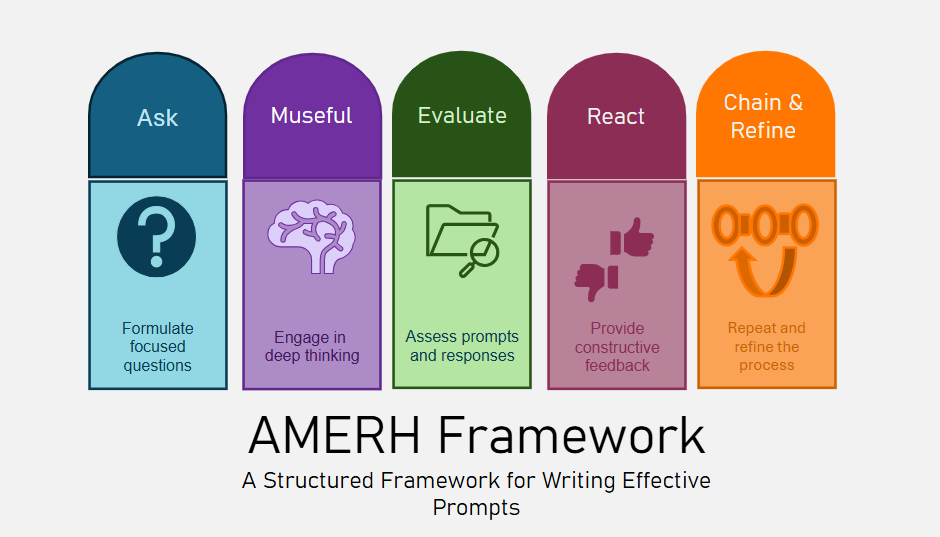
The framework consists of five key principles, represented by the acronym AMERH: A (Ask), M (Museful), E (Evaluate), R (React), and H (Chain/Refine). Each principle guides the learner through a stage of the interaction, from initial query formulation to evaluation, refinement, and co-creation of knowledge. The following sections will detail each of these principles.
3.4. The Five Principles
3.4.1. Ask
This foundational principle involves the learner’s ability to pose the primary prompt or question. In this step, the learner sets the scope and direction for the response, which then serves as a starting point for formulating clear, precise, and effective prompts.
3.4.2. Museful
The Museful principle emphasizes the importance of deep, reflective thinking before writing a prompt. To guide this process, I have identified 16 key elements that can be incorporated into a prompt. These are broken down into two tiers: Essential and advanced components. This tiered approach provides a scaffolded method for prompt design.
3.4.2.1. The Essential Components
It is recommended that an effective prompt should be built upon seven essential components, encapsulated in the mnemonic PRACTIS, that establish its primary context and goal. These are: Profession, Restrictions, Audience, Concept, Task, Intent, and Situation. Mastering these seven components is the foundational step to crafting clear and effective prompts (see Appendix A).
3.4.2.2. The Advanced Components
Once the core prompt is established, it can be significantly enhanced by incorporating nine optional components. These components help to add nuance, specify format, and control the AI’s output with greater precision. These elements are encapsulated in the mnemonic SAFE ACTON: Scope, Amount, Format, Example, Accessibility, Communication, Tone, Other Options, and Nuance. I recommend that learners become comfortable with the essential components before integrating the advanced ones (see Appendix B).
3.4.3. Evaluate
This principle exemplifies a two-fold process of critical assessment: first, evaluating the user’s own prompt for inherent biases, and second, evaluating the AI-generated response for accuracy and objectivity.
In the first assessment, the learners should be able to evaluate the prompt before asking the model any questions. This approach will not steer the model toward a one-sided response. For example, asking "What are the proven benefits of Vaccine Pfizer over others?" presupposes that such benefits are established. Instead, learners should reframe the prompt and ask a balanced question. The second assessment emphasizes the learner’s ability to assess and verify the information received from the model critically. Students should actively cross-check facts using their existing knowledge or conventional research methods. It is crucial to identify potential misinformation or biased language, as AI models may reflect the political or social biases present in their training data. For instance, if a response presents a one-sided argument without acknowledging counterpoints, the student should recognize this as a form of bias and a signal that the initial prompt or the AI’s output needs further improvement.
3.4.4. React
This principle emphasizes the learner’s role in providing constructive feedback to the AI model, which can involve accepting a good response or rejecting a poor one with a clear justification. By engaging with the model’s output—especially by challenging its arguments or correcting inaccuracies—learners engage in a critical act of metacognition. This step is not about immediately refining the AI model itself, but about compelling students to articulate and solidify their own expert knowledge and moral judgment. Moral judgment, or "a decision about what one should do in a morally problematic situation" (Myyry, 2022, p. 332), is key to navigating the ethical complexities of AI-generated content. This process enables developers to use this data to fine-tune and train future versions of the model. This process is often part of what is called Reinforcement Learning from Human Feedback (RLHF). By analyzing the types of responses that yield "good responses" and "bad responses," developers can gradually steer the next generation of AI models to be more helpful, accurate, and safe.
3.4.5. Chain or Refine
This final principle involves the ability of learners to engage in two forms of iteration: refining a query (Refining) to improve a poor response or asking follow-up questions (Chaining) to explore a topic more deeply and address gaps in the model’s initial answer.
4. Classroom Implementation
Instructors can integrate the AMERH framework by scaffolding the learning process. Initially, they can model effective prompt writing and guide students through the five principles. As students grow more confident, they can assume greater responsibility for crafting, evaluating, and refining their prompts. To promote transparency and discourage over-reliance, educators can require students to submit their chatlogs, demonstrating how the GenAI tool was used as a partner in the learning process. The following Figure 1 illustrates the five principles.
5. Applying the Principles: Practical Examples
5.1. Ask
The following Table 1 demonstrates the application of the Ask principle.
5.2. Museful
The following Table 2 demonstrates the application of the Museful principle.
5.3. Evaluate
The following Table 3 demonstrates the application of the Evaluate principle.
5.4. React
The following Table 4 demonstrates the application of the React principle and illustrates how a user might react to model’s response based on their unique professional expertise.
Initial Prompt:
What is the best way to lose weight?
AI Model Response:
The best way to lose weight is to follow a calorie-deficient diet, where you consume fewer calories than you burn. This diet can be achieved by reducing calorie intake or increasing physical activity.
5.5. Chain/Refine
The following Table 5 demonstrates the application of the Chain/Refine principle and has two parts: Refining a flawed prompt and chaining follow-up prompt(s) to a good response.
6. Limitation
While the AMERH framework offers a robust and structured approach to prompt writing, it does have some limitations. The framework may be challenging for beginners due to its complexity. For example, the Museful principle, which is comprised of 16 different elements, can feel overwhelming for students with limited prior knowledge of AI models. It is therefore recommended to teach these elements in a step-by-step fashion. A gradual approach could be the right way to go, with students first mastering a few key elements, such as profession, concept, audience, and situation, before moving on to others, such as task, intent, and restrictions.
Additionally, this framework was developed and tested using the free versions of ChatGPT and Gemini. While the core principles should apply to other platforms, including paid versions and other models like Claude or Co-Pilot, further studies are recommended to examine the differences between free and paid versions.
7. Future Research
While this paper establishes the theoretical and practical foundation of the AMERH framework, it is crucial to test the framework with empirical studies. Future research should involve implementing the framework in various educational settings to assess its effectiveness. A proposed study could involve a pre-test/post-test design where the quality of students’ prompts is evaluated before and after receiving instruction on the AMERH principles. Additionally, qualitative data, such as student and instructor feedback, would be valuable for refining the pedagogical application of the framework.
8. Conclusion
The AMERH framework provides a structured and iterative approach to prompt writing, thereby enhancing students’ ability to interact with generative AI tools such as ChatGPT and Google Gemini. By focusing on the five principles—Ask, Museful, Evaluate, React, and Chain/Refine—students are not only equipped to generate more effective prompts but also to evaluate AI-generated responses critically. This approach fosters the development of essential skills, such as critical thinking, creativity, and ethical decision-making, preparing students for a future where these tools might become integral to both professional and personal life. Educators can implement the AMERH framework gradually, starting with guided instruction and moving toward independent use, mirroring the process of ZPD. As GenAI tools continue to evolve, educators must guide students to use these tools responsibly, ensuring they can navigate the ethical challenges of the digital age. Educators can encourage students to submit their chatlogs and drafts, demonstrating how the AI model was used in the process. This transparency promotes the ethical use of these tools and discourages over-reliance. GenAI tools, such as ChatGPT or Gemini, are similar to other technological innovations throughout history; they do not inherently possess harm. Instead, their influence relies entirely on how humans choose to use them.
We live in an era of AI expansion, and we witness cases of AI misuse that have caused harm to some victims. As educators, it is our responsibility to guide students in developing the ethical awareness and moral judgment necessary to navigate the age of AI responsibly, as well as to teach them how to interact effectively with these GenAI tools. Just as a reckless driver cannot blame the car for a deadly accident, we cannot blame GenAI tools for misuse caused by human decisions. The current advancements in AI call all educators to guide students in using GenAI tools responsibly and ethically, and help them develop the skills needed to navigate and benefit from these powerful tools.
Author Contributions
The author conceived, conducted, analyzed, and wrote the manuscript.
Funding
This research received no funding.
Institutional Review Board Statement
Not applicable.
Informed Consent Statement
Not applicable.
Data Availability Statement
No data is available for sharing, as the research did not involve data collection.
Acknowledgments
I would like to express my heartfelt gratitude to Dr. Kevin Westmoreland Bowers (in memoriam), former professor at Radford University, for his unwavering support and guidance throughout my academic journey. His mentorship and encouragement have had a profound impact on my growth, shaping me both as a scholar and as a person. His influence continues to guide me every day.
Conflicts of Interest
The author declares no conflicts of interest.
Appendix A Essential Components
| Table A1 | |
| The Essential Components of The Museful Principle | |
| Component | Tip |
|
Profession What is your role? Who are you? Options: Writer, designer, CEO, Ph.D. student, singer, professor, etc. |
Identifying your role is important, as it enables the model to provide information that is appropriate and tailored to your needs. Example: I am a high school student Note: Common AI prompting techniques suggest giving a persona to deliver an adequate response. In this case, a user can use the statement "Act as a [Role]..." to give the AI model a persona. However, in the AMERH framework, I suggested using "I am a [Profession]..." to position the AI model as a collaborative assistant that operates within a human-centered perspective, in which users activate their metacognition, think about a task before they start, and determine their goals. Users can choose either way depending on the end goal. |
|
Restrictions Subcategory acronym (CAMP) Options: Physical, cognitive, political, religion, social and cultural, environmental, biological, financial, psychological, economic, systematic and institutional etc. The world operates under various restrictions, and it may be useful to focus on specific aspects of those restrictions that influence the situation. Example: We deal with systemic and institutional restrictions... |
Here are some subcategories that you could use: Constraints What subtle constraints within the broader set of restrictions should be taken into account? Social and Cultural Restrictions (e.g., Gender Roles and Expectations), Institutional Restrictions (e.g., Dress Codes). Voice Assistant Options: Woman, Man, Middle Aged, Baby, Toddler etc. I proposed this feature in 2023 as part of the AMERH framework to be integrated directly into the prompt. In early 2024, a voice assistant was introduced with a list of available voices for users to choose from in the ChatGPT settings. Currently, you cannot add those directly to the prompt, and you have to change the voice assistant manually. Nonetheless, I still hope it can be incorporated as an element of the prompt itself. Example: Please read the following lines using a female voice with an American accent named Maple. Model Version What specific model do you want to use to produce your output? Options: GPT 3, GPT 4O, GPT5, etc. Some researchers choose to test specific models. If you are among them, you may include these in your prompts. Example: Answer this question using your early model GPT 3: Explain the Atom structure? Privacy Redaction How can you remove sensitive information from a document? Please be alert when uploading personal files... Example: Please redact the students’ names and use asterisks, and keep their numbers only. |
|
Audience Who is your target audience? Who is your specific segment within that broader target group? Options: Farmers, faculty, workers, graduate students, nurses, public officials, police officers, etc. |
Identifying your audience is important, as the model can adjust the content to fit their knowledge and skills. Example: Students/ high school students, etc. |
|
Concept What is the topic that you want to focus on? Options: Bullying, coping mechanisms, simple regression, molecule, etc. |
Identifying the core concept will enable the model to generate the most appropriate response. Example: Coping mechanisms among cardiologists. |
|
Task What actions do you want the GenAI tool, such as ChatGPT, to perform? |
Provide a list of tasks to enable the model to focus on your specific objectives. Example: Identify and analyze at least three potential solutions that I can adopt to .... etc. |
|
Intent Why are you doing this? Do you have an intention to persuade or debate? Options: Debate, analyze, entertain, compare, persuade, etc. |
Clarifying your intent will help the model align the response with your desired goal. Example: Identify and analyze at least three potential solutions that I can adopt to help these high school students. |
|
Situation What are the surrounding events that caused the issue that you want to bring attention to? |
Providing the model with context about the issue is valuable, as it enables the model to generate results that align with your needs. Example: 20% of parents drive their kids to nearby cities to receive extracurricular training. Moreover, the rest of the students have parents who work multiple jobs in the city, who do not have cars, and are not native English speakers, which makes it difficult to communicate with them to support their children. |
Note. Essential components of the Museful principle that are needed for writing effective prompts.
Appendix B Advanced Components
| Table B.1 | |
| Advanced Components of The Museful Principle | |
| Component | Tip |
|
Scope Subcategory acronym (PDF) |
Perspective/Lens
From what point of view do you want to interpret human behavior? Various researchers view the world differently. Sometimes, a quantitative researcher might be interested in seeing how a model’s response would change using a different lens or perspective. Options: Behaviorism, cognitivism, etc. Example: Please rewrite this research question, "What is the relationship between the number of hours a student studies per week and their final exam score?" using a phenomenology perspective. |
|
Domain Domain refers to the broad knowledge or discipline that contains many areas of focus. What is the primary domain of your field? Options: Academic, commercial, government, nonprofit/non-governmental, organization (NGO), healthcare, technology, finance, education, manufacturing & industrial, entertainment & media, retail & e-commerce, agriculture & food production,energy & utilities, environmental & sustainability, transportation, defense & security, telecommunications, construction & infrastructure, art & culture, personal development & lifestyle, science & research, mining & natural resources etc. |
|
|
Field Field refers to the specialized branch within that discipline. What is your area of expertise within the above domain? Options: Educational research, marketing strategy, public policy analysis, international development, epidemiology, software engineering, investment banking, curriculum development, industrial engineering, film production, consumer behavior analysis, renewable energy systems, conservation science, urban transport planning, cybersecurity, network engineering, structural engineering, art history, life coaching, quantum physics, mineral exploration, etc. |
|
|
Amount Subcategory acronym (PL) |
Processing Time Duration: What is the estimated time that you want to assign for the final product? This element is useful for those who have a limited time for their speaking or reading, such as those participating in a competition or who want to pitch a particular topic to other audiences. Options: Reading time, speaking time Example: Rewrite this speech and ensure that speaking time should not take more than 2 minutes. |
|
Length of CLPWPP
How many CLPWPP should be there? Options: 20 Characters, 5 Letters, Punctuation Marks, 200 Words, 2 Paragraph, 3 Page If you want to limit the model responses, then you can specify the number of characters, words, etc. Example: Each solution should not exceed 500 words. |
|
|
Format Subcategory acronym (Corf) |
Citations Which format should you want to use to acknowledge the sources of information properly (in-text citation or references)? Options: APA, MLA, Chicago, IEEE, etc. Example: Please cite the information from reliable and peer-reviewed sources using APA 7 style. |
|
Outline Style What is the required structure and format for this type of file? Options: Academic papers, executive summary, lease, business reports, legal documents, formal letters, gift card, business card, job applications, sheet music, report, resume, etc. Example: Please create a lease that include the following information... etc. |
|
|
Representation How would you like to display this content? Options: Tables, graphs, infographics, etc. Tables and graphs show patterns that text cannot do alone, so it is important to determine the final look of your data if needed. Example: Please display the following dataset of students with names, ages, and grades in a table. |
|
|
File Format What type of file should this be saved as? Options: Excel, Word, PowerPoint, Photo, etc. If you need to save the information, please specify your preferred file format. Please note, not all file formats are currently available. However, you can create images, Word documents, Excel spreadsheets, Adobe Acrobat readers, and PowerPoint presentations. Example: Please save the above as a Word file. |
|
|
Example Can you help GenAI by providing an example? |
The examples that you provide to the model would help to clarify the focus, which ensures that the model will provide you with relevant and useful information. Example: Please create an ingredients proportion for a green smoothie that is similar to this red smoothie {Add the ingredients}. |
|
Accessibility How can this information be made usable by people with disabilities? |
This feature is not included yet, but I hope future models will afford the opportunity for people with disability to acquire the same information, engage in the same interactions, and enjoy the same services as a person without a disability. The current models allow users to change the theme color: dark, light, or system. |
|
Communication Subcategory acronym (MP LEFT) |
Medium How would you like to communicate this message? Options: Podcast, TV series, newspapers, magazines, books, radio, infographic, poster, comics, etc. The medium through which a message is delivered is important, as the message to the audience can vary accordingly. Therefore, it is essential to select the appropriate medium carefully. Example: Create a script for an audio podcast where I discuss .... etc. |
|
Performance How well is this done (high quality or low quality)? Options: Unique words, unique words, rare words, etc. The performance is useful for instructors who teach the difference between the low and high readability scores. This process will help students understand the impact of sentence structure and vocabulary on readability and how to approach the audience when they want to create a message. Example: Create a short paragraph with a high readability score etc. |
|
|
Language Skill Which skill do you want to focus on? Options: Reading, listening, speaking, writing This element is useful for instructors who teach languages and want to focus on a particular skill. Example: I am an EFL teacher, and I want to focus on vowel sounds to enhance my students’ pronunciation.... etc. |
|
|
Expression Style Which type of expression will you use to present this information? Options: Informative, persuasive, demonstrative (How-to), training/instructional, sales presentation, pitch presentation, motivational, documentary, storyteller, educational presentation, etc. Example: I want to present the topic about the danger of bullying. Please use a motivational expression style. Note: Try another style and examine the changes in the model’s responses. |
|
|
Formality How formal or informal should this type of communication be? Options: formal, semi-formal, informal etc. Example: Change the content of this letter to the informal style. |
|
|
Target/Primary Language In what language do you need to convey your message to be understood by your intended audience? Options: Arabic, English, French, Italian etc. If you want to generate the information in another language. Example: I am an Italian speaker, and I want to generate this content (e.g., English) into the Italian language. |
|
|
Tone What emotions do you want to convey to the readers/listeners/viewers? |
Adding tone to the content will guide the model to produce responses that align with that particular context. Professional: Options: business/corporate, academic, technical, legal Creative and artistic: Options: poetic, dramatic, romantic, playful, storytelling Marketing: Options: Sales-oriented, call-to-action, brand voice Emotional: Options: Empathetic, inspirational, friendly, casual, humorous, angry/frustrated, sad/reflective Conversational and other tones: Options: Sarcastic/ironic, regional or dialectal, elderly, youthful, childhood, authoritative, instructive, narrative, optimistic, pessimistic. |
|
Other Options What other unique options are available in your field? Options: Style, material, light, color, algorithm, image Size, license, geographical location, accent (British, American, Italian, Arab, etc.) |
The options on the left side may be selected that are relevant to your discipline. These options may be added or removed as necessary to align with the specific aims of the assignment. Example: I am an Economics student who is interested in studying the poverty rates in particular cities. 1. Please summarize the latest poverty trends using government or reputable sources, focusing on {insert the city name} County in Virginia. 2. Please include the source of the information. |
|
Nuance What key factors should model’s responses focus on? Options: Candidate fit, analytical skills etc. |
Identify the small details or differences that influence the situation or appear difficult to resolve. Example: However, the city does not have reliable public transit that the residents can use. |
Note. This table details the advanced components of Museful principle.
Appendix C Examples
| Table C.1 | |
| Examples of Using the Essential Components | |
| Examples | PRACTIS Breakdown |
| Diet / Nutrition Study |
|
| Prompt | I am a nutrition researcher seeking to create personalized diet plans for clients seeking healthier eating patterns. I have incomplete information about these individuals’ eating habits. I want to focus on improving meals, daily calorie intake, and food choices. I intend to help the individuals develop healthier food choices. Their current diet is high in processed foods and low in vegetables. Your task is to analyze this {public data} and suggest practical adjustments. Also, please recommend other questions I could ask these individuals for better personalized plans. |
| Weight Loss Program |
|
| Prompt | I am a weight-loss coach who wants to help my clients lose weight. I want to focus on the habits that impact weight change and sustain lifestyle transformations. Your task is to evaluate their current habits and propose easy steps toward weight loss. I intend to help them adopt a consistent routine. The clients have low physical activity and irregular eating patterns, which cause fluctuations in their progress. Using this data {add data}, identify patterns and offer simple steps to improve clients’ goals. |
| COVID-19 Public Health |
|
| Prompt | I am a public health communicator with limited access to updated local infection data, which is inconsistent, and my audience is community members and health agencies seeking safety guidelines. I want to focus on COVID-19 transmission trends and how to reduce infection risks, and I want you to explain the current health recommendations in clear, straightforward terms. I intend to help people understand how to protect themselves by recommending prevention strategies, as cases are increasing in specific neighborhoods. Based on this {location name or any information you have}, interpret the trends and suggest targeted actions to stay safe. |
| Traffic Problems in a City |
|
| Prompt | I am a city traffic researcher with limited access to data on peak-hour patterns, addressing city officials. I want to focus on traffic congestion and road efficiency, and I ask you to analyze traffic patterns and propose possible solutions. I aim to identify the leading causes of congestion and recommend improvements, as major intersections are experiencing frequent bottlenecks and delays. Using this information, please provide a precise, concise analysis with practical recommendations — and include reliable resources for accessing relevant traffic data in the area of {add location name} |
| Public Transportation Efficiency |
|
| Prompt | I am a transportation analyst working with incomplete data on bus and train delays in {add area name}, and my audience is city transit managers. I want to focus on improving service efficiency, and your task is to review the described issues and suggest practical solutions. I intend to reduce delays and improve rider satisfaction, but buses frequently run late during rush hour. Using this information, give concise recommendations for improvement and provide insights on timing, volume, and route optimization. |
Notes:
- Replace {location name} or {area name} with actual geographic information.
- Make sure to review the information that the AI model provides.
- The above questions help brainstorm some ideas, but you can adjust the content when you create your final prompt.
References
- 2023. Baidoo-Anu, D., & Owusu Ansah, L. Education in the era of generative artificial intelligence (AI): Understanding the potential benefits of ChatGPT in promoting teaching and learning. Journal of AI 7: 52–62. [CrossRef]
- Birss, D. (2023). How to research and write using generative AI tools. [Video]. LinkedIn. https://www.linkedin.com/learning/how-to-research-and-write-using-generative-aitools?u=2071492.
- Brown, T. B. Mann, and et al. 2020. Language models are few-shot learners. Advances in Neural Information Processing Systems 33: 1877–1901. [Google Scholar]
- Carr, D. F. (2023, November 30). ChatGPT’s first birthday is November 30: A year in review. Similarweb Blog. https://www.similarweb.com/blog/insights/ai-news/chatgpt-birthday/. November 30.
- 2024. Cotton, D. R., Cotton, P. A., & Shipway, J. R. (2024). Chatting and cheating: Ensuring academic integrity in the era of ChatGPT. Innovations in Education and Teaching International, 61: 228–239. [CrossRef]
- Dinkevych, D. (2023, May 23). CRISPE — ChatGPT prompt engineering framework. Medium. https://sourcingdenis.medium.com/crispe-prompt-engineering-framework-e47eaaf83611.
- Hernholm, S. (2025, June 22). Why AI literacy is essential for success in an AI-driven economy. Forbes. https://www.forbes.com/sites/sarahhernholm/2025/06/22/why-ai-literacy-is-essential-for-success-in-an-ai-driven-economy/.
- Huang, K., Wang, Y., & Zhang, X. (2024). Foundations of generative AI. In K. Huang, Y. Wang, B. Goertzel, Y. Li, S. Wright, & J. Ponnapalli (Eds.), Generative AI security: Theories and practices (pp. 3–30). Springer Nature, Cham. [CrossRef]
- Lo, L. S. 2023. The CLEAR path: A framework for enhancing information literacy through prompt engineering. The Journal of Academic Librarianship 49: 1–3. [Google Scholar] [CrossRef]
- Loh, H.-H., Beauchene, V., Lukic, V., & Shenoy, R. (2024, October 8). Five must-haves for effective AI upskilling. Boston Consulting Group. https://www.bcg.com/publications/2024/five-must-haves-for-ai-upskilling.
- Meyer, J. G., Urbanowicz, R. J., Martin, P. C. N., O’Connor, K., Li, R., Peng, P.-C., Bright, T. J., Tatonetti, N., Won, K. J., Gonzalez-Hernandez, G., & Moore, J. H. (2023). ChatGPT and large language models in academia: Opportunities and challenges. BioData Mining, 16(1), 1–11. [CrossRef]
- Myyry, L. (2022). Moral judgments and values. In L. R. Kurtz (Ed.), Encyclopedia of violence, peace, & conflict (3rd ed., Vol. 4, pp. 331–338). Elsevier. [CrossRef]
- Ness, I. J. (2023). Zone of Proximal Development. In V. P. Glăveanu (Ed.), The Palgrave encyclopedia of the possible. Palgrave Macmillan, Cham. [CrossRef]
- Ong, J. C. L., Seng, B. J. J., Law, J. Z. F., Low, L. L., Kwa, A. L. H., Giacomini, K. M., & Ting, D. S. W. (2024). Artificial intelligence, ChatGPT, and other large language models for social determinants of health: Current state and future directions. Cell Reports Medicine, 5(1), 1–10. [CrossRef]
- Perera, P., & Lankathilake, M. (2023). Preparing to revolutionize education with the multi-model GenAI tool Google Gemini? A journey towards effective policy making. Journal of Advances in Education and Philosophy, 7(8), 246–253. [CrossRef]
- Pichai, S., & Hassabis, D. (2023, December 6). Introducing Gemini: Our largest and most capable AI model. Google. https://blog.google/technology/ai/google-gemini-ai/#sundar-note.
- Song, C., & Song, Y. (2023). Enhancing academic writing skills and motivation: Assessing the efficacy of ChatGPT in AI-assisted language learning for EFL students. Frontiers in Psychology, 14, 1–14. [CrossRef]
- Spennemann, D. H. (2024). Will artificial intelligence affect how cultural heritage will be managed in the future? Responses generated by four GenAI models. Heritage, 7(3), 1453–1471. [CrossRef]
- Vartiainen, H., & Tedre, M. (2024). How text-to-image generative AI is transforming mediated action. IEEE Computer Graphics and Applications, 44(2), 12–22. [CrossRef]
- Vygotsky, L. S. (1978). Mind in society: The development of higher psychological processes. Harvard University Press. https://www.google.com/books/edition/Mind_in_Society/RxjjUefze_oC?hl=en&gbpv=1&pg=PA1&printsec=frontcover.
- Wach, K., Duong, C. D., Ejdys, J., Kazlauskaite, R., Korzynski, P., Mazurek, G., Paliszkiewicz, J., & Ziemba, E. (2023). The dark side of generative artificial intelligence: A critical analysis of controversies and risks of ChatGPT. Entrepreneurial Business and Economics Review, 11(2), 7–24. [CrossRef]
- Wang, M., Wang, M., Xu, X., Yang, L., Cai, D., & Yin, M. (2024). Unleashing ChatGPT’s power: A case study on optimizing information retrieval in flipped classrooms via prompt engineering. IEEE Transactions on Learning Technologies, 17, 629–641. [CrossRef]
- Wei, J., Wang, X., Schuurmans, D., Bosma, M., Ichter, B., Xia, F., Chi, E., Le, Q., & Zhou, D. (2022). Chain-of-thought prompting elicits reasoning in large language models. Advances in Neural Information Processing Systems. arXiv:abs/2201.11903.
- Wood, D., J. S. Bruner, and G. Ross. 1976. The role of tutoring in problem solving. Journal of Child Psychology and Psychiatry 17, 2: 89–100. [Google Scholar] [CrossRef]
- Xu, H., Omitaomu, F., Sabri, S., Zhang, Y., & Amini, M. H. (2024). Leveraging generative AI for urban digital twins: A scoping review on the autonomous generation of urban data, scenarios, designs, and 3D city models for smart city advancement. Urban Informatics, 3, 1–44. [CrossRef]
Figure 1.
AMERH Framework for Creating Effective Prompts.
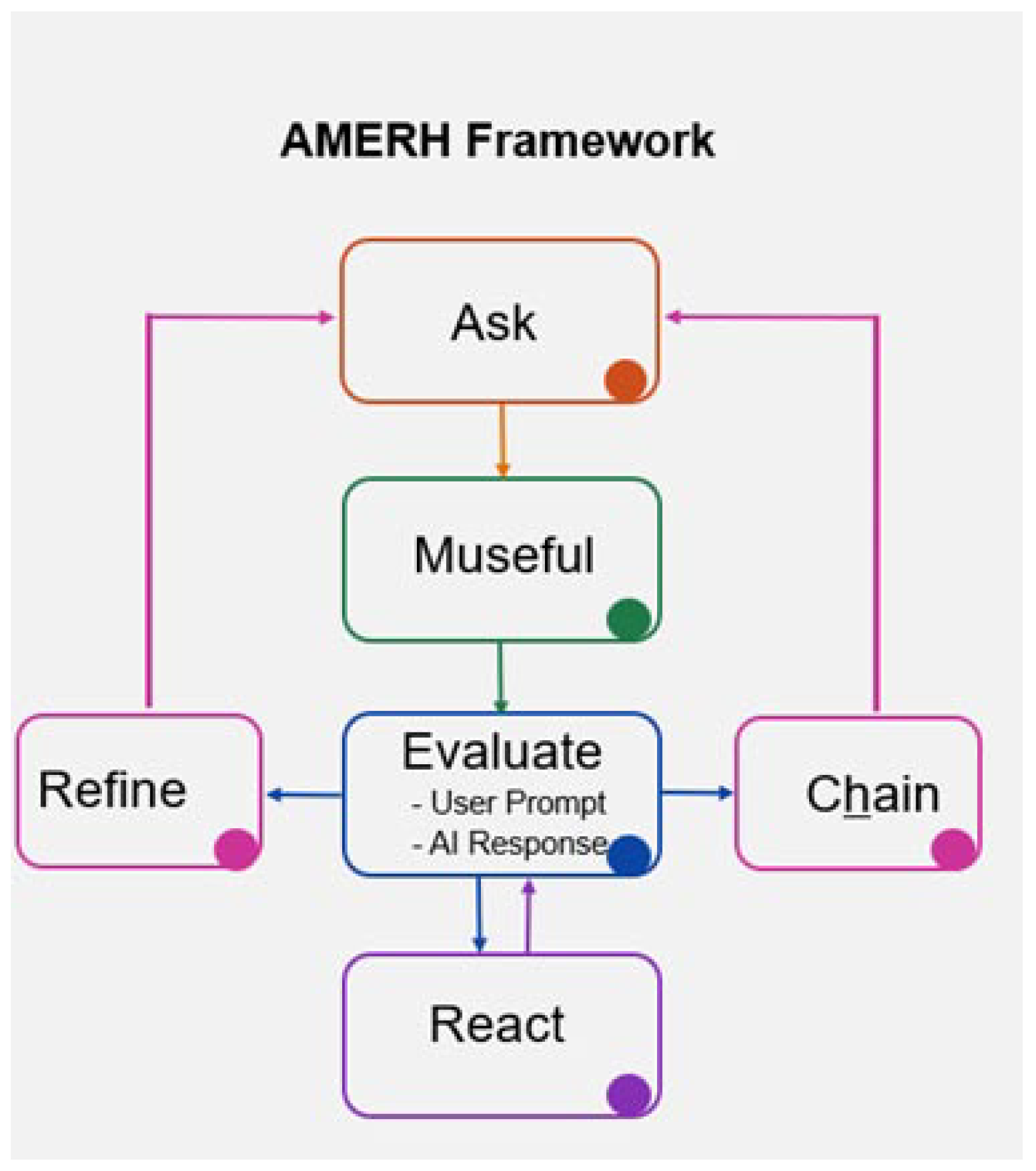

Table 1.
The AMERH Framework: Principle 1 – Ask.
| Prompt Type | Prompt Example & Commentary |
|---|---|
| Weak Prompt | Can you explain climate change? Comment. This prompt is too broad, resulting in a generic and unfocused response. |
| Revised Prompt | What are the primary causes of climate change? Comment. This prompt is specific, directing the model’s response to focus on the causes of climate change. |
Table 2.
The AMERH Framework: Principle 2 – Museful.
| Prompt Type | Prompt Example & Commentary |
|---|---|
| Weak Prompt | Please list the top three causes of climate change and provide a brief explanation for each cause. Comment This prompt is simple. It does not specify the desired Audience, Profession, or Intent, which are crucial for a topic like climate change. The response will likely be less relevant and impactful. |
| Revised Prompt | I am a social media analyst (Profession) who wants to influence public opinion and drive action on climate change (Intent). My target consists of individuals (Audience) who are resistant to drastic environmental changes and may be skeptical about the science (Situation).
Your task is:
This prompt is significantly more effective. By defining the Profession, Intent, Audience, Situation, Task, Format/Style outline, and Communication/Medium, it guides the model to produce a tailored, strategic, and actionable response that meets the user’s specific goals. |
Table 3.
The AMERH Framework: Principle 3 – Evaluate .
| Prompt Type | Prompt Example & Commentary |
|---|---|
| Weak Prompt | What are the proven benefits of Pfizer vaccines over other vaccines?
Comment This prompt is built on a biased premise, leading the model to produce a one-sided response. A core part of the Evaluate principle is learning to spot and correct this kind of bias in the prompts. Additionally, it assumes there are proven benefits while overlooking any potential risks. The responses will focus on the benefits, and the model will not list the risks. |
| Revised Prompt | I am an independent researcher who examines the ongoing discussion about COVID-19 vaccines, preparing a speech for a community with diverse views on vaccination. There are two groups: one views vaccination as a critical tool in controlling the spread of infectious diseases. In contrast, the other group believes that vaccinations are part of government control or a larger conspiracy. Your task is:
This prompt is designed to generate a response that is fair, balanced, and easy to evaluate. By requesting sources and a structured format, the user can more effectively verify the information and assess the model’s objectivity. |
Table 4.
The AMERH Framework: Principle 4 – React .
| Reaction Type | Example Reaction | Associated Profession |
|---|---|---|
| Accept | I agree. I believe the most effective way to lose weight is through a calorie deficit, provided the person adopts a healthy lifestyle that includes healthier food choices, regular exercise, and increased water intake. | Nutritionist |
| Reject | I politely disagree with you. While calories play a crucial role, individual factors such as metabolism, genetics, and mental health also play significant roles. | Clinical Psychologist |
| Counterargument | You might be right, but I personally believe that counting calories can be a stressful task for some people and may lead to unhealthy choices. Diet should be adjusted according to an individual’s specific circumstances. | Wellness Expert |
Table 5.
The AMERH Framework: Principle 5 – Chain/Refine .
| Prompt Type | Prompt Example & Commentary |
|---|---|
| Weak Prompt | Why are men more qualified for IT jobs than women? Comment This type of question reinforces a gender stereotype and overlooks other factors that influence the underrepresentation of women in IT. |
| Example of Refining | What underlying factors might influence the disparities in gender representation within IT jobs? Comment This prompt is a refinement. It corrects the flawed premise of the original prompt and asks a neutral, balanced prompt, leading to a more insightful and unbiased exploration of a complex issue. |
| Example of Chaining | How do role models influence the gender representation within IT jobs? Comment This prompt is a chained prompt. It acts as a follow-up, assuming the AI model has already provided a good answer to the refined prompt. It narrows the focus to build a deeper, more detailed conversation. |
Short Biography of Authors
Eman A. M. Amer is an educator, educational researcher and content designer. She has extensively worked with and tested various generative AI models and currently examines how to incorporate these tools in academia and beyond in ways that teach students to use them responsibly and ethically. Additionally, she is pursuing the development of an LLM suitable for educational use.
Disclaimer/Publisher’s Note: The statements, opinions and data contained in all publications are solely those of the individual author(s) and contributor(s) and not of MDPI and/or the editor(s). MDPI and/or the editor(s) disclaim responsibility for any injury to people or property resulting from any ideas, methods, instructions or products referred to in the content. |
© 2025 by the authors. Licensee MDPI, Basel, Switzerland. This article is an open access article distributed under the terms and conditions of the Creative Commons Attribution (CC BY) license (http://creativecommons.org/licenses/by/4.0/).
Copyright: This open access article is published under a Creative Commons CC BY 4.0 license, which permit the free download, distribution, and reuse, provided that the author and preprint are cited in any reuse.


