

Submitted:
29 September 2025
Posted:
30 September 2025
You are already at the latest version
Abstract
Due to the rapid advancement of AI technology, using AI as a learning aid has become a common learning method in higher education. This fact can be found in many re-search papers and educational reports related to AI. This study, based on this premise, examines the feasibility and effectiveness of guiding students to use AI to learn about sustainable development, and observes whether students' AI usage habits affect their ability to learn about sustainable development through this method. The study takes a compulsory course at a university in Taiwan as an example. By guiding students to use AI tools to learn about sustainable development, it not only reduces the pressure on teachers due to limited course time and the need for students to learn on their own, but also allows students to apply sustainable development-related knowledge in their team reports through the process of self-study. Based on the data collected from the ques-tionnaire, using AI as an auxiliary tool for sustainable development learning is an ef-fective strategy, and most students are able to acquire the necessary sustainable de-velopment-related knowledge. However, we have noticed that students’ daily habits of using AI will affect the effectiveness of their learning related to sustainable develop-ment through AI. For example, whether or not to pay for the use of AI will result in differences in learning outcomes. In addition, the number of devices on which AI is used is also related to students’ anxiety in learning behavior. Students also have a gap to bridge between acquiring knowledge and being able to put it into practice in life, and they are not clear about the relationship between AI using and sustainable de-velopment. Therefore, this research suggests that, in future, teachers should focus on helping students understand the relationship between AI and sustainable development, and guide them to apply the acquired sustainable development knowledge in their personal lives.
Keywords:
AI integration into teaching
; AI and sustainability
; education of sustainable development (ESD)
; personalized learning
1. Introduction
The impact of generative artificial intelligence (AI) on higher education has become undeniable. Data released by Campbell Academic Technology Services in 2025 indicates that the proportion of faculty and students using AI tools for teaching, administration, and academic work in 2025 will be significantly higher than in 2024 [8]. Ever since the ChatGPT craze swept the world in late 2022, higher education has been facing constant challenges: How can AI tools be applied in teaching and research? How can faculty guide students to use AI as a learning aid? Is AI truly a suitable learning aid for students? Research and suggestions addressing these issues are constantly being proposed. For example, UNSECO proposed competency frameworks for the use of AI in higher education in 2025, providing faculty with recommendations for its use in teaching and identifying potential obstacles and challenges[35].
At the same time, the concept of sustainable development is gaining increasing attention. Since the 2015 publication of the United Nations document A/RES/70/1, "Transforming our world: the 2030 Agenda for Sustainable Development," the Sustainable Development Goals (SDGs) have become increasingly embedded in our world. From the perspective about education of sustainable development (ESD), we should help students understand how sustainability can be implemented in their lives. This is reflected in SDG 4.7, which states, "Ensure that all learners acquire the knowledge and skills needed to promote sustainable development."
Given the importance of learning about the SDGs and the increasing maturity of AI tools and technologies, using AI tools to teach students about sustainable development could be an appropriate pedagogical approach. Dr. Huang, one of the researchers, has been guiding master's students using AI tools to develop lesson plans and assignments since 2023. Over a five-week period, the program gradually guided students through the development of a 40-minute lesson plan suitable for elementary school students. The study showed that using AI tools did help students further their understanding of sustainable development, but due to limitations in the technology and teacher guidance at the time, students felt the resulting assignments and lesson plans were inadequate [14]. This unsuccessful experience led the researchers to reconsider whether different approaches should be used to guide students. Furthermore, the growth and advancement of AI technology between 2024 and 2025, along with its increased capabilities, should make it even more effective in integrating sustainable development into teaching and guiding student learning.
Regarding the relationship between AI and sustainable development learning, since AI is a tool that can achieve certain results as an educational aid, how can we use this teaching aid to guide students in their use and further their understanding of the SDGs? This research is based on the results of a course conducted at a university in Taiwan from 2024 to 2025. Because the course is a required course with a common syllabus, the instructor needs to guide students in using AI tools as a personalized learning aid outside of class. This method is used by the instructor to first guide students in gaining a basic understanding of the SDGs, then through group discussions and allowing students to use AI for independent learning outside of class. Finally, the knowledge related to sustainable development is applied in the final group report.
This study aims to understand whether using AI as a learning aid can help students learn about sustainability in a personalized way. However, we also noted that students' learning of sustainability through AI is related to their personal AI usage habits. Therefore, this study will focus on two main questions:
Question 1: Does the use of AI tools as learning aids help students learn about sustainability?
Question 2: Does students' AI usage habits affect their learning of sustainability through AI?
2. Literature Review
The use of AI as a teaching aid is supported by a wealth of literature. Drawing on guidelines and reports from education-related foundations and research institutions, including the United Nations and UNSECO, as well as research from experts and scholars, we will discuss how AI can benefit both students and teachers as a personalized learning aid. While some of the literature and reports discussing AI may focus to specific educational systems (e.g., K-12) or regions (e.g., Latin America), these discussions can provide insights into real-world practices. This review will include discussions and research related to sustainable development. Furthermore, we will include supporting research on AI and higher education, examining the impact of AI on higher education from a practical perspective.
2.1. UNSECO’s Views on the Use of AI in Higher Education
The United Nations and UNSECO have already made recommendations on the relationship between AI and higher education since the advent of AI and its impact.
For example, in 2021, UNSECO published AI and Education: Guidance for Policymakers, which is based on the Beijing Consensus on Artificial Intelligence and Education. The report stated that the use of AI will empower teachers and enhance teaching [21]. The content also mentioned that AI can assist teachers in doing more work, and believed that teachers can work with AI to implement the ‘dual teacher’ model. In 2023, UNSECO published Harnessing the Era of Artificial Intelligence in Higher Education: A Primer for Higher Education Stakeholders. The report noted that AI can provide personalized learning and provide personalized feedback to students and teachers. AI for personalized learning can provide instruction tailored to students' needs, allowing them to learn at their own pace and be applied to personalized course settings.[18]. The use of AI in higher education can help learners meet their individual learning needs through existing learning frameworks. This can be achieved through a blended approach, using contextual tools to help students achieve specific learning needs. [18]
In 2024, UNSECO proposed a preparatory framework for students and teachers to integrate AI tools into education. In the advice to students, UNSECO suggests that AI can be used to build a favorable learning environment with the goal of promoting a learning-oriented curriculum environment, in addition to Hardware and robotics, Software and Programming languages, most importantly is "Tools for learning AI techniques". While the topic discussed here is related to K-12, we note that its core message is to remind users to properly use AI tools to build a conducive learning environment. [20]In its recommendations to teachers, UNESCO suggests that teachers can integrate AI into teaching and training students to use AI for learning to support differentiated instruction. In this document, curriculum objective table 4.2.4 states that teachers can transform their teaching approach to learning design through the use of AI. [21]
2.2. Comprehensive Review of Several Trend Assessment Reports
Several educational research institutions have released surveys on college students' attitudes toward using AI tool as a learning aid. Recent reports and researches indicate that using AI for study and homework has become increasingly commonplace. These reports and researches are focusing on how students use AI for learning and potential concerns.
In 2019, Baker and Smith pointed out that AI can provide students with the learning they need through personalized needs. Especially in large classes, AI can facilitate flipped learning, allowing students to familiarize themselves with knowledge outside of class and apply these learning outcomes in class, thereby improving their individual learning outcomes. [3] Cardona et al. note that one way AI can be used to expand individual learning is by enabling learners to expand beyond their individual cognition to a broader learning perspective.[5]
Sack and Little (2025) believe that AI tools can be extremely helpful in assisting individual students in their learning. This learning approach allows students to precisely master topics of interest and provides them with the skills they need to acquire, forming a path for using AI to improve students' learning attitudes, engagement, and effectiveness. [31] However, we also note that the report Student perceptions of AI 2025 released by the Joint Information Systems Committee (JISC) on May 22, 2025 mentioned that students are worried that over-reliance on AI tool to complete academic work may lead to a decline in learning quality. They don't understand how fake information and deepfakes are generated, and they have difficulty identifying the results, which raises concerns about the use of information and academic integrity. They are also concerned about whether paying for information will affect the accuracy of the generated results, and about whether their privacy will be used by AI to predict and influence their behavior and decisions.[2] There are many papers pointing out the negative impact that AI may have on student learning, so we will not discuss it here.
If educational research institutions track the relationship between AI and higher education over time, we can compare their reports and see the annual growth and changes in AI technology. This study uses EDUCAUSE as an example: EDUCAUSE is a nonprofit association in the United States dedicated to advancing higher education through technology. Starting in 2020, they included AI in its reports, with this major topic discussed annually until 2025.
In 2020, EDUCAUSE included AI in its report for the first time. The discussion included the use of chatbots to assist students with individualized learning and cautioned against fraud in the use of AI tools. The report considered AI tools a key technology for higher education learning.[4] By 2021, AI was again recognized by EDCAUSE as a key technology. Given the continued advancement of LLM, AI is expected to significantly transform learning. Therefore, the report recommends that educators rethink fundamental issues in education, as the entry of AI into higher education represents a potential opening of Pandora's box. The overall and long-term development of higher education may hinge on how AI technology is used.[28] By 2022, EDUCAUSE believes AI will be applied to learning analytics and learning assistance tools. The latter, in particular, will become more than just a data tool, but a learning partner and assistant, based on the maturity and ubiquity of the devices students use. AI can provide real-time feedback on students' learning, and teachers can use it to provide students with personalized learning experiences and paths, alleviating the burden of lesson preparation. [27]
Based on technological developments and the maturity of lesson plans integrating AI into teaching, the 2023 EDUCAUSE report concludes that AI can provide personalized learning assistance for students. Therefore, educators should use their knowledge of AI to help guide students' learning. [26] In the report of 2024, EDUCAUSE argues that trends in AI technology, both positive and negative, are already changing teaching methods and student learning in various ways. [25] Teachers should identify the most appropriate uses of AI in their teaching practices. [25] On page 23 of the report, EDUCAUSE cites several university examples to illustrate how different higher education institutions are finding the most appropriate ways to use AI. In the 2025 edition of the report, EDUCAUSE warned that while AI is now widely available as a free tool, there is an unregulated gap between user-generated content and the truth. Previously, higher education was considered the creator of truth and knowledge, but with AI producing distrust and confusion, traditional higher education is finding it difficult to grasp the truth.[30] EDUCAUSE has made several recommendations, including that teachers should guide students in the responsible and ethical use of AI, and that teaching professionals should equip themselves with a foundational understanding of the technology. Teachers should remain open to technology and continue to apply and learn about AI. EDUCAUSE's reports over the years have shown the gradual realization of AI tools: initially, it was merely a suggestion for integrating AI into teaching, but now it has been truly applied and integrated into teaching.
In addition, a comparison of the numbers also reveals students' acceptance of AI. The UK's HEPI (Higher Education Policy Institute) published a research report in February 2024 and 2025. In the 2024 report, 53% of students surveyed used AI as an assessment and assistance tool, and nearly two-thirds used AI in some form. The 2024 report recommended that educational institutions should teach students how to use AI appropriately. [11] By 2025, 92% of students will use AI as a support tool, and 88% will use it for both assessment and support. These figures are significantly higher than the 2024 survey results. In the 2025 survey, "explaining concepts" was the most common way students used AI. Other reasons cited for using AI included saving time, improving work quality, and obtaining personalized support. [10] Freeman's survey report shows that AI has become a primary learning aid for students, a finding consistent with the observations of several reports cited here. Furthermore, Wang and Li (2024) also note that the introduction of AI has been beneficial for student learning and recommend that universities actively promote AI technology. They believe that a "human-computer symbiosis" model can promote active learning and establish personalized learning paths for students.[37]
2.3. Teachers’ Integration of AI into Classroom and Teaching
How AI can be used in the classroom to enable teachers to teach more creatively, focus more on teaching activiti es, or even reduce the burden on teachers has long been a key topic of discussion regarding its integration into teaching. AI as a tool, we have also noticed scholars and reports offering suggestions. For example, Baker and Smith mentioned in 2019 that using AI technology to assist teaching can help teachers avoid ‘one-size-fits-all’ learning and improve the flexibility and scope of learning assessment. [3]
Cardona et al.'s report also noted that integrating AI into teaching offers practical benefits to teachers. When teachers use AI to assist with teaching, focusing on concept of ACE (Always Center Educators) allows them to focus on their students. ACE includes three key components: Designing, Selecting, and Evaluating Tools for Teaching and Learning; Preparing for and Reflecting on Teaching; and Doing Teaching. Here, AI can demonstrate its value as a teaching aid for teachers. AI can help teachers handle details, allowing them to focus more on student learning. It can also free learning from time constraints, allowing teachers to provide students with the necessary learning process through the use of AI tools. All of this allows teachers to focus more on their professional development. [5] A report published by the UK Department for Education in 2024 noted the potential of AI tools for education, including reducing teacher workload and promoting student autonomy and personalized learning.[33] This personalized learning approach can guide students through AI to learn only the knowledge they are interested in (or need for). [33]
However, guiding students to use AI tools requires designing appropriate strategies. For example, Mollick, E. R., and Mollick, L. (2023) outline five possible approaches: using multiple examples, providing diverse explanations, reducing the risk of tests or experiments, assessing learning outcomes through AI, and using AI as a tool to convey key knowledge. [33] We also noted that human-computer collaboration is a recommended approach for integrating AI into courses by many scholars. For example, Vieriu and Petrea (2025) noted that the majority of respondents agreed that AI can enhance learning and human-computer collaboration, and reported that the learning experience was improved. Nearly 90% of students used AI as an auxiliary tool, providing support for information retrieval, task management, and instant feedback. Students also supported integrating AI into traditional teaching methods as a learning aid.[36]
Niloy et al. (2025) noted in a study that most hybrid approaches to AI and learning focus primarily on language learning, with little research examining the broader aspects of multidisciplinary learning. They noted that creating a hybrid teaching environment that combines physical classroom instruction with AI-assisted tools would benefit student learning. [24] While AI has the potential to transform education, it needs to be properly integrated into academic settings, such as as a supplement to and enhancement of traditional classroom learning. Citing research by Rusdiawan et al., they suggest a hybrid approach combining ChatGPT with classroom instructional methods and recommend future researchers further investigate the potential of this approach. [24] Their course experiments demonstrated that AI can provide autonomous learning capabilities and deliver learning content in a broadly customized manner. For example, blended learning can improve the learning environment and increase student satisfaction with the learning process. They suggest that the application of AI cannot be ignored; opportunities for coexistence should be created. Reina Marín et al. (2024) argue that the introduction of AI tools has already transformed higher education teaching. They found that awareness of AI applications in higher education is low, and most believe it will have a negative impact on the learning process. They recommend preparing for the potential of AI in higher education and for a digital learning environment.[29]
2.4. AI and Sustainability
This study explores the topic of guiding students through personalized learning outside the classroom through AI tools to acquire knowledge related to sustainable development. This differs from the content of many reports on AI and sustainability. Regarding the relationship between AI and sustainability, numerous assessment reports and guidelines emphasize two key aspects: (A) the impact of AI use on environmental resources, and (B) its potential contribution or impact on education for sustainable development.
Regarding the use of AI by teachers as a tool to assist students in learning sustainability, this is often extended through the lens of individualized learning. We can categorize this relationship into macro and micro perspectives: the former considers the relationship between AI and sustainability from the perspective of overall sustainability or higher education; the latter, from the learner's perspective, uses AI as a tool to support sustainability learning within or outside the curriculum.
Taking a macro perspective as an example, the United Nations' 2024 report on AI, when discussing the relationship between AI and sustainable development, uses all aspects of the SDGs as the foundation for its discussion and argues that the use of AI will contribute to the achievement of the SDGs. However, the UN also acknowledges that AI's contribution to sustainability is currently unclear.[34] Hoernig et al. note that AI applications have positive benefits for higher education and sustainable development, but they raise two concerns. One is that AI requires vast computing resources, which could negatively impact the environment. Another is that AI requires significant capital investment in computing equipment and technology, which could widen the gap between educational institutions.[12] These issues are also addressed in the literature cited above. UNSECO, in its discussion of the relationship between student AI use and sustainability, favors using AI in a way that avoids environmental disruption and that is consistent with the sustainable development of humanities and society.[20] Sack and Little's research also notes that the use of AI poses societal risks to sustainable development. Because AI requires vast amounts of electricity and resources, it creates a significant carbon footprint. As higher education increasingly adopts AI tools, the corresponding infrastructure and demand will increase. When schools and students use these devices, this in turn increases the electricity and resource requirements for AI. [31]
We've noticed that these reports often discuss AI and sustainable development from a macro perspective. They affirm the close relationship between AI and sustainable development. Based on this premise, our research lab also considers AI as a tool for users to learn about sustainable development from a micro perspective. Farmanesh et al. (2025) mentioned in a study that the use of AI can help students reduce learning anxiety, ultimately promoting mental health and building quality education by enhancing AI capabilities, and contributing to the achievement of SDGs 3 and 4.[9] Jasper (2024) noted that, if properly implemented, AI could accelerate progress towards the SDGs. He cited SDGs 1, 3, 4, and 13 as examples to highlight potential AI applications.[17] AiSagri and Sohail (2024), through bibliometric analysis, concluded that the use of AI in academia to promote sustainable development is a growing trend. AI can provide educational institutions with scalable and cost-effective teaching solutions, particularly by delivering personalized learning experiences at scale, reducing the need for additional teaching resources while maintaining high-quality education.[1]
According to a literature review, AI can serve as an appropriate teaching aid for teachers and can help students with their learning needs, both in and outside the classroom. Teachers can also benefit from AI support, providing greater flexibility in their teaching. Furthermore, AI is closely related to sustainable development, impacting not only the environment, energy, and the development of educational institutions, but also serving as a tool for students in ESD learning.
3. Research Methods and Objects
This study was based on three classes taught by the researcher. This course is a mandatory, one-year course offered in all departments during the second or third year of university. It is a long-standing institution, having been offered since the university's founding. The course discusses topics related to life and philosophy, organized into ten units, guiding students to discuss the value and direction of life. [6,15] The courses used in this study did not primarily focus on the SDGs; rather, they incorporated discussions of the SDGs into course units or individual/group reports. The three classes included in this study were all third-year university students. None of the students had a science or engineering background, and their majors were primarily in the humanities and social sciences. There are totaled 140 students in three classes.
3.1. Description of student status
This study discusses guiding students to learn the SDGs through the assistance of AI tools. Here, we first provide a brief description of students' knowledge of the SDGs.
Taiwan's education system considers the SDGs to be important competencies or accomplishments. Since 2017, the Ministry of Education has been planning and promoting SDG learning among students. However, university students' understanding of the SDGs remains limited. In 2023-2024, Dr. Huang, one of the authors of this article, received a project grant to research how to enhance university students' understanding of the SDGs within the curriculum. A pre-test, conducted before SDGs instruction, among a sample of 110 sophomores and juniors revealed that only 30.9% of students reported having studied the SDGs before entering university, and 37.2% believed they understood the content and significance of the SDGs. [16] The research revealed that students' understanding of the SDGs was insufficient. This was evident not only in their lack of clarity about the SDGs' content and their literal interpretation of the text, but also in their difficulty in applying the SDGs' goals to the required group reports. The findings from the 2024 research were reaffirmed in the 2024-2025 course: even with the changing student demographics, there is still need for improvement in students' understanding and application of the SDGs.
3.2. Research Design
Because the course for this study runs over the entire academic year, the researchers designed the course to include, in addition to the ten units, students completing a research project of their own choosing as a final report, incorporating SDGs learning into the report preparation. This school has a long history of mandatory courses, and for nearly 15 years, all faculty have been required to adhere to a common curriculum. All teachers who teach the class are required to teach within the common curriculum. While the content can be determined independently by the instructor, the challenge of covering the syllabus content within a fixed timeframe is inherent. Introducing the SDGs into the curriculum presents challenges, particularly as students are not yet fully familiar with the SDGs. Integrating the SDGs into the curriculum would require additional student learning: this is where the value of AI as a supporting tool becomes apparent. The research process is illustrated below:
Figure 1.
Research process.
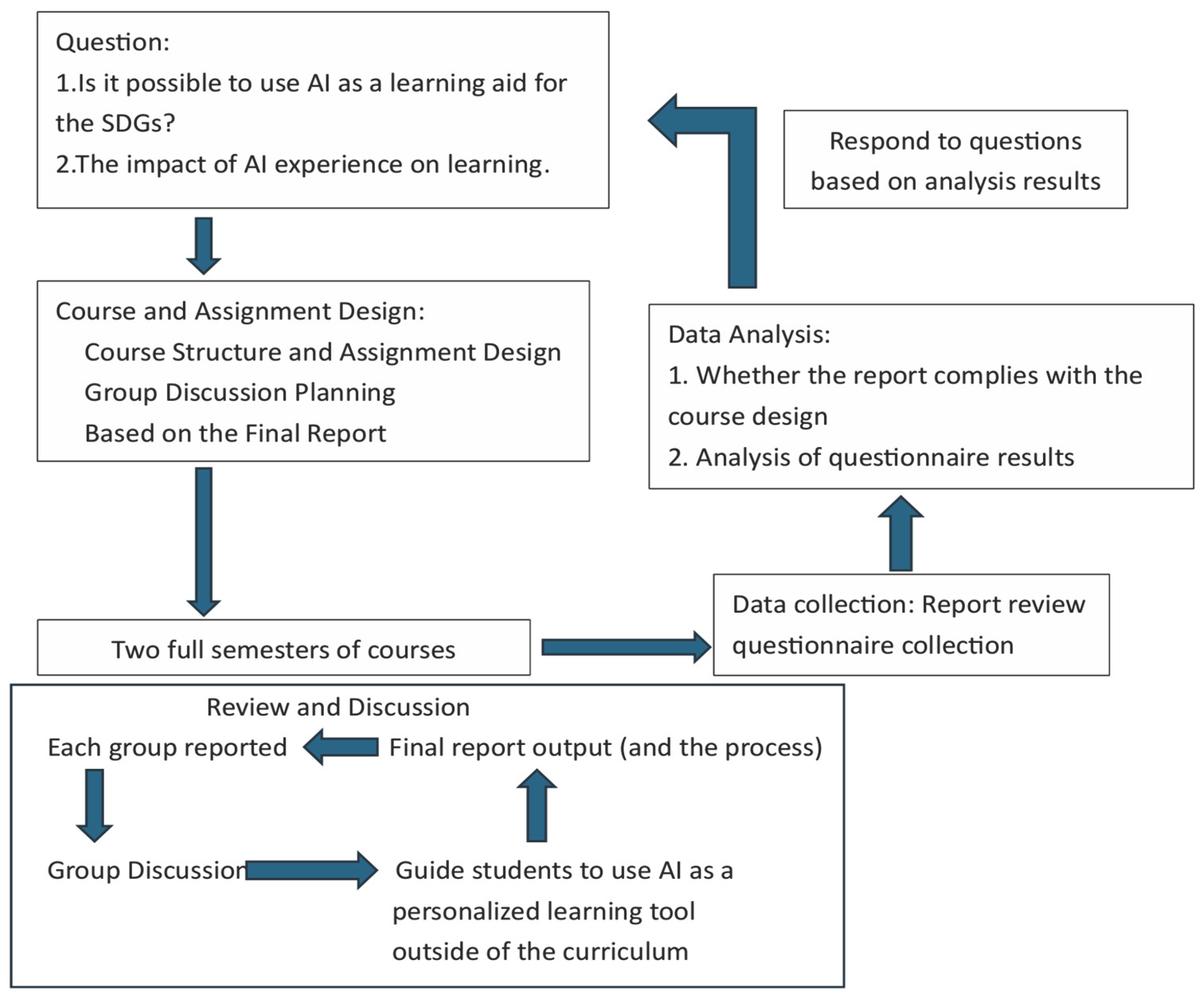
Taking into account students' learning backgrounds, the instructors briefly reviewed the basic concepts of the SDGs and explained the standards for using AI in the course during the first week of school, during the final report presentation. Throughout the semester, the instructors scheduled regular group discussions with students to observe students' effectiveness in using AI to learn about the SDGs. They offered guidance as appropriate through these discussions, asking students to apply the goals and encouraging, but not forcing, the use of the second-level targets of the SDGs for more precise mapping. This process was fully implemented throughout both semesters.
At the end of the two-semester course, the instructor conducted a final questionnaire survey. Since the course already involved students using AI as a tool to assist with team reporting, the questionnaire did not examine students' actual use of AI in their daily lives or studies. Instead, it focused on how students used AI to complete reports related to the SDGs and how they used AI as a personalized learning tool. In addition to basic personal information, the questionnaire included three groups of questions: the first section covered personal AI usage habits; the second section assessed attitudes, consisting of 12 multiple-choice questions, inquiring about the relationship between AI use and learning and report completion; the third section examined students' current AI usage status, consisting of three groups of questions to understand their current focus on AI-based report writing; and the final section consisted of open-ended, free-to-answer questions. The questionnaire was designed based on references to multiple research reports. For example, the HEPI survey reports from 2024 and 2025 cited in the aforementioned literature serve as a reference. The questionnaire also uses a five-point Likert-type scale. The questionnaire aimed to understand students' experiences and usage of AI as a personalized learning tool in this course.
3.3. Assignment Design
The report titles for the course used in this research were decided by the students in each group based on their own interests. The researcher, as the instructor, had limited requirements for the reports to: (A) be related to the topics discussed in the syllabus, (B) be written in the form of an essay using APA format, and (C) be linked to the SDGs. The connection to the SDGs is because this is one of the most directly adopted contents in Taiwan's promotion of ESD. In 2020, teachers in Taiwan begun to have the SDGs Education Handbook as a reference for teaching below high school level. However, as mentioned above, the author of this article, Dr. Huang, found in his 2023-2024 research that Taiwanese students still not enough in this area of learning.[16] Therefore, when guiding students to learn ESD, SDGs are used as the representative and foundation of ESD.
With the group discussion of SDGs, the researchers required that reports address the goals. Linking these to the targets was encouraged but not required, and further discussion of indicators was not required. The report's connection to one of the goals was determined by the instructor during group discussions with each group. Some topics may cover a wide range of goals, and the instructor ensured that each group linked their report to at least one goal. The instructor recommended limiting the number of goals or targets from one to three. If a group felt their report should connect to more than the required number of goals or targets, the instructor would reward them with additional credit if they provided justification.
During the presentation process, students were required to research the relationship between the topic and the assigned goals or targets behind the class time, using AI as a learning aid. This was intended to avoid the "one-size-fits-all" learning problem mentioned above by Baker and Smith (2019): due to time constraints, instructors are limited to providing a brief overview of the SDGs within the course unit.[3] However, the range of topics students freely generated was wide, and individual group discussions would be time-consuming, and the content might not be appropriate for students' research interests. Alternatively, the researchers employed the "dual teacher" model proposed by UNSECO in 2021.[22] After the instructor provided guidance on the SDGs, the AI tool served as a secondary teacher, advising students on their presentations. Finally, further discussions were held in class with the instructor to confirm the appropriateness of the content.
The incorporation of the SDGs into the final group reports differs slightly between the two semesters. First-semester group reports are required to include the SDGs in the conclusion, and to be a summary and preparatory step for the second-semester research. Second-semester group reports incorporate the SDGs within the context of the report, serving as the foundation for the overall discussion. Second-semester group reports can, but need not, be related to the first-semester reports; students can decide whether to continue the topic based on their group discussions. Reports are written in a similar manner to essays and must provide references in APA format. For the 2024-2025 course, the three classes will have a total of 20 groups in the first semester. Due to group consolidation, the remaining 18 groups will be present in the second semester. Twelve of the 18 second-semester groups will continue the topics of their first-semester reports, hoping to engage in more in-depth discussions.
3.4. Research Ethics
Only Professor Huang's classes, one of the researchers, was eligible to complete the questionnaire. The questionnaire was administered during the final class. Completion of the questionnaire had no bearing on student grades. Students already knew their final score at the time of completion, so completing the questionnaire had no impact on their overall score.
All participating students were adults and were clearly informed that the contents of the questionnaires and reports would be used in a completely anonymous research paper to be published in English in an international academic journal outside of Taiwan. All students were also informed that if they did not wish their opinions to be cited, they could indicate so. Conversely, if a student felt the opinion was particularly unique and wished to have it specifically cited in the paper, they could also indicate so. The questionnaire is completely anonymous to protect students' rights and identities. For example, there's no need to enter department or grade. In addition to biological male and female, the gender section also offers options for "other" and "I prefer not to disclose." Even the researchers as a instructor were unable to determine the true identities of the respondents based on the responses from the class. The final number of respondents was 108. Regarding gender, excluding three students who declined to disclose their gender, the remaining group was predominantly female, likely due to the department in which the class was taught.
4. Research Results and Discussion
The questions of this study is whether AI tools can assist students in learning sustainable development. Furthermore, it asks whether students' experience and habits with AI influence their use of AI for personalized learning. We will present the findings from different perspectives below: a comparison of group reports, narrative statistics and qualitative feedback, and quantitative analysis. We will then present research and discuss these findings.
4.1. Results of Reports
We first created a table comparing the student report topics from the two semesters with the corresponding SDGs, allowing us to examine learning outcomes through the report outcomes. Table 1 below lists the final report topics for all groups in the three classes, along with their links to the SDGs. There were 20 groups in the first semester, but in the second semester, due to group mergers and other factors, the final number of groups was 18. Each column in the table represents the same group, and the content of the reports from the same group over the two semesters is compared. The report titles in the table were independently proposed by each group and may not necessarily conform to the requirements for a thesis title. This is permitted by the instructor.
In the table above, the areas marked with an X indicate continuity between the two semesters. While some groups changed their research topics, most maintained a more or less consistent focus from the previous semester. Most of these topics were relevant to students' daily lives or areas of focus, and easily integrated with the SDGs. Due to extensive discussions between teachers and students, students were able to provide appropriate explanations of the topics and report content in relation to the SDGs.
Regarding the relevance of the topic to the SDGs, one group, despite understanding the instructor's instructions, failed to connect their report to the SDGs. This group received a B- in their final report. Four groups remained confined to discussing goals in both semesters. Four groups discussed both goals and targets in the first semester, but only goals in the second. These four groups were either merged or had a second-semester topic that continued from the first semester but expanded in scope, requiring more extensive explanation. For the most of groups, discussing goals in the first semester shifted to discussing targets in the second semester, or the number of discussions became more extensive.
An analysis of the group report topics revealed that of the 17 SDGs, goals 3, 4, and 5 were mentioned the most frequently, while goals 6, 8, 9, 14, and 17 were not mentioned at all. This distribution may be related not only to the topic selection but also to the students' living environments. For example, regarding SDG 14, although Taiwan is surrounded by the ocean, Hou (2023) noted in a research report that Taiwanese citizens obtain public information on the ocean primarily through online media and have little knowledge of the content of ocean policies. Since their lives have no real connection to the ocean, this SDG goal was overlooked.[13]
We also noticed that students weren't focusing on the relationship between AI and sustainability from both a macro and micro perspective. When teachers guided them in using AI tools to study the SDGs in group work, students focused on how to use the tools to complete reports and what knowledge they would gain. The relationship between AI and sustainability discussed in Section 2.4 above was not within their focus.
4.2. Observing Student Responses from Narrative Statistics
Based on the student responses, the study presents the following analysis:
4.2.1. Number of AI Tools Used and Payment Habits
In the usage habits, given that students may not be limited to using just one AI tool, the questionnaire was designed to allow students to select multiple choices. Of the 108 students, 54 indicated that they only used one AI tool, with two single users using Gemini and Grok, and the other 52 using ChatGPT. Other types of AI, such as Co-Pilot or DeepSeek, were not used independently in this survey. Of those using two or more tools, 41 used two (37.9%), 11 used three (10.2%), and only two used four. In the tool usage, a total of nine different AI tools appeared in this survey. ChatGPT was the most commonly used AI tool in this study, appearing 106 times. In addition to ChatGPT, other mainstream AI tools, including Gemini, Microsoft Co-Pilot, and DeepSeek, were also used by many students. In addition to these four most mainstream tools, Grok, Claude, felo, NotebookLM and Perplexity were also cited by at least one person as their primary tools.
Among students who used two AI tools, their tool combination was "ChatGPT + another AI tool." The most common combination was ChatGPT + Gemini. Among students who used three AI tools, the most common combination was "ChatGPT + Gemini + Microsoft Co-Pilot." The two students who used four tools used "ChatGPT + Gemini + Co-Pilot + Felo" and "ChatGPT + Gemini + Claude + Deepseek". This combination reflects the prevalence of ChatGPT and Gemini in student usage habits. Furthermore, the data also suggests a desire or trend among students to integrate multiple tools for personalized AI learning. However, further analysis is needed to determine whether students' AI usage habits are related to brand adherence.
This study also analyzed which devices students use AI on, using a multiple-choice question: mobile phone, tablet, laptop, and desktop computer. 27.8% of students used AI tools on only one device, with the largest percentage using laptops and mobile phones. Among students who used AI on two devices, the vast majority (71.7%) used a "laptop + mobile phone" model. This usage pattern is likely closely related to students' personal experience, as mobile phones are extremely convenient, while laptops can provide practical tool needs. Among students who used AI on three devices, the vast majority (87%) used a "laptop + mobile phone + tablet" model. The data indicates that using AI on at least two devices is the mainstream approach. This is not only due to the convenience of these devices and Taiwan's highly developed internet environment, but may also be driven by students' desire to maximize efficiency by switching between devices in different situations. The lowest number and percentage of students used AI on desktop computers, possibly due to students' expectations for mobility and convenience.
In terms of whether or not students paid for AI, 21 out of 108 students paid for using, accounting for approximately 19.4% of the total. According to a survey conducted by the Taiwan Market Intelligence & Consulting Institute in Q4 2024, the proportion of students who paid for AI on their own was approximately 17%, making the two figures similar. [19]
4.2.2. Aspects of Using AI Tools to Learn Sustainable Development-Related Knowledge
The objective of this study is to investigate whether students' use of AI tools is helpful in learning about sustainable development. Based on the students' responses, we calculated the number of students who responded strongly (5) and agreed (4 points). 87% of students would use AI tools to learn about sustainable development and read the content and knowledge about SDGs provided by AI. 82.4% of students believed that AI tools could help them gain a deeper understanding of sustainable development. The results show that most students believe that the use of AI tools is helpful in their learning about sustainable development. Considering that students prepared reports in groups, it is possible that some students did not actually learn about sustainable development or prepare reports.
To confirm whether students' use of AI for sustainable development learning is consistent with their regular study habits, the study also asked students about their AI usage habits. 93.5% of students already use AI as a learning aid, and 90.7% believe that using AI helps them manage their time better. Importantly, 83.3% of students already use AI to assist with course assignments or reports, and 85.2% use AI tools to assist with writing assignments related to the Sustainable Development Goals. These numbers are significant; the majority of those who strongly agree and agree mentioned in the previous paragraph also scored between 4 and 5 points here.
While students believe that using AI tools can help them learn about sustainability, transitioning from knowledge and reporting to real-life practice is difficult. The number of students willing to try to put sustainability into practice in their lives has dropped to 78%.
4.2.3. Narrative Statistics on Learning for Sustainable Development
The questionnaire included four questions directly related to applying AI to sustainable development learning. The five-point scales for "Using AI to assist with homework writing" and "Reading SDG materials provided by AI" scored 4.130 and 4.120, respectively. Students also believed that AI could help them gain a deeper understanding of the SDGs and their content. These data echo the questions in the second half of the questionnaire. 87% of students expressed a positive response to the question "I would use generative AI to assist with my report writing: Using AI to explain or describe content related to the SDGs." However, we noted that translating AI-acquired knowledge into practical application in real life is not easy, just as we said above, with a mean of only 3.898 and a standard deviation of 0.8531. This suggests that students' understanding of sustainable development remains largely at the knowledge level and requires motivation to put what they have learned into practice. See Table 2 for relevant information.
4.2.4. Qualitative Answers
The study included an open-ended section at the end of the questionnaire to understand whether students had any thoughts or attitudes about AI. Excluding those who expressed no opinion (e.g., "No") or overly simplistic answers (e.g., "AI is really stupid"), the study received feedback from eight students. Table 3 shows these eight responses:
We noted that of the eight responses, only two expressed a positive and proactive understanding, believing that AI is indeed helpful for learning. The other six responses were negative or reserved. These reservations included skepticism about AI's capabilities and personal expectations regarding its use (e.g., concerns about laziness or the requirement to "complete prompts"). This negative attitude echoes the proportion of responses to the "Possible Concerns About Using AI" section in the second half of the questionnaire. For example, 70% of students expressed concern that "the answers generated by the generative AI are problematic but I won't be able to tell," and 69% expressed concern about not being able to tell if the AI has plagiarized answers.
4.3. Sources of Differences in Attitudes, Usage Experience, and Ongoing Learning Behavior Towards Generative AI Tools
Regarding attitudes, usage experience, and ongoing learning behavior towards generative AI tools, there were no significant differences based on gender or the number of AI tools used. However, regarding students' personal usage habits, it was found that "whether or not they paid for generative AI tools" and "number of devices used" contributed to significant differences in AI learning behavior.
4.3.1. Analysis of Payment
Table 4 below shows that while the average scores for both the paid and non-paid groups are generally above 4, the paid group's average scores are significantly higher than the non-paid group in all aspects. This suggests that the decision to pay or not makes a statistically significant difference in user learning behavior. For related data, please refer to Table 4.
As shown in Table 4, in terms of learning behavior, those who paid reported saving more time, learning more, and obtaining more content needed for their reports than those who did not. Payers were also more meticulous in their use of AI than those who did not pay (for example, users would review and polish the text to enhance their personal writing style). The most striking response was for the question, " I would try to practice the content about the Sustain-able Development Goals pro-vided by generative AI in my daily life." The average score for the non-paying group was only 3.816, while the paying group had a score of 4.238.
Overall, students who paid for AI tools were more positive about their learning assistance. This may be due to the fact that paid versions offer a more robust or complete personal experience. We've noted in some online reports that differences in AI usage between paid and unpaid versions include functionality, computational models, data upload space, and conversation window length. [38] This suggests that students using paid AI tools receive more comprehensive and comprehensive information on sustainable development than those using unpaid versions, resulting in better learning outcomes.
From another perspective, this analysis could be a continuation of the digital divide. The disparity in resources accessed through paid and unpaid AI applications could lead to disparities in learning outcomes in the future. Even if students all use AI tools for personalized learning, this could still lead to disparities in learning outcomes. For example, Attewell (2025) mentioned students' concerns about whether to pay for learning.[2] Similar warnings are also found in the aforementioned literature. For example, the Cardona team mentioned the importance of focusing on the long-tail effect of learner differences. They noted that students have diverse learning styles, and researchers should be aware of both the potential and challenges of AI in addressing these situations. Although the Cardona team did not discuss the issue of paid access, their observations remind us that personalized learning may differ depending on students' usage status and experience.[5] Pelletier et al. clearly mentioned that economic disparities may lead to disparities in usage. They emphasize the importance of protecting the rights of students from lower socioeconomic backgrounds to use AI, emphasizing the importance of ensuring equal access to equipment and technology for all students.[26] This phenomenon is also reflected in the 2024 and 2025 HEPI reports. Both reports note that family financial considerations and the price of AI influence students' willingness to use it.[9,10]
4.3.2. Analysis of the Number of Devices Used
The study also compared the number of devices used. Students who were willing or able to use more devices performed better in sustainable development learning. Students who used AI on only one device performed significantly worse than those who used it on three or more devices. See Table 5 for a comparison of the number of devices used and students' AI habits.
Students who can use AI on multiple devices have higher requirements for writing sustainability-related reports and are therefore willing to learn different techniques and instructions. Students who can give better instructions can obtain more complete or customized information when writing sustainability-related reports. This applies not only to the acquisition of sustainability-related information related to this study, but also to the acquisition of information for many different reporting areas. However, the number of devices used also reveals students' anxiety about accessing information. This anxiety is mentioned in the aforementioned HEPI 2025 report, which states that students worry that their understanding of AI will never keep pace with the pace of AI development.[10]
5. Conclusions
Based on the above research, we can confirm that the use of AI tools as learning aids can be helpful for students in their sustainable development studies, as evidenced by student responses. However, we also observed that students' AI usage habits influence their learning of sustainable development through AI, particularly whether they pay for it and the types of devices they use. One possible explanation is that, because AI tools are already widely available, when teachers guide students to use AI for personalized learning, students are highly receptive and quickly adapt to this learning approach. However, when students actually learn, their individual usage habits influence their learning, leading to the findings in our data analysis. Students' usage behavior has an impact on learning outcomes. This can be linked to discussions about AI literacy, while also highlighting the potential digital divide in learning caused by the conditions under which AI is used. Further and more in-depth research is needed in this area to understand how students' experience and habits influence their learning through AI.
This paper's contribution lies in applying the extensive academic research on the use of AI as a personalized learning aid for students to the study of ESD, and in validating the impact of student usage habits. By guiding students to use AI to learn ESD, the perspectives on using AI tools as learning aids, as proposed in several previously mentioned documents, were proven. As instructors, when it is difficult to allocate classroom time to guide students in sustainable development-related knowledge due to the school curriculum and the common curriculum, researchers can guide students in learning through AI outside the classroom. By integrating AI with final reports and engaging with students during group discussions, students' understanding of sustainable development-related knowledge can be enhanced.
For students, using AI as a personalized learning tool for sustainability can be a significant aid. As sustainability becomes a widespread global trend, students face the challenge of learning a vast and comprehensive framework while also considering how to apply this knowledge to their reports. This can be challenging if students lack a solid foundation. However, AI can provide them with relevant sustainability information and, through personalized learning, help them apply this knowledge to their team reports.
While research suggests that AI can be used as a personalized learning tool for students, the results also suggest that this type of learning has potential for continuous improvement. When students use AI to learn about sustainability, they often fail to address the macro and micro relationships between AI and sustainability, as discussed in Section 2.4. While AI certainly brings convenience, it remains unclear whether students are engaging with sustainability knowledge critically or thoughtfully.
Research also shows that while students acquire the necessary knowledge about sustainable development, there's a gap when it comes to translating this knowledge into real-life practice. However, as we know, the United Nations emphasizes its implementation in promoting sustainable development, including AI-related literacy or competencies such as values, attitudes, and behaviors.[32] The work by Valentini and Blancas (2025), cited at the beginning of our paper, also supports this emphasis on literacy and cognitive abilities.[35] Therefore, while using AI as an auxiliary tool is helpful for student learning, how to guide students to apply this knowledge in their daily lives will be a topic worthy of further research and discussion.
Author Contributions
Huang, Din-Yuang: Research design and execution, literature analysis, paper writing, questionnaire analysis. Lin, Ying-Tzu: Data analysis, writing and explaining section 4.3 of the paper.
Funding
This research received no external funding.
Informed Consent Statement
Not applicable.
Acknowledgments
During the preparation of this manuscript/research, the author used Google Translate for translation purposes. The author has reviewed and edited the output and takes full responsibility for the content of this publication.
Conflicts of Interest
The authors declare no conflicts of interest.
References
- AlSagri, H.S.; Sohail, S.S. Evaluating the role of Artificial Intelligence in sustainable development goals with an emphasis on “quality education”. Discov Sustain 2024, 5, 458. [Google Scholar] [CrossRef]
- Attewell, S. Student perceptions of AI 2025. Jisc. 2025. Available online: https://www.jisc.ac.uk/reports/student-perceptions-of-ai-2025.
- Baker, T.; Smith, L. Educ-AI-tion Rebooted? Exploring the future of artificial intelligence in schools and colleges. NESTA. 2019. Available online: https://www.nesta.org.uk/report/education-rebooted/.
- Brown, M.; McCormack, M.; Reeves, J.; Brooks, D. C.; Grajek, S.; Alexander, B.; Bali, M.; Bulger, S.; Dark, S.; Engelbert, B.; Gannon, K.; Gauthier, A.; Gibson, D.; Gibson, R.; Lundin, B.; Veletsianos, G.; Weber, N. 2020 EDUCAUSE Horizon Report, Teaching and Learning Edition. Louisville, CO: EDUCAUSE. 2020. Available online: https://library.educause.edu/resources/2020/3/2020-educause-horizon-report-teaching-and-learning-edition.
- Cardona, M.; Rodríguez, R. J.; Ishmael, K. Artificial Intelligence and Future of Teaching and Learning: Insights and Recommendations. U.S. Department of Education, Office of Educational Technology. 2023. Available online: https://www.ed.gov/sites/ed/files/documents/ai-report/ai-report.pdf.
- Chuang, J.B. A study on the teaching of philosophy of life: the case of Fu Jen catholic university. Universitas: Monthly Review of Philosophy and Culture 1996, 23, 2298–2333. [Google Scholar]
- Chuang, J.B. A study on units of the course of philosophy of life-focus on the outlines of life philosophy of Fu Jen catholic university. Journal of Holistic Education 2007, 1, 103–122. [Google Scholar] [CrossRef]
- Dmulford. AI in Higher Education: A Meta Summary of Recent Surveys of Students and Faculty. Campbell Academic Technology Services. 2025. Available online: https://sites.campbell.edu/academictechnology/2025/03/06/ai-in-higher-education-a-summary-of-recent-surveys-of-students-and-faculty/.
- Farmanesh, P.; Vehbi, A.; Solati Dehkordi, N. AI Literacy in Achieving Sustainable Development Goals: The Interplay of Student Engagement and Anxiety Reduction in Northern Cyprus Universities. Sustainability 2025, 17, 4763. [Google Scholar] [CrossRef]
- Freeman, J. Student Generative AI Survey 2025. HEPI, Policy Note 61. 2025. Available online: https://www.hepi.ac.uk/wp-content/uploads/2025/02/HEPI-Kortext-Student-Generative-AI-Survey-2025.pdf.
- Freeman, J. Provide or punish? Students’ views on generative AI in higher education. HEPI, Policy Note 51. 2024. Available online: https://www.hepi.ac.uk/wp-content/uploads/2024/01/HEPI-Policy-Note-51.pdf.
- Hoernig, S.; Ilharco, A.; Pereira, T.; Pereira, R. Generative AI and Higher Education: Challenges and Opportunities. Lisbon: Institute of Public Policy. 2024. Available online: https://www.ipp-jcs.org/en/2024/09/24/report-11-generative-ai-and-higher-education-challenges-and-opportunitiesreport-11/.
- Hou, T. W. Constructing a scale for Chinese people's ocean literacy and studying the factors influencing their participation in ocean affairs. National Academy of Marine Research, Taiwan. 2023. Available online: https://www.namr.gov.tw/filedownload?file=research/202501141504170.pdf&filedisplay=NAMR11006-S-%E8%87%AA%E8%A1%8C%E7%A0%94%E7%A9%B6-%E5%BB%BA%E6%A7%8B%E5%9C%8B%E4%BA%BA%E6%B5%B7%E6%B4%8B%E7%B4%A0%E9%A4%8A%E9%87%8F%E8%A1%A8%E8%88%87%E5%85%B6%E5%8F%83%E8%88%87%E6%B5%B7%E6%B4%8B%E4%BA%8B%E5%8B%99%E4%B9%8B%E5%BD%B1%E9%9F%BF%E5%9B%A0%E7%B4%A0%E7%A0%94%E7%A9%B6.pdf&flag=doc.
- Huang, D. Y. Mitigating SDGs fatigue: Empowering students with ChatGPT for effective SDGs learning and implementation. International Journal of Research Studies in Education 2024, 13, 123–132. [Google Scholar] [CrossRef]
- Huang, D. Y. Creating the Course “Philosophy of Life” for Online Teaching: A Journey About the Course that Alters. Learning Technology for Education Challenges 2024, 28–39. [Google Scholar] [CrossRef]
- Huang, D. Y. Integrating the SDGs into University-Mandated Core Curriculum: An Experiential Learning Approach. Ministry of Education Teaching Practice Research Program. 2024. Available online: https://tpr.moe.edu.tw/achievement/report.
- Jasper, P. Can AI help us achieve the SDGs? SDG ACTION. 2024. Available online: https://sdg-action.org/can-ai-help-us-achieve-the-sdgs/.
- Liu, B. L.; Morales, D.; Roser-Chinchilla, J.; Sabzalieva, E.; Valentini, A.; Vieira do Nascimento, D.; Yerovi, C. Harnessing the era of artificial intelligence in higher education: a primer for higher education stakeholders. UNSECO. 2023. Available online: https://unesdoc.unesco.org/ark:/48223/pf0000386670.
- Market Intelligence & Consulting Institute. Survey on Generative AI: 46% of Consumers Have Used Generative AI Tools, 17% Are Paying Users, and 9% Use Them Daily. MIC. 2025. Available online: https://mic.iii.org.tw/news.aspx?id=726.
- Miao, F. C.; Mutlu, C. UNSECO(2024A) AI competency framework for teachers. UNSECO. 2024. [CrossRef]
- Miao, F. C.; Kelly, S.; Natalie, L. AI competency framework for students. UNSECO. 2024. [CrossRef]
- Miao, F. C.; Wayne, H.; Huang, R. H.; Zhang, H. AI and education: guidance for policy-makers. UNSECO. 2021. https://unesdoc.unesco.org/ark:/48223/pf0000376709.
- Mollick, E.R.; Mollick, L. Using AI to Implement Effective Teaching Strategies in Classrooms: Five Strategies, Including Prompts The Wharton School Research Paper. 2023. Available online: https://ssrn.com/abstract=4391243.
- Niloy, A. C.; Akter, S.; Sultana, J.; Rahman, M. A.; Sultana, N.; Prome, T. I.; Isha, N. J.; Afroz, M.; Zabeen, M.; Tabassum, M.; Chowdhury, R.; Sarkar, M.; Mahmud, S.; Sen, A. Can generative AI Be an effective Co-Teacher? An experiment. Computers and Education: Artificial Intelligence 2025, 8, 100418. [Google Scholar] [CrossRef]
- Pelletier, K.; McCormack, M.; Muscanell, N.; Reeves, J.; Robert, J.; Arbino, N. 2024 EDUCAUSE Horizon Report: Teaching and Learning Edition. EDUCAUSE: 2024. Available online: https://library.educause.edu/resources/2024/5/2024-educause-horizon-report-teaching-and-learning-edition.
- Pelletier, K.; Robert, J.; Muscanell, N.; McCormack, M.; Reeves, J.; Arbino, N.; Grajek, S.; Birdwell, T.; Liu, D.; Mandernach, J.; Moore, A.; Porcaro, A.; Rutledge, R.; Zimmern, J. 2023 EDUCAUSE Horizon Report, Teaching and Learning Edition; EDUCAUSE: Boulder, CO, 2023. [Google Scholar]
- Pelletier, K.; McCormack, M.; Reeves, J.; Robert, J.; Arbino, N.; Al-Freih, M.; Dickson-Deane, C.; Guevara, C.; Koster, L.; Sánchez-Mendiola, M.; Bessette, L. S.; Stine, J. 2022 EDUCAUSE Horizon Report, Teaching and Learning Edition; EDUCAUSE: Boulder, CO, 2022. [Google Scholar]
- Pelletier, K.; Brown, M.; Brooks, D. C.; McCormack, M.; Reeves, J.; Arbino, N.; Bozkurt, A.; Crawford, S.; Czerniewicz, L.; Gibson, R.; Linder, K.; Mason, J.; Mondelli, V. 2021 EDUCAUSE Horizon Report, Teaching and Learning Edition; EDUCAUSE: Boulder, CO, 2021. [Google Scholar]
- Reina Marín, Y.; Cruz Caro, O.; Maicelo Rubio, Y.d.C.; Alva Tuesta, J.N.; Sánchez Bardales, E.; Carrasco Rituay, A.M.; Chávez Santos, R. Artificial intelligence as a teaching tool in university education. Front. Educ. 2025, 10, 1578451. [Google Scholar] [CrossRef]
- Robert, J.; Muscanell, N.; McCormack, M.; Pelletier, K.; Arnold, K.; Arbino, N.; Young, K.; Reeves, J. 2025 EDUCAUSE Horizon Report, Teaching and Learning Edition. EDUCAUSE. 2025. Available online: https://library.educause. 2025. [Google Scholar]
- Sack, T.; Little, B. The Risks of Personalising Higher Education with Artificial Intelligence: Ethical Risk Report. SURF. 2025. Available online: https://www.surf.nl/files/2025-04/the-risks-of-personalising-higher-education-with-artificial-intelligence-nati-sack-ben-little.pdf.
- Sandoval-Hernández, A.; Miranda, D. Measurement Strategy for SDG Global Indicator 4.7.1 and Thematic Indicators 4.7.4 and 4.7.5 using International LargeScale Assessments in Education Proposal. 2019. Available online: http://gaml.uis.unesco.org/wp-content/uploads/sites/2/2019/08/GAML6-REF-9-measurement-strategy-for-4.7.1- 4.7.4-4.7.5.pdf.
- The Open Innovation Team and Department for Education. Generative AI in Education Educator and expert views. Department for Education. 2024. Available online: https://www.gov.uk/government/publications/generative-ai-in-education-educator-and-expert-views.
- UN. Governing AI for Humanity: Final Report. 2024. Available online: https://www.un.org/sites/un2.un.org/files/governing_ai_for_humanity_final_report_en.pdf.
- Valentini, A.; Blancas, A. The challenges of AI in higher education and institutional responses: is there room for competency frameworks? UNSECO. 2025. Available online: https://unesdoc.unesco.org/ark:/48223/pf0000394935.locale=en.
- Vieriu, A.M.; Petrea, G. The Impact of Artificial Intelligence (AI) on Students’ Academic Development. Education Sciences 2025, 15, 343. [Google Scholar] [CrossRef]
- Wang, L.; Li, W. The Impact of AI Usage on University Students’ Willingness for Autonomous Learning. Behavioral Sciences 2024, 14, 956. [Google Scholar] [CrossRef] [PubMed]
- Zhi, W. Q. What are the differences between the free and paid versions of ChatGPT, Perplexity, Gemini, Claude, and Copilot? Comparison of the five major AI platforms. Manager Monthly. 2025. Available online: https://www.bnext.com.tw/article/83808/chatgpt-perplexity-premium-version.

Table 1.
Topics of student group reports in two semesters and their corresponding SDGs content.
| 1st semester topic | Related to SDGs | 2nd semester topic | Related to SDGs |
|---|---|---|---|
| The happy marriage under gender equality | 5.1, 5.4, 5.5, 5.A, and 5.C | Merged with other groups in the 2nd semester |
|
| Nuclear waste controversy in Orchid Island | 7 | Aboriginal hunting culture | 1, 11, and 15 |
| The Boy and the Heron | 3 | *Marriage and Family: A Critique of Hayao Miyazaki's Works | 3 and 10 |
| Sociology of Fashion | 12 | Environmental and Social Justice in Urban Development: Can the Area of Wenzaizun Become a Model of Sustainability? | 11 |
| Eating meat and reducing carbon emissions | 13 | "The Power of Foreign Women: The Survival Stories of Foreign Spouses in Taiwan" | 5.4 and 10.2 |
| Education shapes the self: the potential impact and importance of universal education | 4.7 | *The distribution of educational resources and social justice in rural and urban areas | 4.5 |
| Nuclear power generation issues | 11.3 | *Is nuclear energy green energy? | 7.1, 7.2, 7.3, 7.A and 7.B |
| Faith and the meaning of life | 3.4, 16.1 | *The meaning of life and faith | 4.7 |
| Why are modern people increasingly reluctant to marry? | 5.1, 11.1, 3.4, 13.1 |
*Why do modern people increasingly avoid marriage? | 3, 5, 13 |
| The impact of environmental change on family and marital relationships | X | *The Transformation of Marriage: The Influence of Self-Perception, Religion, and Environment | X |
| The role of mother | 5.1, 10.2 | *The role and position of the mother | 1,3,4,5,8 |
| Legalization of euthanasia | 3 | *Legalization of euthanasia | 3.4 |
| Euthanasia capsule cabin | 3.8, 16.3 | *Euthanasia capsule cabin | 3, 16 |
| The Practice and Challenge of Reducing Inequality: Religion, Social Justice, and the Protection of Rights and Interests in Family and Marriage | 10.3 | Social Justice: The Rwandan Genocide | 16.10 |
| Youth suicide issues | 3 | *Youth suicide issues | 3 |
| Surrogate mother | 3.7 | The rights and social integration of new immigrants in Taiwan | 10 |
| Discussion on Juvenile Social Cases | 4.7, 4.a | When "Becoming a Better Self" Becomes a Tool of Mind Control— Debunking the Myths of Spirituality Courses | 3.4 |
| Gender inequality in today's society | 5.1 | *In-depth exploration of gender inequality in today's society | 5.1, 5.5 |
| Changing trends in modern marriage | 5 | *The Future of Marriage Customs: The Intersection of Contemporary Marriage Values and a Sustainable Society | 5,8, 12 |
| Homosexuality's self-identity and family acceptance | 10.2, 10.4 | *Aboriginal "herding" culture under changing times | 11 |
| Living conditions of migrant workers in Taiwan | 10.3 | *Merged with other groups in the 2nd semester |
|
*Indicates a continuation of the research topic from the previous semester.
Table 2.
Students’ attitudes towards using AI for sustainable development learning.
| Item | N | M | SD |
|---|---|---|---|
| I would use AI tools to assist me with my assignments related to the Sustainable Development Goals. | 108 | 4.130 | 0.7623 |
| I would carefully read the Sustainable Development Goals materials provided by generative AI. | 108 | 4.120 | 0.7577 |
| I would try to practice the content about the Sustainable Development Goals provided by generative AI in my daily life. | 108 | 3.898 | 0.8531 |
| AI can help me gain a deeper understanding of the Sustainable Development Goals and their content. | 108 | 4.009 | 0.7673 |
Table 3.
Qualitative feedback list.
| Attitude | Feedback text content |
|---|---|
| Positive Attitude | ‧My thinking is quite diffuse, so organizing information into coherent forms can be challenging. Generative AI can help me address this shortcoming. ‧Sometimes, I feel like the entire thing was written by AI, but it still contains my own thoughts. |
| Negative or Reserved Attitude |
‧Chatgpt isn't suitable for searching, only for polishing and boosting confidence. ‧I'm sometimes afraid to use it, fearing it will limit my thinking. ‧It saves learning costs, but the benefits aren't great, as the introduction can easily become misleading. If the user lacks discernment, they'll be led astray. ‧It's more complete, but it can also make people lazy. ‧You need to practice communicating with the AI, and the prompts must be complete. ‧AI can only be used as a supplementary tool, somewhat helpful for finding information, but it's still very rigid in terms of the content of the article. |
Table 4.
Analysis of differences in attitudes, usage, and ongoing learning behaviors toward generative AI tools by payment type.
Table 4.
Analysis of differences in attitudes, usage, and ongoing learning behaviors toward generative AI tools by payment type.
| Questions | Paid or Not | Mean (Standard Deviation) |
T-Score |
|---|---|---|---|
| I already use generative AI as a learning aid. | Unpaid (87) |
4.276 (.710) |
-3.986*** |
| Paid (21) |
4.762 (.436) |
||
| I think generative AI can help me save time learning | Unpaid (87) |
4.276 (.772) |
-3.850*** |
| Paid (21) |
4.762 (.436) |
||
| After the AI generates the article, I will review and polish it to make it more in line with my personal writing style. | Unpaid (87) |
4.253 (.766) |
-3.545** |
| Paid (21) |
4.714 (.463) |
||
| I would carefully read the Sustainable Development Goals materials provided by generative AI. | Unpaid (87) |
4.046 (.791) |
-2.110* |
| Paid (21) |
4.429 (.507) |
||
| I would try to practice the content about the Sustainable Development Goals pro-vided by generative AI in my daily life. | Unpaid (87) |
3.816 (.856) |
-2.065* |
| Paid (21) |
4.238 (.768) |
||
| AI would provide the content I need for my report. | Unpaid (87) |
4.471 (.607) |
-2.520* |
| Paid (21) |
4.762 (.436) |
||
| More to learn. | Unpaid (87) |
4.172 (.838) |
-2.056* |
| Paid (21) |
4.571 (.598) |
||
| Use generative AI to help generate report content | Unpaid (87) |
4.149 (.771) |
-1.977* |
| Paid (21) |
4.524 (.814) |
Note: *p<.05; **p<.01; ***p<.001.
Table 5.
Analysis of Differences in Attitudes, Usage, and Sustained Learning Behavior for AI Tools by Number of Devices.
Table 5.
Analysis of Differences in Attitudes, Usage, and Sustained Learning Behavior for AI Tools by Number of Devices.
| Questiones | Number of devices used | Mean (Standard Deviation) |
F-value |
|---|---|---|---|
| I already use generative AI to help me complete assignments or reports required by my courses. | One device (30) |
3.833 (.949) |
4.039* Two、Three (or more) >One |
| Two devices (53) Three (or more) devices (25) |
4.283 (.744) 4.360 (.638) |
||
| I will actively search for and learn techniques and skills to use generative AI. | One device (30) |
3.500 (1.042) |
4.593* Three (or more)>One |
| Two devices (53) Three (or more) devices (25) |
3.925 (.874) 4.240 (.831) |
||
| After AI produces the article, I will review and polish it so that the text can be more in line with my personal writing style. | One device (30) |
4.033 (.809) |
3.850* Two>One |
| Two devices (53) Three (or more) devices (25) |
4.453 (.667) 4.4,使80 (.714) |
||
| I'm worried about not understanding the techniques or instructions when using generative AI to complete reports. | One device (30) |
3.167 (1.206) |
3.980* Three (or more)>One |
| Two devices (53) Three (or more) devices (25) |
3.396 (1.149) 4.000 (.957) |
Note:*p<.05;**p<.01;***p<.001.
Disclaimer/Publisher’s Note: The statements, opinions and data contained in all publications are solely those of the individual author(s) and contributor(s) and not of MDPI and/or the editor(s). MDPI and/or the editor(s) disclaim responsibility for any injury to people or property resulting from any ideas, methods, instructions or products referred to in the content. |
© 2025 by the authors. Licensee MDPI, Basel, Switzerland. This article is an open access article distributed under the terms and conditions of the Creative Commons Attribution (CC BY) license (http://creativecommons.org/licenses/by/4.0/).
Copyright: This open access article is published under a Creative Commons CC BY 4.0 license, which permit the free download, distribution, and reuse, provided that the author and preprint are cited in any reuse.


