
Submitted:
06 October 2025
Posted:
07 October 2025
You are already at the latest version
Abstract
The Michelson--Morley experiment yielded a null result, indicating equal light travel times in the longitudinal and transverse arms of an interferometer, traditionally interpreted as evidence for the absence of a light-propagating medium. This paper analyzes the experiment in the reference frame of a hypothetical medium, modeled as a property of space or a field, without assuming its absence. We introduce longitudinal and transverse dilation/contraction deformations and derive their relationship to reproduce the null result. This generalizes the pre-Einsteinian Lorentz-FitzGerald contraction postulate and provides a framework for alternative medium-based interpretations consistent with the experimental outcome. The analysis is extended to show that the derived relationship remains valid when comparing arbitrary inertial frames in motion relative to the medium, demonstrating the internal consistency of a medium-based approach.
Keywords:
Michelson--Morley experiment
; Lorentz-FitzGerald contraction
; propagation medium
; length dilation/contraction
; special relativity
; interferometry
; reference frame invariance
; ether theories
1. Introduction
The Michelson–Morley experiment (1887) [1] aimed to detect Earth’s motion through a hypothetical medium for light propagation, historically termed the “ether.” The experiment’s null result, showing equal light travel times in orthogonal arms, challenged the existence of such a medium and paved the way for Einstein’s special relativity [2].
However, alternative interpretations proposing a medium—modeled as a property of space itself or a field—have persisted [3,4]. This paper reexamines the experiment within the reference frame of a hypothetical propagation medium, deriving a general relationship between longitudinal and transverse dimensional changes that explains the null result while maintaining a medium-based approach.
This analysis is conducted strictly within the framework of a hypothetical medium. It should not be conflated with the length contraction derived in Einstein’s special relativity, which is a consequence of the relativity of simultaneity and does not involve a preferred frame.
2. Historical Background
In the late 19th century, the luminiferous ether was hypothesized as the medium for light propagation. Michelson and Morley [1] designed an interferometer to detect Earth’s motion relative to this medium, expecting interference fringe shifts due to differing light travel times. The null result contradicted expectations, prompting Lorentz [5] to propose length contraction in the direction of motion, later generalized by FitzGerald [6]. Einstein’s special relativity [2] explained the null result without a medium, but medium-based models have been proposed [3,4,7], motivating this generalized analysis.
3. Definitions
For the light travel time in the medium to be identical along each arm when the interferometer moves at speed v, the arm lengths must change relative to their rest lengths .
We consider the interferometer in the reference frame of a hypothetical medium, modeled as a property of space or a field, through which light propagates at speed c. We define:
- : length variation of the longitudinal arm,
- : length variation of the transverse arm,
- Both and represent dimensional changes and can be positive (expansion) or negative (contraction)
- : proper arm length when the interferometer is at rest relative to the propagation medium
Our goal is to find the relationship between and that ensures equal light travel times in both arms.
Longitudinal Arm Analysis
For the longitudinal arm (parallel to motion), the light path in the medium frame is:
Forward trip (from O to A’):
Return trip (from A’ to O’):
Total round-trip time ():
4. Transverse Arm Analysis
For the transverse arm:
- Transverse component of the speed of light:
- Forward trip time:
- One-way path length:
- Round-trip distance:
- Total time:
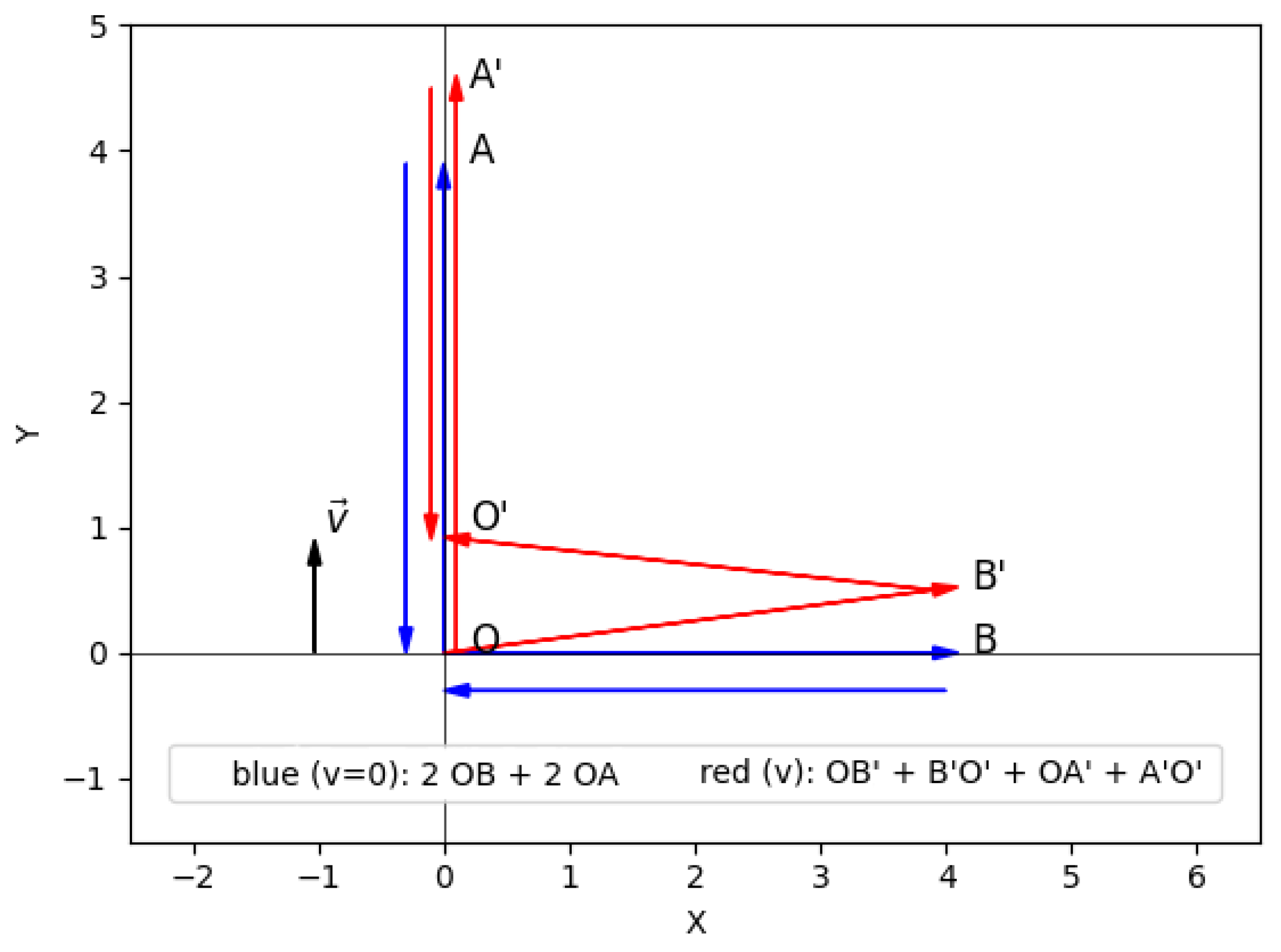
Derivation of Using Figure 1
Distance traveled by light in the medium:
Travel time:
Let us consider the travel durations between the points:
5. Equality Condition
Equal travel times require:
Thus:

Table 1.
Complete analysis of light paths in the Michelson-Morley experiment (medium frame)
| Parameter | Longitudinal Arm | Transverse Arm |
|---|---|---|
| Arm length at velocity v | ||
| Round-trip time | ||
| Null result condition | ||
| Lorentz-FitzGerald special case | ||
6. Invariance of the Null Result for an Arbitrary Initial Velocity
Regardless of the interferometer’s velocity v relative to the medium, the experimental outcome remains null. When the relative velocity changes during the experiment (due to Earth’s rotation, for example), the arm lengths adjust dynamically according to the new velocity. The experimental result remains null at all times.
For this result to be maintained consistently for any orientation and velocity relative to the medium, the model must assume that the dimensional changes affect the interferometer and any material measuring device proportionally. This hypothesis ensures the internal consistency of the model, as the deformation, while ’absolute’ relative to the medium, would be undetectable by local length measurements. The physical mechanism underlying these universal deformations is explained by modeling matter as wave-based structures, an approach we develop comprehensively in the subsequent article of this series. In that framework, particles are described as standing wave patterns whose spatial properties necessarily transform with motion relative to the medium.
The Lorentz-FitzGerald Special Case
The pre-relativistic Lorentz-FitzGerald contraction postulate corresponds to the specific case where (no transverse deformation), requiring:
This special case represents one specific, mathematically simplest solution among the infinity of solutions satisfying the general condition. The Michelson-Morley experiment alone cannot distinguish this special case from other solutions; it only constrains the deformation ratio.
7. Discussion
The fundamental condition we have derived, , ensures the Michelson-Morley null result in a medium-based framework. The principal features of this framework are:
- At (interferometer at rest relative to the medium), , implying no anisotropic dimensional changes.
- For , the ratio is fixed by the Lorentz factor.
- In the special case where (Lorentz-FitzGerald postulate), the longitudinal arm contracts according to .
- The generality of this framework - where only the ratio between deformations is constrained - allows for various physical interpretations beyond the specific Lorentz-FitzGerald case. Different medium properties (isotropic or anisotropic) would correspond to different functional forms for and , all while satisfying the same fundamental constraint from the null result.
7.1. Implications and Falsifiability
A key strength of this generalized framework is its falsifiability. While the Michelson-Morley experiment only constrains the ratio of deformations, other experimental configurations could, in principle, break this degeneracy and measure the absolute dimensional changes.
If future experiments were able to independently measure the longitudinal and transverse dimensions of an object moving at high velocity relative to a hypothetical preferred frame—for instance, through matter-wave interferometry or advanced resonator techniques that are sensitive to absolute lengths rather than round-trip light travel times—they could directly test the specific values of and .
A measurement of a non-zero transverse deformation () would challenge both special relativity and the original Lorentz hypothesis, pointing towards a more complex medium-interaction mechanism. Conversely, a null result for both deformations in such an experiment would falsify the entire class of models based on physical length changes and strongly support the geometric interpretation of special relativity.
This approach provides a mathematical foundation for exploring alternative medium-based theories without contradicting the Michelson-Morley experimental evidence. It demonstrates that the null result does not necessarily imply the absence of a medium, but rather imposes a very specific relationship between longitudinal and transverse deformations that any motion relative to such a medium would induce.
7.2. Theoretical Framework Versus Operational Tool
The fundamental relationship we have derived is established within the theoretical framework of a propagation medium and requires knowledge of the velocity v relative to that medium. This approach provides a conceptually coherent interpretation of the Michelson-Morley null result from a medium-based perspective.
However, a crucial distinction must be made between theoretical coherence and operational utility. In practice, we only have access to relative velocities between inertial frames, not to an absolute velocity relative to a hypothetical medium. This fundamental experimental constraint makes Einstein’s special relativity an indispensable tool for all practical calculations and predictions.
The model presented here and special relativity should therefore be viewed as complementary rather than antagonistic:
- Special relativity provides the operational mathematical framework for all practical computations and is verified by countless experiments.
- The medium-based framework offers an alternative physical interpretation that may prove fruitful for rethinking the foundations of cosmology and astrophysics, particularly in understanding the deep structure of the universe at cosmological scales.
This duality is not unlike that between quantum mechanics and classical physics: although the former provides a more fundamental description, the latter remains essential for most practical applications. Similarly, the pursuit of medium-based models, despite their immediate operational limitations, may open new perspectives for understanding universal properties that remain hidden in the purely relativistic description.
7.3. Experimental Pathway to Absolute Motion Detection
A remarkable implication of this theoretical framework is that it offers a potential pathway to measure absolute motion relative to the medium. If experimental techniques were developed to directly measure the ratio from different inertial frames with known relative velocity , one could solve the equation:
where the left-hand side is experimentally measured and is the known relative velocity between frames. Measurement of the left-hand side would uniquely determine , the absolute velocity relative to the medium.
This approach differs fundamentally from historical ether-drift experiments by measuring dimensional ratios rather than light travel times, potentially offering enhanced sensitivity.
8. Conclusions
The Michelson–Morley null result can be reproduced in a medium-based framework through the derived relationship between longitudinal and transverse dimensional changes. This approach generalizes the Lorentz contraction and demonstrates that medium-based interpretations remain consistent with experimental evidence while providing a physically intuitive mechanism for the null result.
The key insight of this framework is its distinction between the theoretical description involving motion relative to a medium and the operational necessity of using relative velocities in practical physics. While special relativity remains the essential tool for all experimental and theoretical work in fundamental physics, our medium-based interpretation offers complementary insights that may prove valuable for addressing outstanding cosmological questions and for conceptualizing the deep structure of space-time.
The framework’s falsifiable character–through the potential measurement of absolute velocity via length ratio comparisons–provides a clear experimental pathway for future validation or refutation. This positions medium-based theories not as competitors to operational relativity, but as complementary explorations of physics beyond the current phenomenological description, maintaining empirical consistency while offering new perspectives on the nature of space and time.
References
- Michelson, A. A., & Morley, E. W. (1887). On the Relative Motion of the Earth and the Luminiferous Ether. American Journal of Science, 34, 333-345.
- Einstein, A. (1905). Zur Elektrodynamik bewegter Körper. Annalen der Physik, 17(10), 891-921.
- Prokhovnik, S. J. (1973). The Logic of Special Relativity. Cambridge University Press.
- Cahill, R. T. (2005). The Michelson and Morley 1887 Experiment and the Discovery of Absolute Motion. Progress in Physics, 3, 25-29.
- Lorentz, H. A. (1904). Electromagnetic phenomena in a system moving with any velocity smaller than that of light. Proceedings of the Royal Netherlands Academy of Arts and Sciences, 6, 809-831.
- FitzGerald, G. F. (1889). The Ether and the Earth’s Atmosphere. Science, 13(328), 390.
- Mansouri, R., & Sexl, R. U. (1977). A test theory of special relativity: I. Simultaneity and clock synchronization. General Relativity and Gravitation, 8(7), 497-513.
- Kennedy, R. J., & Thorndike, E. M. (1932). Experimental Establishment of the Relativity of Time. Physical Review, 42(3), 400-418.
Figure 1.
Photon Trajectories in the Stationary and Moving Michelson–Morley Interferometer
Disclaimer/Publisher’s Note: The statements, opinions and data contained in all publications are solely those of the individual author(s) and contributor(s) and not of MDPI and/or the editor(s). MDPI and/or the editor(s) disclaim responsibility for any injury to people or property resulting from any ideas, methods, instructions or products referred to in the content. |
© 2025 by the authors. Licensee MDPI, Basel, Switzerland. This article is an open access article distributed under the terms and conditions of the Creative Commons Attribution (CC BY) license (http://creativecommons.org/licenses/by/4.0/).
Copyright: This open access article is published under a Creative Commons CC BY 4.0 license, which permit the free download, distribution, and reuse, provided that the author and preprint are cited in any reuse.


