

Submitted:
21 September 2025
Posted:
26 September 2025
Read the latest preprint version here
Abstract
Green hydrogen is gaining global momentum as a cornerstone of the energy transition. Its production, utilization, and trade require a robust regulatory framework to ensure safety, quality, and market access. This report examines international and regional regulations, standards, and guidelines relevant to green hydrogen, with particular emphasis on adapting them to the Jordan context. It synthesizes European Union (EU) directives, International Organization for Standardization (ISO) and International Electrotechnical Commission (IEC) standards, as well as U.S. and international best practices. It compares these regulations with Jordan’s current regulatory landscape. Drawing on the Draft National Green Hydrogen Strategy for Jordan (2023) and the World Bank’s 2025 policy note, this review identifies critical gaps, proposes an adaptation roadmap, and explores how Jordan can position itself as a regional and export-oriented hub.
Keywords:
green hydrogen
; regulatory framework
; standards and guidelines
; Jordan road map
Introduction
Green hydrogen has emerged as a critical component of the global energy transition, offering low-carbon alternatives for industry, transportation, and power generation. Unlike grey and black hydrogen, which are produced from fossil fuels, green hydrogen is derived from renewable electricity through water electrolysis, thereby providing a sustainable pathway toward decarbonization [1]. The importance of hydrogen is reflected in global strategies, particularly in the European Union (EU) and leading economies in Asia and the Middle East, which are advancing policies to stimulate hydrogen markets. Jordan, with its substantial renewable energy resources, is uniquely positioned to benefit from this global momentum.
Jordan’s solar and wind resources exceed 3,000 full-load hours annually in its southern regions, creating a solid foundation for large-scale hydrogen production [2]. National strategies, including the Economic Modernization Vision 2033 and the National Energy Strategy 2030, explicitly identify hydrogen as a future pillar of the energy mix. In 2023, Jordan established the National Committee for Hydrogen to coordinate strategy, regulatory development, and international cooperation.
According to the World Bank’s 2025 policy note, this reflects a strong political will to integrate hydrogen into the country’s energy and industrial framework [3]. However, transforming this vision into reality requires regulatory adaptation, institutional collaboration, and alignment with international standards to secure market access, particularly in the EU. Moreover, Jordan’s robust solar and wind resource base, continuous energy policy improvements since 2020, and efforts to link with European markets for future power exports are shown in Figure 1.
International and Regional Frameworks
The global hydrogen economy is shaped by international regulations, technical standards, and certification mechanisms. These frameworks ensure that hydrogen is produced safely, meets quality benchmarks, and can be traded across borders. For Jordan, alignment with such frameworks is essential to secure export opportunities and to attract foreign investment.
The European Union has been at the forefront of developing hydrogen-specific policies. The Renewable Energy Directive II (RED II), adopted in 2018 and amended in 2023, established renewable energy targets and certification mechanism for renewable fuels of non-biological origin (RFNBOs) [4]. The EU Delegated Regulation 2023/1184 further specifies lifecycle emissions accounting and renewable criteria for hydrogen [5]. These frameworks are particularly relevant for Jordan because the EU is expected to be a significant market for imported green hydrogen.
International technical standards are also central to hydrogen deployment. ISO 22734 sets out safety standards for electrolyzers [6], ISO 14687 defines hydrogen purity requirements [7], and ISO 19880-1 addresses safety protocols for hydrogen refueling stations [8]. Moreover, the IEC 60079 standard provides guidelines on explosion protection in hydrogen environments [9].
International and Regional Frameworks
Beyond ISO and IEC, the United States Department of Energy (DOE) maintains an extensive repository of codes and standards [10], while Det Norske Veritas company (DNV) offers industry guidance on hydrogen safety and operational best practices [11].
Regionally, countries such as Saudi Arabia, Oman, Egypt, and Morocco are developing their own hydrogen frameworks [12,13,14,15]. Saudi Arabia is advancing regulatory pilots within the NEOM hydrogen hub. Oman has introduced hydrogen-specific institutions to manage large-scale projects. Egypt has linked hydrogen production with its ports and international trade agreements, while Morocco has aligned its certification schemes closely with EU requirements. These experiences demonstrate diverse models that Jordan can draw upon when designing its own regulatory framework.
Jordan’s Current Legal and Institutional Context
Jordan’s current legal and institutional framework provides a starting point for hydrogen regulation but remains incomplete. The Environmental Protection Law No. 6/2017 requires Environmental Impact Assessments (EIAs) for industrial and energy projects, providing a foundation for hydrogen-related developments [16]. However, hydrogen-specific guidelines for EIAs are yet to be developed. The Energy and Minerals Regulatory Commission (EMRC) currently regulates the electricity and mining sectors, but its mandate must be expanded to cover hydrogen production, storage, and transport [3].
The Jordan Standards and Metrology Organization (JSMO) plays a key role in adopting international standards. It has the capacity to integrate ISO and IEC hydrogen standards into Jordanian regulations. Similarly, the National Electric Power Company (NEPCO) operates the grid code, which requires updates to accommodate large-scale electrolyzers and renewable energy integration. Finally, the Petroleum Products Law remains limited to oil derivatives and must be amended or supplemented with hydrogen-specific bylaws.
The Draft National Green Hydrogen Strategy (2023) provides a policy vision for hydrogen, structured around five pillars: investment mobilization, stimulation of domestic demand, development of low-cost supply, leadership in renewable energy deployment, and creation of an enabling environment [2]. This strategy aligns with Jordan’s broader economic modernization goals but requires legislative and institutional reforms to be operationalized.
Gap Analysis and Adaptation Strategy
The regulatory framework for hydrogen in Jordan is marked by fragmentation and a lack of explicit hydrogen-specific regulations. While general environmental and energy regulations exist, they are insufficient for ensuring safe production, quality control, and international market access. Key gaps include the lack of a hydrogen-specific legal framework, the absence of certification mechanisms required by the EU, limited laboratory and testing capacity, and insufficient technical expertise among inspectors.
Following that, Table 1 table below summarizes the key gaps and proposed adaptation measures. It is a roadmap linking hydrogen-related documents to current status, gaps, recommended actions, responsible agencies, priority, and target timelines for implementation across a national context.
Integration with National Strategy
The Draft National Green Hydrogen Strategy outlines Jordan’s vision for both domestic use and export markets. By 2030, the strategy projects production of 591,000 tonnes of green hydrogen, scaling to 3.4 million tonnes by 2050 [2]. A significant portion of this output, up to 2.3 million tonnes, is expected to be converted into green ammonia for export, particularly through the Aqaba Eco- Port.
Domestically, hydrogen is expected to play a role in refining, fertilizers, heavy-duty transport, municipal bus fleets, steel and cement industries, and electricity generation. These applications align with Jordan’s broader goals of industrial decarbonization and energy security. The socio-economic benefits are projected to be substantial, including the creation of 65,000 jobs by 2050, capital investment of up to $175 billion, and avoidance of 8.2 million metric tonnes of CO2 equivalent annually [2].
Regional Cooperation and Trade
Jordan’s strategic location and access to the Red Sea through Aqaba provide it with opportunities to integrate into regional and global hydrogen supply chains. In the short to medium term, exports are likely to focus on shipping green ammonia to European and Asian markets. Over the longer term, Jordan could participate in pipeline-based exports, such as extensions of the Arab Gas Pipeline (AGP) or new corridors linking the Eastern Mediterranean to Europe. Regional cooperation is essential for standardization and certification. Aligning Jordan’s regulations with those of the EU, Gulf Cooperation Council (GCC), and North Africa will enhance competitiveness. Lessons from Morocco and Egypt suggest that early integration with EU certification systems can provide a strong advantage for exporters.
Institutional and Capacity Needs
For Jordan to achieve its hydrogen ambitions, significant institutional and capacity-building efforts are required. Certification bodies aligned with EU RFNBO rules must be created. Hydrogen quality laboratories should be established, ideally within universities and accredited private facilities, to ensure compliance with ISO 14687 purity standards. Training programs for engineers, safety inspectors, and technicians will be necessary to build a skilled workforce. Public awareness campaigns should also be launched to enhance social acceptance of hydrogen technologies.
Institutional coordination will be critical. A cross-ministerial steering committee led by the Ministry of Energy and Mineral Resources (MEMR) could provide oversight, supported by EMRC, JSMO, NEPCO, and the Ministry of Environment (MoE). Ultimately, a dedicated hydrogen regulator may be required to consolidate responsibilities.
Implementation Roadmap
The implementation roadmap for Jordan can be divided into two main phases. In the short to medium term (2025-2030) and long term (2030-2050) as clarified in Figure 2. The country should prioritize adopting RFNBO certification, expanding EMRC’s mandate, introducing investors’ incentives, publishing hydrogen-specific EIA guidelines, updating the NEPCO grid code, enacting pipeline legislation, establishing hydrogen infrastructure in Aqaba, establishing hydrogen quality laboratories, and creating a hydrogen regulator.
In the long term (2030–2050), Jordan should develop export pipelines, harmonize certification with regional partners, and continuously adapt to evolving EU and international standards.
Conclusions
Jordan has laid strong foundations for the green hydrogen sector, anchored in Vision 2033, the National Hydrogen Strategy (2024), and the newly approved incentives (2025). The country’s renewable energy endowment positions it well to become a competitive exporter and regional hub. However, realizing this potential requires immediate progress on legal and regulatory reforms, including RFNBO adoption, hydrogen-specific EIA guidelines, and EMRC mandate expansion. The establishment of Common Use Infrastructure in Aqaba and the operationalization of hydrogen quality certification systems are critical to gaining access to export markets. Over the medium term, legislation for hydrogen transport, creation of a super regulator, and continuous capacity building will be required to build confidence among investors and trading partners. In the long term, scaling renewable energy capacity, integrating hydrogen into gas networks, and localizing green industries such as ammonia will consolidate Jordan’s leadership role. By aligning its domestic strategy with international standards, supported by targeted fiscal incentives, Jordan can ensure that its green hydrogen sector contributes both to national decarbonization and to global clean energy supply chains.
Abbreviation
| EUD | European Union directives |
| ISO | International Organization for Standardization |
| IEC | International Electrotechnical Commission |
| RED | Renewable Energy Directive |
| RFNBO | renewable fuels of non-biological origin |
| USDOE | United States Department of Energy |
| DNV | Det Norske Veritas company |
| MEMR | Ministry of Energy and Mineral Resources |
| NEPCO | National Electric Power Company |
| JSMO | Jordan Standards and Metrology Organization |
| EIA | Environmental Impact Assessments |
| EMRC | Energy and Minerals Regulatory Commission |
References
- IEA. (2022). Global Hydrogen Review 2022. International Energy Agency, Paris.
- MEMR/USAID. (2023). Draft National Green Hydrogen Strategy for Jordan. Ministry of Energy and Mineral Resources, Amman.
- World Bank. (2025). Jordan Green Hydrogen Policy Note – Legal and Regulatory Framework. Washington, D.C.
- European Parliament. (2018, amended 2023). Renewable Energy Directive II (RED II). EUR-Lex.
- European Commission. (2023). EU Delegated Regulation 2023/1184 – RFNBO Rules. EUR-Lex.
- ISO. (2019). ISO 22734: Hydrogen Generators Using Water Electrolysis. https://www.iso.org/standard/ 60891.html.
- ISO. (2019). ISO 14687: Hydrogen Fuel – Product Specification. https://www.iso.org/standard/69539.html.
- ISO. (2020). ISO 19880-1: Gaseous Hydrogen Fuelling Stations. https://www.iso.org/standard/71102.html.
- IEC. (Ongoing). IEC 60079: Explosive Atmospheres. https://webstore.iec.ch/publication/634.
- DOE. (2024). US DOE Hydrogen Program – Codes & Standards. https://h2tools.org/codes-and-standards.
- DNV. (2022). Hydrogen Safety and Standards Guidance. https://www.dnv.com/hydrogen.
- NEOM Green Hydrogen Company completes financial close at a total investment value of USD 8.4 billion in the world’s largest carbon-free green hydrogen plant. (n.d.). https://www.neom.com/en-us/newsroom/neom-green- hydrogen-investment.
- Hydrom. (n.d.). Retrieved September 3, 2025, from https://hydrom.om/Round3Auction.aspx? cms=iQRpheuphYtJ6pyXUGiNqnYV4sgAJufC.
- Egypt’s $40B Green Hydrogen Strategy: Major Projects to Watch. (n.d.). Retrieved September 3, 2025, from https://energycapitalpower.com/egypts-40b-green-hydrogen- strategy-major-projects-to-watch/.
- Morocco | Green Hydrogen Organisation. (n.d.). Retrieved September 3, 2025, from https://gh2.org/countries/morocco.
- Ministry of Environment. (2017). Environmental Protection Law No. 6/2017. https://www.moenv.gov.jo/.
Figure 1.
Jordan’s Renewable Energy Potential and EU Alignment.
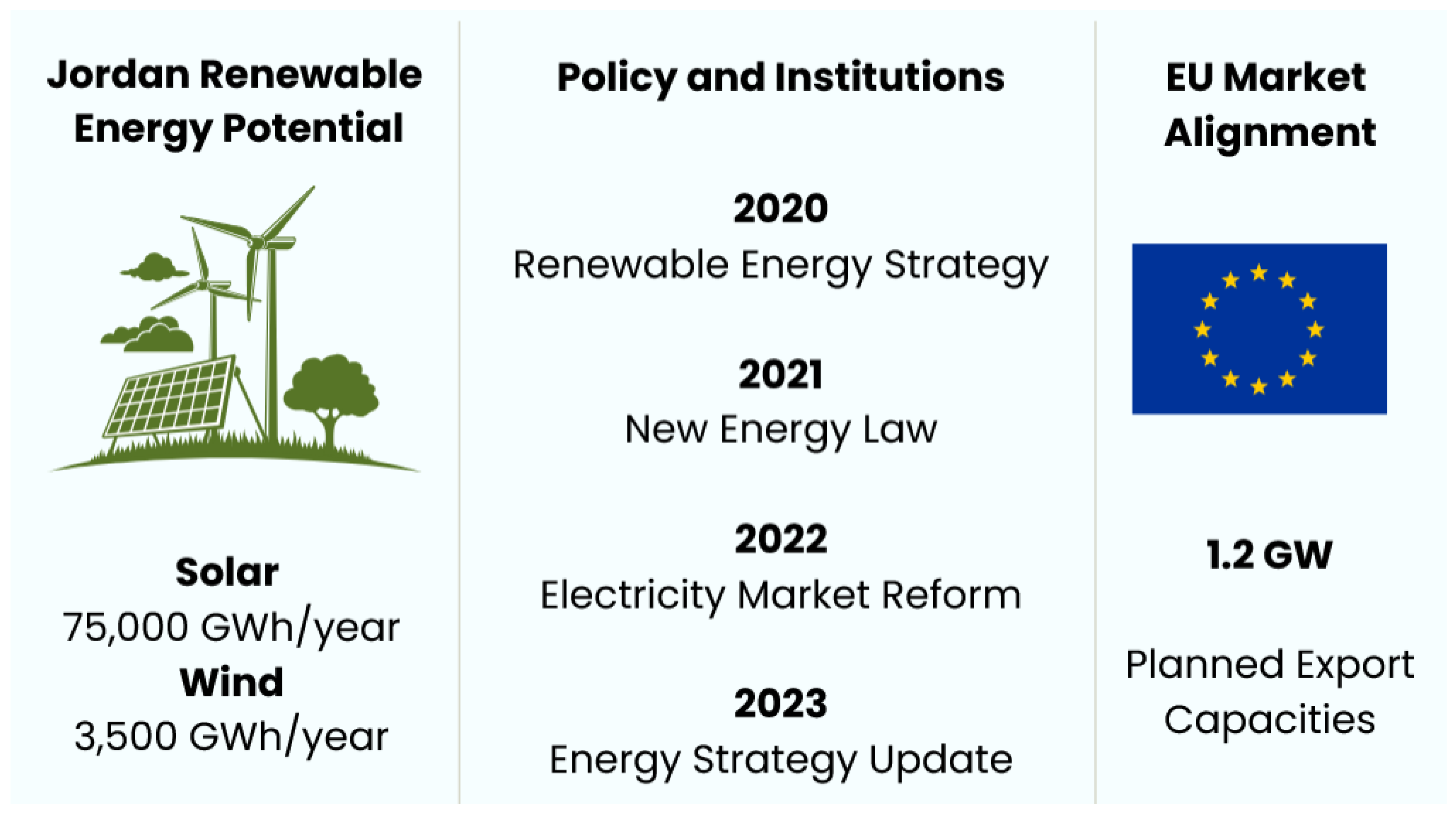
Figure 2.
Jordan’s Hydrogen Roadmap 2025–2050.
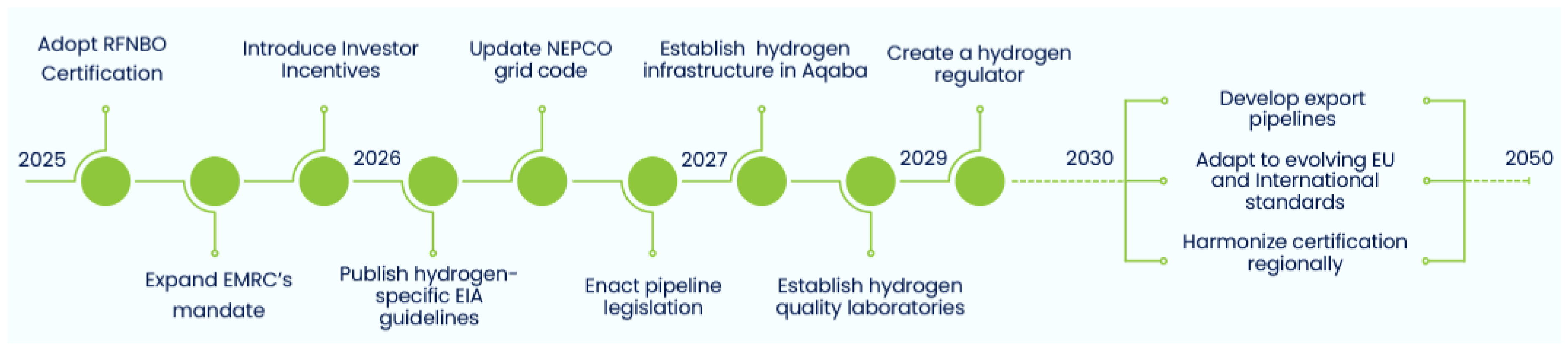

Table 1.
Key gaps and proposed adaptation measures for green hydrogen road map in Jordan.
| Document | Relevance | Current Status | Gap | Recommended Action | Priority | Responsible Agency | Timeline |
|---|---|---|---|---|---|---|---|
| EU RFNBO Rules | Export criteria | Not adopted | No local verification | Develop RFNBO verification procedures | High | MEMR / Industry | 2025 Q4 |
| RED II | Sustainability targets | Not integrated | No national target | Align Jordanian policy with RED II | High | MEMR | 2025 Q4 |
| ISO 22734 | Electrolyzer safety | Partial adoption | Limited training | Adopt ISO 22734, engineer training | High | JSMO / MEMR | 2025 Q3 |
| ISO 14687 | Fuel quality | Not adopted | No certified labs | Establish hydrogen quality labs | High | JSMO / MEMR / Universities | 2025 Q4 |
| IEC 60079 | Explosion protection | Partial adoption | Limited inspector capacity | Train inspectors, enforce IEC 60079 | High | JSMO / Civil Defense | 2025 Q3 |
| Hydrogen Regulation | Transport & derivatives | Absent | No legal framework | Amend Petroleum Products Law or issue hydrogen-specific bylaw | High | MEMR | 2026 Q1 |
| Certification | Export markets | Absent | No independent certifiers | Establish accredited certification bodies aligned with EU RFNBO | High | JSMO / MEMR | 2026 Q2 |
Disclaimer/Publisher’s Note: The statements, opinions and data contained in all publications are solely those of the individual author(s) and contributor(s) and not of MDPI and/or the editor(s). MDPI and/or the editor(s) disclaim responsibility for any injury to people or property resulting from any ideas, methods, instructions or products referred to in the content. |
© 2025 by the authors. Licensee MDPI, Basel, Switzerland. This article is an open access article distributed under the terms and conditions of the Creative Commons Attribution (CC BY) license (http://creativecommons.org/licenses/by/4.0/).
Copyright: This open access article is published under a Creative Commons CC BY 4.0 license, which permit the free download, distribution, and reuse, provided that the author and preprint are cited in any reuse.