
Submitted:
25 September 2025
Posted:
25 September 2025
Read the latest preprint version here
Abstract
In Latin America, coffee is cultivated in distinct coffee agroecosystems (CAS), ranging from traditional agroforestry systems (CAFS) to intensive unshaded monocultures (UCAS). While various socioenvironmental impacts of these systems have been studied, their implications have not yet been integrated within a Planetary Health perspective. This review examines how different CAS in Latin America affect human and planetary health, applying the Planetary Boundaries framework and structuring results through the DPSEEA (Drivers, Pressures, State, Exposure, Effects, Actions) model to map the relationships between socio-environmental drivers, different CAS, natural systems at local and global scales, and human health and well-being. The analysis shows that conventional intensification, driven by low revenues for producers, climate change, and disease outbreaks, has accelerated deforestation, biodiversity loss, greenhouse gas emissions, agrochemical use and leakage, and water pressures. These changes create health risks for coffee-growing communities, such as pesticide exposure, food insecurity, and increased vulnerability to external shocks. Conversely, agroecological practices can mitigate environmental pressures while reducing exposure to health hazards and improving resilience, food security, and income stability. However, mainstreaming these practices requires addressing structural inequities in the global coffee value chain to ensure fairer revenue distribution, stronger institutional support, and the protection of coffee-growing communities.
Keywords:
coffee
; farming
; agroforestry
; agroecology
; planetary health
; DPSEEA
; planetary boundaries
; sustainability
; food systems
; food security
1. Introduction
Coffee is among the world’s most traded tropical commodities, with a global market valued at over US $200 billion annually (ICO 2020). 80% of the world’s coffee is produced by around 25 million smallholder families in the Global South, yet most of the consumption and revenues are concentrated in the northern hemisphere (FAO 2024). Two species dominate global coffee production. Coffea arabica is generally considered superior, but it is a delicate plant requiring specific temperature, humidity, and shade conditions usually found in tropical mountainous regions (Scott 2015). It accounts for 56% of global coffee production (USDA, 2023), concentrated in Latin America, East Africa, and the Arabian Peninsula (Myhrvold 2024). Conversely, Coffea canephora, whose main variety is Robusta, is bitter, contains higher caffeine levels, and is both more productive and disease-resistant. Robusta thrives in warmer climates, often under direct sunlight and at lower altitudes (Jha et al. 2014; Pham et al. 2019). Its production is concentrated in Brazil and Vietnam (the world’s two largest coffee producers), alongside Southeast Asia and West and Central Africa (Rafferty 2023).
The distinct ecological traits of Arabica and Robusta have interacted with diverse biocultural landscapes and historical processes to shape their geographic distribution and cultivation methods. In Brazil, for instance, coffee production is dominated by large-scale, intensively managed Robusta monocultures that depend heavily on wage labor, and similar patterns are found across Latin America in the so-called finca model (Perfecto et al. 2019b). Conversely, a significant share of coffee is cultivated by smallholder farmers in agroforestry systems (often traditional) where Arabica varieties are intercropped with a range of productive and non-productive plants. In this way, coffee cultivation emerges from a dynamic interplay between ecological configurations, sociopolitical structures, and cultural knowledge, resulting in distinct coffee agroecosystems (CAS).
In Latin America, differences between CAS have long been recognized by both producers and scholars. A broad, popular distinction recognizes “shaded coffee”, or coffee agroforestry systems (CAFS), and “sun coffee”, or unshaded coffee agroecosystems (UCAS), based on the presence or absence of shade trees (Figure 1). A more detailed typology proposed by Moguel & Toledo (1999) further differentiates CAFS according to decreasing vegetation structural complexity, ranging from traditional “rustic” systems (rustic T-CAFS), in which coffee is planted within mature primary forests traditionally managed by indigenous communities; to traditional polycultures (T-CAFS), where coffee is intercropped with other plants for human use under primary forest canopy; to commercial polycultures, where forest cover is replaced by planted shade trees and a limited variety of commercial crops; and finally to shaded monocultures (M-CAFS), dominated by one or a few species of shade trees (Figure 2).
However, CAS differ in several dimensions beyond shade level and vegetation structure, including biodiversity, farm size, use of technology and agrochemicals, as well as land tenure and labor organization. These characteristics are captured in the “coffee intensification gradient” proposed by Perfecto et al. (2019b), which spans from traditional, low-intensity multifunctional systems to highly intensified monocultures. Low-intensity multifunctional CAS typically feature:
- Multistory agroforestry with diverse shade trees.
- High biodiversity and ecological complexity, supporting key ecosystem functions.
- Native Arabica varieties.
- Minimal external inputs such as agrochemicals.
- Small-scale farms (<10he), often family-owned and operated.
- Integration with local or indigenous knowledge and labor systems.
Conversely, at the high-intensity end, CAS are marked by:
- High-density coffee monocultures, often with no or low-diversity canopy.
- Ecological simplification and reduced biodiversity.
- Use of Robusta or hybrid Arabica cultivars.
- Heavy reliance on agrochemicals.
- Large-scale operations (>10 ha), often corporate-owned.
- Seasonal wage labor under hierarchical management.
In recent decades, a growing body of research has documented the positive impacts of multifunctional CAFS on biodiversity conservation and on Nature’s Contributions to People (NCP)1 when compared to UCAS, including pollination, carbon (C) storage, soil formation and protection, and livelihood diversification (Davidson 2004; Toledo and Moguel 2012; Libert-Amico and Paz-Pellat 2018; Perfecto et al. 2019b). In the past decade research has also extended beyond ecology to examine how varying agroecological configurations and management practices influence human health outcomes such as food security and nutrition (Fernandez and Méndez 2019; Anderzén et al. 2020), pesticide exposure (Conti et al. 2018; Hutter et al. 2018b), and mental health (Nieto-Betancurt et al. 2024).
However, since the 1960s, T-CAFS have undergone widespread intensification in Latin America. Between 1970 and 1990, roughly 50% of T-CAFS in the region were converted to monocultures, and by 2010 only 24% remained (Jha et al. 2014). This trend appears has accelerated in the last decade (Valencia et al. 2018; Harvey et al. 2021). Despite growing interest, no prior study has synthesized the evidence linking coffee farming under different CAS, natural systems at local and planetary scales, and human health and wellbeing. To map the existing evidence, a literature review was conducted guided by the research question: what are the impacts of different CAS in Latin America and their transformation on planetary health? –defined here as the interdependent health of human populations in all its dimensions and the natural systems on which they rely (Whitmee et al. 2015). Different frameworks were integrated to address this question. First, the Planetary Boundaries (PB) framework was used to evaluate the differential impacts of various CAS in Latin America on local and global natural systems. The review then assessed how coffee farming influences human health and its determinants, and identified key leverage points and policy actions needed to support fairer, healthier, and more sustainable coffee systems. Finally, these relationships are integrated using the Drivers-Pressures-State-Exposure-Effect-Action (DPSEEA) framework, synthetizing the links between CAS and planetary health.
This review focuses on Latin America due to the region’s shared historical, cultural, and socioeconomic trajectories in coffee cultivation; however, the findings are intended to inform discussions on global food systems and agroecological transitions, and contribute to the identification and promotion of coffee systems that offer co-benefits for planetary health in diverse contexts worldwide.
2. Methods
While not a systematic review, efforts were made to structure and systematize the literature search and screening process. To facilitate integration into DPSEEA, the review was conceptually divided into two complementary streams:
- D-P-S review: a review of the Drivers of CAS management practices and their transformation (Pressure), and their impacts of these on the six PB deemed most relevant in coffee farming (State): biosphere integrity, land-system change, climate change, biogeochemical flows, novel entities, and freshwater use.
- S-E-E review: a review of the impacts of the former on the ecosocial determinants of human health (Exposure) and health outcomes (Effect), particularly among coffee-growing communities and farmers.
A combination of keywords (Table 1) was used to conduct a database search on Pubmed and Scopus on June 27th, 2024. The detailed search query is available in the supplementary material (S1). Searches were conducted in English and Spanish, and no publication date filter was applied. In total, 4435 records were retrieved (DPS review: n=553;1754. SEE review: n=1220;908), After removing 1443 duplicates, 2992 (DPS: 1592; SEE: 1400) unique records remained.
Screening was conducted in three stages according to the selection criteria outlined in Table 2: (1) by title and abstract, (2) by sorting for relevance, and (3) by full-text reading. After screening by title and abstract, 438 studies were categorized by topic, study type, main findings reported in the abstract and strength of evidence. Then, in order to identify key literature for evidence mapping and integration within the DPSEEA model, they were sorted by relevance according to scope, thematic representativeness, strength of evidence, and alignment with the PB and DPSEEA frameworks. When multiple studies addressed overlapping topics, the most representative were prioritized, often systematic reviews or meta-analyses. Additional preference was given to studies covering under-researched areas or underrepresented regions. During this process 151 records were pre-selected as key literature. During full-text reading 40 further records were identified by snowballing and targeted thematic searches, and 146 were finally included in this review, including 120 original journal articles, 24 reviews and reports and 2 book chapters. (Figure 3). Evidence was charted and synthesized using the DPSEEA framework, and interpreted in light of the Planetary Health framework, with insights from complex systems and equity perspectives. Mexico, Brazil and Colombia contribute to half (51%) of the reviewed literature (Figure 4). Results are presented in three sections: section 3 presents the main drivers of coffee landscape transformations in Latin America (DP elements of DPSEEA); section 4 presents the main impacts of CAS on PB (PSE elements of DPSEEA); and section 5 presents the main pathways linking CAS, their trends of change and their impact on PB with human health (the SEE elements of DPSEEA).
3. Drivers of Transformation in Coffee Landscapes
The literature reviewed shows that coffee cultivation in Latin America is undergoing seven major trends of transformation the 21st century: (1) a shift to disease-resistant cultivars; (2) conventional intensification through reduced shade, higher planting densities, and increased agrochemical use; (3) the replacement of Arabica with Robusta; (4) the introduction of Robusta in previously uncultivated areas; (5) the conversion of CAS to other crops or pastureland; (6) the expansion of coffee cultivation into forests; and (7) the adoption of sustainability standards (Harvey et al. 2021). Most of these trends reflect the increasing management intensification and ecological simplification of CAS. The drivers of these transformations are multiple, but three stand out: declining net revenues and producer share in the coffee value chain (CVC), increasing impacts of climate change, and recurrent outbreaks of coffee leaf rust (CLR), a fungal disease affecting coffee (Harvey et al. 2021; Escobar-Ocampo et al. 2023; Gabriel-Hernández and Barradas 2024). Other contributing factors include labor shortages and weakening institutional support (Renard 2011; Griffith et al. 2017; Gabriel-Hernández and Barradas 2024).
3.1. Decreasing and Volatile Revenues for Coffee Producers
The literature reviewed consistently points at decreasing and volatile revenues for coffee producers as a critical driver of coffee landscape transformations. Despite a market value exceeding USD $200 billion and steady demand growth of 2% annually over the past two decades (Cordes et al., 2021; ICO, 2020), most producers in the Global South live below the poverty line, earning less than a living income (Cordes et al. 2021; Panhuysen and de Vries 2023). The collapse of the International Coffee Agreement in 1989 and the dismantling of national coffee institutes during the 1980s amidst neoliberal reforms exacerbated these imbalances, leading to a decline in coffee prices paid to producers (Figure 5), a shift in market control toward corporations, the financialization of the coffee trade, and a concentration of revenues within financial and commodity markets (Rettberg 2010; Renard 2011; Hausermann 2014; Utrilla-Catalan et al. 2022). For instance, Colombian producers’ share of final coffee value fell from 20% to 13% between 1970 and 1989, while roasters’ share rose from 53% to 78%; today, producers earn roughly 10% of coffee’s final value (Rettberg 2010; Renard 2011; Devoney 2022). Monopolistic corporate consolidation has eroded producers’ bargaining power, often forcing them to sell below production costs (Braunschweig et al. 2019; Vázquez 2023; Lalani et al. 2024).
Global coffee prices are largely determined in futures markets, where speculative trading has exploded since 1994 and now exceeds physical coffee production by a factor of ten (Hicks 2018; International Coffee Council 2019; European Coffee Federation 2022). Low prices are compounded by extreme volatility, driven by financial speculation and fluctuations in coffee supply and production costs (Barrios-Puente et al. 2022). This undermines farmers’ livelihoods, and has triggered widespread crises associated with food insecurity, school dropout, reduced healthcare spending, and increased migration, as happened during the 2000s coffee crisis in Central America (Gresser and Tickell 2002; Bacon 2010). Outmigration of coffee farmers, in turn, contributes to labor shortages and rising production costs (Griffith et al. 2017; Gabriel-Hernández and Barradas 2024).
- Box 1. Human Rights violations in Coffee Farming.
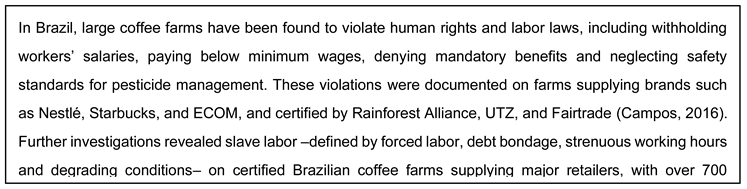
Facing these pressures, many producers have sought to sustain their incomes by increasing production through conventional intensification and expansion into natural areas. This has been encouraged institutionally through the promotion of Robusta cultivation, recommendations to reduce shade, and agrochemical subsidization (Jha et al. 2014; Perfecto et al. 2019b). Some authors point out that resulting overproduction has depressed prices further, justifying continued intensification (Renard 2011; Jha et al. 2014). For example, an aggressive promotion of Robusta cultivation in Vietnam –subsidized by the World Bank– led to an oversupply of cheap coffee that displaced higher-quality Arabica, contributing to lower coffee prices in Latin America (Renard 2011).
3.2. Climate Change
The literature reviewed documents that rising temperatures, unpredictable precipitation patterns, and extreme weather events, such as droughts and hurricanes, are already affecting coffee production and reshaping coffee landscapes across Latin America (Harvey et al. 2021). For example, in Veracruz, Mexico, climate change is reported by farmers as the second most important stressor after low coffee prices, and yield models confirm significant losses attributable to shifting climatic conditions (Gabriel-Hernández and Barradas 2024). In Central America, a survey of 860 smallholder farmers across three countries found that 66% reported negative effects of rising temperatures, erratic rainfall, and extreme events on yields, pest and disease pressure, income, and food security, and 58.7% had changed their practices in response (Harvey et al. 2018). Extreme weather events are also altering coffee landscapes through forced migration and farm abandonment, as seen after hurricanes Mitch (1998), Stan (2005), and more recently Eta and Iota (2020) (Fromm 2023; Escobar-Ocampo et al. 2023). In response, producers are adapting in various ways, including forest encroachment, shifting from Arabica to Robusta, intensifying management, and, in some cases, increasing on-farm tree cover (Harvey et al. 2018, 2021).
Climate change is expected to become an increasingly determinant driver of change in coffee farming. A recent systematic review of 148 studies on the impacts of climate change on coffee farming found that 35 out of 42 studies project Arabica yield declines in Latin America of up to 70% over the coming decades due to rising temperatures and changing humidity, though some studies suggest partial mitigation from CO₂ fertilization. The area suitable for growing Arabica will reduce by an estimate ~30% for Mesoamerica, 16–20% for the Andes, and 25% for Brazil by 2050–2070, with some estimates as high as 84% for Puerto Rico, 98% for Mexico, and 73–88% for overall Latin America. Coffee-growing zones will shift to cooler, higher altitudes and possibly the Amazon basin, threatening forests and protected areas. By contrast, Robusta may maintain or expand its suitability, possibly driving deforestation to meet demand. Pests and diseases are expected to spread faster and become more severe, while pollinator populations are projected to reduce. Combined with more extreme weather, these shifts will impact coffee farming distribution and management practices, as well as food and income security (Bilen et al. 2023).
3.3. CLR Outbreaks
Literature consistently reports that CLR, a fungal disease of coffee leaves, has become a significant driver of coffee transformations since the late 2000s. Introduced to the Americas in the 1960s, CLR remained a minor concern until major epidemics emerged in 2008, devastating coffee cultivation across the region (Libert-Amico and Paz-Pellat 2018; Perfecto et al. 2019b). Between 2012 and 2014, CLR caused an estimated U.S.D. $1 billion in damages across Latin America, affecting over two million people (Valencia et al. 2018). In Central America alone, coffee yields dropped by up to 55%, resulting in losses of U.S.D. $515 million (Harvey et al. 2018). In Colombia, production fell by 31% during the 2008–2011 outbreak, and in southern Mexico, losses reached 95% in 2015-2016, leading many producers to abandon coffee altogether (Avelino et al. 2015; Libert-Amico and Paz-Pellat 2018; Valencia et al. 2018). The exact drivers of this shift in CLR epidemic potential are debated. Hypotheses include the effects of climate change in shortening the latency period of CLR (Avelino et al. 2015), reduced investment in farm management due to low coffee prices, and the erosion of natural control mechanisms as a result of the intensification and ecological simplification of coffee landscapes, leading to the crossing of a tipping point in CLR transmissibility (Perfecto et al. 2019b).
Responses have focused on the introduction of high-yielding, CLR-resistant hybrid cultivars and increased fungicide use, promoted by governments and multilateral agencies. These strategies helped reduce CLR incidence and recover production, often with higher yields and reduced fungicide use (Avelino et al. 2015; Harvey et al. 2021). In Colombia, for example, CLR rates fell from 40% in 2009 to just 3% by 2013 (Avelino et al. 2015). However, they have also become a leading driver of conventional intensification, since resistant varieties typically require higher sunlight and agrochemical inputs. In parts of Chiapas, Mexico, organic CAFS largely gave way to intensified CAS after the epidemic, with agrochemical use rising from 0% to 54% between 2012 and 2016 (Valencia et al. 2018), and shade cover decreasing from 50% to 25-30% between 2005 and 2015 (Escobar-Ocampo et al. 2023). A recent modeling study found that CLR-affected municipalities in Chiapas experienced a 32% rise in deforestation, primarily at the expense of T-CAFS, resulting from policy-supported adoption of resistant varieties (Chort and Öktem 2024).
4. Coffee Farming’s Impacts on Planetary Boundaries
This section synthesizes findings from 89 key studies examining how CAS and their transformations influence six PB —land-system change, biosphere integrity, climate change, biogeochemical flows, freshwater use, and novel entities— and how these alterations affect in turn coffee farming.
4.1. Biosphere Integrity
In the PB framework, biosphere integrity includes both genetic diversity and functional integrity, measured by extinction rates and the Human Appropriation of Net Primary Production (HANPP) (Richardson et al. 2023). This review adopts the integrity of NCP as a practical proxy to evaluate biosphere functionality at local scales, as these are key for natural system’s regulation and human livelihoods and wellbeing, linking biosphere integrity with human and planetary health (Figure 6).
4.1.1. Impacts of CAS on Biodiversity Conservation
Available literature consistently shows that biodiversity and ecological complexity decline with intensification. One meta-analysis showed that bird, ant, and tree biodiversity in Latin American CAS inversely correlates with management intensity, with UCAS exhibiting the lowest diversity and rustic T-CAFS the highest, sometimes comparable to primary forests (Philpott et al. 2008a). A broader global meta-analysis (Manson et al. 2024) found that the diversity and abundance of bird, mammal, epiphyte and insect species in Latin America is significantly higher in high-shade (>30%) CAFS versus low-shade (6–30%) CAFS or UCAS (<5%), controlling for agrochemical use. Bee diversity was higher in low-shade CAFS, possibly due to flower availability during bloom, while other pollinators (wasps, flies, butterflies) thrived in high-shade CAFS, probably due to their higher floristic diversity. Generalist species are the most benefited by high-shade CAFS, though sufficient ecological complexity also supports specialists. These systems also provide important stopover habitats for migratory birds (Manson et al. 2024). Other studies found that in Chiapas, Mexico, bee abundance and diversity were best predicted by tree species richness and the number of flowering trees (Jha and Vandermeer 2010), and that some pollinators like the Mexican stingless bee apparently cannot survive in UCAS (Vaidya et al. 2023). Lesser-studied taxa show similar trends. Amphibians fare better in CAFS than in UCAS (Moguel and Toledo 1999; Murrieta-Galindo et al. 2013; Ríos-Orjuela et al. 2024). Fungal diversity is higher in organic systems (Sternhagen et al. 2020), and soil microbial communities shift with management intensity (Caldwell et al. 2015; Carrasco-Espinosa et al. 2022). In addition to serving as wildlife habitats, CAFS enhance the quality of the landscape matrix, facilitating connectivity for fauna like birds, mammals and forest specialists through canopy bridges connecting forest fragments. This connectivity supports biodiversity maintenance and repopulation in even intensively managed agricultural areas (Perfecto et al. 2019b; Libert Amico et al. 2020; Manson et al. 2024). These results show high shade levels, tree diversity, multistrata canopy structures and organic management support high ecological complexity and are critical for conserving biodiversity within CAS and across coffee landscapes.
However, literature shows that CAFS in general support less biodiversity than primary forests, especially for specialist species (Philpott et al. 2008a; De Beenhouwer et al. 2013; Bedoya-Durán et al. 2023; Manson et al. 2024), emphasizing the need to avoid forest encroachment (Manson et al. 2024). Notably, it has been suggested that intensively managed UCAS, which generally achieve higher yields per area, may reduce pressure on forests by requiring less land. One study found that small-scale land-sparing coffee farms within a highly forested area preserved higher landscape biodiversity than CAFS (Chandler et al. 2013). This approach requires a strict protection of adjacent forests, which is often lacking. These results show that, in Latin America, biodiversity protection both within farms and across landscapes is best served by combining land-sharing and land-sparing strategies, preserving and increasing the shade levels and complexity within CAS while protecting the remaining native forests from further encroachment.
4.1.2. Impacts of CAS on NCP
Soil Health, Nutrient Cycling, and Erosion Control
Several studies show that soil health declines with management intensification. For example, rustic T-CAFS have been found to sustain the richest microbial communities, lowest denitrification rates, and highest levels of bioavailable phosphorus (P) and potassium (K) among five different CAS types in Mexico, whereas UCAS showed the poorest soil health (Molina-Monteleón et al. 2024). CAFS also benefit from the nitrifying activity of leguminous tree species widely used for shading, such as Inga and Erythrina. Their pruning alone contributes 70-90kg of N/ha/year, comparable to one-third the synthetic nitrogen (N) input in UCAS. Agroforestry also conserves soil moisture, limits erosion, and sustains biodiversity, reducing the need for external fertilizers (Tully et al. 2013).
Shade levels correlate with soil health independently of agrochemical use. Studies in Costa Rica and Brazil have found that CAFS show higher soil nutrient mineralization, microbial activity and nutrient retention and uptake than UCAS (Souza et al. 2012; Tully et al. 2012, 2013), and that both organic and conventional CAS exhibit higher soil fauna diversity at higher shade levels (Sauvadet et al. 2019). Conversely, agrochemical use independently undermines soil health. At equal shade levels, organic CAS have higher soil pH, bioavailable N, and food web diversity than conventional CAS (Sauvadet et al. 2019), likely resulting from pesticide exposure, acidification, reduced N-fixing bacteria and higher nutrient loss (Tully et al. 2012; Sauvadet et al. 2019; Carrasco-Espinosa et al. 2022). N-fertilization can also suppress P mineralization increase its losses, leading to depletion and fertilizer dependency (Tully et al. 2013; Carrasco-Espinosa et al. 2022).
Agroforestry and organic management also reduce soil erosion and nutrient loss. Extensive root systems, litter, vegetation, and mulch in CAFS enhances water infiltration and reduces erosion. Nitrogen leaching decreases linearly with increasing shade trees, and can be over three times higher in UCAS than in CAFS (Babbar and Zak 1995; Tully et al. 2012; Cerretelli et al. 2023). Organic and conventional CAFS under similar shade levels show comparable nitrogen fluxes and nutrient concentrations at 1-meter depth, while a reference UCAS showed triple the nitrogen loss, indicating that trees may be the primary regulator of nutrient retention (Tully et al. 2012, 2013). Organic fertilizers also release nutrients more slowly than synthetic fertilizers, which mobilize and leach rapidly. At least 50% of N inputs in chemical fertilizers may be lost this way (Tully et al. 2013; Sauvadet et al. 2019).
Hydrological Services
Evidence suggests that hydrological services are better preserved in CAFS due to their root networks, litter, and improved soil structure and health. They can maintain hydraulic conductivities comparable to natural forests (Lozano-Baez et al. 2021), and show low surface runoff and high infiltration rates, helping to retain soil moisture, minimize erosion, and reduce the superficial transport of sediments (Gómez-Delgado et al. 2011; López-Ramírez et al. 2020; Noriega-Puglisevich and Eckhardt 2024). This also contributes to groundwater recharge and sustained soil moisture and aquifer reserves during dry periods (Gomez et al. 2020; Lozano-Baez et al. 2021). In Mexico, CAFS have been shown to sustain higher baseflows and improve the modulation of peak flows during storms relative to pastures, though not as effectively as native forests (López-Ramírez et al. 2020). One study in Peru suggests that CAFS may even outperform mature forests in reducing surface runoff and enhancing groundwater recharge (Noriega-Puglisevich and Eckhardt 2024). Additionally, CAFS exhibit lower soil evaporation and higher plant evapotranspiration than UCAS, suggesting a more efficient use of rainfall as a result of their microclimatic characteristics (Padovan et al. 2018).
Regulation of Microclimate and Extreme Weather
Studies show that shade in CAFS moderates microclimatic extremes by buffering temperature, radiation, humidity, and soil moisture fluctuations. Field data indicates maximum daily temperatures can be up to 5.4 °C lower in M-CAFS than in UCAS (Souza et al. 2012), while CAFS shaded by rubber trees report reductions of 1.4-2.5 °C (Zaro et al. 2022). Even minimal shading can lower wind speed and temperatures by 0.6°C on average, and increase humidity during dry periods (Coltri et al. 2019). Higher shade correlates with lower variability in temperature, solar radiation, and soil moisture, reducing evaporation (Lin 2007). This microclimatic regulation is increasingly valuable for protecting crops and farmworkers under climate change (Lin 2007; Souza et al. 2012; Zaro et al. 2022).
Some evidence suggest that agroforestry also enhances resilience and resistance to extreme weather events, likely due to root stabilization and wind buffering. A study in Chiapas found that higher vegetation complexity and lower management intensity within CAS was associated with reduced economic losses and roadside landslides at the landscape level after hurricane Stan (Philpott et al. 2008b). However, this benefit was not clear after hurricane Maria in Puerto Rico. While one study found that diverse CAFS suffered less damage and recovered faster (Mayorga et al. 2022), another didn’t find an association between hurricane resistance and canopy cover (Perfecto et al. 2019a). Nonetheless, CAFS were found to support ecological resilience by providing a refuge for biodiversity recovery after the hurricane (Irizarry et al. 2021).
Pollination
Although coffee can self-pollinate, studies show that animal pollination significantly enhances quality and quantity. A global meta-analysis indicates that pollinator richness in CAFS increase Arabica fruit set by 18% on average, alongside improvements in fruit size, weight, and cup quality. Agroforestry and proximity to native forests patches boost Arabica production and quality by providing habitat for pollinators (Moreaux et al. 2022). Even UCAS close to forests can benefit from pollination, with studies reporting a 15% higher productivity, related to a 32% higher pollinator population (Latini et al. 2020), as well as improved yields and quality due to pollination (Pereira Machado et al. 2024). These findings show that land-sharing and land-sparing are both important to support pollinator services.
Regulation of Detrimental Organisms
Ecological complexity in CAS improves pest and disease control by reducing pathogen dispersal and supporting natural biocontrol agents, including fungi, birds, reptiles, nematodes, spiders and insects, and particularly ants, flies and wasps (Karp et al. 2013; Perfecto et al. 2019b; Koutouleas et al. 2023; Moreno-Ramirez et al. 2024). Two key threats in Latin America are the coffee berry borer (CBB, Hypothenemus hampei) and CLR (Cerda et al., 2020).
CBB infests developing berries, causing global losses exceeding $500 million annually. CAS with multiple predator ant species can lower CBB populations by up to 50% (Moreno-Ramirez et al. 2024), and birds from forest patches near to CAS in Costa Rica reduce CBB infestations by a similar margin, potentially preventing $75–310/ha/year in crop damage (Karp et al. 2013). These benefits decline with increased agrochemical use and reduced shade (Moreno-Ramirez et al. 2024). While these studies are in Arabica plantations, evidence shows that CBB infestations in Robusta CAS also are higher under conventional than under organic management (Piato et al. 2021).
The impact of coffee management in CLR is complex and more controversial. While their high humidity may favor CLR development, CAFS also reduce aerial spore dispersal and foster natural Hemileia predators such as Lecanicillium lecanii and Mycodiplosis hemeliae. These organisms may help explain the relatively low CLR incidence in Puerto Rico (Hajian-Forooshani et al. 2016). The complex and non-lineal interactions of biocontrol agents, microclimates, and host plants within CAS are difficult to capture in cross-sectional studies (Koutouleas et al. 2023), and while intensification may reduce CAS resilience and increase CLR outbreak severity (Perfecto et al. 2019b), further research on this area is required to clarify these dynamics.
Coffee Productivity
Evidence on the relationship between shade and Arabica yields is nuanced. Shade removal is a traditional recommendation based on controlled experiments showing that shade limits photosynthesis and reduces yields (Koutouleas et al. 2023). However, field research incorporating agroecological complexity has found that moderately shaded Arabica CAFS can have similar or exceeding yields compared to UCAS (Rossi et al. 2011; Piato et al. 2022; Moreaux et al. 2022; Lalani et al. 2024), probably by balancing photosynthetic rates with NCP such as fertilization, pollination and pest control. One study also found that Robusta can grow taller, with higher leaf N, and similar yields under moderate (25%) shade from leguminous trees as under full sun in Amazonian conditions (Piato et al. 2022). Shade-tree species matter. CAFS shaded with nitrogen-fixing trees like Inga and Erythrina have the highest yields (Rossi et al. 2011; Piato et al. 2022; Lalani et al. 2024), while species such as Eucalyptus hinder growth (Latini et al. 2020). The literature also shows nuances on the effect of agrochemical management on coffee yields. For example, one study found that organic CAFS can be as productive as conventional CAFS (Rossi et al. 2011), while another found that the highest yields among various CAS types were typically achieved in CAFS combining low to moderate agrochemical use with moderate shade levels (Lalani et al., 2024). Additionally, low fertilization rates achieve a higher yield-to-nitrogen input ratio than high fertilization (Capa et al. 2015).
Some studies have evaluated the synergistic effect of complementary NCP on coffee yields. In Costa Rica, one study found that CBB control by birds and pollination by bees jointly contributed up to 25% of total production (Martínez-Salinas et al. 2022). Another study among 61 farms showed that those maximizing NCP through shading, polyculture, and low pesticide use had the lowest yield and economic losses, even in cases of high CLR prevalence (Cerda et al. 2020). In Brazil, a study found that agroecologically managed CAFS achieved competitive yields using less than a third of agrochemicals and half the labor than UCAS. Despite lower yields, these systems generated higher net incomes due to secondary products and reduced expenses (Pronti and Coccia 2020). In Puerto Rico, a study evaluating island-level data on coffee yields and shade management found that total planted area, not shade level, was the strongest predictor of yield, while shade cover correlated with greater food crop richness, suggesting that agroforestry can simultaneously support productivity, food security, and other NCP without obvious tradeoffs (Mayorga et al. 2022).
4.2. Land-System Change
Forests have a critical role in global biophysical regulation, and are the control variable for land-system change in the PB framework (Richardson et al. 2023). CAS influence this boundary mainly through deforestation of native forests and loss of on-farm shade and structural complexity.
Between 1990 and 2010, intensification increased global coffee production by 36% while cultivation area fell 9% (Jha et al. 2014). In Latin America, coffee covers roughly 4.6 million hectares (Sporchia et al. 2021; Harvey et al. 2021), often adjacent to high-conservation-value forests (Moguel and Toledo 1999; Jha et al. 2014). Although overall area is stable, cultivation is contracting in countries such as Brazil and Colombia while expanding into forested zones in Ecuador, Peru, Mexico, and Central America. Pressure on forests is expected to increase as climate change shifts suitability areas (Harvey et al. 2021; Bilen et al. 2023). Annual deforestation attributable to coffee cultivation globally is estimated at 130,000 hectares (Panhuysen and de Vries 2023), with Latin American estimates by indirect land-balance models reaching at least 37,000 ha/yr between 2005 and 2017 (Figure 7; Pendrill et al. 2020). This amounts to 3.3% of the 1,108,800 ha lost to deforestation in Latin America in 2020 (ECLAC 2021), or 0.004% of the regional tropical forest cover in 1995 (FAO 1997). Coffee-driven deforestation is highest in Honduras, Ecuador, and Peru, accounting for 17%, 10%, and 7% of total national forest loss between 2005 and 2013, respectively (Pendrill et al. 2019, supplementary material S4).
On the other hand, a big share of deforestation occurs within farms as shaded coffee systems are replaced by unshaded monocultures or other crops. For example, a study in Chiapas found that most of the deforestation during the CLR epidemic was not in native forests but within T-CAFS (Chort and Öktem 2024). From 1970–1990, ~50% of CAFS in Latin America shifted to low-shade or UCAS (Perfecto et al. 1996), with further declines in the 1990s–2010s, particularly in El Salvador (92 to 24%), Nicaragua (55 to 25%), Guatemala (45 to 40%), and Costa Rica (10 to 0%) (Jha et al. 2014). Shade remained stable in Colombia (~30%) and rose in Honduras (15 to 35%) and Mexico (10 to 30%). By 2010, UCAS covered 41% of coffee area, M-CAFS 35%, and diverse CAFS just 24% (Jha et al. 2014).
Although less prominent than deforestation and farm simplification, coffee farm abandonment and agroforestry-driven reforestation also shape land-system change. Abandoned farms are often converted to crops or pastures such as sugarcane, reducing tree cover, but in some cases regenerate into secondary forests (Harvey et al. 2021). Coffee expansion can also promote reforestation when shade levels and diversity increase. For example, in Mexico’s Sierra Norte de Puebla, over 60,000 ha were reforested between 1988 and 2003, two thirds through CAFS established on grasslands and cornfields, exceeding deforestation losses (Toledo and Moguel 2012). Similarly, western Honduras saw a 17% rise in tree cover from 1954–1992 due to CAFS (Bass 2006). Growth in certified coffee (organic, fair trade) also supports agroforestry, with Latin America leading global production (Harvey et al. 2021).
4.3. Climate Change
The coffee supply chain contributes approximately 1% of global food systems’ carbon footprint, most of which comes from cultivation and consumption (Usva et al. 2020). In Brazil, coffee production’s carbon footprint is estimated at 5% of the agricultural emissions, and 1.14% of the country’s total (Martins et al. 2018).
Coffee intensification contributes to climate change through three mechanisms: deforestation-related emissions, release of in-farm soil and biomass C stocks, and direct greenhouse gases (GHG) emissions, including CO2 emissions from agrochemical production, transport, and on-farm fuel and electricity use, N2O emissions from fertilizer volatilization, and CH4 from wet-processing, background soil emissions, and litter decomposition. While literature on coffee’s deforestation emissions is scarce, a land-balance model estimated them at over 12 million tCO2/yr-1 in Latin America (Pendrill et al. 2020). On the other hand, multiple studies have quantified carbon stocks in CAS along the intensification gradient. For example, a review of eight studies found that T-CAFS store over five times more C than UCAS in Central America, with C stocks decreasing from 54.6 to 9.7 t/ha with increasing intensification (Arellano and Hernández 2023), and a study from Chiapas found that converting T-CAFS to UCAS can release 133 t C/ha on average, and up to 192 t C/ha if replaced by maize or pasture (Table 3; Libert-Amico & Paz-Pellat 2018). Conversely, transitioning UCAS to CAFS could sequester about 1.3 t C/ha/year during tree growth, potentially making CAS carbon-neutral or carbon-negative (Arellano and Hernández 2023). These findings underscore both the emission risks of intensification and the climate mitigation potential of CAFS.
Direct GHG emissions from coffee cultivation vary widely with management. Litter decomposition emissions tend to be higher in CAFS, while emissions from fertilizer production, N₂O volatilization, wet processing, and deforestation are higher in UCAS (van Rikxoort et al. 2014). Reported carbon footprints differ greatly across studies due to variations in methodologies, emission sources considered, and product units (e.g. cherry, green, or parchment coffee). However, across all studies, management intensity consistently correlates with carbon footprints. The carbon footprint of CAS in Central America has been found to increase from 0.51 kg CO₂eq/kg cherry coffee2 in T-CAFS to 0.64 kg CO₂eq/kg in UCAS (Arellano and Hernández 2023), while another study across five Latin American countries showed that polycultures have significantly lower carbon footprints (6.2–7.3 kg CO₂eq/kg parchment coffee) than monocultures (9.0–10.8 kg CO₂eq/kg) (van Rikxoort et al. 2014). Life-cycle analyses have found that carbon footprints are 47% lower in CAFS than UCAS in Colombia (3.1 vs. 5.8 kg CO₂eq/kg parchment coffee; Acosta-Alba et al. 2020), near fivefold lower in organic CAS than conventional CAS in Brazil (1.4 vs. 0.3 kg CO₂eq/kg green coffee; Coltro et al. 2024), and the lowest reported in organic T-CAFS managed by an indigenous cooperative in Mexico, after excluding transport (0.15 CO₂eq/kg green coffee; Calvillo-Arriola and Sotelo-Navarro 2024).
In intensified CAS, conventional nitrogen fertilization is the largest contributor to GHG emissions, accounting for 70–94% of total emissions, followed by C-stock loss (Usva et al. 2020; Arellano and Hernández 2023; Coltro et al. 2024). Fertilization emissions arise from fertilizer manufacturing and from soil N₂O volatilization, a 298 times more potent GHG than CO₂. A systematic review estimated N₂O emissions from coffee farms at 0.2 to 12.8 kg N/ha/year –or 94 to 5995 kg CO₂eq/ha/year– scaling directly with fertilizer use (Quiñones-Huatangari et al. 2022). These results highlight the climate advantages of organic management, supported by NCP in CAFS. Moreover, increasing N inputs reduces efficiency due to saturation and losses. In Ecuador, optimal environmental and economic performance was observed at 70 kg N/ha/year, roughly half the national recommendation (Capa et al. 2015).
4.4. Biogeochemical Flows
Synthetic N and P fertilizers are the main drivers of change in this PB, fueling eutrophication, harmful algal blooms, and oxygen depletion in freshwater and marine ecosystems (Rockström et al. 2009; Richardson et al. 2023). In coffee systems, conventional management increases N and P inputs while shade loss and agrochemical use enhance nutrient runoff.
In 2017, coffee production used ~2.1 Mt of fertilizer, or 1.2% of global use (Sporchia et al., 2021, supplementary material). The exact synthetic N and P inputs from coffee farming are unknown, but given global N (190 Tg/yr)3 and P (22.6 Tg/yr) flows (Richardson et al. 2023) and coffee’s share of fertilizer use, net N and P flows attributable to coffee cultivation can be estimated at about 2.28 Tg N and 0.27 Tg P annually, equivalent to 3.6% of the N planetary boundary (62 Tg) and 2.4% of the P boundary (11 Tg), a significant use of Earth’s resources for a non-nutritious crop. This estimates correlate with fertilization rates in conventional monocultures, ranging from 66–400 kg N/ha/yr and 22–109 kg P/ha/yr (Capa et al. 2015; Quiñones-Huatangari et al. 2022). At global scale (10.3 Mha), this would equate to 0.7–4.1 Tg N/yr and 0.22–1.1 Tg P/yr, or 1–6% and 2–10% of the respective PB under low and high fertilization rates, respectively. Therefore, keeping them near the lower range is critical.
A few life-cycle assessment studies have estimated the eutrophication impact of CAS. A study in Colombia found that CAFS had 44-48% less terrestrial and freshwater and 33% less marine eutrophication impact than UCAS (Acosta-Alba et al. 2020). Another study in Brazil found that, although organic coffee had a lower contribution to freshwater, marine and terrestrial ecotoxicity, it had higher freshwater eutrophication potential due to high-P organic fertilizers (3.33 vs 1.02 kg P-eq/kg green coffee; Coltro et al. 2024). Beyond nutrient input estimates, some studies have measured eutrophication directly. In Veracruz, Mexico, streams from CAFS had the highest N pollution, followed by forest streams, both exceeding pasture streams; yet, both CAFS and forest had lower eutrophication than pasture streams, likely because high shade limits eutrophication despite higher nutrient load from leaf litter (Vázquez et al. 2011). In Costa Rica, M-CAFS streams generally showed low nutrient pollution and eutrophication during most of the year, and greater canopy cover also correlated with lower eutrophication. Water quality was higher than in cattle-dominated highlands but lower than in Veracruz, possibly due to higher management intensity (de Jesús Crespo et al. 2020). These studies show that factors like shade, erosion control, and nutrient uptake by trees strongly mediate nutrient leakage and eutrophication impacts from CAS.
Beyond fertilizer runoff, wet coffee processing is another source of nutrient and water pollution. In 2000, Mexico’s wet mills discharged an estimated 1.5 m³/s of gray water —about 80,000 t of biochemical oxygen demand (BOD) —making coffee a major upstream nutrient source. In Veracruz alone, 22,160 t BOD/year flowed to the Gulf of Mexico, second only to sugarcane (900,000 t) (Olguín et al. 2004).
4.5. Freshwater Change
Coffee cultivation relies primarily on rainwater in most producer countries. As a result, its global green and blue water use (estimated at ~108 km³ and 0.75 km³ in 2017, respectively) are significantly lower than those of other crops (Sporchia et al. 2021). For reference, this amounts to approximately 0.019% of the 4000km3 PB for blue water use set in 2015 (Steffen et al. 2015).
Blue water depletion in production is mainly driven by irrigation (~1,104 m³/t cherry) and wet processing (~7.5 m³/t), both linked to intensive CAS (Chapagain and Hoekstra 2007; Usva et al. 2020). In Latin America, irrigation is concentrated in Brazil, covering 5.9% of the coffee area (Chapagain and Hoekstra 2007; Martins et al. 2018), yet using 274 million m³/year blue water, a third of coffee’s global use (Sporchia et al. 2021). As a result, water scarcity impacts of coffee farming are ten-fold higher in Brazil (0.15–0.27 m³ water/l coffee) than in Central America or Colombia (0.02 m³/l coffee; Usva et al. 2020). On the other hand, wet processing is common in intermediate-intensity CAS across Latin America, as it reduces labor and produces higher-quality coffee than traditional sun-drying, while remaining far less expensive than newer ecological processing technologies (Leal-Echeverri and Tobón 2021; Calvillo-Arriola and Sotelo-Navarro 2024). Life-cycle assessments show that CAFS in Colombia have a 53% lower water use than UCAS (Acosta-Alba et al. 2020), and that organic CAS in Brazil use ten times less water than conventional CAS (3 vs 33 m³ eq./t green coffee; Coltro et al., 2024), confirm lower water impacts in less intensive systems.
4.6. Novel Entities
The Novel Entities PB includes synthetic chemicals, anthropogenically mobilized radioactive materials, genetically modified organisms, and other human-driven evolutionary interventions. As safe loading thresholds are unknown and substance-specific, the proposed boundary is zero release of untested synthetics (Richardson et al. 2023). In CAS, the main contribution to this PB is pesticide use. Despite growing research on pesticide impacts, literature specific to CAS is limited; here, five relevant studies on global and regional use, leakage, and ecological effects are reviewed. Impacts on human health are discussed on section 5.
Pesticides used in coffee cultivation across Latin America include many listed as highly hazardous and banned in several countries (Table 4; de Queiroz et al. 2018; García Ríos et al. 2020). Their use has expanded rapidly, with a 190% increase in Brazil in the last decade (de Queiroz et al. 2018; Koutouleas et al. 2023). There, producing 1,000 kg of green coffee requires ~10 kg of pesticides (Coltro et al. 2006), amounting to ~38 million kg annually (Koutouleas et al. 2023). Evidence shows environmental leakage. In Brazil’s coffee-producing region in the Itapemirim River Basin, 59 pesticides were found in use —more than half considered highly toxic— with contamination risks estimated at 44.7% for surface water and 23.7% for groundwater (de Queiroz et al. 2018). In Quindío, Colombia, surface waters from coffee areas contain high levels of organophosphates and organochlorines, including banned pesticides such as dieldrin, heptachlor, and DDT (García Ríos et al. 2020). Many of these are forbidden, yet enforcement remains weak, undermined by easy accesibility, limited testing, and regulatory gaps (de Queiroz et al. 2018).
6. Discussion
6.1. Human and Planetary Health Impacts of Coffee Farming
The results of this review show that coffee farming in Latin America is undergoing a profound trend of intensification, characterized by shade removal, higher agrochemical use and planting densities, and the replacement of Arabica with Robusta, alongside the expansion of coffee into new or forested areas. While some counter-trends exist, such as certification programs, these remain marginal and insufficient to offset the structural drivers of intensification: declining and volatile coffee revenues for coffee producers, climate change, devastating CLR outbreaks, weak institutional support, and migration. Caught in this precarious context, smallholders are forced to intensify production as a short-term strategy to sustain their livelihoods, undermining the ecological foundations of production and of human health, with impacts on local communities, ecosystems, and ultimately on planetary health.
This review shows that coffee intensification is exerting widespread pressure on six of the nine PB (Figure 8). Approximately 3% of total deforestation in Latin America can be attributed to coffee farming. However, within-farm intensification may have larger impacts on biodiversity and climate change. Evidence shows that rising agrochemical use and the reduction in shade and ecological complexity result in a decline in biodiversity (Manson et al. 2024). This erodes key NCP for human and planetary health, such as soil fertilization and conservation, carbon sequestration, pollination, pest control, hydrological services, microclimate regulation, mitigation of extreme weather events, and diversified produce that supports human livelihoods and resilience (Lin 2007; De Beenhouwer et al. 2013; Lozano-Baez et al. 2021; Moreaux et al. 2022). Nitrogen fertilization, shade removal and deforestation are also the main contributors of coffee farming to climate change, accounting to about 1% of global food systems’ GHG emissions (Usva et al. 2020; Quiñones-Huatangari et al. 2022; Coltro et al. 2024). Yet coffee itself is highly vulnerable to climate change, with Arabica yields and suitability projected to shrink drastically during the next decades, which may accelerate Robusta-driven deforestation and intensification (Bilen et al. 2023). Similarly, we estimate that coffee cultivation currently accounts for approximately 3% of the PB for N and P biogeochemical flows, based on total cultivation area and fertilizer consumption estimates from Sporchia et al. (2021), and average fertilization rates reported by Capa et al. (2015). At the upper end of the intensification gradient –if all coffee were produced in intensive systems using high fertilization rates– this contribution could rise to 6% and 10% of the N and P flow PB, respectively.
These figures indicate that a considerable share of the global C, N, and P budgets is being consumed by coffee production, a non-nutritious crop that has historically been grown at much lower environmental costs under multifunctional CAFS. Most of these environmental impacts result from two management practices related to intensive CAS: shade removal and agrochemical use. Evidence shows that multifunctional CAFS offer an alternative to mitigate coffee’s environmental footprint by enhancing carbon sequestration, reducing fertilizer dependency, and fostering high levels of biodiversity, while simultaneously sustaining good coffee quality and productivity and supporting key NCP for human health, wellbeing, and resilience (Libert-Amico and Paz-Pellat 2018; Perfecto et al. 2019b).
On the other hand, different CAS have both direct and indirect impacts on human health. As with environmental impacts, outcomes are mediated largely by agrochemical use and agroforestry, which modulate occupational exposures and NCP. Pesticide exposure in intensified CAS poses the most severe risk, with studies linking conventional management to acute poisonings, depression, reduced fertility, endocrine disruption, and elevated cancer risk among farmworkers (Conti et al. 2018; Hutter et al. 2018a, b; Londoño et al. 2018; Moshammer et al. 2020). Over a hundred pesticides are regularly used in coffee farming in the region, many highly hazardous and persistent after roasting and grinding, with evidence of environmental leakage and impacts on ecosystem and population’s health in affected areas (Bedoya P. et al. 2014; de Queiroz et al. 2018; Merhi et al. 2022). The high biodiversity fostered by CAFS, on the other hand, increases contact with wildlife, resulting in stings, snakebites, and a higher incidence of Leishmaniasis (Alexander et al. 2009; Mise et al. 2016; Jimenez-Soto 2021). More evidence is needed to evaluate if the risk of other vector-borne diseases and zoonoses is also increased by CAFS.
Agroforestry also buffers coffee farmers from extreme heat and dehydration, potentially lowering risks for several non-communicable diseases. A major regional concern is chronic kidney disease of unknown origin (CKDu), or “Mesoamerican nephropathy”, widely reported among sugarcane workers. While its causes remain debated—including pesticide exposure, heavy metals, and particulate matter—most individual-level studies identify heat stress and dehydration during heavy labor as central risk factors. Importantly, CKDu incidence appears consistently lower among coffee-growing communities and farmworkers than among sugarcane workers or national averages (Laux et al., 2012; Peraza et al., 2012; VanDervort et al., 2014; Schaeffer et al., 2020; Hansson et al., 2021). For instance, one study in a Nicaraguan coffee community above 1000 m found a CKD prevalence of just 0.75%, the lowest recorded nationally (Laux et al., 2012). Arabica cultivation at higher elevations likely offers significant protection from heat stress, while agroforestry and organic management may provide additional safeguards against CKDu and other chronic conditions. Further research is needed to clarify these potential protective effects.
Agroforestry reduces exposure to extreme heat and dehydration among coffee farmers, potentially reducing the incidence of multiple non-communicable diseases. A regional concern is chronic kidney disease of unknown origin (CKDu), or “Mesoamerican nephropathy,” widely reported among sugarcane workers. While causes remain debated –including exposure to pesticides and heavy metals– most studies identify heat stress and dehydration during heavy labor as key risk factors. Notably, incidence of CKDu incidence appears consistently lower among coffee-growing communities and farmworkers than among sugarcane workers or national averages (Laux et al. 2012; Peraza et al. 2012; VanDervort et al. 2014; Schaeffer et al. 2020; Hansson et al. 2021). For instance, one study in a Nicaraguan coffee community above 1000 m found a CKD prevalence of just 0.75%, the lowest recorded nationally (Laux et al. 2012). Arabica cultivation usually occurs at higher altitudes and lower temperatures, greatly protecting farmworkers from extreme heat. Further research is needed to clarify the extent to which agroforestry and organic management protect workers’ renal function and overall health in CAFS.
Indirect impacts on human health are mediated by broader ecosocial determinants. This review shows that NCP contribute to these determinants in a variety of ways. Higher agrobiodiversity in CAFS reduces agrochemical dependence, buffers climate extremes, reduces losses to pests and diseases, and diversifies livelihood by providing secondary products such as timber, food, firewood, medicinal plants, and honey (Rice 2008; Cerda et al. 2020; Pronti and Coccia 2020; Anderzén et al. 2020). These contributions improve income stability, autonomy, and socioecological resilience. Higher agrobiodiversity in CAFS correlates with better food security and more diverse diets, while specialization in coffee income is linked to both overweight and seasonal caloric insufficiency (Bacon et al. 2014; Fernandez and Méndez 2019; van Asselt and Useche 2022). Livelihood diversification also improved food resilience in Honduran coffee-growing communities during the COVID-19 pandemic. While no specific studies directly address this, it is likewise plausible that this contribution to resilience buffers the documented impacts of other external shocks –such as coffee price drops and extreme weather– on mental health, migration, and violence. Traditional coffee farming and contact with nature have also been shown to contribute positively to farmers’ quality of life and mental health (Murillo-López et al. 2022; Gasperín-García et al. 2023; Nieto-Betancurt et al. 2024). Traditional coffee farming and contact with nature have also been shown to contribute positively to farmers’ quality of life and mental health (Murillo-López et al. 2022; Gasperín-García et al. 2023; Nieto-Betancurt et al. 2024).
Yet these dynamics unfold within social determinants that fundamentally constrain human and planetary health. Coffee-growing communities are typically remote, underserved, and characterized by limited healthcare access, entrenched patriarchal norms, and lower educational attainment. Most smallholders in Latin America earn below a living income and live in persistent poverty (Panhuysen and de Vries 2023). Landless, seasonal workers that form the backbone of coffee harvest labor face precarious working conditions and occasional violations to their human rights (Gresser and Tickell 2002; Campos 2016). These conditions are not only the result of local and regional trajectories of poverty and inequality, but also of structural inequities embedded within the CVC, manifested in the racialized labor regimes of fincas, the unpaid labor of women, the low prices paid to producers –and determined in highly speculative foreign commodity markets–, and the imposition of external development agendas and epistemologies. The state of perpetual vulnerability among coffee smallholders facilitates the imposition of capitalistic solutions –including conventional intensification–, which are ostensibly aimed at alleviating poverty but in practice primarily benefit corporations and investors. Such reliance on crises to justify neoliberal restructuring exemplifies what Klein (2008) described as the “shock doctrine”.
6.2. Equity and Identity in the CVC
The coffee intensification gradient is not only one of management, but also of identity, ethnicity, culture, knowledge, and power structures, as shown by the stark contrast between rustic T-CAFS managed by indigenous communities and the finca model. A remarkable difference lies in that, while conventional intensification relies on financial capital, multifunctional agroforestry systems sustain “biocultural capital” –the intertwined ecological and cultural diversity accumulated over generations. The planned increase in agrobiodiversity in T-CAFS is a form of “intensification without simplification” based on farmers’ labor and knowledge, rather than technology (McCune et al. 2021; Mayorga et al. 2022). By preserving agrobiodiversity, genetic resources, and traditional knowledge, multifunctional T-CAFS also foster identity, autonomy, food sovereignty, and resilience. Thus, CAFS are also a source of epistemic resources for transforming global food systems.
On the other hand, coffee intensification in Latin America can only be understood within the context of colonial and neo-colonial subordination of the region, which have imposed persisting hierarchies of peoples, knowledges, and modes of living and relating to nature. These endure in developmental discourses that continue to devaluate indigenous knowledge and promote “modernization” agendas centered on farmers’ specialization, agricultural commodification, and conventional intensification based on closed technologies4. These forces have eroded biocultural heritage and contributed to the broader “depeasantization” of coffee farmers. Such is the case, for example, of the Mame people in Chiapas, Mexico, whose language, culture, and traditional practices were largely lost during the 20th century under conditions of forced displacement, state persecution, and prolonged exploitation in fincas (Hernandez-Castillo 2001). However, indigenous coffee producers have also found spaces for the preservation, reproduction and reinvention of their identities and biocultural heritage, particularly in producer cooperatives. An example of such is Tosepan Titataniske, which has actively worked to preserve Nahuat cultural heritage and agroecological knowledge in Mexico through educational projects, the publication of dictionaries, and the documentation of their taxonomic system (González Álvarez 2017).
On the other hand, while low coffee prices have been used to justify intensification, market-based solutions such as certification programs and corporate responsible sourcing have been promoted as ways to address poverty without challenging the underlying structural power asymetries. Yet the persistence of seasonal hunger among certified producers calls into question the efficacy of these market-based solutions (Morris et al. 2013). Sustainability niches remain small, while the market forces continue to favor cheap, high-volume, environmentally harmful production. Jimenez-Soto (2021) questions if biodiversity conservation can truly benefit farmworkers where structural inequities persist, noting that the narrative of CAFS as spaces of wellbeing contrasts with workers’ lived experience of frequent bites and stings from animals like the tropical fire ant. Most seasonal farmworkers can’t afford rubber boots and other protective equipment, and prefer to work in UCAS, trading painful stings for pesticide exposure (Jimenez-Soto 2021). The solution lies not in cutting trees and exterminating dangerous fauna, but in ensuring safe working conditions and protective gear, which would mitigate most of the health hazards faced by farmworkers. The fact that most cannot afford them is perhaps the starkest display of the inequities embedded in a global market valued at over US $200 billion annually (ICO, 2020).
Real equity requires moving beyond market-driven adjustments toward systemic change. Multifunctional coffee farming demonstrates that coffee production and farmer well-being are possible within planetary boundaries –but only within an economic framework that ensures fair prices, empowers historically marginalized producers, protects livelihoods, and recognizes the biocultural foundations of sustainable coffee landscapes.
6.3. Recommended Actions to Protect Planetary Health in Coffee Farming
This review identifies a range of interventions discussed in the literature as potentially relevant for advancing planetary health in coffee farming. While a detailed analysis falls beyond the scope of this review, two cross-cutting principles frequently emerge: agroecological management and equity.
Agroecological practices –such as diverse agroforestry, low-agrochemical or organic management, biofertilizer use, soil conservation, ecological or dry processing instead of wet processing, minimal irrigation, and the intentional use of NCP to sustain productivity and diversify livelihoods– are consistently associated with benefits for both human well-being and the environment (van Rikxoort et al. 2014; Acosta-Alba et al. 2020; Pronti and Coccia 2020; Arellano and Hernández 2023). These practices should be supported and promoted to shift coffee production towards multifunctional CAFS, along with strategies to diversify livelihoods. On the other hand, advancing equity in the coffee value chain requires addressing its three dimensions (Bremer and al. 2021): 1) distributional equity, ensuring a fair share of revenues, rights, and burdens for different actors in the CVC; 2) procedural equity, enabling inclusive, horizontal participation in decision-making processes; and 3) recognitional equity, respecting diverse knowledge systems, cultural identities, and values embedded in coffee landscapes.
Governments, farmer organizations, NGOs, commodity corporations, retailers, and consumers can participate in these changes in a variety of ways. Indeed, a system-wide combination of public policies, government and private-led programs, and market incentives is required, as part of a larger food-system transformation. Key measures may include:
- -
- Strengthening national coffee institutions and sectoral development plans, including funding mechanisms to support producers during crises.
- -
- Expanding farmer access to credit, land, CLR-resistant seed varieties, inputs, and technical assistance oriented to sustainable practices.
- -
- Providing financial incentives for agroecological production in the form of direct subsidies, payments for ecosystem services, guaranteed minimum prices, and market premiums.
- -
- Developing pricing schemes that internalize social and environmental costs, for instance through targeted taxation mechanisms.
- -
- Including information on the social and environmental impacts of production in product labeling.
- -
- Promoting a more rational and limited use of pesticides, banning highly hazardous pesticides, and enforcing restrictions.
- -
- Promoting integrated pest management prioritizing complementary alternatives such as biological control, agroforestry, and emerging genomic tools.
- -
- Establishing and enforcing minimum working conditions and safety standard, including provisions to ensure that all farmworkers have proper protective equipment.
- -
- Integrating gender perspectives in sectoral programs, promoting female leadership and specifically addressing time poverty.
- -
- Expanding healthcare, social security, and education services in coffee-growing regions, ensuring access for both farmers and seasonal workers.
- -
- Investing in infrastructure and local market access, including for secondary products.
- -
- Establishing mechanisms for an open an equitable access to technological innovations, such as genomic tools for pest control.
- -
- Shortening value chains by linking producers directly to urban consumers.
- -
- Promoting horizontal knowledge exchange and recovery of traditional management practices, protecting biocultural heritage, native seed diversity, and cultural traditions.
Producer cooperatives and broader farmer movements, such as Via Campesina, are key actors for sustainable coffee farming and should be recognized as strategic partners. They promote agroecology, facilitate knowledge exchange, protect biocultural heritage, and improve market and credit access. On the other hand, commodity, roasting and retailer corporations should strengthen sustainability and human rights standards, monitoring and enforcement, and establish fair price schemes. Governments in consuming countries can contribute by establishing and enforcing strict human rights, environmental and tax policies for multinational corporations based in their territories. Coffee-related taxes in consuming countries could also be redirected to support producers and sustainable practices. Moreover, reaching a new international agreement to control coffee prices could greatly restore producers’ and limit the planetary health impacts of overproduction.
6.4. The DPSEEA Framework of Coffee Farming’s Impacts on Planetary Health
This review has identified multiple pathways through which coffee farming affects planetary health. These are summarized in the DPSEEA framework (Figure 9), along with recommended actions to reduce health risks, protect ecosystems, and enhance the regenerative potential of coffee farming. These recommendations build on findings from this review and draw from complementary frameworks, including sustainable livelihoods, agroecology, equity, and post-growth.
6.5. Strengths, Limitations, and Research Gaps
This review has several strengths. It advances a novel synthesis by integrating analytical frameworks such as Planetary Boundaries, Nature’s Contributions to People and DPSEEA, providing a comprehensive lens to assess coffee farming in relation to Planetary Health. It draws on a wide range of disciplines, linking ecological, agronomic, epidemiological, and socio-political perspectives, contributing to bridging fragmented fields of research. Finally, while focused on Latin America, the study provides insights for global debates on sustainable food systems.
However, this review has multiple limitations. This study did not follow a formalized protocol for exhaustive literature retrieval, selection, and analysis. The search was limited to Pubmed and Scopus, excluding relevant results that may have been found in other databases. Results were sorted and screened by relevance, a subjective method that excluded almost 300 papers, many of which may have included relevant data. No formal study quality appraisal was conducted, and the reliance on narrative synthesis limits the assessment of the weight of evidence across themes. Additionally, results in Portuguese were excluded, a significant limitation given that Brazil is the main coffee producer in the region, particularly in intensified CAS. Although efforts were made to include a broad disciplinary scope, social sciences are likely under-represented in the used databases. Finally, causal relationships between coffee management, ecological processes, and health outcomes remain difficult to establish, as most studies are correlational and potentially influenced by confounding factors.
This review highlights several key research gaps. Critical environmental gaps include updated measurements of deforestation linked to coffee, the current extent of shade-coffee systems, the genetic diversity and resilience of native coffee seeds, and sustainable cultivation methods for Robusta. Data on the health status of coffee-growing communities is also scarce, particularly regarding mental health, substance use, violence, gender-based violence, migration, suicide, infectious and vector-borne diseases, food security, and nutrition. The role of coffee agroecology in modifying these and other risks remains critically underexplored. Finally, more research is needed on indigenous knowledge and practices, ecological pest control mechanisms (especially for CLR), the impact of public policies on planetary health-related outcomes in coffee landscapes, and the development of pilot projects to assess strategies for supporting sustainable coffee production.
7. Conclusions
This review shows that while conventional intensification may support higher yields in the short-term, it does so at significant costs to human and planetary health. In contrast, multifunctional agroforestry coffee farming demonstrates the potential to reconcile production with environmental sustainability and human well-being, while offering pathways for resilience and cultural continuity. However, persisting structural inequities in the global CVC remain a central barrier. Smallholder farmers and farmworkers, many from historically marginalized groups, bear the greatest risks while capturing the smallest share of value. These inequities drive ecological simplification, cultural erosion, and health vulnerabilities, limiting the adoption (and preservation) of sustainable practices. Without addressing these systemic imbalances, the potential benefits of these agroecological strategies remain marginal. Therefore, a Planetary Health approach to coffee farming calls for policies and institutions that incentivize and strengthen agroecological management, secure equitable livelihoods, and recognize the biocultural heritage of coffee landscapes.
Finally, coffee farming also offers a case study for understanding the interconnections between livelihoods, ecosystems, and health in the Anthropocene. The tensions observed in coffee between intensification and sustainability, well-being and global trade, equity and profit are not unique, but characteristic of broader challenges across tropical agriculture. As such, the lessons drawn from coffee landscapes may inform pathways toward more sustainable, healthy and equitable food systems.
Supplementary Materials
The following supporting information can be downloaded at the website of this paper posted on Preprints.org. Supplementary material is provided: table S1: search queries used; table S2: list of included studies; table S3: data for figure 5; table S4: data for figure 7.
Author Contributions
EHG: conceptualization, methodology, literature search, investigation, data curation, writing – original draft preparation, visualization. HRR: writing – review and editing. All authors have read and agreed to the published version of the manuscript.
Funding
No funding was received for conducting this study.
Acknowledgments
During the preparation of this manuscript, ChatGTP-5 was used for stylistic enhancement of figures 2 and 6, originally produced by the graphic artist Tamara Davila for this publication. The authors verified the results and take full responsibility for the content. The authors would like to thank MSc. Samana Shreedhar for kindly reviewing the manuscript and providing feedback, as well as the coffee-growing communities of Chiapas, Mexico, that first brought the dynamics discussed in this paper to their attention, and in particular to Isel, Floricelda, and Limner Roblero.
Conflicts of Interest
The authors declare no relevant financial or non-financial interests to disclose.
References
- Acosta-Alba I, Boissy J, Chia E, Andrieu N (2020) Integrating diversity of smallholder coffee cropping systems in environmental analysis. Int J Life Cycle Assess 25:252–266. [CrossRef]
- Alexander B, Agudelo LA, Navarro JF, et al (2009) Relationship between coffee cultivation practices in Colombia and exposure to infection with Leishmania. Trans R Soc Trop Med Hyg 103:1263–1268. [CrossRef]
- Ali S, Ullah MI, Sajjad A, et al (2021) Environmental and Health Effects of Pesticide Residues. In: Inamuddin, Ahamed MI, Lichtfouse E (eds) Sustainable Agriculture Reviews 48: Pesticide Occurrence, Analysis and Remediation Vol. 2 Analysis. Springer International Publishing, Cham, pp 311–336.
- Anderzén J, Guzmán Luna A, Luna-González DV, et al (2020) Effects of on-farm diversification strategies on smallholder coffee farmer food security and income sufficiency in Chiapas, Mexico. Journal of Rural Studies 77:33–46. [CrossRef]
- Arellano C, Hernández C (2023) Carbon footprint and carbon storing capacity of arabica coffee plantations of Central America: A review. Coffee Sci 18. [CrossRef]
- Avelino J, Cristancho M, Georgiou S, et al (2015) The coffee rust crises in Colombia and Central America (2008–2013): impacts, plausible causes and proposed solutions. Food Sec 7:303–321. [CrossRef]
- Babbar LI, Zak DR (1995) Nitrogen loss from coffee agroecosystems in Costa Rica: Leaching and denitrification in the presence and absence of shade trees. Journal of Environmental Quality 24:227–233. [CrossRef]
- Bacon CM (2010) A spot of coffee in crisis: Nicaraguan smallholder cooperatives, fair trade networks, and gendered empowerment. Lat Am Perspect 37:50–71. [CrossRef]
- Bacon CM, Sundstrom WA, Flores Gómez ME, et al (2014) Explaining the “hungry farmer paradox”: Smallholders and fair trade cooperatives navigate seasonality and change in Nicaragua’s corn and coffee markets. Global Environ Change 25:133–149. [CrossRef]
- Barrios-Puente G, Galván-Manuel O, Pérez-Soto F, et al (2022) Price hedging for coffee, using the futures market. Revista mexicana de ciencias agrícolas 13:1147–1154. [CrossRef]
- Bass JOJ (2006) Forty years and more trees: Land cover change and coffee production in Honduras. Southeast Geogr 46:51–65. [CrossRef]
- Bedoya P. S, García R. A, Londoño F. AL, Restrepo C. B (2014) Determination of organochlorine pesticide residues In serum of coffee and banana growers in the departament of quindío by gc-μecd. Rev Colomb Quim 43:11–16. [CrossRef]
- Bedoya-Durán MJ, Jones HH, Malone KM, Branch LC (2023) Continuous forest at higher elevation plays a key role in maintaining bird and mammal diversity across an Andean coffee-growing landscape. Anim Conserv 26:714–728. [CrossRef]
- Bermeo S, Leblang D (2021) Climate, violence, and Honduran migration to the United States. Brookings. Brookings.
- Bilen C, El Chami D, Mereu V, et al (2023) A Systematic Review on the Impacts of Climate Change on Coffee Agrosystems. Plants 12. [CrossRef]
- Bolognesi C, Carrasquilla G, Volpi S, et al (2009) Biomonitoring of genotoxic risk in agricultural workers from five Colombian regions: Association to occupational exposure to glyphosate. J Toxicol Environ Health Part A Curr Iss 72:986–997. [CrossRef]
- Braunschweig T, Kohli A, Lang S (2019) Agricultural commodity traders in Switzerland: Benefitting from misery. Public Eye Report.
- Bremer L, al. (2021) Chapter 5 - Nature-based solutions, sustainable development, and equity. In: Matthews, John H., Cassin, Jan, Lopez-Gunn, Elena, editors. Nature-based Solutions and Water Security. Elsevier, Amsterdam, Netherlands ; Oxford, England ; Cambridge, Massachusetts, pp 81–105.
- Caldwell AC, Silva LCF, Da Silva CC, Ouverney CC (2015) Prokaryotic diversity in the rhizosphere of organic, intensive, and transitional coffee farms in Brazil. PLoS ONE 10. [CrossRef]
- Calvillo-Arriola AE, Sotelo-Navarro PX (2024) A step towards sustainability: life cycle assessment of coffee produced in the indigenous community of Ocotepec, Chiapas, Mexico. Discov Sustain 5. [CrossRef]
- Campos A (2016) Certified coffee, rightless workers. Repórter Brasil - RPBR.
- Capa D, Pérez-Esteban J, Masaguer A (2015) Unsustainability of recommended fertilization rates for coffee monoculture due to high N2O emissions. Agron Sustainable Dev 35:1551–1559. [CrossRef]
- Carrasco-Espinosa K, Avitia M, Barrón-Sandoval A, et al (2022) Land-Use Change and Management Intensification Is Associated with Shifts in Composition of Soil Microbial Communities and Their Functional Diversity in Coffee Agroecosystems. Microorg 10. [CrossRef]
- Cerda R, Avelino J, Harvey CA, et al (2020) Coffee agroforestry systems capable of reducing disease-induced yield and economic losses while providing multiple ecosystem services. Crop Prot 134. [CrossRef]
- Cerretelli S, Castellanos E, González-Mollinedo S, et al (2023) A scenario modelling approach to assess management impacts on soil erosion in coffee systems in Central America. Catena 228. [CrossRef]
- Chandler RB, King DI, Raudales R, et al (2013) A small-scale land-sparing approach to conserving biological diversity in tropical agricultural landscapes. Conserv Biol 27:785–795. [CrossRef]
- Chapagain AK, Hoekstra AY (2007) The water footprint of coffee and tea consumption in the Netherlands. Ecol Econ 64:109–118. [CrossRef]
- Chavez-Miguel G, Bonatti M, Ácevedo-Osorio Á, et al (2022) Agroecology as a grassroots approach for environmental peacebuilding Strengthening social cohesion and resilience in post-conflict settings with community-based natural resource management. GAIA - Ecological Perspectives for Science and Society 31:36–45. [CrossRef]
- Chort I, Öktem B (2024) Agricultural shocks, coping policies and deforestation: Evidence from the coffee leaf rust epidemic in Mexico. Am J Agric Econ 106:1020–1057. [CrossRef]
- Coltri PP, Pinto HS, Gonçalves RRDV, et al (2019) Low levels of shade and climate change adaptation of Arabica coffee in southeastern Brazil. Heliyon 5. [CrossRef]
- Coltro L, Mourad AL, Oliveira PAPLV, et al (2006) Environmental profile of Brazilian green coffee. Int J Life Cycle Assess 11:16–21. [CrossRef]
- Coltro L, Tavares MP, Sturaro KBFS (2024) Life cycle assessment of conventional and organic Arabica coffees: from farm to pack. International Journal of Life Cycle Assessment. [CrossRef]
- Conti CL, Barbosa WM, Simão JBP, Álvares-da-Silva AM (2018) Pesticide exposure, tobacco use, poor self-perceived health and presence of chronic disease are determinants of depressive symptoms among coffee growers from Southeast Brazil. Psychiatry Res 260:187–192. [CrossRef]
- Cordes KY, Sagan M, Kennedy S (2021) Responsible Coffee Sourcing: Towards a Living Income for Producers.
- Craves J (2006) Pesticides used on coffee farms. In: Coffee & conservation. https://www.coffeehabitat.com/2006/12/pesticides_used_2/. Accessed 5 Aug 2024. Available online:.
- Davidson S (2004) Shade Coffee Agro-Ecosystems in Mexico: A Synopsis of the Environmental Services and Socio-Economic Considerations. Journal of Sustainable Forestry 21:81–95. [CrossRef]
- De Beenhouwer M, Aerts R, Honnay O (2013) A global meta-analysis of the biodiversity and ecosystem service benefits of coffee and cacao agroforestry. Agriculture, Ecosystems and Environment 175:1–7. [CrossRef]
- de Jesús Crespo R, Douthat T, Pringle C (2020) Stream friendly coffee: evaluating the impact of coffee farming on high-elevation streams of the Tarrazú coffee region of Costa Rica. Hydrobiologia 847:1903–1923. [CrossRef]
- de Queiroz VT, Azevedo MM, da Silva Quadros IP, et al (2018) Environmental risk assessment for sustainable pesticide use in coffee production. J Contam Hydrol 18–27. [CrossRef]
- Devoney M (2022) How much of the final price of a cup of coffee do farmers receive? In: Perfect Daily Grind. https://perfectdailygrind.com/?p=99315. Accessed 1 Aug 2024.
- Dube O, Vargas JF (2013) Commodity price shocks and civil conflict: Evidence from Colombia. Rev Econ Stud 80:1384–1421. [CrossRef]
- Dupre SI, Harvey CA, Holland MB (2022) The impact of coffee leaf rust on migration by smallholder coffee farmers in Guatemala. World Dev 156. [CrossRef]
- ECLAC (2021) ECLAC Statistical Briefings.
- Escobar-Ocampo MC, Castillo-Santiago MÁ, Ochoa-Gaona S, et al (2023) Drivers of Land-Use Change in Agroforestry Landscapes of Southern Mexico. Hum Ecol 51:409–422. [CrossRef]
- Estrada-Muñoz C, Madrid-Casaca H, Salazar-Sepúlveda G, et al (2022) Musculoskeletal Symptoms and Assessment of Ergonomic Risk Factors on a Coffee Farm. Appl Sci 12. [CrossRef]
- European Coffee Federation (2022) The journey of the coffee bean.
- FAO (1997) State of the World’s Forests.
- Fernandez M, Méndez VE (2019) Subsistence under the canopy: Agrobiodiversity’s contributions to food and nutrition security amongst coffee communities in Chiapas, Mexico. Agroecology and Sustainable Food Systems 43:579–601. [CrossRef]
- Food and Agriculture Organization (FAO) (2024) Markets and trade: Coffee. https://www.fao.org/markets-and-trade/commodities-overview/beverages/coffee/en.
- Fromm I (2023) Climate change impacts, food insecurity and migration: An analysis of the current crisis in Honduras. Migr and Diasporas: Struggl Between Incl and Exclusion 137–149. [CrossRef]
- Gabriel-Hernández L, Barradas VL (2024) Panorama of Coffee Cultivation in the Central Zone of Veracruz State, Mexico: Identification of Main Stressors and Challenges to Face. Sustainability 16. [CrossRef]
- García Ríos A, Martínez AS, Londoño ÁL, et al (2020) Determination of organochlorine and organophosphorus residues in surface waters from the coffee zone in Quindío, Colombia. J Environ Sci Health Part B Pestic Food Contamin Agric Wastes 55:968–973. [CrossRef]
- Gasperín-García EM, Platas-Rosado DE, Zetina-Córdoba P, et al (2023) Quality of life of coffee growers in the high mountains of Veracruz, Mexico. Agron Mesoam 34. [CrossRef]
- Gomez J, Alburqueque G, Ramos E, Raymundo C (2020) An Order Fulfillment Model Based on Lean Supply Chain: Coffee’s Case Study in Cusco, Peru. Adv Intell Sys Comput 1026:922–928. [CrossRef]
- Gómez-Delgado F, Roupsard O, Le Maire G, et al (2011) Modelling the hydrological behaviour of a coffee agroforestry basin in Costa Rica. Hydrol Earth Syst Sci 15:369–392. [CrossRef]
- González Álvarez A (2017) La Comunidad Maseual en la Tosepan y la revitalización de las lenguas originarias; el proyecto de la Maseualpedia. La Jornada del campo.
- González MA, Dennis RJ, Devia JH, et al (2013) Risk factors for cardiovascular and chronic diseases in a coffee-growing population. Rev Salud Publica 14:390–401.
- Gresser C, Tickell S (2002) Mugged: Poverty in your coffee cup. Oxfam.
- Griffith D, Zamudio Grave P, Cortés Viveros R, Cabrera Cabrera J (2017) Losing Labor: Coffee, Migration, and Economic Change in Veracruz, Mexico. Cult Agric Food Environ 39:35–42. [CrossRef]
- Hajian-Forooshani Z, Salinas ISR, Jiménez-Soto E, et al (2016) Impact of regionally distinct agroecosystem communities on the potential for autonomous control of the coffee leaf rust. Environ Entomol 45:1521–1526. [CrossRef]
- Hansson E, Mansourian A, Farnaghi M, et al (2021) An ecological study of chronic kidney disease in five Mesoamerican countries: associations with crop and heat. BMC Public Health 21:840. [CrossRef]
- Harvey CA, Pritts AA, Zwetsloot MJ, et al (2021) Transformation of coffee-growing landscapes across Latin America. A review. Agron Sustain Dev 41:62. [CrossRef]
- Harvey CA, Saborio-Rodríguez M, Martinez-Rodríguez MR, et al (2018) Climate change impacts and adaptation among smallholder farmers in Central America. Agric Food Secur 7. [CrossRef]
- Hausermann H (2014) Maintaining the Coffee Canopy: Understanding Change and Continuity in Central Veracruz. Hum Ecol 42:381–394. [CrossRef]
- Hernandez-Castillo RA (2001) Histories and Stories from Chiapas: Border Identities in Southern Mexico., 1st edn. University of Texas Press.
- Hicks P (2018) The Scandal of the C-Price. In: Daily Coffee News by Roast Magazine. https://dailycoffeenews.com/2018/09/13/the-scandal-of-the-c-price/. Accessed 31 Jul 2024.
- Hutter H-P, Khan AW, Lemmerer K, et al (2018a) Cytotoxic and genotoxic effects of pesticide exposure in male coffee farmworkers of the Jarabacoa Region, Dominican Republic. Int J Environ Res Public Health 15. [CrossRef]
- Hutter H-P, Kundi M, Lemmerer K, et al (2018b) Subjective Symptoms of Male Workers Linked to Occupational Pesticide Exposure on Coffee Plantations in the Jarabacoa Region, Dominican Republic. Int J Environ Res Public Health 15:2099. [CrossRef]
- International Coffee Council (2019) Futures markets: the role of non-commercial traders.
- International Coffee Organization (ICO) (2020) The Value of Coffee. Sustainability, Inclusiveness, and Resilience of the Coffee Global Value Chain.
- International Coffee Organization (ICO) (2011) Rules on statistics statistical reports.
- IPBES (2017) Update on the Classification of Nature’s Contributions to People by the Intergovernmental Science-Policy Platform on Biodiversity and Ecosystem Services.
- Irizarry AD, Collazo JA, Vandermeer J, Perfecto I (2021) Coffee plantations, hurricanes and avian resiliency: insights from occupancy, and local colonization and extinction rates in Puerto Rico. Glob Ecol Conserv 27. [CrossRef]
- Jha S, Bacon C, Philpott S, et al (2014) Shade coffee: update on a disappearing refuge for biodiversity. Bioscience 64:416–428. [CrossRef]
- Jha S, Vandermeer JH (2010) Impacts of coffee agroforestry management on tropical bee communities. Biol Conserv 143:1423–1431. [CrossRef]
- Jimenez-Soto E (2021) The political ecology of shaded coffee plantations: conservation narratives and the everyday-lived-experience of farmworkers. The Journal of Peasant Studies 48:1284–1303. [CrossRef]
- Juárez-López BM, Velázquez-Rosas N, López-Binnqüist C (2017) Tree Diversity and Uses in Coffee Plantations of a Mixe Community in Oaxaca, Mexico. J Ethnobiology 37:765–778. [CrossRef]
- Karp DS, Mendenhall CD, Sandí RF, et al (2013) Forest bolsters bird abundance, pest control and coffee yield. Ecol Lett 16:1339–1347. [CrossRef]
- Klein N (2008) The Shock Doctrine: The Rise of Disaster Capitalism.
- Koutouleas A, Collinge DB, Ræbild A (2023) Alternative plant protection strategies for tomorrow’s coffee. Plant Pathology 72:409–429. [CrossRef]
- Lalani B, Lanza G, Leiva B, et al (2024) Shade versus intensification: Trade-off or synergy for profitability in coffee agroforestry systems? Agric Syst 214. [CrossRef]
- Latini AO, Silva DP, Souza FML, et al (2020) Reconciling coffee productivity and natural vegetation conservation in an agroecosystem landscape in Brazil. J Nat Conserv 57. [CrossRef]
- Laux TS, Bert PJ, Ruiz GMB, et al (2012) Nicaragua revisited: Evidence of lower prevalence of chronic kidney disease in a high-altitude, coffee-growing village. J Nephrol 25:533–540. [CrossRef]
- Leal-Echeverri JC, Tobón C (2021) The water footprint of coffee production in Colombia. Rev Fac Nac Agron Medellín 74:9685–9697. [CrossRef]
- Libert Amico A, Ituarte-Lima C, Elmqvist T (2020) Learning from social–ecological crisis for legal resilience building: multi-scale dynamics in the coffee rust epidemic. Sustainability Science 15:485–501. [CrossRef]
- Libert-Amico A, Paz-Pellat F (2018) Del papel a la acción en la mitigación y adaptación al cambio climático: la roya del cafeto en Chiapas. Madera y bosques 24. [CrossRef]
- Lima J, Rossini S, Reimão R (2010) Sleep disorders and quality of life of harvesters rural labourers. Arq Neuropsiquiatr 68:372–376. [CrossRef]
- Lin BB (2007) Agroforestry management as an adaptive strategy against potential microclimate extremes in coffee agriculture. Agric For Meterol 144:85–94. [CrossRef]
- Londoño ÁL, Restrepo B, Sánchez JF, et al (2018) Pesticides and hypothyroidism in farmers of plantain and coffee growing areas in Quindío, Colombia. Rev Salud Publica 20:215–220. [CrossRef]
- López-Ramírez SM, Sáenz L, Mayer A, et al (2020) Land use change effects on catchment streamflow response in a humid tropical montane cloud forest region, central Veracruz, Mexico. Hydrol Processes 34:3555–3570. [CrossRef]
- Lopez-Ridaura S, Barba-Escoto L, Reyna C, et al (2019) Food security and agriculture in the Western Highlands of Guatemala. Food Secur 11:817–833. [CrossRef]
- Lozano-Baez SE, Domínguez-Haydar Y, Di Prima S, et al (2021) Shade-grown coffee in colombia benefits soil hydraulic conductivity. Sustainability 13. [CrossRef]
- Lyon S, Mutersbaugh T, Worthen H (2017) The triple burden: the impact of time poverty on women’s participation in coffee producer organizational governance in Mexico. Agric Hum Values 34:317–331. [CrossRef]
- Manson S, Nekaris KAI, Nijman V, Campera M (2024) Effect of shade on biodiversity within coffee farms: A meta-analysis. Science of the Total Environment 914. [CrossRef]
- Martínez-Salinas A, Chain-Guadarrama A, Aristizábal N, et al (2022) Interacting pest control and pollination services in coffee systems. Proc Natl Acad Sci U S A 119:e2119959119. [CrossRef]
- Martins LD, Eugenio FC, Rodrigues WN, et al (2018) Carbon and water footprints in Brazilian coffee plantations - the spatial and temporal distribution. Emirates J Food Agric 30:482–487. [CrossRef]
- Mayorga I, Vargas de Mendonça JL, Hajian-Forooshani Z, et al (2022) Tradeoffs and synergies among ecosystem services, biodiversity conservation, and food production in coffee agroforestry. Front For Glob Change 5. [CrossRef]
- McCune N, Luna Y, Vandermeer J, Perfect I (2021) Cuestiones Agrarias y Transformaciones Agroecológicas. In: Benítez M, Rivera-Núñez T, García-Barrios L (eds) Agroecología y Sistemas Complejos: Planteamientos epistémicos, casos de estudio y enfoques metodológicos, 1st edn. CopIt ArXives, México CDMX, pp 27–50.
- Méndez VE, Bacon CM, Olson M, et al (2010) Agrobiodiversity and Shade Coffee Smallholder Livelihoods: A Review and Synthesis of Ten Years of Research in Central America. The Professional Geographer 62:357–376. [CrossRef]
- Merhi A, Kordahi R, Hassan HF (2022) A review on the pesticides in coffee: Usage, health effects, detection, and mitigation. Front Public Health 10:1004570. [CrossRef]
- Mise YF, Lira-da-Silva RM, Carvalho FM (2016) Agriculture and snakebite in Bahia, Brazil – An ecological study. Ann Agric Environ Med 23:416–419. [CrossRef]
- Moguel P, Toledo VM (1999) Biodiversity Conservation in Traditional Coffee Systems of Mexico. Conservation Biology 13:11–21.
- Molina-Monteleón CM, Mauricio-Gutiérrez A, Castelán-Vega R, Tamariz-Flores JV (2024) Importance of Soil Health for Coffea spp. Cultivation from a Cooperative Society in Puebla, Mexico. Land 13. [CrossRef]
- Moreaux C, Meireles DAL, Sonne J, et al (2022) The value of biotic pollination and dense forest for fruit set of Arabica coffee: A global assessment. Agriculture, Ecosystems & Environment 323:107680. [CrossRef]
- Moreno-Ramirez N, Bianchi FJJA, Manzano MR, Dicke M (2024) Ecology and management of the coffee berry borer (Hypothenemus hampei): the potential of biological control. BioControl 69:199–214. [CrossRef]
- Morris KS, Mendez VE, Olson MB (2013) “Los meses flacos”: Seasonal food insecurity in a Salvadoran organic coffee cooperative. J Peasant Stud 40:423–446. [CrossRef]
- Moshammer H, Poteser M, Hutter H-P (2020) More pesticides—less children? Wien Klin Wochenschr 132:197–204. [CrossRef]
- Murillo-López BE, Castro AJ, Feijoo-Martínez A (2022) Nature’s Contributions to People Shape Sense of Place in the Coffee Cultural Landscape of Colombia. Agric 12. [CrossRef]
- Murrieta-Galindo R, González-Romero A, López-Barrera F, Parra-Olea G (2013) Coffee agrosystems: An important refuge for amphibians in central Veracruz, Mexico. Agrofor Syst 87:767–779. [CrossRef]
- Myhrvold N (2024) Coffee. Encyclopaedia Britannica.
- Nava-Tablada ME (2012) International migration and coffee production in Veracruz, Mexico. Migraciones Int 6:139–171.
- Nieto-Betancurt L, Mosquera-Becerra J, Fandiño-Losada A, Guava LAS (2024) Suicide and medical practices: Assessing the way of life among Colombian coffee-growing rural men in mental health care. Salud Colectiva 20. [CrossRef]
- Noriega-Puglisevich JA, Eckhardt KI (2024) Hydrological effects of the conversion of tropical montane forest to agricultural land in the central Andes of Peru. Environ Qual Manage. [CrossRef]
- Ocampo CB, Ferro MC, Cadena H, et al (2012) Environmental factors associated with American cutaneous leishmaniasis in a new Andean focus in Colombia. Trop Med Int Health 17:1309–1317. [CrossRef]
- Olguín EJ, Sánchez G, Mercado G (2004) Cleaner production and environmentally sound biotechnology for the prevention of upstream nutrient pollution in the Mexican coast of the Gulf of México. Ocean Coast Manage 47:641–670. [CrossRef]
- Padovan MP, Brook RM, Barrios M, et al (2018) Water loss by transpiration and soil evaporation in coffee shaded by Tabebuia rosea Bertol. and Simarouba glauca dc. compared to unshaded coffee in sub-optimal environmental conditions. Agric For Meterol 248:1–14. [CrossRef]
- Palomino-García LR, Vargas-Vásquez ML (2023) Identification of Hazards and Assessment of Risks associated with the Harvesting of Coffee. Puerto Rico Health Sci J 42:43–49.
- PAN International (2021) PAN International List of Highly Hazardous Pesticides.
- Panhuysen S, de Vries F (2023) Coffee Barometer 2023.
- Pascual-Mendoza S, Manzanero-Medina GI, Saynes-Vásquez A, Vásquez-Dávila MA (2020) Agroforestry systems of a Zapotec community in the northern Sierra of Oaxaca, Mexico. Bot Sci 98:128–144. [CrossRef]
- Pendrill F, Persson UM, Godar J, Kastner T (2019) Deforestation displaced: trade in forest-risk commodities and the prospects for a global forest transition. Environ Res Lett 14:055003. [CrossRef]
- Pendrill F, Persson UM, Kastner T (2020) Deforestation risk embodied in production and consumption of agricultural and forestry commodities 2005-2017.
- Peraza S, Wesseling C, Aragon A, et al (2012) Decreased kidney function among agricultural workers in El Salvador. Am J Kidney Dis 59:531–540. [CrossRef]
- Pereira Machado AC, Baronio GJ, Soares Novaes C, et al (2024) Optimizing coffee production: Increased floral visitation and bean quality at plantation edges with wild pollinators and natural vegetation. J Appl Ecol 61:465–475. [CrossRef]
- Perfecto I, Hajian-Forooshani Z, Iverson A, et al (2019a) Response of Coffee Farms to Hurricane Maria: Resistance and Resilience from an Extreme Climatic Event. Sci Rep 9. [CrossRef]
- Perfecto I, Jiménez-Soto ME, Vandermeer J (2019b) Coffee Landscapes Shaping the Anthropocene: Forced Simplification on a Complex Agroecological Landscape. Current Anthropology 60:S236–S250. [CrossRef]
- Perfecto I, Jiménez-Soto ME, Vandermeer J (2019c) Coffee landscapes shaping the anthropocene: Forced simplification on a complex agroecological landscape. Current Anthropology 60:S236–S250. [CrossRef]
- Perfecto I, Rice RA, Greenberg R, Van der Voort ME (1996) Shade Coffee: A Disappearing Refuge for Biodiversity: Shade coffee plantations can contain as much biodiversity as forest habitats. BioScience 46:598–608. [CrossRef]
- Pham Y, Reardon-Smith K, Mushtaq S, Cockfield G (2019) The impact of climate change and variability on coffee production: a systematic review. Climatic Change 156:609–630. [CrossRef]
- Philpott SM, Arendt WJ, Armbrecht I, et al (2008a) Biodiversity loss in Latin American coffee landscapes: Review of the evidence on ants, birds, and trees. Conserv Biol 22:1093–1105. [CrossRef]
- Philpott SM, Lin BB, Jha S, Brines SJ (2008b) A multi-scale assessment of hurricane impacts on agricultural landscapes based on land use and topographic features. Agric Ecosyst Environ 128:12–20. [CrossRef]
- Piato K, Subía C, Lefort F, et al (2022) No Reduction in Yield of Young Robusta Coffee When Grown under Shade Trees in Ecuadorian Amazonia. Life (Basel) 12. [CrossRef]
- Piato K, Subía C, Pico J, et al (2021) Organic Farming Practices and Shade Trees Reduce Pest Infestations in Robusta Coffee Systems in Amazonia. Life (Basel) 11. [CrossRef]
- Pineda JA, Piniero M, Ramírez A (2019) Coffee production and women’s empowerment in Colombia. Hum Organ 78:64–74. [CrossRef]
- Pronti A, Coccia M (2020) Agroecological and conventional agricultural systems: Comparative analysis of coffee farms in Brazil for sustainable development. Int J Sustainable Dev 23:223–248. [CrossRef]
- Quiñones-Huatangari L, Fernandez-Zarate FH, Huaccha-Castillo AE (2022) Nitrous Oxide Emissions Generated in Coffee Cultivation: A Systematic Review. Nature Environment and Pollution Technology 21:1697–1703. [CrossRef]
- Rafferty JP (2023) Encyclopedia Britannica. In: Anthropocene Epoch. https://www.britannica.com/science/Anthropocene-Epoch. Accessed 15 Nov 2023.
- Reichert B, de Kok A, Pizzutti IR, et al (2018) Simultaneous determination of 117 pesticides and 30 mycotoxins in raw coffee, without clean-up, by LC-ESI-MS/MS analysis. Anal Chim Acta 1004:40–50. [CrossRef]
- Reichman DR (2022) Putting climate-induced migration in context: the case of Honduran migration to the USA. Reg Environ Change 22:91. [CrossRef]
- Renard MC (2011) Chapter 5: Free trade of coffee, exodus of coffee workers: The case of the Southern Mexican border region of the state of Chiapas. Res Rural SociolDev 17:147–165. [CrossRef]
- Rettberg A (2010) Global markets, local conflict: Violence in the Colombian coffee region after the breakdown of the international coffee agreement. Lat Am Perspect 37:111–132. [CrossRef]
- Riah W, Laval K, Laroche-Ajzenberg E, et al (2014) Effects of pesticides on soil enzymes: a review. Environ Chem Lett 12:257–273. [CrossRef]
- Rice RA (2008) Agricultural intensification within agroforestry: The case of coffee and wood products. Agric Ecosyst Environ 128:212–218. [CrossRef]
- Rice RA (2011) Fruits from shade trees in coffee: How important are they? Agrofor Syst 83:41–49. [CrossRef]
- Richardson K, Steffen W, Lucht W, et al (2023) Earth beyond six of nine planetary boundaries. Science Advances 9:eadh2458. [CrossRef]
- Ríos-Orjuela JC, Falcón-Espitia N, Arias-Escobar A, Plazas-Cardona D (2024) Conserving biodiversity in coffee agroecosystems: Insights from a herpetofauna study in the Colombian Andes with sustainable management proposal. Perspect Ecol Conserv 22:196–204. [CrossRef]
- Rockström J, Steffen W, Noone K, et al (2009) A safe operating space for humanity. Nature 461:472–475. [CrossRef]
- Rodriguez-Camayo F, Lundy M, Borgemeister C, et al (2024) Local food system and household responses to external shocks: the case of sustainable coffee farmers and their cooperatives in Western Honduras during COVID-19. Front Sustain food Syst 8. [CrossRef]
- Rossi E, Montagnini F, de Melo Virginio Filho E (2011) Effects of management practices on coffee productivity and herbaceous species diversity in agroforestry systems in Costa Rica. In: Agroforestry as a Tool for Landscape Restoration. Nova Science Publishers, Inc., pp 113–132.
- Salvi RM, Lara DR, Ghisolfi ES, et al (2003) Neuropsychiatric evaluation in subjects chronically exposed to organophosphate pesticides. Toxicol Sci 72:267–271. [CrossRef]
- Sauvadet M, den Meersche KV, Allinne C, et al (2019) Shade trees have higher impact on soil nutrient availability and food web in organic than conventional coffee agroforestry. Sci Total Environ 649:1065–1074. [CrossRef]
- Schaeffer JW, Adgate JL, Reynolds SJ, et al (2020) A Pilot Study to Assess Inhalation Exposures among Sugarcane Workers in Guatemala: Implications for Chronic Kidney Disease of Unknown Origin. International Journal of Environmental Research and Public Health 17:5708. [CrossRef]
- Scott M (2015) Climate & Coffee. In: National Oceanic and Atmospheric Administration (NOAA). http://www.climate.gov/news-features/climate-and/climate-coffee. Accessed 20 Apr 2024.
- Soto-Pinto L, Colmenares SE, Kanter MB, et al (2022) Contributions of Agroforestry Systems to Food Provisioning of Peasant Households: Conflicts and Synergies in Chiapas, Mexico. Front Sustain Food Syst 5. [CrossRef]
- Soto-Pinto L, Romero-Alvarado Y, Caballero-Nieto J, Warnholtz GS (2001) Woody plant diversity and structure of shade-grown-coffee plantations in Northern Chiapas, Mexico. Rev Biol Trop 49:977–987.
- Souza HND, de Goede RGM, Brussaard L, et al (2012) Protective shade, tree diversity and soil properties in coffee agroforestry systems in the Atlantic Rainforest biome. Agric Ecosyst Environ 146:179–196. [CrossRef]
- Sporchia F, Taherzadeh O, Caro D (2021) Stimulating environmental degradation: A global study of resource use in cocoa, coffee, tea and tobacco supply chains. Curr Res Environ Sustain 3. [CrossRef]
- Steffen W, Richardson K, Rockström J, et al (2015) Planetary boundaries: Guiding human development on a changing planet. Science 347:1259855. https://doi.org/10.1126/science.1259855. [CrossRef]
- Sternhagen EC, Black KL, Hartmann EDL, et al (2020) Contrasting Patterns of Functional Diversity in Coffee Root Fungal Communities Associated with Organic and Conventionally Managed Fields. Appl Environ Microbiol 86. [CrossRef]
- Toledo VM, Moguel P (2012) Coffee and Sustainability : The Multiple Values of Traditional Shaded Coffee Coffee and Sustainability : The Multiple Values of Traditional Shaded Coffee. 0046. [CrossRef]
- Tully KL, Lawrence D, Scanlon TM (2012) More trees less loss: Nitrogen leaching losses decrease with increasing biomass in coffee agroforests. Agriculture, Ecosystems and Environment 161:137–144. [CrossRef]
- Tully KL, Wood SA, Lawrence D (2013) Fertilizer type and species composition affect leachate nutrient concentrations in coffee agroecosystems. Agroforestry Systems 87:1083–1100. [CrossRef]
- United States Department of Agriculture (USDA) (2023) Coffee: World Markets and Trade. https://fas.usda.gov/data/coffee-world-markets-and-trade. Accessed 20 Apr 2024.
- USAID (2021) Monitoring & Evaluation Support for Collaborative Learning and Adapting - Climate Change, Food Security, and Migration Briefer.
- Usva K, Sinkko T, Silvenius F, et al (2020) Carbon and water footprint of coffee consumed in Finland—life cycle assessment. Int J Life Cycle Assess 25:1976–1990. [CrossRef]
- Utrilla-Catalan R, Rodríguez-Rivero R, Narvaez V, et al (2022) Growing Inequality in the Coffee Global Value Chain: A Complex Network Assessment. Sustainability 14:672. [CrossRef]
- Vaidya C, Fitch G, Martinez GHD, et al (2023) Management practices and seasonality affect stingless bee colony growth, foraging activity, and pollen diet in coffee agroecosystems. Agric Ecosyst Environ 353. [CrossRef]
- Valencia V, García-Barrios L, Sterling EJ, et al (2018) Smallholder response to environmental change: Impacts of coffee leaf rust in a forest frontier in Mexico. Land Use Policy 79:463–474. [CrossRef]
- van Asselt J, Useche P (2022) Agricultural commercialization and nutrition; evidence from smallholder coffee farmers. World Dev 159. [CrossRef]
- van Rikxoort H, Schroth G, Läderach P, Rodríguez-Sánchez B (2014) Carbon footprints and carbon stocks reveal climate-friendly coffee production. Agron Sustain Dev 34:887–897. [CrossRef]
- VanDervort DR, López DL, Orantes CM, Rodríguez DS (2014) Spatial distribution of unspecified chronic kidney disease in El Salvador by crop area cultivated and ambient temperature. MEDICC Rev 16:31–38.
- Vázquez EF (2023) En Veracruz la lucha por el café justo cuesta la cárcel. Pie de Página.
- Vázquez G, Aké-Castillo JA, Favila ME (2011) Algal assemblages and their relationship with water quality in tropical Mexican streams with different land uses. Hydrobiologia 667:173–189. [CrossRef]
- Whitmee S, Haines A, Beyrer C, et al (2015) Safeguarding human health in the Anthropocene epoch: report of The Rockefeller Foundation–Lancet Commission on planetary health. The Lancet 386:1973–2028. [CrossRef]
- Zaro GC, Caramori PH, Wrege MS, et al (2022) Coffee crops adaptation to climate change in agroforestry systems with rubber trees in southern Brazil. Sci Agric 80. [CrossRef]
| 1 | NCP: the positive and negative contributions of living nature (i.e., the biosphere) to people’s quality of life (IPBES 2017). The conceptual antecedent of the NCP framework is the ecosystem services framework. |
| 2 | To convert between different coffee forms, a ratio of 5.4 : 2 : 1.25 : 1 (fresh cherry coffee : dry cherry coffee : parchment coffee : green coffee) is suggested (ICO 2011; Arellano and Hernández 2023). |
| 3 | 1 Tg = 1,000,000 tons. |
| 4 | Closed technologies include agrochemicals, farming machinery, genetically-modified seeds, software or other technologies impossible to manufacture, repair or modify by farmers themselves, thus increasing dependence. |
Figure 1.
Examples of coffee agroecosystems in Latin America: (a) A traditional coffee agroforestry (“shaded”) system (T-CAFS); and (b) an unshaded (“sun”) coffee agroecosystem (UCAS). Photo credit: Emiliano Hersch González, 2020.
Figure 1.
Examples of coffee agroecosystems in Latin America: (a) A traditional coffee agroforestry (“shaded”) system (T-CAFS); and (b) an unshaded (“sun”) coffee agroecosystem (UCAS). Photo credit: Emiliano Hersch González, 2020.
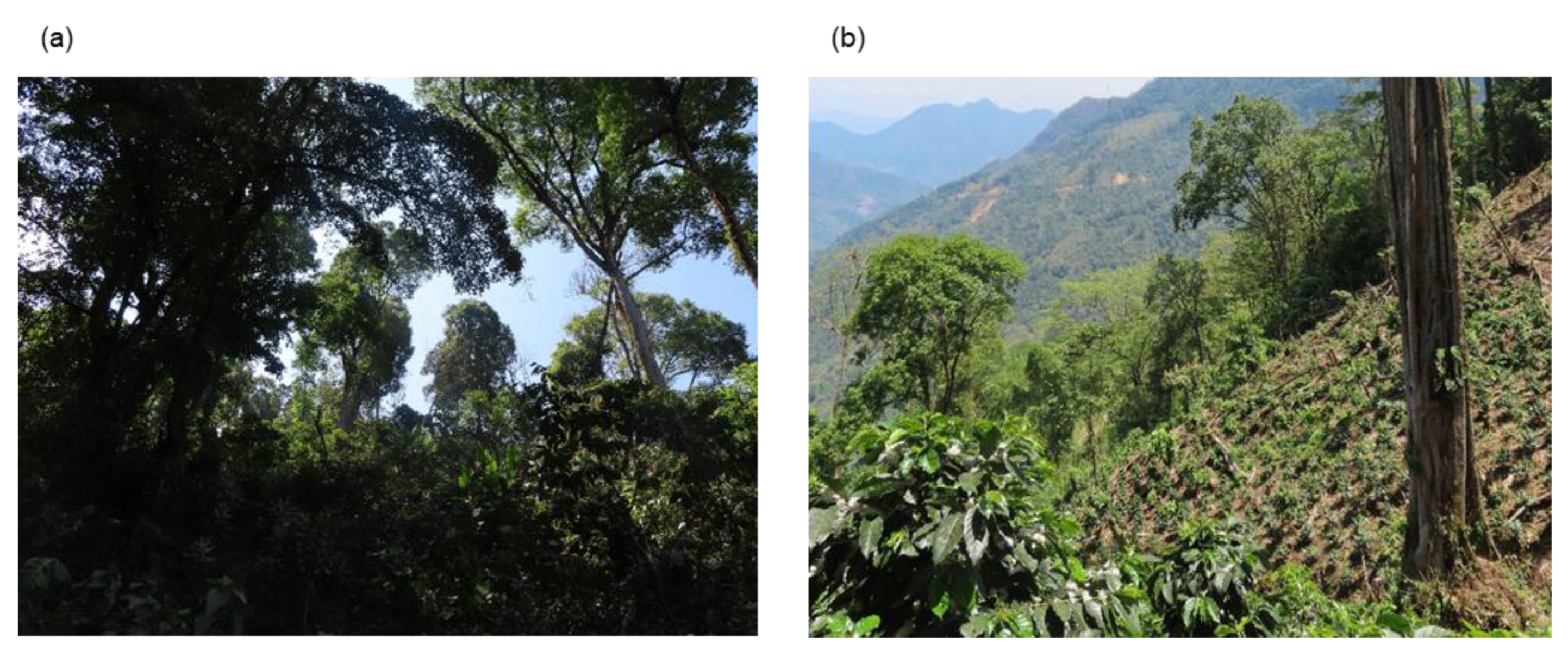
Figure 2.
Five categories of CAS across the coffee intensification gradient used in this review. Modified from Moguel & Toledo, 1999.
Figure 2.
Five categories of CAS across the coffee intensification gradient used in this review. Modified from Moguel & Toledo, 1999.
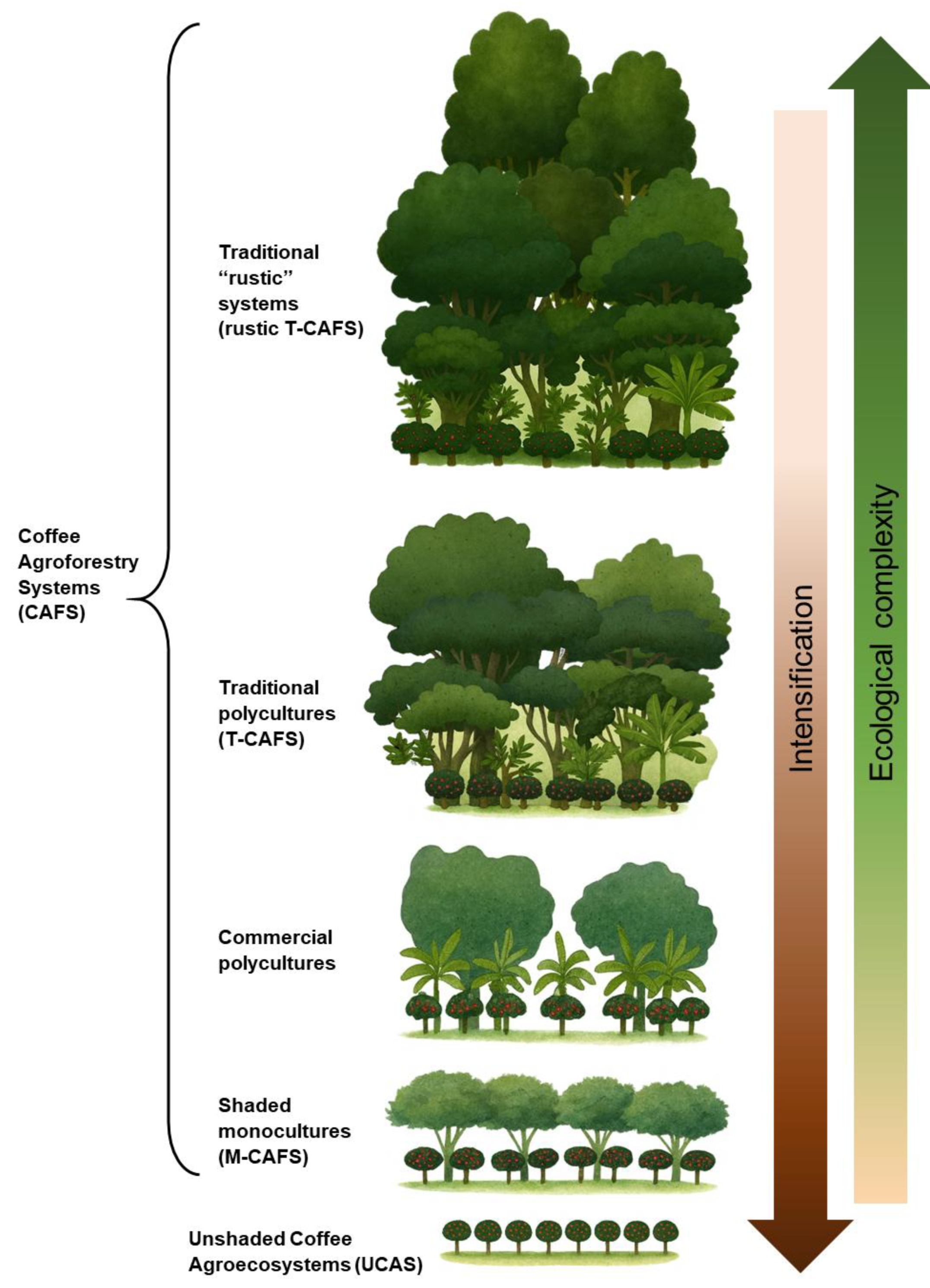
Figure 3.
Outline summary of the review process.
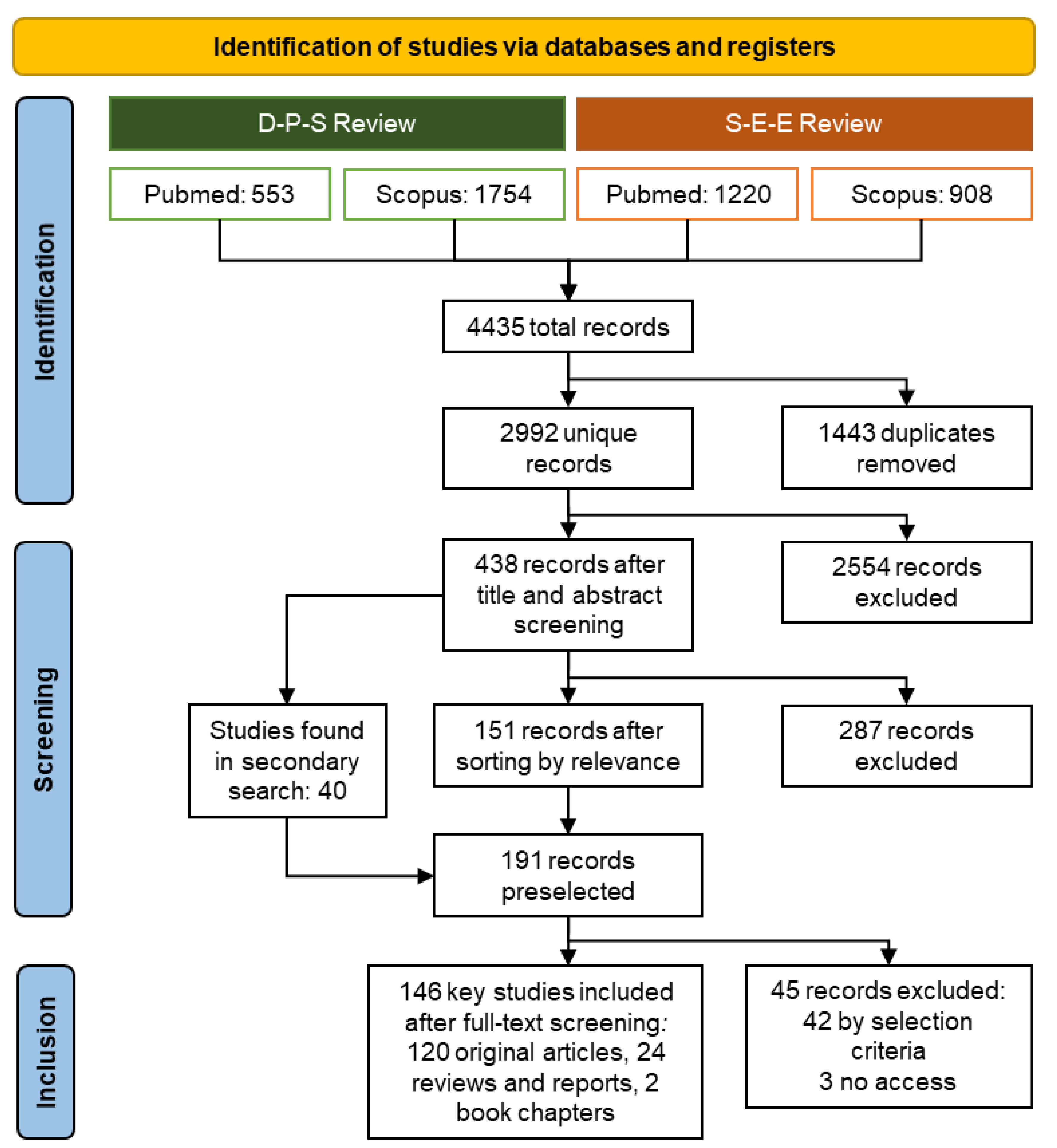
Figure 4.
Included literature by country of origin.
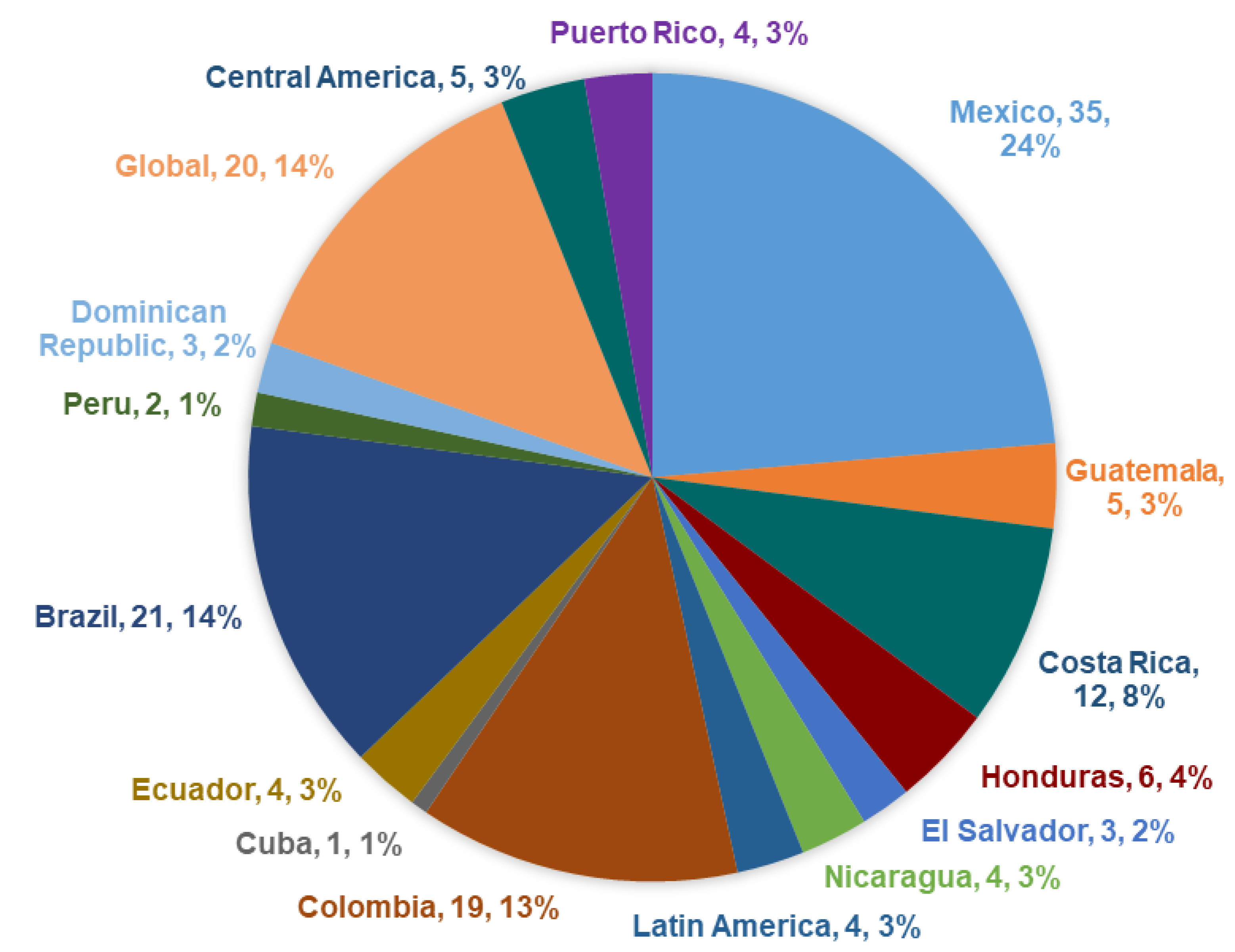
Figure 5.
Yearly reference Arabica coffee price (C-price) in USD per pound, not adjusted for inflation (blue continuous line) and inflation-adjusted (red dotted line). Data from Macrotrends (C-Price) and the US Bureau of Labor Statistics (consumer price index).
Figure 5.
Yearly reference Arabica coffee price (C-price) in USD per pound, not adjusted for inflation (blue continuous line) and inflation-adjusted (red dotted line). Data from Macrotrends (C-Price) and the US Bureau of Labor Statistics (consumer price index).
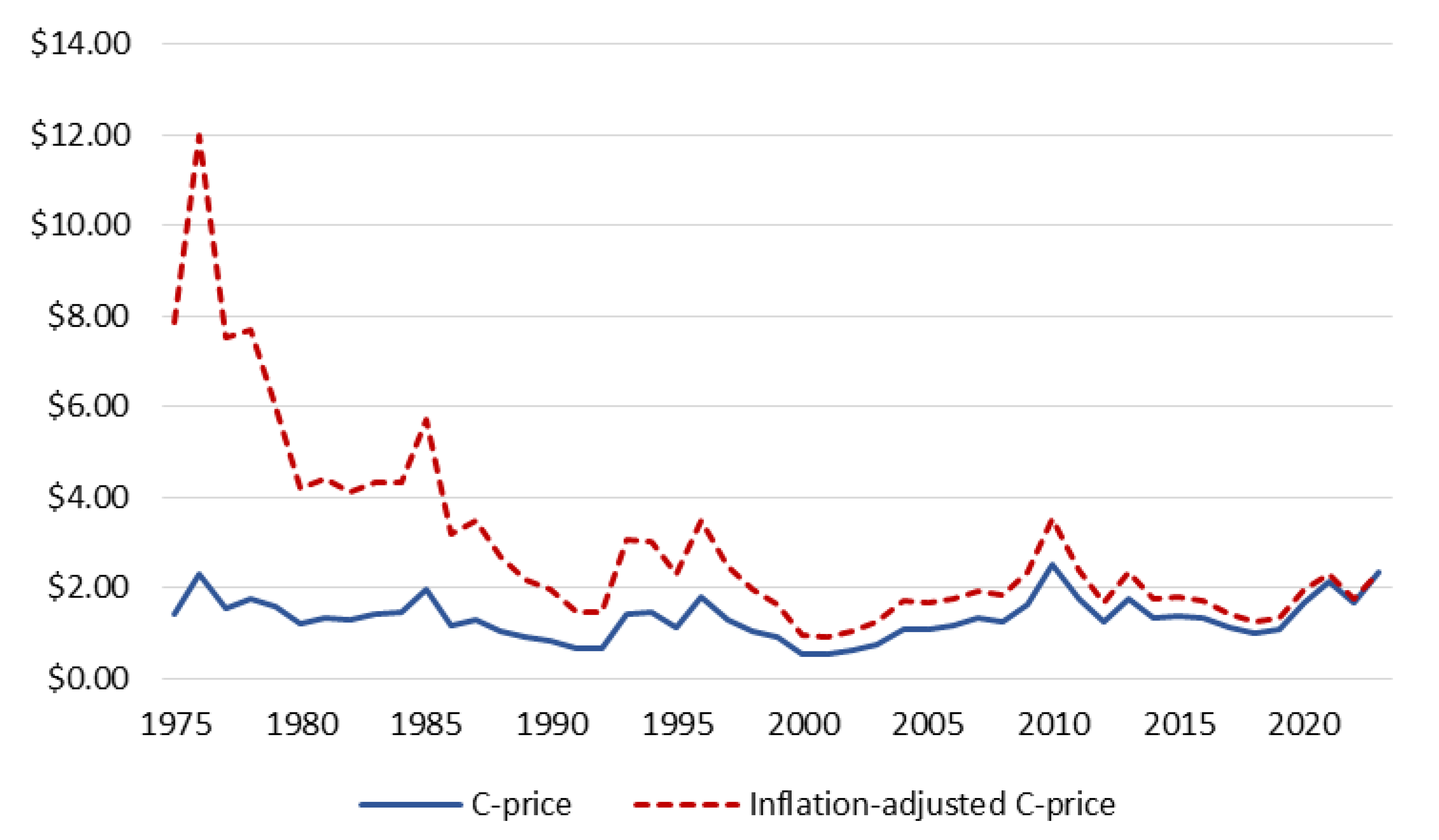
Figure 6.
Key NCP supporting coffee farmers and coffee-growing communities.
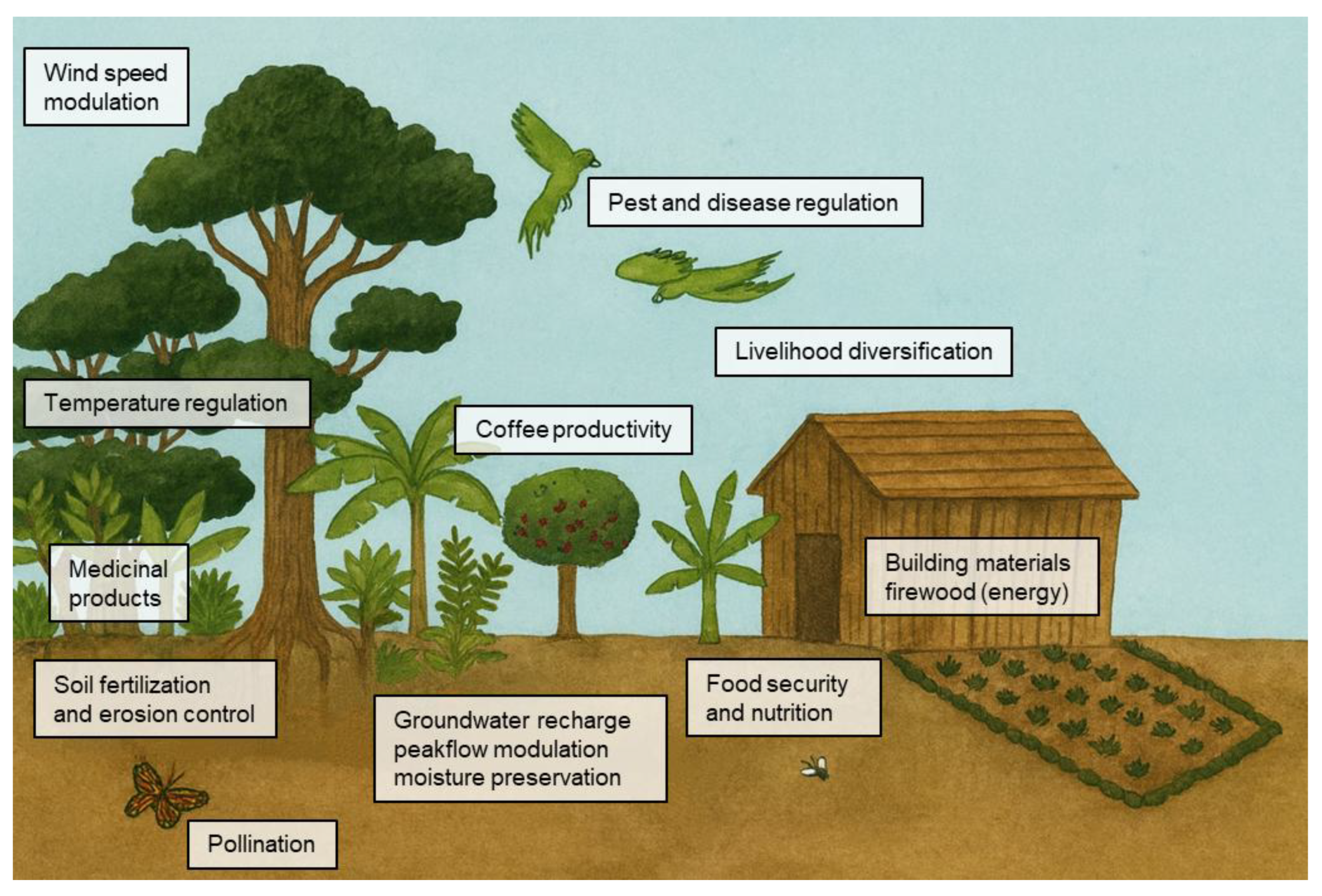
Figure 7.
Deforestation risk attributable to coffee expansion among 10 Latin American countries. No data available for Bolivia, Costa Rica, Haiti, Mexico, Panama, and Venezuela. Data from Pendrill et al. 2019.
Figure 7.
Deforestation risk attributable to coffee expansion among 10 Latin American countries. No data available for Bolivia, Costa Rica, Haiti, Mexico, Panama, and Venezuela. Data from Pendrill et al. 2019.
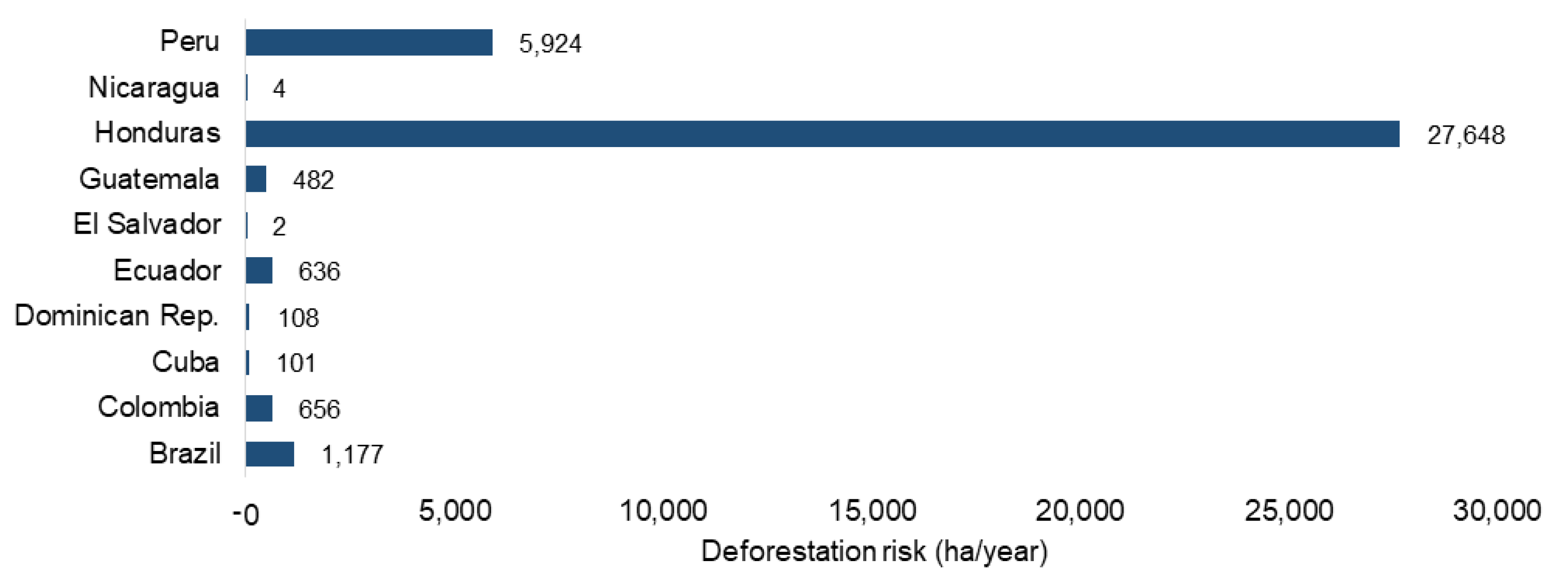
Figure 8.
Main impacts of the coffee intensification gradient extremes on the Planetary Boundaries and Human Health. Green continuous arrows: positive impacts; red dashed arrows: negative impacts; black continuous lines: management practices; dotted lines (green and red): theoretical links. The width of the arrow represents the strength of evidence and magnitude of the impact.
Figure 8.
Main impacts of the coffee intensification gradient extremes on the Planetary Boundaries and Human Health. Green continuous arrows: positive impacts; red dashed arrows: negative impacts; black continuous lines: management practices; dotted lines (green and red): theoretical links. The width of the arrow represents the strength of evidence and magnitude of the impact.
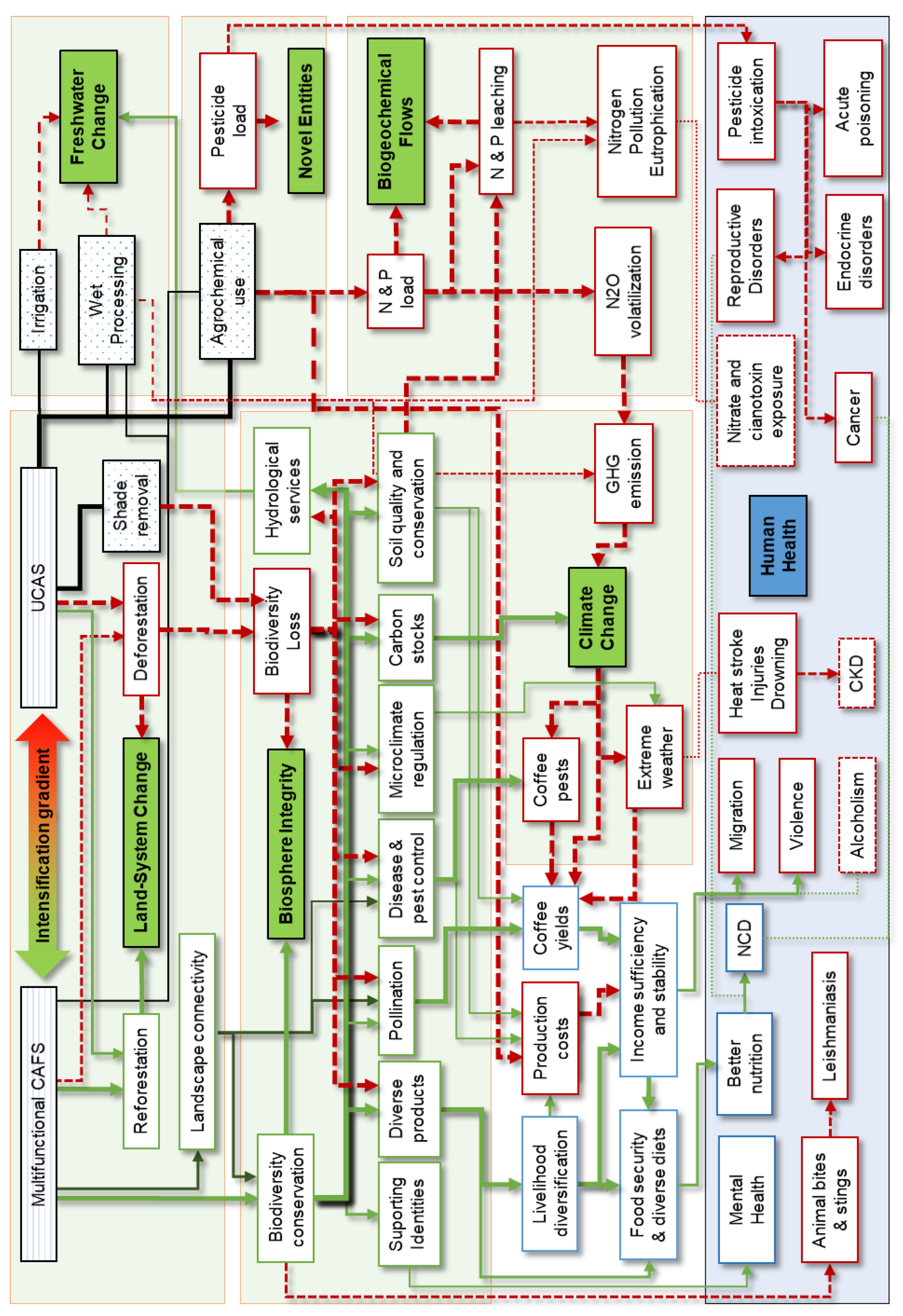
Figure 9.
The DPSEEA model of coffee intensification and planetary health. More detailed relationships between the state, exposure and effect elements are shown on Figure 8.
Figure 9.
The DPSEEA model of coffee intensification and planetary health. More detailed relationships between the state, exposure and effect elements are shown on Figure 8.
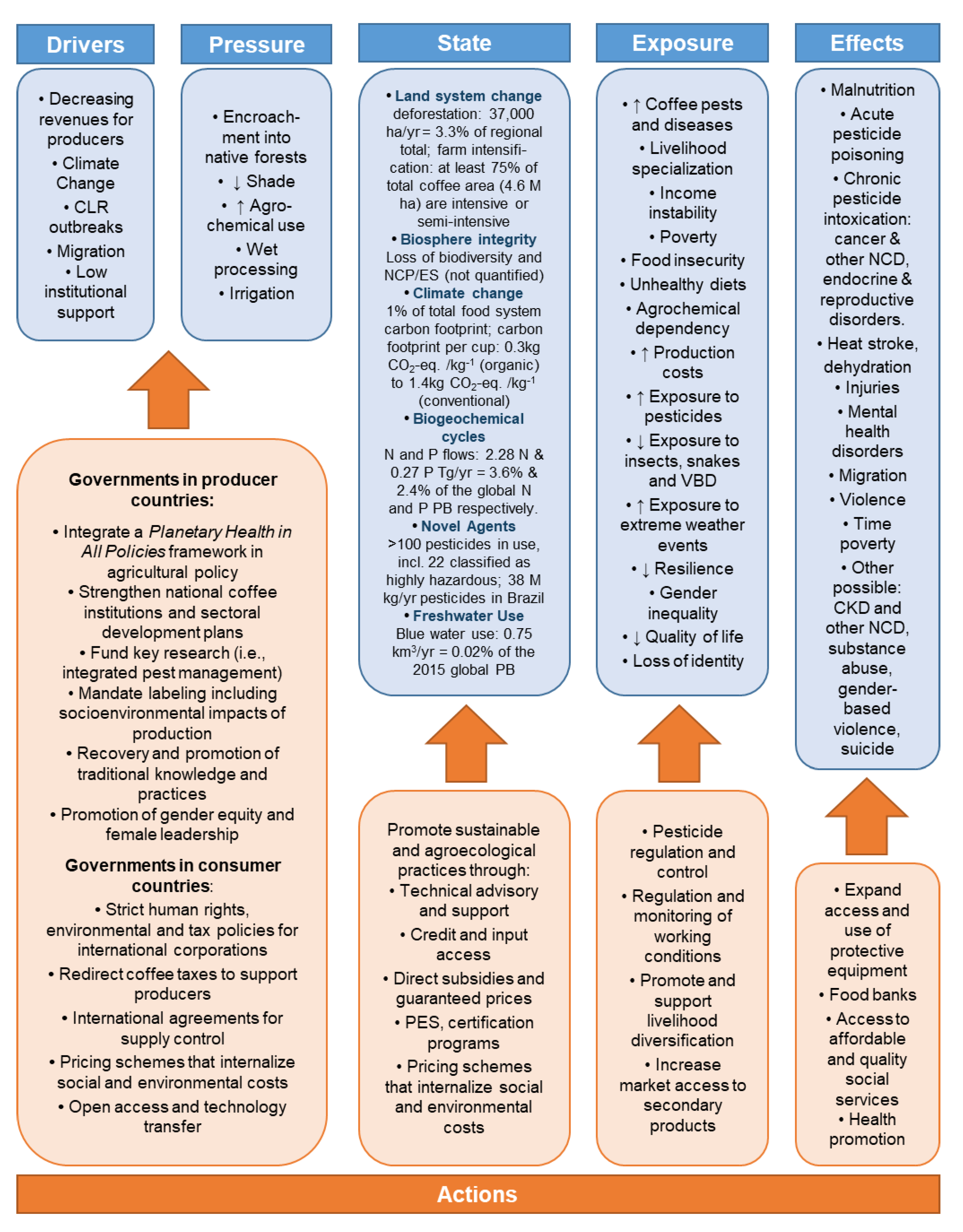

Table 1.
Sample of keywords used in the database search (see S1 for full list).
| Element | Keyword sample |
| CAS in Latin America | Coffee, system, growing, harvesting, farming, agroecosystem, agroforestry, farming, plantation, smallholder, shaded, sun, unshaded, monoculture, landscapes, etc. |
| Planetary Boundaries | Climate change, global warming, biodiversity, conservation, nitrogen, phosphorus, land use, land system, deforestation, pollution, freshwater, agrochemical, fertilizer, pesticide, etc. |
| Geographical delimitation | List of 18 Latin American countries |
| Human Health and its determinants | Health, exposure, infections, zoonosis, vector, food security, nutrition, income, poverty, migration, violence, mental, gender, intoxication, water security, extreme weather, bite, sting, etc. |
Table 2.
Selection criteria.
| Inclusion criteria |
|
| Exclusion criteria: |
|
Table 3.
Carbon stocks in selected CAS and land systems. Adapted from Libert-Amico & Paz-Pellat 2018.
Table 3.
Carbon stocks in selected CAS and land systems. Adapted from Libert-Amico & Paz-Pellat 2018.
| Land system | Soil (t C ha-1) | Biomass (t C ha-1) | Total (t C ha-1) |
| T-CAFS | 180 | 80 | 260 |
| M-CAFS | 130 | 43 | 173 |
| UCAS | 120 | 7 | 127 |
| Cornfield | 66 | 2 | 68 |
| Grassland | 80 | 8 | 88 |
Table 4.
Higly hazardous pesticides used in coffee farming in Latin America.
| Pesticide | Human Health Hazards | Environmental Hazards |
| Chlorpyrifos | Reproductive toxicant (GHS) | Highly toxic to bees (EPA) |
| Copper II Hydroxide | Fatal if inhaled (GHS) | Very toxic to aquatic organisms and very persistant in water, soil or sediment (EPA) |
| Cypermethrin | Highly toxic to bees (EPA) | |
| Cyproconazole | Reproductive toxicant (GHS) | |
| Diazinon | Probable carcinogen (IARC) | Highly toxic to bees (EPA) |
| Disulfoton | Extremely high accute toxicity (WHO Ia) | |
| Diuron | Probable carcinogen (EPA) | |
| Endosulfan | Fatal if inhaled (GHS) | Persistent Organic Pollutant (Stockholm convention) |
| Epoxiconazole | Probable carcinogen (EPA, GHS), reproductive toxicant (GHS) | |
| Glyphosate | Probable carcinogen (IARC) | |
| Iprodione | Probable carcinogen (EPA) | |
| Malathion | Probable carcinogen (IARC) | Highly toxic to bees (EPA) |
| Mancozeb | Probable carcinogen (EPA, GHS), reproductive toxicant (GHS), endocrine disruptor (EU) | |
| Methyl Parathion | Extremely high accute toxicity (WHO Ia), fatal if inhaled (GHS) | Very toxic to aquatic organisms (EPA) |
| Methomyl | High acute toxicity (WHO 1b) | Highly toxic to bees (EPA) |
| Paraquat Dichloride | Fatal if inhaled (GHS) | |
| Pendimethalin | Very bioaccumulative, very persistant in water, soils or sediments (EPA) | |
| Permethrin | Probable carcinogen (EPA) | Highly toxic to bees (EPA) |
| Simazine | Probable carcinogen (GHS), probable reproductive toxicant (GHS) | |
| Thiamethoxam | Highly toxic to bees (EPA) | |
| Triadimenol | Reproductive toxicant (GHS) | |
| Triazophos | High acute toxicity (WHO 1b) |
Note: highly hazardous pesticides reportedly used in coffee cultivation in Latin America (Craves 2006; de Queiroz et al. 2018; Londoño et al. 2018; García Ríos et al. 2020; Merhi et al. 2022; Koutouleas et al. 2023), classified as such by the World Health Organization (WHO), the U.S. Environmental Protection Agency (EPA), the Globally Harmonized System of Classification and Labelling of Chemicals (GHS), the International Agency for Research on Cancer (IARC) and the Stockholm convention, compiled in the PAN list of highly hazardous pesticides (PAN International 2021). In total, 55 different pesticides used in coffee farming in Latin America were identified in this review: Aldicarb, Aldrin, Ametryn, Atrazine, Azoxystrobin, Beta-BHC, Boscalid, Carbendazim, Cartap, Chlordane, Chlorpyrifos, Copper II hydroxide, Cypermethrin, Cyproconazole, DDT, Delta-BHC, Dieldrin, Diazinon, Dinotefuran, Disulfoton, Diuron, Endosulfan, Endosulfan II, Endosulfan sulfate, Endrin, Endrin aldehyde, Endrin Ketone, Epoxiconazole, Etion, Flutriafol, Heptachlor, Heptachlor Epoxide, Iprodione, Lindane, Malathion, Mancozeb, Methamidophos, Methoxychlor, Methyl parathion, Methomyl, Paraquat dichloride, Parathion, Pendimethalin, Permethrin, Picoxystrobin, Propiconazole, Simazine, Tebuconazole, Thiamethoxam, Thiophanate-methyl, Triadimefon, Triadimenol, Triazophos, Trifloxystrobin, 2,4-D and 4,4’-DDE (Craves 2006; de Queiroz et al. 2018; Londoño et al. 2018; García Ríos et al. 2020; Merhi et al. 2022; Koutouleas et al. 2023). A list of 117 different pesticides detected in raw coffee beans can be found in Reichert et al. (2018).
Disclaimer/Publisher’s Note: The statements, opinions and data contained in all publications are solely those of the individual author(s) and contributor(s) and not of MDPI and/or the editor(s). MDPI and/or the editor(s) disclaim responsibility for any injury to people or property resulting from any ideas, methods, instructions or products referred to in the content. |
© 2025 by the authors. Licensee MDPI, Basel, Switzerland. This article is an open access article distributed under the terms and conditions of the Creative Commons Attribution (CC BY) license (http://creativecommons.org/licenses/by/4.0/).
Copyright: This open access article is published under a Creative Commons CC BY 4.0 license, which permit the free download, distribution, and reuse, provided that the author and preprint are cited in any reuse.