

Submitted:
24 September 2025
Posted:
26 September 2025
You are already at the latest version
Abstract
The present work aims to verify the growth (estimated with optical density) of the dry biomass after proper flocculation and weighing, and removal of phosphorus by the mi-croalga Chaetoceros muelleri (Mediophyceae) at six different salinities. Cultivations were carried out with constant volume, for a period of eight days, consisting of six treatments with three repetitions each, at different salinities (30, 25, 20, 15, 10 and 5) (seawater=34). We observed that the best results were obtained when the microalgae were grown at salinity 30, that is, we observed better performances for this microalga at higher salini-ties. At this same salinity, the microalgae presented the best results of phosphorus re-moval (46.08 ± 0.67%). Regarding biomass recovery by microalgae, after drying the flocculate, the best result was obtained at salinity 25, with a final value of 3.47 ± 0.04 g dry mass L-1. Therefore C. muelleri is a promising solution for increasing demand by the blue economy with association circular economy, promoting rehabilitation of ecological sites with economic output. Thus, this work aims to evaluate the effect of salinity on phos-phorus removal using C. muelleri.
Keywords:
marine diatom
; Chaetoceros muelleri
; phosphorus
; nutrient removal
; salinity effects
; blue economy
; circular economy
1. Introduction
The emerging global trend is the blue economy, which is based on the principle of seeking new options to avoid overexploiting the ocean and aquatic systems. Its objective is to restore ecosystems through solutions that generate new, valorized products. Therefore, it is essential to align with the Sustainable Development Goals (SDGs) to promote economically viable solutions for aquatic ecosystems. A thorough risk analysis is necessary to determine whether these proposed solutions have beneficial effects in overall evaluations [1,2].
Eutrophication in estuarine and coastal ecosystems— primarily caused by excessive nutrient runoff from agriculture, livestock, and industrial activities —poses a serious environmental threat by disrupting ecological balance, reducing oxygen levels, and triggering harmful algal blooms that endanger aquatic life. This degradation undermines the health and resilience of marine habitats, making it difficult to sustain biodiversity and economic activities dependent on these ecosystems. Due to this danger, recent guidelines within the blue economy framework emphasize the adoption of sustainable practices, eco-friendly technologies, and ecosystem restoration strategies to mitigate these impacts and promote long-term environmental and economic viability [3].
Nowadays, one of the principal objectives is the search and developing solutions to reduce the eutrophication impact in estuarine and coastal/oceanic ecosystems [3,4]. The eutrophication of estuarine and nearshore waters is mainly derived from anthropogenic origin, such as agriculture, livestock, and industry. This eutrophication is very negative to the native fauna and flora, provoking stress and the disruption of the ecosystem homeostasis [3]. Phosphorus is a nutrient that has special alarm in the eutrophication areas because of its role in aquatic system eutrophication. It is not easily remediated, and it is problem at the global scale with the principal sources being agriculture and livestock creation. Therefore, there are large and diffuse sources of phosphorus and, in the estuarine zones as well as near the shore, there are high concentrations in various locations worldwide [3,5,6,7,8]. Thus, the phosphorus runaway to the oceans can increase the appearance of toxic algal blooms and might cause more significant issues, such as inadequate quantities of oxygen dissolved in the water. Severe algal growth prevents plants, such as seagrasses, from growing by blocking light. When algae and seagrass die, they decompose. The oxygen in the water is used up throughout the decay process, resulting in low amounts of dissolved oxygen in the water. This, in turn, has the potential to harm fish, crabs, oysters, and other aquatic species in a large scale. Thus, it is necessary to create prevention techniques to control and mitigate the excessive amount of nutrient runoff into the oceans, where estuary can be vital key point [9].
Marine microalgae are extremely important in nature, mainly for their vast contribution to the primary production of the oceans and the land itself, they the primary producers and are the base of marine food chain [10,11,12].
Microalgae are single-celled, filamentous or colonial organisms, which may have prokaryotic or eukaryotic cell structures [13] and, therefore, organisms provided with chlorophyll a and other pigments, capable of performing photosynthesis, constituting phytoplankton, being classified, in general, according to the type of pigment, the chemical nature of its reserve products and the components of their cell wall [14,15]. In addition, they are primarily responsible for fixing CO2 [16,17] and for the production of global oxygen [18]. Also, the marine microalgae is one of the principal keys in the marine ecosystem maintenance due to the marine microalgae is responsible for more than 50% of global primary carbon production [19,20].
Microalgae are also widely used in aquaculture due to their high nutritional value, adequate size, high growth rate and because they produce biomolecules with several important properties [21,22]. Thus, microalgae can be utilized across various applications and industries, including as a food source for different organisms, environmental indicators, and a source of bioactive compounds with pharmacological, industrial, and biomedical relevance, among others [23,24]. Thus, these potentialities are derived from large potential of microalga as a rich source of proteins, lipids, and carbohydrates. And now, their potential usages and applications are being explored more deeply. Various species of microalgae are used as a live feed targeted for aquatic animals and feed for livestock. In recent times, microalgae have gained attention in new sectors and industries as an striking natural source of biological compounds that have been proven to have a good response in many biotechnological purposes [25,26,27,28,29,30]. Among their natural compounds, there are the fatty acids, particularly long-chain polyunsaturated fatty acids (PUFA), like eicosapentaenoic acid (EPA), and docosahexaenoic acid (DHA), that have an vital role in aquaculture productions and biomedical areas [31,32]. Also, microalgal compounds have been demonstrated to have better antioxidant activity than fish oil, which is nowadays used due to their carotenoid and polyphenol content, constructing a new plan with microalgae as high potential alternative to the fish oil [27,31,33,34].
These organisms also accumulate large amounts of oil, mainly triglycerides, which can be extracted and converted by chemical processes into biodiesel [35]. They have also been used as bioindicators of water quality and in the treatment of wastewater rich in nitrogenous compounds, phosphates and heavy metals, purifying and improving its quality.
Among the physical and chemical factors that affect the growth of microalgae the main ones are light, temperature, salinity, availability and quality of nutrients [24]. The choice of the culture medium is extremely important for the mass production of microalgae ([36,37], being that, for each microalgae species, the productivity and the biochemical composition of the cells depend strongly on the type of cultivation and the nutrient profile of the environment [38,39].
Diatoms are a wide range distributed and evolutionarily group of microalgae that synthetize a diverse range of valuable compounds [40]. Diatoms group remain as one of the utmost essential organisms contributing to aquatic primary production and their sterols are commonly used as indicators for their occurrence and richness analysis and ecological data used to give the bioindication of the ecological status of a targeted area [41,42], due to being a key group of phytoplankton, playing essential roles in global carbon fixation and natural food webs, so if they are affected the ecosystem niche also is [43].
Chaetoceros muelleri (Mediophyceae) (Figure 1) is a marine diatom , and its biomass has the high prospective to deliver a natural source of high-value compounds, like linoleic acid, EPA, DHA, and supplementary long-chain PUFA, also proteins, fucoxanthin and carbohydrates, for the food, pharmaceutical, biomedical, and feed industry [44].
Also this species yield a great variety of exclusive and exceptional sterols, turning even more the industry attention to this species [41]. Normally now, it is requested for aquatic feed for aquaculture species (shellfish, shrimp and fish) because of the high nutritional value as described above [43]. This fucoxanthin-producing microalga (that can produce 2.92 mg/g dry weight) can have advantages over fucoxanthin macroalgae for compound’s extraction, given the higher productivity, non-seasonality, and more controlled aquaculture systems [45,46], as open-pounds technique, the presently chosen technique for large-scale cultivation [47].
To obtain benefits from the microalgae in aquaculture systems, it is necessary to consider every abiotic and biotic factor, in the marine, estuarine or freshwater location. One of the main factors are salinity effects in the species targeted, mainly in mesohaline/estuarine/nearshore aquaculture systems because the salinity effect needs to be carefully chosen to have the best, most productive and efficient aquaculture system, to obtain the best biomass recovery and nutrients removal (positive commercial and ecological outputs), promoting circular economy and blue economy within the same system [47,48]. This aquaculture conception is the turning point to be ecologically friendly (with mitigation of eutrophication in such cases) and have a valorized product that can be applied to various industries.
Previous studies have demonstrated the potential of various microalgal species in bioremediation, particularly in the removal of excess nutrients such as nitrogen and phosphorus from aquatic environments. Species like Chlorella, Scenedesmus (Chlorophyta), and Nannochloropsis (Eustigmatophyceae) have been widely studied for their capacity to absorb pollutants and improve water quality in both freshwater and marine systems. Within the diatom group, Chaetoceros species have gained attention for their ecological significance and high biomass productivity, yet their role in targeted phosphorus bioremediation remains underexplored.
While Chaetoceros muelleri (Mediophyceae) has been extensively used in aquaculture due to its nutritional profile and production of valuable compounds such as EPA, DHA, and fucoxanthin, few studies have investigated its performance under varying salinity conditions with a focus on phosphorus uptake and biomass yield. This study addresses that gap by evaluating C. muelleri across six salinity gradients, assessing its growth, phosphorus removal efficiency, and biomass recovery. By integrating bioremediation with biomass valorization, this work contributes a novel approach to sustainable aquaculture and blue economy models, offering dual ecological and commercial benefits [48].
The present work aims to verify the growth, in optical density, the dry biomass yield after proper flocculation and weighing, and the removal of phosphorus by the microalgae C. muelleri in six different salinities formulated in the culture media, to see if the C. muelleri can be applied in blue economy models of phosphorus bioremediation strategies in estuarine and open-sea systems and with an biomass output to be sustainable to explore.
2. Materials and Methods
2.1. Microalgae Cultivation
Chaetoceros muelleri (Mediophyceae) was grown in the Laboratory of Live Food Production - LABPAV of the Federal Institute of Education, Science and Technology of Ceará - IFCE, Campus Aracati, Brazil, starting from strains obtained from the Laboratory of Aquaculture Technologies - LTA, also from the referred educational institution, which was kept in a germination chamber at 25 ± 1 °C, in test tubes, with a photoperiod of 16 h in light and 8 h in dark, in controlled conditions.
For the cultivation, it was initially prepared a culture medium Guillard F/2 [49], used for maintaining the inoculants and conducting the experiments. The microalgae cultivation started from a volume of 20 mL in a 250 mL conical flask, in which approximately the same volume of culture medium was added every two days, always aiming to increase the volume of the inoculum, to be used in the definitive cultures.
For the preparation, seawater was collected at the beach of Majorlândia, municipality of Aracati, Ceará (Brazil) and the salinity of maintenance of the inoculum was 20. Then, the contents of the conical flask were transferred to another one, with a larger volume. Finally, about 500 mL of each culture were transferred to a plastic container with a capacity of 5 L, containing 4 L of culture medium at different salinities, the culture being subjected to constant aeration through a compressor (Figure 1). Thus, the final volume, in each repetition, was 4.500 mL. The illuminance, provided constantly by a 40 W fluorescent lamp (daylight), was 30 μE cm-2 s-1 and the temperature in the culture room was 25 ± 1 °C (Figure 2).
2.2. Experimental Design and Microalgae Performance
Cultivations were carried out in a constant volume for a period of eight days. The culture medium and all glassware used in the cultures were previously sterilized in an autoclave for 15 min. at 121 °C. The experimental design was completely randomized, consisting of six treatments with three repetitions each, at different salinities (Table 1), adjusted with a refractometer.
The salinity in each experimental unit was adjusted using a chemical equation and dilutions to determine the volume and concentration of each solution, starting from the collected volume, and checking using a refractometer.
The growth of microalgae was evaluated through optical density (OD700nm) by spectrophotometry at 700 nm, using a UV/VIS spectrophotometer (Kasuaki, DIATEK INSTRUMENTS CO. LTD., China), according to Lourenço (2006).
2.3. Removal of Phosphorus from Culture Media by Microalgae
Phosphorus concentrations were determined in the culture media, at the beginning of the experiment (inoculation of microalgae) and at the end of cultures (beginning of the stationary phase) by spectrophotometry, that is, on the eighth day of cultivation.
For this, 100 mL samples, from each repetition, were removed and centrifuged at 3,000 g for 5 min (Relative Centrifugal Force – RCF, or g-force). Then, for each 25 mL of the samples, the PhosVer 3 Phosphate reagent (HACH, USA) was added for the determination of phosphorus concentrations. After the reaction time (1 min.), the samples were taken to the spectrophotometer and the concentration of the compound was expressed in mg L-1.
The percentages of phosphorus removal in the different salinities present in the culture media by microalgae were calculated by the equation below according to Henry-Silva and Camargo (2008):
where: R is the percentage of phosphorus removal (%).
2.4. Biomass Recovery
The recovery of microalgae biomass occurred through chemical flocculation and subsequent drying in an oven, related to the increase in biomass through their cultivation through the consumption of nutrients present in the culture medium, in each treatment.
To separate the microalgae from the culture medium, the chemical flocculation technique was used, through the addition of 0.5 to 2 mL per liter of culture medium, of 2N NaOH solution. The supernatant containing the culture medium was siphoned and the moist algal biomass was subjected to several washes with distilled water. Finally, the washed biomass was dried in an oven with air renewal at 60 °C for a period of 48 h. After drying, it was crushed in a food processor and weighed on a semi-analytical balance to determine the recovery of its biomass.
2.5. Statistical Analysis
The data obtained in the present study were submitted to analysis of variance (ANOVA) and, in the case of significant difference, the means were subjected to the Tukey test to the level of 5%, using the program BioEstat 5.0. It is worth noting that before the analysis of variance, the Shapiro-Wilk normality test and Levene's homogeneity of variance test were performed to verify the assumptions of equality of variances between the groups (homoscedasticity) and the normal distribution of the data, ensuring the validity of the ANOVA test results.
3. Results
3.1. Culture Performance
The initial and final optical densities of the Chaetoceros muelleri microalgae grown at different salinities can be seen in Table 2.
With the completion of the cultivation assay, we found that the best results were obtained when the microalgae were cultivated at salinity 30 (T30) (0.404 ± 0.004 nm). For the microalga C. muelleri, the best performance was observed in at higher salinities, being statistically different from the other treatments tested. With the decrease in salinity, the performance of microalgae was also reduced, presenting the lowest level at salinity 5 (T5) (0.338 ± 0.003 nm), statistically different from the other treatments tested, but not when compared to salinity 10, with a final value of 0.339 ± 0.002 nm (Table 2). These results demonstrate that the salinity significantly influences the growth of C. muelleri, revealing a clear positive correlation between increasing salinity and enhanced algal growth.
3.2. Phosphorus Removal by C. muelleri
Regarding the removal of phosphate present in the culture media, due to the initial amounts of this compound (Table 3), it can be seen in Table 4 that C. muelleri showed the best results of phosphorus removal in salinity 30 (T30) (46.08 ± 0.67%), being statistically different from other treatments (p <0.05). With the decrease in salinity, the removal of phosphate present in the microalgae culture media was also reduced, presenting the lowest level in salinity 5 (T5) (36.33 ± 0.55%). It is worth noting that there was a significant difference between all treatments tested (p <0.05). As the same of growth parameters, the salinity is also correlated with the phosphorus removal, noting that they diminish the removal efficiency by 10%, only between T20 and T15.Proving that they can support salinities of 20% and with some impact but not dangerous for the purpose of removing phosphorus.
3.3. Biomass Yield and Harvesting Efficiency
In this study, the term biomass recovery refers to the final concentration of dry algal biomass (g L⁻¹) obtained after harvesting and drying the flocculated microalgae. This value reflects both the growth performance of Chaetoceros muelleri under different salinity conditions and the efficiency of biomass harvesting. As shown in Table 5, the highest biomass yield was recorded at salinity T25 (3.47 ± 0.04 g L⁻¹), closely followed by T30 (3.38 ± 0.07 g L⁻¹), with no statistically significant difference between these two treatments (p > 0.05). In contrast, the lowest yield was observed at T5 (1.35 ± 0.08 g L⁻¹), which was significantly lower than all other treatments (p < 0.05). These results align with the optical density measurements (Table 2), where higher OD700 values at T25 and T30 corresponded to greater biomass accumulation. This correlation confirms that increased salinity enhances both the growth and harvestable biomass of C. muelleri, suggesting that salinities between T25 and T30 are optimal for cultivation and phosphorus bioremediation applications.
4. Discussion
The carried-out assays demonstrated the potential of Chaetoceros muelleri at salinities between 30 and 25, with the best results in growth performance and phosphorus removal observed at salinity 30, while salinity 25 yielded the highest dry biomass concentration (3.47 ± 0.04 g L⁻¹). These findings confirm that C. muelleri performs better at higher salinities, whereas mid-to-low salinity levels (20, 15, 10, and 5) resulted in reduced growth and biomass yield.
This microalgae cultivation can be successfully implemented in estuarine locations, where salinity gradients naturally fluctuate. For example, in the Mondego River estuary (Portugal), salinity values around 25 have been recorded approximately 13 km upstream from the river mouth [50,51]. Moreover, phosphate concentrations tend to be higher near the estuarine outlet, aligning with the microalga’s demonstrated capacity for phosphorus uptake. Although the assays reaffirm C. muelleri’s preference for marine conditions, its adaptability to estuarine salinity ranges makes it a promising candidate for bioremediation in transitional ecosystems.
Within estuarine systems, the feasibility of cultivating C. muelleri is closely tied to the salinity gradient that characterizes these environments. Since this species demonstrated optimal growth and phosphorus removal at salinities between 25 and 30, its cultivation should be strategically limited to the outer regions of estuaries—those closest to the open sea—where salinity levels remain within this favorable range. In contrast, the inner zones of estuaries often experience salinity levels below 10, which, based on the results of this study, are unsuitable for efficient biomass production or nutrient uptake by C. muelleri. Therefore, identifying and targeting estuarine areas with stable, moderate-to-high salinity is essential for the successful implementation of bioremediation and aquaculture systems using this microalga.
According to Lourenço (2006) [23] and Lovio-Fragos et al. (2019) [52], monitoring microalgal cultures over time allows for the characterization of growth phases and prediction of biomass yields. Diatoms, including C. muelleri, are known for their ecological versatility, occurring in marine, brackish, and freshwater environments. The results of this study suggest that C. muelleri’s marine origin contributes to its superior performance in higher salinity conditions.
While comparing our results with other studies, it is important to note that differences in phosphorus removal efficiency are largely influenced by species-specific traits and culture conditions. Freshwater microalgae such as Chlorella, Scenedesmus (Chlorophyta), and Coelastrella (Mediophyceae) are often cultivated in nutrient-rich wastewater, which enhances phosphorus uptake. In contrast, our study used synthetic saline media under controlled conditions, which may limit nutrient availability and uptake rates. Despite this, C. muelleri demonstrated consistent phosphorus removal and high biomass yield, making it suitable for marine and estuarine applications.
To provide a clearer comparison, Table 5 summarizes phosphorus removal and biomass yield across various studies, highlighting differences in species and culture conditions.
The differences in phosphorus removal efficiency among microalgal species can be attributed to several physiological and biochemical mechanisms. One key factor is the species-specific affinity for phosphorus uptake, which depends on the presence and activity of membrane-bound phosphate transporters. Marine diatoms like Chaetoceros muelleri tend to have moderate phosphorus uptake rates adapted to oligotrophic conditions, whereas freshwater species such as Chlorella and Scenedesmus often exhibit higher uptake efficiencies due to their evolution in nutrient-rich environments. Additionally, the capacity for intracellular phosphorus storage in the form of polyphosphate granules varies across taxa, influencing both short-term uptake and long-term retention. Environmental conditions—including salinity, pH, light intensity, and nutrient availability—also modulate enzymatic activity and metabolic pathways involved in phosphorus assimilation. Therefore, the observed differences in phosphorus removal across studies are not solely due to experimental design but reflect inherent biological traits and ecological adaptations of each microalgal species.
5. Conclusions
This study highlights the potential of Chaetoceros muelleri for application in aquaculture and bioremediation systems in marine, nearshore, and estuarine environments, particularly within salinity ranges of 25 to 35. The species demonstrated strong performance in phosphorus removal and biomass production, suggesting its utility in mitigating eutrophication and reducing the risk of harmful algal blooms in coastal waters.
Our findings confirm that C. muelleri can be effectively cultivated in estuarine or open sea systems to counteract nutrient enrichment—especially elevated phosphorus levels—in brackish and marine ecosystems. Furthermore, the biomass recovery achieved in this study supports the commercial viability of C. muelleri cultivation, given its capacity to synthesize high-value compounds such as fucoxanthin, sterols, proteins, and polyunsaturated fatty acids (PUFAs), or to be used directly as feed in aquaculture and livestock systems.
By combining bioremediation with biomass valorization, this approach contributes to the advancement of blue and circular economy models, provided that ecological impacts are minimized and sustainability standards—such as those outlined by the United Nations Sustainable Development Goals (SDGs)—are upheld. To fully validate this system, future field trials and complementary assays are necessary to optimize cultivation conditions and assess the species’ ability to remove additional environmental pollutants, including nitrogenous compounds (e.g., ammonia) and emerging contaminants such as pharmaceutical and phytopharmaceutical residues.
Author Contributions
Conceptualization, methodology, validation, investigation, J.P.S.S., G.S.A., J.W.A.S.; writing—original draft preparation, G.S.A., C.S.S., L.C.B.S., J.C., L.P.; writing—review and editing, J.C., L.P.; supervision, G.S.A., L.P. All authors have read and agreed to the published version of the manuscript.
Funding
This research received no external funding.
Institutional Review Board Statement
Not applicable.
Informed Consent Statement
Not applicable.
Data Availability Statement
Data available from authors.
Acknowledgments
L.P and J.C. thank FCT for the support of this study through the Centre for Functional Ecology Strategic Project (UIDB/04004/2025, UIDP/04004/2025), and by TERRA Associate Laboratory (LA/P/0092/2020).
Conflicts of Interest
The authors declare no conflicts of interest.
References
- Stead, S.M. Rethinking Marine Resource Governance for the United Nations Sustainable Development Goals. Current Opinion in Environmental Sustainability 2018, 34, 54–61. [Google Scholar] [CrossRef]
- Techera, E.J. Supporting Blue Economy Agenda: Fisheries, Food Security and Climate Change in the Indian Ocean. Journal of the Indian Ocean Region 2018, 14, 7–27. [Google Scholar] [CrossRef]
- Ryan, M.H.; Tibbett, M.; Lambers, H.; Bicknell, D.; Brookes, P.; Barrett-Lennard, E.G.; Ocampo, C.; Nicol, D. Pronounced Surface Stratification of Soil Phosphorus, Potassium and Sulfur under Pastures Upstream of a Eutrophic Wetland and Estuarine System. Soil Res. 2017, 55, 657–669. [Google Scholar] [CrossRef]
- Sarelli, A.; Sykas, D.; Miltiadou, M.; Bliziotis, D.; Spastra, Y.; Ieronymaki, M. A Novel Automated Methodology That Estimates the United Nations (UN) Sustainable Development Goal (SDG) 14. 1.1.: Index of Coastal Eutrophication Using the Copernicus Marine Environment Monitoring Service (CMEMS). In Proceedings of the Sixth International Conference on Remote Sensing and Geoinformation of the Environment (RSCy2018); International Society for Optics and Photonics, August 6 2018; Vol. 10773, 1077302.
- Shore, M.; Murphy, S.; Mellander, P.-E.; Shortle, G.; Melland, A.R.; Crockford, L.; O’Flaherty, V.; Williams, L.; Morgan, G.; Jordan, P. Influence of Stormflow and Baseflow Phosphorus Pressures on Stream Ecology in Agricultural Catchments. Science of The Total Environment 2017, 590–591, 469–483. [Google Scholar] [CrossRef]
- Jarvie, H.P.; Sharpley, A.N.; Withers, P.J.A.; Scott, J.T.; Haggard, B.E.; Neal, C. Phosphorus Mitigation to Control River Eutrophication: Murky Waters, Inconvenient Truths, and “Postnormal” Science. J. Environ. Qual. 2013, 42, 295–304. [Google Scholar] [CrossRef] [PubMed]
- Rivers, M.R.; Weaver, D.M.; Smettem, K.R.J.; Davies, P.M. Estimating Farm to Catchment Nutrient Fluxes Using Dynamic Simulation Modelling – Can Agri-Environmental BMPs Really Do the Job? Journal of Environmental Management 2013, 130, 313–323. [Google Scholar] [CrossRef]
- Sharpley, A.N.; Bergström, L.; Aronsson, H.; Bechmann, M.; Bolster, C.H.; Börling, K.; Djodjic, F.; Jarvie, H.P.; Schoumans, O.F.; Stamm, C.; et al. Future Agriculture with Minimized Phosphorus Losses to Waters: Research Needs and Direction. AMBIO 2015, 44, 163–179. [Google Scholar] [CrossRef]
- Gobler, C.J. Climate Change and Harmful Algal Blooms: Insights and Perspective. Harmful Algae 2020, 91, 101731. [Google Scholar] [CrossRef]
- Uddin, S.; Bebhehani, M.; Al-Musallam, L.; Kumar, V.V.; Sajid, S. Po Uptake in Microalgae at Different Seawater pH: An Experimental Study Simulating Ocean Acidification. Marine Pollution Bulletin 2020, 151, 110844. [Google Scholar] [CrossRef]
- Ishika, T.; Moheimani, N.R.; Bahri, P.A.; Laird, D.W.; Blair, S.; Parlevliet, D. Halo-Adapted Microalgae for Fucoxanthin Production: Effect of Incremental Increase in Salinity. Algal Research 2017, 28, 66–73. [Google Scholar] [CrossRef]
- Sigman, D. M.; Hain, M. P. The Biological Productivity of the Ocean. Nature Education Knowledge 2012, 3, 21. [Google Scholar]
- de-Bashan, L.E.; Bashan, Y. Immobilized Microalgae for Removing Pollutants: Review of Practical Aspects. Bioresource Technology 2010, 101, 1611–1627. [Google Scholar] [CrossRef]
- Tomaselli, L. The Microalgal Cell. In Handbook of Microalgal Culture; John Wiley & Sons, Ltd, 2007; pp. 1–19 ISBN 978-0-470-99528-0.
- Kuczynska, P.; Jemiola-Rzeminska, M.; Strzalka, K. Photosynthetic Pigments in Diatoms. Marine Drugs 2015, 13, 5847–5881. [Google Scholar] [CrossRef]
- Chisti, Y. Biodiesel from Microalgae. Biotechnology Advances 2007, 25, 294–306. [Google Scholar] [CrossRef]
- Molazadeh, M.; Ahmadzadeh, H.; Pourianfar, H.R.; Lyon, S.; Rampelotto, P.H. The Use of Microalgae for Coupling Wastewater Treatment With CO2 Biofixation. Front. Bioeng. Biotechnol. 2019, 7, 42. [Google Scholar] [CrossRef]
- Tahmasebi, A.; Kassim, M.A.; Yu, J.; Bhattacharya, S. Thermogravimetric Study of the Combustion of Tetraselmis Suecica Microalgae and Its Blend with a Victorian Brown Coal in O2/N2 and O2/CO2 Atmospheres. Bioresource Technology 2013, 150, 15–27. [Google Scholar] [CrossRef] [PubMed]
- Field, C.B.; Behrenfeld, M.J.; Randerson, J.T.; Falkowski, P. Primary Production of the Biosphere: Integrating Terrestrial and Oceanic Components. Science 1998, 281, 237–240. [Google Scholar] [CrossRef] [PubMed]
- Falkowski, P. Do Tiny Floating Microorganisms in the Ocean’s Surface Waters Play a Massive Role in Controlling the Global Climate? 2012, 4.
- Yaakob, Z.; Ali, E.; Zainal, A.; Mohamad, M.; Takriff, M.S. An Overview: Biomolecules from Microalgae for Animal Feed and Aquaculture. Journal of Biological Research-Thessaloniki 2014, 21, 6. [Google Scholar] [CrossRef]
- Roy, S.S.; Pal, R. Microalgae in Aquaculture: A Review with Special References to Nutritional Value and Fish Dietetics. Proc Zool Soc 2015, 68, 1–8. [Google Scholar] [CrossRef]
- Lourenço, S.O. Cultivo de microalgas marinhas: princípios e aplicações; RiMa, 2006; ISBN 978-85-7656-113-2.
- Khan, M.I.; Shin, J.H.; Kim, J.D. The Promising Future of Microalgae: Current Status, Challenges, and Optimization of a Sustainable and Renewable Industry for Biofuels, Feed, and Other Products. Microbial Cell Factories 2018, 17, 36. [Google Scholar] [CrossRef] [PubMed]
- Reijnders, M.J.M.F.; van Heck, R.G.A.; Lam, C.M.C.; Scaife, M.A.; Santos, V.A.P.M. dos; Smith, A.G.; Schaap, P.J. Green Genes: Bioinformatics and Systems-Biology Innovations Drive Algal Biotechnology. Trends in Biotechnology 2014, 32, 617–626. [Google Scholar] [CrossRef]
- Bahadar, A.; Bilal Khan, M. Progress in Energy from Microalgae: A Review. Renewable and Sustainable Energy Reviews 2013, 27, 128–148. [Google Scholar] [CrossRef]
- Valenzuela B, A.; Sanhueza C, J.; Valenzuela B, R. Las microalgas: una fuente renovable para la obtención de ácidos grasos omega-3 de cadena larga para la nutrición humana y animal. Rev. chil. nutr. 2015, 42, 306–310. [Google Scholar] [CrossRef]
- Du, Z.-Y.; Benning, C. Triacylglycerol Accumulation in Photosynthetic Cells in Plants and Algae. In Lipids in Plant and Algae Development; Nakamura, Y., Li-Beisson, Y., Eds.; Subcellular Biochemistry; Springer International Publishing: Cham, 2016; pp. 179–205. ISBN 978-3-319-25979-6. [Google Scholar]
- Paliwal, C.; Mitra, M.; Bhayani, K.; Bharadwaj, S.V.V.; Ghosh, T.; Dubey, S.; Mishra, S. Abiotic Stresses as Tools for Metabolites in Microalgae. Bioresource Technology 2017, 244, 1216–1226. [Google Scholar] [CrossRef] [PubMed]
- Sajjadi, B.; Chen, W.-Y.; Raman, Abdul. Aziz.A.; Ibrahim, S. Microalgae Lipid and Biomass for Biofuel Production: A Comprehensive Review on Lipid Enhancement Strategies and Their Effects on Fatty Acid Composition. Renewable and Sustainable Energy Reviews 2018, 97, 200–232. [Google Scholar] [CrossRef]
- Borowitzka, M.A. High-Value Products from Microalgae—Their Development and Commercialisation. J Appl Phycol 2013, 25, 743–756. [Google Scholar] [CrossRef]
- Gangl, D.; Zedler, J.A.Z.; Rajakumar, P.D.; Martinez, E.M.R.; Riseley, A.; Włodarczyk, A.; Purton, S.; Sakuragi, Y.; Howe, C.J.; Jensen, P.E.; et al. Biotechnological Exploitation of Microalgae. EXBOTJ 2015, 66, 6975–6990. [Google Scholar] [CrossRef]
- LeuStefan; BoussibaSammy Advances in the Production of High-Value Products by Microalgae. Industrial Biotechnology 2014. [CrossRef]
- Ryckebosch, E.; Bruneel, C.; Termote-Verhalle, R.; Goiris, K.; Muylaert, K.; Foubert, I. Nutritional Evaluation of Microalgae Oils Rich in Omega-3 Long Chain Polyunsaturated Fatty Acids as an Alternative for Fish Oil. Food Chemistry 2014, 160, 393–400. [Google Scholar] [CrossRef]
- Mondal, M.; Goswami, S.; Ghosh, A.; Oinam, G.; Tiwari, O.N.; Das, P.; Gayen, K.; Mandal, M.K.; Halder, G.N. Production of Biodiesel from Microalgae through Biological Carbon Capture: A Review. 3 Biotech 2017, 7, 99. [Google Scholar] [CrossRef]
- Kenny, P.; Flynn, K.J. In Silico Optimization for Production of Biomass and Biofuel Feedstocks from Microalgae. J Appl Phycol 2015, 27, 33–48. [Google Scholar] [CrossRef]
- Fuentes, J.-L.; Montero, Z.; Cuaresma, M.; Ruiz-Domínguez, M.-C.; Mogedas, B.; Nores, I.G.; González del Valle, M.; Vílchez, C. Outdoor Large-Scale Cultivation of the Acidophilic Microalga Coccomyxa Onubensis in a Vertical Close Photobioreactor for Lutein Production. Processes 2020, 8, 324. [Google Scholar] [CrossRef]
- Guedes, A.C.; Amaro, H.M.; Malcata, F.X. Microalgae as Sources of High Added-Value Compounds-a Brief Review of Recent Work. Biotechnol Progress 2011, 27, 597–613. [Google Scholar] [CrossRef] [PubMed]
- Metsoviti, M.N.; Papapolymerou, G.; Karapanagiotidis, I.T.; Katsoulas, N. Comparison of Growth Rate and Nutrient Content of Five Microalgae Species Cultivated in Greenhouses. Plants 2019, 8, 279. [Google Scholar] [CrossRef]
- Jaramillo-Madrid, A.C.; Ashworth, J.; Ralph, P.J. Levels of Diatom Minor Sterols Respond to Changes in Temperature and Salinity. JMSE 2020, 8, 85. [Google Scholar] [CrossRef]
- Rampen, S.W.; Abbas, B.A.; Schouten, S.; Sinninghe Damste, J.S. A Comprehensive Study of Sterols in Marine Diatoms (Bacillariophyta): Implications for Their Use as Tracers for Diatom Productivity. Limnol. Oceanogr. 2010, 55, 91–105. [Google Scholar] [CrossRef]
- Nelson, D.M.; Tréguer, P.; Brzezinski, M.A.; Leynaert, A.; Quéguiner, B. Production and Dissolution of Biogenic Silica in the Ocean: Revised Global Estimates, Comparison with Regional Data and Relationship to Biogenic Sedimentation. Global Biogeochemical Cycles 1995, 9, 359–372. [Google Scholar] [CrossRef]
- Liang, C.; Zhang, Y.; Wang, L.; Shi, L.; Xu, D.; Zhang, X.; Ye, N. Features of Metabolic Regulation Revealed by Transcriptomic Adaptions Driven by Long-Term Elevated p CO 2 in Chaetoceros Muelleri: Metabolic Regulation Driven by Long-Term Elevated p CO 2. Phycological Res. 2020. [Google Scholar] [CrossRef]
- de Jesús-Campos, D.; López-Elías, J.A.; Medina-Juarez, L.Á.; Carvallo-Ruiz, G.; Fimbres-Olivarria, D.; Hayano-Kanashiro, C. Chemical Composition, Fatty Acid Profile and Molecular Changes Derived from Nitrogen Stress in the Diatom Chaetoceros Muelleri. Aquaculture Reports 2020, 16, 100281. [Google Scholar] [CrossRef]
- Griffiths, M.J.; Harrison, S.T.L. Lipid Productivity as a Key Characteristic for Choosing Algal Species for Biodiesel Production. J Appl Phycol 2009, 21, 493–507. [Google Scholar] [CrossRef]
- Indrayani, I. ISOLATION AND CHARACTERIZATION OF MICROALGAE WITH COMMERCIAL POTENTIAL. 225.
- Ishika, T.; Laird, D.W.; Bahri, P.A.; Moheimani, N.R. Co-Cultivation and Stepwise Cultivation of Chaetoceros Muelleri and Amphora sp. for Fucoxanthin Production under Gradual Salinity Increase. J Appl Phycol 2019, 31, 1535–1544. [Google Scholar] [CrossRef]
- Minggat, E.; Roseli, W.; Tanaka, Y. , Nutrient Absorption and Biomass Production by the Marine Diatom Chaetoceros muelleri: Effects of Temperature, Salinity, Photoperiod, and Light Intensity. Journal of Ecological Engineering 2021, 22, 231–240. [Google Scholar] [CrossRef]
- Guillard, R.R.L. Culture of Phytoplankton for Feeding Marine Invertebrates. In Culture of Marine Invertebrate Animals; Smith, W.L., Chanley, M.H., Eds.; Springer US: Boston, MA, 1975; pp. 29–60. ISBN 978-1-4615-8716-3. [Google Scholar]
- Cotas, J.; Figueirinha, A.; Pereira, L.; Batista, T. The effect of salinity on Fucus ceranoides (Ochrophyta, Phaeophyceae) in the Mondego River (Portugal). J. Ocean. Limnol. 2019, 37, 881–891. [Google Scholar] [CrossRef]
- Duarte, António A. L. S.; Vieira, José M.P.; Neto, J.M.; Pardal, M.A. Monitorização da Hidrodinâmica e da Qualidade da Água no Estuário do Rio Mondego. Engenharia Civil. 2008, 65–74.
- Lovio-Fragoso, J.P.; Hayano-Kanashiro, C.; López-Elías, J.A. Effect of Different Phosphorus Concentrations on Growth and Biochemical Composition of Chaetoceros Muelleri. Latin American Journal of Aquatic Research 2019, 47, 361–366. [Google Scholar] [CrossRef]
- Huy, M.; Kumar, G.; Kim, H.-W.; Kim, S.-H. Photoautotrophic Cultivation of Mixed Microalgae Consortia Using Various Organic Waste Streams towards Remediation and Resource Recovery. Bioresource Technology 2018, 247, 576–581. [Google Scholar] [CrossRef] [PubMed]
- Arias, D.M.; Solé-Bundó, M.; Garfí, M.; Ferrer, I.; García, J.; Uggetti, E. Integrating Microalgae Tertiary Treatment into Activated Sludge Systems for Energy and Nutrients Recovery from Wastewater. Bioresource Technology 2018, 247, 513–519. [Google Scholar] [CrossRef] [PubMed]
- Li, Y.; Chen, Y.-F.; Chen, P.; Min, M.; Zhou, W.; Martinez, B.; Zhu, J.; Ruan, R. Characterization of a Microalga Chlorella Sp. Well Adapted to Highly Concentrated Municipal Wastewater for Nutrient Removal and Biodiesel Production. Bioresour. Technol. 2011, 102, 5138–5144. [Google Scholar] [CrossRef] [PubMed]
- Abou-Shanab, R.A.I.; Ji, M.-K.; Kim, H.-C.; Paeng, K.-J.; Jeon, B.-H. Microalgal Species Growing on Piggery Wastewater as a Valuable Candidate for Nutrient Removal and Biodiesel Production. Journal of Environmental Management 2013, 115, 257–264. [Google Scholar] [CrossRef]
- Li, X.; Yang, W.L.; He, H.; Wu, S.; Zhou, Q.; Yang, C.; Zeng, G.; Luo, L.; Lou, W. Responses of Microalgae Coelastrella Sp. to Stress of Cupric Ions in Treatment of Anaerobically Digested Swine Wastewater. Bioresource Technology 2018, 251, 274–279. [Google Scholar] [CrossRef]
- Gao, Y.; Yang, M.; Wang, C. Nutrient Deprivation Enhances Lipid Content in Marine Microalgae. Bioresource Technology 2013, 147, 484–491. [Google Scholar] [CrossRef]
- Henry-Silva, G.G.; Camargo, A.F.M. Tratamento de efluentes de carcinicultura por macrófitas aquáticas flutuantes. Revista Brasileira de Zootecnia 2008, 37, 181–188. [Google Scholar] [CrossRef]
- Cloern, J.E.; Jassby, A.D.; Schraga, T.S.; Nejad, E.; Martin, C. Ecosystem Variability along the Estuarine Salinity Gradient: Examples from Long-Term Study of San Francisco Bay. Limnology and Oceanography 2017, 62, S272–S291. [Google Scholar] [CrossRef]
- Webster, I.; Atkinson, I.; Radke, L. Salinity. Available online: https://ozcoasts.org.au/indicators/biophysical-indicators/salinity/ (accessed on 22 April 2020).
- Becerra-Dórame, M.; López-Elías, J.A.; Martínez-Córdova, L.R. An Alternative Outdoor Production System for the Microalgae Chaetoceros Muelleri and Dunaliella Sp. during Winter and Spring in Northwest Mexico. Aquacultural Engineering 2010, 43, 24–28. [Google Scholar] [CrossRef]
- Rodolfi, L.; Zittelli, G.C.; Bassi, N.; Padovani, G.; Biondi, N.; Bonini, G.; Tredici, M.R. Microalgae for Oil: Strain Selection, Induction of Lipid Synthesis and Outdoor Mass Cultivation in a Low-Cost Photobioreactor. Biotechnology and Bioengineering 2009, 102, 100–112. [Google Scholar] [CrossRef] [PubMed]
- Wang, X.-W.; Liang, J.-R.; Luo, C.-S.; Chen, C.-P.; Gao, Y.-H. Biomass, Total Lipid Production, and Fatty Acid Composition of the Marine Diatom Chaetoceros Muelleri in Response to Different CO2 Levels. Bioresource Technology 2014, 161, 124–130. [Google Scholar] [CrossRef] [PubMed]
- Pérez, L.; Salgueiro, J.L.; González, J.; Parralejo, A.I.; Maceiras, R.; Cancela, Á. Scaled up from Indoor to Outdoor Cultures of Chaetoceros Gracilis and Skeletonema Costatum Microalgae for Biomass and Oil Production. Biochemical Engineering Journal 2017, 127, 180–187. [Google Scholar] [CrossRef]
- Zhai, X.; Zhu, C.; Zhang, Y.; Pang, H.; Kong, F.; Wang, J.; Chi, Z. Seawater Supplemented with Bicarbonate for Efficient Marine Microalgae Production in Floating Photobioreactor on Ocean: A Case Study of Chlorella Sp. Science of The Total Environment 2020, 738, 139439. [Google Scholar] [CrossRef]
- Khor, W.H.; Kang, H.-S.; Lim, J.-W.; Iwamoto, K.; Tang, C.H.-H.; Goh, P.S.; Quen, L.K.; Shaharuddin, N.M.R.B.; Lai, N.Y.G. Microalgae Cultivation in Offshore Floating Photobioreactor: State-of-the-Art, Opportunities and Challenges. Aquacultural Engineering 2022, 98, 102269. [Google Scholar] [CrossRef]
Figure 1.
Chaetoceros muelleri colony, girdle view, 6 frustules (Scale = 10 µm) (After Paulding et al. 2021. Diatoms.org: supporting taxonomists, connecting communities. Diatom Research 36(4): 291-304. https://doi.org/10.1080/0269249X.2021.2006790).
Figure 1.
Chaetoceros muelleri colony, girdle view, 6 frustules (Scale = 10 µm) (After Paulding et al. 2021. Diatoms.org: supporting taxonomists, connecting communities. Diatom Research 36(4): 291-304. https://doi.org/10.1080/0269249X.2021.2006790).
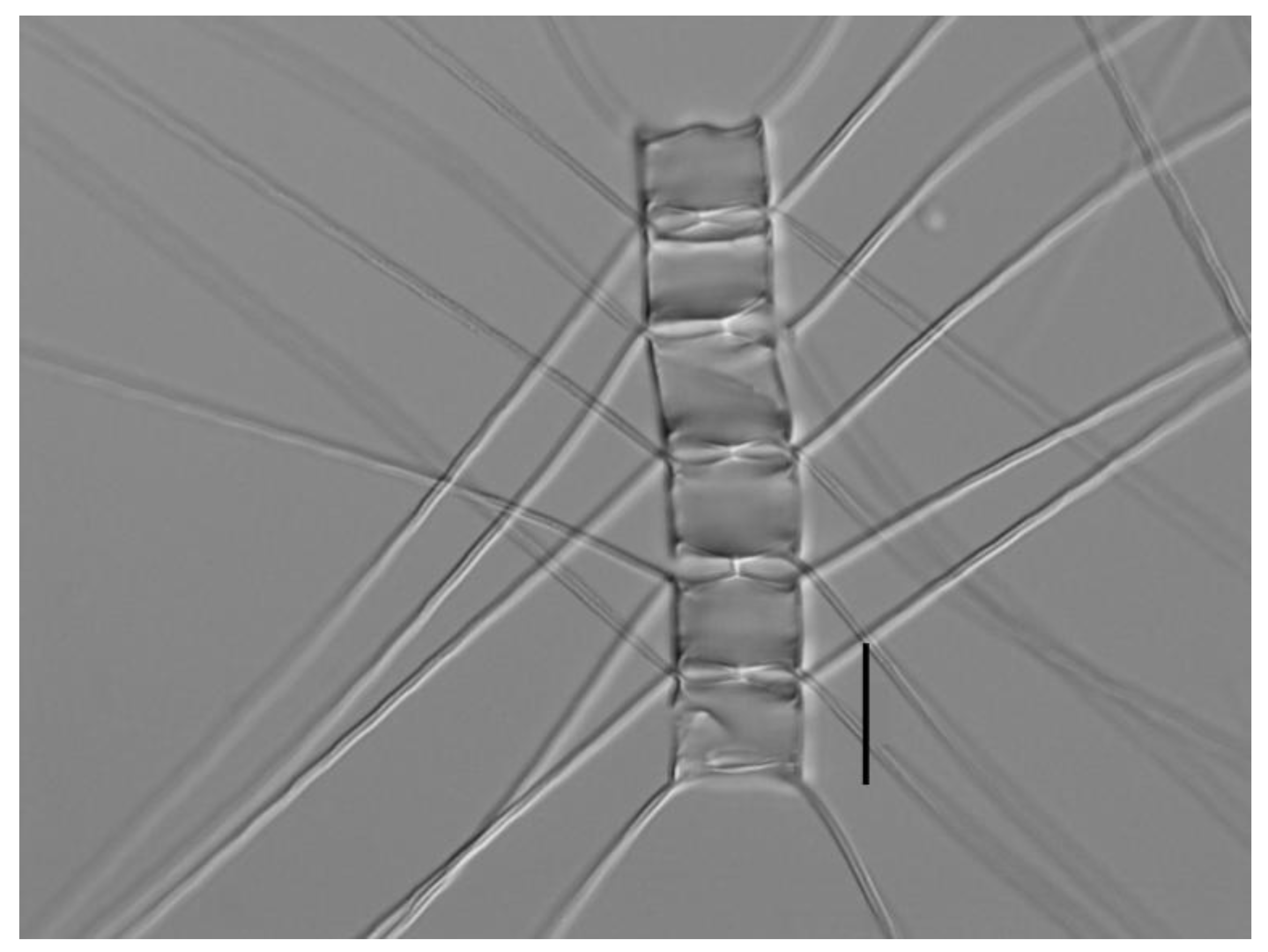
Figure 2.
Chaetoceros muelleri (Mediophyceae) cultivation. View of part of the experiment.
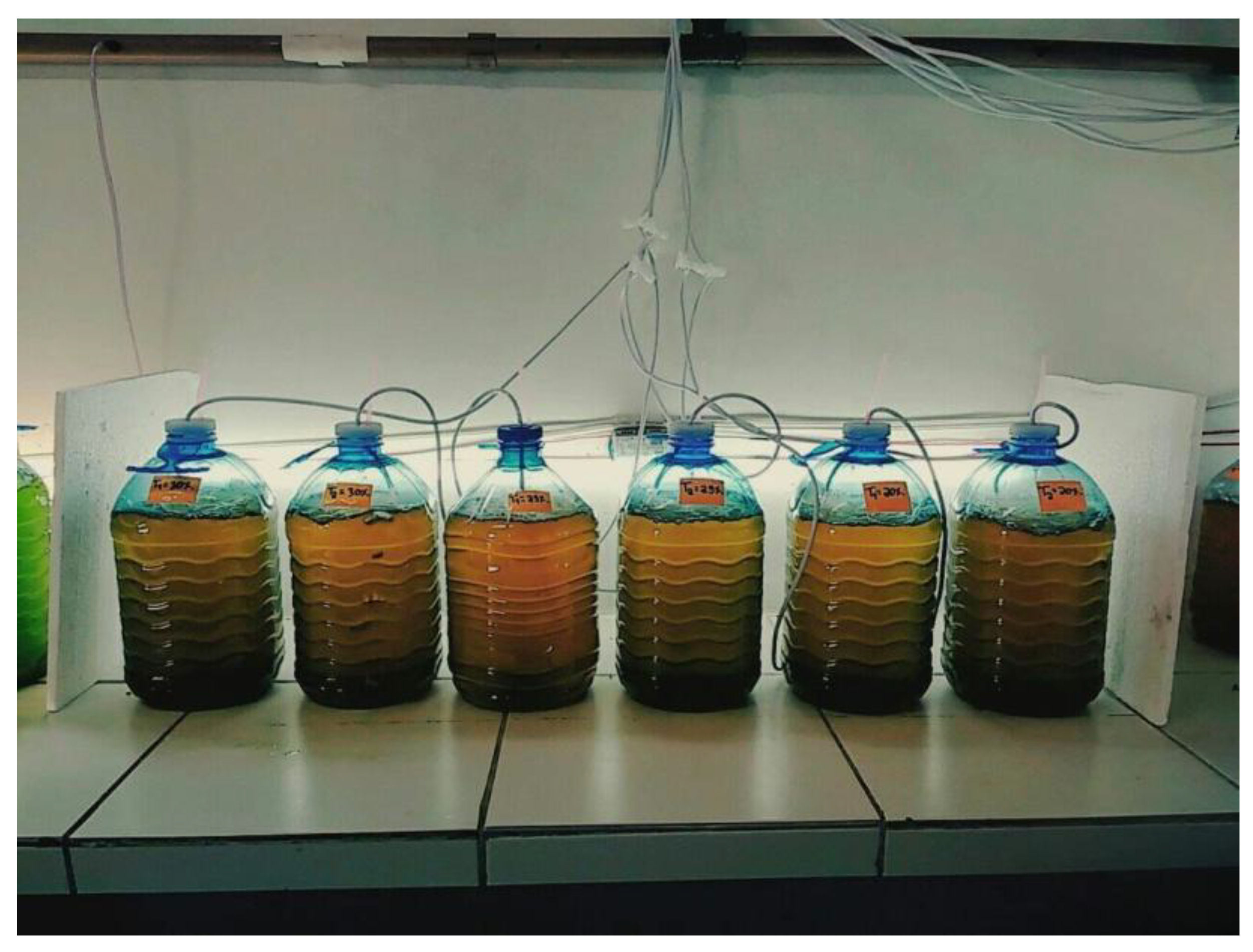

Table 1.
Treatment nomenclature and respective salinity.
| Chaetoceros muelleri | Treatment | |||||
| T30 | T25 | T20 | T15 | T10 | T5 | |
| Salinity | 30 | 25 | 20 | 15 | 10 | 5 |
Table 2.
Initial and final optical densities (OD700 nm) of C. muelleri microalgae cultivated with different salinities. The values indicate the average ± standard deviation.
Table 2.
Initial and final optical densities (OD700 nm) of C. muelleri microalgae cultivated with different salinities. The values indicate the average ± standard deviation.
| Optical Densities (OD700 nm) | ||||||
| T30 | T25 | T20 | T15 | T10 | T5 | |
| Initial | 0,096±0,007 | 0,110±0,012 | 0,103±0,01 | 0,092±0,001 | 0,094±0,002 | 0,103±0,005 |
| Final | 0,404±0,004a | 0,401±0,003b | 0,396±0,004c | 0,347±0,002d | 0,339±0,002e | 0,338±0,003e |
| Percentage of Change | 320.83% | 264.55% | 284.47% | 277.17% | 260.64% | 228.16% |
a,b,c,d,e Different lower-case letters show significant differences between the final optical densities of microalgae grown with different salinities.
Table 3.
Initial and final concentration of phosphorus from C. muelleri is cultivated with different salinities. The values indicate the average ± standard deviation.
Table 3.
Initial and final concentration of phosphorus from C. muelleri is cultivated with different salinities. The values indicate the average ± standard deviation.
| Time Period | Quantity (mg L-1) | |||||
|---|---|---|---|---|---|---|
| T30 | T25 | T20 | T15 | T10 | T5 | |
| Initial | 0,562±0,0010 |
0,573±0,0010 |
0,529±0,0010 |
0,571±0,0006 |
0,554±0,0010 |
0,589±0,0010 |
| Final P % removal |
0,303±0,0036 46,08±0,67%a |
0,320±0,0029 44,15±0,77%b |
0,305±0,0018 42,34±0,30%c |
0,350±0,0021 38,80±0,30%d |
0,346±0,0017 37,54±0,41%e |
0,375±0,0026 36,33±0,55%f |
a,b,c,d,e,f Different lower-case letters show significant differences between the percentage of phosphate removed by microalgae grown at different salinities.
Table 4.
Removal of phosphorus from C. muelleri grown with different salinities. The values indicate the average ± standard deviation.
Table 4.
Removal of phosphorus from C. muelleri grown with different salinities. The values indicate the average ± standard deviation.
| Microalgae | Biomass yields (g L-1) | ||||||
|---|---|---|---|---|---|---|---|
| T30 | T25 | T20 | T15 | T10 | T5 | ||
| Chaetoceros muelleri | 3,38±0,07a | 3,47±0,04a | 2,88±0,04b | 2,08±0,02c | 1,53±0,03d | 1,35±0,08e | |
a,b,c,d,e Different lower-case letters show significant differences between the biomass recovery of microalgae grown at different salinities.
Table 5.
Comparison of phosphorus removal and biomass yield across different microalgal studies.
| Study | Microalgae Species | P Removal (%) | Biomass Yield (g L⁻¹) | Culture Conditions |
|---|---|---|---|---|
| This study | Chaetoceros muelleri | 28–52% | 1.35–3.47 | Synthetic saline media, 6 salinity levels (T5–T30), 10-day culture |
| Huy et al. (2018) [53] | Chlorella sp. (dominant) | 100% | 0.4 | Textile effluent, open system, 13 days |
| Arias et al. (2018) [54] | Scenedesmus sp. | 100% | Not reported | Secondary effluent, closed 30 L PBR, 8-day HRT |
| Li et al. (2011) [55] | Chlorella sp. | 80.9% | Not reported | Domestic sewage, stationary culture |
| Abou-Shanab et al. (2013) [56] | Chlamydomonas sp. | 28% | Not reported | Synthetic wastewater, batch culture |
| Li et al. (2018) [57] | Coelastrella sp. | 12.6–84.9% | Not reported | Swine effluent, copper oxide stress, 16 days |
| Gao et al. (2013) [58] | C. muelleri | 64% | 0.24 | Nutrient-restricted F/2 medium, 12 days |
Footnotes for Culture Conditions: This study: Cultivation of C. muelleri in synthetic saline media with salinity (T5–T30), 10-day culture, flocculation with 2N NaOH, biomass dried at 60 °C; Huy et al. (2018) [53]: Mixed freshwater microalgae cultivated in textile effluent, open system, 13 days; Arias et al. (2018) [54]: Scenedesmus sp. grown in secondary effluent in closed 30 L photobioreactor, 8-day hydraulic retention time; Li et al. (2011) [55]: Chlorella sp. cultivated in domestic sewage for biofuel production and stationary culture; Abou-Shanab et al. (2013) [56]: Multiple species tested in synthetic wastewater for nutrient removal and biodiesel; Li et al. (2018) [57]: Coelastrella sp. grown in swine effluent under varying copper oxide concentrations, 16-day culture; Gao et al. (2013) [58]: C. muelleri cultivated in Guillard F/2 medium with nutrient restrictions, 12 days.
Disclaimer/Publisher’s Note: The statements, opinions and data contained in all publications are solely those of the individual author(s) and contributor(s) and not of MDPI and/or the editor(s). MDPI and/or the editor(s) disclaim responsibility for any injury to people or property resulting from any ideas, methods, instructions or products referred to in the content. |
© 2025 by the authors. Licensee MDPI, Basel, Switzerland. This article is an open access article distributed under the terms and conditions of the Creative Commons Attribution (CC BY) license (http://creativecommons.org/licenses/by/4.0/).
Copyright: This open access article is published under a Creative Commons CC BY 4.0 license, which permit the free download, distribution, and reuse, provided that the author and preprint are cited in any reuse.


