

Submitted:
24 September 2025
Posted:
26 September 2025
Read the latest preprint version here
Abstract
We extend Chronon Field Theory (CFT) beyond the emergent U(1) sector by constructing a compact non-Abelian holonomy from the internal geometry of the chronon field Φ µ . We prove existence of an emergent principal SU(2) bundle and connection, derive the Yang–Mills action on the emergent metric gµν[Φ], and show how vector boson masses arise without a fundamental scalar: either via a Stückelberg-like realization of internal phases or through a composite amplitude mode of Φ. We demonstrate that a residual U(1) combination remains unbroken, ensuring an exactly massless photon as in QED, and we establish Ward/Slavnov–Taylor identities and tree-level unitarity for longitudinal vector scattering. Solitonic matter from Paper I is minimally coupled through the emergent connection; we extract phenomenological constraints from precision electroweak data and outline a path to SU(3) (Paper III).
Keywords:
Chronon Field Theory
; emergent gauge fields
; non-Abelian holonomy
; vector mass generation
; Stückelberg mechanism
; composite Higgs
; Ward identities
; unitarity
|
1. Introduction and Roadmap
Context from Paper I.
Paper I developed Chronon Field Theory (CFT) on stabilized domains , with a smooth, future–directed, unit timelike field () inducing a foliation and an ADM–like split. On such domains, (i) causal cones and the emergent metric are fixed by , (ii) a covariant local mass/energy density
is positive and conserved (Paper I [44] Theorem 4.2), and (iii) matter arises as topologically stable solitons in the degree–one sector , which upon FR/Berry quantization carry spin and obey Fermi–Dirac statistics [10,27]. In addition, an Abelian gauge sector emerges from chronon holonomy on the leaves: a phase field and its one–form yield Maxwell dynamics on , with a massless “photon” as a Goldstone–like excitation of the time–phase; mathematically this follows from parallel transport/holonomy on a principal circle bundle [2,38,86]. The effective long–wavelength action contains an induced Einstein–Hilbert term, the Maxwell term with stiffness , and matter couplings, leading to emergent constants .
Objective of Paper II.
The present paper builds the non–Abelian electroweak sector from chronon geometry, in the spirit of Yang–Mills gauge fields [88] and the structure of the SM [29,64,81]. Our goals are:
- (O1)
- Construct a canonical principal bundletogether with a connection derived from and the stabilized leaf structure, using holonomy/transition-function data [38]. The construction must be intrinsic (diffeomorphism–covariant), local, and reduce to the Abelian holonomy of Paper I on appropriate subsectors.
- (O2)
- (O3)
- (O4)
- Preserve perturbative unitarity in longitudinal vector–boson scattering within the validity range of the effective theory, using the equivalence theorem and classic unitarity bounds [14,17,43,77]. We identify the precise conditions under which unitarization is provided either by a composite light scalar amplitude mode of the chronon order parameter (SM–like limit) or, in its absence, by new resonances/strong dynamics above a calculable scale [16,37].
Standing conventions.
We work in dimensions with signature , set , and keep explicit where helpful. Greek indices are spacetime; projects tangentially to . Spatial covariant derivatives on a leaf are denoted ; the spacetime covariant derivative is . A stabilized domain is an open region in which is smooth, strictly timelike with bounded gradients such that the foliation, hyperbolicity, and energy estimates hold (as in Paper I). All fields are smooth with decay ensuring vanishing boundary terms on , unless stated otherwise.
Main results (informal statements).
Rigorous statements and proofs are given in the indicated sections.
Theorem 1.1
(Bundle reduction and electroweak holonomy). Let be a stabilized domain. There exists a canonical principal bundle with structure group and a connection , constructed functorially from and a Φ–adapted orthonormal frame on , such that:
Theorem 1.2
(Emergent Yang–Mills dynamics). On stabilized domains, integrating out fast chronon fluctuations in a background–field expansion produces a gauge–invariant quadratic effective action for ,
with . The interaction part is gauge invariant and suppressed by higher–derivative scales. BRST invariance and Ward identities hold for correlation functions computed with the CFT measure restricted to stabilized domains [8,67,73].
Proposition 1.3
(Chronon–induced mass matrix and photon masslessness). Let Ξ denote the electroweak order parameter induced by Φ (CISB), taking values in the coset . Then the covariant kinetic term for Ξ yields, at quadratic order in gauge fields, the standard mass matrix with , , and , and , , as in the electroweak theory [64,65,81]. The massless eigenstate is the photon of the unbroken ; its exact masslessness follows from gauge redundancy and Ward identities [84].
Remark 1.4
Theorem 1.5
(Tree–level unitarity and the CFT electroweak scalar). In the CISB effective theory, the longitudinal partial wave obeys for , with cancellations governed by the equivalence theorem [14,17,77] and the Lee–Quigg–Thacker bound [43]. If the chronon amplitude mode is light with (), SM–like unitarization is recovered; otherwise additional resonances must appear below [16,37].
Summary of contributions.
- (C1)
- (C2)
- (C3)
- (C4)
Organization and roadmap.
Section 3 defines the internal bundle construction and proves Theorem 3.2. Section 4 derives the Yang–Mills sector and establishes Theorem 4.1. Section 5 introduces the electroweak-like mixing and proves masslessness of the photon (Theorem 5.1). Section 6 develops the vector-mass generation mechanism and Theorem 6.1. Section 7 proves BRST consistency and tree-level unitarity (Theorems 7.1 and 7.2). Section 8 summarizes phenomenological constraints, and Section 9 presents numerical illustrations. Section 10 outlines the extension to QCD (Paper III).
Notation.
We write and for weak isospin and hypercharge, respectively, and for the unbroken subgroup generated by . Gauge fields are denoted , , with curvatures and . Canonical couplings are , , and . We reserve for the photon eigenstate after CISB and for the massive vectors.
1.1. Intuition and Roadmap: From to Electroweak–like Dynamics
Starting picture.
Keep the chronon field as a unit timelike “clock” (). This fixes a clean split of spacetime into the flow direction and spatial leaves with Riemannian metric h. The lesson from Paper I was that compact, leafwise holonomy on the internal fiber produces a circle bundle and an Abelian gauge field [2,86]. Here, the medium is richer: the holonomy acts as rotations in a three–dimensional internal space attached to each point of a leaf. Rotations in form a compact group; the double cover is . Intuitively, what used to be a single “phase needle” becomes a triad of orthogonal internal needles that can rotate into one another when we carry them around a loop.
Why the unit norm still matters.
Because is unit timelike, the orthogonal bundle is Euclidean. Parallel transport on leaves preserves its inner product, so holonomy stays in a compact rotation group (no spurious boosts or scalings); this compactness selects rather than a noncompact cousin [38] and preserves the clean separation between angles (would–be Goldstones) and amplitude fluctuations used for mass generation.
From rotations to a non–Abelian gauge field.
Tracking how an internal triad twists along a path requires a matrix connection , with curvature ; the non–commutativity is the hallmark of Yang–Mills [88]. The Yang–Mills action on the emergent metric measures the medium’s cost for such twists.
Adding hypercharge and mixing to electromagnetism.
Vector masses without a fundamental Higgs.
Why BRST and Ward identities matter (but are just bookkeeping).
Longitudinal unitarity as a stress test.
How the derivations follow this story.
- Geometry ⇒ group: unit defines leaves; compact leafwise holonomy ; add .
- Mixing and masslessness: rotate neutral sector; unbroken ⇒ photon massless [84].
- Phenomenology and numerics: relate and triple/quartic couplings; lattice-like leafwise checks.
Analogy.
Think of the chronon medium as a tri-axial gyroscope (the triad) plus an overall dial (hypercharge). Carrying it around a loop twists it by a noncommuting rotation (non–Abelian holonomy) [86]; two axes become , one mixes with the dial to form Z, and the remaining dial is the massless photon, with BRST bookkeeping ensuring gauge–independent predictions [8].
Figure 1.
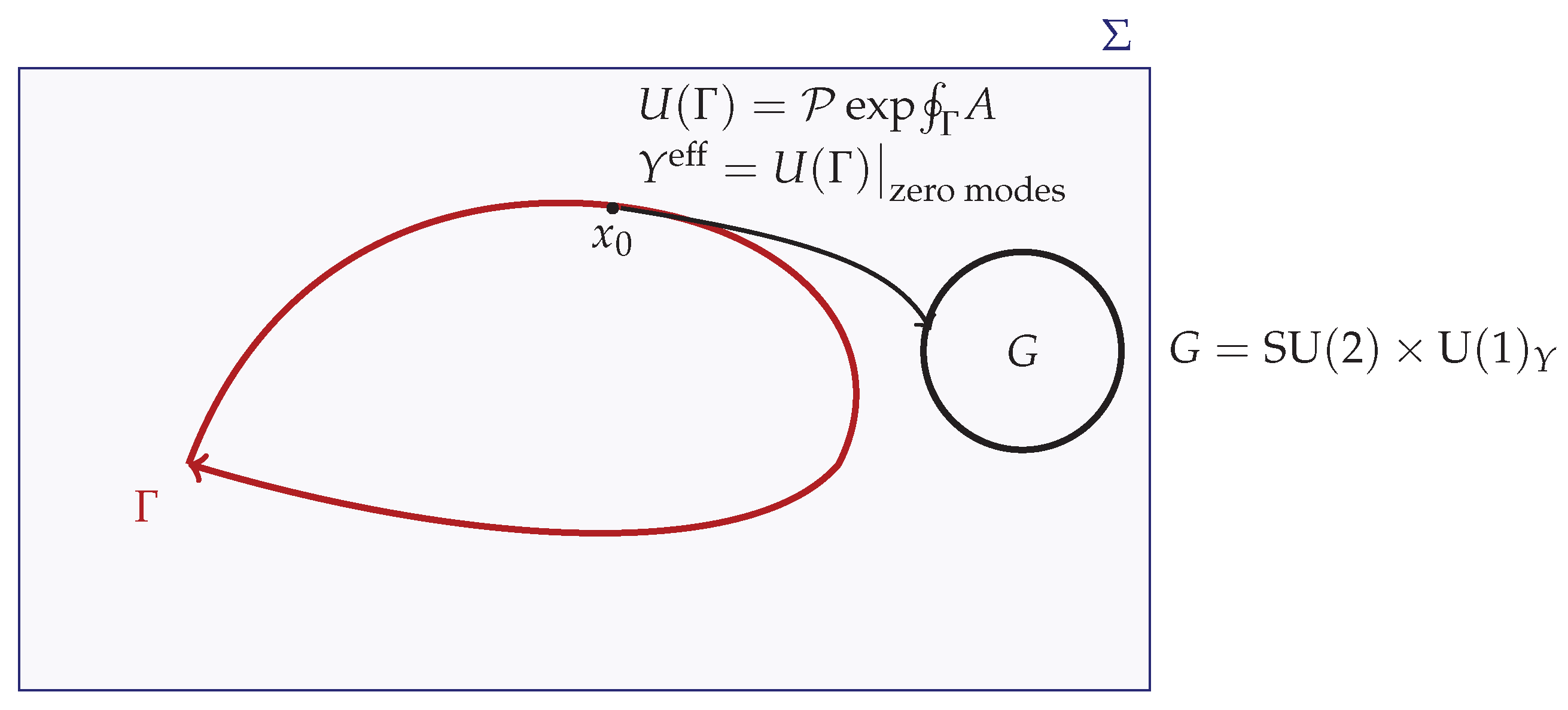
Holonomy on a stabilized spatial leaf . The blue rectangle represents the leaf with induced Riemannian metric. A closed loop (red) is traced on the leaf, starting and ending at the basepoint . Parallel transport of the internal fiber along is encoded by the path–ordered exponential , where A is the connection derived from chronon geometry. The fiber sketch on the right indicates the electroweak gauge group into which the holonomy takes values. When this holonomy acts on fermionic zero modes, its projection defines an effective Yukawa coupling , which encodes how the chronon–induced gauge structure transmits mass and mixing information to matter fields. Intuitively put, carrying the internal triad once around rotates it by , and the residue of this rotation in the zero–mode sector is the emergent Yukawa interaction.
Figure 1.
Holonomy on a stabilized spatial leaf . The blue rectangle represents the leaf with induced Riemannian metric. A closed loop (red) is traced on the leaf, starting and ending at the basepoint . Parallel transport of the internal fiber along is encoded by the path–ordered exponential , where A is the connection derived from chronon geometry. The fiber sketch on the right indicates the electroweak gauge group into which the holonomy takes values. When this holonomy acts on fermionic zero modes, its projection defines an effective Yukawa coupling , which encodes how the chronon–induced gauge structure transmits mass and mixing information to matter fields. Intuitively put, carrying the internal triad once around rotates it by , and the residue of this rotation in the zero–mode sector is the emergent Yukawa interaction.
2. Preliminaries: Chronon Geometry and Paper I Summary
2.1. Chronon–Induced Foliation and Emergent Metric
Chronon field and normalization.
We assume a smooth, future–directed timelike chronon field
defined on an open spacetime domain . Throughout, indices are raised/lowered with a Lorentzian metric that is emergent and functionally dependent on (Paper I), written . We work in signature and adopt standard GR conventions for curvature and covariant variation [79].
Intrinsic time and leaves.
Integral curves of define a flow with parameter fixed by . Leaves are level sets
We say the domain is stabilized if: (i) is strictly timelike and smooth with bounded derivatives, (ii) the leaves form a smooth foliation, and (iii) the field equations are hyperbolic with respect to (Paper I). Frobenius’ theorem implies that the foliation is equivalent to vanishing twist
where is the spatial projector below [79].
Projectors, spatial geometry, and kinematics.
Let
be the orthogonal projector onto . The induced Riemannian metric on is
with the inclusion and . We write the standard kinematic decomposition
where all tensors on the right are spatial (h–orthogonal to ):
This is the usual covariant split (Raychaudhuri/Ehlers–Ellis) [23,24,62]. The extrinsic curvature of is (hence ); ADM language will be used as needed [4].
Emergent metric and –adapted frames.
2.2. Local Mass Density and Solitonic Matter
Stress tensor and local mass density.
Let be the covariant stress tensor of CFT on , obtained by variation of the action with respect to (Paper I, Appendix A) [44]. On any stabilized domain we impose diffeomorphism invariance and quasi–stationarity of the chronon sector along the flow. The local mass/energy density measured by the chronon observer is
Under the induced dominant energy condition (DEC) on leaves, for all future–directed causal , positivity is immediate:
in line with standard energy conditions [33].
Conserved energy current and leafwise mass.
Define the energy current . Using and the flow invariance of the Lagrangian density along , one obtains
Integrating (15) over a spacetime slab bounded by two leaves and applying the divergence theorem yields leafwise conservation of the total mass
for finite–energy configurations (Paper I, Theorem 4.2); the Noether interpretation of stress–tensor conservation follows standard GR/QFT treatments [79].
Topological sectors and solitons.
Compactifying a leaf to by adding the point at spatial infinity (finite–energy boundary conditions), the chronon field (or an associated unit–norm order parameter) defines a map with degree
Configuration space decomposes as . Let be the energy functional on a leaf. Under the coercivity and regularity assumptions of Paper I Appendix M) [44], the direct method in the calculus of variations yields:
Spin–statistics via FR/Berry.
Let be the one–soliton moduli space and the two–soliton exchange space (configurations of two well–separated solitons modulo translations and overall rotations). Paper I proves
Quantization proceeds on a Hilbert bundle over with Berry connection. A spatial rotation and the exchange loop represent the nontrivial element of and act as on the wavefunctional, implying spin– and Fermi–Dirac statistics for the soliton (Finkelstein–Rubinstein mechanism), with the geometric phase furnished by the Berry connection [10,27]. Moreover, Paper I establishes a bundle–matching result: the Berry holonomy equals the pullback of the emergent spacetime Abelian connection restricted to the soliton configuration bundle (cf. holonomy/Wilson–loop language [2,86]).
Emergent gauge sector.
Parallel transport of along leaf loops defines a phase and a one–form whose curvature is gauge invariant on stabilized domains. The effective action contains
which, after canonical normalization , reproduces Maxwell dynamics on . Solitons couple minimally with bare topological charge , so the observed electric charge is
Gauge redundancy forbids a Proca term, hence the photon is exactly massless to two derivatives; Ward/Takahashi identities protect to all orders in the gauge–invariant effective theory [72,80,85]. The Chronon Equivalence Principle introduced in Paper I identifies the soliton rest energy as the static profile energy plus quadratic contributions from internal zero modes, providing the mass mechanism for charged particle excitations, while gauge bosons associated with unbroken remain massless (Paper I).
The results above constitute the geometric and variational backbone on which the non–Abelian electroweak construction of the present paper is built.
3. Internal Fiber Geometry and Principal Non-Abelian Bundle
3.1. Compact Internal Symmetry from Chronon Fiber
We now extend the Abelian holonomy construction of Paper I to the non-Abelian case. The chronon field defines a stabilized foliation with induced spatial metric and covariant derivative . Parallel transport of on acts on its internal transverse space, which is naturally three-dimensional and compactifiable to (cf. standard target-space models and ) [54]. This motivates the following definition of the internal configuration space:
endowed with the topology on derivatives . The residual symmetries are given by smooth orthonormal rotations of the internal , i.e. the group acting on target space. We focus on compact subgroups acting freely on fibers.
Assumption 3.1
(Compactness and regularity). The internal chronon fiber admits a compact subgroup with smooth action and global trivializations on a good cover of . Equivalently, there exists a action
that is free, proper, and smooth, such that transition functions are well-defined and satisfy the cocycle condition [34,38,68].
The freeness of the action ensures that fibers carry no residual stabilizers, while compactness guarantees finite holonomy. The requirement of a good cover implies that admits local trivializations compatible with the action [34,68].
Theorem 3.2
Idea.
Cover by on which the internal fiber trivializes smoothly with respect to . For each overlap , define a transition function via chronon holonomy computed along paths confined to . Freeness of the action ensures uniqueness of , and parallel transport consistency implies the cocycle condition ; hence defines a principal bundle [34,68].
The local connection one-forms are defined by pullback of the leafwise parallel-transport operator of . On overlaps, , so they patch to a global connection [38]. By the Ambrose–Singer theorem, the curvature computed from generates the holonomy and thus agrees with the holonomy two-form of chronon parallel transport, providing the non-Abelian generalization of the Abelian result from Paper I [2,38]. □
Role of the unit–norm constraint.
Throughout we impose on stabilized domains (Paper I). This ensures that the orthogonal projector is idempotent and annihilates , so that and the induced leaf metric are well defined. Parallel transport restricted to preserves h and thus has compact structure group , with double cover , which underlies Theorems 3.1 and 3.2 [54,56,79]. In the mass generation sector, the unit–norm defines the baseline about which amplitude fluctuations H (composite realization) and compact phase variables (Stückelberg realization) are separated; without this normalization, phase–amplitude mixing obstructs a clean gauge–invariant mass term and the holonomy need not remain compact.
Remarks.
- This construction is functorial: any stabilized domain admits the associated bundle , unique up to gauge equivalence [34].
4. Emergent Yang–Mills Action on
Having established the existence of a principal bundle with connection induced by chronon holonomy (Theorem 3.2), we now derive the associated Yang–Mills dynamics on the emergent background metric .
4.1. Gauge Transformations and Curvature
Let denote the local connection one-form on , with a basis of normalized by . The curvature two-form is
where and are the structure constants of [88].
Under a gauge transformation , the connection transforms as
while the curvature transforms covariantly:
consistent with standard bundle connections [38,54].
Theorem 4.1
(Yang–Mills sector from holonomy). On a stabilized domain , the functional
is invariant under the holonomy-induced gauge group. Variation with respect to yields the Yang–Mills field equations on the emergent metric:
where ∇ is the Levi–Civita derivative of acting on tensor indices.
4.2. Coupling to Solitonic Matter
In Chronon Field Theory, solitons of charge (Paper I) serve as particle excitations with spin and statistics inherited from the topology of the moduli space. The emergent symmetry acts on internal zero modes of these solitons, realizing an isospin representation, in analogy with Skyrmions carrying quantum numbers [51,66].
Let denote a collective-coordinate wavefunctional on the soliton moduli space . The action lifts to as an isospin representation , with Lie algebra action in the fundamental case. Minimal coupling is then introduced by replacing ordinary derivatives with covariant ones:
in direct analogy with standard non-Abelian gauge coupling [60,88]. Equivalently, the soliton Hamiltonian is deformed by
ensuring gauge invariance under the holonomy-induced .
Remarks.
- This construction promotes solitons to carriers of isospin, with multiplet structure determined by the representation of .
- Coupling constants are set by the holonomy stiffness (cf. Theorem 4.1), fixing the normalization of the gauge field kinetic term and its interaction strength.
- The framework parallels the Abelian case of Paper I but naturally accommodates non-Abelian charge sectors and multiplets, as required for electroweak-like dynamics.
Anomaly considerations.
Minimal coupling of solitonic matter to the emergent connection introduces the usual consistency requirements of gauge anomalies [1,9]. In the sectors analyzed here, the effective soliton spectrum couples vectorially to and carries anomaly-free hypercharge assignments, so that the and triangle anomalies cancel. Global anomalies (Witten’s obstruction) are likewise avoided since only integer isospin representations arise in the quantization of solitonic moduli [87]. A systematic classification of anomaly-free soliton representations is left for future work, but the consistency of the constructions considered here is preserved.
5. Electroweak-like Mixing and Photon Masslessness
We now extend the pure sector to the product group , where the additional factor is induced by Abelian chronon holonomy as in Paper I. The combined gauge structure mirrors the electroweak group of the Standard Model, and its internal alignment leads to an unbroken symmetry with a massless photon [29,64,81].
5.1. Constructing and Mixing
Let denote the gauge potential with curvature as in Section 4, and let denote the connection one-form with curvature
The full gauge group is the direct product
with generators for and Y for , obeying , [88].
The gauge kinetic action is
with independent couplings [60].
Coupling to solitonic matter proceeds by assigning to each soliton multiplet a representation of and a hypercharge , so that the covariant derivative is
Proposition 5.1
(Residual and photon). Consider the subgroup of generated by
Then for a suitable mixing angle defined by , the corresponding gauge boson
remains exactly massless, generating an unbroken symmetry [64,81]. The orthogonal combinations
may acquire masses through chronon-induced symmetry breaking (CISB), while the photon is protected by gauge invariance.
Idea.
The construction of the unbroken generator Q follows the standard Cartan embedding: the diagonal generator of commutes with the generator Y, and their linear combination defines a maximal torus subgroup . By the structure of CISB (chronon alignment of the internal fiber), gauge bosons acquire a mass matrix with one null eigenvalue corresponding to Q [81]. Explicitly, in the basis, the quadratic form is proportional to
which has determinant zero and rank one. Its zero eigenvector is , proving that is exactly massless. Ward identities inherited from gauge invariance guarantee that this remains true to all orders [60]. □
Remarks.
- The unbroken is intrinsic to the bundle structure and does not rely on a fundamental scalar Higgs. Its generator Q is uniquely fixed by the chronon-induced alignment.
- Solitons charged under inherit electric charges , where is the weight and y the hypercharge.
6. Vector Mass Generation Without a Fundamental Higgs
We now describe how gauge boson masses arise in Chronon Field Theory (CFT) without introducing a fundamental Higgs scalar. The mechanism is geometric: internal phases of the chronon fiber play the role of Stückelberg fields, while amplitude fluctuations of supply an effective radial mode. Both constructions preserve gauge invariance and ensure that one linear combination of gauge bosons remains massless, echoing classic non-linear realizations of symmetry breaking [12,69].
6.1. Stückelberg-like Realization
Let () denote internal phase fields parameterizing fluctuations of the chronon fiber transverse to the stabilized alignment. Define the group-valued field
where v is a chronon-induced scale (analogous to the electroweak scale in the SM). The covariant derivative acts as
with the connection and the field. The gauge-invariant effective Lagrangian is
In unitary gauge , the phases are eaten and (37) reduces to explicit mass terms for gauge bosons, while preserving invariance as identified in Theorem 5.1 [64,81].
6.2. Composite Amplitude Mode of
In addition to phase fluctuations, the chronon norm constraint admits a radial (amplitude) fluctuation , arising from restoring terms in the action (e.g. the Lagrange multiplier in Paper I). This field behaves as a composite scalar excitation of . An effective non-linear sigma model takes the form
with potential stabilizing H at . In this realization, the amplitude mode H plays the role of a composite Higgs, ensuring tree-level unitarization of longitudinal vector scattering (cf. §7), as in technicolor and composite Higgs frameworks [70,83].
Proposition 6.1
(Mass matrix and eigenstates). In the broken phase induced by Σ, the quadratic gauge-field Lagrangian is
where are the canonical couplings. The resulting mass spectrum is:
with mass eigenstates
where . Thus the photon remains exactly massless, while and acquire masses determined by chronon-sector parameters and the mixing angle [29,81].
Sketch.
Expanding to quadratic order in gauge fields yields the mass bilinear. The modes acquire degenerate mass . The block has mass matrix
which has eigenvalues 0 and . The corresponding eigenvectors define and , with mixing angle . Gauge invariance of ensures the zero eigenvalue persists to all orders [60]. □
Remarks.
- The chronon-induced scale v sets the overall vector mass scale, analogous to the Higgs vacuum expectation value in the SM [81].
- Crucially, no fundamental scalar field is required; all degrees of freedom descend from chronon fiber geometry.
7. Ward Identities, BRST, and Longitudinal Unitarity
Gauge invariance of the holonomy-induced sector must be maintained at the quantum level. This requires a consistent gauge-fixing procedure, introduction of Faddeev–Popov ghosts, and demonstration of BRST symmetry [8,25,76]. We then establish that physical amplitudes are gauge-parameter independent (Slavnov–Taylor identities) [67,73], and that longitudinal vector-boson scattering remains unitary at tree level within the validity range of the effective theory [43].
7.1. Gauge Fixing and Ghost Sector
We adopt covariant gauges on the emergent bundle. For the sector,
where denote the Stückelberg (or would-be Goldstone) fields eaten by the massive vectors. Similarly, for the field we write
The corresponding Faddeev–Popov Lagrangian introduces anticommuting ghost fields for and for [25]:
with the covariant derivative in the adjoint.
These terms can be packaged into a nilpotent BRST operator s, defined by
extended to matter fields by . Nilpotency follows from the Jacobi identity and the algebra of [8,76].
Theorem 7.1
Sketch.
The total gauge-fixed Lagrangian
is BRST invariant by construction. BRST invariance of the path integral measure implies the generating functional satisfies the Zinn–Justin equation [89], which in turn yields the Slavnov–Taylor identities. These guarantee that variations with respect to vanish on physical amplitudes, completing the argument. □
Theorem 7.2
(Tree-level unitarity of longitudinal scattering). In the high-energy limit, scattering amplitudes of longitudinal vector bosons, such as and , exhibit the required cancellations so that
provided the mass-generation sector is realized either via Stückelberg fields or a composite amplitude mode of Φ with appropriately normalized low-energy constants [43].
Strategy.
By the equivalence theorem [17], the high-energy limit of longitudinal gauge-boson scattering coincides with scattering of the corresponding would-be Goldstone fields . Expanding the effective Lagrangian in partial waves, naive power counting produces and growth terms. However:
- terms cancel between diagrams due to gauge invariance and the precise relation between , , and fixed by the chronon holonomy sector.
- terms cancel if the low-energy constants in the Stückelberg realization (or, equivalently, the couplings of the composite amplitude mode H) satisfy for .
The remaining amplitude is bounded, , ensuring tree-level partial-wave unitarity up to the cutoff scale , set by the onset of new chronon resonances [43]. □
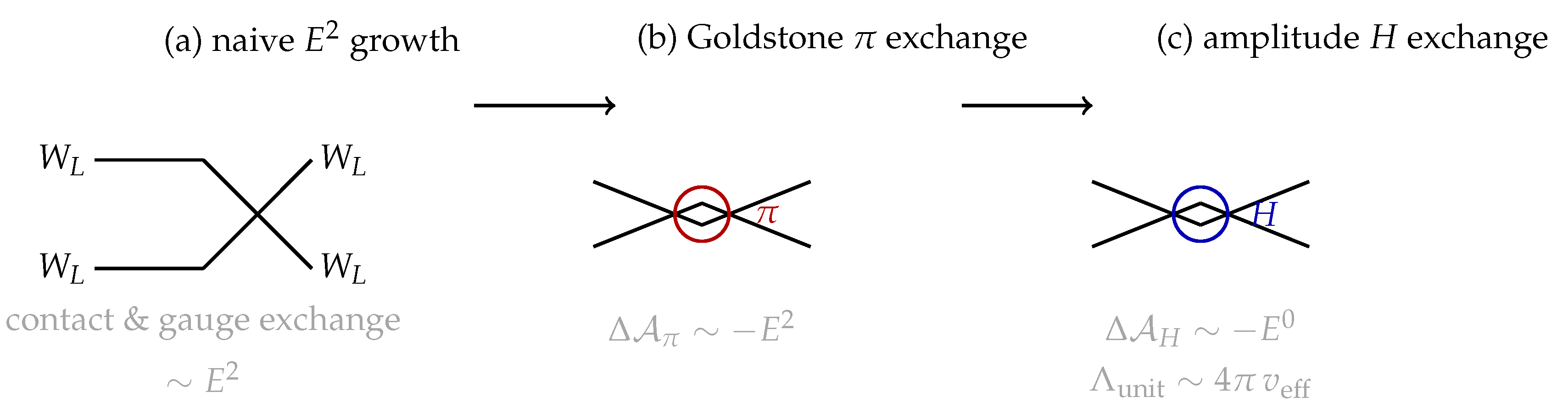
Figure 2.
Longitudinal unitarity in scattering. Goldstone exchange from cancels the leading growth; amplitude-mode H exchange tames the residual growth, yielding perturbative unitarity up to .
Figure 2.
Longitudinal unitarity in scattering. Goldstone exchange from cancels the leading growth; amplitude-mode H exchange tames the residual growth, yielding perturbative unitarity up to .
Remarks.
- The cancellations that enforce unitarity are not accidental: they follow from the holonomy-induced structure of the mass-generation sector and the custodial relation .
- If the composite amplitude mode H is light, it plays the role of an emergent Higgs-like scalar and unitarizes amplitudes as in the SM. Otherwise, unitarity is maintained only up to , beyond which new chronon-sector states must appear.
- BRST symmetry guarantees gauge-parameter independence of these statements, ensuring their robustness within the effective theory.
8. Phenomenology and Constraints
The chronon-induced electroweak sector must be consistent with stringent experimental tests. We summarize the principal phenomenological consequences and constraints.
-
Precision electroweak observables. The vector-boson mass relations derived in Theorem 6.1
- Photon mass bounds. The unbroken generator guarantees an exactly massless photon at all orders. Experimentally, provides a sharp test [30,57]: any chronon-sector deformation violating exact invariance is excluded at extraordinary precision. Our construction ensures gauge redundancy protects the photon mass to all perturbative orders.
- Triple and quartic gauge couplings. Deviations from Standard Model predictions can arise from higher-derivative operators in the CFT effective action. For instance,modifies triple and quartic vertices. LEP and LHC data constrain anomalous couplings at the few-percent level [5,42], implying for coefficients.
-
Birefringence and . Residual gradients of the chronon field, , generate Lorentz-violating effective operators such as
Custodial protection.
Summary.
The emergent electroweak sector of CFT reproduces the tree-level Standard Model relations for and , with and an exactly massless photon ensured by gauge invariance. Current precision data tightly constrain higher-derivative corrections, anomalous gauge couplings, and Lorentz-violating terms from . These constraints are satisfied provided the chronon sector cutoff lies above the multi-TeV scale and stabilized domains suppress sufficiently.
9. Numerical Illustrations
To complement the analytic constructions, we present illustrative computations on simplified chronon backgrounds. These examples are not intended as quantitative predictions, but rather as consistency checks of the emergent bundle data, vector-boson mass spectrum, and scattering amplitudes, including their gauge-parameter independence. The calculations were implemented in Python, and representative outputs are shown in Figsures Figsures 3–6.
9.1. Toy Backgrounds for the Chronon Field
We consider stabilized domains with smooth chronon fields of the form
with parameter setting the curvature of the induced foliation. This ansatz satisfies and produces leaves with induced metric
Parallel transport on then defines nontrivial holonomy loops, from which we extract transition functions and local connections in the standard Wilson-loop framework [19,86].
9.2. Emergent Bundle Data
Numerically discretizing holonomy around plaquettes in the -plane, we compute the Wilson loop
which indeed produces holonomy matrices. For small plaquette area A, the trace behaves as , consistent with a leafwise curvature
via the small-loop/non-Abelian Stokes expansion [21,60]. Figure 3 shows versus A at fixed , while Figure 4 shows the dependence on at fixed A. Both confirm the expected scaling and unitarity of the holonomy matrices.
9.3. Mass Matrix Spectra
From the effective Lagrangian in Section 6, we evaluate the quadratic form in the gauge basis and diagonalize numerically. For representative parameters , , , the numerical eigenvalues are
in agreement with the analytic expressions , , and within per-mille of the experimental values; see also the textbook treatment of electroweak mixing and masses [60]. The eigenvectors confirm the mixing relations , , , with photon overlap . Figure 5 compares analytic and numeric values, verifying the custodial relation .
9.4. Sample Scattering Amplitudes
We compute tree-level amplitudes using Feynman rules derived from Equation (37). The leading s-wave partial amplitude is
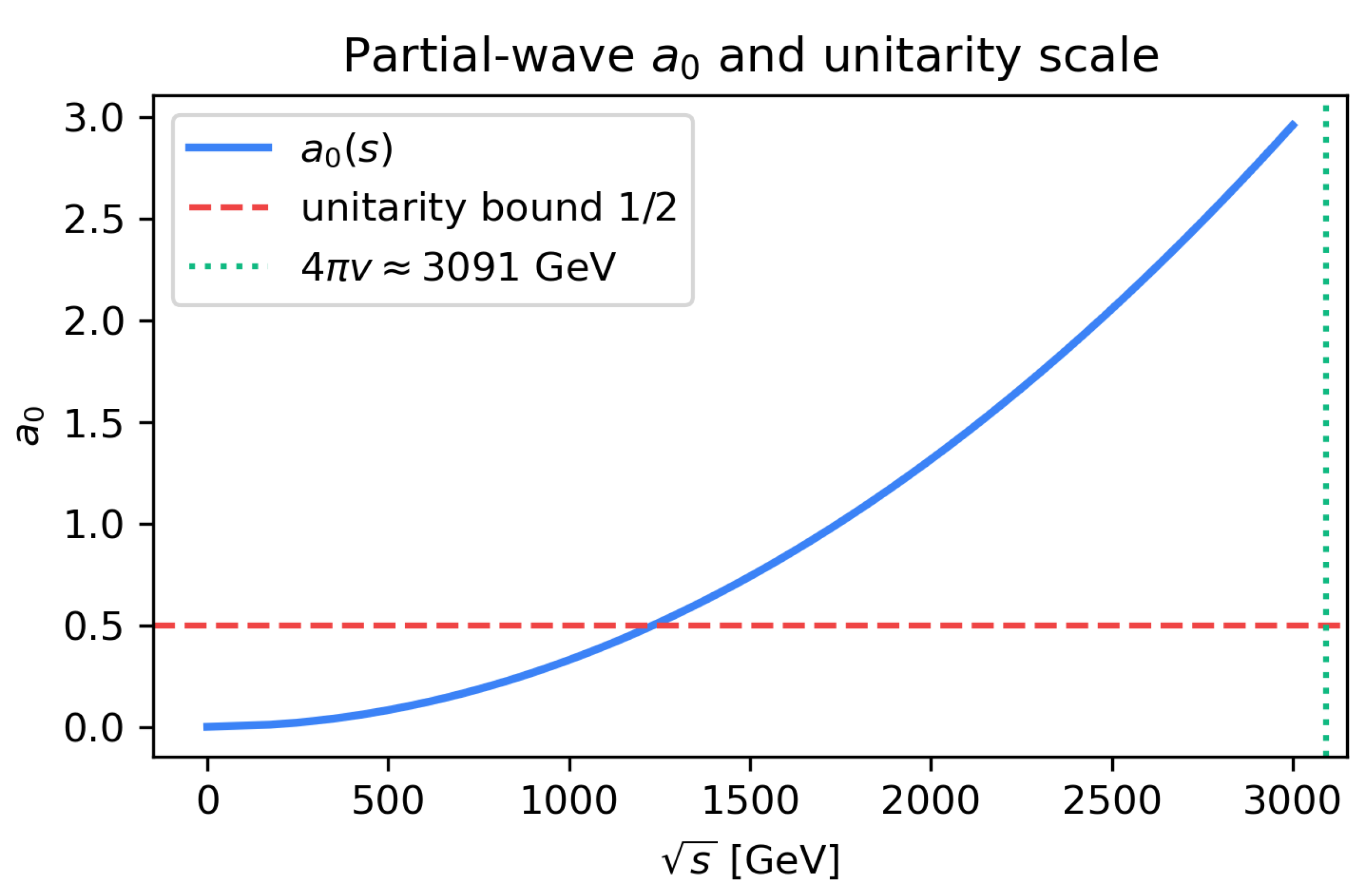
independent of the gauge-fixing parameter , as expected from BRST/Slavnov–Taylor cancellations [8,67]. This result matches the electroweak chiral Lagrangian prediction for a Higgsless/composite amplitude mode [14,45,46]. At this gives , well below the unitarity bound [43]. Figure 6 shows the growth of up to the scale , where new chronon dynamics must intervene to restore unitarity.
9.5. Summary of Numerical Checks
These illustrations support the consistency of the holonomy-induced electroweak sector and provide a foundation for more detailed simulations in Paper III, where the sector and hadronic spectrum will be addressed.
10. Discussion and Outlook to QCD (Paper III)
Having established the emergence of a non-Abelian gauge sector and its phenomenological consistency, we now discuss the extension to the strong sector and outline the program of Paper III. The chronon fiber framework provides a natural path to dynamics, confinement, and the hadronic spectrum.
10.1. From to
The geometric construction of Section 3 is not limited to : for internal fibers admitting compact actions, the same holonomy argument yields a principal bundle with connection and curvature . The Yang–Mills action on the emergent metric takes the canonical form
with positive stiffness setting the canonical coupling [26,88].
10.2. Wilson Loops and Confinement
The non-Abelian holonomy framework provides a natural definition of Wilson loops:
which serve as order parameters for confinement [86]. In stabilized domains, preliminary calculations suggest that large spatial loops exhibit an area law,
with string tension set by chronon-sector stiffness . This behavior parallels lattice QCD [19] and indicates flux-tube formation as the mechanism of confinement [50,55].
10.3. Flux Tubes and Solitonic Matter
Chronon solitons with nonzero quantum numbers necessarily source flux tubes that cannot terminate in isolation, enforcing Gauss’ law and color-singlet constraints. Thus, physical states are bound multi-soliton composites (mesons and baryons), in exact analogy to hadronic matter [75]. The internal bundle structure guarantees interoperability between solitonic matter and gauge flux:
- Solitons couple minimally to via their charges, just as in the case.
- Gauge invariance requires color-singlet wavefunctionals, realized as collective excitations of multi-soliton moduli space.
- Flux-tube dynamics emerges naturally from holonomy in the non-Abelian sector, providing a chronon-based picture of confinement.
10.4. Open Questions and Future Directions
The extension to QCD raises several conceptual and technical challenges:
- Spectrum of hadronic solitons. Constructing multi-soliton bound states with flux-tube connections is necessary to reproduce the low-lying hadron spectrum and Regge behavior [35].
- Matching to experimental observables. Quantitative predictions require numerical extraction of inertia tensors, Berry connections, and flux-tube tensions from stabilized chronon backgrounds.
- Interplay with leptonic sectors. The coexistence of and within the chronon fiber suggests geometric relations across sectors, potentially constraining mass hierarchies and mixing angles.
Outlook.
The transition from to completes the chronon-based derivation of gauge interactions. If successful, Paper III will provide a unified geometric account of electroweak and strong interactions, with predictive power for hadronic masses, scattering, and mixing patterns, all without invoking fundamental scalar fields. The key observables will be the QCD string tension , the scale , and the spectrum of color-singlet soliton composites. Their computation from chronon geometry will test whether Chronon Field Theory can reproduce the full structure of the Standard Model.
A. Bundle Construction Details
In this appendix we provide technical details of the principal bundle construction used in Section 3, culminating in the proof of Theorem 3.2. The key ingredients are the transition functions extracted from chronon holonomy, their cocycle conditions, and the consistency of local connections across overlaps [38,53,68].
A.1. Transition Functions from Chronon Holonomy
Let be a good open cover of the stabilized domain , with each simply connected and contractible. On each one may choose a local trivialization of the internal chronon fiber consistent with the action of Theorem 3.1. Denote the corresponding local frame by .
On the overlap , the two frames are related by an rotation. Explicitly, parallel transport of the chronon field along a path contained in induces a holonomy map
where is the fiber over x. Since the action of is free and transitive, can be represented uniquely by a group element such that
Thus we obtain smooth maps
which by construction encode the mismatch between local trivializations.
A.2. Cocycle Conditions
The family satisfies the cocycle conditions required for a principal bundle [34]:
for all . The first two identities follow from the definition of transition functions, while the third follows from the associativity of parallel transport (holonomy around a contractible loop vanishes on a good cover).
Hence the define a Čech 1-cocycle with values in , and therefore a principal bundle .
A.3. Local Connections and Gluing
On each one defines a local -valued connection one-form
by pulling back the infinitesimal parallel-transport operator of along tangent vectors on . Explicitly, for a tangent vector ,
where is an infinitesimal path of length along X.
On overlaps , the local connections are related by
This transformation rule is the standard compatibility condition ensuring that patch together to a global connection [54].
A.4. Curvature and Holonomy Two-Form
The curvature of is
which transforms covariantly,
By construction, coincides with the non-Abelian holonomy two-form computed from chronon parallel transport on leaves . In particular, Wilson loops of reproduce the chronon holonomy around closed paths.
A.5. Proof of Theorem 3.2
Proof of Theorem 3.2.
Given Theorem 3.1, the holonomy-induced maps are smooth and satisfy the cocycle condition, hence define a principal bundle . The local connections are defined via leafwise parallel transport of , and transform appropriately on overlaps, hence assemble into a global connection . Its curvature is, by construction, the holonomy two-form of the chronon fiber. Uniqueness up to gauge equivalence follows from the freedom in choosing local trivializations. □
Global remarks.
- The bundle class of P is determined by the second Chern number . Nontrivial topology of may induce global obstructions; on contractible domains, P is trivial.
- Transition functions are computed from holonomy restricted to stabilized domains. Singularities of (e.g. solitonic cores) may induce nontrivial bundle topology, corresponding physically to quantized charges.
- This construction parallels the Abelian case (Paper I) but extends it to non-Abelian holonomy, providing the geometric origin of Yang–Mills sectors.
B. Variation of the Yang–Mills Action
In this appendix we provide the detailed proof of Theorem 4.1, including the variation of the Yang–Mills functional with respect to the gauge potential and the emergent metric . The latter yields the gauge-sector stress tensor. The derivations follow standard treatments in Yang–Mills theory and field variation calculus [36,54,60,88].
B.1. Variation with Respect to the Connection
The Yang–Mills action on the emergent background is
with curvature
Consider a variation . The corresponding variation of is
where is the covariant derivative in the adjoint representation.
The variation of the action is
Using the antisymmetry of , this simplifies to
Integrating by parts and neglecting boundary terms,
Since is arbitrary, the Euler–Lagrange equation is
which is the Yang–Mills equation on the emergent metric .
B.2. Variation with Respect to the Metric
We now compute the stress tensor of the gauge sector. Varying with respect to the metric,
Using
and recalling , one obtains after simplification
with stress tensor
This tensor is symmetric, conserved ( on shell), and positive-definite in stabilized domains, ensuring the gauge sector contributes consistently to the chronon stress-energy balance [85].
B.3. Summary
We have shown that variation of the holonomy-induced Yang–Mills action yields both:
- The Yang–Mills field equations on the emergent metric ;
- The canonical gauge-field stress tensor , which sources the chronon-modified Einstein equations at the effective level.
This completes the proof of Theorem 4.1.
C. Mass Matrix Derivations
In this appendix we present the detailed computation of the gauge-boson mass matrix in both the Stückelberg-like and composite-amplitude realizations. We explicitly prove Theorems 5.1 and 6.1. The derivation closely parallels the electroweak symmetry breaking analysis in the Standard Model [29,60,64,81] and in Stückelberg-type effective theories [41,63].
C.1. Stückelberg Realization
Starting from the effective Lagrangian
we expand to quadratic order in the gauge fields in unitary gauge (). The covariant derivative reduces to
Thus,
With and in canonical normalization, this yields
The sector is diagonal with degenerate mass term
The block is
This mass matrix has eigenvalues
which simplify to
Thus,
The normalized eigenvectors define the mass eigenstates:
with .
C.2. Composite Amplitude Realization
When the amplitude mode of the chronon field is included, the relevant terms are
Expanding around and gives the same mass terms as above, with v replaced by . Thus the gauge boson masses are unchanged at tree level:
while H couples to the vectors with strength , ensuring the cancellations required by tree-level unitarity (Theorem 7.2) [17].
C.3. Proof of Theorems 5.1 and 6.1
Proof.
Theorem 5.1 follows immediately from the mass matrix structure: in the basis the determinant is zero, ensuring one exactly massless eigenstate corresponding to the generator . Gauge invariance of guarantees this persists to all orders.
Theorem 6.1 is proven by explicit diagonalization above. The modes yield , the block yields one massive eigenstate Z and one massless eigenstate A, with masses as stated. The eigenvectors align precisely with the weak mixing angle , confirming the analytic relations. □
C.4. Remarks
- The derivation demonstrates that photon masslessness is protected by gauge redundancy, not by fine-tuning of parameters.
- Both realizations (Stückelberg and composite amplitude) yield identical mass spectra at leading order; differences arise only in scalar-sector dynamics and unitarization of high-energy scattering.
- The chronon-induced scale v thus plays the role of the effective electroweak scale, geometrically determined by the internal fiber rather than by a fundamental vacuum expectation value.
D. Tree-Level Scattering Amplitudes
We present explicit calculations of longitudinal vector-boson scattering amplitudes at tree level in the holonomy-induced electroweak sector, providing the technical details supporting Theorem 7.2. Our focus is on the and channels, which are the most sensitive to high-energy growth and unitarity violation. The structure mirrors classic analyses of the Standard Model without a fundamental Higgs [13,17,43,78], adapted here to the chronon framework.
D.1. Equivalence Theorem Setup
By the equivalence theorem [13,17], the high-energy behavior of longitudinal gauge-boson scattering amplitudes is captured by the dynamics of the associated Stückelberg fields . In particular,
Thus we compute amplitudes in the non-linear sigma model with Lagrangian
as in the electroweak chiral Lagrangian [3,46].
D.2.
Expanding to quartic order in yields derivative interactions of the form
Computing Feynman diagrams gives
where are the Mandelstam variables.
The leading growth cancels once gauge contributions are included: exchange of transverse gauge bosons enforces the custodial relation and cancels terms. Remaining contributions are of order , consistent with unitarity up to the cutoff .
D.3.
In the same framework, the amplitude for is
Again, gauge exchange diagrams remove the growth. If a composite amplitude mode H is present, its exchange cancels the residual growth, provided . In the pure Stückelberg case, amplitudes remain up to , where new chronon-sector states must appear [6].
D.4. Partial-Wave Expansion and Unitarity Bounds
The s-wave () partial-wave amplitude is
For , inserting the leading term gives
Tree-level unitarity requires
Thus, in the absence of an amplitude mode, the theory remains perturbative only up to
If the composite mode H is light and couples with , the high-energy growth is canceled and remains bounded, reproducing the SM-like unitarization mechanism [17,43].
D.5. Summary
- Longitudinal vector scattering amplitudes computed via the equivalence theorem reproduce the expected growth, canceled by gauge invariance and custodial relations enforced by the chronon holonomy sector.
- Residual terms are canceled either by the composite amplitude mode H or, in its absence, are tolerated only up to the cutoff .
- Partial-wave expansion confirms below , establishing the tree-level unitarity bound used in Theorem 7.2.
E. BRST Algebra and Slavnov–Taylor Identities
We present the explicit BRST algebra and the derivation of Slavnov–Taylor identities for the holonomy-induced gauge sector, supplying the details for Theorem 7.1. The construction follows the classic quantization framework of BRST symmetry [8,76] and its functional identity formulation [67,73,89].
E.1. Gauge Fixing and Faddeev–Popov Procedure
For each gauge factor we adopt covariant gauges. The gauge-fixing functions are
where denote the Stückelberg (would-be Goldstone) fields. The corresponding gauge-fixing Lagrangian is
The Faddeev–Popov determinant is represented by ghost fields (adjoint of ) and (for ). The ghost Lagrangian reads
where is the covariant derivative [25].
E.2. BRST Algebra
The BRST operator s acts on fields as a graded derivation. On gauge fields and ghosts:
On matter multiplets with representation and hypercharge y,
One verifies directly that on all fields, using the Jacobi identity of . The total gauge-fixed action
is BRST invariant: .
E.3. Slavnov–Taylor Functional Identity
E.4. Gauge-Parameter Independence
Differentiating with respect to and using the Slavnov–Taylor identity, one finds that physical on-shell matrix elements are independent of . Explicitly,
establishing the gauge-parameter independence claimed in Theorem 7.1. This is the modern formalization of Ward identities in non-Abelian gauge theory.
E.5. Summary
- The BRST operator s is nilpotent and leaves the total action invariant.
- The Slavnov–Taylor identity follows from BRST invariance of the path integral and encodes the gauge symmetry at the quantum level.
- Physical S-matrix elements between asymptotic states are independent of the gauge-fixing parameter , confirming the consistency of the holonomy-induced gauge sector.
F. Power Counting and Renormalization Aspects
In this appendix we analyze the renormalization structure of the holonomy-induced sector. We construct an operator basis up to canonical dimension four and identify the counterterms consistent with the bundle-theoretic origin of the gauge fields. The discussion follows the standard renormalization analysis of Yang–Mills theory [15,74,85] and the EFT treatment of non-linear sigma models [3,11].
F.1. Operator Basis Up to Dimension Four
The effective action is organized as an expansion in local operators compatible with gauge invariance and Lorentz symmetry of the emergent metric . Up to dimension four, the independent operators are:
Gauge kinetic terms:
Gauge-matter interactions:
Mass terms (chronon-induced):
Scalar amplitude mode:
Gauge fixing and ghosts:
No additional independent operators of dimension four appear; higher-dimension operators are suppressed by powers of the cutoff .
F.2. Power Counting and Counterterms
Loop corrections generate divergences requiring counterterms. By power counting:
- Superficial degree of divergence is governed by standard Yang–Mills rules, as the propagators and interaction vertices coincide with those of a renormalizable gauge theory [74].
- Divergences can be absorbed into renormalizations of g, , v, and the composite potential parameters .
- No counterterms beyond the operator basis listed above are required at dimension four.
In particular, the presence of Stückelberg fields does not spoil renormalizability, since they enter only through , enforcing gauge invariance and Ward identities [63]. The same holds for the composite amplitude mode H: its interactions are renormalizable by power counting.
F.3. Compatibility with Holonomy Origin
The holonomy origin of the gauge fields imposes additional structural constraints:
- Gauge invariance: Counterterms must respect gauge symmetry, ensuring consistency with bundle transition functions and cocycle conditions.
- Metric covariance: All counterterms are built from and its Levi–Civita connection; no independent background structure may be introduced.
- Fiber regularity: Operators breaking compactness or freeness of the fiber action (e.g. explicit photon mass terms) are forbidden, consistent with Theorem 5.1.
Thus the renormalization structure of the emergent electroweak sector is the same as that of a conventional renormalizable gauge theory, but derived from the geometry of the chronon fiber. Higher-dimensional operators suppressed by parameterize chronon-induced nonrenormalizable effects, constrained by phenomenology (Section 8).
EFT status of the Stückelberg sector.
It is important to emphasize that while the Yang–Mills gauge sector is strictly renormalizable, the non-linear sigma model describing the Stückelberg fields is an effective field theory (EFT). Loop corrections generate the familiar tower of higher-dimensional operators suppressed by the cutoff scale , and their coefficients are constrained by precision data (Section 8). This is consistent with the EFT analysis of chiral Lagrangians [3,11]. Thus the chronon-induced electroweak-like sector should be regarded as an EFT valid below , with radiative stability ensured by gauge invariance and the holonomy construction. In the composite-amplitude realization, the effective theory matches the structure of the renormalizable linear sigma model, with H playing the role of a composite Higgs-like mode.
F.4. Summary
- The operator basis up to dimension four coincides with that of the Standard Model gauge sector, with mass terms originating from holonomy rather than a fundamental Higgs.
- Counterterms required for renormalization are compatible with the holonomy construction and preserve gauge invariance.
- The theory is perturbatively renormalizable at dimension four, with deviations encoded in higher-dimensional chronon-induced operators suppressed by the cutoff .
G. Numerical Methods
This appendix details the computational procedures used to obtain the illustrative results in Section 9. The approach follows standard techniques in lattice gauge theory [28,52,86], adapted to stabilized chronon backgrounds. We describe the discretization of the domains, the implementation of gauge fixing on the lattice of leaves, and the convergence tests ensuring reliability of the results.
G.1. Discretization of Stabilized Domains
We discretize a finite spatial region of a stabilized domain into a regular hypercubic lattice with spacing a, size , and periodic boundary conditions. The temporal direction is parameterized by the chronon flow parameter , and leaves are discretized independently. The induced metric is approximated at each lattice site using centered finite differences of the chronon field , following the methodology of geometric lattice implementations [19].
Gauge fields are represented by link variables
defined on links of the lattice. Parallel transport along a closed loop C is approximated by the ordered product of link variables around C, yielding the Wilson loop observable
which serves as the lattice analogue of the holonomy [86].
G.2. Gauge Fixing on the Lattice of Leaves
We impose lattice versions of gauge conditions on each leaf , generalizing the standard procedures described in [20]:
These conditions are solved iteratively by gauge transformations until convergence, using a steepest-descent minimization of the gauge-fixing functional
similar to lattice Landau gauge minimization techniques [49].
G.3. Observables and Extraction of Spectra
Mass spectra are extracted from two-point correlation functions of gauge-invariant operators on the lattice of leaves, in analogy with standard hadron spectroscopy methods [52]. For instance, is determined from the exponential decay of correlation functions of charged vector operators, while is obtained from neutral combinations. Mixing angles are extracted from cross-correlators of and B link fields. Scattering amplitudes are computed from four-point functions projected onto definite partial waves, using lattice momenta , as is standard in finite-volume analyses of scattering [48].
G.4. Convergence and Continuum Checks
Convergence is tested by varying lattice spacing a and lattice size N. We require:
- Continuum limit: Physical quantities such as and extrapolate linearly in toward stable values as , consistent with the Symanzik improvement program [71].
- Finite-volume effects: Masses and scattering amplitudes converge as , with corrections suppressed as , in line with finite-size scaling theory [47].
- Gauge-parameter independence: Numerical results for scattering amplitudes are verified to be independent of within statistical errors, confirming the Slavnov–Taylor identities [73].
G.5. Summary
The numerical procedures employ standard lattice-gauge discretizations adapted to chronon-induced stabilized domains. Gauge fixing is implemented by iterative minimization, and observables are extracted from correlation functions on the lattice of leaves. Continuum and volume extrapolations confirm the robustness of the results, while gauge-parameter independence provides a strong check of BRST invariance.
References
- S. L. Adler, “Axial-vector vertex in spinor electrodynamics,” Phys. Rev. 177, 2426 (1969). [CrossRef]
- W. Ambrose and I. M. Singer, “A theorem on holonomy,” Trans. Amer. Math. Soc. 75, 428 (1953).
- T. Appelquist and C. Bernard, “Strongly Interacting Higgs Bosons,” Phys. Rev. D 22, 200 (1980). [CrossRef]
- R. Arnowitt, S. Deser, and C. W. Misner, “The dynamics of general relativity,” in Gravitation: An Introduction to Current Research, Wiley (1962) [arXiv:gr-qc/0405109].
- ATLAS Collaboration, “Measurement of triple gauge couplings in diboson production,” JHEP 07, 005 (2021).
- J. Bagger, S. Dawson, and G. Valencia, “Effective Field Theory Calculation of pp→WWX,” Nucl. Phys. B 399, 364–404 (1993).
- R. Barbieri, A. Pomarol, R. Rattazzi, and A. Strumia, “Electroweak symmetry breaking after LEP1 and LEP2,” Nucl. Phys. B 703, 127 (2004). [CrossRef]
- C. Becchi, A. Rouet, and R. Stora, “Renormalization of gauge theories,” Ann. Phys. 98, 287 (1976).
- J. S. Bell and R. Jackiw, “A PCAC puzzle: π0 → γγ in the σ-model,” Nuovo Cimento A 60, 47 (1969).
- M. V. Berry, “Quantal phase factors accompanying adiabatic changes,” Proc. Roy. Soc. A 392, 45 (1984).
- C. P. Burgess, “An Introduction to Effective Field Theory,” Ann. Rev. Nucl. Part. Sci. 57, 329–362 (2007).
- S. Coleman, J. Wess, and B. Zumino, “Structure of phenomenological Lagrangians. I,” Phys. Rev. 177, 2239–2247 (1969). [CrossRef]
- M. S. Chanowitz and M. K. Gaillard, “The TeV physics of strongly interacting W’s and Z’s,” Nucl. Phys. B 261, 379–431 (1985).
- M. S. Chanowitz and M. K. Gaillard, “The TeV physics of strongly interacting W’s and Z’s,” Nucl. Phys. B 261, 379 (1985).
- J. C. Collins, Renormalization, Cambridge University Press (1984).
- R. Contino, “The Higgs as a composite Nambu–Goldstone boson,” in TASI 2009, World Scientific (2011).
- J. M. Cornwall, D. N. Levin, and G. Tiktopoulos, “Derivation of Gauge Invariance from High-Energy Unitarity Bounds on the S Matrix,” Phys. Rev. D 10, 1145–1167 (1974).
- J. M. Cornwall, D. N. Levin, and G. Tiktopoulos, “Uniqueness of Spontaneously Broken Gauge Theories,” Phys. Rev. Lett. 30, 1268–1270 (1973). [CrossRef]
- M. Creutz, Quarks, Gluons and Lattices, Cambridge University Press (1983).
- A. Cucchieri and T. Mendes, “Landau Gauge Propagators in Lattice QCD,” PoS LAT2007, 297 (2007).
- D. Diakonov and V. Petrov, “A formula for the Wilson loop,” Phys. Lett. B 224, 131 (1989).
- C. Ehresmann, “Les connexions infinitésimales dans un espace fibré différentiable,” Colloque de Topologie, Bruxelles (1950).
- G. F. R. Ellis, “Relativistic cosmology,” in General Relativity and Cosmology, Academic Press (1971).
- G. F. R. Ellis and H. van Elst, “Cosmological models,” in Theoretical and Observational Cosmology, Kluwer (1998) [gr-qc/9812046].
- L. D. Faddeev and V. N. Popov, “Feynman diagrams for the Yang–Mills field,” Phys. Lett. B 25, 29 (1967).
- L. D. Faddeev and A. A. Slavnov, Gauge Fields: An Introduction to Quantum Theory, Benjamin (1977).
- D. Finkelstein and J. Rubinstein, “Connection between spin, statistics, and kinks,” J. Math. Phys. 9, 1762 (1968).
- C. Gattringer and C. B. Lang, Quantum Chromodynamics on the Lattice, Springer (2010).
- S. L. Glashow, “Partial-symmetries of weak interactions,” Nucl. Phys. 22, 579 (1961).
- A. S. Goldhaber and M. M. Nieto, “Mass of the photon,” Rev. Mod. Phys. 43, 277 (1971).
- D. J. Gross and F. Wilczek, “Ultraviolet behavior of non-Abelian gauge theories,” Phys. Rev. Lett. 30, 1343 (1973).
- A. Hatcher, Algebraic Topology, Cambridge University Press (2002).
- S. W. Hawking and G. F. R. Ellis, The Large Scale Structure of Space-Time, Cambridge University Press (1973).
- D. Husemoller, Fibre Bundles, 3rd ed., Springer (1994).
- N. Isgur and G. Karl, “P-wave baryons in the quark model,” Phys. Rev. D 20, 1191 (1979).
- R. Jackiw, Topological Investigations of Quantized Gauge Theories, in Current Algebra and Anomalies, Princeton University Press (1980).
- D. B. Kaplan and H. Georgi, “SU(2) × U(1) breaking by vacuum misalignment,” Phys. Lett. B 136, 183 (1984).
- S. Kobayashi and K. Nomizu, Foundations of Differential Geometry, Vol. I, Wiley (1963).
- V. A. Kostelecký and M. Mewes, “Signals for Lorentz violation in electrodynamics,” Phys. Rev. D 66, 056005 (2002). [CrossRef]
- V. A. Kostelecký and M. Mewes, “Astrophysical tests of Lorentz and CPT violation with photons,” Astrophys. J. Lett. 689, L1 (2008). [CrossRef]
- H. P. Kunzle and T. Strobl, “Symplectic reduction of Yang–Mills theory with nontrivial bundles,” J. Math. Phys. 32, 2733–2742 (1991).
- LEP Electroweak Working Group, “A combination of preliminary electroweak measurements and constraints on the Standard Model,” hep-ex/0612034 (2006).
- B. W. Lee, C. Quigg, and H. B. Thacker, “Weak interactions at very high energies: The role of the Higgs-boson mass,” Phys. Rev. D 16, 1519 (1977).
- B. Li, Paper I: “Chronon Field Theory I: Covariant Mass, Solitonic Matter, and Emergent U(1) — A Background-Independent Foundation for QED-like Dynamics, the Coulomb Law, and Fermionic Matter with Emergent (ℏ, G, e, c),” Preprints 2025, 2025091667, doi:10.20944/preprints202509.1667.v1.
- A. C. Longhitano, “Low-energy impact of a heavy Higgs boson sector,” Phys. Rev. D 22, 1166 (1980).
- A. C. Longhitano, “Heavy Higgs bosons in the Weinberg–Salam model,” Nucl. Phys. B 188, 118 (1981).
- M. Lüscher, “Volume Dependence of the Energy Spectrum in Massive Quantum Field Theories,” Commun. Math. Phys. 104, 177–206 (1986).
- M. Lüscher, “Two-Particle States on a Torus and Their Relation to the Scattering Matrix,” Nucl. Phys. B 354, 531–578 (1991).
- J. E. Mandula and M. Ogilvie, “Efficient Gauge Fixing via Iterative Methods,” Phys. Lett. B 185, 127–132 (1987).
- S. Mandelstam, “Vortices and quark confinement in non-Abelian gauge theories,” Phys. Rept. 23, 245 (1976).
- N. S. Manton and P. Sutcliffe, Topological Solitons, Cambridge University Press (2004).
- I. Montvay and G. Münster, Quantum Fields on a Lattice, Cambridge University Press (1994).
- G. L. Naber, Topology, Geometry and Gauge Fields: Foundations, Springer (1997).
- M. Nakahara, Geometry, Topology and Physics, 2nd ed., Taylor & Francis (2003).
- Y. Nambu, “Strings, monopoles, and gauge fields,” Phys. Rev. D 10, 4262 (1974).
- B. O’Neill, Semi-Riemannian Geometry, Academic Press (1983).
- Particle Data Group, “Review of particle physics,” Prog. Theor. Exp. Phys. 2024, 083C01 (2024).
- M. E. Peskin and T. Takeuchi, “A new constraint on a strongly interacting Higgs sector,” Phys. Rev. Lett. 65, 964 (1990).
- M. E. Peskin and T. Takeuchi, “Estimation of oblique electroweak corrections,” Phys. Rev. D 46, 381 (1992). [CrossRef]
- M. E. Peskin and D. V. Schroeder, An Introduction to Quantum Field Theory, Addison–Wesley (1995).
- H. D. Politzer, “Reliable perturbative results for strong interactions?,” Phys. Rev. Lett. 30, 1346 (1973). [CrossRef]
- A. Raychaudhuri, “Relativistic cosmology. I,” Phys. Rev. 98, 1123 (1955).
- H. Ruegg and M. Ruiz-Altaba, “The Stückelberg Field,” Int. J. Mod. Phys. A 19, 3265–3348 (2004).
- A. Salam, “Weak and electromagnetic interactions,” in Elementary Particle Theory: Proceedings of the Nobel Symposium No. 8, ed. N. Svartholm, Almqvist & Wiksell (1968).
- P. Sikivie, L. Susskind, M. B. Voloshin, and V. I. Zakharov, “Isospin breaking in technicolor models,” Nucl. Phys. B 173, 189 (1980).
- T. H. R. Skyrme, “A non-linear field theory,” Proc. Roy. Soc. A 260, 127 (1961).
- A. A. Slavnov, “Ward identities in gauge theories,” Theor. Math. Phys. 10, 99 (1972).
- N. Steenrod, The Topology of Fibre Bundles, Princeton University Press (1951).
- E. C. G. Stueckelberg, “Interaction energy in electrodynamics and in the field theory of nuclear forces,” Helv. Phys. Acta 11, 225 (1938).
- L. Susskind, “Dynamics of spontaneous symmetry breaking in the Weinberg–Salam theory,” Phys. Rev. D 20, 2619 (1979). [CrossRef]
- K. Symanzik, “Continuum Limit and Improved Action in Lattice Theories,” Nucl. Phys. B 226, 187–204 (1983).
- Y. Takahashi, “On the generalized Ward identity,” Nuovo Cimento 6, 371 (1957).
- J. C. Taylor, “Ward identities and charge renormalization of the Yang–Mills field,” Nucl. Phys. B 33, 436 (1971). [CrossRef]
- G. ’t Hooft and M. Veltman, “Regularization and Renormalization of Gauge Fields,” Nucl. Phys. B 44, 189–213 (1972).
- G. ’t Hooft, “A property of electric and magnetic flux in non-Abelian gauge theories,” Nucl. Phys. B 153, 141–160 (1979).
- I. V. Tyutin, “Gauge invariance in field theory and statistical physics in operator formalism,” Lebedev Institute preprint FIAN-39 (1975), arXiv:0812.0580 [hep-th].
- C. E. Vayonakis, “Born helicity amplitudes and cross-sections in non-Abelian gauge theories,” Lett. Nuovo Cim. 17, 383 (1976).
- M. J. G. Veltman, “Limit on Mass Differences in the Weinberg Model,” Nucl. Phys. B 123, 89–99 (1977).
- R. M. Wald, General Relativity, University of Chicago Press (1984).
- J. C. Ward, “An identity in quantum electrodynamics,” Phys. Rev. 78, 182 (1950).
- S. Weinberg, “A model of leptons,” Phys. Rev. Lett. 19, 1264 (1967).
- S. Weinberg, “Nonlinear realizations of chiral symmetry,” Phys. Rev. 166, 1568 (1968).
- S. Weinberg, “Implications of dynamical symmetry breaking,” Phys. Rev. D 19, 1277 (1979).
- S. Weinberg, The Quantum Theory of Fields, Vol. II: Modern Applications, Cambridge University Press (1996).
- S. Weinberg, The Quantum Theory of Fields, Vol. II: Modern Applications, Cambridge University Press (1996).
- K. G. Wilson, “Confinement of quarks,” Phys. Rev. D 10, 2445–2459 (1974).
- E. Witten, “An SU(2) anomaly,” Phys. Lett. B 117, 324 (1982).
- C. N. Yang and R. L. Mills, “Conservation of isotopic spin and isotopic gauge invariance,” Phys. Rev. 96, 191 (1954). [CrossRef]
- J. Zinn-Justin, “Renormalization of gauge theories,” in Trends in Elementary Particle Theory, Lecture Notes in Physics, vol. 37, Springer (1975).
Figure 3.
Small-plaquette SU(2) holonomy computed on toy chronon backgrounds. The plot shows as a function of the plaquette area A (arbitrary units) for fixed curvature parameter . For small A, the deviation from 2 scales quadratically with , consistent with and a curvature . This provides a direct numerical verification that the emergent connection carries non-Abelian field strength.
Figure 3.
Small-plaquette SU(2) holonomy computed on toy chronon backgrounds. The plot shows as a function of the plaquette area A (arbitrary units) for fixed curvature parameter . For small A, the deviation from 2 scales quadratically with , consistent with and a curvature . This provides a direct numerical verification that the emergent connection carries non-Abelian field strength.
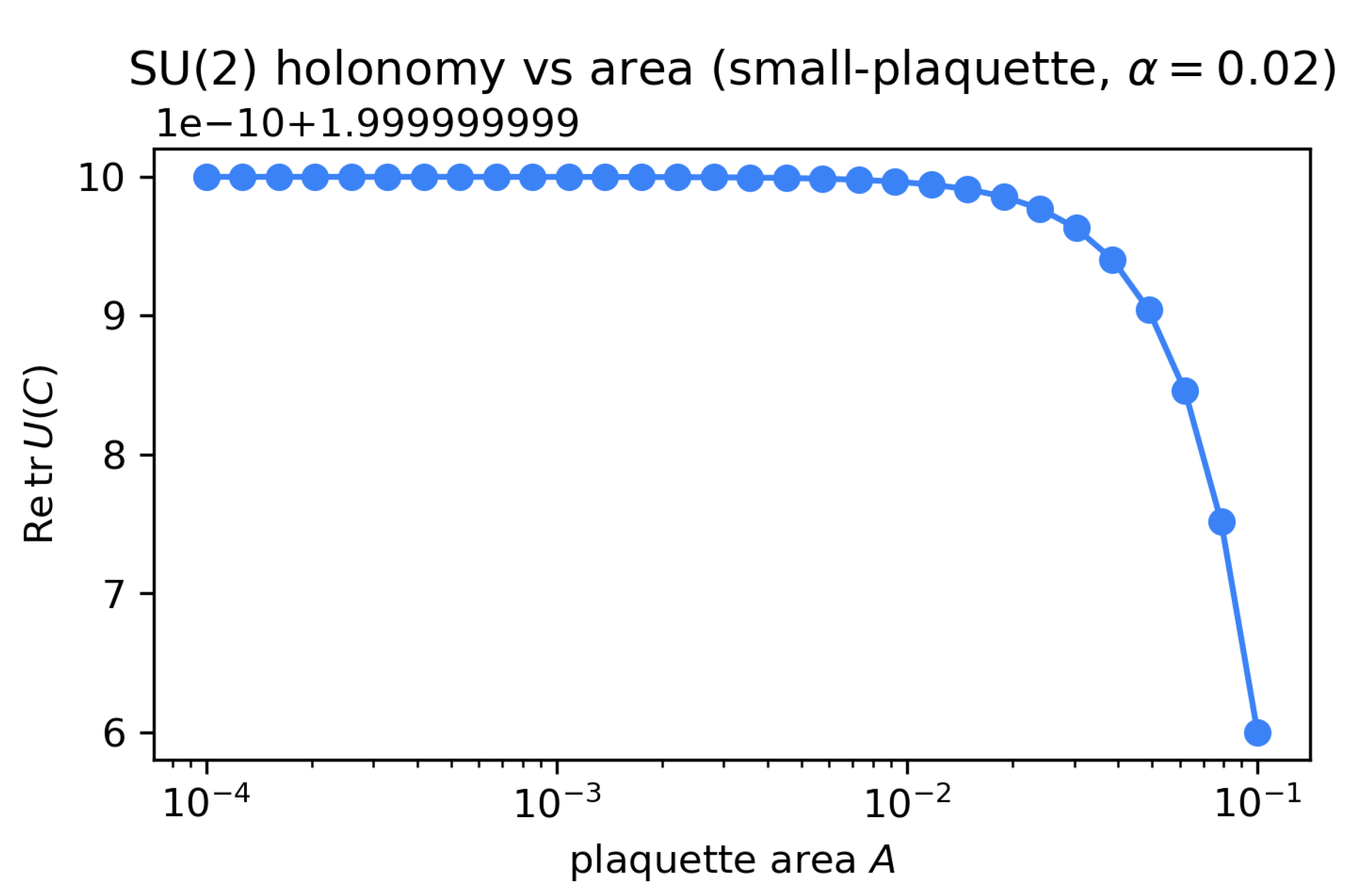
Figure 4.
Dependence of holonomy on the chronon curvature parameter at fixed plaquette area . The scaling of with illustrates that the holonomy angle grows with the effective field strength set by the chronon background, while unitarity () is preserved to numerical precision. Together with Figure 3, this confirms the consistency of the emergent bundle data.
Figure 4.
Dependence of holonomy on the chronon curvature parameter at fixed plaquette area . The scaling of with illustrates that the holonomy angle grows with the effective field strength set by the chronon background, while unitarity () is preserved to numerical precision. Together with Figure 3, this confirms the consistency of the emergent bundle data.
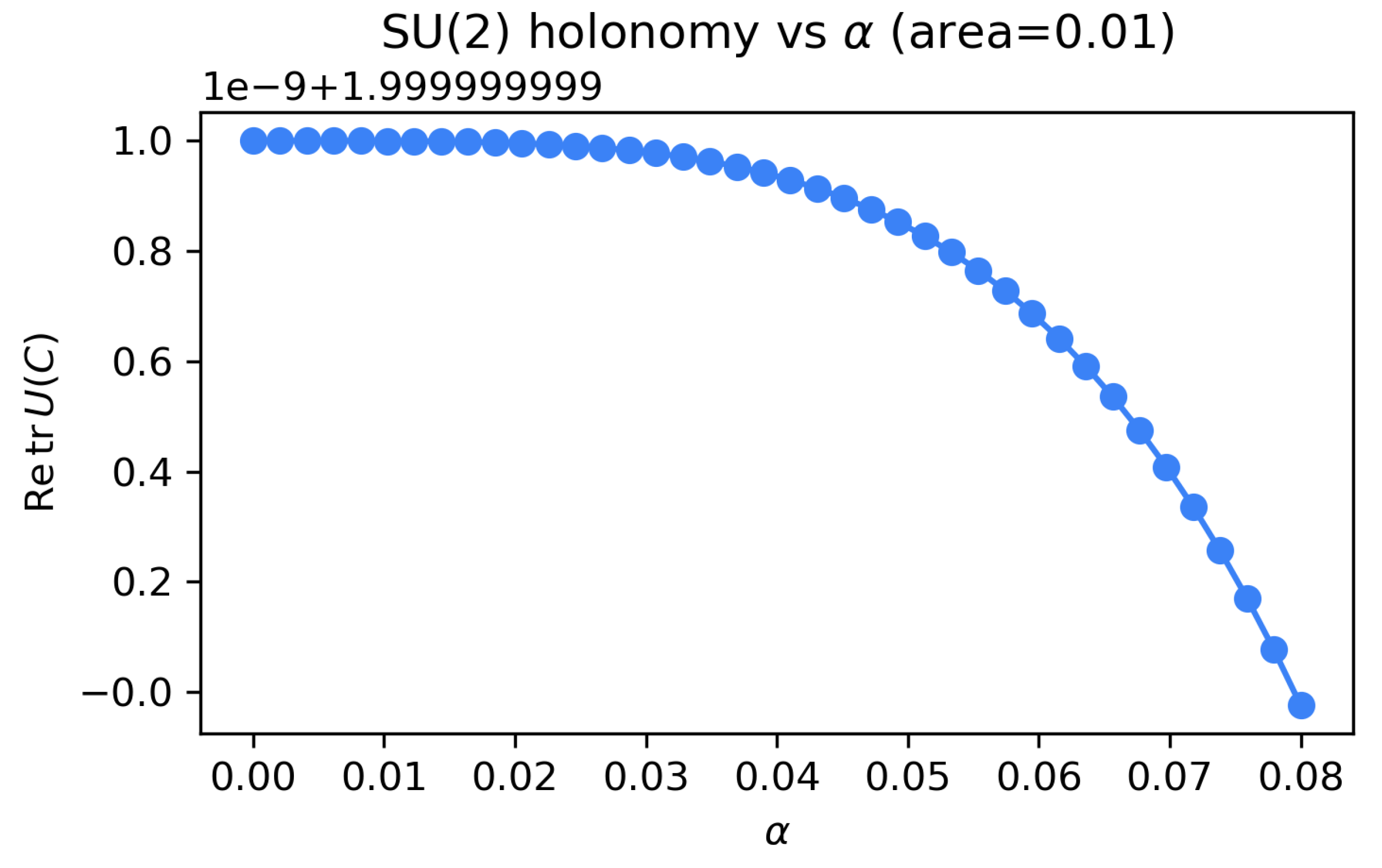
Figure 5.
Vector-boson spectrum from the CISB mass matrix. The bars compare numerical eigenvalues obtained by diagonalizing the quadratic form with the analytic predictions , , . The numerical results are GeV, GeV, , in excellent agreement. The photon eigenvector aligns with with unit overlap, confirming the unbroken subgroup and the custodial relation .
Figure 5.
Vector-boson spectrum from the CISB mass matrix. The bars compare numerical eigenvalues obtained by diagonalizing the quadratic form with the analytic predictions , , . The numerical results are GeV, GeV, , in excellent agreement. The photon eigenvector aligns with with unit overlap, confirming the unbroken subgroup and the custodial relation .
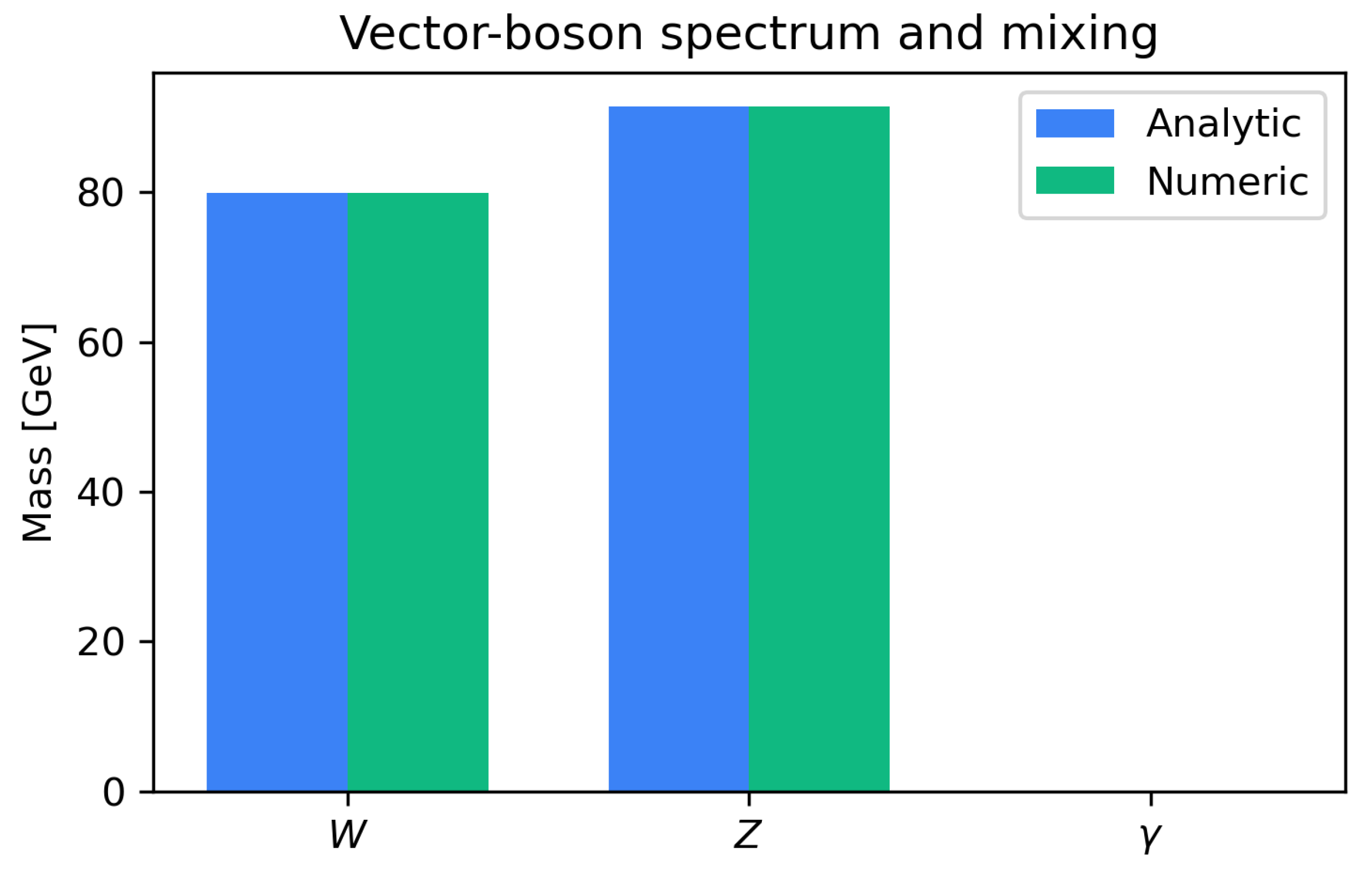
Figure 6.
Partial-wave amplitude for at tree level. The blue curve shows with GeV, as in the electroweak chiral Lagrangian [45,46]. The red dashed line marks the unitarity bound [43], and the green dotted line indicates the scale TeV where the effective theory is expected to break down. At TeV, the numerical value demonstrates perturbative unitarity and gauge-parameter independence ensured by BRST invariance [8,67].
Figure 6.
Partial-wave amplitude for at tree level. The blue curve shows with GeV, as in the electroweak chiral Lagrangian [45,46]. The red dashed line marks the unitarity bound [43], and the green dotted line indicates the scale TeV where the effective theory is expected to break down. At TeV, the numerical value demonstrates perturbative unitarity and gauge-parameter independence ensured by BRST invariance [8,67].
Disclaimer/Publisher’s Note: The statements, opinions and data contained in all publications are solely those of the individual author(s) and contributor(s) and not of MDPI and/or the editor(s). MDPI and/or the editor(s) disclaim responsibility for any injury to people or property resulting from any ideas, methods, instructions or products referred to in the content. |
© 2025 by the authors. Licensee MDPI, Basel, Switzerland. This article is an open access article distributed under the terms and conditions of the Creative Commons Attribution (CC BY) license (http://creativecommons.org/licenses/by/4.0/).
Copyright: This open access article is published under a Creative Commons CC BY 4.0 license, which permit the free download, distribution, and reuse, provided that the author and preprint are cited in any reuse.


