
Submitted:
24 September 2025
Posted:
25 September 2025
You are already at the latest version
Abstract
As a transformative technology, artificial intelligence (AI) is profoundly reshaping corporate innovation practices, creating new opportunities for ambidextrous (exploitative and exploratory) innovation and thereby advancing sustainable competitiveness. Drawing on ambidextrous theory and adopting a resource-based perspective, this study employs panel data from Chinese A-share listed firms in the period 2014–2023 to examine the relationship between and the mechanism of action of AI application on corporate exploitative and exploratory innovation performance. It further explores the moderating effect of data resources. The findings reveal that AI application significantly enhances both exploitative and exploratory innovation performance. The improvement in corporate research and development (R&D) efficiency and the optimization of labor structures play mediating roles in the relationship between AI application and both exploitative and exploratory innovation. Moreover, firms’ data resources strengthen the positive impact of AI on exploitative innovation while weakening its effect on exploratory innovation. Overall, this study provides novel insights into how traditional enterprises can leverage AI applications to foster ambidextrous innovation and achieve sustainable competitive advantages.
Keywords:
artificial intelligence
; ambidextrous innovation
; data resource
; resource-based view
; sustainable innovation
1. Introduction
Artificial intelligence (AI), as one of the most prominent emerging technologies to reshape the global economic landscape, exerts a profound influence on the sustainable development of modern businesses [1]. In the context of firms, AI technology has significantly affected their strategic planning [2], organizational structure [3,4], business processes [5], and so on. Particularly for firms from non-digital-native industries, AI technology serves not only as a crucial strategic instrument for enhancing innovation capabilities but also as an important means of conducting effective digital transformation, adapting to the digital economy pattern, and therefore developing sustainable competitive advantages.
Ambidextrous innovation is a key means of maintaining competitiveness and achieving sustainable development, especially under the dual pressure of the digital economy and escalating competition [6]. Firms’ ambidextrous innovation includes both exploitative innovation and exploratory innovation [6]. Exploitative innovation emphasizes the innovative activities which focus on the optimization of existing production processes and services [7], usually carried out by resource bricolage or orchestration based on their existing knowledge, information, and routines [8,9]. On the other hand, exploratory innovation focuses on a more long-range and disruptive changes, which requires firms to break through the existing knowledge framework and develop new technologies and products for potential customers or future market demands [7]. The former usually enhances firms’ short-term performances, helping them survive in the face of fierce market competition. The latter requires the firm to learn new knowledge and develop new products to cope with future uncertainties [10]. Both are important guarantees of firms’ sustainable development [11]. However, exploitative and exploratory innovation differ substantially in their resource requirements, knowledge bases, and strategic cycles [7,12]. While exploitative innovation provides firms with immediate competitive advantages, its dependence on refining and recombining existing knowledge may constrain its scope for radical breakthroughs, thereby exposing firms to heightened vulnerability when facing disruptive environmental shifts. Conversely, exploratory innovation enables firms to seize future opportunities, yet its high risk, uncertain returns, and substantial resource demands often divert critical assets away from current operations, undermining short-term competitiveness and placing firms under considerable pressure [7,12]. As a result, achieving ambidextrous innovation requires firms to develop core dynamic capabilities that enable them to adapt to environmental changes and sustain continuous innovation [13]; this, however, remains a challenging endeavor.
Recent advances in AI technology, including its diffusion, inference capabilities, and reinforcement learning, have prompted growing interest among scholars in its managerial implications. The extant literature generally recognizes that AI application enhances firms’ innovation performance. Documented effects include the transformation and upgrading of human capital and labor structures [14,15], the optimization of R&D resource allocation and management [16], the strengthening of organizational learning and knowledge management capabilities [17], and the creation of an innovation culture that combines leadership with resilience [18,19]. While these studies have made significant theoretical contributions to understanding the outcomes of AI application, most of the existing literature emphasizes a single dimension of innovation, such as an invention or a breakthrough innovation, thereby neglecting the ambidextrous perspective. Given the fundamental differences between exploitative and exploratory innovation in terms of objectives, risks, and knowledge bases, achieving ambidexterity requires firms to manage both activities simultaneously and effectively, thereby striking a dynamic balance between exploiting the present and exploring the future [7,12,20]. The diffusion and progress of AI technologies present significant opportunities for firms to overcome this challenge of ambidexterity. Exploring this issue not only enriches our theoretical understanding but also provides practical guidance for firms to better balance the two types of innovation and achieve sustainability.
Ambidextrous innovation is highly dependent on tangible resources and knowledge resources [6,7]. According to the resource-based view, firms derive competitive advantage from the deployment of resources that are valuable, rare, inimitable, and non-substitutable [21,22]. Innovation activities, in turn, represent a vital channel through which firms transform their resources into competitiveness and prevent resource rigidities from eroding core capabilities [8,9]. Both exploitative and exploratory innovation are resource-intensive, yet the adoption of AI reshapes firms’ operating models and labor structures, altering how material and human resources are mobilized for innovation [23]. Examining the structure and use of these resources thus provides a critical lens for unpacking the mechanism of how AI influences ambidextrous innovation, as well as for advancing our understanding of the technology-enabled mechanisms that sustain corporate competitiveness and long-term development.
In addition, existing studies have largely overlooked the contextual factors that shape the impact of AI applications on firms’ innovation performance. Although the rapid development of AI has substantially improved firms’ efficiency and quality in operations and decision-making, scholars increasingly emphasize its nature as a general-purpose technology [24]. However, general-purpose technologies, due to their pervasiveness, cannot provide sustained competitive advantage for firms alone, especially for those that are not from the technology-intensive industries [25,26]. Instead, firms must achieve alignment between technologies and resources [21,27]. In the digital era, data have become a critical organizational resource that creates value for firms [28]. The core advantage of AI lies in its capacity to efficiently analyze both structured and unstructured data [23,29,30]. Thus, the effectiveness of AI applications in innovation is likely to depend heavily on the characteristics of firms’ data resources [31]. However, no prior research has systematically examined this boundary condition. Clarifying the boundary conditions under which AI influences ambidextrous innovation can therefore provide both theoretical insights and practical guidance for firms in strategically designing AI applications and achieving sustainable development.
Based on the above, this study investigates the impact of AI applications on firms’ ambidextrous innovation, with a particular focus on the mediating role of R&D efficiency and labor structure improvement and the moderating effect of firms’ data resources. Using unbalanced panel data from Chinese A-share listed firms during the period 2014–2023, we employ fixed-effects regression analysis to empirically examine the underlying relationships among these variables. Our findings are intended to provide theoretical insights and practical implications for firms seeking to strategically leverage AI technologies, optimize knowledge recombination strategies, and enhance sustainable innovation. This study makes three main contributions. First, it extends research on the economic consequences of AI adoption by examining its impact on firms’ ambidextrous innovation through the lens of resources and capabilities. Whereas prior studies primarily focus on AI’s influence on invention-oriented innovation [5,32], we adopt the perspective of ambidextrous innovation and analyze the role of AI adoption in firms, especially those that are not from digital-native industries. This broadens our understanding of how AI technologies reshape innovation outcomes with a view to promoting the sustainable development of firms in the digital era. Second, from the perspective of emerging technologies, this study enriches the literature on the determinants of ambidextrous innovation by explicating the level and mechanisms through which AI contributes to firms’ innovation performance. While prior research emphasizes that environmental characteristics [33,34], firms’ resource structures [16], and leadership traits [18] significantly influence firms’ ambidextrous innovation, this study takes the progress of AI technology as a promising opportunity for firms to achieve ambidexterity, revealing how firms can exploit AI to realize the balance between exploitative and exploratory activities. Finally, this study emphasizes the alignment between technology and organizational resources, clarifying the boundary conditions of AI’s impact on ambidextrous innovation from a resource-based perspective. As a general-purpose technology, AI amplifies or attenuates the efficacy of organizational resources in value creation and competency development [24,27]. In particular, data, which is highly complementary to AI technology, profoundly influences firms’ strategic choices and outcomes with respect to adopting AI. By incorporating firms’ data resource characteristics into the analytical framework, we uncover the interaction mechanisms between AI technologies and complementary resources, offering a more contextual explanation of the relationship between AI applications and ambidextrous innovation. These insights help firms design innovation strategies that reconcile short-term goals with long-term performance, thereby providing theoretical guidance and practical implications for sustainable development in the digital era.
The structure of this study is as follows: Section 2 presents the literature review. Section 3 presents the theoretical analysis and the research hypotheses. Section 4 presents the research data and methods. Section 5 provides the empirical results. A discussion is presented in Section 6. The results of our study are summarized in Section 7, which concludes with a series of recommendations and further research directions.
2. Literature Review
2.1. Factors Influencing Firms’ Ambidextrous Innovation
Ambidextrous innovation reflects an organization’s ability to balance the exploration of new knowledge with the exploitation of existing knowledge [6]. Achieving ambidexterity requires firms to develop core dynamic capabilities that enable them to adapt to environmental changes and sustainable innovation [13]. In essence, ambidextrous innovation represents the fundamental capability of firms to secure sustainable competitive advantage in complex environments.
As a key driver of firms’ sustainable competitiveness [35], the mechanisms and determinants of ambidextrous innovation have been a key issue in both academic research and practical practice [6]. Prior studies suggest that both organizational attributes and environmental characteristics play a critical role in shaping firms’ ambidextrous innovation strategies. At the organizational level, structural and leadership factors constitute critical conditions influencing firms’ ambidextrous innovation. Structural separation enables different organizational units to concentrate on either exploitation or exploration [7]. As to firms’ ambidextrous leadership [36,37], innovative organization culture [38,39], and technology capabilities [35], at the environmental level, external conditions and dynamics determine whether firms need ambidextrous innovation and which type of innovation is more effective [33,40]. Favorable government policies [41,42] and environmental uncertainty [43] can stimulate firms’ ambidextrous innovation. Industry competition, by contrast, tends to weaken the motivation for exploratory innovation [44] while reinforcing exploitative innovation [45]. In addition, an advanced technological environment and a supportive business context have also been shown to enhance firms’ ambidextrous innovation performance [46].
2.2. AI Technologies: Essence and Influence on Firms’ Innovation
As an emerging technology at the forefront of a new wave of technological revolution and industrial transformation, AI has attracted growing attention to its implications for innovation management research [1,47]. Although prior studies conceptualized AI from diverse perspectives, such as its instrumental, agentic [48,49], and ecological attributes [50], a shared view is that AI essentially constitutes a data-driven process of human–machine interaction [3,29], while lacking human beliefs [4,51]. Consequently, the value of AI for firms, including organizational learning [23], entrepreneurial decision-making [52], and resource allocation improvement [53,54,55], relies highly on human–AI collaboration and the scale, quality, and structure of organizational data [50].
The extant literature has generally found a positive relationship between AI application and firms’ innovation performance through the enabling and enhancing of firms’ innovation abilities [5]. AI can be a powerful tool enabling managers to explore and select valuable problem and solutions [56]. AI adoption significantly reshapes firms’ production and operational processes [57], as well as their business model [58], while also substantially transforming the characteristics of workforce structures. AI adoption also enhances firms’ ability to access and integrate knowledge [59], accelerating technology spillover [60] and thus further fostering firms’ innovation performance.
2.3. The Role of Data in AI Application
The essence of modern AI technology—particularly machine learning and deep learning—lies in the algorithm that autonomously identify patterns, extract regularities, and generate predictions or outputs from various data [61,62]. This implies that data constitute the fundamental factors of production for AI. As Felin and Holweg (2024) [29] highlighted, AI functions as a data-driven prediction tool whose capability boundaries are determined by the breadth and depth of training data, while lacking the capacity for forward-looking causal reasoning grounded in human beliefs. Hence, data resources provide the foundational basis for AI applications, which may therefore significantly influence their innovation outcome.
Data are also crucial to the efficacy of AI applications. Due to its inherent nature as data-driven and without human beliefs, AI application entails a number of risks, including algorithmic bias, decision opacity, resulting trust crises, and accountability ambiguities [49]. These risks often trace back to the data perspectives [30], as biased or unrepresentative datasets may directly reproduce or even amplify existing decision-making and inference errors [63]. Therefore, ensuring effective and sustainable AI-enabled innovation requires addressing the quality, representativeness, and governance of data resources [27] .
In summary, the extant literature suggests that as an emerging technology, AI is profoundly reshaping the internal structures and capability bases of firms, thereby providing opportunities for achieving both exploitative and exploratory innovation. However, from the resource-based view, AI itself—as an general-purpose technology with pervasiveness and accessibility—does not provide the sole source of sustainable innovation. Its efficacy also depends on the complementarity effect with firms’ heterogeneous resource endowments. In particular, data have become a pivotal productive resource, whose scale, quality, and structure are likely to play a crucial synergistic and moderating role in linking AI adoption with ambidextrous innovation. This implies that whether firms can effectively leverage AI to foster ambidextrous innovation hinges not only on the technology itself but also on whether firms possess the necessary data resource base to enable their deployment and value appropriation. Accordingly, unpacking the boundary role of data assets in this process is of significant theoretical and practical value for understanding how non-digital-native firms can build innovation advantages through the synergy of technologies and resources.
3. Theoretical Analysis and Research Hypotheses
3.1. The Impact and Mechanism of Artificial Intelligence on Firms’ Ambidextrous Innovation
From a resource-based theoretical perspective, firms are heterogeneous bundles of resources, and their sustainable competitive advantage stems from their strategic resources that are valuable, rare, inimitable, and non-substitutable [21]. As an emerging general-purpose technology [64], AI is characterized by its accessibility [53], which makes it difficult to constitute an exclusive advantage on its own [23]. Instead, its value lies in serving as an enabler that reconfigures and amplifies firms’ existing resources and capabilities, thereby fostering new sources of competitive advantage. Meanwhile, organizational ambidexterity theory highlights that firms’ long-term survival and sustainable development depend on their ability to simultaneously engage in exploitative and exploratory innovation [6,65]. Exploitative innovation deepens, optimizes, and extends existing knowledge, technologies, and markets, emphasizing efficiency, reliability, and immediate returns. By contrast, exploratory innovation seeks new knowledge, ventures into emerging markets, and experiments with disruptive technologies, characterized by risk-taking, experimentation, and long-term orientation. Although these two modes of innovation differ fundamentally in objectives, knowledge bases, and operational logics, successful firms manage this paradox by building organizational structures, contextual mechanisms, or leadership practices that enable a dynamic balance.
The application of AI technologies offers firms new possibilities for overcoming the paradox of ambidextrous innovation. AI facilitates ambidexterity primarily through two key mechanisms: enhancing R&D efficiency and optimizing firms’ labor structures. These mechanisms illustrate how AI reshapes firms’ resource and capability bases, thereby fostering both exploitative and exploratory innovation. Innovation is a process of knowledge transformation and creation [66]. Traditional innovation activities, however, rely heavily on the experience, intuition, and trial-and-error efforts of R&D personnel, which makes them costly, time-consuming, and uncertain [40]. By contrast, AI fundamentally alters this paradigm by improving cost efficiency and knowledge acquisition.
From the perspective of the resource-based view, AI integrates data as a novel production factor with computational power and algorithms, profoundly transforming firms’ technological environment. First, AI-enabled data resources endow firms with the ability to rapidly and effectively acquire and integrate critical internal and external knowledge, thereby reducing the costs of information search and learning in the early stages of R&D. Second, AI enhances firms’ predictive and simulation capabilities in innovation, lowering development costs. For instance, generative adversarial networks (GANs) allow firms to achieve near-realistic simulations based on limited data and experiments in a cost-efficient manner [67]. Finally, AI applications improve the allocation of R&D resources by identifying key factors that drive success and directing resources toward projects with higher probabilities of success and greater value.
From the perspective of organizational ambidexterity, exploitative and exploratory activities require distinct knowledge bases and cognitive logics [65]. As a skill-biased technology, AI alters firms’ labor structures in non-neutral ways. Emerging digital technologies have reshaped labor demand, income distribution, and workforce composition, providing new opportunities for cultivating the knowledge and capabilities required for ambidexterity. On the one hand, AI substitutes for low-skill routine tasks, releasing critical resources and managerial attention needed for innovation. Both exploitative and exploratory innovation are knowledge-intensive, relying heavily on firms’ cognitive resources and skilled talent. In traditional settings, however, highly educated R&D and managerial staff often remain trapped in repetitive data processing and routine tasks, limiting their creative potential. AI’s automation capabilities allow firms to redeploy these resources toward domains requiring human judgment, creativity, and strategic thinking, thereby enhancing ambidexterity. On the other hand, the effectiveness of AI depends on human–machine collaboration [54]. The experience and capabilities of AI users determine the extent to which the technology creates value, requiring firms to employ talent with technical and learning capabilities. In exploitative innovation, such collaboration takes the form of AI-driven solution searches complemented by human decision-making, ensuring alignment with strategic priorities and efficiency maximization [51]. In exploratory innovation, AI extends the search frontier, while human decision-makers break existing frames of reference, leveraging AI’s insights for higher-order creativity.
Accordingly, we propose the following hypotheses:
H1a:
AI applications promote firms’ exploitative innovation performance.
H1b:
AI applications promote firms’ exploratory innovation performance.
3.2. The Moderating Role of Firms’ Data Resource
From a resource-based perspective, data have become a critical strategic resource in the digital economy, playing a decisive role in shaping firms’ competitiveness [21]. Data resources are extensible, developmental, non-consumable, and co-productive in use [50,62], while also embodying firms’ unique histories and knowledge bases [23]. Accordingly, data that generate expected economic returns constitute a valuable, rare, inimitable, and non-substitutable strategic resource.
Exploitative innovation emphasizes the deep seeking and recombination of existing knowledge and resources [65]. When supported by abundant and accurately recorded data, AI applications can further enhance firms’ exploitative innovation performance. Data resources enable AI to accelerate the scanning and recognition of exploitative opportunities, shifting innovation activities from experience-driven to data-driven. Rich data resources also provide the foundation for automated and large-scale opportunity identification, allowing firms to uncover potential optimization directions from existing knowledge. Moreover, they support the development of digital twins and predictive models that improve innovation processes [48]. By enabling the more precise identification of deficiencies in current processes or services, abundant data resources ensure that scarce innovation inputs (e.g., R&D investment, managerial attention) are allocated with greater efficiency and focus.
However, the value of any resource is not static. Capabilities built on specific resources can become rigid over time, thereby constraining innovation [13]. Accordingly, while data resources enhance firms’ ability to leverage AI for exploitative innovation, they can simultaneously reinforce path dependence and induce knowledge rigidities, thus inhibiting exploratory innovation. On the one hand, data resources risk degenerating from flexible to rigid assets over time, weakening AI’s potential to support exploration. Once firms build efficient systems around particular data types and AI technologies, the sunk costs and asset-specific investments make it prohibitively costly to pivot toward new untested data sources or technological paths. In this case, the more extensively firms exploit existing data through AI, the more they gravitate toward incremental rather than radical innovation. On the other hand, both data and AI exhibit strong feedback loops and self-reinforcing tendencies [3,55], which can entrench behavioral patterns and further limit exploration. Because AI outputs are trained on existing datasets and lack interpretability, AI-driven exploration tends to favor options with abundant data support, generating algorithmic bias [52]. Moreover, firms pursuing breakthrough innovation often face scarcity of data at the early stages, where the absence of relevant datasets prevents AI from reliably evaluating opportunities and risks, leading to the systematic underestimation or rejection of exploratory initiatives.
Accordingly, we propose the following hypotheses:
H2a:
Data resources strengthen the positive effect of AI applications on exploitative innovation.
H2b:
Data resources weaken the positive effect of AI applications on exploratory innovation.
Figure 1 shows the theoretical model of this study.
4. Data and Methods
4.1. Data Source and Sample Selection
To test the relationship between firms’ AI application, ambidextrous innovation, and the moderating role of data resources, this study selects the unbalanced panel data of China’s A-share listed firms from traditional industries during the period 2014–2023. Firm-level innovation data were obtained from the Chinese Patent Data Project (CPDP) database, while firms’ information and financial data were collected from the China Stock Market and Accounting Research (CSMAR) database. Based on the research context of this study, the sample was further refined as follows: (1) Firms designated as “special treatment (ST)” by the stock exchange during the sample period were excluded. Special treatment indicates that the listed firm has abnormal financial status and is at risk of delisting, usually with high suspicion of financial fraud. (2) Considering the digital-native character of the information technology and financial industries [68], firms classified under Sector I (Information Transmission, Software, and Information Technology Services Industry) and Sector J (Financial Industry), according to the 2017 China’s National Industry Classification, were removed. (3) Firms with missing values on key variables were excluded. After these steps, the final dataset consisted of 21,603 firm-year observations, covering 3,167 listed firms.
4.2. Description of Variables
4.2.1. Dependent Variables
The dependent variables are exploitative innovation (Exploit) and exploratory innovation (Explore). Following prior studies [20], we distinguish between exploitative and exploratory innovation based on firms’ patent applications. Specifically, if the first four digits of the IPC (International Patent Classification) code of a patent application had appeared at least once in the past five years, then the patent is classified as exploitative innovation; otherwise, it is classified as exploratory innovation. Accordingly, if a firm applies for patents in the current year, whose IPC codes match those in the preceding five-year window, then these patents are classified as exploitative innovation. By contrast, if a firm applies for patents in IPC classes not observed in the prior five years, then these patents are classified as exploratory innovation. Finally, the annual counts of exploitative and exploratory patents are log-transformed after adding 1, and the resulting values are used to measure firms’ exploitative and exploratory innovation levels, respectively.
4.2.2. Independent Variable
The independent variable is the AI application (AI). Following previous research, this study measures firms’ AI application by applying textual analysis to the annual reports of the listed firms. Following prior studies that identify AI-related keywords [59,69], we calculate the frequency of these AI-related keywords in the Management Discussion and Analysis (MD&A) section of the annual reports for each firm–year observation. Finally, we take the natural logarithm of 1 plus the keyword frequency, which serves as the measurement of firms’ AI application level. Taking into account that firms may exaggerate or hide their AI application in MD&A for strategic reasons, following the extant literature [70], this study also applied firms’ investment into intellectual technology-related properties. Specifically, we manually searched firms’ financial statements for firms’ investment. Then, we screened firms’ asset investments for items containing keywords such as “electronic,” “computer,” “software,” and “information”. Finally, we added the total end-of-year value of the firms’ related investment.
4.2.3. Moderating Variable
The moderating variable is firms’ data resources (Data). Despite data playing a crucial role in firms’ operation, measuring a firm’s data resources is still a challenge that has yet to be solved. The extant literature follows a dichotomy approach to measure a firm’s data resources based on whether keywords related to data assets appear in its annual report [28]. However, this may overlook the intensity differences between firms regarding their data resources. To address this issue, we developed a keyword list based on China’s Data Management Capability Maturity Assessment Model (DCMM). Issued in 2018, the DCMM was the first government-issued national standard measuring organizations’ data capability. The DCMM contains eight major building blocks on data management, namely, “data strategy,” “data governance,” “data framework,” “data standard,” “data quality,” “data safety,” “data application,” and “data life cycle,” providing a comprehensive means of measuring firms’ data management. Therefore, we use the frequency of these phrases in a firm’s annual report to measure its data resources. To avoid potential missing of related keywords, we employed the Word2Vec natural language processing method to capture all data-related keywords [71]. The Word2Vec method represents words and phrases in natural languages as dense real-valued vectors based on their contextual information, thereby constructing a word embedding space in which the geometric distance between vectors reflects the semantic similarity between words. A smaller distance indicates a higher degree of semantic and syntactic similarity. In this study, we set the phrases of eight major building blocks, mentioned above, as the seed words, employed the “Skip-Gram” model to predict the potential targeted words, and used the cosine distance to measure the semantic similarity based on the MD&A texts of sample firms. Finally, we took the natural logarithm of one plus the keyword frequency as the level of the firms’ data resources.
The final keyword list for data resources is presented in Table 1.
4.2.4. Control Variable
Following prior studies [54,59], this study controlled for a set of variables that may affect firms’ innovation performance: (1) firm size (Size)—this is measured by the logarithm of total assets at the end of the year; (2) age of the firm (Age)—this is measured by subtracting the year the firm was established from the year of the statistic and then taking the logarithm of the resulting value; (3) return on assets (Roa)—this is measured by the ratio of the firm’s net profit to its total assets; (4) leverage (Leverage)—this is measured by the ratio of the firm’s total liabilities to its total assets; (5) R&D intensity (R&D)—this is measured by the logarithm of annual research and development expenses; (6) board scale (Board)—this is measured by the logarithm of the number of people on the board of the firm; (7) firm’s governance structure (Independent)—this is measured by the proportion of independent directors in the board; and (8) ownership concentration (Top5)—this is measured by the Herfindahl-Hirschman Index (HHI) of the shareholding ratio of the top five shareholders. In specific, HHI is calculated by squaring the shareholding proportion of each shareholder of the top 5 shareholders and then summing the resulting numbers. In Additionally, firm- and year-fixed effects are controlled to account for unobservable factors related to individual firms and specific years.
4.3. Model Specification
To verify the hypotheses, we constructed the following models:
Models (1) and (2) test the effects of AI application on exploitative innovation and exploratory innovation, respectively, in which i denotes the firm; t denotes the year; α denotes the estimated coefficient of the core explanatory variable (AI); ε represents the random error; Exploit and Explore denote firms’ exploitative and exploratory innovation performances, respectively; X is a vector of all firm-level control variables; Firm denotes the firm-fixed effects; and Year denotes the year-fixed effects.
To further test the moderating effect of firms’ data resources, Models (3) and (4) extend the prior models by including the level of data resources (Data) and its interaction term with respect to AI application. In the empirical analysis, we focus on the sign and significance of α across the four models. Consistent with our hypotheses, we expect α to be positive in Models (1), (2), and (3) and negative in Model (4).
5. Empirical Results and Analysis
5.1. Descriptive Statistics and Correlation Analysis
Table 2 presents the descriptive statistics of the variables. The mean value of firms’ artificial intelligence application level (AI) is 0.782, with a standard deviation of 1.032, indicating substantial variation in the extent of AI adoption among different firms. The mean, median, and maximum values of exploitative innovation (Exploit) are all higher than those of exploratory innovation (Explore), suggesting that sample firms are generally more inclined toward exploitative innovation, while also exhibiting notable heterogeneity in different types of innovation activities. The ranges of the other control variables are consistent with prior studies, confirming the validity and representativeness of the sample.
Table 3 reports the results of the correlation analysis and the variance inflation factor (VIF) tests. The correlation between variables shows that firms’ AI application (AI) is significantly and positively correlated with both exploitative innovation (Exploit) and exploratory innovation (Explore), providing preliminary evidence that AI adoption facilitates ambidextrous innovation. Furthermore, the absolute values of the correlation coefficients among the main variables are relatively small, and all VIF values are below 2 (with the maximum being 1.602)—far lower than the conventional threshold of 10. These results indicate that multicollinearity is not a serious concern in the regression models.
5.2. Benchmark Regression Results and Analysis
Table 4 presents the baseline regression results. Columns (1) and (2), without the control variables, show that the coefficients of firms’ AI application (AI) are 0.121 and 0.063, with both being significant at the 1% level. After adding firm-level control variables in Columns (3) and (4), the coefficients of AI remain positive and significant at least at the 5% level (0.073 and 0.034), suggesting that AI adoption enhances both exploitative and exploratory innovation among firms. Columns (5) and (6) further incorporate firms’ data resources (Data) and their interaction with AI. The coefficients of the interaction terms are 0.054 and -0.035, with both being significant at least at the 5% level, indicating that a higher level of data resources strengthens the positive effect of AI on exploitative innovation while constraining its effect on exploratory innovation. Overall, these results provide empirical support for all the proposed hypotheses.
5.3. Robustness Checks
5.3.1. Test of Omitted Variable Bias
The determinants of firms’ ambidextrous innovation are rather complex, which may raise concerns about endogeneity caused by omitted variables. Following Altonji et al. (2005) [72], we measure the potential bias attributable to unobservable factors and infer the extent to which omitted variables may affect the baseline results. Specifically, we calculate the ratio of coefficient differences after conditioning on a limited set of observable covariates and use this ratio to assess the likelihood of omitted-variable bias. A higher ratio indicates that the estimates are less sensitive to selection on observables, implying that unobserved factors would need to be substantially stronger than observed ones to fully account for the estimated effects.
Table 5 reports results of the test of omitted bias. When no control variables or fixed effects are included, the ratio is below 1, much smaller than under other specifications, suggesting that omitted-variable bias is more pronounced in this case. This finding suggests the necessity of incorporating control variables and fixed effects in the baseline models. Moreover, when only firm- and year-fixed effects are included without other controls, or when firm-level covariates are controlled alongside firm-fixed effects, the ratios of the coefficients for AI application on ambidextrous innovation fall between 1.172 and 3.041. This indicates that self-selection on unobservable factors would need to be at least 1.172 times stronger than that on observable factors to fully explain away the baseline results. Hence, the probability that unobserved variables substantially bias our estimates is relatively low.
5.3.2. Test of Sample Selection Bias
To address potential concerns regarding sample selection bias, we employ the propensity score matching (PSM) approach to check the robustness of our results. Specifically, we divide the sample into two groups—high- and low-AI-application groups—using the median value of firms’ AI application as the cutoff point. Next, we estimate the propensity scores for all firms based on the control variables using a logit model. We then perform one-to-one nearest matching and re-estimate the regressions with the matched sample.
Columns (1) and (2) of Table 6 present the results based on the PSM-matched sample. The findings reveal that firms’ AI application remains positively associated with both exploitative and exploratory innovation, with coefficients that are statistically significant at least at the 5% level. These results indicate that our benchmark conclusions remain robust even after mitigating endogeneity concerns arising from potential sample selection bias.
5.3.3. Test of Instrumental Variable
We further employ an instrumental variable to address other potential endogeneity concerns. Specifically, we select historical, region-level data related to information and communication infrastructure as the instrumental variable. On the one hand, the historical adoption of postal and telecommunication services in a city reflects local social preferences and technological development extend, which, in turn, shapes firms’ current adoption and application of information technologies, including AI. On the other hand, such historical communication facilities have become largely obsolete in modern business operations and thus do not directly affect firms’ current innovation performances. Based on this logic, we use the number of post offices in the firms’ city in 1984 (per 100 units) as the instrument variable. Since the 1984 city-level post office data are cross-sectional, and therefore not suitable for panel regressions directly, we follow the approach of previous research by constructing a panel instrument variable. Specifically, we combine the number of post offices in 1984 with the proportion of total households with internet access in the firm’s city in the previous year, denoted as IV.
Columns (3)–(5) of Table 6 report the results of the two-stage least squares (2SLS) estimation. The first-stage regression shows that the instrument variable (IV) is positively and significantly associated with firms’ AI application. Moreover, the Cragg–Donald Wald F-statistic substantially exceeds the Stock–Yogo critical values, indicating that selected variable is not a weak instrument. The second-stage results demonstrate that the instrumented AI application (AI_IV) remains positively and significantly related to both exploitative and exploratory innovation. These findings further reinforce the robustness of our baseline results.
5.3.4. Additional Robustness Checks
To further ensure the reliability of our findings, we conducted several robustness checks by considering lagged effects, adopting alternative measures of key variables, adjusting the fixed effects specification, and refining the sample selection. Table 7 reports the results of these tests.
First, given that the effect of digital technology application on firms’ ambidextrous innovation may exhibit time lagging effects, we used firms’ time-lagged exploitative innovation performances (Lag_Exploit) and exploratory innovation performances (Lag_Explore) as dependent variables to conduct robustness checks. Columns (1) and (2) of Table 7 present the estimation results. The coefficients of AI application on both time-lagged exploitative and exploratory innovation are positive, with the former significant at the 1% level and the latter significant at the 10% level. This indicates that even when accounting for lagged effects, AI application continues to significantly enhance firms’ ambidextrous innovation, supporting the robustness of our baseline results.
Second, as mentioned previously, annual reports may contain strategic disclosure behaviors, particularly concerning emerging technologies, as firms may overstate adoption to gain potential benefits. To address this concern, we used financial information as an alternative proxy for AI application. Following prior studies [70], we employed firms’ investment on digital related assets as a proxy measure, denoted as Invest. Columns (3) and (4) show that such investment is positively and significantly associated with both exploitative and exploratory innovation, at least at the 1% level. This finding further validates the robustness of our results.
Third, since industry characteristics may also influence firms’ ambidextrous innovation, we re-estimated the model by replacing firm- and year-fixed effects with firm and industry-year-fixed effects. Columns (5) and (6) report the estimation results of using alternative fixed effect models. The coefficients of AI application (AI) remain positive and statistically significant at the 1% level, indicating that our findings are not sensitive to alternative fixed effects specifications.
Finally, for non-digital-native firms, the adoption of emerging digital technologies often involves a two-stage process: the decision of whether to adopt and the extent of adoption [73]. These two dimensions may have different marginal effects on innovation. To address this issue, and following Chen and Roth (2023)’s study [74], we excluded firms exposed no AI application from the sample and re-estimated the benchmark models. Columns (7) and (8) show that the coefficients of AI application remain positive and significant (at least at the 5% level), thereby providing further support for the robustness of our main findings.
5.4. Mechanism Testing
The preceding theoretical analyses suggest that the application of AI primarily promotes ambidextrous innovation by enhancing firms’ R&D efficiency and optimizing labor structure. To further validate these mechanisms, we constructed the following models to examine how AI application influences ambidextrous innovation through these channels:
The mediating variables to be tested are firms’ R&D efficiency (Efficiency) and labor force structure (Graduate). This study measures R&D efficiency by the number of patent applications generated per unit of R&D investment and measures labor force structure by the proportion of employees holding a master’s degree or above in total employment.
Table 8 reports the results of the mechanism tests. Column (1) shows that AI application significantly improves firms’ R&D efficiency, as reflected by the increase in the number of patent applications per unit of R&D input. Columns (2) and (3) further indicate that higher R&D efficiency significantly enhances ambidextrous innovation. Column (4) shows that AI application significantly increases the share of highly educated employees within firms. Columns (5) and (6) further demonstrate that the structural shift in the workforce, driven by a higher proportion of highly educated employees, significantly promotes ambidextrous innovation. In sum, the mechanism test results confirm that AI application fosters ambidextrous innovation by enhancing firms’ R&D efficiency and by reshaping their labor force structure.
5.5. Heterogeneity Test
5.5.1. Slack Resource Heterogeneity
Organizational slack, as discretionary buffer resources, provides financial support for innovation activities and is a critical determinant of firms’ innovation performance [75,76]. When encountering major technological transformations, abundant slack resources allow firms to absorb risks and tolerate failures, enabling them to allocate resources more flexibly between exploring future opportunities and refining existing businesses. Conversely, firms constrained by limited slack resources tend to adopt more conservative strategies, concentrating their scarce resources on short-term activities that can quickly generate cash flow. Thus, differences in slack resource levels may systematically shape the pathways through which AI applications affect ambidextrous innovation. Given that absorbed slack resources are characterized by low liquidity, high specificity, and weak visibility, this study focuses on the heterogeneity of unabsorbed slack resources in conditioning the AI–innovation relationship. This study classifies sample firms into high-slack and low-slack groups, using the median of the sum of the debt-to-asset ratio and the current ratio as the threshold.
Table 10 presents the results. For firms in the high-slack group, AI application significantly promotes both exploitative and exploratory innovation. By contrast, for firms in the low-slack group, AI application exerts a significant positive effect only on exploitative innovation, while its effect on exploratory innovation is not significant. These findings suggest that firms’ resource endowments are a key contingency in shaping the innovation outcomes of AI adoption. Ample slack resources can effectively mitigate the uncertainty and high failure costs inherent in exploratory innovation, enabling managers to transcend short-term survival pressures and achieve balanced support for both exploitative and exploratory innovation. Conversely, for firms lacking slack resources, stringent resource constraints force them to prioritize low-risk, quick-return innovation activities. As a result, AI applications are channeled toward exploitative innovation, improving efficiency, reducing costs, and optimizing existing operations, while high-risk and long-cycle exploratory innovation is strategically postponed beyond the firms’ immediate risk-bearing capacity.
5.5.2. Firms’ AI Foundation Heterogeneity
AI is increasingly exhibiting the characteristics of a general-purpose technology [5,62]. However, general-purpose technologies themselves do not provide firms with sustainable competitive advantages [23]. Accordingly, the innovation-enhancing effect of AI may be more pronounced during the initial stage of adoption—i.e., when firms move from “absence” to “presence” in AI usage. For firms that already possess a mature AI foundation, innovation performance and competitive advantage are more likely to stem from the deep integration of AI with other firm-specific resources and special organizational structures. We divide sample firms into high-AI-foundation and low-AI-foundation groups based on whether they have been granted invention patents related to AI technologies.
Table 11 reports the results of the heterogeneity analysis based on firms’ AI technological foundation. For the high-AI-foundation group, AI application has no significant effect on either exploitative or exploratory innovation, suggesting that for firms with strong AI foundations, AI per se does not directly enhance ambidextrous innovation. In contrast, for the low-AI-foundation group, AI application significantly promotes both exploitative and exploratory innovation. These findings corroborate the general-purpose technology nature of AI: its adoption—i.e., whether and how firms use it—matters more for innovation outcomes than the extent of use.
5.5.3. Industrial Competitiveness Heterogeneity
The intensity of industry competition substantially shapes firms’ innovation strategies [40]. Competition levels influence firms’ strategic decision-making horizons, resource conditions, and the speed of strategic iteration, thereby affecting how firms deploy AI technologies [23,48]. Consequently, the effect of AI adoption on ambidextrous innovation is likely to vary across industries with different competition intensities.
Following prior studies, we divide sample firms into high-competition and low-competition groups. Specifically, if an industry’s Herfindahl–Hirschman Index (HHI) is below the median HHI across all industries in 2012, the industry is classified as high competition. Table 12 presents the heterogeneity analysis results. For firms in highly competitive industries, AI application significantly enhances exploitative innovation but has no significant effect on exploratory innovation. In contrast, for firms in less competitive industries, AI application significantly promotes both exploitative and exploratory innovation. These findings indicate that under high competitive pressure, firms tend to concentrate their strategic focus on short-term efficiency gains. Accordingly, AI is deployed in a more instrumental and utilitarian manner, with exploratory innovation—characterized by high risk, long horizons, and uncertain outcomes—being strategically sacrificed or marginalized due to misalignment with urgent survival goals. Conversely, in less competitive industries, firms typically enjoy monopoly rents or a more relaxed survival environment, facing fewer short-term pressures. Managers in such contexts are more inclined to pursue long-term orientations, enabling firms to use AI in a more comprehensive and diversified manner—i.e., not only to deepen existing advantages but also as an effective tool for disruptive experimentation, new product development, and market exploration.
6. Discussion
As an emerging general-purpose technology, AI is profoundly reshaping firms’ organizational features and business environments. Drawing on ambidexterity theory and adopting a resource-based view, using panel data of A-share listed firms in China from 2014 to 2023, this study examines the impact, mechanisms, and boundary conditions of AI application on ambidextrous innovation. The main conclusions of this study are reflected in the following aspects.
Firstly, AI adoption enhances firms’ both exploitative and exploratory innovation performance. This finding is consistent with consistent with prior findings that AI application provide firms chances to enhance their innovation activities [5,59]. Based on extant literature, we focus on firm’s ambidextrous innovation—an activity vital for sustainable development—and investigates the potential role of AI in helping firms overcome the inherent tension between exploitation and exploration. Extending the theoretical perspective of March (1991) [6] which emphasizes exploitation and exploration as dual capabilities essential for sustainable organizational survival, our findings suggest that advances in and the application of AI can contribute positively to resolving the ambidexterity dilemma. Our results enriches the literature on the economic consequences of AI adoption, providing theoretical and practical insights on firms’ sustainable innovation activities.
Secondly, the role of innovation efficiency increasing and labor structure optimization acting as mediators in the relationship between AI application and firm’s ambidextrous innovation is also supported. Costs on innovation and limited attention, as key factors trapping firms in the exploitation and exploration dilemma have been the focus of existing scholars in research on innovation [7,40]. Consistent with the mainstream thoughts, this study also confirms the mediating role of cost reduction and optimization of labour force structure in the process of AI application affecting firms’ achieving balance between exploitative and exploratory innovation activities. Despite require different level of costs and forms of knowledge, both exploitative and exploratory innovation activities are still capital and knowledge intensive. AI as a revolutionary technology have changed the innovation process and knowledge formation fundamentally [5], therefore enabling firms to achieve both forms of innovation simultaneously.
Thirdly, the distinctive moderating effect of firm’s data resources on the relationship between AI application and exploitative/exploratory innovation is also confirmed. Since data is defined as a key complementary resource to AI [23], it strengthens the positive effect of AI adoption on exploitative innovation but weakens its impact on exploratory innovation. Given the increasing recognition of AI as a general-purpose technology, scholars have called for more attention to how AI may amplify or undermine firms’ existing resources and capabilities [24,77]. Responding to this call, our study highlights the role of data resources—an emergent production factor in the digital economy—and explores their interactive effects with AI adoption. This approach not only deepens theoretical understanding of the boundary conditions of AI’s impact but also broadens the perspective on how AI shapes firms’ innovation outcomes. Overall, this study highlights the complex and context-dependent role of AI in fostering ambidextrous innovation and offers a richer theoretical perspective for understanding how firms adapt strategically to emerging technologies in the digital economy, thereby achieving sustainable development.
7. Conclusions and Implications
7.1. Main Research Conclusions
Based on data from Chinese A-share listed companies spanning 2014 to 2023, this study explores the relationship between AI application and firm’s both exploitative exploratory innovation performance, along with its underlying mechanisms and boundary conditions, providing practical basis for firms to achieve sustainable development in the digital ere. The key findings are as follows:
Firstly, AI application significantly promotes firms’ both exploitative and exploratory performance. A key tension between exploitative and exploratory innovation lies in how firms allocate limited innovation resources and managerial attention to two activities that place mutually exclusive demands on resources. The adoption of AI enhances firms’ overall efficiency and reduces financing constraints associated with pursuing both types of innovation simultaneously, thereby creating a critical opportunity for firms to balance the two innovation activities.
Secondly, improvements in R&D efficiency and the optimization of firms’ labor structures serve as mediating mechanisms through which AI application simultaneously enhances firms’ ambidextrous innovation performance. Both exploratory and exploitative innovation are knowledge-intensive activities that also rely on material resources. On the one hand, AI can partially replace low–knowledge-intensive and repetitive tasks, enabling firms to increase the proportion of highly educated labor in their workforce. On the other hand, the intelligentization of decision-making and innovation management improves the output efficiency of firms’ R&D investments. Together, these mechanisms inject vitality into firms’ innovation activities, providing a critical pathway for balancing ambidextrous innovation and achieving sustainable development.
Finally, firm’s data resources positively moderates the relationship between AI application and firm’s exploitative innovation performance while negatively moderates the relationship between AI application and firm’ exploratory innovation performance. Since the efficacy of AI application is highly dependent on the data input [23,30], firm’s with abundant data resource are likely to better apply AI to dig into firm’s existing knowledge, thereby promoting the exploitative innovation performance. However, given the strong dependence of AI outputs on input data, abundant data resources may paradoxically constrain firms’ knowledge exploration in unfamiliar domains, therefor hampering the exploratory innovation performance.
Moreover, the heterogeneity analysis reveals that AI application have a stronger promoting effect on firms with weaker AI technology foundation. This suggests that once AI technologies have become deeply embedded in organizational routines, their marginal effect on enhancing ambidextrous innovation diminishes, and firms’ sustainable competitiveness depends more on the integration of AI with unique resources and organizational capabilities. In contrast, for firms with a weaker AI foundation, AI application significantly promotes both exploitative and exploratory innovation, underscoring that the adoption of AI from scratch generates substantial innovation dividends. Additionally, the positive impact of AI adoption on exploratory innovation is more pronounced in firms with higher levels of organizational slack, as such firms possess sufficient risk-bearing capacity and flexibility to support long-term and uncertain exploration activities. Conversely, in firms with lower levels of slack, AI adoption primarily enhances exploitative innovation, as resource constraints force managers to prioritize short-term efficiency gains and incremental improvements. Lastly, In highly competitive industries, AI adoption significantly promotes exploitative innovation but has no significant effect on exploratory innovation. This reflects firms’ tendency to concentrate limited resources on short-term efficiency gains when facing strong competitive pressure. By contrast, in less competitive industries, AI adoption significantly promotes both exploitative and exploratory innovation, as firms enjoy more strategic leeway to engage in long-term, high-risk exploration while also optimizing existing activities.
Overall, AI application promotes both exploitative and exploratory innovation by enhancing R&D efficiency and optimizing firms’ labor structures. This process is shaped by the characteristics of firms’ data resources and exhibits heterogeneity depending on their AI technology foundation, levels of slack resources, and the intensity of industrial competition.
7.2. Practical Implementations
7.2.1. Implications for Government
Governments should adopt a differentiated yet precise policy approach to foster the integration of AI with the traditional economy to ensure sustainable development. First, given the strong contextual dependence of AI’s effects on firms’ ambidextrous innovation, policies should provide niche targeting support. For firms in highly competitive industries with restricted slack resources, policies should prioritize guiding AI applications toward exploitative innovation, helping firms reduce costs, improve efficiency, and accumulate AI-related capabilities during transition. For firms with stronger technological foundations and abundant slack resources, governments should promote exploratory innovation in frontier and cross-disciplinary fields through subsidies and knowledge-sharing platforms, thereby helping them secure future technological advantages.
Second, governments should accelerate the establishment of the data exchange market to enable efficient circulation and compliant use of data resources. Since data is a critical complementary resource for AI, policy efforts should focus on dismantling data silos and enabling the value realization of diverse data types. On the one hand, institutions related to data property rights, circulation, and revenue distribution should be improved, and mechanisms for data ownership and rights allocation should be clarified to regulate the traded-data market, lowering the cost and risk of acquiring external heterogeneous data. On the other hand, governments should promote industry- and region-level data spaces and open-source platforms, encouraging firms to share non-sensitive, internally generated data under secure conditions, thereby facilitating cross-sector data integration and mitigating innovation path dependence.
Finally, governments should optimize the innovation environment by fostering a regulatory framework that is tolerant of experimentation and failure. This includes strengthening competition policy to prevent monopolistic practices by dominant platforms, ensuring fair opportunities for small and medium enterprises and new entrants to engage in exploratory innovation. Additionally, a more forgiving trial-and-error mechanism should be established in areas such as pilot programs, granting firms greater autonomy and reducing concerns about the risks associated with breakthrough innovation.
7.2.2. Implications for Firms
At the firm level, managers should enhance technological alignment and long-term orientation in AI adoption to ensure sustainable innovation outcomes. First, firms should formulate AI and data strategies that dynamically align technology, resources, and innovation goals. AI adoption is a strategic investment rather than a simple technological acquisition. For exploitative innovation, firms should prioritize high-quality governance of internally generated data, invest in precise algorithms, and embed AI into existing R&D processes. For exploratory innovation, firms should deliberately incorporate diverse external data, strengthen governance mechanisms, and establish dedicated data governance committees to avoid over-reliance on existing data structures and to unlock new knowledge and opportunities.
Second, firms should reinforce organizational resilience by maintaining sufficient slack to buffer risks associated with exploratory activities. Where resources are constrained, firms tend to retreat to short-term, efficiency-focused innovation. To counter this, firms may adopt structurally separate organizational units with flexible evaluation standards to create space for exploratory efforts.
Finally, firms should develop context-specific human–AI collaborative innovation capabilities. The true value of AI lies in augmenting rather than replacing human capabilities. This requires cultivating hybrid talent proficient in both AI technologies and business processes, enabling the precise application of AI to diverse innovation scenarios. Simultaneously, firms should redesign workflows and decision-making mechanisms to foster mutual learning between humans and AI systems, thereby establishing new forms of agency and co-creation that drive ambidextrous innovation and shape distinctive competitive advantages in the AI era.
7.3. Limitations and Future Research Directions
This study provides empirical evidence on the effects of AI adoption on ambidextrous innovation, but further research could extend these insights in three directions. First, a limitation of this study is that it does not explicitly examine the role of data governance mechanisms, which may moderate the AI-innovation relationship. Future studies could investigate the governance mechanisms of data resources under different institutional arrangements, paying particular attention to how firms’ internal data governance practices influence ambidextrous innovation. Secondly, this study lacks a case-based perspective on the dynamic evolution of AI adoption and its impact on firms’ innovation strategies. As time progresses, the maturity, diffusion, and cost of AI technologies continue to change, which may alter the ways in which firms integrate AI into their innovation processes. Therefore, future research could adopt a case-based perspective to examine how firms integrate AI technologies with their innovation strategies at different stages of AI evolution. This approach would allow scholars to capture the temporal dynamics of AI adoption, revealing how changes in maturity, diffusion, and cost of AI technologies reshape firms’ strategic responses over time. Third, this study lacks an examination of how employee–AI interactions shape innovation outcomes from a more micro-level perspective. Micro-level studies could further explore the human–AI interaction processes within firms, focusing on how patterns of collaboration, trust-building, and responsibility allocation between employees and AI systems shape the outcomes of ambidextrous innovation.
Author Contributions
Conceptualization, L.L. and L.C.; methodology, L.L. and C.L.; software, C.L.; validation, L.L. and C.L.; formal analysis, C.L.; investigation, L.L. and C.L.; resources, L.L.; data curation, C.L.; writing—original draft preparation, L.L.; writing—review and editing, C.L.; visualization, C.L.; supervision, C.L.; project administration, L.L.; funding acquisition, L.L. All authors have read and agreed to the published version of the manuscript.
Funding
This paper was supported by the Major Program of the National Fund of Philosophy and Social Science of China (grant number: 19ZDA080).
Data Availability Statement
The data presented in this study are available on request from the corresponding author.
Conflicts of Interest
The authors declare no conflicts of interest.
References
- Li, H.; Chen, Y. Does Artificial Intelligence Promote Firms’ Green Technological Innovation? Sustainability 2025, 17, 4900.
- Helfat, C.E.; Kaul, A.; Ketchen, D.J.; et al. Renewing the resource-based view: New contexts, new concepts, and new methods. Strategic Management Journal 2023, 44, 1357–1390.
- Murray, A.; Rhymer, J.; Sirmon, D.G. Humans and Technology: Forms of Conjoined Agency in Organizations. Academy of Management Review 2021, 46, 552–571.
- Raisch, S.; Krakowski, S. Artificial Intelligence and Management: The Automation–Augmentation Paradox. Academy of Management Review 2021, 46, 192–210.
- Gama, F.; Magistretti, S. Artificial intelligence in innovation management: A review of innovation capabilities and a taxonomy of AI applications. Journal of Product Innovation Management 2025, 42, 76–111.
- March, J.G. Exploration and Exploitation in Organizational Learning. Organization Science 1991, 2, 71–87.
- Jansen, J.J.P.; Van den Bosch, F.A.J.; Volberda, H.W. Exploratory Innovation, Exploitative Innovation, and Performance: Effects of Organizational Antecedents and Environmental Moderators. Management Science 2006, 52, 1661–1674.
- Baker, T.; Nelson, R.E. Creating Something from Nothing: Resource Construction through Entrepreneurial Bricolage. Administrative Science Quarterly 2005, 50, 329–366.
- Sirmon, D.G.; Hitt, M.A.; Ireland, R.D.; et al. Resource Orchestration to Create Competitive Advantage: Breadth, Depth, and Life Cycle Effects. Journal of Management 2011, 37, 1390–1412.
- Rosenkopf, L.; Nerkar, A. Beyond local search: boundary-spanning, exploration, and impact in the optical disk industry. Strategic Management Journal 2001, 22, 287–306.
- Lin, C.; Chang, C.C. A patent-based study of the relationships among technological portfolio, ambidextrous innovation, and firm performance. Technology Analysis & Strategic Management 2015, 27, 1193–1211.
- Limaj, E.; Bernroider, E.W.N. The roles of absorptive capacity and cultural balance for exploratory and exploitative innovation in SMEs. Journal of Business Research 2019, 94, 137-153.
- Teece, D.J.; Pisano, G.; Shuen, A. Dynamic capabilities and strategic management. Strategic Management Journal 1997, 18, 509–533.
- Kinkel, S.; Baumgartner, M.; Cherubini, E. Prerequisites for the adoption of AI technologies in manufacturing – Evidence from a worldwide sample of manufacturing companies. Technovation 2022, 110. 102375.
- Wu, Q.; Qalati, S.A.; Tajeddini, K.; et al. The impact of artificial intelligence adoption on Chinese manufacturing enterprises’ innovativeness: new insights from a labor structure perspective. Industrial Management & Data Systems 2025, 125, 849–874.
- Wamba-Taguimdje, S.L.; Wamba, S.; Kamdjoug, J.R.K.; et al. Influence of artificial intelligence (AI) on firm performance: the business value of AI-based transformation projects. Business Process Management Journal 2020, 26, 1893–1924.
- Zebec, A.; Stemberger, M. Creating AI business value through BPM capabilities. Business Process Management Journal 2024, 30, 1–26.
- Dey, P.; Chowdhury, S.; Abadie, A.; et al. Artificial intelligence-driven supply chain resilience in Vietnamese manufacturing small- and medium-sized enterprises. International Journal of Production Research 2023, 62, 5417–5456.
- Saleem, I.; Hoque, S.; Tashfeen, R.; et al. The Interplay of AI Adoption, IoT Edge, and Adaptive Resilience to Explain Digital Innovation: Evidence from German Family-Owned SMEs. Journal of Theoretical and Applied Electronic Commerce Research 2023, 18, 1419–1430.
- Guan, J.; Liu, N. Exploitative and exploratory innovations in knowledge network and collaboration network: A patent analysis in the technological field of nano-energy. Research Policy 2016, 45, 97–112.
- Barney, J. Firm Resources and Sustained Competitive Advantage. Journal of Management 1991, 17, 99–120.
- Wernerfelt, B. A resource-based view of the firm. Strategic Management Journal 1984, 5, 171–180.
- Kemp, A. Competitive Advantage Through Artificial Intelligence: Toward a Theory of Situated AI. Academy of Management Review 2024, 49, 618–635.
- Barney, J.B.; Reeves, M. AI Won’t Give You a New Sustainable Advantage. Harvard Business Review 2024, 5, 72–79.
- Bresnahan, T.F.; Trajtenberg, M. General purpose technologies ‘Engines of growth’? Journal of Econometrics 1995, 65, 83–108.
- Zheng, Y.; Liu, S.; Zhao, Y.; et al. Game analysis on general purpose technology cooperative R&D with fairness concern from the technology chain perspective. Journal of Innovation & Knowledge 2023, 8, 100312.
- Cristofaro, M.; Giardino, P.L. Surfing the AI waves: the historical evolution of artificial intelligence in management and organizational studies and practices. Journal of Management History 2025.
- Hu, C.; Li, Y.; Zheng, X. Data assets, information uses, and operational efficiency. Applied Economics 2022, 54, 6887–6900.
- Felin, T.; Holweg, M. Theory Is All You Need: AI, Human Cognition, and Causal Reasoning. Strategy Science 2024, 9, 346–371.
- Lebovitz, S.; Lifshitz-Assaf, H.; Levina, N. To Engage or Not to Engage with AI for Critical Judgments: How Professionals Deal with Opacity When Using AI for Medical Diagnosis. Organization Science 2022, 33, 126–148.
- Paschen, U.; Pitt, C.; Kietzmann, J. Artificial intelligence: Building blocks and an innovation typology. Business Horizons 2020, 63, 147–155.
- Hudson, K.; Morgan, R.E. Industry Exposure to Artificial Intelligence, Board Network Heterogeneity, and Firm Idiosyncratic Risk. Journal of Management Studies 2025.
- Soto-Acosta, P.; Popa, S.; Martínez-Conesa, I. Information technology, knowledge management and environmental dynamism as drivers of innovation ambidexterity: a study in SMEs. Journal of Knowledge Management 2018, 22, 824–849.
- Bernal, P.; Maicas, J.; Vargas, P. Exploration, exploitation and innovation performance: disentangling the evolution of industry. Industry and Innovation 2019, 26, 295–320.
- Waseel, A.H.; Zhang, J.H.; Shehzad, M.U.; et al. Navigating the innovation frontier: ambidextrous strategies, knowledge creation, and organizational agility in the pursuit of competitive excellence. Business Process Management Journal 2024, 30, 2127–2160.
- Oluwafemi, T.B.; Mitchelmore, S.; Nikolopoulos, K. Leading innovation: Empirical evidence for ambidextrous leadership from UK high-tech SMEs. Journal of Business Research 2020, 119, 195-208.
- Tan, M.; Xia, Q. Curious, unconventional and creative: CEO openness and innovation ambidexterity. Technology Analysis & Strategic Management 2024, 36, 1054–1066.
- Hanifah, H.; Halim, H.; Ahmad, N.; et al. Emanating the key factors of innovation performance: leveraging on the innovation culture among SMEs in Malaysia. Journal of Asia Business Studies 2019, 13, 559-587.
- Khan, B.Z. Related Investing: Family Networks, Gender, and Shareholding in Antebellum New England Corporations. Business History Review 2022, 96, 487–524.
- Mueller, V.; Rosenbusch, N.; Bausch, A. Success Patterns of Exploratory and Exploitative Innovation. Journal of Management 2013, 39, 1606–1636.
- Gao, Y.; Zhang, S.; Liu, X. Too Much of a Good Thing: The Dual Effect of R&D Subsidy on Firms’ Exploratory Innovation. IEEE Transactions on Engineering Management 2023, 70, 1639–1651.
- Gao, Y.; Hu, Y.; Liu, X.; et al. Can public R&D subsidy facilitate firms’ exploratory innovation? The heterogeneous effects between central and local subsidy programs. Research Policy 2021, 50, 104221.
- Kim, K.; Seo, E.H.; Kim, C.Y. The Relationships Between Environmental Dynamism, Absorptive Capacity, Organizational Ambidexterity, and Innovation Performance from the Dynamic Capabilities Perspective. Sustainability 2025, 17, 449.
- Auh, S.; Menguc, B. Balancing exploration and exploitation: The moderating role of competitive intensity. Journal of Business Research 2005, 58, 1652–1661.
- Bachmann, J.T.; Ohlies, I.; Flatten, T. Effects of entrepreneurial marketing on new ventures’ exploitative and exploratory innovation: The moderating role of competitive intensity and firm size. Industrial Marketing Management 2021, 92, 87–100.
- Li, L.; Wang, Z. Does Investment in Digital Technologies Foster Exploitative and Exploratory Innovation? The Moderating Role of Strategic Flexibility. IEEE Transactions on Engineering Management 2024, 71, 9402–9413.
- Mariani, M.; Dwivedi, Y.K. Generative artificial intelligence in innovation management: A preview of future research developments. Journal of Business Research 2024, 175, 114542.
- Gehman, J.; Glaser, V.L.; Merritt, P. An Assemblage Perspective on Hybrid Agency: A Commentary on Raisch and Fomina’s “Combining Human and Artificial Intelligence”. Academy of Management Review 2025, 50, 477–479.
- Grote, G.; Parker, S.K.; Crowston, K. Taming Artificial Intelligence: A Theory of Control-Accountability Alignment among AI Developers and Users. Academy of Management Review 2024, 00, 1-22.
- Gregory, R.W.; Henfridsson, O.; Kaganer, E.; et al. The Role of Artificial Intelligence and Data Network Effects for Creating User Value. Academy of Management Review 2021, 46, 534–551.
- Raisch, S.; Fomina, K. Combining Human and Artificial Intelligence: Hybrid Problem-Solving in Organizations. Academy of Management Review 2025, 50, 441–464.
- Chalmers, D.; MacKenzie, N.G.; Carter, S. Artificial Intelligence and Entrepreneurship: Implications for Venture Creation in the Fourth Industrial Revolution. Entrepreneurship Theory and Practice 2021, 45, 1028–1053.
- Krakowski, S.; Luger, J.; Raisch, S. Artificial intelligence and the changing sources of competitive advantage. Strategic Management Journal 2023, 44, 1425–1452.
- Wang, L.; Zhao, C.; Wei, W.; et al. Research on the Influence Mechanism of Enterprise Industrial Internet Standardization on Digital Innovation. Sustainability 2023, 15, 7347.
- Te’eni, D.; Yahav, I.; Zagalsky, A.; et al. Reciprocal Human-Machine Learning: A Theory and an Instantiation for the Case of Message Classification. Management Science 2023.
- Kakatkar, C.; Bilgram, V.; Füller, J. Innovation analytics: Leveraging artificial intelligence in the innovation process. Business Horizons 2020, 63, 171–181.
- Brem, A.; Giones, F.; Werle, M. The AI Digital Revolution in Innovation: A Conceptual Framework of Artificial Intelligence Technologies for the Management of Innovation. IEEE Transactions on Engineering Management 2023, 70, 770–776.
- Rammer, C.; Fernández, G.P.; Czarnitzki, D. Artificial intelligence and industrial innovation: Evidence from German firm-level data. Research Policy 2022, 51, 104555.
- Sun, Z.; Wu, X.; Dong, Y.; et al. How Does Artificial Intelligence Application Enable Sustainable Breakthrough Innovation? Evidence from Chinese Enterprises. Sustainability 2025, 17, 7787.
- Liu, J.; Chang, H.; Forrest, J.Y.L.; et al. Influence of artificial intelligence on technological innovation: Evidence from the panel data of China’s manufacturing sectors. Technological Forecasting and Social Change 2020, 158, 120142.
- Boussioux, L.; Lane, J.N.; Zhang, M.; et al. The Crowdless Future? Generative AI and Creative Problem-Solving. Organization Science 2024, 35, 1589–1607.
- Yu, Z.; Liang, Z.; Wu, P. How data shape actor relations in artificial intelligence innovation systems: an empirical observation from China. Industrial and Corporate Change 2021, 30, 251–267.
- Moser, C.; den Hond, F.; Lindebaum, D. Morality in the Age of Artificially Intelligent Algorithms. Academy of Management Learning & Education 2022, 21, 139–155.
- Hillebrand, L.; Raisch, S.; Schad, J. Managing with Artificial Intelligence: An Integrative Framework. Academy of Management Annals 2025, 19, 343–375.
- Raisch, S.; Birkinshaw, J. Organizational Ambidexterity: Antecedents, Outcomes, and Moderators. Journal of Management 2008, 34, 375–409.
- Grant, R.M. Toward a knowledge-based theory of the firm. Strategic Management Journal 1996, 17(S2), 109–122.
- Yu, S.; Chai, Y.; Samtani, S.; et al. Motion Sensor–Based Fall Prevention for Senior Care: A Hidden Markov Model with Generative Adversarial Network Approach. Information Systems Research 2024, 35, 1–15.
- Nambisan, S.; Lyytinen, K.; et al. Digital Innovation Management: Reinventing Innovation Management Research in a Digital World. MIS Quarterly 2017, 41, 223–238.
- Yao, J.Q.; Zang, K.P.; Guo, L.P.; Feng, X. How does Artificial Intelligence Improve Enterprise Productivity?—Based on the Perspective of Labor Skill Restructuring. Manag. World 2024, 40, 101–116.
- Liu, Z.; Zhou, J.; Li, J. How do family firms respond strategically to the digital transformation trend: Disclosing symbolic cues or making substantive changes? Journal of Business Research 2023, 155, 113395.
- Mikolov, T.; Sutskever, I.; Chen, K.; et al. Distributed representations of words and phrases and their compositionality. In Proceedings of the 27th International Conference on Neural Information Processing Systems - Volume 2; Curran Associates, Inc.: Red Hook, NY, USA, 2013; pp. 3111–3119.
- Altonji, J.G.; Elder, T.E.; Taber, C.R. Selection on Observed and Unobserved Variables: Assessing the Effectiveness of Catholic Schools. Journal of Political Economy 2005, 113, 151–184.
- Loonam, J.; Eaves, S.; Kumar, V.; et al. Towards digital transformation: Lessons learned from traditional organizations. Strategic Change 2018, 27, 101–109.
- Chen, J.; Roth, J. Logs with Zeros? Some Problems and Solutions. The Quarterly Journal of Economics 2023, 139, 891–936.
- Chen, C.J.; Huang, Y.F. Creative workforce density, organizational slack, and innovation performance. Journal of Business Research 2010, 63, 411–417.
- Nohria, N.; Gulati, R. Is Slack Good or Bad for Innovation? Academy of Management Journal 1996, 39, 1245–1264.
Figure 1.
Theoretical model.
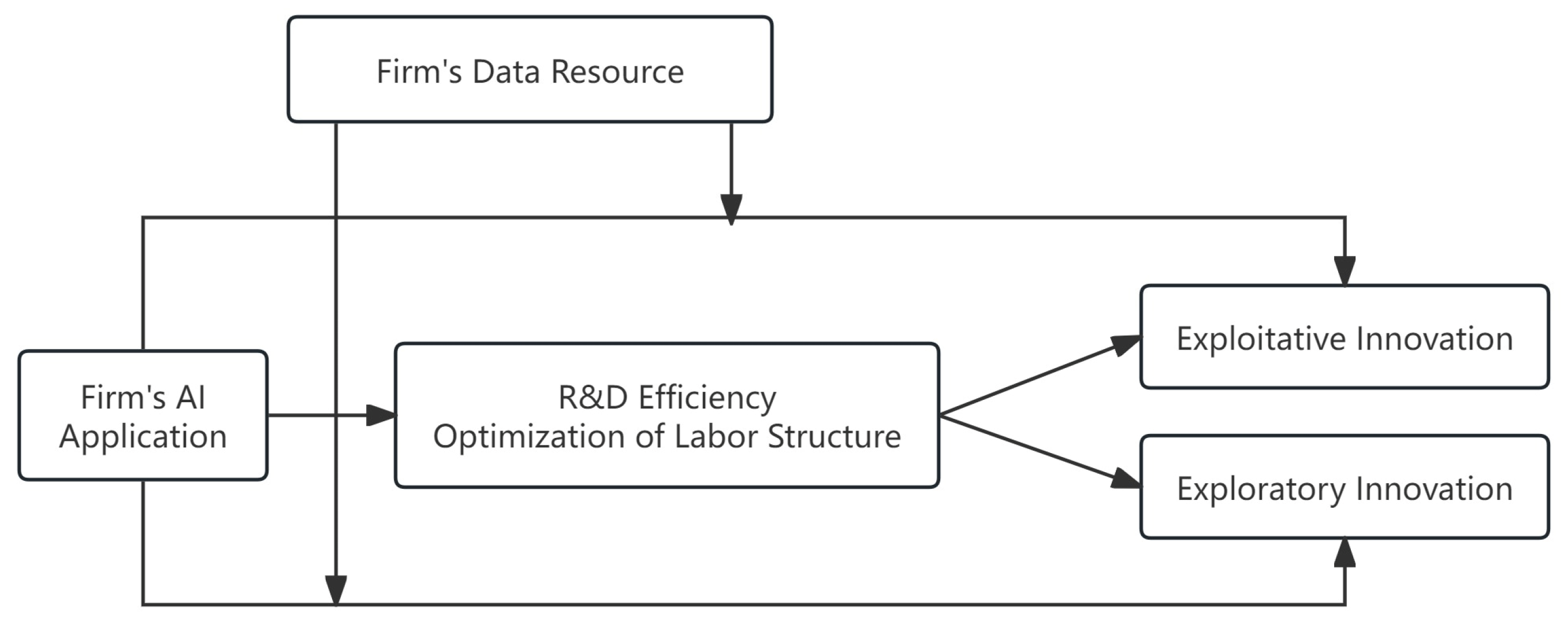

Table 1.
Data resource keyword list.
| Seed Word | Extended Word |
| Data strategy | cloud, data infrastructure, data connection |
| Data governance | data management, data hub, data middleware, data middle platform, business intelligence, informatization, computility, algorithm |
| Data framework | parallel processing, data model, data sharing, data interflow, service-oriented architecture, database, AutoML, sampling, PyTorch, TensorFlow, visualization, open edge computing, metadata, product data management, distributed computation, data modeling |
| Data standard | data warehouse, data exchange, data fabric, data retrieval, data coding, security orchestration, automation and response, data closed loop, network video recorder, enterprise resource planning, DevOps, data model, decision support system |
| Data quality | internet safety, password, information safety, data validation, sensitive data, data provenance, data lineage, data monitoring, data reconciliation, data collection |
| Data safety | information security, local area network, private data, data protection |
| Data application | data analysis, data mining, intellectual algorithm, data business, software development, data silo, data modeling, data service, data sensing |
| Data life cycle | data maintenance, intelligent fault diagnose, data retire, data destruction |
Table 2.
Descriptive statistics of the variables.
| Variable Name | Variable Expression | Obs | Mean | Std | Min | Max |
| Firms’ exploitative innovation performance | Exploit | 21,253 | 2.818 | 1.977 | 0.000 | 9.774 |
| Firms’ exploratory innovation performance | Explore | 21,253 | 1.509 | 1.170 | 0.000 | 7.172 |
| Firms’ AI application | AI | 21,253 | 0.782 | 1.032 | 0.000 | 5.620 |
| Firms’ size | Size | 21,253 | 22.633 | 1.362 | 17.641 | 28.697 |
| Firms’ age | Age | 21,253 | 3.087 | 0.263 | 1.792 | 4.290 |
| Return on firms’ total assets | Roa | 21,253 | 0.023 | 0.089 | -2.646 | 0.786 |
| Firms’ liability | Leverage | 21,253 | 0.464 | 0.207 | 0.008 | 1.957 |
| R&D investment intensity | R&D | 21,253 | 15.426 | 6.697 | 0.000 | 24.630 |
| Firms’ board scale | Board | 21,253 | 2.123 | 0.201 | 0.000 | 2.890 |
| Firms’ governance structure | Independent | 21,253 | 0.378 | 0.058 | 0.000 | 0.800 |
| Firms’ share concentrationTOP5 | Top5 | 21,253 | 0.146 | 0.112 | 0.001 | 0.810 |
* Obs represents number of observations, Mean represents the average of samples, Std represents the standard error of the samples, Min represents the minimum number of the samples, Max represents the maximum number of the samples.
Table 3.
Correlations and variance inflation factors.
| Variables | Exploit | Explore | AI | Size | Age | Leverage | Roa | R&D | Board | Independent | Top5 |
| Exploit | 1.000 | ||||||||||
| Explore | 0.663*** | 1.000 | |||||||||
| AI | 0.281*** | 0.162*** | 1.000 | ||||||||
| Size | 0.312*** | 0.390*** | 0.041*** | 1.000 | |||||||
| Age | -0.100*** | -0.085*** | 0.004 | 0.075** | 1.000 | ||||||
| Leverage | 0.076*** | 0.071*** | -0.022** | 0.407*** | 0.103*** | 1.000 | |||||
| Roa | 0.080*** | 0.104*** | -0.007 | 0.127*** | -0.025*** | -0.321*** | 1.000 | ||||
| R&D | 0.415*** | 0.609*** | 0.217*** | 0.123*** | -0.120*** | -0.089*** | 0.070*** | 1.000 | |||
| Board | 0.100*** | 0.086*** | -0.067*** | -0.030*** | 0.010 | -0.026*** | 0.009 | -0.537*** | 1.000 | ||
| Independent | -0.018** | 0.014* | 0.043*** | 0.311*** | -0.065*** | 0.058*** | 0.135*** | -0.051*** | 0.074*** | 1.000 | |
| TOP5 | 0.068*** | 0.039*** | -0.080*** | 0.311*** | -0.065*** | 0.058*** | 0.135*** | -0.051*** | 0.074*** | 0.038*** | 1.000 |
| VIF | — | — | 1.064 | 1.602 | 1.04 | 1.482 | 1.233 | 1.117 | 1.561 | 1.458 | 1.154 |
***, **, and * indicate passing significance tests at 1%, 5%, and 10% significance levels, respectively.
Table 4.
Benchmark regression results for artificial intelligence influencing ambidextrous innovation.
Table 4.
Benchmark regression results for artificial intelligence influencing ambidextrous innovation.
| (1) | (2) | (3) | (4) | (5) | (6) | |
| Variables | Exploit | Explore | Exploit | Explore | Exploit | Explore |
| AI | 0.121*** (0.015) |
0.063*** (0.014) |
0.073*** (0.015) |
0.034** (0.014) |
-0.103* (0.060) |
0.152*** (0.054) |
| Data | -0.065** (0.029) |
0.014 (0.030) |
||||
| AI×Data | 0.054*** (0.018) |
-0.035** (0.016) |
||||
| Size | 0.420*** (0.032) |
0.258*** (0.025) |
0.408*** (0.032) |
0.258*** (0.025) |
||
| Age | -0.073 (0.327) |
-0.821*** (0.268) |
-0.023 (0.327) |
-0.818*** (0.268) |
||
| Roa | -0.159 (0.099) |
-0.204** (0.084) |
-0.167* (0.099) |
-0.202* (0.084) |
||
| Leverage | 0.008 (0.107) |
0.165 (0.104) |
0.015 (0.106) |
0.158 (0.104) |
||
| R&D | 0.041*** (0.003) |
0.037*** (0.003) |
0.042*** (0.003) |
0.037*** (0.003) |
||
| Board | 0.1910* (0.103) |
0.052 (0.085) |
0.1862* (0.103) |
0.054 (0.085) |
||
| Independent | 0.220 (0.291) |
-0.478* (0.238) |
0.214 (0.291) |
-0.476* (0.238) |
||
| Top5 | 0.317 (0.285) |
0.573* (0.230) |
0.343 (0.285) |
0.558* (0.230) |
||
| Firm FE | Y | Y | Y | Y | Y | Y |
| Year FE | Y | Y | Y | Y | Y | Y |
| Observation | 21,253 | 21,253 | 21,253 | 21,253 | 21,253 | 21,253 |
| Adj.R square | 0.825 | 0.435 | 0.837 | 0.475 | 0.838 | 0.475 |
* Robust standard errors in ( ). ***, **, and * indicate passing significance tests at 1%, 5%, and 10% significance levels, respectively. Y represents the control.
Table 5.
Omission bias test.
| Exploit | Explore | |||||
| (1) | (2) | (3) | (4) | (5) | (6) | |
| Groups of Controls | Coefficient of Limited Controls | Coefficient of All Controls | Ratio Difference | Coefficient of Limited Controls | Coefficient of All Controls | Ratio Difference |
| No Controls | 0.538 | 0.073 | 0.160 | 0.184 | 0.034 | 0.227 |
| Only Control Firm- and Year-Fixed Effects | 0.121 | 0.073 | 1.521 | 0.063 | 0.034 | 1.172 |
| Only Control Firm-Specific Variables | 0.097 | 0.073 | 3.041 | 0.058 | 0.034 | 1.417 |
Table 6.
Results of propensity score matching and instrumental variable estimation.
| (1) | (2) | (3) | (4) | (5) | |
| Variables | Exploit | Explore | AI | Exploit | Explore |
| AI | 0.073*** (0.015) |
0.031** (0.013) |
|||
| IV | 0.042*** (0.011) |
||||
| AI_IV | 1.627*** (0.526) |
0.672* (0.265) |
|||
| Controls | Y | Y | Y | Y | Y |
| Firm FE | Y | Y | Y | Y | Y |
| Year FE | Y | Y | Y | Y | Y |
| Observation | 20,794 | 20,794 | 19,371 | 19,371 | 19,371 |
| Adj.R square | 0.832 | 0.461 | 0.346 | 0.244 | 0.172 |
* Robust standard errors in ( ). ***, **, and * indicate passing significance tests at 1%, 5%, and 10% significance levels, respectively. Y represents the control.
Table 7.
Other robustness checks.
| (1) | (2) | (3) | (4) | (5) | (6) | (7) | (8) | |
| Variables | Exploit | Explore | Exploit | Explore | Exploit | Explore | Exploit | Explore |
| AI | 0.077*** (0.016) |
0.030* (0.015) |
0.067*** (0.014) |
0.043*** (0.013) |
0.088*** (0.024) |
0.044** (0.021) |
||
| Invest | 0.006** (0.003) |
0.006** (0.002) |
||||||
| Controls | Y | Y | Y | Y | Y | Y | Y | Y |
| Firm FE | Y | Y | Y | Y | Y | Y | Y | Y |
| Year FE | Y | Y | Y | Y | Y | Y | Y | Y |
| Year-Industry FE | N | N | N | N | Y | Y | N | N |
| Observation | 17.584 | 17.584 | 21,253 | 21,253 | 21,253 | 21,253 | 10,397 | 10,397 |
| Adj.R square | 0.847 | 0.480 | 0.084 | 0.047 | 0.850 | 0.487 | 0.847 | 0.494 |
* Robust standard errors in ( ). ***, **, and * indicate passing significance tests at 1%, 5%, and 10% significance levels, respectively. Y represents the control.
Table 8.
Estimation results of the mediation mechanism with R&D efficiency and optimization of the labor structure.
Table 8.
Estimation results of the mediation mechanism with R&D efficiency and optimization of the labor structure.
| (1) | (2) | (3) | (4) | (5) | (6) | |
| Variables | Efficiency | Exploit | Explore | Graduate | Exploit | Explore |
| AI | 0.004*** (0.001) |
0.042*** (0.010) |
0.004** (0.002) |
0.468*** (0.138) |
0.071*** (0.015) |
0.289** (0.013) |
| Efficiency | 12.066*** (0.214) |
10.131*** (0.175) |
||||
| Graduate | 0.004*** (0.001) |
0.004*** (0.001) |
||||
| Controls | Y | Y | Y | Y | Y | Y |
| Firm FE | Y | Y | Y | Y | Y | Y |
| Year FE | Y | Y | Y | Y | Y | Y |
| Observation | 17.584 | 17.584 | 21,253 | 21,253 | 21,253 | 21,253 |
| Adj.R square | 0.798 | 0.901 | 0.621 | 0.841 | 0.837 | 0.475 |
* Robust standard errors in ( ). ***, **, and * indicate passing significance tests at 1%, 5%, and 10% significance levels, respectively. Y represents the control.
Table 10.
Estimated results of firms’ slack resource heterogeneity.
| (1) | (2) | (3) | (4) | |
| Variables | High Slack Resource | Low Slack Resource | ||
| Exploit | Explore | Exploit | Explore | |
| AI | 0.064*** (0.022) |
0.037* (0.020) |
0.056*** (0.020) |
0.023 (0.019) |
| Controls | Y | Y | Y | Y |
| Firm FE | Y | Y | Y | Y |
| Year FE | Y | Y | Y | Y |
| Observation | 11,011 | 11,011 | 11,011 | 11,011 |
| Adj.R square | 0.849 | 0.474 | 0.826 | 0.484 |
* Robust standard errors in ( ). ***, **, and * indicate passing significance tests at 1%, 5%, and 10% significance levels, respectively. Y represents the control.
Table 11.
Estimated results of firms’ AI foundation heterogeneity.
| (1) | (2) | (3) | (4) | |
| Variables | High AI foundation | Low AI foundation | ||
| Exploit | Explore | Exploit | Explore | |
| AI | -0.002 (0.041) |
-0.020 (0.036) |
0.075*** (0.016) |
0.0360** (0.014) |
| Controls | Y | Y | Y | Y |
| Firm FE | Y | Y | Y | Y |
| Year FE | Y | Y | Y | Y |
| Observation | 2,319 | 2,319 | 19.702 | 19.702 |
| Adj.R square | 0.850 | 0.469 | 0.820 | 0.470 |
* Robust standard errors in ( ). ***, **, and * indicate passing significance tests at 1%, 5%, and 10% significance levels, respectively. Y represents the control.
Table 12.
Estimated results of industrial competition intensity heterogeneity.
| (1) | (2) | (3) | (4) | |
| Variables | High competition intensity | Low competition intensity | ||
| Exploit | Explore | Exploit | Explore | |
| AI | 0.060*** (0.019) |
-0.002 (0.018) |
0.074*** (0.021) |
0.050** (0.020) |
| Controls | Y | Y | Y | Y |
| Firm FE | Y | Y | Y | Y |
| Year FE | Y | Y | Y | Y |
| Observation | 11,045 | 11,045 | 10.976 | 10.976 |
| Adj.R square | 0.835 | 0.451 | 0.834 | 0.503 |
* Robust standard errors in ( ). ***, **, and * indicate passing significance tests at 1%, 5%, and 10% significance levels, respectively. Y represents the control.
Disclaimer/Publisher’s Note: The statements, opinions and data contained in all publications are solely those of the individual author(s) and contributor(s) and not of MDPI and/or the editor(s). MDPI and/or the editor(s) disclaim responsibility for any injury to people or property resulting from any ideas, methods, instructions or products referred to in the content. |
© 2025 by the authors. Licensee MDPI, Basel, Switzerland. This article is an open access article distributed under the terms and conditions of the Creative Commons Attribution (CC BY) license (http://creativecommons.org/licenses/by/4.0/).
Copyright: This open access article is published under a Creative Commons CC BY 4.0 license, which permit the free download, distribution, and reuse, provided that the author and preprint are cited in any reuse.


