

Submitted:
23 September 2025
Posted:
25 September 2025
You are already at the latest version
Abstract
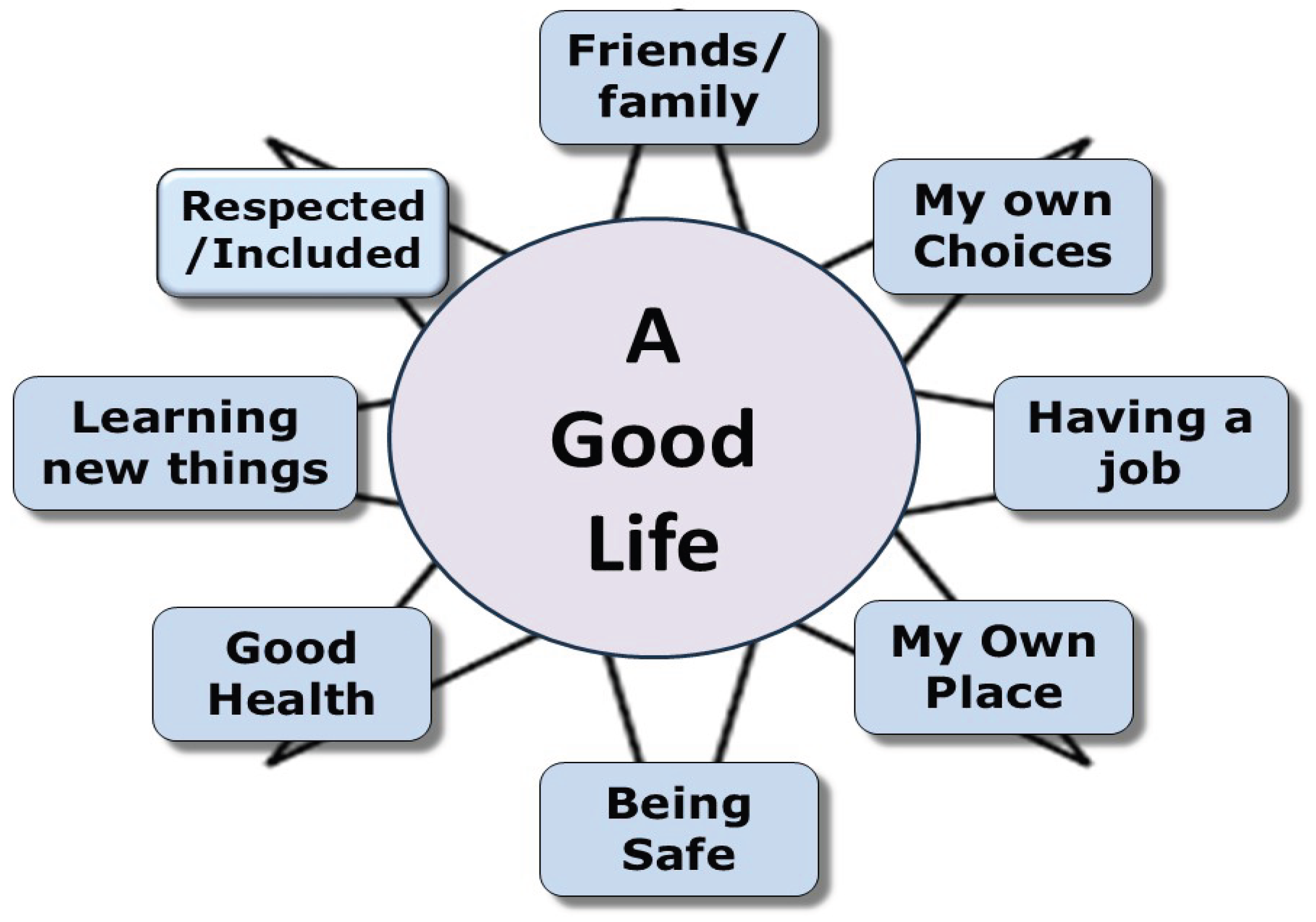
People with Down syndrome often experience more barriers to achieving a good quality of life compared to people without disabilities. A lot of the existing research has focused on the views of parents and professionals, rather than directly including the voices and perspectives of people with Down Syndrome themselves. At the 2024 World Down Syndrome Conference, over 140 adults with Down Syndrome came together at a one-day Forum to talk about their lives—what’s going well and what could be better. The goal was to hear directly from them. This article explains how the Forum was run so that others with Down Syndrome can use a similar process. It also shows how Artificial Intelligence (AI) could help organise and share the information they give. Eight key things were found that would help people to have a good life: 1. Good relationships with family and friends; 2. Having a job; 3. Learning new things; 4. A place of our own to live; 5. Feeling safe; 6. Good health; 7. Making my own choices; 8. Being respected and included. The Forum gave valuable insights and helped us think of new ideas for supporting people with Down Syndrome to speak up for themselves. AI (Artificial Intelligence) could be a helpful tool in the future to help them share their experiences and needs. More research is needed to understand how people with Down Syndrome can be more involved in making changes through projects where they take an active role.
Keywords:
Down Syndrome
; quality of life
; intellectual disability
; self-advocacy
; rights
; inclusion
; artificial intelligence
; international
1. Introduction
This article is written in simple plain language. We have added some photos and diagrams to help to explain things. Two people with Down Syndrome helped write this article. We want to make it easier for everyone—not just academics—to understand. We hope this kind of study helps to collect useful ideas for future research.
Also we believe that people with disabilities, along with their families and support workers, should have access to information. This article is just one example of how universities and researchers can do a better job of sharing what they learn with people who could create a better life for people with Down Syndrome.
1.1. The Rights of Persons with Down Syndrome
People with disabilities—whether physical, sensory, or intellectual—don’t always get the same chances as others. For example, people with Down Syndrome often miss out on education, job opportunities, and friendships [1]. This isn’t just in one country—it happens all over the world and has for many years.
In response, people with disabilities began speaking up for themselves and working for change. Many groups from different countries worked together to write a list of rights for people with disabilities. People with Down Syndrome and their families were involved. The United Nations, which includes 195 countries, also supported this work.
About 20 years ago, most countries agreed to the United Nations Convention on the Rights of Persons with Disabilities [2]. By early 2025, 192 countries had signed on. This means that people with disabilities can now use this agreement to ask for their rights from governments and service providers. But they still need support to learn about these rights and how to stand up for themselves [3].
People with intellectual disabilities, including those with Down Syndrome, often rely on others—like parents or teachers—to speak up for them. While this can help, sometimes these individuals want to make their own choices, even if they’re different from what others expect. One review looked at 39 studies on the quality of life of adults with Down Syndrome. Only 8 studies actually asked people with Down Syndrome directly about their views—and most had small numbers and were from the USA [4]. These studies focused more on health and less on things like friendships or inclusion. This may reflect what professionals think is important, rather than what people with Down Syndrome want.
Two other studies from Australia [5,6], found that people with Down Syndrome wanted more relationships, more chances to be part of the community, and more independence—especially with work and where they live.
Self-advocacy—speaking up for yourself—is not very common among people with intellectual disabilities, and even less so for people with Down Syndrome. But there’s growing evidence that it can work and make a real difference for persons who take part in it [7]. Organisations like Down Syndrome International are trying to encourage this, and they have shared useful ideas [8].
At the 2024 World Down Syndrome Congress in Brisbane, Australia (organised by Down Syndrome International and Down Syndrome Australia), over 1,000 people attended. The day before the main event, there was a Forum just for people with Down Syndrome. It was a chance to hear from more people than ever before about what they want in life. The goal was to test a method that could be used again in other places to gather feedback from people with Down Syndrome or other intellectual disabilities.
Technology—like the Internet and Artificial Intelligence (AI)—could help people with intellectual disabilities speak up and share their ideas more clearly [9]. After the Forum, we tried different ways to help advocacy groups organize and share what was said. The “Method and Findings” sections below, show how these reports could be written and used—for example, by people who fund or provide services.
1.2. Our Goals
We had three main goals for the self-advocates' Forum at the 2024 Congress:
- To listen to adults with Down Syndrome about what they enjoy in life and what could make it better.
- To try out a method for collecting this kind of information that others could use in their own countries or communities.
- To explore how tools like the Internet and Artificial Intelligence (AI) could help people with Down Syndrome or other intellectual disabilities, gather and share their ideas and needs more easily.
2. How We Ran the Forum
The day before the 2024 World Down Syndrome Congress, we held a meeting just for people with Down Syndrome. It was called a Self-advocates Forum. The event lasted all day, with breaks for food and rest. Almost 140 people from 7 countries came. Most were from Australia and New Zealand, but others came from England, Canada, the USA, Singapore, and Germany. There was a good mix of men and women. Nearly everyone was under 40, with most in their 20s or 30s.
We used a large room with round tables (see Figure 1).
Each table had about 6 to 8 people, with a mix of men and women. Some people brought a support person, who sat with them and helped if needed. Supporters helped in different ways—for example, translating into different languages or using communication tools. At each table there was another support person who guided the discussion.
2.1. What We Did
The Forum was planned by a team led by Rachel (Down Syndrome Australia), Ruth (Down Syndrome Queensland), and Robin (Down Syndrome International).
To start the day, people did some fun activities at their tables to help everyone feel comfortable. Rachel and Ruth explained what the Forum was about and what we would be doing. No one would be named, and anyone who didn’t want to speak could still join and listen. People could ask questions, and Robin brought them a microphone so everybody in the room could hear.
Roy gave a short talk about rights for people with Down Syndrome. Others joined him to show why speaking up for yourself is important.
Then Rachel introduced the first activity. The question was: "What are the good things in your life?" Everyone who wanted to share could do so, and supporters helped write answers on big sheets of paper. These were placed on tables so everyone could see their ideas being written down (see Figure 2).
When all the tables had finished, Robin and Andrew (a self-advocate leader from New Zealand) went around the tables, asking some people to share things they had written down. Other tables raised their hands if they had written the same thing.
After a short break, we started the second activity: "What things in your life could be better?" At each table, people explained why these things mattered to them, what made them hard to get, and what could help. Again, supporters wrote the answers on large sheets. Then it was time for lunch and rest.
During lunch, Rachel, Robin, Roy, and a few others read through all the answers and grouped similar ideas together into topics. They wrote summaries on new sheets and put them on the walls around the room.
In the afternoon, people walked around to read the summary sheets, then went back to their tables to talk. Robin and Andrew asked if anyone wanted to tell a personal story or share their wishes for a better life. Many people spoke—at least one from each table.
Then, people were given stickers (dots) and asked to vote by placing a dot on the ideas that mattered most to them. Later, we counted the dots to see which ideas were the most important. (see Figure 3).
In the final part of the day, volunteers read out the top ideas and everyone cheered if they agreed. We ended the day with songs and a group photo.
2.2. Sharing What Happened
On the final day of the Congress, five self-advocates and three supporters spoke on stage in a panel session. The audience included professionals, family members, and other people with Down Syndrome: everyone who had attended the Congress. Roy asked the panel questions so they could tell everyone what happened at the Forum and what people said would make their lives better. They finished by inviting everyone to sing and dance to the song "Roar" by Katy Perry, which has the line: “You held me down but I got up, ‘cause I am a champion and you’re gonna hear me roar!” This song was chosen by the Forum participants.
2.3. What We Did After the Forum
After the Forum we took photos of the big paper sheets.
- There were 20 sheets about the good things in people’s lives.
- There were 24 sheets about what could be better.
We read the words out loud into a voice recorder on a smartphone. This took about an hour.
Then we used a free website called TurboScribe to turn the recording into written words. It only took about two minutes. We couldn’t record the table conversations because the room was so loud and busy. But this could be done in smaller groups in the future.
To help organise the information, we used ChatGPT (an example of Artificial Intelligence: 'AI'). We uploaded the text and asked it to group the answers into themes. It gave us clear lists and examples in just a minute.
We did the same thing for both sets of answers:
- What people liked about their lives
- What they wanted to improve
Roy double-checked the AI results with the original paper notes.
Some people might find it hard to read the written list. So we used a free tool called Amazon Polly (https://aws.amazon.com/polly/) to turn the words into speech. People could listen to the answers instead of reading them.
We also tried a tool called NotebookLM (https://notebooklm.google/), which turned the written notes into a conversation between two people (like actors). This could be helpful for training sessions in the future.
3. Our Findings – What Matters in the Lives of People with Down SYNDROME
At the Forum, people with Down syndrome shared what made their lives good and what they wished could be better in the future. Figure 4 shows the eight big topics people talked about most.
Everyone had different ideas—what made one person happy was not always the same for someone else.
Some people talked about just one thing that would make their life better, while others spoke about many ways life could be better. A few people said they couldn’t think of anything they would change.
Below are examples of what people shared. These words were written on the big paper sheets at the Forum.
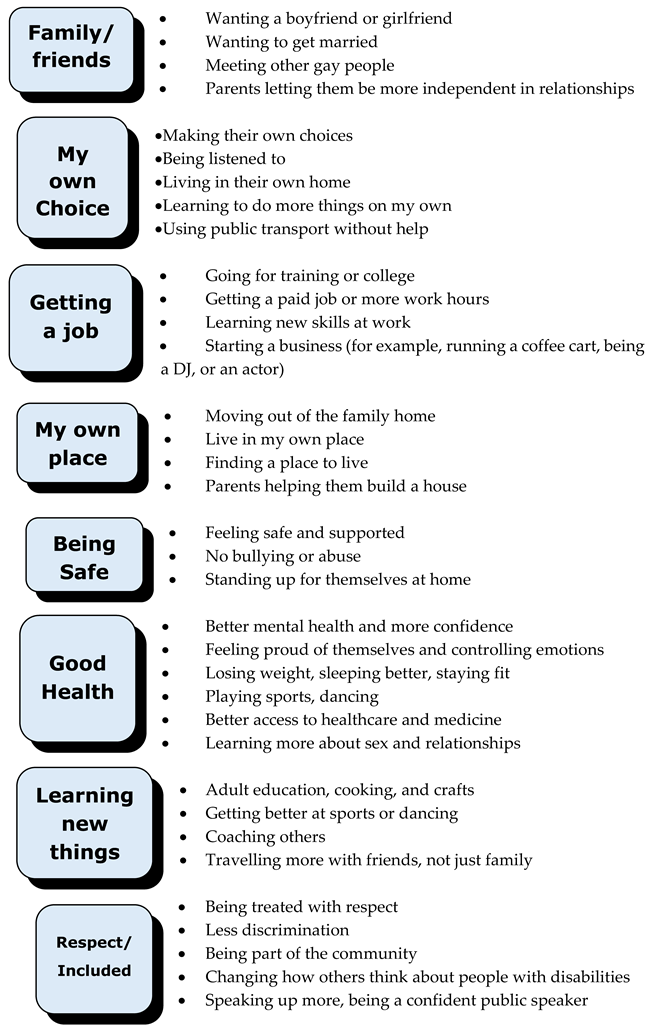
Some people also shared other dreams and ideas for a better future:
- Stopping pollution and littering
- Ending animal cruelty
- Feeling sad when people or pets die
- Wanting to become a motivational speaker
- Taking leadership roles and speaking up for others with Down syndrome
4. Discussion – What Did We Learn?
The Forum brought together nearly 140 people with Down syndrome from Australia and other countries. It may have been the biggest ever meeting of its kind. Many people who attended had already been part of local self-advocacy groups. They likely had strong support from family, good healthcare, education, and social opportunities. This is very different from the experience of older generations and also from people with Down syndrome who still do not have these opportunities— especially in communities with fewer resources or less inclusive support systems.
We learned two big lessons from the Forum:
- Like everyone else, people with Down syndrome can have good lives.
The Forum showed that people with Down syndrome can clearly explain what makes their life good. This was special because the information came directly from them—not from parents or professionals. They confirmed what earlier research found [4] but also gave us new insights because more people from different places took part.
- 2.
- People with Down syndrome should be listened to when decisions are made.
The eight topics discussed at the Forum can help guide important conversations. For example, when making school or work plans [10] or when planning support through programs like Australia’s National Disability Insurance Scheme (NDIS) [11].
The Forum also gave us a chance to test a way to hear from many people with Down syndrome. We found that this method worked well and could be used by others. Here are two tips:
- Take your time. Don’t rush the process. People need time to feel comfortable and to think. Breaks help people relax and connect.
- Use visual tools. Writing and pictures help people see that their ideas have been heard. These can be saved and shared later.
We also used Artificial Intelligence (AI) after the Forum to help organise and share what people said. The Internet and AI helped us:
- Turn recorded voices into written text.
- Sort ideas into themes quickly.
- Convert text into speech so people could listen instead of reading.
- Create role-play conversations from the written summary.
- Find previous research studies.
- Write our report in plain language.
These tools made communication easier and quicker. But we know AI must be used carefully [12]. People with Down syndrome and their supporters will need to learn how to use it safely. We hope others will study how AI can be used in a good and helpful way [13]. AI could help people with Down Syndrome to play an active part in research projects [14].
One limitation of the Forum was that we found out what matters to people but we didn’t have time to work on how to make changes happen. That would need more time—maybe many days—and would be better done in small local groups, not at one big event.
For example, a local Down Syndrome association could help a small group of self-advocates focus on one topic (like jobs or housing). They could work on a plan to create change in their own town or region. These kinds of small groups are also a great way to learn new skills. This is called ‘participatory action research' and there are examples of Down Syndrome being involved in such projects [15,16]. Future World Down Syndrome Congresses should include chances for people with Down syndrome to do action planning in small groups on the themes from this Forum.
Finally, this Forum added to what we already know about the quality of life for people with Down Syndrome, in countries with developed support systems. But in many other parts of the world, people face different barriers. Even though many countries have signed the UN Convention on the Rights of Persons with Disabilities, those rights are not always a reality. Advocacy—especially when people with Down syndrome speak for themselves—is one of the best ways to create change. It’s not always easy, but it works. An example from South Africa showed how advocacy helped reduce unfair treatment of people with Down Syndrome [17]. We hope more of this happens around the world in the years ahead.
5. Conclusions
The Forum confirmed what we already knew—and added new insights—about what adults with Down syndrome need for a better quality of life.
The most important things to them were:
- Relationships with family and friends
- Having a job
- Learning new things
- Living in their own home
- Feeling safe and healthy
- Making their own decisions
- Being respected and included
The way we collected information at the Forum gave us deep and meaningful ideas. It also showed how we can support people with Down syndrome to speak up for themselves and share their views. Artificial Intelligence (AI) proved to be a useful tool. It can help people with Down syndrome gather and explain what they want and need in life.
More research is needed to explore how people with Down syndrome can take part in projects that aim to make real changes in their communities.
Author Contributions
Conceptualization, R.S., R.G.; Methodology, R.S., R.G., R.M.; Data curation, R.S., R.G., R.M.; Formal analysis, R.M.; Validation, L.C., C.W.; Writing—original draft, R.M.; Writing—review and editing, R.S.,R.G., L.C., C.W. and R.M. The authors have agreed to the published version of the manuscript.
Funding
This study received no external funding .
Institutional Review Board Statement
Formal ethical approval was not required for this evaluation under UK Research and Innovation Guidance. However this study adhered to the seventh revised version W.M.A. of the Helsinki Declaration on Medical Research involving Human Subjects issued on 19 October 2013. Their consent was taken verbally as part of the Forum.
Informed Consent Statement
Informed consent was obtained from all participants who took part in the Forum.
Data Availability Statement
The written information is available on reasonable request to the corresponding author.
Acknowledgments
Our thanks to the conference committee for the 2024 World Down Syndrome congress for arranging sponsorship for the Forum and Down Syndrome Australia for organising the Congress https://www.downsyndrome.org.au/news-events/world-down-syndrome-congress-2024/). We are grateful to the volunteer facilitators and supporters at each table and all the participants who so enthusiastically took part in the Forum.
Conflicts of Interest
The authors declare no conflicts of interest in relation to this article.
References
- Down Syndrome International (undated) About Down Syndrome' information pack. Available at: https://ds-int.org/about-down-syndrome/.
- United Nations. Convention on the Rights of Persons with Disabilities. 2006. Available online: http://www.un.org/disabilities/.
- Frawley, P.; Bigby, C. Reflections on being a first generation self-advocate: Belonging, social connections, and doing things that matter. Journal of Intellectual and Developmental Disability 2015, 40, 254–264. [Google Scholar] [CrossRef]
- Ijezie, O.A.; Healy, J.; Davies, P.; Balaguer-Ballester, E.; Heaslip, V. Quality of life in adults with Down Syndrome: A mixed methods systematic review. PLoS ONE 2023, 18, e0280014. [Google Scholar] [CrossRef] [PubMed]
- Scott, M.; Foley, K.-R.; Bourke, J.; Leonard, H.; Girdler, S. “I have a good life”: the meaning of well-being from the perspective of young adults with Down Syndrome. Disability and Rehabilitation 2014, 36, 1290–1298. [Google Scholar] [CrossRef] [PubMed]
- Jevne, K.W.; Kollstad, M.; Dolva, A.-S. The perspective of emerging adults with Down Syndrome–On quality of life and well-being. Journal of Intellectual Disabilities 2021, 2021, 17446295211030097. [Google Scholar] [CrossRef] [PubMed]
- Tilley, E.; Strnadová, I; Danker, J.; Walmsley, J.; Loblinzk, J. The impact of self-advocacy organizations on the subjective well-being of people with intellectual disabilities: A systematic review of the literature. Journal of Applied Research in Intellectual Disabilities 2020, 33, 1151–1165. [Google Scholar] [CrossRef] [PubMed]
- Down Syndrome International (2025) Self-Advocacy Group Guide. Available at: https://ds-int.org/self-advocacy/ (Accessed May 2025).
- Birhane, A.; Isaac, W.; Prabhakaran, V.; Díaz, M.; Elish, M.C.; Gabriel, I.; et al. Power to the people? Opportunities and challenges for participatory AI. arXiv 2024, arXiv:2209.07572. [Google Scholar]
- Alkahtani, M.A.; Kheirallah, S. A. Background of Individual Education Plans (IEPs) Policy in Some Countries: A Review. Journal of Education and Practice, 2016, 7, 5–26. [Google Scholar]
- Understanding the National Disability Insurance Scheme (2025) Available online at: https://www.ndis.gov.au/understanding/how-ndis-works (last accessed May 2025).
- United Nations Regional Information Centre for Western Europe (2024) Building an accessible future for all: AI and the inclusion of Persons with Disabilities. Available at: https://unric.org/en/building-an-accessible-future-for-all-ai-and-the-inclusion-of-persons-with-disabilities/ (Accessed May 2025).
- O’Brien, P.; Iriarte-Garcia, E.; McConkey, R. Inclusive Research: Is the Road More or Less Well Travelled? Social Sciences 2022, 11, 483. [Google Scholar] [CrossRef]
- Chubb, J.; Cowling, P.; Reed, D. Speeding up to keep up: exploring the use of AI in the research process. AI & Soc 2022, 37, 1439–1457. [Google Scholar] [CrossRef]
- Miriam Stevenson. Flexible and Responsive Research: Developing Rights-Based Emancipatory Disability Research Methodology in Collaboration with Young Adults with Down Syndrome. Australian Social Work 2010, 63, 35–50. [Google Scholar] [CrossRef]
- Vaccarino, F.; Vaccarino, Z.; Armstrong, D.; Borkin, E.; Hewitt, A.; Oswin, A. . Glew, A. Self-advocates with Down Syndrome research the lived experiences of COVID-19 lockdowns in Aotearoa New Zealand. Journal of Applied Research in Intellectual Disabilities 2023, 36, 300–309. [Google Scholar] [CrossRef] [PubMed]
- McGlinchey, E.; Fortea, J.; Vava, B.; et al. Raising awareness and addressing inequities for people with Down Syndrome in South Africa. Int J Equity Health 2025, 24, 7. [Google Scholar] [CrossRef] [PubMed]
Figure 1.
The room layout.
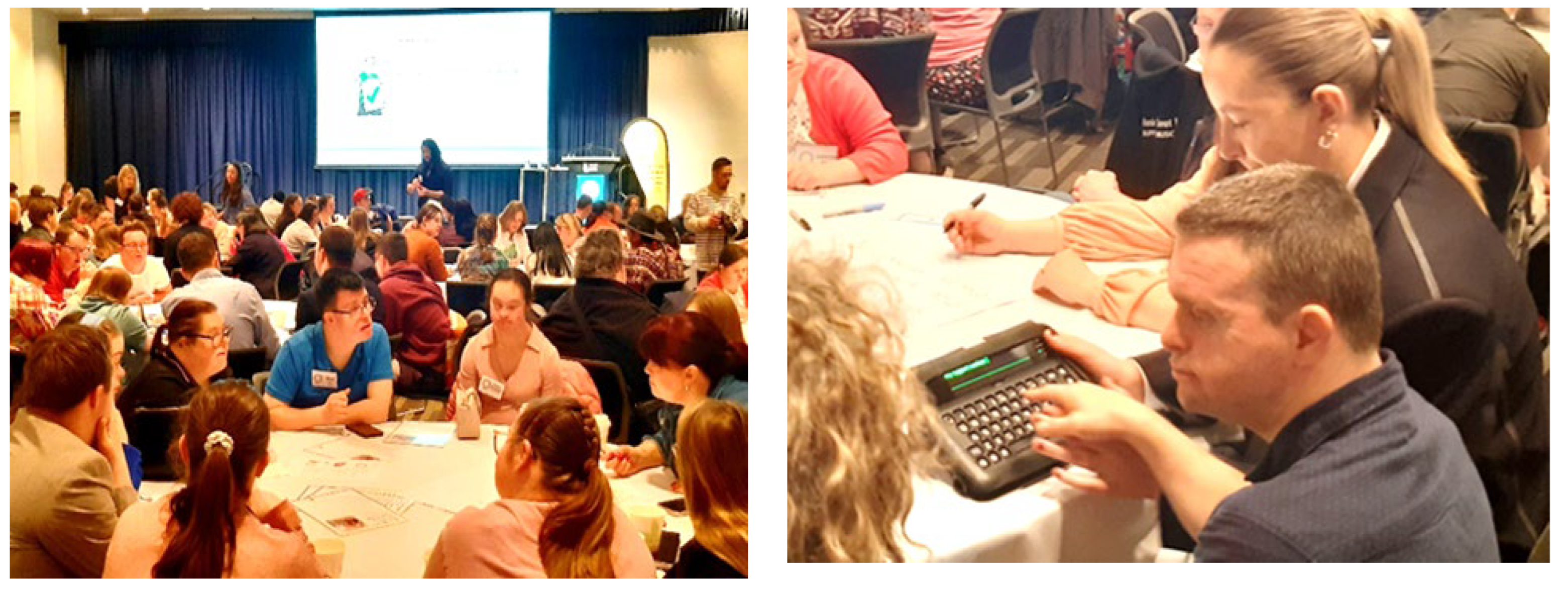
Figure 2.
Recording what was said at each Table.
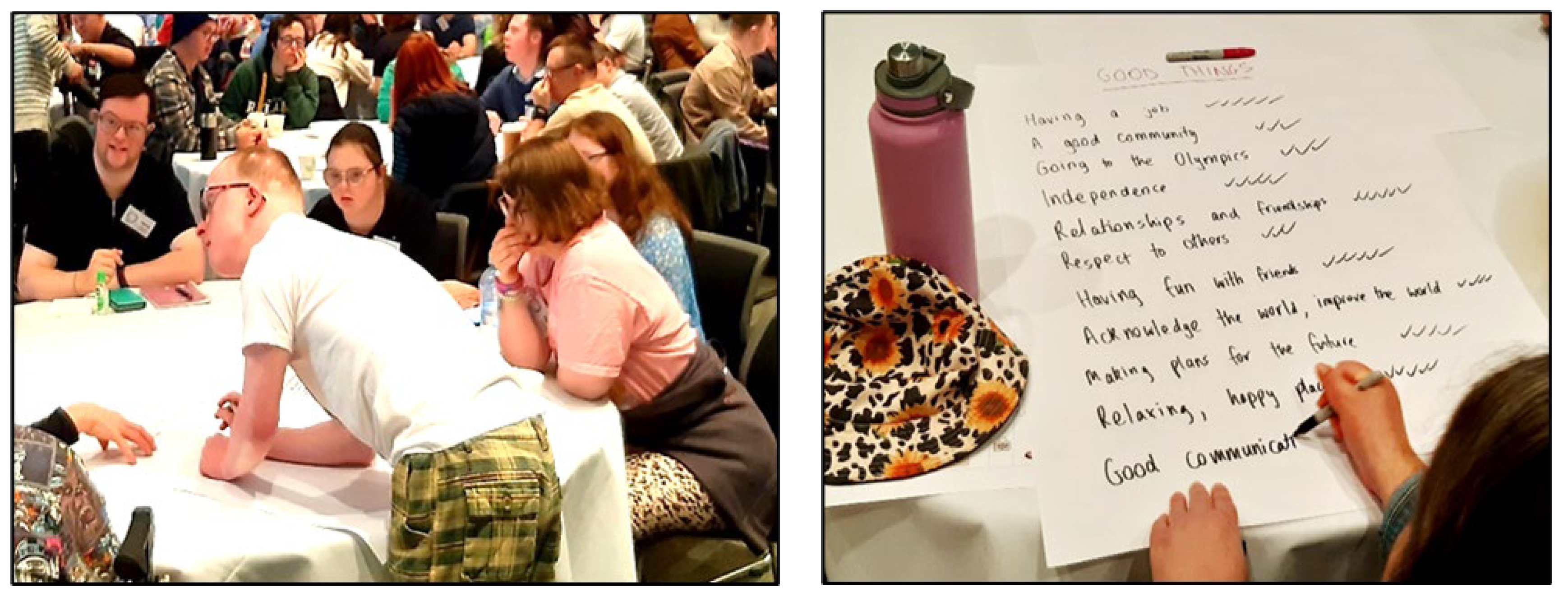
Figure 3.
Summary of themes.
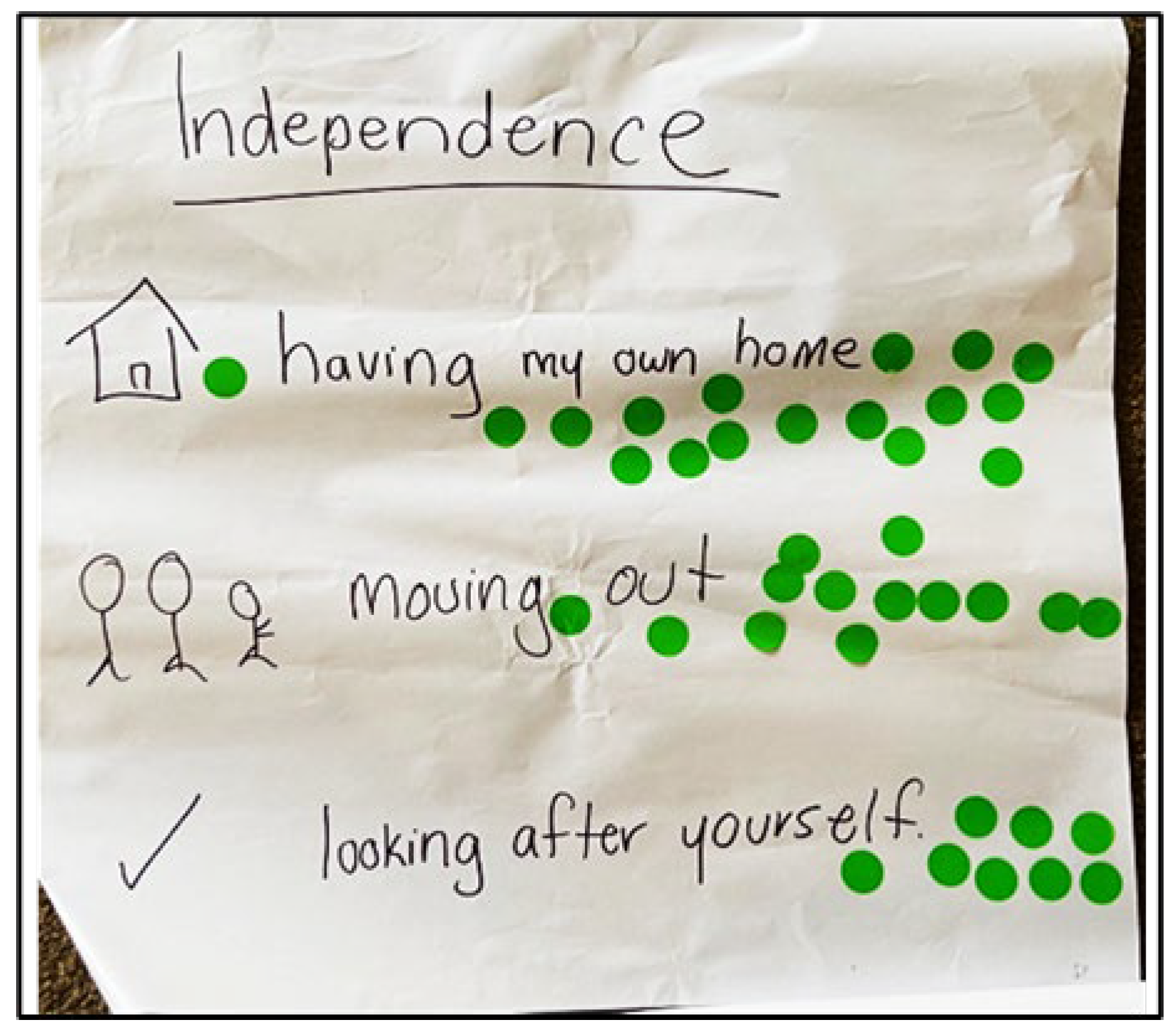
Figure 4.
The eight things that made life good.
Disclaimer/Publisher’s Note: The statements, opinions and data contained in all publications are solely those of the individual author(s) and contributor(s) and not of MDPI and/or the editor(s). MDPI and/or the editor(s) disclaim responsibility for any injury to people or property resulting from any ideas, methods, instructions or products referred to in the content. |
© 2025 by the authors. Licensee MDPI, Basel, Switzerland. This article is an open access article distributed under the terms and conditions of the Creative Commons Attribution (CC BY) license (http://creativecommons.org/licenses/by/4.0/).
Copyright: This open access article is published under a Creative Commons CC BY 4.0 license, which permit the free download, distribution, and reuse, provided that the author and preprint are cited in any reuse.


