

Submitted:
21 September 2025
Posted:
23 September 2025
You are already at the latest version
Abstract
Supercapacitors, which are a prominent type of energy storage device, have attracted considerable interest because of their exceptional power density, rapid charging rate, and extended cycle life. This review explores the composition and fundamental characteristics of perovskite materials, emphasizing their distinct abilities to transport both electrons and ions. Furthermore, they demonstrate a remarkable level of compatibility with electrochemical energy storage devices. The research examining different types of perovskite electrodes, including la-perovskites, Sr-perovskites, Ce-perovskites, and other perovskite oxides, has demonstrated that when combined with conducting polymers like PANI and polyazulene, they form perovskite-polymer composite materials.Electrochemical features, including high specific capacitance, cycle capabilities, and energy and power densities, make these composites valuable. Thus, they are the most promising materials in this field. Their use in supercapacitors is interesting. This research investigates the manufacturing and evaluation of these composite materials. The benefits of approaches such as the one-pot approach and the two-stage electrodeposition process are of specific relevance. The study provides an in-depth analysis of the challenges and technological obstacles encountered in perovskite-polymer composites for supercapacitors, specifically regarding limitations in conductivity and concerns regarding stability. It also discusses the strategies being employed to address these issues. The article offers a comprehensive outlook on the subject of perovskite and polymer composite materials, which have the potential to be used in the development of high-performance supercapacitors. It highlights their capacity to revolutionize energy storage technology and contribute to the progress of effective and environmentally friendly energy solutions.
Keywords:
supercapacitor
; perovskite
; polymer
; energy storage
; composite
1. Introduction
Novel energy storage equipment with high energy density and good stability are needed due to the increasing use of electronic devices and electric-powered vehicles [1]. Supercapacitors are an emerging energy storage technology known for their exceptional power density, rapid charging capability, and extended lifespan [2]. The electrochemical performance of a supercapacitor is contingent upon the composition of the electrode material, which encompasses metal oxides, carbon-based materials, conducting polymers, and perovskite-based materials [3]. Perovskites with ABX3 structures have excellent electronic and ionic conduction properties [4]. Nevertheless, there are limitations associated with perovskite materials [5]. One issue is their resistance and the sluggish speed at which charge transfer occurs during electrochemical reactions [6]. The efficiency of active materials is reduced, impacting their performance and capacity [7]. Prior to the utilization of perovskites as high-performance electrode materials in commercial energy storage devices, it is imperative to address and resolve these issues [8]. Improving the electrochemical performances of perovskite oxides has involved utilizing different methods such as altering the shape, ion doping, and incorporating other materials. [9,10]. CPs are commonly utilized in SCs due to their widespread availability, affordability, high conductivity, and excellent capacitive performance [10]. Presently, there is extensive research being conducted on p- type conducting systems such as polyaniline, polypyrrole, polythiophene, and its derivatives [11]. PAz, possessing both reversible p–type and n–type doping characteristics and a high theoretical specific capacitance, exhibits great potential as a pseudocapacitive material [12,13].
Perovskite-polymer composites possess unique characteristics that combine the qualities of perovskites with the advantages of polymers [14]. The aforementioned materials are used in advanced energy storage systems, such as supercapacitors [15]. Super capacitors and other energy storage devices benefit greatly from composites as they exhibit distinct electrochemical features [8]. Their precise capacitances have been evaluated at 121 Fg-1, indicating their capacity to store electrical charge [16]. Despite enduring 5000 rounds, these materials maintain 73% of their original capacitance [17]. In addition, they are capable of achieving energy densities of 24.4 Wh kg-1, power densities of 3.9 kW kg-1 [18]. Conversely, the electrode-electrolyte interface has exhibited n-type dielectric characteristics, and their mechanical flexibility enables their incorporation into various device structures [19]. Polymers, when included into perovskites, improve their stability and mechanical properties, making it easier for the perovskites to exhibit optoelectronic characteristics such as light absorption and charge transfer [20]. Moreover, polymers provide better ease of processing, allowing the composites to be used in a wide range of optoelectronic devices such as solar cells, LEDs, and sensors, and enhanced processing of large quantities of solid materials [21].
2. Perovskite-Polymer Composite
Combining perovskite oxides with polymeric compounds balances their densities, enhancing energy storage and retaining quick electrochemical reactions [15]. Specific capacitance increases significantly when perovskites are combined with polymers [9]. Polymers absorb ions better due to their increased surface area [22]. By adjusting the ratio of polymer to perovskite, it is possible to precisely control the electrochemical properties, mechanical strength, and stability of the composite material [23]. Perovskite-polymer composites have a higher ability to last longer during various numbers of charge-discharge cycles because of the protective nature of the polymer components against ion insertions and extractions [8]. The ability of the polymer to help maintain its structural integrity throughout a longer period increases the lifespan of the device [24]. More so, the high absorption of photons in the perovskites increases their potential in the production of light-rechargeable supercapacitors [25]. The perovskite layers can absorb photons resulting in electron-hole pairs, increasing the ability of the layer to store an electric charge [6]. The current study has emphasized the prospect of the long-term restorative capacity, the ability to respond with an increased need, and the view of the economic justification [26].
2.1. CsPbBr3−PMMA Composite
A recent research paper thoroughly reviews the numerous benefits and practical uses of Highly Stable and Luminescent CsPbBr3−PMMA Composites [4]. CsPbBr3−PMMA composites are more durable and reliable to repeated exposure [27]. The eco-friendly synthesis approach removes organic solvents from CsPbBr3−PMMA Composite production [28]. The technique is green chemistry-friendly and aims to generate eco-friendly products by lowering environmental impact [29]. The PL intensity was 70% for CsPbBr3−PMMA and 78% for CsPbBr3−PBMA after one month in the air [30]. After 48 hours of immersion, CsPbBr3−PMMA and CsPbBr3−PBMA composites remain extremely water- resistant, with PL intensity remaining at 54% and 56%, respectively [31]. After 30 days in water, the PL spectra’s peak form remained consistent, demonstrating stability [32]. The composite demonstrated a remarkable specific capacitance of 528 m Fg-1 under the current density of 100 m Ag-1, which shows the ability to store an enormous amount of electrical energy [28]. In addition, the composite showed an outstanding repetition capability, making it possible to cycle the material 10,000 times with more than 90% of its initial capacitance [33].
A one-pot synthesis method was employed to create stable and luminous CsPbBr3−PMMA Composite by crystallizing perovskite structures and integrating them into a polymer matrix [34]. First, gas was carefully removed from the monomer solution in nitrogen [30]. It was done to avoid oxygen, which could slow polymerization [14]. The first thermal synthesis of composite perovskite-polystyrene at 70 degrees Celsius produced a yellow semi-transparent product [32]. Methacrylate monomers, which polymerize faster, improved the procedure and styrene monomers have sluggish radical polymerization kinetics [35]. Perovskite- methacrylic polymer composites use methyl methacrylate as the main constituent [36]. Despite MMA’s increased polarity, CsPbBr3 was synthesized in bulk methacrylate [37]. A perovskite-PMMA composite, bright with a yellow shade, was obtained after 12 hours at 70 degrees Celsius [38]. Polymerization was initiated in the MMA monomer solution under UV light to accelerate the synthesis process [39]. The one-step synthesis capability of a wide range of easily accessible monomers makes it feasible to create the perovskite-polymer composites framework [30].
The versatile approach works for poly(methyl methacrylate) and polystyrene are ideal for optical applications that demand a wide surface area and luminosity [40]. Stability, flexibility and the brightness of supercapacitors are enhanced with composites [5]. Supercapacitors with CsPbBr3−PMMA composites exhibits superior air stability and water resistance [41]. The composites CsPbBr3−PMMA and CsPbBr3−PBMA show 70% and 78% photoluminescence intensities, respectively, over a month in air [30]. After 48 hours in water, CsPbBr3−PMMA and CsPbBr3−PBMA maintain photoluminescence intensities of 54% and 56%, respectively. CsPbBr3−PMMA composites exhibit exceptional endurance in demanding environments, making them ideal for applications requiring long-term stability [42]. The CsPbBr3−PMMA composite is strong, with 320 MPa tensile stress and 15% breaking strain [43]. The composite is suited for high mechanical stress and moduli applications because to its rigidity and green light emission [30]. The CsPbBr3−PMMA composite exhibits 62.4% photoluminescence quantum yield (PLQY), demonstrating excellent luminosity for various devices [32]. Under various environmental conditions, the CsPbBr3−PMMA composite beats weight-based tests in stability and specific energy density [30].
2.2. Ru-Based Perovskites/RGO Composite
Recent investigations have shown that Ru-based perovskites and reduced graphene oxide (RGO) composites have high specific capacitance [44]. Composites with high energy storage capacities are ideal for high-performance supercapacitors which activated RGO films used to make graphene films exhibit a power density of 500 kW kg−1, energy density of 26 Wh kg−1, current density of 11 A g−1, and specific capacitance of 120 F g−1 [45]. Rationalizing further that leveraging mesoporous structures in macro porous frameworks material engineering has allowed one to achieve as much as 3300 m2g-1 specific surface areas [46]. Hereby, rationalized specific surface area is demonstrated to have allowed 339 kW kg-1 power densities, 75 Wh kg-1 energy densities, and 175 F g-1 specific capacitances [47]. To enhance supercapacitor performance, Ru-based perovskites/RGO composites were made utilizing two distinct synthesizing approaches, each with a varying impact [48]. Yang et al. made a long-lasting and conductive RuO2/RGO composite framework on carbon paper using double-phase synthesizing [49]. Graphene is electrophoretically reduced from chloride when electrochemically deposited on carbon paper, creating RuO2 nanoparticles that conduct [44]. Atomic layer deposition is used to deposit RuO2 particles on graphene nanosheets in an orderly pattern and sticks [50]. One of the method’s many features is its long-term performance, as shown by electrochemical activity repeated 2000 times [3]. A high specific capacitance of 345 F g−1 and even more exciting SC of 1365 Fg−1 [48,51]. State-of-the-art three- dimensional network topologies quickly transmit protons and electrons during electrochemical reactions to increase energy generation and release by the supercapacitor which generated Ru-based perovskites/RGO composites [23]. Yang et al.’s rigorous two-stage approach produced high- power and energy density RuO2/RGO nanocomposites on carbon paper [52]. The composites’ 92% performance retention after 4000 charge-discharge cycles demonstrated the electrodes’ durability [3,53].

Table 1.
Specific Capacitance of Ru-Based Perovskites/RGO Composites for Various Synthesis Technique.
Table 1.
Specific Capacitance of Ru-Based Perovskites/RGO Composites for Various Synthesis Technique.
| Synthesis Technique | Specific Capacitance (Fg-1) | References |
|---|---|---|
| Hydrothermal | 1585 | [54] |
| Laser scribing method | 1140 | [55] |
| Sol-gel and low temperature annealing | 570 | [56] |
| Solution phase assembly | 480 | [57] |
Hydrogel electrodes retain supercapacitivity after 2000 cycles [58]. Hydrogels beat traditional counterparts in rate capacity with a specific capacitance of 345 F g−1 [59]. One- step hybrid manufacturing boosts specific capacitance by 1365 F g−1, making these composites suitable for high- energy-density applications [60]. The strategy’s single application helps after 2,000 rounds, electrodes still work.Durable electrode [61]. By adding RuO2 to composites, specific capacitance can reach 1365 F g−1 [58]. These methods improve capacitance, power, energy density, cycling stability, rate performance, and durability [52].
Durable in repeating applications, new composite materials provide high power and energy efficiency and 92% cycling retention after over 4000 charge-discharge sets [62]. High specific energy density, which measures charge storage capacity, makes these composites appropriate for supercapacitors [3]. The one-step hydrothermal technique produced RuO2/RGO hydrogels with a high specific capacitance of 1365 F g−1, proving effective charge storage [63]. Additionally, sol-gel-fabricated hydrous RuO2/graphene sheets with low-temperature calcination exhibited 571 F g−1 specific capacitance [64]. These compounds must be explored for supercapacitor technology to improve energy density and stability for future energy storage devices [44,48].
2.3. STO:PANI Composite
Energy storage and discharge devices benefit from Strontium Titanate and Polyaniline (STO:PANI) composites high specific capacitance which have high current densities that maintains 80% capacitance at 20 A g-1 current density and cyclic stability strengthens STO: PANI composites [65]. From 1500 cycles at 9 A g-1, the composite retains 70% of its specific capacitance [66]. Since robustness shows a material can withstand repeated charging and discharging without capacity loss, supercapacitors need it [67]. Strontium Titanate-Polyaniline composites were created by chemical polymerization using catalysts of highly tailored counteracted STO particles via aniline cautious oxidation (Figure 1) [14]. The STO particles were initially distributed equally in the aniline monomer and 1M hydrochloric acid while an ice bath was used to reduce the reactivity of the product [68]. For further homogenization following the first phase, a cold solution of ammonium persulfate was added contiguously to the aniline/STO blend and stirred at all times [65]. Autoclaving the reactants overnight at 110° C ensured polymerization after three hours [69]. Filtering and washing with distilled water and acetone removed monomers and oligomers from the post-reaction mixture [65]. This composite was formed by oven-drying the mixture [70]. STO-aniline molar ratios of 2:1, 1:1, and 1:2 were used to study composite attribute variations due to composition [71]. Variations produced composite samples SP21, SP11, and SP12 [72]. Oxidative chemical polymerization improved heterojunctions in STO:PANI composites which enhance contact charge transmission, affecting composite material electrochemistry [62].
The existence of particles and their reduced dimensions on the structure of the composite shows a large surface area and, as a result, increases capacitance values [74]. Additionally, the composites have extraordinary cyclic stability, preserving a constant capacitance value for more than 1500 cycles [75]. The combination of Strontium Titanate and Polyaniline (STO: PANI) provides multiple advantages to the functional properties of supercapacitors [76]. Initially, an improvement in the electrochemical performance is noticed, which can be ascribed to the creation of efficient heterojunctions inside the STO: PANI composites [3,77]. Heterojunctions significantly improve the movement of electric charge across various materials, which is essential for the increase of electrodes’ electrochemical efficiency in supercapacitors [78]. Besides, the SP11 composite with a one-to-one ratio of STO to aniline also demonstrates an outstanding increase in specific capacitance [21]. The measured characteristic of 602 F g−1 at a current density of 1 A g−1 demonstrates that the composite’s increased ability to save electric charge has been empirically confirmed [79]. An optimally high specific capacitance is vital for the efficient use of supercapacitor devices in the process of energy storage [80].
2.4. KCuCl3/PANI Composites
KCuCl3/PANI composites have shown promising results in specific capacitance, current handling capacity, and cyclic stability for supercapacitor electrodes [40]. The capacitance is 2434 and 1183 Fg-1 for each composition [65]. The composites’ capacitive advantage shows substantial charge buildup per mass, suitable for high- performance energy storage devices [18]. The cyclic stability of the KCuCl3/PANI electrodes significantly improved to 97% and 96% after 3,000 charging/discharging cycles, compared to the initial values of 95% and 92%. [81]. The composites consistent conductivity and shape after many treatments could be their significant advantage for long-term use in energy storage devices [40]. KCuCl3/PANI electrodes have high current responsiveness and electrochemical activity with linear sweep voltammetry [82]. Conductivity and resistivity help charge transfer and redox process kinetics for optimal electrochemical behavior [18]. The polyaniline-supported halide perovskite nanocomposite KCuCl3/PANI is synthesized using solvothermal and antisolvent methods at ambient temperatures. [83]. Solvothermal synthesis dissolves a stoichiometric ratio of potassium chloride and copper chloride in dimethyl sulfoxide with hydrochloric acid to prevent precipitate formation [14]. Sonication produces a transparent solution, which forms a slurry when toluene is added [84]. It is followed by autoclaving, electric and filter press operations, washing and filtering, as well as annealing [40]. substances KCl and CuCl are dissolved in dimethyl sulfoxide Kingswine & Pashby, 2000, from which the resulting solution is separated on toluene, and mechanical agitation is performed [85]. In the production of composites based on polyaniline, aniline is dissolved in distilled water, and the resulting dissolution is achieved by adding hydrochloric acid to the required pH [65]. Ammonium persulfate is created in another solution and gently mixed with the aniline solution and precursory synthesized KCuCl3 [65]. A composite results after polymerization, washing, ethanol treatment, and drying [86].
Supercapacitors made from KCuCl3/PANI nanocomposites solvothermal and antisolvent methods could store energy [65]. Composite electrodes produced with 1.0 M KOH electrolytes boost specific capacitance and cyclic stability [77]. PANI electrodes have a specific capacitance of 1757 F/g and 1297 Fg-1 at 5 m Vs-1, surpassing basic electrodes [87]. PANI-enriched electrodes preserve 97% to 96% capacitative integrity after 3000 cycles, enhancing cyclic stability [76]. The PANI-based electrodes 438.12 Wh kg-1 specific energy density at 0.2 A g-1 current density shows that the KCuCl3/PANI composite stores energy relative to its mass [82]. The composite’s energy density outperforms typical materials by mass, making it a promising supercapacitor energy storage alternative [82,88].
2.5. LaNiO3-PAz Composite
Excellent LaNiO3-PAz composite exhibits high specific capacitance (464 F g-1 at 2 A g-1), indicating strong charge storage power per unit weight [89]. Even under extreme conditions, this composite possesses capacity, indicating good current handling for LaNiO3-Paz [90]. The LaNiO3-PAz composite remains 91.6% capacitance after 3000 charge-discharge cycles at 50 m Vs-1, demonstrating its longevity for supercapacitor which increased by electric double-layer and pseudocapacitance, and the heterostructure’s organic and inorganic components synergize to promote transport of mass and transmission of electrons, ensuring structural and electrochemical stability [18,91]. This makes LaNiO3-PAz composite material suitable for supercapacitors in electric vehicles, portable electronics, and energy renewable technologies, especially in high-power, instantaneous supply and long-term retention applications [77].
The Paz@LaNiO3 heterostructure electrochemical performance is good, with a specific capacitance of 464 F g−1 at 2 A g−1 and an energy density of 56.4 Wh kg-1 [92]. The supercapacitor maintains 91.6% of its initial capacitance after 3000 cycles at 50 mV s−1, demonstrating high cycling durability [90]. Electric double-layer capacitance and pseudocapacitance improve heterostructure supercapacitor electrodes [18]. Sol-gel synthesis of LaNiO3 (Figure 2) and in situ oxidative polymerization of azulene improve energy storage by increasing mass transport and charge transfer between the electrode and electrolyte [90]. Understanding ion-electrode interactions with electrochemical impedance spectroscopy and electrochemical quartz crystal microbalance shows the heterostructure’s better conductivity and stability at low charge-transfer resistance and quick mass transfer [93]. Density functional theory simulations show the heterostructure’s core properties, including the PAz@LaNiO3 band structure’s zero band gap and Dirac cone, which enable high-efficiency energy storage and supercapacitor electrode performance and stability [90].
The LaNiO3-PAz heterostructure composite is suited for supercapacitive applications due to its high specific capacitance (464 F g-1 at 2 A g-1), energy density (56.4 Wh kg-1), and power density (1100 W kg-1) [94]. The ion dynamics analysis showed that the composite has rapid flux and adsorption capacities, so the measured energy density is a more precise indicator of how much energy can store than its mass, promoting a comprehensive understanding of the remarkable progress in supercapacitive technology development [95].
2.6. MBI: CPH-G Composite
Highly concede capacitance, current efficiency, and robustness qualify MBI:CPH-G composite as a energy storage supercapacitor [18,78]. The 94.79% capacitors also give the energy that suggests that the performance is a performance post-5,000 charge-discharge cycles for long- term use [96]. Importantly, the light-stored IC interacts with the substrate to store and release more energy than that secreted by capacitive and diffusion arriving dormant [97]. The technological application of this hybrid charge storage is mechanically fitting in many other fields, including substantial energy storage density, charging-discharge capacitance desires, and cycle stability [61].
MBI:CPH-G is made from methylammonium bismuth triiodide in multiple processes [84]. After mixing BiI3 and MAI in DMF solvent at 1200 rpm and 70 °C overnight, keep the MBI solution in a nitrogen-imbued glove box [98]. Clean FTO glasses using soapy water, deionized water, ethanol, and acetone before MBI solution spin-coating [38]. Symmetric photo-supercapacitors with CPH-G polymer gel electrolytes used dried and heated perovskite sheets as photo-capacitive electrodes [5]. Infrared, absorption, and CPH-G gel electrolyte morphology of MBI photo- capacitive electrodes were examined using Fourier- transform infrared spectroscopy, ultraviolet-visible spectrophotometry, and field emission scanning electron microscopy [99]. Finally, an Autolab PG302N with NOVA 2.1 software characterized MBI:CPH-G photo- supercapacitor energy storage at different scan speeds and lighting conditions [100].
The MBI:CPH-G photo-supercapacitor’s dark electrochemical performance includes diffusion and capacitive energy storage mechanisms, according to cyclic voltammetry experiments at various scan speeds [101]. MBI photo-capacitive electrodes rod-shaped structures resembling bars and micro-sheets with a hexagonal shape have nanoporous characteristics that improve capacitive storage dynamics in CV profiles, unlike electric double- layer capacitors rectangular shape [18]. Energy storage is improved by this micro-architecture’s electrode and CPH-G gel electrolyte interactions [14]. Light-induced electrochemical charge storage occurs in MBI:CPH-G photo-supercapacitors due to significant UV, visible, and near-infrared light absorption [99]. With a scanning rate of 0.01 Vs-1, photo-generated electron-hole pairs produce a light-amplified areal capacitance of 3.96 mF cm-2 and a peak specific capacitance of 4.96 Fg-1 [18]. Photographic excitation electrochemical impedance spectroscopy improves light-induced charge storage efficiency by favoring capacitive current over diffusion-controlled current [99,102]. Light improves energy storage, preserving 94.79% of initial capacitance after 5000 charge- discharge cycles, showing cycling stability [90].
Table 2.
Specific Capacitance of MBI: CPH-G composite Under Dark and Light environment at various scan rate.
Table 2.
Specific Capacitance of MBI: CPH-G composite Under Dark and Light environment at various scan rate.
| Scan Rate (V s-1) | Specific Capacitance under Dark (F g-1) |
Specific Capacitance under Light (F g-1) | References |
|---|---|---|---|
| 0.01 | 0.35 | 4.96 | |
| 0.02 | 0.26 | 3.72 | |
| 0.05 | 0.19 | 2.48 | [99] |
| 0.1 | 0.15 | 1.65 | |
| 0.2 | 0.11 | 0.94 | |
| 0.5 | 0.09 | 0.23 |
The nano porous geometry of the MBI:CPH-G composite for supercapacitors allows the electrolyte to access internal surfaces, improving energy storage [86]. This design enhances energy storage by bringing the electrode and gel electrolyte closer together [103]. In terms of energy density, the MBI:CPH-G photo-supercapacitor has areal and gravimetric capacitance values of 0.28 mF cm-2 and 0.35 F g-1 in dark conditions, but these values increase to 3.96 mF cm-2 and 4.96 F g-1 in light [95,97]. With a scanning rate of 0.01 V s-1, the energy density increases by almost 1275%, from 0.04 μWh cm-2 (0.05 Wh kg-1) in dark conditions to 0.55 μWh cm-2 (0.70 Wh kg-1) when illuminated [99]. Cyclic charge-discharge stability investigation shows that the MBI:CPH-G photo-supercapacitor retains 94.79% after 5000 cycles, the capacitance has decreased to a fraction of its original value, proving its exceptional performance and reliability [21,97].
2.7. LaMnO3@CC-PPy Composite
The LaMnO3@CC-PPy composite has exceptional electrochemical characteristics, rendering it extremely favorable for advanced supercapacitor applications [104]. The composite demonstrates a remarkable specific capacitance of 862 F g-1 at 1 A g-1, which allows for significant energy storage [105]. The composite exhibits consistent performance even under high current densities (up to 10 A g-1) and shows long-term durability with 66% of its capacitance retained after 3000 charge-discharge cycles [106]. The composite’s exceptional mix of high capacitance, rate performance, and cycle stability renders it very adaptable for a wide range of energy storage requirements utilizing supercapacitors [74]. The LaMnO3@CC-PPy composite is fabricated by a two-step electrodeposition procedure [84]. Initially, LaMnO3 nanoparticles are applied onto a carbon fabric substrate [94]. Subsequently, a coating of polypyrrole is applied, resulting in the formation of a distinctive nanostructure resembling a coaxial cable [107]. This architecture incorporates two conductive pathways, which greatly improve the movement of electric charges and ions within the substance [108].
The LaMnO3@CC-PPy composite is fabricated by a two- step electrodeposition procedure [109]. Initially, LaMnO3 nanoparticles are applied onto a carbon fabric substrate (Figure 3) [107]. Subsequently, a coating of polypyrrole is applied, resulting in the formation of a distinctive nanostructure resembling a coaxial cable [110]. This arrangement exhibits two conductive channels, which greatly improve the transfer of charge and diffusion of ions within the material [62]. The composite’s remarkable electrochemical performance and its applicability for high- performance supercapacitors are dependent on these structural features [111,112]. The synthesis method’s efficiency and potential for scaling make the LaMnO3@CC-PPy composite an appealing choice for prospective commercialization [109,113].
The LaMnO3@CC-PPy composite exhibits remarkable energy and power densities (73 Wh kg-1 and 800 W kg-1 respectively), positioning it as an exceptional choice for asymmetric supercapacitor designs [114]. Nevertheless, researchers must confront the constraints frequently linked to perovskite transition metal oxides, including their diminished conductivity and probable vulnerability in specific electrolyte systems [10]. Effectively addressing these obstacles will be essential in harnessing the complete capabilities of the LaMnO3@CC-PPy composite for real- world supercapacitor uses [9]. Additional research should investigate methods to enhance conductivity by doping or composite modifications and optimize electrolyte compatibility to ensure long-term cycle stability [109].
2.8. Cs2AgBiBr6-PEDOT: PSS composite
Energy storage systems will also advance from electrochemical enhancements as the specific capacitance is 40% more than the Cs2AgBiBr6-PEDOT:PSS composite carbon black binary with perovskite electrode [27]. The galvanostatic charge-discharge curves for devices with different energy requirements in order to sample its demand variation potential for relation to current consumption [115]. Its faultless cyclic stability is a strong indicator of its energy storage capabilities, as the P-15 electrode it is composed of retains 97% of its capacitance in 1500 cycles [102]. The Cs2AgBiBr6-PEDOT:PSS composite has a 400 Fg storage capacity, the best dynamic of the charge, and extensive stability, which are favorable improvements to supercapacitors and energy storage [86,116].
Making Cs2AgBiBr6-PEDOT:PSS composites requires careful planning [61]. A 0.08 M solution of CsBr, BiBr3, and AgBr in HBr is needed to make a lead-free double perovskite powder from Cs2AgBiBr6 single crystals [27,32]. This solution is heated, stirred, and cooled to pulverize single crystals into Cs2AgBiBr6 powder [117]. For homogeneity, polyvinylidene fluoride is added to the powder [37]. To make C-15, C7-P7, and P-15 composite electrodes, Carbon Black and PEDOT:PSS are proportionally integrated with N-methyl-2-pyrrolidone solvent according to a methodology [29,86]. PSS into the perovskite electrode, dry the aqueous dispersion, grind it into powder, and mix it with the remaining ingredients [118]. A graphite sheet is covered evenly with a homogeneous slurry [119]. Drying the coated electrode in a vacuum oven at 80° C for 12 hours evaporates solvent and stabilizes it [120].
The specific capacitance and energy density of the Cs2AgBiBr6-PEDOT:PSS were boosted by synthesis and carbon black and PEDOT:PSS interspersed between porous Cs2AgBiBr6 electrodes [121]. The binary perovskite-carbon black composites exhibited nearly 40% higher specific capacitance and energy density [61]. The ionic-electronic conductivity balance of the Cs2AgBiBr6-PEDOT:PSS potentially benefits supercapacitors [122]. The composite will perform well in supercapacitors for maximized energy distribution since the gel echelon showed excellent consistency up to a majority of solid-state symmetric supercapacitor round trips [123].
Carbon black-PEDOT:PSS ternary provides a conductivity-fixing Cs2AgBiBr6 porous electrode [124]. Specific capacitance and energy density over 40% higher for the carbon black-perovskite electrode binary composite [125]. The quasi-solid-state gel electrolyte solid-state symmetric supercapacitor composite remains after several cycles Cs2AgBiBr6 is a good energy storage unit and should be utilized since perovskites without it pose environmental and health problems [86]. In charge storage devices, the Cs2AgBiBr6-PEDOT:PSS composite is limited by technical issues, particularly bismuth-based double perovskites’ weak electrical and ionic conductivities [29,97].
Table 3.
Specific Capacitance, Current Density and Stability of Discussed Perovskite-Polymer Composites.
Table 3.
Specific Capacitance, Current Density and Stability of Discussed Perovskite-Polymer Composites.
| Composites | Specific Capacitance (Fg-1) | Current Desnisty (A g-1) | Stability | Ref |
|---|---|---|---|---|
| CsPbBr3- PMMA | 528 | 100 | 10,000 | [28] |
| RuO2/RGO | 480-1365 | 11 | 4000 | [48] |
| STO: PANI | 602 | 1 | 1500 | [73] |
| KCuCl3/PANI | 2434 | 0.2 | 3000 | [40] |
| LaNiO3-PAz | 464 | 2 | 3000 | [90] |
| LaMnO3@CC- PPy | 862 | 1 | 3000 | [109] |
| Cs2AgBiBr6-PEDOT:PSS | 633.5 | 0.5 | 10000 | [27] |
3. Current Situation and Future Research on Perovskite-Polymer Composites
Current studies should focus on prioritizing the advancement of methods to improve the electrochemical characteristics of Ru-based perovskites and RuO2 (or modified RuO2) composites, especially when utilizing higher quantities of metal oxide [48]. To achieve progress, it will be crucial to address challenges such as agglomeration, compact morphologies, restricted specific capacitance, and elevated resistance caused by increasing metal oxide loading [126]. Furthermore, it is essential to give priority to the investigation of cost-effective electrode materials that exhibit exceptional energy density and capacitance [111]. This will facilitate the advancement of supercapacitors that are simultaneously more economical and effective [127]. Investigating the charge/energy storage mechanisms of PANI-based halide perovskite composites, studying the influence of hysteresis effects on performance, and analyzing the ion migration inside halide perovskites would provide crucial knowledge for enhancing the field [14,128]. When studying photocapacitors, it is crucial for researchers to prioritize improving stability, strengthening energy conversion efficiency, and creating methods to significantly increase capacitance [128]. Additional areas for research could involve examining the integration of EDLC materials to improve the stability of cyclic processes, optimizing dual-purpose electrodes for photo- supercapacitor applications to achieve optimal efficiency, and investigating the potential of lead-free perovskites, specifically bismuth-based variants, for sustainable and eco-friendly energy storage solutions [15]. Combining perovskites with graphene, carbon nanotubes, graphene oxide, or activated carbon enhances electrical conductivity and charge storage [129]. By investigating polymer matrices like conductive polymers or polymer blend topologies, molecular weights, and doping levels, composite characteristics and electrochemical performance can be improved [106]. Studies of perovskite compositions with cesium and formamidinium cations or chloride and bromide anions can increase stability, conductivity, and energy storage [14]. Electrochemical deposition, solvothermal techniques, and vapor-phase deposition can form composite materials with better properties [97]. Combining perovskite-polymer composites with graphene- based supercapacitors and hybrid solar cells improves hybrid energy storage devices [29,86]. Enhancing device topologies and arrangements, employing symmetric and asymmetric supercapacitors, and exploring flexible, stretchy, or integrated energy storage systems can boost these composite uses [3].
4. Conclusions
The study thoroughly analyzes different composite materials for supercapacitors, their substantial progress and potential to revolutionize energy storage technology. The comprehensive examination of perovskite-polymer composites, Ru-based perovskites/RGO composites, STO: PANI composites, and other novel materials demonstrates their remarkable specific capacitance, ability to handle current, and cyclic stability, establishing them as leading contenders in the field of high-performance supercapacitors. Composite materials present a favorable opportunity to improve the efficiency of energy storage, the density of power, and the lifespan of cycles. This addresses the increasing need for dependable and sustainable energy storage solutions in response to the growing number of electronic devices and electric-powered vehicles in today’s society. The use of sophisticated synthesis methods, such as the careful two-step procedure for creating Ru-based perovskites/RGO composites and the exact production of LaMnO3@CC-PPy composite, demonstrates the ongoing innovation and commitment to enhancing the efficiency of supercapacitors. These materials possess remarkable properties that make them very suitable for a wide range of energy storage applications, including both portable devices and large-scale grid energy storage systems. Nevertheless, the presence of obstacles like as restrictions in conductivity, worries about stability, and the necessity for additional research and development emphasize the intricate and profound nature of the effort needed to completely exploit the capabilities of these composite materials. Supercapacitor technology is on the verge of making significant gains by tackling these issues with creative methods, state-of-the-art material improvements, and collaborative research endeavors. Further research and advancement in this area will not only propel the advancement of energy storage technology but also facilitate the development of long-lasting, efficient, and environmentally friendly energy storage systems that can meet the changing needs of the future. The favorable attributes of these composite materials, combined with the continuous progress in material design and synthesis methods, are crucial in fully realizing the capabilities of supercapacitors and influencing the development of energy storage technology in a quickly changing world.
References
- Raza, W.; Ali, F.; Raza, N.; Luo, Y.; Kim, K.-H.; Yang, J.; Kumar, S.; Mehmood, A.; Kwon, E.E. Recent advancements in supercapacitor technology. Nano Energy 2018, 52, 441–473. [CrossRef]
- Oyedotun, K.O.; Ighalo, J.O.; Amaku, J.F.; Olisah, C.; Adeola, A.O.; Iwuozor, K.O.; Akpomie, K.G.; Conradie, J.; Adegoke, K.A. Advances in Supercapacitor Development: Materials, Processes, and Applications. J. Electron. Mater. 2022, 52, 96–129. [CrossRef]
- Maksoud, M.I.A.A.; Fahim, R.A.; Shalan, A.E.; Elkodous, M.A.; Olojede, S.O.; Osman, A.I.; Farrell, C.; Al-Muhtaseb, A.H.; Awed, A.S.; Ashour, A.H.; et al. Advanced materials and technologies for supercapacitors used in energy conversion and storage: A review. Environ. Chem. Lett. 2020, 19, 375–439. [CrossRef]
- Wang, S.; Amin, A.A.Y.; Wu, L.; Cao, M.; Zhang, Q.; Ameri, T. Perovskite Nanocrystals: Synthesis, Stability, and Optoelectronic Applications. Small Struct. 2021, 2, 2000124. [CrossRef]
- E. T. Bonatto, G. I. Selli, P. T. Martin, and F. T. Bonatto, “Perovskite Nanomaterials: Properties and Applications BT - Environmental Applications of Nanomaterials,” A. Kopp Alves, Ed., Cham: Springer International Publishing, 2022, pp. 255–267. [CrossRef]
- Zhou, D.; Zhou, T.; Tian, Y.; Zhu, X.; Tu, Y. Perovskite-Based Solar Cells: Materials, Methods, and Future Perspectives. J. Nanomater. 2018, 2018, 1–15. [CrossRef]
- Sgourou, E.N.; Panayiotatos, Y.; Davazoglou, K.; Solovjov, A.L.; Vovk, R.V.; Chroneos, A. Self-Diffusion in Perovskite and Perovskite Related Oxides: Insights from Modelling. Appl. Sci. 2020, 10, 2286. [CrossRef]
- Zhu, L.; Ran, R.; Tadé, M.; Wang, W.; Shao, Z. Perovskite materials in energy storage and conversion. Asia-Pacific J. Chem. Eng. 2016, 11, 338–369. [CrossRef]
- Sunarso, J.; Hashim, S.S.; Zhu, N.; Zhou, W. Perovskite oxides applications in high temperature oxygen separation, solid oxide fuel cell and membrane reactor: A review. Prog. Energy Combust. Sci. 2017, 61, 57–77. [CrossRef]
- Sun, C.; Alonso, J.A.; Bian, J. Recent Advances in Perovskite-Type Oxides for Energy Conversion and Storage Applications. Adv. Energy Mater. 2020, 11. [CrossRef]
- Han, Y.; Dai, L. Conducting Polymers for Flexible Supercapacitors. Macromol. Chem. Phys. 2019, 220. [CrossRef]
- P. Kurzweil, “CAPACITORS | Electrochemical Polymer Capacitors,” J. B. T.-E. of E. P. S. Garche, Ed., Amsterdam: Elsevier, 2009, pp. 679–684. [CrossRef]
- Shown, I.; Ganguly, A.; Chen, L.-C.; Chen, K.H. Conducting polymer-based flexible supercapacitor. Energy Sci. Eng. 2015, 3, 2–26. [CrossRef]
- Qian, Y.; Ruan, Q.; Xue, M.; Chen, L. Emerging perovskite materials for supercapacitors: Structure, synthesis, modification, advanced characterization, theoretical calculation and electrochemical performance. J. Energy Chem. 2023, 89, 41–70. [CrossRef]
- Goel, P.; Sundriyal, S.; Shrivastav, V.; Mishra, S.; Dubal, D.P.; Kim, K.-H.; Deep, A. Perovskite materials as superior and powerful platforms for energy conversion and storage applications. Nano Energy 2021, 80. [CrossRef]
- Miller, E.E.; Hua, Y.; Tezel, F.H. Materials for energy storage: Review of electrode materials and methods of increasing capacitance for supercapacitors. J. Energy Storage 2018, 20, 30–40. [CrossRef]
- Barber, P.; Balasubramanian, S.; Anguchamy, Y.; Gong, S.; Wibowo, A.; Gao, H.; Ploehn, H.J.; Zur Loye, H.-C. Polymer Composite and Nanocomposite Dielectric Materials for Pulse Power Energy Storage. Materials 2009, 2, 1697–1733. [CrossRef]
- Raza, W.; Ali, F.; Raza, N.; Luo, Y.; Kim, K.-H.; Yang, J.; Kumar, S.; Mehmood, A.; Kwon, E.E. Recent advancements in supercapacitor technology. Nano Energy 2018, 52, 441–473. [CrossRef]
- Zhang, L.; Hu, X.; Wang, Z.; Sun, F.; Dorrell, D.G. A review of supercapacitor modeling, estimation, and applications: A control/management perspective. Renew. Sustain. Energy Rev. 2018, 81, 1868–1878. [CrossRef]
- Moniruddin; Ilyassov, B.; Zhao, X.; Smith, E.; Serikov, T.; Ibrayev, N.; Asmatulu, R.; Nuraje, N. Recent progress on perovskite materials in photovoltaic and water splitting applications. Mater. Today Energy 2018, 7, 246–259. [CrossRef]
- Jayaraj, M.K.; Antony, A.; Subha, P.P. Energy Harvesting and Storage; Springer Nature: Dordrecht, GX, Netherlands, 2022; ISBN: 9789811945250.
- Larramendi, N. Ortiz-Vitoriano, I. Bautista, and T. Rojo, “Designing Perovskite Oxides for Solid Oxide Fuel Cells. 2016. [CrossRef]
- Cao, Y.; Liang, J.; Li, X.; Yue, L.; Liu, Q.; Lu, S.; Asiri, A.M.; Hu, J.; Luo, Y.; Sun, X. Recent advances in perovskite oxides as electrode materials for supercapacitors. Chem. Commun. 2021, 57, 2343–2355. [CrossRef]
- John, B.; Cheruvally, G. Polymeric materials for lithium-ion cells. Polym. Adv. Technol. 2017, 28, 1528–1538. [CrossRef]
- Shi, Z.; Jayatissa, A.H. Perovskites-Based Solar Cells: A Review of Recent Progress, Materials and Processing Methods. Materials 2018, 11, 729. [CrossRef]
- M. K. Mishra, S. Moharana, S. K. Satpathy, P. Mallick, and R. N. Mahaling, “Perovskite-type dielectric ceramic- based polymer composites for energy storage applications,” in Perovskite Metal Oxides: Synthesis, Properties, and Applications, Elsevier, 2023, pp. 285–312. [CrossRef]
- Beniwal, S.; Kumar, A.; Kumar, R.; Suhail, A.; Bag, M. Tuning Conductivity of Lead-Free Cs2AgBiBr6 Double Perovskite Ternary Composite with PEDOT:PSS and Carbon Black for Supercapacitor Application. J. Phys. Chem. C 2023, 127, 12874–12881. [CrossRef]
- Xin, Y.; Zhao, H.; Zhang, J. Highly Stable and Luminescent Perovskite–Polymer Composites from a Convenient and Universal Strategy. ACS Appl. Mater. Interfaces 2018, 10, 4971–4980. [CrossRef]
- Thakur, S.; Paul, T.; Maiti, S.; Chattopadhyay, K.K. All-inorganic CsPbBr3 perovskite as potential electrode material for symmetric supercapacitor. Solid State Sci. 2021, 122. [CrossRef]
- Wang, Z.; Fu, R.; Li, F.; Xie, H.; He, P.; Sha, Q.; Tang, Z.; Wang, N.; Zhong, H. One-Step Polymeric Melt Encapsulation Method to Prepare CsPbBr3 Perovskite Quantum Dots/Polymethyl Methacrylate Composite with High Performance. Adv. Funct. Mater. 2021, 31, 2010009. [CrossRef]
- Wang, L.; Ma, D.; Guo, C.; Jiang, X.; Li, M.; Xu, T.; Zhu, J.; Fan, B.; Liu, W.; Shao, G.; et al. CsPbBr3 nanocrystals prepared by high energy ball milling in one-step and structural transformation from CsPbBr3 to CsPb2Br5. Appl. Surf. Sci. 2021, 543. [CrossRef]
- Yang, W.; Fei, L.; Gao, F.; Liu, W.; Xu, H.; Yang, L.; Liu, Y. Thermal polymerization synthesis of CsPbBr3 perovskite-quantum-dots@copolymer composite: Towards long-term stability and optical phosphor application. Chem. Eng. J. 2020, 387. [CrossRef]
- Selvaraj, T.; Perumal, V.; Khor, S.F.; Anthony, L.S.; Gopinath, S.C.; Mohamed, N.M. The recent development of polysaccharides biomaterials and their performance for supercapacitor applications. Mater. Res. Bull. 2020, 126. [CrossRef]
- Hu, H.; Wu, L.; Tan, Y.; Zhong, Q.; Chen, M.; Qiu, Y.; Yang, D.; Sun, B.; Zhang, Q.; Yin, Y. Interfacial Synthesis of Highly Stable CsPbX3/Oxide Janus Nanoparticles. J. Am. Chem. Soc. 2017, 140, 406–412. [CrossRef]
- Tang, J.; Ding, T.; Daniels, E.S.; Dimonie, V.L.; Klein, A.; El-Aasser, M.S. Synthesis of well-defined, functionalized polymer latex particles through semicontinuous emulsion polymerization processes. J. Appl. Polym. Sci. 2003, 88, 30–41. [CrossRef]
- Laysandra, L.; Fan, Y.J.; Adena, C.; Lee, Y.-T.; Au-Duong, A.-N.; Chen, L.-Y.; Chiu, Y.-C. Improving the Lifetime of CsPbBr3 Perovskite in Water Using Self-Healing and Transparent Elastic Polymer Matrix. Front. Chem. 2020, 8, 766. [CrossRef]
- Huang, C.-Y.; Wu, C.-C.; Wu, C.-L.; Lin, C.-W. CsPbBr3 Perovskite Powder, a Robust and Mass-Producible Single-Source Precursor: Synthesis, Characterization, and Optoelectronic Applications. ACS Omega 2019, 4, 8081–8086. [CrossRef]
- Petrov, A.A.; Tarasov, A.B. Methylammonium Polyiodides in Perovskite Photovoltaics: From Fundamentals to Applications. Front. Chem. 2020, 8, 418. [CrossRef]
- Stoumpos, C.C.; Malliakas, C.D.; Peters, J.A.; Liu, Z.; Sebastian, M.; Im, J.; Chasapis, T.C.; Wibowo, A.C.; Chung, D.Y.; Freeman, A.J.; et al. Crystal Growth of the Perovskite Semiconductor CsPbBr3: A New Material for High-Energy Radiation Detection. Cryst. Growth Des. 2013, 13, 2722–2727. [CrossRef]
- Riaz, M.; Munawar, T.; Mukhtar, F.; Nadeem, M.S.; Manzoor, S.; Ashiq, M.N.; Iqbal, F. Facile synthesis of polyaniline-supported halide perovskite nanocomposite (KCuCl3/PANI) as potential electrode material for supercapacitor. J. Mater. Sci. Mater. Electron. 2022, 33, 24462–24476. [CrossRef]
- Du, K.; He, L.; Song, S.; Feng, J.; Li, Y.; Zhang, M.; Li, H.; Li, C.; Zhang, H. In Situ Embedding Synthesis of Highly Stable CsPbBr3/CsPb2Br5@PbBr(OH) Nano/Microspheres through Water Assisted Strategy. Adv. Funct. Mater. 2021, 31, 2103275. [CrossRef]
- Cai, Y.; Wang, L.; Zhou, T.; Zheng, P.; Li, Y.; Xie, R.-J. Improved stability of CsPbBr3 perovskite quantum dots achieved by suppressing interligand proton transfer and applying a polystyrene coating. Nanoscale 2018, 10, 21441–21450. [CrossRef]
- Wang, Q.; Jin, M.; Chen, Y.; Zhao, Y.; Tong, Y.; He, Z.; Liang, X.; Xiang, W. Composition Optimization of Multifunctional CsPb(Br/I)3 Perovskite Nanocrystals Glasses with High Photoluminescence Quantum Yield. Adv. Opt. Mater. 2021, 9, 2002075. [CrossRef]
- Galal, A.; Hassan, H.K.; Atta, N.F.; Jacob, T. Energy and cost-efficient nano-Ru-based perovskites/RGO composites for application in high performance supercapacitors. J. Colloid Interface Sci. 2019, 538, 578–586. [CrossRef]
- Choi, J.-H.; Lee, C.; Cho, S.; Moon, G.D.; Kim, B.-S.; Chang, H.; Jang, H.D. High capacitance and energy density supercapacitor based on biomass-derived activated carbons with reduced graphene oxide binder. Carbon 2018, 132, 16–24. [CrossRef]
- Li, Z.-Y.; Akhtar, M.S.; Yang, O.-B. Supercapacitors with ultrahigh energy density based on mesoporous carbon nanofibers: Enhanced double-layer electrochemical properties. J. Alloy. Compd. 2015, 653, 212–218. [CrossRef]
- Fuhu, L.; Weidong, C.; Zengmin, S.; Yixian, W.; Yunfang, L.; Hui, L. Activation of mesocarbon microbeads with different textures and their application for supercapacitor. Fuel Process. Technol. 2010, 91, 17–24. [CrossRef]
- Y. Slimani and E. Hannachi, “Ru-based perovskites/RGO composites for applications in high performance supercapacitors.” 2021. [CrossRef]
- Liu, X.; Pickup, P.G. Ru oxide supercapacitors with high loadings and high power and energy densities. J. Power Sources 2008, 176, 410–416. [CrossRef]
- Chen, Y.; Zhang, X.; Zhang, D.; Yu, P.; Ma, Y. High performance supercapacitors based on reduced graphene oxide in aqueous and ionic liquid electrolytes. Carbon 2011, 49, 573–580. [CrossRef]
- Hong, J.; Mengesha, T.T.; Hong, S.-W.; Kim, H.-K.; Hwang, Y.-H. A Comparative Study of the Effects of Different Methods for Preparing RGO/Metal-Oxide Nanocomposite Electrodes on Supercapacitor Performance. J. Korean Phys. Soc. 2020, 76, 264–272. [CrossRef]
- Li, Q.; Zheng, S.; Xu, Y.; Xue, H.; Pang, H. Ruthenium based materials as electrode materials for supercapacitors. Chem. Eng. J. 2018, 333, 505–518. [CrossRef]
- Nie, C.; Liu, D.; Pan, L.; Liu, Y.; Sun, Z.; Shen, J. Enhanced capacitive behavior of carbon aerogels/reduced graphene oxide composite film for supercapacitors. Solid State Ionics 2013, 247-248, 66–70. [CrossRef]
- Chaitra, K.; Sivaraman, P.; Vinny, R.; Bhatta, U.M.; Nagaraju, N.; Kathyayini, N. High energy density performance of hydrothermally produced hydrous ruthenium oxide/multiwalled carbon nanotubes composite: Design of an asymmetric supercapacitor with excellent cycle life. J. Energy Chem. 2016, 25, 627–635. [CrossRef]
- Hwang, J.Y.; El-Kady, M.F.; Wang, Y.; Wang, L.; Shao, Y.; Marsh, K.; Ko, J.M.; Kaner, R.B. Direct preparation and processing of graphene/RuO 2 nanocomposite electrodes for high-performance capacitive energy storage. Nano Energy 2015, 18, 57–70. [CrossRef]
- Wu, Z.; Wang, D.; Ren, W.; Zhao, J.; Zhou, G.; Li, F.; Cheng, H. Anchoring Hydrous RuO2 on Graphene Sheets for High-Performance Electrochemical Capacitors. Adv. Funct. Mater. 2010, 20, 3595–3602. [CrossRef]
- Deng, L.; Wang, J.; Zhu, G.; Kang, L.; Hao, Z.; Lei, Z.; Yang, Z.; Liu, Z.-H. RuO2/graphene hybrid material for high performance electrochemical capacitor. J. Power Sources 2014, 248, 407–415. [CrossRef]
- Amir, F.Z.; Pham, V.H.; Dickerson, J.H. Facile synthesis of ultra-small ruthenium oxide nanoparticles anchored on reduced graphene oxide nanosheets for high-performance supercapacitors. RSC Adv. 2015, 5, 67638–67645. [CrossRef]
- Zhang, X.; Jiang, J.; Chen, Y.; Cheng, K.; Yang, F.; Yan, J.; Zhu, K.; Ye, K.; Wang, G.; Zhou, L.; et al. A flexible and high voltage symmetric supercapacitor based on hybrid configuration of cobalt hexacyanoferrate/reduced graphene oxide hydrogels. Chem. Eng. J. 2018, 335, 321–329. [CrossRef]
- S. Singh, “Recent advancements in supercapacitor technology.” 2018. Available online: https://www.sciencedirect.com/science/article/abs/pii/S2211285518305755.
- He, B.; Lu, A.-H.; Cheng, F.; Yu, X.-F.; Yan, D.; Li, W.-C. Fabrication of high-energy hybrid capacitors by using carbon-sulfur composite as promising cathodes. J. Power Sources 2018, 396, 102–108. [CrossRef]
- Siwal, S.S.; Zhang, Q.; Devi, N.; Thakur, V.K. Carbon-Based Polymer Nanocomposite for High-Performance Energy Storage Applications. Polymers 2020, 12, 505. [CrossRef]
- Thangappan, R.; Arivanandhan, M.; Kumar, R.D.; Jayavel, R. Facile synthesis of RuO2 nanoparticles anchored on graphene nanosheets for high performance composite electrode for supercapacitor applications. J. Phys. Chem. Solids 2018, 121, 339–349. [CrossRef]
- Jaidev; Jafri, R.I.; Ramaprabhu, S. Hydrothermal Synthesis of RuO2·xH2O/Graphene Hybrid Nanocomposite for Supercapacitor Application. 2011 International Conference on Nanoscience, Technology and Societal Implications (NSTSI). LOCATION OF CONFERENCE, IndiaDATE OF CONFERENCE; pp. 1–5.
- Hong, X.; Fu, J.; Liu, Y.; Li, S.; Wang, X.; Dong, W.; Yang, S. Recent Progress on Graphene/Polyaniline Composites for High-performance Supercapacitors. Materials 2019, 12, 1451. [CrossRef]
- Eftekhari, A.; Li, L.; Yang, Y. Polyaniline supercapacitors. J. Power Sources 2017, 347, 86–107. [CrossRef]
- Li, X.; Wei, B. Supercapacitors based on nanostructured carbon. Nano Energy 2013, 2, 159–173. [CrossRef]
- Reddy, A.L.M.; Amitha, F.E.; Jafri, I.; Ramaprabhu, S. Asymmetric Flexible Supercapacitor Stack. Nanoscale Res. Lett. 2008, 3, 145–151. [CrossRef]
- Prévost, V.; Petit, A.; Pla, F. Studies on chemical oxidative copolymerization of aniline and o-alkoxysulfonated anilines II. Mechanistic approach and monomer reactivity ratios. Eur. Polym. J. 1999, 35, 1229–1236. [CrossRef]
- dos Santos, A.M.; Le Bris, T.; Graillat, C.; D’aGosto, F.; Lansalot, M. Use of a Poly(ethylene oxide) MacroRAFT Agent as Both a Stabilizer and a Control Agent in Styrene Polymerization in Aqueous Dispersed System. Macromolecules 2009, 42, 946–956. [CrossRef]
- Jeyakumari, J.J.L.; Yelilarasi, A.; Sundaresan, B.; Dhanalakshmi, V.; Anbarasan, R. Chemical synthesis of poly(aniline-co-o/m-toluidine)/V2O5 nano composites and their characterizations. Synth. Met. 2010, 160, 2605–2612. [CrossRef]
- Eisazadeh, H.; Eghtesadi, M. Synthesis of Processable Conducting Polyaniline Nanocomposite Based on Novel Methodology. High Perform. Polym. 2009, 22, 534–549. [CrossRef]
- Joy, R.; Haridas, S. Polyaniline enfolded titanate perovskite: A promising material for supercapacitor applications. Polym. Bull. 2023, 81, 2129–2142. [CrossRef]
- Yao, L.; Pan, Z.; Zhai, J.; Zhang, G.; Liu, Z.; Liu, Y. High-energy-density with polymer nanocomposites containing of SrTiO3 nanofibers for capacitor application. Compos. Part A: Appl. Sci. Manuf. 2018, 109, 48–54. [CrossRef]
- Wu, T.H.; Li, X.Y.; Li, L. Research Review of Composite Electrode Materials for Super Capacitor. Appl. Mech. Mater. 2016, 851, 37–41. [CrossRef]
- Huang, Z.; Li, L.; Wang, Y.; Zhang, C.; Liu, T. Polyaniline/graphene nanocomposites towards high-performance supercapacitors: A review. Compos. Commun. 2018, 8, 83–91. [CrossRef]
- Wang, H.; Lin, J.; Shen, Z.X. Polyaniline (PANi) based electrode materials for energy storage and conversion. J. Sci. Adv. Mater. Devices 2016, 1, 225–255. [CrossRef]
- Yu, L.; Chen, G.Z. Supercapatteries as High-Performance Electrochemical Energy Storage Devices. Electrochem. Energy Rev. 2020, 3, 271–285. [CrossRef]
- Wang, H.; Wang, X.; Peng, C.; Peng, F.; Yu, H. Preparation and the Electrochemical Performance of MnO2/PANI@CNT Composite for Supercapacitors. J. Nanosci. Nanotechnol. 2015, 15, 709–714. [CrossRef]
- Zhao, H.; Liu, L.; Vellacheri, R.; Lei, Y. Recent Advances in Designing and Fabricating Self-Supported Nanoelectrodes for Supercapacitors. Adv. Sci. 2017, 4, 1700188–1700188. [CrossRef]
- Bonatto, G. Selli, P. Martin, and F. Bonatto, “Perovskite Nanomaterials: Properties and Applications.” 2021. [CrossRef]
- Cai, X.; Cui, X.; Zu, L.; Zhang, Y.; Gao, X.; Lian, H.; Liu, Y.; Wang, X. Ultra High Electrical Performance of Nano Nickel Oxide and Polyaniline Composite Materials. Polymers 2017, 9, 288. [CrossRef]
- Jyothi, N.K.; Venkataratnam, K.K.; Murty, P.N.; Kumar, K.V. Preparation and characterization of PAN–KI complexed gel polymer electrolytes for solid-state battery applications. Bull. Mater. Sci. 2016, 39, 1047–1055. [CrossRef]
- Naoi, K.; Naoi, W.; Aoyagi, S.; Miyamoto, J.-I.; Kamino, T. New Generation “Nanohybrid Supercapacitor”. Accounts Chem. Res. 2012, 46, 1075–1083. [CrossRef]
- W. L. F. Armarego and C. L. L. Chai, “Chapter 5 - Purification of Inorganic and Metal Organic Chemicals: (Including Organic compounds of B, Bi, P, Se, Si, and ammonium and metal salts of organic acids),” W. L. F. Armarego and C. L. L. B. T.-P. of L. C. (Fifth E. Chai, Eds., Burlington: Butterworth-Heinemann, 2003, pp. 389–499. [CrossRef]
- Güz, S.; Buldu-Akturk, M.; Göçmez, H.; Erdem, E. All-in-One Electric Double Layer Supercapacitors Based on CH3NH3PbI3 Perovskite Electrodes. ACS Omega 2022, 7, 47306–47316. [CrossRef]
- Li, Z.; Gong, L. Research Progress on Applications of Polyaniline (PANI) for Electrochemical Energy Storage and Conversion. Materials 2020, 13, 548. [CrossRef]
- Zhang, W.; Sun, M.; Yin, J.; Abou-Hamad, E.; Schwingenschlögl, U.; Costa, P.M.F.J.; Alshareef, H.N. A Cyclized Polyacrylonitrile Anode for Alkali Metal Ion Batteries. Angew. Chem. Int. Ed. Engl. 2020, 60, 1355–1363. [CrossRef]
- Zhao, X.; Wang, N.; Tan, Y.; Liu, Y.; Kong, L.; Kang, L.; Ran, F. High rate capability and long cycle-life of nickel oxide membrane electrode incorporated with nickel and coated with carbon layer via in-situ supporting of engineering plastic for energy storage application. J. Alloy. Compd. 2017, 710, 72–79. [CrossRef]
- Huang, J.; Jiang, K.; Tranca, D.; Ke, C.; Zhang, L.; Li, J.; Li, J.; Tong, G.; Kymakis, E.; Zhuang, X. Perovskite oxide and polyazulene–based heterostructure for high–performance supercapacitors. J. Appl. Polym. Sci. 2021, 138, 51198. [CrossRef]
- Zhu, Y.; Zong, Q.; Zhang, Q.; Yang, H.; Du, W.; Wang, Q.; Zhan, J.; Wang, H. Ultra-long lifespan asymmetrical hybrid supercapacitor device based on hierarchical NiCoP@C@LDHs electrode. Electrochimica Acta 2020, 334. [CrossRef]
- Wen, Y.; Wang, B.; Zeng, G.; Nogita, K.; Ye, D.; Wang, L. Electrochemical and Structural Study of Layered P2-Type Na2/3Ni1/3Mn2/3O2 as Cathode Material for Sodium-Ion Battery. Chem. – Asian J. 2015, 10, 661–666. [CrossRef]
- Chen, W.-C.; Wen, T.-C.; Teng, H. Polyaniline-deposited porous carbon electrode for supercapacitor. Electrochimica Acta 2003, 48, 641–649. [CrossRef]
- Lang, X.; Zhang, H.; Xue, X.; Li, C.; Sun, X.; Liu, Z.; Nan, H.; Hu, X.; Tian, H. Rational design of La0.85Sr0.15MnO3@NiCo2O4 Core–Shell architecture supported on Ni foam for high performance supercapacitors. J. Power Sources 2018, 402, 213–220. [CrossRef]
- Wong, S.I.; Sunarso, J.; Wong, B.T.; Lin, H.; Yu, A.; Jia, B. Towards enhanced energy density of graphene-based supercapacitors: Current status, approaches, and future directions. J. Power Sources 2018, 396, 182–206. [CrossRef]
- Wu, C.; Wang, X.; Ju, B.; Zhang, X.; Jiang, L.; Wu, H. Supercapacitive behaviors of activated mesocarbon microbeads coated with polyaniline. Int. J. Hydrogen Energy 2012, 37, 14365–14372. [CrossRef]
- Popoola, I.K.; Gondal, M.A.; Popoola, A.; Oloore, L.E.; Younas, M. Inorganic perovskite photo-assisted supercapacitor for single device energy harvesting and storage applications. J. Energy Storage 2023, 73. [CrossRef]
- Wang, A.; Hong, W.; Yang, L.; Tian, Y.; Qiu, X.; Zou, G.; Hou, H.; Ji, X. Bi-Based Electrode Materials for Alkali Metal-Ion Batteries. Small 2020, 16, e2004022. [CrossRef]
- Popoola, I.K.; Gondal, M.A.; Popoola, A.; Oloore, L.E. Bismuth-based organometallic-halide perovskite photo-supercapacitor utilizing novel polymer gel electrolyte for hybrid energy harvesting and storage applications. J. Energy Storage 2022, 53. [CrossRef]
- Liang, J.; Zhu, G.; Wang, C.; Zhao, P.; Wang, Y.; Hu, Y.; Ma, L.; Tie, Z.; Liu, J.; Jin, Z. An all-inorganic perovskite solar capacitor for efficient and stable spontaneous photocharging. Nano Energy 2018, 52, 239–245. [CrossRef]
- Berestok, T.; Diestel, C.; Ortlieb, N.; Glunz, S.W.; Fischer, A. A Monolithic Silicon-Mesoporous Carbon Photosupercapacitor with High Overall Photoconversion Efficiency. Adv. Mater. Technol. 2022, 7. [CrossRef]
- Huang, X.; Zhang, X.; Jiang, H. Energy storage via polyvinylidene fluoride dielectric on the counterelectrode of dye-sensitized solar cells. J. Power Sources 2013, 248, 434–438. [CrossRef]
- Mahato, N.; Sreekanth, T.V.M.; Yoo, K.; Kim, J. Semi-Polycrystalline Polyaniline-Activated Carbon Composite for Supercapacitor Application. Molecules 2023, 28, 1520. [CrossRef]
- Yao, J.; Yao, S.; Gao, F.; Duan, L.; Niu, M.; Liu, J. Reduced graphene oxide/Mn3O4 nanohybrid for high-rate pseduocapacitive electrodes. J. Colloid Interface Sci. 2018, 511, 434–439. [CrossRef]
- Zheng, X.; Li, S.; Yang, Y.; Chen, L.; Si, P. Electrochemical Characterization of Nanostructured LiMn2O4 Composite in Lithium-Ion Hybrid Supercapacitors. ChemElectroChem 2020, 8, 179–186. [CrossRef]
- Fan, H.; Zhang, X.; Wang, Y.; Lang, J.; Gao, R. Highly conductive KNiF3@carbon nanotubes composite materials with cross-linked structure for high performance supercapacitor. J. Power Sources 2020, 474. [CrossRef]
- Ju, K.; Miao, Y.; Li, Q.; Yan, Y.; Gao, Y. Laser Direct Writing of MnO2/Carbonized Carboxymethylcellulose-Based Composite as High-Performance Electrodes for Supercapacitors. ACS Omega 2023, 8, 7690–7698. [CrossRef]
- Maksoud, M.I.A.A.; Fahim, R.A.; Shalan, A.E.; Elkodous, M.A.; Olojede, S.O.; Osman, A.I.; Farrell, C.; Al-Muhtaseb, A.H.; Awed, A.S.; Ashour, A.H.; et al. Advanced materials and technologies for supercapacitors used in energy conversion and storage: A review. Environ. Chem. Lett. 2020, 19, 375–439. [CrossRef]
- Sun, X.; Hao, Z.; Zeng, F.; Xu, J.; Nan, H.; Meng, Z.; Yang, J.; Shi, W.; Zeng, Y.; Hu, X.; et al. Coaxial cable-like dual conductive channel strategy in polypyrrole coated perovskite lanthanum manganite for high-performance asymmetric supercapacitors. J. Colloid Interface Sci. 2022, 610, 601–609. [CrossRef]
- Zhang, J.; Kong, L.-B.; Cai, J.-J.; Luo, Y.-C.; Kang, L. Nano-composite of polypyrrole/modified mesoporous carbon for electrochemical capacitor application. Electrochimica Acta 2010, 55, 8067–8073. [CrossRef]
- Zhang, Y.; Feng, H.; Wu, X.; Wang, L.; Zhang, A.; Xia, T.; Dong, H.; Li, X.; Zhang, L. Progress of electrochemical capacitor electrode materials: A review. Int. J. Hydrogen Energy 2009, 34, 4889–4899. [CrossRef]
- Liu, D.; Wang, H.; Du, P.; Wei, W.; Wang, Q.; Liu, P. Flexible and robust reduced graphene oxide/carbon nanoparticles/polyaniline (RGO/CNs/PANI) composite films: Excellent candidates as free-standing electrodes for high-performance supercapacitors. Electrochimica Acta 2018, 259, 161–169. [CrossRef]
- Xi, S.; Zhu, Y.; Yang, Y.; Liu, Y. Direct Synthesis of MnO2 Nanorods on Carbon Cloth as Flexible Supercapacitor Electrode. J. Nanomater. 2017, 2017, 1–8. [CrossRef]
- Lin, Z.; Goikolea, E.; Balducci, A.; Naoi, K.; Taberna, P.; Salanne, M.; Yushin, G.; Simon, P. Materials for supercapacitors: When Li-ion battery power is not enough. Mater. Today 2018, 21, 419–436. [CrossRef]
- Wang, H.; Hu, X.; Chen, H. The effect of carbon black in carbon counter electrode for CH3NH3PbI3/TiO2 heterojunction solar cells. RSC Adv. 2015, 5, 30192–30196. [CrossRef]
- Tong, L.; Skorenko, K.H.; Faucett, A.C.; Boyer, S.M.; Liu, J.; Mativetsky, J.M.; Bernier, W.E.; Jones, W.E. Vapor-phase polymerization of poly(3,4-ethylenedioxythiophene) (PEDOT) on commercial carbon coated aluminum foil as enhanced electrodes for supercapacitors. J. Power Sources 2015, 297, 195–201. [CrossRef]
- Marcomini, A.L.; Dias, J.A.; Morelli, M.R.; Bretas, R.E.S. Potential supercapacitors made of polymer/perovskite composites. PROCEEDINGS OF PPS-33 : The 33rd International Conference of the Polymer Processing Society – Conference Papers. LOCATION OF CONFERENCE, MexicoDATE OF CONFERENCE; p. 110005.
- Gao, Y. Graphene and Polymer Composites for Supercapacitor Applications: A Review. Nanoscale Res. Lett. 2017, 12, 1–17. [CrossRef]
- Wang, J.; Cai, G.; Zhu, X.; Zhou, X. Oxidative chemical polymerization of 3, 4-ethylenedioxythiophene and its applications in antistatic coatings. J. Appl. Polym. Sci. 2011, 124, 109–115. [CrossRef]
- Yao, K.; Yu, S.; Tay, F.E.H. Preparation of perovskite Pb(Zn1∕3Nb2∕3)O3-based thin films from polymer-modified solution precursors. Appl. Phys. Lett. 2006, 88, 052904. [CrossRef]
- Wang, Y.; Du Pasquier, A.; Li, D.; Atanassova, P.; Sawrey, S.; Oljaca, M. Electrochemical double layer capacitors containing carbon black additives for improved capacitance and cycle life. Carbon 2018, 133, 1–5. [CrossRef]
- Du, P.; Hu, X.; Yi, C.; Liu, H.C.; Liu, P.; Zhang, H.; Gong, X. Self-Powered Electronics by Integration of Flexible Solid-State Graphene-Based Supercapacitors with High Performance Perovskite Hybrid Solar Cells. Adv. Funct. Mater. 2015, 25, 2420–2427. [CrossRef]
- Sun, K.; Zhang, Z.; Peng, H.; Zhao, G.; Ma, G.; Lei, Z. Hybrid symmetric supercapacitor assembled by renewable corn silks based porous carbon and redox-active electrolytes. Mater. Chem. Phys. 2018, 218, 229–238. [CrossRef]
- Lei, C.; Wilson, P.; Lekakou, C. Effect of poly(3,4-ethylenedioxythiophene) (PEDOT) in carbon-based composite electrodes for electrochemical supercapacitors. J. Power Sources 2011, 196, 7823–7827. [CrossRef]
- Bian, X.; Fu, Q.; Qiu, C.; Bie, X.; Du, F.; Wang, Y.; Zhang, Y.; Qiu, H.; Chen, G.; Wei, Y. Carbon black and vapor grown carbon fibers binary conductive additive for the Li1.18Co0.15Ni0.15Mn0.52O2 electrodes for Li-ion batteries. Mater. Chem. Phys. 2015, 156, 69–75. [CrossRef]
- Panić, V.; Dekanski, A.; Stevanović, R. Sol–gel processed thin-layer ruthenium oxide/carbon black supercapacitors: A revelation of the energy storage issues. J. Power Sources 2010, 195, 3969–3976. [CrossRef]
- Forouzandeh, P.; Kumaravel, V.; Pillai, S.C. Electrode Materials for Supercapacitors: A Review of Recent Advances. Catalysts 2020, 10, 969. [CrossRef]
- Seok, S.I.; Guo, T.-F. Halide perovskite materials and devices. MRS Bull. 2020, 45, 427–430. [CrossRef]
- H.-J. Choi, S.-M. Jung, J.-M. Seo, D. W. Chang, L. Dai,.
- Choi, H.-J.; Jung, S.-M.; Seo, J.-M.; Chang, D.W.; Dai, L.; Baek, J.-B. Graphene for energy conversion and storage in fuel cells and supercapacitors. Nano Energy 2012, 1, 534–551. [CrossRef]
Figure 1.
SrTiO3: PANI (STO: PANI) composite preparation Process [73].
Figure 1.
SrTiO3: PANI (STO: PANI) composite preparation Process [73].
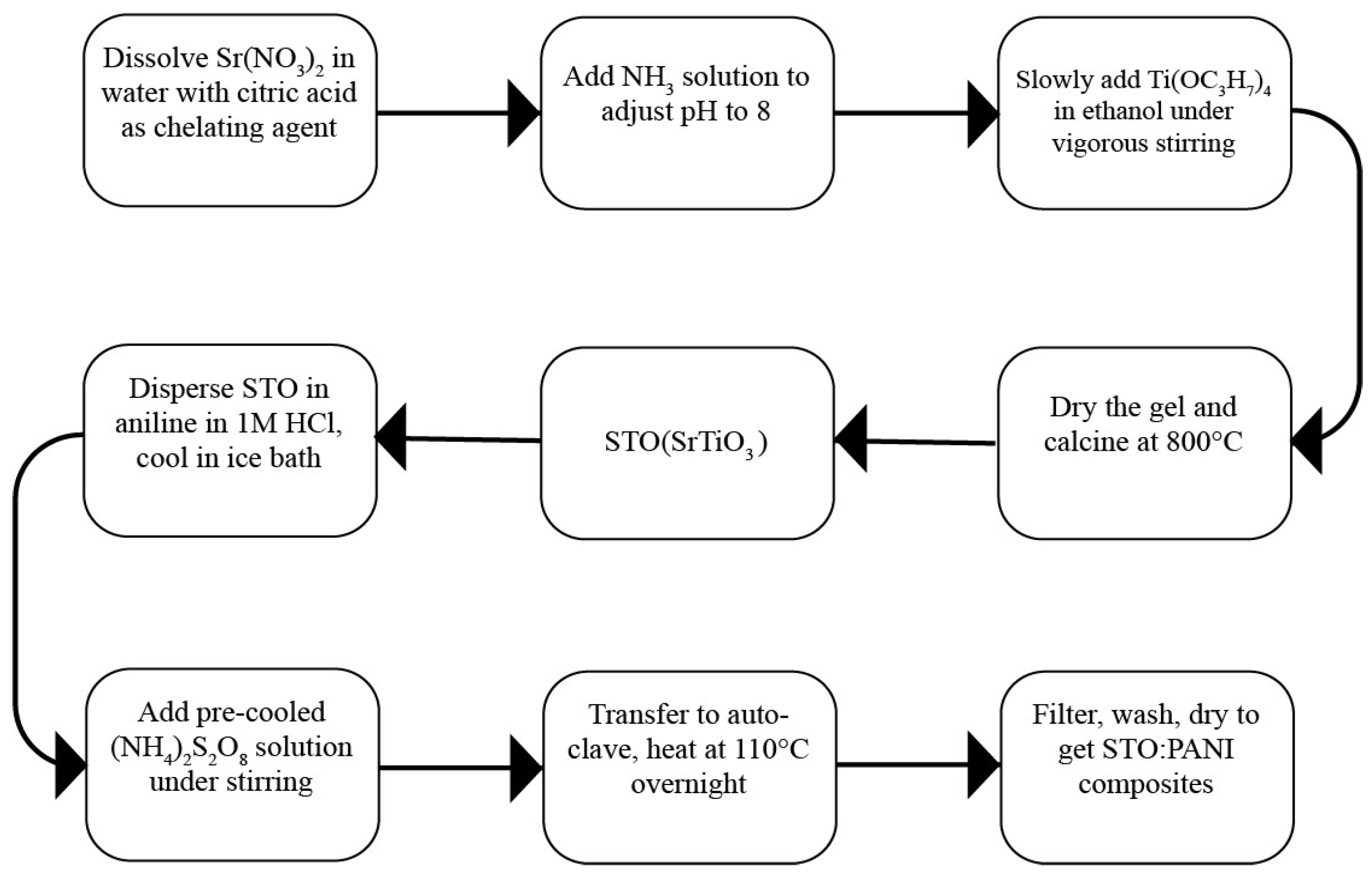
Figure 2.
Forming Process of Paz@LaNiO3 [90].
Figure 2.
Forming Process of Paz@LaNiO3 [90].

Figure 3.
Forming Process of LaMnO3@CC-PPy [109].
Figure 3.
Forming Process of LaMnO3@CC-PPy [109].

Disclaimer/Publisher’s Note: The statements, opinions and data contained in all publications are solely those of the individual author(s) and contributor(s) and not of MDPI and/or the editor(s). MDPI and/or the editor(s) disclaim responsibility for any injury to people or property resulting from any ideas, methods, instructions or products referred to in the content. |
© 2025 by the authors. Licensee MDPI, Basel, Switzerland. This article is an open access article distributed under the terms and conditions of the Creative Commons Attribution (CC BY) license (http://creativecommons.org/licenses/by/4.0/).
Copyright: This open access article is published under a Creative Commons CC BY 4.0 license, which permit the free download, distribution, and reuse, provided that the author and preprint are cited in any reuse.


