

Submitted:
19 September 2025
Posted:
22 September 2025
You are already at the latest version
Abstract
The aim of the study was to identify doctoral and postdoctoral dissertations that were created between 2003-2023 and based on tourism research, and the promotion procedures were conducted within the discipline of ‘Physical culture sciences’ (PCS). An attempt was made to identify the connections between such theses and other fields/disciplines of science and the methodological approaches used in them. The conducted research was empirical in nature, and its result is the opinions of the authors of 119 doctoral theses and 42 postdoctoral dissertations addressing tourism issues on the scientific disciplines within which these works were located. The research results revealed strong connections between “tourism” Ph.D. and postdoctoral theses completed in the PCS discipline, especially with the fields of ‘Social Sciences’ and ‘Humanities’. In the research, it was shown that doctoral and postdoctoral dissertations devoted to tourism issues completed within the discipline of PCS are characterised by great diversity concerning the applied methodological approaches. They are largely multi-/inter-disciplinary in nature, and the doctoral theses are dominated by empirical methods focused on cultural research. At the same time, these profiles are strongly diversified depending on to which other field of science the works formally assigned to the PCS are related.
Keywords:
physical culture
; tourism
; doctoral theses
; postdoctoral theses
; methodology
1. Introduction
Tourism research is conducted from the perspective of many different fields and disciplines of science, including Physical Culture Sciences (PCS). This also applies to research that is the basis for doctoral and postdoctoral theses. However, although attempts are sometimes made to identify the participation of PCS in the disciplinary structure of research and the works (including doctoral and postdoctoral dissertations) that are based on them, the methodological approaches used in this type of research are rarely empirically recognised. With this in mind, an attempt is made in this article to show the significance of tourism research conducted as part of the promotion procedures for academic doctorate and post-doctorate degrees in the field of PCS in the general structure of disciplines within which “tourism”-related Ph.D. and postdoctoral degrees are awarded. Furthermore, it was attempted to determine the methodological profiles of this type of research in various analytical cross-sections—in particular, by comparing (1) doctorates with postdoctoral degrees and (2) doctorates and postdoctoral degrees created within the field of PCS with those created in other scientific disciplines. In contrast to the research conducted so far and described in the literature, whose authors focused on disciplinarity itself and relied on data from official scientific databases in which doctorates and habilitations (postdoctoral Associate Professor degree in Poland) are recorded, in this article, the results are presented of empirical research, where the basis for the analyses were data obtained by means of a diagnostic survey directly from the authors of doctoral and postdoctoral/habilitation theses. They were asked to indicate the disciplinary location of their works: both formally, i.e. by designating the discipline in which the academic degree was awarded, and informally—the aim was to reveal such fields and scientific disciplines within which the research issues and substantive content of the works were best located. The data obtained in this way were used to reveal inter-disciplinary connections of the works as well as to create, compare and visualise their methodological profiles, which was achieved by using the method of Methodological Imaging of Academic Works© (OMPN©).
1.1. Physical Culture Sciences—the origin and meaning of the term physical culture and deliberations on the name of the discipline
Scientific research on broadly understood physical activity and sport already has a fairly long tradition, but the name of the scientific discipline within which the main part of it is performed did not appear until the turn of the 19th and 20th centuries. The person who probably first used the term “physical culture” in his publications is considered to be the American researcher and promoter of physical activity and sport B. Macfaddeni. Not only did he use the aforementioned term in the titles and content of his works, but in 1899, he founded the journal “Physical Culture”, which was a journal about bodybuilding, health, and physical fitness, published until 1951 (https://archivessearch.bsu.edu/repositories/7/resources/3226). The term in question appeared in many of his publications, including the five-volume (2,969 pages) publication published in New York in 1920 entitled MacFadden’s Encyclopedia of Physical Culture (https://archive.org/details/macfaddensencycl02macf/page/n5/mode/2up)ii.
While the priority and merits of B. Macfadden in popularising the term of physical culture (especially in the USA) seem to be unquestionable, the term “physical culture sciences” is more often associated with researchers and works published in the former USSR, in particular, with the figure of G.A. Djuperroniii, the author of a two-volume book published in 1925 entitled Theory of Physical Culture (quoted from: Jaczynowski, 2019, p. 18). It is worth adding, however, that while over time the terms “theory of physical culture” and “physical culture sciences” became popular in some countries, mainly in Central and Eastern Europe, they did not become well-known in English-speaking countries, and in English-language literature they are rareiv. L. Jaczynowski describes these issues in an interesting way, emphasizing that instead of this term, others such as “Sport Sciences”, “Movement Sciences” or “Sciences on Physical Education” are more often encountered (Jaczynowski, 2019, p. 21). It is worth adding that the names “Kinesiology” or “Kinesiology and Exercise Sciences” are also often currently being used.
Although the research that is now part of PCS was conducted earlier, it was not until the 20th century that physical culture began to be the subject of systematic scientific research. During this time, physical culture studies have come a long way—from analysing the history of physical fitness development and its significance for the concept of health and military issues in ancient times, to the extensive, inter-disciplinary research area that PCS are today, encompassing fields such as the aforementioned ‘Physiology’, ‘Biomechanics’ and ‘Psychology’, as well as disciplines such as ‘Health Sciences’, ‘Sociology’ and ‘Pedagogy’. Research conducted within PCS not only influences the improvement of sports performance and injury prevention, but also shapes public health, promotes an active lifestyle and supports mental and physical health. It covers a wide range of issues, within which, in addition to the so-called biomedical component, the most common areas are: physical education, sport, recreation, tourism and rehabilitation (Kobierecki, 2016). In this sense, it may be assumed that research carried out within the framework of physical culture sciences is characterised by a specific understanding of inter-disciplinarityv.
The broad scope regarding the meaning of the “physical culture” term indicated above is reflected in the generally accepted ways of its definition. For example, philosopher W. Tatarkiewicz wrote about physical culture that it is “the care of the psyche for the body” (Tatarkiewicz, 1978, p. 80). Sociologist Z. Krawczyk argued that “physical culture is a relatively integrated and established system of behaviours in the field of care for the physical development, mobility, health and beauty of a person, proceeding according to patterns accepted in a given community, as well as the results of such behaviours” (Krawczyk, 1978, p. 147). In turn, from the perspective of pedagogy and physical education, M. Demel and A. Skład indicated that “physical culture is an expression of a specific attitude towards one’s own body, conscious and active care for one’s development, fitness and health. It is the ability to organise and spend time with the greatest benefit for physical and mental health” (Demel & Skład, 1970, p. 13).
PCS has been one of the disciplines distinguished in Polish classifications of science for a long time, although in different periods, it has been assigned different status and position in the field and disciplinary structures. Currently—i.e. from November 11, 2022—the classification of scientific fields and disciplines introduced by the Regulation of the Minister of Education and Science of October 11, 2022 (Journal of Laws of 2022, item 2202) (Regulation..., 2022) is in force, in which physical culture sciences are placed as one of five disciplines within the field of ‘Medical and Health Sciences’vi. In the Classification of Fields of Science and Scientific Disciplines and Artistic Disciplines recommended on the website of the Polish Ministry of Science and Higher Education, it is proposed to use the name “Physical Culture Science” as the English name for this discipline (www.gov.pl › attachment › 77ced6fc-ccdb-44c2-a1f2-7c6531882b6f).
1.2. Physical culture in the disciplinary structure of doctoral theses in the field of tourism in light of previous research
Research concerning the scientific disciplines in which doctoral degrees were awarded worldwide based on tourism research have been conducted recently. Among the pioneering publications on this subject, the article by J. Jafari and D. Aaser entitled Tourism as the Subject of Doctoral Dissertations published in the journal “Annals of Tourism Research”vii in 1988 should be mentioned (Jafari & Aaser, 1988). In it, analysed are all doctoral degrees awarded based on tourism research created in the USA and Canada from the beginning of their registration, i.e. from 1861 to 1987. Two databases were used for this purpose: American Doctoral Dissertations (ADD) and Dissertation Abstracts International (DAI). It turned out that in the entire analysed period, i.e. for a little over 125 years, a total of 157 doctoral dissertations were “defended” that were created within 15 scientific disciplines. The authors of the paper took only those works into account that were directly related to tourism, i.e. it had to be a basic and clearly separated area of analysis. The results of the cited studies are presented in Table 1.
In the presented comparison, tourism research was considered, among others, in the context of the discipline called ‘Recreation’, which seems to be particularly close to PCS. Works from this category were ranked high, fourth among all the distinguished scientific disciplines, following ‘Economics’, ‘Anthropology’ and ‘Geography’. The discipline that dominated at that time was economics, but each of the three subsequent disciplines had a fairly similar number of doctoral dissertations, in each case at least twice as many as the number of theses that were outside the “big four”.
According to the list prepared by B. Weiler et al. (2012), ‘Recreation’ (or more precisely the discipline called ‘Parks and Recreation’, which to some extent can be identified with PCS) was the third discipline (following ‘Geography’ and ‘Urban and Regional Planning’) within which a doctorate based on tourism research was awarded in the USA, Canada, Australia and New Zealand. The first doctorate in this field was achieved in 1963. The dates of the first works prepared in the individual disciplines are given in Table 2.
Deliberations on the significance of tourism research conducted within the discipline referred to in Poland as PCS are very difficult due to the different terminology and scientific classification systems applicable in individual countries. It is worth adding that they are also difficult in the case of specific countries, where such research can be classified into different fields and disciplines of science. This is confirmed by a comparison of scientific discipline within which doctorates in tourism were written in the USA, where, in addition to the aforementioned discipline of ‘Parks and Recreation’, ‘Kinesiology’ can also be found, within which research is conducted in the field of ‘Sports Tourism and Medicine’ (Figure 1).
Since the last decade of the 20th century, tourism research has experienced a real boom, at least in terms of quantity. This also applies to research on the basis of which doctoral degrees were awarded. Much interesting information on the disciplinary structure of “tourism Ph.D.s” is provided in the works by K.J. Meyer-Arendt (2000) and K.J. Mayer-Arendt and C. Justice (2002), who analyse theses defended in the USA and Canada in the years 1987-2000. During this period, 377 doctoral dissertations were defended in these countries. The database constituting the foundation for the analyses presented in this work was used by W. Alejziak (2005) to analyse dissertations defended in the years 1990-2000 (for comparative purposes, theses defended in the 1980s were omitted). In these studies, it has been shown that the period under review saw not only a very large increase in the number of degrees, but also significant changes in the structure of disciplines involved in tourism research. In the decade under review, 330 doctoral theses were defended, which were created within 25 scientific disciplines (according to the American classification).
Compared to the 157 theses defended within 15 disciplines described by Jafari and Asser, this means not only a significant increase in the number of disciplines involved in tourism research, but also a growing significance of its inter-disciplinarity. Their disciplinary structure has also changed significantly. While previously the largest number of theses were created within the fields of ‘Economics’, ‘Geography’ and ‘Anthropology’ (in Jafari and Asser’s research, they accounted for a total of 89 theses, or almost 57%), in the 1990s, Ph.D. dissertations were most often defended within the discipline also identified in Mayer-Arendt’s publication as ‘Recreation’ (although, in other studies, it also appears as ‘Parks and Recreation’), which accounted for 25.4% of all dissertations. On the other hand, the three previously dominant disciplines have lost some of their importance, as they accounted for only about 30% of theses. The disciplinary structure of doctorates identified in the aforementioned research is shown in Table 3.
It is worth noting that the presented list also includes a discipline defined as ‘Health Studies’, and the only doctoral dissertation associated with it—as can be assumed—referred to the health aspects of tourism, and so it could have concerned issues within the scope of PCS. The 22nd position in the table also includes information about the first doctorate classified in the discipline defined in this ranking as “Tourism”, which was approved in 1951 (it was H. Caldwell’s thesis entitled Tourism in Idaho: Study in Tourist Resource Development, defended at Clarc University and registered in Doctoral Dissertation Accepted by American Universities, under the catalogue number 1933/34-1954/55). The rapid development of research and the growing number of Ph.D. dissertations based on tourism research are also confirmed in the aforementioned research by B. Weiler, B. Moyle and Ch. McLennan [2012] conducted for four countries: the USA, Canada, Australia and New Zealand. Based on the analysis of abstracts and several keywords (hotel, hospitality, leisure, tourism, tourist, travel, tour, recreation, holiday, vacation, guide, trip and heritage), 1,888 doctoral theses were identified that were created in these four countries in the years 1951-2010 (Weiler et al., 2012, p. 10).
The dynamic development of “tourism Ph.D.” dissertations is evidenced by the fact that in the first decade of the 21st century alone, twice as many papers were created in these countries than in the entire second half of the 20th century (in the period 1951-1999, there were 577 doctorates, between 2000-2009, as many as 1,262). Basic data on this dynamics and the disciplinary structure of the analysed works are shown in Table 4.
According to B. Weiler et al. (2012), in the four countries they studied, recreational issues, which are largely included in the “Polish” PCS, were ranked 11th among all scientific disciplines awarding doctorates in tourism in the years 1999-2009, which means that there were fewer of theses than in the 1951-1999 period (when this discipline was ranked 8th). Full data on this subject can be found in Table 5.
The authors of the study emphasized that the dissertations they identified were defended within 21 scientific disciplines, and the quickest increase concerned doctorates in the field of ‘Hotel and Restaurant Administration’ (943%), while ‘Psychology’ came first in terms of the total number of theses (289 papers). The authors also noted that 47 theses (2.4%) were classified as multidisciplinary, based on the terms multi-, inter-, cross- and trans-disciplinary found in the abstracts and keywords (Weiler et al., 2012, pp. 8-9). Initially, apart from the USA and Canada, Australia and New Zealand, this type of research was undertaken only in a few countries. Over time, however, such studies became more common and were conducted, among others, in Great Britain and Ireland (Botterill & Haven Gale, 2002), China (Bao, 2000), Turkey (Şalvarcı & Aylan, 2019), and even in Egypt (Afiti, 2009). It is worth emphasizing that in many works, their authors point to the difficulties encountered by researchers when trying to obtain a doctoral degree based on tourism research. Such difficulties were also highlighted by authors from other countries, including Poland (Alejziak, 2005, Liszewski, 2011, Butowski, 2011).
In Poland, the first attempts to study the disciplinary structure and methodology used in doctoral theses (and postdoctoral dissertations) were undertaken at the turn of the 20th and 21st centuries. The research initiated by W. Alejziak (2003, 2005) initially mainly concerned the quantitative and disciplinary dimension of Ph.D. theses, and the basic source of information was the data of the Information Processing Centre in Warsaw (two databases were used: “Rozprawy doktorskie i habilitacyjne” [Eng. Doctoral Dissertations and Habilitations]—containing announcements on awarding academic degrees and titles, and “Prace Naukowo-Badawcze SYNABA” [Eng. “SYNABA” Scientific and Research Papers]—additionally containing abstracts of theses). In the research, it was shown that in the years 19910-2002, 66 doctoral theses were approved in Poland, the subject of which was tourism (Alejziak, 2003, p. 244). If these analyses were limited to the years 1990-2000 (see Table 6), so that they could be compared with American research, it would turn out that in the period under study, 45 doctoral degrees were awarded in Poland within seven scientific disciplines.
Despite the differences in terminology and science classification systems, it is easy to notice that in Poland, the structure of disciplines involved in doctoral research in the field of tourism was different than in the countries analysed earlier. Three disciplines clearly dominated in Poland at that time: ‘Economic Sciences’, ‘Earth Sciences’ and ‘Physical Culture Sciences’. The most widespread were economic studies, within which almost every third doctoral thesis on tourism was created. ‘Earth Sciences’ had a slightly smaller share (29.6%), mainly corresponding to geography. Third place is occupied by ‘Physical Culture Sciences’, a discipline of a decidedly interdisciplinary nature, in which tourism is only a relatively small element of the total scope, covering issues related mainly to “man in tourism”, particularly including tourist activity, tourist needs and motivations, etc. The share of other disciplines is much smaller.
In a consecutive study by Alejziak (2005), it was demonstrated that based on tourism research in the years 2001-2005, another 75 doctorate degrees were awarded in Poland, which means a large increase compared to the decade of the 1990s. In these studies, following the example of the cited American, British and Australian trials, there was interest not only in disciplines, but also in the specific issues of dissertations (Table 7). It turned out that third place in the “ranking” of scientific disciplines was assumed by PCS (12%).
At the end of this review of research and publications on the subject of “tourism Ph.D. dissertations”, it is worth citing the results of one of the most extensive studies on the subject that has been recently conducted. It was carried out by a team comprising C. Oliveira et al. (2015), whose analyses covered the period 2000-2013 and six European countries: Germany, France, Great Britain, Spain, Portugal and Italy. Based on national databases of scientific works, 6,189 doctoral theses defended at 343 local universities were initially selected, which in the title or key words had at least one of the following words: hotel, hospitality, leisure, tourism, tourist, travel, tour, recreation, holiday, vacation, guide, trip and heritage, education. environment and tourism management. In the course of further analyses, especially those concerning reading abstracts in detail, 1,624 doctoral theses were finally qualified for research (UK—659, or 40.6% of all theses); France—487 (30.0%), Spain—206 (12.7%), Portugal—117 (7.2%) and Italy—91 (5.6%) [Oliveira, De Man, Guerreiro 2015, p. 14]. The most significant research results are presented in Table 8, demonstrating the size and dynamics of the studied phenomenon and the general disciplinary structure of the works.
Despite adopting different criteria for classifying works as “tourist”-related (more words were included than in most of the studies cited earlier—additionally, e.g. guide, trip, holiday, heritage or vacation), the results are basically similar to those presented earlier. It turned out that the most frequently defended doctoral theses were from four disciplines (scientific field tourism-related research): ‘Economics’, ‘Sociology’, ‘Geography’ and ‘Anthropology’. The difference concerns, for example, ‘Recreation’ distinguished in the American studies cited earlier, which does not appear in the list of disciplines in these studies. However, this does not mean that this issue was not present in the analysed Ph.D. theses. It even appeared quite often, because the analysis of the topics of theses (tourism subject analysis of doctoral research) showed that in the analysed period the term ‘Recreation’ appeared in 257 (15.8%) of the defended dissertations and in this respect, it was in third place: following ‘Tourism Management’—338 (20.8%) and ‘Trip and Heritage’—258 (15.9%) theses, and if we combine the term ‘Recreation’ with ‘Leisure’, appearing in 118 (7.3%) theses, it would turn out that this issue was undertaken by the largest number, as many as 373 doctoral theses (Oliveira et al., 2015, p. 116).
While there are many studies and publications on doctoral theses in the field of tourism, in relation to habilitations, this type of research has not been conducted so far (one of the few, which was mentioned earlier, was conducted by W. Alejziak at the beginning of the 21st century). It seems that an important reason for such as situation is the fact that ‘habilitation’, as a mandatory stage in a scientific career, exists in only a few countries in the world. Until recently, Poland was one of them—which does not mean that people wishing to obtain the title of habilitated doctor cannot do so. In Poland, as in several other countries (such as Germany, Austria, Switzerland, the Czech Republic, Slovakia, Slovenia, Hungary, France, Belgium and the Netherlands), the degree of habilitated doctor (or its equivalent) is awarded. On the other hand, the Anglo-Saxon model generally does not provide for this academic degree, which concerns the stage between a contractual professorship and a doctorate. In Great Britain, in some fields, there are so-called “higher doctorates”, similar in nature to the Polish degree of habilitated doctor. In the aforementioned research by W. Alejziak, it was shown that between 1990 and 2000 in Poland, the degree of habilitated doctor was awarded to 18 people, within five scientific disciplines—however, the ‘Physical Culture Sciences’ of interest to us were not found among them. The results of this research is presented in Table 9.
2. Materials and Methods
The literature review presented so far leads to the conclusion that although research on the disciplinary structure of doctoral theses related to tourism is conducted with some regularity—at least in selected countries, including Poland, it is worth persisting in order to maintain the continuity of the collected data, i.e. to build increasingly longer time series and thus, learn about the broader picture regarding the analysed phenomena It is also noteworthy that this type of research has not been conducted in relation to postdoctoral theses. In particular, however, it should be noted that the nature and scope of the research on “tourism doctoral dissertations” cited in the theoretical part of this article did not consider the uniqueness of work carried out within the rather specific scientific discipline, which is PCS. This specificity is primarily revealed in the significant interdisciplinarity of this discipline. Therefore, it can be assumed that doctoral and postdoctoral theses devoted to tourism issues carried out within the field of PCS may also show connections with other scientific disciplines and, at the same time, be characterised by far-reaching methodological differentiation.
The research gap outlined in such a manner prompted the authors to undertake research aimed at identifying the connections between doctoral and postdoctoral theses in the field of tourism successfully completed within PCS in Poland between 2003 and 2023 with other fields and disciplines of science, as well as determining their methodological profiles. The presented research objective was developed by posing four research questions:
- What is the share of works that were carried out within the framework of PCS in the total number of examined doctoral and postdoctoral/habilitation theses?
- Do doctoral and postdoctoral/habilitation theses related to tourism formally defended within the field of PCS cover issues that also fall within other areas and scientific disciplines and use their methodology?
- What is the methodological profile of doctoral and postdoctoral/habilitation theses related to tourism completed within the field of PCS?
- What is the scale of methodological differences, i.e. what are the similarities and differences between the three basic categories of doctoral and postdoctoral/habilitation theses related to tourism, i.e. works in the field of ‘Medical and Health Sciences’, ‘Social Sciences’ and ‘Humanities’?
In order to resolve the presented objective and obtain answers to the posed research questions, empirical studies were carried out, the scope of which is presented in Table 10.
The research was conducted using a diagnostic survey method, via a survey technique with the use of a research questionnaire. The latter, prepared specifically for the research presented here, contained, among others, questions that allowed:
- to identify the field/discipline of science in which a given work was created (in accordance with the classification of sciences in force in Poland at a given time);
- to classify the work into specific fields and disciplines of science in accordance with the OECD taxonomy;
- to generate a methodological profile for the work in accordance with the method called Methodological Imaging of Scientific Works©.
The latter method allows for the identification and visualisation of the methodological profile of a specific work or set of works in the form of numerical data and radar charts, by indicating the intensity of selected methodological features, grouped into opposing pairs (positivist approach—Interpretive approach, empirical research/studies—theoretical research/studies, mono-disciplinary research—multi-/inter-disciplinary research, analysis—synthesis, nature/body—culture/soul, induction—deduction, quantitative research—qualitative research, nomothetic knowledge—idiographic knowledge). At the stage of conducting the research, the authors consider each pair of opposing features and assign numerical values on a scale from 0 to 5—the dominant feature (0 meaning that the given feature did not occur in the work at all, and 5—that it occurred with the highest possible intensity), and for the secondary feature—numerical values on a scale from 0 to 3 (Alejziak 2019).
The initial version of the database of doctoral and postdoctoral theses, necessary for the implementation of the research, was generated via the platform called “Nauka Polska” (https://nauka-polska.pl). All works in the category of so-called “scientific works” described as ‘doctoral theses’ and ‘postdoctoral/habilitation theses” were searched for in this respect. With this in mind, following the approaches applied by other authors, a set of keywords was used, which included the following terms: tourism, travel, trip, hike, pilgrimage, sightseeing, guide, hotel, recreation, free time, rest. The given keywords could appear in different forms (inflections) in the titles or abstracts of the works, or in other types of descriptors assigned to the works. The database created in this way was verified by adding works that undoubtedly met the adopted search criteria, and the absence of which resulted from a certain incompleteness of data on the aforementioned platform. Ultimately, the database contained 491 works, including 406 doctoral theses and 85 postdoctoral theses.
For each of the 491 papers, an attempt was made to find the current e-mail address of the author, after which an invitation to participate in the study was sent to this address, as well as a link to the research questionnaire. This procedure yielded 161 completed questionnaires, including 119 for doctoral and 42 for habilitation theses, which gave a satisfactory return rate of 29.53%. The structure of the papers from the point of view of the adopted keywords, both for the full population and the examined sample, is presented in Table 11 (for doctoral theses) and Table 12 (for habilitations).
Statistical analysis of the obtained data was performed using Statistica software. Basic measures of descriptive statistics were calculated, i.e. minimal (), maximal (), range (), modal (), median (), arithmetic mean () and standard deviation () values.
3. Results
3.1. Share of doctoral and postdoctoral theses completed in the field of PCS in the structure of works related to tourism
The set of 119 doctoral and 42 postdoctoral/habilitation theses, for which completed questionnaires were obtained, included: 29 doctoral dissertations (i.e. 24%), whose authors were awarded a doctoral degree in the PCS discipline, and seven habilitation theses (i.e. 17%), whose authors were awarded a postdoctoral degree in the same field. The time series showing the distribution of the number of doctoral and postdoctoral degrees awarded in this discipline over the entire period under consideration is presented in Figure 2.
Interpreting these data with some caution, especially in view of the small number of analysed postdoctoral/habilitation theses, it can be stated that throughout the period under consideration, doctoral theses related to tourism were defended within the area of PCS. Despite this, after a certain “peak” period, which occurred in the years 2010-2014 (when a total of 14 out of 29 theses were defended, i.e. 48%), the number of “tourism Ph.D. dissertations” defended in this field seems to be decreasing noticeably. Continuation of research on the phenomenon analysed here in subsequent years will be able to provide an answer as to whether this is a temporary fluctuation in the number of theses or whether this reveals a certain long-term trend.
3.2. OECD Connections of doctoral and postdoctoral theses in the field of tourism carried out in the PCS discipline with fields and disciplines of science according to the OECD classification
Taking the fact into account that the doctoral and habilitation theses included in the study were created over a relatively long period of 21 years (during which the classifications of science in force in Poland changed) and, at the same time, trying to obtain data that could be comparable with the results of research conducted in other countries (where the classifications of science may differ from those applicable in Poland), the study participants were asked to assign their works to fields and disciplines of science distinguished in accordance with the internationally accepted OECD taxonomy. This was expressed in the form of the following instruction: “Please indicate to which field and discipline of science—according to the OECD taxonomy—your work would be best assigned?”. It may be assumed that the respondents’ answers would indicate that the works formally created within PCS would be classified mainly within the discipline listed in the OECD classification as “health sciences (in the scope of sports and physical fitness sciences)”. According to the guidelines of the Ministry of Science in Poland, the PCS discipline corresponds to the above-mentioned field in the OECD framework (see Figure 3).
Data obtained from the authors of doctoral theses related to tourism formally completed within the PCS field revealed a much more complex situation (see the left part of Table 13). It turned out that out of the 29 dissertations that were the basis for the analysis, only 11 (i.e. 38%) were assigned by the authors to the field of ‘Medical and Health Sciences’, of which 10 were classified to the above-mentioned discipline of ‘Health Sciences’ (in the scope of ‘Sports and Physical Fitness Sciences’). In addition, there were also numerous assignments of theses to fields defined as ‘Social Sciences’ (34%) and ‘Humanities’ (21%), and sporadically, to ‘Natural Sciences’ (7%). Within each of the listed fields of science, the authors indicated the discipline of science most strongly related to their work. In total, eight such disciplines appeared. On this basis alone, a preliminary conclusion can be drawn that doctoral theses formally completed within the PCS discipline are linked to several other fields of science, and within them—to numerous disciplines of science. In this sense, the PCS field, hidden “low” in the classification (the second level of systematisation of sciences), demonstrates great interdisciplinarity, remaining in strong relationships with fields higher up in the classificationviii.
Following the above, the authors of individual works were asked whether, in addition to the above-declared (as if “first”) field and discipline of science, their work could be linked to another (as if “second”) field and discipline—and if so, which field and discipline of science would it be. This request was expressed as follows: “Please, specify whether it is possible and reasonable to assign your work to another (“second”) field and discipline of science distinguished according to the OECD taxonomy - other than the one you have already indicated?”, and further: “To which “second” field and discipline of science—according to the OECD taxonomy—can and is it reasonable to assign your work?”. In this respect, the research results revealed (see the right part of Table 13) that out of the analysed set of 29 doctoral theses, 20 authors (i.e. 69%) admitted that their work was strongly linked to the aforementioned “second” field and discipline of science. In other words, over two-thirds of doctoral theses are linked by their authors to at least two different fields and disciplines of science, which is quite a strong argument for inter-disciplinarity on the one hand—Tourism Studies, and on the other—PCS. In connection with this, the set of scientific disciplines related to the analysed works has increased to a dozen or so and, at the same time, various combinations of fields and disciplines of science relating to individual works have been revealed. This seems to confirm the previously formulated conclusion about strong links between PCS and other scientific disciplines which, in turn, probably leads to significant methodological diversification of works related to physical culture.
A similar analysis of data concerning postdoctoral/habilitation theses also reveals links between works from the scope of PCS and other fields and disciplines of science. However, the image related to this is less complex, probably especially due to the significantly smaller sample size—as evidenced by the data in Table 14. The works of interest to us fell within the scope of two fields and five disciplines—at the level of the “first” choice, and two fields and four disciplines—at the level of the “second” choice.
3.3. Methodological profiles of doctoral and postdoctoral theses in the field of tourism carried out within the PCS discipline
The data obtained from the authors during the research allowed us to reveal not only the connections between the works completed in PCS and other fields as well as disciplines of science, but also to identify the methodological profiles of each individual work and their sets—analysed in various systems and cross-sections. Below are presented the main results of such analyses, identifying the methodological profiles first of the doctoral theses completed in the PCS discipline (both in their set and in comparison to all “tourist doctoral dissertations”), and then an analogous set of habilitation theses—although the set of the latter, as already emphasised, is characterised by a very small number.
Basic data on Ph.D. theses formally completed within the field of PCS are presented in Table 15, and detailed data related to them can be found in Table 16.
The data presented in Table 15 demonstrate - for each of the considered methodological features—the number of indications assigned to it by the authors, i.e. assessments presented on an ordinal scale from 0 (a given feature does not occur in the work at all) to 5 (a given feature occurs in the work to a very high degree). Following this, for each pair of methodological features, the distribution of its frequency of occurrence was provided, determined as the quotient of: the sum of the assessment products and the number of their indications as well as the total number of indications for both features constituting a given pair. Analysing the data thus obtained, it can be noticed that with respect to three pairs of features, the difference between the frequency at which both features occurs exceeds 10 p.p. In this sense, the following studies clearly prevail: empirical over theoretical (58% vs. 42%), concerning culture/soul over nature/body (59% vs. 41%), multi-/inter-disciplinary over mono-disciplinary (59% vs. 41%); there is also a clear advantage of research based on inductive over deductive research (55% vs. 45%). The given observations seem to be justified by the fact that PCS are focused on research in the sphere of culture (although of a specific culture, because it refers to the physical layer of man)ix, drawing on the achievements of various fields and disciplines of science - which is included, for example, in the concept of “sciences” of physical culture. Doctoral theses, due to their functions, are usually of a typically research nature, i.e. they have strong empirical inclination, which also explains the popularity of the inductive approach.
The data set presented in Table 16 contains values determined for basic descriptive statistics measures. Considering these parameters, it can be seen that particularly noticeable differences in average measures concern the following variable systems: “Research/empirical studies” vs. “Research/theoretical studies” (with an indication of the former) and “Nature/body” vs. “Culture/soul” (with a predominance of the latter), as well as “Mono-disciplinary research” vs. “Multi-/inter-disciplinary research” (in favour of the latter).
The conclusions resulting from the analyses of dissertations in the comparison of PCS with all doctoral theses are interesting. It turned out that the differences between the average indications are small. This is illustrated in Figure 4, which—using the values determined for the arithmetic mean—visualizes the methodological profiles of two sets: doctoral theses completed in the PCS discipline and all “tourism” thesesx.
Although further research in this area is advisable to verify the research results presented here, it seems that they may largely correspond to reality and confirm the thesis that “doctoral” research on tourism conducted within the PCS field and defended most often at physical education universities do not differ much in methodological terms from theses defended at other types of Polish universities and processed within other sciences. This may indicate that the methodology used in tourism research is quite similar and depends more on the research issues than on the scientific discipline within which the research is conducted. This is probably related to the nature of tourism, which is a multi-faceted, multi-dimensional and inter-disciplinary phenomenon, which forces the use of specific, often quite similar, approaches and research procedures. To a large extent, this also applies to recreation, the significance of which for the analysed issues may be smaller, due to the fact that its share in the set of analysed works was much less noticeable than in the case of tourism. The similarity of the studies that form the basis of the doctoral theses is evidenced by the fact that most of the methodological features presented in Figure 4 have similar values of average indications. An exception in this respect concerns the variable of ‘nature/body’, for which significantly more indications were noted among the PCS-related works.
Analysing the results, it should also be borne in mind that when using arithmetic means, i.e. at the level of general aggregation, the differences between individual types of works are not so clearly visible, because the profiles generated in such a collective way average the images. This is clearly visible in the analyses of the methodological profiles of individual works or when analysing smaller and more detailed thematically grouped sets of works. The use of other measures and indicators may reveal greater methodological differences. An example of this type of differentiation of research conducted within doctoral theses related to physical culture can be provided by comparing the methodological profiles of dissertations in the field of PCS, which the authors assigned—according to the OECD taxonomy (see Table 13)—to three fields of science: ‘Medical and Health Sciences’, ‘Social sciences’ and ‘Humanities’. The methodological profiles of these types of theses are shown in Figure 5.
In the figure, the methodological profiles of 27 doctoral theses are presented. While the profiles of theses written in the field of ‘Medical and Health Sciences’ and ‘Social Sciences’ are quite similar, it is easy to notice the clear specificity of research in the ‘Humanities’. In the case of studies that were classified in this way by the authors, the yellow shading resulting from the intensity of indications is clearly shifted to the lower right part of the graph, where the characteristics of such studies are located, i.e. the interpretative approach (4.67 for ‘Humanities’ vs. 3.10—for ‘Social Sciences’ and 3.00—for ‘Medical and Health Sciences’), ‘culture/soul’ (respectively: 4.83 vs. 3.60 and 3.91), ‘idiographic knowledge’ (4.17 vs. 2.80 and 2.82) and ‘qualitative research’ (4.83 vs. 3.10 and 3.18).
In a similar manner to the previous one, data concerning—this time—postdoctoral/habilitation theses formally completed within the field of PCS are presented below (Table 17 and Table 18). However, let us immediately point out that although these data reveal very significant methodological differentiation of postdoctoral theses, the analysed sample was modest: it consisted of only seven theses. Therefore, no general conclusions can be drawn on this basis.
Despite the limitations indicated above, it seems that postdoctoral theses are also characterised by a certain methodological diversity. They appear to be dominated by empirical research/studies of quantitative nature, based on analysis and induction, leading to the creation of idiographic knowledge. In the small sample under study, the multi- or inter-disciplinary dimension of the assessed works is also very strong.
To conclude the presentation of the results regarding this part of the research, it is worth confronting the methodological profiles of the doctoral and habilitation theses created within the field of PCS. Such a comparison is included in Figure 7.
Although the highest average indicators concerned the same methodological features, i.e. empirical and quantitative research, there were noticeable differences between doctorates and habilitations. While the variable ‘empirical research’ had the highest number of indications for both doctorates and habilitations, in the case of the variable “quantitative research” we have a clear advantage in habilitations over doctorates (4.29 vs. 3.31). Postgraduate dissertations also had a significantly higher number of indications regarding the positivist approach (3.86 vs. 2.79) and research conducted on a macro scale (3.86 vs. 3.21). In the case of the ‘analysis’ and ‘synthesis’ features—the differences in means were small. It is also worth emphasizing the clear advantage of doctoral research over habilitations in terms of the ‘culture/soul’ feature (3.90 vs. 2.80) and the fact that habilitations have stronger indications for the ‘nature/body’ trait (2.66 vs. 3.14 in favour of habilitations). Moreover, habilitations were also characterised by a greater “element” of theoretical content (3.14 vs. 2.93), while doctoral dissertations more often concerned the micro-scale (3.24 vs. 2.71).
3.4. Answers to research questions
The presented research results allow to formulate the following answers to the posed research questions:
- In Poland, in the period 2003-2023, among the promotion theses related to tourism issues, on average, every fourth doctoral thesis (24%) and every sixth postdoctoral thesis (17%) was completed within the PCS discipline.
- Doctoral and postdoctoral theses related to tourism, formally defended within the PCS discipline, cover issues that also fall (according to the OECD classification) within other fields of science. In particular, these are—apart from medical sciences and health sciences: Social Sciences, Humanities, Natural Sciences. Within the indicated fields, the works of interest are related to several disciplines of science, as a result, they also use research approaches developed and applied within these disciplines.
- Doctoral and postdoctoral theses related to tourism, completed within the PCS field, are characterised by large diversity of applied methodological approaches:
- -
- doctoral theses are largely multi-/inter-disciplinary in nature, dominated by empirical approaches focused on cultural research;
- -
- postdoctoral theses also seem to be multi-/inter-disciplinary in nature, however, the possibilities of presenting their more detailed methodological characteristics are limited due to the too small size of the studied sample;
- -
- doctoral theses addressing tourism issues, formally completed within the PCS field, related (in accordance with the OECD classification) to: the field of ‘Medical and Health Sciences’ and ‘Social Sciences’ have a fairly similar methodological profile, with the former dominated by research on nature/body, and the latter by a greater share of empirical, quantitative, macro-scale research, while the works related to the field of ‘Humanities’ are more theoretical in nature, based on qualitative research regarding cultural phenomena using an interpretative approach.
4. Discussion
The presented research results, also included in the answers to the posed research questions, lead to the conclusion that doctoral and habilitation theses devoted to tourism issues formally completed within the PCS field are related to several other fields of science (especially ‘Social Sciences’ and ‘Humanities’), and within them—to numerous disciplines of science. Due to the fact that theses for promotion can be considered to a certain extent “representative” for a given discipline of science (they address important and original issues, maintain appropriate methodological rigour, are subject to a peer-review procedure, etc.), also PCS itself—at least in the aspect of tourism research—can be considered strongly disciplinarily diversified, in the sense that in the research related to it, theoretical achievements and research approaches are used typical of other scientific disciplines. It seems that there is a certain discrepancy between the formal classification of science (which is important, among others, in the implementation of promotion procedures) and the systematisations of individual scientific fields of historical and cultural nature, and above all, substantive nature. This fact is of particular significance in relation to those areas of scientific knowledge that are, to some extent, inter-disciplinary in nature [cf. Ciesielski 2022]—which applies, in the case of interest to us here, to both tourism research (as it is sometimes referred to as ‘Tourism Sciences’) and research in the field of physical culture, i.e. ‘Physical Culture Sciences’).
In connection with the above, works formally assigned to PCS may, in their substantive content, definitely go beyond this discipline, entering areas specific to other scientific areas, or it may even be a matter of debate whether another discipline provides a stronger foundation for such work. We refer here to the results of the presented research, which indicated that works classified in Poland to PCS have—in the authors’ opinion—a different assignment in the OECD classification than would result from the postulated way of linking these two classifications under consideration. The result of this is a natural observation in this situation, according to which different formal classifications result in different assignments of advancement works.
The above observation seems to be supported by attempts described in the literature to specify the essence of PCS through appropriate explanations or classifications. In the current of this first idea, H. Grabowski—considering the issue of basic sciences, historically and substantively closest to physical culture—argued, for example, that “The subject of physical culture sciences is the human body as a value and an object of improvement” (Grabowski, 2002, p. 5), and then explained: “The issue of values falls within the scope of interests of pedagogy, for which the source of empirical data is psychology. The human body is the subject of anthropological research as a science regarding cultural conditions of biological development. Physiology deals with explaining the mechanisms of stimulating this development” (Ibid., p. 5). The indicated position is an attempt not only to indicate the key scientific disciplines for PCS, but also to outline the existing connections between them, which already creates a system. Views in favour of organising the scope of PCS are usually associated, first of all, with the indication of the previously mentioned “components” of physical culture as such (most often including: physical education, sport, physical recreation, physical rehabilitation and tourism) (Kobierecki, 2016), but at a more in-depth level, scientific disciplines particularly related to physical culture are indicated. In this spirit, for example, L. Jaczynowski, considering the issue of “(...) what should the system of physical culture sciences look like, which, given the complexity and variety of problems that this discipline must deal with, cannot be limited only to solving medical problems that appear in physically active people” (Jaczynowski, 2019, p. 22), presents an overview of concepts regarding the systemic approach to PCS, citing the views of R. Przewęda and J. Kosiewicz, and especially Z. Krawczyk (the so-called “pyramid” of Physical Culture Sciences) and L.P. Matwiejew (system of Physical Culture Sciences) (Ibid., pp. 22-23).
The indicated discrepancy between the formal placement of the advanced works analysed here in the PCS discipline and their actual connection with other fields of science (i.e. categories distinguished at a higher level of classification than PCS), and consequently—many disciplines of science, may constitute an incentive for further discussion on the place that PCS should occupy in the classification of sciences. It turns out—and we are referring here to a specific set of works devoted to the issue of tourism—that the discipline “hidden” at the second level of systematisation of sciences in the field of ‘Medical and Health Sciences’, in fact, escapes the framework resulting directly from this assignment. The argument strengthening the above observations is the solid methodological differentiation of the set of doctoral and habilitation theses analysed here. While basic sciences use their own methodological apparatus, inter-disciplinary fields of knowledge—PCS being one of them—draw on the achievements of various scientific fields and disciplines.
5. Conclusions
The presented considerations lead to the adoption of the following conclusions and the resulting directions for further research:
- There is a certain discrepancy between the formal assignment of promotion papers devoted to tourism issues formally completed within the PCS field and the fact of their connections with other areas and disciplines of science. On the one hand, this is a certain argument confirming the interdisciplinary nature of PCS, but on the other, it encourages further research aimed at deciding whether this observation concerns only “tourism” papers (and thus, results from the specificity of such a particular subject of research) or whether it characterises other (or maybe all?) works in the field of the PCS. In connection with this, further, in-depth discussion on the placement of PCS in the classification of sciences adopted for formal purposes, used for promotion procedures, but also for profiling universities, fields of study, etc., seems justified.
- Doctoral and postdoctoral/habilitation theses devoted to tourism issues completed within the field of PCS are characterised by a great diversity of the applied methodological approaches. They are largely multi-/inter-disciplinary in nature, and empirical approaches focused on cultural research dominate doctoral theses. At the same time, the methodological profiles of doctoral and postdoctoral theses devoted to tourism issues, formally completed within the PCS framework, are strongly diversified depending on to which other field/discipline of science they are related. Further research conducted in this area should be particularly focused on verifying the analyses presented in this article (e.g. through research on larger samples and covering an even longer time perspective) and, at the same time, on searching for a scientific explanation of such a situation. In the form of preliminary hypotheses, it can be assumed that the reasons for this state of affairs may include factors such as: the specificity of tourism research, the lack of one’s own, well-established research methodology, and the use of methods and techniques by researchers borrowed from other fields and disciplines of science.
Author Contributions
Conceptualization, Wiesław Alejziak and Bartosz Szczechowicz; Methodology, Wiesław Alejziak and Bartosz Szczechowicz; Software, Wiesław Alejziak and Bartosz Szczechowicz; Validation, Wiesław Alejziak and Bartosz Szczechowicz; Formal Analysis, Wiesław Alejziak and Bartosz Szczechowicz; Investigation, Wiesław Alejziak and Bartosz Szczechowicz; Resources, Wiesław Alejziak and Bartosz Szczechowicz; Data Curation, Wiesław Alejziak and Bartosz Szczechowicz; Writing—Original Draft Preparation, Wiesław Alejziak and Bartosz Szczechowicz; Writing—Review & Editing, Wiesław Alejziak and Bartosz Szczechowicz; Visualization, Wiesław Alejziak and Bartosz Szczechowicz; Supervision, Wiesław Alejziak and Bartosz Szczechowicz; Project Administration, Wiesław Alejziak and Bartosz Szczechowicz; Funding Acquisition, Wiesław Alejziak and Bartosz Szczechowicz.
Funding
The research results presented in this paper were obtained as part of two research projects: (1) within the framework of a Project ‘Disciplinary Structure and Methodological Profiles of Tourism, Recreation and Leisure Research. Analytical Study of Doctoral and Postdoctoral Theses Completed in Poland in 2003-2023”, funded by the Polish Ministry of Science programme titled ‘Re-gional Initiative of Excellence’ for the years 2024 to 2027, Project number: RID/SP/0027/2024/01 in the amount of PLN 4,053,904.00), and (2) ‘Research Methodology in Physical Culture Sciences: Profiling and Visualization of Methodological Procedures Used in Doctoral and Postdoctoral Theses at Selected Universities in Poland and Slovakia’ (No. 378/IPiZ/2024).
Conflicts of Interest
The authors declare no conflict of interest.
References
- Afiti, G. M. H. (2009). Tourism as the Subject of Doctoral Theses in Egypt: 1975–2008. Anatolia: An International Journal of Tourism and Hospitality Research, 20(2), 387-400. [CrossRef]
- Alejziak, W. (2003). Perspektywy i kierunki rozwoju badań naukowych nad turystyką. In G. Gołembski (Ed.), Kierunki rozwoju badań naukowych w turystyce (231-248). Wydawnictwo Naukowe PWN.
- Alejziak, W. (2005). Present Status and Perspectives of Tourism Research Development, [in:] In W. Alejziak & R. Winiarski (Eds.), Tourism in Scientific Research (257-279). Academy of Physical Education in Krakow, University of Information Technology and Management in Rzeszow.
- Alejziak, W. (2019). Methodological Imaging of Academic Works© As a Method of Visualizing Academic Activities (Based on Articles Published in “Folia Turistica” in 2014-2018). Folia Turistica, 50(1), 67-97. [CrossRef]
- Bao, J. (2002). Tourism geography as the subject of doctoral dissertations in China: 1989-2000. Tourism Geographies, 4(2), 148-152. [CrossRef]
- Botterill, D., Haven, C., & Gale, T. (2002). A survey accepted by universities in the UK and Ireland for studies related to tourism: 1990-1999. Tourist Studies, 2(3), 283-311. [CrossRef]
- Brent Ritchie, J.R., Sheehan, L.R., & Timur, S. (2009). Tourism Sciences or Tourism Studies?Implications for the Design and Content of Tourism Programming. https://journals.openedition.org/teoros/docannexe/image/1621/img-1.jpg.
- Butowski, L. (2011). Tourism-an academic discipline (discursive article). Turyzm, 21(1/2), 17-24. [CrossRef]
- Ciesielski, M. (2022). Klasyfikacja, typologizacja, umiejscowienie teoretyczne. O trzech sposobach systematyzacji dyscyplin naukowych. Przegląd Filozoficzny—Nowa Seria, R. 31, Nr 3(123), 5-24. [CrossRef]
- Crichton, K. (1978). Dissertations on Travel, Recreation, and Leisure. Journal of Travel Research, 17(1), 14-22. [CrossRef]
- Demel, M., & Skład, A., (1970). Teoria wychowania fizycznego. PWN, Warszawa.
- Grabowski, H. (2002). Wprowadzenie. In H. Grabowski (Ed.), Perspektywy poznawcze i praktyczne nauk o kulturze fizycznej (5-8). Studia i Monografie no. 18, Akademia Wychowania Fizycznego im. Bronisława Czecha w Krakowie.
- Jafari, J., & Aaser, D. (1988). Tourism as the subject of doctoral dissertations. Annals of Tourism Research, 15, 407-429. [CrossRef]
- Jaczynowski, L. (2019). Nauki o kulturze fizycznej w wymiarze historycznym a nowa klasyfikacja dziedzin i dyscyplin naukowych w Polsce. Sport i Turystyka. Środkowoeuropejskie Czasopismo Naukowe, II(2), 11–28. http://dlibra.bg.ajd.czest.pl:8080/Content/5671/2_Jaczynowski_SiT%202_2.pdf.
- Kobierecki, M. M. (2016). Kultura fizyczna a kultura rozważania teoretyczne. Zbliżenia Cywilizacyjne, 1(1)/, 116-143. http://dx.doi.org/10.21784/ZC.2016.004.
- Krawczyk, Z. (1978). Studia z filozofii i socjologii kultury fizycznej. Wydawnictwo Sport i Turystyka, Warszawa.
- Liszewski, S. (2011). Tourism Studies: Situated within Multiple Disciplines or a single Independent Discipline? (discursive article). Tourism, 20(2), 37-44. [CrossRef]
- Meyer-Arendt, K.J. (2000). Tourism Geography as the Subject of North American Doctoral Dissertations and Master’s Theses: 1951-1998. Tourism Geographies, 2, 140-156. [CrossRef]
- Meyer-Arendt, K. J., & Justice, C. (2002). Tourism as the subject of North American Doctoral Dissertations, 1987–2000. Annals of Tourism Research, 29, 1171-1174. [CrossRef]
- Oliveira, C., De Man, A., & Guerreiro, S. (2015). Tourism research: A systematic review of knowledge and cross cultural evaluation of doctoral theses. Tourism Management Studies, 11(1), 111-119. http://tmstudies.net/index.php/ectms/article/download/765/1302.
- Pizam, A., & Chacko, E.M. (1982). Tourism and Hospitality Related Dissertations: 1976-1980. Annals of Tourism Research, 9(4), 587-620.
- Rozporządzenie Ministra Edukacji i Nauki z dnia 11 października 2022 r. Dz.U. z 2022 r., poz. 2202. https://dziennikustaw.gov.pl/D2022000220201.pdf.
- Silk, M. L., & Andrews, D.L. (2011). Toward a physical cultural studies. Sociology of Sport Journal, 28(1), 4-35. https://purehost.bath.ac.uk/ws/portalfiles/portal/249573/Silk_SSJ_2011_28_1_4.pdf.
- Şalvarcı, S. & Aylan, F. K. (2019). Analysis of PhD Dissertations in Tourism (2014-2018). Journal of Gastronomy Hospitality and Travel, 2(1), 29-37. https://www.joghat.org/uploads/2019-vol-2-issue-1-abstract-13.pdf.
- Tatarkiewicz, W. (1978). Parerga. PWN.
- Weiler, B., Moyle, B., & McLennan, Ch. (2012). Disciplines that influence tourism doctoral research: The United States, Canada, Australia and New Zealand. Annals of Tourism Research, 39(3), 1425-1445. https://researchportal.scu.edu.au/esploro/outputs/journalArticle/Disciplines-that-influence-tourism-doctoral-research/991012821700902368.
Netography
- https://en.wikipedia.org/wiki/Bernarr_Macfadden (06.11.2024)
- www.gov.pl › attachment › 77ced6fc-ccdb-44c2-a1f2-7c6531882b6f (06.11.2024)
- http://bazy.opi.org.pl/ (06.11.2024)
- https://wordart.com (20.10.2024)
Notes
-
1The research results presented in this paper were obtained as part of two research projects: (1) within the framework of a Project ‘Disciplinary Structure and Methodological Profiles of Tourism, Recreation and Leisure Research. Analytical Study of Doctoral and Postdoctoral Theses Completed in Poland in 2003-2023”, funded by the Polish Ministry of Science programme titled ‘Re-gional Initiative of Excellence’ for the years 2024 to 2027, Project number: RID/SP/0027/2024/01 in the amount of PLN 4,053,904.00), and (2) ’Research Methodology in Physical Culture Sciences: Profiling and Visualization of Methodological Procedures Used in Doctoral and Postdoctoral Theses at Selected Universities in Poland and Slovakia’ (No. 378/IPiZ/2024).
-
iBernarr McFadden, often called the father of physical culture in the US (see https://www.americanheritage.com/true-story-bernard-macfadden), was a rather controversial figure who, in addition to his publishing activities and promotion of physical activity, was also an entrepreneur. He created a publishing empire, which included, among others, a several dozen journals that were widely read at the time; he owned many hotels and many restaurants promoting vegetarianism and healthy eating; he ran for mayor of New York as senator from Florida, and even president of the US (https://money.com/wackiest-millionaire-ever-run-president/). He formally changed his birth name and surname (Bernard Adolphus McFadden) in order to appear with more dignity; he believed that “Bernarr sounds like a lion’s roar” (see https://en.wikipedia.org/wiki/Bernarr_Macfadden). He also consistently used the term "physical culture" in his popularisation and educational activities, including, for example, emphasizing the importance of physical culture in the education of children and youth in his work titled Physical Culture for Babies (https://archive.org/details/physicalculturef00macf/page/n3/mode/2up). His foundation (The Macfadden Foundation), to which he donated USD 50 million, ran boarding schools for young boys and girls where physical culture was promoted.
-
iiIt is worth adding that the first, not so impressive edition of the encyclopaedia was published in 1911 (https://www.americanheritage.com/true-story-bernard-macfadden).
-
iiiHe owes his surname unusual for a Russian to the fact that he was born into a German-French family whose ancestors settled in Saint Petersburg in the early 19th century.
-
ivIt is worth adding, however, that in the opinion of some researchers (e.g. Silk & Andrews, 2011], there is justification for using the name ‘Physical Culture Sciences’, specifically ‘Physical Cultural Studies’ (PCS). This term even appears in the names of academic institutions, e.g. at the University of Texas in Austin, where the Center for Physical Culture and Sports operates (https://starkcenter.org/?query=Physical%20Culture%20and%20Sports), or the Physical Culture Research in Education operating at the University of Edinburgh (https://education-sport.ed.ac.uk/research/thematic-hubs/sport-related-research/physical-culture-research-in-education-pcre). Of further mention deserves the fact that in December 2024, the University of Physical Education in Kraków (Poland) will officially change its name to the University of Physical Culture in Kraków.
-
vIn fact, within PCS, we deal not only with inter-, but also multi-, trans- and intra-disciplinarity. An example of this is research on one of the components of PCS, which is tourism (see Alejziak, Szczechowicz, work in print).
-
viThe previous regulation (of August 8, 2011), which additionally distinguished so-called knowledge areas, classified PCS as a separate field of knowledge. However, in 2018, the separation of scientific areas was abandoned, recognising fields as the basic category, with some of the scientific fields listed at that time becoming scientific disciplines. This also applies to PCS.
-
viiResearch on this subject began somewhat earlier, in the 1970s, and one of the first publications on the so-called doctoral theses in tourism was an article by K. Crichton (1978), in which the author identified 122 dissertations in this field which were defended between 1974 and 1977 in the USA. Eight key words were used to select the works, where in addition to the basic terms: tourism and tourist, there were also such ones as: airline, aviation, free time, parks, recreation and travel. A few years later, research on the issue defined as “tourism and hospitality” was conducted by A. Pizam and E.M. Chacko (1982), who established that 65 doctoral theses on this subject were written in the years 1976–1980.
-
viiiOn the other hand, it can be assumed that there are also doctoral or habilitation theses that were formally completed within “other” (than PCS) scientific disciplines, but the issues addressed in them may be related to physical culture.
-
ixThis does not, however, change the fact that the subject of influence within physical culture is the human “body”.
-
xFor clarity of the radar chart, the pair of visualized features has been omitted: “mono-disciplinary research” vs. “multi-/inter-disciplinary research”. This remark also applies to the subsequent charts presented in this article.
Figure 1.
Disciplinary inputs to tourism. Source: Own elaboration based on: (Brent et al., 2009).
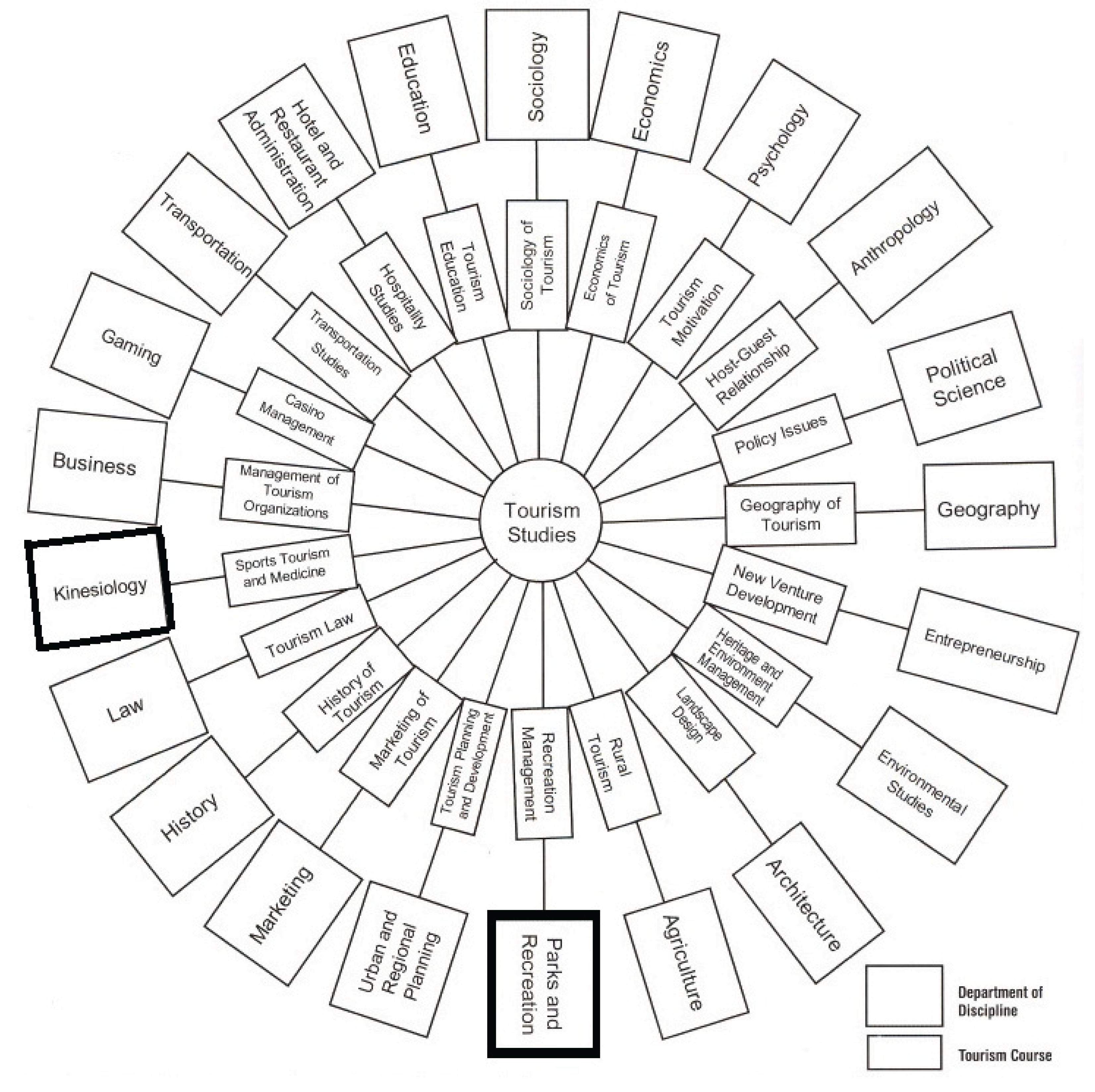
Figure 2.
Number of examined doctoral [N=29] and postdoctoral/habilitation theses [N=7] in the field of tourism carried out within PCS (time series for the 2003-2023 period). Source: Own elaboration based on research results.
Figure 2.
Number of examined doctoral [N=29] and postdoctoral/habilitation theses [N=7] in the field of tourism carried out within PCS (time series for the 2003-2023 period). Source: Own elaboration based on research results.
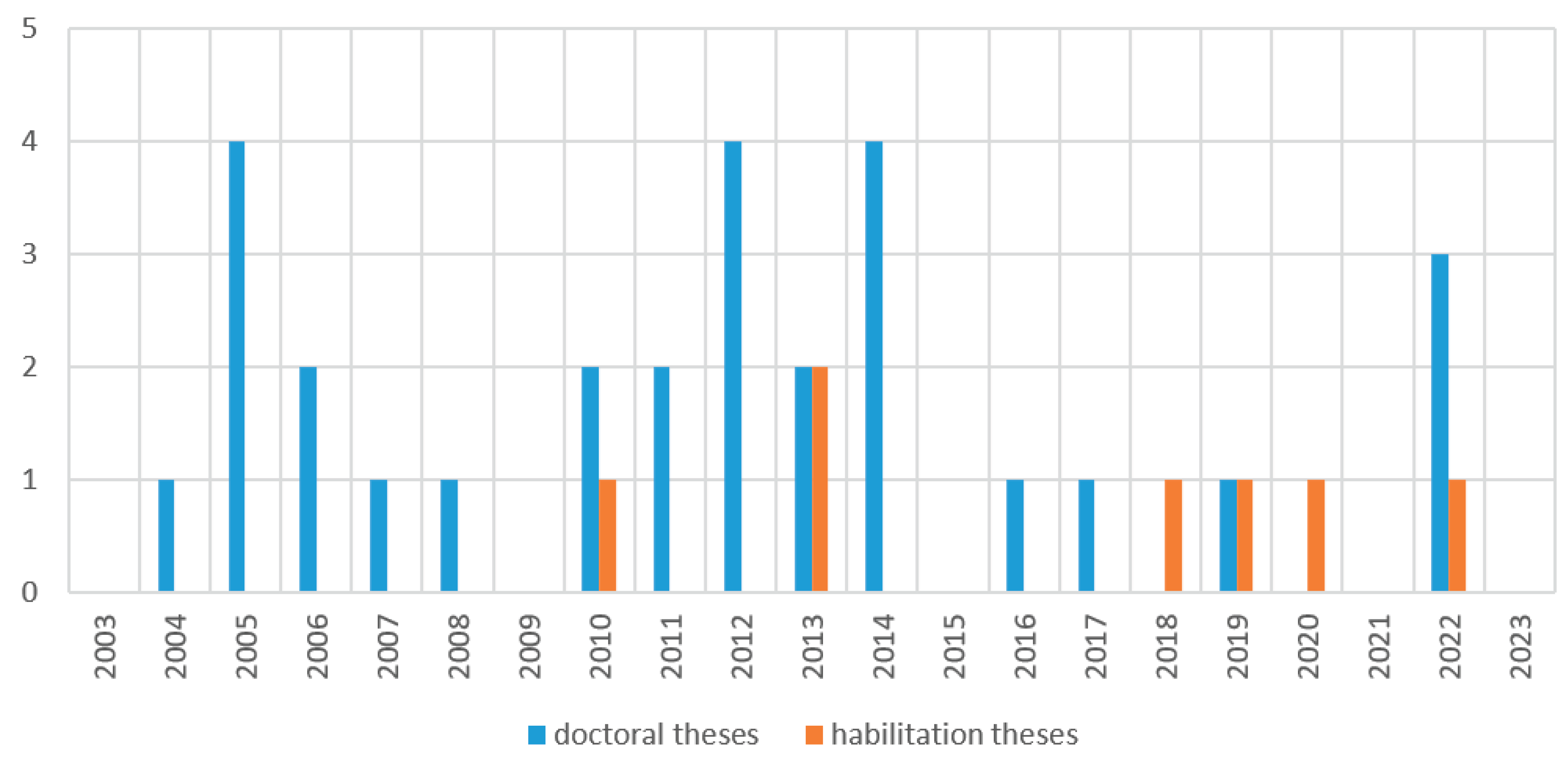
Figure 3.
Relationships between the classification of scientific fields and disciplines in Poland and the OECD taxonomy—fragment of the sheet for the field of ‘Medical and Health Sciences’. Source: (https://www.gov.pl/attachment/94747338-a74b-4b34-9d00-6a28351edbc9).
Figure 3.
Relationships between the classification of scientific fields and disciplines in Poland and the OECD taxonomy—fragment of the sheet for the field of ‘Medical and Health Sciences’. Source: (https://www.gov.pl/attachment/94747338-a74b-4b34-9d00-6a28351edbc9).
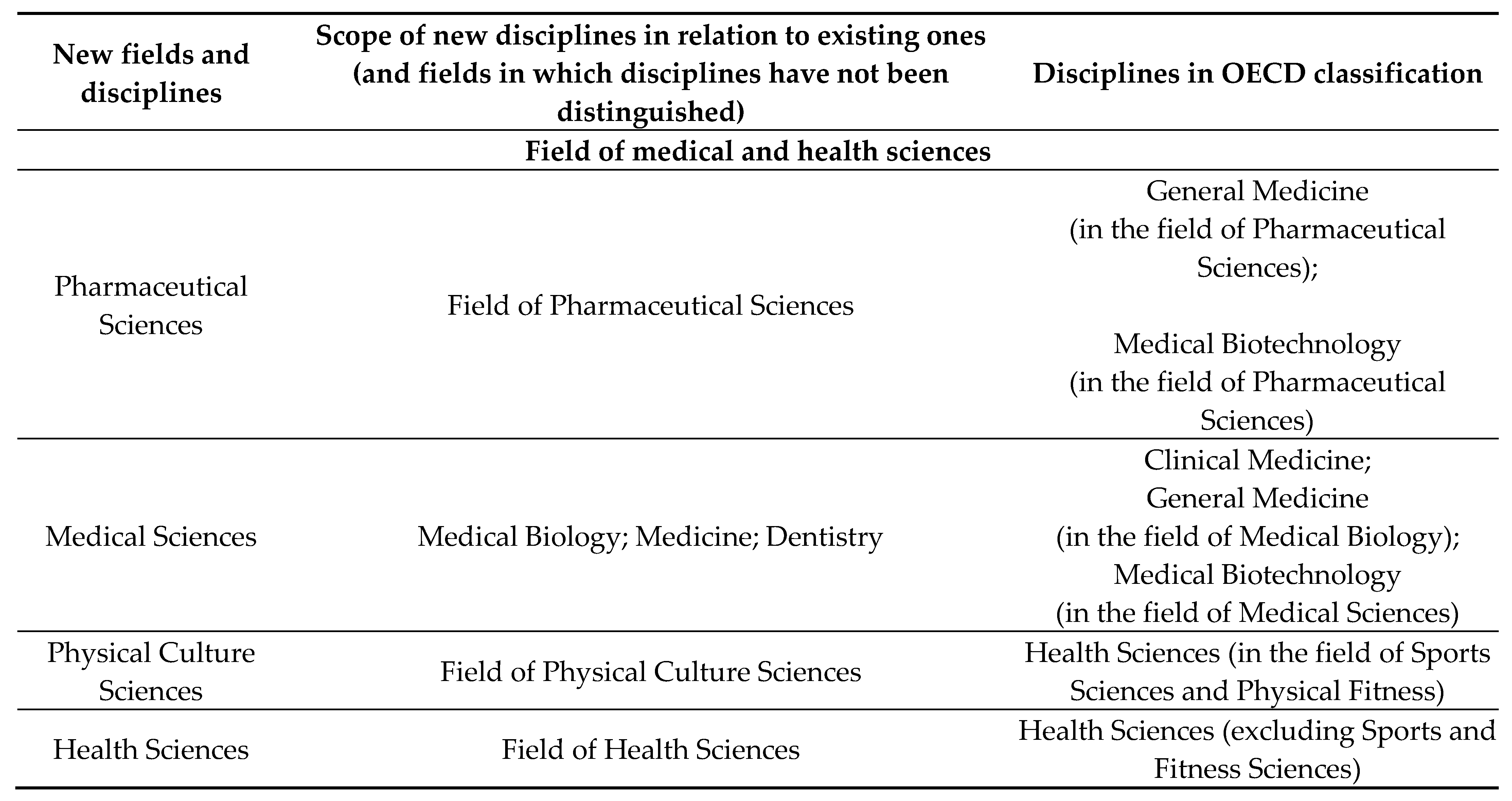
Figure 4.
Profiles of examined doctoral theses related to tourism completed within the field of PCS [N=29] compared to all doctoral theses related to tourism [N=119] defended in the years 2003-2023. Source: Own elaboration based on research results.
Figure 4.
Profiles of examined doctoral theses related to tourism completed within the field of PCS [N=29] compared to all doctoral theses related to tourism [N=119] defended in the years 2003-2023. Source: Own elaboration based on research results.
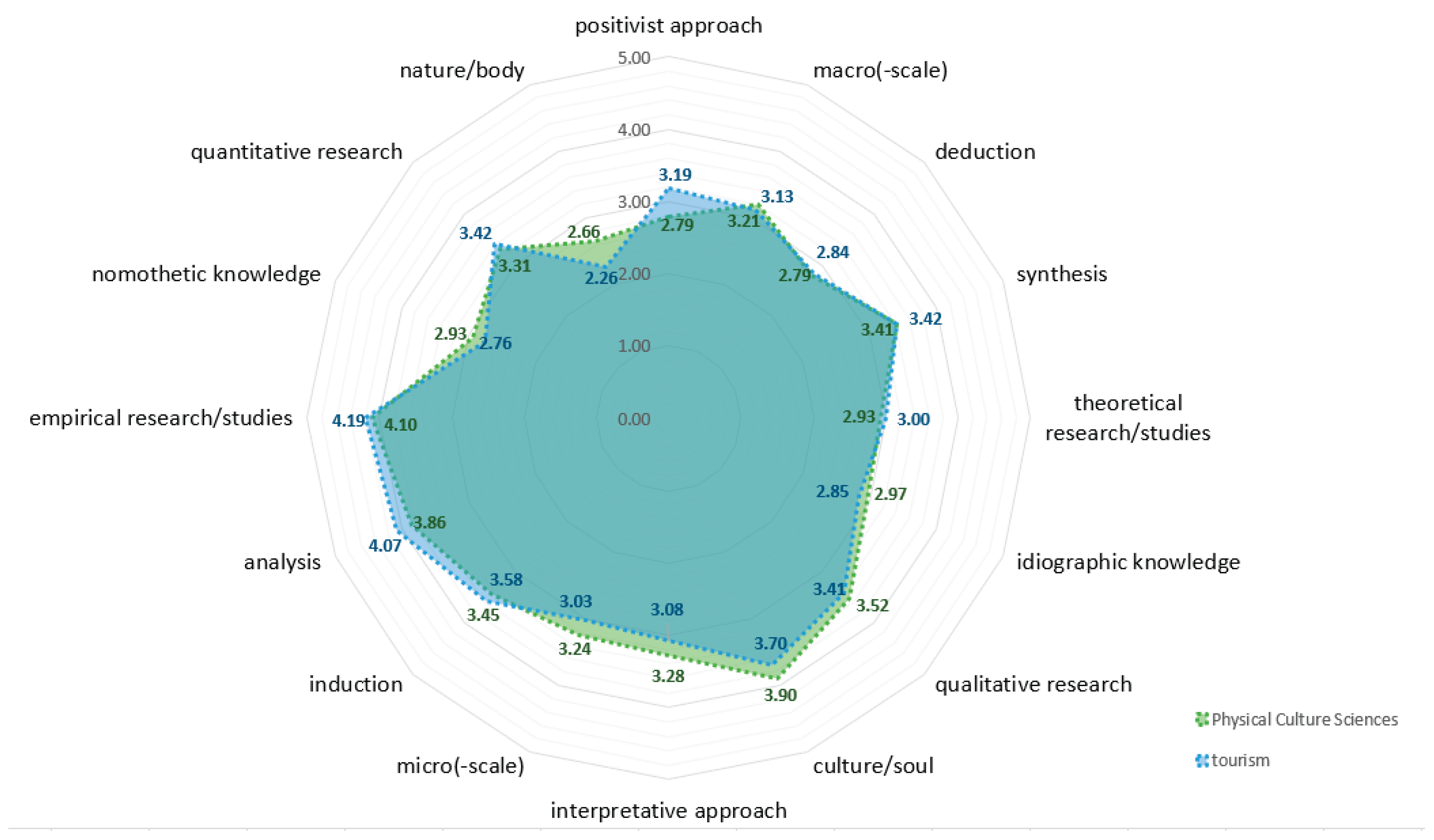
Figure 5.
Methodological profiles of the examined doctoral theses related to tourism carried out within the PCS field, assigned by the authors (according to the OECD classification) to: ‘Medical and Health Sciences’ [N=11], ‘Social Sciences’ [N=10] and ‘Humanities’ [N=6]. Source: Own elaboration based on research results.
Figure 5.
Methodological profiles of the examined doctoral theses related to tourism carried out within the PCS field, assigned by the authors (according to the OECD classification) to: ‘Medical and Health Sciences’ [N=11], ‘Social Sciences’ [N=10] and ‘Humanities’ [N=6]. Source: Own elaboration based on research results.
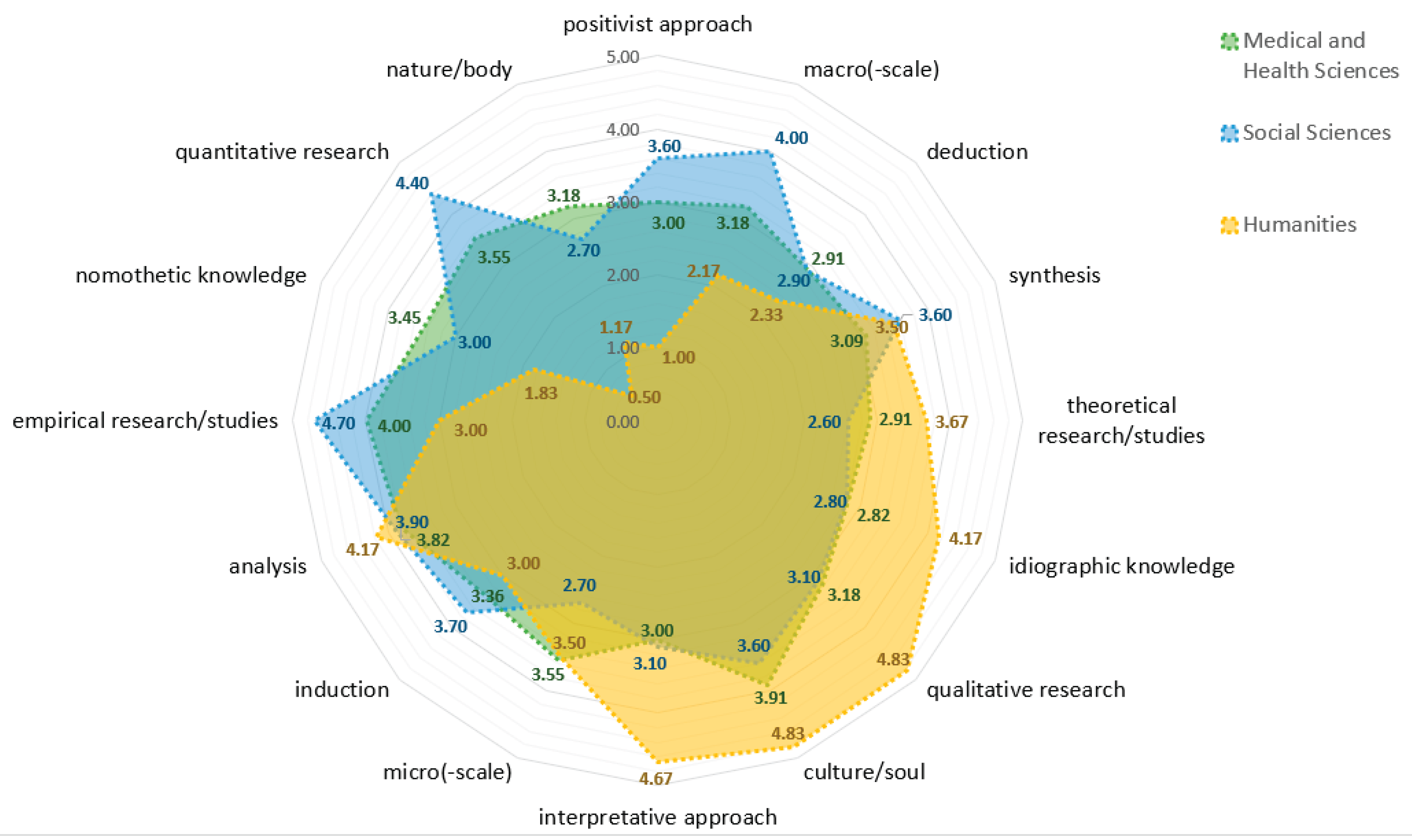
Figure 7.
Methodological profiles of the examined doctoral [N=29] and postdoctoral/habilitation theses [N=7] related to tourism in the field of PCS defended in the years 2003-2023. Source: Own elaboration based on research results.
Figure 7.
Methodological profiles of the examined doctoral [N=29] and postdoctoral/habilitation theses [N=7] related to tourism in the field of PCS defended in the years 2003-2023. Source: Own elaboration based on research results.
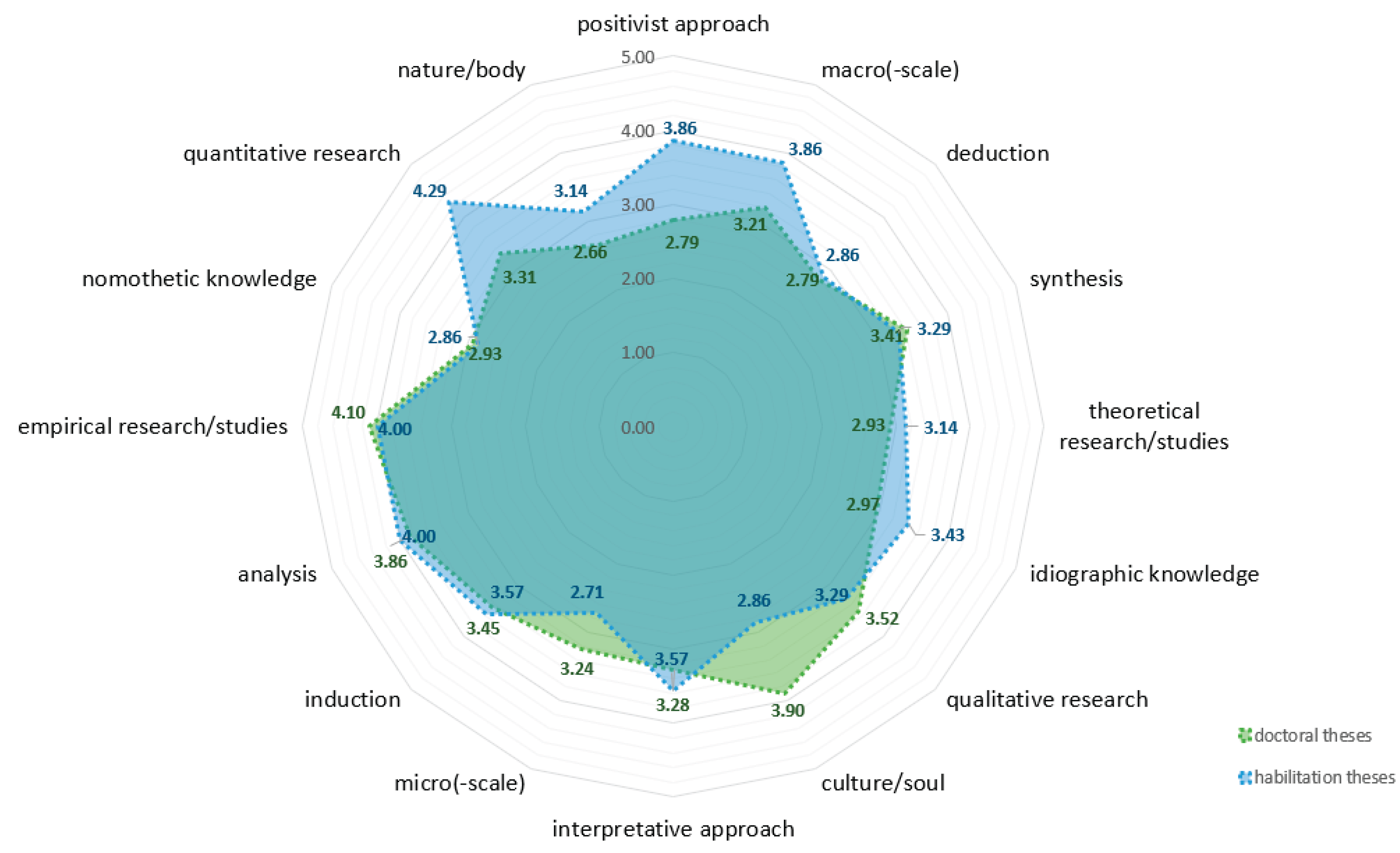

Table 1.
Scientific disciplines awarded doctorates based on research regarding tourism in the US and Canada between 1861 and 1987.
Table 1.
Scientific disciplines awarded doctorates based on research regarding tourism in the US and Canada between 1861 and 1987.
| Scientific field/discipline | Total | % | |
| 1 | Economics | 40 | 25.48 |
| 2 | Anthropology | 25 | 15.92 |
| 3 | Geography | 24 | 15.29 |
| 4 | Recreation | 23 | 14.65 |
| 5 | Business Administration | 11 | 7.01 |
| 6 | Education | 9 | 5.73 |
| 7 | Sociology | 7 | 4.46 |
| 8 | Urban and Regional Planning | 7 | 4.46 |
| 9 | Political Science | 5 | 3.18 |
| 10 | Fine Arts | 1 | 0.64 |
| 11 | Social Work | 1 | 0.64 |
| 12 | Theology | 1 | 0.64 |
| 13 | History | 1 | 0.64 |
| 14 | Mass Communications | 1 | 0.64 |
| 15 | Public Relations | 1 | 0.64 |
| Total | 157 | 100.00 | |
Source: (Jafari & Aaser, 1988, p. 413).
Table 2.
Year in which the first Ph.D. was awarded based on tourism research within a specific academic discipline in the USA, Canada, Australia and New Zealand.
Table 2.
Year in which the first Ph.D. was awarded based on tourism research within a specific academic discipline in the USA, Canada, Australia and New Zealand.
| Order | Discipline | Year |
| 1 | Geography | 1951 |
| 2 | Urban and Regional Planning | 1963 |
| 3 | Parks and Recreation | 1963 |
| 4 | Economics | 1968 |
| 5 | Anthropology | 1969 |
| 6 | Marketing | 1971 |
| 7 | Business | 1971 |
| 8 | Political Science | 1973 |
| 9 | Psychology | 1974 |
| 10 | Education | 1976 |
| 11 | History | 1976 |
| 12 | Environmental Studies | 1978 |
| 13 | Sociology | 1978 |
| 14 | Hotel and Restaurant Administration | 1982 |
Source: (Weiler et al., 2012, p. 23).
Table 3.
Doctorates awarded in tourism studies in the US and Canada in the period 1990-2000.
| Discipline | 1990 | 1991 | 1992 | 1993 | 1994 | 1995 | 1996 | 1997 | 1998 | 1999 | 2000 | Total | % | |
| 1 | Recreation | 6 | 7 | 6 | 6 | 10 | 9 | 12 | 11 | 5 | 3 | 9 | 84 | 25.45 |
| 2 | Anthropology | 2 | 1 | 2 | 3 | 3 | 2 | 5 | 4 | 8 | 7 | 6 | 43 | 13.03 |
| 3 | Geography | 2 | 4 | 1 | 3 | 3 | 7 | 4 | 5 | 7 | 3 | 2 | 41 | 12.42 |
| 4 | History | 2 | 1 | 1 | 1 | 1 | 3 | 8 | 2 | 3 | 5 | 27 | 8.18 | |
| 5 | Business Administration | 1 | 1 | 1 | 2 | 5 | 4 | 6 | 2 | 2 | 3 | 27 | 8.18 | |
| 6 | Education | 1 | 2 | 2 | 1 | 2 | 2 | 3 | 2 | 4 | 3 | 22 | 6.67 | |
| 7 | Economics | 3 | 1 | 2 | 2 | 1 | 3 | 1 | 2 | 2 | 1 | 1 | 19 | 5.76 |
| 8 | Urban and Regional Planning | 1 | 2 | 1 | 2 | 1 | 3 | 2 | 1 | 13 | 3.94 | |||
| 9 | Sociology | 1 | 1 | 4 | 1 | 1 | 1 | 4 | 13 | 3.94 | ||||
| 10 | American Studies | 2 | 1 | 1 | 1 | 1 | 1 | 2 | 9 | 2.73 | ||||
| 11 | Mass Communications | 2 | 1 | 2 | 5 | 1.52 | ||||||||
| 12 | Political Science | 2 | 1 | 1 | 4 | 1.21 | ||||||||
| 13 | Speech Communications | 1 | 1 | 1 | 3 | 0.91 | ||||||||
| 14 | Literature | 2 | 1 | 3 | 0.91 | |||||||||
| 15 | Environmental Studies | 1 | 2 | 3 | 0.91 | |||||||||
| 16 | Psychology | 2 | 1 | 3 | 0.91 | |||||||||
| 17 | Architecture | 1 | 1 | 2 | 0.61 | |||||||||
| 18 | Agriculture | 2 | 2 | 0.61 | ||||||||||
| 19 | Biology | 1 | 1 | 0.30 | ||||||||||
| 20 | Information Science | 1 | 1 | 0.30 | ||||||||||
| 21 | Health Studies | 1 | 1 | 0.30 | ||||||||||
| 22 | Tourism | 1 | 1 | 0.30 | ||||||||||
| 23 | Cinema | 1 | 1 | 0.30 | ||||||||||
| 24 | Music | 1 | 1 | 0.30 | ||||||||||
| 25 | Women’s Studies | 1 | 1 | 0.30 | ||||||||||
| Total | 22 | 21 | 19 | 22 | 34 | 29 | 38 | 39 | 38 | 36 | 32 | 330 | 100.00 | |
Source: (Alejziak, 2005, p. 261, based on: Meyer-Arendt, 2000, and Meyer-Arendt & Justice, 2002, p. 1173).
Table 4.
Disciplines that influence tourism doctoral research in United States, Canada, Australia and New Zealand—in the 1951-2010 period.
Table 4.
Disciplines that influence tourism doctoral research in United States, Canada, Australia and New Zealand—in the 1951-2010 period.
|
Discipline |
Number of theses 1951-2010 |
% | Ranking of discipline | ||||
| USA | Can. | Aus. | N. Zel. | ||||
| 1 | Psychology | 289 | 15.3 | 2 | 8 | 2 | 1 |
| 2 | Environmental Studies | 270 | 14.3 | 4 | 2 | 1 | 4 |
| 3 | Anthropology | 254 | 13.4 | 1 | 11 | 7 | 3 |
| 4 | History | 212 | 11.2 | 3 | 12 | 12 | 11 |
| 5 | Economics | 211 | 11.2 | 5 | 6 | 4 | 9 |
| 6 | Geography | 206 | 10.9 | 7 | 1 | 8 | 7 |
| 7 | Sociology | 197 | 10.4 | 6 | 4 | 5 | 5 |
| 8 | Marketing | 173 | 9.2 | 8 | 13 | 6 | 10 |
| 9 | Business | 143 | 7.6 | 12 | 9 | 3 | 6 |
| 10 | Political Science | 137 | 7. 2 | 9 | 5 | 13 | 2 |
| 11 | Parks and Recreation | 131 | 6.9 | 10 | 7 | 10 | 8 |
| 12 | Urban and Regional Planning | 125 | 6.6 | 11 | 3 | 11 | 12 |
| 13 | Hotel and Restaurant Administration | 82 | 4.3 | 13 | 14 | 9 | 13 |
| 14 | Education | 70 | 3.7 | 14 | 10 | 14 | 14 |
| 15 | Other | 204 | 10.8 | ||||
* Due to the incomplete nature of the database with respect to the most recent year, 2010, this particular analysis was conducted using 2000-2009 theses only. Source: Own elaboration based on: (Weiler et al., 2012, p. 25 and 27).
Table 5.
Disciplines influencing tourism doctoral research in the United States, Canada, Australia and New Zealand—in the 1951-2009 period (ranking: 2000-2009).
Table 5.
Disciplines influencing tourism doctoral research in the United States, Canada, Australia and New Zealand—in the 1951-2009 period (ranking: 2000-2009).
|
Discipline |
Number of theses 1951-1999 |
Number of theses 1999-2009* |
Ranking 2000-2009 |
% change | |
| 1 | Environmental Studies | 51 | 213 | 1 | 318 |
| 2 | Psychology | 73 | 211 | 2 | 189 |
| 3 | Anthropology | 79 | 166 | 3 | 110 |
| 4 | History | 60 | 156 | 4 | 212 |
| 5 | Sociology | 52 | 139 | 5 | 167 |
| 6 | Geography | 68 | 131 | 6 | 95 |
| 7 | Marketing | 40 | 129 | 7 | 223 |
| 8 | Economics | 93 | 109 | 8 | 17 |
| 9 | Business | 33 | 108 | 9 | 227 |
| 10 | Political Science | 32 | 99 | 10 | 209 |
| 11 | Parks and Recreation | 41 | 88 | 11 | 115 |
| 12 | Urban and Regional Planning | 41 | 82 | 12 | 100 |
| 13 | Hotel and Restaurant Administration | 7 | 73 | 13 | 943 |
| 14 | Education | 22 | 45 | 14 | 105 |
| All disciplines* | 577 | 1262 | 119 | ||
* Due to the incomplete nature of the database with respect to the most recent year, 2010, this particular analysis was conducted using 2000-2009 theses only. Source: Own elaboration based on: (Weiler et al., 2012, p. 25).
Table 6.
Doctoral degrees awarded for tourism studies in Poland between 1990 and 2000.
| Discipline | 1990 | 1991 | 1992 | 1993 | 1994 | 1995 | 1996 | 1997 | 1998 | 1999 | 2000 | Total | % | |
| 1 | Economic Sciences | 1 | 1 | 2 | 2 | 2 | 4 | 3 | 15 | 33.33 | ||||
| 2 | Earth Sciences | 1 | 1 | 2 | 2 | 1 | 2 | 4 | 13 | 28.89 | ||||
| 3 | Physical Culture Studies | 1 | 1 | 2 | 1 | 2 | 1 | 2 | 10 | 22.22 | ||||
| 4 | Natural Sciences | 1 | 1 | 2.22 | ||||||||||
| 5 | Technical Studies | 1 | 1 | 1 | 3 | 6.67 | ||||||||
| 6 | Agriculture Studies | 2 | 2 | 4.44 | ||||||||||
| 7 | Medical Studies | 1 | 1 | 2.22 | ||||||||||
| Total | 0 | 2 | 2 | 4 | 2 | 3 | 4 | 7 | 4 | 8 | 9 | 45 | 100.00 | |
Source: Own elaboration based on data obtained from the Polish Information Processing Centre. [http://bazy.opi.org.pl/].
Table 7.
Doctoral degrees awarded for tourism studies in Poland between 2001-2005.
| Discipline | 2001 | 2002 | 2003 | 2004 | 2005 | Total | % |
| Economic Sciences | 6 | 10 | 5 | 10 | 7 | 38 | 50.67 |
| Earth Sciences | 4 | 3 | 3 | 3 | 1 | 14 | 18.67 |
| Physical Culture Studies | 2 | 2 | 2 | 1 | 2 | 9 | 12.00 |
| Technical Studies | 1 | 1 | 2 | 2.67 | |||
| Agriculture Studies | 2 | 2 | 1 | 1 | 6 | 8.00 | |
| Medical Studies | 2 | 2 | 2 | 6 | 8.00 | ||
|
According to research issue (75 works in total), including: |
17 | 18 | 12 | 15 | 13 | 75 | 100.00 |
| Tourist reception areas | 2 | 1 | 3 | 4.00 | |||
| International tourism | 1 | 1 | 1.33 | ||||
| Tourist behaviour | 1 | 4 | 1 | 3 | 9 | 9.00 | |
| Tourism development | 2 | 1 | 1 | 4 | 5.33 | ||
| History of tourism | 1 | 1 | 1.33 | ||||
| Impact of tourism | 1 | 2 | 1 | 2 | 6 | 8.00 | |
| Tourism planning | 1 | 1 | 1.33 | ||||
| Tourism policy | 3 | 1 | 4 | 5.33 | |||
| Tourist attractions | 1 | 1 | 1.33 | ||||
| Rural tourism, agritourism* | 6 | 8 | 2 | 2 | 18 | 24.00 | |
| Tourism assets and their protection* | 2 | 1 | 3 | 4.00 | |||
| Tourism development* | 1 | 2 | 3 | 4.00 | |||
| Marketing and tourism product* | 1 | 2 | 3 | 4 | 10 | 13.33 | |
| Recreational and health tourism* | 1 | 1 | 2 | 2.67 | |||
| Educational and social aspects of tourism* | 1 | 1 | 1.33 | ||||
| IT* | 1 | 2 | 1 | 4 | 5.33 | ||
| Forms of tourism (religious, hiking)* | 1 | 1 | 2 | 2.67 | |||
| Tourism industry (organisation and functioning of tourism enterprises) | 1 | 1 | 2 | 2.67 |
* Categories not distinguished in British research. Source: Own elaboration based on: [http://bazy.opi.org.pl/].
Table 8.
Scientific field tourism-related research (2000-2013): Development dynamics and disciplinary structure of doctoral dissertations based on tourism research in chosen European countries (Germany, France, the UK, Spain, Italy and Portugal).
Table 8.
Scientific field tourism-related research (2000-2013): Development dynamics and disciplinary structure of doctoral dissertations based on tourism research in chosen European countries (Germany, France, the UK, Spain, Italy and Portugal).
| Year | Number of theses | % | Thesis by discipline | Number of theses | % | |
| 2000 | 90 | 5.5 | Anthropology | 134 | 8.3 | |
| 2001 | 87 | 5.4 | Earth Science and Space | 83 | 5.1 | |
| 2002 | 115 | 7.1 | Economics | 478 | 29.4 | |
| 2003 | 105 | 6.5 | Geography | 258 | 15.9 | |
| 2004 | 75 | 4.6 | History | 119 | 7.3 | |
| 2005 | 68 | 4.2 | Law | 15 | 0.9 | |
| 2006 | 69 | 4.2 | Linguistics | 7 | 0.4 | |
| 2007 | 91 | 5.6 | Pedagogy | 41 | 2.5 | |
| 2008 | 108 | 6.7 | Political Science | 32 | 2.0 | |
| 2009 | 119 | 7.3 | Psychology | 16 | 1.0 | |
| 2010 | 139 | 8.6 | Sociology | 441 | 27.2 | |
| 2011 | 158 | 9.7 | Total | 1,624 | 100.0 | |
| 2012 | 169 | 10.4 | ||||
| 2013 | 231 | 14.2 | ||||
| Total | 1,624 | 100.0 |
Source: Own elaboration based on: (Oliveira et al., 2015, p. 114).
Table 9.
Habilitations awarded in Poland between 1990 and 2000.
| Scientific discipline | 1990 | 1991 | 1992 | 1993 | 1994 | 1995 | 1996 | 1997 | 1998 | 1999 | 2000 | Total | % |
| Economic Sciences | 3 | 1 | 3 | 1 | 1 | 1 | 1 | 11 | 61.11 | ||||
| Earth Sciences | 1 | 1 | 2 | 11.11 | |||||||||
| Natural Sciences | 2 | 1 | 3 | 16.67 | |||||||||
| Technical Sciences | 1 | 1 | 5.56 | ||||||||||
| Theological Sciences | 1 | 1 | 5.56 | ||||||||||
| Total: | 3 | - | 4 | 2 | - | 3 | 1 | - | 2 | 1 | 2 | 18 | 100.0 |
Source: Own elaboration based on data from the Information Processing Centre (http://bazy.opi.org.pl/).
Table 10.
Scope of empirical research.
| Objective scope | Doctoral and postdoctoral/habilitation theses connected with PCS |
| Subjective scope | authors of works |
| Spatial scope | Poland |
| Time scope | 01 Jan. 2003-31 Dec. 2023 |
Source: Own elaboration.
Table 11.
Structure of examined doctoral theses based on considered keywords.
| Keywords | Number of doctoral theses… | ||||
|
…qualified for study [N=406] |
…for which completed questionnaires were obtained [N=119] | ||||
| Works selected based on keywords | Tourism | 231 | 56.90% | 80 | 67.23% |
| Recreation | 78 | 19.20% | 24 | 20.17% | |
| Free time | 42 | 10.30% | 8 | 6.72% | |
| Travel | 33 | 8.10% | 7 | 5.88% | |
| Hotel | 31 | 7.70% | 11 | 9.24% | |
| Pilgrimage | 27 | 6.70% | 1 | 0.84% | |
| Guide | 12 | 3.00% | 3 | 2.52% | |
| Sightseeing | 11 | 2.70% | 3 | 2.52% | |
| Leisure | 10 | 2.40% | 4 | 3.36% | |
| Trip | 4 | 1.00% | 0 | 0.00% | |
| Hiking | 4 | 1.00% | 1 | 0.84% | |
Note: Some works had more than one assigned keyword, hence, the sum of data in individual columns exceeds N and the 100% indicator. Source: Own elaboration.
Table 12.
Structure of examined habilitation theses based on considered keywords.
| Keywords | Number of habilitation theses… | ||||
|
…qualified for study [N=85] |
… for which completed questionnaires were obtained [N=42] | ||||
| Works selected based on keywords | Tourism | 52 | 61.18% | 32 | 76.19% |
| Recreation | 5 | 5.88% | 2 | 4.76% | |
| Free time | 8 | 9.41% | 1 | 2.38% | |
| Travel | 5 | 5.88% | 1 | 2.38% | |
| Hotel | 4 | 4.71% | 3 | 7.14% | |
| Pilgrimage | 7 | 8.24% | 1 | 2.38% | |
| Guide | 2 | 2.35% | 2 | 4.76% | |
| Sightseeing | 3 | 3.53% | 1 | 2.38% | |
| Leisure | 0 | 0.00% | 0 | 0.00% | |
| Trip | 0 | 0.00% | 0 | 0.00% | |
| Hiking | 4 | 4.71% | 1 | 2.38% | |
Note: Some works had more than one assigned keyword, hence, the sum of data in individual columns exceeds N and the 100% indicator. Source: Own elaboration.
Table 13.
Structure of doctoral theses related to tourism completed in the PCS discipline [N=29] from the point of view of assignment to the “first” and “second” field and discipline of science according to the OECD classification.
Table 13.
Structure of doctoral theses related to tourism completed in the PCS discipline [N=29] from the point of view of assignment to the “first” and “second” field and discipline of science according to the OECD classification.
|
“First” scientific field… |
…and assigned scientific discipline |
“Second” scientific field… |
…and assigned scientific discipline | |||||
| Medical and Health Sciences | 11 | 37.93% | Health Sciences | 11* | Social Sciences | 4 | Psychology | 1 |
| Sociology | 1 | |||||||
| Economics and Business (Management) | 1 | |||||||
| Social and Economic Geography | 1 | |||||||
| Humanities | 2 | History and Archaeology | 1 | |||||
| Other Humanistic Sciences | 1 | |||||||
| Natural Sciences | 1 | Other Natural Sciences | 1 | |||||
| Social Sciences | 10 | 34.48% | Sociology | 2 | Humanities | 1 | Other Humanistic Sciences | 1 |
| Psychology | 1 | Medical and Health Sciences | 1 | Health Sciences (Sport and Physical Fitness Studies) | 1 | |||
| Education |
1 | Medical and Health Sciences | 1 | Health Sciences (Sport and Physical Fitness Studies) | 1 | |||
| Other Social Sciences | 6 | Natural Sciences | 2 | Earth and Environmental Studies | 2 | |||
| Medical and Health Sciences | 1 | Health Sciences (Sport and Physical Fitness Studies) | 1 | |||||
| Social Sciences | 1 | Economics and Business (Management) | 1 | |||||
| Humanities | 6 | 20.69% | History and Archaeology | 4 | Humanities | 2 | Philosophy, Ethics and Religious Studies | 1 |
| Linguistics and Literary Studies | 1 | |||||||
| Medical and Health Sciences | 1 | Health Sciences (Sport and Physical Fitness Studies) | 1 | |||||
| Philosophy, Ethics and Religious Studies | 2 | Social Sciences | 1 | Other Social Sciences | 1 | |||
| Medical and Health Sciences | 1 | Health Sciences (Sport and Physical Fitness Studies) | 1 | |||||
| Natural Science | 2 | 6.90% | Earth and Environmental Sciences | 2 | Social Sciences | 1 | Other Social Sciences | 1 |
| Total: | 29 | 100.0% | 29 | 20 | 20 | |||
* Including ‘Sports and Physical Fitness Studies”—10, and ‘Public and Environmental Health’—1 Source: Own elaboration based on research results.
Table 14.
Structure of habilitation theses related to tourism completed in the PCS discipline [N=7] from the point of view of assignment to the “first” and “second” field and discipline of science according to the OECD classification.
Table 14.
Structure of habilitation theses related to tourism completed in the PCS discipline [N=7] from the point of view of assignment to the “first” and “second” field and discipline of science according to the OECD classification.
|
“First” scientific field… |
…and assigned scientific discipline |
“Second” scientific field… |
…and assigned scientific discipline | |||||
| Medical and Health Sciences | 4 | 57.14% | Health Sciences | 3* | Social Sciences | 2 | Sociology | 1 |
| Economics and Business (Management) | 1 | |||||||
| Other Medical Sciences | 1 | --- | --- | --- | --- | |||
| Social Sciences | 3 | 42.86% | Sociology | 1 | Humanities | Philosophy, Ethics and Religious Studies | 1 | |
| Economics and Business (Management) | 1 | Social Sciences | Media and Communication | 1 | ||||
| Other Social Sciences | 1 | --- | --- | --- | --- | |||
| Total: | 7 | 100.0% | 7 | 4 | 4 | |||
* Including ‘Sports and Physical Fitness Studies’—2, and ‘Public and Environmental Health’—1. Source: Own elaboration based on research results.
Table 15.
Number of indications of individual values for each methodological feature regarding examined doctoral theses related to tourism completed within PCS field [N=29].
Table 15.
Number of indications of individual values for each methodological feature regarding examined doctoral theses related to tourism completed within PCS field [N=29].
| Methodological characteristics | Number of indications | Total value of indications | |||||||||
| 0 | 1 | 2 | 3 | 4 | 5 | ||||||
| 1 | 1.1. | Positivist approach | 1 | 7 | 4 | 5 | 9 | 3 | 81 | 176 | 46% |
| 1.2. | Interpretive approach | 2 | 1 | 7 | 3 | 9 | 7 | 95 | 54% | ||
| 2 | 2.1. | Empirical research/studies | 0 | 2 | 2 | 0 | 12 | 13 | 119 | 204 | 58% |
| 2.2. | Theoretical research/studies | 1 | 3 | 6 | 10 | 5 | 4 | 85 | 42% | ||
| 3 | 3.1. | Mono-disciplinary research | 4 | 5 | 7 | 4 | 5 | 4 | 71 | 172 | 41% |
| 3.2. | Multi-/inter-disciplinary research | 1 | 4 | 2 | 5 | 7 | 10 | 101 | 59% | ||
| 4 | 4.1. | Analysis | 0 | 2 | 1 | 7 | 8 | 11 | 112 | 211 | 53% |
| 4.2. | Synthesis | 0 | 3 | 3 | 8 | 9 | 6 | 99 | 47% | ||
| 5 | 5.1. | Nature/body | 5 | 4 | 1 | 10 | 4 | 5 | 77 | 190 | 41% |
| 5.2. | Culture/soul | 1 | 0 | 3 | 6 | 6 | 13 | 113 | 59% | ||
| 6 | 6.1. | Induction | 0 | 3 | 2 | 11 | 5 | 8 | 110 | 181 | 55% |
| 6.2. | Deduction | 1 | 7 | 3 | 7 | 8 | 3 | 81 | 45% | ||
| 7 | 7.1. | Macro(-scale) | 2 | 1 | 5 | 8 | 7 | 6 | 93 | 187 | 50% |
| 7.2. | Micro(-scale) | 1 | 2 | 6 | 6 | 8 | 6 | 94 | 50% | ||
| 8 | 8.1. | Quantitative research | 3 | 4 | 1 | 3 | 9 | 9 | 96 | 198 | 48% |
| 8.2. | Qualitative research | 1 | 1 | 3 | 8 | 9 | 7 | 102 | 52% | ||
| 9 | 9.1. | Nomothetic knowledge | 3 | 3 | 5 | 5 | 8 | 5 | 85 | 171 | 50% |
| 9.2. | Idiographic knowledge | 4 | 5 | 2 | 3 | 7 | 8 | 86 | 50% | ||
| Number of indications | 30 | 57 | 63 | 109 | 135 | 128 | |||||
Source: Own elaboration based on research results.
Table 16.
Methodological profile of doctoral theses related to tourism carried out within the discipline of PCS [N=29]—basic measures of descriptive statistics.
Table 16.
Methodological profile of doctoral theses related to tourism carried out within the discipline of PCS [N=29]—basic measures of descriptive statistics.
| Methodological characteristics | |||||||||
| 1 | 1.1. | Positivist approach | 0 | 5 | 5 | 4 | 3 | 2.79 | 1.47 |
| 1.2. | Interpretive approach | 0 | 5 | 5 | 4 | 4 | 3.28 | 1.51 | |
| 2 | 2.1. | Empirical research/studies | 1 | 5 | 4 | 5 | 4 | 4.10 | 1.18 |
| 2.2. | Theoretical research/studies | 0 | 5 | 5 | 3 | 3 | 2.93 | 1.31 | |
| 3 | 3.1. | Mono-disciplinary research | 0 | 5 | 5 | 2 | 2 | 2.45 | 1.64 |
| 3.2. | Multi-/inter-disciplinary research | 0 | 5 | 5 | 5 | 4 | 3.48 | 1.55 | |
| 4 | 4.1. | Analysis | 1 | 5 | 4 | 5 | 4 | 3.86 | 1.19 |
| 4.2. | Synthesis | 1 | 5 | 4 | 4 | 4 | 3.41 | 1.24 | |
| 5 | 5.1. | Nature/body | 0 | 5 | 5 | 3 | 3 | 2.66 | 1.72 |
| 5.2. | Culture/soul | 0 | 5 | 5 | 5 | 4 | 3.90 | 1.29 | |
| 6 | 6.1. | Induction | 1 | 5 | 4 | 3 | 3 | 3.45 | 1.27 |
| 6.2. | Deduction | 0 | 5 | 5 | 4 | 3 | 2.79 | 1.45 | |
| 7 | 7.1. | Macro(-scale) | 0 | 5 | 5 | 3 | 3 | 3.21 | 1.42 |
| 7.2. | Micro(-scale) | 0 | 5 | 5 | 4 | 3 | 3.24 | 1.38 | |
| 8 | 8.1. | Quantitative research | 0 | 5 | 5 | 4 | 4 | 3.31 | 1.75 |
| 8.2. | Qualitative research | 0 | 5 | 5 | 4 | 4 | 3.52 | 1.27 | |
| 9 | 9.1. | Nomothetic knowledge | 0 | 5 | 5 | 4 | 3 | 2.93 | 1.60 |
| 9.2. | Idiographic knowledge | 0 | 5 | 5 | 5 | 4 | 2.97 | 1.86 | |
Legend: —minimal value; —maximal value; —range; —modal; —median; —arithmetic mean; —standard deviation. Source: Own elaboration based on research results.
Table 17.
Number of indications of individual values for each methodological feature for the examined habilitation theses related to tourism conducted within PCS field [N=7].
Table 17.
Number of indications of individual values for each methodological feature for the examined habilitation theses related to tourism conducted within PCS field [N=7].
| Methodological characteristics | Number of indications | Total value of indications | |||||||||
| 0 | 1 | 2 | 3 | 4 | 5 | ||||||
| 1 | 1.1. | Positivist approach | 0 | 0 | 0 | 3 | 2 | 2 | 27 | 52 | 52% |
| 1.2. | Interpretive approach | 0 | 0 | 0 | 3 | 4 | 0 | 25 | 48% | ||
| 2 | 2.1. | Empirical research/studies | 0 | 0 | 1 | 1 | 2 | 3 | 28 | 50 | 56% |
| 2.2. | Theoretical research/studies | 1 | 0 | 0 | 2 | 4 | 0 | 22 | 44% | ||
| 3 | 3.1. | Mono-disciplinary research | 2 | 2 | 2 | 1 | 0 | 0 | 9 | 41 | 22% |
| 3.2. | Multi-/inter-disciplinary research | 0 | 0 | 0 | 1 | 1 | 5 | 32 | 78% | ||
| 4 | 4.1. | Analysis | 0 | 0 | 1 | 0 | 4 | 2 | 28 | 51 | 55% |
| 4.2. | Synthesis | 0 | 0 | 1 | 3 | 3 | 0 | 23 | 45% | ||
| 5 | 5.1. | Nature/body | 1 | 0 | 1 | 1 | 3 | 1 | 22 | 42 | 52% |
| 5.2. | Culture/soul | 1 | 1 | 1 | 0 | 3 | 1 | 20 | 48% | ||
| 6 | 6.1. | Induction | 0 | 0 | 2 | 1 | 2 | 2 | 25 | 45 | 56% |
| 6.2. | Deduction | 0 | 1 | 1 | 3 | 2 | 0 | 20 | 44% | ||
| 7 | 7.1. | Macro(-scale) | 0 | 0 | 0 | 4 | 0 | 3 | 27 | 46 | 59% |
| 7.2. | Micro(-scale) | 1 | 0 | 1 | 3 | 2 | 0 | 19 | 41% | ||
| 8 | 8.1. | Quantitative research | 0 | 0 | 0 | 1 | 3 | 3 | 30 | 53 | 57% |
| 8.2. | Qualitative research | 0 | 1 | 1 | 2 | 1 | 2 | 23 | 43% | ||
| 9 | 9.1. | Nomothetic knowledge | 1 | 1 | 0 | 2 | 2 | 1 | 20 | 44 | 45% |
| 9.2. | Idiographic knowledge | 0 | 1 | 1 | 1 | 2 | 2 | 24 | 55% | ||
| Number of indications | 7 | 7 | 13 | 32 | 40 | 27 | |||||
Source: Own elaboration based on research results.
Table 18.
Methodological profile of habilitation theses related to tourism conducted within PCS field [N=7]—basic measures of descriptive statistics.
Table 18.
Methodological profile of habilitation theses related to tourism conducted within PCS field [N=7]—basic measures of descriptive statistics.
| Methodological characteristics | |||||||||
| 1 | 1.1. | Positivist approach | 3 | 5 | 2 | 3 | 4 | 3.86 | 0.90 |
| 1.2. | Interpretive approach | 3 | 4 | 1 | 4 | 4 | 3.57 | 0.53 | |
| 2 | 2.1. | Empirical research/studies | 2 | 5 | 3 | 5 | 4 | 4.00 | 1.15 |
| 2.2. | Theoretical research/studies | 0 | 4 | 4 | 4 | 4 | 3.14 | 1.46 | |
| 3 | 3.1. | Mono-disciplinary research | 0 | 3 | 3 | 1 | 1 | 1.29 | 1.11 |
| 3.2. | Multi-/inter-disciplinary research | 3 | 5 | 2 | 5 | 5 | 4.57 | 0.79 | |
| 4 | 4.1. | Analysis | 2 | 5 | 3 | 4 | 4 | 4.00 | 1.00 |
| 4.2. | Synthesis | 2 | 4 | 2 | 4 | 3 | 3.29 | 0.76 | |
| 5 | 5.1. | Nature/body | 0 | 5 | 5 | 4 | 4 | 3.14 | 1.68 |
| 5.2. | Culture/soul | 0 | 5 | 5 | 4 | 4 | 2.86 | 1.86 | |
| 6 | 6.1. | Induction | 2 | 5 | 3 | 2 | 4 | 3.57 | 1.27 |
| 6.2. | Deduction | 1 | 4 | 3 | 3 | 3 | 2.86 | 1.07 | |
| 7 | 7.1. | Macro(-scale) | 3 | 5 | 2 | 3 | 3 | 3.86 | 1.07 |
| 7.2. | Micro(-scale) | 0 | 4 | 4 | 3 | 3 | 2.71 | 1.38 | |
| 8 | 8.1. | Quantitative research | 3 | 5 | 2 | 4 | 4 | 4.29 | 0.76 |
| 8.2. | Qualitative research | 1 | 5 | 4 | 3 | 3 | 3.29 | 1.50 | |
| 9 | 9.1. | Nomothetic knowledge | 0 | 5 | 5 | 3 | 3 | 2.86 | 1.77 |
| 9.2. | Idiographic knowledge | 1 | 5 | 4 | 5 | 4 | 3.43 | 1.51 | |
Legend: —minimal value; —maximal value; —range; —modal; —median; —arithmetic mean; —standard deviation. Source: Own elaboration based on research results.
Disclaimer/Publisher’s Note: The statements, opinions and data contained in all publications are solely those of the individual author(s) and contributor(s) and not of MDPI and/or the editor(s). MDPI and/or the editor(s) disclaim responsibility for any injury to people or property resulting from any ideas, methods, instructions or products referred to in the content. |
© 2025 by the authors. Licensee MDPI, Basel, Switzerland. This article is an open access article distributed under the terms and conditions of the Creative Commons Attribution (CC BY) license (http://creativecommons.org/licenses/by/4.0/).
Copyright: This open access article is published under a Creative Commons CC BY 4.0 license, which permit the free download, distribution, and reuse, provided that the author and preprint are cited in any reuse.


