

Submitted:
18 September 2025
Posted:
21 September 2025
You are already at the latest version
Abstract
Indigenous and local chicken breeds can be used as slow-growing genotypes in non-conventional production systems, thereby ensuring consumer preferences for meat from these systems while conserving endangered animal genetic resources. This study aimed to examine and compare the potential of indigenous Banat Naked Neck (BNN) and Svrljig hen (SH) chickens in meat production under defined rearing conditions and con-tribute to the economic interest in the survival of these breeds. The growth of BNN and SH chickens up to the age of 12 and 14 weeks was analysed for a total of 240 individuals. Carcass yield and quality were analysed on a sample of 10 male chickens of each breed and slaughter age, a total of 40 chickens, based on measures of carcass conformation, processed carcass yield, proportion of main and edible carcass parts, and meat yield in main carcass parts. The quality of breast meat and leg meat is determined by analysing the basic chemical composition, fatty acid content and certain physical properties (cook-ing loss and tenderness). Breeds BNN and SH have a similar line of growth and final body weight at the ages of 12 and 14 weeks. The advantages of the BNN breed are in the higher yield of processed carcass, a higher proportion of breast and breast meat compared to the SH breed. On the other hand, SH chicken meat has a lower fat content, a higher n-3 fatty acid content and a more desirable n-6/n-3 ratio. Slaughter at an older age is justified in better carcass conformation and higher yields of carcass, breast and leg meat. Keywords: meat quality, indigenous breed, Banat Naked Neck, Svrljig hen, slaughter age.
Keywords:
meat quality
; indigenous breed
; Banat Naked Neck
; Svrljig hen
; slaughter
1. Introduction
Chicken meat is an important source of animal protein for the growing human population. It contains all the necessary nutrients with a minimum fat content compared to the meat of other animal species [1]. The convenience of its use by all age categories, health conditions and without religious restrictions is emphasised. The genetic progress of chickens for meat production in terms of growth rate and increase in the proportion of breasts in the carcass is conditioned by the increase in market needs and requirements for cut-up portions, primarily the breast, as its most valuable part [2]. In these circumstances, less productive pure breeds, indigenous and local breeds, were completely neglected, which threatened their survival.
The determination of modern-day consumers towards a healthy diet, the development of awareness about the welfare of farm animals, and the importance of the origin and safety of animal products are increasingly focusing on product quality. In many studies dealing with the quality of broiler meat, it is reported that the appearance of various meat abnormalities (woody, pale, soft, exudative meat) is related to the genotype, i.e. the growth rate of chickens [3,4]. The aforementioned phenomena, in addition to the effect on the nutritional quality of meat [5], cause a decrease in the technological quality of such meat, causing damage to the poultry industry (processing) [6]. In addition, the genetic improvement of broiler growth rate has led to problems in their adaptability to suboptimal rearing conditions [7] and the incidence of various metabolic disorders [8,9].
Locally adapted and indigenous chicken breeds can play a significant role in the development of non-conventional chicken meat production systems. The needs of these breeds in terms of housing conditions, nutrition and care correspond to low inputs that result in low productivity, but on the other hand, meat of a specific quality, characteristic of traditional production [10]. The specificity of the quality of meat from unconventional production is determined by the choice of breed, the rearing system, which, to a greater or lesser extent, enables the natural nutrition and activity of the birds, as well as the age of the birds at slaughter [10,11].
The Banat naked Neck (BNN) and the Svrljig hen (SH) are indigenous breeds of chickens in Serbia. Their preservation, as an integral part of animal genetic resources, is of national interest. The population of these breeds of chickens places them in the status of endangered [12]. The population of BNN hens is slightly larger than that of the Svrljig hen. The area of rearing of BNN has expanded from Vojvodina to other regions of Serbia. Unlike it, the Svrljig hen has a small population and it is bred mainly in eastern Serbia, which is the origin of this breed. Both breeds are medium-sized and dual-purpose, reaching a body weight of 2-3 kg BNN, i.e. 1.5-2 kg SH [13]. The need to preserve these genetic resources is imposed as an imperative, and the production of meat of specific quality or as an organic product, based on these indigenous breeds, is one of the possible ways to achieve the set goal. Non-conventional, free-range or organic meat production based on indigenous breeds, which would be market-oriented, would have a significant social and economic component because it would provide income and development to households in rural areas [14].
Carcass characteristics and meat quality of the indigenous Banat Naked Neck and Svrljig hen breeds have been documented in a few studies. In the study by Pavlovski et al. [15], it was determined that, from the aspect of the variety used, based on the colour of the feathers of Banat Naked Neck chickens (white, black, grey), there is no difference in growth and carcass characteristics. Mitrović et al. [16] examined the slaughter characteristics of Banat Naked Neck and Svrljig hen at the age of 84 days and found significant differences in the percentage of drumsticks and thighs, that is, back and pelvis between these two breeds. By comparing the meat quality of Banat Naked Neck chickens and commercial chicken hybrids [17], i.e., Banat Naked Neck and medium-growing hybrid Redbro [18], significant differences in the fatty acid composition of meat and carcass yield were established. Given that until now the Banat Naked Neck and Svrljig hen breeds have not been the subject of intensive selection work with the aim of genetic improvement, there is a pronounced variability of reproductive and production potential depending on the locality and growing conditions of these chicken breeds [19].
In order to preserve the indigenous Banat Naked Neck and Svrljig hen breeds and their use in non-conventional production systems, it is necessary to have larger databases that will confirm the specificity of meat quality in defined growing conditions and thus contribute to the economic interest in the survival of these breeds.
2. Materials and Methods
2.1. Design, Birds and Management
The experiment and experimental procedures were evaluated by the Ethics Committee of the Institute for Animal Husbandry (Belgrade, Serbia) and approved by the Veterinary Directorate in MAFW of the Republic of Serbia (Approval No: 002097079/2025).
The growth of BNN and SH chickens was tested on a total of 240 chickens (120 BNN chickens and 120 SH chickens) obtained by incubating the eggs of the parent flocks of these two breeds at the Institute for Animal Husbandry in Belgrade. Day-old chicks were placed in group boxes with a litter of chopped straw in 3 replicates of 40 chicks for each breed. The chicks were hatched in the spring and were reared for 3 weeks in a closed facility where they were provided with adequate ambient conditions, primarily in terms of temperature, and constant lighting (23L:1D). Subsequently, they were moved to group mobile cages on natural pasture, in 3 replicates per breed. Stocking density was 8 birds/m2. The chickens were exposed to outside air temperature and daylight. The cages were equipped with round drinkers, feeders and perches. The cages provided the chickens with protection from the sun and adverse weather conditions. At the same time, thanks to the movement, the chickens had constant access to the pasture.
The basal diet consisted of a complete, balanced corn-soybean meal-based mash, formulated and analysed to contain 18.3% crude protein (CP) and 12.2 MJ/kg metabolizable energy (ME). This diet was provided ad libitum, supplemented by the forage available from the pasture within the mobile cage.
2.2. Data Collection
The increase in body weight was recorded by individual measurements of all BNN and SH chickens at weekly intervals until the age of 12 and 14 weeks, respectively. On a random sample of 10 male chickens for each breed and age (40 chickens in total), the characteristics of carcass conformation, yield and quality of carcass and meat were examined. On a selected sample of chickens, feeding was stopped 8 hours before slaughter. The chickens were slaughtered and processed by hand, and then their carcasses were cooled to 4 °C.
Carcass conformation was evaluated based on morphometric measuring on processed and cooled carcasses, according to the method by Pavlovski et al. [20]: shank length (SL): the distance between the foot pad and the hock joint, measured with a caliper on the metatarsus of the right leg; keel length (KL): the distance between the cranial and caudal ends of the keel bone, measured with a caliper; breast depth (BD was measured with a caliper placed between the cranial part of the keel and the dorsal surface above the first thoracic vertebrae; breast angle (BA): measured with a protractor at 1-1.5 cm from the cranial part of the sternum; thigh girth (TG): measured with a measuring tape on the widest part of the thigh of the right leg. Their index values represent the relation of slaughter weight (SW) and observed measure (SW/SL, SW/KL, SW/BD, SW/TG) (g/mm).
The weight of the processed carcass was determined for three ways of carcass processing: “conventional processed carcass” (CC) (carcass with head, neck, lower legs and edible internal organs), “ready to roast” (RR) (carcass with neck, lungs and kidneys, heart, liver, stomach and spleen) and “ready to grill” (RG) (carcass with lungs and kidneys). By comparing the weight of the processed carcasses with the slaughter weight (SW), the yield of the processed carcasses, that is, dressing percentage, was calculated.
Subsequently, the carcasses were cut into basic parts in accordance with Commission Regulation (EC) [21] and their weight was measured. The relative proportions of the main parts of the carcass (head, neck, beak, back, pelvis, wings, breast, thigh with drumstick) and edible internal parts of the carcass (heart, liver, stomach) were calculated in relation to slaughter weight. By dissection of the breast and legs (thigh and drumstick), the meat, skin and bones were separated and their weight was measured. Their yield was determined by calculating the relation to the slaughter weight and the weight of a conventionally processed carcass.
The determination of the proximate chemical composition, fatty acid content and certain physical properties (cooking loss and tenderness) of white and dark meat was performed on breast and leg meat samples. A total of 80 samples were analysed, that is, 10 breast meat samples by breed and slaughter age and 10 leg meat samples by breed and slaughter age.
The proximate chemical composition of meat was determined in the following manner: dry-matter content was determined by drying samples at 103 ± 2℃ [22]; protein content was determined by the Kjeldahl method, i.e., quantified the total nitrogen content in the sample and multiplied with a factor of 6.25 to estimate the crude protein content [23]; total fat content was determined by the Soxhlet method [24]; and ash content was determined by the mineralization of samples at 550 ± 25℃ [25].
The fatty acid composition was determined according to the method of O’Fallon et al. [26]. The fatty acid methyl esters (FAMEs) were analysed using a Shimadzu GC-2014 gas chromatograph with flame ionisation detector (Shimadzu Corporation, Kyoto, Japan). The complete analytical procedure, including sample preparation, derivatisation and instrument parameters, is described in detail in Stanišić et al. [27]. The individual FAMEs were identified by comparing their relative retention times with those of a certified standard mixture (Supelco 37 Component FAME Mix, Sigma-Aldrich, Hamburg, Germany). The fatty acid concentrations were expressed as weight percentages of the total identified fatty acids. The total amount of saturated fatty acids (SFA), monounsaturated fatty acids (MUFA) and polyunsaturated fatty acids (PUFA) was calculated as the sum of their respective individual components.
Cooking loss was determined by measuring the weight difference of standardised muscle samples (3 × 4 × 1.5 cm) before and after thermal treatment. The samples were vacuum sealed in polyethylene bags and cooked in a water bath at 100 °C for 10 minutes. The cooking loss was expressed as a percentage of the initial sample weight. To determine the tenderness of the meat, the cooked samples were cut into 1 × 1 cm strips aligned parallel to the muscle fibres. Shear force was measured using a Volodkevich-type texture analyser [28] by cutting the samples perpendicular to the fibre direction. The results were expressed in relative (arbitrary) units as the instrument does not provide absolute force measurements in standardised units. Higher recorded values indicated greater shear resistance, which corresponds to less tenderness (i.e. tougher meat).
2.3. Statistical Analysis
The obtained results were processed with the statistical software package Statistica, version 8 (StatSoft Inc., Tulsa, OK, USA), using the Factorial ANOVA procedure. If the significance of the effect of the main factors (breed, age at slaughter) or their interaction effect was determined, the significance of the differences in treatment means was tested using the Least Significant Difference (LSD) test at the 5% significance level.
3. Results
The growth of chickens was without significant differences between the BNN and SH breeds based on the shown average body weights on a weekly basis (p>0.05). The growth lines of BNN and SH chickens (Figure 1) mostly overlapped, except in the periods of 2-5, 9-11 and 11-13 weeks of age, when slightly lower average body weights of SH compared to the BNN breed were recorded. At the age of 12 weeks, SH chickens had an average body weight of 1005.48 g, and at the age of 14 weeks, 1308.45 g. At the same ages, the body weight of BNN chickens was 1072.58 g and 1338.96 g, respectively.
The sample of slaughter chickens showed without significant differences (p>0.05) in slaughter weight between breeds. In this way, the effect of body weight on slaughter indicators was eliminated. The BNN breed had a significantly higher yield of processed carcass (% SW) (conventional processing, ready to cook, ready to grill) compared to the SH breed. Rearing of chickens up to 14 weeks of age resulted in significantly higher slaughter weight, yields and carcass yields, with the exception of the ready-to-cook carcass yield (Table 1). Abdominal fat content was higher in BNN chickens and was 0.61% at the age of 12 weeks and 0.75% at the age of 14 weeks. The carcass of SH breed chickens had a lower content of abdominal fat in both slaughter ages (0.35% and 0.59%, respectively).
The absolute values of body conformation measures (Table 2) show that BNN chickens had a larger thigh circumference and breast angle compared to SH. Index values of all conformation measures were without differences between breeds. In accordance with the higher body weights of chickens of both breeds, all measures of body conformation (absolute and index values) were significantly higher at 14 weeks of age compared to 12 weeks of age. The interaction effect of breed and age on carcass conformation was not determined (p>0.05).
The weight of the main carcass parts and the edible internal parts of the carcass, as well as their proportion in the slaughter weight, are shown in Table 3. The differences between the BNN and SH breeds were determined in the weight of the head, back and breast. SH had a higher percentage of the neck and a lower percentage of the back and breast compared to BNN, which indicates certain differences in the body structure of these two breeds. The age of chickens for slaughter influenced the decrease in the proportion of head and stomach, and the increase in the proportion of thighs with drumsticks. An interaction effect of breed and age of chickens was recorded for breast % of SW, which resulted in the lowest (p<0.05) proportion of breast of SH at the age of 12 weeks. Also, the interaction effect of breed and age was determined for head weight in % of SW, and it was the highest (p<0.01) in SH at 12 weeks of age.
Breast meat yield was significantly influenced by breed and age (Table 4). BNN chickens had a higher breast meat yield compared to SH chickens, expressed in absolute values and as % of SW, i.e., % of CCW. Slaughter at an older age of chickens influences an increase in breast meat yield (p<0.05). Breast meat yield expressed as % of CCW was under the interaction effect of breed and age (p<0.05). As a result, the significantly lowest yield of breast muscle tissue was recorded in the SH carcass at 12 weeks of age. Weight, as well as percentage of breast bone and skin, did not differ between breeds. There was an effect (p<0.001) of chicken age on the weight of bones and breast skin, but not on % of SW and % of CCW.
The effect of breed was not determined for the weight and the percentage of meat, bones and skin of the legs in the slaughter weight and the weight of the classically processed carcass (Table 4). Similar to the breast, the age of slaughter chickens significantly influenced the meat yield of thighs and drumsticks, while for bones and skin, the effect of slaughter age was confirmed only on their weight (p≤0.001) but not on % of SW and % of CCW.
The chemical composition of the breast meat (Table 5) differed between the BNN and SH breeds in terms of fat content (p<0.05). A higher fat content was recorded in BNN breast meat in both slaughter age groups. Between the two breeds, there were no differences in the total content of SFA, MUFA and PUFA, but the n-6/n-3 ratio was less favourable in the breast meat of BNN (p<0.001), and it increased with the age of chickens of this breed (p<0.05). The interaction effect of breed and age of broiler chickens was also determined for water and protein content in breast meat. Higher water content (p<0.05) and lower protein content (p<0.05) were recorded in breast meat of the SH breed at the age of 12 weeks. There was no significant effect of breed and age (p>0.05) on the physical properties of meat (cooking loss and tenderness).
Analyses of the leg meat of BNN and SH (Table 6) showed differences in water and fat content, as well as in the content of n-3 fatty acids and the n-6/n-3 ratio. A lower percentage of water (p<0.05) and a higher percentage of fat (p<0.001) were found in the leg meat of the BNN breed. Leg meat of the SH breed had a higher content of n-3 fatty acids (p<0.01) and a more desirable n-6/n-3 ratio (p<0.01). Regarding the examined physical properties, significant differences between the breeds were recorded for the cooking loss, which was higher (p<0.05) in SH, indicating a lower water binding capacity.
The age of broiler chickens significantly (p<0.05) affected the water content in the leg meat, which was lower at 14 weeks compared to 12 weeks, with no significant difference (p>0.05) in the ability to retain water. Contrary to expectations, dark meat was softer (p<0.001) in older chickens. In contrast to breast meat, the interaction effect of breed and age was not established for leg meat quality parameters.
4. Discussion
In the conservation programs of indigenous breeds, which are based on the use of these breeds in the production of meat and eggs of a specific quality, after selection, male chickens that are not needed for reproduction and multiplication of flocks can be used for meat production. For the aforementioned reason, in the study, we focused on the production and quality of meat only in male chickens.
The body weights of BNN and SH chickens were not significantly different from each other. Based on the achieved body weights, it can be stated that these breeds have a modest potential for meat production compared to genetically improved fast-growing hybrids in standard broiler meat production. Differences in body weight can be noted in relation to certain hybrids of moderate and slow growth intended for free range and traditional meat production [29,30,31], as well as in comparison with certain other indigenous and local breeds intended for meat production [32]. The BNN and SH breeds are dual-purpose, which is one of the reasons for the lower body weight compared to breeds intended for meat production. Another reason is the absence of significant selection work aimed at the genetic improvement of these breeds, given that body weight is a highly heritable trait. However, by comparing the performance of BNN chickens in this study with previous results for this breed [15], a certain improvement in body weight and carcass properties at the same slaughter age can be noted. In addition to the genetic improvement of the performance of indigenous breeds, through selection and/or crossbreeding, changes in rearing, nutrition and health care can also be a way to achieve better production results [33]. This can explain the deviations from earlier research [16] in which significantly higher body weights of BNN and SH male chickens (1686.86 g and 1651.71 g) at the age of 84 days were reported compared to the results of this study. Similar lines of growth and final body weight of BNN and SH chickens indicate that there were no great differences in the adaptability of these breeds to the growing conditions in the experiment. Growth lines are considered a better indicator of adaptability in free-range conditions compared to measured pre-slaughter live weights [8]. In our study, both indicators confirmed the absence of differences between breeds in terms of adaptability. Regarding the duration of rearing, the results of the study justify the rearing of chickens to an older age based on significantly higher pre-slaughter live weights at older ages for both breeds. Similarly, by analysing the fixed effects on the growth of the Slovakian indigenous breed of Oravka chicken, the effect of bird age on body weight was confirmed [34].
Yields of processed carcass were significantly influenced by breed and age. BNN chickens had a higher processed carcass yield (conventional processing, ready for roast and ready for grill) compared to SH chickens, contrary to the previous comparison of these two breeds in which no differences were found in the yield of BNN and SH carcasses [16]. By comparing the dressed carcass yield of BNN chickens with the available results of previous research on this breed, it can be stated that higher carcass yields are recorded compared to those reported by Pavlovski et al. [15] and Mitrović et al. [16] and lower compared to the study by Pavlovski et al. [18]. Based on the obtained results, it can be stated that the carcass yield of the BNN breed is in the rank of the Italian indigenous breeds in the combined direction, with a recorded carcass yield of 82.9% (Polverara) and 81.8% (Padovana) at the age of 183 days [35]. The carcass yields of SH were below the specified range. If we compare the yield of the carcass ready for grill (net carcass weight), it is significantly lower in the Padovana and Polverara breeds compared to the BNN and SH breeds. However, a more precise comparison with the results of other studies is impossible due to different conditions of nutrition, housing, and age at slaughter.
With the age and higher body weight of the chickens, an increase in the processed carcass yield and all carcass conformation parameters was recorded. Carcass conformation is an important indicator of carcass value. Based on the confirmed effect of carcass conformation on breast yield in chickens of different genotypes, including the indigenous BNN breed, the authors [18] conclude that breeding and selection work aimed at improving carcass conformation can significantly increase carcass yield and breast meatiness. Even though none of these breeds (BNN and SH) were in the previous period under significant selection pressure aimed at improving the body conformation, which is confirmed by the insignificant differences between the indices of conformation indicators in this study, the differences were recorded in the absolute values of thigh circumference and breast angle. The mentioned traits indicate better development of thighs and breasts of the BNN breed, which contributed to a higher yield of processed carcass and breast yield (% SW) compared to the SH breed. In a previous comparison of BNN and SH breeds [16], no differences were noted in the proportion of breasts, thighs and drumsticks. Also, in earlier studies [15], lower yields of breasts, thighs and drumsticks of the BNN breed (13.37%, 10.91%, and 9.51%, respectively) were recorded compared to our results for that breed. Comparison between local breeds cannot be considered precise due to the high variability of most traits between populations. However, the general specificity of slow-growing genotypes is a lower proportion of breasts and a higher proportion of legs compared to fast-growing genotypes [36,37], which is a response to growing conditions and greater freedom of movement in non-conventional production systems. The most prevalent recorded differences between local, i.e. indigenous breeds, refer to the proportion of the breast, legs, head and neck [35,38], which is also confirmed by our results. The advantage of the BNN breed compared to the SH is in the higher percentage of muscle tissue of the breast compared to the percentage of breast bone and skin in slaughter weight and conventional carcass weight. Taking the percentage of leg bones as a criterion for evaluating the robustness of the skeleton [11], the similarity in the robustness of the skeleton of these two breeds of chickens can be confirmed. At a higher age for slaughter, the yields of breast and leg meat increase (absolute and percentage indicators), and the skin and bones of the breast and legs increase only in absolute values, which is expected for the growth and development process of the individual. The above indicators are in favour of a longer period of rearing of these breeds, and according to some authors, rearing until close to sexual maturity is desirable. Rearing of indigenous and slow-growing breeds to an older age approaching sexual maturity is justified not only in higher carcass yields but also due to better sensory attributes of the meat, primarily aroma and taste [39].
Studies that have dealt with the specifics of the meat quality of indigenous and local breeds of chickens in relation to broiler meat from commercial production are in agreement regarding the differences in the chemical composition of the meat. Higher content of dry matter, high content of protein and low content of fat in the meat of local breeds is reported in several studies [5,32,36]. Analysis of the amino acid composition of the meat of the local breed shows that this meat is a better source of essential amino acids compared to broiler meat [40]. Such findings are related to the genetic basis and slow growth of these breeds, but also to greater locomotor activity, nutrition, as well as to slaughter at an older age. In our study, we recorded specificities in the chemical composition of meat between two indigenous breeds. The breast and leg meat of the BNN breed had a higher fat content, while the leg meat had a lower water content compared to the SH breed. In addition to the lower content of lipids in the SH meat, the advantage of this breed is also reflected in the higher content of n-3 fatty acids in the leg meat, as well as the overall more desirable n-6/n-3 ratio. Given that both breeds had the same diet and access to pasture, the resulting differences are likely the result of the ability of the genotype to use natural sources of α-linolenic acid to increase the content of n-3 PUFA in its tissues [41]. Similar results are reported by Dalle Zotte et al. [42] for two Italian autochthonous breeds that differed in the content of dry matter, fat and ash, as well as in the fatty acid profile and n-6/n-3 ratio in leg meat, while differences in breast meat were absent. The reason for the observed differences only in the meat of the legs, the authors state, is the greater variability of fatty acids in the meat of the legs as a consequence of the higher content of intramuscular fat.
For the acceptability of meat of local breeds from non-conventional farming systems, in addition to the more desirable, “natural” way of farming that ensures greater activity of chickens and slaughtering at an older age, the physical and sensory properties of the meat are extremely important for consumers [43]. In our study, we focused on meat tenderness and cooking loss, which are important indicators of meat consumption and functional quality [44]. The increasingly present problem of woody and spaghetti breast meat from commercial broiler production reduces the technological quality, sensory acceptability and nutritional quality of the meat, and accordingly, one of the possible strategies to overcome this problem is production systems with slow-growing genotypes [45]. The development and frequency of myopathies are related to the growth rate, and in breeds with similar growth rates, increased development and yield of breast meat is considered the main factor related to muscle abnormalities [4]. Baeza et al. [46] state that genotype, i.e. growth rate and slaughter age, has a greater effect on yields, organoleptic and technological properties of meat in relation to nutritional quality; on the other hand, growing conditions have the greatest effect on carcass and meat yields in relation to quality. Meat from non-conventional production is often less tender, which some studies link to intensive physical activity of chickens [47], higher slaughter age [48], and genotype of chickens with longer growth cycles [44]. The mentioned factors contribute to the specific morphometric properties of muscles, i.e. larger diameter of muscle fibres, higher content of connective tissue and total collagen and low content of soluble collagen, which are related to harder meat [48]. In addition to the above, Faria et al. [49] note the effect of gender on soluble collagen content and meat tenderness, with higher content being recorded in male chickens. One of the reasons why we limited the rearing period to 12 or 14 weeks in our study is the physical properties, primarily the tenderness of the meat of indigenous breeds in non-conventional systems, which we expected to decrease with the age of the chickens. However, some studies indicate that the age at slaughter is not decisive for the tenderness of the meat, which is also confirmed by our findings. Owens et al. [50] report that the meat of the slow-growing genotype at an older age is more tender than the meat of the fast-growing genotype at a younger age. This finding is explained by lower post-mortem proteolysis and reduced meat softening in broilers with larger body masses. Breast fillet weight is a significant factor for sensory properties, meat tenderness and water holding capacity when genotype and slaughter age are excluded [51]. Differences were found between the categories of heaviest and lightest fillets, whereby the shear force was higher for heavier fillets. Fanatico et al. [52] report lower shear force and lower cooking loss of slow-growing compared to fast-growing chickens. In addition to the main effects of breed and slaughter age, the significance of the interaction effect of breed and age on meat tenderness is reported by Horsted et al. [53] and Deng et al. [54]. In our study, a significant interaction effect of breed and slaughter age was manifested on the nutritional quality of breast meat, i.e. water and protein content, as well as the n-6/n-3 ratio. Different adaptability of certain breeds to stress factors before slaughter and the impact on peri-mortem metabolism and the rate of pH decline can have a significant role in regard to meat quality, affecting the ability to retain water in the meat [43], which differed between breeds in our study.
5. Conclusions
Indigenous breeds BNN and SH are characterised by a similar line of growth, as well as final body weights at the age of 12 and 14 weeks. The BNN breed of chickens has higher yields of processed carcass, a higher proportion of breast, as well as a higher percentage of breast meat compared to chickens of the SH breed. On the other hand, SH chicken meat has a lower fat content, a higher n-3 fatty acid content and a more desirable n-6/n-3 ratio, but also a higher cooking loss, which indicates a lower water holding capacity. Rearing these breeds to a higher age for slaughter is justified in higher yields of processed carcass, better conformation of the carcass, higher yields of breast and legs, i.e. higher yields of breast and leg meat, without negative effects on the meat tenderness, which is significant for consumer acceptability.
Based on the obtained results, we conclude that the indigenous breeds BNN and SH have potential in terms of yield and meat quality for rearing in non- conventional, market-oriented systems, which would ensure the survival and preservation of these breeds. The directions of future research should be the potential of these local breeds for the production of meat at an older age for slaughter, with the aim of achieving higher yields, as well as a more detailed analysis of the nutritional and sensory quality of the meat.
Author Contributions
Conceptualization, Z.Š., V.P., and M.L.; methodology, Z.Š., M.L., M.P., S.R., V.D., and N.T.; validation, S.R., V.D., and N.T.; formal analysis, Z.Š.; data curation, Z.Š.; investigation, Z.Š., V.P., M.P., and M.L.; resources, Z.Š., V.P., and M.L.; writing—original draft preparation, Z.Š.; writing—review and editing Z.Š., M.L., S.R., V.P., N.T., V.D., and M.P.; visualization, Z.Š.; supervision, Z.Š., S.R., and M.L.; project administration, Z.Š. All authors have read and agreed to the published version of the manuscript.
Funding
The results of this research were financed under the Contracts concluded between the Ministry of Science, Technological Development and Innovation of the Republic of Serbia and the following institutions: the Institute for Animal Husbandry (Contract No. 451-03-136/2025-03/200022), the Faculty of Agronomy, University of Kragujevac (Contract No. 451-03-136/2025-03/200088), and the Institute for Science Application in Agriculture (Contract No. 451-03-136/2025-03/200045).
Institutional Review Board Statement
The experiment and experimental procedures were evaluated by the Ethics Committee of the Institute for Animal Husbandry (Belgrade, Serbia) and approved by the Veterinary Directorate in MAFW of the Republic of Serbia (Approval No: 002097079/2025).
Informed Consent Statement
Not applicable.
Data Availability Statement
All data generated or analyzed during this study are included in this published article.
Conflicts of Interest
The authors declare no conflict of interest. The funders had no role in the design of the study; in the collection, analyses, or interpretation of data; in the writing of the manuscript; or in the decision to publish the results.
References
- Kralik, G.; Kralik, Z.; Grčević, M.; Hanžek, D. Quality of Chicken Meat. In Animal Husbandry and Nutrition, B. Yucel, & T. Taskin (Eds.); InTechOpen, 2018; pp.69-94. [CrossRef]
- Petracci, M. Current meat quality challenges for the poultry industry – a review. Anim. Sci. Pap. Rep. 2022, 40, 253–261. Available online: http://www.igbzpan.pl/uploaded/FSiBundleContentBlockBundleModelTranslatableBlockTranslatableFilesElement/filePath/2201/str253-262.pdf.
- Petracci, M.; Mudalal, S.; Babini, E.; Cavani, C. Effect of white striping on chemical composition and nutritional value of chicken breast meat. Ital. J. Anim. Sci. 2014, 13, 179–183. [Google Scholar] [CrossRef]
- Santos, M.N.; Rothschild, D.; Widowski, T.M.; Shai Barbut, S.; Elijah, G.; Kiarie, E.G.; Mandell, I.; Guerin, M.T.; Edwards, A.M.; Torrey, S. In pursuit of a better broiler: carcass traits and muscle myopathies in conventional and slower-growing strains of broiler chickens. Poult. Sci. 2021, 100, 101309. [Google Scholar] [CrossRef] [PubMed]
- Dalle Zotte, A.; Ricci, R.; Cullere, M.; Serva, L.; Tenti, S.; Marchesini, G. Effect of chicken genotype and white striping–wooden breast condition on breast meat proximate composition and amino acid profile. Poult. Sci. 2020a, 99, 1797–1803. [Google Scholar] [CrossRef] [PubMed]
- Petracci, M.; Mudalal, S.; Soglia, F.; Cavani, C. Meat quality in fast-growing broiler chickens. World Poult. Sci. J. 2015, 71, 363–374. [Google Scholar] [CrossRef]
- Lukić, M.; Škrbić, Z.; Petričević, V.; Delić, N.; Tolimir, N.; Dosković, V.; Rakonjac, S. Genotype and breeder flock age impact on broiler performance in suboptimal conditions. Biotech. Anim. Husb. 2020, 36, 447–462. [Google Scholar] [CrossRef]
- Menchetti, L.; Birolo, M.; Mugnai, C.; Mancinelli, A.C.; Xiccato, G.; Trocino, A.; Castellini, C. Effect of genotype and nutritional and environmental challenges on growth curve dynamics of broiler chickens. Poult. Sci. 2024, 103, 104095. [Google Scholar] [CrossRef]
- Riber, A.B.; Wurtz, K.E. Impact of Growth Rate on the Welfare of Broilers. Animals 2024, 14, 3330. [Google Scholar] [CrossRef]
- Sokołowicz, Z.; Krawczyk, J.; Świątkiewicz, S. Quality of poultry meat from native chicken breeds – a review. Ann. Anim. Sci. 2016, 16, 347–368. [Google Scholar] [CrossRef]
- Sosnówka-Czajka, E.; Skomorucha, I.; Muchacka, R. Effect of organic production system on the performance and meat quality of two purebred slow-growing chicken breeds. Ann. Anim. Sci. 2017, 17, 1197–1213. [Google Scholar] [CrossRef]
- Food and Agriculture Organization of the United Nations [FAO]. Domestic Animal Diversity Information System (DAD-IS). 2025. Available online: https://www.fao.org/dad-is/browse-by-country-and-species/en/ (accessed on May 2025).
- Mean Breeding Programm of indigenous poultry breeds of RS [MBP]/Glavni odgajivački program autohtonih rasa živine RS [GOP] (in Serbian). Institut za stočarstvo, Beograd, 2024. Available online: https://istocar.bg.ac.rs/wp-content/uploads/2024/11/GOP-ZIVINARSTVO-Autohtone-rase-2025-2029.pdf.
- Food and Agriculture Organization of the United Nations [FAO]. The State of the World’s Biodiversity for Food and Agriculture. FAO Commission on Genetic Resources for Food and Agriculture Assessments, Rome, Italy, 2019. [CrossRef]
- Pavlovski, Z.; Škrbić, Z.; Lukić, M.; Vitorović, D.; Petričević, V. Naked Neck – Autochthonous Breed of Chicken in Serbia: Carcass Characteristics. Biotech. Anim. Husb. 2009, 25, 1–10. [Google Scholar] [CrossRef]
- Mitrovic, S.; Bogosavljevic-Boskovic, S.; Stanisic, G.; Djermanovic, V.; Doskovic, V.; Rakonjac, S. Carcass characteristics of two strains of native broilers (White Naked Neck and Black Svrljig) fattened under a semi-intensive system. Afr. J. Biotechnol. 2011, 10, 15813–15818. [Google Scholar] [CrossRef]
- Pavlovski, Z.; Škrbić, Z.; Stanišić, N.; Lilić, S.; Hengl, B.; Lukić, M.; Petričević, V. Differences in fatty acid composition of meat between naked neck and two commercial broiler chicken breeds. Biotech. Anim. Husb. 2013, 29, 467–476. [Google Scholar] [CrossRef]
- Pavlovski, Z.; Škrbić, Z.; Lukić, M.; Petričević, V.; Stanojković, A. Carcass quality of chickens of different conformation. Biotech. Anim. Husb. 2014, 30, 473–479. [Google Scholar] [CrossRef]
- Škrbić, Z.; Petričević, V.; Rakonjac, S.; Dosković, V.; Tolimir, N.; Bogosavljević-Bošković, S.; Lukić, M. Comparative study of the production potential of indigenous poultry breeds of Banat Naked Neck and Svrljig Hen: Reproductive parameters and egg quality. Acta Agric. Serb. 2024, 29, 97–103. [Google Scholar] [CrossRef]
- Pavlovski, Z.; Lukić, M.; Cmiljanić, R.; Škrbić, Z. Conformation measures on carcass of chickens [in Serbian]. Biotech. Anim. Husb. 2006, 22, 83–97. [Google Scholar] [CrossRef]
- European Commission EC. Commission Regulation (EC) No 543/2008 of 16 June 2008 laying down detailed rules for the application of Council Regulation (EC) No 1234/2007 as regards the marketing standards for poultrymeat. Available online: https://eur-lex.europa.eu/eli/reg/2008/543/oj.
- ISO 1442: Meat and meat products – Determination of moisture content, Switzerland: International Organization for Standardization, 1997.
- ISO 937: Meat and meat products – Determination of nitrogen content, Switzerland: International Organization for Standardization, 1978.
- ISO 1443: Meat and meat Products – Determination of total fat content, Switzerland: International Organization for Standardization, 1973.
- ISO 936: Meat and meat products – Determination of ash content, Switzerland: International Organization for Standardization, 1998.
- O’Fallon, J.V.; Busboom, J.R.; Nelson, M.L.; Gaskins, C.T. A Direct Method for Fatty Acid Methyl Ester Synthesis: Applica-tion to Wet Meat Tissues, Oils, and Feedstuffs. J. Anim. Sci. 2007, 85, 1511–1521. [Google Scholar] [CrossRef]
- Stanišić, N.; Škrbić, Z.; Petričević, V.; Milenković, D.; Petričević, M.; Gogić, M.; Lukić, M. The fatty acid and mineral composition of Cobb 500 broiler meat influenced by the nettle (Urtica dioica) dietary supplementation, broiler gender and muscle portion. Agriculture 2023, 13, 799. [Google Scholar] [CrossRef]
- Volodkevich, N.N. Apparatus for measurement of chewing resistance or tenderness of foodstuffs. Food Res. 1938, 3, 221–225. [Google Scholar] [CrossRef]
- Blagojević, M.; Pavlovski, Z.; Škrbić, Z.; Lukić, M.; Milošević, N.; Perić, L. The effect of genotype of broiler chickens on carcass quality in extensive rearing system. Acta Vet.-Beogr. 2009, 59, 91–97. [Google Scholar] [CrossRef]
- Škrbić, Z.; Pavlovski, Z.; Lukić, M.; Petričević, V. Production performance and carcass quality of coloured broilers differentiated genetic potencial for growth. Biotech. Anim. Husb. 2013, 29, 615–624. [Google Scholar] [CrossRef]
- Dosković, V.; Bogosavljević-Bošković, S.; Škrbić, Z.; Jašović, B.; Rakonjac, S.; Petričević, V.; Petrović, D.M. Carcass conformation of Master Gris broiler chickens as an indicator of carcass quality. Acta Agric. Serb. 2018, 23, 247–255. [Google Scholar] [CrossRef]
- Mosca, F.; Zaniboni, L.; Stella, S.; Kuster, C.A.; Iaffaldano, N.; Cerolini, S. Slaughter performance and meat quality of Milanino chickens reared according to a specific free-range program. Poult. Sci. 2018, 97, 1148–1154. [Google Scholar] [CrossRef]
- Padhi, M.K. Importance of indigenous breeds of chicken for rural economy and their improvements for higher production performance. Scientifica 2016, ID 2604685. [CrossRef]
- Hanusová, E.; Oravcová, M.; Hanus, A.; Hrnčár, C. Factors affecting growth in native Oravka chicken breed. Slovak J. Anim. Sci. 2017, 50, 112–117. [Google Scholar]
- Tasoniero, G.; Cullere, M.; Baldan, G.; Dalle Zotte, A. Productive performances and carcase quality of male and female Italian Padovana and Polverara slow-growing chicken breeds. Ital. J. Anim. Sci. 2017, 17, 530–539. [Google Scholar] [CrossRef]
- Oblakova, M.; Mincheva, N.; Hristakieva, P.; Ivanova, I.; Lalev, M.; Georgieva, Sv. Carcass traits and meat quality of different slow growing and fast growing broiler chickens. Agri. Sci. and Tech. 2017, 9, 351–357. [Google Scholar] [CrossRef]
- Farzana, N.; Habib, M.; Ali, M.H.; Hashem, M.A.; Ali, M.S. Comparison of meat yield and quality characteristics between indigenous chicken and commercial broiler. Bangladesh Vet. 2017, 34, 61–70. [Google Scholar] [CrossRef]
- Rizzi, C. Growth and slaughtering performance, carcase fleshiness and meat quality according to the plumage colour in Padovana male chickens slaughtered at 18 weeks of age. Ital. J. Anim. Sci. 2019, 18, 450–459. [Google Scholar] [CrossRef]
- Horsted, K.; Allesen-Holm, B.H.; Hermansen, J.E.; Kongsted, A.G. Sensory profiles of breast meat from broilers reared in an organic niche production system and conventional standard broilers. J. Sci. Food. Agric. 2012, 92, 258–265. [Google Scholar] [CrossRef]
- Dalle Zotte, A.; Gleeson, E.; Franco, D.; Cullere, M.; Lorenzo, J.M. Proximate Composition, Amino Acid Profile, and Oxidative Stability of Slow-Growing Indigenous Chickens Compared with Commercial Broiler Chickens. Foods 2020b, 9, 546. [Google Scholar] [CrossRef]
- Mancinelli, A.C.; Mattioli, S.; Twining, C.; Dal Bosco, A.; Donoghue, A.M.; Arsi, K.; Angelucci, E.; Chiattelli, D.; Castellini, C. Poultry Meat and Eggs as an Alternative Source of n-3 Long-Chain Polyunsaturated Fatty Acids for Human Nutrition. Nutrients 2022, 14, 1969. [Google Scholar] [CrossRef] [PubMed]
- Dalle Zotte, A.; Tasoniero, G.; Baldan, G.; Cullere, M. Meat quality of male and female Italian Padovana and Polverara slow-growing chicken breeds. Ital. J. Anim. Sci. 2019, 18, 398–404. [Google Scholar] [CrossRef]
- Pellattiero, E.; Tasoniero, G.; Cullere, M.; Gleeson, E.; Baldan, G.; Contiero, B.; Dalle Zotte, A. Are Meat Quality Traits and Sensory Attributes in Favor of Slow-Growing Chickens? Animals 2020, 10, 960. [Google Scholar] [CrossRef] [PubMed]
- Yue, K.; Cao, Qq.; Shaukat, A.; Zhang, C.; Huang, Sc. Insights into the evaluation, influential factors and improvement strategies for poultry meat quality: a review. npj Sci Food 2024, 8, 62. [Google Scholar] [CrossRef]
- Petracci, M.; Soglia, F.; Madruga, M.; Carvalho, L.; Ida, E.; Estévez, M. Wooden-breast, white striping, and spaghetti meat: causes, consequences and consumer perception of emerging broiler meat abnormalities. Compr. Rev. Food Sci. Food Saf. 2019, 18, 565–583. [Google Scholar] [CrossRef]
- Baéza, E.; Guillier, L.; Petracci, M. Review: Production factors affecting poultry carcass and meat quality attributes. Animal 2022, Suppl 1, 100331. [Google Scholar] [CrossRef]
- da Silva, D.C.F.; de Arruda, A.M.V.; Goncalves, A.A. Quality characteristics of broiler chicken meat from free-range and industrial poultry system for the consumers. J. Food. Sci. Technol. 2017, 54, 1818–1826. [Google Scholar] [CrossRef]
- Faria, P.B.; Esteves, C.; Cruz, F.L.; Bruhn, F.R.P.; Souza, X.R.; Bressan, M.C. Gender, lineage, and age on muscle morphometry traits and meat tenderness of free-range chickens. Cienc. Rural 2022, 52, e20210444. [Google Scholar] [CrossRef]
- Faria, P.B.; Geraldo, A.; Oliveira, G.P.; Marçal, J.O.; Miranda, J.R.; Moreira, L.F.S.M.; de Almeida, A.A.; de Souza Camargos, R. Performance and meat quality of Label Rouge chickens at different slaughter ages. Ciênc. Rural 2023, 53, e20210616. [Google Scholar] [CrossRef]
- Owens, C.M.; Fanatico, A.C.; Pillai, P.B.; Meullenet, J.F.; Emmert, J.L. Evaluation of alternative genotypes and production systems for natural and organic poultry markets in the U.S Proceedings XII European Poultry Conference, Verona, Italy, 2006, 10730.
- Zhuang, H.; Savage, E.M. Effects of fillet weight on sensory descriptive flavor and texture profiles of broiler breast meat. Poult. Sci. 2012, 91, 1695–1702. [Google Scholar] [CrossRef]
- Fanatico, A.C.; Pillai, P.B.; Emmert, J.L.; Owens, C.M. Meat quality of slow- and fast-growing chicken genotypes fed low-nutrient or standard diets and raised indoors or with outdoor access. Poult. Sci. 2007, 86, 2245–2255. [Google Scholar] [CrossRef]
- Horsted, K.; Allesen-Holm, B.H.; Hermansen, J.E. The effect of breed and feed-type on the sensory profile of breast meat in male broilers reared in an organic free-range system. Br. Poult. Sci. 2010, 51, 515—524. [Google Scholar] [CrossRef]
- Deng, S.; Liu, R.; Li, C.; Xu, X.; Zhou, G. Meat quality and flavor compounds of soft-boiled chickens: effect of Chinese yellow-feathered chicken breed and slaughter age. Poult. Sci. 2022, 101, 102168. [Google Scholar] [CrossRef]
Figure 1.
Increase in body weight of Banat Naked Neck (BNN) and Svrljig hen (SH) chickens up to 14 weeks of age.
Figure 1.
Increase in body weight of Banat Naked Neck (BNN) and Svrljig hen (SH) chickens up to 14 weeks of age.
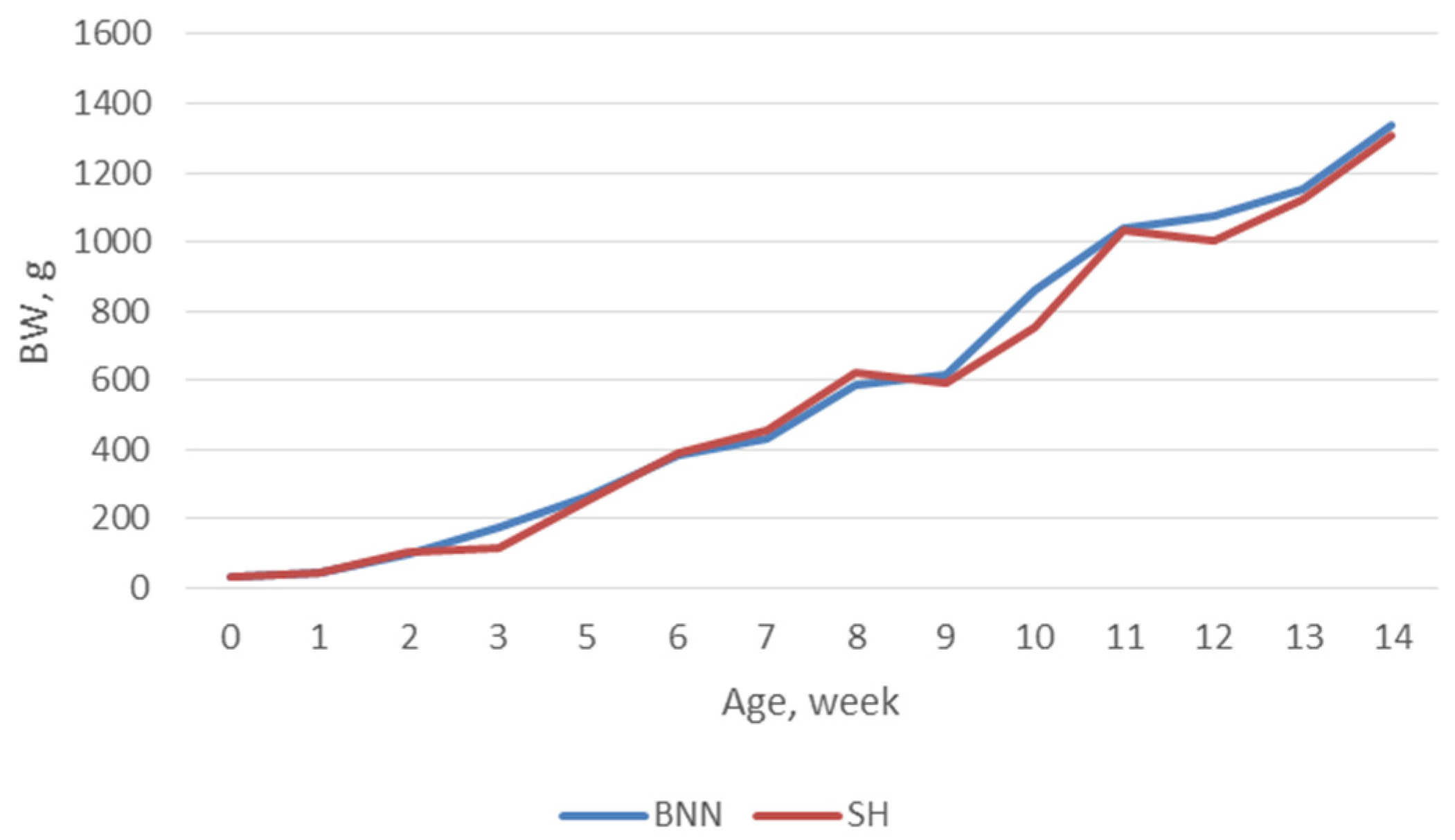

Table 1.
Yields of processed carcasses of BNN and SH at the ages of 12 and 14 weeks.
| BNN | SH | p-value | |||||
|---|---|---|---|---|---|---|---|
| 12 | 14 | 12 | 14 | Breed | Age | B x A | |
| SW | 1226.10±79.13 | 1457.10±157.93 | 1092.90±224.70 | 1461.10±206.62 | 0.254 | <0.01 | 0.227 |
| Processed carcass yield, g | |||||||
| CC | 1000.09±58.28 | 1206.51±139.47 | 806.36±194.89 | 1171.12±174.33 | 0.075 | <0.01 | 0.282 |
| RR | 902.37±51.66 | 1087.76±130.10 | 773.07±183.20 | 1052.65±159.51 | 0.072 | <0.01 | 0.295 |
| RG | 783.40±44.84 | 952.41±113.87 | 660.33±158.72 | 920.53±137.43 | 0.051 | <0.01 | 0.243 |
| Processed carcass yield, % SW | |||||||
| CC | 81.62±2.20 | 82.75±1.24 | 78.30±3.01 | 80.07±1.81 | <0.01 | 0.042 | 0.646 |
| RR | 73.66±2.10 | 74.58±1.35 | 70.20±3.42 | 71.97±2.26 | <0.01 | 0.084 | 0.582 |
| RG | 63.95±1.97 | 65.31±1.78 | 59.90±3.47 | 62.93±1.70 | <0.01 | <0.01 | 0.269 |
Data are expressed as mean ± standard deviation. SW-slaughter weight; CC-conventional processed carcass; RR-ready to roast; RG-ready to grill.
Table 2.
Conformation of processed carcass BNN and SH at the ages of 12 and 14 weeks.
| Conformation measures | BNN | SH | p-value | ||||
|---|---|---|---|---|---|---|---|
| 12 | 14 | 12 | 14 | Breed | Age | B x A | |
| Absolute values | |||||||
| SL, mm | 84.0±4.85 | 91.0±5.77 | 78.2±7.93 | 90.0±5.62 | 0.089 | <0.01 | 0.225 |
| KL, mm | 104.4±4.03 | 108.2±5.61 | 99.1±7.32 | 107.5±11.25 | 0.217 | 0.015 | 0.342 |
| BD, mm | 96.4±5.40 | 99.6±8.03 | 92.8±7.80 | 103.1±7.26 | 0.982 | <0.01 | 0.128 |
| TG, mm | 112.5±4.03 | 119.3±3.40 | 106.1±8.49 | 116.5±7.96 | 0.03 | <0.01 | 0.379 |
| BA, degree | 96.1±3.96 | 101.4±6.33 | 93.2±4.71 | 94.9±5.63 | <0.01 | <0.05 | 0.284 |
| Index values | |||||||
| SW/SL, g/mm | 14.62±0.98 | 16.00±1.25 | 13.84±1.67 | 16.21±1.91 | 0.547 | <0.01 | 0.304 |
| SW/KL, g/mm | 11.74±0.58 | 13.46±0.96 | 11.00±1.93 | 13.57±1.05 | 0.420 | <0.01 | 0.280 |
| SW/BD, g/mm | 12.77±0.86 | 14.65±1.31 | 11.69±1.70 | 14.14±1.30 | 0.067 | <0.01 | 0.511 |
| SW/TG, g/mm | 10.90±0.66 | 12.21±1.23 | 10.23±1.58 | 12.50±1.15 | 0.616 | <0.01 | 0.211 |
Data are expressed as mean ± standard deviation. SW-slaughter weight; SL-shank length; KL-keel length; BD-breast depth; TG-thigh girth; BA-breast angle.
Table 3.
Proportions of main carcass parts and edible internal carcass parts of BNN and SH at the ages of 12 and 14 weeks.
Table 3.
Proportions of main carcass parts and edible internal carcass parts of BNN and SH at the ages of 12 and 14 weeks.
| Carcass parts | BNN | SH | p-value | ||||
|---|---|---|---|---|---|---|---|
| 12 | 14 | 12 | 14 | Breed | Age | B x A | |
| Weight, g | |||||||
| Head | 42.62±3.51 | 51.51±4.89 | 36.52±5.32 | 46.21±5.37 | <0.01 | <0.01 | 0.795 |
| Neck | 52.50±4.96 | 59.99±8.47 | 50.74±14.46 | 70.15±13.44 | 0.236 | <0.01 | 0.096 |
| Metatarsus | 55.18±6.72 | 67.31±8.26 | 50.08±8.26 | 62.35±10.89 | 0.074 | <0.01 | 0.98 |
| Back | 102.06±11.14 | 122.60±16.94 | 86.19±19.65 | 116.15±18.86 | 0.044 | <0.01 | 0.386 |
| Pelvis | 102.28±11.70 | 125.22±16.54 | 86.09±21.53 | 122.76±21.01 | 0.112 | <0.01 | 0.238 |
| Wings | 113.18±10.18 | 134.77±12.79 | 99.52±20.94 | 129.66±18.91 | 0.77 | <0.01 | 0.412 |
| Breast | 190.78±12.82 | 225.20±29.91 | 148.39±43.42 | 219.90±35.31 | 0.026 | <0.01 | 0.078 |
| Thighs & drumstick | 265.22±19.98 | 328.86±36.01 | 233.21±58.37 | 321.11±51.03 | 0.161 | <0.01 | 0.388 |
| Heart | 6.18±1.40 | 7.03±0.93 | 5.59±1.18 | 6.55±1.74 | 0.178 | 0.031 | 0.991 |
| Liver | 25.03±4.29 | 27.36±5.69 | 21.88±3.52 | 27.73±4.13 | 0.333 | <0.01 | 0.222 |
| Stomach | 35.69±3.27 | 41.16±12.86 | 34.79±9.11 | 37.48±10.83 | 0.460 | 0.192 | 0.653 |
| % SW | |||||||
| Head | 3.76B±0.54 | 3.55B±0.29 | 4.71A±1.30 | 3.18B±0.20 | 0.214 | <0.01 | <0.01 |
| Neck | 4.28±0.30 | 4.11±0.31 | 4.57±0.48 | 4.77±0.40 | <0.01 | 0.871 | 0.124 |
| Metatarsus | 4.50±0.40 | 4.63±0.41 | 4.64±0.47 | 4.28±0.56 | 0.494 | 0.449 | 0.105 |
| Back | 8.34±0.88 | 8.39±0.46 | 7.85±0.56 | 7.96±0.76 | 0.04 | 0.71 | 0.911 |
| Pelvis | 8.34±0.81 | 8.58±0.34 | 7.85±0.74 | 8.37±0.60 | 0.1 | 0.073 | 0.5 |
| Wings | 9.23±0.60 | 9.27±0.39 | 9.09±0.58 | 8.88±0.37 | 0.1 | 0.566 | 0.428 |
| Breast | 15.60a±1.22 | 15.44a±0.91 | 13.31b±1.61 | 15.04a±0.89 | <0.01 | 0.045 | 0.017 |
| Thighs & drumstick | 21.63±0.70 | 22.59±1.00 | 21.12±1.80 | 21.94±1.02 | 0.136 | 0.024 | 0.856 |
| Heart | 0.51±0.12 | 0.49±0.05 | 0.51±0.05 | 0.44±0.07 | 0.394 | 0.094 | 0.272 |
| Liver | 2.04±0.31 | 1.87±0.28 | 2.05±0.35 | 1.90±0.18 | 0.82 | 0.096 | 0.883 |
| Stomach | 2.92±0.26 | 2.81±0.76 | 3.20±0.49 | 2.54±0.49 | 0.975 | 0.03 | 0.11 |
Data are expressed as mean ± standard deviation. a,b Means in rows with different superscripts differ significantly at p ≤ 0.05 as a result of the interaction effect of factors. A,B Means in rows with different superscripts differ significantly at p ≤ 0.01 as a result of the interaction effect of factors.
Table 4.
Proportions of certain tissues of the chest and legs (thighs & drumsticks) of the BNN and SH breeds at the ages of 12 and 14 weeks.
Table 4.
Proportions of certain tissues of the chest and legs (thighs & drumsticks) of the BNN and SH breeds at the ages of 12 and 14 weeks.
| BNN | SH | p-value | ||||||
|---|---|---|---|---|---|---|---|---|
| 12 | 14 | 12 | 14 | Breed | Age | BxA | ||
| Breast | ||||||||
| Muscle tissue | g | 124.07 ±10.25 | 150.06 ±21.77 | 94.19 ± 32.06 | 143.05 ±24.05 | 0.017 | <0.001 | 0.131 |
| % SW | 10.15 ± 0.98 | 10.28 ± 0.74 | 8.37 ± 1.44 | 9.78 ± 0.74 | 0.001 | 0.022 | 0.055 | |
| % CCW | 12.42a ± 1.02 | 12.42a ± 0.84 | 10.66b ± 1.62 | 12.22a ± 0.95 | 0.01 | 0.039 | 0.039 | |
| Bone tissue | g | 45.27 ± 5.32 | 51.79 ± 7.59 | 38.28 ± 8.92 | 51.08 ± 7.28 | 0.108 | <0.001 | 0.187 |
| % SW | 3.70 ± 0.47 | 3.56 ± 0.4 | 3.49 ± 0.38 | 3.50 ± 0.26 | 0.287 | 0.6 | 0.533 | |
| % CCW | 4.53 ± 0.48 | 4.30 ± 0.44 | 4.46 ± 0.45 | 4.38 ± 0.34 | 0.964 | 0.262 | 0.593 | |
| Skin | g | 14.06 ± 1.84 | 16.69 ± 2.29 | 10.85 ± 3.19 | 16.57 ± 3.82 | 0.077 | <0.001 | 0.1 |
| % SW | 1.15 ± 0.15 | 1.15 ± 0.12 | 0.99 ± 0.18 | 1.13 ± 0.18 | 0.082 | 0.169 | 0.154 | |
| % CCW | 1.41 ± 0.18 | 1.39 ± 0.14 | 1.26 ± 0.22 | 1.41 ± 0.23 | 0.333 | 0.293 | 0.163 | |
| Thighs & Drumsticks | ||||||||
| Muscle tissue | g | 164.56 ±14.14 | 209.37 ±24.46 | 143.83 ±40.38 | 205.26 ±34.37 | 0.199 | <0.001 | 0.387 |
| % SW | 13.42 ± 0.65 | 14.38 ± 0.84 | 12.94 ± 1.49 | 14.02 ± 0.85 | 0.199 | 0.003 | 0.866 | |
| % CCW | 16.44 ± 0.70 | 17.38 ± 0.97 | 16.50 ± 1.46 | 17.51 ± 0.89 | 0.785 | 0.005 | 0.918 | |
| Bone tissue | g | 64.35 ± 6.38 | 78.40 ± 10.82 | 58.41 ± 11.18 | 74.21 ± 11.67 | 0.126 | <0.001 | 0.788 |
| % SW | 5.25 ± 0.39 | 5.38 ± 0.51 | 5.37 ± 0.47 | 5.09 ± 0.44 | 0.551 | 0.597 | 0.149 | |
| % CCW | 6.43 ± 0.44 | 6.50 ± 0.59 | 6.87 ± 0.61 | 6.35 ± 0.48 | 0.406 | 0.193 | 0.086 | |
| Skin | g | 26.02 ± 3.83 | 29.72 ± 5.29 | 20.34 ± 7.39 | 29.91 ± 6.4 | 0.148 | 0.001 | 0.123 |
| % SW | 2.12 ± 0.26 | 2.05 ± 0.37 | 1.82 ± 0.42 | 2.04 ± 0.28 | 0.152 | 0.49 | 0.186 | |
| % CCW | 2.60 ±0.33 | 2.48 ± 0.45 | 2.31 ± 0.49 | 2.54 ± 0.35 | 0.402 | 0.678 | 0.181 | |
Data are expressed as mean ± standard deviation. SW – slaughter weight; CCW-conventional processed carcass weight. a,b Means in rows with different superscripts differ significantly at p ≤ 0.05 as a result of the interaction effect of factors.
Table 5.
Quality of breast meat of BNN and SH at the ages of 12 and 14 weeks.
| BNN | SH | p-value | |||||
|---|---|---|---|---|---|---|---|
| 12 | 14 | 12 | 14 | Breed | Age | BxA | |
| Chemical composition, % | |||||||
| Water | 74.41b±0.60 | 74.22b±0.85 | 75.15a±0.59 | 73.96b±0.71 | 0.283 | 0.003 | 0.023 |
| Fat | 0.50±0.12 | 0.54±0.13 | 0.41±0.11 | 0.46±0.13 | 0.04 | 0.278 | 0.837 |
| Proteins | 24.10a±0.61 | 24.24a±0.76 | 23.45b±0.53 | 24.59a±0.76 | 0.495 | 0.005 | 0.024 |
| Ash | 0.78±0.41 | 1.00±0.05 | 0.88±0.29 | 0.98±0.05 | 0.625 | 0.059 | 0.464 |
| Fatty acid content | |||||||
| SFA | 40.26±3.85 | 40.33±3.79 | 41.87±3.55 | 42.21±4.12 | 0.158 | 0.866 | 0.913 |
| MUFA | 26.50±2.93 | 25.20±3.94 | 25.28±2.41 | 24.52±3.31 | 0.352 | 0.315 | 0.795 |
| PUFA | 33.13±2.33 | 34.23±3.13 | 32.74±3.63 | 33.31±4.16 | 0.540 | 0.438 | 0.805 |
| SFA/PUFA | 1.23±0.19 | 1.19±0.17 | 1.30±0.24 | 1.30±0.27 | 0.203 | 0.774 | 0.829 |
| n-6 | 31.19±2.00 | 32.84±3.09 | 30.68±3.28 | 30.76±4.27 | 0.218 | 0.405 | 0.449 |
| n-3 | 1.97±0.55 | 1.63±0.21 | 2.05±0.48 | 2.08±0.43 | 0.063 | 0.262 | 0.188 |
| n-6/n-3 | 16.66b±3.33 | 20.56a±3.50 | 15.46b±2.62 | 15.15b±2.51 | 0.001 | 0.068 | 0.035 |
| Physical properties | |||||||
| Cooking loss, % | 26.59±1.68 | 26.61±1.12 | 26.77±1.97 | 26.43±0.92 | 0.996 | 0.734 | 0.701 |
| Tenderness, kg | 3.57±1.02 | 3.11±0.37 | 3.14±0.87 | 2.88±0.44 | 0.157 | 0.129 | 0.673 |
Data are expressed as mean ± standard deviation. a,b Means in rows with different superscripts differ significantly at p ≤ 0.05 as a result of the interaction effect of factors.
Table 6.
Quality of leg meat of BNN and SH at the ages of 12 and 14 weeks.
| BNN | SH | p-value | |||||
|---|---|---|---|---|---|---|---|
| 12 | 14 | 12 | 14 | Breed | Age | BxA | |
| Chemical composition, % | |||||||
| Water | 75.58±0.78 | 75.09±0.57 | 76.32±0.93 | 75.60±0.74 | 0.014 | 0.017 | 0.637 |
| Fat | 2.60±0.28 | 2.55±0.59 | 1.66±0.69 | 2.06±0.60 | <0.001 | 0.330 | 0.212 |
| Proteins | 20.86±0.83 | 21.27±0.87 | 21.06±1.27 | 21.35±0.87 | 0.664 | 0.259 | 0.849 |
| Ash | 0.95±0.04 | 0.98±0.04 | 0.96±0.06 | 0.98±0.09 | 0.760 | 0.165 | 0.922 |
| Fatty acid content | |||||||
| SFA | 34.67±2.16 | 35.97±2.65 | 35.23±2.92 | 33.98±2.73 | 0.394 | 0.981 | 0.135 |
| MUFA | 32.68±2.05 | 30.94±3.05 | 30.06±3.61 | 30.90±5.19 | 0.257 | 0.700 | 0.273 |
| PUFA | 32.46±3.07 | 33.09±4.48 | 34.71±4.63 | 34.62±5.30 | 0.187 | 0.847 | 0.798 |
| SFA/PUFA | 1.08±0.16 | 1.11±0.21 | 1.04±0.18 | 1.01±0.21 | 0.224 | 0.984 | 0.632 |
| n-6 | 30.97±2.64 | 31.48±4.26 | 32.72±4.52 | 32.93±5.33 | 0.247 | 0.795 | 0.914 |
| n-3 | 1.68±0.16 | 1.62±0.31 | 1.99±0.30 | 1.92±0.40 | 0.003 | 0.496 | 0.947 |
| n-6/n-3 | 18.56±1.59 | 19.78±2.72 | 16.67±2.60 | 17.46±2.52 | 0.009 | 0.193 | 0.780 |
| Physical properties | |||||||
| Cooking loss, % | 28.49±1.93 | 27.77±1.20 | 29.54±1.75 | 28.86±1.22 | 0.037 | 0.165 | 0.970 |
| Tenderness, kg | 3.47±0.87 | 2.58±0.49 | 3.33±0.90 | 2.44±0.31 | 0.520 | <0.001 | 0.990 |
Data are expressed as mean ± standard deviation.
Disclaimer/Publisher’s Note: The statements, opinions and data contained in all publications are solely those of the individual author(s) and contributor(s) and not of MDPI and/or the editor(s). MDPI and/or the editor(s) disclaim responsibility for any injury to people or property resulting from any ideas, methods, instructions or products referred to in the content. |
© 2025 by the authors. Licensee MDPI, Basel, Switzerland. This article is an open access article distributed under the terms and conditions of the Creative Commons Attribution (CC BY) license (https://creativecommons.org/licenses/by/4.0/).
Copyright: This open access article is published under a Creative Commons CC BY 4.0 license, which permit the free download, distribution, and reuse, provided that the author and preprint are cited in any reuse.


