

Submitted:
16 September 2025
Posted:
18 September 2025
You are already at the latest version
Abstract
Wildlife is a common asset to which the local community has the right to exploit. To achieve sustainable management of this resource, a community forest (CF) with a wildlife vocation has been set up as part of the "Sustainable management of wildlife and the bushmeat sector in Central Africa" project. Given the constraints faced by these community forests (CFs), we conducted a study to assess their governance in Gabon. Our aim was to examine whether the way they currently operate is conducive to their long-term survival and the integration of sustainable hunting. To do this, we constructed a SWOT matrix (strengths, weaknesses, opportunities and threats) to deter-mine their strengths and weaknesses, from which we carried out a factorial correspondence analysis (FCA) to identify potentially viable CFs. This enabled us to understand that most of the difficulties encountered by these CFs stem from the low level of appropriation of this concept by local communities, which is due to the low level of intervention by the forestry administration in raising awareness of CF management. This study shows that local communities must first take ownership of how CFs work so that they can better apply their success factors.
Keywords:
community forest
; local community involvement
; ownership of CFs governance
; forestry administration
; Gabon
1. Introduction
The participatory approach in forestry stems from the concept of sustainable forest management. This requires the involvement of various stakeholders and is characterized by the achievement of three objectives: (i) the sustainability of natural resources; (ii) social development; (iii) and economic development [1,2,3]. The participatory management concept emerged in the early 1980s and is defined as the inclusion of local communities in the management of their natural resources on the grounds that they are in a best position to manage them because they are the ones facing these challenges [4]. Gabon, like many other nations, has made commitments to sustainable development at the United Nations Conference on Environment and Sustainable Development in Rio de Janeiro in 1992. Indeed, "It was recognized by all during this conference that development can only be sustainable if it is effectively taken in hand by the populations it concerns" [4,5] (pp.11 & 3). To fulfill this commitment, the public authorities had to reform the country's forestry policy by drawing up a forestry code that was enacted into law no. 016/2001 on 31 December 2001 and applied across the Gabonese Republic. This code focuses on the sustainable management of natural resources. Involvement of local communities in the management of their natural resources is detailed under the heading of Participatory Forestry. In Gabon, the latter takes three forms [6] : (i) series (portions of land) for the use of local populations that are delimited in forest concessions under sustainable management, the aim of which is to promote the social aspect of sustainable forest management within the Republic’s permanent forest estate, classified forests and production forests; (ii) buffer zones in relation to national parks (permanent forest estate and classified forests), in which communities are allowed to conduct certain activities; (iii) and CFs, in which local populations manage natural resources sustainably by exploiting them for themselves on the basis of a simple management plan (SMP) and a local development plan (LDP).
Integrated and community approaches characterize sustainable forest management [7]. Accordingly, the CF “is a portion of the rural forest estate, assigned to a village community with a view to carrying out activities or undertaking dynamic processes for the sustainable management of natural resources based on a simplified management plan” [8] and consistent with article 156 of the Gabonese forestry code. Other authors would provide a definition that gives local communities greater responsibility in decision-making on forest management, land access rules and the right to the benefits that are derived from these resources [9].
A CF is a legal entity that enables local populations to take community actions to manage, exploit resources and benefit from subsequent economic spin-offs. In Central Africa, the first CFs were launched in Cameroon in 2000 [10]. In Gabon, the first CFs are established in 2013, including those in Ebyeng-Edzuameniène, Nkang and Ongam, thanks to projects such as “Développement d'Alternatives Communautaires à l'Exploitation Forestière Illégale” (DACEFI) [11]. This project was funded by the International Tropical Timber Organization (ITTO) [8]. To obtain their CF, local communities must form a legal management entity (LME) that is referred to as a cooperative or association [12]. For its operation, each CF must be equipped with technical documents such as the SMP and LDP which identify the multi-resource inventories, the income-generating activities (IGAs) and the community development projects to be implemented, together with a certificate legalizing the LME, articles of association, internal rules and a final agreement.
To be successful, many authors have addressed the criteria that are necessary for a CF to function properly, namely local and participative governance, local economic benefits, multiple use of the forest and transparency [13,14,15]. Considered as a tool for participatory forest management, each CF aims to reduce the poverty of local communities and thus promote better forest management [15,16].
In speaking of multiple uses of forests, hunting is one of the activities that is defined in several CFs. It is part of the daily life of local populations, but urban populations also enjoy bushmeat. For many people, it is an essential part of their consumption habits [17]and bushmeat is a main source of animal protein for human populations in many parts of Africa and Asia [18].
On the basis of Elinor Ostrom’s concept of common goods, in which wildlife is a unit of resource belonging to the pool of common goods where an individual’s harvesting reduces the capacity of others to harvest [19]. Common goods, the benefits of which are enjoyed by local populations, must be managed rationally by the community, given that they are shared resources, while at the same time establishing effective management rules in coordination with external authorities [19,20]. Regarding the changing nature of the “Commons”, Euler [21] has conceptualized the Commons by moving beyond the goods-based definition by introducing the social practices of commoning as a vital determinant. In this case, Commons are hence conceptualized as the social form of (tangible and/or intangible) matter that is determined by commoning. The social practices of commoning are argued to be voluntary and inclusively self-organized activities and mediation of peers who aim at satisfying needs. The pilot project named “Sustainable management of wildlife and the bushmeat sector in Central Africa”, was financed by the Global Environment Facility (GEF) and implemented by the Food and Agriculture Organization (FAO) in collaboration with the forestry administrations of Congo, Gabon, Democratic Republic of Congo and Central African Republic, together with the Commission des forêts d'Afrique centrale (Central African Forest Commission)-COMIFAC, Réseau des Aires Protégées d'Afrique Centrale (the Network of Protected Areas of Central Africa)-RAPAC, Center for International Forestry Research (CIFOR), Centre de cooperation International en Recherche Agronomique pour le Développement (Center for International Cooperation in Agricultural Research for Development)-CIRAD and the International Union for Conservation of Nature (IUCN). One of the objectives of this project was to encourage local populations to practice sustainable hunting and to promote formal marketing channels for the products of this hunting [22,23]. To achieve this objective, CFs were selected as natural laboratories to study the sustainable wildlife hunting in Gabon, but their development has encountered difficulties that have been translated into lessons learned [24].
These CFs in Gabon are experiencing difficulties in applying and achieving their sustainability objectives. The same difficulties have also been identified in several Central African CFs [25,26] as well as those, in East Africa, as is the case in Tanzania with the introduction of community wildlife management [27]. This has led us to evaluate several Gabon’s CF operations throughout the country. We asked ourselves whether the current management of CFs meets expectations in such a way that the inclusion of a sustainable hunting activity could reduce the hunting of fully protected species and enable stakeholders to make a living from their activities. To this end, based on documentary research and information gathered from focus groups and individual interviews, we have constructed a SWOT matrix (Strengths, Weaknesses, Opportunities, Threats), the analysis of which would enable us to answer our question. The aim of our study is therefore to use SWOT analysis to assess the current operation of CFs in Gabon, to determine community ownership of CFs management and whether there is a need to revitalize their operation in order to integrate and optimize sustainable hunting activities.
2. Materials and Methods
2.1. Presentation of the Study Sites
Considering the number of CFs with definitive agreements and their distribution across the country, seven CFs in four provinces of Gabon were selected (Figure 1).
Among the first CFs installed in Gabon in 2009 were those in Ebyeng-Edzuameniène, Nkang and Ongam. The first was set up by ITTO, while the others were established by the DACEFI project. It should be noted that these community forests have been in operation since their establishment in 2009 but did not obtain their definitive agreements until later (Table 1). Ngokoéla is a wildlife CF. It was set up in 2012 under the pilot project "Sustainable management of wildlife and the bushmeat sector in Central Africa". Then, the Balem-Inzanza CF was established. The Viafé and Kouagna-Ndougou CFs were set up at the request of the local communities.
2.2. Site Selection and Data Collection
During our data collection from September 2020 to January 2021, Gabon had 85 CFs application files, 84 CFs with provisional agreements and 51 CFs with definitive agreements. We chose to work only with those that had their definitive agreements and, consequently, all of the technical documents that were required for the proper running of their FC. Our project was approved by Université Laval’s Ethics Committees for Research involving Humans (CÉRUL) no. 2020-043 / 29-05-2020.
Given that non-probability sampling and sampling by networks are the best approaches for qualitative research, we proceeded with purposive sampling, which is a reasoned choice or a "judgmental" choice enabling us to define a sample according to very precise factors [28,29]. With reference to the multiple case study, which also takes account of diversity [30], based on the number of CFs in each province, we considered their geolocations. We worked with three CFs in Ogooué-Ivindo, two CFs in Woleu-Ntem, one CF in Ngounié and one CF in Estuaire, for a total of seven CFs. Regarding data collection, we carried out a documentary search by examining SMPs, LPDs, final CF allocation agreements, statutes and internal regulations. Using an interview guide and a microphone, we conducted individual semi-structured interviews in French and local language with 87 people, including six forestry administration officers working in the CF department and 81 members of the six CFs we worked with.
These interviews focused on issues such as socio-demographic data; the adequacy of community activities and actions carried out in relation to those defined in the SMP and LDP; the use of funds generated according to the distribution defined in the aforementioned documents, as well as the intervention of the forest administration in the operation of their CFs.
SWOT is "a strategic planning tool" [31]. It has enabled us to assess the way in which these CFs operate. The aim of the assessment is to ensure that strengths and opportunities offset weaknesses and threats, so as to improve the functioning of these CFs. This would promote the integration of sustainable hunting activities to meet the objectives of sustainable wildlife resource management and the fight against human poverty in local communities living in these CFs.
2.3. Data Analysis Methods
To analyse the degree of ownership of CF management by local communities, we used the data collected to design the SWOT matrix. We then used the SWOT matrix to produce a heat map in Excel and a factorial correspondence analysis (FCA), considering the "CF" factor with its "Balem-Inzanza", "Ebyeng-Edzuameniene", "Ngokoela", "Nkang", "Viafe", "Kouagna-Ndougou" and "Ongam" modalities, and the "SWOT matrix results" factor with its "Strengths", "Weaknesses", "Opportunities" and "Threats" modalities.
3. Results
3.1. Characteristics and Governance of the Studied CFs
The characteristics of the studied CFs are given in Table 2. This table contains the socio-demographic characteristics of the populations, the CF characteristics as well as the information on their governance.
Table 2 shows that in the CFs we visited, an average of 11% of people were illiterate generally over 70 years old while the majority were young, active and literate. This should enable members to get involved in various activities. The General Assembly is the decision-making body, while LME managers are responsible for implementing them. Each CF is located within the village finage. In some SMPs and LDPs, we find the funding distribution key for certain CFs (Table 2), while the others do not. This can be explained by the fact that from one CF to another, not all the documents have the same presentation template.
According to the technical documents that guide the operation of CFs, the LME must set up activities that are more akin to IGAs (Income-Generating Activities) than to activities that are entrusted to third parties or companies. The aim is to involve every member of the community in activities to earn an income and carry out community and social actions for the development of the villages. Table 2 shows that two of the seven CFs have diversified their activities. The one at Ebyeng-Edzuameniène has set up bee-keeping activities, non-timber forest product (NTFP) harvesting, tree nurseries, a five-bedroom hut that earns around $22 per night for each room, and iboga (Tabernanthe iboga, Apocynaceae) cultivation. This CF is not yet exploiting its wood, but has embarked on reforestation, with a hectare of wood planted. All of its activities are carried out by its members, even if its profits do not yet reach the millions of CFA francs that are needed to carry out major projects. The Ongam FC's activities include fishing, woodcutting, tent and chair hire (which are IGAs but involve only two fishermen and one person to provide the hire), logging and sand harvesting (which are activities carried out by operators from outside the local community). Apart from logging, the Kouagna-Ndougou CF, has taken up basket-making, which is an IGA. In contrast, the other CFs, such as Balem-Inzanza, Nkang, Ngokoéla, Viafé (although they have tried to develop other activities) and Kouagna-Ndougou, operate solely on logging. This does not require the involvement of community members.
In terms of actions that were implemented, Table 2 shows that, for all CFs combined, more social actions have been carried out, while several community actions remain unfinished. Apart from the other CFs that have benefited from the installation of electricity in their villages thanks to other projects, Balem-Inzanza CF has completed its electrification project, Ngokoéla CF remains unfinished and those of Nkang and Kouagna-Ndougou have not yet begun. As for village water supplies, Balem-Inzanza and Viafé have already installed pumps, but no water is yet flowing. In contrast, the CFs of Viafé and Ongam have rehabilitated their elementary school, and Ebyeng-Edzuameniène has built an infirmary, which self-finances health care expenses. We further note that most social actions that have been carried out depend upon logging, which is not accompanied by reforestation or other activities. In the case of Balem-Inzanza CF, electricity is supplied by two generators instead of solar panels that were specified in the initial SMP. As a result, when logging was suspended, these generators ran out of fuel for electricity power. This has created a need among members that did not previously exist, and they are obliged to ask for help to contribute to the purchase of the diesel that was needed for their lighting. Instead of appeasing the villagers, the decision to purchase generators has created an additional difficulty for them.
3.2. SWOT Analysis of Community Forests
The matrix of SWOT analysis of CFs showing the Strengths, weaknesses, opportunities and threats is shown in Figure 2.
3.2.1. Strengths and Weaknesses
The SWOT analysis shows that the seven CFs are similar in several points, while some stand out from the others. The lack of use of their strengths systematically enriches the weaknesses that have been identified. Indeed, the CFs are endowed with natural resources enabling them to carry out activities such as logging, NTFP exploitation, hunting, fishing, handicrafts, agriculture, sand exploitation and many others. Yet, the fact that several CFs do not diversify their activities, results in low involvement of community members. CFs have young, literate populations who are capable of working, but who do not necessarily have management qualifications. The fact of having an unqualified human resource may explain the lack of diversification of activities within CFs.
Many managers of the seven CFs have a poor grasp of the articles of association, internal rules, SMP and LDP, and other members even less so. These documents are supposed to guide them in the best possible management practices for their CFs. The result is a lack of diversification of activities, which systematically leads to a low degree of involvement among community members. With the exception of the Ebyeng-Edzuameniène CF, where various activities attract community involvement, the Ongam CF only has fishing, which is carried out by two people, as an IGA, while logging and sand harvesting are entrusted to operators; the five other CFs have only logging under tenancy. This indicates a very low level of participation. If awareness-raising campaigns were to have been organized so that everyone understood that their right includes the idea of having a voice in the CF, they would be involved in the CF activities as they are in their own activities: "[...] Here, each of us makes with his hands. You make your cassava, you pile it up, you go out and sell it. It's not part of the community forest. It's the same as going into the bush, picking my kumu and going off to sell. That's not the community forest project" (respondent 67).
This low level of appropriation of technical documents is also reflected in the poor management of the CF. Although the LME's managers include forestry officers, forestry activity is not really monitored, as these respondents indicate :
Respondent 17: We have a lot of wood in the bush. We don't know why they made such a mess of it. We have a lot of wood in the bush that they didn't take. And we don't know why that wood is now rotting in the bush. They've been aware of this ever since, but we haven't yet had any takers who feel able to come and take everything that's on the ground. Indeed, what the project manager has just told you is all well and good, because these people know how to salvage nothing but Kevazingo [African rosewood, Guibourtia, Fabaceae]. And this Kevazingo, they haven't taken everything. Some Kevazingos are still in the bush.
Respondent 47: They leave certain species, such as Okoumé [Gaboon mahogany, Aucoumea klaineana, Burseraceae], to rot after felling it.
Indeed, several species are often found laying on the ground without being sold, the minimum exploitable diameter (MED) is often not respected, payment of forest royalties due to communities is often delayed, and several blocks are exploited in less than five years when a single block is supposed to last five years.
For CFs that have developed their forestry activities, the aim was to generate important profits and easily implement various IGAs that would support community and social actions. Yet not only have very few CFs diversified their activities, but the actions they have carried out are based more on social than community actions, such as preparing school kits and providing assistance with weddings and bereavements, to the detriment of water supply and electrification projects. All of these social actions are based mainly on logging, which does not respect the five-year blocks, is not followed by reforestation. This also generates other problems for communities such as in the case of the Balem-Inzanza CF, which bought generators for the two villages, instead of solar panels. However, with the cessation of logging, which is their only activity, they found themselves unable to supply diesel for electricity, forcing members to seek financial help to contribute to the purchase of diesel, at the risk of remaining in the dark.
Favoring social actions without diversifying into IGAs is a deterrent to the sustainability of these CFs, especially as LME managers will make community members dependent upon their actions, since logging would have stopped for lack of timber at the required MED. Another of their weaknesses concerns the embezzlement of funds by former LME managers in these CFs, such as Ngokoéla, Balem-Inzanza and Viafé.
Taking cultural aspects into account is a strength. It can explain the ability to diversify activities in the Ebyeng-Edzuameniène and Ongam CFs:
Respondent 47: [...] even the head of the forestry department once told us that you have to make sacrifices because there are too many accidents. We too said yes, because we have to make sacrifices to protect the lives of human beings, other people's children and other people's drivers. Even he said that I couldn't send my contingents to go and carry out missions in your forest, because one of my sons, the deputy general secretary's grand brother, had his head cut off here, but thank God he wasn't dead.
Respondent 80: Normally, before starting the forest, there are tombs there. So, when it comes to exploiting this area of forest, the owners have to come and talk. At the sacrifice, you give them wine and food so that the workers don't have too many accidents, because sometimes the wood refuses to fall. It even blocks the machine. Our forest has grandfathers in it, so to work properly, we'd have to ask permission from the grandfathers. Once we've done that, it's all over, and people go to work.
Respondent 41: There's hatred. There is no understanding between families.
3.2.2. Opportunities and Threats
Opportunities consolidate strengths and, together, reduce weaknesses and threats. Low ownership of CF documents or management is identified as a weakness, while interference by local elites, negative influence of non-residents and conflicts with loggers are threats. This leads us to believe that the priority reserved for logging is just to make money and share it, rather than to bring the CF to life by developing activities in which the community is involved, as these people say: "Bad management and people had no will, especially the will because everyone wanted that when there's a little money, you have to share, you have to share [...]" (Respondent 20) and "So here, people are only interested in the money that falls from the sky. They don't want to work. That's the problem that's killing Ngokoéla. Ngokoéla likes everything to fall from the sky, and he just collects it like wood”(Respondent 43).
However, the CF is a management tool that local communities are learning to handle, even though activities such as hunting, fishing, livestock rearing, exploitation of NTFP and agriculture are daily individual activities. Capacity-building training on the various activities to be implemented and on the concepts of management will be necessary assets in order to better understand and appropriate the functioning of CFs, thus reducing the weaknesses and threats identified.
3.3. CF Representation by the Heatmap and FCA
The heatmap (Figure 3) and the FCA (Figure 4) enable us to identify potentially viable CFs. The FCA reveals two main axes explaining most of the percentage of total inertia in the data. Indeed, the sum of these two axes represents 98.13% of the total inertia of the data, whereas the reference value is estimated at 97.93%. This is extremely high and indicates that the variability expressed is significant. The chi-square of independence gave a statistical value of 11.0877 with a p-value of 0.890. This indicates a low correlation between CF and SWOT modalities. However, dimension one accounts for 92.68% of the variability in the data. This dimension is therefore the only axis carrying real information, reflecting a strong correlation between this axis and the six CF modalities and the seven SWOT modalities. It includes the "Strengths", "Weaknesses", "Threats", "Ebyeng-Edzuameniène", "Ongam", "Kouagna-Ndougou", "Balem-Inzanza", "Nkang" and "Ngokoéla" modalities.
Thus, according to the results of the FCA (Figure 4), on dimension one, the "Strengths", "Ebyeng-Edzuameniène", "Ongam" and "Kouagna-Ndougou" modalities are positively correlated, while the "Weaknesses", "Balem-Inzanza", "Nkang" and "Ngokoéla" modalities are negatively correlated. The heatmap shown in Figure 3 provides complementary results to those of the FCA, leading us to say that CFs associated with the 'Strengths' modality are more likely to develop, with a high potential for success for the Ebyeng-Edzuameniène CF. Conversely, those associated with the 'Weaknesses' category are less likely to develop.
3.4. SWOT Analysis of Forest Administration Intervention in CFs
The matrix of SWOT analysis of forest administration intervention showing the forces, weaknesses, opportunities and threats is shown in Figure 5.
The forestry administration is the state body that allocates CFs, defines the rules for managing forest resources and can suspend a FC that does not comply with its rules (Figure 5). Although it has delegated its rights to local communities, the administration board retains the right to monitor and impose sanctions on the manner in which forest resources are managed. It also has a duty to help local communities, free of charge, to carry out the technical work required to design their SMPs and LDPs, as stipulated in the community forest agreement (CFA) and referred to by this participant:
Respondent 1: Our role is to support communities wishing to set up and manage community forests. This implies technical responsibility for setting up community forests and overseeing their management. This involvement takes the form of carrying out preliminary technical work before the community forest is allocated. So, according to the law, the work is carried out free of charge for the benefit of the communities, but this is not always the case in the field due to financial problems. This doesn't always make it possible to apply this free service. So some communities that have a little money, ask the administration to support them, but this support is more due to travel to be in the field, but the work is carried out by the administration. Increasingly, they are calling on external expertise other than that provided by the administration, which is often referred to as a consulting firm. But the administration is obliged to validate the work carried out by these firms.
However, financing the design of these documents is one of the reasons why these local communities favor logging.
Each community also has a workforce with few skills in participatory resource management. The emphasis on logging to the detriment of monitoring the use of profits through diversification of activities and community projects is also one of their weaknesses. This interest in logging, which generates substantial profits, exposes them to corruption by collaborating with logging companies instead of looking after the interests of the communities, as illustrated by the testimony given during a focus group that the forestry administration forces communities to validate unwanted timber exports.
However, opportunities exist to mitigate the impact of these weaknesses by building the capacity of forestry administration staff in the field of social forestry, so that they can better monitor and guide local communities in the management of their CFs. In contrast, strengthening the regulatory framework of CFs would help improve their functioning, for example, by defining the minimum area of a CF to allow for the creation of sufficiently large hunting areas.
4. Discussion
The evaluation of CFs enables us to understand that assets can be available, but the situation is distorted when they are not put to good use. This study reveals two models of CF operation in Gabon: the participatory model, in which activities are diversified and involve community members, and the non-participatory model, in which the only activity is logging and communities are not involved. This leads us to conclude that local communities have little ownership of CF governance, but with more awareness-raising and following the participatory model, their functioning can be improved. This would make it possible to safely integrate sustainable hunting activities.
Indeed, among the factors favoring the operation of CF, we find the availability of resources, clear property rights, community involvement and motivation [13,14,15]. Yet, community involvement requires the development of activities in which each member of the community receives an income to arouse their interest in the CF, and CF profits that are used to develop, first and foremost, community projects while associating those of a social nature. On the one hand, among those operating with the participatory model, one CF has tapped into its opportunities by creating a partnership on the cultivation of iboga, a plant endemic to Gabon. On the other hand, several CFs have developed only one activity: logging. They have transformed the CF into a simple logging operation. With no knowledge of industrial logging, these communities are not involved in the activities, know nothing about how a CF operates and only receive a royalty on this activity, which is carried out by a logger. This makes them wait-and-see spectators or passive rather than active participants [3,4].
The low level of ownership of CF operations is also reflected in the lack of knowledge of the content of the technical documents that are necessary for the smooth running of a CF. First, many members of the various CFs do not know the contents of their statutes and by-laws, and are unable to impose themselves on non-residents, who have no decision-making power over the operation of the CF. What is more, local communities do not consider CF activities to be the same as those they carry out individually. Second, there are the LME managers, who often withhold information and take decisions in place of the general assembly. To facilitate the start-up of the CFs, many of them put the emphasis on forestry activities. This was intended to finance the IGAs that would enable community and social projects to be carried out safely. Yet, the profits from logging are mainly injected into social projects, such as support for marriages and bereavements, to the detriment of community projects, which often remain unfinished. This is a form of embezzlement, since most of the profits generated are used for other needs that are not those identified by the communities, not to mention the real embezzlement practised either by local elites or by those in charge of the community forest management entity [1]. Third and to complete the picture, the people in charge of the forests are not doing their job of surveillance, since the forests are littered with cut but unutilised trees which do not benefit the community. The SMP divides the forest area into four five-year blocks, but for most of these CFs, two blocks have been used in less than five years. We believe that it is necessary at this level for the community to require the logger to present a contract with a buyer before the timber is cut and that, given the size of the FC areas, artisanal logging should prevail to respect the exploitation of the blocks.
All of these weaknesses and threats would be minimized with the intervention of the forestry administration in helping local communities to manage CFs and, above all, in multiple workshops to ensure that these communities have fully understood what CF management consists of and have ownership on it so as to make decisions for all [34]. While it is true that the forestry administration has granted them the necessary rights to manage CFs, the fact remains that it still retains its right to oversee the exploitation and management of forest resources in CFs [3]. In this respect, it would be wise to proceed with a gradual transfer of governance through the forestry administration or NGOs, especially as many of these local communities have no knowledge of business management, since we consider the management of a CF as such.
Taking into account the bottom-up approach [35], we can see the importance of including cultural aspects in the operation of CFs. In CFs that have been able to diversify their activities, these have been preceded by cultural rites for the success of the activities. Given that the aim of the analysis of these CFs is to integrate sustainable hunting into them, in order for it to be successful, it is necessary to take traditional knowledge into account by bridging and strengthening distinct knowledge systems and empowering local knowledge holders with scientific knowledge [36,37,38,39]. Local communities are accustomed to restricting consumption of a species when it is rare, by applying initiation or cultural prohibitions [17]. This means restricting consumers, for example to a species such as the python (Python sebae), which is only consumed by men. There are also totemic species that the community has a duty to protect. Taking into account the lineage and the traditional chief are factors that help limit not only conflicts within the community, but also the actions of local elites [40,41,42].
Finally, the results of our research show us the need for local communities to take ownership of CF governance if CF are to function over time, while sustainably managing their resources and developing better living conditions for these populations.
5. Conclusions
Two types of CFs have been identified in Gabon: 1) those that diversify activities while involving local communities, who receive income in addition to the profits generated by the CFs; and 2) those whose sole activity is logging, which is likely to experience a decline. CF requires a certain number of factors, such as the involvement and motivation of communities, acquired rights over their resources, and technical support from the forestry administration to empower local communities in the governance of CFs. And all of these factors can only play their part if local communities take ownership of FC management and consider CF activities as those that they carry out individually. Furthermore, for sustainable hunting to take place in CFs, local communities must be genuinely involved in the sustainable management of their forest resources. For a more in-depth assessment, it would be useful, in the future, to carry out a study on the financial evaluation of FCs in Gabon to find out their level of profitability.
Author Contributions
Conceptualization, AMMS, LB and DPK; methodology, AMMS.; software, AMMS.; validation, AMMS, LB and DPK.; formal analysis, AMMS; investigation, AMMS; resources, PCBF; data curation, AMMS; writing—original draft preparation, AMMS; writing—review and editing, AMMS, LB and DPK; visualization, AMMS, LB and DPK.; supervision, LB and DPM.; project administration, AMMS; funding acquisition, AMMS. All authors have read and agreed to the published version of the manuscript.
Funding
This research was funded by Canadian Bureau for International Education through the Programme Canadien des Bourses de la Francophonie and the Discovery Grant from the Natural Sciences and Engineering Research Council of Canada (NSERC) (Damase Khasa)
Institutional Review Board Statement
The study was conducted in accordance with the Declaration of Helsinki and approved by the Ethics Committee of Laval University (2020-043 / 29-05-2020 of 29-05-2020).
Informed Consent Statement
Informed consent was obtained from all subjects involved in the study.
Data Availability Statement
The data supporting this study are available at the following link https://doi.org/10.5683/SP3/16H1OF
Acknowledgments
We would like to thank Davy-Juste Matassa for producing the map of the study sites, and Léna Ilama and Gilles Raoul Lontsi Meli for their help in analysing our data.
Conflicts of Interest
The authors declare no conflicts of interest. The funders had no role in the design of the study; in the collection, analyses, or interpretation of data; in the writing of the manuscript; or in the decision to publish the results.
References
- Bigombe Logo, P. Les Élites et La Gestion Décentralisée Des Forêts Au Cameroun . Essai d ’ Analyse Politiste de La Gestion Néopatrimoniale de La Rente Forestière En Contexte de Décentralisation. In Proceedings of the Colloque Gecolev (Gestion Concertée des Ressources Naturelles), Saint Quentin en Yvelines, France; 2006; p. 18. [Google Scholar]
- Mensah, A.M.; Castro, L.C. Sustainable Resource Use & Sustainable Development: A Contradiction? Center of Development Research, University of Bonn 2004, 1, 22. [Google Scholar]
- Nkwinkwa, R. La Gestion Participative Des Forêts: Expériences En Afrique de l’Ouest et Au Cameroun. In Sustainable management of African rain forest, Part I: Workshops; 2001; pp. 155–158.
- Buttoud, G.; Nguinguiri, J.-C. L’association Des Acteurs à La Politique et La Gestion Des Forêts. Un Constat Nuancé. In La gestion inclusive des forêts d’Afrique centrale: passer de la participation au partage des pouvoirs; Buttoud, G., Nguinguiri, J.-C., Aubert, S., Karsenty, A., Kouplevatskaya Buttoud, I., Lescuyer, G., Eds.; FAO-CIFOR: Libreville-Bogor, 2016; pp. 3–15. ISBN 9786023870295. [Google Scholar]
- Nguinguiri, J.C. Les Approches Participatives Dans La Gestion Des Ecosystemes Forestiers d’Afrique Centrale: Revue Des Initiatives Existantes. 1999, 62. [CrossRef]
- Nguimbi, L. Evaluation de l’étendue et de l’efficacité de La Foresterie Participative Au Gabon; Libreville. 2018. [Google Scholar]
- Gareau, P. Approches de Gestion Durable et Démocratique Des Forêts Dans Le Monde. VertigO 2005, 6, 1–8. [Google Scholar]
- Meunier, Q.; Vermeulen, C.; Moumbogou, C. Les Premières Forêts Communautaires Du Gabon Sont - Elles Condamnées d ’ Avance ? Parcs et Réserves 2011, 17–22.
- McDermott, M.H.; Schreckenberg, K. Equity in Community Forestry: Insights from North and South. International Forestry Review 2009, 11, 157–170. [Google Scholar] [CrossRef]
- Djeumo, A. Développement Des Forêts Communautaires Au Cameroun: Génèse, Situation Actelle et Contraintes. ODI Rural Development Forestry Network 2001, 25 bi.
- Federspiel, M.; Vermeulen, C.; Carr, B.; Somé, L.; Doucet, J.L. Le Projet DACEFI : Contexte, Philosophie et Résultats Attendus. In Les premières forêts communautaires au GAbon; 2008; pp. 5–8.
- Meunier, Q.; Boldrini, S.; Larzillière, A.; Federspiel, M.; Vermeulen, C. Principes Fondateurs d ’ Une Forêt Communautaire Au Gabon. Outils de Vulgarisation et de Sensibilisation, 2014.
- Mbairamadji, J. De La Décentralisation de La Gestion Forestière à Une Gouvernance Locale Des Forêts Communautaires et Des Redevances Forestières Au Sud-Est Cameroun. VertigO 2009, 9, 0–9. [Google Scholar] [CrossRef]
- Fournier, J. Facteurs de Succès et Contraintes à La Foresterie Communautaire : Étude de Cas et Évaluation de Deux Initiatives, Mémoire de maitrise, Université du Québec à Montréal, 2013.
- Teitelbaum, S. Criteria and Indicators for the Assessment of Community Forestry Outcomes: A Comparative Analysis from Canada. Journal of Environmental Management 2014, 132, 257–267. [Google Scholar] [CrossRef] [PubMed]
- Koumba, E.P. Détermination Des Préalables et Des Critères et Indicateurs de Gestion Durable, Applicables Aux Forêts Communautaires : Proposition Pour Le Gabon, Master, Université Senghor, 2009.
- Okouyi Okouyi, V.J.J. Savoirs Locaux et Outils Modernes Synégétiques: Développement de La Filière Commerciale de Viande de Brousse à Makokou (Gabon)., Thèse de Doctorat, Université d’Orléans, 2006.
- Cawthorn, D.M.; Hoffman, L.C. The Bushmeat and Food Security Nexus: A Global Account of the Contributions, Conundrums and Ethical Collisions. Food Research International 2015, 76, 906–925. [Google Scholar] [CrossRef]
- Ostrom, E. Common-Pool Resources and Institutions: Toward a Revised Theory. Handbook of Agricultural Economics 2002, 2, 1315–1339. [Google Scholar] [CrossRef]
- Ostrom, E.; Baechler, L. Gouvernance Des Biens Communs, Pour Une Nouvelle Approche Des Ressources Naturelles; 2010; ISBN 978-2-8041-6141-5.
- Euler, J. Conceptualizing the Commons: Moving Beyond the Goods-Based Definition by Introducing the Social Practices of Commoning as Vital Determinant. Ecological Economics 2018, 143, 10–16. [Google Scholar] [CrossRef]
- Petitot, A. La Chasse Villageoise et Le Commerce de Venaison, Une Évaluation Économique et Financière En République Centrafrique, Mémoire de Maitrise, AgroSup: Dijon, 2014.
- Cornelis, D.; Van Vliet, N.; Nguinguiri, J.C.; Le Bel, S. Gestion Communautaire de La Chasse En Afrique Centrale. À La Reconquête d’une Souveraineté Confisquée. In Communautés locales et utilisation durable de la faune en Afrique Centrale; Van Vlet, N., Nguinguiri, J.-C., Cornélis, D., Eds.; FAO: Bogor, 2017; pp. 3–11. ISBN 978-602-387-054-7. [Google Scholar]
- Van Vliet, N.; Nguinguiri, J.C.; Cornelis, D.; Le Bel, S.; (eds.) Communautés Locales et Utilisation Durable de La Faune En Afrique Centrale; CIFOR, CIRAD, FAO, 2017; ISBN 9789252098041.
- Ballet, J.; Kouamékan, J.-M.K.; Kouadio, B.K. La Soutenabilité Des Ressources Forestières En Afrique Subsaharienne Francophone: Quels Enjeux Pour La Gestion Participative? Mondes endéveloppement 2009, 148, 31–46. [Google Scholar] [CrossRef]
- Tonye, D. Evaluation de l’impact de La Gestion Des Forêts Communautaires Au Cameroun, Mémoire de Maitrise, Université Laval, Québec, 2008.
- Nelson, F. Gestion Communautaire de La Faune Sauvage En Tanzanie, 2007.
- Fortin, M.-F.; Gagnon, J. Fondements et Étapes Du Processus de Recherche: Méthodes Quantitatives et Qualitatives; 3e édition.; Chenelière éducation,: Montréal. 2016; ISBN 2765050066. [Google Scholar]
- Beaud, J.-P. L’échantillonnage. In Recherche sociale. De la problématique à la collecte des données; Presses de l’Université du Québec: Québec, 2009; Vol. 5, pp. 169–198. [Google Scholar]
- Savoie-zajc, L. Comment Peut-on Construire Un Échantillonnage Scientifique Valide? Recherches Qualitatives 2006, 5, 99–111. [Google Scholar]
- Ibnezzyn, N.; Benabdellah, M.; Aitlhaj, A. Analyse SWOT de La Filière de l’arganier: Etat Des Lieux, Défis et Des Perspectives. Rev. Mar. Sci. Agron. Vét 2022, 10, 287–291. [Google Scholar]
- R Core Team RA Language and Environment for Statistical Computing, R Foundation for Statistical. 2021.
- Lê, S.; Josse, J.; Husson, F. FactoMineR: An R Package for Multivariate Analysis. Journal of Statistical Software 2008, 25, 1–18. [Google Scholar] [CrossRef]
- Hajjar, R.; Kozak, R.A.; El-Lakany, H.; Innes, J.L.; Robert, A. kozak; Hosny, E.-L.; John, L.I. Community Forests for Forest Communities: Integrating Community-Defined Goals and Practices in the Design of Forestry Initiatives. Land use policy 2013, 34, 158–167. [Google Scholar] [CrossRef]
- Teitelbaum, S.E. Community Forestry in Canada: Lessons from Policy and Practice; UBC Press, 2016; ISBN 077483191X.
- Chapman, J.M.; Schott, S. Knowledge Coevolution: Generating New Understanding through Bridging and Strengthening Distinct Knowledge Systems and Empowering Local Knowledge Holders. Sustainability Science 2020, 15, 931–943. [Google Scholar] [CrossRef]
- Jacqmain, H.; Nadeau, S.; Bélanger, L.; Courtois, R.; Bouthillier, L.; Dussault, C. (2006) Valoriser Les Savoirs Des Cris de Waswanipi Sur l’orignal Pour Améliorer l’aménagement Forestier de Leurs Territoires de Chasse. Recherches Amérindiennes au Québec 2006, 36, 19. [Google Scholar] [CrossRef]
- Jacqmain, H.; Dussault, C.; Courtois, R.; Bélanger, L. Moose-Habitat Relationships: Integrating Local Cree Native Knowledge and Scientific Findings in Northern Quebec. Canadian Journal of Forest Research 2008, 38, 3120–3132. [Google Scholar] [CrossRef]
- Jacqmain, H.; Bélanger, L.; Courtois, R.; Dussault, C.; Beckley, T.M.; Pelletier, M.; Gull, S.W. Aboriginal Forestry: Development of a Socioecologically Relevant Moose Habitat Management Process Using Local Cree and Scientific Knowledge in Eeyou Istchee. Canadian Journal of Forest Research 2012, 42, 631–641. [Google Scholar] [CrossRef]
- Bouki, T. La Participation Dans Les Forêts Communautaires Du Sud-Cameroun. In La gestion inclusive des forêts d’Afrique centrale: passer de la participation au partage des pouvoirs; Buttoud, G., Nguinguiri, J.-C., Aubert, S., Bakouma, J., Karsenty, A., Kouplevatskaya Buttoud, I., Lescuyer, G., Eds.; FAO-CIFOR: Libreville-Bogor, 2016; pp. 47–61. [Google Scholar]
- Kialo, P. Les Forêts Communautaires Au Gabon. Les sylvo-anthroponymes pové: Cahiers Gabonais d’anthropologie 2006, 2115–2136.
- Schippers, C.; Bracke, C.; Ndouna Ango, A.; Ndongo Nguimfack, C.; Mihindou, V.; Bouroubou, F.; Dissaki, A.; Vermeulen, C. Délimiter Les Forêts Communautaires: Une Approche Par Contraintes Multiples. In Les premières forêts communauatires du Gabon; Vermeulen, C., DOUCET, J.-L., Eds.; 2008; pp. 47–55.
Figure 1.
Locations of the study sites in Gabon.
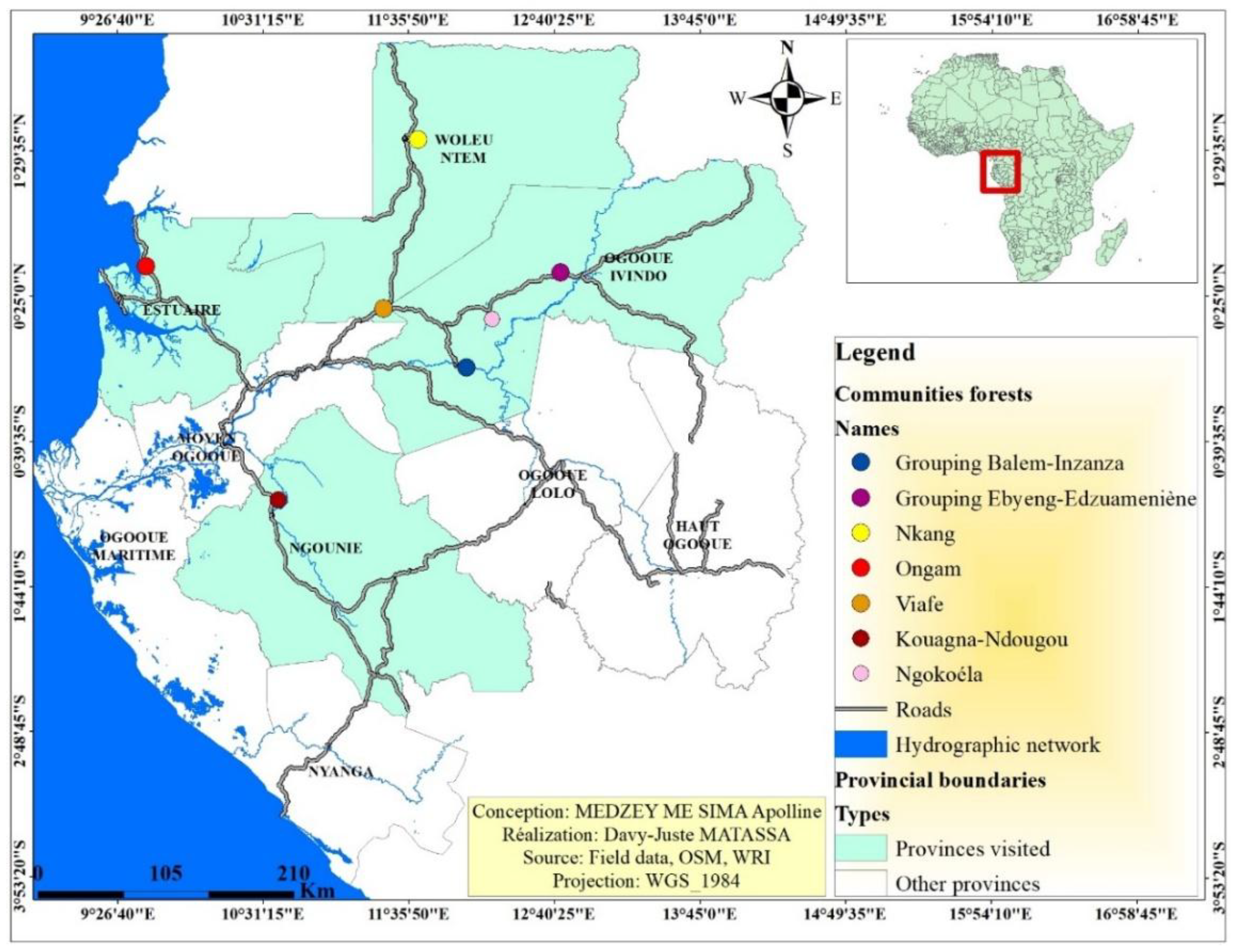
Figure 2.
CF SWOT analysis.
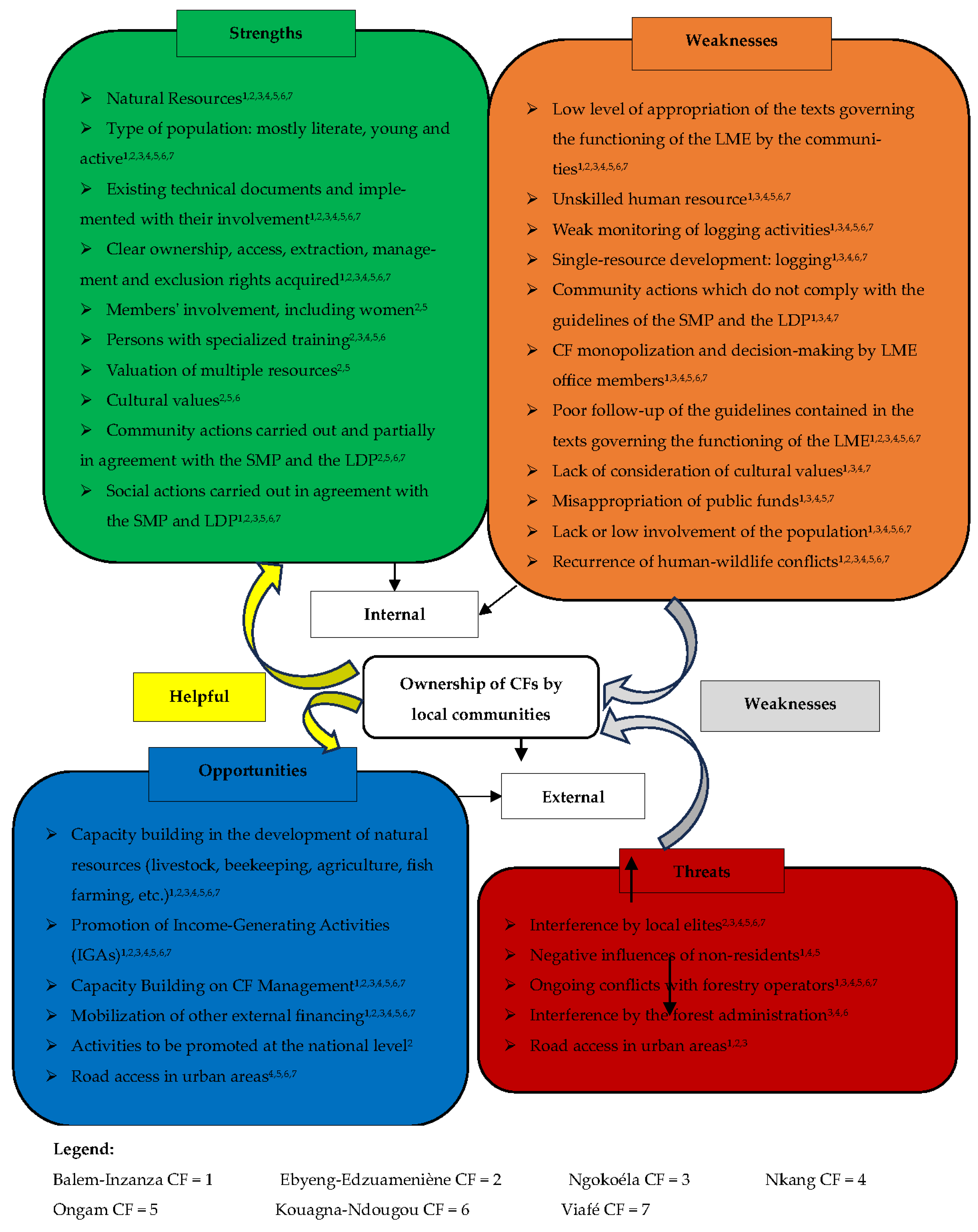
Figure 3.
Heatmap of SWOT analysis of CFs.
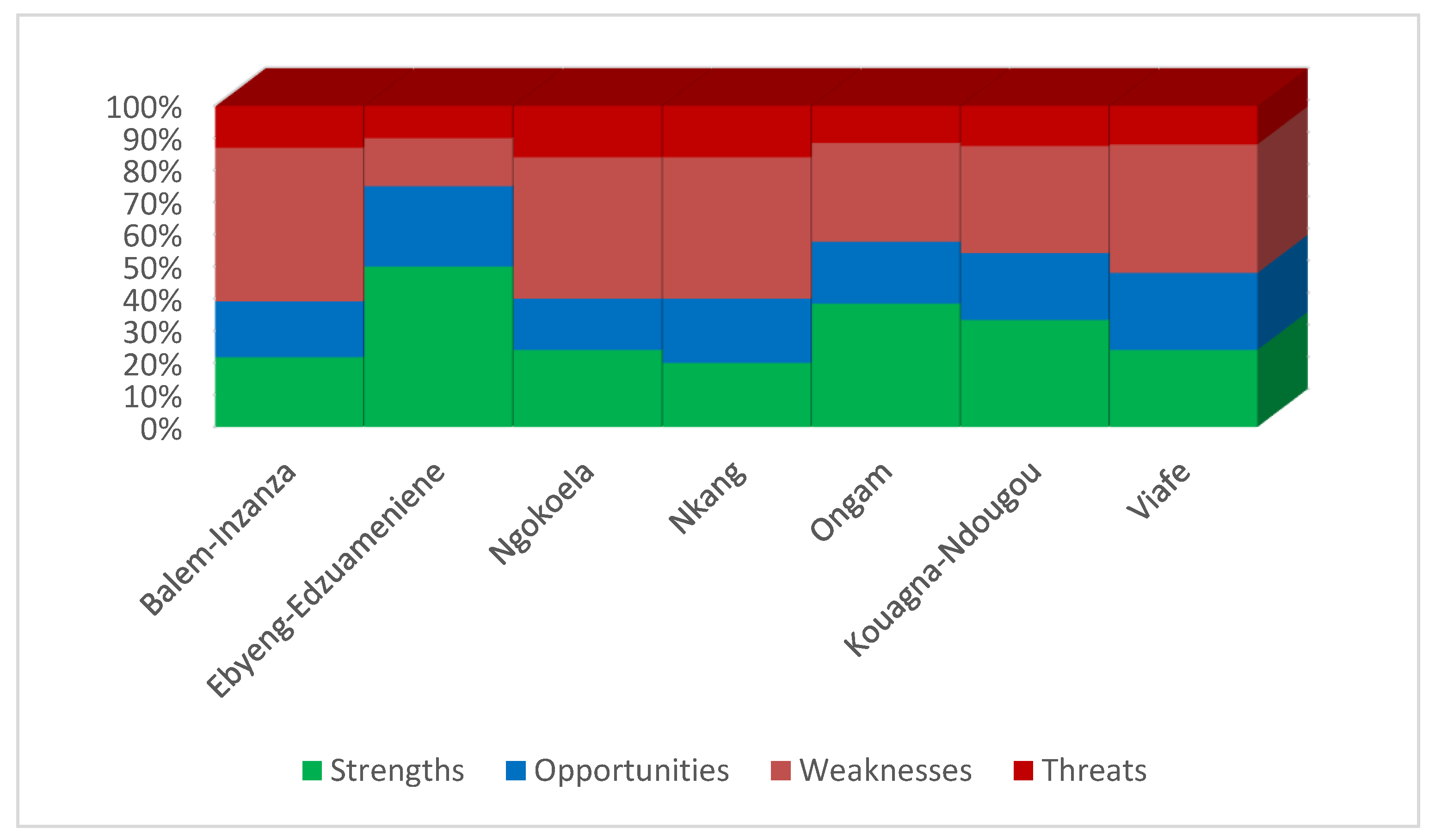
Figure 4.
CF two-dimensional space distributions.
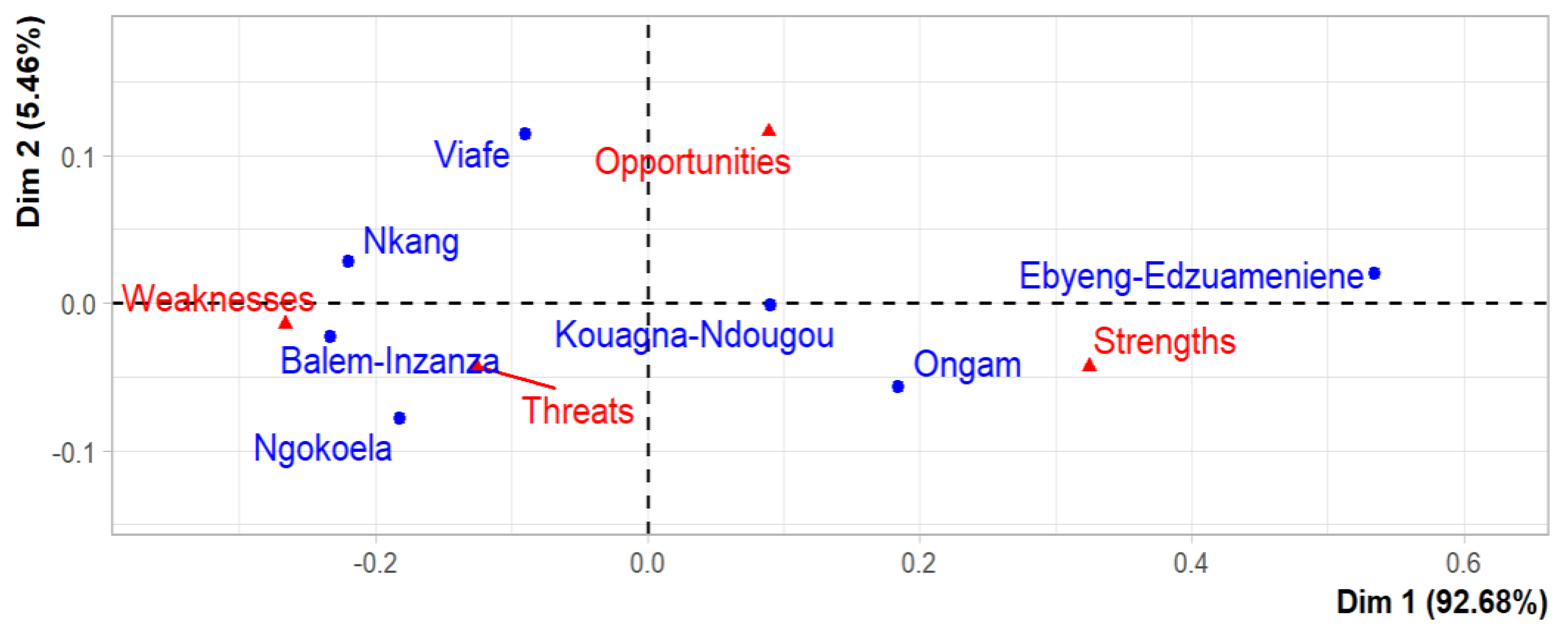
Figure 5.
SWOT analysis of forestry administration.
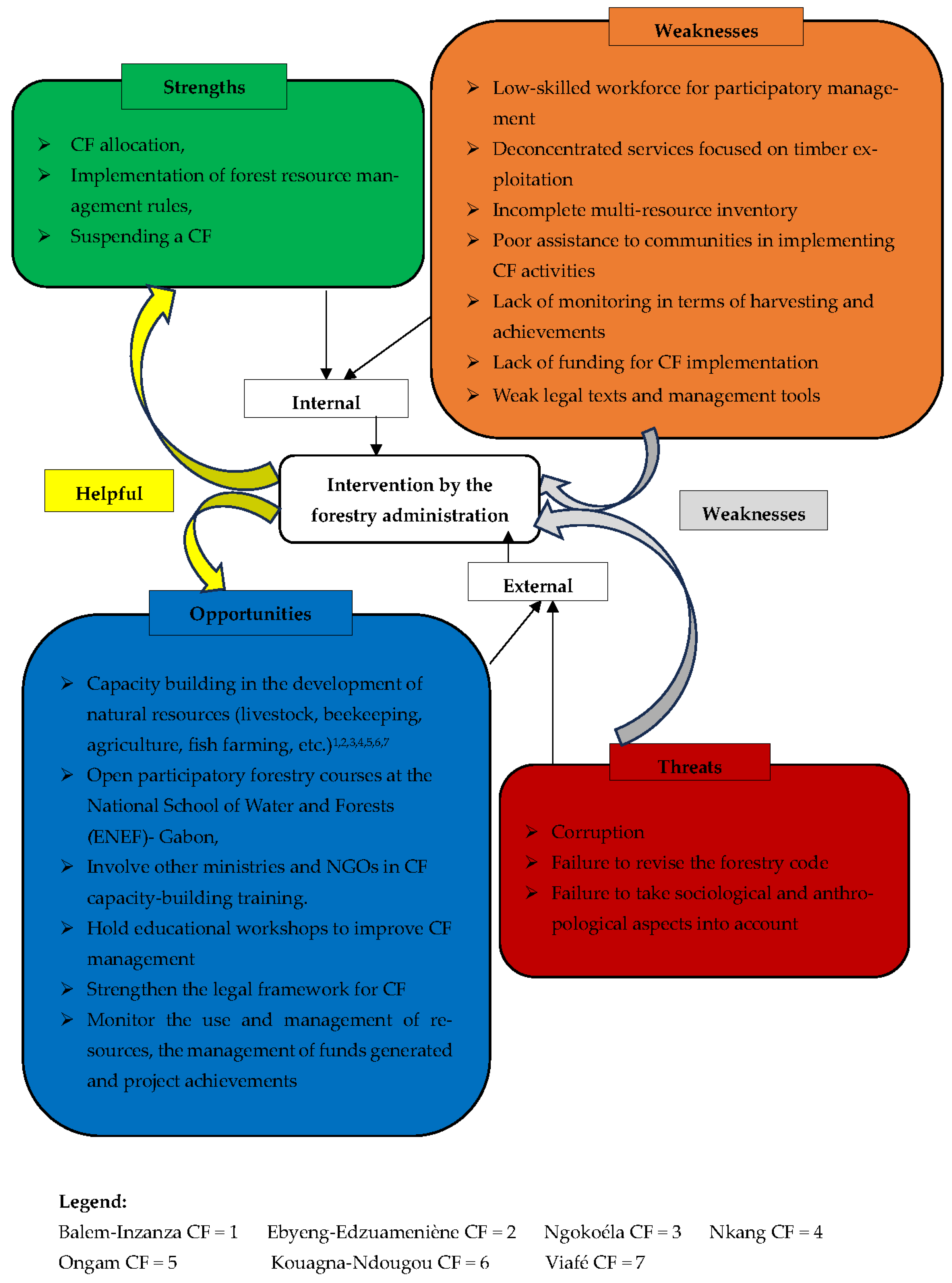

Table 1.
Characteristics of the community forests (CFs) under studied. .
| Name of the CF | Province | SIG | Villages / districts | Ethnic groups | Name of LME | Final agreement |
| Balem- Inzanza |
Ogooué-Ivindo |
0°6'11.88"N 11°59'33.47"E |
Balem et Inzanza |
Makina, Saké Ndambomo, Kota et Fang | Melare (Gathering of villages) |
2017 |
| Ebyeng-Edzuameniène | Ogooué-Ivindo | 0°35'34.30"N 12°42'36.79"E | Ebyeng Edzuame-niène | Fang |
A2E (Ebyeng-Edzuameniène association) |
2013 |
| Ngokoéla |
Ogooué-Ivindo |
0°16'42.72"N 12°12'32.34"E |
Ngouriki, Nkaritom, Kombani Elata-Bakota | Fang, Kota, Makina Saké | Ngokoéla (abreviation of the name of 4 districts) | 2016 |
| Nkang |
Woleu-Ntem | 1°35'5.75"N 11°41'29.80"E | Nkang |
Fang |
Nnem mbô (Our hearts are one) | 2013 |
| Viafé |
Woleu-Ntem | 0°19'27.34"N 11°24'52.92"E | Viafé |
Fang |
Obangame (Defending your own) | 2017 |
| Kouagna-Ndougou | Ngounié |
1°1'53,29"S 10°36'18,24"E |
Kouagna Ndougou |
Tsogo, Eshira Akélé |
Tokano |
2017 |
| Ongam |
Estuaire | 0°38'30.66"N 9°39'21.56 "E | Ongam, Abenelang, Biyemame, Nzong-Meyong, Alos, Nombo |
Fang, Puvi Sékiani |
Elat-Meyong (union of tribes) | 2016 |
Table 2.
CF characteristics and governance.
| Populations Technical documents Type of LME Decision-making body Areas (hectares) Breakdown of funds generated Planned income-generating community activities Community income-generating activities Community development projects planned Community development projects completed |
Educational level: 11% illiterate; 21% primary; 56% secondary and 12% university Fairly young: on average, 48% are in the 0-17 age group; 31%, 19% of whom are women, are in the 18-49 age group and 21% are in the 50+ age group LME certificate, articles of association, internal rules, SMP, LDP Associations1,2,4,5,6,7 and cooperative3 General Meeting 9 5291, 1 2562, 4 9933, 2 9734, 2 9655, 9 3896 et 2 5397 Development projects from 25% to 50%2,3,7, social projects 25%2,3,5, LME management costs from 5% to 25%2,3,7, relief fund 10%2,3, worker’s wages from 10% to 25%2,3, purchase and maintenance of equipment from 5% to 10%2,3, ecomuseum 5%2 Logging1,2,3,4,6,7, sawmill6, NTFP1,2,3,6, agriculture1,2,3,6, agroforestry1,3,6, forestry1,6, livestock1,2,3,4,6, fishing1,2,3,6,7, hunting1,2,3,4,6,7, construction of a cassava processing unit1,6, commissary1,6, carpentry1,6, conservation1,2,6, tourism1,6, beekeeping2,3,4, fish farming4, purchase of equipments3, purchase of vehicles1,6 Logging1,3,4,5,6,7, rental of cassava processing machine1, beekeeping2, iboga cultivation2, NTFP exploitation2, ecolodges (room rental)2, sale of tree species from nurseries2, reforesttion2, fishing5, sand exploitation5, tent and chair rental5, chainsaw rental5, equipment purchase2,3,5 Village hydraulics1,2,3,4,6,7, electrification1,3,4,6,7, housing modernization1,3,6, construction of a listening hut1,2,4,6,7, purchase of two vehicles1, construction or renovation of a school2,6,7, infirmary2,6, construction of a church2, construction of LME headquarters2, construction of a pharmaceutical depot3, donations of school kits3,7, construction of a public market6, construction of a playground6, construction housing for teachers and nurses4,7 Unfinished village hydraulics project1,7, electrification1,3, purchase of TVsets1, purchase of TV subscription boxes1, back-to-school kits1,5,7, assistance with healthcare, deaths and mariage1,4,5,6,7, rehabilitation of 15 km of old road1, gendarmerie post2, construction of unfinished church2, infirmary2, purchase medecines2,5 modernization of housing3,5, rehabilitation of school5,6,7, construction of listening hut7 |
|
Legend: Balem-Inzanza CF = 1 Ebyeng-Edzuameniène CF = 2 Ngokoéla CF = 3 Nkang CF = 4 Ongam CF = 5 Kouagna-Ndougou CF = 6 Viafé CF = 7 | |
Disclaimer/Publisher’s Note: The statements, opinions and data contained in all publications are solely those of the individual author(s) and contributor(s) and not of MDPI and/or the editor(s). MDPI and/or the editor(s) disclaim responsibility for any injury to people or property resulting from any ideas, methods, instructions or products referred to in the content. |
© 2025 by the authors. Licensee MDPI, Basel, Switzerland. This article is an open access article distributed under the terms and conditions of the Creative Commons Attribution (CC BY) license (http://creativecommons.org/licenses/by/4.0/).
Copyright: This open access article is published under a Creative Commons CC BY 4.0 license, which permit the free download, distribution, and reuse, provided that the author and preprint are cited in any reuse.


