

Submitted:
10 April 2025
Posted:
11 April 2025
You are already at the latest version
Abstract
The decline of forests in many countries has prompted governments to adopt conservation measures for forest resources. In the total and partial wildlife reserves of Bontioli, forest conservation appears difficult to implement despite the state's adoption of so-called participatory management approaches. Forest cover loss persists due to the combined effects of natural and human factors. Authorities are attempting to preserve the forest in a context of growing local needs, driven—though not exclusively—by demographic pressure. Using a mixed-methods approach combining qualitative and quantitative data, we mapped this forest retreat and analyzed its underlying causes. We also examined local perceptions of forest conservation. While forest decline is widely acknowledged and lamented, it highlights divergent views between authorities and local populations regarding concepts such as deforestation and conservation. The diversity of perceptions, depending on place of residence and the level of dependence on the land resources of the Bontioli reserves, also plays a key role in the acceptance of policies aimed at forest preservation. For sustainable forest management, the development of socio-economic infrastructure, the transformation of a part of the reserve into an agroforestry park, and the ongoing consultation of local communities emerge as effective solutions for safeguarding the forest.
Keywords:
Forest
; deforestation
; forest conservation
; forest resources
; Bontioli Forest
1. Introduction
“Forest! Can we still speak of a forest? No, I don’t think so!”
This statement, made by a provincial director, raises an essential question about the perception of what constitutes a “forest” and its implications for forest conservation.
In recent decades, the rapid degradation of forest resources has led many governments to implement policies aimed at their restoration and preservation [1]. In Burkina Faso, forest decline has become a major concern for successive governments. This situation stems from a combination of natural and anthropogenic factors, including climate change, agricultural expansion, extensive livestock farming, “illegal” logging, wildfires, and the improper use of pesticides [2,3]. Today, primary forest cover in the country is estimated at less than 25% of the national territory [4,5]. Faced with the rapid loss of forest cover, the government has intensified its efforts to preserve forest resources by involving local populations in forest management through the implementation of so-called participatory management policies in several forest areas. This approach aims to reconcile local needs with forest conservation objectives [6-8]. To effectively protect forests, measures such as redefining the boundaries of protected areas and establishing monitoring and protection mechanisms have been introduced to maintain the ecosystem services provided by forests. Despite these initiatives, non-compliant practices, such as overharvesting of wood, gold panning, and others, continue to hinder sustainable forest management [9-11].
Several studies have highlighted the importance of forests for rural communities in Burkina Faso [12,13], particularly in terms of the ecosystem services they provide. Other research has documented forest loss, its causes, and its consequences across different forest zones in the country [14], identifying climate change and the overexploitation of certain plant species as major threats to forest sustainability in both the short and long term [15,16]. The pressures exerted by local populations have led to land use changes, reducing forest area and regeneration capacity [17]. As such, deforestation, driven primarily by agricultural expansion, is regarded as a major ecological issue in the region, justifying the implementation of forest conservation policies. However, Michon [18] suggests a more nuanced perspective, arguing that deforestation should not be viewed solely as an act of destruction. She highlights the subjective nature of concepts such as “forest,” “deforestation,” and “conservation,” which shape how forest conservation is perceived and implemented, thereby complicating the management of forest resources.
Against this backdrop, a central question arises: In a context where local communities heavily depend on forest reserves for their livelihoods, how do they perceive the imperative to preserve forest land? More specifically, how do they envision a balance between their land use practices and forest conservation?
While numerous studies have contributed to understanding the state of forest resources and the role of local communities in forest management in Burkina Faso, this research aims to take the analysis further by focusing on perceptions surrounding the concepts of forest, deforestation, and conservation. To this end, we combine cartographic analysis to examine land cover dynamics in the Bontioli Forest with a study of the perceptions held by stakeholders involved in forest conservation—particularly local populations and state actors. More specifically, we use remote sensing and mapping tools to describe land use changes in the Bontioli Forest between 1991 and 2024. In parallel, we analyze perceptions of these changes through a series of semi-structured interviews and focus group discussions with various stakeholders.
1.1. Exploring the Definition of Forest
The definition of a forest is complex and widely debated, with significant implications for biodiversity conservation and efforts to combat deforestation. Existing definitions are often ambiguous and may vary depending on context and objectives. The FAO (Food and Agriculture Organization of the United Nations) defines forests as “land spanning more than 0.5 hectares with trees higher than 5 meters and a canopy cover of more than 10 percent, or trees able to reach these thresholds in situ” [19]. According to Chazdon, et al. [20] p.539, “forests can be seen as a source of forest products, an ecosystem composed of trees and diverse forms of biodiversity, a habitat for Indigenous peoples, a reservoir for carbon storage, a source of multiple ecosystem services, a socio-ecological system, or all of these combined.” Furthermore, Lund [21] points to the possibility of defining forests in terms of land cover or land use. From this perspective, forests may be seen either as ecosystems or vegetation formations composed of specific plant and animal species, or as legal land categories defined as forest regardless of the actual vegetation cover [21,22]. Putz and Redford [23] argue that the ambiguity in forest definitions poses major challenges for implementing effective forest conservation and restoration actions, particularly in the evolving context of carbon markets and environmental policies.
The way forests are conceptualized has evolved historically, driven in part by technological advancements such as remote sensing, mapping, and database development, which have made forest inventories more reliable [24]. Today, many studies highlight the need to clarify and refine the definition of forest to better guide conservation efforts, balance priorities—such as biodiversity preservation versus carbon sequestration—and improve our understanding of the various forms of forest degradation [20,23]. Such an approach, which emphasizes finding a balance between biodiversity conservation and carbon sequestration [25], is grounded in scientific and ecological reasoning that often exceeds the local communities’ frame of reference. The current global context is marked by a dramatic loss of forest cover [26] and the resulting global climate change. As noted by Sasaki and Putz [27], key elements such as responsible forest management and the promotion of sustainable development should also be considered when defining what constitutes a forest. According to these authors, responsible forest management can reduce climate warming while protecting biological diversity. In the face of ongoing forest cover loss, ensuring the sustainable management of managed or even cultivated forest ecosystems may become just as critical as the strict conservation of primary forests.
1.2. Deforestation and the Plurality of Interests Among Social Groups
Researchers generally distinguish between two types of deforestation: net deforestation and gross deforestation. Net deforestation refers to the loss of forest area in a given location over time, while accounting for reforestation or natural regeneration [28]. More concretely, it is estimated by subtracting regenerated or reforested areas from those that have been deforested [29,30]. In contrast, gross deforestation focuses solely on the conversion of forest land to other land uses, without considering replanting or regeneration efforts [31]. It thus represents the total loss of forest area converted for agricultural or silvopastoral purposes in areas defined as “forests.” It is important to differentiate deforestation from forest degradation, the latter referring to severe or irreversible alterations in the structure, functioning, species composition, or productivity of forests due to human activities. Forest degradation leads to a reduced capacity of forests to deliver ecosystem services [32-34]. As for the distinction between primary and secondary forests, the former is defined as a naturally regenerated ecosystem composed of native species, without visible signs of human activity and exhibiting only minor or negligible ecological disturbances. The latter emerges following past or ongoing destruction of the former, whether due to natural or human disturbances [35].
Today, the diversity of forest users' interests calls for an integrated framework to achieve a more consensual definition of deforestation [36]. Perceptions of deforestation vary widely across social groups, as they are influenced by how each group conceptualizes the forest. This is why, according to Michon [18], it is crucial to examine the underlying perceptions, schools of thought, and values that shape forest-related discourses before conducting any analysis. In some dynamic understandings of vegetative succession, or in contexts where forest fallow systems are practiced, changes in vegetation composition are not necessarily perceived as deforestation [37]. Definitions of deforestation also vary by geographic region. For instance, under European criteria, deforestation is often associated with environmental issues such as biodiversity loss and climate change. In contrast, for more traditional forest communities, deforestation raises issues related to identity, land loss, or even existential concerns [18].
In scientific circles, deforestation is generally viewed in a negative light, often linked to climate change, land conversion, biodiversity loss, and greenhouse gas emissions [38,39]. Some scholars regard it as a structural threat with repercussions across multiple economic sectors, including production, manufacturing, service delivery, and regulatory mechanisms [40]. Although commonly seen as a destructive process, deforestation should not be viewed exclusively in negative terms. It can lead to profound transformations in landscapes as well as in social and political relationships [41]. Without minimizing the global environmental consequences it may trigger, deforested lands can carry deep identity value for some communities and be seen as a lever for development [41]. Historically, it is through the religious, technical, and legal domestication of “wild” forests that great civilizations consolidated their power [42]. It is therefore essential not to analyze deforestation solely as an irreversible act of destruction, but also to explore the transformations it may bring to the lives of communities and nations [41,43,44]. Indeed, many admired agrarian landscapes around the world have emerged from the massive clearing of “ancient forests.” This has not diminished the communities’ recognition of the forest’s economic, cultural, or symbolic value. On the contrary, it has often led to a redefinition of their relationship with the forest [45]. Thus, deforestation should not be regarded merely as a simple act of irreversible forest destruction, but rather as part of the complex relationships societies maintain with their environment [41].
1.3. Influence of Perceptions of Forest Conservation on Resource Management
In current dominant discourse, forest conservation refers to the protection of forests with the aim of preserving their ecosystem services for the benefit of both present and future generations [46]. Forest conservation, in this sense, seeks to protect natural resources, maintain biodiversity, and mitigate natural disasters, which represent key vulnerabilities for rural populations. As with the representations of the concepts of “forest” and “deforestation,” perceptions of forest conservation also vary significantly depending on the community, cultural values, and the stakeholders involved. For example, a study conducted in the Bago Yoma region of Myanmar found that local populations did not perceive forest conservation outside the lens of their daily energy needs and food security. Their participation in forest conservation efforts was influenced by potential economic incentives, such as the creation of income-generating opportunities [47]. According to Clark, et al. [48], perceptions of changes occurring within forests and the rivalries that exist between different social groups can also play a significant role in shaping conservation outcomes. Moreover, Joa and Schraml [49] emphasize that the perceived benefits of conservation strongly influence local community support for conservation measures.
In sub-Saharan African countries as well, perceptions of forest conservation significantly influence how forest resources are managed. Ultimately, the importance and priorities of forest restoration differ depending on the stakeholders involved, particularly local communities, state forest officials, and technical experts. This is why participatory approaches are essential in the field of conservation to ensure effective implementation of conservation projects [50,51]. In Burkina Faso, for example, a study by Pouliot, et al. [52] found that agricultural land held much greater value for rural households than forested land, explaining their limited interest in forest conservation. Similarly, a study conducted in the Pagou-Tandougou hunting concession revealed that for the nearby communities, one hectare of agricultural land was considered far more profitable than one hectare of well-preserved hunting territory [10].
2. Materials and Methods
2.1. Study Area Description
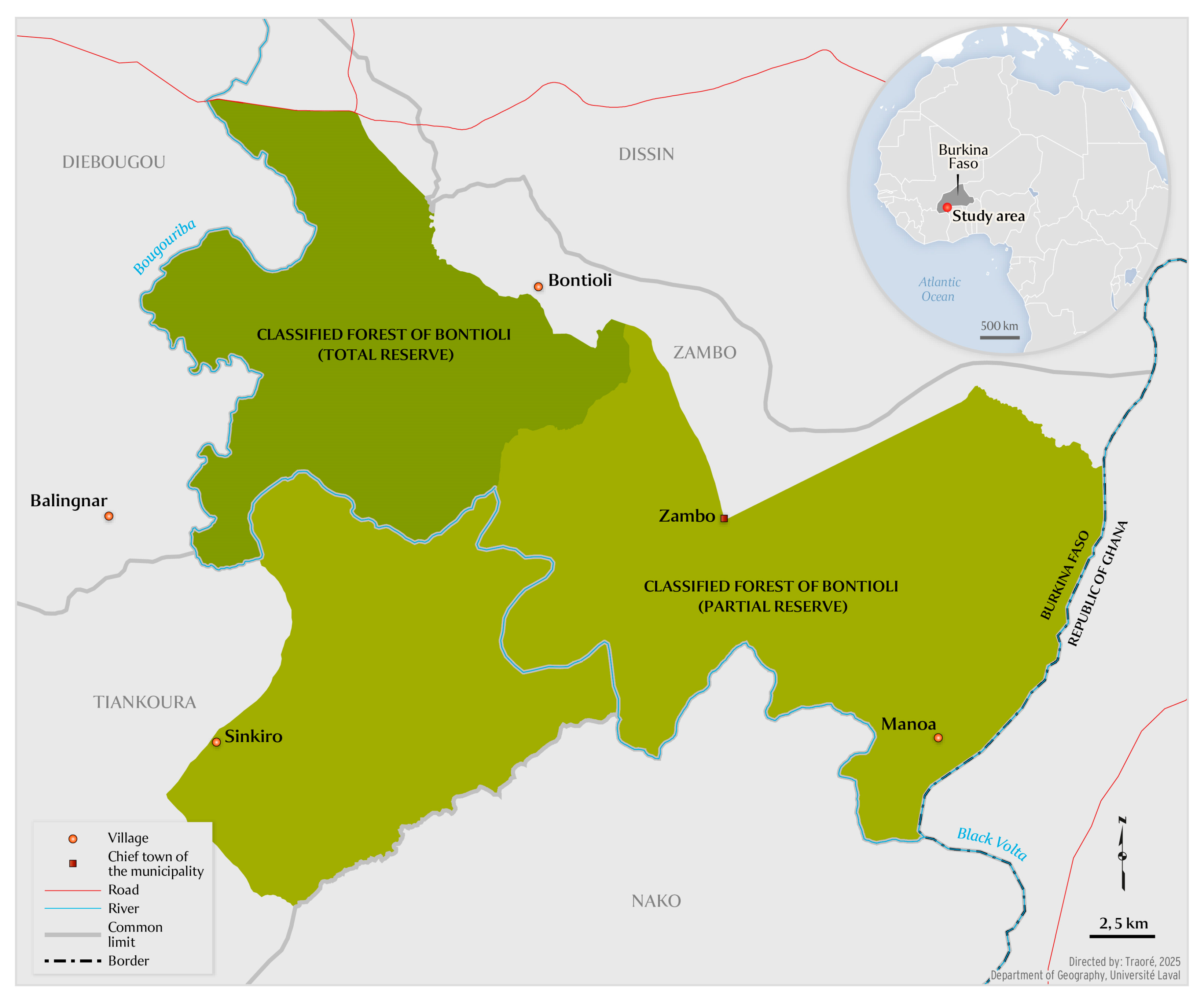
The Bontioli Forest, located in the southwestern part of Burkina Faso, lies between latitudes 10°40’ N and 10°56’ N and longitudes 2°53’ W and 3°09’ W. This tropical forest receives up to 1,100 mm of annual rainfall. It comprises two wildlife reserves: a partial reserve covering approximately 29,500 hectares and a total reserve of about 12,700 hectares [53]. Despite its status as a protected area, the forest is significantly affected by human presence, with several villages established within its boundaries. Administratively, it falls under the jurisdiction of the rural commune of Zambo, where it occupies a large portion of the territory. Although designated as a wildlife reserve due to its ecological importance, the Bontioli Forest is subject to intense anthropogenic pressures, leading to the progressive degradation of its vegetation cover.
Figure 1.
Map locating the study area.
Many residents in the surrounding villages depend on agriculture, livestock farming, and the exploitation of forest resources for their livelihoods. For several decades, the area has experienced an intensification of activities considered illegal by the state, such as uncontrolled clearing, charcoal production, poaching, human-induced forest fires, and more recently, artisanal gold mining. The scale of these pressures is partly explained by rapid population growth, driven by a crude birth rate estimated at 37.9 per thousand in the region [54], as well as by the arrival of new communities seeking more fertile land or pasture. Considering these dynamics, the management of the Bontioli Forest represents a major challenge in terms of conservation and governance. Striking a balance between protecting this ecosystem and meeting the needs of local populations remains a key challenge for stakeholders involved in the forest’s management.
2.2. Data Collection and Analysis Methods
To better understand long-term environmental changes, we used satellite data. Landsat TM (1991), ETM+ (2001 and 2011), and OLI (2024) images of the study area were downloaded from the United States Geological Survey (USGS) website. To maximize vegetation expression, scenes acquired between October and November were selected [55]. The processing and analysis of these images enabled us to assess land cover change over time. Quantitative information was extracted to measure these changes. The digital processing of satellite images involved image manipulation and interpretation using specialized software. For example, supervised classification—based on identifying land cover categories from satellite images [56]—was performed using QGIS.
To ensure data consistency, all images were resampled to a 30-meter resolution to standardize pixel size. Color composites were applied to enhance image interpretation. Landsat TM (1991) and ETM+ (2001 and 2011) scenes were displayed using a 4-3-2 band combination, while 2024 images were displayed using a 5-4-3 combination to better highlight vegetation. Simultaneous display of images in different views allowed for identification of land cover classes while considering their temporal evolution. For classification, we opted for the supervised method using the Maximum Likelihood algorithm, which produced the most satisfactory results. The classification results were then vectorized in ArcGIS to produce land cover maps. Vectorization involves converting raster data (where information is stored in pixels) into vector format, where data are represented as points, lines, and polygons [57].
In addition to satellite data, interviews and focus group discussions were conducted to gain deeper insights into land use dynamics and their socio-ecological implications, as well as local perceptions of forest conservation. Fieldwork was conducted in four villages:
- Sinkiro and Manoa, located inside the forest,
- Bontioli, on the forest edge,
- Balingnar, approximately 5 kilometers from the forest.
- The selection of these villages was based on accessibility and security recommendations at the time of the surveys (January to June 2022).
Semi-structured individual interviews were conducted with 26 individuals of diverse backgrounds, selected through purposive sampling [58]. These interviews were carried out between January and June 2022. Interviewees included members of Forest Management Groups (FMG) and monitoring committees, leaders of Village Development Committees (VDC), traditional authorities, and state representatives, including forestry officers, provincial directors of agriculture and environment, Presidents of Special Delegations (PSD), and officials from government programs such as Forest Investment Program (FIP).
In parallel, 12 focus group discussions were held across the four villages, involving a total of 124 participants. These groups included 6 to 12 participants each [59] and were organized based on sociocultural categories: elders, young men, and women. Each interview or discussion lasted between 45 and 120 minutes. The semi-structured interviews and focus groups generated rich qualitative data that strengthened our understanding of forest conservation in the area. Collected data were subjected to qualitative content analysis using a mixed approach that combined both inductive and deductive reasoning. Interviews were transcribed verbatim using the online tool "TurboScribe" and then coded in NVivo 14 to identify recurring themes. For coding, sentences or paragraphs were considered as meaningful units to which codes could be assigned. According to Saldaña [60], a code is a concise label used to group data into analytical categories. In this study, the analysis focused primarily on local perceptions of vegetation cover dynamics, deforestation, and forest conservation.
3. Results
3.1. Land Use Dynamics and Key Drivers of Deforestation
Forest retreat is a widely observed phenomenon in the Bontioli Forest. All stakeholders, whether local communities or state authorities, agree on the decline of forest potential. Local communities do not clearly distinguish between different types of vegetation cover but perceive the forest as an area more or less densely covered with plant species and not yet exploited for agriculture. This perception aligns closely with the scientific definition of forest. According to forestry officers, the felling of a tree is equated with a process of deforestation and forest degradation. As such, this act is strictly prohibited by forest authorities and is legally unacceptable. In contrast, for local populations, tree felling follows a completely different logic. It is seen as a necessity driven by survival, particularly for expanding agricultural land in the absence of viable alternatives (FJ1, FV1, FJ3). This situation compels them to clear new forest areas to ensure their food security. Clearly, the behavior of local populations has a direct impact on forest dynamics.
Figure 2 illustrates the evolution of land use units in the Bontioli Forest across four time periods: 1991, 2001, 2011, and 2024. It highlights major changes in land cover classes, notably the regression of gallery forests, wooded and shrubby savannas, the expansion of agricultural land, and the increase in grassland savannas and human settlements. These transformations indicate a gradual deforestation process driven by agricultural expansion and human pressure (wood as fuel, small-scale logging—i.e., cutting wood for housing construction—village expansion, etc.). The spread of bare soil and built-up areas suggests a rise in anthropogenic activities, which may negatively affect the region’s biodiversity and ecological resilience. In addition, the emergence and expansion of orchards—primarily composed of cashew trees—are also observed. Table 1 below presents the evolution of surface areas corresponding to the various land use and land cover units.

Table 1.
Surface area evolution of land use and land cover units between 1991 and 2024.
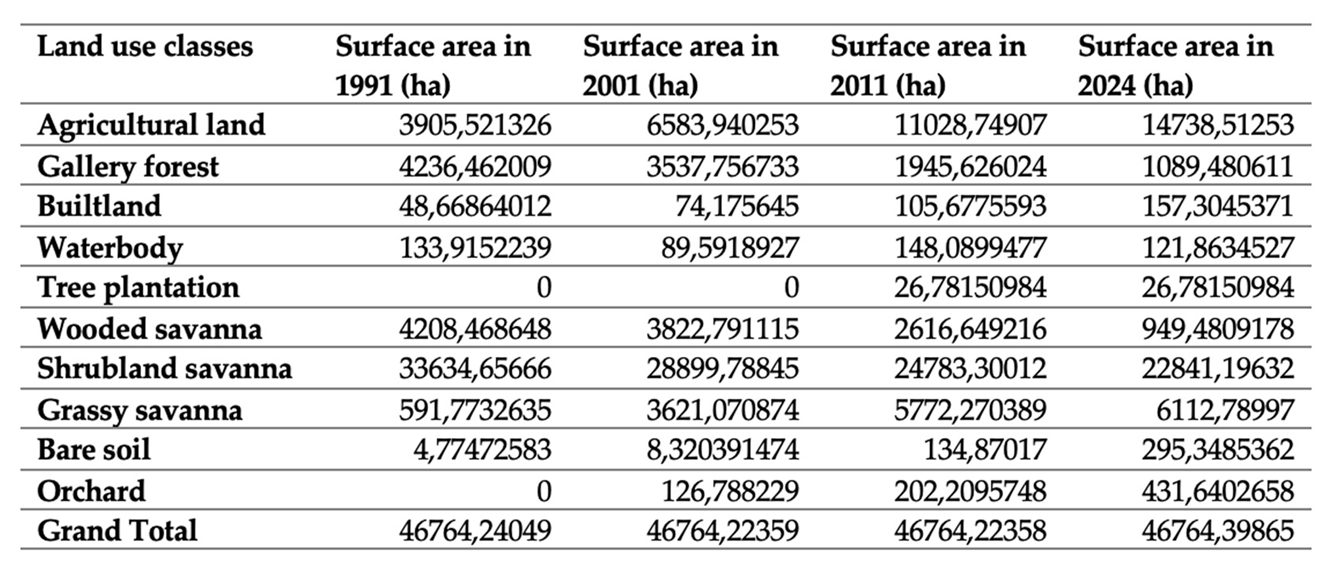
Between 1991 and 2024, the area occupied by agricultural land (light grey-brown category on the map) continuously increased, rising from 3,905.52 ha to 14,738.51 ha. This rapid expansion has led to a significant loss of vegetation cover. Meanwhile, land cover units such as gallery forests, wooded savannas, and shrubby savannas have experienced a drastic decline. Gallery forests decreased from 4,236.46 ha in 1991 to 1,089.48 ha in 2024, while wooded savannas declined from 4,208.47 ha to 949.48 ha over the same period. The area of shrubby savannas dropped from 33,634.66 ha in 1991 to 22,841.20 ha in 2024—a reduction of more than 10,000 ha (Table).
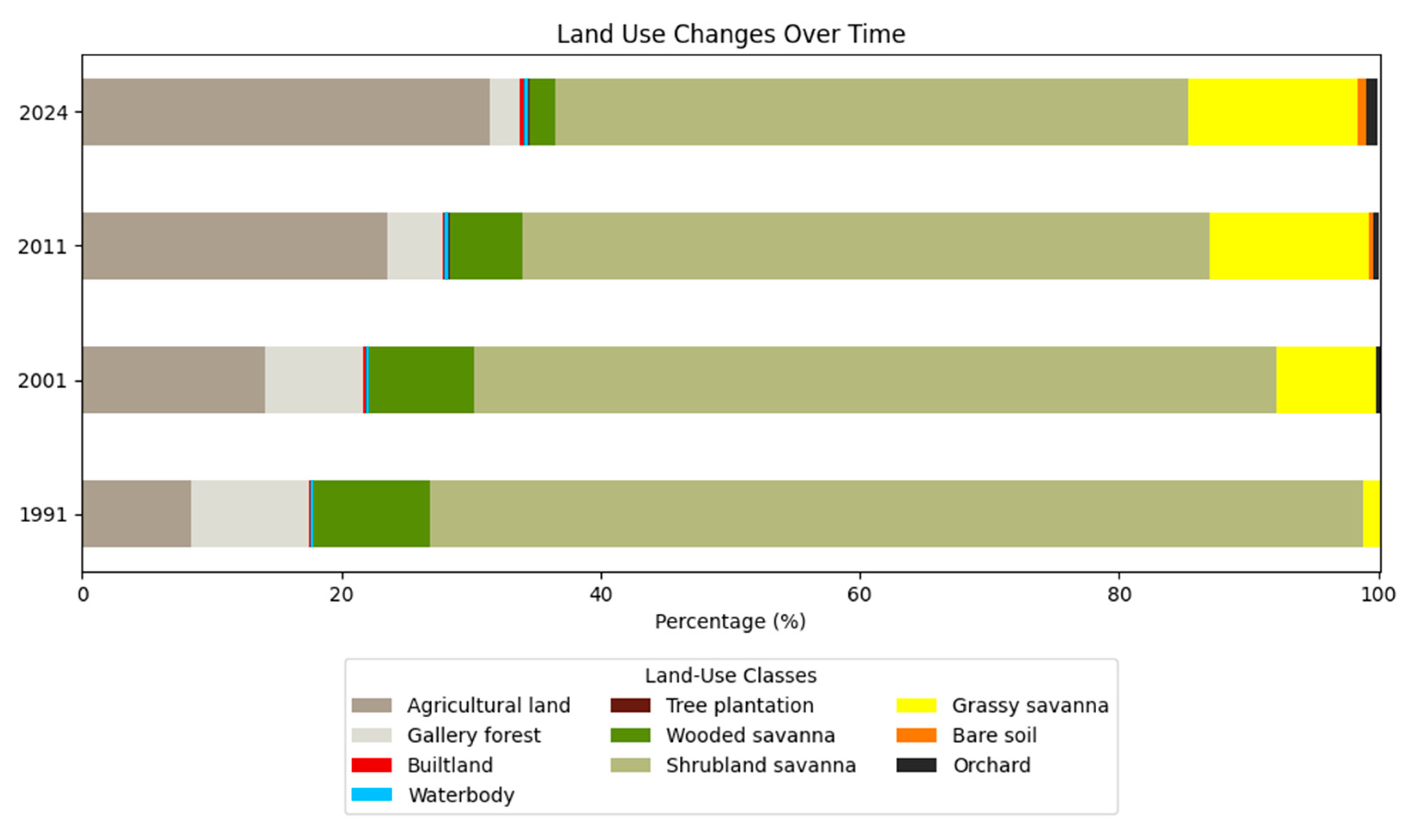
In addition to these visible transformations, other non-visible factors have contributed to vegetation cover loss. These include the development of artisanal gold mining, forest encroachment by nomadic herders, and bushfires. A complementary analysis presented as a horizontal bar chart (Figure 3) illustrates the percentage change in land use and land cover units. These ratios were calculated in relation to the total surface area of all land use units.
The chart highlights a rapid transformation of forest landscapes into a mosaic dominated by agriculture and degraded savannas. The decline of forests and wooded savannas reflects the increasing pressure on natural resources. Indeed, the graph clearly shows a marked increase in agricultural land (light grey-brown) and herbaceous savanna (yellow), while wooded savanna (green) and shrubby savanna (light green) are gradually decreasing. The expansion of built-up areas (red) illustrates ongoing population growth, although this land cover category remains relatively marginal. These dynamics have significant implications for biodiversity conservation and the ecological resilience of the region.
According to a provincial director of the environment, one of the objectives of the forest administration is to move toward “zero deforestation” in conservation areas (DP1), which implies a strict ban on agricultural expansion within the forest. Efforts have been made through the implementation of policies and programs—such as FIP and PROGEREF (Project for the Sustainable Management of Forest Resources in the South-West, Centre-East, and East Regions)—to support effective conservation and halt the forest’s regressive trajectory. However, in a context marked by a lack of cultivable land and limited financial and material resources, individuals have developed avoidance and adaptation strategies to circumvent forest controls, allowing them to continue clearing new plots within the forest (DP1), despite the severe penalties associated with such practices. Many communities, particularly those living within the forest, feel unable to abandon this dynamic. Their limited means hinder access to agricultural inputs, making the transition to intensive agriculture difficult and forcing them to maintain extensive farming practices.
3.2. Different Perceptions of Deforestation
The rapid deforestation of the Bontioli Forest has raised concern among state authorities, who appear to adopt a strict conservationist approach aimed at preventing all forms of forest degradation. In contrast, local communities tend to adopt a more flexible, pragmatic view of conservation. Their perception is based on the direct usefulness of plant species to meet their daily needs. They place particular importance on preserving species that have proven economic or socio-cultural value. While a strict conservationist perspective emphasizes the ecological importance of every plant species, for communities with longstanding historical ties to the forest, only species that offer direct benefits are considered essential. Perceptions of the forest and deforestation in the Bontioli area are therefore shaped by the divergent interests of different stakeholder groups. Some men justify forest clearing by the need to expand agricultural land to feed their families. In contrast, a group of women (FF1) expressed deep emotional and economic attachment to the forest as a vital source of livelihood:
“The forest is everything to us. It’s our sorghum, our millet, our sauce. Everything we have comes from the forest. Seeing it disappear like this deeply saddens us. We collect non-timber forest products (NTFPs), and we also gather wood, which is our main source of energy. The forest must be preserved.”
This testimony highlights not only an apparent contradiction between male and female perspectives, but also the diversity of relationships that different social groups maintain with the forest.
Local populations find themselves in a paradoxical situation. On the one hand, agricultural expansion is viewed as essential for ensuring food security. On the other hand, communities living within the forested zones are confronted with restrictions linked to the forest’s legal status as state public land. In this context, strict conservation policies are perceived as a major constraint. While these communities see themselves as victims of this situation, the state regards them as key agents of deforestation—hence, as responsible parties. This divergence in perception undermines effective forest conservation efforts, especially when local populations believe that the main drivers of forest loss are external groups settling in the region. Although these populations acknowledge their own share of responsibility in forest degradation, they often attribute their actions to what they see as the authorities' failure to act against outside incursions.
Furthermore, local communities argue that they are, in their own way, contributing to forest preservation by practicing resource management that attempts to align with certain existing rules (FJ1, FV1, FJ3, FV3, E14, E17). In this regard, a group composed mainly of farmers (FV1) explained:
“During awareness sessions, agricultural officers recommend that we keep 20 fruit trees per hectare of cultivated land. But whenever we come across useful trees, like fruit trees, we preserve them systematically. Sometimes we even keep more than the recommended amount.”
Other statements echo this reasoning, emphasizing selective vegetation management (FV1):
“We don’t cut down trees randomly. We usually remove old trees that no longer offer much benefit. If a tree casts too much shade, we cut it down because it affects agricultural yields. So we don’t act carelessly. In fact, fruit trees are more productive on cultivated land than on uncultivated land.”
These comments align with certain scientific theories on fruit tree productivity in agricultural settings [61], and they illustrate a perceived capacity among some individuals to manage resources responsibly. In this light, strict conservation, in the literal sense, emerges as a major factor that may compromise local food security. In a context of rapid population growth, the expansion of agricultural land is viewed as a survival imperative.
3.3. Toward Local Forms of Adaptation
In response to the constraints imposed by conservation policies, local populations have developed adaptation strategies aimed at reconciling resource use with environmental preservation. One notable initiative is the development of orchards, which allows the replacement of plant species deemed less useful with those of higher economic value. This trend has been reinforced by the return of migrants from neighboring countries with strong agroforestry traditions, such as Ivory Coast and Ghana. Their desire to introduce new practices has led to the rise of cashew plantations within and around the Bontioli Forest. For local communities, these plantations are seen as an effective way to offset forest losses while generating income (FJ1, FJ2, E12, DP2). However, this practice remains significantly limited by several factors: lack of available land, recurring bushfires, and free-roaming livestock that destroy everything in their path. In addition, due to limited financial and material resources, some individuals consider this practice to be reserved for wealthier community members (FJ1, FJ2, FJ3, FV3, E17).
The importance of cashew cultivation was also emphasized by a provincial director of the environment: “Cashew trees play an important role in carbon sequestration due to their dense foliage. They also contribute to the restoration of heavily degraded land.” Moreover, the state supports reforestation campaigns aimed at restoring deforested areas. For instance, the FIP program made it possible to scarify or reforest 278 hectares of degraded land [62]. Thus, while local conservation approaches—such as agroforestry plantations within the forest—do not fully align with state policies, they reflect adaptation to the socio-economic realities of the territory. These local initiatives, if better supported and framed by the state, could serve as a lever for a more integrated conservation approach, one that reconciles environmental imperatives with the needs of local populations.
3.4. Implications of Forest Conservation for Socio-Economic Development
The studies conducted reveal a widespread feeling of socio-economic marginalization among forest communities. Residents of the Bontioli Forest openly express this sentiment. While they recognize the forest’s fundamental importance in providing ecosystem services, their aspirations for socio-economic development are equally strong. However, from their perspective, these aspirations are hindered by the near-total absence of basic infrastructure such as schools, health centers, and roads—facilities essential for local development. According to the state’s view, building such infrastructure within the forest, which would require the clearing of new forest areas, is seen as incompatible with conservation objectives. Although the state has made considerable efforts to develop infrastructure in rural areas, these efforts are perceived by forest-dwelling communities as being primarily directed toward villages outside the forest. As a result, residents within the forest feel that their chances of accessing essential services are significantly reduced. In this context, forest conservation is experienced as a contributing factor to the delay in school enrollment and the low literacy rates in these communities. Their demands reflect a strong emphasis on socio-economic infrastructure, which is viewed as crucial to their well-being—sometimes even more so than the preservation of the forest itself, despite its recognized importance within the community. For these communities, being located within a forest reserve is perceived as a form of injustice and a deprivation of access to basic rights.
A government representative (P1), who has participated in several community meetings, believes that local populations do not fully assume their role in conservation efforts. He emphasizes that, despite limited support from the authorities, the government has demonstrated a willingness to assist forest monitors—residents assigned to help protect the forest—by providing equipment such as mopeds and bicycles for forest patrols, mobile phones for alerts, and other resources aimed at improving both forest surveillance and the individuals’ personal well-being. Despite this interpretation, the failure to meet infrastructure demands within forest areas due to conservation restrictions fuels a sense of marginalization among local populations (FJ1, FJ3, FJ4, FV1, FV3, FV4, FF1, FF4). This perception further complicates conservation efforts. Indeed, the frustration generated by this perceived marginalization sometimes leads to opportunistic behaviors, whereby individuals exploit forest resources for personal gain, with little concern for preservation or future generations. In response, several state representatives have acknowledged the need for stronger support and engagement with local communities. Such support is considered essential for more effectively reconciling conservation objectives with the socio-economic needs of forest-dependent populations.
3.5. Attributing Responsibility for Forest Resource Degradation
Beyond natural factors related to climate change, the degradation of the Bontioli Forest is primarily the result of human activity. However, the belief that resident communities are the main culprit of this destruction is strongly challenged by those very communities. They express their sense of powerlessness in the face of repeated incursions by outsiders, often coming from distant regions. They particularly point to gold miners—many of whom are considered “foreigners”—and Fulani herders who invade the forest and intensively exploit everything that could serve as fodder for their livestock (FJ3, FF3, FF1). These herders, it is claimed, even go so far as to set fires in the forest to clear paths for their animals in still densely wooded areas. This behavior contributes to the destruction of many species essential to both the forest’s ecological balance and the livelihoods of local communities.
Moreover, a group of women (FF1) expressed concern over the growing competition between them and these nomadic herders, whose animals do not spare non-timber forest products (NTFPs), thus jeopardizing access to vital subsistence resources. According to a youth representative (E14), most fields established in the total reserve are owned by individuals from more distant villages. Acknowledging that only a very small proportion of his own village's residents are present in the forest—or at least in the partial reserve—he attributes this dynamic to the authorities’ inaction in addressing external settlements. While state representatives are aware of the damage caused by these exogenous groups, they frequently denounce what they perceive as the bad faith of local populations (P1, P2, DP1, E5). Local communities cannot deny their own impact, as they themselves admit that agricultural expansion into the forest is often necessary due to a lack of cultivable land, compounded by demographic pressure and the high cost of agricultural inputs (FJ1, FV1, FF1, FJ3, FV3, FJ4, FF4, DP3). Therefore, they cannot entirely absolve themselves of responsibility for the damage caused in the forest. Nonetheless, the constant accusations leveled at them by forestry authorities foster frustration within parts of the community. This, in turn, leads some individuals to adopt behaviors that show little regard for the preservation of the forest ecosystem.
3.6. Loss of Traditional Values and Forest Conservation
The research findings show that various traditional practices have long contributed to the preservation of the ecosystem—a fact acknowledged by all stakeholders interviewed. Among these practices are the sacralization of certain forest areas or specific plant species, the traditional organization of hunting, and customary land management, all of which played a central role. According to local accounts, traditional leaders would annually designate zones for agricultural and pastoral activities while reserving other areas as off-limits to any human use. This customary governance was binding for all, and no one dared to violate the rules for fear of severe sanctions. Many respondents emphasized that these ancestral management systems were effective in curbing certain behaviors now observed, such as the cutting of trees that were once spared. However, they lament the loss of influence of traditional authorities—particularly the land chiefs (chefs de terre)—which has made it increasingly difficult to control deforestation (FJ3, FV3, FJ2, FV2).
The important role of traditional authorities is also recognized by the state, as confirmed by several institutional stakeholders. Nonetheless, some of them pointed to the sometimes-ambivalent influence of these local leaders, who may hinder the enforcement of sanctions against offenders from within their own communities (P1, DP1). In fact, to maintain social cohesion and local cooperation, forest officers have at times been forced to show leniency toward certain individuals (P1), which ultimately undermines forest management and conservation efforts.
3.7. A Contrasting View of Opportunities Available to Local Populations
The land degradation mentioned by local populations—as a reason for clearing new areas within the forest—is a global issue. In the Bontioli area, while this argument is widely used by communities to justify their actions, other factors help explain the gap between their perspective and that of some forestry agents. For instance, a local forest station chief (E9) noted that the rising cost of agricultural inputs is a global phenomenon and that it is only natural for Burkina Faso—heavily reliant on imports in this sector—to be affected by it. However, he argued that the communities living in and around the Bontioli Forest still benefit from a relatively favorable environment, with fertile soils and abundant rainfall, reducing the need for fertilizers to achieve good harvests. This perception, rooted in a conservationist logic of forest management, partly explains the attitude of some forest officers toward the agricultural practices of local populations and, to some extent, their inflexibility regarding newly cleared areas. Nevertheless, despite the repression they may face, the extent of encroachment into the forest highlights the magnitude of local food and socio-economic needs.
Demographic pressure on forest resources in the area is very real, as demonstrated by numerous studies [14]. The argument of declining soil fertility advanced by local communities to justify new clearings also reflects the deeply ingrained practice of extensive agriculture, which is based on the belief that production depends on the continuous expansion of cultivated land. This situation further underscores the need for stronger state support to improve access to agricultural inputs and promote sustainable intensification practices. However, the effectiveness of such measures depends not only on the availability of chemical fertilizers, but also on raising farmers’ awareness of their responsible use (DP3). According to a provincial director of agriculture (DP3), although chemical fertilizers can enable agricultural intensification on smaller plots, their misuse has contributed to soil fertility loss and the pollution of surface water in the region. These dynamics push resource-limited populations to continue expanding their farmland at the expense of the forest.
4. Discussion
4.1. Survival and Deforestation
The primary objective of this research was to analyze how different social groups perceive the need to conserve forest resources in the Bontioli Forest. Before examining these perceptions, we first mapped the evolution of various land use units across four distinct time periods—1991, 2001, 2011, and 2024—to gain insight into their dynamics.
The results reveal a significant decline in vegetation cover, confirming the findings of Kiribou, Dimobe, Yameogo, Yang, Santika and Dejene [14], who documented a continuous loss of vegetation in this forest between 2000 and 2022. Several factors explain this trend, including natural causes such as global climate warming, but above all, increasing anthropogenic pressures. Among these, agricultural expansion stands out as a key driver, amplified by demographic growth and declining soil fertility, which force farmers to clear new land. Additional contributing factors include unsustainable wood harvesting, forest fires, charcoal production, and more recently, the spread of artisanal gold mining. These processes—well documented in other studies on deforestation in sub-Saharan Africa [63,64]—exert growing pressure on forest ecosystems in Burkina Faso.
As a country with a strong agricultural orientation, Burkina Faso experiences considerable annual forest cover loss, estimated in the tens of thousands of hectares [65]. The Bontioli Forest is subject to this deforestation, which is progressively fragmenting the landscape and threatening both its biodiversity and ecological functions. Local communities are aware of the importance of forest preservation. However, the limited material and financial resources available to them significantly restrict their options. As a result, the clearing of new agricultural land within the forest is perceived by many as a matter of survival. Studies by Chomini, et al. [66] in the Toro region of Nigeria also highlight the critical role of poverty in driving unsustainable use of forest resources. Beyond its ecological functions, the Bontioli Forest provides essential non-timber forest products and serves as a habitat for local communities. Although the area occupied by human settlements remains relatively small compared to other land use categories, its expansion—driven by rapid demographic growth—places increasing pressure on biodiversity and disrupts the socio-ecological balance of the region. Local populations have reported a sharp decline in wildlife and the disappearance of certain plant species. Clearly, human activities—including settlement expansion, agriculture, and poaching—are having a negative impact on both faunal and floral diversity [67]. Balancing local community needs with the preservation of forest resources therefore remains a major challenge for the sustainable management of this forest.
4.2. Resource Use Conflicts and Deforestation
Research conducted in the Bontioli Forest highlights tensions between resident communities and external groups. These tensions manifest as conflicts between farmers and herders, as well as competition between herders and women over access to non-timber forest products (NTFPs). While herders are in constant search of grazing land for their livestock, local communities are primarily concerned with achieving food security. As [68] points out, environmental changes and climate pressures in West Africa are increasingly exacerbating conflicts between sedentary farmers and nomadic herders. This competition intensifies household vulnerability and brings renewed attention to the issue of unequal access to natural resources. In the face of these tensions, local populations have come to question the state's control policies, which they perceive as particularly repressive toward them. The increasing inaccessibility of resources fuels deep frustration with the authorities' mandates, contributing to growing hostility toward conservation policies. According to Alusiola, et al. [69], feelings of injustice and restricted access to forest resources are potential drivers of conflict escalation.
Although local populations express a need to expand agricultural land due to demographic pressure and poverty in the region, external groups are also involved in illegal logging, poaching, and gold mining in the forest. As a result, the idea that resident communities are the primary agents responsible for forest degradation is strongly contested. In the absence of appropriate responses from the state to address these intrusions, Indigenous communities view themselves as victims, deprived of vital resources necessary for their survival. This context reveals a lack of dialogue and mutual understanding that undermines forest resource conservation. Therefore, deforestation should be addressed through close consultation with local communities, adopting a holistic approach that avoids deepening their sense of exclusion and frustration.
4.3. Diverging Perceptions of Forest Conservation
The gradual disappearance of forest resources over the years is lamented by both local communities and state representatives. However, as Michon [18] argues—and as seen in the case of the Bontioli Forest—perceptions of forest conservation diverge and are shaped by the interests of different social groups. The administration adopts a negative view of practices such as tree cutting and agricultural expansion, which it considers forms of deforestation detrimental to forest conservation. This view aligns with the broader scientific community’s generally negative perception of deforestation [38,39]. In contrast, local communities—especially those living inside the forest—while they do express concern over large-scale deforestation, also perceive these practices as necessary for their survival. As such, they tend to favor a more flexible approach to forest conservation, one that coexists with agricultural development. This is why Harrison [44], Michon, Moizo, Verdeaux, De Foresta, Aumeeruddy, Gely and Smektala [41], and Williams [43] argue that deforestation should not be seen solely as an act of destruction but also analyzed in terms of its potential positive impacts on the lives of local populations. Similarly, studies by Soe and Yeo-Chang [47] have shown that local populations do not perceive forest conservation outside the lens of their daily energy needs and food security. Despite the implementation of programs such as PROGEREF and FIP aimed at promoting sustainable forest management, the strict conservation approach adopted by the state reflects this divergence in perception, which ultimately hinders effective conservation. For this reason, Castillo, Smith-Ramírez and Claramunt [50] and Maioli, Monteiro, Tubenchlak, Pepe, De Carvalho, Gomes, Strassburg and Latawiec [51] also emphasize the importance of using participatory approaches when implementing forest conservation policies.
Moreover, communities living within the forest believe that their agricultural practices are thoughtful and do not necessarily contribute to forest destruction. For instance, they defend the selective cutting of certain species as an act of forest preservation. Their conservation interests are directed toward species they deem useful—those with direct economic or socio-cultural value. This perception is a source of tension with the forest administration, which views any unauthorized tree felling within the forest reserve as a legal offense. As Badola [70] argues, local populations are aware of the importance of preserving forest resources, but in the absence of viable alternatives, their dependence on these resources generates conflict. Sunderland and Vasquez [71] similarly stress the need to integrate forest conservation with food security objectives to mitigate tensions—a principle that lies at the theoretical core of Burkina Faso’s Forest policy.
Administrative officials highlight the efforts made by the state to improve the management of the Bontioli Forest. Nevertheless, the current situation has led many to question the sincerity of local communities. Conversely, local populations feel misunderstood and marginalized, viewing state sanctions as harsh and government support as insufficient. These diverging forest conservation objectives—between local communities and the state—are at the root of mutual misunderstandings. Authors such as Chomba, et al. [72] and Ece, et al. [73] argue that such divergences can become more pronounced when policies are poorly adapted to local realities and when communities are not meaningfully involved in decision-making processes. This is why prioritizing the rights of local communities in any forest management policy is essential to align global conservation goals with sustainable development [74].
4.4. Socio-Economic Consequences of Forest Conservation
As highlighted by several studies, including the work of Soe and Yeo-Chang [47] in the Bago Yoma region, local conditions and the socio-economic characteristics of populations significantly influence how forest conservation is perceived—particularly in terms of income opportunities. Conservation policies that limit access to agricultural land and restrict certain subsistence practices within the Bontioli Forest have major repercussions on the living conditions of local communities. Many residents feel that the state has made little effort to build basic infrastructure such as roads, health centers, and schools, which are essential for socio-economic development. They frequently lament the delay in school enrollment and low literacy rates, which hinder the advancement of their communities. Additionally, Pouliot, Treue, Obiri and Ouédraogo [52] have shown that strict conservation policies often limit access to agricultural land, which holds great value for rural households. For these communities, the priority is not so much the protection of the forest as the improvement of their living conditions. These findings reinforce the idea that, in contexts where viable alternatives are lacking, forest communities cannot envision forest conservation beyond their immediate interests [47].
Research conducted by Massinga, et al. [75] in the Moribane and Serra Chôa forest reserves in Mozambique suggests that strict conservation policies constrain the diversification of income sources and increase community dependence on agriculture. In Burkina Faso, for example, the implementation of the FIP in the Bontioli reserve area has created income-generating opportunities for local populations. Some components of this program have supported women’s cooperatives in developing gardens and processing non-timber forest products (NTFPs), such as shea nuts and néré seeds. The sale of these processed products has allowed women's cooperatives to earn income. In addition, although irregularly implemented, the state has provided financial and material support to forest monitors selected from within the local population to assist in conservation efforts. However, with demographic growth, community needs—including the high demand for arable land—remain difficult to meet. Despite the state’s efforts, forest conservation outcomes in the area remain mixed. This is why Duguma, et al. [76] and Soe and Yeo-Chang [47] emphasize that, in addition to income opportunities, policies must also ensure a certain degree of land tenure security for local communities.
Furthermore, the declining influence of traditional authorities is a limiting factor in forest conservation. The legal status of the Bontioli Forest—as a state-owned wildlife reserve—significantly diminishes their power. Lacking any real coercive means, traditional leaders are no longer able to effectively prevent practices that conflict with state regulations. As Majambu, et al. [77] also note, the lack of official recognition and coercive authority granted to traditional leaders encourages certain actors to continue illegally exploiting forest resources. This study shows that traditional authorities once played a vital role in regulating forest practices in the Bontioli area and held strong moral authority within their communities. However, their power has gradually weakened in forest areas managed by the state, leaving them powerless in the face of certain harmful practices. The findings underscore the importance of recognizing and reinforcing traditional authority and ensuring their active involvement in forest resource conservation [78].
4.5. Perspectives for Better Integration of Local Needs into Forest Conservation
Forest conservation aims to protect ecosystems in order to preserve their services for both present and future generations [46]. Its goals include safeguarding natural resources, maintaining biodiversity, and reducing risks associated with natural disasters, which increase the vulnerability of rural populations. The results of our study, along with the attention paid to the diversity of expressed perceptions, highlight the need for a more inclusive approach to forest management. Rather than imposing strict, top-down conservation by the state, several avenues emerge for better integrating local needs. These include: 1. Strengthening participatory management by involving local communities more actively in decision-making processes related to forest governance. 2. Promoting sustainable economic alternatives, such as agroforestry systems or high-value plantations, to reduce pressure on natural resources. 3. Reaffirming and clarifying the role of traditional leaders to better regulate local practices and ensure governance that reflects the socio-cultural context. 4. Better aligning conservation with development goals by integrating infrastructure projects into preservation strategies, including within forest zones. The implementation of these actions would help improve the social acceptability of conservation efforts in the Bontioli Forest and enhance their long-term effectiveness.
Moreover, the demand for agricultural expansion expressed by local communities faces strong limitations under strict conservation policies, which restrict access to arable land and thus hinder community support for forest protection initiatives. Although the Bontioli Forest is classified and designated as a wildlife reserve—granting formal authority to the forest administration—longstanding resident communities claim customary land rights. This situation calls for deeper reflection on the forms of forest land tenure. We therefore argue that the conservation of the Bontioli Forest must be approached more participatively to reconcile the multiple uses of the territory. As Pour, et al. [79] emphasize, poorly managed divergences can undermine the success of conservation efforts. Adopting participatory approaches that recognize the value of multiple perspectives strengthens the effectiveness of conservation projects [51]. In this regard, redefining the forest boundaries and transforming part of the reserve into an agroforestry park could serve as a compromise—one that both preserves remaining resources and meets the aspirations of local communities.
5. Conclusions
Our findings reveal a significant decline in forest cover and highlight the impact of diverging perceptions on the preservation of forest resources. For the state, conservation refers to protecting the forest to preserve its ecosystem services for present and future generations, with deforestation viewed as the destruction of forest capital. This perspective is partly shared by local communities. However, when conservation policies restrict access to essential resources—such as agricultural land—they are widely questioned by those same communities.
In the context of the Bontioli Forest, although several actions have been undertaken—particularly through programs such as PROGEREF and FIP to enhance forest conservation—major challenges persist. These include the limited involvement of local populations in decision-making, the lack of viable economic alternatives, the marginalization of traditional authorities, and the absence of socio-economic infrastructure within the forest area.
Our study contributes to ongoing discussions on the differing perceptions of forest, deforestation, and forest conservation. It supports the conclusions of similar research showing how difficult it is for local communities to conceptualize forest conservation independently of their immediate socio-economic and ecological needs. In conclusion, we recommend stronger involvement of local communities and their traditional leaders in the development of forest conservation policies. We also advocate for the creation of sustainable economic opportunities for forest-dwelling populations and the development of socio-economic infrastructure to stimulate local development. Implementing these measures could enhance community acceptance of conservation initiatives and ultimately improve the effectiveness of efforts to protect the Bontioli Forest.
Author Contributions
Conceptualization, M.A.T.; methodology, M.A.T. and J-F.B.; software, M.A.T.; validation, M.A.T. and J-F.B.; formal analysis, M.A.T.; investigation, M.A.T.; resources, M.A.T. and J-F.B.; data curation, M.A.T.; writing—original draft preparation, M.A.T.; writing—review and editing, J-F.B.; visualization, M.A.T.; supervision, J-F.B.; project administration, M.A.T. and J-F.B.; funding acquisition, J-F.B.
Funding
This research was funded by Social Sciences and Humanities Research Council of Canada (SSHRC), project number: 430-2021-01031.
Data Availability Statement
Data available on request due to privacy, legal or ethical restrictions
Ethics Statement
This study was approved by the Ethics Committee for Research with Human Beings of Laval University (File number: 2022-020 A-1 / 08-08-2022).
Acknowledgments
We thank the Social Sciences and Humanities Research Council of Canada (SSHRC) for supporting us by funding our field research. We also extend our heartfelt thanks to the local communities of the Bontioli forest, and all the participants in our research, for their openness and support. Without their assistance, this study would not have been possible. We also express our deep gratitude to the local authorities who facilitated our contact with the field. We cannot conclude our remarks without expressing a special thank you to Ms. Louise Marcoux, Mr. Evariste Meda, Mr. Raymond Kabo, Dr. Denis Blouin, Dr. Salifou Sanogo, Dr. Fulgence Talaridia Idani and Dr. Rachid Addou, for their multifaceted support.
Conflicts of Interest
The authors declare no conflicts of interest.
References
- Lapola, D.; Pinho, P.; Barlow, J.; Aragão, L.; Berenguer, E.; Carmenta, R.; Liddy, H.; Seixas, H.; Silva, C.; Silva-Junior, C.; et al. The drivers and impacts of Amazon forest degradation. Science 2023, 379. [Google Scholar] [CrossRef] [PubMed]
- Belem, M.; Zoungrana, M.; Moumouni, N. Les effets combinés du climat et des pressions anthropiques sur la forêt classée de Toéssin, Burkina Faso. International Journal of Biological and Chemical Sciences 2018, 12, 2186. [Google Scholar] [CrossRef]
- Ouattara, B.; Sanou, L.; Koala, J.; Hien, M. Perceptions locales de la dégradation des ressources naturelles du corridor forestier de la Boucle du Mouhoun au Burkina Faso. 2022, 352, 43–60. [Google Scholar] [CrossRef]
- FAO. Global forest resources assessment 2015. Desk reference. 2015.
- Nesha, K.; Herold, M.; De Sy, V.; Duchelle, A.; Martius, C.; Branthomme, A.; Garzuglia, M.; Jonsson, O.; Pekkarinen, A. An assessment of data sources, data quality and changes in national forest monitoring capacities in the Global Forest Resources Assessment 2005-2020. Environmental Research Letters 2021, 16. [Google Scholar] [CrossRef]
- Coulibaly-Lingani, P. Appraisal of the Participatory Forest Management Program in Southern Burkina Faso. 2011. [Google Scholar]
- Ouedraogo, B. Forest Policies and Forest Fringe Households’ Resilience against Poverty in Participatory Forest Management Sites in Burkina Faso. Environmental Management and Sustainable Development 2018, 7, 93–114. [Google Scholar] [CrossRef]
- Sibiri, B.; Eveline, C.; Jacqueline, S.; Patrice, T.; Souleymane, O. Participatory Forest Management in Burkina Faso: Perceptions of Local Populations in the Cassou Managed Forest. Humanities and Social Sciences 2024. [Google Scholar] [CrossRef]
- PACO/IUCN. Évaluation de l’efficacité de la gestion des aires protégées : parcs et réserves du Burkina Faso; IUCN: Ouagadougou, Burkina Faso, 2009.
- Traoré, M.A. Impacts environnementaux et retombées socioéconomiques de la gestion tripartite de la faune dans la concession de chasse de Pagou-Tandougou (province de la Tapoa). Université Joseph Ki-Zerbo, Ouagadougou, Burkina Faso, 2019.
- Yelkouni, M. Gestion d'une ressource naturelle et action collective : le cas de la forêt de Tiogo au Burkina Faso. Université d'Auvergne - Clermont-Ferrand I, 2004.
- Devineau, J.-L.; Fournier, A.; Nignan, S. “Ordinary biodiversity” in western Burkina Faso (West Africa): what vegetation do the state forests conserve? Biodiversity and Conservation 2009, 18, 2075–2099. [Google Scholar] [CrossRef]
- Paré, S.; Savadogo, P.; Tigabu, M.; Ouadba, J.M.; Odén, P.C. Consumptive values and local perception of dry forest decline in Burkina Faso, West Africa. Environment, Development and Sustainability 2010, 12, 277–295. [Google Scholar] [CrossRef]
- Kiribou, R.; Dimobe, K.; Yameogo, L.; Yang, H.; Santika, T.; Dejene, S. Two decades of land cover change and anthropogenic pressure around Bontioli Nature Reserve in Burkina Faso. Environmental Challenges 2024, 17, 101025. [Google Scholar] [CrossRef]
- Adjognon, G.S.; Rivera-Ballesteros, A.; van Soest, D. Satellite-based tree cover mapping for forest conservation in the drylands of Sub Saharan Africa (SSA): Application to Burkina Faso gazetted forests. Development Engineering 2019. [Google Scholar] [CrossRef]
- Gaisberger, H.; Kindt, R.; Loo, J.; Schmidt, M.; Bognounou, F.; Da, S.S.; Diallo, O.; Ganaba, S.; Gnoumou, A.; Lompo, D.; et al. Spatially explicit multi-threat assessment of food tree species in Burkina Faso: A fine-scale approach. PLoS ONE 2017, 12. [Google Scholar] [CrossRef] [PubMed]
- Amatya, D.M.; Sun, G.; Rossi, C.G.; Ssegane, H.S.; Nettles, J.E.; Panda, S. Forests, Land Use Change, and Water. 2015.
- Michon, G. Ma forêt, ta forêt, leur forêt. Perceptions et enjeux autour de l’espace forestier. Bois Et Forets Des Tropiques 2003a, Numéro Spécial: ‘Forêts Détruites Ou Reconstruites ?, 278 : 215-224.
- FAO. Comparison of forest area and forest area change estimates derived from FRA 1990 and FRA 2000. In Proceedings of the Forest Resources Assessment, 2000; p. 59.
- Chazdon, R.L.; Brancalion, P.H.S.; Laestadius, L.; Bennett-Curry, A.; Buckingham, K.; Kumar, C.; Moll-Rocek, J.; Vieira, I.C.G.; Wilson, S.J. When is a forest a forest? Forest concepts and definitions in the era of forest and landscape restoration. Ambio 2016, 45, 538–550. [Google Scholar] [CrossRef]
- Lund, H.G. When Is a Forest Not a Forest? Journal of Forestry 2002, 100, 21–28. [Google Scholar] [CrossRef]
- Vandergeest, P.; Lee Peluso, N.; Bryant, R.L. The International Handbook of Political Ecology. In Chapter 12: Political forests; Edward Elgar Publishing: 2015.
- Putz, F.E.; Redford, K.H. The Importance of Defining ‘Forest’: Tropical Forest Degradation, Deforestation, Long-term Phase Shifts, and Further Transitions. Biotropica 2010, 42, 10–20. [Google Scholar] [CrossRef]
- Hnatiuk, R.; Tickle, P.; Wood, M.S.; Howell, C. Defining Australian forests. Australian Forestry 2003, 66, 176–183. [Google Scholar] [CrossRef]
- Intergovernmental Panel on Climate Change. Rapport spécial du GIEC sur les conséquences d’un réchauffement planétaire de 1,5 °C par rapport aux niveaux préindustriels et les trajectoires associées d’émissions mondiales de gaz à effet de serre dans le contexte du renforcement de la parade mondiale au changement climatique, du développement durable et de la lutte contre la pauvreté; 2018; p. 32.
- Claeys, F. Impacts du changement climatique sur la durabilité de l’exploitation forestière en Afrique centrale. 2018, 318.
- Sasaki, N.; Putz, F.E. Critical need for new definitions of “forest” and “forest degradation” in global climate change agreements. Conservation Letters 2009, 2, 226–232. [Google Scholar] [CrossRef]
- Brown, S.A.; Zarin, D.J. What Does Zero Deforestation Mean? Science 2013, 342, 805–807. [Google Scholar] [CrossRef]
- Oduro, K.A.; Mohren, G.M.J.; Peña-Claros, M.; Kyereh, B.; Arts, B.J.M. Tracing forest resource development in Ghana through forest transition pathways. Land Use Policy 2015, 48, 63–72. [Google Scholar] [CrossRef]
- Pendrill, F.; Persson, U.M.; Godar, J.; Kastner, T. Deforestation displaced: trade in forest-risk commodities and the prospects for a global forest transition. Environmental Research Letters 2019, 14. [Google Scholar] [CrossRef]
- Alvarez, N.; Naughton-Treves, L. Linking National Agrarian Policy to Deforestation in the Peruvian Amazon: A Case Study of Tambopata, 1986–1997. In Proceedings of the Ambio, 2003.
- Ghazoul, J.; Buřivalová, Z.; García-Ulloa, J.; King, L. Conceptualizing Forest Degradation. Trends in ecology & evolution 2015, 30 10, 622-632.
- Thompson, I.D.; Guariguata, M.R.; Okabe, K.; Bahamóndez, C.; Nasi, R.; Heymell, V.; Sabogal, C. An Operational framework for defining and monitoring forest degradation. Ecology and Society 2013, 18, 20. [Google Scholar] [CrossRef]
- Vásquez-Grandón, A.; Donoso, P.J.; Gerding, V. Forest Degradation: When Is a Forest Degraded? Forests 2018. [Google Scholar] [CrossRef]
- Chokkalingam, U.; Jong, W.d. Secondary forest: a working definition and typology. International Forestry Review 2001, 3. [Google Scholar]
- Fernández-Montes de Oca, A.; Gallardo-Cruz, J.A.; Ghilardi, A.; Kauffer, E.; Solórzano, J.V.; Sánchez-Cordero, V. An integrated framework for harmonizing definitions of deforestation. Environmental Science & Policy 2021, 115, 71–78. [Google Scholar]
- Fox, J. How blaming'slash and burn'farmers is deforesting mainland Southeast Asia. 2000.
- Aleixandre-Benavent, R.; Aleixandré-Tudo, J.L.; Castelló-Cogollos, L.; Aleixandre, J.L. Trends in global research in deforestation. A bibliometric analysis. Land Use Policy 2018, 72, 293–302. [Google Scholar] [CrossRef]
- Baruah, M.B.; Barua, R. Effects of Deforestation on Environment: Special Reference to Assam. International Journal of Trend in Scientific Research and Development 2019.
- Mammadova, A.; Behagel, J.H.; Masiero, M.; Pettenella, D.M. Deforestation As a Systemic Risk. The Case of Brazilian Bovine Leather. Forests 2022. [Google Scholar] [CrossRef]
- Michon, G.; Moizo, B.; Verdeaux, F.; De Foresta, H.; Aumeeruddy, Y.; Gely, A.; Smektala, G. Perceptions et usages de la forêt en pays bara (Madagascar). 2003b.
- Perlin, J. A Forest Journey: The Story of Wood and Civilization. 1989.
- Williams, M. Deforesting the earth from prehistory to global crisis : an abridgment; University of Chicago Press: Chicago, 2006.
- Harrison, R.P. Forests : the shadow of civilization; University of Chicago Press: Chicago (Ill.), 1992.
- Corvol, A. L'arbre et la nature (XVIIe-XXe siècles). 1987, 6, 67-82. [CrossRef]
- Soni, K. FOREST CONSERVATION & ENVIRONMENT. Journal of Science Innovations and Nature of Earth 2023. [Google Scholar] [CrossRef]
- Soe, K.; Yeo-Chang, Y. Perceptions of forest-dependent communities toward participation in forest conservation: A case study in Bago Yoma, South-Central Myanmar. Forest Policy and Economics 2019. [Google Scholar] [CrossRef]
- Clark, M.; Hamad, H.; Andrews, J.; Hillis, V.; Mulder, M.B. Effects of perceptions of forest change and intergroup competition on community-based conservation behaviors. Conservation biology : the journal of the Society for Conservation Biology 2024. [Google Scholar] [CrossRef]
- Joa, B.; Schraml, U. Conservation practiced by private forest owners in Southwest Germany – The role of values, perceptions and local forest knowledge. Forest Policy and Economics 2020. [Google Scholar] [CrossRef]
- Castillo, J.; Smith-Ramírez, C.; Claramunt, V. Differences in stakeholder perceptions about native forest: implications for developing a restoration program. Restoration Ecology 2020, 29. [Google Scholar] [CrossRef]
- Maioli, V.; Monteiro, L.; Tubenchlak, F.; Pepe, I.; De Carvalho, Y.; Gomes, F.; Strassburg, B.; Latawiec, A. Local Perception in Forest Landscape Restoration Planning: A Case Study From the Brazilian Atlantic Forest. 2021, 9. [CrossRef]
- Pouliot, M.; Treue, T.; Obiri, B.; Ouédraogo, B. Deforestation and the Limited Contribution of Forests to Rural Livelihoods in West Africa: Evidence from Burkina Faso and Ghana. AMBIO 2012, 41, 738–750. [Google Scholar] [CrossRef] [PubMed]
- Governor General of French West Africa. Arrêté conjoint portant délimitation et classement de le forêt et réserve totale de faune de Bontioli, portant délimitation et fixant le régime de la réserve partielle de faune de Bontioli-Cercle de Diébougou. 1957, 4.
- National Institute of Statistics and Demography. Cinquième récensement général de la population et de l’habitation : Monographie de la région du Sud-Ouest; 2022; p. 212.
- Gansaonré, R.N. Dynamique du couvert végétal et implications socio-environnementales à la périphérie du parc W/Burkina Faso. 2018, 1-20. [CrossRef]
- Mehmood, M.; Shahzad, A.; Zafar, B.; Shabbir, A.; Ali, N. Remote Sensing Image Classification: A Comprehensive Review and Applications. Mathematical Problems in Engineering 2022. [CrossRef]
- Yao, L.; Lu, Y.; Liu, T.; Jiang, H.; Zhou, C. Vectorization Method for Remote Sensing Object Segmentation Based on Frame Field Learning: A Case Study of Greenhouses. IEEE Transactions on Geoscience and Remote Sensing 2024, 62, 1–14. [Google Scholar] [CrossRef]
- Campbell, S.; Greenwood, M.; Prior, S.J.; Shearer, T.; Walkem, K.; Young, S.; Bywaters, D.; Walker, K. Purposive sampling: complex or simple? Research case examples. Journal of Research in Nursing 2020, 25, 652–661. [Google Scholar] [CrossRef] [PubMed]
- O.Nyumba, T.; Wilson, K.A.; Derrick, C.J.; Mukherjee, N. The use of focus group discussion methodology: Insights from two decades of application in conservation. Methods in Ecology and Evolution 2018, 9, 20 - 32.
- The Coding Manual for Qualitative Researchers, 2nd Ed. ed.; Sage Publications Ltd: London, UK, 2013.
- Reed, J.; Vianen, J.; Foli, S.; Clendenning, J.; Yang, K.; MacDonald, M.; Petrokofsky, G.; Padoch, C.; Sunderland, T. Trees for life: the ecosystem service contribution of trees to food production and livelihoods in the tropics. Forest Policy and Economics 2017, 84, 62–71. [Google Scholar] [CrossRef]
- PIF. Actualisation du plan d’aménagement et de gestion des réserves partielle et totales de faune de Bontioli. 2017, 101.
- Olorunfemi, I.E.; Olufayo, A.A.; Fasinmirin, J.T.; Komolafe, A.A. Dynamics of land use land cover and its impact on carbon stocks in Sub-Saharan Africa: an overview. Environment, Development and Sustainability 2021. [CrossRef]
- Ordway, E.; Asner, G.; Lambin, E. Deforestation risk due to commodity crop expansion in sub-Saharan Africa. Environmental Research Letters 2017, 12. [CrossRef]
- Etongo, D.; Djenontin, I.; Kanninen, M.; Fobissie, K.; Korhonen-Kurki, K.; Djoudi, H. Land tenure, asset heterogeneity and deforestation in Southern Burkina Faso. Forest Policy and Economics 2015, 61, 51–58. [Google Scholar] [CrossRef]
- Chomini, E.; Imoh, J.; Ameh, M.; Henry, M.; Ademiluyi, I.; Mbah, J.; Vihi, S.; Nguwap, Y.; Ogenyi, R.; Chomini, M. Forestry Resource Exploitation by Rural Household, Their Pathways out of Poverty and its Implications on the Environment. A Case Study of Toro LGA of Bauchi State, Nigeria. Journal of Applied Sciences and Environmental Management 2022. [CrossRef]
- Püttker, T.; Crouzeilles, R.; Almeida-Gomes, M.; Schmoeller, M.; Maurenza, D.; Alves-Pinto, H.; Alves-Pinto, H.; Pardini, R.; Vieira, M.; Banks-Leite, C.; et al. Indirect effects of habitat loss via habitat fragmentation: A cross-taxa analysis of forest-dependent species. Biological Conservation 2020, 241, 108368. [Google Scholar] [CrossRef]
- Brottem, L. Environmental Change and Farmer-Herder Conflict in Agro-Pastoral West Africa. Human Ecology 2016, 44, 547–563. [Google Scholar] [CrossRef]
- Alusiola, R.; Schilling, J.; Klär, P. REDD+ Conflict: Understanding the Pathways between Forest Projects and Social Conflict. Forests 2021. [Google Scholar] [CrossRef]
- Badola, R. Attitudes of local people towards conservation and alternatives to forest resources: A case study from the lower Himalayas. Biodiversity & Conservation 1998, 7, 1245–1259. [Google Scholar] [CrossRef]
- Sunderland, T.; Vasquez, W. Forest Conservation, Rights, and Diets: Untangling the Issues. 2020, 3. [CrossRef]
- Chomba, S.; Nathan, I.; Minang, P.; Sinclair, F. Illusions of empowerment? Questioning policy and practice of community forestry in Kenya. Ecology and Society 2015, 20. [Google Scholar] [CrossRef]
- Ece, M.; Murombedzi, J.; Ribot, J. Disempowering Democracy: Local Representation in Community and Carbon Forestry in Africa. Conservation and Society 2017, 15, 357–370. [Google Scholar] [CrossRef]
- Erbaugh, J.; Pradhan, N.; Adams, J.; Oldekop, J.; Agrawal, A.; Brockington, D.; Pritchard, R.; Pritchard, R.; Chhatre, A. Global forest restoration and the importance of prioritizing local communities. Nature Ecology & Evolution 2020, 4, 1472–1476. [Google Scholar] [CrossRef]
- Massinga, J.; Lisboa, S.; Virtanen, P.; Sitoe, A. Impact of Conservation Policies on Households’ Deforestation Decisions in Protected and Open-Access Forests: Cases of Moribane Forest Reserve and Serra Chôa, Mozambique. 2022, 5. [CrossRef]
- Duguma, L.; Minang, P.; Foundjem-Tita, D.; Makui, P.; Piabuo, S.M. Prioritizing enablers for effective community forestry in Cameroon. Ecology and Society 2018, 23. [CrossRef]
- Majambu, E.; Wabasa, S.M.; Elatre, C.W.; Boutinot, L.; Ongolo, S. Can Traditional Authority Improve the Governance of Forestland and Sustainability? Case Study from the Congo (DRC). Land 2019. [Google Scholar] [CrossRef]
- Kajembe, G.; Luoga, E.; Kijazi, M.; Mwaipopo, C. The role of traditional institutions in the conservation of forest resources in East Usambara, Tanzania. International Journal of Sustainable Development & World Ecology 2003, 10, 101–107. [Google Scholar] [CrossRef]
- Pour, M.D.; Barati, A.; Azadi, H.; Scheffran, J.; Shirkhani, M. Analyzing forest residents' perception and knowledge of forest ecosystem services to guide forest management and biodiversity conservation. Forest Policy and Economics 2023. [Google Scholar] [CrossRef]
Figure 2.
Land use dynamics in the Bontioli Forest.
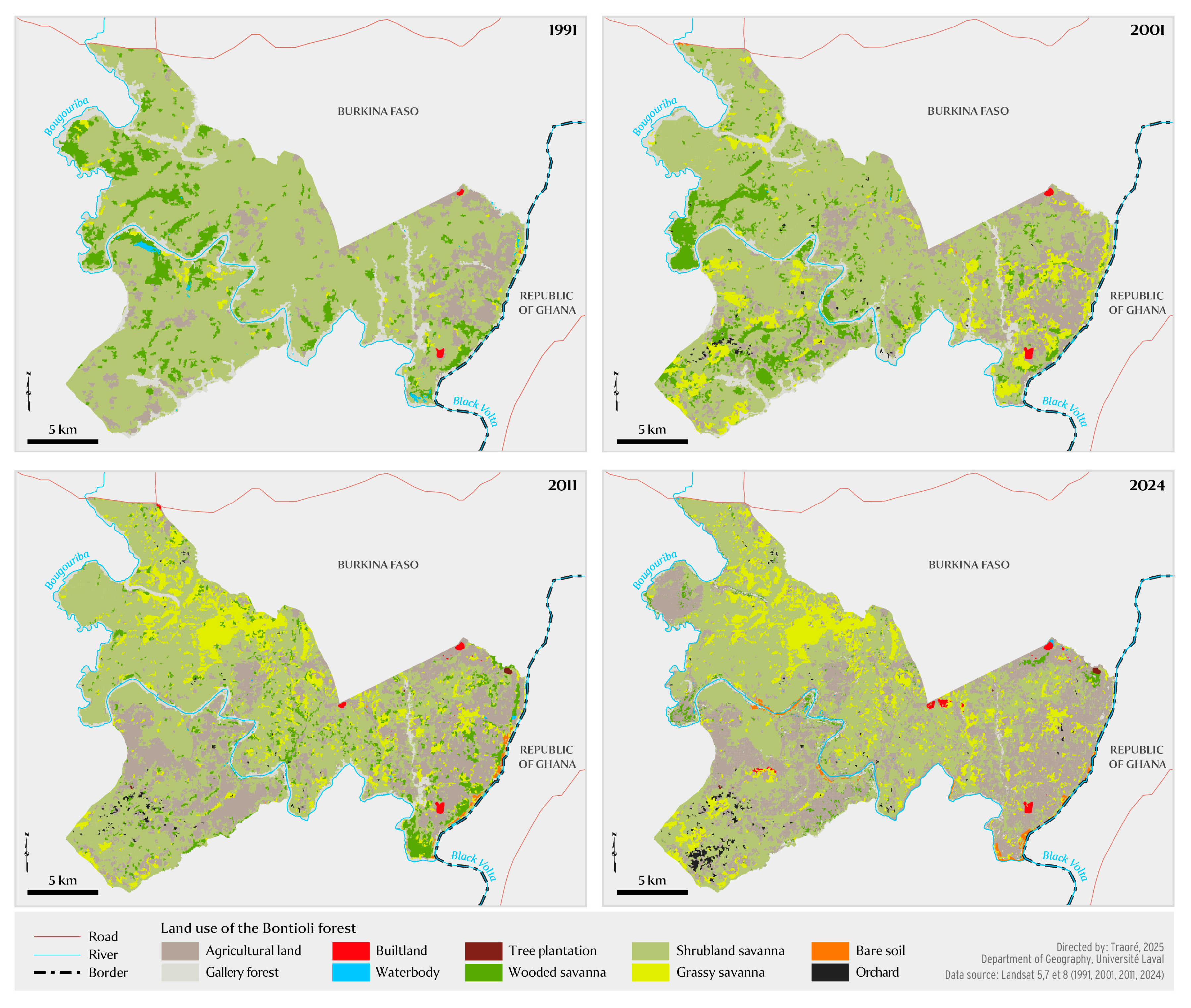
Figure 3.
Graph showing trends in the evolution of land cover surface areas.
Disclaimer/Publisher’s Note: The statements, opinions and data contained in all publications are solely those of the individual author(s) and contributor(s) and not of MDPI and/or the editor(s). MDPI and/or the editor(s) disclaim responsibility for any injury to people or property resulting from any ideas, methods, instructions or products referred to in the content. |
© 2025 by the authors. Licensee MDPI, Basel, Switzerland. This article is an open access article distributed under the terms and conditions of the Creative Commons Attribution (CC BY) license (http://creativecommons.org/licenses/by/4.0/).
Copyright: This open access article is published under a Creative Commons CC BY 4.0 license, which permit the free download, distribution, and reuse, provided that the author and preprint are cited in any reuse.


