

Submitted:
24 November 2024
Posted:
25 November 2024
You are already at the latest version
Abstract
The sustainability of reforestation initiatives depends on the involvement of local communities, whose lack of ownership compromises efforts to combat deforestation in the Lubumbashi Charcoal Production Basin. This study assesses reforestation activities in two village areas (Milando and Mwawa), based on individual interviews (50 individuals/village area) and floristic inventories carried out in two types of habitats (reforested and unexploited) for each village area. The hypotheses test whether (i) reforested habitats and tree species were inclusively selected and sustained through community-based practices, (ii) reforested habitats exhibit comparable ecological metrics to unexploited miombo due to protected regrowth, and (iii) ethnobotanical and floristic lists show variations reflecting differing anthropogenic impacts and limited species diversity in reforestation efforts. Thus, the interviews gathered data on habitat and woody species selection for reforestation, and management practices, while the inventories assessed the condition of these reforested habitats in terms of density per hectare, basal area, mean square diameter, and floristic diversity. The results show that in both village areas, the selection of habitats for reforestation was carried out concertedly (22.00-44.00% of citations). Woody species were chosen according to the needs of local communities (40-52%) and the availability of seeds (18.00-44.00%). Furthermore, management practices for these reforested habitats include planning/assessment meetings (26.00-38.00%) and maintenance activities, such as firebreaks (38.00-46.00%) and surveillance of reforested habitats (24.00%). Additionally, these practices are being increasingly neglected, jeopardizing reforestation efforts. However, density/ha, basal area, mean square diameter and floristic diversity did not show significant differences between reforested and unexploited habitats, particularly at Milando (p>0.05). Furthermore, floristic similarity is 55.56% for reforested habitats and 93.75% for unexploited habitats but remains low between reforested and unexploited habitats (40.00-47.62%). This similarity between ethnobotanical and floristic lists is also low (43.75-31.58%). The results of the present study suggest a sustainable and continuous management of these reforested habitats for an effective reconstitution of the forest cover. To reinforce the sustainable management of these reforested habitats, it is recommended that decision-makers conduct with awareness-raising campaigns and establish payment for environmental services mechanisms to motivate communities.
Keywords:
Restoration
; deforestation
; forest degradation
; miombo
; sustainable management
; local community forest concession
1. Introduction
Forests are terrestrial ecosystems harboring exceptional biodiversity [1]. They are home to 80% of the Earth's biological diversity and numerous endemic plant and animal species [2]. As a result, they play an important role in the sequestration of atmospheric carbon and contribute to the survival of both rural and urban populations through the ecosystem services they provide, such as dendro-energy and various non-timber forest products [3].
These forests cover almost 4.1 billion hectares, or 31% of the planet's land surface [4]. In Africa, forests represent around 675 million hectares [5,6], of which almost 12% is covered by miombo [7,8], a forest dominated-by woody species of the genera Brachystegia, Julbernardia and Isoberlinia [9,10]. This forest covers between 2.7 and 3.6 million km² of the Zambezi ecoregion [11], providing a livelihood for over 100 million people in both rural and urban areas [12,13]. In addition, this forest harbors significant biodiversity with a high rate of endemism, making it a priority for conservation [14,15].
However, increasing anthropogenic pressure on miombo is leading to deforestation and forest degradation [16-18]. The main factors are shifting agriculture and dendro-energy production [19, 20], to which are added timber exploitation and repeated bushfires, contributing to forest loss [21-23]. Thus, the deforestation rate of miombo varies from 2% to 22% in the Zambezi region, reaching high levels in countries where populations are highly dependent on forest resources [24], such as the Democratic Republic of Congo.
Indeed, in the Democratic Republic of Congo, a country with high forestry potential, the annual deforestation rate is the highest in the Congo Basin, at almost −0.4% between 2001 and 2019 [3]. Southeastern Democratic Republic of Congo, where miombo is dominant, has not been spared: its cover fell from over 70% of Katanga in 2000 to 43% in 2010 [25]. In the Lubumbashi Charcoal Production Basin – the administrative areas that supply the city of Lubumbashi with dendro-energy−, the deforestation rate is 1.51%, six times the national average [20], due to the poverty of rural and urban populations [26] and a difficult socio-economic context [27]. Combined with population growth and urbanization, this overexploitation is extending the deforestation of miombo, threatening the survival of dependent populations [2].
To combat deforestation and forest degradation, forest cover restoration is a key solution [8,28]. This process aims to restore the structure, composition, and ecological functions of forests, essential to the survival of communities in anthropized habitats [29]. Natural regeneration, a sustainable alternative, is effective in habitats with a high restoration capacity, dependent on disturbance and the resilience of woody species [13,30,31]. In cases of low resilience, reforestation is crucial to rapidly restore forest cover and ecosystem services [32,33], as in the Lubumbashi Charcoal Production Basin.
However, successful reforestation requires the involvement of local communities in project management, particularly in the selection of habitats and tree species [27,34]. Their involvement facilitates the acceptance and appropriation of reforestation programs, thus contributing to the sustainable management of natural resources [35,36].
Furthermore, several studies emphasize the importance of involving local communities in reforestation projects in Africa [6,37], particularly for the choice of woody species and the management of reforested habitats [38-40]. However, in the Zambezi region [41-43] and the Democratic Republic of the Congo [32,44], studies demonstrate this importance without delving into other aspects of the reforestation process that can lead to its success. In the Lubumbashi region, research on reforestation is limited. Although, studies highlight the need for reforestation in response to deforestation and emphasize the importance of integrating local communities into these processes [45-47], they do not specifically address the importance of this integration. This study fills this gap by showing that the involvement of local communities is crucial to the success and sustainability of reforestation projects. Integrating endogenous knowledge and local perceptions into these programs fosters sustainable involvement in natural resource management [24,32].
Thus, the present study aims to assess the sustainability of reforestation activities carried out in anthropized miombo habitats in the Lubumbashi Charcoal Production Basin. It tests the hypotheses that (i) reforested habitats and tree species were selected concertedly by the various stakeholders, attesting to an inclusive approach. Additionally, community-based planning, maintenance, monitoring, and evaluation practices ensure the sustainability of reforested habitats; (ii) the density/ha, mean square diameter, basal area, and floristic diversity of reforested habitats are statistically equivalent to those of unexploited miombo, because reforested habitats have been set aside to allow the forest cover to be reconstituted, and (iii) there are significant similarities/dissimilarities between the ethnobotanical and floristic lists, due to the varying levels of anthropogenic disturbance experienced by each habitat and the limited diversity of woody species used for reforestation.
2. Materials and Methods
2.1. Study Environment
The present study was carried out in the Lubumbashi Charcoal Production Basin in Haut-Katanga province, Democratic Republic of the Congo (Figure 1). This basin is situated at an altitude between of 1,200 and 1,300 m and at 11° 40'S - 27° 29'E. According to Koppen's classification system, the climate prevailing in this Lubumbashi Charcoal Production Basin is of the Cw type [48], characterized by two seasons including a rainy season (November to March), a dry season (May to September), separated by two transition months (April and October). Average annual rainfall is 1,270 mm, and average annual temperature ranges from 17 to 26°C [9,10].
In the Lubumbashi Charcoal Production Basin, the primary vegetation is miombo, which is gradually being replaced by savannah, particularly around built-up areas, due to human activities [16,20]. The soils in this region are ferralsols with poorly differentiated horizons [49]. The population of the Lubumbashi region remains highly dependent on natural resources, particularly though slash-and-burn agriculture and dendro-energy production [27]. Moreover, most of this population lives on less than $1.25 a day, expressing a high level of poverty, food insecurity, and deprivation [26].
2.1. Methods
2.2.1. Village Areas Selection and Sampling
To assess the effectiveness and sustainability of forest cover restoration activities, two village areas (Milando and Mwawa) in the Lubumbashi Charcoal Production Basin were selected. These village areas were identified as having intense anthropogenic activities, notably agriculture and charcoal production [27]. In addition, Milando and Mwawa benefited from reforestation activities initiated in 2018 as part of the implementation of forest concessions for local communities (FCLC). These activities involved the participation of several categories of stakeholders, including local communities, NGOs (APRONAPAKAT: Action pour la Protection de la Nature et des Peuples Autochtones du Katanga; BUCODED: Bureau Conseil en Développement Durable), the provincial environment coordination and the FAO (Food and Agriculture Organization of the United Nations). In these village areas, 100 individuals, 50 per village area, were selected for ethnobotanical surveys using the snowball method [50,51], between August 3 and September 15, 2024. This number was determined due to the lack of official statistics concerning individuals familiar with reforestation issues in both village areas.
2.2.2. Data collection
Ethnobotanical surveys were carried out using a semi-directive method [52], enabling the participants' discourse to be guided by pre-defined themes [53]. These surveys made it possible to gather qualitative data on the involvement of local communities in reforestation activities, particularly concerning the choice of habitats and woody species for reforestation, as well as the management activities of these habitats (Supplementary material). Forest management refers to all technical and practical actions aimed at preserving, restoring, and sustainably exploiting forests, including planning, reforestation, biodiversity monitoring, fire control, and conservation [54]. The identification of woody species cited under their vernacular names during these ethnobotanical surveys was carried out using existing floras (Flora of Zambia, Flora of Zimbabwe, World Flora) and identification manuals [9,55-57]. Field trips with some of the respondents also enabled to identify species cited and described in the local language, particularly those whose identification was difficult through the manuals.
Additionally, floristic inventories were carried out in reforested habitats and unexploited forests in each village area. Unexploited forest refers to miombo never exploited on a human scale for agriculture and charcoal production [20]. To this end, 40 floristic inventory plots were randomly installed, 20 in Milando village area (10 in reforested habitat and 10 in patches of unexploited forest) and 20 others in Mwawa. Plot dimensions were determined based on previous studies [58,59] which had shown that 50 m x 20 m (1000 m²) are adequate dimensions for floristic studies in miombo [13,59]. In these plots, all woody individuals with a diameter at breast height (DBH) ≥ 10 cm were counted and measured using forest tape [60]. These data on individual diameters allowed the establishment of the diameter structure of each inventoried habitat, while the counting enabled the calculation of individual density per unit area (hectare; [61]).
2.2.3. Data analysis
To determine the criteria used when selecting habitats and woody species for reforestation, the citation frequency (Cf; Equation (1); [62]) was calculated with the ethnobotanyR package under R software version 4.3.2, based on individual interviews. This frequency is based on the principle that the most frequently cited criteria directly influence the choice of habitats and species for reforestation. It is calculated by the equation:
where s represents the number of respondents citing the criterion and N, the total number of respondents. If Cf approaches 0, the criterion had little influence on the choice, while an Cf close to 100 indicates a strongly favored criterion.
Furthermore, to characterize and compare reforested and unexploited habitats in both village areas, several indicators were calculated: the diametric structure of inventoried individuals, density per hectare (N; Equation (2)), and the importance value index (IVI; [13,58]). The diametric structure reveals forest composition and dynamics, possibly indicating tree growth and the effects of environmental disturbances [61]. Density measures the number of individuals per hectare, while relative density reflects the proportion of a woody species within the habitat [62].
where ni is the number of individuals of a wood species on a plot and a is the area of the plot expressed in a hectare.
Additionally, the IVI assesses the ecological dominance of woody species, with a higher value indicating greater ecological significance of the species within the forest ecosystem [59,63]. This index is calculated by the following equation (Equation (3)):
where RDo represents relative dominance (Equation (4)), while RD and RF correspond to relative density and frequency (Equations (6) and (7), respectively).
Relative dominance measures the basal area occupied by all individuals of a species over a hectare. However, relative density expresses the proportion of individuals of a species about all individuals in the habitat, while relative frequency indicates the proportion of a species out of wood species [58,59].
where gisp is the basal area of a species and giTsp, the sum of all basal areas of all woody species inventoried. However, gi, the basal area of each individual measured (expressed in m²/plot area), is calculated using the equation below (Equation (5)):
with D, the diameter at breast height (DBH) of an individual, measured at 1.30 m from the ground.
where ni is the number of individuals of a species and N is the total number of individuals surveyed.
with f the frequency of a woody species (Equation (8)), expressing the probability that a woody species occurs in each of the installed floristic inventory plots (surveys), and F the sum of all frequencies.
where n is the total number of plots where the species was surveyed, and Np is the total number of plots.
However, mean square diameter (DBHm, Equation (9)) and basal area (GBA, Equation (10)) were calculated. The mean square diameter, expressed in cm, is used for trees with several trunks at 1.3 m height. In this study, DBHm was used to determine the mean diameter of trees in both reforested and unexploited habitats. The basal area, a common metric in forest management (expressed in m²/ha), represents the cross-sectional area of tree trunks measured at breast height (1.3 m) [61,64]. In addition, the averages of species, genera, and families of individual trees inventoried in each habitat were calculated [64].
where di is the diameter at breast height (DBH) of each tree trunk or branch, measured at 1.3 m above the ground, and n is the total number of such trunks or branches measured.
with m being the number of woody individuals inventoried in the plot, and FE the extension factor related to plot area (m²), used to extrapolate gi values to the hectare [61].
To highlight statistical differences at the 5% significance level among the parameters characterizing these two habitat types, the non-parametric Kruskal-Wallis's test [65] was applied to density/ha, means square diameter, basal area, and floristic richness. This test was used given the non-normality of the data confirmed by Shapiro's test [66]. In the case of significant differences, the Dunn-Bonferroni post-hoc test enabled pairwise comparison of means [67,68].
To compare floristic diversity between the reforested and unexploited habitats, the Shannon, Simpson, and Piélou indices were calculated from floristic inventory data [2]. The Shannon index assesses specific heterogeneity and the distribution of individuals between species, while Simpson measures the probability of encountering two individuals of the same species consecutively. Piélou's equitability index estimates the ratio between observed diversity and maximum possible diversity [2,59].
Finally, to compare the plant species lists from individual interviews and floristic inventories in each village area, Jaccard's similarity index (J; Equation (11)) was calculated [69]. All these analyses were carried out using R (dendrometry package) and Past (version 4.05) software.
where a is the total number of woody species inventoried in the two habitats being compared; b and c respectively the number of woody species inventoried in one of the two habitats but absent in the other.
3. Results
3.1. Habitats and Species Selection Criteria for Reforestation and Management of Reforested Habitats
3.1.1. Choice of Habitats for Reforestation in Village Areas
Over 70% of respondents reported that reforestation habitats were chosen either through concertation among stakeholders or by village chiefs. Specifically, in Milando village area, the choice of habitats was strongly influenced by the village chief, whereas in Mwawa, it resulted from consultation involving the community, the NGO, the public environmental service, and the village chief (Table 1).
3.1.2. Choice of Woody Species for Reforestation in Village Areas
More than 70% of respondents reported that woody species used for reforestation were selected based on their usefulness and the availability of seeds. In Milando, the availability of seeds was the main factor, while in Mwawa, the choice of woody species was primarily based on the needs of the local community. Other criteria, such as the use of timber and adaptation to soil types, influenced the selection of certain woody species, particularly in Mwawa (14% of respondents; Table 2).
3.1.3. Management Practices on Reforested Habitats Within Village Areas
Around 75% of respondents report that the management of reforested habitats relies mainly on planning and assessment meetings, the installation of firebreaks, and surveillance by forestry brigades. Specifically, the holding of such meetings and the installation of firebreaks are frequently mentioned in both village areas. In addition, plant nursery maintenance was particularly highlighted as a key activity in Mwawa, in contrast to Milando where this maintenance is less reported (Table 3).
3.2. Forest Recovery in Reforested Habitats Compared to Unexploited Miombo in Both Village Areas
3.2.1. Diameter Structure of Individuals Inventoried in Reforested and Unexploited Habitats Within Village Areas
Most individuals inventoried in reforested and unexploited habitats have a diameter at breast height (DBH) of between 10 and 40 cm. In the reforested habitat of Mwawa, many individuals are in the 10-20 cm DBH class, while in Milando, these individuals are distributed across all diametric classes. However, the unexploited habitats in both village areas show a similar diametric distribution, presenting increasingly larger trees compared to the reforested habitats. Furthermore, the "inverted J" diametric structure observed in both habitat types (reforested, unexploited) reflects the predominance of juveniles, indicating active regeneration and the gradual reconstitution of the forest cover, especially in reforested habitats (Figure 2).
3.2.2. Density per Hectare and Ecological Importance of Woody Species Inventoried within Reforested and Unexploited Habitats in Both Village Areas
A total of 442 woody individuals were inventoried in reforested habitats, including 256 in Milando and 186 in Mwawa, belonging to 26 genera (Milando: 17; Mwawa: 21) and 13 families (Milando: 7; Mwawa: 11). In unexploited habitats, 630 individuals were counted: 300 in Milando and 330 in Mwawa, belonging to 37 species (35 per habitat), 27 genera (Milando: 25; Mwawa: 21) and 17 families (Milando: 15; Mwawa: 12). The Fabaceae family dominates in both habitat types, accounting for 60.94% and 74.73% respectively in the reforested habitats of Milando and Mwawa, and 70.67% and 76.97% in the unexploited habitats.
Some wood species cited by respondents as chosen for reforestation, such as Acacia polyacantha, Afzelia quanzensis, and Anisophyllea boehmii, were not recorded in either reforested or unexploited habitats. Nevertheless, of these woody species, Brachystegia spiciformis, Diplorhynchus condylocarpon, and Isoberlinia angolensis are the most represented in reforested habitats, while B. spiciformis remains dominant in unexploited habitats (Table 4).
3.2.3. Dendrometric and floristic parameters of woody individuals inventoried within reforested and unexploited habitats in both village areas
Overall, floristic parameters (number of species, genera, and families per hectare) show no statistically significant differences between reforested and unexploited habitats. However, reforested habitats, particularly in the Mwawa village area, show significantly lower values for density (p < 0.05), mean square diameter, and basal area (p < 0.001; Table 5). These results indicate that miombo is recovering in reforested habitats, although this process remains less advanced than in unexploited habitats.
3.2.4. Floristic Diversity Indices of Reforested and Unexploited Habitats in Both Village Areas
The Simpson and Shannon diversity indices range from 0.0834 to 0.1633 and from 2.503 to 2.809 respectively, with higher values in unexploited habitats. This indicates greater biodiversity in these habitats, where the probability of two randomly selected individuals belonging to the same species is lower. Piélou's equitability, which ranged from 0.7039 to 0.8593, remained almost similar between reforested and unexploited habitats, suggesting a relatively uniform distribution of species in both habitat types (Table 6).
3.3. Similarities Between Ethnobotanical and Floristic Lists of Habitats in Both Village Areas
Jaccard's similarity index varies between 31.58% (between the ethnobotanical list and that of the floristic inventory in the reforested habitat at Mwawa) and 93.75% (between the unexploited habitats). This similarity remains low (below 50%), particularly between the ethnobotanical lists and those of the floristic inventories of reforested habitats in the two village areas. However, the ethnobotanical lists of these two village areas show a similarity of up to 66.67% (Table 7). These observations indicate a high dissimilarity between the ethnobotanical lists and the woody species present in the reforested habitats, while highlighting a high similarity between the floristic lists within unexploited habitats.
4. Discussion
4.1. Involvement of Local Communities in Decision-Making on Reforestation in Both Village Areas
Habitats and woody species for reforestation were selected through concertation, involving local communities, public services, NGOs, and international organizations (Tables 1, 2). These results underline a participatory approach to reforestation, valuing the environmental perception and endogenous knowledge of local communities. This approach to selecting habitats and woody species can be explained by the fact that the NGDOs driving this reforestation process advocate the promotion of a participatory approach, to meet the requirements of funding agencies [34]. This has led to consideration of the environmental perception of local community members when choosing habitats for reforestation. Indeed, in Milando, reforestation targeted habitat degraded by dendro-energy production, while in Mwawa, it was concentrated in post-cultivation fallows, as indicated by the perception maps of Ref. [70]. These habitats were selected because they had been abandoned by local communities after being exploited, respectively for agriculture and charcoal production. In addition, miombo species were chosen for reforestation, to meet the specific needs of local communities (Table 2). Indeed, these species will help maintain the floristic composition, structure, and functions of the forests, thus ensuring the continuity of ecosystem services for the local communities [71]. This contributes to the involvement of local communities in the reforestation process, thereby reinforcing its success [72]. For illustration, other reforestation activities previously conducted in the Lubumbashi region using primarily exotic species, such as Acacia auriculiformis A.Cunn. ex Benth. and Leucaena leucocephala (Lam.) de Wit [73], have not yielded satisfactory results. Indeed, these exotic species have proven to be invasive, threatening local biodiversity [74] and providing ecosystem services that are less comparable to those of miombo woody species [75]. This have led to low community participation and limited sustainability of the reforestation processes. This situation highlights the importance of a participatory approach, which greatly enhances the success of reforestation and its adoption by local communities [36]. Indeed, the active and equitable involvement of the various stakeholders, in particular local communities, ensures that their needs and interests are considered, guaranteeing greater inclusiveness and relevance of the actions carried out. Furthermore, incorporating traditional knowledge enriches restoration strategies, offering adapted and culturally relevant solutions [76]. The results of this study corroborate findings from research conducted in Africa [39,77] and in the miombo ecoregion, particularly in Tanzania [78] and Mozambique [43], highlighting the importance of integrating endogenous cultures and knowledge in the choice of habitats and woody species for reforestation.
However, reforested habitat management practices primarily include planning and assessment meetings, as well as maintenance actions, and surveillance carried out by forestry brigades (Table 3). This can be explained by the fact that, following the implementation of the project to reforest anthropized habitats, local communities are striving to sustain these initiatives despite the interruption in funding. These practices are essential to ensure the sustainability of reforestation and promote the restoration of forest cover. Nevertheless, the implementation of certain activities, such as plant nursery maintenance and the creation of firebreaks, has dwindled, particularly in Mwawa. This is due to a lack of motivation on the part of local communities, attempts to expropriate reforested land, and insufficient post-project monitoring. Sustainable management of reforested habitats requires ongoing action to strengthen ecosystem resilience [76]. Thus, the gradual reduction of these practices exposes reforested habitats to anthropogenic pressures, notably late and repetitive bushfires, which characterize the miombo ecoregion [79-82], and especially the Lubumbashi region [23]. This threat is compounded by intensive tree-cutting for dendro-energy and agriculture, practices that are increasingly observed around reforested habitats. These activities are among the main drivers of deforestation and degradation of miombo [83,84], particularly in the Lubumbashi region [20,22,85]. Weak management and maintenance practices for green spaces, resulting in the exponential degradation of these habitats, have already been reported in Burundi [86]. The results of the present study confirm the findings of previous research conducted in the miombo ecoregion [33,87,88], highlighting the importance of continuity of management practices, such as bushfire control, in the reforestation process. These practices are essential for mitigating anthropogenic pressures and promoting the rapid regeneration of forest cover in reforested habitats.
4.2. Reconstitution of Forest Cover Within Reforested Habitats in Both Village Areas
The results show statistically similar values between reforested and unexploited habitats, for dendrometric parameters, and more particularly for floristic parameters (figure 2; tables 4, 5, and 6). This shows that the miombo forest cover is recovering in reforested habitats, compared with unexploited habitats in the Lubumbashi region. Indeed, the values for diameter structure, density of individuals/ha, root mean square diameter, basal area, and floristic diversity are increasingly like those for unexploited miombo and to the results for unexploited forest found by Ref. [33]. This situation is justified by the reforestation carried out, the protection of these reforested habitats, and the management activities mentioned above, such as the establishment of firebreaks and the monitoring of these habitats, which contribute to the growth and establishment of woody species while being spared from anthropic pressure. These results corroborate those of studies carried out in Mozambique [59,79,89], showing that in the absence of anthropogenic activities, anthropized miombo habitats reconstitute their forest cover over the years up to the pyroclimax stage [11,90]. Nevertheless, this reconstitution is a function of the level of anthropogenic degradation experienced by the habitats and the resilience of woody species to these disturbances [13,59]. This also explains the low values represented by the reforested Mwawa habitat in terms of dendrometric parameters, compared with other habitats. Indeed, the reforested habitat at Mwawa would have undergone a high degree of anthropization, compared with that at Milando, thus explaining this difference in dendrometric parameter values particularly. In addition, the increasingly rare application of management practices works against the biodiversity conservation and reforestation efforts devoted to miombo. The results of the present study corroborate those of other research conducted in the miombo ecoregion [2,13,21,59,91-93], showing that habitat composition and floristic diversity are negatively correlated with anthropogenic disturbance.
4.3. Similarity Between Ethnobotanical and Floristic Lists of Reforested and Unexploited Habitats in Both village Areas
The similarity between the ethnobotanical and floristic lists of reforested habitats remains low (Table 7). Some woody species present on the ethnobotanical lists are absent from the floristic inventory lists, and vice versa. This situation can be explained on the one hand by the fact that, during the floristic inventory, the individuals of certain species chosen for reforestation were still juveniles, with a diameter (DBH) below the pre-counting level set at ≥10 cm for the present study. This lower diameter of these individuals would be justified by the slow growth exhibited by most miombo woody species, as attested by previous studies [2,94], leading to this situation during floristic inventories [95]. Furthermore, the availability of woody species in a reforested habitat depends on these ecological requirements and the technical problems that may arise during the reforestation operation. Indeed, the requirements of a woody species in terms of ecological factors, particularly the physico-chemical properties of the soil, influence its ability to recover, survive, and establish in a habitat [96]. On the other hand, this situation can be explained by the fact that reforested habitats were already teeming with individuals of other woody species, leading to this difference between ethnobotanical and floristic lists.
However, the similarity of floristic inventory lists within reforested and unexploited habitats is low. This situation can be explained by the anthropogenic disturbances experienced by these reforested habitats in the past. Indeed, the composition and floristic diversity of habitat is inversely correlated with anthropogenic disturbance [13,21,92]. These results corroborate previous studies conducted in the Zambezi region [59,92] and particularly in Lubumbashi region [33], showing that the floristic diversity of habitats that have experienced anthropogenic disturbance, remains low, compared to unexploited habitats.
4.4. Implications of Results for Optimized Management of Reforested Habitats in the Lubumbashi Charcoal Production Basin
The miombo forest cover is in full recovery within the reforested habitats of the Lubumbashi charcoal production basin. However, the mechanisms (firebreaks and surveillance) that can regulate human activities are increasingly neglected in these village areas. This leads to a proliferation of human activities around these habitats, affecting efforts to combat deforestation and forest degradation in Lubumbashi Charcoal Production Basin. In response to this issue, environmental education is one of the potential solutions. Indeed, through awareness campaigns, environmental education would increasingly promote the involvement of local communities in the management of these reforested habitats [97]. It would also encourage compliance with regulations governing the protection of these reforested habitats and the continuation of practices regulating anthropogenic activities [98], such as bushfires, charcoal production, and agriculture, the main drivers of deforestation and forest degradation [20,85]. Environmental education has already been used after reforestation projects in Malawi, Lesotho, and Tanzania, to raise local communities' awareness of the need for further action to ensure the sustainable management of these habitats [99]. However, this awareness-raising may not produce the expected results, due to the mistrust and lack of confidence that plague relations between governance players in the Lubumbashi region [27]. The solution to this problem would be to organize dialogue frameworks between the different stakeholders, to renew mutual trust.
Improving land tenure laws and forestry policy is also a key alternative. Strengthened land legislation would secure habitats under local community forest concession (LCFC), which are often coveted by concessionaires, farmers, and dendro-energy producers. Indeed, cases of habitat invasion under biodiversity conservation/preservation status have already been reported in the Charcoal Production Basin of Lubumbashi, resulting in the degradation of the vegetative cover of these habitats [47]. Additionally, reform of forestry policy would help address anthropogenic invasions of these habitats through appropriate sanctions [36,100]. This will only be possible with the support of accredited public services and the advocacy of NGOs and international agencies [101]. However, the strengthening of the existing monitoring framework will have to be considered to ensure continuous monitoring and assess the results of the reforestation activities after the implementation of the related projects.
Finally, mechanisms to encourage local communities to become involved in the sustainable management and expansion of reforested habitats, such as payment for environmental services (PES), is a solution that decision-makers need to implement. Indeed, PES is an incentive mechanism designed to encourage the protection, restoration, or enhancement of natural ecosystems [102]. This concept is based on the idea that beneficiaries of environmental services (governments, and companies) pay local communities for the adoption of practices that maintain or improve forest ecosystems [103]. This type of PES has already been initiated in the miombo ecoregion in Zimbabwe, with convincing results in terms of sustainable management of forest resources [104]. However, this will need to be accompanied by equitable distribution and reasoned use of PES dividends, to prevent conflicts between stakeholders [105].
The present study does not address social risks, such as land conflicts or inequalities in the distribution of benefits between local communities, which could compromise the sustainability of reforested habitats. Such information would enrich the current results and help develop strategies to ensure the long-term sustainability of these habitats.
5. Conclusions
The present study assessed the sustainability of reforestation activities carried out in two anthropized miombo habitats in the village areas of Milando and Mwawa, through individual interviews combined with floristic inventories in two habitat types (reforested and unexploited) for each village area. The results confirm that habitats and woody species for reforestation were selected concertedly, aligning with the environmental perceptions and needs of local communities. Indeed, these habitats were selected in consultation with local communities, public services, NGOs, and international organizations, while the woody species were chosen according to the local communities' needs. This participatory approach ensures the sustainability of reforested habitats, through activities such as planning, maintenance, monitoring, and assessment, involving local communities in the ongoing management of these habitats. The results also confirm that the miombo forest cover is recovering in reforested habitats, with dendrometric and floristic parameter values approaching those of unexploited miombo. Indeed, the averages of dendrometric (diameter structure; density/ha; root mean square diameter; basal area) and floristic (taxa, genera, and families) parameters did not generally show significant differences between reforested and unexploited habitats. Finally, these results confirm that there are similarities and dissimilarities between the ethnobotanical and floristic lists of reforested and unexploited habitats. Certainly, high similarities were found between the floristic lists of these different habitats, while dissimilarities were observed between the ethnobotanic lists and these floristic lists. Although this study does not address social risks, such as land conflicts or inequalities in the distribution of benefits, it nevertheless highlights the importance of including local communities to ensure the sustainable success of reforestation projects. To promote the restoration of forest cover in reforested habitats, decision-makers need to revive environmental education and raise awareness among local communities about the need to adopt practices that support reforestation. Additionally, establishing a payment for environmental services mechanism is necessary to encourage local communities to manage their forests sustainably.
Supplementary Materials
The following supporting information can be downloaded at the website of this paper posted on Preprints.org.
Funding
This research was funded by the project CHARLU (ARES-CCD, Belgium).
Data Availability Statement
The data related to this study will be available upon request from the interested party.
Acknowledgments
The authors would like to express their gratitude to the Académie de Recherche et d'Enseignement Supérieur (ARES) via the Projet de Recherche pour le Développement entitled "Renforcement des capacités de gestion durable de la forêt claire de miombo par l'évaluation de l'impact environnemental de la production de charbon de bois et l'amélioration des pratiques vis-à-vis des ressources forestières (PRD CHARLU)", for the doctoral Grants awarded to Dieu-donné N'tambwe Nghonda, Héritier Khoji Muteya, Nathan Kasanda Mukendi and Bienvenu Esoma Okothomas. Our thanks go to the local communities and village authorities who took part in this study.
Conflicts of Interest
The authors declare no conflicts of interest.
References
- Tchekoté, H.; Meva’a Nleme, Z.L.; Moudingo J.H.; Djofang, N.P. Diagnostic de la conservation pour une gestion durable de la biodiversité dans le Bakossi, Banyang-Mbo, Régions du Sud-Ouest et du Littoral au Cameroun. Rev. Sci. Tech. For. Environ. Bassin Congo 2020, 5, 49–59. [CrossRef]
- Kalaba, F.K.; Quinn, C.H.; Dougill, A.J.; Vinya, R. Floristic composition, species diversity and carbon storage in charcoal and agriculture fallows and management implications in Miombo woodlands of Zambia. For. Ecol. Manag. 2013, 304, 99–109. [CrossRef]
- Eba’a Atyi, R.; Hiol Hiol, F.; Lescuyer, G.; Mayaux, P.; Defourny, P.; Bayol, N.; Saracco, F.; Pokem, D.; Sufo Kankeu, R.; Nasi, R. Les forêts du bassin du Congo : état des forêts 2021. CIFOR, Bogor, Indonésie, 2022; 474p. [CrossRef]
- FAO. La Situation des forêts du monde 2024 – Innovations dans le secteur forestier pour un avenir plus durable. FAO, Rome, Italie, 2024; 132p. [CrossRef]
- Gonçalves, F.M.P.; Chisingui, A.V.; Luís, J.C.; Rafael, M.F.F.; Tchamba, J.J.; Cachissapa, M.J.; Caluvino, I.M.C.; Bambi, B.R.; Alexandre, J.L.M.; Chissingui, M.D.G.; Manuel, S.K.A.; Jacinto, H.D.; Finckh, M.; Meller, P.; Jürgens, N.; Revermann, R. First vegetation-plot database of woody species from Huíla province, SW Angola. Veg. Classif. Surv. 2021, 2, 109–116. [CrossRef]
- Bostancı, S.H. The Role of Local Governments in Encouraging Participation in Reforestation Activities. In: Singh, P.; Milshina, Y.; Batalhão, A.; Sharma, S.; Mohd, M.H. (eds.), The Route Towards Global Sustainability. Springer nature, Cham, Switzerland, 2023; 25–44. [CrossRef]
- Campbell, B. M.; Frost, P.; Byron, N. Miombo Woodlands and their use: overview and key issues. In: Campbell, B. (eds.), The Miombo in Transition: Woodlands and Welfare in Africa. Centre for International Forestry Research, Bogor, Indonesia, 2006; 1–10.
- Berrahmouni, N.; Regato, P.; Parfondry, M. Global guidelines for the restoration of degraded forests and landscapes in drylands: building resilience and benefiting livelihoods. FAO, Rome, Italie, 2015; 173 p.
- Malaisse, F. How to live and survive in Zambezian open forest (Miombo ecoregion). Les Presses Agronomiques de Gembloux, Gembloux, Belgique, 2010; 424 p.
- Malaisse, F.; Bogaert, J.; Boisson, S.; Useni, S.Y. La végétation naturelle d’Élisabethville (actuellement Lubumbashi) au début et au milieu du XXième siècle. Géo-Eco-Trop. 2021, 45(1), 41–51.
- Sawe, T.; Munishi, P.; Maliondo, S. Woodlands degradation in the Southern Highlands, Miombo of Tanzania: Implications on conservation and carbon stocks. Int. J. Biodivers. Conserv. 2014, 6, 230–237.
- Mwitwa, J.; German, L.; Muimba-Kankolongo, A.; Puntondewo, A. Governance and sustainability challenges in landscape shaped by mining: mining forestry linkages and impacts in the copper belt of Zambia and the DR Congo. For. Policy Econ. 2012, 25, 19–30. [CrossRef]
- Gonçalves, F.M.P.; Revermann, R.; Cachissapa, M.J.; Gomes, A.L.; Aidar, M.P.M. Species diversity, population structure and regeneration of woody species in fallows and mature stands of tropical woodlands of southeast Angola. J. For. Res. 2018, 29, 1569–1579. [CrossRef]
- Mittermeier, R.A.; Mittermeier, C.G.; Brooks, T.M.; Pilgrim, J.D.; Konstant, W.R.; Da Fonseca, G.A.B.; Kormos, C. Wilderness and biodiversity conservation. Proc. Natl. Acad. Sci. U.S.A, 2003, 100, 10309–10313. [CrossRef]
- Godlee, J.L.; Gonçalves, F.M.; Tchamba, J.J.; Chisingui, A.V.; Ilunga, M.J.; Ngoy, S.M.; Ryan, C.M.; Brade, T.K.; Dexter, K.G. Diversity and Structure of an Arid Woodland in Southwest Angola, with Comparison to the Wider Miombo Ecoregion. Diversity 2020, 12, 140. [CrossRef]
- Munyemba, K. F.; Bogaert, J. Anthropisation et dynamique spatiotemporelle de l’occupation du sol dans la région de Lubumbashi entre 1956 et 2009. E-revue Unilu 2014, 1, 3–23.
- Mojeremane, W.; Lumbile, A. A review of Pterocarpus angolensis DC. (Mukwa) an important and threatened timber species of the Miombo woodlands. Res. J. For. 2016, 10, 8–14.
- Khoji, M.H.; N’tambwe, N.D.; Malaisse, F.; Waselin, S.; Sambiéni, K.R.; Cabala, K.S..; Munyemba, K.F.; Bastin, J.-F.; Bogaert, J.; Useni, S.Y. Quantification and Simulation of Landscape Anthropization around the Mining Agglomerations of Southeastern Katanga (DR Congo) between 1979 and 2090. Land 2022, 11, 850. [CrossRef]
- Cabala, K.S.; Useni, S.Y.; Munyemba, K.F.; Bogaert, J. Activités anthropiques et dynamique spatiotemporelle de la forêt claire dans la Plaine de Lubumbashi. In: Bogaert, J., Colinet, G. & Mahy, G. (Eds), Anthropisation des paysages katangais. Les Presses Universitaires de Liège, Liège, Belgique, 2018; 253-266.
- Khoji, M.H.; N’tambwe, N.D.; Mwamba, K.F.; Harold, S.; Munyemba, K.F.; Malaisse, F.; Bastin, J.-F.; Useni, S.Y.; Bogaert, J. Mapping and Quantification of Miombo Deforestation in the Lubumbashi Charcoal Production Basin (DR Congo): Spatial Extent and Changes between 1990 and 2022. Land 2023, 12, 1852. [CrossRef]
- Syampungani, S.; Geldenhuys, C.J.; Chirwa, P.W. Regeneration dynamics of miombo woodland in response to different anthropogenic disturbances: forest characterisation for sustainable management. Agrofor. Syst. 2016, 90, 563–576. [CrossRef]
- Mpanda, M.M.; Khoji, M.H.; N’Tambwe, N.D.; Sambieni, R.K.; Malaisse, F.; Cabala, K.S.; Bogaert, J.; Useni, S.Y. Uncontrolled Exploitation of Pterocarpus tinctorius Welw. and Associated Landscape Dynamics in the Kasenga Territory: Case of the Rural Area of Kasomeno (DR Congo). Land 2022, 11, 1541. [CrossRef]
- Useni, S.Y.; Mpanda Mukenza, M.; Khoji Muteya, H.; Cirezi Cizungu, N.; Malaisse, F.; Bogaert, J. Vegetation Fires in the Lubumbashi Charcoal Production Basin (The Democratic Republic of the Congo): Drivers, Extent and Spatiotemporal Dynamics. Land 2023, 12, 2171. [CrossRef]
- Chirwa, P.W.; Larwanou, M.; Syampungani, S.; Babalola, F.D. Management and restoration practices in degraded landscapes of Southern Africa and requirements for up-scaling. Int. For. Rev. 2015, 17, 31–42. [CrossRef]
- Potapov, P.V.; Turubanova, S.A.; Hansen, M.C.; Adusei, B.; Broich, M.; Altstatt, A.; Mane, L.; Justice, C.O. Quantifying forest cover loss in Democratic Republic of the Congo, 2000–2010, with Landsat ETM+ data. Remote Sens. Environ. 2012, 122, 106–116. [CrossRef]
- Cadre Intégré de Classification de la sécurité Alimentaire. Analyse de l’IPC de l’insécurité alimentaire chronique. IPC-Kinshasa, Kinshasa, République démocratique du Congo, 2024 ; 120p.
- N’tambwe, D.N.; Khoji, M.H.; Kasongo, K.B.; Kouagou, S.R.; Malaisse, F.; Useni, S.Y.; Masengo, K.W.; Bogaert, J. Towards an Inclusive Approach to Forest Management: Highlight of the Perception and Participation of Local Communities in the Management of miombo Woodlands around Lubumbashi (Haut-Katanga, D.R. Congo). Forests 2023, 14, 687. [CrossRef]
- Rinaudo, T.; Muller, A.; Morris, M. Manuel La Régénération Naturelle Assistée (RNA). Une ressource pour les gestionnaires de projets, les utilisateurs et tous ceux qui ont un intérêt à mieux comprendre et soutenir le mouvement pour la RNA. FMNR Hub, World Vision, Melbourne, Australia, 2020; 241p.
- Awono, A.; Assembe-Mvondo, S.; Tsanga, R.; Guizol, P.; Peroches, A. Restauration des paysages forestiers et régimes fonciers au Cameroun : Acquis et handicaps. Document Occasionnel 10. CIFOR-ICRAF, Bogor, Indonésie, 2023; 43p. [CrossRef]
- Holl, K.D.; Aide, T.M. When and where to actively restore ecosystems? For. Ecol. Manag. 2011, 261, 1558–1563. [CrossRef]
- Chazdon, R.L.; Guariguata, M.R. Natural regeneration as a tool for large-scale forest restoration in the tropics: prospects and challenges, Biotropica 2016, 48(6), 716–730. [CrossRef]
- Reyniers, C. Agroforesterie et déforestation en République démocratique du Congo. Miracle ou mirage environnemental ? Monde dev. 2019, 187, 113–132. [CrossRef]
- N’tambwe, N.D.; Khoji, M.H.; Salomon, W.; Cuma, M.F.; Malaisse, F.; Ponette, Q.; Useni, S.Y.; Masengo, K.W.; Bogaert, J. Floristic Diversity and Natural Regeneration of Miombo Woodlands in the Rural Area of Lubumbashi, D.R. Congo. Diversity 2024, 16, 405. [CrossRef]
- Buttoud, G.; Nguinguiri J.C., 2016. La gestion inclusive des forêts d’Afrique centrale : passer de la participation au partage des pouvoirs. FAO-CIFOR, Bogor, Indonésie, 2016; 250p.
- Hervé, D.; Randriambanona, H.; Ravonjimalala, H. R.; Ramanankierana, H.; Rasoanaivo, N. S.; Baohanta, R.; Carrière, S. M. Perceptions des fragments forestiers par les habitants des forêts tropicales humides malgaches. Bois For. Trop. 2020, 345, 43–62. [CrossRef]
- Nansikombi, H.; Fischer, R.; Kabwe, G.; Günter, S. Exploring patterns of forest governance quality: Insights from forest frontier communities in Zambia’s Miombo ecoregion. Land Use Policy 2020, 99, 1-16. [CrossRef]
- Asaah, E.K.; Tchoundjeu, Z.; Leakey, R.R.B.; Takousting, B.; Njong, J.; Edang, I. Trees, agroforestry and multifunctional agriculture in Cameroon. Int. J. Agric. Sustain. 2011, 9:110–119. [CrossRef]
- Ouattara, B.; Sanou, L.; Koala, J.; Hien M. Perceptions locales de la dégradation des ressources naturelles du corridor forestier de la Boucle du Mouhoun au Burkina Faso. Bois For. Trop. 2022, 352, 43–60. [CrossRef]
- Baïyabe, I.-M.; Dongock, N.D.; Amougoua, A.C.; Tchobsala; Mapongmetsem, P.M. Perceptions paysannes des sites reboisés de la région de l’extrême-nord, cameroun. Rev. ivoir. sci. technol. 2023, 42, 114–131.
- Diawara, S.; Dao, A.; Ouattara, M.; Savadogo, P. Evaluation des connaissances locales dans la restauration écologique des paysages forestiers dégradés au Burkina Faso. Sci. Nat. Appl. 2024, 43(1), 180–205.
- Landry, J.; Chirwa, PW. Analysis of the potential socioeconomic impact of establishing plantation forestry on rural communities in Sanga district, Niassa province, Mozambique. Land Use Policy 2011, 28, 542–551. [CrossRef]
- Axelsson, E.P.; Grady, K.C. Symphony for the native wood(s): Global reforestation as an opportunity to develop a culture of conservation. People Nat. 2022, 4, 576–587. [CrossRef]
- Montfort, F. Dynamiques des paysages forestiers au Mozambique : étude de l’écologie du Miombo pour contribuer aux stratégies de restauration des terres dégradées. Bois For. Trop. 2023, 357, 105–106. [CrossRef]
- Bisiaux, F.; Peltier, R.; Muliele, J.-C. Plantations industrielles et agroforesterie au service des populations des plateaux Batéké, Mampu, en République Démocratique du Congo. Bois For. Trop. 2009, 301(3), 21–32. [CrossRef]
- Muchiza, B.I.; Monga, I.D.R.; Mumba, T.U.; Ndabereye, S. M.D.A.; Kalombo, W.K.C.; Nono, M.N. Perceptions des populations locales sur la forêt, la déforestation et leur participation à la gestion forestière du Miombo dans l’hinterland de Lubumbashi (Haut-Katanga/RDC). Rev. Afr. Environ. Agric. 2022, 5(4), 108–115.
- Numbi, M.D.; Mbinga, L.B.; Mpange, K.F.; Mukendi, E.; Kazaba, K.P.; Nzuzi, M.G.; Kapend, K.D.L.V.; Kaya, B.H.H.; Lwamba, B.J.; Monga, I.D.R.; Ngoy, S.M. Influence de traitements sur la germination et la croissance en pépinière d’Afzelia quanzensis Welw. (Fabaceae) à Lubumbashi en République Démocratique du Congo. Rev. Afr. Environ. Agric. 2024, 7(1), 11–17. [CrossRef]
- Khoji, M.H.; Mpanda, M.M.; Kipili, M.I.; Malaisse, F.; N’tambwe, N.D.; Kasanda, M.N.; Bastin, J.-F.; Bogaert, J.; Useni, S.Y. Protected area creation and its limited effect on deforestation: Insights from the Kiziba-Baluba hunting domain (DR Congo). Trees, Forests and People 2024, 18, 100654. [CrossRef]
- Kalombo, K. D. Evolution des éléments du climat en RDC : Stratégies d'adaptation des communautés de base, face aux événements climatiques de plus en plus fréquents. Éditions universitaires européennes, Sarrebruck, Allemagne, 2016; 220p.
- Kasongo, L.M.E.; Banza, M.J. Evaluation de la réponse du soja aux doses croissantes d’un compost à base de Tithonia diversifolia sur un sol fortement altéré. Int. J. Innov. Appl. Stud. 2015, 11(2), 273–281.
- Johnston, L.G.; Sabin, K. Échantillonnage déterminé selon les répondants pour les populations difficiles à joindre. Methodol. Innovations 2010, 5(2), 38–48. [CrossRef]
- Marpsat, M.; Razafindratsima, N. Les méthodes d’enquêtes auprès des populations difficiles à joindre : Introduction au numéro spécial. Methodol. Innovations 2010, 5(2), 3–16. [CrossRef]
- Traoré, L.; Hien, M.; Ouédraogo, I. Usages, disponibilité et stratégies endogènes de préservation de Canarium schweinfurthii (Engl.) (Burseraceae) dans la région des Cascades (Burkina Faso). Ethnobot. Res. Appl. 2021, 21(1), 1–17. [CrossRef]
- Dubois, É.; Michaux, E. Étalonnages à l’aide d’enquêtes de conjoncture : de nouveaux résultats. Econ. Prévis. 2006, 172 : 11-28. [CrossRef]
- Bettinger, P.; Boston, K.; Siry, P.J.; Grebner, L.D. Forest Management and Planning. Academic press, 2nd ed, Cambridge, Massachusetts, USA, 2016; 362p.
- Smith, P.; Allen, Q. Field guide to the trees and shrubs of the miombo woodlands. Royal Botanic Gardens, Brussels, Belgium, 2004; 176p.
- Meerts, P.J.; Hasson, M. Arbres et Arbustes du Haut-Katanga. Editions Jardin Botanique de Meise, Brussels, Belgium, 2016; 386p.
- Vollesen, K.; Merrett, L. A photo rich field guide to the (wetter) Zambian Miombo woodland: Based on Plants from the Mutinondo Wilderness Area, Northern Zambia. Lari Merret, Lusaka, Zambia, 2020; 1200p.
- Thiombiano, A.; Glele kakaï, R.; Bayen, P.; Boussim, J.I.; Mahamane, A. Méthodes et dispositifs d’inventaires forestiers en Afrique de l’Ouest : état des lieux et propositions pour une harmonisation. Ann. Sci. Agron. 2016, 20, 15–31.
- Ameja, L.G.; Ribeiro, N.S.; Sitoe, A.; Guillot, B. Regeneration and Restoration Status of Miombo Woodland Following Land Use Land Cover Changes at the Buffer Zone of Gile National Park’s Central Mozambique. Trees, Forests and People 2022, 9, 100290. [CrossRef]
- Ding, Y.; Zang, R.; Lu, X.; Huang, J. The impacts of selective logging and clear-cutting on woody plant diversity after 40 years of natural recovery in a tropical montane rain forest, south China. Sci. Total Environ. 2017, 579, 1683–1691. [CrossRef]
- Rondeux, J. La mesure des arbres et des peuplements forestiers. 3ème édition. Les Presses Universitaires de Liège – Agronomie – Gembloux, Gembloux, Belgique, 2021; 738p. http://hdl.handle.net/2268/262622.
- Badjaré, B.; Kokou, K.; Bigou-lare, N.; Koumantiga, D.; Akpakouma, A.; Adjayi, M.B.; Abbey, G.A. Etude ethnobotanique d’espèces ligneuses des savanes sèches au Nord-Togo, diversité, usages, importance et vulnérabilité. Biotechnol. Agron. Soc. Environ. 2018, 22(3), 152–171.
- Amba, G.J.A.; Gnahoré, É.; Diomandé, S. Diversité floristique et structurale de la forêt classée de la Mabi au Sud-Est de la Côte d’Ivoire. Afr. Sci. 2021, 18(1), 159–171.
- Zébazé, D.; Gorel, A.; Gillet, J.-F.; Houngbégnon, F.; Barbier, N.; Ligot, G.; Lhoest, S.; Kamdem, G.; Libalah, M.; Droissart, V.; Sonké, B.; Doucet, J.-L. Natural regeneration in tropical forests along a disturbance gradient in South-East Cameroon. For. Ecol. Manag. 2023, 547, 121402. [CrossRef]
- Ostertagová, E.; Ostertag, O.; Kováč, J. Methodology and Application of the Kruskal-Wallis Test. Appl. Mech. Mater. 2014, 611, 115–120. [CrossRef]
- Razali, N.M.; Wah, Y.B. Power comparisons of Shapiro-Wilk, Kolmogorov-Smirnov, Lilliefors and Anderson-Darling tests. J. Stat. Model. Anal. 2011, 2(1), 21-33.
- Gupta, B.; Mishra, T.K. Analysis of tree diversity and factors affecting natural regeneration in fragmented dry deciduous forests of lateritic West Bengal. Trop. Ecol. 2019, 60, 405–414. [CrossRef]
- Heinken, T.; Diekmann, M.; Liira, J.; Orczewska, A.; Schmidt, M.; Brunet, J.; Chytrý, M.; Chabrerie, O.; Decocq, G.; De Frenne, P.; Dřevojan, P.; Dzwonko, Z.; Ewald, J.; Feilberg, J.; Graae, B.J.; Grytnes, J.; Hermy, M.; Kriebitzsch, W.; Laiviņš, M.; Lenoir, J.; Lindmo, S.; Marage, D.; Marozas, V.; Niemeyer, T.; Paal, J.; Pyšek, P.; Roosaluste, E.; Sádlo, J.; Schaminée, J.H.J.; Tyler, T.; Verheyen, K.; Wulf, M.; Vanneste, T. The European Forest Plant Species List (EuForPlant): Concept and applications. J. Veg. Sci. 2022, 33, e13132. [CrossRef]
- Albatineh, A.N.; Niewiadomska-Bugaj, M. Correcting Jaccard and other similarity indices for chance agreement in cluster analysis. Adv. Data Anal. Classif. 2011, 5, 179–200. [CrossRef]
- N’tambwe, N.D.; Khoji, M.H.; Cabala, K.S.; Malaisse, F.; Amisi, M.Y.; Useni, S.Y.; Masengo, K.W.; Bogaert, J. Spatial Footprint of anthropogenic activities in the Charcoal Production Basin of Lubumbashi (D.R. Congo): Applicability of Kevin Lynch's (1960) approach. J. nat. conserv. (In press). http://dx.doi.org/10.2139/ssrn.4743650.
- Aerts, R.; Honnay, O. Forest restoration, biodiversity and ecosystem functioning. BMC Ecol. 2011, 11, 29. [CrossRef]
- Evans, M.D.; Zipper, E.C.; Burger, A.J.; Strahm, D.B.; Villamagna, M.A. Reforestation practice for enhancement of ecosystem services on a compacted surface mine: Path toward ecosystem recovery. Ecol. Eng. 2013, 51, 16–23. [CrossRef]
- Useni Sikuzani, Y.; Khoji Muteya, H.; Yona Mleci, J.; Mpanda Mukenza, M.; Malaisse, F.; Bogaert, J. The Restoration of Degraded Landscapes along the Urban–Rural Gradient of Lubumbashi City (Democratic Republic of the Congo) by Acacia auriculiformis Plantations: Their Spatial Dynamics and Impact on Plant Diversity. Ecologies 2024, 5, 25–41. [CrossRef]
- Doren, R.F. ; Volin, J.C.; Richards, J.H. Invasive Exotic Plant Indicators for Ecosystem Restoration: An Example from the Everglades Restoration Program. Ecol. Indic. 2009, 9, 29–36.
- Useni, S.Y.; Mpibwe, K.A.; Yona, M.J.; N’Tambwe, N.D.; Malaisse, F.; Bogaert, J. Assessment of Street Tree Diversity, Structure and Protection in Planned and Unplanned Neighborhoods of Lubumbashi City (DR Congo). Sustainability 2022, 14, 3830. [CrossRef]
- FAO. Restauration du paysage forestier. Unasylva, Rome, Italie, 2015; 116p. https://openknowledge.fao.org/handle/20.500.14283/i5212f.
- Tiki, L.; Abdallah, J.M.; Marquardt, K.; Tolera, M. Does Participatory Forest Management Reduce Deforestation and Enhance Forest Cover? A Comparative Study of Selected Forest Sites in Adaba-Dodola, Ethiopia. Ecologies 2024, 5, 647–663. [CrossRef]
- Kimambo, N.E.; L’Roe, J.; Naughton-Treves, L.; Radeloff, V.C. The role of smallholder woodlots in global restoration pledges – Lessons from Tanzania. Forest Policy Econ. 2020, 115, 102144. [CrossRef]
- Giliba, R.A.; Mafuru, C.S.; Paul, M.; Kayombo, C.J.; Kashindye, A.M.; Chirenje, L.I.; Musamba, E.B. Human Activities Influencing Deforestation on Meru Catchment Forest Reserve, Tanzania. J. Hum. Ecol. 2011a, 33(1): 17–20. [CrossRef]
- Van Wilgen, B.W.; De Klerk, H.M.; Stellmes, M.; Archibald, S. An analysis of the recent fire regimes in the Angolan catchment of the Okavango Delta, Central Africa. Fire Ecol. 2022, 18, 13. [CrossRef]
- Buramuge, V.A.; Ribeiro, N.S.; Olsson, L.; Bandeira, R.R. Exploring Spatial Distributions of Land Use and Land Cover Change in Fire-Affected Areas of Miombo Woodlands of the Beira Corridor, Central Mozambique. Fire 2023a, 6, 77. [CrossRef]
- Buramuge, V.A.; Ribeiro, N.S.; Olsson, L.; Bandeira, R.R.; Lisboa, S.N. Tree Species Composition and Diversity in Fire-Affected Areas of Miombo Woodlands, Central Mozambique. Fire 2023b, 6, 26. [CrossRef]
- Cabral, A.I.R.; Vasconcelos, M.J.; Oom, D.; Sardinha, R. Spatial dynamics and quantification of deforestation in the central-plateau woodlands of Angola (1990–2009). Appl. Geogr. 2011, 31, 1185–1193. [CrossRef]
- Barbara, N.; Linda, N.; Ngonga, C. Drivers of Deforestation in the Miombo Woodlands and Their Impacts on the Environment. Adv. Res. 2016, 6(5), 1–7. [CrossRef]
- Cabala, K.S.; Useni, S.Y.; Amisi, M.Y.A.; Munyemba, K.F.; Bogaert, J. Activités anthropiques et dynamique des écosystèmes forestiers dans les zones territoriales de l’Arc Cuprifère Katangais (RD Congo). Tropicultura 2022, 40(3/4), 210. [CrossRef]
- Kabanyegeye, H.; Useni, S.Y.; Sambieni, K.R.; Masharabu, T.; Havyarimana, F.; Bogaert, J. Trente-trois ans de dynamique spatiale de l’occupation du sol de la ville de Bujumbura, République du Burundi. Afrique Sci. 2021, 18, 203–2015. https://hdl.handle.net/2268/256070.
- Giliba, R. A.; Boon, E. K.; Kayombo, C. J.; Musamba, E. B.; Kashindye, A. M.; Shayo, P. F. Species composition, richness and diversity in Miombo woodland of Bereku Forest Reserve, Tanzania. J. Biodivers. 2011b, 2(1), 1–7.
- Chirwa, W.P.; Mahamane, L. Overview of restoration and management practices in the degraded landscapes of the Sahelian and dryland forests and woodlands of East and southern Africa, Southern Forests. J. For. Sci. 2017, 17(3), 20-30. http://dx.doi.org/10.2989/20702620.2016.1255419.
- Vinya, R.; Syampungani, S.; Kasumu, E.C.; Monde, C.; Kasubika, R. Preliminary study on the drivers of deforestation and potential for REDD+ in Zambia. A consultancy report prepared for Forestry Department and FAO under the national UN-REDD+ Programme Ministry of Lands & Natural Resources. Lusaka, Zambia, 2011; 65p.
- Masharabu, T.; Noret, N.; Lejoly, J.; Bigendako, M-J.; Bogaert, J. Etude comparative des paramètres floristiques du Parc National de la Ruvubu, Burundi. Géo-Eco-Trop. 2010, 34, 29 – 44.
- Gonçalves, F.M.P.; Revermann, R.; Gomes, A.L.; Aidar, M.P.M.; Finckh, M.; Juergens, N. Tree Species Diversity and Composition of Miombo Woodlands in South-Central Angola: A Chronosequence of Forest Recovery after Shifting Cultivation. Int. J. For. Res. 2017, 2017, 1–13. [CrossRef]
- Montfort, F.; Nourtier, M.; Grinand, C.; Maneau, S.; Mercier, C.; Roelens, J.-B.; Blanc, L. Regeneration capacities of woody species biodiversity and soil properties in Miombo woodland after slash-and-burn agriculture in Mozambique. For. Ecol. Manag. 2021, 488, 119039. [CrossRef]
- Kissanga, R.; Catarino, L.; Máguas, C.; Cabral, A.I.R.; Chozas, S. Assessing the Impact of Charcoal Production on Southern Angolan Miombo and Mopane Woodlands. Forests 2023, 15, 78. [CrossRef]
- Kaumbu, J.M.K.; Mpundu, M.M.M.; Kasongo, E.L.M.; Ngoy Shutcha, M.; Tekeu, H.; Kalambulwa A.N.; Khasa, D. Early Selection of Tree Species for Regeneration in Degraded Woodland of Southeastern Congo Basin. Forests 2021, 12, 117. [CrossRef]
- Tonga, K.P.; Zapfack, L.; Kabelong B.L.P.R.; Endamana, D. Disponibilité des produits forestiers non ligneux fondamentaux à la périphérie du Parc national de Lobeke. Vertigo 2017, 17(3), consulté le 20 octobre 2024. [CrossRef]
- Caro, TM.; Sungula, M.; Schwartz, M.W.; Bella, EM. Recruitment of Pterocarpus angolensis in the wild. For. Ecol. Manag. 2005, 219, 169–175.
- Alemagi, D. ; Hajjar, R. ; Tchoundjeu, Z.; Kozak, R.A. Cameroon’s environmental impact assessment decree and public participation in concession-based forestry: An exploratory assessment of eight forest-dependent communities. J. Sustain. Dev. 2013, 6(10), 8–24.
- Fobissie, K.; Chia, E.; Enongene, K., 2017. Mise en œuvre de la REDD+, du MDP et de la CDN du secteur AFAT en Afrique francophone. Forum For. Afr. 2017, 3(7), 61p.
- Wily, L.A. Vers une gestion démocratique des forêts en Afrique orientale et australe. International Institute for Environment and Development, Programme zones arides. International Institute for Environment and Development (IIED), Londres, au Royaume-Uni, 2000; 27p.
- Kiyulu, J.; Mpoyi, M.A. Mécanismes d’amélioration de la gouvernance forestière en République Démocratique du Congo : Rapport national d’études juridiques et socio-économiques. UE, IUCN, Kinshasa, RDC, 2007; 88p.
- Ibanda, K.P. La réforme forestière de 2002 en République démocratique du Congo. Essai d’évaluation de ses conséquences juridiques, fiscales, écologiques et socio-économiques. L'Harmattan, Paris, France, 2019; 22p.
- Etrillard, C. Paiements pour services environnementaux : nouveaux instruments de politique publique environnementale. Dev. Durab. Territ. 2016, 7(1), 1–8. Consulté le 15 février 2023. [CrossRef]
- Lescuyer, G.; Karsenty, A.; Eba'a Atyi, R. Un nouvel outil de gestion durable des forêts d'Afrique Centrale : les paiements pour services environnementaux. In : De Wasseige, C.; Devers, D.; De Marcken, P.; Eba'a Atyi, R.; Nasi, R.; Mayaux, P. (Eds.), Les forêts du bassin du Congo : état des forêts 2008. Publications Office of the European Union, Luxembourg, Luxembourg, 2009; 143-155.
- Dewees, P.A.; Campbell, B.M.; Katerere, Y.; Sitoe, A.; Cunningham, A.B.; Angelsen, A.; Wunder, S. Managing the miombo woodlands of southern Africa: policies, incentives and options for the rural poor. J. nat. resour. policy res. 2010, 2(1), 57–73.
- Martin, A.; Akol, A.; Phillips, J. Just conservation? On the fairness of sharing benefits. In: Sikor, T.; Fisher, J.; Few, R.; Martin, A.; Zeitoun, M. (Eds), The justices and injustices of ecosystem services. 1st éd, Routledge, London, UK, 2013; 69-91. [CrossRef]
Figure 1.
Location of the city of Lubumbashi (grey polygon) and its rural area (white space around the city of Lubumbashi). The triangles represent the village areas covered by the present study. The geographic coordinates used to locate these two village areas were taken from reforested habitats using GPS.
Figure 1.
Location of the city of Lubumbashi (grey polygon) and its rural area (white space around the city of Lubumbashi). The triangles represent the village areas covered by the present study. The geographic coordinates used to locate these two village areas were taken from reforested habitats using GPS.
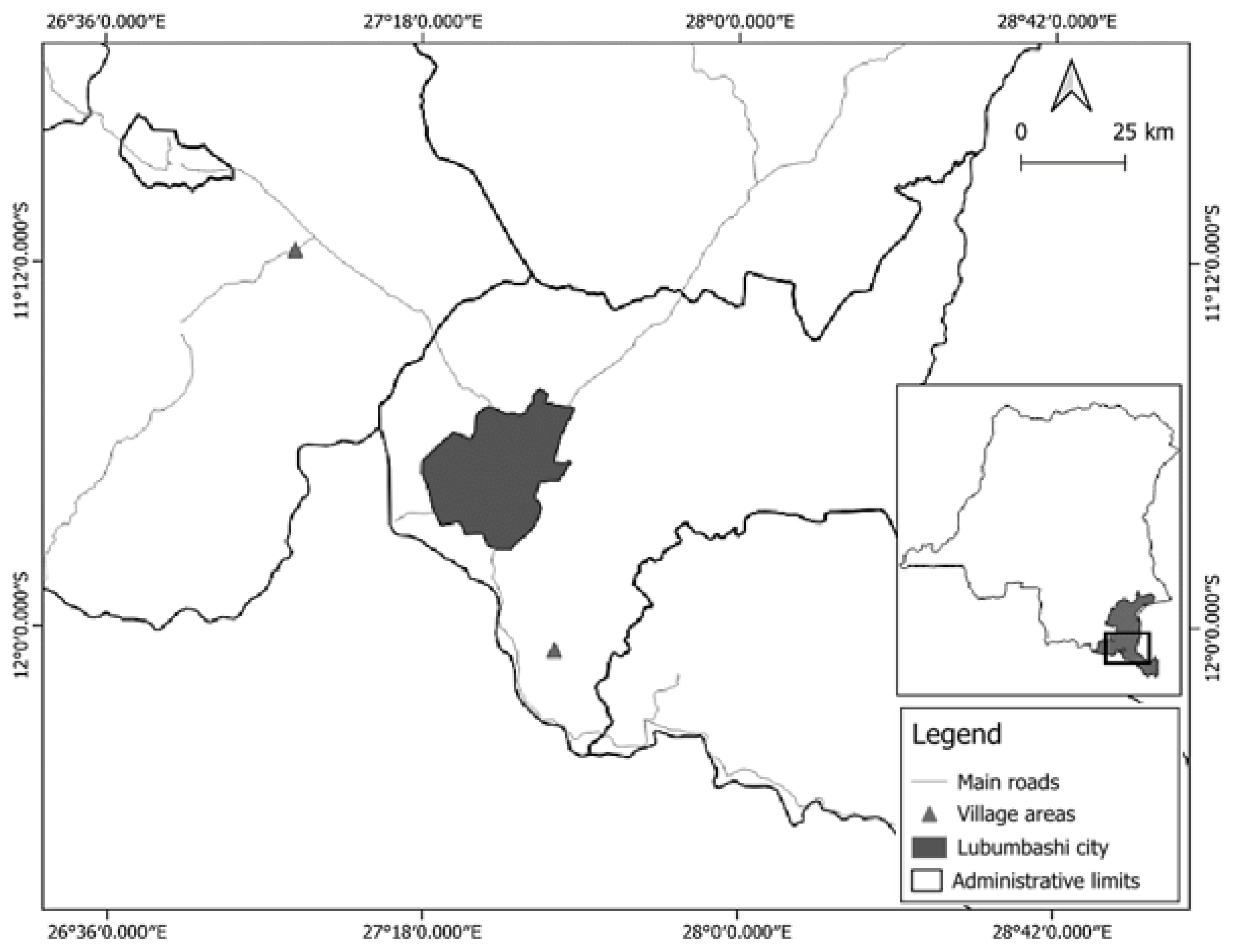
Figure 2.
Diametric structure of habitats in both village areas: (a): reforested habitats; (b): unexploited habitats.
Figure 2.
Diametric structure of habitats in both village areas: (a): reforested habitats; (b): unexploited habitats.
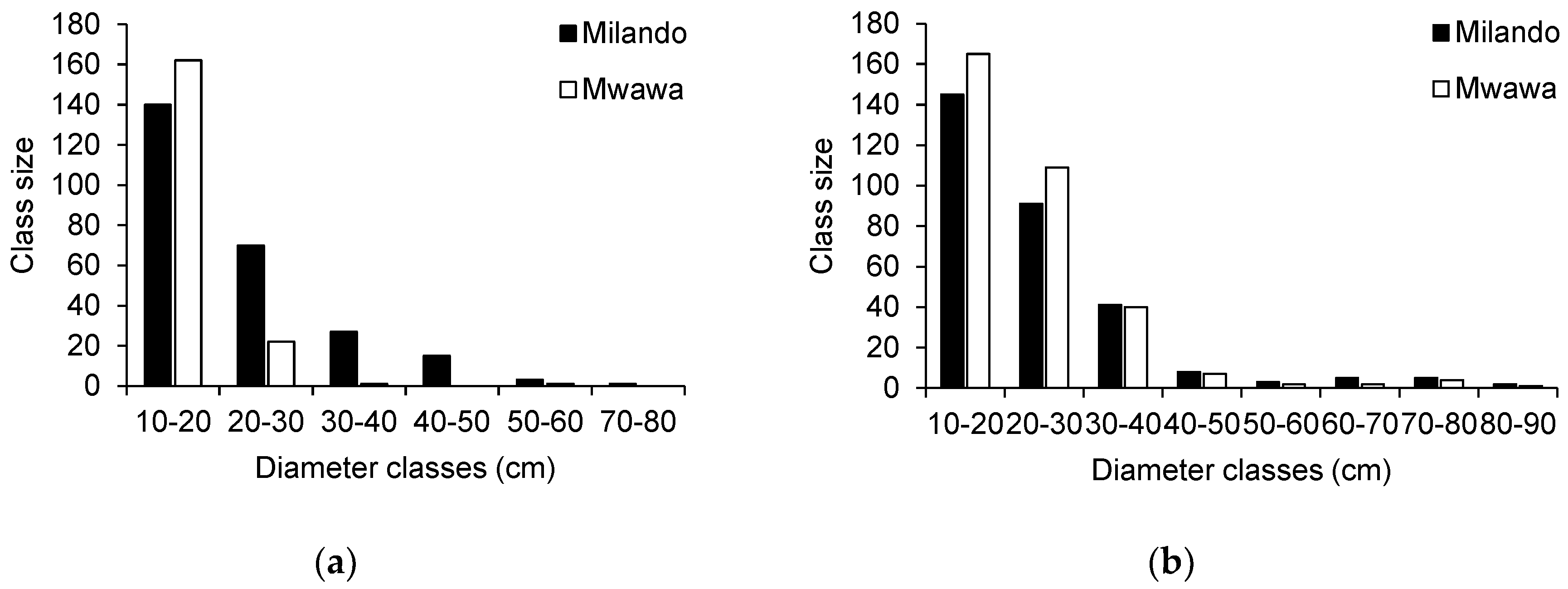

Table 1.
Factors influencing the choice of habitats used for reforestation in both village areas. n= number of people surveyed. The sum of frequencies does not add up to 100%, as the proportions of those with no answer to this question have been removed from the table.
Table 1.
Factors influencing the choice of habitats used for reforestation in both village areas. n= number of people surveyed. The sum of frequencies does not add up to 100%, as the proportions of those with no answer to this question have been removed from the table.
| Selection criteria | Reforested habitats (%) | |
|---|---|---|
| Milando (n=50) | Mwawa (n=50) | |
| Choice of the village chief | 48.00 | 24.00 |
| Choice of the village chief and NGO | 6.00 | 4.00 |
| Choice of the village chief and notables | 14.00 | 12.00 |
| Consultation | 22.00 | 44.00 |
Table 2.
Criteria for choosing woody species for reforestation in the rural area of Lubumbashi. n= number of people surveyed; -: the choice criterion was not cited in the concerned village area.
Table 2.
Criteria for choosing woody species for reforestation in the rural area of Lubumbashi. n= number of people surveyed; -: the choice criterion was not cited in the concerned village area.
| Selection criteria | Reforested habitats (%) | |
|---|---|---|
| Milando (n=50) | Mwawa (n=50) | |
| Timber | - | 4.00 |
| Village chief and notables | - | 6.00 |
| Choice of NGO | 16.00 | 16.00 |
| Seed availability | 44.00 | 18.00 |
| NTFP sources | 40.00 | 52.00 |
| Soil type | - | 4.00 |
Table 3.
Management practices for reforested habitats in the rural area of Lubumbashi. n= number of people surveyed; -: management practice was not cited in the concerned village area.
Table 3.
Management practices for reforested habitats in the rural area of Lubumbashi. n= number of people surveyed; -: management practice was not cited in the concerned village area.
| Management practices | Reforested habitats (%) | |
|---|---|---|
| Milando (n=50) | Mwawa (n=50) | |
| Firebreaks | 38.00 | 46.00 |
| Plant nursery | - | 4.00 |
| Planning/assessment meetings | 38.00 | 26.00 |
| Surveillance (Brigade) | 24.00 | 24.00 |
Table 4.
Floristic list of woody species cited during interviews and those recorded in reforested and unexploited habitats across both village areas. Woody species are listed in alphabetical order. Density per hectare; IVI: Index of importance values; Re: Reforested habitat; Un: Unexploited habitat; -: the woody species was not inventoried in the concerned village area; *: the species was cited during the interviews and recorded during the floristic inventories; +: the species was cited during the individual interviews but not recorded during the floristic inventories.
Table 4.
Floristic list of woody species cited during interviews and those recorded in reforested and unexploited habitats across both village areas. Woody species are listed in alphabetical order. Density per hectare; IVI: Index of importance values; Re: Reforested habitat; Un: Unexploited habitat; -: the woody species was not inventoried in the concerned village area; *: the species was cited during the interviews and recorded during the floristic inventories; +: the species was cited during the individual interviews but not recorded during the floristic inventories.
| Species | Families | Density/ha | IVI | ||||||
|---|---|---|---|---|---|---|---|---|---|
| Milando | Mwawa | Milando | Mwawa | ||||||
| Re | Un | Re | Un | Re | Un | Re | Un | ||
| Acacia polyacantha Willd. | Fabaceae | -+ | - | - | - | - | - | - | - |
| Afzelia quanzensis Welw. | Fabaceae | -+ | - | -+ | - | - | - | - | - |
| Albizia adianthifolia (Schumach.) W. F. Wight | Fabaceae | -* | 6 | 37 | 14 | - | 8.36 | 55.73 | 15.24 |
| Albizia antunesiana Harms | Fabaceae | 20* | 8 | 6* | 9 | 24.37 | 10.77 | 10.82 | 8.78 |
| Albizia versicolor Welw. ex Oliv. | Fabaceae | - | 1 | 7 | 1 | - | 1.39 | 12.50 | 1.29 |
| Anisophyllea boehmii Engl. | Anisophylleaceae | -* | 4 | -* | 1 | - | 4.81 | - | 1.40 |
| Baphia bequaertii De Wild. | Fabaceae | - | 11 | 7 | 12 | - | 11.67 | 10.13 | 10.80 |
| Bobgunnia madagascariensis (Desv.) J.H.Kirkbr. & Wiersema | Fabaceae | 8* | 2 | 5* | 4 | 9.88 | 2.85 | 11.91 | 3.51 |
| Brachystegia boehmii Taub. | Fabaceae | 5* | - | 10* | - | 13.70 | - | 13.36 | - |
| Brachystegia floribunda Benth. | Fabaceae | - | - | -+ | - | - | - | - | - |
| Brachystegia spiciformis Benth. | Fabaceae | 23* | 59 | 10* | 70 | 24.59 | 42.38 | 15.94 | 49.86 |
| Brachystegia wangermeeana De Wild. | Fabaceae | 24 | 98 | 15 | 108 | 31.99 | 69.52 | 20.54 | 68.83 |
| Combretum collinum Fresen. | Combretaceae | - | 1 | - | 1 | - | 1.94 | - | 1.88 |
| Combretum molle R.Br ex G. Don | Combretaceae | - | 1 | - | 2 | - | 1.96 | - | 3.41 |
| Combretum zeyheri Sond. | Combretaceae | - | - | 1 | - | - | - | 2.03 | - |
| Dalbergia boehmii Taub. | Fabaceae | 2 | - | - | - | 3.51 | - | - | - |
| Diplorhynchus condylocarpon (Müll. Arg.) Pichon | Apocynaceae | 15* | 8 | 21 | 8 | 16.72 | 9.26 | 29.01 | 8.77 |
| Ekebergia benguelensis Welw. ex C.DC. | Meliaceae | - | 1 | - | - | - | 1.43 | - | - |
| Erythrina abyssinica (Hochst.) A. Rich. | Fabaceae | 4 | - | 12 | - | 5.80 | - | 27.58 | - |
| Erythrophleum africanum (Welw. ex Benth.) Harms | Fabaceae | - | 4 | - | 3 | - | 5.20 | - | 4.01 |
| Faurea rochetiana (A.Rich.) Chiov. ex Pic. Serm. | Proteaceae | - | - | 1 | - | - | - | 1.89 | - |
| Ficus sp | Moraceae | - | - | 1 | - | - | - | 1.97 | - |
| Isoberlinia angolensis (Benth.) Hoyle & Brenan | Fabaceae | 20* | 7 | 19* | 12 | 22.81 | 8.89 | 24.26 | 13.34 |
| Julbernardia globiflora (Benth.) Troupin | Fabaceae | 4 | - | 1 | - | 6.88 | - | 1.97 | - |
| Julbernardia paniculata (Benth.) Troupin | Fabaceae | 12* | 5 | 4* | 2 | 12.94 | 6.33 | 7.04 | 1.93 |
| Lannea discolor (Sond.) Engl. | Anacardiaceae | 2 | 4 | - | 4 | 3.04 | 3.70 | - | 3.46 |
| Maranthes floribunda (Baker) F.White | Chrysobalanaceae | - | - | 1 | - | - | - | 1.87 | - |
| Markhamia obtusifolia (Boulanger) Sprague | Bignoniaceae | - | 3 | - | 3 | - | 10.34 | - | 10.72 |
| Marquesia macroura Gilg | Dipterocaerpaceae | -* | 18 | 1* | 8 | - | 32.40 | 1.88 | 17.00 |
| Monotes africanus Gilg | Dipterocaerpaceae | 3 | 1 | 2 | 1 | 4.90 | 2.10 | 2.67 | 2.06 |
| Monotes katangensis De Wild. | Dipterocaerpaceae | 7 | 12 | 3 | 6 | 8.34 | 8.41 | 4.69 | 4.64 |
| Mystroxylon aethiopicum (Thunb.) Lœs. | Celastraceae | - | 1 | - | 1 | - | 2.04 | - | 1.99 |
| Ochna schweinfurthiana F.Hoffm. | Ochnaceae | - | 2 | 4 | 6 | - | 2.73 | 7.98 | 6.69 |
| Olax obtusifolia De Wild. | Olacaceae | - | - | - | 1 | - | - | - | 1.49 |
| Parinari curatellifolia Planch. ex Benth. | Chrysobalanaceae | 2* | 3 | 5* | 6 | 2.96 | 3.38 | 10.02 | 6.84 |
| Pericopsis angolensis (Harms) Van Meeuw. | Fabaceae | 29* | 7 | 2* | 5 | 32.44 | 8.12 | 2.83 | 6.87 |
| Philenoptera katangensis (De Wild.) Schrire | Fabaceae | 1 | - | - | - | 1.47 | - | - | - |
| Phyllocosmus lemaireanus (De Wild. & T. Durand) T. Durand & H. Durand | Ixonanthaceae | - | 1 | - | 4 | - | 1.60 | - | 3.63 |
| Pseudolachnostylis maprouneifolia Pax | Phyllanthaceae | 5 | 2 | - | 1 | 4.69 | 2.79 | - | 1.26 |
| Psorospermum febrifugum Spach | Hypericaceae | - | 1 | - | - | - | 1.39 | - | - |
| Pterocarpus angolensis DC. | Fabaceae | 1* | 4 | 4* | 14 | 1.45 | 5.30 | 7.97 | 13.89 |
| Pterocarpus tinctorius Welw. | Fabaceae | 3* | - | -* | - | 6.42 | - | - | - |
| Salacia rhodesiaca Blakelock | Celastraceae | - | - | 1 | - | - | - | 2.00 | - |
| Strychnos cocculoides Boulanger | Loganiaceae | - | 3 | - | 1 | - | 3.69 | - | 1.67 |
| Strychnos innocua Del. subsp. innocua | Loganiaceae | 1 | - | - | - | 1.42 | - | - | - |
| Strychnos pungens Soler. | Loganiaceae | - | 1 | - | 1 | - | 1.64 | - | 1.56 |
| Strychnos sp | Loganiaceae | - | 2 | - | 2 | - | 3.17 | - | 2.95 |
| Strychnos spinosa Lam. | Loganiaceae | - | 1 | - | 1 | - | 1.50 | - | 1.41 |
| Syzygium guineense (Willd.) DC. subsp. Macrocarpum | Myrtaceae | -* | - | 2* | - | - | - | 4.27 | - |
| Uapaca kirkiana Müll. Arg. | Phyllanthaceae | 43* | 10 | 2* | 7 | 36.46 | 11.64 | 2.64 | 8.14 |
| Uapaca nitida Müll.Arg. | Phyllanthaceae | 15 | 7 | 1 | 7 | 15.05 | 5.91 | 2.43 | 5.38 |
| Uapaca pilosa Hutch. var. pilosa | Phyllanthaceae | 7 | - | 1 | - | 8.15 | - | 2.07 | - |
| Uapaca robynsii De Wild. | Phyllanthaceae | - | 1 | - | 3 | - | 1.39 | - | 3.90 |
| Vitex doniana Sweet | Lamiaceae | - | - | - | 1 | - | - | - | 1.39 |
Table 5.
Dendrometric and floristic parameters of individuals inventoried in the reforested and unexploited habitats. Mean ± standard deviation. Letters indicate significant differences at the p<0.05 significance level.
Table 5.
Dendrometric and floristic parameters of individuals inventoried in the reforested and unexploited habitats. Mean ± standard deviation. Letters indicate significant differences at the p<0.05 significance level.
| Parameters | Reforested habitats | Unexploited habitats | ||
|---|---|---|---|---|
| Milando | Mwawa | Milando | Mwawa | |
| Dendrometric parameters | ||||
| Density (individuals/ha) | 256.00 ± 111.77ab | 186.00 ± 64.15b | 300.00 ± 97.18a | 330.00 ± 123.47a |
| Mean square diameter (cm) | 21.94 ± 3.11a | 14.97 ± 2.54b | 24.64 ± 4.71a | 22.73 ± 3.11a |
| Basal area (m2 /ha) | 11.52 ± 5.52a | 3.40 ± 1.17b | 17.23 ± 7.70a | 15.89 ± 6.72a |
| Floristic parameters | ||||
| Taxa/plot | 10.40 ± 3.10a | 9.10 ± 2.92a | 10.30 ± 3.43a | 11.20 ± 2.86a |
| Type/ plot | 8.30 ± 2.71a | 7.70 ± 2.71a | 8.30 ± 2.58a | 9.00 ± 2.11a |
| Families/ plot | 3.60 ± 1.43a | 3.90 ± 2.03a | 5.00 ± 2.21a | 5.10 ± 2.23a |
Table 6.
Diversity index between reforested and unexploited habitats in the Lubumbashi charcoal production basin.
Table 6.
Diversity index between reforested and unexploited habitats in the Lubumbashi charcoal production basin.
| Indices | Milando reforested | Milando unexploited |
Mwawa reforested | Mwawa unexploited |
|---|---|---|---|---|
| Simpson | 0.0834 | 0.1581 | 0.08689 | 0.1633 |
| Shannon | 2.731 | 2.531 | 2.809 | 2.503 |
| Piélou's equitability | 0.8593 | 0.712 | 0.8342 | 0.7039 |
Table 7.
Jaccard's similarity index of ethnobotanical and floristic lists in both village areas. Values are presented in percentages. - Less informative comparison.
Table 7.
Jaccard's similarity index of ethnobotanical and floristic lists in both village areas. Values are presented in percentages. - Less informative comparison.
| Milando reforested | Milando unexploited |
Mwawa reforested |
Milando ethnobotany |
|
|---|---|---|---|---|
| Milando unexploited | 40.00 | |||
| Mwawa reforested | 55.56 | - | ||
| Mwawa unexploited | - | 93.75 | 47.62 | |
| Milando ethnobotany | 43.75 | - | - | |
| Mwawa ethnobotany | - | - | 31.58 | 66.67 |
Disclaimer/Publisher’s Note: The statements, opinions and data contained in all publications are solely those of the individual author(s) and contributor(s) and not of MDPI and/or the editor(s). MDPI and/or the editor(s) disclaim responsibility for any injury to people or property resulting from any ideas, methods, instructions or products referred to in the content. |
© 2024 by the authors. Licensee MDPI, Basel, Switzerland. This article is an open access article distributed under the terms and conditions of the Creative Commons Attribution (CC BY) license (http://creativecommons.org/licenses/by/4.0/).
Copyright: This open access article is published under a Creative Commons CC BY 4.0 license, which permit the free download, distribution, and reuse, provided that the author and preprint are cited in any reuse.


