

Submitted:
15 September 2025
Posted:
16 September 2025
You are already at the latest version
Abstract
Innovative IoT-enabled human movement monitoring systems have shown significant potential to support the prehabilitation programs in mixed-mode settings for abdominal pre-operative patients by enabling patient’s movement tracking and the performance measurement. This IoT-based prehabilitation program in mixed-mode settings, can enable clinical supervision with home-based independence with remote monitoring and enhance accessibility which alleviates pressure on healthcare resources and overcome geographical isolation. However, this existing programs often lack personalized analysis of movement dynamics and automated adaptive interventions, which can limit their effectiveness in improving functional outcomes and patient adherence. Recent research study suggests that Digital Twin technology along with IoT and ML/AI can address these limitations by enabling dynamic, adaptive, and personalized prehabilitation programs. This paper reviews the literature to investigate the efficacy of technology integration in prehabilitation programs for abdominal preoperative patients, key components and functionalities of IoT systems, and potential software capabilities of Digital Twin and AI technologies to design a conceptual framework for mixed-mode prehabilitation program. The proposed framework will collects continuous movement data on exercises involved in physical activity of prehabilitation program from inertial sensors embedded in wearable watch and smart mobile phones. Machine learning algorithms can analyze these data to identify activity type and intensity precisely, overcoming challenges such as overlapping of dominant frequencies and amplitudes that occur in traditional FFT-based activity recognition. Data training can enable personalised movement analysis that often impact reality alignment. The proposed Digital Twin can enable auto-intervention and interaction for recommendations and can dynamically manage the IoT system.
Keywords:
wearable sensors
; artificial intelligence
; Digital Twin
; IoT
; human movement monitoring
; prehabilitation
1. Introduction
Globally, abdominal cancer is one of the most common and life-threatening cancers, disproportionately impacting middle-aged and older populations [1,2,3,4], and represents a leading cause of mortality globally [5]. While surgical intervention remains the cornerstone of curative treatment for locally advanced abdominal cancers [2,6], postoperative complications affect 30–50% of patients, particularly older individuals and those with low cardiorespiratory fitness, who face higher morbidity and mortality [6]. Preoperative treatments, such as chemotherapy, further impair physical function, underscoring the need for interventions that optimize functional capacity before surgery [7,8]. Pre-rehabilitation is an emerging concept, described as preoperative therapies aiming at enhancing the functional capacity of patients and alleviating the physiological stress associated with surgery, hence improving surgical outcomes and facilitating speedier recovery. In supervised settings, there is evidence that it can increase functional ability, decrease surgical complications, shorten hospital stays, and improve life quality [2,3,6,7,9,10,11,12,13]. Supporting this, a pilot study by Carli et al.(2020) [3] reported a reduction in postoperative complications from 70.2% to 37.5% in patients undergoing complex colorectal surgeries. Exercise modalities span aerobic and resistance training, delivered either in supervised clinical settings or through home-based programs. Both traditional program models face certain limitations. Supervised interventions while more effective but often inaccessible due to geographical isolation and resource limitations. However, unsupervised patients face the challenges of lower adherence and limited monitoring [4,10].
Prehabilitation has seen transformative advancements made possible by new digital technologies, wearables, the Internet of Things (IoT), and wireless sensor technologies, providing a promising teleprehabilitation model or technology-integrated model alternative to the limitations inherent in both supervised and unsupervised prehabilitation models [8,14,15,16,17,18,19]. Specifically, a mixed-mode IoT-based prehabilitation model combines remote monitoring, real-time feedback, and clinician oversight throughout the prehabilitation period to bridge these gaps [20,21]. In addition, such systems can reduce the necessity of regular in-person meetings, alleviate transportation burdens, optimize resource utilization within healthcare settings. Wearable devices collect patient activity data, edge or gateway devices help process data locally, and cloud systems offer analytics and feedback. These systems enhance accessibility, support more personalized exercise regimens, and foster greater patient engagement. Early studies have validated that wearable-facilitated prehabilitation can yield functional improvements in patients undergoing abdominal cancer surgery [17,18,19,22,23]. Recent advancement in wearable technology have given oncologists new ways to get real-time, objective data on exercise. [18]. Additionally, some studies have looked at the financial viability of teleprehabilitation, which is feasible for patients with colorectal cancer who are at a higher risk; nevertheless, measures to improve adherence to the intensity of physical exercise training should be taken into consideration [16].The cost-effectiveness of teleprehabilitation to increase preoperative aerobic fitness and lower postoperative complications demands greater research. In order to facilitate remote monitoring of prehabilitation programs for patients with abdominal cancer, some early research has shown how well IoT devices capture, identify, and interpret patient movement data [20,22] and rehabilitation programs for individuals recovering from hip fractures [21,23].
Despite the promising potential of IoT-based mixed-mode prehabilitation models, current evidence remains limited. First, most studies have been conducted in small cohorts, restricting the generalizability of the findings. Second, current models typically adopt a one-size-fits-all methodology, lacking mechanisms for real-time adaptation of exercise intensity, modality, or demographics based on individual progress or recovery goals. Moreover, there is a notable scarcity of studies exploring the incorporation of cutting-edge artificial intelligence (AI) and machine learning (ML) techniques for the precise recognition of movement types and intensities, and personalized intervention planning remains in its infancy.
Within this framework, the conception of Digital Twin (DT) has emerged as a transformative technology. Originating in industrial contexts, DT consists of dynamic, virtual replicas of real-world systems that are constantly updated with real-time data from their physical counterparts and, in some cases, exert bidirectional feedback to influence the physical system [24,25,26,27,28]. In healthcare, DT integration would enhance healthcare services by combining patients and medical personnel in a flexible, intelligent, and comprehensive health ecosystem [27]. It is sometimes conceptualized as Human Digital Twins (HDTs), which allow the creation of patient-specific models that can adapt over time and support early detection, simulation, and personalized intervention strategies [29,30,31]. Although the concept is still emerging, several early-stage applications demonstrate the potential of DT in various healthcare domains. For example, cloud-based DT for elderly care [32], electrocardiogram (ECG) monitoring [27,33], and vulnerability detection in lung cancer [34], fitness management through DT [29]. In addition, DT-enabled frameworks have been proposed for rehabilitation robotics, such as self-balancing exoskeletons that enhance patient–robot interaction [31], as well as conceptual models for supporting prehabilitation before surgery [35]. Furthermore, DT has been applied in IoT-enabled environments, for example, smart university campuses, where virtual models of IoT devices improve energy efficiency and operational management [36]. Moreover, combining DT with Simulation and AI offers further opportunities, such as better handling of data, explainable AI, and solutions for sparse or missing data [37]. These studies show that DT, particularly when integrated with IoT and AI, holds promise in advancing personalized, real-time, and dynamic management of the system.
Extending these principles to prehabilitation, this article proposes a conceptual framework integrating DT and AI to serve as an intelligent layer on top of IoT-based monitoring systems, continuously integrating patient data with its virtual model of the system to provide adaptive feedback, simulate prehabilitation outcomes, and support personalized intervention planning. Such integration holds the potential to shift prehabilitation from static programs toward dynamic, data-driven, and personalized models that can enhance functional outcomes.
2. Prehabilitation Program Structure: Clinical and Technological Needs
Pre-rehabilitation programs aim to improve the physical fitness of the patient before surgery, as the level of aerobic capacity before surgery is a key factor in determining their ability to deal with surgical resilience and outcomes after surgery. In order to address fitness issues, especially in frail patients, many hospitals have implemented structured exercise programs that focus primarily on enhancing aerobic capacity in supervised settings [2,3,7,11].
The aerobic exercises most commonly used include treadmill walking, cycling, walking, rowing, cross-training, and stepping [38]. The level of exercise intensity in these programs typically ranges from light, moderate and hard to very hard, and some programs now incorporate interval training, which alternates periods of low-intensity activity with bouts of vigorous physical activity [38]. The Resistance training is frequently employed alongside aerobic exercises to strengthen both muscles of the lower and upper limbs (e.g., leg press, chest press), generally performed at moderate intensity of 10–20 repetitions [11,12,38]. Patients who participate in a supervised program generally perform the prescribed physical exercises under the direct supervision of a healthcare professional, typically conducted in gym-based settings or rehabilitation centers, using a variety of equipment, from basic commercial machines to advanced cycle ergometers with preset specifications for the workload [38]. The frequency of sessions varies, although most research findings indicate that participants attend two to three sessions a week [2,3]. For personalized monitoring, exercise intensity is usually determined by cardiopulmonary exercise testing (CPET), but the 6 minute walk test (6MWT) has been shown to be a useful substitute for evaluating functional capacity [2,3]. This supervised model enables better control over exercise delivery [2,3,12], CPET monitoring, and patients’ adherence, but it also requires significant resources and is generally accessible only to individuals who reside near prehabilitation facilities and are able to access the hospital resources [38]. Home-based prehabilitation programs provide flexibility and get around geographic restrictions, but pilot studies show limited effectiveness, probably because of poor adherence and a lack of supervision [4,14,17].
The Table 1 encapsulates the methods of prehabilitation interventions, with consistent emphasis on exercise modality, intensity, duration, and delivery method. By categorizing the studies based on supervised, unsupervised and technology-based approaches, the table provides a comparative framework that highlights not only the clinical efficacy of structured prehabilitation programs but also the growing feasibility of mixed-mode models integrating technology.
Technological advancements, particularly in remote monitoring, offer promising solutions to these challenges and have emerged as a transformative approach, enabling real-time tracking of patient movements, physiological metrics, and exercise compliance across both settings [8,14,15,16,17,18,19,39]. Supervised clinical interventions with remote monitoring and feedback of home-based exercises, leveraging technology to bridge gaps in adherence, monitoring, and personalization. A recent scoping review highlighted the growing role of technological resources, including wearable sensors, web-based systems, and mHealth (mobile health) applications, in improving physical rehabilitation for cancer patients undergoing chemotherapy, although the evidence on long-term effectiveness remains limited [8]. Similarly, the Digital Platform for Exercise (DPEx) demonstrated the feasibility of a decentralized, patient-centric approach that integrates telemedicine, remote monitoring, and wearable health devices to deliver exercise therapy in home-based settings across different cancer cohorts [15]. In addition, A recent feasibility study in high-risk patients with colorectal cancer demonstrated that a bimodal tele-prehabilitation program, which combined personalized tele-monitored exercise and nutritional counseling, achieved high participation (81%), adherence, and patient satisfaction [16]. These findings suggest that tele-prehabilitation is feasible and well accepted, although further research is needed to evaluate its cost-effectiveness and long-term impact on functional outcomes.
Systematic reviews of wearable activity monitors in oncology have shown that these devices are increasingly used to collect real-world physical activity data and have the potential to predict clinical outcomes and quality of life. However, lack of standardization in device types, data collection, and analysis limits their broader clinical application [17,18]. These findings suggest that wearable technologies can effectively support prehabilitation and enhance preoperative functional capacity. Complementing these findings, a pilot study demonstrated that smartwatches and mobile applications can effectively deliver trimodal-based prehabilitation in patients awaiting abdominal cancer surgery, resulting in increased modmoderate to vigorousysical activity and significant gains in functional fitness [19]. Additionally, IoT-enabled prehabilitation systems have been shown to reduce barriers of conventional programs by continuously monitoring patient activity through wearable sensors and cloud platforms, supporting mixed-mode prehabilitation for patients with limited access to healthcare resources or living in remote areas [20]. Monitoring of pre-habilitation performance progress will be analyzed using a mathematical model that will work with the credit calculation of the efforts made throughout the program, as shown in Table 2. This model’s distinctive characteristic is the real-time feedback on the precise prehabilitation activities performed by the patient, along with the measurement of exercise intensity and type [38]. Further, IoT environments for hip fracture rehabilitation have demonstrated the ability to continuously monitor activity movements type in both supervised and unsupervised settings, providing flexible analysis, visualization, and feedback to optimize adherence and functional recovery [21]. Thus, a mixed-mode model has the potential to address the limitations of purely home-based programs and the challenges of fully supervised regimens (e.g., cost, accessibility). It can mitigate the strain on the hospital system while enabling cancer patients to engage in prehabilitation within their local community under remote oversight and supervision. Furthermore, AI-based Digital Twin frameworks offer transformative potential by simulating patient-specific rehabilitation scenarios, predicting outcomes, providing real-time adaptive feedback, and facilitating remote and multidisciplinary care [39]. This approach underscores the value of integrating IoT with AI and Digital Twin-enabled frameworks in prehabilitation, enabling personalized, remotely monitored interventions and providing actionable insights to optimize patient outcomes in mixed-mode settings.
Practical considerations for the implementation of prehabilitation programs encompass several critical factors, as shown in Table 2 [22]. Selecting sensors carefully, recognising activities accurately, creating customised models, and measuring performance are all necessary for the successful execution of prehabilitation programs. While technological advancements allow for precise activity tracking, automated interventions, and dynamic management to maximise outcomes for patients with abdominal cancer, a mixed-model approach using supervised sessions and remote monitoring can strike a balance between flexibility and clinical oversight.
3. IoT and Monitoring System
The new paradigm, Internet of Things, envisions a future where people, devices, and services are interconnected through advanced information and communication technologies, enabling transformative applications across domains including healthcare [40]. In healthcare, IoT facilitates continuous patient monitoring, real-time data collection, and cloud-based management. A cloud-based conceptual framework has been proposed, highlighting the technological aspects that make IoT healthcare solutions feasible and scalable. A recent survey of IoT healthcare systems highlighted the need for standardization in wearable IoT solutions and identified critical challenges including security, privacy, and device usability [41]. In addition, survey examined IoT and IoMT-based smart healthcare systems, highlighting the integration of medical sensors, AI, edge and cloud computing, and next-generation wireless technologies. The study reviewed literature published between 2014 and 2020, discussing system architectures, data fusion techniques, security challenges, and future research directions for intelligent, connected healthcare solutions [42]. In addition, IoT-based motion tracking systems leveraging the Publish–Subscribe communication paradigm have demonstrated efficient monitoring of multiple users’ movements, delivering only relevant information and reducing network congestion [43]. The Digital Human Model (DHM) approach further integrates Kinect motion capture, IoT devices, advanced machine learning, and virtual reality to simulate and optimize human motion in real time [44]. Additionally, IoT-enabled rehabilitation frameworks have been applied in post-operative hip fracture care, combining wearable sensors and edge computing to monitor patients’ physical movements, provide personalized feedback, and balance system performance with real-time remote supervision [21]. Building on these advances, a recent study proposed a precision IoT-based prehabilitation monitoring system for abdominal cancer patients, integrating wearable sensors and cloud platforms to track key physical activities during a six-week preoperative program, thereby reducing resource constraints and improving adherence and functional outcomes [20]. IoT technology offers significant potential for prehabilitation programs by enabling continuous, remote monitoring of patients’ physical activity and functional status. While IoT technologies have been extensively explored in numerous healthcare domains, the application of IoT within pre-habilitation programs remains relatively under-investigated. Although some studies have highlighted the potential of IoT-based solutions for prehabilitation programs[20,21], this area is still emerging. IoT connectivity facilitates real-time data transmission and processing, using edge and cloud services for data storage and analysis. These insights inform the design of IoT-based prehabilitation frameworks, ensuring reliable, secure, and scalable monitoring of patient progress, especially in home-based or mixed-mode rehabilitation programs. This enables healthcare professionals to gain insight that supports remote monitoring, data-driven decision-making, and personalized patient care.
The foundational architecture of an IoT-enabled prehabilitation program typically follows a layered sensor–edge–cloud model, as shown in Figure 1 , which supports continuous, remote monitoring of patients’ physical activity and functional status in diverse environments (clinical, residential, home-based) [20,21]. Figure 1 shows the elements of the framework and their software functionalities.
Sensing Layer: Wearable sensors, including gyroscopes, accelerometers, or inertial sensors, are the basis of the architecture used to obtain physiological and movement data in real time. this layer can also be used for short data storage and data processing.
Edge / Fog Layer: These sensors are interconnected to edge computer nodes, such as microcontrollers or Raspberry Pis, which preprocess the raw data and store the data. It serves as the link between wearable sensors and cloud services. The functions of this layer include local data computation, simple feature extraction (such as FFT), noise filtering, and preliminary inference or categorization. This preprocessing improves responsiveness and reduces transmission load.
Cloud Layer: The preprocessed data are transferred through secure communication protocols to cloud platforms. At this layer data are stored for long-term, data computation, data visualization, and deeper analytics and machine learning took place. The cloud layer also hosts dashboards, visualization tools, and clinician / patient interfaces to monitor progress and adherence.
In the realm of abdominal cancer prehabilitation, IoT systems that use mobile microcontroller-based wearables and Raspberry Pi gateways have been developed to accurately identify activity types, intensity and effort within mixed-mode programs. These systems enable precise remote functional tracking, facilitating real-time monitoring and feedback for patients undergoing preoperative rehabilitation [20]. Similarly, in hip fracture rehabilitation, an IoT-enabled movement monitoring system architecture has been proposed that integrates multiple wearable sensors (placed in the hip, waist, chest, etc.) with edge and gateway processing. This setup demonstrates real-time activity recognition, flexible feedback, and manageable data loss through edge-level computation, enhancing the rehabilitation process by providing timely interventions and support [21] . More broadly, in medical IoT applications, fog-to-cloud models have been explored to optimize energy usage and reduce latency. These models utilize biosensors, gateways, fog nodes, and cloud services to streamline data processing and analytics while maintaining privacy and efficiency. Such architectures are particularly beneficial in healthcare settings, where timely data processing and secure communication are critical for patient monitoring and care.
The significance of IoT in prehabilitation lies in its ability to connect patients, devices, and healthcare systems to enable continuous monitoring, analysis of data, and making knowledgeable decisions. However, managing IoT-based human monitoring systems presents some challenges due to system rigidity and the need for dynamic, adaptive interventions. Advanced data processing and effective algorithms are required to handle the constant influx of real-time sensor data in order to ensure precise movement analysis and immediate feedback. Integrating machine learning and artificial intelligence with IoT allows automatic activity recognition, intensity estimation, and precise insights, while Digital Twin technology builds a digital model of the system to introduce auto-interventions and optimize customized care.
4. Human Movement Recognition and Intelligent Approaches: Role of ML/AI
deep learning As reported by Sukor et al. (2018) [45], mobile phone-based systems utilizing embedded accelerometers have demonstrated the ability to detect various human activities, such as standing, sitting, walking, staircase-ascending, staircase-descending, and running. Furthermore, the application of suitable classification techniques, including graph-based and statistical classifiers, been demonstrated to enhance the activity recognition accuracy. In their study, the authors categorized activities into six main types, achieving the highest classification accuracy of 90%. However, several challenges persist, including sensor placement variability, data heterogeneity between different users and devices, and the necessity of extensive, datasets with annotations [46]. Considering such issues is crucial for developing robust and scalable recognition systems. Recent studies have proposed various solutions, including hybrid learning algorithms and domain adaptation techniques, in order to lessen such challenges and improve the generalization of the human movement recognition models through a variety of real-world situations.
ML algorithms, particularly deep learning models, are pivotal in classifying human movements captured by wearable sensors. These models process data from accelerometers, gyroscopes, and electromyography sensors to determine particular activities, such sitting, walking or performing prehabilitation exercises. For instance, a notable study introduced an innovative method for recognizing human activity employing convolutional neural networks (CNN) specifically designed for many kinds of sensors, including gyroscopes and accelerometers. This design addresses the challenge of diverse data shapes from various sensors, thereby improving recognition accuracy in complex movement patterns. The study demonstrated that sensor-specific CNN models could effectively capture the unique characteristics of each sensor type, leading to more precise activity classification [45]. In addition, Khan et al. (2022)[47] explored various deep learning approaches for automatic feature extraction, such as CNN, Artificial Neural Networks (ANNs), Deep Neural Networks (DNNs), and Deep Belief Networks (DBNs). In his review, the effectiveness of CNN and DNN for activity detection accuracy is compared. He highlighted studies where sensors were used to monitor activities such as walking, standing, sitting, and other movements. According to his analysis, DNN demonstrated the highest accuracy in detecting these activities and achieving 96% accuracy. He also discussed the limitations of conventional techniques for machine learning, which call for the manual extraction of features from sensor data, and shifted the focus to DNN for activity classification, emphasizing their advantages over traditional ML methods. Zhang et al. also supports Deep Learning to address the limitations of ML in vulnerability detection. A CNN model was developed for the recognition of human activity, achieving an accuracy of 96.4% in identifying both dynamic and static activities. Additionally, the study emphasized edge computing’s function in enhancing performance in real time and computational efficiency.
Some of the authors also focused on HMR using wearable sensor networks (WSNs) to monitor and analyze older adults’ activities [38,48]. However, a critical aspect that has been underexplored is the fairness of AI models in recognizing activities of older adults, particularly those with diverse functional abilities. Alam et a (2020)[48] highlights that the same activity, such as walking, can manifest differently among older adults depending on their functional abilities. This oversight can result in unfair activity recognition, impacting the effectiveness of healthcare interventions. To address this, Alam proposes an AI-fairness framework that employs signal processingand Bi-directional Long Short-Term Memory (Bi-LSTM) models can identify various multi-label activities using a single wearable WSN sensor. Experimental evaluations using data from a retirement center demonstrate the efficacy of this approach in promoting AI fairness in HAR systems for older adults.
Table 3 shows the study reviews , application of sensor technology used for movement monitoring, types of activity monitored and the activity algorithm used with the percentage of accuracy achieved. This review shows the transformative impact of ML/AI techniques in Human Movement Recognition, particularly with reference to wearable sensors and their applications in healthcare and prehabilitation systems. This Intelligence algorithms integration in IoT-based prehabilitation systems also represents a significant advancement in personalized programs. These technologies enable real-time monitoring, analysis, and interpretation of patients’ physiological and movement data, facilitating tailored prehabilitation interventions. Wearable sensors, such as inertial sensors collect continuous data on patients’ physical activity and functional status. ML/AI algorithms process this data to recognize activity patterns, predict outcomes, and provide personalized feedback, thereby enhancing the effectiveness and efficiency of prehabilitation programs. Although great strides have been made, challenges like sensor variability, data heterogeneity, and AI fairness remain critical areas for further research and development.
5. Digital Twin in Smarthealthcare and Prehabilitation
In recent years, Digital twin technology has gained popularity in various fields, each leveraging its unique capabilities for application in various domain[27,50]. Qi et al. (2022)[25] provide a comprehensive overview of DT, including connections, communications, tools, and the technology required, as well as its applications in engineering and beyond. While many researchers have presented a study that explored the application of DT in the field of healthcare [35]. The research studies highlight the application of DT to develop adaptive digital models of physical entities, including patients and medical devices. These digital counterparts reflect real-time data and behavior, enabling enhanced monitoring, analysis, and interaction. The study emphasizes the potential of DT technology in supporting customized medicine, particularly in improving diagnostic accuracy and treatment planning. Expanding upon this perspective, Liu et al.[32] introduced the CloudDTH framework, which leverages data analysis in real-time through the DT technology. Targeting elderly care, this framework enables continuous health monitoring and assessment by capturing data from wearable IoT devices. The study demonstrates how CloudDTH improves decision-making and predictive capabilities, particularly in managing age-related health conditions, by dynamically updating patient profiles and triggering timely clinical interventions. Further illustrating the adaptability of DT systems, the SmartFit platform uses Digital Twins to monitor physical and behavioral data of athletes[29]. This system utilizes both IoT sensors incorporated into wearable technology and user-input applications for contextual data logging such as mood and dietary intake. These inputs form dynamic data streams represent the condition of the physical twin in real time. SmartFit analyzes and stores this data historically to enhance its predictive modeling, offering personalized recommendations to trainers. Although originally designed for sports optimization, the SmartFit architecture demonstrates high adaptability and can be translated into various health monitoring and rehabilitation contexts [29]. In a parallel development, another study presented a comprehensive review of DT applications in both industrial and healthcare settings, followed by a focused investigation into rehabilitation needs based on bibliographic research and questionnaire-based analysis. As a result, the authors introduce an innovative approach to supervise a rehabilitation exoskeleton through its DT within a virtual environment. This model’s practical benefits and implementation obstacles are assessed, with a focus on real-world application. The study demonstrates the potential of using DTs for remote manual kinesiotherapy and outlines safety mechanisms for predicting and preventing harmful situations [31]. Collectively, these research demonstrate the expanding function of DT technology in rehabilitation and healthcare, enabling dynamic management, predictive analysis, remote monitoring, and personalized care, extending its application well beyond traditional industrial and manufacturing domains. The concept of the digital twin is evolving as a complement to IoT technology. Several researchers have proposed conceptual models of Digital twins that facilitate the integration of heterogeneous data sources within IoT environments, thereby enhancing system flexibility, responsiveness, and efficiency [51]. These models support dynamic decision-making by continuously synchronizing the virtual counterpart with its physical entity. The Digital Twin is thus positioned not just as a passive digital replica but as an active component of IoT systems that enables predictive analytics, fault detection, and optimization[35].In the context of IoT-enabled smart environments, the integration of Digital Twin technology is gaining attention for its potential to enhance operational efficiency and energy optimization. One study positions a proposed model as a cost-effective solution for automating traditional infrastructures, specifically targeting lecture halls within educational institutions. The objective is to improve campus management by offering administrators enhanced visibility and control over building operations[36]. Expanding the capabilities of IoT-integrated smart environments, this study presents an AI-powered Digital Twin framework for IoT-enabled smart homes, integrating VGG networks, LSTM, and attention mechanisms to detect irregular ECG rhythms. The results demonstrate high predictive accuracy and real-time monitoring capabilities, highlighting the potential of AI-driven DT systems for adaptive, health-focused environments[33].
Despite significant advancements in smart healthcare leveraging IoT and Digital Twin (DT) technologies, the application of these innovations to prehabilitation programs remains largely underexplored. Previous studies [20,21] have proposed IoT-based models for prehabilitation, demonstrating improvements in patient monitoring within mixed-mode settings. However, existing solutions cannot frequently deliver personalized and adaptive interventions throughout the prehabilitation process. This study proposes a novel conceptual framework that integrates Digital Twin technology within an IoT-based human movement monitoring system, enabling continuous, individualized monitoring and dynamic adjustment of prehabilitation protocols. By supporting timely interventions and adaptive management of the IoT system, the proposed framework seeks to enhance prehabilitation outcomes and address limitations in current supervised prehabilitation delivery.
6. IoT Framework for Adaptive Prehabilitation Interventions Using Digital Twin
6.1. Conceptual Framework
According to recent studies, the IoT-based prehabilitation model for pre-operative patients with abdominal cancer can handle several tasks at once, such as gathering data from multiple WSDs, analyzing that data, identifying activities, monitoring the patient, prompting inactivity, learning from machine learning, and storing the data for long-term storage [20,21,22]. In addition similar study also focused the IoT based system in different types of movement recognition in case of hip fracture patients [21]. However, in order to effectively identify the type and intensity of movement, logical intelligence (LI) must be investigated. This might further improve system performance and raise the accuracy of physical activity recognition. By integrating AI into the system, unnecessary trips to the health center may be decreased and the requirement for a medical technician or professional to update the database may be lessened. The study proposed a conceptual framework of the system shown in Figure 2, which includes the different key components and their hardware and software functionalities. The proposed framework includes wearable devices with accelerometer sensors to collect data on abdominal cancer patients undergoing major surgery. The state of the art of these three IoT, ML/AI, and DT core-related technologies presents each technology’s straightforward methods, advantages,development status,and disadvantages in the Modelling & Simulation of the system for the prehabilitation model of pre-operative patients undergoing major abdominal cancer surgery.
6.1.1. Wearable Activity tracker
Wearable Sensors or motion-capturing systems are the front-end components and play a crucial role in tracking human movement. Mobile sensor devices, such as smartphones and smartwatches, have become ubiquitous today[46,52]. Such devices incorporate several types of sensors that may capture rich data on the movements and activities of users, such as GPS, accelerometers, gyroscopes, magnetometers, and more. Accelerometer sensor data has been shown to have a higher classification accuracy (92%) than gyroscope sensor data. However, when accelerometer and gyroscope data are combined, this accuracy increases to 95%[53]. Reserach study suggested that Wearable sensors such as accelerometers and gyroscopes will collect continuous movement data on patients undergoing a prehabilitation program [20,21,30,53]. The activities generally include walking, treadmill, cycling, Rowing, Leg press as mentioned in Table 2 at different intensities (Low, Medium, hard, very hard) [38]. The collection of data will be conducted for the whole prehabilitation program (4-6 weeks) in both the settings. Raw movement data once collected, the data is stored in the smartphone’s local memory using structured formats such as CSV (Comma-Separated Values), SQLite databases, or JSON (JavaScript Object Notation). CSV files are widely used for their simplicity and ease of integration with data analysis tools, whereas SQLite databases enable efficient querying and management of large datasets. JSON format is commonly used in IoT applications for data exchange due to its lightweight and flexible structure. Local storage allows initial data logging and preprocessing, such as noise filtering, DC offset removal, and segmentation for feature extraction, before transmitting the data to an IoT gateway or cloud platform.
The layout of sensing devices for human movement monitoring considering the main functionality, namely movement sensing using inertial sensors, data acquisition, data storage, data communication. The future work can include the data processing by integrating ML/AI algorithms for precise movement recognition [30]. The primary function, data acquisition, involves selecting appropriate sensors, determining the sampling rate, and defining the duration of data collection. Existing IoT systems typically employ fixed window sizes, sampling rates, and data collection durations for processing and analysis. In contrast, the proposed system investigates the adaptability of these parameters, enabling dynamic optimization to improve data quality and activity recognition performance.
Figure 3 presents raw accelerometer data collected in an older person at a sampling frequency of 20Hz using a smartphone-based MATLAB application that involves different prehabilitation exercises. Figure 3 shows the complete dataset for multiple activities, including treadmill walking, cycling, rowing, walking, and leg press, illustrating the distinct patterns across activities. Figure 3 highlights accelerometer signals during cycling at varying intensities(low, medium, hard, very hard), demonstrating clear differences in signal amplitude and frequency corresponding to effort levels. These results demonstrate that wearable sensing devices, particularly accelerometers,gyroscope embedded in smartphones, can effectively capture raw movement data across multiple activities and intensities at a sampling frequency ranging from 1-100Hz, but 20-30Hz frequency shows consistent with literature recommendations for human movement analysis. The clear distinctions observed between activities (e.g., treadmill, cycling, rowing, leg press) and between intensity levels in cycling confirm the feasibility of using wearable devices for monitoring physical activity in prehabilitation. Moreover, continuous raw data collected from wearable sensors and smartwatches can serve not only to validate data acquisition but also to integrate additional physiological parameters, such as heart rate, for performance measurement. This multimodal data stream provides a more comprehensive assessment of patient functional capacity. Furthermore, the continuous raw data collected from wearables can be directly integrated into the Digital Twin model, enabling dynamic simulation of patient-specific movement patterns. This integration strengthens the conceptual framework by providing a reliable data acquisition layer that supports personalized, adaptive, and remotely monitored prehabilitation programs.
6.1.2. IoT Gateway or Edge Level
In the proposed framework, the Edge or Gateway serves as a pivotal component bridging the gap of wearable devices and the cloud-based services. Wearable sensors such as accelerometers and gyroscopes continuously collect raw motion data, which is transmitted to the gateway for initial processing. At this stage, the gateway not only aggregates and manages connectivity but also performs lightweight preprocessing tasks, including filtering, segmentation, and FFT-based feature extraction, thereby reducing noise, bandwidth requirements, and transmission overhead. Furthermore, the gateway can enables edge intelligence by deploying lightweight ML/AI models to perform preliminary activity recognition and error detection in real time. This reduces latency and ensures critical insights. This can further be learned for the personalized model that is very crucial in case of prehabilitation, are captured promptly even without constant cloud access. To enable real-time, personalized prehabilitation monitoring, the proposed framework incorporates an edge-based human activity recognition system using AI algorithm deployed directly on wearables or gateway devices. The CNN model automates feature extraction and accurately classifies both static and dynamic activities (96.4% accuracy), while optimizations such as 8-bit quantization of weights and activations reduce model size by over four times[49]. This ensures fast, low-latency on-device inference, minimizing reliance on cloud resources, preserving user privacy, and enabling adaptive feedback in real time within the proposed Digital Twin-enabled IoT prehabilitation system. This layer can be used to investigate the data processing using traditional feature extraction and employing ML/AI for human activity recognition. Data can processed using the Fast Fourier Transform (FFT) to extract the features and transmitted to the edge or cloud layer for visualization and analysis [20,21]. This approach achieved an activity recognition accuracy of approximately 78% by calculating dominant frequencies and maximum acceleration values. However,this method shows certain overlappingin signal characteristics in two different activities led to misclassification, such as the ambiguity observed between walking, running, or sleeping. This also require human intervention in feature engineering. To overcome these limitations, the proposed framework integrates ML/AI models capable of learning patterns from processed data in the time or frequency domain, from FFT-derived features, or directly from raw sensor inputs. These models are trained and tested to maximize recognition accuracy before deployment at the edge or cloud level, where they are integrated into the virtual representation of the system and provide feedback for adaptive monitoring. A range of machine learning approaches can be tested and employed, from classical algorithms such as Support Vector Machines (SVM) and Random Forests to deep learning architectures like Convolutional Neural Networks (CNNs) and Long Short-Term Memory (LSTM) networks, enabling robust and reliable activity classification beyond the limitations of FFT-based analysis alone.
Figure 4.
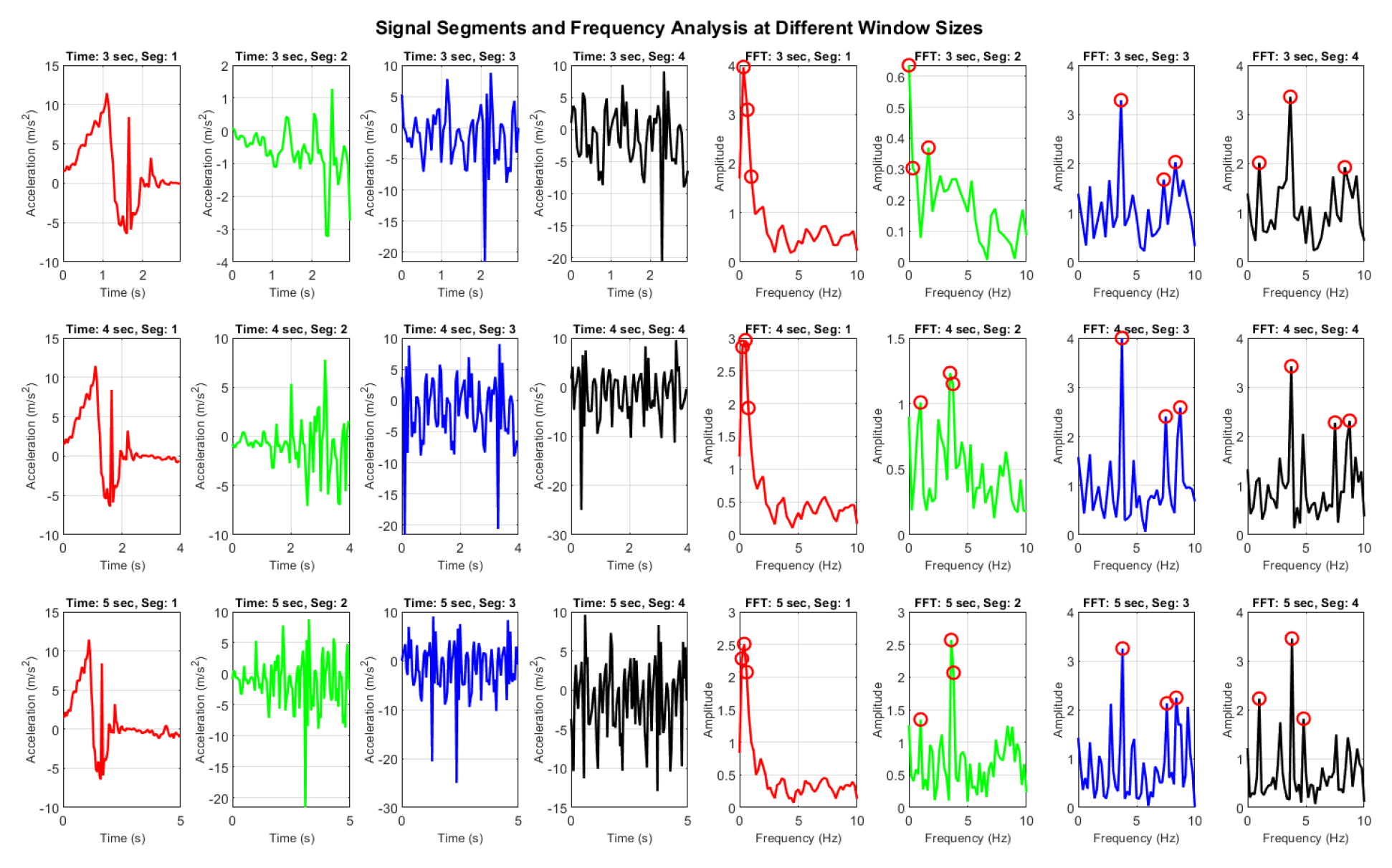
Signal Segmentation at different window size 3sec, 4sec, 5sec, to observe optimum accuracy and calculation of dominant frequency.
Figure 4.
Signal Segmentation at different window size 3sec, 4sec, 5sec, to observe optimum accuracy and calculation of dominant frequency.
6.1.3. Cloud-Level Functionality
The proposed framework aggregates sensor data from wearable devices to provide scalable storage, advanced analytics, remote monitoring capabilities, and performance analysis at the cloud level. While edge devices perform real-time activity recognition, the cloud supports computationally intensive machine learning models for precise recognition accuracy, personalized model, performance analysis and model training and deployment. The cloud also enables continuous performance evaluation, detects deviation in patterns, and personalized program model for scheduled prehabilitation monitoring periods. It also facilitates the user’s interaction through feedback mechanism. This framework include the general functionalities of cloud as well as the implementation of Digital Twin at the cloud level that represent the virtual representation of the IoT- based prehabilitation system to monitor the system dynamically. Digital Twins hosted in the cloud integrate continuous sensor data to simulate and adapt prehabilitation interventions dynamically. This enables healthcare providers to monitor progress remotely, receive alerts for deviations in functional performance, and deliver personalized feedback or auto-interventions. The synchronization between edge and cloud ensures a balance between immediate, low-latency activity recognition and long-term, population-level analytics, optimizing both patient outcomes and resource utilization. For this the current study will use TS (ThingSpeak), an IoT cloud platform, to collect and store real-time data while facilitating processing and visualization. MATLAB has been incorporated into the system for data computation and data training. With support for up to eight data fields, three location fields, and one status field, TS can function via communication channels. It efficiently reduces delays in sending processed data from the gateway to the cloud by updating data every second and processing about 90,000 messages daily [20,21].
Figure 5.
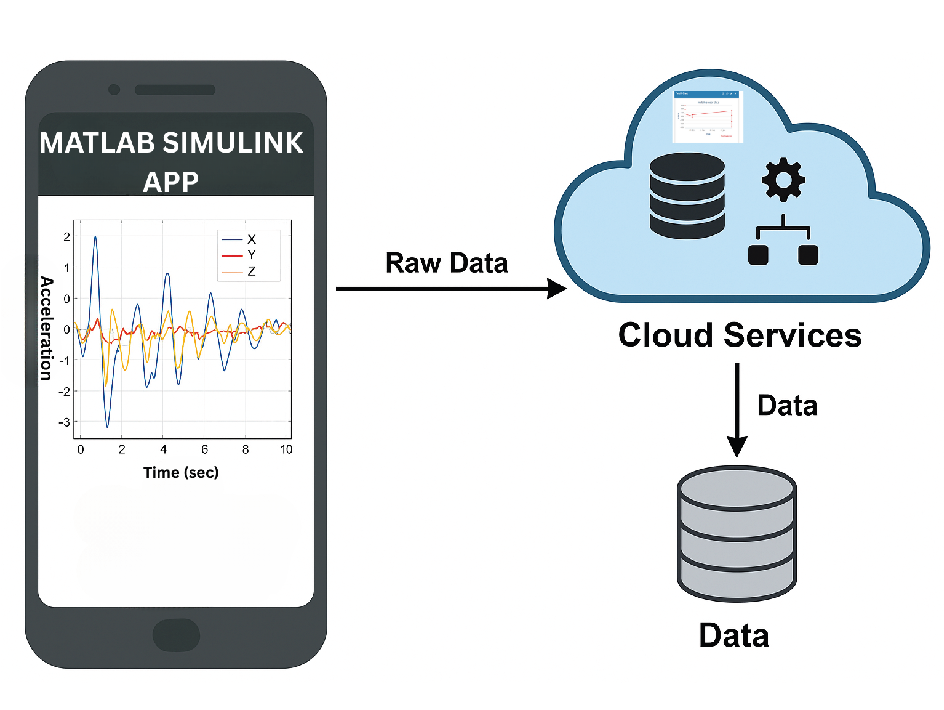
Simulink Mobile App and raw data integration for more data analytics, to the cloud services and Virtual model integration.
Figure 5.
Simulink Mobile App and raw data integration for more data analytics, to the cloud services and Virtual model integration.
6.1.4. Digital Twin
The Digital Twin acts as a adaptive digital model of the IoT system for prehabilitation program of pre-operative patients, comprising a virtual representation of all the components of the IoT system, continuously updated using sensor data in real time to mirror current states, activities, and prehabilitation progress. It enables clinicians and patients to visualize movements, track performance against baseline goals, and identify deviations that may require corrective action. Crucially, the Digital Twin supports closed-loop intervention, where detected errors or performance gaps trigger automated feedback or adaptive recommendations delivered back through the gateway to the wearable device. For example, if abnormal movement patterns or excessive fatigue are detected, the system can automatically adjust exercise intensity, generate alerts, or suggest corrective actions. For the initial testing of the prototype, a Simulink MATLAB App is developed to transmit raw accelerometer data to the cloud through a Simulink model. The collected data is then stored in the cloud (ThingSpeak drive) for visualization and further analysis. In addition, by applying advanced machine learning algorithms and adaptive learning, the digital model can be updated as per the physical system requirements and provide feedback on the performance of prehabilitation. This operational digital twin will offer a more dynamic and comprehensive virtual representation of the system and the prehabilitation, prehabilitation, and post-prehabilitation processes.
This integration of cloud intelligence with the Digital Twin ensures not only accurate recognition and visualization of activities but also dynamic management and auto-intervention, thereby personalizing rehabilitation, reducing risks, and improving overall treatment outcomes.
7. Conclusions
This study highlights the effectiveness of prehabilitation programs, the integration of technology within traditional approaches, and their associated applications and challenges. It emphasizes the potential of advanced technologies ML/AI, to enhance precise movement recognition and the need for personalized databases to monitor key prehabilitation activities. The study also highlights the transformative role of digital twin technology to support the IoT-based human movement monitoring systems, to make it adaptive and personalized prehabilitation models, as personalisation logical analysis of movement dynamics affect alignment with reality. Such systems can be able to overcome the rigidity of current IoT frameworks by enabling real-time interaction, patient-specific adjustments, especially valuable for elderly abdominal cancer patients. Despite progress in applying DT within various domains including healthcare, its potential in prehabilitation for abdominal cancer patients remains underexplored. The conceptual framework includes the interlinked phases beginning with data acquisition via practical, user-friendly smartphones, processing and storage using edge/cloud platforms, developing an AI model for personalized prehabilitation movement recognition, data-driven DTs to enable dynamic system adaptation, and validating feasibility through preliminary testing on a small sample of the population. These stages lay the groundwork for extensive validation and subsequent deployment in the real world in the, future. The critical challenges will include the seamless integration of real-time data, latency issues, system integration complexity, and ensuring real-time responsiveness within a dynamic and heterogeneous healthcare environment. Furthermore, the validation of the system both remotely and within clinical settings presents a significant hurdle, necessitating rigorous evaluation protocols. Ultimately, this research will contribute to the evolution of cyber-physical systems in prehabilitation by introducing the concept of Digital Twin technology within an IoT system that can revolutionize remote patient monitoring, enhance personalization, reduce healthcare costs and improve accessibility and outcomes in preoperative care of patients.
References
- Daniels, S.L.; Lee, M.J.; George, J.; Kerr, K.; Moug, S.; Wilson, T.R.; Brown, S.R.; Wyld, L. Prehabilitation in elective abdominal cancer surgery in older patients: systematic review and meta-analysis. BJS Open 2020, 4, 1022–1041. [Google Scholar] [CrossRef] [PubMed]
- Barberan-Garcia, A.; Ubré, M.; Roca, J.; Lacy, A.M.; Burgos, F.; Risco, R.; Momblán, D.; Balust, J.; Blanco, I.; Martínez-Pallí, G. Personalized Prehabilitation in High-risk Patients Undergoing Elective Major Abdominal Surgery: A Randomized Blinded Controlled Trial. Annals of Surgery 2018, 267, 50–56. [Google Scholar] [CrossRef]
- Carli, F.; Bousquet-Dion, G.; Awasthi, R.; Elsherbini, N.; Liberman, S.; Boutros, M.; Stein, B.; Charlebois, P.; Ghitulescu, G.; Morin, N.; et al. Effect of Multimodal Prehabilitation vs Postoperative Rehabilitation on 30-Day Postoperative Complications for Frail Patients Undergoing Resection of Colorectal Cancer: A Randomized Clinical Trial. JAMA Surgery 2020, 155, 233–242. [Google Scholar] [CrossRef]
- McIsaac, D.I.; Hladkowicz, E.; Bryson, G.L.; Forster, A.J.; Gagne, S.; Huang, A.; Lalu, M.; Lavallée, L.T.; Moloo, H.; Nantel, J.; et al. Home-based prehabilitation with exercise to improve postoperative recovery for older adults with frailty having cancer surgery: the PREHAB randomised clinical trial. British Journal of Anaesthesia 2022, 129, 41–48. [Google Scholar] [CrossRef]
- Bray, F.; Laversanne, M.; Sung, H.; Ferlay, J.; Siegel, R.L.; Soerjomataram, I.; Jemal, A. Global cancer statistics 2024: GLOBOCAN estimates of incidence and mortality worldwide for 36 cancers in 185 countries. CA: A Cancer Journal for Clinicians 2024. [Google Scholar] [CrossRef]
- Berkel, A.; Bongers, B.; van Kamp, M.; et al. The effects of prehabilitation versus usual care to reduce postoperative complications in high-risk patients with colorectal cancer or dysplasia scheduled for elective colorectal resection: study protocol of a randomized controlled trial. BMC Gastroenterology 2018, 18, 29. [Google Scholar] [CrossRef] [PubMed]
- Christensen, J.F.; Simonsen, C.; Banck-Petersen, A.; et al. . Safety and feasibility of preoperative exercise training during neoadjuvant treatment before surgery for adenocarcinoma of the gastro-oesophageal junction. BJS Open 2019, 3, 74–84. [Google Scholar] [CrossRef]
- Amarelo, A.; Mota, M.; Amarelo, B.; Ferreira, M.C.; Fernandes, C.S. Technological Resources for Physical Rehabilitation in Cancer Patients Undergoing Chemotherapy: A Scoping Review. Cancers 2024, 16. [Google Scholar] [CrossRef]
- Coca-Martinez, M.; Carli, F. Prehabilitation: Who can benefit? European Journal of Surgical Oncology 2024, 50, 106979. [Google Scholar] [CrossRef]
- Chmelo, J.; Phillips, A.W.; Greystoke, A.; et al. . A feasibility trial of prehabilitation before oesophagogastric cancer surgery using a multi-component home-based exercise programme: the ChemoFit study. Pilot and Feasibility Studies 2022, 8, 173. [Google Scholar] [CrossRef] [PubMed]
- Lee, K.; Zhou, J.; Norris, M.K.; et al. . Prehabilitative Exercise for the Enhancement of Physical, Psychosocial, and Biological Outcomes Among Patients Diagnosed with Cancer. Current Oncology Reports 2020, 22, 71. [Google Scholar] [CrossRef] [PubMed]
- Michel, A.; Gremeaux, V.; Muff, G.; Pache, B.; Geinoz, S.; Larcinese, A.; Benaim, C.; Kayser, B.; Demartines, N.; Hübner, M.; et al. Short term high-intensity interval training in patients scheduled for major abdominal surgery increases aerobic fitness. BMC Sports Science, Medicine and Rehabilitation 2022, 14, 61. [Google Scholar] [CrossRef]
- Steffens, D.; Young, J.; Riedel, B.; Morton, R.; Denehy, L.; Heriot, A.; Koh, C.; Li, Q.; Bauman, A.; Sandroussi, C.; et al. Prehabilitation with Preoperative Exercise and Education for Patients Undergoing Major Abdominal Cancer Surgery: Protocol for a Multicenter Randomized Controlled TRIAL (PRIORITY TRIAL). BMC Cancer 2022, 22, 443. [Google Scholar] [CrossRef] [PubMed]
- Barberan-Garcia, A.; Cano, I.; Bongers, B.C.; Seyfried, S.; Ganslandt, T.; Herrle, F.; Martínez-Pallí, G. Digital support to multimodal community-based prehabilitation: looking for optimization of health value generation. Frontiers in Oncology 2021, 11, 662013. [Google Scholar] [CrossRef] [PubMed]
- Underwood, W.P.; Michalski, M.G.; Lee, C.P.; Fickera, G.A.; Chun, S.S.; Eng, S.E.; Liu, L.Y.; Tsai, B.L.; Moskowitz, C.S.; Lavery, J.A.; et al. A digital, decentralized trial of exercise therapy in patients with cancer. NPJ digital medicine 2024, 7, 304. [Google Scholar] [CrossRef]
- Franssen, R.F.; Bongers, B.C.; Vogelaar, F.J.; Janssen-Heijnen, M.L. Feasibility of a Tele-prehabilitation Program in High-risk Patients with Colon or Rectal Cancer Undergoing Elective Surgery: A Feasibility Study. Perioperative Medicine 2022, 11, 28. [Google Scholar] [CrossRef]
- Cloß, K.; Verket, M.; Müller-Wieland, D.; Marx, N.; Schuett, K.; Jost, E.; Crysandt, M.; Beier, F.; Brümmendorf, T.H.; Kobbe, G.; et al. Application of Wearables for Remote Monitoring of Oncology Patients: A Scoping Review. Digital Health 2024, 10. [Google Scholar] [CrossRef]
- Gresham, G.; Schrack, J.; Gresham, L.M.; Shinde, A.M.; Hendifar, A.E.; Tuli, R.; Rimel, B.; Figlin, R.; Meinert, C.L.; Piantadosi, S. Wearable Activity Monitors in Oncology Trials: Current Use of Emerging Technology. Contemporary Clinical Trials 2017, 64, 13–21. [Google Scholar] [CrossRef]
- Waller, E.; Sutton, P.; Rahman, S.; Allen, J.; Saxton, J.; Aziz, O. Prehabilitation with Wearables versus Standard of Care before Major Abdominal Cancer Surgery: A Randomised Controlled Pilot Study (Trial Registration: NCT04047524). Surgical Endoscopy 2022, 36, 1008–1017. [Google Scholar] [CrossRef]
- Al-Naime, K.; Al-Anbuky, A.; Mawston, G. IoT Based Pre-Operative Prehabilitation Program Monitoring Model: Implementation and Preliminary Evaluation. In Proceedings of the 2022 4th International Conference on Biomedical Engineering (IBIOMED); 2022; pp. 24–29. [Google Scholar] [CrossRef]
- Gupta, A.; Al-Anbuky, A. IoT-Based Patient Movement Monitoring: The Post-Operative Hip Fracture Rehabilitation Model. Future Internet 2021, 13. [Google Scholar] [CrossRef]
- Al-Naime, K.; Al-Anbuky, A.; Mawston, G. Remote Monitoring Model for the Preoperative Prehabilitation Program of Patients Requiring Abdominal Surgery. Future Internet 2021, 13. [Google Scholar] [CrossRef]
- Gupta, A.; Al-Anbuky, A.; McNair, P. Activity Classification Feasibility Using Wearables: Considerations for Hip Fracture. Journal of Sensor and Actuator Networks 2018, 7. [Google Scholar] [CrossRef]
- Grieves, M.; Vickers, J. , Undesirable Emergent Behavior in Complex Systems. In Transdisciplinary Perspectives on Complex Systems. In Transdisciplinary Perspectives on Complex Systems: New Findings and Approaches; Springer International Publishing: Cham, 2017; pp. 85–113. [Google Scholar] [CrossRef]
- Qi, Q.; Tao, F.; Hu, T.; Anwer, N.; Liu, A.; Wei, Y.; Wang, L.; Nee, A. Enabling technologies and tools for digital twin. Journal of Manufacturing Systems 2021, 58, 3–21. [Google Scholar] [CrossRef]
- Liu, M.; Fang, S.; Dong, H.; Xu, C. Review of digital twin about concepts, technologies, and industrial applications. Journal of Manufacturing Systems 2021, 58, 346–361. [Google Scholar] [CrossRef]
- Elayan, H.; Aloqaily, M.; Guizani, M. Digital Twin for Intelligent Context-Aware IoT Healthcare Systems. IEEE Internet of Things Journal 2021, 8, 16749–16757. [Google Scholar] [CrossRef]
- Minerva, R.; Lee, G.M.; Crespi, N. Digital Twin in the IoT Context: A Survey on Technical Features, Scenarios, and Architectural Models. Proceedings of the IEEE 2020, 108, 1785–1824. [Google Scholar] [CrossRef]
- Barricelli, B.R.; Casiraghi, E.; Gliozzo, J.; Petrini, A.; Valtolina, S. Human Digital Twin for Fitness Management. IEEE Access 2020, 8, 26637–26664. [Google Scholar] [CrossRef]
- Johnson, Z.; Saikia, M.J. Digital Twins for Healthcare Using Wearables. Bioengineering 2024, 11. [Google Scholar] [CrossRef]
- Falkowski, P.; Osiak, T.; Wilk, J.; Prokopiuk, N.; Leczkowski, B.; Pilat, Z.; Rzymkowski, C. Study on the Applicability of Digital Twins for Home Remote Motor Rehabilitation. Sensors 2023, 23. [Google Scholar] [CrossRef]
- Liu, Y.; Zhang, L.; Yang, Y.; Zhou, L.; Ren, L.; Wang, F.; Liu, R.; Pang, Z.; Deen, M.J. A Novel Cloud-Based Framework for the Elderly Healthcare Services Using Digital Twin. IEEE Access 2019, 7, 49088–49101. [Google Scholar] [CrossRef]
- Chen, J.; Wang, Z.; He, T.; Fang, B.; Li, C.; Fridenfalk, M.; Lyu, Z. Artificial Intelligence Empowered Digital Twins for ECG Monitoring in a Smart Home. ACM Trans. Multimedia Comput. Commun. Appl. 2024. [Google Scholar] [CrossRef]
- Zhang, J.; Li, L.; Lin, G.; Fang, D.; Tai, Y.; Huang, J. Cyber Resilience in Healthcare Digital Twin on Lung Cancer. IEEE Access 2020, 8, 201900–201913. [Google Scholar] [CrossRef]
- Parween, G.; Al-Anbuky, A.; Mawston, G.; Lowe, A. Internet of Things-Based Human Movement Monitoring System: Prospect for Conceptual Digital Twin. ASME Journal of Medical Diagnostics 2025, 8, 021104. [Google Scholar] [CrossRef]
- Muka, E.; Marinova, G. Digital Twins to Monitor IoT Devices for Green Transformation of University Campus. In Proceedings of the 2024 International Conference on Broadband Communications for Next Generation Networks and Multimedia Applications (CoBCom), July 2024; pp. 1–6. [Google Scholar] [CrossRef]
- Taylor, S.J.E.; Macal, C.M.; Matta, A.; Rabe, M.; Sanchez, S.M.; Shao, G. Enhancing Digital Twins with Advances in Simulation and Artificial Intelligence: Opportunities and Challenges. In Proceedings of the 2023 Winter Simulation Conference (WSC), Dec 2023; pp. 3296–3310. [Google Scholar] [CrossRef]
- Al-Naime, K.; Al-Anbuky, A.; Mawston, G. Human Movement Monitoring and Analysis for Prehabilitation Process Management. Journal of Sensor and Actuator Networks 2020, 9. [Google Scholar] [CrossRef]
- Mikołajewska, E.; Masiak, J.; Mikołajewski, D. Applications of Artificial Intelligence-Based Patient Digital Twins in Decision Support in Rehabilitation and Physical Therapy. Electronics 2024, 13, 4994. [Google Scholar] [CrossRef]
- Tyagi, S.; Agarwal, A.; Maheshwari, P. A conceptual framework for IoT-based healthcare system using cloud computing. In Proceedings of the 2016 6th International Conference - Cloud System and Big Data Engineering (Confluence); 2016; pp. 503–507. [Google Scholar] [CrossRef]
- Baker, S.B.; Xiang, W.; Atkinson, I. Internet of Things for Smart Healthcare: Technologies, Challenges, and Opportunities. IEEE Access 2017, 5, 26521–26544. [Google Scholar] [CrossRef]
- Alshehri, F.; Muhammad, G. A Comprehensive Survey of the Internet of Things (IoT) and AI-Based Smart Healthcare. IEEE Access 2021, 9, 3660–3678. [Google Scholar] [CrossRef]
- De Vito, L.; Lamonaca, F.; Mazzilli, G.; Riccio, M.; Luca Carnì, D.; Sciammarella, P.F. An IoT-enabled multi-sensor multi-user system for human motion measurements. In Proceedings of the 2017 IEEE International Symposium on Medical Measurements and Applications (MeMeA), May 2017; pp. 210–215. [Google Scholar] [CrossRef]
- Huang, H.; Zhao, L.; Wu, Y. An IoT and machine learning enhanced framework for real-time digital human modeling and motion simulation. Computer Communications 2023, 212, 78–89. [Google Scholar] [CrossRef]
- Lateef, R.A.; Abbas, A.R. Human Activity Recognition Using Smartwatch and Smartphone: A Review on Methods, Applications, and Challenges. Iraqi Journal of Science 2022, 363–379. [Google Scholar] [CrossRef]
- Thakur, D.; Biswas, S. Smartphone based human activity monitoring and recognition using ML and DL: a comprehensive survey. Journal of Ambient Intelligence and Humanized Computing 2020, 11, 5433–5444. [Google Scholar] [CrossRef]
- Khan, Y.A.; Imaduddin, S.; Prabhat, R.; Wajid, M. Classification of human motion activities using mobile phone sensors and deep learning model. In Proceedings of the 2022 8th International Conference on Advanced Computing and Communication Systems (ICACCS), Coimbatore, India. IEEE, Vol. 1; 2022; pp. 1381–1386. [Google Scholar] [CrossRef]
- Alam, M.A.U. AI-Fairness Towards Activity Recognition of Older Adults. In Proceedings of the MobiQuitous 2020 - 17th EAI International Conference on Mobile and Ubiquitous Systems: Computing, Networking and Services, New York, NY, USA, 2021; MobiQuitous ’20; pp. 108–117. [Google Scholar] [CrossRef]
- Zebin, T.; Scully, P.J.; Peek, N.; Casson, A.J.; Ozanyan, K.B. Design and Implementation of a Convolutional Neural Network on an Edge Computing Smartphone for Human Activity Recognition. IEEE Access 2019, 7, 133509–133520. [Google Scholar] [CrossRef]
- Pracucci, A. Designing Digital Twin with IoT and AI in Warehouse to Support Optimization and Safety in Engineer-to-Order Manufacturing Process for Prefabricated Building Products. Applied Sciences 2024, 14. [Google Scholar] [CrossRef]
- Al-Ali, A.R.; Gupta, R.; Zaman Batool, T.; Landolsi, T.; Aloul, F.; Al Nabulsi, A. Digital Twin Conceptual Model within the Context of Internet of Things. Future Internet 2020, 12. [Google Scholar] [CrossRef]
- Rani, G.J.; Hashmi, M.F.; Gupta, A. Surface Electromyography and Artificial Intelligence for Human Activity Recognition—A Systematic Review on Methods, Emerging Trends Applications, Challenges, and Future Implementation. IEEE Access 2023, 11, 105140–105169. [Google Scholar] [CrossRef]
- Sukor, A.S.A.; Zakaria, A.; Rahim, N.A. Activity recognition using accelerometer sensor and machine learning classifiers. In Proceedings of the 2018 IEEE 14th International Colloquium on Signal Processing and Its Applications (CSPA); 2018; pp. 233–238. [Google Scholar] [CrossRef]
Figure 1.
IoT Architecture and its key components.
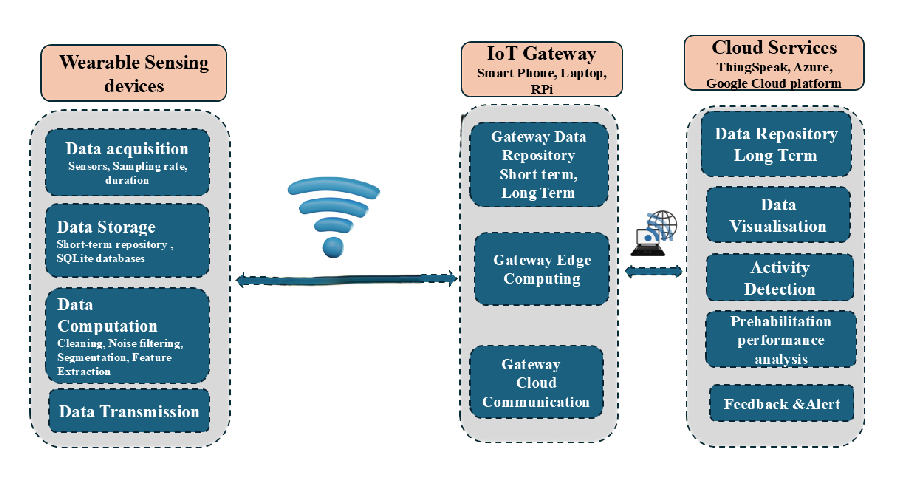
Figure 2.
conceptual framework.
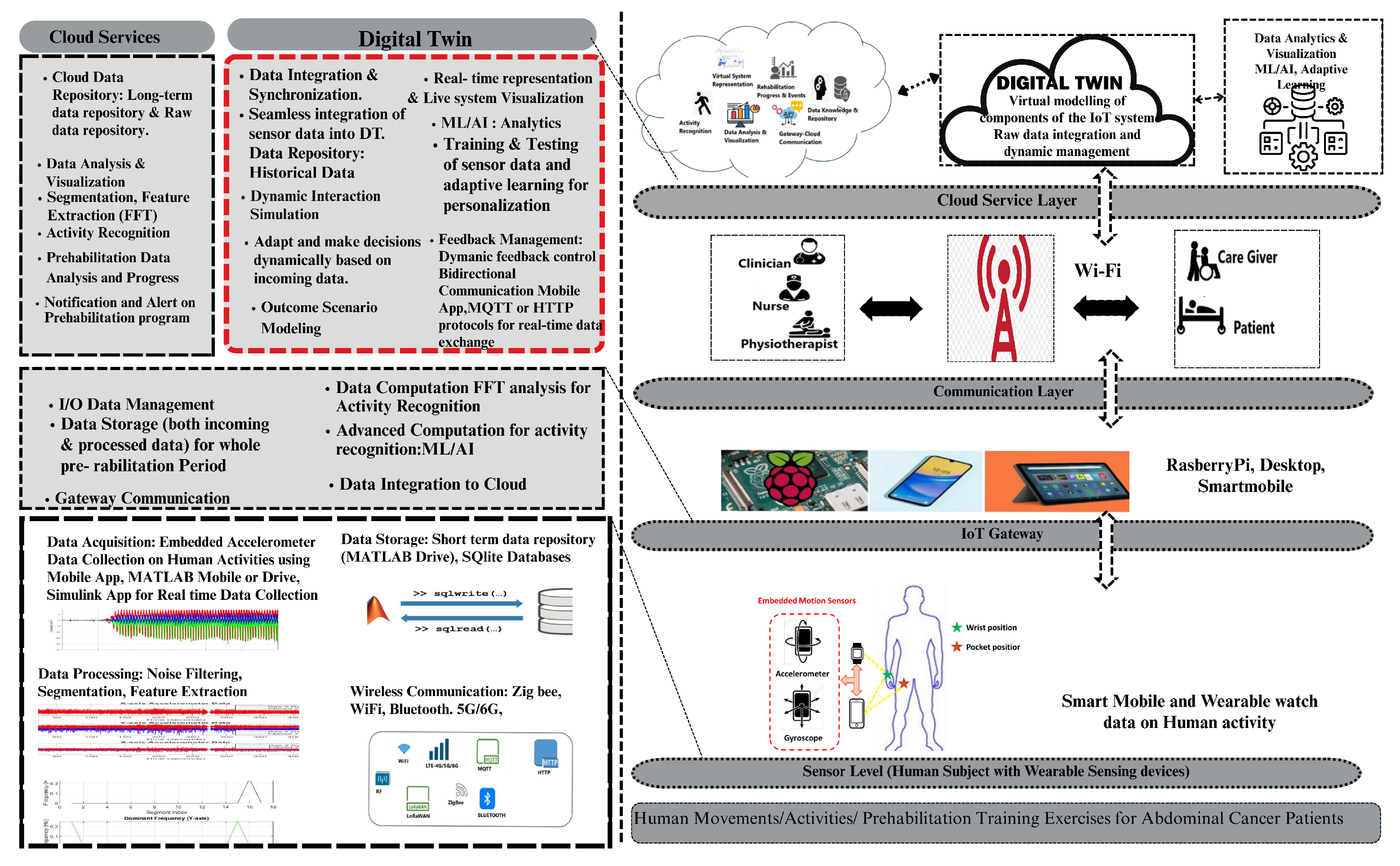
Figure 3.
Raw accelerometer data collected on older person at 20 Hz using a smartphone-based MATLAB application: (a) signals from multiple activities (treadmill walking, cycling, Rowing, leg press) at various intensities; (b) signals during cycling at varying intensities (Low, Medium, Hard, Very Hard).
Figure 3.
Raw accelerometer data collected on older person at 20 Hz using a smartphone-based MATLAB application: (a) signals from multiple activities (treadmill walking, cycling, Rowing, leg press) at various intensities; (b) signals during cycling at varying intensities (Low, Medium, Hard, Very Hard).
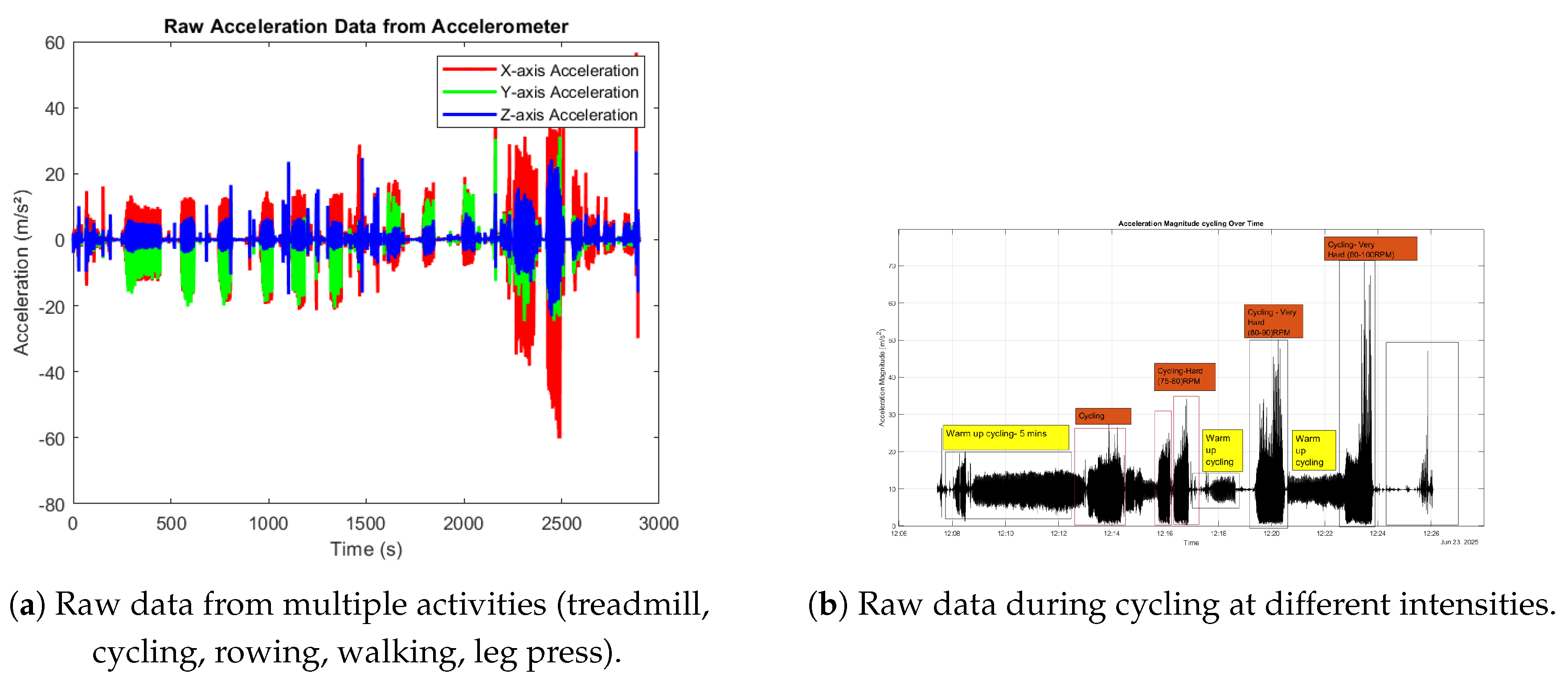

Table 1.
Summary of Reviewed Studies on Prehabilitation Programs.
| Review Study | Population | Duration | Type of Exercises | Key Functional Outcomes |
|---|---|---|---|---|
| Supervised Prehabilitation | ||||
| [2,3] | Colorectal cancer patients | 4–6 weeks | Aerobic and resistance training, flexibility exercise | 20% increase in 6MWT; 35% reduction in postoperative complications |
| [7] | 62 candidates (patients) | 17.5 sessions (2 sessions/week) | High, moderate intensity | aerobic fitness improvement, strength, and quality of life; lower risk of surgical failure in exercise group (5% vs. 21%) |
| [11] | Review study | — | Low, medium, and high intensity exercises | Significant improvements in physical activity scores and walking test results, indicating better physical readiness for surgery |
| [12] | 14 patients | 3 sessions/week for 3 weeks | Low-volume HIIT program | 13% increase in peak; strong correlation between walking distance and peak (, ) |
| Unsupervised / Technology-Based Prehabilitation | ||||
| [13] | 172 participants | 4–8 weeks | Aerobics, resistance, and respiratory exercises; recommendations of home exercises | Improved physical and psychological readiness for surgery; potentially improving postoperative outcomes |
| [4] | 204 randomized patients (out of 543 assessed) | 5 weeks | Home-based walking | No significant improvement in functional recovery or other outcomes compared to standard care |
| [8] | 80 patients scheduled for colorectal cancer resection | — | — | 20 m improvement in 6MWT; postoperative complications assessed |
| [14,15,16,17] | Abdominal cancer patients | 4–6 weeks | Low to high cardiorespiratory fitness testing using treadmill | Adherence and outcomes of prehabilitation assessed |
| [20,22,38] | Abdominal cancer patients | 4–6 weeks | Low, medium, high aerobic exercises | Remote monitoring and feedback alert system applied |
Table 2.
Key Elements and Boundaries of Prehabilitation Programs [22].
Table 2.
Key Elements and Boundaries of Prehabilitation Programs [22].
| Sl.No | Prehabilitation Elements | Boundaries | Remarks |
|---|---|---|---|
| 1 | Prehabilitation Program Duration | 4–6 weeks / 4–8 weeks | Patient’s status and surgical schedules |
| 2 | Number of sessions per week | 2 or more | Can participate as per the guidance of health supervisor |
| 3 | Threshold duration | 150 minutes of moderate duration or equivalent | 75 minutes of vigorous intensity or a combination of vigorous and moderate exercise |
| 4 | Minimum Duration of Each Session | 10 minutes or more at moderate intensity | As per patients’ needs |
| 5 | Initial Assessment | 6MWT, cardiopulmonary exercise testing, 10-m shuttle walk test | Dependent upon clinical resources and expertise |
| 6 | Exercises Involved | Walking, cycling, treadmill and land-based running, cross-trainer, staircase ascending & descending, rowing, step-up, leg press | Can be altered according to need |
| 7 | Location | Healthcare center, clinic, gym, indoor, sports club or park | Availability of resources |
| 8 | Performance Measurement | Credit Point Calculation | Not standardized; conceptual analysis of performance based on credit point calculation |
Table 3.
Studies on Sensor-Based Activity Recognition, Application and recognition Outcomes.
| Study | Technology Used | Application | Performance/Technique |
|---|---|---|---|
| [20,23] | Accelerometer, IMU, IoT-enabled devices | Lower body and transitional activities | Frequency domain analysis (FFT), 4-sec window size for processing; achieved 78% accuracy |
| [47] | Smart mobile sensors (accelerometer, gyroscope, magnetometer), machine learning | Walking, brisk walking | Deep learning model reached 96.5% accuracy |
| [45] | Smartphone embedded sensors with classifier | Daily activities (standing, sitting, lying, stairs up/down, walking) | FFT and ML with 3-sec window size, PCA – 96.11% accuracy; Frequency domain analysis – 92.10% accuracy |
| [46] | Smartphone with ML and deep learning | Static and dynamic activities | Model performance not reported |
| [49] | Waist-mounted inertial sensor (accelerometer and gyroscope) | Real-time data: walking, upstairs, downstairs, sitting, standing, lying | Adaptive window size; 96.4% accuracy in five-class static and dynamic activity recognition |
Disclaimer/Publisher’s Note: The statements, opinions and data contained in all publications are solely those of the individual author(s) and contributor(s) and not of MDPI and/or the editor(s). MDPI and/or the editor(s) disclaim responsibility for any injury to people or property resulting from any ideas, methods, instructions or products referred to in the content. |
© 2025 by the authors. Licensee MDPI, Basel, Switzerland. This article is an open access article distributed under the terms and conditions of the Creative Commons Attribution (CC BY) license (http://creativecommons.org/licenses/by/4.0/).
Copyright: This open access article is published under a Creative Commons CC BY 4.0 license, which permit the free download, distribution, and reuse, provided that the author and preprint are cited in any reuse.


