

Submitted:
12 September 2025
Posted:
15 September 2025
You are already at the latest version
Abstract
Digital transformation, compliance to requirements and regulations, smart cyber-security, agility, data and information mesh, integration with convergent technologies, skill development and adapting to the socio-technical dynamics, Everyone benefits from a "adequately and sufficiently" sophisticated and complex platform of data-driven wisdom and its interaction with human experts. The realization of all these good goals and needs requires a good and innovative theory, method, framework, solution, and generally a good and innovative paradigm for enterprise architecture in the coming years, which seems to be slowly being experienced, evolving, and emerging. With such an approach and in this paper, a proposed conceptual architecture for the problem of "integrated and intelligent government financial management system (FMIS)" is presented (from the perspective of enterprise architecture and hybrid wisdom). This conceptual architecture establishes a dynamic and adjustable balance between centralization and distributedness, and with the help of the combination of computational data-driven and human wisdom, it is possible to improve the effectiveness of government resources, operational transparency, program adherence, and operational agility. It facilitates dynamic adaptability, in-depth reporting, support for analytical intelligence, and support for resolving budget discrepancies and disharmonies. Achieving the wisdom of cyber-human thinking in a systematic way in the field of FMIS will be one of the most distinctive achievements of such a conceptual architecture.
Keywords:
enterprise architecture
; computational wisdom
; hybrid wisdom
; government integrated financial system
; FMIS
; complexity
I. Introduction
Responding to modern concerns in the field of enterprise architecture and grasping classical ideals in this field of engineering and innovation form a geometry of problems [1], which relies on the general principles of data-drivenness, versatility, positive complexity and intelligence (at the level of human and computational wisdom) which are inevitable for future paradigms in this field.
Big data is one of the important commercial, enterprise, organizational, national and even civilization resources in today's world. Therefore, it is natural that any new (and beyond) approach for enterprise architecture (and comprehensive intelligent society-sector-organizations) should use and support this technology in a general and complete way.
Versatility is an important feature for complex systems and organizations. Without relying on this feature, it is not possible to create and engineer complex and adaptable systems or organizations in a desirable way (for missions, objectives and missions in dynamic, changing and undulating environments which are prone to all kinds of errors and noises, ambiguities, uncertainties, complexities and so-called VUCA2 )[2,3].
Positive complexity expresses positive assets (and operational values in all dimensions and perspectives [4] [5]) in a system. Just as a simple biological organism has less positive complexity than a complex biological organism (and therefore represents simpler levels of biological complexity), a system or organization consisting of and has less positive reserves, layers, processes, components, and events, may face the poverty of complexity. Then, because of the resulting deficiencies, it is unable to play a correct, effective, and appropriate role in its field, problem or environment.
Intelligence, especially its highest levels that end in wisdom (both computational and human\natural), is the most value-creating part of a complex organization [1]. All data content, information, operation, process, structure and body, knowledge, procedures and methods, events and manifestations, and multifaceted and positive complexities of a system or organization could be placed in the service of hybrid wisdom (the result of the combination of computing and natural wisdom, with the integration of human and machine wisdom). in a two-way dialectical (or escalating) process, leading to the promotion of added value, promotion of operational efficiency, promotion of problem solving ability, promotion of the successful role playing, improving the level of goals and achieving of goals, that too in a "rank-breaking" and "grand record creation" way.
Therefore, these principles (or fundamental geometry) can be considered as the basis of a conceptual framework or architecture for new (and ultramodern) organizations in the coming recent decades: hybrid wisdom in the center and a solar-peripheral-system of big data, data-drivenness, multifaceted versatility, positive complexity and intelligent paradigms, around it (Figure 1).
This importance should not be taken lightly because without adopting the correct basic and fundamental principles, it is not possible to reach concrete, technical and practical levels (Figure 2).
These principles and foundations leave their impact in the form of cascading, exponential and sometimes butterfly effects in higher layers. Thus, the smallest deficiency or deviation in the basic principles and geometry of any organizational framework can limit the space for Creativity, limitation of space for innovation, sedation and locking in certain types, lead to incapacity, functional defects or physical and structural defects. Therefore, the most strategic (and most important) stage of designing any organization (or system) is to reflect the basic, essential and pure ideas within the basic principles and geometry of that organizational framework. This, of course, is not a negation of exemplary approaches (in the upper layers) and a harmony between examples and basic principles can (and should) be provided. Examples are previously found (or solved) solutions, approaches and methods. Smart adaptation and positive impersonation also occur in higher layers.
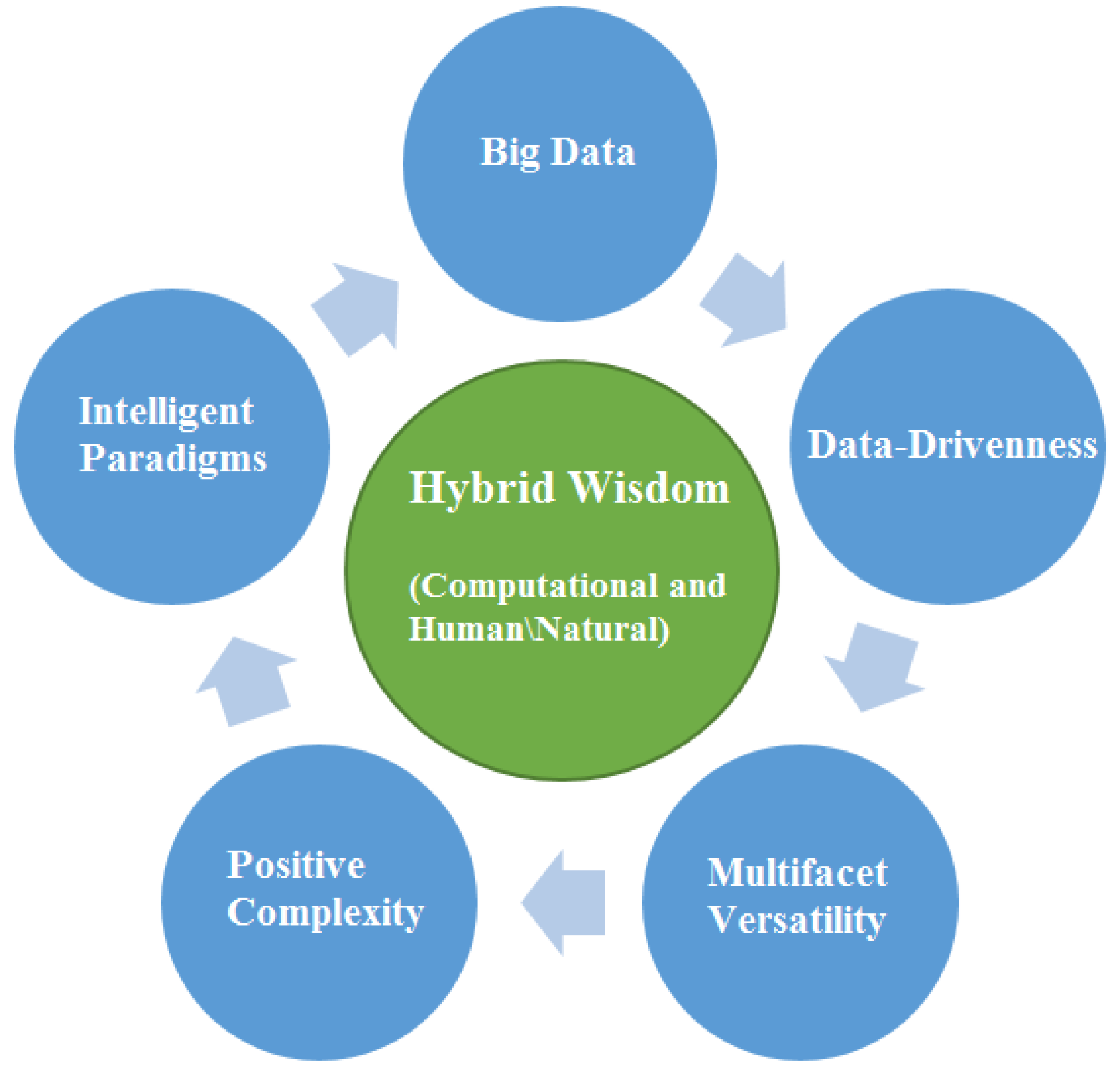
Figure 1.
Geometry and fundamental principles for ultramodern organizations and systems in the coming decades.
Figure 1.
Geometry and fundamental principles for ultramodern organizations and systems in the coming decades.
Agility should show itself both in the structures and in the processes of a system, so that it could be prevented from solidification and freezing (both in the concrete physical levels and the implicit and hidden but very effective functional levels). This is not the only software that is dead if it doesn't change. Every order, every organization and every system, if it experiences immutability (especially due to heaviness), then it has received its dynamic death sentence. Therefore, Agility is very fundamental and vital in this viewpoint: the main characteristic that ends with evolvability and changeability is fluidity, and fluidity cannot be obtained without agility (especially, in human-technical fields).
A. Data and Information Mesh-Networks
Data and information mesh-networks are the origin of a civilizational evolution as much as the invention of the Sumerian script in ancient Mesopotamia. But these changes that replace the poles of success (and power) in their influential environment (both organizational, business, economic, social and geopolitical), happen in just a few years instead of millennia. Without data and information mesh-networks (especially technical examples such as strategic upper-levels ontologies, ultra-large knowledge graphs and pre-trained domain-specific neural networks and models), we cannot expect "scholarship" and "knowledge" in enterprises in coming new era, in a competitive and effective manner at the edge of competence.
B. Integration with Convergent Technologies
Integration with convergent technologies, especially cognitive aspects in the organization, requires a proper combination of data-driven intelligence (to compute personas, events, and patterns) and human intelligence (to integrate with expertise, judgment, and even situational emotions). Although converging technologies were a contemporary concept and a generation that is relatively old and will soon be replaced by a newer paradigms, the integration of the previous new paradigm (i.e. converging technologies) with the requirements and organizational environment has not yet actually occurred in the business world. As an important example, the fact that the appearance of Industry 4.0 is less than expectations, could teach us to be gentle in paradigm making. Therefore, this previously new paradigm, in the case of our problem, will remain as a practically ready platform and practically a candidate for integration for solutions of the coming decades.
C. Skill Development and Adaptation to Sociotechnical Dynamics
Skill development and adapting to the dynamics of humans, machines, business and social needs is one of the most difficult (and most competitive) aspects of cyber-human systems. With the help of combined wisdom, it is possible to avoid false-dogmas, conflicts of interests, wastes, wasted opportunities, indiscretions and entanglements in organizations and systems.
D. Hybrid Wisdom Era
Hybrid wisdom should not (and cannot) be considered as "the key that opens any lock", but actually this driver will be one of the emerging drivers of organizational, enterprise and system changes in the coming decades.
In the following, we will examine the potential and proposed application of this engine (i.e. hybrid wisdom and its solar-peripheral-system of principals) in the conceptual architecture of the organization (and extended large system) for the integrated and intelligent government financial management system (FMIS).
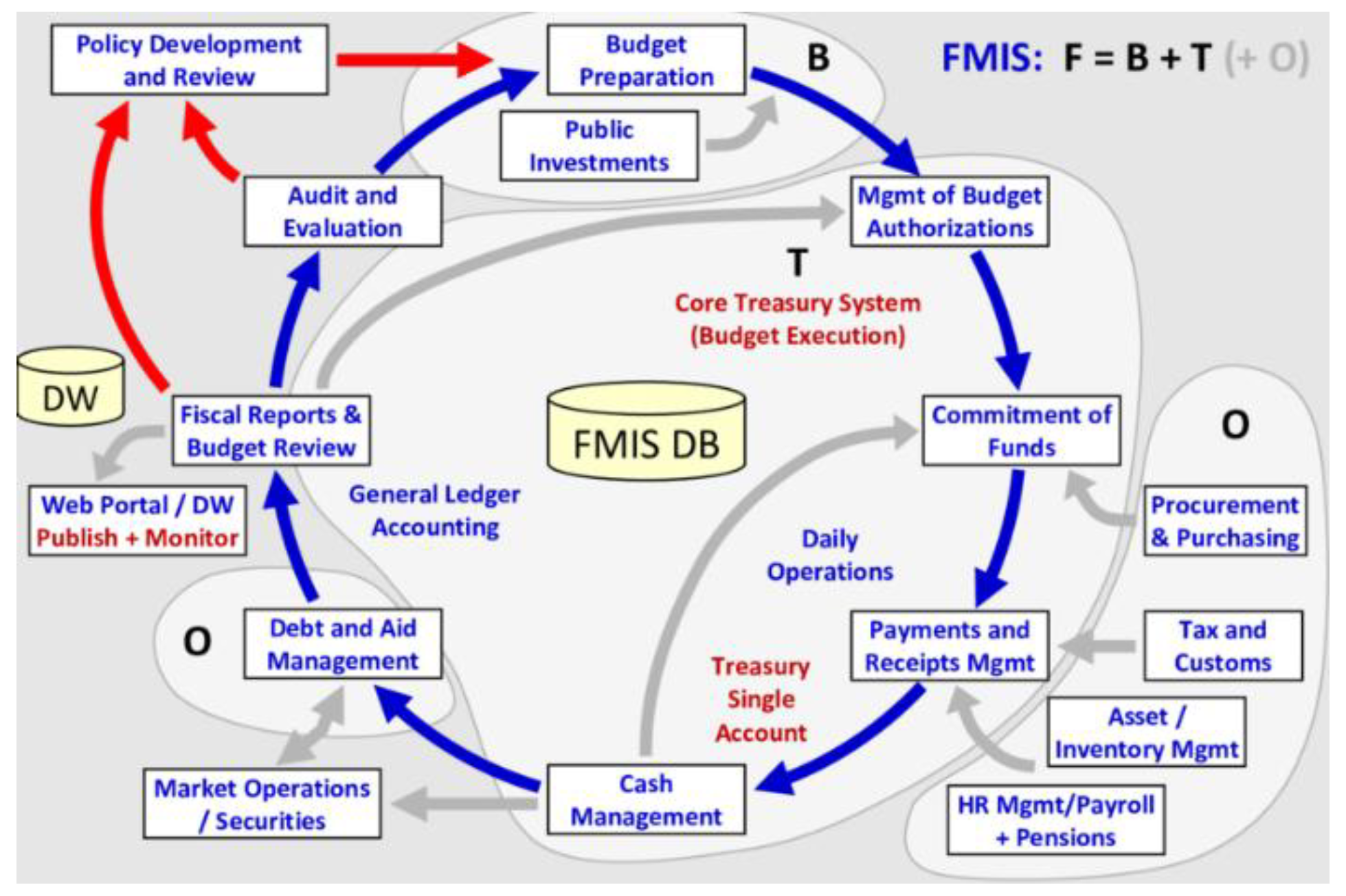
Figure 2.
The classic global FMIS model is based on the framework presented by the World Bank[8].
Figure 2.
The classic global FMIS model is based on the framework presented by the World Bank[8].
II. Integrated and Intelligent Government Financial Management System
Governments (with their structures, organization, assets, and both positive and negative complexities) are the most important terrestrial asset of any nation. The triangle of "nation, country, and government" forms the geopolitical, economic, human, social (and even in some aspects spiritual) core of existence for each component within the realm of human geography. Improving government performance (in each of their functional dimensions) has a direct impact on the life of people in each of countries. Even on a broader horizon, improving supply in the East can enhance the responsiveness to demand in the West (as experienced in the China-Atlantic context). Therefore, the most critical and effective organizations are those that manage macro-systems for “governments”.
Financial management constitutes an important part of the duties (and powers) of a government. This right to govern must be realized by governments and within the framework of traditional bureaucratic organization (or new systematization). Alternatively, at a more advanced level, a complex organization based on collective wisdom allows a country to establish (and regulate) the best levels of qualitative parameters for the government's financial management.
Components such as scenario mapping, spatial planning, programming, budgeting, resource allocation, expenditure, monitoring and feedback, adjustment, redesign, and then repeating the cycle are typical steps in government financial management (with a program and budget approach)[6]. This cycle is implemented at least once a year in most countries[7].
Global FMIS models (such as the World Bank model) effectively reduce the concept of this system to a classic notion of information systems, rather than a comprehensive new organizational structure. The components of this classic model for FMIS may be "necessary," but they are not sufficient for the coming years, especially in competing with powers in a VUCA world. Furthermore, lessons learned from previous experiences indicate that negative organizational complexities, complexities of human relationships, unmanaged complexities in the environment, the lack of architectural engineering for organizations and systems, and deficiencies in organization can hinder the creation, establishment, and evolution of such a mega-system.
II. Proposed Conceptual Architecture for FMIS
With this approach, this section presents the essential elements of a proposed conceptual architecture for the issue of "Integrated and Intelligent Financial Management System of the Government" (from the perspective of enterprise architecture and computational intelligence). This conceptual architecture establishes a dynamic and adjustable balance between centralization and distribution, facilitating the enhancement of the effectiveness of government resources, operational transparency, programmatic compliance, operational agility, dynamic adaptability, in-depth reporting, support for spatial intelligence, and assistance in addressing budgetary imbalances. Achieving human-computer wisdom in a systematic manner within the context of FMIS will be one of the distinct achievements of such a conceptual architecture.
The core of the proposed architecture for FMIS (which we call HFMIS, i.e. Hakim-FMIS ) is based on the combination of classical FMIS architectural elements with:"intelligent agents", "big data", "knowledge repositories", "hybrid wisdom engines", "programmatic compliance monitoring engines", "agile specialized operational teams", "smart spatial documents (based on digital twins)"[9], "crowdsourcing", "systematic crowdsourcing"[10], and "real-time economic imbalances notification dashboards”.
In other words, just as we have witnessed the evolution of organizational complexity and systems in most organizations and technological products throughout the twentieth century (from its beginning to its end), it is expected that the advanced conceptual architecture for the integrated and intelligent financial system of the government for recent years, namely HFMIS, will be composed of more mature, diverse, multi-faceted, and complex elements (in terms of affirmative and potential aspects), based on big data and hybrid wisdom[11]. Additionally, reliance on the achievements of distributed multi-agent systems (such as the prominent example being the web) can lead to improvements in organizing HFMIS in a way that supports dynamic adjustment and establishes balance between distribution and adaptability.
Relying on hybrid wisdom (with repository and engine tools such as knowledge graphs, legal repositories, wisdom repositories, large language models, large computational and cognitive models, and semantic logics[12]) can lead to a "hybrid service-oriented wisdom with ExaFLOPS[13] capability at the government's disposal" in the upcoming years, serving as a true and comprehensive example of artificial intelligence application[14] for Iran.
III. Conclusions
By relying on the fundamental principles of advanced organization for intelligent and complex systems, the HFMIS architecture can be presented for the integrated and intelligent financial management system of the government. This approach, based on the key and central concept of "hybrid wisdom," and utilizing specific components identified within the proposed conceptual architecture framework, aims to transcend the classical FMIS conceptual model in a "disruptive" and "satisfactory" manner, bringing a tangible application of the discourse on intelligence, complexity, and data-centricity to the country and nation of Iran. Just as nothing is more practical than a good theory[15], for engineering organizational and systemic architectures, nothing is more fundamental (and effective in outcome) than a correct, complete, up-to-date, successful, and efficient conceptual architecture.
Acknowledgments
We extend our heartfelt gratitude to all those who provided their feedback on HFMIS, especially at Tarbiat Modares University, Sharif University of Technology, and the government.
References
- Ahmadi, Mohammad Hossein, "Creating a Set of Architectural Process Patterns," Master's Thesis, Faculty of Computer Engineering, Sharif University of Technology, 2012.
- Biloslavo, Roberto, David Edgar, Erhan Aydin, and Cagri Bulut., “Artificial intelligence (AI) and strategic planning process within VUCA environments: a research agenda and guidelines”, Management Decision, 2024. [CrossRef]
- Ullrich, André, Clementine Bertheau, Miriam Wiedmann, Eldar Sultanow, Tim Körppen, and Stefan Bente. "Roles, tasks and skills of the enterprise architect in the VUCA world.", In 2021 IEEE 25th International Enterprise Distributed Object Computing Workshop (EDOCW), pp. 261-270. IEEE, 2021. [CrossRef]
- Zachman, John A., "A Framework for Information Systems Architecture", IBM Systems Journal, Vol. 26, No. 3, 1987. [CrossRef]
- Fill, Hans-Georg, and Harald Kühn, eds. Metamodeling: Applications and Trajectories to the Future: Essays in Honor of Dimitris Karagiannis. Springer Nature, 2024.
- Karimi, M. A., Kordestani, Gh. Biglar, K., “Identifying Challenges to the Public Financial Management System”, Empirical Studies in Financial Accounting, 20(77), 141 -182, 2023. [CrossRef]
- Uña, Gerardo, Mr Richard I. Allen, Richard Allen, and Nicolas M. Botton. How to design a financial management information system: a modular approach. International Monetary Fund, 2019.
- Dener, Cem, Joanna Watkins, and William Leslie Dorotinsky., Financial management information systems: 25 years of World Bank experience on what works and what doesn't, World Bank Publications, 2011.
- Tan, Fangqi, and Yuning Cheng. "A digital twin framework for innovating rural ecological landscape control.", Environmental Sciences Europe 36, no. 1 (2024): 59. [CrossRef]
- Wu, Jie, Narisa Zhao, and Tong Yang. “Wisdom of crowds: SWOT analysis based on hybrid text mining methods using online reviews.”, Journal of Business Research 171: 114378, 2024. [CrossRef]
- Williams, Deborah H., and Gerhard P. Shipley. "Enhancing artificial intelligence with indigenous wisdom." Open Journal of Philosophy 11, no. 01 (2021): 43-58. [CrossRef]
- Besharati, Mohammad Reza, and Mohammad Izadi. "DD-KARB: data-driven compliance to quality by rule based benchmarking", Journal of Big Data 9, no. 1 (2022): 103. [CrossRef]
- Perrault, Ray, and Jack Clark. "Artificial Intelligence Index Report 2024.", Stanford University, 2024.
- Duenas, Tom, and Diana Ruiz. "The ministry of artificial intelligence: A catalyst for national AI ecosystems and global cooperation in the age of superintelligence.", ResearchGate, 2024a. [CrossRef]
- Vapnik, Vladimir. The nature of statistical learning theory., Springer science & business media, 2013.
Disclaimer/Publisher’s Note: The statements, opinions and data contained in all publications are solely those of the individual author(s) and contributor(s) and not of MDPI and/or the editor(s). MDPI and/or the editor(s) disclaim responsibility for any injury to people or property resulting from any ideas, methods, instructions or products referred to in the content. |
© 2025 by the authors. Licensee MDPI, Basel, Switzerland. This article is an open access article distributed under the terms and conditions of the Creative Commons Attribution (CC BY) license (http://creativecommons.org/licenses/by/4.0/).
Copyright: This open access article is published under a Creative Commons CC BY 4.0 license, which permit the free download, distribution, and reuse, provided that the author and preprint are cited in any reuse.


