
Submitted:
11 September 2025
Posted:
15 September 2025
You are already at the latest version
Preprints on COVID-19 and SARS-CoV-2
Abstract
Objective: This longitudinal study examined how preceptors’ perceived difficulty and role performance in instructing newly graduated nurses impacted by restricted clinical practicum opportunities because of COVID-19 impact their mental health outcomes, including stressors, burnout, and turnover intention. Methods: The study surveyed 426 preceptors responsible for newly graduated nurses across 39 hospitals during fiscal year 2022. Data were collected at three time points: June, September, and December 2022. The questionnaire assessed personal attributes, perceived instructional difficulty due to limited clinical practice, self-rated preceptor role performance, nursing job stressors, burnout, and intention to resign. Two-way ANOVA was conducted to analyze the effects of perceived difficulty (high/low) and role performance (high/low) on mental health indicators. Results: Seventy-six preceptors (6 males, 70 females) completed all three surveys. In June 2022, preceptors reporting high perceived difficulty demonstrated significantly higher scores in role performance subscales, including “goal achievement and accident prevention” and “continuation of instruction with cooperation.” Significant main effects of perceived difficulty and role performance were observed on stressors such as role conflict, physician conflict, and death-related stress, as well as on burnout dimensions such as emotional exhaustion and personal accomplishment. By December, significant interaction effects emerged for outcomes related to “intention to quit nursing” and “desire to change departments.” Conclusion: Preceptors perceived instructional difficulty and role performance significantly influence their stress, burnout, and turnover intentions. Those experiencing both high difficulty and high role performance experience increased psychological burden. This underscores the importance of targeted mental health support for preceptors.
Keywords:
COVID-19
; preceptor
; mental health
; longitudinal study
1. Introduction
In December 2019, the first case of pneumonia caused by a novel coronavirus disease (COVID-19) was reported in Wuhan, Hubei Province, China. The infection rapidly spread, and in January 2020, the World Health Organization (WHO) declared it a Public Health Emergency of International Concern (PHEIC) [1]. This unprecedented pandemic had a profound impact not only on healthcare systems but also on nursing education.
Clinical practicum is a core component of nursing education and relies on collaboration with hospitals and community medical institutions. It was significantly restricted or canceled because of infection control measures. Consequently, many nursing schools in Japan were forced to revise their curricula, including shortening clinical practice or replacing it with simulation training [2,3].
Clinical practicum is essential for integrating knowledge, skills, and attitudes acquired in foundational and specialized nursing courses into real-world application [4]. The inability to sufficiently participate in clinical training may hinder the development of clinical competency and judgment in newly graduated nurses.
Kwon SJ, Kim Y, and Kwak Y. stated that this study explored nursing students’ clinical practice during the COVID-19 pandemic. Despite fears and restrictions, students gained valuable experience, felt protected, and developed a strong sense of duty as future nurses [5]. Conversely, Palese et al. [6] did not identify a significant difference in basic nursing skills or role performance between newly graduated nurses who experienced restricted training and those from the previous year, indicating variability in outcomes.
Ohue et al. [7] suggested that decreased clinical practicum and increased reliance on in-school training may lead to diminished practical ability among new nurses. This view underscores the importance of both the quality and quantity of hands-on experience.
In this context, newly graduated nurses in 2022 entered clinical settings with limited real-world experience, potentially experiencing difficulties in skill development and workplace adaptation. Consequently, preceptors and nurse educators faced increased instructional burdens, requiring greater personalized—and flexible—guidance.
Indeed, studies have shown that nurses who graduated during the COVID-19 pandemic experienced anxiety about patient care and lacked confidence in clinical decision-making, emphasizing the need for support systems [8]. However, the impact of these abrupt changes in educational environments on the mental health and role performance of the preceptors responsible for guiding these nurses remains vague.
Mental health models for nurses have identified “stressors,” “burnout,” and “intention to resign” as critical indicators [9]. Clarifying the impact of these factors may induce the development of effective cognitive–behavioral strategies to mitigate stress [10].
1.1. Research Objective
Newly graduated nurses in fiscal year 2022 experienced significant changes in their clinical practicum due to COVID-19, including cancellations and a shift to online formats. This study aims to longitudinally examine the impact of preceptors’ role performance and perceived difficulty in instructing these nurses on the preceptors’ mental health.
2. Materials and Methods
2.1. Participants
The study targeted 426 preceptors involved in guiding newly graduated nurses in the fiscal year 2022 across 39 hospitals in the Hyogo Prefecture, Japan. All hospitals agreed to participate.
2.2. Study Design
This study employed a longitudinal research design, conducting surveys at three time points: June, September, and December 2022.
2.3. Survey Period
First survey: June 1–30, 2022
Second survey: September 1–30, 2022
Third survey: December 1–31, 2022
2.4. Survey Contents
2.4.1. Demographic Data
Participants provided demographic data including sex, age, department, academic background, qualifications, and employment type.
2.4.2. Perceived Instructional Difficulty
Preceptors rated the degree of difficulty experienced in instructing newly graduated nurses who had insufficient clinical practicum because of COVID-19. Responses were recorded on a 5-point Likert scale ranging from “Not at all difficult” to “Very difficult.”
2.4.3. Role Performance as a Preceptor
The “Preceptor Role Self-Evaluation Scale,” developed by Yoshitomi and Funashima [11], was applied to assess the role performance of nurses instructing new graduates. This 35-item scale comprises seven subscales designed to comprehensively evaluate the multifaceted functions of a preceptor:
- Collecting diverse information about the new nurse and developing individualized instructional plans
- Providing instruction and evaluation based on the instructional plan
- Alleviating the anxiety of the new nurse and compensating for deficiencies
- Offering explanations and psychological support to help the new nurse continue working
- Achieving instructional goals and preventing incidents while monitoring the new nurse’s condition
- Continuing instruction with support from other staff and patients
- Managing other duties in addition to preceptorship
Each item is rated on a 4-point Likert scale from 1 (“Not applicable at all”) to 4 (“Highly applicable”). Higher scores indicate greater self-evaluated role performance as a preceptor. The reliability and validity of the scale have been confirmed.
2.4.4. Mental Health Factors
Job Stressors:
The Nursing Job Stressor Scale (NJSS), developed by Higashiguchi [12], was applied to assess stressors related to nursing practice. It comprises 33 items across seven subscales:
- Conflict with other nurses
- Role conflict
- Conflict with physicians/autonomy
- Dealing with death and dying
- Qualitative workload
- Quantitative workload
- Conflict with patients
- Higher scores indicate greater perceived stress
Burnout:
Burnout was assessed using the Maslach Burnout Inventory (MBI), originally developed by Maslach et al. [13] and modified by Tao et al. and Kubo [14]. This scale evaluates three dimensions of burnout: emotional exhaustion, depersonalization, and personal accomplishment. It comprises 17 items, each rated on a 5-point Likert scale ranging from “Always” to “Never.” High scores in emotional exhaustion and depersonalization, combined with low scores in personal accomplishment, indicate a higher likelihood of burnout.
Intention to Resign:
Intention to resign was measured using items based on the categories defined by Tsuchie et al. and Nakamura [15], including:
- “I want to quit working as a nurse,”
- “I want to change hospitals or departments,”
- “I want to continue working as a nurse”
Responses were recorded on a 5-point Likert scale, with higher scores indicating stronger intention to resign.
2.5. Data Collection Procedure
A paid version of Google Forms was used to create the survey and corresponding QR code. After obtaining ethical approval, the research team contacted the director of nursing at each hospital through written and oral explanation to seek consent. Upon receiving permission, the nursing departments were provided with questionnaires (including a QR code) and explanation documents. Ward nurse managers then distributed the materials to eligible preceptors.
Participants who agreed to participate accessed the survey via the QR code on the form. Responses were collected at three separate time points (June, September, December) using the same survey instrument. The first survey was completed via QR code on paper, and for the second and third rounds, the form was distributed via BCC email to avoid disclosing participants’ addresses. Linkage across time points was established through voluntary registration of email addresses, which were deleted after the study’s completion. All responses were anonymous.
2.6. Data Analysis
Descriptive statistics (frequencies and percentages) were calculated for demographic data. Participants were categorized into “low” and “high” groups based on their perceived instructional difficulty:
- “Not at all,” “Not very much,” and “Neutral” = Low
- “Somewhat,” and “Very much” = High
The mean score of the Preceptor Role Self-Evaluation Scale (mean = 106) was applied to divide participants into high- and low-role-performance groups. Normality was confirmed and two-way ANOVA was conducted with the two factors (perceived difficulty and role performance) for each time point. IBM SPSS Statistics version 26 was used for the analysis.
2.7. Ethical Considerations
The study was approved by the Hyogo University Research Ethics Committee (No. 21011). Written explanations of the study purpose and procedures were provided to institutional administrators, and written informed consent was obtained from each participant. The subjects were informed that participation was voluntary and could be withdrawn at any time without penalty. Additionally, they were informed that the data would be utilized solely for this research, analyzed statistically using coded identifiers, and participants’ privacy would be fully protected. There are no conflicts of interest to declare for this study.
3. Results
3.1. Participant Characteristics (Table 1)
A total of 76 preceptors participated in the study: six males (7.9%) and 70 females (92.1%). Regarding their work departments, the largest proportion worked in general wards (51 participants, 67.1%), followed by community comprehensive care wards (8 participants, 10.5%). Intensive care units and psychiatric wards had five participants each (6.6%), obstetrics and gynecology had two participants (2.6%), and one participant each worked in pediatric wards, operating rooms, and outpatient departments (1.3%). Two participants (2.6%) belonged to other departments.

Table 1.
Basic Attributes of Participants.
| N=76 | |||
| n | % | ||
| Gender | Male | 6 | 7.9 |
| Female | 70 | 92.1 | |
| Education | Vocational School | 31 | 40.8 |
| Junior College | 2 | 2.6 | |
| University | 39 | 51.3 | |
| Postgraduate School | 4 | 5.3 | |
| Qualification | Nurse | 71 | 93.4 |
| Public health nurse | 3 | 3.9 | |
| Midwife | 2 | 2.6 | |
| Work Shift | Day Shift Only | 8 | 10.5 |
| 3 Shift Rotation | 8 | 10.5 | |
| 2 Shift Rotation | 60 | 78.9 | |
| Department | General Ward | 51 | 67.1 |
| Obstetrics and Gynecology Ward | 2 | 2.6 | |
| Pediatric Ward | 1 | 1.3 | |
| Intensive Care Unit | 5 | 6.6 | |
| Operating Room | 1 | 1.3 | |
| Psychiatric Ward | 5 | 6.6 | |
| Outpatient | 1 | 1.3 | |
| Community Comprehensive Ward | 8 | 10.5 | |
| Other | 2 | 2.6 | |
3.2. Role Performance and Perceived Difficulty in Precepting (Table 2)
In terms of educational background, 39 participants (51.3%) were university graduates, 31 (40.8%) were vocational school graduates, four (5.3%) held graduate degrees, and two (2.6%) were junior college graduates. Regarding professional qualifications, 71 participants (93.4%) were registered nurses, three (3.9%) were public health nurses, and two (2.6%) were midwives. For work schedules, 60 participants (78.9%) worked two shifts, eight (10.5%) worked only day shifts, and eight (10.5%) worked three shifts.
To examine the relationship between preceptors’ role performance and the perceived difficulty of instructing newly graduated nurses as of June 2022, an independent-samples t-test was conducted between the high- and low-difficulty groups using the subscales of the Preceptor Role Self-Evaluation Scale. The results indicated that the high-difficulty group scored significantly higher than the low-difficulty group on the subscales related to “assessing the condition of the preceptee while aiming to achieve instructional goals and prevent incidents” and “continuing instruction with the support of ward nurses and patients.”
Table 2.
Role Performance and Perceived Difficulty in Precepting.
| M | SD | M | SD | t | p | |
| Providing instruction and evaluation in accordance with the instructional plan. | 15.07 | 3.05 | 16.19 | 2.03 | -1.91 | 0.06 |
| Offering explanations of problematic phenomena and psychological support to enable continued work by new nurses. | 14.68 | 2.93 | 15.55 | 2.38 | -1.41 | 0.16 |
| Alleviating the new nurse’s tension and compensating for deficiencies. | 14.75 | 3.60 | 15.74 | 1.91 | -1.57 | 0.12 |
| Monitoring new nurses’ conditions while aiming to achieve instructional goals and prevent accidents. | 14.75 | 2.35 | 15.83 | 2.06 | -2.08 | 0.04 |
| Continuously performing duties other than new nurse instruction. | 13.18 | 3.08 | 14.15 | 2.45 | -1.51 | 0.14 |
| Collecting diverse information about new nurses and developing individualized instructional plans reflecting their uniqueness. | 14.64 | 2.34 | 14.96 | 1.57 | -0.70 | 0.49 |
| Continuing instruction with cooperation from ward nurses and patients. | 13.54 | 3.47 | 15.45 | 2.40 | -2.81 | 0.01 |
| Preceptor role self-evaluation total | 100.61 | 17.75 | 109.38 | 14.21 | -2.35 | 0.02 |
3.3. Effects of Perceived Difficulty and Role Performance on Stressors Over Time (Table 3)
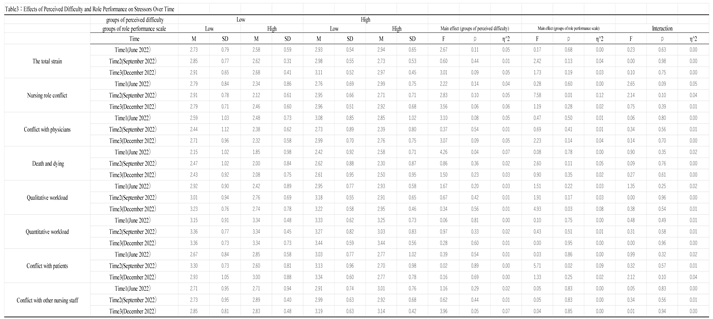
A two-way ANOVA was conducted to examine the effects of perceived difficulty (high or low) and role performance (high or low) on stressors over three time points (June, September, and December 2022). The subscales of the Nursing Job Stressor Scale were used as dependent variables.
In terms of total strain, a marginally significant main effect of perceived difficulty was observed in December (p = .09). Regarding nursing role conflict, interactions approached significance in both June and September (F = 2.65, p = .09, η² = 0.05; F = 2.14, p = .10, η² = 0.04). A simple main effects analysis revealed that in the high-difficulty group, participants with high role performance scores had significantly higher nursing role conflict scores than those with low role performance (p = .05).
For conflict with physicians, a marginally significant main effect of perceived difficulty was identified in June (F = 3.10, p = .08, η² = 0.05). In the domain of death and dying, the main effect of perceived difficulty was significant in June (F = 4.26, p = .04, η² = 0.07), indicating higher stressor scores in the high-difficulty group. Regarding qualitative workload, a significant main effect of role performance was identified in December (F = 4.93, p = .03, η² = 0.08), suggesting that participants with high role performance perceived less qualitative workload.
An interaction effect on conflict with patients approached significance in December (F = 2.12, p = .10, η² = 0.04). Simple main effects analysis showed that in the high-difficulty group, participants with high role performance scores had significantly higher conflict with patients scores than those with low role performance (p = .05).
3.4. Effects on Burnout by Perceived Difficulty and Role Performance Over Time (Table 4)
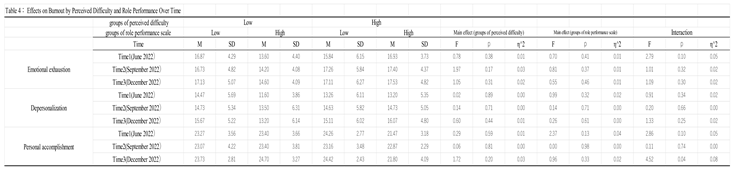
Burnout was analyzed based on three dimensions: emotional exhaustion, depersonalization, and personal accomplishment, according to levels of perceived difficulty and role performance over three time points (June, September, and December 2022). For emotional exhaustion, a significant interaction was identified at Time 1 (F = 2.79, p = .10, η² = .05). A simple main effects analysis revealed that among participants with low perceived difficulty, those with low role performance had significantly lower emotional exhaustion scores than those with high role performance (p = .05). No significant effects were identified for depersonalization. For personal accomplishment, significant interaction effects were observed at Time 1 (F = 2.86, p = .10, η² = .05) and Time 3 (F = 4.52, p = .04, η² = .08). At both time points, participants in the high-difficulty and high role-performance groups reported significantly lower declines in personal accomplishment compared to those with low role performance (p = .10 and p = .04, respectively).
3.5. Effects on Turnover Intention Over Time (Table 5)
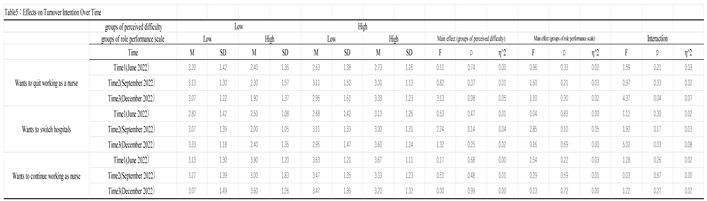
Finally, turnover intention was assessed based on three items: “I want to quit nursing,” “I want to transfer to another hospital or department,” and “I want to continue working as a nurse.” The relationships between these items and perceived difficulty and role performance were examined over three time points.
For the intention to quit nursing, no significant effects were observed at Time 1 or Time 2. However, at Time 3, a significant interaction was identified (F = 4.37, p = .04, η² = .07). In the low-difficulty group, participants with low role performance had significantly lower intention to quit nursing compared to those with high role performance (p = .04).
For the intention to transfer departments or hospitals, no significant effects were observed at Time 1 or Time 2. However, at Time 3, a significant interaction was identified (F = 5.02, p = .03, η² = .08). Again, in the low-difficulty group, participants with low role performance showed significantly lower intention to transfer than those with high role performance (p = .04). As for the positive intention to continue working as a nurse, no significant main effects or interactions were observed at any time point.
4. Discussion
This longitudinal study examined how role performance behaviors and perceived instructional difficulty among preceptors responsible for newly graduated nurses, in the context of changes to clinical practicum due to the COVID-19 pandemic, influenced their mental health. The study is significant in that it elucidates the impact of perceived instructional difficulty and role performance on stressors, burnout, and intention to resign among nurses who instruct newly graduated nurses.
With the spread of COVID-19, many nursing education institutions suspended or curtailed clinical practicums, opting instead for alternative methods such as online learning and simulations [2,3]. Consequently, newly graduated nurses assigned to clinical settings from 2022 onward were reported to have diminished practical competencies—such as clinical judgment and care skills gained through direct patient interaction—compared to those with conventional practicum experience [7]. This decline in practical skills likely increased the instructional burden on preceptors. In the present study, preceptors exhibited a high level of perceived instructional difficulty, particularly in tasks such as “understanding the preceptee’s condition while aiming to achieve instructional goals and prevent incidents” and “continuing instruction with the cooperation of ward nurses and patients.” These findings suggest that preceptors were required to engage in instruction involving elevated levels of risk management and situational judgment to compensate for the clinical immaturity of new graduates, resulting in increased instructional complexity and the need for extensive role performance. This structure reflects the burden placed on instructors to compensate for the curtailed practicum experiences caused by the pandemic.
Previous research has shown that such extensive role performance can be a risk factor for burnout and stress [16], and the current findings reinforce concerns that instructional burdens may manifest as psychological strain. In fact, the results indicated that perceived instructional difficulty and role performance affected several subscales of stressors, including “conflict with physicians,” “conflict with patients,” “nursing role conflict,” “death and dying,” and “qualitative workload.” Notably, those in the high-difficulty and high-performance group tended to score higher on interpersonal stressor subscales, suggesting that preceptors with high responsibility and competence may be more prone to conflicts in workplace relationships and patient interactions [17].
Furthermore, interaction effects between perceived difficulty and role performance were observed in the burnout dimensions of “emotional exhaustion” and “personal accomplishment.” Particularly, participants with both low perceived difficulty and low role performance exhibited lower emotional exhaustion and higher personal accomplishment. This indicates that when both perceived difficulty and role performance are elevated, efforts to fulfill instructional roles may, paradoxically, contribute to greater burnout, as instructors experience the challenges in providing guidance.
Regarding turnover intention, participants with low perceived difficulty and low role performance showed significantly lower levels of negative intentions such as “wanting to quit nursing” or “wanting to transfer to another ward.” This implies that a moderate level of challenge and engagement in instructional activities may positively influence continued occupational motivation [18]. Conversely, positive intentions such as “wanting to continue working as a nurse” were not significantly influenced by perceived difficulty or role performance. This suggests that such positive professional attitudes may be shaped more by individual values and long-term career perspectives than by daily stress or role evaluations [19].
In summary, the findings indicate the impact of instructional difficulty and elevated role performance on the mental health and turnover intention among preceptors responsible for newly graduated nurses who have reduced clinical preparedness due to changes in clinical practicums caused by the COVID-19 pandemic. The educational background of restricted clinical practice during the pandemic has diminished new nurses’ readiness for practice, thereby amplifying the burden on preceptors who strive to compensate for this gap. Going forward, it will be necessary to promote collaboration between basic nursing education and clinical practice settings, while also establishing systems that provide psychological support to instructors and promote shared educational responsibilities, such as through team-based instructional models.
5. Conclusions and Practical Implications
This study focused on the psychological impact of educational changes induced by restricted clinical practicums during the COVID-19 pandemic on nurses who instruct newly graduated nurses. It longitudinally examined the effects of perceived instructional difficulty and role performance on stressors, burnout, and turnover intention. The results revealed that nurses who reported high instructional difficulty and also demonstrated high role performance tended to experience greater stress and burnout, suggesting that the weight of clinical instructional responsibilities manifests as psychological strain. Additionally, turnover intention varied significantly depending on levels of perceived difficulty and role performance.
These findings suggest that the increased effort of clinical instructors to compensate for the diminished practical skills of newly graduated nurses may considerably impact their mental health. Thus, in bridging the gap between post-pandemic nursing education and clinical practice, it is essential to establish systems of psychological and educational support not only for new nurses but also for their preceptors. Specifically, multifaceted interventions such as implementing team-based instructional systems and providing mental health support, including cognitive behavioral therapy, are urgently required.
Author Contributions
Contributors T.O. was responsible for the organization and coordination of the trial. T.O. was the chief investigator and was responsible for the data analysis. T.O. and Y.O. contributed to the writing of the final manuscript. All members of the Study Team contributed to the management or administration of the study. All authors have read and agreed to the published version of the manuscript.
Funding
The author(s) disclosed receipt of the following financial support for the research, authorship, and/or publication of this article: This research was funded by JSPS Grant-in-Aid for Scientific Research (KAKENHI) (24K13590).
Institutional Review Board Statement
This study was conducted with approval from the Hyogo University Research Ethics Committee (Approval No. 21011). Written requests for participation were sent to facility administrators, who provided consent before the study proceeded. Participants received written explanations and participated only after providing informed consent.
Informed Consent Statement
Informed consent was obtained from all subjects involved in the study.
Data Availability Statement
The de-identified data underlying the results presented in this study are available upon request to the corresponding author.
Public Involvement Statement
No public involvement in any aspect of this research.
Guidelines and Standards Statement
Data are reported here according to the Strengthening the Reporting of Observational studies in Epidemiology (STROBE) statements to improve truthfulness and ensure clarity. “https://www.equator-network.org/reporting-guidelines/strobe/” (accessed on 28 August 2023).
Use of Artificial Intelligence
In preparing this paper, we used Google Translate for some English translations.
Conflicts of Interest
The authors declare no conflicts of interest.
Abbreviations
The following abbreviations are used in this manuscript:
| COVID-19 | Coronavirus Disease |
| WHO | World Health Organization |
| PHEIC | Public Health Emergency of International Concern |
| NJSS | Nursing Job Stressor Scale |
| MBI | Maslach Burnout Inventory |
References
- World Health Organization. Coronavirus disease (COVID-19) pandemic, 2025. Available online: https://www.who.int/emergencies/diseases/novel-coronavirus-2019.
- Sugawara, K.; Ueda, T.; Koike, A.; Okawa, A.; Hishinuma, N. Implementation status and future challenges of clinical practice under the COVID-19 situation: Results of a survey by the Public University Association Nursing and Health Division (Part 2). Bull Mie Prefectural Coll Nurs 2020. [Special Issue, 35–42]. [Google Scholar]
- Japan Association of Nursing Universities. Report on the Impact of COVID-19 on Nursing Practical Training in 2020 (Survey A and B), 2021. Available online: https://www.janpu.or.jp/wp/wp-content/uploads/2021/04/covid-19cyousaAB.pdf.
- Ministry of Education, Culture, Sports, Science, and Technology. Japan. Report of the Second Review Committee on Nursing Human Resource Development at Universities, 2019. Available online: https://www.mext.go.jp/b_menu/shingi/chousa/koutou/098/gaiyou/mext_00260.html.
- Kwon SJ, Kim Y, Kwak Y.Nursing students’ clinical practice education experience during the COVID-19 pandemic: a qualitative study. BMC Nurs. 2024;23:63. [CrossRef]
- Palese, A.; Brugnolli, A.; Achil, I.; Mattiussi, E.; Fabris, S.; Kajander-Unkuri, S.; Dimonte, V.; Grassetti, L.; Danielis, M. The first COVID-19 new graduate nurses generation: Findings from an Italian cross-sectional study. BMC Nurs 2022, 21, Article 101. [Google Scholar] [CrossRef] [PubMed]
- Ohue, T.; Ohue, Y.; Harada, H. Examining the long-term impact of COVID-19-induced clinical practice changes on problem-solving behaviors among newly graduated nurses: A longitudinal study. Sage Open Nurs 2025, 11, 23779608251323836. [Google Scholar] [CrossRef] [PubMed]
- Dewart, G.; Corcoran, L.; Thirsk, L.; Petrovic, K. Nursing education in a pandemic: Academic challenges in response to COVID-19. Nurse Educ Today 2020, 92, 104471. [Google Scholar] [CrossRef] [PubMed]
- Ohue, T.; Moriyama, M.; Nakaya, T. Examination of a cognitive model of stress, burnout, and intention to resign for Japanese nurses. Jpn J Nurs Sci 2011, 8, 76–86. [Google Scholar] [CrossRef] [PubMed]
- Jaber MJ, Bindahmsh AA, Baker OG, Alaqlan A, Almotairi SM, Elmohandis ZE, Qasem MN, AlTmaizy HM, du Preez SE, Alrafidi RA, Alshodukhi AM, Al Nami FN, Abuzir BM. Burnout combating strategies, triggers, implications, and self-coping mechanisms among nurses working in Saudi Arabia: a multicenter, mixed methods study. BMC Nurs. 2025;24:590. [CrossRef]
- Yoshitomi, M.; Funashima, N. Development of a self-evaluation scale for the preceptor role. J Jpn Soc Nurs Educ 2009, 18, 1–10. [Google Scholar] [CrossRef]
- Higashiguchi, K.; Morikawa, Y.; Miura, K.; Nishijo, M.; Tabata, M.; Nakagawa, H. Work stressors of clinical nursing professionals: Development of work stressor measure and examination of psychological assumption characteristics. Health Psychol Res 1998, 11, 64–72. [Google Scholar]
- Maslach, C.; Schaufeli, W.B.; Leiter, M.P. Job burnout. Annu Rev Psychol 2001, 52, 397–422. [Google Scholar] [CrossRef] [PubMed]
- Tao, M.; Kubo, M. Measurement of burnout. Psychol Rev 1992, 35, 361–376.auth-info. [Google Scholar]
- Tsuchie, J.; Nakamura, Y. The relationship between nurses’ job attitudes and their stress or burnout syndrome. J Jpn Soc Nurs Res 1993, 16, 9–19. [Google Scholar]
- Laschinger, H.K.S.; Fida, R. New nurses burnout and workplace wellbeing: The influence of authentic leadership and psychological capital. Burnout Res 2016, 3, 43–50. [Google Scholar] [CrossRef]
- Lavoie-Tremblay, M.; Wright, D.; Desforges, N.; Gélinas, C.; Marchionni, C.; Drevniok, U. Creating a healthy workplace for new-generation nurses. J Nurs Scholarsh 2008, 40, 290–297. [Google Scholar] [CrossRef] [PubMed]
- Price, J.L. Reflections on the determinants of voluntary turnover. Int J Manpow 2001, 22, 600–624. [Google Scholar] [CrossRef]
- Takase, M. A concept analysis of turnover intention: Implications for nursing management. Collegian 2010, 17, 3–12. [Google Scholar] [CrossRef] [PubMed]
Disclaimer/Publisher’s Note: The statements, opinions and data contained in all publications are solely those of the individual author(s) and contributor(s) and not of MDPI and/or the editor(s). MDPI and/or the editor(s) disclaim responsibility for any injury to people or property resulting from any ideas, methods, instructions or products referred to in the content. |
© 2025 by the authors. Licensee MDPI, Basel, Switzerland. This article is an open access article distributed under the terms and conditions of the Creative Commons Attribution (CC BY) license (http://creativecommons.org/licenses/by/4.0/).
Copyright: This open access article is published under a Creative Commons CC BY 4.0 license, which permit the free download, distribution, and reuse, provided that the author and preprint are cited in any reuse.


