

Submitted:
12 September 2025
Posted:
12 September 2025
You are already at the latest version
Abstract
This paper is devoted to the sustainable management problem of a multipolar world. The description of a multipolar world as a global organizational system is given. For the first time in the literature, all elements of the global organizational system mathematical model are specified in terms of a multipolar world order where civilizations act as agents. The peculiarities of viability conditions for such a global socio-ecological-economic system are indicated. The solvability conditions of the sustainable management problem under multipolarity are identified.
Keywords:
game theory
; global organizational system
; mathematical modeling
; multipolar world
; sustainable management
1. Introduction
As is well known, diversity is the key to sustainability. At the global level, a multipolar world is a natural condition for sustainable development.
Since the mid-17th century (after the Thirty Years’ War in Europe), international relations were determined by the interaction of sovereign nation-states (the Westphalian system). After World War II, a bipolar world order was established (the Yalta system), where the poles were the USA at the head of the North Atlantic Treaty Organization (NATO) and the USSR at the head of the Warsaw Pact Organization (WPO). Finally, after the collapse of the USSR in 1991, the world became unipolar, with the USA and its allies seizing sole leadership. In his famous book [1], Francis Fukuyama fixed that situation as “the end of history.” It was assumed that the unipolar world order would be preserved forever, and over time would probably lead to the collapse of nation-states and the formation of a world government with liberal-democratic norms and rules, a capitalist market economy, and societal atomization for all peoples.
However, Fukuyama’s conclusions were premature. As early as 1996, in the equally famous book [2], Samuel Huntington predicted the formation of a multipolar world where civilizations rather than nation-states would be the main actors. The idea was further developed in several works [3,4,5]. A significant contribution to the theory of a multipolar world was made by Alexander Dugin [6], who conducted a geopolitical analysis of the problem and outlined ways of its conceptualization. As is now evident, the USA has failed to retain unilateral global leadership, though the exact timeline for the formation of a multipolar world remains unclear. Nevertheless, the rapid economic growth of China, India, and other Asian countries, the formation of BRICS, the Shanghai Cooperation Organization (SCO), and other associations of Southern and Eastern states, events in Ukraine and the Middle East, and numerous internal problems of the USA and the European Union clearly indicate the emergence and steady dynamics of the multipolarity trend.
The most important task of a multipolar world is to ensure its sustainable development. According to a well-known definition, sustainable development is understood as “a development that meets the needs of the present without compromising the ability of future generations to meet their own needs” [7]. This definition expands on the concept of “three pillars,” distinguishing three groups of mandatory viability conditions underlying sustainable development: social, economic, and environmental.
Numerous publications have been devoted to the theory of sustainable development (sustainability science) in recent decades; for example, see [8,9,10,11]. Criticism of this theory and alternative concepts were presented in [12]. The key viability conditions for sustainable development were mathematically formalized in the monograph [13] and subsequent papers [14,15,16].
However, this conventional approach fails to address the crucial questions: Who is responsible for fulfilling sustainable development requirements? What motivates the responsible party(ies)? Meanwhile, decades of experience show that without a genuinely motivated control authority, any sustainable development strategies remain mere declarations unrealized in practice. Therefore, according to the author’s original concept of sustainable management [17,18,19], besides the demand to satisfy the viability conditions, it is necessary to consider and coordinate the interests of active agents of sustainable development. Only the joint fulfillment of system viability conditions and agents‘ motivation ensures sustainable development.
Consideration of interests and motivation links the theory of sustainable management with contract theory and mechanism design [20,21,22], the theory of active systems, and organizational systems management (the theory of control in organizations) [23,24].
This paper has two objectives. First, we formalize a multipolar world within the mathematical model of an organizational system [25] at the global level (a global organizational system). Second, we refine the sustainable management problem for a multipolar global organizational system and discuss prospects for solving this problem. Thus, the contribution of this paper and its novelty are the following:
- − The concept of a multipolar world as a global organizational system is pioneered and specified in mathematical model terms.
- − The sustainable management problem is refined for a multipolar world.
- − For this problem, solvability conditions are identified, and prospects for its solution are revealed.
2. A Formal Model of a Multipolar Global Organizational System
The model of an organizational system in the form
was proposed in [25]. Let us specify this model for a multipolar world as a global organizational system (GOS). For this purpose, we sequentially describe all elements of the tuple (1).
is the set of active agents forming the composition (staff) of the GOS control subsystem. Several points should be emphasized here.
First, the role of agents in a multipolar GOS is played by civilizations [2,6]. This means that each agent has a complex internal structure, which cannot be reduced, e.g., to a single state. A possible three-level structure of an agent was described in [6]. The top level is a center of strategic decision-making (Principal) in the field of defense, transportation, energy, interaction with other agents, etc. It can be a leading state within a given civilization (the USA, Russia, China, India) or some special body (the European Parliament). The second level consists of the so-called “great spaces” (Carl Schmitt’s term “Grossraum”), which unite several states (e.g., Western or Eastern Europe). Finally, the third level is formed by numerous and very diverse territorial communities and social groups, up to individual tribes of archaic type. Therefore, when describing the GOS functioning, agents can be identified with the Principals representing them, but the internal structure of an agent should be kept in mind, as it influences goal-setting and decision-making.
Second, all agents of a multipolar world are fundamentally equal and sovereign. However, this does not imply the absence of centralized control agents separated in the general model [25]. Equal civilizations may find it reasonable to create some coordinating body (an analog of the modern United Nations), whose decisions will be binding, to a certain extent, for all agents.
Third, it is hardly possible to specify right now the exact set of agents in a multipolar GOS. The only thing that can be said for sure is that there should be at least three agents, which follows from the concept of “multipolarity.” Neither the current unipolar nor the previous bipolar world fit this definition. In all likelihood, four to ten agents will emerge. An alternative is to name the almost formed civilizations, also mentioned in [2] and confirmed in [6]:
- -
- Western European (now led by the USA);
- -
- Russian;
- -
- Chinese;
- -
- Indian;
- -
- Islamic;
- -
- Japanese,
and the emerging ones:
- -
- Latin American;
- -
- African
(possibly, Buddhist as well).
As a matter of fact, there are various alternatives of world structuring, and it seems reasonable to analyze them via scenario simulation. Apparently, the real picture will become totally clear after several decades.
is the set of different-type links between active agents, . A digraph defines the structure of GOS links, which are determined by subordination relations as well as by the flows of substances, energy, and information. More precisely, we should speak of a multi-digraph, as each flow type is associated with a particular graph. A different approach is to construct separate structural digraphs (different models) to describe different-quality flows. In the general case, each arc is assigned a weight and each vertex a value, which characterize the interaction structure of agents in quantitative terms.
Subordination relations arise only when the internal structure of a certain agent is described in detail since agents are equal in their mutual relations. Therefore, the main part of the arc set is formed by the flows of substances, energy, and information between agents. These include:
- natural flows (transboundary rivers, atmospheric transfer of substances, animal migration);
- transportation of oil, gas, and other minerals and raw materials, power supply;
- trade flows (supply chains of goods);
- technology transfer;
- investment (financial flows);
- migration flows, which are extremely significant in the modern economy and social life;
- cultural interaction in various forms (exchange of works of art and literature, information impact, educational programs, etc.).
is the state set of the GOS controlled subsystem. It includes indicators determining the state and functioning of the global socio-ecological-economic system. Here are some indicators by the corresponding groups as an example.
Social: birth rate, mortality rate, natural increase rate, life expectancy, morbidity rate (the incidence rate of disease), Gini coefficient, the proportion of low-income population (with wages below the subsistence level), mean and median wages, unemployment rate, crime rate, the ratio of average per capita monetary income of the population to the subsistence level, population aging ratio, Human Development Index (HDI), alcohol and drug consumption rates, suicide rate, etc.
Economic: Gross Domestic Product (GDP, total and per capita), the depreciation of fixed assets, the volume of investment in fixed assets, the share of machine building and manufacturing in the industrial sector, the profitability of production and assets, labor productivity, inflation rate, the share of loss-making enterprises, the share of material production in GDP, monetization level (M2 aggregate), international reserve adequacy ratio, the volume of total external debt, the share of imported equipment in domestic demand, the share of imported food in the consumption structure, the share of exports in material production, the share of foreign capital in investments, the volume of foreign liabilities of commercial banks and other sectors, the share of overdue and non-performing foreign loans, the share of foreign investors in the ownership structure, the share of foreign currency loans in M2, trade balance deficit, the volume of foreign currency relative to national currency, the share of government debt service expenditures, the share of innovation-active enterprises, the share of new product types in the total volume of machine building, the share of intellectual property in business value, etc.
Environmental: the share of government environmental protection expenditures in GDP, specific energy consumption indicators, mineral loss during extraction, the volumes of pollutant emissions, the concentration levels of pollutants in soil and atmosphere, biodiversity characteristics, the area of erosion-prone land, etc.
Clearly, the dimension of the state vector of a global socio-ecological-economic system can reach many thousands of elements. Therefore, one has to consider the most significant elements depending on the objectives of a particular study.
, where is the information about the GOS available to agent i. This information contains the agent’s data regarding the actions of other agents and their payoff functions, as well as the state of the controlled subsystem. The structure of information sets will be specified below when describing the strategies of agents.
, where is the set of feasible actions of agent i. It includes all political and economic decisions made at the top level of the agent-civilization after multilevel coordination within the internal structure of the agent.
, where Si is the set of feasible strategies of agent i.
A feasible strategy is a mapping that determines the choice of a feasible action by agent i depending on his/her available information. It is reasonable to distinguish the following main classes of strategies.
Open-loop strategies . In this case, the strategy is a function that depends only on time. In other words, the agent chooses an action for the entire horizon under consideration, without changes under any circumstances. An example is legislation.
Closed-loop strategies. Here, the strategy is a function that depends both on time and the state of the controlled system. This type of function provides feedback and the possibility of adaptation, i.e., control correction depending on the current situation. For example, an agent can adjust its mining strategy depending on the explored reserves.
Strategies with control feedback . In this case, the strategy becomes a function that depends both on time and the actions of other agents. For example, an agent can set customs duties depending on the actions of its trading counterparties.
Of course, more complex (compound) strategies are also possible in practice, including various types of feedback, the dependence on state history, etc.
is a rule of changing the controlled subsystem states given the strategies of active agents. It can be a system of algebraic, differential, or difference equations, or an algorithm explicitly determining transitions between the states of this subsystem. The rule can be treated as a generalized operator acting in the state space. The most common example is nonlinear functions on the right-hand side of a system of differential equations that describe the state dynamics of the controlled subsystem.
is the set of payoff functionals of active agents. A mappingℝ defines the payoff of agent i depending on the actions of all agents and the current state of the controlled subsystem.
In particular, it seems reasonable to define the agent’s payoff functional by utilizing the idea of competition-cooperation (coopetition). The concept of coopetition was proposed by Brandenburger and Nalebuff [26]. Its core is that almost all economic interactions contain both elements of competition and cooperation. For example, two firms may compete for their customers but join their efforts in marketing or R&D. Moreover, temporary price cartels may be advantageous for all participants. Firms can share the accounts of their customers. A striking example is the space cooperation between the USA and Russia. In general, coopetition is well combined with modern ESG (Environmental, Social, Governance) trends. No doubt, the concept of coopetition well fits a multipolar world, where civilizations compete for definite resources but, at the same time, cooperate when dealing with global economic, environmental, and other challenges.
A connection between coopetition and game theory was established by Okura and Carfi [27]. Carfi and his colleagues have published many papers on the game-theoretic models of coopetition, e.g., on coopetitive games for the sustainability of global feeding and climate change [28]. Strategies of coopetition were also analyzed in [29,30]. The author’s original approach to coopetition modeling was presented in [31].
Note that model (1), as well as game theory in general, is based on the so-called postulate of economic rationality, dating back to Adam Smith. According to this postulate, the interests of each agent are completely described by the desire to maximize his/her payoff, and other related considerations are neglected.
However, economic rationality is by no means exclusive. Besides economic rationality (goal-rationality), prominent sociologist Max Weber identified three other types, namely, value-rationality, traditional rationality, and affective rationality [32]. Value-rationality and traditional rationality play a special role in a multipolar world, where civilizations act as agents. Almost all civilizations, except for Western European, do not consider the maximization of some material gain as the main goal, being oriented to other spiritual values and cultural traditions.
The problem is that the mathematical formalization of other rationality types than economic rationality has been underinvestigated and causes essential conceptual and technical difficulties. One can endeavor, e.g., to minimize an objective functional representing the difference between the current value of some indicator and its normative (ideal) value reflecting traditional values. However, the issues of quantitative measurement of weakly formalizable qualitative indicators arise inevitably, and this problem requires serious study.
is an order of functioning of the GOS, which algorithmically determines the sequence of choosing strategies by active agents, the possible transmission of information to other agents, and changes in the state of the controlled subsystem. Examples of such orders can be found in [25].
In a more general stochastic formulation, model (1) also includes the beliefs of agents regarding uncertainty of various types: in reality, agents do not necessarily know the exactvalues characterizing the actions of other agents, their interests, and the state of the controlled subsystem.
Then the agent’s strategy becomes a mapping , where an additional model parameter characterizes the uncertainty of the current situation. In the special case , it is assumed that the agent has accurate information about the situation. Accordingly, the agent’s payoff functional also depends on , and the payoff is calculated using the mathematical expectation over the set .
In general, the following attributes of an organizational system can be distinguished [25].
1. The activeness of agents. Each agent has an individual payoff functional and independently chooses a feasible strategy . Within the model, the optimization of the payoff functional completely determines the agent’s interests and preferences. In particular, agents may deliberately distort the information transmitted to other agents in their own interests (the so-called manipulation problem of decision procedures). Other manifestations of activeness include the far-sighted behavior of agents and their reflexion regarding their activity and the activity of other agents.
2. Goal-setting. A GOS has a certain goal; in the general case, this goal/constraint consists at least in fulfilling the viability condition of the GOS:
In other words, the values of all its essential indicators must belong to a given range. This problem statement will be specified for a GOS in the next section.
3. Organization. A GOS (an extended active system) is formed by a control subsystem consisting of active agents and a controlled subsystem. The controlled subsystem does not contain active agents: it includes technical, economic, environmental, and other components controlled by active agents. The interaction between active agents is established by an order of functioning and determines the dynamics of the controlled subsystem (the change of its state over time by a rule) and the payoffs of agents.
Taken together, these attributes are necessary and sufficient for a system to be called organizational. Obviously, due to the nature of civilizations (in particular, their sovereignty and the presence of stable systems of values and other cultural institutions), they are inherent in a multipolar world. Therefore, a multipolar world can be considered a global organizational system.
3. The Sustainable Management Problem in a Multipolar Global Organizational System
According to the author’s theory [17,18,19], sustainable development is described by the formula
where , , and denote sustainability, viability, and motivation, respectively.
Thus, sustainable development requires the fulfillment of two groups of conditions, viz., viability and motivation. Viability conditions express the key requirements for the system state that determine the content of its sustainable development. For example, the annual growth rate of an economy must not be smaller than a given threshold; the unemployment rate and the concentration of pollutants in the environment must not exceed admissible levels. Such requirements must be fulfilled for all components of the system’s state vector on a corresponding horizon (for sustainable development, a better choice is an infinite horizon), which is formalized as Lyapunov stability. In a more stringent formulation, all values of relevant indices must tend in the limit to some ideal values, which is defined as asymptotic Lyapunov stability.
However, the real fulfillment of these conditions is achievable only under the motivation of all active agents associated with and affecting the system. In mathematical formalization, this is interpreted as the solution of a game of active agents associated with the system. The point is that the interests of agents do not coincide, although being usually not strictly antagonistic. Therefore, the solution of the game reflects some compromise, to a certain extent satisfying the interests of all agents and their understanding that it is impossible to achieve more in conflict interaction, even with elements of cooperation.
As applied to a multipolar global organizational system, the sustainable management problem is specified as follows.
The state vector of a global socio-ecological-economic system has the form
where the component corresponds to agent i. This is a subvector of the state vector in the zone of responsibility of agent i. Accordingly, viability conditions are formulated for each agent separately:
Here, each agent defines the viability domains independently, since they reflect specific perceptions of a given civilization and cannot be universal. Then the viability of a multipolar system consists of the fulfillment of the viability conditions for all its constituent agents:
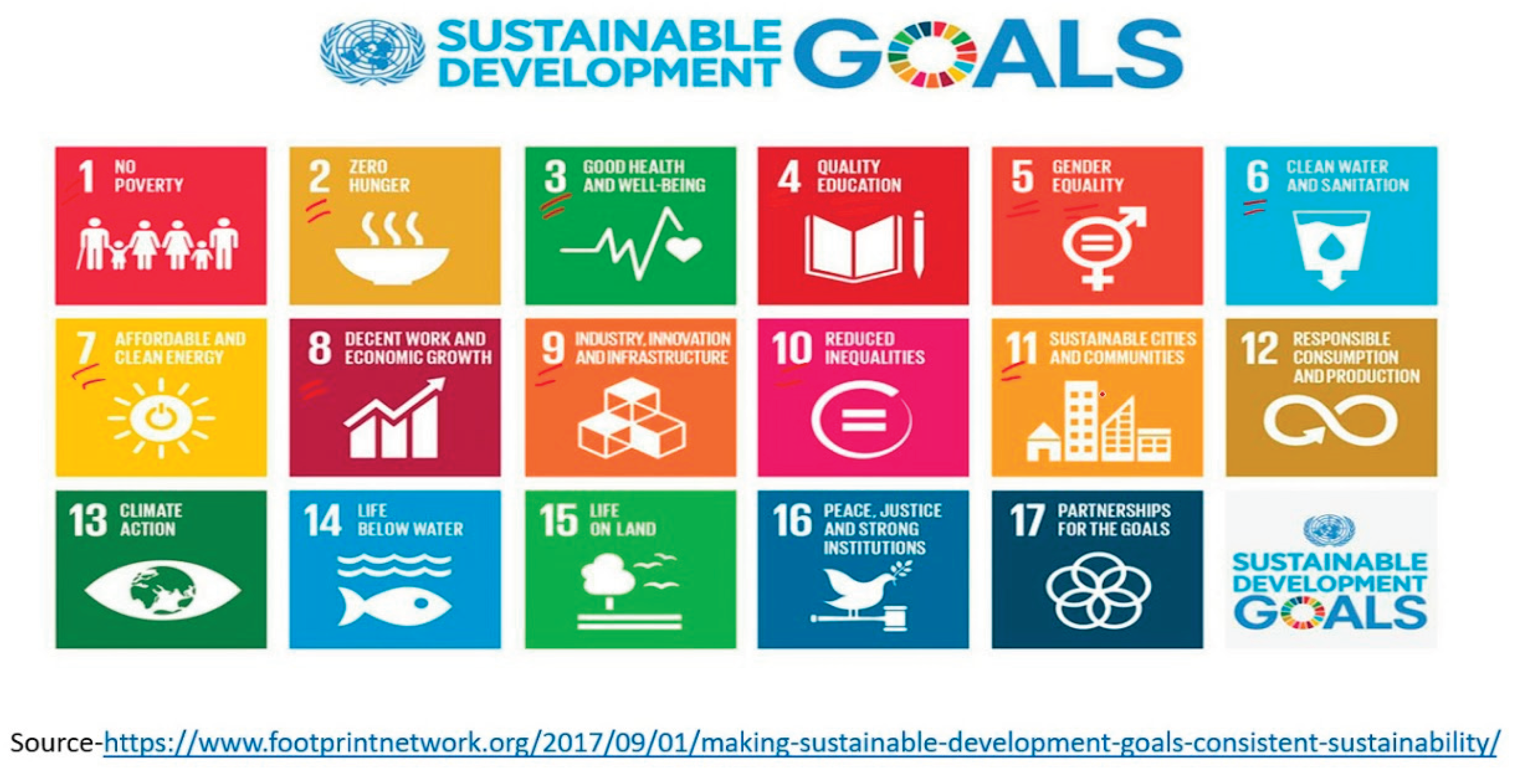
Determining the viability domains of agents is a complex expert task requiring multilevel coordination within each pole. Let us emphasize again that this approach differs from the UN Sustainable Development Goals (Figure 1). For example, gender equality (Goal 5) may not meet the traditional values of some civilizations, etc.
Further, the fulfillment of the motivation condition can be understood as finding a Nash equilibrium in the game of agents:
Here, is the action of agent i; is the current payoff function of agent i; is a nonlinear dynamics function realizing the change rule ; is initial conditions; finally, is a discount factor. Note that the payoff functional of agent i depends on the actions of all agents and the single component of the state vector corresponding to this agent.
Nash equilibrium is a conventional solution of the normal-form differential game (7)–(9). Recall that anaction profile is a Nash equilibrium in this game if [33]
where . In other words, in a Nash equilibrium, no agent benefits by unilaterally deviating from his/her equilibrium action: a Nash equilibrium is said to be stable with respect to individual deviations. Of course, this is not the only possible optimality principle behind the solution of game (7)–(9), but it is the most widespread and natural enough.
The motivation condition can be assigned even a more stringent formalization. For example, one may require that the game solution be not only a Nash equilibrium but also a Pareto optimal action profile [33]. This means that
Thus, if the game solution is Pareto optimal, then the payoff of some agent can be increased only at the expense of reducing the payoff of another agent. That is, a Pareto optimal action profile maximizes the payoff of the entire set of agents (social welfare).
One can go further by requiring that the game solution be a strong equilibrium. This means that it is nonbeneficial to deviate from strongly equilibrium actions not only for individual agents but also for arbitrary coalitions (subsets of agents), particularly for the entire set of agents [33]. Thus, the concept of strong equilibrium generalizes both Nash equilibrium (nonbeneficial deviations for individual agents) and Pareto optimality (nonbeneficial deviations for the grand coalition of agents). In the case of a two-player game, we have ; under multipolarity, there are more than two agents, so .
Naturally, this approach has both advantages and disadvantages. The former are due to the absence of a universal optimality principle in game theory. Therefore, a solution satisfying several optimality principles simultaneously is more credible because it reflects various complementary aspects of forming reasonable compromises. As for the disadvantages, it is much more difficult to find such solutions, and not all games have solutions that are Pareto-optimal Nash equilibria, and even less have strong equilibria. Accordingly, the solution of the sustainable management problem becomes even more complicated in a more stringent formalization.
In view of the above, we assume that the sustainable management problem of a multipolar GOS is solvable if
Here, is the set of agent’s actions ensuring the viability conditions (6), and is the set of actions corresponding to some optimality principle, say,, etc.
We emphasize that and are completely different, generally unrelated sets. Agents’ actions falling into the first set ensure viability and those falling into the second set ensure motivation .
Of course, (12) is only a necessary condition for sustainable development. It is not obvious that independent agents-civilizations will choose their actions from the set and not just from the set ensuing the coordination of their interests.
Therefore, there are two ways to solve the sustainable management problem. The first is the social and environmental responsibility of civilizations: they should voluntarily and consciously choose their actions from the set . The second is the creation of a coordinating body (see the discussion above) to which all agents will delegate powers for fulfilling this condition through some centralized impact.
4. Conclusions
The most important characteristic of the modern world is the collapse of the unipolar dominance of the USA and the transition to a multipolar world order. It is crucial to identify conditions for the sustainable development of a multipolar world system. This paper has presented a mathematical formalization of a multipolar world as a global organizational system based on the model [25] and analysis of the sustainable management problem [17,18,19] for such a system.
According to Albert Einstein, a general theory is always simpler than applications. Therefore, an attempt to apply model (1) to reality, in one or another interpretation, is an extremely difficult challenge. In particular, it is impossible to give an illustrative example, as it will inevitably turn out to be either over-simplified or immensely complicated. For this reason, the paper is more of a research program that sets the stage for further detailed study of this challenge. Nevertheless, the solution of such problems seems to be very useful for scientific analysis of the transition to a multipolar world and ensuring its sustainable development. The tragic alternative here could be a third world war with the use of nuclear weapons, which would inevitably lead to a fatal outcome.
The sustainable development of a diverse multipolar world is quite possible, although it requires substantial efforts. Will the unified Humanity ever become a subject of sustainable development?This question is currently open.
Funding
This research is financially supported by the Russian Science Foundation, project #25-11-00094, in Southern Federal University.
Data Availability Statement
Not applicable.
Conflicts of Interest
The author declares no conflict of interest.
References
- Fukuyama, F. The End of History and the Last Man; Free Press: New York, 1992. [Google Scholar]
- Huntington, S. The Clash of Civilizations and the Remaking of World Order; Simon and Schuster: New York, 1996. [Google Scholar]
- Ambrosio, Th. Challenging America’s Global Preeminence: Russia’s Quest for Multipolarity; Anthony Rose: Wiltshire, UK, 2005. [Google Scholar]
- Multipolarity in the 21st Century. A New World Order; Murray, D., Brown, D., Eds.; Routledge: Abingdon, UK, 2010. [Google Scholar]
- Turner, S. Russia, China and the multipolar world order: the danger in the undefined. Asian Perspective 2009, 33, 159–184. [Google Scholar] [CrossRef]
- Dugin, A. The Theory of a Multipolar World;Arktos, London, 2021.
- Our Common Future. World Commission on Environment and Development (WСED); Oxford University Press: Oxford, 1987. [Google Scholar]
- Adams, W.M.; Jeanrenaud, S.J. Transition to Sustainability: Towards a Humane and Diverse World; Gland: International Union for Conservation of Nature and Natural Resources, 2008. [Google Scholar]
- Clark, W.C. Sustainability science: a room of its own. Proceedings of the National Academy of Sciences, 2007, 114, 1737–1738. [Google Scholar] [CrossRef] [PubMed]
- Clark, W.C.; Dickson, N.M. Sustainability science: the emerging research program. Proceedings of the National Academy of Sciences, 2003, 100, 8059–8061. [Google Scholar] [CrossRef] [PubMed]
- Kates, R.W.; Clark, W.C.; et al. Sustainability science. Science, 2001, 292, 641–642. [Google Scholar] [CrossRef] [PubMed]
- Zaccai, E. Over two decades in pursuit of sustainable development: Influence, transformations, limits. Environ. Dev., 2012, 1, 79–90. [Google Scholar] [CrossRef]
- Aubin, J.-P. Viability Theory; SpringerVerlag: New York, 2009. [Google Scholar]
- Cairns, R.D.; Long, N.V. Maximin: a direct approach to sustainability. Env. Dev. Econ. 2006, 11, 275–300. [Google Scholar] [CrossRef]
- Doyen, L.; Martinet,V. Maximin, viability and sustainability. J. Econ. Dyn. Control, 2012, 36, 1414–1430. [Google Scholar] [CrossRef]
- Martinet, V.; Doyen, L. Sustainability of an economy with an exhaustible resource: a viable control approach. Resour. Energy Econ. 2007, 29, 17–39. [Google Scholar] [CrossRef]
- Ougolnitsky, G. Sustainable Management; Nova Science Publishers: New York, 2011. [Google Scholar]
- Ougolnitsky, G. Game theoretic formalization of the concept of sustainable development in the hierarchical control systems. Annals of Operations Research 2014, 220, 69–86. [Google Scholar] [CrossRef]
- Ougolnitsky, G.A. Sustainable management as a key to sustainable development. In Sustainable Development: Processes, Challenges and Prospects; Reyes, D., Ed.; Nova Science Publishers: New York, 2015; pp. 87–128. [Google Scholar]
- Laffont, J.-J.; Martimort, D. The Theory of Incentives. The Principal-Agent Model; Princeton University Press: Princeton, NJ, 2002. [Google Scholar]
- Myerson, R. Optimal coordination mechanisms in generalized principal-agent models. J. Math. Econ., 1982, 10, 67–81. [Google Scholar] [CrossRef]
- Myerson, R. Mechanism design by an informed principal. Econometrica, 1983, 51, 1767–1798. [Google Scholar] [CrossRef]
- Mechanism Design and Management: Mathematical Methods for Smart Organizations. Novikov, D. (Ed.); Nova Science Publishers: New York, 2013. [Google Scholar]
- Novikov, D. Theory of Control in Organizations; Nova Science Publishers: New York, 2013. [Google Scholar]
- Ougolnitsky, G.A. The essence, attributes, and description principle of organizational systems. Control Sciences, 2025, 3, 32–40. [Google Scholar]
- Brandenburger, A.M.; Nalebuff, B.J. Coopetition; Currency Doubleday: New York, 1996. [Google Scholar]
- Okura, M.; Carfi, D. Coopetition and game theory. J. Appl. Econ. Sci., 2014, 9, 458–469. [Google Scholar]
- Carfì, D.; Donato, A. Coopetitive games for sustainability of global feeding and climate change: Recent developments. J. Environ. Manag. Tour, 2018, 9, 200–215. [Google Scholar] [CrossRef]
- Cygler, J.; Sroka, W.; Solesvik, M.; Dębkowska, K. Benefits and drawbacks of coopetition: the roles of scope and durability in coopetitive relationships. Sustainability, 2018, 10, 2688. [Google Scholar] [CrossRef]
- Sharma, M.G.; Singh, K.N. Servitization, coopetition, and sustainability: An operations perspective in aviation industry. VIKALPA J. Decis. Mak., 2017, 42, 145–152. [Google Scholar] [CrossRef]
- Ougolnitsky, G.; Korolev, A. Game-theoretic models of coopetition in Cournot oligopoly. Stats 2023, 6, 576–595. [Google Scholar] [CrossRef]
- Weber, M. Economy and Society: A New Translation; Harvard University Press: Cambridge, MA, 2019. [Google Scholar]
- Dixit, A.K.; Skeath, S.; Reiley, D.H.Jr. Games of Strategy; W.W. Norton & Company: New York, 2015. [Google Scholar]
Figure 1.
UN Sustainable Development Goals.
Disclaimer/Publisher’s Note: The statements, opinions and data contained in all publications are solely those of the individual author(s) and contributor(s) and not of MDPI and/or the editor(s). MDPI and/or the editor(s) disclaim responsibility for any injury to people or property resulting from any ideas, methods, instructions or products referred to in the content. |
© 2025 by the authors. Licensee MDPI, Basel, Switzerland. This article is an open access article distributed under the terms and conditions of the Creative Commons Attribution (CC BY) license (http://creativecommons.org/licenses/by/4.0/).
Copyright: This open access article is published under a Creative Commons CC BY 4.0 license, which permit the free download, distribution, and reuse, provided that the author and preprint are cited in any reuse.


