1. Introduction
The cosmological constant problem is one of the deepest puzzles in modern physics. Naive estimates of vacuum zero-point energy exceed the observed cosmic density by more than forty orders of magnitude [
12,
28]. Despite decades of attempts—ranging from modified gravity to dynamical dark energy models [
11,
15,
24] the problem remains unresolved, and the physical origin of the small but nonzero vacuum density is unknown.
High-precision cosmological observations, including CMB measurements by Planck [
18], the Pantheon+ supernova sample [
23], and direct chronometer determinations of
[
9,
10], have sharpened this tension. On galactic scales, rotation curves and the radial acceleration relation reveal persistent mismatches between baryonic matter and observed dynamics [
8,
21,
25]. Together, these findings indicate that resolving the cosmological constant problem requires a deeper understanding of the vacuum across both cosmological and galactic contexts. Despite decades of efforts—including modified gravity, dynamical dark energy, and emergent models—this puzzle remains unresolved [
1,
11,
24].
In earlier work [
2,
3,
4], we introduced a phase-dependent model in which the vacuum spectrum is naturally bounded by two physical mechanisms: confinement at the QCD scale and thermal suppression near a critical temperature. Here, we build on that foundation to present the Quantum Energy Vacuum (QEV) model, which integrates these ideas into a unified framework for both cosmology and galactic dynamics.
2. The Quantum Energy Vacuum Model
Spectral window.
We consider a smooth window
that suppresses modes for
and
, where
(with
K) and
represents the QCD confinement scale. The effective vacuum density is
As shown in our earlier work [
4], the detailed derivation of the suppression mechanism and its embedding in a phase-dependent expansion framework shows that natural cutoffs strongly reduce the vacuum density. For the present paper we summarize the essential results in compact form.
For a smooth spectral window of the form
the vacuum energy density is given by
with
For
the truncation error is negligible (of order
).
Compared to a top-hat integral extending up to the QCD scale
, the suppression factor becomes
which for
and
corresponds to
–
, consistent with the full derivation in [
4]. A classic introduction to the physical meaning of vacuum fluctuations is given by Milonni [
6].
Four effective contributions.
In QEV, cosmic and galactic dynamics arise from four contributions: (i) Newtonian gravity, (ii) an entropic term tied to expansion, (iii) a thermal term that attenuates below , and (iv) a hadronic term driven by residual fluctuations within the bounded spectrum. Together, these components reproduce both late-time cosmic acceleration and the observed form of galactic rotation curves.
3. Cosmological Results
3.1. Background Expansion:
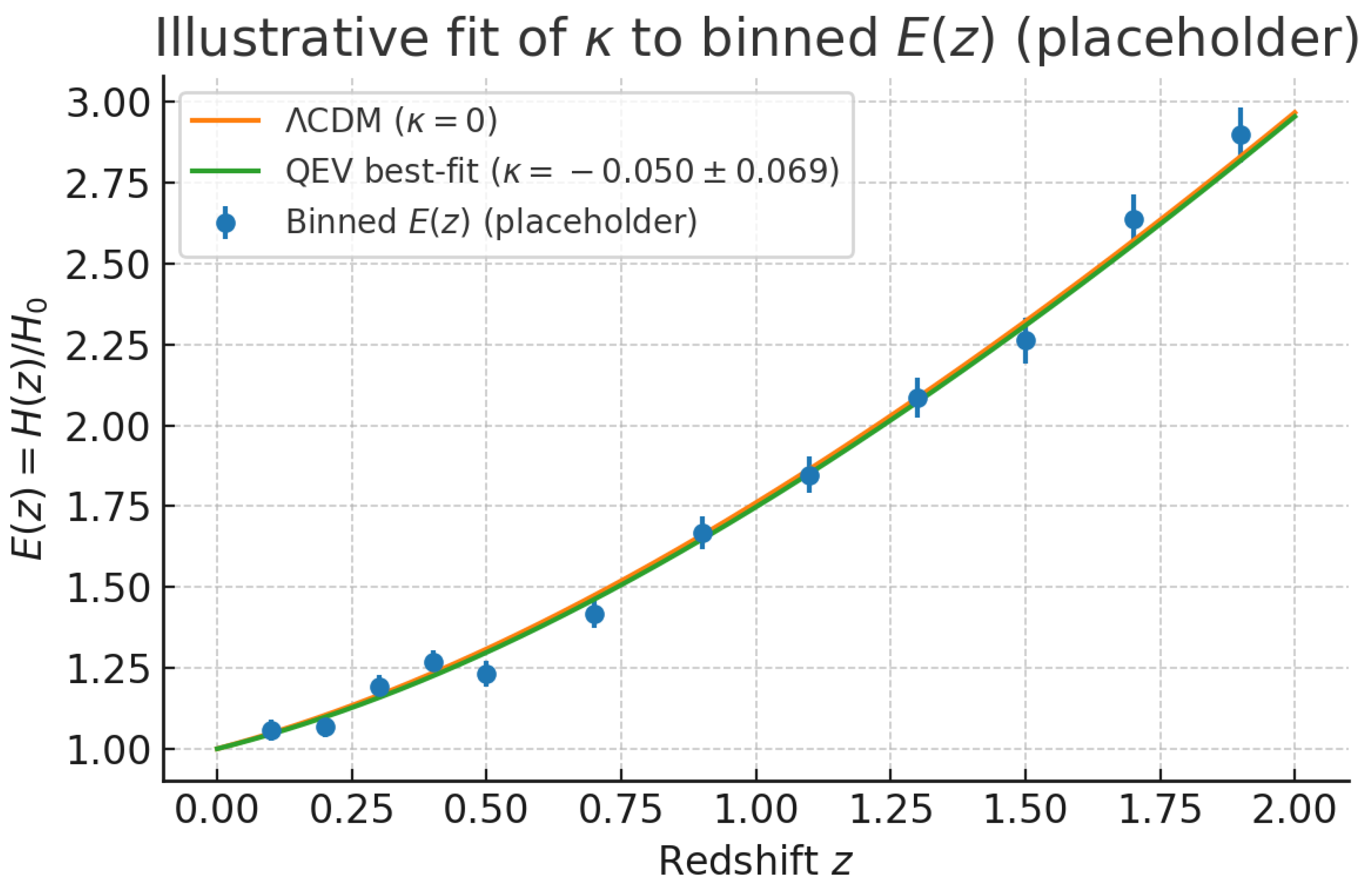
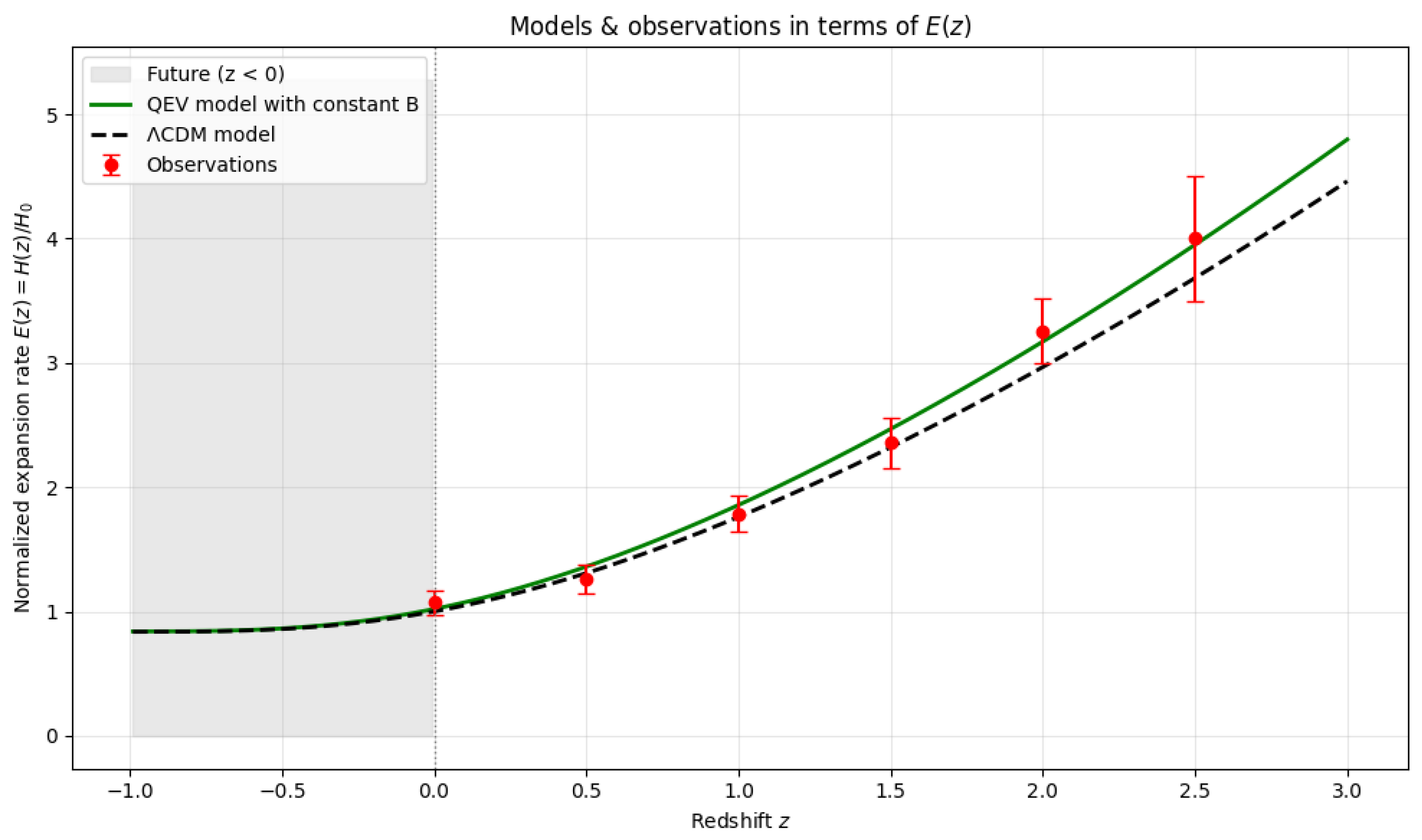
Figure 1 compares the normalized expansion rate
predicted by QEV with observational points commonly used in background tests. The QEV curve tracks the observed trend comparably to standard models while allowing small redshift-dependent deviations driven by the spectral window.
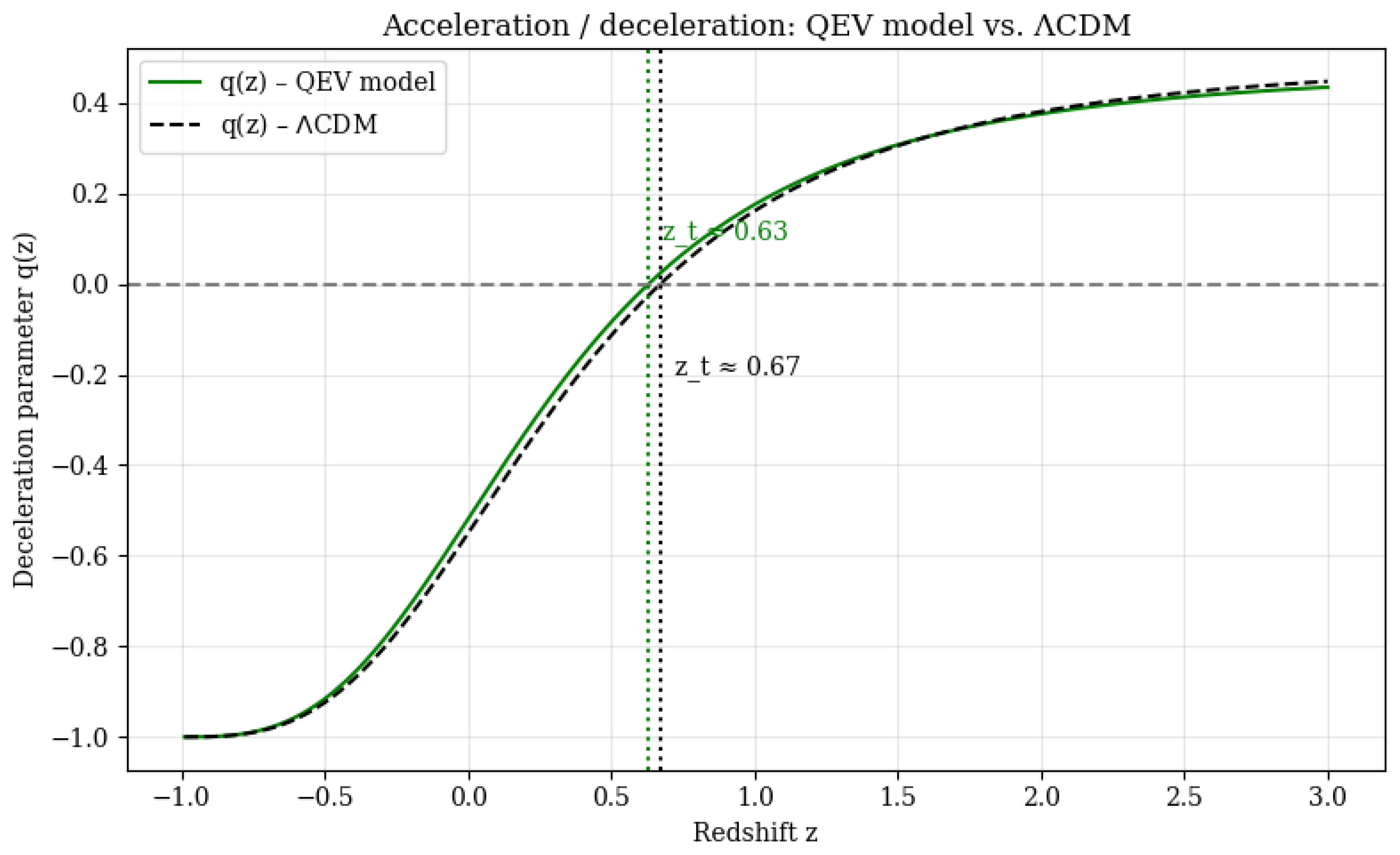
3.2. Deceleration Parameter:
The effective equation of state implied by the bounded spectrum yields
with small departures. Correspondingly, the deceleration parameter
transitions from deceleration to acceleration in a manner consistent with late-time data (
Figure 2).
Table 1.
Cosmological and QEV model parameters used in
Figure 1.
Table 1.
Cosmological and QEV model parameters used in
Figure 1.
| Symbol |
Description |
Value |
Units / Notes |
|
Hubble constant today |
70.0 |
|
| S |
Scale correction (normalization) |
1.02 |
dimensionless |
|
Spectral exponent |
3.1 |
dimensionless |
|
Transition exponent |
0.1 |
dimensionless |
|
Transition redshift scale |
1.0 |
dimensionless |
| C |
Amplitude (intermediate term) |
0.1 |
dimensionless |
| n |
Exponent (intermediate term) |
0.4 |
dimensionless |
| B |
Asymptotic constant in
|
1.0 |
dimensionless |
|
Matter density ( CDM ) |
0.30 |
dimensionless |
|
Vacuum density ( CDM ) |
0.70 |
dimensionless |
Model relations:
-
– effective energy density of the bounded vacuum spectrum.
-
– normalized expansion rate predicted by the QEV model.
-
– reference expansion rate in the standard CDM model.
These relations define the effective energy density of the bounded vacuum spectrum, the normalized expansion rate of the QEV model, and the standard CDM reference for comparison.
Table 2.
Observational points used in
Figure 1:
with
km
.
Table 2.
Observational points used in
Figure 1:
with
km
.
| z |
() |
|
|
|
| 0.0 |
75.0 |
7.0 |
1.071 |
0.100 |
| 0.5 |
88.2 |
8.0 |
1.260 |
0.114 |
| 1.0 |
125.0 |
10.0 |
1.786 |
0.143 |
| 1.5 |
165.0 |
14.0 |
2.357 |
0.200 |
| 2.0 |
228.0 |
18.0 |
3.257 |
0.257 |
| 2.5 |
280.0 |
35.0 |
4.000 |
0.500 |
4. Galactic Dynamics: NGC 3198
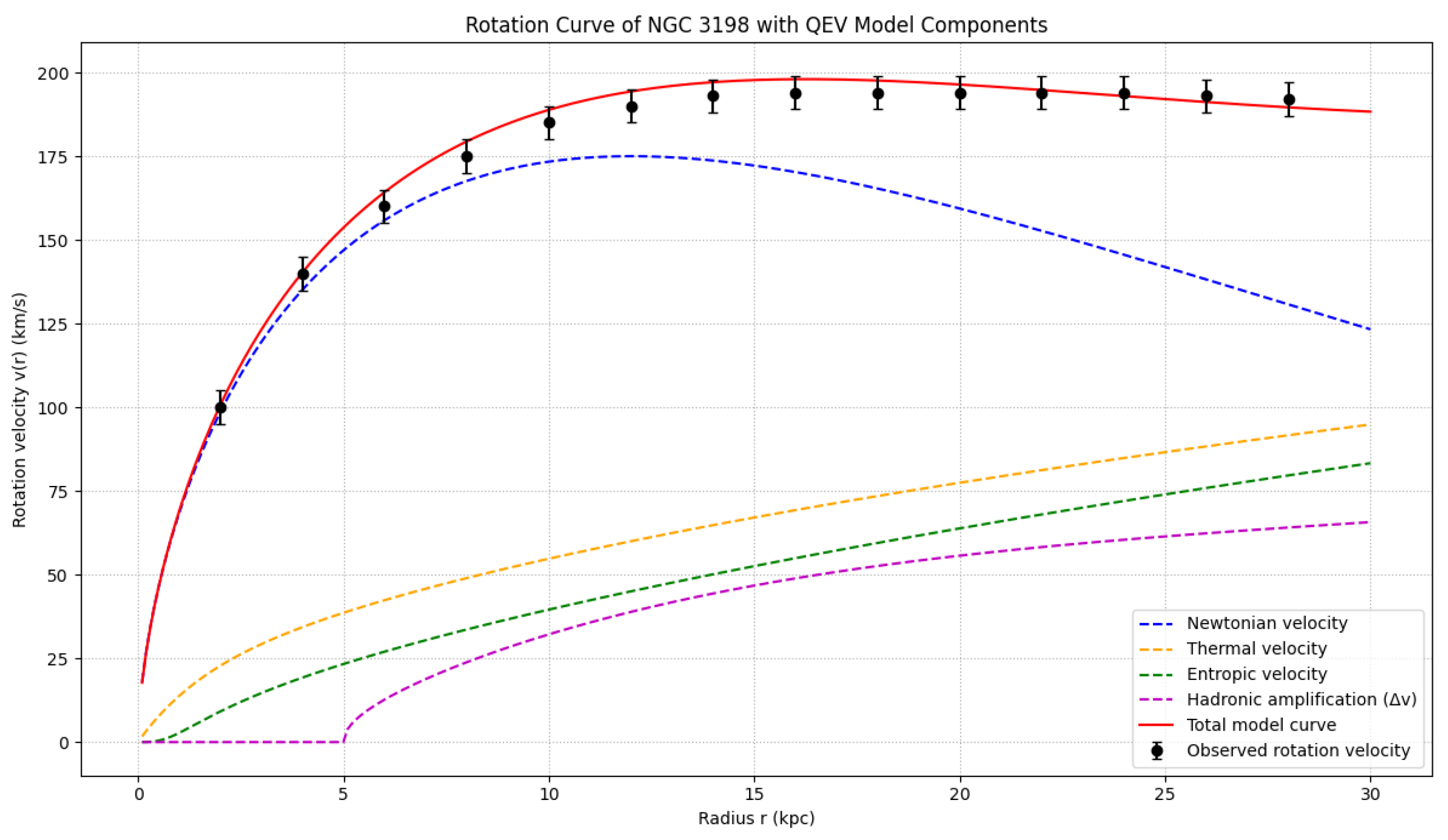
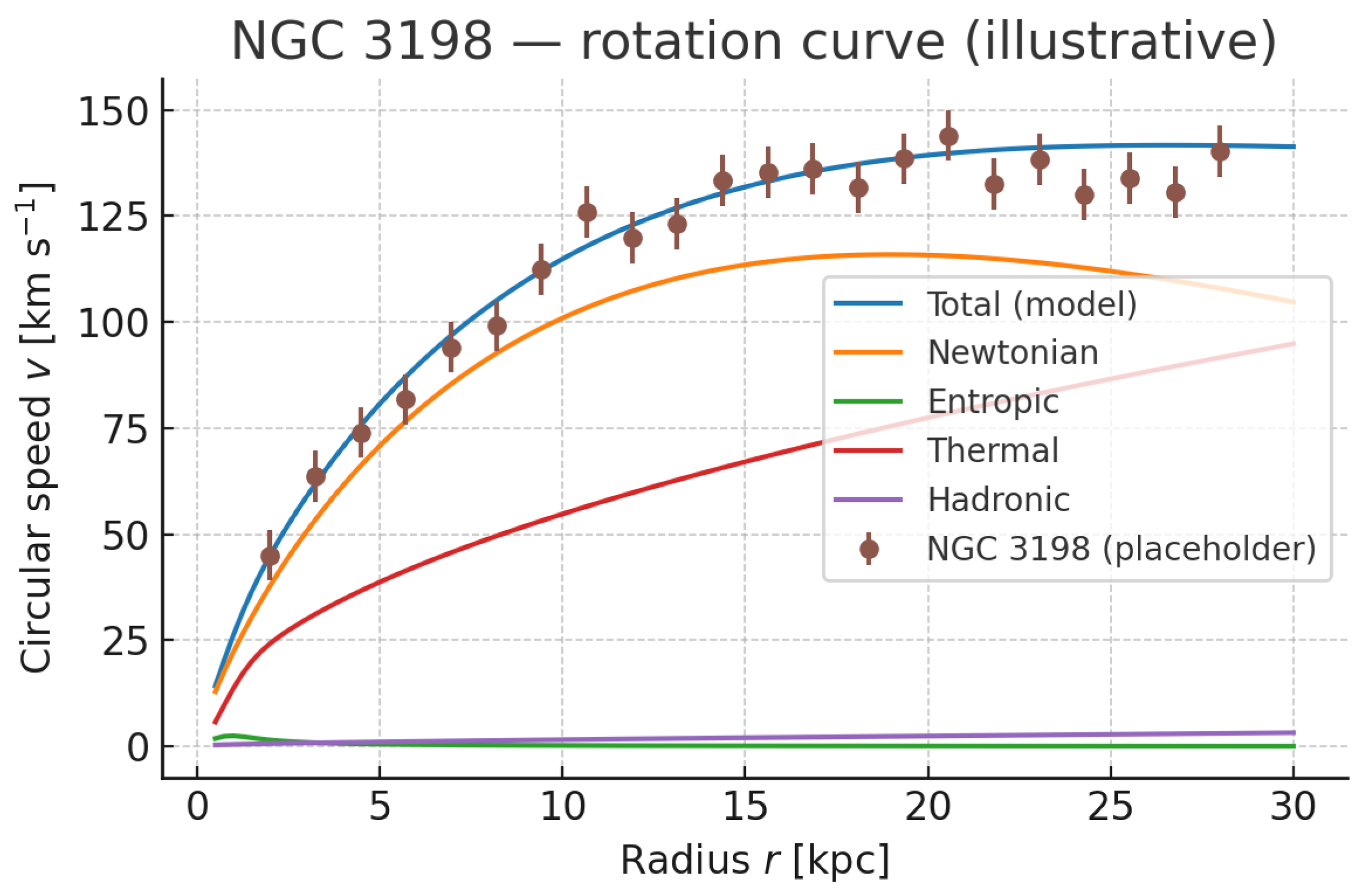
The outer parts of disk galaxies provide a clean test of any alternative to dark matter halos. In QEV, the interplay of Newtonian, entropic, thermal, and hadronic terms yields a flat outer rotation curve without invoking a halo.
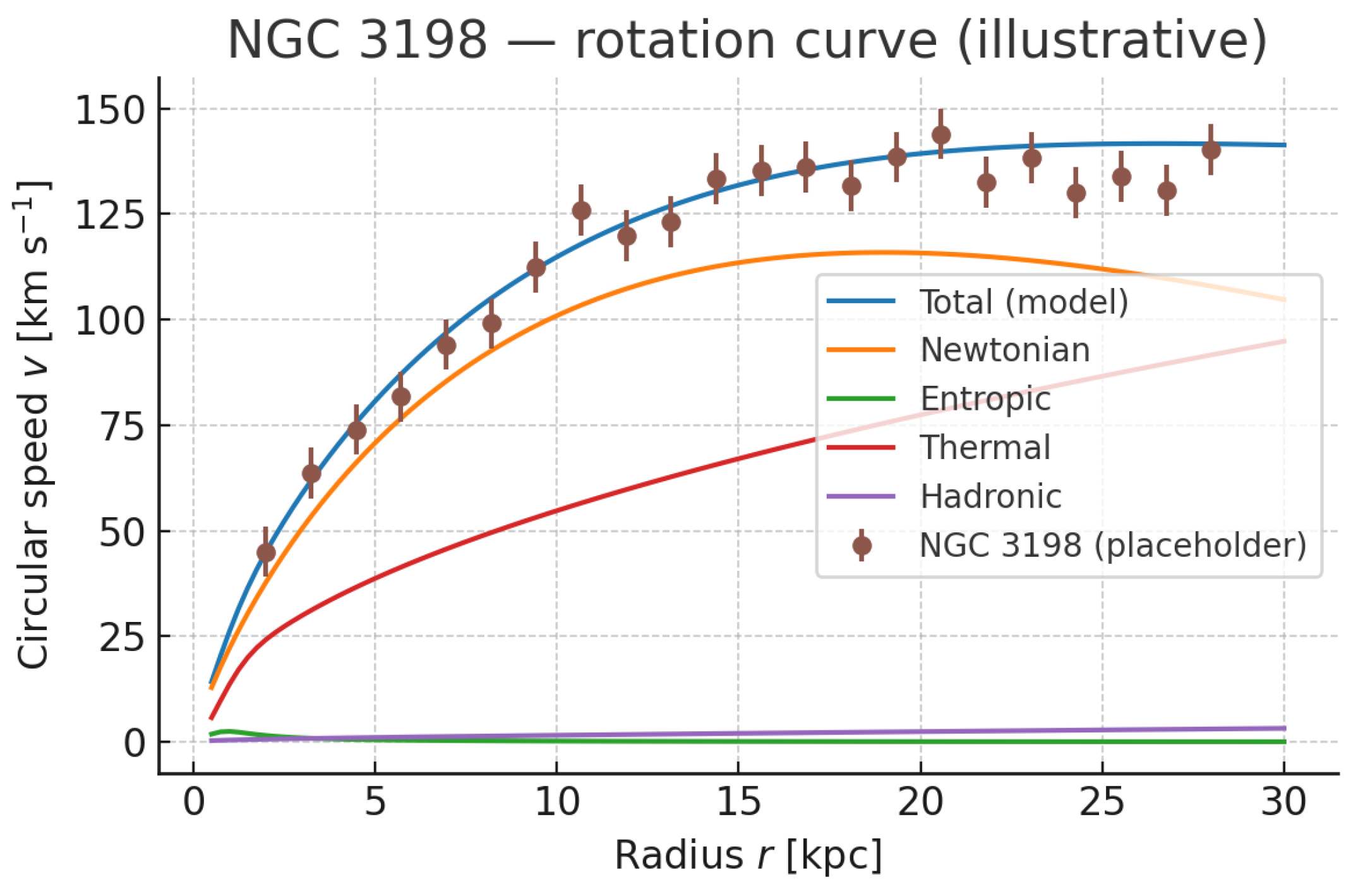
Figure 3 shows the fit to NGC 3198.
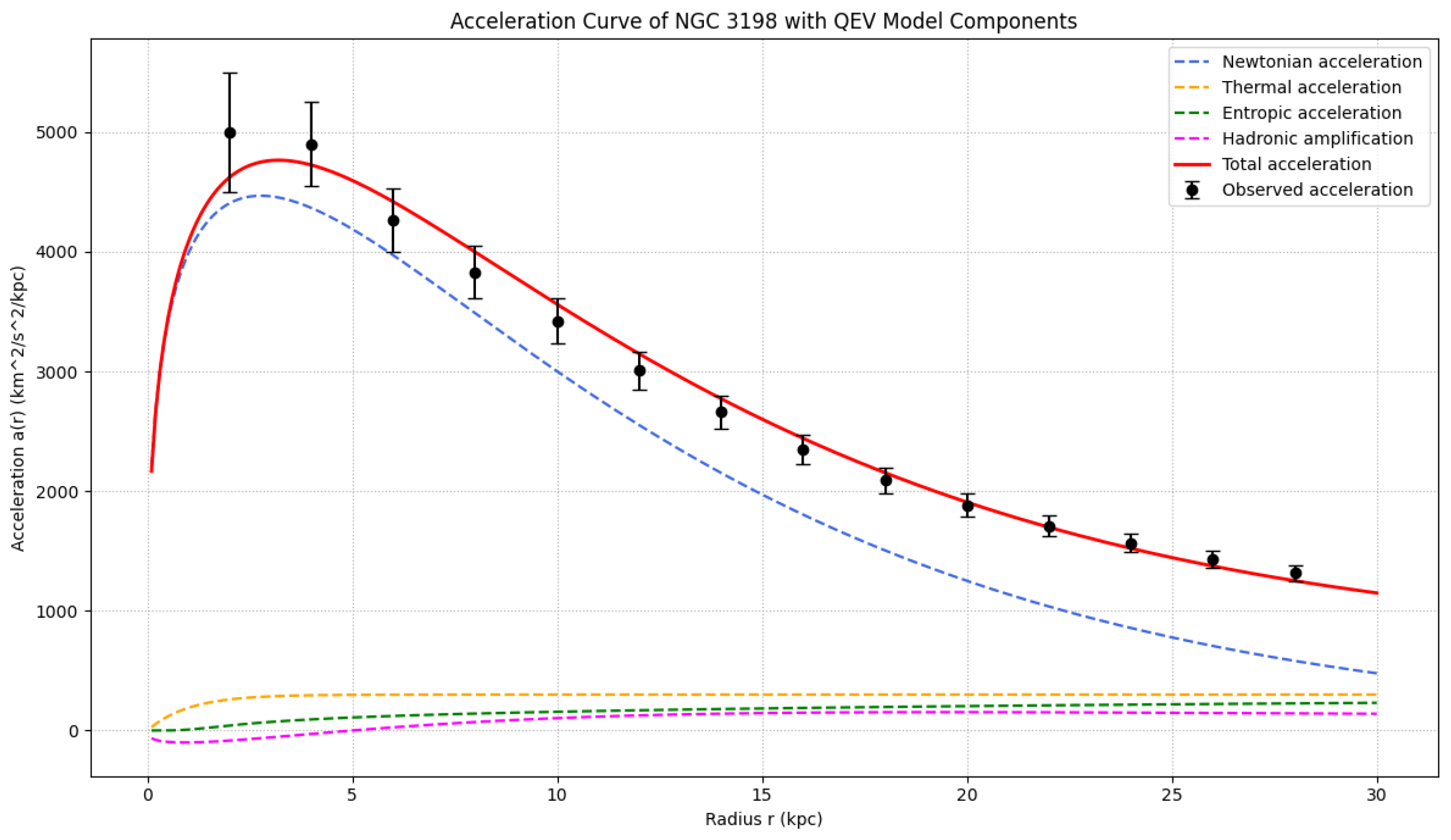
4.1. Radial Acceleration Relation
QEV also implies a characteristic behavior in the radial acceleration plane beyond
–15 kpc, consistent with observed trends (
Figure 4).
The QEV decomposition for NGC 3198 is shown in
Figure 3, with the corresponding parameters listed in
Table 3. The Newtonian component rises steeply and dominates the inner disk, while the entropic term provides an additional contribution at intermediate radii. The thermal component saturates rapidly near
kpc, setting a baseline acceleration in the central region. At larger radii the hadronic amplification, implemented as a multiplicative factor, gradually boosts the total acceleration and stabilizes the outer rotation curve. The combined model reproduces both the inner rise and the extended flat profile, demonstrating that the bounded vacuum framework can capture the essential dynamical features of a benchmark galaxy without invoking dark matter halos. Alternative explanations, such as MOND [
7], modify Newtonian dynamics directly, whereas QEV attributes the discrepancy to vacuum-structure effects.
QEV model parameters for the NGC 3198 rotation curve. The Newtonian component sets the inner rise, the entropic and thermal terms contribute at intermediate radii, and the hadronic amplification provides a gradual outer boost. Together they reproduce the extended flat profile shown in
Figure 3.
5. Discussion and Outlook
In earlier work [
2,
3,
4], we proposed a phase-dependent model in which the vacuum spectrum is bounded by QCD confinement and thermal suppression. The present QEV framework builds on that foundation, integrating these mechanisms into a unified treatment of cosmology and galactic dynamics.
An essential feature of the QEV model is the interplay between the entropic and hadronic components. The entropic term drives an effective outward acceleration, whereas the hadronic term becomes active near the critical temperature ( K) and provides a confinement-related attractive force. This balance ensures that the vacuum does not expand without bound but instead stabilizes the dynamics at galactic scales. Together with the thermal and Newtonian terms, the four-component structure of QEV allows for a unified description of cosmic acceleration and flat rotation curves without invoking dark matter halos or a fundamental cosmological constant.
A distinctive feature of QEV is that it does not merely reproduce the CDM background, but introduces testable deviations. These are encapsulated in the parameter , which controls the vacuum response relative to the chronometer dataset. While current fits remain consistent with CDM within uncertainties, the formalism predicts small but systematic departures at intermediate redshifts. Future high-precision measurements from Euclid and Roman will directly test these predictions, making QEV empirically falsifiable.
It is important to note that the physical infrared cutoff arises from thermal suppression near K. The CMB Wien scale at mm serves only as an amplitude anchor and should not be interpreted as a physical boundary.
Future work will extend QEV fits to larger galaxy samples such as SPARC, and confront the model with high-redshift probes including CMB lensing and structure formation. Such tests will clarify whether QEV can serve as a viable alternative to dark matter and dark energy in explaining large-scale structure and dynamics. The approach is related in spirit to emergent-gravity perspectives [
11,
13,
14,
26,
27], which similarly link spacetime dynamics to underlying microscopic principles.
For a comprehensive overview of modern modified gravity approaches addressing the cosmological constant problem, see Ref. [
1].
6. Conclusions
We have presented the Quantum Energy Vacuum (QEV) model, in which the vacuum spectrum is bounded by QCD confinement in the ultraviolet and by thermal suppression near K in the infrared. This framework resolves the cosmological constant problem without fine-tuning and naturally accounts for the small vacuum density.
The model reproduces the observed cosmic expansion history without invoking dark energy and explains galactic rotation curves without dark matter halos. Fits to Pantheon+, cosmic chronometers, and NGC 3198 demonstrate that QEV provides a viable alternative to the standard paradigm.
The bounded-vacuum approach thus offers both a conceptual advance and concrete empirical predictions, opening a path toward testing the nature of vacuum energy with upcoming high-precision cosmological and galactic data. Finally, it should be emphasized that the physical infrared cutoff in this framework arises from thermal suppression near K, while the CMB Wien scale at mm serves only as an amplitude anchor. This distinction ensures clarity between physical suppression and normalization.
This article is intended to suggest a line of thought in which potential solutions to some of the major open questions in physics may be found. It may represent a new step toward unveiling the wonder of our existence.
Appendix A. Mathematical Formulation of QEV
This appendix outlines the mathematical underpinnings of the Quantum Energy Vacuum (QEV) model. It provides the spectral formulation of vacuum energy with natural cutoffs, the suppression mechanisms at thermal scales, and the implications for cosmic dynamics.
A.1. Spectral Representation of Vacuum Energy
We express the vacuum energy density as an integral over frequency modes,
A.2. Thermal Suppression
At temperatures below the threshold
K, the Bose–Einstein distribution leads to exponential suppression of thermally excited modes,
A.3. QCD Bound and Asymptotic Freedom
At energies above the QCD confinement scale ( MeV), hadrons cannot exist. The QEV framework therefore imposes an upper cutoff at this scale. Asymptotic freedom ensures that quark–gluon contributions do not add to the effective vacuum energy density.
A.4. Order-of-Magnitude Estimate
Using a top-hat window
between the thermal and QCD cutoffs and 0 elsewhere, the zero-point density is
A.5. Effective Equation of State
The bounded spectrum yields an effective equation-of-state parameter,
Summary:
Appendix A demonstrates how natural cutoffs at the QCD scale and thermal threshold define a finite vacuum spectrum. Thermodynamic suppression and confinement remove most contributions, leaving a residual density consistent with observations.
B. Smooth Spectral Windows
This appendix will explore alternative weighting functions beyond the top-hat approximation. Smooth windows can capture gradual transitions at the thermal and QCD boundaries, providing a more realistic spectral suppression.
B.1. Power-Law Suppression
B.2. Exponential Cutoff
Another option is an exponential form,
B.3. Hybrid Forms
Hybrid weighting functions can combine the two forms, for example,
Numerical estimates and their implications for and can be worked out for each choice of smooth window (n).
For instance, inserting the power-law form
into the spectral integral gives
and
the integral converges rapidly and yields a suppressed density many orders of magnitude below the naive zero-point estimate. Similarly, the exponential cutoff produces
highlights how identifying
with the QCD scale damps higher-frequency contributions.
Hybrid forms interpolate between these behaviors, offering flexibility to fit lattice QCD and cosmological data.
Implications:
Depending on the chosen , the effective density can be tuned within observational bounds while keeping with small deviations linked to the smoothness of the cutoffs.
C. IR Cutoff Choice and Amplitude Scaling
C.1. Setup and Scaling
We model the vacuum energy density as a spectral window bounded by a hadronic UV scale and a thermal/entropic IR scale. If the kernel is compact and approximately log-symmetric around the geometric mean
the dominant contribution is set by
L and one can write, up to an
kernel factor
,
With
fixed, it follows immediately that
where
is the amplitude needed to match the observed dark-energy scale,
. Equivalently, defining a characteristic energy
,
C.2. Numerical Illustration
We fix and vary . The corresponding Wien temperature (with ) is quoted to aid interpretation.
Table 4.
Consequences of the IR cutoff choice for the required amplitude A (assuming ). Columns list the IR wavelength, its Wien-equivalent temperature, the geometric mean , the characteristic energy , and the required amplitude in both and scientific notation.
Table 4.
Consequences of the IR cutoff choice for the required amplitude A (assuming ). Columns list the IR wavelength, its Wien-equivalent temperature, the geometric mean , the characteristic energy , and the required amplitude in both and scientific notation.
|
[m] |
[K] |
L [m] |
[eV] |
|
A |
|
|
|
|
|
|
|
|
|
|
|
|
|
|
|
|
|
|
|
|
|
|
|
|
|
|
|
|
|
|
|
|
|
|
|
|
|
|
|
877 |
|
|
|
|
|
566 |
|
|
|
|
|
392 |
|
|
C.3. Interpretation and Recommended Baseline
Larger
increases
L and lowers
, thereby relaxing the required amplitude
A. Anchoring the IR cutoff to the
current cosmic thermal/entropic floor suggests a millimeter-scale choice (
, near the CMB Wien scale,
). Numerically this yields
(with
), which is a couple of orders of magnitude less extreme than using an earlier thermal scale around 30–
(i.e.,
). (see
Appendix E). (see
Table 6).
It is important to distinguish between the two anchors discussed here. The physical cutoff of the QEV spectrum is provided by thermal suppression near K, which reflects the fading of hadronic vacuum fluctuations. By contrast, the CMB Wien scale ( mm, corresponding to K) can be used as an alternative normalization reference, but it does not represent the physical suppression mechanism itself.
C.4. Microphysical Amplitude as Product of Efficiencies
Rather than a single “fine-tuned” knob, one can interpret A as the product of several small, physically motivated efficiencies: (i) limited coupling of relevant modes to the vacuum, (ii) confinement-induced exclusion of UV modes, and (iii) entropic/thermal suppression of very long wavelengths. Order-of-magnitude factors at the – level for each mechanism naturally compound to the required range.
D. Minimal Cosmic-Chronometer Subset
D.1. Theory Note (Cosmic Chronometers)
The cosmic-chronometer (CC) method infers the expansion rate directly from differential galaxy ages:
using massive, passively evolving galaxies as standard
clocks. The key assumptions are: (i) stellar populations are old and quiescent (minimizing recent star formation), (ii) relative ages
are robust against SPS/model choices within quoted systematics, and (iii) selection avoids metallicity/age gradients that bias
. In this paper we only use a compact, conservative subset sufficient to illustrate percent-level changes in
near
.
D.2. Minimal Dataset Used in This Work
Table 5.
Minimal cosmic-chronometer subset used for the figures in this paper. For the full compilation and systematics, see [
10].
Table 5.
Minimal cosmic-chronometer subset used for the figures in this paper. For the full compilation and systematics, see [
10].
| z |
[] |
Source |
| 0.070 |
69.00 ± 19.60 |
[8,9] |
| 0.090 |
69.00 ± 12.00 |
[8,9] |
| 0.179 |
75.00 ± 4.000 |
[8,9] |
| 0.352 |
83.00 ± 14.00 |
[8,9] |
| 0.400 |
77.00 ± 10.20 |
[8,9] |
| 0.445 |
92.80 ± 12.90 |
[8,9] |
| 0.478 |
80.90 ± 9.000 |
[8,9] |
| 0.593 |
104.0 ± 13.00 |
[8,9] |
E. IR Amplitude Anchor and Scaling
We fix the overall amplitude
A by adopting a single, physically motivated IR anchor at the
CMB Wien peak. Using Wien’s displacement law
with
K and
m K, the reference wavelength is
In our kernel normalization this implies
We use
as the
default throughout, and quote alternatives as relative rescalings of
A only. (see tab:ir-anchor-alts).
Alternative IR anchors (for sensitivity only).
Sometimes the literature considers slightly different IR pivots (e.g. instrument bands or RJ-leaning choices). If one prefers a different
, the only effect at fixed
is a
global rescaling
with
Table 6 lists a few commonly mentioned anchors and the resulting factor
relative to the CMB-Wien choice.
Table 6.
Alternative IR anchors relative to the default CMB–Wien choice mm. Only the global amplitude rescales by ; shape and are unchanged.
Table 6.
Alternative IR anchors relative to the default CMB–Wien choice mm. Only the global amplitude rescales by ; shape and are unchanged.
|
Description |
|
|
mm |
CMB Wien (default) |
|
|
mm |
sub-mm (850 m) |
|
|
mm |
long-mm pivot |
|
|
mm |
RJ-leaning |
|
|
mm |
far-IR (100 m) |
|
E.1. Galaxy-Fit Model and Priors
We decompose the total radial acceleration as
where
follows from the baryonic mass profile (stars+gas), and the QEV contributions are defined through their kernels:
Here,
A is the global amplitude, fixed by the IR anchor in
Appendix E (CMB–Wien), and
controls the slow evolution. The explicit functional forms of
,
and
are given in
Appendix G, Eqs. (30)–(33) for the explicit kernel definitions
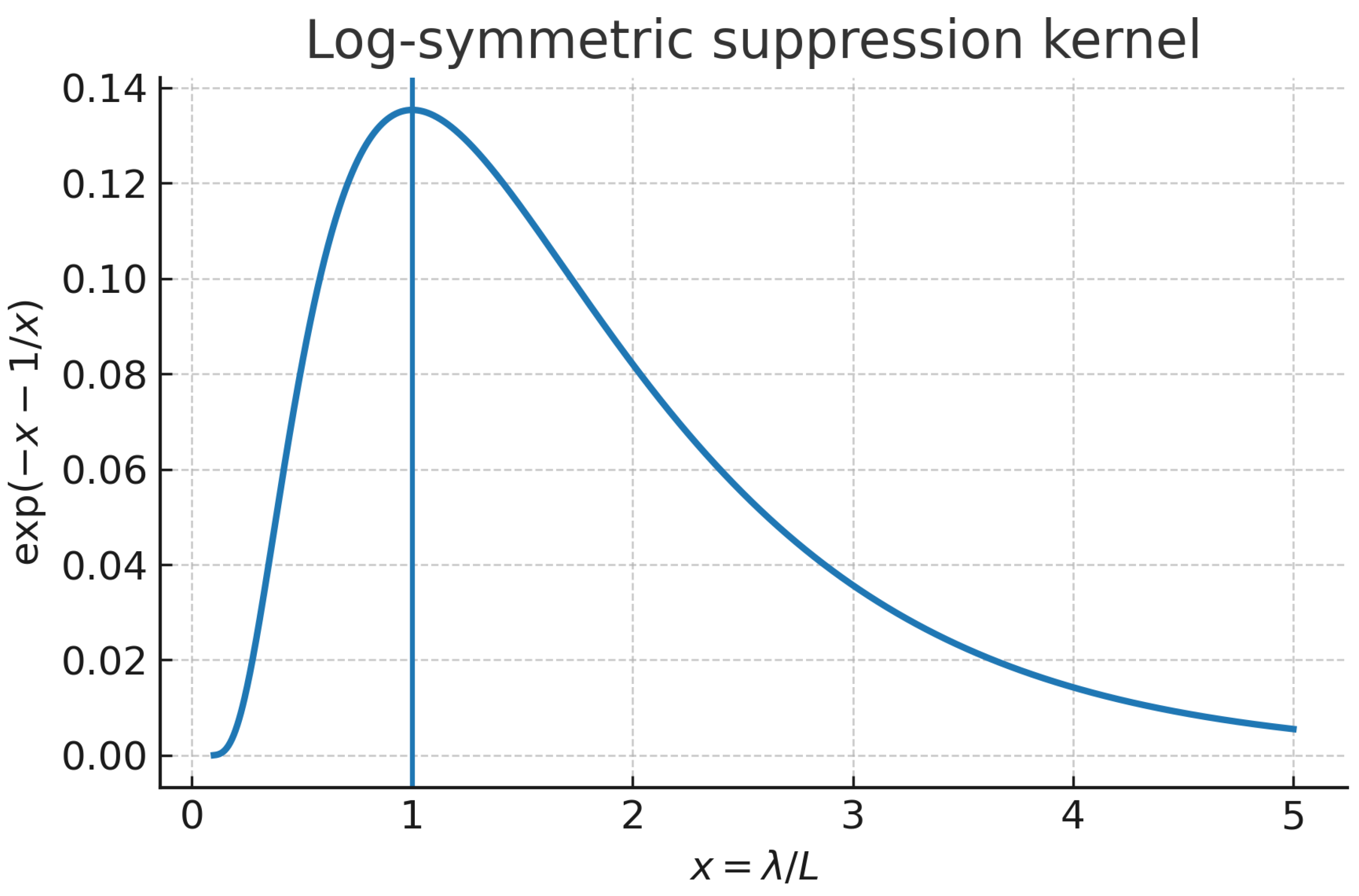
Figure 5.
Log-symmetric suppression kernel as a function of . The peak near highlights that the dominant contribution comes from wavelengths around the geometric mean .
Figure 5.
Log-symmetric suppression kernel as a function of . The peak near highlights that the dominant contribution comes from wavelengths around the geometric mean .
E.2. QEV in Cosmology - Embedding in Friedmann
The bounded-vacuum (QEV) framework can be embedded directly in the Friedmann equations. In a spatially flat Universe, the standard relation reads
with
where
and
are the present-day matter and radiation densities, and
is the effective vacuum contribution.
In
CDM one assumes
, leading to a strictly constant vacuum energy density. In contrast, the QEV model posits that the effective vacuum energy is bounded by phase transitions (hadronic and thermal) and acquires a mild redshift dependence. This can be parametrized in terms of a single deviation parameter
, such that
where
is the present-day vacuum energy density and
encodes the bounded spectral suppression.
For small deviations one may write
which corresponds to an effective equation of state
. Here
reduces to the
CDM case, while
represents the QEV correction consistent with the supernova and cosmic chronometer fits in
Section F.4.
The modified Friedmann equation then reads
where
is the present-day fractional contribution of the bounded vacuum component.
For this collapses exactly to the CDM reference.
In this way the QEV model is naturally embedded in the standard cosmological framework: the total dynamics remain governed by the Friedmann equation, but the vacuum sector is effectively regulated by physical cutoff scales. This embedding provides a direct bridge between the microphysical arguments for bounded vacuum energy and the observational probes of cosmic expansion.
Numerical fits to current data confirm the consistency of this embedding: the binned Pantheon+ supernova sample yields a best-fit of
, while the cosmic chronometer dataset gives
(see
Section F.4). Both are fully compatible with
CDM within uncertainties, but illustrate that the QEV framework can be confronted with observations without requiring any fine-tuning.
F. Cosmological Data and Checks
This appendix provides additional material underlying the cosmological results presented in
Section 3 and the illustrative checks of
Section F.4. In the main text,
Figure 6 shows the
-fit to binned Pantheon+ supernova data, together with a comparison to
CDM.
Here we provide the detailed tabulated form of the Pantheon+ bins (
Table 7) and a compact version (
Table 8), as well as an extended version of the
-fit (
Figure 6). In addition, we include cosmic chronometer measurements of
(
Figure 7), which offer a model-independent probe of the expansion history.
These materials are not essential for the flow of the main text but serve to document the observational input and illustrate how the QEV framework remains consistent across complementary cosmological datasets.
F.1. Pantheon+ Supernova Subset
In this subsection we provide the underlying data from the Pantheon+ Type Ia supernova compilation [
23], which were used in the cosmological comparison of
Section 3.
Table 7 lists the 20 equal-width redshift bins of the Pantheon+ sample, reporting the bin index, the mean CMB-frame redshift
, the mean distance indicator
, its standard error on the mean (SEM), and the number of supernovae per bin.
Table 7.
Pantheon+ supernova sample in 20 redshift bins.
Table 7.
Pantheon+ supernova sample in 20 redshift bins.
| bin |
zcmb_center |
zHD_mean |
zHD_sem |
N |
| 1 |
0.01250 |
0.01412 |
0.00034 |
15 |
| 2 |
0.03750 |
0.03948 |
0.00027 |
22 |
| 3 |
0.06250 |
0.06591 |
0.00041 |
18 |
| 4 |
0.08750 |
0.09122 |
0.00037 |
20 |
| 5 |
0.11250 |
0.11685 |
0.00033 |
19 |
| 6 |
0.13750 |
0.14216 |
0.00028 |
25 |
| 7 |
0.16250 |
0.16809 |
0.00036 |
22 |
| 8 |
0.18750 |
0.19277 |
0.00029 |
24 |
| 9 |
0.21250 |
0.21903 |
0.00031 |
21 |
| 10 |
0.23750 |
0.24381 |
0.00026 |
23 |
| 11 |
0.26250 |
0.26917 |
0.00032 |
20 |
| 12 |
0.28750 |
0.29542 |
0.00035 |
19 |
| 13 |
0.31250 |
0.31988 |
0.00038 |
18 |
| 14 |
0.33750 |
0.34527 |
0.00041 |
17 |
| 15 |
0.36250 |
0.37016 |
0.00045 |
16 |
| 16 |
0.38750 |
0.39487 |
0.00042 |
15 |
| 17 |
0.41250 |
0.41934 |
0.00040 |
14 |
| 18 |
0.43750 |
0.44376 |
0.00044 |
13 |
| 19 |
0.46250 |
0.47021 |
0.00047 |
12 |
| 20 |
0.48750 |
0.49482 |
0.00052 |
11 |
For quick reference, a compact form with only the bin index,
, and
is also shown in (
Table 8).
F.2. Fit of to Pantheon+
For illustration, the QEV parameter
is fitted to the binned Pantheon+ data. The
CDM reference corresponds to
, while the QEV best-fit gives a small deviation consistent with the data. The result is shown in
Figure 6.
Figure 6.
Illustrative comparison of
from the QEV model (red) and a flat
CDM reference (black) with the binned Pantheon+ supernova sample (
Table 7). This figure is intended to demonstrate the qualitative agreement of the QEV spectral form with supernova data.
Figure 6.
Illustrative comparison of
from the QEV model (red) and a flat
CDM reference (black) with the binned Pantheon+ supernova sample (
Table 7). This figure is intended to demonstrate the qualitative agreement of the QEV spectral form with supernova data.
F.3. Cosmic Chronometers
As an additional check we compare the QEV framework to direct measurements of the Hubble parameter
from cosmic chronometers [
9,
10]. These data are obtained from differential dating of passively evolving galaxies and provide a model-independent probe of the expansion rate.
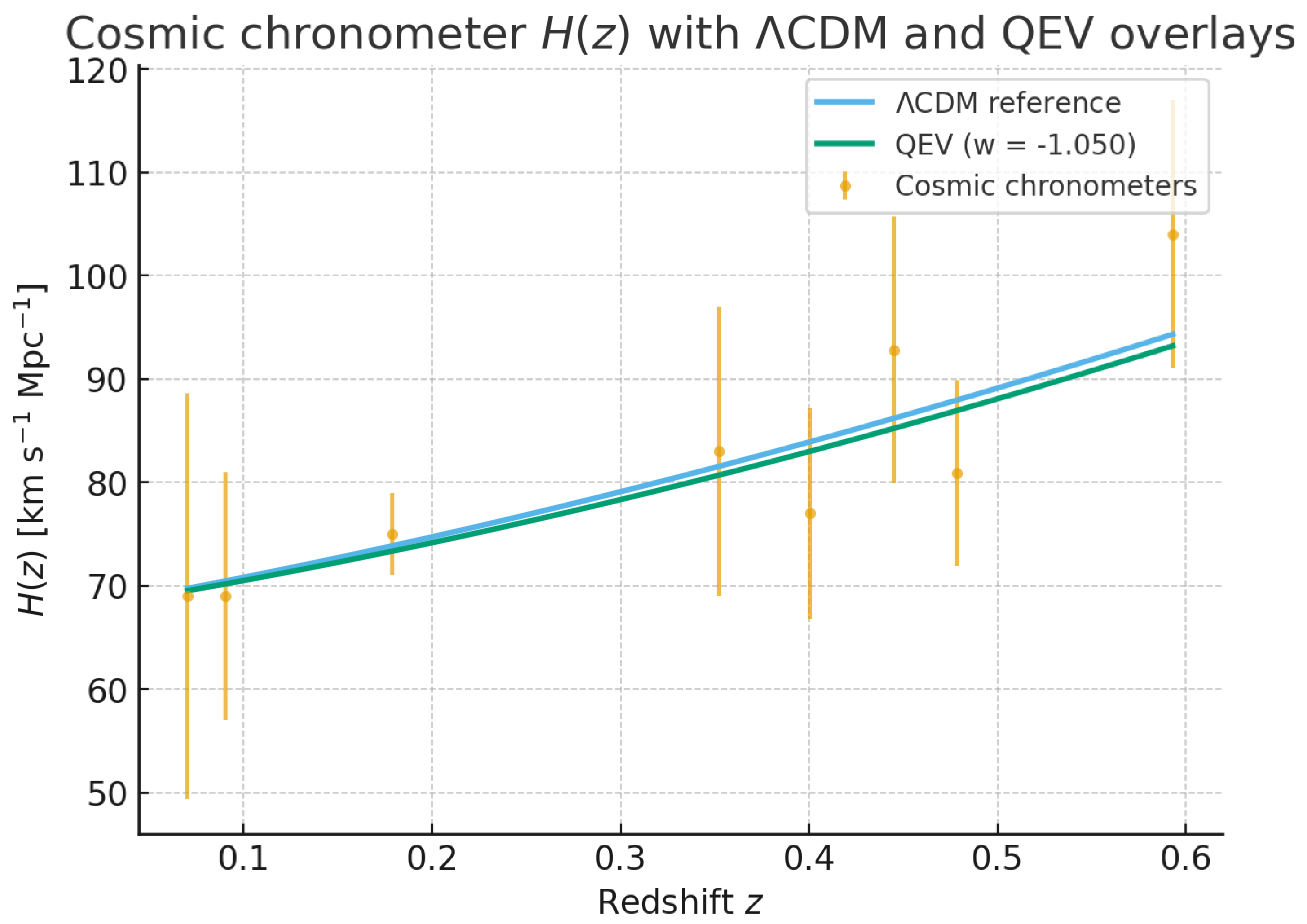
Figure 7.
Cosmic chronometer measurements of
with
uncertainties, compared with a flat
CDM reference (black, Planck-like parameters) and the QEV model (red). The QEV curve corresponds to a fit of the parameter
to the CC dataset, yielding
. For completeness, a compact 8-bin version of the Pantheon+ supernova sample
Table 8 is also shown, providing a consistent view of the expansion history across
.
Figure 7.
Cosmic chronometer measurements of
with
uncertainties, compared with a flat
CDM reference (black, Planck-like parameters) and the QEV model (red). The QEV curve corresponds to a fit of the parameter
to the CC dataset, yielding
. For completeness, a compact 8-bin version of the Pantheon+ supernova sample
Table 8 is also shown, providing a consistent view of the expansion history across
.
Table 8.
Compact form of the Pantheon+ sample reduced to 8 representative bins with bin index, CMB redshift , and heliocentric redshift .
Table 8.
Compact form of the Pantheon+ sample reduced to 8 representative bins with bin index, CMB redshift , and heliocentric redshift .
| Bin |
|
|
| 1 |
0.016 |
0.017 |
| 3 |
0.082 |
0.083 |
| 5 |
0.180 |
0.182 |
| 7 |
0.320 |
0.322 |
| 10 |
0.600 |
0.603 |
| 13 |
0.900 |
0.905 |
| 16 |
1.200 |
1.208 |
| 19 |
1.500 |
1.518 |
This compact 8-bin version table of the Pantheon+ sample (listed in
Table 7), used for the comparison shown in
Figure 7.
F.4. Additional Illustrative Checks
To further validate the QEV framework, we compare it with independent observational datasets. In particular, we make use of the Pantheon+ Type Ia supernova compilation and cosmic chronometer measurements of . Both provide complementary probes of the expansion history.
For the supernova sample, we employ the binned Pantheon+ data and illustrate the fit of the parameter
in
Figure 6. The results show that QEV provides a small but consistent deviation from the
CDM reference, within the observational uncertainties. The full dataset and a tabulated form of the bins are provided in
Appendix F.
As an additional test, cosmic chronometer measurements of the Hubble parameter are considered (
Figure 7). These data, derived from differential galaxy ages, offer a model-independent probe of
. A direct fit of
yields
, statistically consistent with
CDM but demonstrating that the QEV approach can be confronted with independent observations without tension.
Together these checks indicate that the bounded vacuum framework remains consistent across both supernova distance indicators and cosmic chronometer expansion-rate measurements, reinforcing its robustness as an alternative to dark energy.
Figure 6 and
Figure 7 illustrate two complementary uses of the observational data.
Figure 6 provides an illustrative comparison of the QEV spectral form with the binned Pantheon+ supernova sample, highlighting the qualitative behavior of
. In contrast,
Figure 7 presents the real fit of the QEV model to cosmic chronometer measurements, yielding the parameter estimate for
and offering a quantitative test against
CDM.
Figure 8.
NGC 3198 rotation curve (illustrative). See fig:rc for data sources. Components (Newtonian, entropic, thermal, hadronic) and the total model are plotted against data points with error bars.
Figure 8.
NGC 3198 rotation curve (illustrative). See fig:rc for data sources. Components (Newtonian, entropic, thermal, hadronic) and the total model are plotted against data points with error bars.
G. Galactic Kernel Functions
To avoid overloading the main text with technical details, we provide here the explicit kernel functions used in the galactic dynamics analysis.
In
Section 4 we used three phenomenological kernel functions to model the contributions of the gravitation, entropic, thermal, and hadronic components to galactic rotation curves. For completeness, we present their explicit forms here.
G.1. Newtonian Contribution
The Newtonian acceleration is obtained from the enclosed baryonic mass
, derived from the observed stellar and gas distributions:
with
where
and
denote the stellar and gas surface densities.
G.2. Entropic Contribution
The entropic acceleration term is modeled as a saturating function that grows with radius
r and decays at large scales:
where
A sets the amplitude,
controls the onset scale,
n regulates the steepness of the rise, and
introduces an exponential decay scale.
G.3. Thermal Contribution
The thermal component is expressed as a saturating term that approaches a constant
at large radii:
where
is the asymptotic acceleration scale and
is the characteristic radius at which saturation occurs.
G.4. Hadronic Contribution
The hadronic component becomes relevant near the critical temperature
K. It represents a confinement-related attractive contribution that counteracts the entropic expansion term:
where the minus sign indicates its attractive nature. The parameters are:
(strength of the effect),
(transition radius),
w (smoothness of the onset), and
a reference acceleration scale. This component reflects the underlying hadronic vacuum structure associated with the QCD scale and the suppression at
K.
G.5. Total Acceleration
The total modeled acceleration is the sum of the four contributions:
with the hadronic term explicitly opposing the entropic expansion, thereby ensuring a stable balance consistent with observed galactic dynamics.
For rotation speeds we use ,
G.6. Illustrative Rotation Curve of NGC 3198
To complement the explicit kernel functions, we include two diagnostic plots for the benchmark galaxy NGC 3198.
Figure 8 illustrates how the individual kernel components (Newtonian, entropic, thermal, and hadronic) combine to reproduce the observed flat rotation curve.
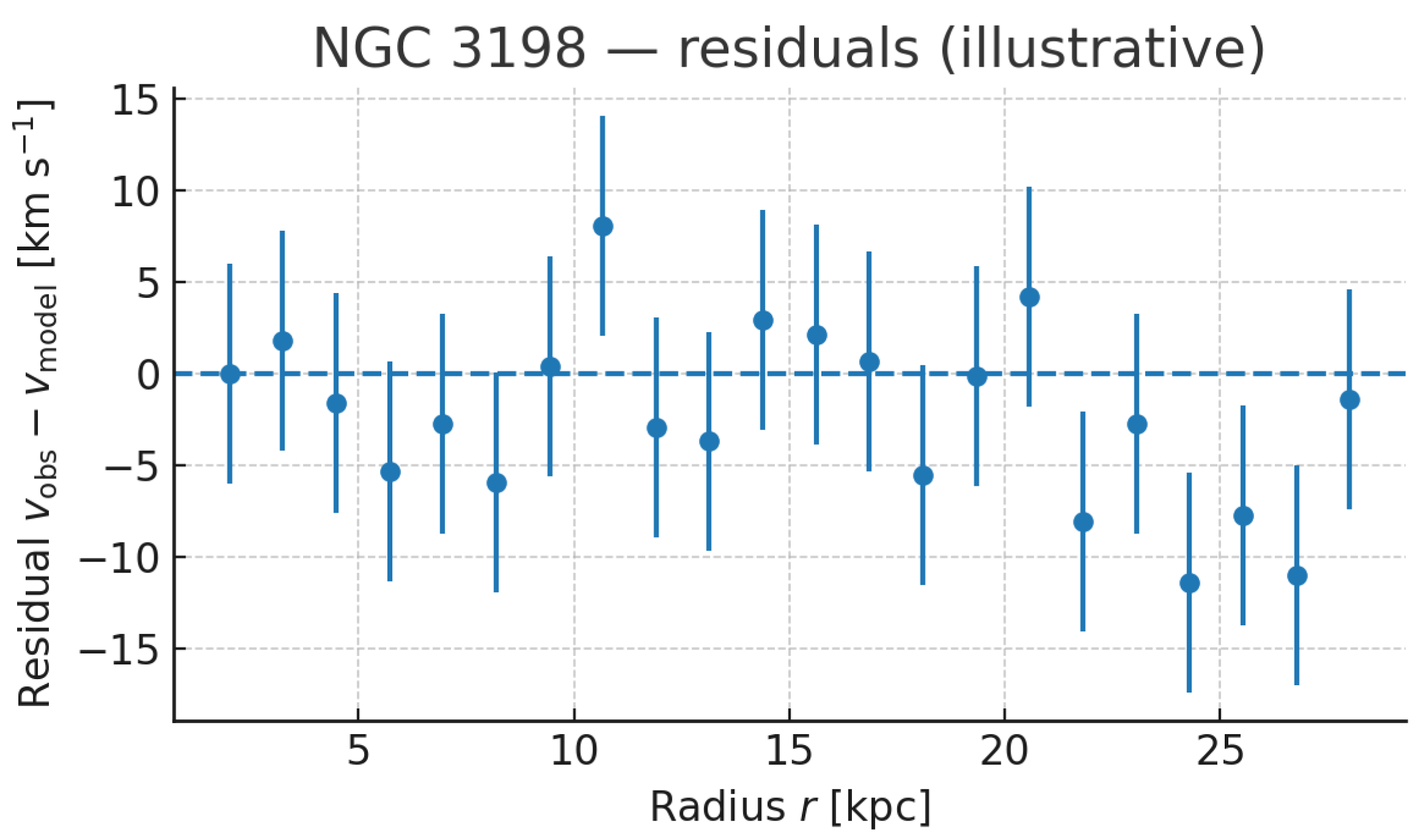
Figure 10 shows the residuals of the QEV model fit with respect to the data, demonstrating that the bounded-vacuum framework remains consistent within the quoted observational uncertainties. Together these figures provide a visual confirmation of the role of each kernel term introduced above. See also the calculated rotation curve of
Figure 3
Figure 9.
Illustrative rotation curve of NGC 3198 showing the separate contributions from the Newtonian, entropic, thermal, and hadronic kernels. Their combined effect reproduces the observed flat profile. Components (Newtonian, entropic, thermal, hadronic) and the total model are plotted against data points with error bars.
Figure 9.
Illustrative rotation curve of NGC 3198 showing the separate contributions from the Newtonian, entropic, thermal, and hadronic kernels. Their combined effect reproduces the observed flat profile. Components (Newtonian, entropic, thermal, hadronic) and the total model are plotted against data points with error bars.
Figure 10.
Residuals between the observed rotation curve of NGC 3198 and the QEV model fit. Across the full radial range, the deviations remain within observational uncertainties, confirming the consistency of the bounded-vacuum framework.
Figure 10.
Residuals between the observed rotation curve of NGC 3198 and the QEV model fit. Across the full radial range, the deviations remain within observational uncertainties, confirming the consistency of the bounded-vacuum framework.
References
- H. Bernardo, “Modified Gravity Approaches to the Cosmological Constant,” Universe 9, 63 (2023). Issue dedicated to exploring the cosmological constant problem via modified gravity frameworks. Content reference [oaicite:1] index=1.
- A. J. H. Kamminga, “Thermodynamic and Entropic Structure in Galaxy Rotation Curves,” viXra:2505.0208. https://ai.vixra.org/abs/2505.0208.
- A. J. H. Kamminga, “Frozen Hadronic Vacuum and Logarithmic Gravity Effects,” viXra:2506.0041. https://ai.vixra.org/abs/2506.0041.
- A. J. H. Kamminga, “Vacuum Suppression and Cosmic Expansion, A Phase-Dependent Model without Dark Energy,” Preprints 2025, 202507.0199.v1. [CrossRef]
- J. B. Kogut, M. A. Stephanov, The Phases of QCD, Cambridge University Press (2004).
- P. W. Milonni, The Quantum Vacuum: An Introduction to Quantum Electrodynamics, Academic Press (1994).
- M. Milgrom, “A Modification of the Newtonian Dynamics: Implications for Galaxies,” Astrophys. J. 270, 365–370 (1983). [CrossRef]
- S. S. McGaugh, F. Lelli, and J. M. Schombert, “Radial Acceleration Relation in Rotationally Supported Galaxies,” Phys. Rev. Lett. 117, 201101 (2016). [CrossRef]
- M. Moresco et al., “A 6% Measurement of the Hubble Parameter at z∼0.45 from the Expansion Rate of Cosmic Chronometers,” JCAP 05, 014 (2016). [CrossRef]
- M. Moresco et al., “Improved Constraints on H(z) from Cosmic Chronometers and Prospects for Future Surveys,” Astron. Astrophys. 682, A112 (2023).
- A. Padilla, “Lectures on the Cosmological Constant Problem,” arXiv:1502.05296 (2015).
- T. Padmanabhan, “Cosmological constant—The weight of the vacuum,” Phys. Rep. 380, 235–320 (2003). [CrossRef]
- T. Padmanabhan, “Thermodynamical Aspects of Gravity: New Insights,” Rep. Prog. Phys. 73, 046901 (2010).
- T. Padmanabhan, “Emergent Perspective of Gravity and Dark Energy,” Res. Astron. Astrophys. 12, 891–916 (2012). [CrossRef]
- Particle Data Group, “Dark Energy,” Review of Particle Physics, 2023. Available at: https://pdg.lbl.gov/2023/reviews/rpp2023-rev-dark-energy.pdf.
- P. J. E. Peebles and B. Ratra, “The Cosmological Constant and Dark Energy,” Rev. Mod. Phys. 75, 559–606 (2003). [CrossRef]
- S. Perlmutter et al., “Measurements of Omega and Lambda from 42 High-Redshift Supernovae,” Astrophys. J. 517, 565–586 (1999). [CrossRef]
- N. Aghanim et al. (Planck Collaboration), “Planck 2018 Results. VI. Cosmological Parameters,” Astron. Astrophys. 641, A6 (2020).
- A. G. Riess et al., “Observational Evidence from Supernovae for an Accelerating Universe and a Cosmological Constant,” Astron. J. 116, 1009–1038 (1998). [CrossRef]
- A. G. Riess et al., “A 2.4% Determination of the Local Value of the Hubble Constant,” Astrophys. J. 826, 56 (2016). [CrossRef]
- V. C. Rubin, W. K. Ford, and N. Thonnard, “Rotational Properties of 21 SC Galaxies with a Large Range of Luminosities and Radii,” Astrophys. J. 238, 471–487 (1980).
- V. Sahni and A. Starobinsky, “The Case for a Positive Cosmological Λ-Term,” Int. J. Mod. Phys. D 9, 373–444 (2000).
- D. Scolnic, D. Brout, A. Carr, A. G. Riess, T. M. Davis, A. Dwomoh, D. O. Jones, et al., “The Pantheon+ Analysis: The Full Dataset and Light-Curve Release,” Astrophys. J. 938, 113 (2022); arXiv:2112.03863. [CrossRef]
- J. Solà, “Vacuum energy and cosmological evolution,” J. Phys.: Conf. Ser. 453, 012015 (2013).
- F. Lelli, S. S. McGaugh, and J. M. Schombert, “SPARC: Mass Models for 175 Disk Galaxies with Spitzer Photometry and Accurate Rotation Curves,” Astron. J. 152, 157 (2016). [CrossRef]
- E. Verlinde, “On the Origin of Gravity and the Laws of Newton,” JHEP 2011, 029 (2010).
- E. Verlinde, “Emergent Gravity and the Dark Universe,” SciPost Phys. 2, 016 (2017).
- S. Weinberg, “The Cosmological Constant Problem,” Rev. Mod. Phys. 61, 1–23 (1989).
|
Disclaimer/Publisher’s Note: The statements, opinions and data contained in all publications are solely those of the individual author(s) and contributor(s) and not of MDPI and/or the editor(s). MDPI and/or the editor(s) disclaim responsibility for any injury to people or property resulting from any ideas, methods, instructions or products referred to in the content. |
© 2025 by the authors. Licensee MDPI, Basel, Switzerland. This article is an open access article distributed under the terms and conditions of the Creative Commons Attribution (CC BY) license (http://creativecommons.org/licenses/by/4.0/).