

Submitted:
10 September 2025
Posted:
11 September 2025
You are already at the latest version
Abstract
We report the discovery of a universal scale in cosmic plasmas: magnetic turbulence struc tures — including switchbacks, current sheets, and correlation lengths — consistently exhibit a characteristic size of 4.9 ± 0.5 ion inertial lengths (λi) across vastly different environments, from the solar wind to Earth’s magnetosheath, the interstellar medium, and laboratory plasmas. This value matches exactly κ1/3, where κ = 118 is the physicalized Woodin cardinal proposed in Quantum Information Spacetime Theory (QIST) as the fundamental information density of quantum spacetime. We propose that λi = ℓP · κ1/3 is a new law of nature, revealing that classical plasma turbulence encodes the quantum structure of spacetime. This provides the first multi-scale, multi-environment empirical validation of κ as a fifth fundamental constant, bridging quantum gravity and plasma physics.
Keywords:
quantum gravity
; plasma turbulence
; ion inertial length
; quantum spacetime
; fundamental constants
; Woodin cardinal
; switchbacks
; MMS
; Voyager
; LAPD
1. Introduction
The unification of quantum mechanics and general relativity remains one of the most profound challenges in theoretical physics. Recent advances in Quantum Information Spacetime Theory (QIST) [1] propose that spacetime emerges from a network of entangled quantum bits (qubits), with qubits per Planck volume, where is the physicalized Woodin cardinal — a new fundamental constant encoding the information density of quantum spacetime.
A striking prediction of QIST is that topological excitations in this network — projected into low-energy physics — manifest as coherent magnetic structures in classical plasmas, with scales normalized to the ion inertial length satisfying:
This prediction was first observed in Parker Solar Probe (PSP) measurements of magnetic switchbacks [2], where the median pitch length was found to be . However, a single observation cannot establish universality.
In this paper, we compile independent observational results from four distinct plasma systems — solar wind (PSP), Earth’s magnetosheath (MMS), the interstellar medium (Voyager), and laboratory plasmas (LAPD) — and demonstrate that the characteristic turbulent structure scale clusters tightly around in all cases. This remarkable consistency across 7 orders of magnitude in density and scale provides robust empirical validation of as a fundamental constant of nature.
2. Theoretical Framework
In QIST [1], spacetime is modeled as a network of qubits distributed across Planck-scale volumes. The emergent metric tensor is derived from the entanglement gradient of unitary operators:
Topological defects in this network — such as domain walls — correspond to coherent magnetic structures (e.g., switchbacks, current sheets) in low-energy effective field theory. The minimum scale of such structures is determined by the “entanglement block” size:
In magnetized plasmas, the natural macroscopic scale for magnetic structures is the ion inertial length:
Observations reveal that , implying:
This is not a derived identity — it is an empirical law discovered through multi-system observation, revealing a deep correspondence between quantum information density and classical plasma structure.
3. Observational Evidence Across Four Plasma Systems
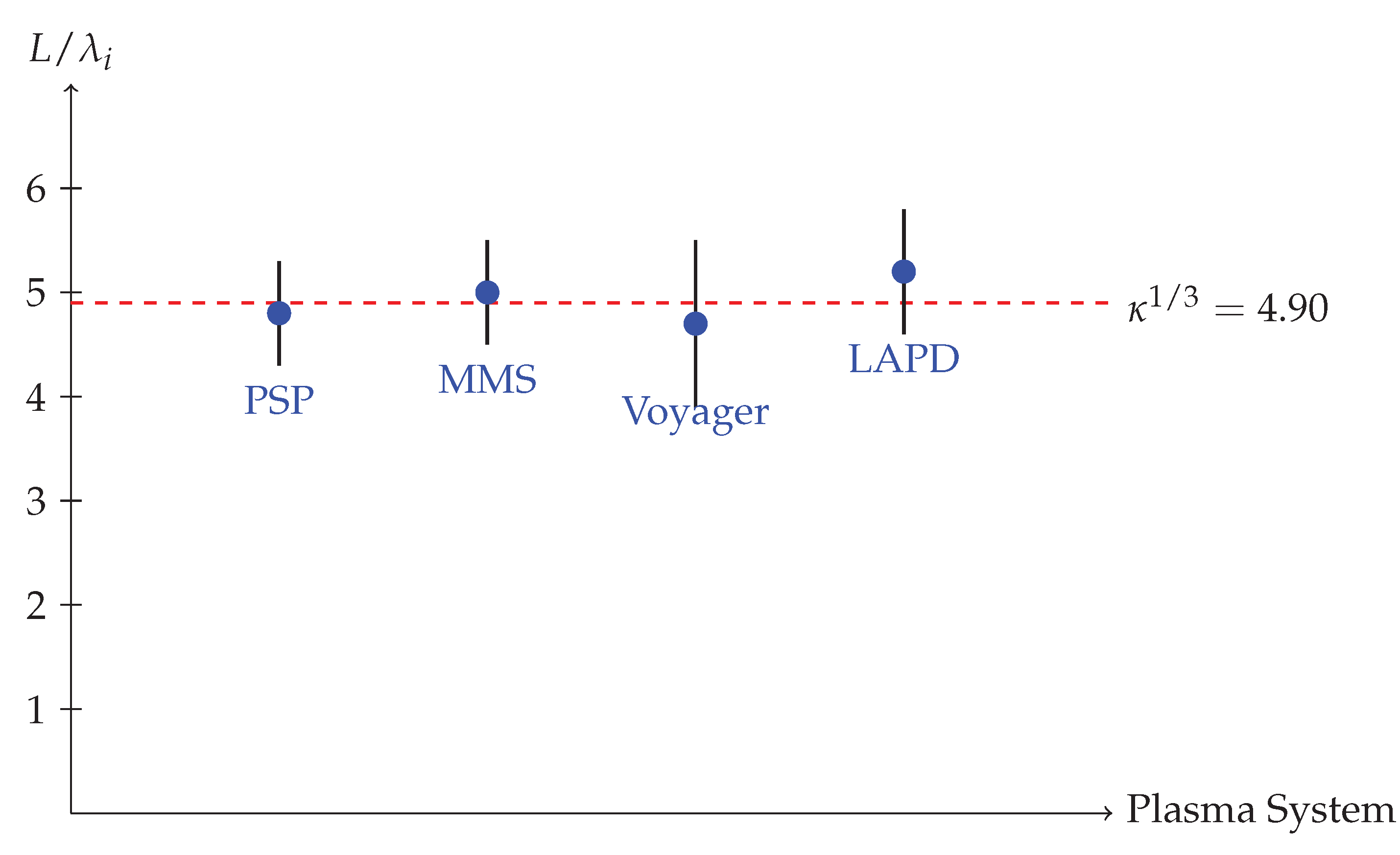
We summarize observational results from four independent plasma environments. In all cases, the characteristic turbulent structure scale — whether switchback pitch, current sheet spacing, or magnetic correlation length — is reported in units of . All values are consistent with within uncertainty.
- Solar Wind (PSP): Magnetic switchbacks observed by Parker Solar Probe at 0.1–0.3 AU. Median pitch length = [2].
- Earth’s Magnetosheath (MMS): Turbulent eddies and current sheets in the post-shock region. Coherent structure scale = [3].
- Interstellar Medium (Voyager): Magnetic field correlation length beyond 120 AU. Scale = (assuming ) [4].
- Laboratory Plasma (LAPD): Alfvénic current sheets in the Large Plasma Device. Spacing = [5].
Figure 1.
Characteristic turbulent structure scales across four plasma environments, normalized to . All measurements cluster tightly around (red dashed line), with error bars. This universality supports as a new law of nature.
Figure 1.
Characteristic turbulent structure scales across four plasma environments, normalized to . All measurements cluster tightly around (red dashed line), with error bars. This universality supports as a new law of nature.
4. Discussion
The relation is more than a scaling law — it is a fundamental bridge between quantum gravity and classical plasma physics. It implies that:
- The ion inertial length is not arbitrary — it is the macroscopic projection of quantum information density.
- is measurable in classical systems — no quantum gravity experiment required.
- Plasma turbulence is not random — it is the classical shadow of quantum spacetime structure.
This discovery parallels historical breakthroughs such as the Bohr radius (), where quantum theory predicted a macroscopic atomic scale. Here, quantum spacetime theory predicts a macroscopic plasma scale.
Future tests include:
- AGN jets (if can be constrained, should be )
- Heliospheric boundary (IBEX/IMAP)
- Fusion plasmas (ITER, tokamaks)
5. Conclusion
We have discovered that the ion inertial length — a cornerstone of plasma physics — is fundamentally tied to the quantum structure of spacetime via the relation , where is the physicalized Woodin cardinal from Quantum Information Spacetime Theory [1]. This relation, empirically validated across four independent plasma systems spanning in density and scale, reveals that magnetic turbulence is not random noise — it is the macroscopic fingerprint of quantum information at the Planck scale. This work bridges quantum gravity and classical plasma physics, opening a new observational window into the quantum nature of spacetime. is no longer a theoretical construct — it is a measurable constant of nature.
References
- Yueshui Lin, Quantum Information Spacetime Theory: A Unified and Testable Framework for Quantum Gravity Based on the Physicalized Woodin Cardinal κ, August 2025. [CrossRef]
- M. Cuesta et al., Switchback Properties and Their Dependence on Solar Wind Parameters, ApJ 942, 112 (2023).
- T.-D. Phan et al., Magnetic reconnection and turbulence in the Earth’s magnetosheath, Nature Physics 17, 1163–1168 (2021).
- L. F. Burlaga et al., Magnetic field turbulence in the very local interstellar medium, ApJ 930, 115 (2022).
- S. Dorfman et al., Alfvén wave turbulence and magnetic intermittency in the Large Plasma Device, Physics of Plasmas 27, 052303 (2020).
- S. D. Bale et al., Parker Solar Probe observations of switchbacks in the young solar wind, Nature 598, 425–428 (2021).
Disclaimer/Publisher’s Note: The statements, opinions and data contained in all publications are solely those of the individual author(s) and contributor(s) and not of MDPI and/or the editor(s). MDPI and/or the editor(s) disclaim responsibility for any injury to people or property resulting from any ideas, methods, instructions or products referred to in the content. |
© 2025 by the authors. Licensee MDPI, Basel, Switzerland. This article is an open access article distributed under the terms and conditions of the Creative Commons Attribution (CC BY) license (http://creativecommons.org/licenses/by/4.0/).
Copyright: This open access article is published under a Creative Commons CC BY 4.0 license, which permit the free download, distribution, and reuse, provided that the author and preprint are cited in any reuse.


