

Submitted:
07 September 2025
Posted:
08 September 2025
You are already at the latest version
Abstract
This research is mainly focussed on the prospects of producing pulp and paper from sustainable plant source. Fibers of matured Luffa cylindrica fruit were considered for this study. The chemical composition studies showed that these fibers contain 82.4% of holocellulose, 11.2% of lignin and 0.63% of ash. These fibers were observed through light microscope and the important fiber parameters such as fiber diameter, fiber lumen and cell wall thickness were measured. Based on the observed values, the derived indices that determine a fiber’s suitability for pulping such as Runkel index, slenderness ratio, co-efficient of rigidity, flexibility co-efficient, Luce’s shape factor and Solids factor of the fibers were evaluated. The derived indices, fiber morphology and chemical composition were found similar to the fibers used for paper and pulp production ascertaining the objectives.
Keywords:
Luffa cylindrica fibers
; chemical analysis
; pulp and paper fiber morphology
; derived indices
; sustainability
1. Introduction
Paper is a very thin material used to prepare documents, paintings, wrappings and is prepared from wood and cellulose fibers. The basic raw material used for the production of paper is pulp, especially wood pulp. Wood pulp may be derived from both hard wood tress such as birch, aspen, eucalyptus and from softwood trees such as pine, spruce, hemlock and larch [1]. Papers are used as a medium for storing valuable information for a very large number of years and even now in this digital age the usage of paper and paper products is on the rise [2]. The Global paper consumption report says that more than 50kg of paper is currently used by every human and the paper consumption of 500 million tons during 2020 is expected to be doubled during 2050. Apart from writing and printing, paper is used for wrappings, billings, copying, education and communication making its need inevitable and its market capitalization is forecasted to be 370 billion U.S. dollars by 2027 [3]. All these applications lead to economic development of a country. The need and growth of paper usage can be witnessed from the increase in production of pulpwoods. It was reported that 60,18,36,690 m3 of pulpwood were produced in 2010 and it rose to 70,86,40,761m3 in 2019 which is 17.7% higher when compared to 2010 as per the United Nations (U.N.) statistics of Food and Agricultural Organization (FAO). This evinces that demand for pulp products will be increasing furthermore and hence alternate sources for producing pulp and paper products shall be vetted [4]. This stimulates us to maintain proper supply of pulp to the paper producing industries so that they remain unaffected. Bamboo is the main source for producing paper in India in addition to the wood fibers and agricultural residues [5]. About 40% of the paper needs are satisfied through imports. Similar to this many countries are unable to satisfy their paper needs and hence they cut trees and also try to mitigate paper imports using alternate source for producing paper and pulp. Deforestation causes climatic change and other problems, hence, sustainable measures need to be undertaken so that they do not leave any carbon footprint [6]. To accomplish this, non-wood fibers are also studied for pulp and paper production. Hence, remnants of agricultural produces like rice straws, wheat straws, sorghum, reeds, phragmites, cotton stalks, abaca, sugarcane bagasse, Bambusa stenostachya, Neosinocalamus affinis and Dendrocalamus strictus are studied by researchers to covert waste into value pulp [7]. Generally varieties of Eucalyptus trees such as Eucalyptus globules, Eucalyptus grandis, Eucalyptus camaldulesnsis, Eucalyptus regnans, Eucalyptus tereticornis etc. were found as promising sources to produce paper and pulp [7,8,9]. All these varieties are fast growing and deliver fiber woods within five to ten years after planting. Hence they are mostly preferred for pulp and paper production. Studies on pulp and paper making show huge potential in lignocellulosic fibers and more new sources are also identified. In a recent review, it was reported that sugar palm fibers can be used for making cigarette papers. Discarded lignocellulosic fibers from Cocos nucifera fruit were explored recently for their prospects in pulp and paper production [10]. It was concluded that these fibers are a good source for pulp and paper production based on fiber morphology and derived indices.
The prime requirement of a fibrous and non-fibrous wood material to be used in making pulp and paper is dependent on its chemical composition and morphological features. Hence these characteristics are studied before deploying a material to be used for producing paper and pulp. The morphological characteristics include fiber length, fiber lumen diameter, cell wall thickness and the fiber diameter. The efficiency and the quality of the pulp being produced depend on these morphological characteristics. These characteristics vary adversely between species and within the species on account of various external factors such as climatic conditions, soil type, age and height of the plant [11].
Amongst the fiber parameters, fiber length influences tear strength and lengthy fibers are preferred in paper production due to their high tear strength. The strength of a paper, sheet density and the pulp yield are controlled by the fiber wall thickness. Fibers with large lumen width ensure better beating and fiber flattening and these fibers are called as thin-walled fibers. Considering all these parameters, certain derived indices were reported to evaluate the quality of pulp and paper produced using these fibers. Runkel ratio, Rigidity ratio, Slenderness ratio, Co-efficient of flexibility, Luce’s shape factor and Solid’s factor are some indices that aid in adjudicating a fiber’s potential in making pulp of good quality. In addition to this, an investigation of the chemical contents such as the holocelluose and lignin in a fiber is imperative. High holocellulose and low lignin content are considered favourable for pulp and paper production [10].
In this study, fibers extracted from the ripened Luffa cylindrica fibers were considered to find their appropriateness for producing pulp and paper. Luffa cylindrica plant is an edible climber that belongs to the Cucurbitaceae family and a habitat of South Asia. This fruit when young is edible and taken as vegetable, while matured fruit is inedible with a strong naturally formed mesh of fibers and is used as bath sponge. Figure 1 shows a completely ripened and matured Luffa cylindrica fruit. Fibers of this fruit were studied by many researchers for making many useful products and it is declared as a cash crop for fabricating composites, making bath sponges, packaging items, air filters, medicines etc [12,13,14]. In order to meet out the increasing demand of pulp and paper products and to find out new sources for producing pulp and paper the Luffa cylindrica fibers were selected. This can reduce dependence and over exploitation of commonly used fibers for producing paper and can help in utilizing new and underutilized fibers for producing pulp and paper seamlessly. Hence in this study chemical composition, Fourier Transform Infrared (FTIR) spectroscopic analysis, morphological studies were conducted on the completely ripened Luffa cylindrica fibers.
2. Material and Methods
2.1. Collection of Materials
Luffa cylindrica fibers were taken from a matured Luffa cylindrica fruit in a plant at Pattam village, Sivagangai District, Tamil Nadu State, India. The fruit was completely ripened and left undetached from the plant making it fibrous. This outer cover of this inedible fruit was peeled off and the inner core fibers were taken, cut and cleaned with tap water continuously several times to eliminate dirt, mud and other unwanted particles. Then they were washed using distilled water and kept under sunlight for a week and used for further studies.
2.2. Determination of Chemical Composition
The moisture content in the extracted fibers were expelled by placing the fibers in an oven maintained at 105°C for 4 hours before further analysis. The holocellulose and Klason lignin content were determined as per D1107-96 (2007) and D1106-96 (2007) standards respectively. A conical flask was taken and 180ml of distilled water was added to it. Then sodium acetate, sodium chloride and ethanolic acid of mass 8.6gms, 6.6gms and 5.7gms respectively were added to it. Fiber sample was placed inside the conical flask and was covered. It was kept under a fuming chamber for four hours whose temperature was maintained as 60°C. The solution changed its colour and the whitish sample was washed, filtered and dried in an oven at a temperature of 105°C for four hours and weighed. The ratio of the sample weight to the initial dry weight gives the weight% of holocellulose. A predetermined mass of the fiber was kept a bath containing sulphuric acid. The temperature of the bath was maintained at 15°C. After thorough mixing it was transferred to a water bath maintained at 15°C followed by heating the contents for four hours. Later the contents were filtered, dried and weighed. The weight ratio of this dried lignin to the initial moisture free mass shows the Klason lignin content. ASTME1755-01 standard was used to find the % of ash content present in these fibers. Two grams mass of the fiber sample was dried in an oven at 100 - 105°C until its weight becomes constant. Carbon content present in the fibers was removed by heating the contents at a temperature of 550°C using a muffle furnace. This was continued after alternate cooling and heating until a constant weight is obtained and the weight is noted. The difference in weight of the sample before and after the heating shows the ash content present in the fibers.
2.3. Fourier Transform Infra-Red Spectroscopy
FTIR analysis of the Luffa cylindrica fibers taken from the ripened fruits was done using a Shimadzu (FTIR 8400S, Japan) spectroscope. Initially the cleaned fibers were powdered and pressed using Potassium bromide (KBr) powder forming pellets. The spectrum was recorded in the wave number ranging from 500 to 4000 cm-1 at 2cm-1 resolution. The analysis was conducted with a scan rate of 32scans/min.
2.4. Determination of Fiber Dimensions
Fiber morphology is an important stricture that tells the prospects of a fiber to be used for producing paper and pulp. Fiber length, fiber diameter, lumen diameter and cell wall thickness were reported to control a fiber’s suitability to be used in making paper [15]. In this study twenty samples of fibers were chosen and were observed through a light microscope (Coslab, India). The fiber morphology was studied in accordance with standards specified by International Association of Wood Anatomists (IAWA) (1989). Based on these dimensions of the fiber namely Fiber Diameter (FD), Fiber Length (FL), Lumen Width or Lumen Diameter (LW) and Fiber Wall Thickness (FWT) the derived parameters discussed in the subsequent section were evaluated.
2.5. Determination of Derived Indices of Fibers
The commonly used derived indices that are used for finding a fiber’s potential in making pulp and paper are Runkel ratio, Co-efficient of flexibility, Slenderness ratio, Rigidity ratio, Luce’s shape factor and Solid’s factor. All these indices were evaluated using the following Equations (1) to (6) [16,17,18,19].
Runkel ratio = (2 x FWT/LW)
Slenderness ratio = (FL / FD)
Co-efficient of flexibility = (LW / FD)
Rigidity ratio = (FWT/FD)
Luce’s shape factor = (FD2 – LW2) / (FD2 + LW2)
Solids factor = (FD2 – LW2) x FL
3. Results and Discussion
3.1. Chemical Composition
The chemical analysis test conducted on the Luffa cylindrica fibers shows that the holocellulose (Cellulose + hemicellulose) content in the fibers is found as 82.4% by weight. Fibers with holocellulose content greater than 33% are related to high pulp yield and are mostly preferred [20]. Most plant species contain more than 70weight% of holocellulose and it gives strength to the fibers and the internal stress is reduced. The holocellulose content of some fibers studied and found suitable for producing paper includes Tobacco stalks (67.79%), Canola stalk (73.6%), Paulownia (75.74%) and Reed (77.9%) [21]. The chemical constituents present in the Luffa cylindrica fibers are shown in Table 1. Lignin is another major constituent present in the lignocellulosic fibers. It adds rigidity to the plant and increases bonding strength. But lignin creates difficulties in breaking the fiber bonds during the process of pulping. More lignin content consumes more chemicals and time during the process of pulping which increases the pulping costs. Hence fibers with lignin content less than 30% are deemed fit for pulp and paper production. In this present study, the lignin content is 11.2% which is agreeable and lesser than the lignin content present in pulp producing fibers such Tobacco stalks (18.9%), Canola stalk (17.3%), Paulownia (20.5%) and Reed (18.7%) [21,22]. Ash is another constituent in fibers and it is the combustion residue left after heating the fibers to a temperature greater than 525°C. Presence of metal salts like carbonates, phosphates and oxalates of silicon, magnesium, manganese and iron represents the ash content in fibers. Lesser the ash content better is the pulp quality. Ash content in the Luffa cylindrica fibers was found as 0.63%. This is lesser than many fibers like cotton stalk (2.4%), reed (3.9%) and slightly more than Paulownia fibers (0.21%). All the constituents present in Luffa cylindrica fibers are favourable and within the admissible range evincing that these fibers can be suited for paper and pulp production.
3.2. Fourier Transform Infra-Red Spectroscopy
The FTIR spectrum of the Luffa cylindrica fiber is illustrated in the Figure 2. The spectrum shows a broad nose peak at 3333 cm-1 which corresponds to the O-H stretching vibration of the polysaccharides present in the fibers [25]. Other peaks of less intensity are also seen at 3840, 3740 and 3618cm-1. A sharp peak noticed at 2912 cm-1 is associated with the C-H asymmetric stretching confirming the presence of fiber constituents especially cellulose in the fibers. The tiny peak at 2307 cm-1 represents the O-H stretching of carboxylic acid. The sharp pointed peak at 1670 cm-1 is ascribed to the carboxylic groups (C=O) of lignin and hemicellulose in the fibers. The peak at1433 cm-1 is associated to the CH2 bending vibrations showing the presence of cellulose in them. The stretching vibration of carbonyl (–C = O) bond is assigned to the peak at 1265 cm-1 confirming the presence of lignin. The C-OH vibration that is assigned to hemicellulose is related to the sharp and pointed peak at 1033 cm-1. Small intensity peaks found at 842, 686 and 580 cm-1 are assigned to the symmetric ring-stretching mode of glycosidic bonds representing the presence of polysaccharides in the fibers. Thus the peaks confirm the presence of fiber constituents from their functional groups.
3.3. Determination of Fiber Dimensions
3.3.1. Fiber Length
The fiber lengths of the Luffa cylindrica fibers observed in this present study lie in the range 912 - 1108μm. The mean fiber length was found as 995.6 ± 53.92μm. The mean fiber length of these fibers is smaller than the non-wood fibers like tobacco stalks (1.23μm) canola stalks (1.17μm), corn stalk (1.32μm) and reeds (1.39μm) respectively and is more than rice straw stalks (0.89μm) and paulownia (0.82 μm) [22,26]. Fiber length represents the count of bonding sites on the fiber that may be used to form fiber network. Long fibers provide resistance against tearing of papers and are preferred. Table 2 shows the dimensions of Luffa cylindrica fiber.
3.3.2. Fiber Diameter
Fiber diameter is another morphological feature associated with pulp yield and fibers with small diameter provide flexibility and required paper density. They form high contact surface and paper made are strong with good tearing resistance. The mean fiber diameter in this present study was 16.31 ± 1.4 μm. This value is similar to the diameter of the bamboo, rice straw and reed fibers reported as 15.1μm, 13.5μm and 14.8μm respectively [27,28].
3.3.3. Lumen Width
Fiber lumen width is a vital ultra structural parameter that is related to the mechanical strength, and thermal conductivity of the fibers. Lumen is a tiny aperture through which necessary nutrients are inducted into the fiber and is also related to the pulping process. Beating of pulp is a process involved in pulping and fibers with large lumen width are susceptible to permit more fluids into it so that pulp yield would be high. Small lumen do not allows more fluids to pass through them during pulping resulting in low yield of pulp. Hence fibers with large lumen width are preferred. The lumen width of Luffa cylindrica fibers were observed as 10.4 ± 1.29 μm. This value is quite comparable with the lumen width of Canola stalk (12.5μm), Corn stalk (10.7 μm), and 9.2 ± 3µm [6,29].
3.3.4. Fiber Cell Wall Thickness
Fiber cell wall is another anatomical parameter that should be considered for pulp production. Cell walls are initially thinner in nature during young stage and they become thicker towards maturity. It is used to find the age of a plant. Papers made from thick walled fibers are coarse with less tensile strength and tearing resistance with large void content [30]. Hence thin walled fibers are preferred and in this study the fiber cell wall thickness of the fibers were found as 3.11 ± 0.76±μm. This value is smaller than many of the fibers confirming that these fibers are suitable for manufacturing papers that are dense and smooth. The fiber wall thicknesses of reed and bamboo fibers were reported as 3.2 and 4.1μm respectively [27].
3.4. Derived Indices of Fibers
Fiber’s capability to yield pulp and paper product can be verified using the derived indices. These derived indices help in identifying a fibers paper producing potential from the calculated derived indices namely Runkel ratio, co-efficient of flexibility, slenderness ratio, rigidity ratio and Luce’s shape factor. These indices of the fibers were found and reported.
3.4.1. Runkel Ratio
The Runkel ratio is the computed as the ratio of fiber cell wall thickness to its lumen width. It signifies the suitability of a fibrous material for pulp and paper production. The flexibility, bulkier nature and stiffness of a paper were computed using the relation. [22,31]. Thick walled fibers produce bulky and poor quality papers. Pulp produced using these fibers can be used as additives to replace hardwood fibers in small quantities to produce papers of various grades. Generally, fibers with Runkel ratio less than 1 are preferred for producing quality papers. In this study, Runkel ratio of the Luffa cylindrica fibers was found as 59.77%. This Runkel value is quite similar to the Runkel values of Bambusa vulgaris, Setaria glauca and Oxythenantera abyssinica reported as 0.55, 0.57 and 0.60 respectively [27,32]; Similar Runkel ratios were reported for Crotolarea pallida (0.60) and Sida cordifolia (0.69) fibers which were concluded to be suitable for pulp production.
3.4.2. Slenderness Ratio
Slenderness ratio of a fiber is obtained by dividing the value of fiber length by fiber diameter. This factor shows the tearing property of paper. If the slenderness ratio of a fiber is greater than 33, then the fiber can be used for producing papers. But higher values are considered to produce high quality paper. Slenderness values are used to classify the elastic nature of a fiber. According to Ververis et al (2004), if the slenderness ratio is greater than 75, the fibers are high elastic fibers. If the slenderness ratio is between 50 and 75, then the fibers are elastic in nature. On the other hand if the slenderness values of the fibers are in the range from 30 to 50, they are rigid fibers and high rigid fibers have a very low slenderness values (< 30).The present study showed the slenderness of the Luffa cylindrica fibers as 61.04% producing that these fibers are elastic in nature and can be used for producing quality pulp. The slenderness ratio of Alstonia boonei was found and reported as 61% which is nearly equal to the slenderness value of the fibers used in the present study [33].
3.4.3. Coefficient of Flexibility
Coefficient of flexibility of a fiber is usually expressed in percentage and is deduced from the ratio of lumen width to fiber diameter. This parameter determines the elasticity or rigidity nature of the fibers and controls the tensile strength, burst strength and folding endurance of the papers [34]. Coefficient of flexibility gives the bonding strength of individual fiber and by extension the tensile strength and bursting properties [35]. Based on coefficient of flexibility fibers are classified as highly rigid, rigid, elastic and highly elastic with their respective coefficient of flexibility values lesser than 0.3, between 0.3 and 0.5, between 0.5 and 0.75 and greater than 0.75. The present study showed that Luffa cylindrica fibers have coefficient of flexibility value as 0.637 confirming the elastic nature of fibers. Elastic fibers are best suited for producing writing and printing pages unlike rigid fibers that are used for packaging purposes. Fibers of this kind can be easily made into thin and strong sheets with large surface area and nice bonding. Similar kind of values (0.61 - 0.69) were obtained for Alstonia boonei fibers [33].
3.4.4. Rigidity Coefficient
The cell wall thickness of a fiber is used to determine the tearing resistance and the rigidity of a fiber. Dividing the cell wall thickness and the diameter of fiber result in a parameter termed as Rigidity coefficient. It is a measure that specifies a fiber’s pulp making capability with respect to conformability and energy requirements. Rigidity values less than 0.5 are considered suitable for making pulp. To be precise, the rigidity coefficient values of soft and hardwood fibers should respectively lie in the range 0.13 – 0.2 and 0.15 – 0.35 for making high strength papers. In the present case, the rigidity coefficient of Luffa cylindrica fibers is 0.19. This value confirms that these fibers require less energy and are highly conformable. The rigidity values that support the values of the present research are Solanum lycopersicum (0.23) and Capsicum annuum var. grossum 0.24 [27].
3.4.5. Luce’s Shape Factor
Luce’s shape factor is an important fiber index and is directly related to paper sheet density and shows the measure of resistance of the pulp to beating. It was evaluated using the Equation 5 considering the fiber diameter and lumen width. Luce’s shape factor values less than 0.5 are considered good for paper and pulp making, however, Eucalyptus species such as Eucalyptus tereticornis, Eucalyptus camaldulensis and Eucalyptus globules were reported to possess values of 0.72, 0.37 and 0.42 respectively [7,36]. All these species were reported to be used to making pulp and paper. It was reported that the Luce’s shape factor lies between 0.51 and 0.73 for Spondia mombin fibers. The Luce’s shape factor of Luffa cylindrica fibers is 0.42 which is less than 0.5 and agree with the values reported by researchers making these fibers fit for paper production.
3.4.6. Solid’s Shape Factor
Solid’s shape factor is inversely associated with the resistance of pulp to beating and resistance of paper to bending. The fiber diameter, lumen width and fiber length are the fiber parameters that influence the Solid’s shape factor of fibers. In this study the Solid’s shape factor of Luffa cylindrica fibers is 157.3685x103 μm3. This value is consistent with the values reported for Alstonia boonei and juvenile beech wood which was reported as 140.380 x103 μm3. The Hybrid Dwarf Yellow variety of Cocos nucifera fiber were reported to have a Solid’s shape factor of 146 x103 μm3 in line with the present research [37]. This factor yields high resistance of paper to bending and low resistance of pulp to beating. Papers with good strength were obtained from fibers with low Luce’s Shape Factor and Solids Factor [27]. The derived indices of some fibers recommended for paper making is shown in Table 3.
The chemical composition studies, FTIR analysis and the fiber morphological observations on the Luffa cylindrica fibers have shown that these fibers are capable for producing pulp and paper. Holocellulose content present in the fibers is comparatively higher than many of the fibers used for pulp and paper production. Less proportion of lignin is another major advantage that is present in the fibers. This reduces the time and cost of pulping process. Also, the less Runkel ratio, rigidity coefficient, high slenderness ratio and coefficient of flexibility are some derived indices that support the fibers to be used for pulp production. In addition, other traits such as microfibrillar angle, fiber surface roughness, or porosity also influence pulp and paper properties. Luffa cylindrica fruits are found in many places and do not require any special attention for its growth. Moreover, many different species of Luffa fruits are available and a judicious usage of these fibers can make this species as a viable cash crop.
4. Conclusions
The chemical composition, FTIR spectroscopic analysis and fiber morphology studies conducted on the cellulosic fibers extracted from matured Luffa cylindrica fruits corroborated that these fibers can be used for pulp and paper production. This plant species do not require special and tedious procedures for its cultivation and do not leave any carbon footprint or any detrimental by product to the environment. The plant has excellent scope for material recovery and effective strategies can be developed for sustainable management and resource conservation.
References
- Dutt, D.; Tyagi, C.H. Comparison of various eucalyptus species for their morphological, chemical, pulp and paper making characteristics. Indian Journal of Chemical Technology 2011, 18, 145–151. [Google Scholar]
- Gopal, P.M.; Sivaram, N.M.; Barik, D. Paper industry wastes and energy generation from wastes. In Energy from Toxic Organic Waste for Heat and Power Generation; Woodhead Publishing; pp. 83–97. [CrossRef]
- Przybysz, K.; Małachowska, E.; Martyniak, D.; Boruszewski, P.; Iłowska, J.; Kalinowska, H.; Przybysz, P. Yield of Pulp, Dimensional Properties of Fibers, and Properties of Paper Produced from Fast Growing Trees and Grasses. BioResources 2018, 13, 1372–1387. [Google Scholar] [CrossRef]
- Anthonio, F.; Antwi-Boasiako, C. The characteristics of fibres within coppiced and non-coppiced rosewood (Pterocarpus erinaceus Poir.) and their aptness for wood - and paper -based products. Pro Ligno 2017, 13, 27–39. [Google Scholar]
- Sharma, A.K.; Dutt, D.; Upadhyaya, J.S.; Roy, T.K. Anatomical, morphological, and chemical characterization of Bambusa tulda, Dendrocalamus hamiltonii, Bambusa balcooa, Malocana baccifera, Bambusa arundinacea, and Eucalyptus tereticornis. BioResources 2011, 6. [Google Scholar] [CrossRef]
- NagarajaGanesh, B.; Rekha, B.; Kailasanathan, C.; Ganeshan, P.; Mohanavel, V. Sustainable fiber extraction and determination of mechanical and wear properties of Borassus flabellifer sprout fiber-reinforced polymer composites. Biomass- Convers. Biorefinery 2024, 15, 6859–6870. [Google Scholar] [CrossRef]
- Balasubramanian, N.; Balasubramanian, R. Turning Discarded Agricultural Remnants and Poultry Waste into Usable Hybrid Polymer Matrix Reinforcements: An Experimental Study. J. Compos. Sci. 2024, 8, 411. [Google Scholar] [CrossRef]
- Pirralho, M.; Flores, D.; Sousa, V.B.; Quilhó, T.; Knapic, S.; Pereira, H. Evaluation on paper making potential of nine Eucalyptus species based on wood anatomical features. Ind. Crop. Prod. 2014, 54, 327–334. [Google Scholar] [CrossRef]
- Ibrahim, M.F.E.; Abdelazim, Y.A. Effect of growth rate on fiber characteristics of eucalyptus camaldulensis wood of coppice origin grown in White Nile State. Sudan J. Nat. Resour. Environ. Stud. 2015, 3, 14–23. [Google Scholar]
- Ohshima, J.; Yokota, S.; Yoshizawa, N.; Ona, T. Examination of within-tree variations and the heights representing whole-tree values of derived wood properties for quasi-non-destructive breeding of Eucalyptus camaldulensis and Eucalyptus globulus as quality pulpwood. J. Wood Sci. 2005, 51, 102–111. [Google Scholar] [CrossRef]
- NagarajaGanesh, B.; Rekha, B.; Mohanavel, V.; Ganeshan, P. Exploring the Possibilities of Producing Pulp and Paper from Discarded Lignocellulosic Fibers. J. Nat. Fibers 2022, 20. [Google Scholar] [CrossRef]
- NagarajaGanesh, B.; Rekha, B. Morphology and damage mechanism of lignocellulosic fruit fibers reinforced polymer composites: a comparative study. SN Appl. Sci. 2019, 1, 1250. [Google Scholar] [CrossRef]
- Tanobe, V.O.; Sydenstricker, T.H.; Munaro, M.; Amico, S.C. A comprehensive characterization of chemically treated Brazilian sponge-gourds (Luffa cylindrica). Polym. Test. 2005, 24, 474–482. [Google Scholar] [CrossRef]
- Querido, V.A.; D’aLmeida, J.R.M.; Silva, F.A. Development and analysis of sponge gourd (Luffa cylindrica L.) fiber-reinforced cement composites. BioResources 2019, 14, 9981–9993. [Google Scholar] [CrossRef]
- NagarajaGanesh, B.; Muralikannan, R. Extraction and characterization of lignocellulosic fibers from Luffa cylindrica fruit. International Journal of Polymer Analysis and Characterization 2016, 21, 259–266. [Google Scholar] [CrossRef]
- Zobel, B.J.; Buijtenen, J.P.V. Wood variation and wood properties. In Wood Variation; Springer: Berlin, 1989. [Google Scholar]
- Luce, G.E. Transverse collapse of wood pulp fibers: Fiber models. In The physics and chemistry of wood pulp fibers (special technical association publication, no. 8) (pp.278–281); Page, D.H., Ed.; Technical Association of the Pulp and Paper industry: New York, United States, 1970. [Google Scholar]
- Malan, F.; Gerischer, G. Wood Property Differences in South African Grown Eucalyptus grandis Trees of Different Growth Stress Intensity. Holzforschung 1987, 41, 331–335. [Google Scholar] [CrossRef]
- Rana, R.; Langenfeld-Heyser, R.; Finkeldey, R.; Polle, A. Functional anatomy of five endangered tropical timber wood species of the family Dipterocarpaceae. Trees 2008, 23, 521–529. [Google Scholar] [CrossRef]
- Afrifah, K.A.; Osei, L.; Ofosu, S. Suitability of Four Varieties of Cocos Nucifera Husk in Ghana for Pulp and Paper Production. J. Nat. Fibers 2021, 19, 4654–4661. [Google Scholar] [CrossRef]
- Rowell, R.M. (Ed.) Handbook of wood chemistry and wood composites; CRC Press: New York, 2012. [Google Scholar]
- Shakhes, J.; Marandi, M.A.B.; Zeinaly, F.; Saraian, A.; Saghaf, T. Tobacco residuals as promising lignocellulosic materials for pulp and paper industry. BioResources 2011, 6. [Google Scholar] [CrossRef]
- Enayati, A.A.; Hamzeh, Y.; Mirshokraie, S.A.; Molaii, M. Papermaking potential of canola stalks. BioResources 2009, 4. [Google Scholar] [CrossRef]
- Sadiku, N.A.; Oluyege, A.O.; Ajayi, B. Fibre dimension and chemical characterisation of naturally grown Bambusa vulgaris for pulp and paper production. Journal of Bamboo and Rattan 2015, 15, 33–43. [Google Scholar]
- Lukmandaru, G.; Zumaini, U.F.; Soeprijadi, D.; Nugroho, W.D.; Susanto, M. Chemical Properties and Fiber Dimension of Eucalyptus pellita from The 2nd Generation of Progeny Tests in Pelaihari, South Borneo, Indonesia. J. Korean Wood Sci. Technol. 2016, 44, 571–588. [Google Scholar] [CrossRef]
- NagarajaGanesh, B.; Muralikannan, R. Physico-chemical, thermal, and flexural characterization of Cocos nucifera fibers. International Journal of Polymer Analysis and Characterization 2016, 21, 244–250. [Google Scholar] [CrossRef]
- Khakifirooz, A.; Kiaei, M.; Sadegh, A.N.; Samariha, A.A. Studies on chemical properties and morphological characteristics of Iranian cultivated kenaf (Hibiscus cannabinus L.): A potential source of fibrous raw material for paper industry in Iran. Research on Crops. 2012, 13, 715–720. [Google Scholar]
- Sharma, M.; Sharma, C.L.; Lama, D.D. Anatomical and fibre characteristics of some agro waste materials for pulp and paper making. International Journal of Agricultural Science and Research 2015, 5, 155–162. [Google Scholar]
- Laftah, W. A.; Rahman, A.W.A. Pulping Process and the Potential of Using Non-Wood Pineapple Leaves Fiber for Pulp and Paper Production: A Review. Journal of Natural Fibers 2016, 13, 85–102. [Google Scholar] [CrossRef]
- Fonseca, A.; Mori, F.; Tonoli, G.; Savastano, H.; Ferrari, D.; Miranda, I. Properties of an Amazonian vegetable fiber as a potential reinforcing material. Ind. Crop. Prod. 2013, 47, 43–50. [Google Scholar] [CrossRef]
- Ververis, C.; Georghiou, K.; Christodoulakis, N.; Santas, P.; Santas, R. Fiber dimensions, lignin and cellulose content of various plant materials and their suitability for paper production. Ind. Crop. Prod. 2004, 19, 245–254. [Google Scholar] [CrossRef]
- Xu, F.; Zhong, X.; Sun, R.; Lu, Q. Anatomy, ultrastructure and lignin distribution in cell wall of Caragana Korshinskii. Ind. Crop. Prod. 2006, 24, 186–193. [Google Scholar] [CrossRef]
- Boadu, K.B.; Antwi-Boasiako, C.; Frimpong-Mensah, K. Physical and mechanical properties of Klainedoxa gabonensis with engineering potential. J. For. Res. 2016, 28, 629–636. [Google Scholar] [CrossRef]
- Afrifah, K.A.; Adom, A.N.A.; Ofosu, S. The Morphological and Pulping Indices of Bagasse, Elephant Grass (Leaves and Stalk), and Silk Cotton Fibers for Paper Production. J. Nat. Fibers 2021, 19, 9782–9790. [Google Scholar] [CrossRef]
- Wangaard, F.F. Contributions of hardwood fibres to the properties of kraft pulps. Tappi 1962, 45, 548–556. [Google Scholar]
- Sangumbe, L.M.V.; Pereira, M.; Carrillo, I.; Mendonça, R.T. An exploratory evaluation of the pulpability of Brachystegia spiciformis and Pericopsis angolensis from the angolan miombo woodlands. Maderas-Cienc Tecnol 2018, 20, 183–198. [Google Scholar] [CrossRef]
- Ohshima, J.; Yokota, S.; Yoshizawa, N.; Ona, T. Examination of within-tree variations and the heights representing whole-tree values of derived wood properties for quasi-non-destructive breeding of Eucalyptus camaldulensis and Eucalyptus globulus as quality pulpwood. J. Wood Sci. 2005, 51, 102–111. [Google Scholar] [CrossRef]
- Afrifah, K.A.; Adjei-Mensah, E. Anatomical and chemical characterization of Alstonia boonei for pulp and paper production. Les/Wood 2021, 70, 5–18. [Google Scholar] [CrossRef]
- Ofosu, S.; Boadu, K.B.; Afrifah, K.A. Suitability of Chrysophyllum albidum from moist semi-deciduous forest in Ghana as a raw material for manufacturing paper-based products. J. Sustain. For. 2019, 39, 153–166. [Google Scholar] [CrossRef]
- Monga, S.; Naithani, S.; Thapliyal, B.P.; Tyagi, S.; Bist, M. Effect of morphological characteristics of indegeneous fibers (E. tereticornis and S. officinarum) and their impact on paper properties. Ippta Journal 2017, 29, 1–5. [Google Scholar]
- Oluwadare, A.O.; Sotannde, O.A. The relationship between fiber characteristics and pulp-sheet properties of Leucaena leucocephala (Lam. ) De Wit. Middle-East Journal of Scientific Research 2007, 2, 63–68. [Google Scholar]
- Rekha, B.; NagarajaGanesh, B. X-ray Diffraction: An Efficient Method to Determine Microfibrillar Angle of Dry and Matured Cellulosic Fibers. J. Nat. Fibers 2020, 19, 3689–3696. [Google Scholar] [CrossRef]
Figure 1.
Completely ripened and matured Luffa cylindrica fruit.
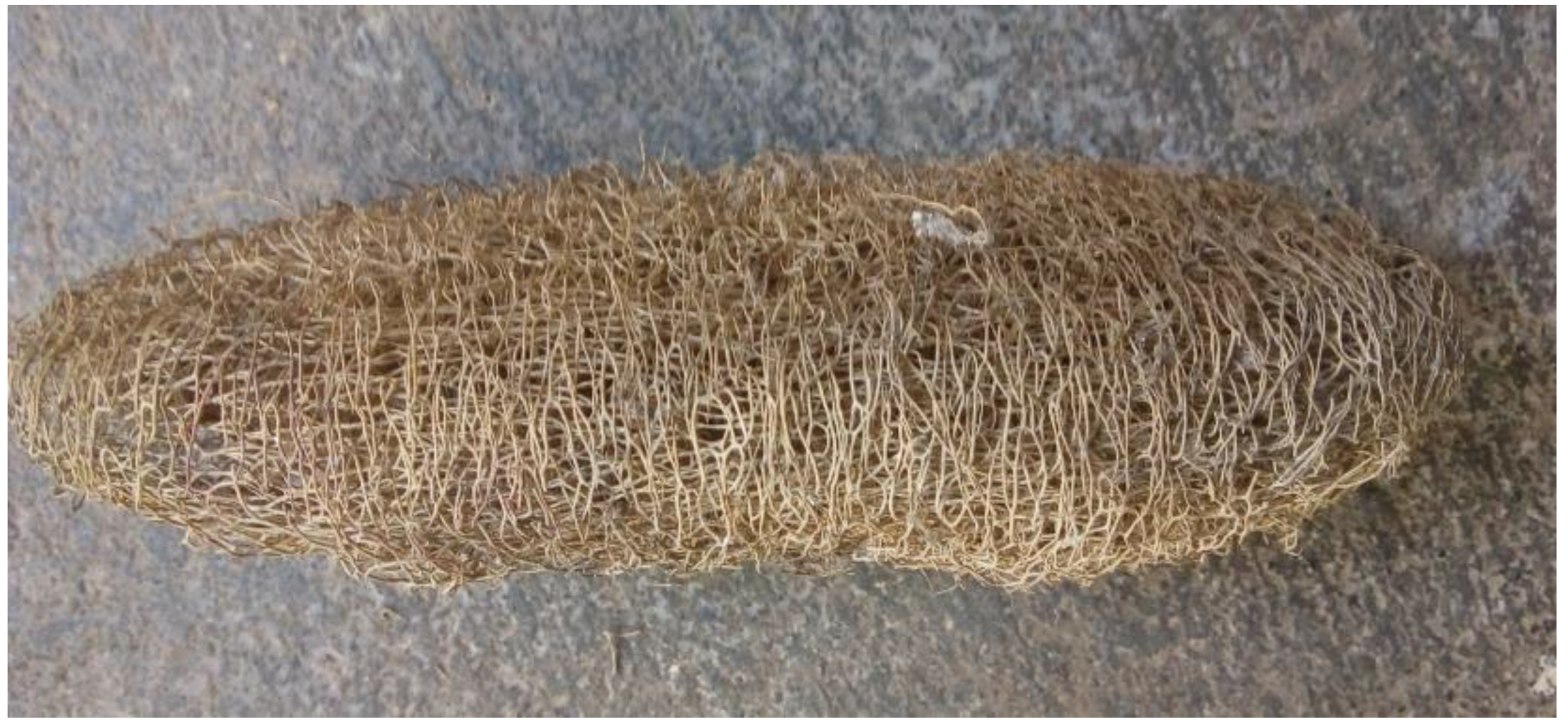
Figure 2.
FTIR spectrum of the Luffa cylindrica fiber.
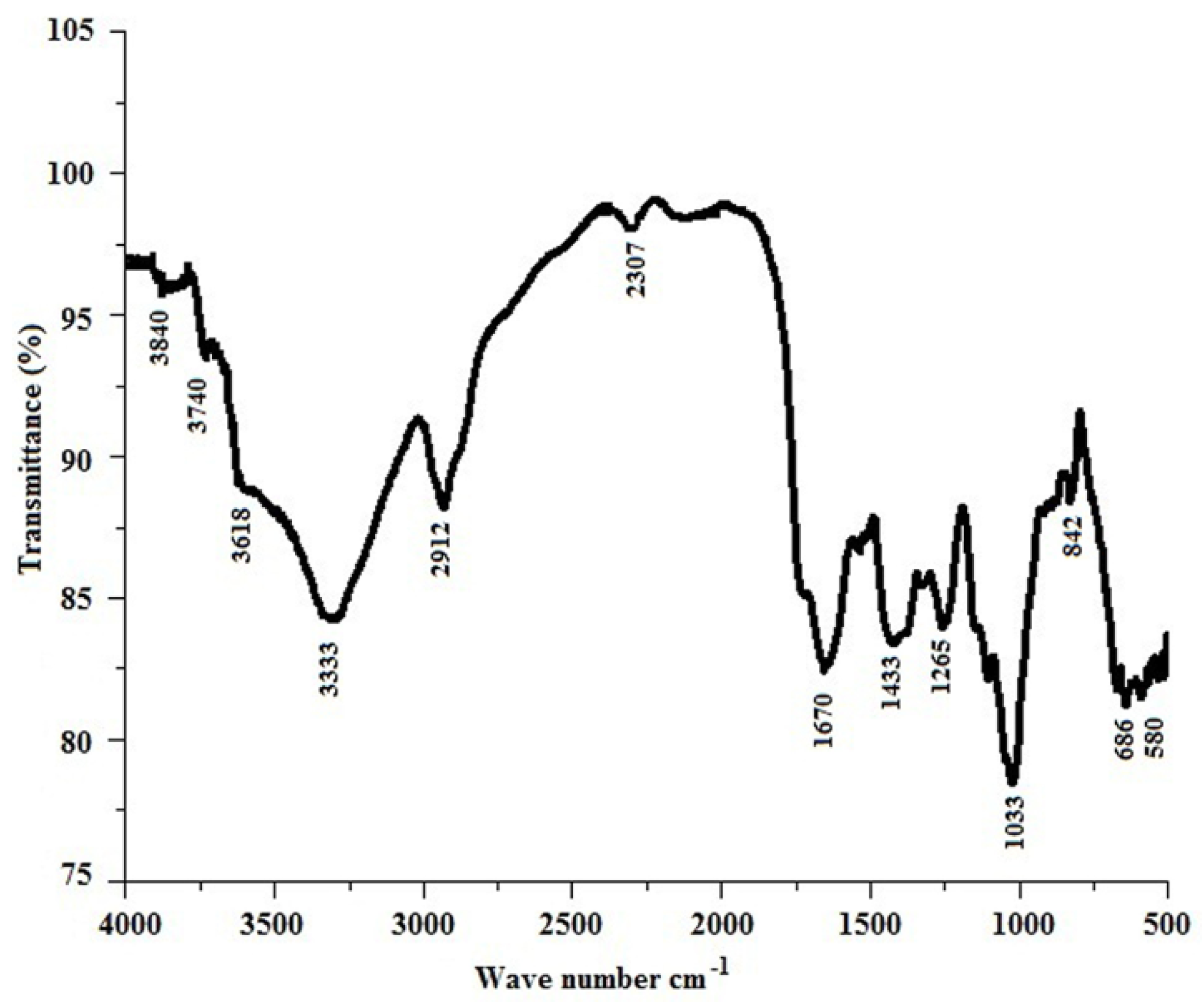

Table 1.
Chemical composition of some fibers used for pulp and paper making.
| Fiber name | Holocellulose | Lignin | Ash content | References |
| % | % | % | ||
| Eucalyptus grandis | 59.8 | 29.6 | 2.87 | [1] |
| Eucalyptus alba | 60.3 | 27.9 | 0.36 | [6] |
| Eucalyptus europhyllia | 64.2 | 26.5 | 0.98 | [6] |
| Reed | 77.9 | 18.7 | 3.9 | [1] |
| Paulownia | 75.4 | 20.5 | 0.21 | [21] |
| Canola stalk | 73.6 | 17.3 | 8.2 | [21] |
| Bamboosa vulgaris | 79.01 | 40.41 | 29.2 | [23] |
| Eucalyptus pellita | 71.07 | 25.5 | - | [24] |
| E. tereticornis | 66.5 | 28.2 | 1.12 | [6] |
| Luffa cylindrica | 82.4 | 11.2 | 0.63 | Current work |
Table 2.
Dimensions of Luffa cylindrica fiber.
| S.No | Fiber length | Fiber Diameter | Lumen diameter | Cell Wall Thickness |
| μm | μm | μm | μm | |
| 1 | 956 | 15.2 | 9.3 | 2.9 |
| 2 | 984 | 16.2 | 9.5 | 3.4 |
| 3 | 964 | 14.7 | 10.3 | 2.3 |
| 4 | 1022 | 16.4 | 12.6 | 2.2 |
| 5 | 1014 | 16.2 | 10.2 | 3.2 |
| 6 | 1036 | 17.4 | 10.3 | 3.6 |
| 7 | 1012 | 18.6 | 14.2 | 2.4 |
| 8 | 956 | 15.3 | 11.1 | 2.3 |
| 9 | 976 | 15.8 | 8.9 | 3.4 |
| 10 | 932 | 16.8 | 10.8 | 3.2 |
| 11 | 912 | 14.6 | 11.1 | 2.1 |
| 12 | 948 | 14.4 | 9.4 | 2.5 |
| 13 | 914 | 14.2 | 10.4 | 2.2 |
| 14 | 1042 | 18.8 | 10.5 | 4.2 |
| 15 | 968 | 15.8 | 9.6 | 3.3 |
| 16 | 992 | 15.6 | 8.6 | 3.6 |
| 17 | 1068 | 17.8 | 12.4 | 2.6 |
| 18 | 1060 | 16.8 | 8.4 | 4.5 |
| 19 | 1048 | 17.2 | 10 | 3.7 |
| 20 | 1108 | 18.4 | 10.2 | 4.4 |
| Mean | 995.6 | 16.31 | 10.39 | 3.1 |
| Median | 988 | 16.2 | 10.25 | 3.2 |
| Mode | 956 | 16.2 | 10.3 | 3.4 |
| Min | 912 | 14.2 | 8.4 | 2.1 |
| Max | 1108 | 18.8 | 14.2 | 4.5 |
| Range | 196 | 4.6 | 5.8 | 2.4 |
| STD | 53.92 | 1.40 | 1.41 | 0.76 |
| N | 20 | 20 | 20 | 20 |
Table 3.
Derived indices of some common fibers used for paper making.
| Fiber name | Runkel ratio | Slenderness ratio% | Coefficient of Flexibility | Rigidity Ratio | Luce shape factor | Solids Factor μm³ | References |
| Chrysophyllum albidum | 0.55 | 46.9 | 0.64 | 0.177 | 0.41 | 346 | [38] |
| Saccharum officinarum | 2.479 | 69.77 | 29.12 | 0.722 | 84 | 634 | [39] |
| Eucalyptus tereticornis | 1.047 | 39.07 | 39.73 | 0.416 | 0.727 | 256 | [40] |
| Leucaena leucocephala | 0.59 | - | 0.63 | - | 0.41 | - | [41] |
| Biden spilosa | 0.46 | 47.33 | 69.01 | - | 0.33 | - | [1] |
| Eupatorium odoratum | 0.52 | 42.3 | 65.81 | - | 0.50 | - | [1] |
| Beema bamboo | 0.69-0.8 | 78.38-101.48 | 56.32-60.39 | - | - | - | [32] |
| Oxythenantera abyssinica | 0.6-0.76 | 82.37-93.92 | 59.75-60.66 | - | - | - | [32] |
| Setaria glauca | 0.57 | 173.15 | 65.57 | 0.35 | 0.4 | 0.86 | [27] |
| Solanum torvum | 0.25 | 24.62 | 80.30 | - | 0.19 | - | [27] |
| Tobacco stalk | 1.16 | 50.59 | 63.26 | - | - | - | [21] |
| Pinus kesiya | 0.22 | 49.04 | 81.74 | - | 0.19 | - | [27] |
| Luffa cylindrica | 0.5977 | 61.04 | 0.637 | 0.19 | 0.42 | 157.36 | Current work |
Disclaimer/Publisher’s Note: The statements, opinions and data contained in all publications are solely those of the individual author(s) and contributor(s) and not of MDPI and/or the editor(s). MDPI and/or the editor(s) disclaim responsibility for any injury to people or property resulting from any ideas, methods, instructions or products referred to in the content. |
© 2025 by the authors. Licensee MDPI, Basel, Switzerland. This article is an open access article distributed under the terms and conditions of the Creative Commons Attribution (CC BY) license (http://creativecommons.org/licenses/by/4.0/).
Copyright: This open access article is published under a Creative Commons CC BY 4.0 license, which permit the free download, distribution, and reuse, provided that the author and preprint are cited in any reuse.


