Preprint
Article

This version is not peer-reviewed.

Serum Vitamin D Levels, Systemic Inflammation and Exacerbations Among Patients with COPD GOLD Group E

Submitted:

22 August 2025

Posted:

08 September 2025

You are already at the latest version

Abstract

Background: Chronic obstructive pulmonary disease (COPD) is associated with systemic inflammation and frequent exacerbations, thus, leading to disease progression and increased morbidity. Vitamin D deficiency has been suggested to be a contributing factor to COPD inflammation and exacerbations. Aim: To investigate the association between serum 25-hydroxyvitamin D [25(OH)D] levels, systemic inflammation and exacerbation frequency among patients with COPD GOLD group E. Methods: A cross-sectional study was conducted on 111 patients with stable COPD. Patients were divided into two groups based on their serum 25(OH)D levels (<50 nmol/L vs. ≥50 nmol/L). Data on exacerbation frequency the past year, inflammatory markers, dynamic lung volumes and symptom burden were collected. Results: Patients with low serum 25(OH)D (<50 nmol/L) had significantly higher CAT-score and level of serum-high sensitivity (hs)-CRP and exhibited significantly more exacerbations compared to those with higher levels (p < 0.001, p < 0.001 and p < 0.0001, respectively). Furthermore, lower vitamin D levels were associated with higher CAT scores (r = -0.30; p < 0.01) and level of serum hs-CRP (r = -0.25; p < 0.01) and significantly more exacerbations (r = -0.74; p < 0.0001). Conclusion: Low vitamin D levels are significantly associated with greater symptom burden, elevated hs-CRP and increased exacerbation frequency in COPD patients group E. These findings suggest that monitoring and treating vitamin D deficiency may be beneficial in COPD patients with frequent exacerbations.

Keywords: 
;  ;  ;  ;  ;  ;  ;  ;  ;  

Introduction

Due to Sweden’s northern latitude and extended periods of low sunlight, maintaining adequate vitamin D synthesis can be challenging [1]. In addition, for patients with severe chronic obstructive pulmonary disease (COPD) physical limitations often reduce outdoor activity [2,3]. Among elderly patients with advanced COPD previous research suggests that 50–70% may display a lack of vitamin D, i.e. serum 25-hydroxyvitamin D [25(OH)D] levels below 50 nmol/L [4,5,6,7]. Since 25(OH)D is the stable circulating metabolite of vitamin D, it is the preferred marker for serum analysis.
The relationship between vitamin D deficiency and COPD progression remains unclear [8,9,10]. It is possible that a lack of vitamin D merely reflects generally poor health, rather than being a direct cause behind COPD progression [11]. However, evidence suggests that vitamin D may have anti-inflammatory effects that could counteract the inflammatory processes involved in COPD [12]. Thus, low serum 25(OH)D levels are associated with poor lung function [13,14,15], increased respiratory symptoms [7,16,17], and reduced quality of life [7,16,18].
Given the known anti-inflammatory effects of vitamin D [12], it is reasonable to investigate the vitamin’s role for COPD exacerbations. Multiple studies have also reported a link between low serum 25(OH)D levels and increased frequency of COPD exacerbations [19,20,21,22,23,24,25]. Two recent studies from 2021 examined the relationship between serum 25(OH)D and systemic inflammation in COPD patients and demonstrated that the strongest correlation was with the inflammatory marker CRP [26,27]. However, the correlations of these two studies were rather weak (Spearman; r = -0.25, p < 0.01 and r = -0.32, p < 0.01, respectively), which might be explained by mixed COPD stages (I–IV) included [26,27]. Thus, to better understand the role of low serum 25(OH)D level in systemic inflammation and COPD exacerbations, we hypothesized that patients with COPD and frequent exacerbations, i.e., GOLD group E, would be more relevant for further studies.
Therefore, the objectives of the present study were to investigate patients with COPD belonging to GOLD group E, to better understand whether low serum 25(OH)D is associated with raised levels in serum of markers of systemic inflammation, and to study relationships between serum 25(OH)D and other clinical variables, such as symptom burden and COPD exacerbation frequency the past year.

Methods

Study Design and Data Collection

The present study is a monocentric, cross-sectional, observational study. The inclusion and criteria for the study were COPD (defined as FEV1/FVC <0.7 after bronchodilator inhalation and symptoms present typical for COPD and FEV1% predicted after bronchodilation <100%), belonging to GOLD group E, in a stable phase and age >45 years. Exclusion criteria were ongoing supplementation with calcium and/or vitamin D, recent COPD exacerbation or infection (treated with antibiotics and/or oral cortisone) two weeks before the inclusion date or ongoing exacerbation, systemic inflammatory disease, mental inability, and unwillingness or language difficulties that would cause difficulties in participating in the study. Patients were included in the study from August 2012 to October 2018.
Data on gender, age, smoking status, body-mass-index (BMI), COPD medications, exacerbation frequency during the past year (only moderate and severe exacerbations were registered), symptom burden (assessed by the COPD Assessment Test; CAT) [28], dyspnea (assessed by the modified Medical Research Council scale; mMRC) [29], and comorbidities (assessed by the Charlson Comorbidity Index; CCI) [30] were registered at inclusion.
Blood oxygenation (SAT) was assessed, and venous blood samples were collected at inclusion to measure the levels of white blood cell count (WBC) and high-sensitivity C-reactive protein (hs-CRP). Dynamic spirometry was performed using a spirometer from Jaeger and Hedenström as a reference [31,32]. Thus, measurements were performed pre- and post-bronchodilator (salbutamol 0.1 mg/dose x 4 doses administrated via a spacer). COPD was staged by airway obstruction, that is, FEV1% predicted 80-100%=GOLD stage I, 50-79%=stage II, 30-49%=stage III, and <30%=stage IV.

Data Handling and Data Protection

All data handling procedures adhered to the guidelines by the General Data Protection Regulation (GDPR). The collected data were anonymized and were securely stored.

Patient and Public Involvement

Patients and the public were not involved in the design or conduct or reporting of the present research. Results were not disseminated to study participants.

Statistical Analysis

The statistics were presented as numbers (n), mean and standard deviation (SD), median and inter quartile range (IQR), and minimum (min) and maximum (max). Correlations were calculated with Pearson’s correlation coefficient (r), when variables fulfilled the normality criterium; otherwise, Spearman’s Rank Test (ρ) was used. The level of significance was 0.05 and the p-values were two-tailed. All analyses were undertaken using IBM SPSS Statistics, vs 27.0.0.0 (IBM SPSS, Chicago, IL, USA).

Ethics

The Swedish ethical review authority (Dnr: 2022-05013-01) granted ethical approval. The study was performed according to ethical rules originating from the Declaration of Helsinki. All mandatory laboratory health and safety procedures have been followed.

Results

Characterization of the Study Population

One hundred eleven patients with COPD, GOLD group E, were included in the data analysis from August 2012 to October 2018, and divided into two groups, those with serum 25(OH)D <50 nmol/L (hereafter called “low”) and those with serum 25(OH)D ≥50 nmol/L (hereafter called “high”). Variables without significant difference are summarized in Table 1. Thus, the two groups did not differ significantly regarding gender, age, smoking status, BMI, mMRC, CCI, WBC, SAT, post-bronchodilator FEV1 % of predicted, GOLD stage and on-going medications for COPD, including LTOT. None of the patients were on calcium and/or vitamin D supplementation.

Vitamin D Status Has a Significant Impact on CAT, hs-CRP and Exacerbation Frequency

The group with patients displaying low serum 25(OH)D had significantly higher CAT-score and level of serum-hs-CRP and exhibited significantly more exacerbations compared to those with high level of serum 25(OH)D (p < 0.001, p < 0.001 and p < 0.0001, respectively). Results are shown in Figure 1.

Vitamin D Level Correlates Significantly with CAT, hs-CRP and Exacerbation Frequency

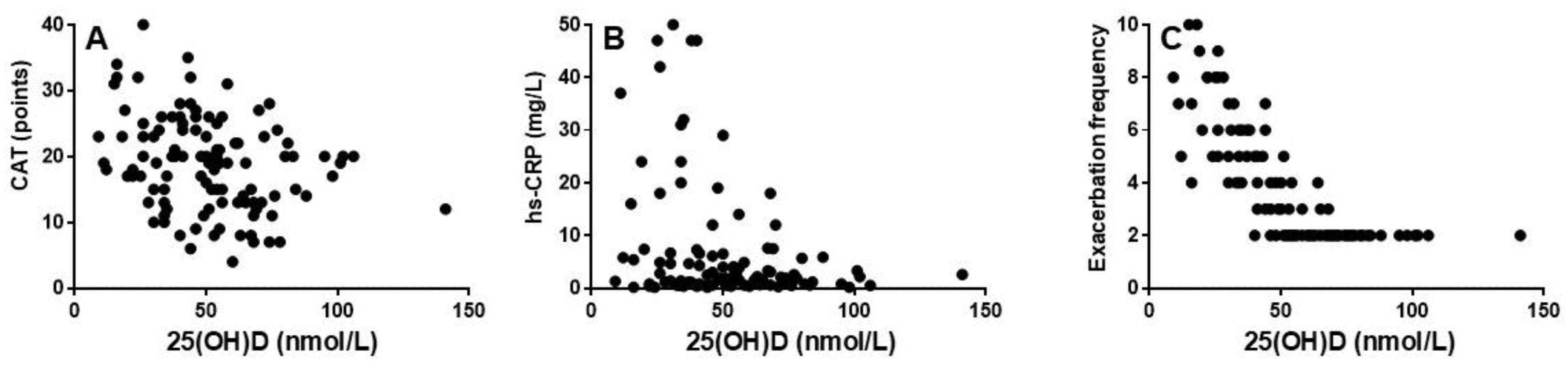
Low serum 25(OH)D was associated with high CAT score (r = -0.30; p < 0.01) and level of serum hs-CRP (Spearman; r = -0.25; p < 0.01) and significantly more exacerbations during the past year (r = -0.74; p < 0.0001) compared to those with high serum 25(OH)D. Results are shown in Figure 2. No significant associations were observed between serum 25(OH) and the other study variables presented in Table 1.

Discussion

In this cross-sectional study of 111 patients with COPD, group GOLD E, without on-going vitamin D supplementation low serum 25(OH)D was associated with a greater COPD symptom burden (shown as high CAT-score), an elevated level of hs-CRP and an increased exacerbation frequency during the past year (Figure 1). To the best of our knowledge, the present study is the first to show, in the same study, that symptom burden, systemic inflammation and exacerbation frequency are all associated with the level of serum 25(OH)D (Figure 2). No significant associations were observed between serum 25(OH)D and the other study variables. These findings reinforce the idea that vitamin D plays a role in immune regulation and inflammation related to COPD.
In a previous study of a cohort of patients with severe COPD, our research team showed that ongoing vitamin D supplementation was the most important intervention to maintain serum 25(OH)D levels above 50 nmol/L [7]. In the present study, none of the patients included was on supplementation with vitamin D. Compared with earlier studies demonstrating 50-70% prevalence of vitamin D deficiency among patients with COPD [4,5,6,7], a more recent Swedish study reported that only 33% of the study subjects demonstrated vitamin D deficiency [33]. In that study, subjects were included from January 2017 to December 2018 and from January to December 2021 [33].
The Swedish regulation on food fortification changed in 2018, to include more products and higher fortification levels of vitamin D [34]. Therefore, more people cover their recommended intake of vitamin D from food. In recent years, increased awareness of the osteoporosis risk among elderly has led to routine prescription of calcium and vitamin D supplements. In addition, due to an increased public awareness among elderly that vitamin D deficiency is associated with an increased risk of respiratory infections [35], purchase of over-the-counter supplements containing vitamin D has increased.
Consequently, the recruitment of patients with COPD with vitamin deficiency and without ongoing vitamin D supplementation has become troublesome. This problem is well illustrated by a recent Dutch, multi-centre, 2-arm, parallel, double-blind RCT over 1 year, studying the effect of vitamin D supplementation on exacerbations; 2 444 patients were screened for eligibility; the major reasons for exclusion were refusal to participate (n=659), no exacerbations in the previous year (n=555), ongoing vitamin D supplementation (n=442) and serum 25(OH)D >50 nmol/L (n=141) [36]. Despite an extension of the predefined inclusion period of 1.5 years to 3.5 years, the predefined sample size (120 in each arm) was not reached [36]. Possibly due to insufficient power, the study did not show any significant effect on exacerbation frequency by vitamin D supplementation [36]. In the present study, all subjects were recruited from August 2012 to October 2018, thus, when vitamin D deficiency still had a high prevalence among Swedish patients with COPD.
Plenty of previous studies have shown that adequate vitamin D levels were associated with less burden of COPD symptoms [7,16,17]. The result of the present study is in line with these studies, as it shows a significant negative correlation between serum-25(OH)D and CAT-score (r = -0.30; p < 0.01) (Figure 2A).
To the best of our knowledge there is only one previous study like the present [27]. Jorde et al. recruited study subjects during 2011–2012 and demonstrated a significant association between low levels of serum 25(OH)D and raised levels of CRP [27]. The correlation was rather weak (Spearman; r = -0.32, p < 0.01; n = 94) [27]. In another study, the same correlation was even weaker (Spearman; r = -0.25, p < 0.01; n = 101) [26]. These observations gave us the idea to test whether this correlation could be strengthened by a study on only frequent exacerbators (n=111), and, by employing high-sensitivity CRP, to achieve a more fine-tuned assessment of the systemic inflammation. In contrast to what we expected, these alterations of the study conditions gave almost the same result (Spearman; r = -0.25; p < 0.01) (Figure 2B). We conclude that the present study provides additional evidence for an association in patients with COPD between vitamin D deficiency and systemic inflammation and past exacerbations (Figure 2B-C).
In the present study, we also analyzed WBC and fibrin, being well-known markers of systemic inflammation. None of these markers demonstrated a significant difference, when patients with low serum-25(OH)D were compared with patients exhibiting high level of serum-25(OH)D (Table 1). We decided to not complete the analysis of IL-6 in all subjects, since Jorde et al [27] already had demonstrated that IL-6 displayed a weaker correlation (Spearman; r = −0.23, p = 0.028) with serum 25(OH)D than CRP did.
Unlike the study by Jorde et al [27], who did not find a correlation between the serum 25(OH)D level and the number of exacerbations during the past year, we found a very strong correlation (r = -0.74; p < 0.0001). This difference was probably due to the selection of patients with frequent exacerbations. This observation is in line with previous studies [19,20,21,22,23,24,25], but, unlike these studies, the present study assesses the important link between systemic inflammation and serum 25(OH)D.
The exact mechanisms of how vitamin D deficiency influence the inflammatory process observed in COPD still require further studies. Notably, the first report on a link between vitamin D deficiency and iron-mediated oxidative damage in the pathogenesis of COPD was very recently published [37]. Thus, vitamin D deficiency was positively associated with glutathione peroxidase 4 reduction and iron parameters elevation in COPD patients [37]. Plenty of studies support the crucial role of transition metals, like ferrous iron, and oxidative damage on lung cells as the cause behind the structural changes observed in airways and lung tissues of patients with COPD [38,39,40,41].

Conclusions

The results of the present study emphasize the clinical relevance of monitoring and addressing vitamin D deficiency in COPD patients, particularly those experiencing frequent exacerbations.

Author Contributions

Both authors made a significant contribution to the work reported, whether that was in the conception, study design, execution, acquisition of data, analysis, and interpretation, or in all these areas; took part in drafting, revising or critically reviewing the article; gave final approval of the version to be published; have agreed on the journal to which the article has been submitted; and agree to be accountable for all aspects of the work.

Funding

The study was supported by the Medical Research Council of Southeast Sweden (FORSS) (Grant No. FORSS-994744). The founders had no role in study design, data collection or analysis.

Data Sharing Statement

The data upon which this analysis was based are available from Professor Hans Lennart Persson in anonymized form, upon receipt of a reasonable request.

Manuscript Originality

The manuscript is original, is not under consideration by any other journal, and has not previously been published.

Disclosures

AS and HLP have no disclosures to report.

Acknowledgments

We would like to acknowledge R.N. Petra Jacobson and R.N. Leili Lind and all patients participating in the study.

References

  1. Holick, MF. Vitamin D deficiency. N Engl J Med. 2007;357(3):266-81. [CrossRef] [PubMed]
  2. Donaldson GC, Wilkinson TM, Hurst JR, Perera WR, Wedzicha JA. Exacerbations and time spent outdoors in chronic obstructive pulmonary disease. Am J Respir Crit Care Med. 2005;171(5):446-52. Epub 2004 Dec 3. [CrossRef] [PubMed]
  3. Wang H, Ge C, Zhang Z, Geng Z, Zhang L. Effects of physical activity and sedentary behavior on serum vitamin D in patients with chronic obstructive pulmonary disease. Adv Clin Exp Med. 2024;33(12):1329-1341. PMID: 38506415. [CrossRef]
  4. Janssens W, Bouillon R, Claes B, Carremans C, Lehouck A, Buysschaert I, Coolen J, Mathieu C, Decramer M, Lambrechts D. Vitamin D deficiency is highly prevalent in COPD and correlates with variants in the vitamin D-binding gene. Thorax. 2010;65(3):215-20. Epub 2009 Dec 8. [CrossRef] [PubMed]
  5. Persson LJ, Aanerud M, Hiemstra PS, Hardie JA, Bakke PS, Eagan TM. Chronic obstructive pulmonary disease is associated with low levels of vitamin D. PLoS One. 2012;7(6):e38934. Epub 2012 Jun 21. PMCID: PMC3380863. [CrossRef] [PubMed]
  6. Måhlin C, von Sydow H, Osmancevic A, Emtner M, Grönberg AM, Larsson S, Slinde F. Vitamin D status and dietary intake in a Swedish COPD population. Clin Respir J. 2014;8(1):24-32. Epub 2013 Jul 31. [CrossRef] [PubMed]
  7. Kentson M, Leanderson P, Jacobson P, Persson HL. The influence of disease severity and lifestyle factors on the peak annual 25(OH)D value of COPD patients. Int J Chron Obstruct Pulmon Dis. 2018;13:1389-1398. PMCID: PMC5927355. [CrossRef] [PubMed]
  8. Janssens W, Lehouck A, Carremans C, Bouillon R, Mathieu C, Decramer M. Vitamin D beyond bones in chronic obstructive pulmonary disease: time to act. Am J Respir Crit Care Med. 2009;179(8):630-6. Epub 2009 Jan 22. [CrossRef] [PubMed]
  9. Herr C, Greulich T, Koczulla RA, Meyer S, Zakharkina T, Branscheidt M, Eschmann R, Bals R. The role of vitamin D in pulmonary disease: COPD, asthma, infection, and cancer. Respir Res. 2011;12(1):31. PMCID: PMC3071319. [CrossRef] [PubMed]
  10. Foong RE, Zosky GR. Vitamin D deficiency and the lung: disease initiator or disease modifier? Nutrients. 2013;5(8):2880-900. PMCID: PMC3775233. [CrossRef] [PubMed]
  11. Kokturk N, Baha A, Oh YM, Young Ju J, Jones PW. Vitamin D deficiency: What does it mean for chronic obstructive pulmonary disease (COPD)? a compherensive review for pulmonologists. Clin Respir J. 2018;12(2):382-397. Epub 2017 Jan 5. [CrossRef] [PubMed]
  12. Tang W, Rong Y, Zhang H, Zhan Z, Yuan L, Ning Y, Lin W. The correlation between a Th1/Th2 cytokines imbalance and vitamin D level in patients with early chronic obstructive pulmonary disease (COPD), based on screening results. Front Physiol. 2023;14:1032786. PMCID: PMC10063780d. [CrossRef] [PubMed]
  13. Berg I, Hanson C, Sayles H, Romberger D, Nelson A, Meza J, Miller B, Wouters EF, Macnee W, Rutten EP, Romme EA, Vestbo J, Edwards L, Rennard S. Vitamin D, vitamin D binding protein, lung function and structure in COPD. Respir Med. 2013;107(10):1578-88. Epub 2013 Jul 1. [CrossRef] [PubMed]
  14. Black PN, Scragg R. Relationship between serum 25-hydroxyvitamin d and pulmonary function in the third national health and nutrition examination survey. Chest. 2005;128(6):3792-8. [CrossRef] [PubMed]
  15. Burkes RM, Ceppe AS, Doerschuk CM, Couper D, Hoffman EA, Comellas AP, Barr RG, Krishnan JA, Cooper C, Labaki WW, Ortega VE, Wells JM, Criner GJ, Woodruff PG, Bowler RP, Pirozzi CS, Hansel NN, Wise RA, Brown TT, Drummond MB; SPIROMICS Investigators. Associations Among 25-Hydroxyvitamin D Levels, Lung Function, and Exacerbation Outcomes in COPD: An Analysis of the SPIROMICS Cohort. Chest. 2020;157(4):856-865. Epub 2020 Jan 17. PMCID: PMC7118244. [CrossRef] [PubMed]
  16. Ghosh AJ, Moll M, Hayden LP, Bon J, Regan E, Hersh CP; COPDGene Investigators. Vitamin D deficiency is associated with respiratory symptoms and airway wall thickening in smokers with and without COPD: a prospective cohort study. BMC Pulm Med. 2020;20(1):123. PMCID: PMC7199369. [CrossRef] [PubMed]
  17. Lee CY, Shin SH, Choi HS, Im Y, Kim BG, Song JY, Lee D, Park HY, Lim JH. Association Between Vitamin D Level and Respiratory Symptoms in Patients with Stable Chronic Obstructive Pulmonary Disease. Int J Chron Obstruct Pulmon Dis. 2022;17:579-590. PMCID: PMC8937312. [CrossRef] [PubMed]
  18. Carson EL, Pourshahidi LK, Madigan SM, Baldrick FR, Kelly MG, Laird E, Healy M, Strain JJ, Mulhern MS. Vitamin D status is associated with muscle strength and quality of life in patients with COPD: a seasonal prospective observation study. Int J Chron Obstruct Pulmon Dis. 2018;13:2613-2622. PMCID: PMC6118240. [CrossRef] [PubMed]
  19. Kunisaki KM, Niewoehner DE, Connett JE; COPD Clinical Research Network. Vitamin D levels and risk of acute exacerbations of chronic obstructive pulmonary disease: a prospective cohort study. Am J Respir Crit Care Med. 2012;185(3):286-90. Epub 2011 Nov 10. PMCID: PMC3297108. [CrossRef] [PubMed]
  20. Malinovschi A, Masoero M, Bellocchia M, Ciuffreda A, Solidoro P, Mattei A, Mercante L, Heffler E, Rolla G, Bucca C. Severe vitamin D deficiency is associated with frequent exacerbations and hospitalization in COPD patients. Respir Res. 2014;15(1):131. PMCID: PMC4269938. [CrossRef] [PubMed]
  21. Mekov E, Slavova Y, Tsakova A, Genova M, Kostadinov D, Minchev D, Marinova D, Tafradjiiska M. Vitamin D Deficiency and Insufficiency in Hospitalized COPD Patients. PLoS One. 2015;10(6):e0129080. PMCID: PMC4457885. [CrossRef] [PubMed]
  22. Ferrari R, Caram LMO, Tanni SE, Godoy I, Rupp de Paiva SA. The relationship between Vitamin D status and exacerbation in COPD patients- a literature review. Respir Med. 2018;139:34-38. Epub 2018 Apr 23. PMID: 29857999. [CrossRef]
  23. Jolliffe DA, Greenberg L, Hooper RL, Mathyssen C, Rafiq R, de Jongh RT, Camargo CA, Griffiths CJ, Janssens W, Martineau AR. Vitamin D to prevent exacerbations of COPD: systematic review and meta-analysis of individual participant data from randomised controlled trials. Thorax. 2019;74(4):337-345. Epub 2019 Jan 10. [CrossRef] [PubMed]
  24. Lokesh KS, Chaya SK, Jayaraj BS, Praveena AS, Krishna M, Madhivanan P, Mahesh PA. Vitamin D deficiency is associated with chronic obstructive pulmonary disease and exacerbation of COPD. Clin Respir J. 2021;15(4):389-399. Epub 2020 Dec 2. PMCID: PMC8043964. [CrossRef] [PubMed]
  25. Li B, Liu M, Wang Y, Zhang H, Xuan L, Huang K, An Z. Association of Severe Vitamin D Deficiency with Hospitalization in the Previous Year in Hospitalized Exacerbated COPD Patients. Int J Chron Obstruct Pulmon Dis. 2024;19:1471-1478. PMCID: PMC11214566. [CrossRef] [PubMed]
  26. Fu L, Fei J, Tan ZX, Chen YH, Hu B, Xiang HX, Zhao H, Xu DX. Low Vitamin D Status Is Associated with Inflammation in Patients with Chronic Obstructive Pulmonary Disease. J Immunol. 2021;206(3):515-523. Epub 2020 Dec 23. PMCID: PMC7812059. [CrossRef] [PubMed]
  27. Jorde I, Stegemann-Koniszewski S, Papra K, Föllner S, Lux A, Schreiber J, Lücke E. Association of serum vitamin D levels with disease severity, systemic inflammation, prior lung function loss and exacerbations in a cohort of patients with chronic obstructive pulmonary disease (COPD). J Thorac Dis. 2021;13(6):3597-3609. PMCID: PMC8264670. [CrossRef] [PubMed]
  28. Jones PW, Harding G, Berry P, Wiklund I, Chen WH, Kline Leidy N. Development and first validation of the COPD Assessment Test. Eur Respir J. 2009;34(3):648-54. PMID: 19720809. [CrossRef]
  29. Bestall JC, Paul EA, Garrod R, Garnham R, Jones PW, Wedzicha JA. Usefulness of the Medical Research Council (MRC) dyspnoea scale as a measure of disability in patients with chronic obstructive pulmonary disease. Thorax. 1999;54(7):581-6. PMCID: PMC1745516. [CrossRef] [PubMed]
  30. Charlson ME, Pompei P, Ales KL, MacKenzie CR. A new method of classifying prognostic comorbidity in longitudinal studies: development and validation. J Chronic Dis. 1987;40(5):373-83. [CrossRef] [PubMed]
  31. Hedenström H, Malmberg P, Agarwal K. Reference values for lung function tests in females. Regression equations with smoking variables. Bull Eur Physiopathol Respir. 1985;21(6):551-7. [PubMed]
  32. Hedenström H, Malmberg P, Fridriksson HV. Reference values for lung function tests in men: regression equations with smoking variables. Ups J Med Sci. 1986;91(3):299-310. [CrossRef] [PubMed]
  33. Minter M, Augustin H, van Odijk J, Vanfleteren LEGW. Gender Differences in Vitamin D Status and Determinants of Vitamin D Insufficiency in Patients with Chronic Obstructive Pulmonary Disease. Nutrients. 2023;15(2):426. PMC9863414. [CrossRef] [PubMed]
  34. Livsmedelsverket. LIVSFS 2018:5. Available online: https://kontrollwiki.livsmedelsverket.se/lagstiftning/402/livsfs-2018-5 (accessed on 15 March 2025).
  35. Abioye AI, Bromage S, Fawzi W. Effect of micronutrient supplements on influenza and other respiratory tract infections among adults: a systematic review and meta-analysis. BMJ Glob Health. 2021;6(1):e003176. PMCID: PMC7818810. [CrossRef] [PubMed]
  36. Rafiq R, Aleva FE, Schrumpf JA, Daniels JM, Bet PM, Boersma WG, Bresser P, Spanbroek M, Lips P, van den Broek TJ, Keijser BJF, van der Ven AJAM, Hiemstra PS, den Heijer M, de Jongh RT; PRECOVID-study group. Vitamin D supplementation in chronic obstructive pulmonary disease patients with low serum vitamin D: a randomized controlled trial. Am J Clin Nutr. 2022;116(2):491-499. PMCID: PMC9348978. [CrossRef] [PubMed]
  37. Fei J, Liu L, Li JF, Zhou Q, Wei Y, Zhou TD, Fu L. Associations of Vitamin D With GPX4 and Iron Parameters in Chronic Obstructive Pulmonary Disease Patients: A Case-Control Study. Can Respir J. 2024;2024:4505905. PMCID: PMC11535414. [CrossRef] [PubMed]
  38. Sioutas A, Vainikka LK, Kentson M, Dam-Larsen S, Wennerström U, Jacobson P, Persson HL. Oxidant-induced autophagy and ferritin degradation contribute to epithelial-mesenchymal transition through lysosomal iron. J Inflamm Res. 2017;10:29-39. PMCID: PMC5378460. [CrossRef] [PubMed]
  39. Kentson M, Leanderson P, Jacobson P, Persson HL. Oxidant status, iron homeostasis, and carotenoid levels of COPD patients with advanced disease and LTOT. Eur Clin Respir J. 2018;5(1):1447221. PMCID: PMC5912708. [CrossRef] [PubMed]
  40. Persson HL, Sioutas A, Jacobson P, Vainikka LK. Human Lung Macrophages Challenged to Oxidants ex vivo: Lysosomal Membrane Sensitization is Associated with Inflammation and Chronic Airflow Limitation. J Inflamm Res. 2020;13:925-932. PMCID: PMC7678820. [CrossRef] [PubMed]
  41. Cui Y, Du X, Li Y, Wang D, Lv Z, Yuan H, Chen Y, Liu J, Sun Y, Wang W. Imbalanced and unchecked: the role of metal dyshomeostasis in driving COPD progression, COPD: J COPD, 2024; 21: 1, 2322605. [Google Scholar] [CrossRef]
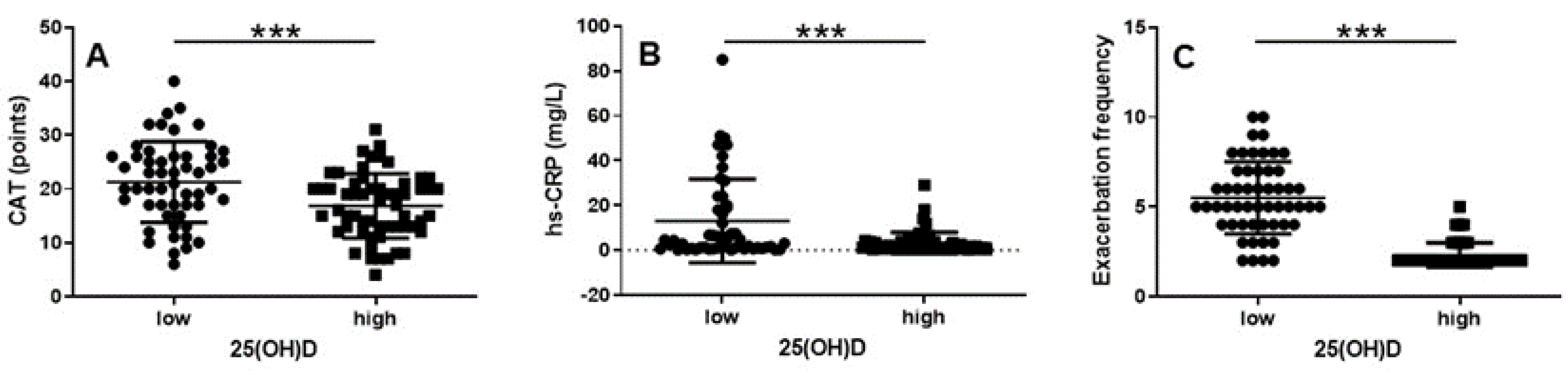
Figure 1. Significant differences between low and high serum 25(OH)D, defined as < 50 nmol/L and ≥ 50 nmol/L, respectively; (A) CAT, (B) serum hs-CRP and (C) exacerbation frequency during the year prior two inclusion.
Preprints 173481 g001
Figure 2. Significant correlations between serum 25(OH)D and (A) CAT score (Pearson; r = -0.30; p < 0.01), (B) serum hs-CRP (Spearman; r = -0.25; p < 0.01) and (C) exacerbation frequency during the year prior to inclusion (Pearson; r = -0.74; p < 0.0001).
Preprints 173481 g002
Table 1. Descriptive statistics.
COPD patients
n = 111
Low (< 50 nmol/L)
n = 53
High (≥ 50 nmol/L)
n = 58
Difference
Age (yrs) 70±10 (46-84) 70±7 (52-86) n.s.
Women, n (%) 28 (53) 34 (57) n.s.
BMI (kg/m2) 26±7 (15-44) 25±5 (15-40) n.s.
Current smokers, n (%) 12 (23) 7 (12) n.s.
Ex smokers, n (%) 39 (74) 49 (84) n.s.
Never smokers, n (%) 2 (4) 2 (3) n.s.
mMRC (points) 3(1) Md (IQR) 3(1) Md (IQR) n.s.
CCI, score 1, n (%) 12 (23) 18 (31) n.s.
CCI, score 2, n (%) 13 (25) 7 (12) n.s.
CCI, score 3, n (%) 14 (26) 14 (24) n.s.
CCI, score ≥4, n (%) 14 (26) 19 (33) n.s.
WBC 9.8±4.2 (4.2-5.8) 8.7±2.3 (4.2-15.4) n.s.
SAT (%) 92±6 (70-100) 94±4 (82-100) n.s.
FEV1 (% predicted) 42±17 (14-92) 41±17 (13-82) n.s.
GOLD stage 1, n (%) 1 (2) 0 (0) n.s.
GOLD stage 2, n (%) 18 (34) 17 (29) n.s.
GOLD stage 3, n (%) 14 (26) 22 (38) n.s.
GOLD stage 4, n (%) 20 (38) 18 (31) n.s.
COPD medications
SABA; n (%) 39 (74) 48 (83) n.s.
SAMA; n (%) 15 (28) 14 (24) n.s.
LABA; n (%) 51 (96) 56 (97) n.s.
LAMA; n (%) 50 (94) 53 (91) n.s.
ICS; n (%) 50 (94) 54 (93) n.s.
OCS; n (%) 13 (25) 13 (22) n.s.
PD4I; n (%) 7 (13) 7 (12) n.s.
LTOT; n (%) 16 (30) 12 (21) n.s.
Abbreviations: BMI, body mass index; CCI, Charlson Comorbidity Index; COPD, chronic obstructive pulmonary disease; FEV1(% of predicted), forced expiratory volume in one second expressed as % of predicted; GOLD, global initiative for chronic obstructive lung disease; ICS, inhaled corticosteroids; IQR, inter quartile range; LABA, long acting beta-2 agonists; LAMA, long acting muscarin antagonist; LTOT, long term oxygen therapy; Md, median; mMRC, modified Medical Research Council dyspnoea scale; n.s., not significant; PD4I, phosphodiesteras 4 inhibitor; OCS, oral corticosteroids; SABA, short acting beta-2-agonists; SAMA, short acting muscarin antagonist; SAT, blood oxygen saturation; WBC, white blood cell count.
Disclaimer/Publisher’s Note: The statements, opinions and data contained in all publications are solely those of the individual author(s) and contributor(s) and not of MDPI and/or the editor(s). MDPI and/or the editor(s) disclaim responsibility for any injury to people or property resulting from any ideas, methods, instructions or products referred to in the content.
Copyright: This open access article is published under a Creative Commons CC BY 4.0 license, which permit the free download, distribution, and reuse, provided that the author and preprint are cited in any reuse.
Prerpints.org logo

Preprints.org is a free preprint server supported by MDPI in Basel, Switzerland.

Subscribe

Disclaimer

Terms of Use

Privacy Policy

Privacy Settings

© 2025 MDPI (Basel, Switzerland) unless otherwise stated