

Submitted:
02 September 2025
Posted:
04 September 2025
You are already at the latest version
Abstract
Given the predominant outdoor lifestyle, it is not surprising that public playgrounds play an integral role in the lives of Australian families. Nonetheless, in 2018 it was reported that over 150 Australian children (aged 0-14 years) are killed and over 68,000 hospitalized each year because of unintentional injuries – such as falls from public playground equipment. The youngest victims of playground equipment-related injuries are under 2 years old. The purpose of this pilot study was to survey caregivers of toddlers (ages 0-2 years), to obtain their perspec-tive on how well playground equipment met their very young child’s needs. A local regional community play-group (cohort of 36 caregivers) comprising of parents, grandparents and nannies (paid family assistants), agreed to participate. Survey data was collected anonymously. Caregivers indicated that (1) their child could not fully participate in the playground’s offerings; (2) felt that the playground was not appropriate for their toddler and (3) dreamed of an age-appropriate playground that met their young child’s needs. Despite millions of dollars being spent on public playgrounds, with designs and equipment meant to surpass the playgrounds of yesteryear, this project raises the question: Are public playgrounds really any safer today than before?
Keywords:
toddlers
; play
; public playgrounds
; parent worry
; safety
1. Introduction
Playgrounds have been around for some time. Although not particularly well designed or constructed, wherever there was a tree to climb or a creek to play in there was an impromptu playground. Before the turn of the century, play spaces probably only included a swing set and a see-saw (teeter-totter) made from a wooden plank. At this time, it was also reported that playgrounds evolved from sets of simple individual pieces of equipment that may have been grouped, but not with intent or meaning [1].
The words playground and park are often used interchangeably. Often people will say “I’m going to the park” when what they really mean is specifically the area with outdoor playground equipment. While there are over 27,000 parks and 16,000 playgrounds operated by local councils countrywide in the United Kingdom [2], there is no definitive count of the total number of Australian playgrounds. Based on anecdotal information, Australia has thousands of playgrounds spread across its different regions, with some councils managing hundreds of playgrounds within their local government areas. For example, within the capital city of Queensland, the Brisbane City Council maintains over 2,180 parks and playgrounds [3].
Playground Play - it is a risky business.
The current standard in Australia for playground equipment, AS 4685:2021, was introduced in 2004, updated in 2021 [4] and closely aligns with European Standards. In April 2022, Australian Standards released a warning about playground safety, highlighting accidents as the leading cause of death for Australian children under 16 years of age [5]. Unfortunately, playgrounds do pose a significant risk of injury to children [6,7]. Playgrounds are known to contribute to the most unintentional child injuries in the developed world [8]. In 2008, the World Health Organization (WHO) published a comprehensive report on child injury prevention [9]. According to this report, over 2000 children die in accidental injuries each year [10]. In Australia, between 2010 and 2014, there were 7795 hospitalizations for fall-related injuries from playground equipment [11].
Injuries to the shoulder and upper arm were most common for 0–4-year-olds [11], with playground falls accounted for more than a quarter of forearm fractures (27%), with 38% being falls from monkey-bars [12]. Thus, despite millions of dollars being spent on public playgrounds in Australia, with designs and equipment meant to surpass the playgrounds of yesteryear and marking the evolution of the built environment for the sake of child’s play, this project sought to raise the question: Are public playgrounds really any safer today than before?
2. Materials and Methods
This paper reports on the investigation of the experiences of a small Australian regional community playgroup located in Queensland, (consisting of 36 caregivers of children aged 0-2 years, known as toddlers) and their perception of taking their toddlers to public playgrounds. The pilot project was approved by the relevant university ethics committee. The playgroup operates on a weekly basis under the leadership of a volunteer caregiver, who was approached by the lead researcher. The caregivers who became this study’s participants provided written informed consent and agreed to complete an anonymous survey which sought their views and opinions about taking their toddler to a local playground in their community.
Data were collected using a questionnaire (22 questions) which offered a combination of Likert scale (closed) demographic questions and open-ended questions about public playground experiences. The authors did not use any generative artificial intelligence when preparing the study materials. To ensure confidentiality, following consent, a copy of the questionnaire was sent online to the lead volunteer caregiver who printed it and distributed the document to the participants. Participants retained their anonymity as no identifying information was sought. Once the questionnaires were completed, the participants posted the completed questionnaire to the first author for analysis.
3. Results
Responses to closed ended questions provided general demographic details including an overall view of the participants, their family composition, and the playground setting.
3.1. Participants
The participants consisted of 14 mothers, 12 fathers, 8 grandparents and 2 nannies. Most parents were aged between 35-44 years (n=20; 76.9%) with 23% (n=6) aged between 25-44 years. The two nannies were aged between 25-44 years while the eight grandparents were aged between 55-64. While most parents (n=20) had completed a university degree (i.e., medicine, pathology, architecture, engineering), two parents had trained as chefs.
The children (18 boys, 18 girls) were aged between 18-24 months old. In 30 families, the toddler was their first and only child. Two participants were also parents of a newborn baby. One of the mothers was pregnant, while four participants were parenting three children. Thirty children attended day care centers, while six children were cared for full time in their family home.
3.2. Participant Location
The participants resided in the smallest and most northerly of three major islands on the northern part of Moreton Bay, Queensland, Australia. This rural beach community boasts pristine beaches, stunning natural scenery, and amazing wildlife. The traditional owners of this land are the Kabi Kabi and Joondoburri people and the area is known as Yarun or Yirin which means 'Hunting Ground’.
Participants were asked to nominate the type of recreational facilities or activities that they frequented with their child. The most regularly visited sites for family get-togethers nominated by 30 (83.3%) participants were local picnic shelters and playgrounds. Six participants indicated that they regularly went hiking, walking, or biking with their child. Four participants indicated that they frequented basketball courts and community swimming pools. While this area is a small island (148 KM2), only one grandfather took his grandson to the beach. In all cases, the public playgrounds used by this group were within 5 kilometers of their residences.
3.3. Preparing to Take Toddlers to a Public Playground
Given the young age of toddlers, it could be assumed that prior to attending, families would explore the suitability of the location; for example, using online information from council websites and Facebook. Approximately 93.1% of Australian households identify as having had a home computer [13], and the participants in this study were predominantly professionals and regular computer users, with easy access to the internet. As many council websites provide explanations, descriptions and in some cases, photographs of the playground sites and facilities, it would seem a simple task to check out a playground before attending. So, it was surprising to find that none of the participants had accessed websites to preview playground facilities before visiting.
3.4. Participant Perception of Suitability of Public Playground Facilities for Toddlers
Despite the online accolades about the public parks and playgrounds in this beach side region, the participants were ambivalent about the appropriateness of these public facilities for their toddlers. When asked if they were satisfied with their community’s playground offerings for their child, 15 male participants (12 fathers, 3 grandfathers) agreed. However, all the female participants (mothers, grandmother, and nannies) disagreed or strongly disagreed. Interestingly, when justifying their answer, 30 participants (83.3%) selected the same closed response option:
The facility and its offerings were not appropriate for my child (e.g., no adaptations were made for a young child, or the equipment was not appropriate for young children).
In addition to the above comment, 15 participants (41.6%; 12 females, 3 males) nominated that they were also: worried about the safety of their child if they participated in the playground’s offering.
3.5. Toddler Preferred Playground Equipment
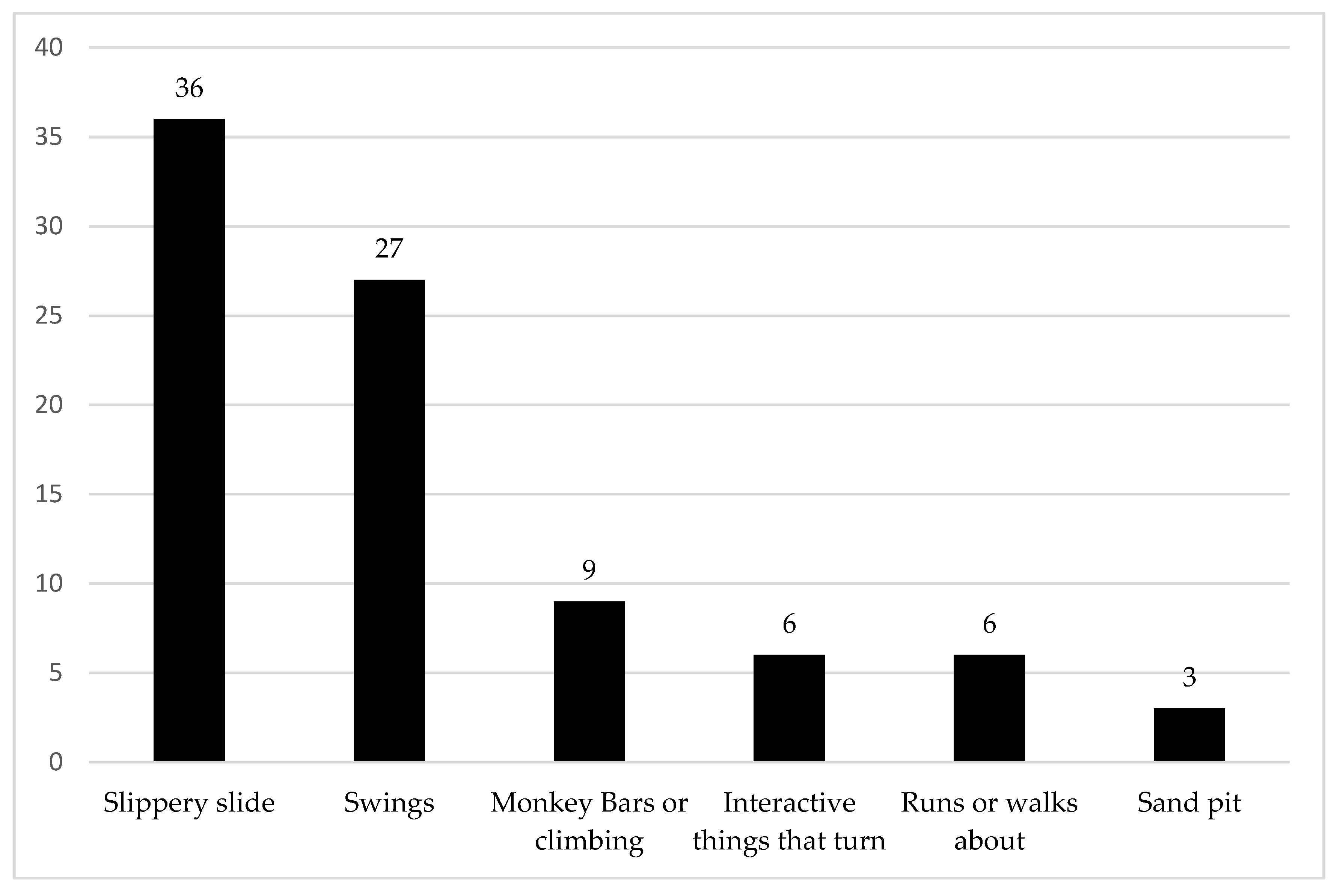
Participants were then asked to nominate the play equipment their toddler engaged with the most (Figure 1). The two most popular activities were the slippery slide and the swings, with both activities requiring adult supervision/ assistance.
In the present study, open ended questions were used to discover insights and user perspectives on the suitability of playgrounds for toddlers. Open ended responses were coded using a content analysis procedure, with participant responses coded at the word or phrase level to capture the perspective that participants were describing. All the surveys were double coded through random selection for reliability purposes, yielding an interrater reliability of 80%. Disagreements were resolved though discussion to achieve mutual consensus among the coders.
3.6. Participant Perspectives of the Toddler Playground Experience
Participants were asked if they felt their child was capable of independent play in the playground and interestingly there was an even split with 50% indicating YES, and 50% indicating NO. Participants were asked to comment on their toddler’s active participation with the playground’s offerings. Comments indicated that toddlers were just as happy (if not happier) to sit with their parent/carer or to be held by their parent/carer – rather than engage with the playground equipment. Consequently, the toddlers’ time at the playground was not actually filled with playing on the equipment. Participants commented:
I take her for a walk around the park. She watches her older brothers, but she does not want to go with them to the equipment unless there is no one else at the park, which is rare (Case no 12).
She will run about the park (near me, near the bench) but she is careful to keep away from the play equipment. She plays with her toys on the bench (Case 4).
3.7. Participant Perspectives of Their Experience of Taking a Toddler to a Playground
A content analysis of the comments from the participants’ experiences of taking their child to a playground revealed four main themes. These included: toddler vulnerability in playgrounds, carer experiences, child experiences and the importance of playground safety.
3.8. Toddler Vulnerability in Playgrounds
Participants raised the issue of the suitability of the equipment for toddlers at public playgrounds. In many instances, participants indicated the need for close adult supervision, suggesting:
We have witnessed young children fall off the play equipment due to limited safety measures in place therefore we always stay close with our child at the playground (Case 7).
3.9. Adult Experience When Taking Toddler to a Public Playground
When asked to describe their toddler’s playground experience, two participants (male) suggested that their time at the public playground was relatively positive. For example, Case 4 reported that their experience was “Normally good”, while Case 3 commented that their child “wanted them to participate” with them. More commonly, the participants’ comments suggested fewer positive perceptions of the experience:
I wish there was a bit more for younger kids to do. The more he can do by himself safely - that would cause me less anxiety (Case 3).
When describing their playground experience, these participants used emotive terms such as worry, anxiety, and frustration. As a result, the appeal of toddler play at public playgrounds appears to be centered upon the concept of calculated risk.
3.10. Child Experience of Attending a Public Playground
When invited to describe their child’s play experience, participants commented on the inappropriate design of playground equipment for toddlers suggesting:
Most of the community playgrounds have generic play equipment which is more tailored for older children (Case 7).
Some play places have open spaces, and a toddler could just walk off a 10-foot drop! (Case 12).
Several carers mentioned the impact of the weather on reduced ability to go to the park or to use equipment because of the heat, cold or rain, suggesting:
Everything is made of metal and with the heat, those slippery slides get hot. Even the rubber swing seat gets hot (Case 12).
Participants also mentioned the poor state of the playground equipment suggesting:
Playgrounds should have more maintenance than they currently do (i.e., broken bolts or plastic bits pulled off by other kids) can make it unsafe. To be cleaned occasionally would be great too (Case 3).
However, newer playgrounds were reported to have more toddler friendly equipment including:
Usually, the playgrounds newly built are more fun and my son spends longer time playing there (Case 27).
The written responses of 50% of the participants indicated there was limited age-appropriate play equipment available identified, suggesting:
There is only…. one baby suitable swing being occupied (This age group don’t understand having to wait!) (Case 9).
I wish there was a bit more for younger kids to do. The more he can do by himself safely would cause me less anxiety (Case 13).
There was mention of the play equipment being built for older children who have better motor co-ordination and who were less likely to fall, suggesting:
Playgrounds look great but in almost all cases, they are designed to take the kids up off the ground. That means that there are steps. Well right now, my daughter’s legs are too short for the steps and her hands are too small for the handrails (Case 26). The stair rises (the steps) are too high for someone with little legs (Case 2).
3.11. The Importance of Safe Outdoor Spaces for Toddlers
Time and time again, comments were made about the inadequacy of public playground design for small children versus the participant perspectives when making a conscious effort to promote their toddler’s safe recreation experience, commenting:
High rails on the slippery slides. My daughter has caught her legs under herself on the slippery slide and almost fallen off (Case 28).
Some different soft-landing flooring not consisting of bark. Bark can be sharp for little soft skin (Case 9).
3.12. Designing a Dream Playground for Toddlers
Participants were invited to offer their thoughts on what their dream playground for their toddler would look like. Three themes emerged:
3.12.1. Theme 1: A Play Area that Would Provide Safety for a Toddler
Participants indicated concern that their children might incur injuries while playing at playgrounds and on inappropriately designed playground equipment. They suggested:
If there was a little kids play area (like at the pool – there is a baby pool area), then she could play with other kids her age (Case 8).
Smaller steps, A bit more ‘safety’ for baby swings (not just a chain across the front) (Case 6).
3.12.2. Theme 2: A Playground that Meets the Needs of Toddler Play Skill Development
While clearly keen to give their toddlers a community playground experience, participants most frequently requested purpose-built equipment for toddlers, that would offer more independent play for toddler:
Some more on the ground play equipment for little kids, like a trampoline set into the ground that she could bounce on, some musical play toys, some swings with safe harnesses – not just a chain (Case 32).
More things that he can do by himself would be great like, little tracks to play with his toy cars and soft building blocks to climb over (Case 2).
3.12.3. Theme 3: The Need for a Toddler Playground that is Weatherproof
Participants’ comments also raised the impact of weather conditions on access to playground equipment. Neither a hot summer sun nor a rain drenched playground was ever going to be ideal specifically for very young children. Comments highlighting the impact of the Queensland weather were also evident:
It gets very hot here and more and more it rains. So, an indoor playground would be great (Case 11).
Everything is made of metal and with the heat, those slippery slides get hot. Even the rubber swing seat gets hot (Case 21).
Participants raised safety concerns, specifically for their young children, along with the importance of safe, weatherproof, outdoor play environments. Tailor made play spaces with developmentally appropriate play equipment for toddlers to ensure safe recreation experiences for their children were repeatedly identified in participants’ comments.
3.13. Perceived Needs for Training of Recreation Providers
Lastly, participants were invited to offer their suggestions to community professionals in order that future playgrounds better meet parent/career needs for access and trust in safe recreation options for toddlers. Participants’ needs were clear; they wanted toddler only play areas and playground equipment that was designed for toddlers. Clearly a one size does not fit all children perception reined. However, it was also clear that if a playground was built to cater for all children’s needs – then more families will come!
3.14. Toddler Only Play Areas
Participants in this study were concerned about their children’s possible interactions with older children resulting in injury including:
My daughter has been knocked over in the past by other kids rushing past her or she doesn’t see them coming, and she walks into them (Case 34).
As most of the participants attended this community playgroup session during school hours – they only had the one child to supervise at the playground. However, there were some participants who commented on how they felt about supervising two or more children at a playground. In all cases, the fear was child elopement. One mother who was pregnant contemplated how she would go supervising two young children at the playground. She felt: “A bit nervous, but hopefully baby will be okay in the pram and (I will) wheel around after toddler or I will use a baby carrier”. When envisaging this task, the father-to-be rated his ability to supervise two children as; “Not great. Very hard to supervise one child, let alone two”. The maternal grandmother was even less positive stating that, “It just could not be done!”.
Two parents, already raising three children including a toddler, explained their strategies for taking multiple children to a public playground. They prepared a playground safety plan, and every family member had a role to play.
The two boys take care of each other, and I take care of my daughter. She likes me to carry her to the swings or the slide and we walk about watching her brothers play (Case 12).
By planning in advance, these parents were able to promote their toddler’s outdoor play experience. Their individualized proactive safety plans were consistent with their perceptions of playground safety for the entire family.
3.15. Seeking Toddler Specific Designer Playgrounds
Strategies to ensure safe design of future playgrounds could include policy directions for community spaces to include secure areas where toddlers can play without parents enduring safety fears.
There is not enough low-level play equipment for toddlers. My daughter is not a good climber yet. Most of the equipment that her brothers like to play on is high. She cannot get up there. If she did, she could fall (Case 31).
There were no specific solutions suggested by the participants to address these concerns. However, further research on this topic may be fruitful to assess parental needs about appropriate playgrounds for 0–2-year-olds in their communities. By utilizing adult playground user experience, community organizations, property developers and local councils might better address such concerns and adapt playground equipment to suit toddlers and other children with limited capacity such as children with disability.
The idea of investigating the use of inclusive design principles to promote recreation activity for children with disability has been percolating for some time now [16,17]. Participatory strategies have been successfully used for the design of products for children with disabilities in the past [18]. Specifically designed pieces of equipment may also hold the key to the design of safe and inclusive play spaces for toddlers.
4. Discussion
The findings of this study highlight how parents/carers experienced wide-ranging safety concerns related to their toddlers’ special interests, risky behaviors, and the presence of hazards prominent in public playgrounds. The parents/carers of this community playgroup feared recreational participation could place their toddler in harm’s way due to their limited size, limited upper body strength, limited motor co-ordination and physical challenges as well as the environmental hazards present in public outdoor play areas. Clearly aware of the many hazards and risks present in their local community playgrounds, when given the opportunity, the participants of this study expressed a range of solutions to mitigate their concerns. These complex notions point to the need to acknowledge that parents/carers may have contradictory views that may be reflected in in their restrictions or encouragement of their toddlers’ recreation participation.
The present study also highlighted the varied strategies and adaptations that parents/families used to take charge and promote their child’s safe recreation participation. Parents described their oftentimes intensive involvement with their children’s activities that helped to integrate their young children more effectively in recreational activities while providing them with familiar, one-to-one support and high levels of supervision.
The parents who had enrolled their children in community day care programs highlighted the lack of access to trained or qualified personnel to effectively address their children’s needs. Consumer concern suggests the need for practice and policy changes in the hiring of suitable staff for community day care programs. Further, recreation department policy could create separate play zones for young children in a playground while creating more challenging play equipment for older children. Having high ratios of parents/carers to toddlers is important for supporting individualized approaches to participation. Access to ground level play equipment and more toddler safe equipment is also critical [19]. Online training programs may also hold promise for building knowledge and skills among qualified personnel across various disciplines (e.g., recreation equipment designers, property developers) [20].
There is no question that ensuring access for everyone in a playground through inclusive design presents challenges. Another group of children currently being studied who face a similar scenario to toddlers and their families in playgrounds are children with vision impairment [21]. Being a group already known to be less physically active than their peers [22,23], play is a critical activity for children with vision impairment. The developmental impact that vison loss can have on a child’s play has been well recognised including a reluctance for independent exploring, reduced spontaneous play, a tendency to prefer to parents than peers and reduced social play [24]. This should be recognised and evident in design approaches, so that playgrounds become critical developmental and social locations for all children.
Despite the Australian Government acknowledging that access to playgrounds should be universal [25], barriers to participation are well known [3]. The barriers faced by toddlers have been identified in this study, and are surprisingly similar to those identified for children with vision impairment including possible safety risks, a lack of accessible resources [26] , a lack of opportunities for risky play and a lack of sensory play experiences [27]. An Australian team is currently exploring the experiences of families raising children with vision impairment in playgrounds, with the goal of developing universal co-designed approaches that focus on playground access for all [28].
5. Conclusions
The present study highlights parental/carer experiences and expresses needs for promoting safe recreation participation for their very young children. Practical strategies for addressing these needs that can be implemented at community and recreation program levels have been suggested. This research offers a new understanding of carers’ perspectives and the unique safety concerns surrounding recreational participation for toddlers. Moreover, this study represents a family-centred voice reflecting their perspectives and provides a novel contribution to the literature. These findings provide an important foundation for future program and policy development to support families and young children to engage in recreation and sport in their communities. Improved participation in recreation can contribute to the health, safety, and quality of life of toddlers and their families. Future directions for research are also suggested. Toddlers should have opportunities to experience safe inclusive recreation no matter their differing abilities, needs, or settings in which they live.
Author Contributions
Tait was responsible for conceptualization, methodology, investigation, data curation, writing – original draft preparation. Silveira was responsible for data curation and writing – review, editing. Reinhardt was responsible for writing – review, editing. All authors have read and agreed to the published version of the manuscript.
Funding
This research received no external funding.
Institutional Review Board Statement
The study was conducted in accordance with the Declaration of Helsinki and approved by the Human Research Ethics Committee, Macquarie University Institutional Review Board protocol code 520231294146654 and the date of approval is 28 February 2023.
Informed Consent Statement
Informed consent was obtained from all participants involved in this study.
Data Availability Statement
Data is unavailable due to privacy requests by participants
Acknowledgments
The authors did not use any generative artificial intelligence for the purpose of preparation of this manuscript/study.
Conflicts of Interest
The authors declare no conflicts of interest.
References
- Darian-Smith, K. Australian children's play in historical perspective: Continuity and change on the school playground. Int J Play 2012, 1, 264-278. [CrossRef]
- King, P. How have adventure playgrounds in the United Kingdom adapted post-March Lockdown in 2020? Clin Care Prac 2021, 2, 5. [CrossRef]
- Glass, C.; Flemmer, C. Evaluating the Accessibility and Inclusiveness of Community Playgrounds in Australia for Children with Disabilities. Disabilities, 2024, 4, 996-1005. [CrossRef]
- Standards Australia. Available online: https://www.standards.org.au/standards-catalogue/standard-details?designation=as-4685-1-2021 (accessed on 30 August 2025).
- Standards Australia. Available online: https://www.standards.org.au/blog/new-warning-on-playground-safety (accessed on 30 August 2025).
- Mack, M. G.; Sacks, J. J. Thompson, D. Testing the impact attenuation of loose-fill playground surfaces. Inj Prev, 2000, 6, 141-144. [CrossRef]
- Norton, C.; Nixon, J.; Sibert, J. R. Playground injuries to children. Arc Dis Child, 2004, 89, 103-108. [CrossRef]
- MacKay, M. Playground injuries. Inj Prev, 2003, 9, 194-196. [CrossRef]
- World Health Organization World report on child injury prevention. Available online: https://www.who.int/publications/i/item/9789241563574 (accessed on 30 August 2025).
- Begum, K., Priya, M., & Kiran Babu, N. C. (2024). Development and Validation of Play Behavior Scale. In AI in Business: Opportunities and Limitations: Volume 1 (pp. 229-241). Cham: Springer Nature Switzerland. [CrossRef]
- Bierbaum, M.; Curtis, K.; Mitchell, R. Incidence and cost of hospitalisation of children with injuries from playground equipment falls in New South Wales, Australia. J Paed Child H, 2018, 54, 556-562. [CrossRef]
- Lally, M., Valentine-French, S., & Lang, D. (2020). Early childhood. Parenting and Family Diversity Issues. Available online: https://saskoer.ca/ (accessed on 30 August 2025).
- Morrissey, A. M.; Scott, C.; Wishart, L. Infant and toddler responses to a redesign of their childcare outdoor play space. Child Youth Environ, 2015, 25, 29-56. [CrossRef]
- Sungur, A; Czaplinska, P. Designing Playgrounds for All. Megaron, 2018, 13(3). [CrossRef]
- Curtis, S. Building an Inclusive Park for Holden: Understanding Community Needs, Priorities, and Expectations. Available online: https://digital.wpi.edu/. (accessed on 30 August 2025).
- Fernelius, C. L.; Christensen, K. M. Systematic review of evidence-based practices for inclusive playground design. Child Youth Environ, 2017, 27(3), 78-102. [CrossRef]
- Lynch, H.; Moore, A.; Edwards, C.; Horgan, L. Advancing play participation for all: The challenge of addressing play diversity and inclusion in community parks and playgrounds. Br J Occup Ther, 2020, 83, 107-117. [CrossRef]
- Benton, L.; Johnson, H. Structured approaches to participatory design for children: can targeting the needs of children with autism provide benefits for a broader child population? Instr Sci, 2014, 42, 47-65. http://dx.doi.org/10.1007/s11251-013-9297-y.
- McNamara, S.; Bittner, M.; Healy, S. Online training for physical activity practitioners on evidence-based practices for clients with autism. Adv Autism, 2021, 7, 283-293. [CrossRef]
- Tait, K.; Liang, P.; Silveira, S. Why Can’t My Child Play Too? Current Challenges of Public Playgrounds for Children with Disabilities. Educ Sci, 2024, 14, 1153. [CrossRef]
- Haegele, J. A.; Brian, A.; Goodway, J. Fundamental motor skills and school-aged individuals with visual impairments: A review. Rev J Autism Dev Disord, 2015, 2, 320-327. [CrossRef]
- Verbecque, E.; Lobo Da Costa, P. H.; Vereeck, L.; Hallemans, A. Psychometric properties of functional balance tests in children: a literature review. Dev Med Child Neurol, 2015, 57, 521-529. [CrossRef]
- Mellou, E. Play theories: A contemporary review. Early Child Dev Care, 1994, 102(1), 91-100. https://eric.ed.gov/?id=EJ493611.
- National Constriction Code. Available online: https://ncc.abcb.gov.au/ (accessed on 30 August 2025).
- Yantzi, N. M.; Young, N. L; McKeever, P. The suitability of school playgrounds for physically disabled children. Child Geogr, 2010, 8(1), 65-78. [CrossRef]
- Pierce-Jordan, S.; Lifter, K. Interaction of social and play behaviors in preschoolers with and without pervasive developmental disorder. Topics Early Child Spec Educ, 2005, 25, 34-47. [CrossRef]
- American Society of Landscape Architects. Available online: https://www.asla.org/ (accessed on 30 August 2025).
- Tait, K.; Silveira, S.; Holloway, L.; Reinhardt, D.; Loke, L.; Jones, E. Ensuring playground access for children with vision impairment. Vis Impair Res, 2023, 14, 1-11. [CrossRef]
Figure 1.
Playground activities that were most liked by toddlers.
Disclaimer/Publisher’s Note: The statements, opinions and data contained in all publications are solely those of the individual author(s) and contributor(s) and not of MDPI and/or the editor(s). MDPI and/or the editor(s) disclaim responsibility for any injury to people or property resulting from any ideas, methods, instructions or products referred to in the content. |
© 2025 by the authors. Licensee MDPI, Basel, Switzerland. This article is an open access article distributed under the terms and conditions of the Creative Commons Attribution (CC BY) license (http://creativecommons.org/licenses/by/4.0/).
Copyright: This open access article is published under a Creative Commons CC BY 4.0 license, which permit the free download, distribution, and reuse, provided that the author and preprint are cited in any reuse.


