

Submitted:
02 September 2025
Posted:
02 September 2025
You are already at the latest version
Abstract
This study investigates how climate change literacy (CCL) and institutional contexts shape the climate-related behaviors of Taiwan’s public officials. Drawing on a 2024 national survey of 1,940 civil servants, we apply hierarchical and comparative regression analyses to examine the relative influence of knowledge, affective dispositions, and organizational supports. Results show that solution-oriented knowledge exerts greater behavioral influence than factual awareness. At the same time, affective resources—particularly self-efficacy and environmental identity—are the strongest and most consistent drivers of engagement. Institutional factors further condition these relationships: central officials’ behaviors are shaped by departmental mandates and bureaucratic constraints, whereas local officials rely more on supervisor support and prior project involvement. These findings integrate literacy research with institutional perspectives, demonstrating that effective climate governance requires both individual agency and enabling organizational contexts. Policy implications include strengthening leadership training, creating experiential learning opportunities, and streamlining administrative structures across governance levels to accelerate climate action.
Keywords:
Climate Change Literacy (CCL)
; Knowledge–Behavior Gap
; Institutional Theory
; Central–Local Governance
1. Introduction
Climate change Climate change is among the defining challenges of the twenty-first century, with far-reaching environmental, social, and economic consequences [1,2,3,4]. Meeting this challenge requires not only technological innovation and robust policy frameworks but also the active engagement of public officials, who translate statutory visions into administrative practice [5,6]. International initiatives such as the European Green Deal (EGD) demonstrate how comprehensive governance frameworks can accelerate renewable energy adoption, mainstream circular economy policies, and enhance regional leadership [7,8]. These experiences highlight administrative capacity as central to achieving carbon neutrality. In Taiwan, the Climate Change Response Act similarly emphasizes the need for institutional readiness and governance capacity to realize long-term climate objectives [9,10].
1.1. Climate Change Literacy and the Knowledge-Behavior Gap
Individual responses to climate change shape both mitigation and adaptation efforts, with broader implications for sustainable development and human well-being.[11,12]. Research shows these responses are influenced by socioeconomic conditions, psychological dispositions, cultural orientations, and institutional contexts [13,14,15,16,17,18,19]. Among these factors, climate change literacy (CCL) is widely recognized as a multidimensional construct that offers both the conceptual foundation and practical tools for understanding climate change, enabling informed decision-making and pro-environmental behavior [20,21]. Higher climate literacy has been linked to greater risk perception, more substantial concern, and higher policy support [22,23,24]. Yet, findings are inconsistent: knowledge alone often proves insufficient—and at times counterproductive—for motivating behavior, as information can reinforce existing beliefs rather than prompt action. This suggests that literacy operates indirectly through affective factors such as concern and self-efficacy, or with institutional supports [25]. In Taiwan, while citizens and students report high awareness and concern, their actual participation in climate action remains limited, revealing a persistent “knowledge–behavior gap” [26,27]. This underscores the need to investigate how institutional and organizational conditions facilitate or constrain the translation of literacy into action.
1.2. Policy Vision to Administrative Practice: The Critical Role of Public Officials
Translating statutory climate targets into outcomes depends heavily on civil servants, who coordinate cross-agency planning, manage budgets and regulations, and facilitate collaboration with stakeholders [28,29]. Comparative governance research emphasizes the need for governments to build capacity, establish clear mandates, and enhance administrative systems to deliver climate action at the required pace and scale [30,31].
Taiwan’s Climate Change Literacy (CCL) survey initially focused on the general public and students, but was later expanded to officials. Enhancing workplace engagement and embedding climate literacy into routine administrative practice across central and local agencies has become increasingly critical [32,33,34]. This progression—from policy vision capacity building and everyday implementation—positions officials’ CCL as a pivotal mechanism for accelerating mitigation and adaptation, advancing sustainable procurement reforms, and strengthening place-based resilience planning [26].
1.3. Behavior Differences Across Governance Contexts
Research on organizational behavior consistently shows that leadership support, resource provision, and organizational culture strongly shape employees’ willingness to adopt innovative or sustainability-oriented practices [35,36,37,38]. In the public sector, supportive supervisors and environmentally oriented organizational climates are linked to stronger pro-environmental engagement, suggesting mechanisms through which knowledge and affection translate into action [39,40].
At the same time, institutional arrangements define the opportunities and constraints for implementing climate policy. Scholarship highlights how leadership clarity, mandate design, resource availability, and intergovernmental coordination condition the mainstreaming of climate policy at subnational levels [41,42,43]. Local governments often operate with tighter capacity constraints and more immediate stakeholder pressures than central agencies, producing different behavioral responses even under the same statutory frameworks [44,45,46]. Cross-level comparisons between central and local governments are therefore essential for identifying institutional heterogeneity and understanding how different incentive structures and governance contexts mediate the relationship between knowledge, affection, and behavior.
Central agencies are typically responsible for policy design and inter-ministerial coordination, while local governments focus on implementation, community outreach, and disaster response [41,47]. Understanding how supervisory support, departmental involvement, and cross-level dynamics influence officials’ ability to translate their knowledge and affection into action is crucial for assessing implementation readiness and identifying capacity gaps that may hinder Taiwan’s broader climate governance objectives.
1.4. Research Objectives
Against this backdrop, this study systematically evaluates the climate change literacy (CCL) of Taiwanese public officials, focusing on the interplay between knowledge, affection, and behavior. Beyond providing a baseline assessment of literacy levels, the research highlights the institutional contexts that shape whether climate awareness translates into action. Specifically, it examines how supervisory support and departmental involvement influence the relationship between CCL and behavioral practices. By comparing behaviors across various institutional and organizational settings, this study extends the application of CCL frameworks to the field of public administration. In doing so, it addresses a key gap in the climate governance research and offers practical insights for designing capacity-building programs, strengthening administrative readiness, and supporting Taiwan’s long-term goals of carbon neutrality and resilience.
2. Materials and Methods
This study examines the climate change literacy (CCL) of Taiwanese public officials, focusing on the knowledge, affective, and behavioral domains, as well as the institutional factors that shape their engagement in climate policy. Understanding how officials perceive, internalize, and respond to climate change information is crucial for implementing effective mitigation and adaptation policies [48,49]. The methodological framework is built upon established national CCL surveys in Taiwan and incorporates organizational perspectives from public administration studies [50].
2.1. Data Sources and Sampling Procedures
Data were collected through a cross-sectional survey of Taiwanese public officials in 2024. The process of questionnaire construction and survey implementation is illustrated in Figure 1. A stratified quota sampling strategy was used to ensure representativeness across three dimensions: (a) government levels (central vs. local), (b) policy domains, and (c) administrative ranks. This design aligns with best practices in governance research, as stratified sampling minimizes selection bias and improves coverage of diverse populations [51].
The questionnaire (full version in Appendix A) was distributed primarily online through official channels, with Fax and mail options for agencies with limited internet access. Telephone follow-ups were conducted to confirm delivery and encourage participation, thereby reducing missing data.
Before launch, the survey was cognitively pre-tested with 56 public officials to ensure clarity and contextual appropriateness. The pre-test assessed response time, item distributions, and reliability. The final dataset included 1,940 valid responses after excluding incomplete or invalid cases.. Participation was voluntary and anonymous, and only active government employees aged 20 or older were eligible.
2.2. Measurement of Climate Change Literacy
The CCL framework builds upon the National Environmental Literacy Survey [26,50,52]. It conceptualizes CCL as a multi-dimensional construct with three domains—knowledge, affect, and behavior—representing understanding, emotional response, and participation in climate issues. Each domain was operationalized through sub-dimensions and measured with items designed to reflect both individual and institutional contexts. Figure 2 illustrates the framework.
Knowledge Domain. The dimension assessed officials’ understanding of the scientific, contextual, and strategic aspects of climate change, through three sub-domains: (a) content knowledge –fundamental concepts such as the greenhouse effect, anthropogenic impacts, and global emissions trends; (b) issue knowledge –the broader context, including natural variability, the human–climate relationship, and evolving policy frameworks; and (c) strategy knowledge – knowledge of mitigation and adaptation strategies at national and international levels. Items were multiple-choice or true-false, scored dichotomously and aggregated into a composite score of knowledge literacy.
Affective Domain. This dimension assessed officials’ values, attitudes, and motivation for climate action, with five sub-domains: (a) sensitivity – perceiving climate impacts and their extent; (b) values – recognizing of stakeholder responsibilities and the need for cross-sector cooperation; (c) self-efficacy – believing in one’s own ability to adapt, communicate, and cooperate on climate issues; (d) sense of hope – a positive psychological state involving persistence, support from others, and knowledge of strategies; and (e) environmental identity – seeing that environmental protection/environmental problem-solving is important to individuals and even part of one’s self-image. Constructs were measured with five-point Likert-scale items (1 = strongly disagree to 5 = strongly agree), and mean scores were calculated for each sub-dimension.
Behavioral Domain. This dimension assessed how public officials translate knowledge and attitudes into action. Sub-domains included: (a) individual skills, which include the ability to collect, apply, and plan climate change information and activities, and to build partnerships across sectors; (b) individual behavior, which refers to actions to mitigate and adapt to climate change.; and (c) civic engagement, including generating intention and experience in collective climate action. Items were rated on a five-point frequency scale (1 = never to 5 = always) and averaged to create action scores.
To capture the organizational settings in which knowledge and affection are translated into action, the 2024 survey asked about officials’ duties and support. Specifically, respondents reported: (1) prior involvement in climate-related projects, (2) the extent to which current work relates to climate issues, and (3) perceived supervisor support for integrating climate considerations. These factors were used as institutional variables in regression analyses to test how professional engagement and organizational support shape behavioral outcomes.
2.3. Data Processing and Statistical Analysis
Data were analyzed using Stata 15.1. To examine mechanisms linking literacy to behavior, hierarchical regression analyses (HRA) were conducted [17]. Independent variables were entered sequentially: knowledge and demographics, then affective domains, then institutional variables. This stepwise approach tested how institutional contexts contribute to explaining behavior and whether administrative structures influence action [54].
Ordinary least squares (OLS) regression analyses were further used to compare central and local officials [20,26,53]. Both dummy variable and split-sample analyses were used to test whether literacy and institutional factors varied significantly across levels of government. This is how institutional culture and administrative roles influence behavior [54,55]. Five hypotheses guided the study:
H1: Higher knowledge literacy predicts stronger behavioral engagement.
H2: Higher affective literacy predicts stronger engagement.
H3: Prior or current involvement in climate tasks predicts higher engagement.
H4: Supervisor support enhances engagement.
H5: Central and local officials differ significantly in behavioral engagement, reflecting institutional heterogeneity.
3. Results
3.1. Demographic and Background Assessment
Table 1 presents descriptive statistics for the 1,940 valid responses, providing a profile of Taiwan’s administrative workforce. The gender distribution was balanced (54.2% women; 45.8% men). The largest age groups were 30–39 (32.3%) and 40–49 (32.0%), followed by 50–59 (17.7%). Younger officials (<29) accounted for 13.9%, while only 4.1% were 60–69. This pattern indicates that most respondents were mid-career professionals, consistent with the civil service structure.
Educational attainment reflected a highly qualified workforce: 51.4% held a bachelor’s degree, 38.4% a master’s, and 2.1% a doctorate. Only 7.0% reported below-tertiary education, meaning over 93% had tertiary education or higher. This profile positions officials well to address complex governance challenges, such as implementing climate policy.
In terms of tenure, 44.7% had <10 years of service, 33.3% had 10–19 years, 13.6% had 20–29 years, and 8.0% had 30–39 years. Fewer than 1% reported 40 years or more. This suggests a relatively junior workforce, balanced by a notable group of mid- to long-tenured officials contributing institutional knowledge.
Regarding affiliation, 57.0% worked in central government and 43.0% in local government. This split enables analysis of institutional differences: central agencies typically focus on policy design and coordination, while local administrations emphasize implementation, outreach, and frontline adaptation. Together, these characteristics provide context for interpreting how literacy relates to institutional behavior.
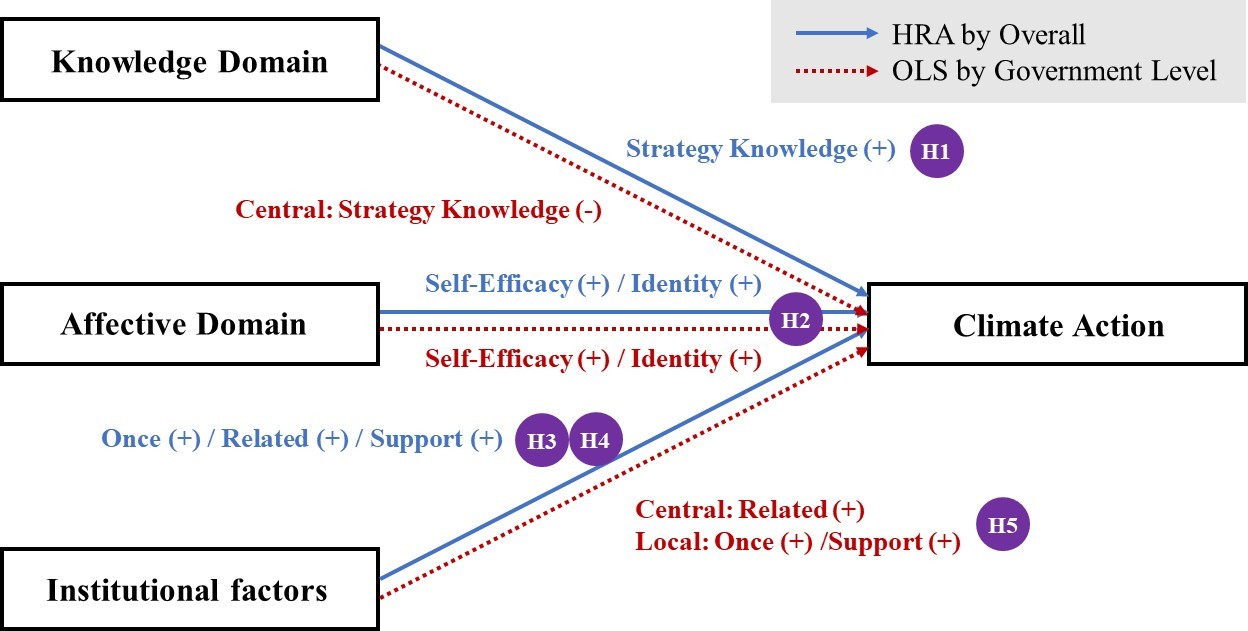
Hierarchical regression (Table 2) tested the effects of knowledge, affective, and institutional factors on behavior. In the baseline model, strategy knowledge (SK) was positively associated with behavior (β ≈ 0.04, p < 0.001), while content (CK) and issue knowledge (IK) were not significant. These results partially support H1 and align with prior research emphasizing the importance of solution-oriented knowledge[56,57].
Affective variables showed robust effects, strongly supporting H2. Self-efficacy was the most potent predictor (β ≈ 0.56–0.61, p < 0.001), consistent with social cognitive theory and studies linking efficacy beliefs to pro-environmental action [58]. Environmental identity was also positively associated (β ≈ 0.13–0.14, p < 0.001), confirming that self-perception as an environmentally responsible individual strengthens engagement [59].
Institutional factors also played a role, supporting H3 and H4. Departmental involvement (“related”) and supervisor support (“support”) both showed significant positive effects (β ≈ 0.07, p < 0.001; β ≈ 0.03, p < 0.05). These results underscore the importance of organizational relevance and hierarchical support in enabling action [60,61,62,63,64,65]. These suggest that the organizational context is crucial, alongside individual literacy and attitudes.
Control variables were included in all models. Education was positively associated with behavior (β ≈ 0.02–0.06, p < 0.001), while gender and age showed weak or inconsistent associations. Importantly, model fit improved substantially: R² rose from 0.04 in the baseline to 0.56 in the complete model, showing that affective and institutional variables added significant explanatory power.
Separate OLS models for central (N = 1,106) and local (N = 834) officials (Table 3) provided clear support for H5. Both groups relied heavily on self-efficacy and environmental identity, with consistent magnitudes (central: β = 0.55 and 0.13; local: β = 0.57 and 0.13, all p < 0.001).
Institutional variables diverged. For central officials, departmental relevance was a significant predictor (β = 0.09, p < 0.001), whereas supervisor support and prior task involvement were not. For local officials, by contrast, supervisor support (β = 0.05, p < 0.05) and prior project involvement (β = 0.09, p < 0.05) were significant, while departmental relevance was not. This indicates that local engagement depends less on formal mandates and more on managerial encouragement and hands-on experience, consistent with research on resource-constrained local governments [66].
Interestingly, strategy knowledge (SK) had a small but significant adverse effect among local officials (β = –0.016, p < 0.05). This suggests that awareness of strategies may heighten perceptions of bureaucratic or political constraints. This paradox echoes a prior study, showing that knowledge does not automatically lead to implementation without supportive institutions [67].
4. Discussion
This study examined how officials’ knowledge, affective, and behavior interrelate across mitigation, adaptation, and civic participation. Building on this, it explored how supervisory support strengthens the translation of knowledge and affection into actions, particularly when supervisors endorse integrating climate issues into daily tasks. It also assessed the influence of departmental climate experience, testing whether prior involvement fosters more proactive cultures. Finally, it compared central and local officials to evaluate how institutional contexts such as hierarchy and governance style shape behavioral engagement. Together, the findings offer theoretical and practical insights into the knowledge–behavior gap, psychological dispositions, and organizational contexts in climate governance.
Findings partially supported H1, which states that strategy knowledge predicts behavior, while content and issue knowledge do not. This underscores a key point: factual and contextual knowledge, though necessary, are insufficient for behavioral change without actionable, solution-oriented understanding [68]. Strategy knowledge provides feasible tools that help close part of the knowledge–behavior gap [26].
H2 was strongly supported. Self-efficacy was the most potent predictor (β ≈ 0.56–0.61, p < 0.001), consistent with social cognitive theory and prior findings [69]. Environmental identity also had positive effects (β ≈ 0.13–0.14, p < 0.001), confirming that viewing oneself as an environmentally responsible actor strengthens behavioral consistency [70]. By contrast, sensitivity, values, and hope were nonsignificant, suggesting that action depends less on awareness or moral stance than on capacity and identity alignment.
H3 and H4 were also supported. Departmental involvement and supervisor support both exerted significant positive effects (β ≈ 0.07, p < 0.001; β ≈ 0.03, p < 0.05), highlighting the importance of organizational climate and leadership in facilitating the translation of literacy and affect into behavior. Institutional theory emphasizes that agency is embedded within norms and structures, and our findings confirm that organizational contexts amplify the role of literacy and affective dispositions [71,72].
H5 was clearly supported. Both central and local officials relied heavily on self-efficacy and identity, but institutional pathways diverged. For central officials, departmental relevance was the only significant institutional predictor, suggesting a reliance on mandates but also constraints imposed by bureaucratic awareness. Local officials, by contrast, were shaped by supervisor support and prior involvement, showing that managerial encouragement and practical experience drive frontline engagement.
4.1. Implications
Practically, this study offers guidance for strengthening Taiwan’s climate governance under the Climate Change Response Act. For central agencies, reforms should streamline mandates, clarify responsibilities, and reduce fragmentation, so that knowledge translates into capacity rather than being hindered by institutional constraints. For local governments, policies should prioritize supervisory training, experiential learning, and capacity-building, as these approaches are effective in driving frontline engagement. More broadly, the study contributes to the field of behavioral public administration by highlighting the importance of leadership exemplars, training programs, and internal governance mechanisms in fostering a climate-conscious public sector. Internationally, the findings offer comparative lessons for other multi-level systems, where aligning capacities with institutional supports is essential for effective climate action.
4.2. Strengths and Limitations
A significant strength of this study is its large, nationally representative dataset (N = 1,940), providing robust evidence on officials’ climate literacy across central and local governments. It also integrates multidimensional measures of CCL with institutional factors, providing a comprehensive framework that is rarely applied in prior research. Methodologically, the central–local comparison offers a nuanced view of both individual and institutional determinants, thereby contributing to the intersection between environmental psychology and public administration.
Several limitations should be noted. First, the cross-sectional design limits causal inference; future work should use longitudinal or experimental approaches to capture the dynamic processes linking literacy, institutions, and behavior. Second, reliance on self-reports may introduce social desirability bias, especially on politically salient topics. Third, while distinguishing central and local officials, the study does not fully capture sectoral variation across policy domains. Finally, the Taiwan focus offers valuable insights but may limit generalizability; comparative research across diverse political and institutional settings would extend validation.
5. Conclusions
Institutional factors also conditioned these relationships. Departmental involvement and supervisor support significantly enhanced engagement, underscoring the importance of organizational climates and leadership in enabling knowledge and affection to translate into action. Cross-level comparisons further confirmed divergence: central officials’ behaviors were shaped by departmental mandates and bureaucratic constraints, whereas local officials relied more on supervisory encouragement and experiential involvement. These results validate institutional theory by showing that individual literacy and attitudes are embedded within broader organizational and governance structures.
The study contributes theoretically by bridging environmental psychology with institutional perspectives, showing that effective climate governance requires both individual agency and supportive institutional contexts. Policy implications include strengthening leadership exemplars, investing in training, and reinforcing governance mechanisms to foster a climate-conscious public sector.
Author Contributions
Conceptualization, S.C.Y., H.C.W, and S.Y.L; methodology, S.C.Y. and C.L.; software, validation, and formal analysis; investigation, P.H.L ; resources and data curation, S.C.Y., C.L. and P.H.L; writing—original draft preparation, C.L.; writing—review and editing, S.C.Y., H.C.W, and S.Y.L; visualization, C.L.; supervision, project administration, and funding acquisition, S.C.Y. All authors have read and agreed to the published version of the manuscript.
Funding
This research was funded by the Environmental Protection Administration, Taiwan, ROC, grant number EPA-113-BA-027.
Data Availability Statement
Restrictions apply to the availability of these data. Data were obtained from the Ministry of Environment, Taiwan, ROC, and are available at https://ccl.moenv.gov.tw/Apply with the permission of the Ministry of Environment.
Acknowledgments
During the preparation of this manuscript/study, the author(s) used STATA 15.1. for the purposes of analysis. The authors have reviewed and edited the output and take full responsibility for the content of this publication.
Conflicts of Interest
The authors declare no conflicts of interest.
Abbreviations
The following abbreviations are used in this manuscript:
| CCL | Climate Change Literacy |
| CK | Content Knowledge |
| IK | Issue Knowledge |
| OLS | Ordinary Least Squares |
| SK | Strategy Knowledge |
Appendix A
Appendix A.1. Taiwanese Public Servants’ Climate Change Literacy Perception Survey - Questionnaire
Please answer the following questions by providing what you believe to be the most appropriate answer (True/False and multiple-choice questions).
| Sub-domains | Question |
| Background Information (3) |
Q1. When did you first hear about the term ‘’climate change’’? (1) Just now (I had never heard it before) (2) Within the past year (3) Within the past 1-3 years (4) Within the past 3-5 years (5) Within the past 5-10 years (6) Within the past 10-15 years (7) Within the past 15-20 years (8) More than 20 years ago (9) I have heard of it, but cannot recall when Q2. Before today, have you ever heard of the term “climate change mitigation”? ☐ Yes ☐ No Q3. Before today, have you ever heard of the term “climate change adaptation”? ☐ Yes ☐ No |
Section 1. Knowledge Domain (19)Section 2. Affective Domain (28)
| Sub-domains | Question |
| Content Knowledge (4) |
Q4. On April 16, 2024, Dubai experienced the heaviest rainfall in 75 years, with daily precipitation far exceeding the city’s annual average. In the field of climate change, such an event is called: (1) Extreme climate (2) Extreme weather (3) Anomalous condition (4) Unresolved phenomenon |
| Q5. Which of the following gases has the strongest warming potential per unit of weight? (1) Carbon dioxide (CO2) (2) Methane (CH4) (3) Nitrous oxide (N2O) (4) Hydrogen (H₂) |
|
| Content Knowledge (4) |
Q6. Which of the following is the primary cause of climate change? (1) Burning fossil fuels (2) Ozone layer depletion (3) Deforestation (4) Use of plastics |
| Q7. Over the past five years, the global atmospheric concentration of carbon dioxide (CO2) has decreased. (True/False) ☐ True ☑ False |
|
| Issue knowledge (3) |
Q8. Compared with the pre-industrial era, by approximately how many degrees Celsius has the global average temperature increased? (1) 0.5°C (2) 1.0°C (3) 2.0°C (4) 3.0°C |
| Q9. In 2023, which energy source accounted for the largest share of Taiwan’s electricity generation? (1) Hydropower (2) Thermal power (3) Nuclear power (4) Solar and wind power |
|
| Q10. In the international community, who makes the key decisions regarding actions to address climate change? (1) Scientists (2) Media (3) Political leaders (4) Civil society organizations |
|
| Strategy Knowledge (12) |
Q11. Which of the following is not considered a climate change adaptation strategy? (1) Installing additional air conditioning units on school campuses (2) Strengthening urban flood control and drainage systems (3) Developing water resources through seawater desalination (4) Replacing fuel-powered vehicles with electric vehicles |
| Q12. In Taiwan, which of the following is considered a priority measure for achieving net-zero emissions? (1) Announcing carbon reduction pledges (2) Implementing afforestation programs (3) Reducing electricity consumption (4) Joining international climate organizations |
|
| Q13. Which of the following groups is not considered highly vulnerable to heat-related risks? (1) Patients with chronic diseases (2) Persons with physical or mental disabilities (3) Outdoor workers (4) Young adults |
|
| Q14.”Net-zero emissions” means reducing anthropogenic greenhouse gas emissions to zero. (True/False) ☐ True ☑ False |
|
| Strategy Knowledge (12) |
Q15. Which of the following laws has been enacted in Taiwan in response to the severity of global climate change? (1) Climate Mitigation and Adaptation Act (2) Climate Change Response Act (3) Greenhouse Gas Reduction and Management Act (4) No such law exists |
| Q16. In Taiwan’s 2050 Net-Zero Emissions Roadmap, which of the following is classified as a “carbon removal” strategy? (1) Just Transition (2) Energy efficiency (3) Net-zero green lifestyle (4) Natural carbon sinks |
|
| Q17. In Taiwan, can private enterprises obtain “Voluntary Emission Reduction” by planting trees in their own private parks? (True/False) ☐ True ☑ False |
|
| Q18. According to Taiwan’s Climate Change Response Act, local governments are required to develop climate change adaptation implementation plans. (True/False) ☑ True ☐ False |
|
| Q19. Which international treaty currently governs global climate change responses under the United Nations? (1) Kyoto Protocol (2) Washington Convention (CITES) (3) Paris Agreement (4) Montreal Protocol |
|
| Q20. Following the current global trend in carbon reduction, in which year has Taiwan set its national target for achieving net-zero emissions? (1) 2030 (2) 2040 (3) 2050 (4) 2060 |
|
| Q21. Which of the following is not a potential impact of climate change? (1) Banks factoring climate risks into financing decisions (2) Continued increase in oil demand (3) Expansion of employment opportunities requiring climate expertise (4) Fluctuations in food prices |
|
| Q22. Regarding the government agencies legally designated with responsibilities for climate change affairs in Taiwan, which of the following assignments is incorrect? (1) Just Transition is overseen by the National Development Council (NDC) (2) Carbon Fee Collection is overseen by the Ministry of Finance (3) Natural Carbon Sinks are overseen by the Ministry of Agriculture (MOA) (4) Mass Transit System Development is overseen by the Ministry of Transportation and Communications (MOTC) |
Section 2. Affective Domain (28)
Please indicate the extent to which you agree with each of the following statements. (1 = Strongly Disagree; 2 = Disagree; 3 = Neutral; 4 = Agree; 5 = Strongly Agree)
| Sub-domains | Question |
| Sensitivity (6) | Q23. Climate change is already happening. |
| Q24. Climate change has already affected my life and the lives of my family and friends. | |
| Q25. Global climate change has already entered a state of emergency. | |
| Q26. More people in society are now discussing climate change. | |
| Q27. The average summer temperature in Taiwan is becoming increasingly higher. | |
| Q28. The summer season in Taiwan is becoming increasingly longer. | |
| Values (12) | Q29. Everyone has a responsibility to respond to climate change. |
| Q30. Climate change should be regarded as a national security issue. | |
| Q31. The implementation of climate change policies should also consider the rights and interests of traditional energy-related industries. | |
| Q32. In your opinion, to what extent is climate change related to the environment (e.g., environmental quality, ecological conservation)? | |
| Q33. In your opinion, to what extent is climate change related to society (e.g., human well-being, social justice)? | |
| Q34. In your opinion, to what extent is climate change related to the economy (e.g., economic development, urban construction)? | |
| Q35. The impacts of climate change are equal for everyone. (Reverse-coded item) | |
| Q36. Cross-departmental collaboration within the government is very important for responding to climate change. | |
| Q37. International carbon reduction measures (e.g., supply chain decarbonization, carbon tariffs) will affect the cost of living. | |
| Q38. Climate change response measures will affect the nature of my work responsibilities. | |
| Q39. The government should develop long-term response plans for periods of extreme heat and cold weather. | |
| Q40. The responsibilities of my department/unit are related to climate change. | |
| Self-Efficacy (7) | Q41. My daily carbon-reduction actions can help mitigate global climate change. |
| Q42. My work responsibilities contribute to the effectiveness of climate change response measures. | |
| Q43. I am able to maintain my health during periods of extreme heat or cold (e.g., heatwaves, cold spells). | |
| Q44. My knowledge and skills enable me to carry out tasks related to climate change response. | |
| Q45. I am able to collaborate with personnel from other departments or agencies on projects or tasks related to climate change. | |
| Q46. Climate change can create more opportunities for my professional development. | |
| Q47. Climate change will bring more challenges to my work. | |
| Sense of Hope (2) | Q48. I believe that through collective effort, climate change problems can be solved. |
| Q49. I believe that there are people who are working to solve climate change problems. | |
| Identity (1) | Q50. I will take actions to respond to climate change and live in a more sustainable way. |
Section 3. Behavioral Domain (13)
Please indicate your level of agreement with the following statements for the sub-domain of Individual Skills. (1 = Strongly Disagree; 2 = Disagree; 3 = Neutral; 4 = Agree; 5 = Strongly Agree), and the frequency of your behaviors or actions as described in the following statements for the sub-domain of Individual Behavior and Civic Engagement. (1 = Never; 2 = Rarely; 3 = Sometimes; 4 = Often; 5 = Always)
| Sub-domains | Question |
| Individual Skills (5) |
Q51. I am capable of collecting information on climate change that is relevant to the responsibilities (or professional) of my department. |
| Q52. I am capable of interpreting professional scientific information related to climate change (e.g., carbon emissions, temperature changes). | |
| Q53. I am capable of interpreting social information related to climate change (e.g., regulations and policies, social advocacy, industry trends). | |
| Q54. I am capable of translating climate change knowledge into messages that colleagues or the public can easily understand. | |
| Q55. I am capable of planning projects to respond to climate change. | |
| Individual Behavior | Q56. I regularly follow information related to climate change (e.g., news reports, online videos). |
| (5) | Q57. I participate in climate change–related training courses organized by the government or civil society. |
| Q58. When making purchases, I prioritize products with carbon labels (e.g., carbon footprint labels). | |
| Q59. I usually opt for a low-carb diet whenever possible. | |
| Q60. In hot weather, I avoid exposing myself to high-temperature environments. | |
| Civic Engagement | Q61. I try to persuade colleagues or the public to take action in response to climate change. |
| (3) | Q62. I pay attention to or prioritize supporting public figures who emphasize climate change policies. |
| Q63. I participate in civic activities related to climate change in my personal capacity (e.g., expressing public opinions, attending hearings, signing petitions). |
Section 4. Demographic Information (15)
Q64. What is your gender?
Q65. What is your year of birth (ROC year)? ____
| Q66. In which city/county is your current workplace located? | ||
| (1) Keelung City (2) Taipei City (3) New Taipei City (4) Taoyuan City (5) Hsinchu City (6) Hsinchu County (7) Miaoli County (8) Taichung City |
(9) Changhua County (10) Nantou County (11) Yunlin County (12) Chiayi City (13) Chiayi County (14) Tainan City (15) Kaohsiung City (16) Pingtung County |
(17) Taitung County (18) Hualien County (19) Yilan County (20) Penghu County (21) Kinmen County (22) Lienchiang County |
Q67. What is your highest level of education?
(1) Junior high school (2) Senior high school (3) Junior college (4) Bachelor’s degree (5) Master’s degree (6) Doctoral degree (7) Other: ________
Q68. What is your current employment type?
(1) Political appointee (2) Career civil servant (3) Contract-based employee
(4) Manual worker (5) Temporary worker (6) Other: ________
Q69. What is your job grade? (If you are not a career civil servant, please select “None.”)
(1) None (2) Ordinary appointment (3) Select appointment (4) Distinguished appointment (5) Special appointment
Q70. In which year did you enter the public service system? ____
| Q71. What is your field of expertise? (Please indicate based on your highest level of education; multiple selections allowed) | |
| (1) Information Technology (2) Engineering (3) Mathematics, Physics, and Chemistry (4) Medicine and Health Sciences (5) Life Sciences (6) Biological Resources (7) Earth and Environmental Sciences (8) Architecture and Design (9) Arts (10) Social Sciences and Psychology |
(11) Mass Communication (12) Foreign Languages (13) Humanities (Literature, History, Philosophy) (14) Education (15) Law, Political Science, and Public Administration (16) Management (17) Finance and Economics (18) Recreation and Sports |
Q72. Have you ever been involved in climate change–related work/projects/activities (e.g., greenhouse gas reduction, mitigation and adaptation, low-carbon sustainability, net-zero emissions)?
☐ Yes ☐ No
Q73. What are your main sources of information on climate change? (Multiple selections allowed)
(1) Formal school courses (during study period)
(2) Exhibitions / Lectures / Performances
(3) Workshops / Seminars
(4) Newspapers / Magazines / Books
(5) Television news / Programs / Advertisements
(6) Movies / Documentaries
(7) Non-governmental websites
(8) Social media platforms (e.g., Facebook, Twitter, Instagram)
(9) Online video platforms (e.g., Podcast, YouTube)
(10) Instant messaging apps (e.g., Line, Messenger, other mobile apps)
(11) Friends / Colleagues
(12) External courses
(13) Government resources (e.g., training programs)
(14) Government websites
(15) Other: _______
Q74. To what extent is your current work related to climate change?
(1) Not at all related (2) Slightly related (3) Moderately related (4) Related (5) Very strongly related
Q75. To what extent does your immediate supervisor support integrating climate change considerations into your unit’s work?
(1) Very high (2) High (3) Moderate (4) Low (5) Very low
Q76. Are you currently employed in a central government agency or a local government agency?
(1) Central government agency (2) Local government agency
(If you select Central, proceed to Q77; if Local, skip to Q78.)
Q77. Which central ministry/commission do you currently serve in?
(1) Ministry of the Interior
(2) Ministry of Foreign Affairs
(3) Ministry of National Defense
(4) Ministry of Finance
(5) Ministry of Education
(6) Ministry of Justice
(7) Ministry of Economic Affairs
(8) Ministry of Transportation and Communications
(9) Ministry of Labor
(10) Ministry of Agriculture
(11) Ministry of Health and Welfare
(12) Ministry of Environment
(13) Ministry of Culture
(14) National Science and Technology Council
(15) Ministry of Digital Affairs
(16) National Development Council
(17) Mainland Affairs Council
(18) Financial Supervisory Commission
(19) Ocean Affairs Council
(20) Overseas Community Affairs Council
(21) Veterans Affairs Council
(22) Council of Indigenous Peoples
(23) Hakka Affairs Council
(24) Public Construction Commission, Executive Yuan
(25) Directorate-General of Budget, Accounting and Statistics, Executive Yuan
(26) Directorate-General of Personnel Administration, Executive Yuan
(27) Central Bank
(28) National Palace Museum
(29) Central Election Commission
(30) Fair Trade Commission
(31) National Communications Commission
Q78. Which bureau/department/office do you currently serve in? ________
References
- AR6 Synthesis Report: Climate Change 2023. Available online: https://www.ipcc.ch/report/ar6/syr/ (accessed on 10 August 2025).
- Intergovernmental Panel On Climate Change (Ipcc) Climate Change 2021 – The Physical Science Basis: Working Group I Contribution to the Sixth Assessment Report of the Intergovernmental Panel on Climate Change; 1st ed.; Cambridge University Press, 2023. ISBN 978-1-009-15789-6. [CrossRef]
- Calvin, K.; Dasgupta, D.; Krinner, G.; Mukherji, A.; Thorne, P.W.; Trisos, C.; Romero, J.; Aldunce, P.; Barrett, K.; Blanco, G.; et al. IPCC, 2023: Climate Change 2023: Synthesis Report. Contribution of Working Groups I, II and III to the Sixth Assessment Report of the Intergovernmental Panel on Climate Change [Core Writing Team, H. Lee and J. Romero (Eds.)]. IPCC, Geneva, Switzerland.; First.; Intergovernmental Panel on Climate Change (IPCC), 2023. [CrossRef]
- United Nations. Transforming our world: The 2030 agenda for sustainable development; United Nations: New York, NY, USA, 2015; Available online: https://sdgs.un.org/2030agenda (accessed on 8 August 2025).
- Blijleven, W.; Van Hulst, M. How Do Frontline Civil Servants Engage the Public? Practices, Embedded Agency, and Bricolage. The American Review of Public Administration 2021, 51, 278–292. [Google Scholar] [CrossRef]
- Braams, R.B.; Wesseling, J.H.; Meijer, A.J.; Hekkert, M.P. Civil Servant Tactics for Realizing Transition Tasks Understanding the Microdynamics of Transformative Government. Public Administration 2024, 102, 500–518. [Google Scholar] [CrossRef]
- Skjærseth, J.B. Towards a European Green Deal: The Evolution of EU Climate and Energy Policy Mixes. Int Environ Agreements 2021, 21, 25–41. [Google Scholar] [CrossRef]
- Ecer, K.; Güner, O. The European Union’s Policies and Role in Tackling Climate Change in the Context of the European Green Deal. In The Social Consequences of Climate Change; Açikalin, Ş.N., Erçetin, Ş.Ş., Eds.; Emerald Publishing Limited, 2024; pp. 163–185. ISBN 978-1-83797-678-2. [Google Scholar]
- Wretling, V.; Balfors, B. Building Institutional Capacity to Plan for Climate Neutrality: The Role of Local Co-Operation and Inter-Municipal Networks at the Regional Level. Sustainability 2021, 13, 2173. [Google Scholar] [CrossRef]
- Zhang, S.; Cai, W.; Zheng, X.; Lv, X.; An, K.; Cao, Y.; Cheng, H.S.; Dai, J.; Dong, X.; Fan, S.; et al. Global Readiness for Carbon Neutrality: From Targets to Action. Environmental Science and Ecotechnology 2025, 25, 100546. [Google Scholar] [CrossRef]
- Rickard, L.N.; Yang, Z.J.; Seo, M.; Harrison, T.M. The “I” in Climate: The Role of Individual Responsibility in Systematic Processing of Climate Change Information. Global Environmental Change 2014, 26, 39–52. [Google Scholar] [CrossRef]
- Sapiains, R.; Beeton, R.J.; Walker, I.A. Individual responses to climate change: Framing effects on pro-environmental behaviors. J. Appl. Soc. Psychol. 2016, 46, 483–493. [Google Scholar] [CrossRef]
- Adger, W.N.; Barnett, J.; Brown, K.; Marshall, N.; O’Brien, K. Cultural Dimensions of Climate Change Impacts and Adaptation. Nature Clim Change 2013, 3, 112–117. [Google Scholar] [CrossRef]
- Bulkeley, H.; Betsill, M. Rethinking Sustainable Cities: Multilevel Governance and the “Urban” Politics of Climate Change. Environmental Politics 2005, 14, 42–63. [Google Scholar] [CrossRef]
- Hornsey, M.J.; Harris, E.A.; Bain, P.G.; Fielding, K.S. Meta-Analyses of the Determinants and Outcomes of Belief in Climate Change. Nature Clim Change 2016, 6, 622–626. [Google Scholar] [CrossRef]
- Nielsen, K.S.; Clayton, S.; Stern, P.C.; Dietz, T.; Capstick, S.; Whitmarsh, L. How Psychology Can Help Limit Climate Change. American Psychologist 2021, 76, 130–144. [Google Scholar] [CrossRef] [PubMed]
- Pan, W.-L.; Fan, R.; Pan, W.; Ma, X.; Hu, C.; Fu, P.; Su, J. The Role of Climate Literacy in Individual Response to Climate Change: Evidence from China. Journal of Cleaner Production 2023, 405, 136874. [Google Scholar] [CrossRef]
- Poortinga, W.; Whitmarsh, L.; Steg, L.; Böhm, G.; Fisher, S. Climate Change Perceptions and Their Individual-Level Determinants: A Cross-European Analysis. Global Environmental Change 2019, 55, 25–35. [Google Scholar] [CrossRef]
- Wolf, J.; Moser, S.C. Individual Understandings, Perceptions, and Engagement with Climate Change: Insights from In-depth Studies across the World. WIREs Climate Change 2011, 2, 547–569. [Google Scholar] [CrossRef]
- Simpson, N.P.; Andrews, T.M.; Krönke, M.; Lennard, C.; Odoulami, R.C.; Ouweneel, B.; Steynor, A.; Trisos, C.H. Climate Change Literacy in Africa. Nat. Clim. Chang. 2021, 11, 937–944. [Google Scholar] [CrossRef]
- Suhaimi, N.; Mahmud, S.N.D. A Bibliometric Analysis of Climate Change Literacy between 2001 and 2021. Sustainability 2022, 14, 11940. [Google Scholar] [CrossRef]
- Drews, S.; Van Den Bergh, J.C.J.M. What Explains Public Support for Climate Policies? A Review of Empirical and Experimental Studies. Climate Policy 2016, 16, 855–876. [Google Scholar] [CrossRef]
- Lee, T.M.; Markowitz, E.M.; Howe, P.D.; Ko, C.-Y.; Leiserowitz, A.A. Predictors of Public Climate Change Awareness and Risk Perception around the World. Nature Clim Change 2015, 5, 1014–1020. [Google Scholar] [CrossRef]
- Shi, J.; Visschers, V.H.M.; Siegrist, M. Public Perception of Climate Change: The Importance of Knowledge and Cultural Worldviews. Risk Analysis 2015, 35, 2183–2201. [Google Scholar] [CrossRef]
- Knutti, R. Closing the Knowledge-Action Gap in Climate Change. One Earth 2019, 1, 21–23. [Google Scholar] [CrossRef]
- Yeh, S.-C.; Chen, Y.-H.; Van Velzen, R.; Lin, P.-H. The Climate Change Literacy of Public Officials in Taiwan: Implications and Strategies for Global Adaptation. Policy Studies 2025, 46, 168–201. [Google Scholar] [CrossRef]
- Portus, R.; Aarnio-Linnanvuori, E.; Dillon, B.; Fahy, F.; Gopinath, D.; Mansikka-Aho, A.; Williams, S.-J.; Reilly, K.; McEwen, L. Exploring the Environmental Value Action Gap in Education Research: A Semi-Systematic Literature Review. Environmental Education Research 2024, 30, 833–863. [Google Scholar] [CrossRef]
- Van Gestel, N.; Kuiper, M.; Pegan, A. Strategies and Transitions to Public Sector Co-Creation across Europe. Public Policy and Administration 2023, 09520767231184523. [Google Scholar] [CrossRef]
- Van de Meene, S.J.; Head, B.W.; Bettini, Y. Toward Effective Change in Urban Water Policy: The Role of Collaborative Governance and Cross-Scale Integration; Cooperative Research Centre for Water Sensitive Cities: Melbourne, Australia, 2016; Https://Watersensitivecities.Org.Au/Wp-Content/Uploads/2017/04/TMR_A3-1_Toward-Effective-Change-in-Urban-Water-Policy.Pdf. [Google Scholar]
- Innovative capacity of governments. Available online: https://www.oecd.org/en/publications/innovative-capacity-of-governments_52389006-en.html (accessed on 25 August 2025).
- Termeer, C.; Dewulf, A.; Rijswick, H.; Buuren, A.; Huitema, D.; Meijerink, S.; Rayner, T.; Wiering, M. The regional governance of climate adaptation: A framework for developing legitimate, effective, and resilient governance arrangements. 2011. [CrossRef]
- Willis, C.D.; Saul, J.E.; Bitz, J.; Pompu, K.; Best, A.; Jackson, B. Improving Organizational Capacity to Address Health Literacy in Public Health: A Rapid Realist Review. Public Health 2014, 128, 515–524. [Google Scholar] [CrossRef]
- Abdulrahman, B.S.; Qader, K.S.; Jamil, D.A.; Sabah, K.K.; Gardi, B.; Anwer, S.A. Work Engagement and Its Influence in Boosting Productivity. Int. J. Lang. Lit. Cult. 2022, 2, 30–41. [Google Scholar] [CrossRef]
- Schaufeli, W. Engaging Leadership: How to Promote Work Engagement? Front. Psychol. 2021, 12. [Google Scholar] [CrossRef]
- Adla, L.; Eyquem-Renault, M.; Gallego-Roquelaure, V. From the Leader’s values to organizational values: Toward a dynamic and experimental view on value work in SMEs. Management 2020, 23, 81–101. [Google Scholar] [CrossRef]
- Alemu, B.A. ; NULL Cultivating a Culture of Sustainability: The Role of Organizational Values and Leadership in Driving Sustainable Practices. BEL 2025, 9, 79–94. [Google Scholar] [CrossRef]
- Aukhoon, M.A.; Iqbal, J.; Parray, Z.A. Corporate Social Responsibility Supercharged: Greening Employee Behavior through Human Resource Management Practices and Green Culture. Evidence-based HRM: a Global Forum for Empirical Scholarship 2024, 12, 945–965. [Google Scholar] [CrossRef]
- Mingaleva, Z.; Shironina, E.; Lobova, E.; Olenev, V.; Plyusnina, L.; Oborina, A. Organizational Culture Management as an Element of Innovative and Sustainable Development of Enterprises. Sustainability 2022, 14, 6289. [Google Scholar] [CrossRef]
- Li, Y.; Li, Y. Enhancing pro-environmental behavior through green HRM: Mediating roles of green mindfulness and knowledge sharing for sustainable outcomes. Sustainability 2025, 17, 2411. [Google Scholar] [CrossRef]
- Resanovich, S.L.; Hopthrow, T.; Randsley de Moura, G. Growing greener: Cultivating organisational sustainability through leadership development. Behav. Sci. 2024, 14, 998. [Google Scholar] [CrossRef]
- von Lüpke, H.; Leopold, L.; Tosun, J. Institutional Coordination Arrangements as Elements of Policy Design Spaces: Insights from Climate Policy. Policy Sci 2023, 56, 49–68. [Google Scholar] [CrossRef]
- What Constitutes “Institutional Arrangements” for Member State Reporting within the UNFCCC and Paris Agreement? | PLOS Climate. Available online: https://journals.plos.org/climate/article?id=10.1371/journal.pclm.0000327 (accessed on 25 August 2025).
- Mogelgaard, K.; Dinshaw, A.; Ginoya, N.; Gutiérrez, M.; Preethan, P.; Waslander, J. From Planning to Action: Mainstreaming Climate Change Adaptation Into Development. 2018.
- Local Governments Facing Turbulence: Robust Governance and Institutional Capacities. Available online: https://www.mdpi.com/2076-0760/12/8/462 (accessed on 25 August 2025).
- Local Government Strategies in the Face of Shocks and Crises: The Role of Anticipatory Capacities and Financial Vulnerability - Carmela Barbera, Martin Jones, Sanja Korac, Iris Saliterer, Ileana Steccolini, 2021. Available online: https://journals.sagepub.com/doi/full/10.1177/0020852319842661 (accessed on 25 August 2025).
- Gomes, R.C.; Liddle, J.; Gomes, L.O.M. A Five-Sided Model Of Stakeholder Influence: A Cross-National Analysis of Decision Making in Local Government. Public Management Review 2010, 12, 701–724. [Google Scholar] [CrossRef]
- Garritzmann, J.L.; Siderius, K. Introducing ‘Ministerial Politics’: Analyzing the Role and Crucial Redistributive Impact of Individual Ministries in Policy-Making. Governance 2025, 38, e12859. [Google Scholar] [CrossRef]
- Public Bureaucracy and Climate Change Adaptation - Biesbroek - 2018 - Review of Policy Research - Wiley Online Library. Available online: https://onlinelibrary.wiley.com/doi/full/10.1111/ropr.12316 (accessed on 25 August 2025).
- Hoppe, T.; van den Berg, M.M.; Coenen, F.H. Reflections on the Uptake of Climate Change Policies by Local Governments: Facing the Challenges of Mitigation and Adaptation. Energy, Sustainability and Society 2014, 4, 8. [Google Scholar] [CrossRef]
- Liang, S.-W.; Fang, W.-T.; Yeh, S.-C.; Liu, S.-Y.; Tsai, H.-M.; Chou, J.-Y.; Ng, E. A Nationwide Survey Evaluating the Environmental Literacy of Undergraduate Students in Taiwan. Sustainability 2018, 10, 1730. [Google Scholar] [CrossRef]
- Makwana, D.; Engineer, P.; Dabhi, A.; Chudasama, H. Sampling Methods in Research: A Review. Int. J. Trend Sci. Res. Dev. 2023, 7, 762–768. [Google Scholar]
- Yeh, S.-C.; Yeh, T.-H.; Wu, A.-W.; Wu, H.C.; Chen, Y.-H.; Lin, P.-H. Development of the climate change literacy framework and baseline survey in Taiwan. Cities Plan. 2024, 51, 188–246. [Google Scholar] [CrossRef]
- Helbling, M.; Auer, D.; Meierrieks, D.; Mistry, M.; Schaub, M. Climate Change Literacy and Migration Potential: Micro-Level Evidence from Africa. Climatic Change 2021, 169, 9. [Google Scholar] [CrossRef]
- Transforming Administrative Policy - Christensen - 2002 - Public Administration - Wiley Online Library. Available online: https://onlinelibrary.wiley.com/doi/10.1111/1467-9299.00298 (accessed on 25 August 2025).
- Bremer, S.; Glavovic, B.; Meisch, S.; Schneider, P.; Wardekker, A. Beyond Rules: How Institutional Cultures and Climate Governance Interact. WIREs Climate Change 2021, 12, e739. [Google Scholar] [CrossRef]
- Tengö, M.; Andersson, E. Solutions-Oriented Research for Sustainability: Turning Knowledge into Action. Ambio 2022, 51, 25–30. [Google Scholar] [CrossRef]
- Roos, R.; van der Sluijs, J. Bridging Different Ways of Knowing in Climate Change Adaptation Requires Solution-Oriented Cross-Cultural Dialogue. Front. Clim. 2025, 7. [Google Scholar] [CrossRef]
- Bostrom, A.; Hayes, A.L.; Crosman, K.M. Efficacy, Action, and Support for Reducing Climate Change Risks. Risk Analysis 2019, 39, 805–828. [Google Scholar] [CrossRef]
- Whitmarsh, L.; O’Neill, S. Green Identity, Green Living? The Role of pro-Environmental Self-Identity in Determining Consistency across Diverse pro-Environmental Behaviours. Journal of Environmental Psychology 2010, 30, 305–314. [Google Scholar] [CrossRef]
- Linking Organizational Context and Managerial Action: The Dimensions of Quality of Management - Ghoshal - 1994 - Strategic Management Journal - Wiley Online Library. Available online: https://sms.onlinelibrary.wiley.com/doi/10.1002/smj.4250151007 (accessed on 25 August 2025).
- Paillé, P.; Francoeur, V. Enabling Employees to Perform the Required Green Tasks through Support and Empowerment. Journal of Business Research 2022, 140, 420–429. [Google Scholar] [CrossRef]
- Top Management Support as a Catalyst: Unpacking the Influence of Green Culture, Green HRM, and Green Work Engagement on Employee Ecological Behaviour | Journal of Management Development | Emerald Publishing. Available online: https://www.emerald.com/jmd/article/doi/10.1108/JMD-07-2024-0240/1268856/Top-management-support-as-a-catalyst-unpacking-the (accessed on 25 August 2025).
- Organizational Support for Employees: Encouraging Creative Ideas for Environmental Sustainability - Catherine A. Ramus, 2001. Available online: https://journals.sagepub.com/doi/10.2307/41166090 (accessed on 25 August 2025).
- Promoting Pro-Environmental Behaviours at Work: The Role of Green Organizational Climate and Supervisor Support / Fomentando Las Conductas Proambientales En El Trabajo: El Papel Del Clima Organizacional Verde y El Apoyo Del Supervisor - Patrícia Leitão, Carla Mouro, Ana Patrícia Duarte, Sílvia Luís, 2024. Available online: https://journals.sagepub.com/doi/10.1177/21711976241263474 (accessed on 25 August 2025).
- Albrecht, S.L.; Dalton, J.R.; Kavadas, V. Employee Pro-Environmental Proactive Behavior: The Influence of pro-Environmental Senior Leader and Organizational Support, Supervisor and Co-Worker Support, and Employee pro-Environmental Engagement. Front. Sustain. 2024, 5. [Google Scholar] [CrossRef]
- Riege, A.; Lindsay, N. Knowledge Management in the Public Sector: Stakeholder Partnerships in the Public Policy Development. Journal of Knowledge Management 2006, 10, 24–39. [Google Scholar] [CrossRef]
- Sager, F. The polity of implementation: Organizational and institutional arrangements in policy implementation. Governance 2022. Available online: https://onlinelibrary.wiley.com/doi/10.1111/gove.12677 (accessed on 16 August 2025). [CrossRef]
- Wiek, A.; Kay, B. Learning While Transforming: Solution-Oriented Learning for Urban Sustainability in Phoenix, Arizona. Current Opinion in Environmental Sustainability 2015, 16, 29–36. [Google Scholar] [CrossRef]
- Guo, N.; Hao, J.L.; Zheng, C.; Yu, S.; Wu, W. Applying Social Cognitive Theory to the Determinants of Employees’ Pro-Environmental Behaviour Towards Renovation Waste Minimization: In Pursuit of a Circular Economy. Waste Biomass Valor 2022, 13, 3739–3752. [Google Scholar] [CrossRef]
- Applying Social Cognitive Theory to the Determinants of Employees’ Pro-Environmental Behaviour Towards Renovation Waste Minimization: In Pursuit of a Circular Economy | Waste and Biomass Valorization. Available online: https://link.springer.com/article/10.1007/s12649-022-01828-4 (accessed on 25 August 2025).
- Battilana, J.; D’Aunno, T. Institutional Work and the Paradox of Embedded Agency. In Institutional Work: Actors and Agency in Institutional Studies of Organizations; Leca, B., Suddaby, R., Lawrence, T.B., Eds.; Cambridge University Press: Cambridge, 2009; pp. 31–58. ISBN 978-0-521-51855-0. [Google Scholar]
- Putnam, L.L.; Mumby, D.K. The SAGE Handbook of Organizational Communication: Advances in Theory, Research, and Methods; SAGE Publications, 2013; ISBN 978-1-4833-0997-2. [Google Scholar]
Figure 1.
Diagram of Questionnaire Construction and Survey Design.
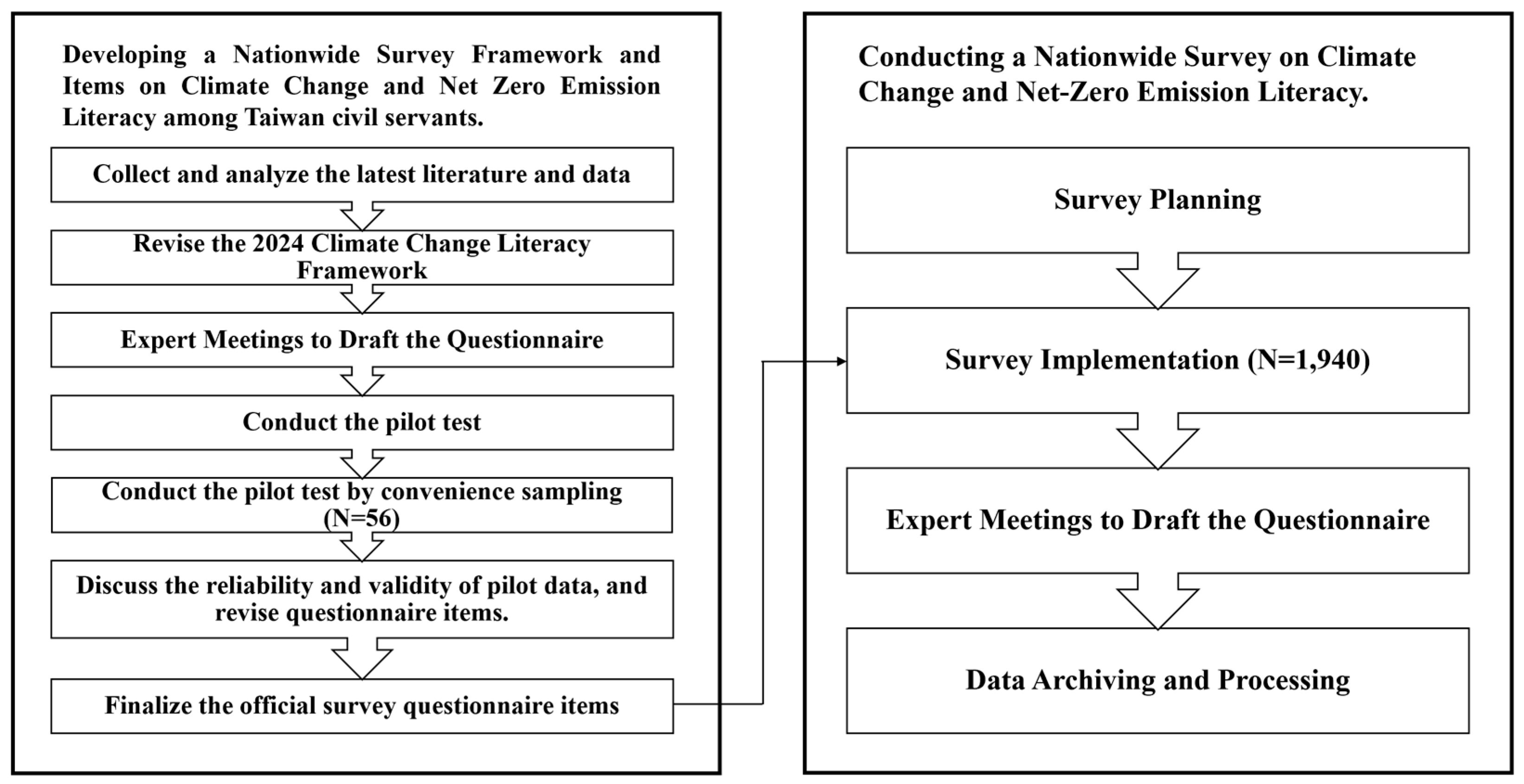
Figure 2.
Three domains of the climate change literacy survey for civil servants.
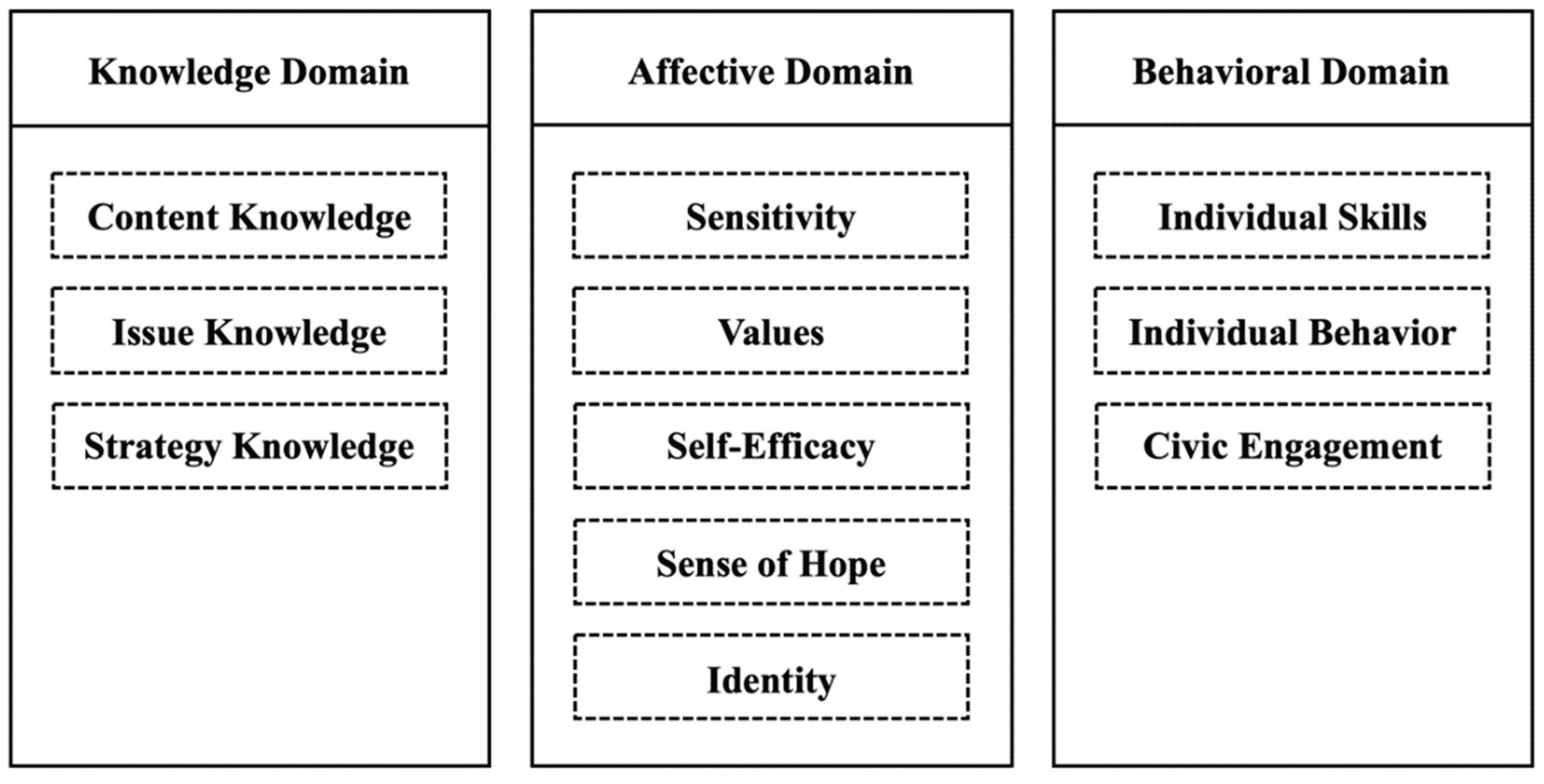

Table 1.
Sample distribution by demographic characteristics.
| Variables | Description | Freq. | Percent | Cum. |
|---|---|---|---|---|
| Gender | Male | 889 | 45.82 | 45.82 |
| Female | 1,051 | 54.18 | 100.00 | |
| Age (years) | 29 years and under | 270 | 13.92 | 13.92 |
| 30-39 | 626 | 32.27 | 46.19 | |
| 40-49 | 621 | 32.01 | 78.20 | |
| 50-59 | 343 | 17.68 | 95.88 | |
| 60-69 | 80 | 4.12 | 100.00 | |
| Education level | Junior high school | 7 | 0.36 | 0.36 |
| Senior high school | 34 | 1.75 | 2.11 | |
| Junior college | 115 | 5.93 | 8.04 | |
| Bachelor’s degree | 998 | 51.44 | 59.48 | |
| Master’s degree | 745 | 38.40 | 97.89 | |
| Doctoral degree (PhD) | 41 | 2.11 | 100.00 | |
| Seniority | 0-9 | 867 | 44.69 | 44.69 |
| 10-19 | 646 | 33.30 | 77.99 | |
| 20-29 | 263 | 13.56 | 91.55 | |
| 30-39 | 155 | 7.99 | 99.54 | |
| 40 years and over | 9 | 0.46 | 100.00 | |
| Government Level | Central | 1,106 | 57.01 | 57.01 |
| Local | 834 | 42.99 | 100.00 |
1 Unit of Seniority: year.
Table 2.
Hierarchical Regression Results Predicting Climate-Related Action.
| (1) | (2) | (3) | (4) | (5) | (6) | |
| Variables | Action | |||||
| CK | 0.021 | 0.017 | 0.013 | 0.020 | 0.016 | 0.013 |
| (0.018) | (0.013) | (0.013) | (0.018) | (0.013) | (0.013) | |
| IK | -0.024 | -0.019 | -0.018 | -0.018 | -0.016 | -0.015 |
| (0.021) | (0.015) | (0.014) | (0.021) | (0.015) | (0.015) | |
| SK | 0.041*** | 0.0068 | -0.0046 | 0.039*** | 0.0049 | -0.0067 |
| (0.0086) | (0.0061) | (0.0062) | (0.0086) | (0.0061) | (0.0063) | |
| Sensitivity | - | -0.015 | -0.0049 | - | -0.011 | -0.00088 |
| - | (0.025) | (0.024) | - | (0.025) | (0.025) | |
| values | - | 0.040 | -0.00088 | - | 0.037 | -0.0015 |
| - | (0.037) | (0.037) | - | (0.037) | (0.037) | |
| Self-Efficacy | - | 0.61*** | 0.56*** | - | 0.61*** | 0.56*** |
| - | (0.020) | (0.021) | - | (0.020) | (0.021) | |
| Sense of Hope | - | 0.0093 | 0.020 | - | 0.012 | 0.021 |
| - | (0.022) | (0.021) | - | (0.022) | (0.021) | |
| Identity | - | 0.13*** | 0.14*** | - | 0.13*** | 0.13*** |
| - | (0.023) | (0.023) | - | (0.023) | (0.023) | |
| Once | - | - | 0.053* | - | - | 0.046 |
| - | - | (0.029) | - | - | (0.029) | |
| Related | - | - | 0.067*** | - | - | 0.065*** |
| - | - | (0.014) | - | - | (0.014) | |
| Support | - | - | 0.026* | - | - | 0.028** |
| - | - | (0.014) | - | - | (0.014) | |
| Gender | 0.067** | 0.0030 | -0.0066 | 0.050 | 0.0029 | -0.0035 |
| (0.034) | (0.024) | (0.024) | (0.034) | (0.024) | (0.024) | |
| Age | 0.0024 | -0.0033* | -0.0029 | 0.00079 | -0.0039** | -0.0035* |
| (0.0027) | (0.0019) | (0.0018) | (0.0027) | (0.0019) | (0.0019) | |
| Edu | 0.056*** | 0.026*** | 0.020*** | 0.064*** | 0.032*** | 0.024*** |
| (0.011) | (0.0075) | (0.0074) | (0.011) | (0.0076) | (0.0076) | |
| Seniority | 0.0011 | 0.0035* | 0.0030 | 0.0022 | 0.0043** | 0.0037* |
| (0.0028) | (0.0019) | (0.0019) | (0.0028) | (0.0019) | (0.0019) | |
| Constant | 1.79*** | -0.0012 | 0.13 | 2.09*** | 0.060 | 0.14 |
| (0.19) | (0.15) | (0.15) | (0.24) | (0.18) | (0.18) | |
| City | Yes | Yes | Yes | |||
| Observations | 1,940 | 1,940 | 1,940 | 1,940 | 1,940 | 1,940 |
| R-squared | 0.043 | 0.542 | 0.556 | 0.075 | 0.548 | 0.560 |
2 (a) * denotes significance at the 1% level, ** denotes significance at the 5% level, and * denotes significance at the 10% level. (b) Standard errors are in parentheses.
Table 3.
OLS Regression Results by Government Level (Central vs. Local Officials).
| Central | Local | ||||
|---|---|---|---|---|---|
| Coef. | Std. | Coef. | Std. | ||
| CK | 0.019 | (0.017) | 0.0053 | (0.020) | |
| IK | -0.016 | (0.019) | -0.014 | (0.023) | |
| SK | -0.016* | (0.0084) | 0.0024 | (0.0096) | |
| Sensitivity | -0.0038 | (0.033) | 0.0052 | (0.038) | |
| values | 0.013 | (0.049) | -0.011 | (0.058) | |
| Self-Efficacy | 0.55*** | (0.028) | 0.57*** | (0.034) | |
| Sense of Hope | 0.032 | (0.028) | 0.015 | (0.035) | |
| Identity | 0.13*** | (0.029) | 0.13*** | (0.036) | |
| Once | 0.016 | (0.040) | 0.093** | (0.043) | |
| Related | 0.088*** | (0.019) | 0.023 | (0.023) | |
| Support | 0.017 | (0.018) | 0.054** | (0.024) | |
| Constant | -0.16 | (0.27) | 0.24 | (0.26) | |
| Control var. | Yes | Yes | |||
| City | Yes | Yes | |||
| Observations | 1,106 | 834 | |||
| R-squared | 0.561 | 0.575 | |||
3 (a) * denotes significance at the 1% level, ** denotes significance at the 5% level, and * denotes significance at the 10% level. (b) Standard errors are in parentheses.
Disclaimer/Publisher’s Note: The statements, opinions and data contained in all publications are solely those of the individual author(s) and contributor(s) and not of MDPI and/or the editor(s). MDPI and/or the editor(s) disclaim responsibility for any injury to people or property resulting from any ideas, methods, instructions or products referred to in the content. |
© 2025 by the authors. Licensee MDPI, Basel, Switzerland. This article is an open access article distributed under the terms and conditions of the Creative Commons Attribution (CC BY) license (http://creativecommons.org/licenses/by/4.0/).
Copyright: This open access article is published under a Creative Commons CC BY 4.0 license, which permit the free download, distribution, and reuse, provided that the author and preprint are cited in any reuse.


