

Submitted:
29 August 2025
Posted:
01 September 2025
You are already at the latest version
Abstract
Wood and wood-based products are increasingly recognized for their renewability and carbon storage capacity, supporting sustainable development and circular economy goals in the EU. This paper systematically reviews material flow analysis (MFA) practices applied to wood resources in the European Union (EU) and Switzerland, covering 42 studies from 2000 to 2024. The review assesses how MFA is conducted, including scopes of system boundaries, data sources, unit consistency, flow representation, and handling of uncertainty. Results show that while volume-based units and Sankey diagrams are commonly used, there is significant variation in terminology, data quality, and methodology. Challenges include limited access to reliable data, inconsistent spatial and temporal scales, and diverse data processing risk levels. The study highlights the need for harmonized methods, standardized units, and open data platforms to improve data quality and comparability. Clear guidelines and a unified framework are essential for advancing MFA as a tool for policy support, resource efficiency, and climate change mitigation. This review demonstrates that further collaboration and methodological consistency are crucial to unlocking the full potential of wood MFA in sustainable resource management.
Keywords:
material flow analysis (MFA)
; wood resources
; wood products
1. Introduction
The significance of wood and wood-based products is increasingly acknowledged, particularly considering their environmental properties such as renewability and carbon storage capacity. In addition to carbon stored in forests and wood products, long-lasting final applications like building materials and furniture also serve as reliable forms of carbon sequestration for decades. In the context of sustainable development and the circular economy, forestry as well as the wood processing industries are important elements in promoting resource efficiency, waste reduction, and related objectives. The importance of wood resources is reflected in key European Union policy frameworks, including the EU Bioeconomy Strategy [1] and the European Green Deal [2]. The Bioeconomy Strategy highlights both the environmental and economic benefits of engineered wood use in the construction sector, particularly due to their lower greenhouse gas emissions compared to non-renewable materials such as steel and concrete. It also notes the high potential of wood supply, with 84% of the EU forest area considered available for wood production. The European Green Deal, meanwhile, sets a target to reduce greenhouse gas emissions by at least 55% by 2030, through legislation such as the “Regulation on Land Use, Forestry and Agriculture” and the “New EU Emissions Trading System for buildings and road transport fuels.” Both documents emphasize the need for sustainable natural resource management and identify wood as a viable substitute for fossil-based and carbon-intensive materials.
To meet these extraordinary goals, an analytical framework is needed to monitor the availability of wood materials, the production and utilization of wood products, and the management of wood waste throughout the entire lifecycle. Material flow analysis (MFA) is a methodological framework for quantifying the flows and stocks of materials within defined systems. As a tool for macro-level evaluation, MFA has been widely applied in fields such as waste management, industrial ecology, and sustainability science. A common standard for MFA has existed since 2016, known as The Handbook of Material Flow Analysis [3]. However, while the application of MFA to wood resources began as early as the 1990s (e.g., Buchanan et al., 1999 [4]), a standardized and consistent methodological framework for wood-specific MFA is still lacking. This absence makes comparison between studies difficult and limits the development of a systematic understanding of wood flows.
In support of a more standardized procedure, Joosten et al. (1999) [5] developed a method called STREAMS, which stands for Statistical Research of the Analysis of Material Streams. However, the method was not widely adopted. The authors also predicted that such analyses would become increasingly difficult in the future due to observable trends in which statistical offices are collecting a decreasing amount of physical material flow data. Based on a literature review, Marques et al. (2020) [6] emphasized the need for harmonization in MFA studies, the relevance of MFA for policy and the circular economy, and challenges in existing research, such as inconsistent terminology and limited attention to cascading uses. They proposed a five-step methodology and offered suggestions to improve the understanding of wood-based biomass MFA.
Nevertheless, the lack of a universal standard has led to difficulties in comprehension, and the importance of improving data quality and methodological consistency is increasingly recognized by scholars in the field. Alongside the growing use of wood in the EU, meaningful cross-country comparisons are needed, but these will only be possible with a sufficiently standardized framework. Clearly, the development of a general framework for wood-specific MFA is still in its early stages. Greater attention and further contributions are required. This paper aims to systematically review current practices in the material flow analysis of wood resources. It was intended to assess how these practices are applied, what methodological trends are emerging, and where there are opportunities for standardization and improvement.
2. Materials and Methods
To establish a comprehensive understanding of current practices in wood resource management, a systematic literature review was conducted, focusing on MFA studies within the European Union and Switzerland. This geographic scope was chosen due to shared policy frameworks and regional characteristics. The review gathered peer-reviewed journal articles, conference papers, and relevant reports published between 2000 and 2024, all written in English. The search strategy employed combinations of keywords such as “wood” or “wood resource”, and secondarily “forest” or “forest biomass”, with “material flow analysis (MFA)” or “flow”, applied to titles, abstracts, and author-specified keywords. Publications were selected based on their relevance to MFA in the wood sector within the defined geographic area.
Studies focusing on MFA in unrelated sectors, such as metals, plastics, or electronic waste, as well as those conducted outside the EU and Switzerland, were excluded. However, some Life Cycle Assessment (LCA)-oriented papers and single-stage studies were retained where they offered relevant insights into wood-related MFA. A total of 42 studies (see Table 1) were selected for in-depth analysis.
These studies were examined to extract information on the structure, scope, and methodological approaches applied in wood MFA. A content analysis framework was used to assess several evaluation criteria: geographical and temporal coverage, system boundaries, data sources and quality, flow representation techniques, and the treatment of uncertainty. To ensure clarity and comparability across studies, these criteria were organized into Table 2, which outlines the purpose and specific aspects analyzed under each category. For example, regarding data sources and quality, an assessment was made of whether the studies used primary or secondary data, how missing or inconsistent information was addressed, and whether methodological choices were clearly explained. In terms of flow representation, we compared the visualization tools used and evaluated how effectively they conveyed the system structure and material balance. For uncertainty and assumptions, we examined how assumptions were described and handled. Each study was reviewed using these criteria to identify methodological similarities, differences, and potential gaps.
3. Results and Discussion
3.1. System Boundaries and Purposes
To clearly map out the complex relationships among the different stages of wood processing, four stages were defined that encompass the entire material flow: Forestry, Manufacturing, Building, and End-of-Life. Each stage represents a distinct phase in the life cycle of wood resources, from raw material extraction to final disposal or reuse. The forestry stage involves the extraction of roundwood from domestic or foreign forests. This stage reflects forest management practices, harvesting intensity, and the initial availability of wood supply. The manufacturing stage covers the processing of raw materials into semi-finished and finished wood products, including sawmilling, board production, and the generation of by-products like wood chips. The building stage includes the utilization of wood products in construction, renovation, and demolition, as well as related applications like furniture manufacturing, where wood serves as structural components or interior fittings. Finally, the end-of-life stage addresses the processes of material recycling, thermal recycling, incineration without energy recovery, or landfilling of wood products after their useful life has ended.
The selected papers collectively aim to advance the understanding and application of material flow analysis in the wood sector across Europe. Some studies focus on improving MFA methodologies through the development of standardized frameworks, enhanced data reconciliation techniques, and better handling of uncertainties. Others map and quantify wood flows at national and regional levels to support resource monitoring and strategic planning. Several papers evaluate the role of wood in carbon storage and greenhouse gas mitigation to align with climate goals. Additional research assesses the efficiency of wood use by exploring circular and cascading utilization strategies. Finally, some studies provide insights into socioeconomic implications and bioeconomy performance to provide a basis for policy decisions. To support clearer comparison and synthesis of findings, the reviewed studies have been grouped into five main categories labeled A to E, each reflecting a distinct purpose:
- A – Methodological Development and Standardization of MFA
- B – National and Regional Wood Flow Analyses
- C – Climate Change Mitigation and Carbon Accounting
- D – Resource Efficiency, Circularity, and Cascading Use
- E – Policy Support, Strategic Planning, and Socioeconomic Implications
Table 3 summarizes the stages and purposes addressed in each paper.
While forestry, manufacturing, and end-of-life stages have received considerable attention in the literature, the building stage remains comparatively underexplored, particularly regarding the lifespan and long-term use of wood products. Many studies tend to stop at the point where wood is processed into finished products, treating this as the final stage of the material flow. However, this perspective overlooks the continued flow of wood as a resource. Material flow analysis typically focuses on resources rather than just products. Most wood does not end its role once it leaves the manufacturing stage. Instead, a significant portion of wood materials flows into the building stage, where they serve as various architectural components such as beams and panels, or as interior elements like furniture. These applications often extend the life of wood for several decades, making the building stage a key phase in the overall flow that should not be ignored. Moreover, wood used in construction is frequently stored in long-term stocks, which has important implications for resource efficiency and carbon storage potential. Therefore, to obtain a more holistic and representative picture of wood resource flows, the building sector should be clearly defined and fully integrated into the analysis. By doing so, researchers can better capture the temporal aspects of material use and provide more accurate data for circularity assessments and sustainability planning.
In the literature on wood resources and material flow analysis, authors frequently introduce their own terminology, concepts, and categorical boundaries to describe specific processes, products, or sectors. Terms such as “building timber industry” [7], “building finish” [11], and “massive house” [13] are examples of self-defined expressions that appear in the building stage of selected papers. Tailored to the focus of individual studies, these terms give researchers flexibility to achieve their unique goals, but they can also create ambiguity or inconsistency when comparing across studies. In contrast, international organizations and governmental agencies, such as national statistical offices, typically provide standardized product names and definitions [48]. These official definitions are designed to ensure consistency in reporting and data aggregation across time and space. Referring to such sources improves not only the clarity of an article but also its alignment with widely accepted data systems and policy frameworks. This, in turn, enhances the reliability and comparability of research findings. Problems arise when terms commonly used in research cannot be found in official sources. This disconnect can lead to confusion for readers unfamiliar with the term or complicate efforts to match results with similar studies. Therefore, using self-defined terms is generally discouraged unless unavoidable. When such terms are necessary, they should be clearly defined in the text and consistently labeled in tables and figures. Providing definitions, explanations, or references to similar established terms can greatly improve understanding.
3.2. Data Processing
In terms of data collection, most studies tend to source their raw data primarily from governmental or institutional publications, which are generally considered the most reliable and accessible. These include statistics from authorities such as national forest agencies, forest inventories, national statistical offices, or ministries of the environment [6]. After that, researchers often turn to academic literature, existing databases, interviews with factories, and expert estimations to fill in data gaps. These secondary sources play an important role, especially when official statistics are unavailable or not detailed enough to meet the needs of a specific study.
As shown in Table 1, research on the material flow analysis of wood resources began in the early 2000s, gained prominence after 2015, and has continued to attract growing attention in recent years. This reflects increasing awareness of the importance of tracking wood flows for environmental planning, resource management, and bioeconomy development. However, one of the key challenges faced by researchers in this area is the lack of easily accessible, high-quality data. Most studies rely heavily on official government statistics, such as annual roundwood removal data in Germany [26], as these serve as the foundation for flow estimations. While large institutions such as the Food and Agriculture Organization of the United Nations (FAO) [48] and national statistical agencies provide a wide range of data on wood products, much of the detailed or sector-specific information required for a complete MFA remains difficult to obtain. Unlike life cycle assessment (LCA), which often focuses on clearly defined units like individual buildings or products, MFA of wood resources is typically conducted at a broader, macro-scale level. Because of this, it requires comprehensive data across multiple sectors and regions, which is not always readily available. Some studies [42,43,44] have attempted to fill data gaps by conducting telephone or on-site interviews to estimate national wood flows. While valuable, these efforts were usually one-time projects and required significant time and effort. It is unrealistic to expect all researchers, particularly those working in academic settings with limited funding, to carry out this kind of intensive data collection on a regular basis. Given these limitations, university researchers have only limited capacity to directly improve the overall data situation. The most practical solution is to encourage government agencies to collect and publish more detailed and consistent data. Another option is to explore ways of gaining access to ongoing governmental investigations or national-level surveys, either by requesting shared data or through collaborative partnerships. Involving academic researchers in such efforts could help address key data gaps while also strengthening the reliability and relevance of future MFA studies.
Many time scales, geographical ranges, and data sources used in this field are outdated, which creates significant challenges for current research. In most cases, each study independently defines its own spatial and temporal boundaries, often based on what data is available at the time or the specific goals of the project. This results in inconsistencies that make it difficult to compare or update findings across studies. For example, although some papers have created comprehensive flowcharts of wood material flows in the European Union, such as the one presented in [44], these now contain inaccuracies due to geopolitical changes, most notably the departure of the United Kingdom from the EU. Similarly, older studies like [36], published in Slovenia 18 years ago, may have been highly relevant and accurate at the time, but are unlikely to reflect the current state of wood flows in the country. To evaluate today’s material flows in Slovenia or elsewhere, researchers would either need to repeat the entire data collection and analysis process based on the previous study’s framework or build a completely new analysis from scratch. In many cases, however, replicating earlier work is not possible. There is often limited information available about the original data sources, and even when sources are cited, the actual inventories or databases used may no longer be publicly accessible or have since been discontinued. This lack of transparency and reproducibility weakens the long-term usefulness of many studies and discourages efforts to build upon earlier research. To overcome these issues related to inaccessible data, outdated study scopes, and irreproducible workflows, the development of a shared, open-access database that collects material flow data related to wood resources across different countries and time periods is recommended. This should be complemented by a standardized methodological framework that outlines clear expectations for system boundaries, inventory compilation, documentation, and visualization. By combining open data with a common approach, future studies will become more consistent, comparable, and easier to update.
Various units were used across studies due to differences in purpose, data availability, personal preference, and other factors. Particularly for wood products, both volume-based and mass-based units are common, as shown in Table 4. Product names and definitions also varied, with many abbreviations specific to individual papers.
Wood products are typically measured in either cubic meters (product volume, wood fiber equivalent, solid wood equivalent, or roundwood equivalent) or metric tons (wet matter or dry matter). In general, volumetric units (31 out of 42) are more commonly used than gravimetric ones (10 out of 42). The debate over whether to use volume-based or mass-based data has been ongoing for a long time. Even scholars who adopted cubic meters in their studies have questioned whether it might be more appropriate to use mass units, such as oven-dry tons, instead of volumetric units [21]. They argued that a mass-based approach would avoid potential complications related to moisture content, shrinkage or swelling, and densification (e.g., in panel production), and would also facilitate stronger correlations with biomass and carbon management. Volume units, they noted, could still be derived afterward to meet the information needs of the forest-based industry. [27] also pointed out that wood and wood products are often better understood when expressed in different units. Different products are managed by different industries using their preferred units, which becomes problematic when attempting to convert all of them into a single standardized unit. While there is no absolute reason to replace metric tons entirely with cubic meters, it makes sense that most wood product data published by authorities such as the FAO [48] are expressed in volumetric terms. Using official statistics directly or relying on official conversion factors can save considerable time and reduce the likelihood of human error. For consistency, only the use of volumetric units or gravimetric units is recommended, as these are the predominant units across studies, although authors can still add additional data in different units for their specific purposes. Although there are no complete official conversion factors for all wood resources, those with official conversion factors should be adopted wherever possible. Encouraging the use of standardized units is beneficial, especially for inventory and reporting purposes.
Different levels of accuracy exist at various stages of data processing, reflecting the complexity and potential for error that can arise throughout the analytical workflow. Typically, raw data collected from diverse sources experience multiple stages of processing, often involving calculations that require conversion factors. These factors may be obtained from official publications issued by governmental authorities, extracted from peer-reviewed academic papers, or sometimes determined through estimations and assumptions when direct data are unavailable. Beyond the typical uncertainty treatments applied in many scientific studies such as sensitivity analyses, there remains a significant risk of human errors occurring during data input or output stages. Such errors may result from simple typographical mistakes, misinterpretation of figures in reviewed papers, or the adoption of overly basic or rough assumptions that fail to capture the complexity of the underlying processes. Reference [27] emphasized the crucial importance of minimizing compounded errors by directly referring to primary sources of data whenever possible. They argued that converting data straight into the desired output units is preferable, rather than performing multiple intermediate conversions through derived mass values such as tones or cubic meters, which can amplify inaccuracies. This approach helps to reduce the risk of error accumulation throughout the conversion chain. Additionally, they highlighted the necessity of critically evaluating the assumptions behind any conversion process, especially when these are based on primary data, since incorrect or unverified assumptions can lead to consistent errors in the results.
To better manage and communicate the varying degrees of uncertainty and risk in data processing, a classification system consisting of five distinct levels of risk was proposed. Level 1 represents the use of raw data directly as collected, where the only potential source of error is human error during data handling or entry. Level 2 applies when raw data are processed using official conversion factors, which have been published and validated by recognized authorities. Level 3 is assigned to situations where conversion factors are sourced from academic papers or literature, which may vary in quality or relevance depending on the study context. Level 4 corresponds to cases where data are not directly measured or published but estimated using certain logical reasoning or indirect indicators, thereby increasing uncertainty. Finally, Level 5 covers the most uncertain situations, where there is no clear or documented method for obtaining the data, and values must be obtained purely based on assumptions without observational support. Ideally, data falling into Levels 3 through 5 should be avoided or replaced with higher-quality information whenever possible, given their higher uncertainty and risk of introducing error. Nevertheless, directly including these risk levels in any data inventory or analysis framework serves an important purpose: it helps users and other researchers understand the reliability and credibility of the dataset. It also draws attention to areas where better, more accurate data collection is urgently needed to improve future analyses. By transparently communicating these levels of risk, involved parties can make informed decisions about the confidence they place in specific datasets and prioritize efforts to refine or replace lower-quality data.
3.3. Outputs and Applications
Most of the reviewed papers include tables and figures to improve the clarity and accessibility of their analytical results. These visual aids help break down complex data into more understandable formats, making it easier for readers to locate key findings. In addition to infographics, some studies take it further by providing extra links or references, encouraging readers to explore related materials or datasets for deeper insights. Among the various types of graphical representations used, the Sankey diagram stands out as the most common method to show the flow of wood resources through the different stages of the material lifecycle. Sankey diagrams are widely favored because they visually show the size of material flows using arrows, where the thickness corresponds directly to the volume or quantity being represented. This clear design enables viewers to quickly identify major streams within the system. Despite their popularity, a notable limitation is the lack of consistency in how these diagrams are created across different studies, which makes direct comparison difficult. Variations in graphical standards, including layout orientation, color schemes, node and link styling, scaling ratios, and software tools, can cause inconsistencies that make interpretation confusing. This issue becomes particularly noticeable when diagrams illustrate complex systems involving multiple categories of wood products, as the intersecting flows and numerous branches can overwhelm the viewer. Navigating the path of a single flow line within a single diagram is often a challenge; comparing two diagrams at the same time, each designed with different conventions, makes the difficulty even greater.
Recognizing these interpretive challenges, especially for audiences not in this field or less familiar with complex visualizations, it was considered that Sankey diagrams remain the preferred format for visualizing material flow outputs. However, to improve their effectiveness and usability, several suggestions were proposed. First, it is essential to develop and adopt standardized design guidelines that specify consistent rules for diagram direction, color usage, node and link appearance, inclusion of illustrative icons, and proportional scaling. Second, the complexity of each diagram should be managed by limiting the number of nodes and connections to a level that remains visually clear; when necessary, the flow system can be divided into multiple, focused diagrams that highlight specific parts. Third, using additional visual elements such as product-specific icons to identify wood categories and enlarged nodes to highlight stock volumes can help guide interpretation and provide clearer context. Figure 1 demonstrates an example where such enhancements improve the readability and informative value of a Sankey diagram.
5. Conclusions
This study systematically reviewed material flow analysis practices related to wood resources within the European Union and Switzerland from 2000 to 2024. The findings reveal that while MFA is a powerful tool for quantifying the flows and stocks of wood materials, its current application remains fragmented and inconsistent. Considerable differences in methodological approaches remain across studies, including but not limited to differences in scope, terminology, data sources, units of measurement, and visualization techniques. These inconsistencies reduce the comparability of results, limit policy relevance, and challenge efforts to assess wood use in the broader context of sustainable development and circular economy strategies. The review highlights a variety of critical gaps: the building stage is often underrepresented despite its importance in long-term carbon storage; many studies rely heavily on outdated or incomplete data; and elements such as conversion factors are not always transparently documented. While efforts such as the development of frameworks like STREAMS [5] and proposals for stepwise method-ologies have contributed valuable insights [6], a universally accepted standard for wood-specific MFA has yet to emerge. To address these challenges, this paper emphasizes three key directions for future work: (1) the harmonization of methodological approaches, including clearer definitions, standardized units, and classification levels for data reliability; (2) the establishment of an open, regularly updated database for MFA of wood resources to ensure transparency, reproducibility, and accessibility; and (3) stronger collaboration among researchers, statistical authorities, and policymakers to improve data availability and coordinate analytical efforts with policy goals. In this context, developing a standardized methodological framework, as has been done in Life Cycle Assessment, may be a necessary first step. This would involve, for example, common rules for defining terminology, setting system boundaries, and promoting the use of tools such as Environmental Product Declarations where applicable. Ultimately, advancing the quality and consistency of MFA of wood resources will enhance its utility as a decision-support tool and strengthen its role in shaping a more sustainable, resource-efficient, and climate-adaptive future.
Author Contributions
Conceptualization, A.T., H.W., S.W.; methodology, H.W.; formal analysis, H.W.; data curation, H.W.; writing—original draft preparation, H.W.; writing—review and editing, A.T. and S.W.; visualization, H.W.; supervision, A.T. and S.W.; project administration, S.W. All authors have read and agreed to the published version of the manuscript.
Funding
This research received no external funding.
Institutional Review Board Statement
Not applicable.
Data Availability Statement
Data will be available upon request.
Conflicts of Interest
The authors declare no conflicts of interest.
References
- European Commission: Directorate-General for Research and Innovation. A Sustainable Bioeconomy for Europe – Strengthening the Connection between Economy, Society and the Environment – Updated Bioeconomy Strategy; Publications Office: Luxembourg, 2018. [Google Scholar] [CrossRef]
- European Commission: Directorate-General for Communication. The European Green Deal – Delivering the EU’s 2030 Climate Targets; Publications Office of the European Union: Luxembourg, 2023. [Google Scholar] [CrossRef]
- Brunner, P.H.; Rechberger, H. Practical Handbook of Material Flow Analysis, 1st ed.; CRC Press: Boca Raton, FL, USA, 2004. [Google Scholar]
- Buchanan, A.H.; Levine, S.B. Wood-based building materials and atmospheric carbon emissions. Environ. Sci. Policy 1999, 2, 427–437. [Google Scholar] [CrossRef]
- Joosten, L. A. J.; Hekkert, M. P.; Worrell, E.; Turkenburg, W. C. STREAMS: A new method for analysing material flows through society. Resour. Conserv. Recycl. 1999, 27, 249–266. [Google Scholar] [CrossRef]
- Marques, A.; Cunha, J.; De Meyer, A.; Navare, K. Contribution Towards a Comprehensive Methodology for Wood-Based Biomass Material Flow Analysis in a Circular Economy Setting. Forests 2020, 11, 106. [Google Scholar] [CrossRef]
- Džubur, N.; Sunanta, O.; Laner, D. A Fuzzy Set-Based Approach to Data Reconciliation in Material Flow Modeling. Appl. Math. Model. 2017, 43, 464–480. [Google Scholar] [CrossRef]
- Džubur, N.; Laner, D. Evaluation of Modeling Approaches to Determine End-of-Life Flows Associated with Buildings: A Viennese Case Study on Wood and Contaminants. J. Ind. Ecol. 2018, 22, 1156–1169. [Google Scholar] [CrossRef]
- Kalcher, J.; Praxmarer, G.; Teischinger, A. Quantification of Future Availabilities of Recovered Wood from Austrian Residential Buildings. Resour. Conserv. Recycl. 2017, 123, 143–152. [Google Scholar] [CrossRef]
- Kalt, G. Biomass Streams in Austria: Drawing a Complete Picture of Biogenic Material Flows within the National Economy. Resour. Conserv. Recycl. 2015, 95, 100–111. [Google Scholar] [CrossRef]
- Bergeron, F.C. Assessment of the Coherence of the Swiss Waste Wood Management. Resour. Conserv. Recycl. 2014, 91, 62–70. [Google Scholar] [CrossRef]
- Bergeron, F.C. Energy and Climate Impact Assessment of Waste Wood Recovery in Switzerland. Biomass Bioenergy 2016, 94, 245–257. [Google Scholar] [CrossRef]
- Mehr, J.; Vadenbo, C.; Steubing, B.; Hellweg, S. Environmentally Optimal Wood Use in Switzerland—Investigating the Relevance of Material Cascades. Resour. Conserv. Recycl. 2018, 131, 181–191. [Google Scholar] [CrossRef]
- Suter, F.; Steubing, B.; Hellweg, S. Life Cycle Impacts and Benefits of Wood along the Value Chain: The Case of Switzerland. J. Ind. Ecol. 2017, 21, 874–886. [Google Scholar] [CrossRef]
- Jasinevičius, G.; Lindner, M.; Cienciala, E.; Tykkyläinen, M. Carbon Accounting in Harvested Wood Products: Assessment Using Material Flow Analysis Resulting in Larger Pools Compared to the IPCC Default Method. J. Ind. Ecol. 2018, 22, 121–131. [Google Scholar] [CrossRef]
- Bösch, M.; Jochem, D.; Weimar, H.; Dieter, M. Physical Input–Output Accounting of the Wood and Paper Flow in Germany. Resour. Conserv. Recycl. 2015, 94, 99–109. [Google Scholar] [CrossRef]
- Cote, M.; Poganietz, W.-R.; Schebek, L. Anthropogenic Carbon Stock Dynamics of Pulp and Paper Products in Germany. J. Ind. Ecol. 2015, 19, 366–379. [Google Scholar] [CrossRef]
- Egenolf, V.; Vita, G.; Distelkamp, M.; Schier, F.; Hüfner, R.; Bringezu, S. The Timber Footprint of the German Bioeconomy—State of the Art and Past Development. Sustainability 2021, 13, 3878. [Google Scholar] [CrossRef]
- Jochem, D.; Weimar, H.; Bösch, M.; Mantau, U.; Dieter, M. Estimation of Wood Removals and Fellings in Germany: A Calculation Approach Based on the Amount of Used Roundwood. Eur. J. For. Res. 2015, 134, 869–888. [Google Scholar] [CrossRef]
- Knauf, M. An Analysis of Wood Market Balance Modeling in Germany. Forest Policy and Economics 2015, 50, 319–326. [Google Scholar] [CrossRef]
- Knauf, M. The Wood Market Balance as a Tool for Calculating Wood Use's Climate Change Mitigation Effect — An Example for Germany. Forest Policy and Economics 2016, 66, 18–21. [Google Scholar] [CrossRef]
- Schweinle, J.; Geng, N.; Iost, S.; Weimar, H.; Jochem, D. Monitoring Sustainability Effects of the Bioeconomy: A Material Flow Based Approach Using the Example of Softwood Lumber and Its Core Product Epal 1 Pallet. Sustainability 2020, 12, 2444. [Google Scholar] [CrossRef]
- Szarka, N.; Haufe, H.; Lange, N.; Schier, F.; Weimar, H.; Banse, M.; Sturm, V.; Dammer, L.; Piotrowski, S.; Thrän, D. Biomass Flow in Bioeconomy: Overview for Germany. Renew. Sustain. Energy Rev. 2021, 150, 111449. [Google Scholar] [CrossRef]
- Szichta, P.; Risse, M.; Weber-Blaschke, G.; Richter, K. Potentials for wood cascading: A model for the prediction of the recovery of timber in Germany. Resour. Conserv. Recycl. 2022, 178, 106101. [Google Scholar] [CrossRef]
- Taskhiri, M.S.; Garbs, M.; Geldermann, J. Sustainable logistics network for wood flow considering cascade utilisation. J. Clean. Prod. 2016, 110, 25–39. [Google Scholar] [CrossRef]
- Wang, R.; Haller, P. Dynamic material flow analysis of wood in Germany from 1991 to 2020. Resour. Conserv. Recycl. 2024, 201, 107339. [Google Scholar] [CrossRef]
- Brownell, H.; Iliev, B.E.; Bentsen, N.S. How much wood do we use and how do we use it? Estimating Danish wood flows, circularity, and cascading using national material flow accounts. J. Clean. Prod. 2023, 423, 138720. [Google Scholar] [CrossRef]
- Hassan, M.K.; Villa, A.; Kuittinen, S.; Jänis, J.; Pappinen, A. An assessment of side-stream generation from Finnish forest industry. J. Mater. Cycles Waste Manag. 2019, 21, 265–280. [Google Scholar] [CrossRef]
- Nasiri, B.; Piccardo, C.; Hughes, M. Estimating the material stock in wooden residential houses in Finland. Waste Manag. 2021, 135, 318–326. [Google Scholar] [CrossRef]
- Layton, R.J.; Horta Arduin, R.; Yazdeen, H.; Pommier, R.; Sonnemann, G. Material Flow Analysis to Evaluate Supply Chain Evolution and Management: An Example Focused on Maritime Pine in the Landes de Gascogne Forest, France. Sustainability 2021, 13, 4378. [Google Scholar] [CrossRef]
- Lenglet, J.; Courtonne, J.-Y.; Caurla, S. Material flow analysis of the forest-wood supply chain: a consequential approach for log export policies in France. J. Clean. Prod. 2017, 165, 1296–1305. [Google Scholar] [CrossRef]
- Polgár, A. Carbon footprint and sustainability assessment of wood utilisation in Hungary. Environ. Dev. Sustain. 2024, 26, 24495–24519. [Google Scholar] [CrossRef]
- Donlan, J.; Skog, K.E.; Byrne, K.A. Carbon storage in harvested wood products for Ireland 1961–2009. Biomass Bioenergy 2012, 46, 731–738. [Google Scholar] [CrossRef]
- Hekkert, M.P.; Joosten, L.A.J.; Worrell, E. Analysis of the paper and wood flow in The Netherlands. Resour. Conserv. Recycl. 2000, 30, 29–48. [Google Scholar] [CrossRef]
- Gonçalves, M.; Freire, F.; Garcia, R. Material flow analysis of forest biomass in Portugal to support a circular bioeconomy. Resour. Conserv. Recycl. 2021, 169, 105507. [Google Scholar] [CrossRef]
- Piškur, M.; Krajnc, N. Roundwood flow analysis in Slovenia. Croj. J. For. Eng. 2007, 28, 39–46. Available online: https://crojfe.com/site/assets/files/3901/piskur39-46.pdf (accessed on 18 April 2024).
- Gejdoš, M.; Danihelová, Z. Valuation and timber market in the Slovak Republic. Procedia Econ. Finance 2015, 34, 697–703. [Google Scholar] [CrossRef]
- Parobek, J.; Paluš, H.; Kaputa, V.; Šupín, M. Modelling of wood and wood products flow in the Slovak Republic. In A European Wood Processing Strategy: Future Resources Matching Products and Innovations; COST Action E44 Conference, Ghent, Belgium, 2008, p. 93. Available online: https://www.researchgate.net/publication/285288571_Modelling_of_wood_and_wood_products_flow_in_the_Slovak_Republic (accessed on 25 April 2024).
- Parobek, J.; Paluš, H.; Kaputa, V.; Šupín, M. Analysis of wood flows in Slovakia. BioResources 2014, 9, 6453–6462. [Google Scholar] [CrossRef]
- Parobek, J.; Paluš, H. Material flows in primary wood processing in Slovakia. Acta Logistica 2016, 3, 1–5. [Google Scholar] [CrossRef]
- Bais-Moleman, A.; Sikkema, R.; Vis, M.; Reumerman, P.; Theurl, M.; Erb, K.-H. Assessing wood use efficiency and greenhouse gas emissions of wood product cascading in the European Union. J. Clean. Prod. 2018, 172, 3942–3954. [Google Scholar] [CrossRef]
- Mantau, U.; Saal, U.; Steierer, F.; Verkerk, H.; Lindner, M.; Anttila, P.; Asikainen, A.; Oldenburger, J.; Leek, N.; Eggers, J.; Prins, K.; Leek, N. EUwood – Real potential for changes in growth and use of EU forests. Final report; Hamburg, Germany, June 2010; 160 p. Available online: https://www.probos.nl/images/pdf/rapporten/Rap2010_Real_potential_for_changes_in_growth_and_use_of_EU_forests.pdf (accessed on 18 March 2024).
- Mantau, U. Wood flows in Europe (EU 27). Project report; INFRO e.K.: Celle, Germany, 2012; Available online: https://www.researchgate.net/publication/291034739_Wood_flows_in_Europe_EU_27 (accessed on 24 May 2023).
- Mantau, U. Wood flow analysis: Quantification of resource potentials, cascades and carbon effects. Biomass Bioenergy 2015, 79, 28–38. [Google Scholar] [CrossRef]
- Pilli, R.; Fiorese, G.; Grassi, G. EU mitigation potential of harvested wood products. Carbon Balance Manag. 2015, 10, 6. [Google Scholar] [CrossRef]
- Saal, U.; Iost, S.; Weimar, H. Supply of wood processing residues – a basic calculation approach and its application on the example of wood packaging. Trees Forests People 2022, 7, 100199. [Google Scholar] [CrossRef]
- Sikkema, R.; Styles, D.; Jonsson, R.; Tobin, B.; Byrne, K.A. A market inventory of construction wood for residential building in Europe – in the light of the Green Deal and new circular economy ambitions. Sustain. Cities Soc. 2023, 90, 104370. [Google Scholar] [CrossRef]
- Food and Agriculture Organization of the United Nations. FAO Yearbook of Forest Products 2020; FAO: Rome, Italy, 2020; Available online: https://openknowledge.fao.org/items/6fdc429f-1d35-428d-bcde-326070d6d3ad (accessed on 16 January 2024).
- Food and Agriculture Organization of the United Nations. Available online: http://www.fao.org (accessed on 14 July 2025).
- Wang, H.; Takano, A.; Tamura, K. An attempt to create the holistic flow chart of forest resources. IOP Conf. Ser.: Earth Environ. Sci. 2020, 588, 042039. [Google Scholar] [CrossRef]
Figure 1.
Example of a diagram recommended for use [50].
Figure 1.
Example of a diagram recommended for use [50].
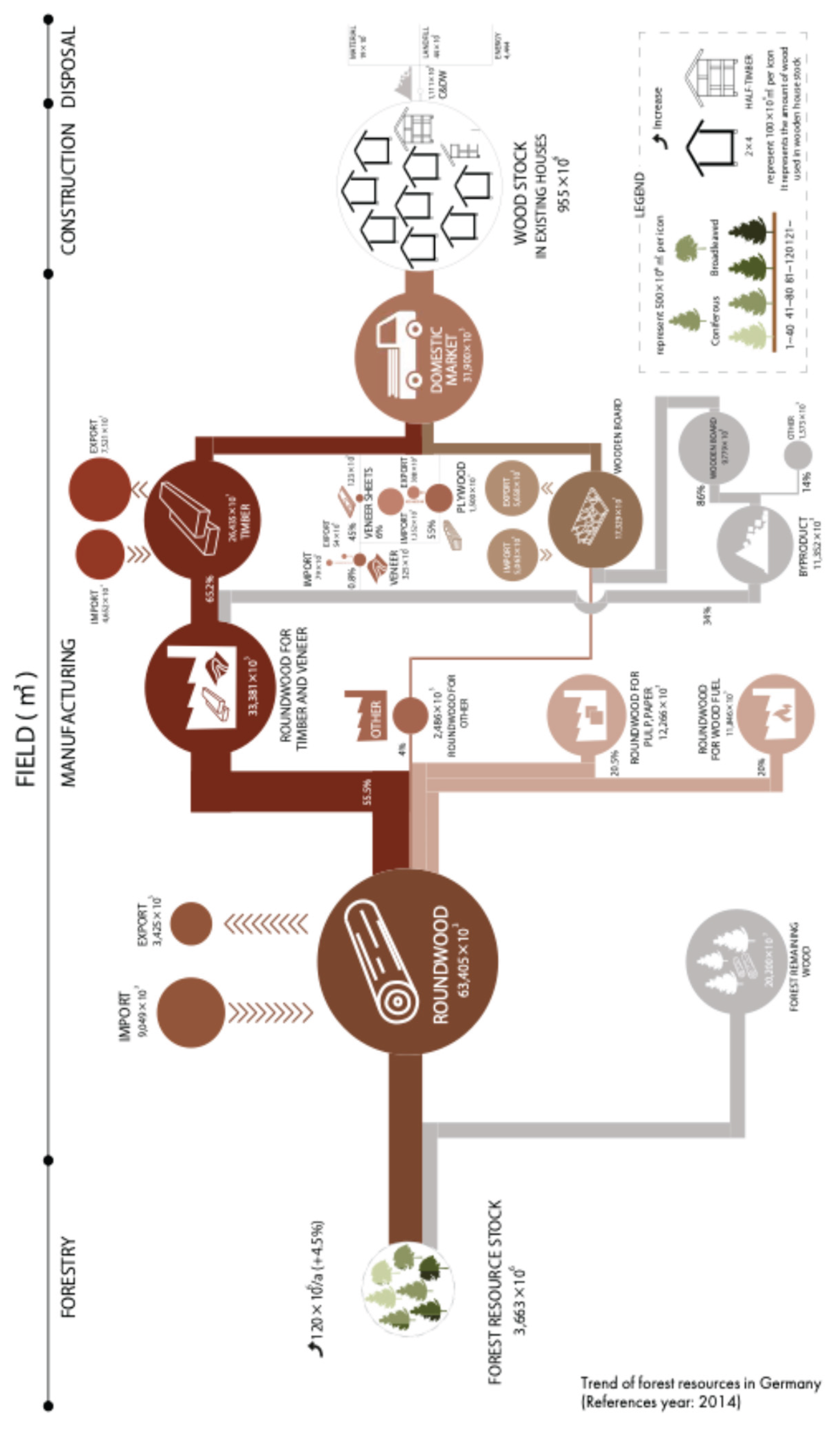

Table 1.
Selected papers and publications (countries abbreviated by Top-Level Domain).
| No | Country | First Author | Year | Title |
|---|---|---|---|---|
| 1 | AT | Džubur | 2017 | A fuzzy set-based approach to data reconciliation in material flow modeling [7] |
| 2 | AT | Džubur | 2018 | Evaluation of modeling approaches to determine end-of-life flows associated with buildings: A Viennese case study on wood and contaminants [8] |
| 3 | AT | Kalcher | 2017 | Quantification of future availabilities of recovered wood from Austrian residential buildings [9] |
| 4 | AT | Kalt | 2015 | Biomass streams in Austria: Drawing a complete picture of biogenic material flows within the national economy [10] |
| 5 | CH | Bergeron | 2014 | Assessment of the coherence of the Swiss waste wood management [11] |
| 6 | CH | Bergeron | 2016 | Energy and climate impact assessment of waste wood recovery in Switzerland [12] |
| 7 | CH | Mehr | 2018 | Environmentally optimal wood use in Switzerland—Investigating the relevance of material cascades [13] |
| 8 | CH | Suter | 2017 | Life cycle impacts and benefits of wood along the value chain [14] |
| 9 | CZ | Jasinevičius | 2018 | Carbon accounting in harvested wood products: Assessment using material flow analysis resulting in larger pools compared to the IPCC default method [15] |
| 10 | DE | Bösch | 2015 | Physical input-output accounting of the wood and paper flow in Germany [16] |
| 11 | DE | Cote | 2015 | Anthropogenic carbon stock dynamics of pulp and paper products in Germany [17] |
| 12 | DE | Egenolf | 2021 | The timber footprint of the German bioeconomy—State of the art and past development [18] |
| 13 | DE | Jochem | 2015 | Estimation of wood removals and fellings in Germany: A calculation approach based on the amount of used roundwood [19] |
| 14 | DE | Knauf | 2015 | An analysis of wood market balance modeling in Germany [20] |
| 15 | DE | Knauf | 2016 | The wood market balance as a tool for calculating wood use's climate change mitigation effect—An example for Germany [21] |
| 16 | DE | Schweinle | 2020 | Monitoring sustainability effects of the bioeconomy: A material flow based approach using the example of softwood lumber and its core product epal 1 pallet [22] |
| 17 | DE | Szarka | 2021 | Biomass flow in bioeconomy: Overview for Germany [23] |
| 18 | DE | Szichta | 2022 | Potentials for wood cascading: A model for the prediction of the recovery of timber in Germany [24] |
| 19 | DE | Taskhiri | 2016 | Sustainable logistics network for wood flow considering cascade utilisation [25] |
| 20 | DE | Wang | 2024 | Dynamic material flow analysis of wood in Germany from 1991 to 2020 [26] |
| 21 | DK | Brownnell | 2023 | How much wood do we use and how do we use it? Estimating Danish wood flows, circularity, and cascading using national material flow accounts [27] |
| 22 | FI | Hassan | 2018 | An assessment of side-stream generation from Finnish forest industry [28] |
| 23 | FI | Nasiri | 2021 | Estimating the material stock in wooden residential houses in Finland [29] |
| 24 | FR | Layton | 2021 | Material flow analysis to evaluate supply chain evolution and management: An example focused on maritime pine in the Landes de Gascogne forest, France [30] |
| 25 | FR | Lenglet | 2017 | Material flow analysis of the forest-wood supply chain: A consequential approach for log export policies in France [31] |
| 26 | HU | Polgár | 2023 | Carbon footprint and sustainability assessment of wood utilisation in Hungary [32] |
| 27 | IE | Donlan | 2012 | Carbon storage in harvested wood products for Ireland 1961-2009 [33] |
| 28 | NT | Hekkert | 2000 | Analysis of the paper and wood flow in The Netherlands [34] |
| 29 | PT | Gonçalves | 2021 | Material flow analysis of forest biomass in Portugal to support a circular bioeconomy [35] |
| 30 | PT | Marques | 2020 | Contribution towards a comprehensive methodology for wood-based biomass material flow analysis in a circular economy setting [6] |
| 31 | SI | Piškur | 2007 | Roundwood flow analysis in Slovenia [36] |
| 32 | SK | Gejdoš | 2015 | Valuation and timber market in the Slovak Republic [37] |
| 33 | SK | Parobek | 2008 | Modelling of wood and wood products flow in the Slovak Republic [38] |
| 34 | SK | Parobek | 2014 | Analysis of Wood Flows in Slovakia [39] |
| 35 | SK | Parobek | 2016 | Material flows in primary wood processing in Slovakia [40] |
| 36 | EU | Bais-Moleman | 2018 | Assessing wood use efficiency and greenhouse gas emissions of wood product cascading in the European Union [41] |
| 37 | EU | Mantau | 2010 | EUwood—Real potential for changes in growth and use of EU forests. Final report [42] |
| 38 | EU | Mantau | 2012 | Wood flows in Europe [43] |
| 39 | EU | Mantau | 2015 | Wood flow analysis: Quantification of resource potentials, cascades and carbon effects [44] |
| 40 | EU | Pilli | 2015 | EU mitigation potential of harvested wood products [45] |
| 41 | EU | Saal | 2022 | Supply of wood processing residues—A basic calculation approach and its application on the example of wood packaging [46] |
| 42 | EU | Sikkema | 2023 | A market inventory of construction wood for residential building in Europe: In the light of the Green Deal and new circular economy ambitions [47] |
Table 2.
Evaluation criteria used for content analysis of selected studies.
| Evaluation Criterion | Purpose | Specific Aspects Analyzed |
|---|---|---|
| Geographical and temporal coverage | Understand spatial and historical scope of studies | Countries or regions covered, temporal range |
| System boundaries | Clarify purposes and completeness of material flow systems | Inclusion of forest resources, processing stages, product use, end-of-life |
| Data sources and quality | Assess transparency, reliability, and comparability of data | Data sources, unit consistency, conversion factors, estimation methods, treatment of gaps |
| Flow representation techniques | Evaluate clarity and comprehensiveness | Use of diagrams, flow charts, tables; level of detail and consistency in visualization |
| Treatment of uncertainty | Identify methodological validity and transparency | Presence of sensitivity analysis, handling of uncertainties, documentation of assumptions, reconciliation steps |
Table 3.
Research stages and purposes in selected studies.
| No | Stage-I | Stage-II | Stage-III | Stage-IV | Purpose |
|---|---|---|---|---|---|
| Forestry | Manufacturing | Building | End-of-Life | ||
| 1 | Yes | Yes | Yes | Yes | A |
| 2 | Yes | C | |||
| 3 | Yes | B | |||
| 4 | Yes | Yes | Yes | B | |
| 5 | Yes | Yes | Yes | Yes | D |
| 6 | Yes | Yes | Yes | Yes | C |
| 7 | Yes | Yes | Yes | Yes | D |
| 8 | Yes | Yes | Yes | E | |
| 9 | Yes | Yes | Yes | Yes | C |
| 10 | Yes | Yes | Yes | Yes | A |
| 11 | Yes | Yes | A | ||
| 12 | Yes | Yes | D | ||
| 13 | Yes | Yes | A | ||
| 14 | Yes | Yes | Yes | A | |
| 15 | Yes | Yes | Yes | C | |
| 16 | Yes | Yes | Yes | D | |
| 17 | Yes | Yes | D | ||
| 18 | Yes | Yes | Yes | Yes | B |
| 19 | Yes | Yes | Yes | Yes | D |
| 20 | Yes | Yes | Yes | B | |
| 21 | Yes | Yes | Yes | Yes | B |
| 22 | Yes | Yes | D | ||
| 23 | Yes | D | |||
| 24 | Yes | B | |||
| 25 | Yes | Yes | Yes | E | |
| 26 | Yes | Yes | C | ||
| 27 | Yes | Yes | Yes | Yes | C |
| 28 | Yes | Yes | Yes | A | |
| 29 | Yes | Yes | B | ||
| 30 | Yes | Yes | Yes | A | |
| 31 | Yes | Yes | Yes | E | |
| 32 | Yes | D | |||
| 33 | Yes | Yes | E | ||
| 34 | Yes | Yes | B | ||
| 35 | Yes | Yes | B | ||
| 36 | Yes | Yes | Yes | D | |
| 37 | Yes | Yes | Yes | E | |
| 38 | Yes | Yes | Yes | B | |
| 39 | Yes | Yes | Yes | A | |
| 40 | Yes | C | |||
| 41 | Yes | Yes | A | ||
| 42 | Yes | Yes | E |
Table 4.
Units and quantity types in selected studies (material flows only).
| No | Unit symbol | Unit name | Quantity type |
|---|---|---|---|
| 1 | t / t dry matter | tonnes of dry wood / matter | mass |
| 2 | t | metric tonne | mass |
| 3 | m³ | cubic meter | volume |
| 4 | Mtdry | million tonnes of dry mass | mass |
| 5 | Mt | megatons | mass |
| 6 | m³ | cubic meter | volume |
| 7 | m³ | cubic meter | volume |
| 8 | m3 solid wood | cubic meter solid wood equivalent | volume |
| 9 | m³ | cubic meter | volume |
| 10 | m3(f) | (cubic meter) wood fiber equivalent | volume |
| 11 | Mt | million metric tons | mass |
| 12 | m³ | cubic meter | volume |
| 13 | m³ | cubic meter | volume |
| 14 | Mm³ | million cubic meters | volume |
| 15 | Mm³ | million cubic meters | volume |
| 16 | t | metric ton | mass |
| 17 | tDM | tons of dry matter | mass |
| 18 | m³ SWE | volume of solid wood equivalents | volume |
| 19 | m³ | cubic meter | volume |
| 20 | SWE | solid wood equivalent | volume |
| 21 | m3 SWE | cubic meter solid wood equivalent | volume |
| 22 | m³ | cubic meter | volume |
| 23 | m³ | cubic meter | volume |
| 24 | m3 [f] | wood fiber equivalent | volume |
| 25 | m3 [f] | wood fiber equivalent | volume |
| 26 | m³ | cubic meter | volume |
| 27 | m³ | cubic meter | volume |
| 28 | kt | kiloton / kilotonne | mass |
| 29 | m3(f) | cubic meter of wood fiber equivalent | volume |
| 30 | kton | kiloton | mass |
| 31 | m³ | cubic meter | volume |
| 32 | m³ | cubic meter | volume |
| 33 | m³ | cubic meter | volume |
| 34 | m³ | cubic meter | volume |
| 35 | m³ | cubic meter | volume |
| 36 | tonne | tonne wet weight woody raw material | mass |
| 37 | m³ rwe | roundwood equivalent | volume |
| 38 | m³ swe | solid wood equivalent | volume |
| 39 | m³ swe | solid wood equivalent | volume |
| 40 | m³ | cubic meter | volume |
| 41 | m3f | wood fiber equivalent | volume |
| 42 | m³ | cubic meter | volume |
Disclaimer/Publisher’s Note: The statements, opinions and data contained in all publications are solely those of the individual author(s) and contributor(s) and not of MDPI and/or the editor(s). MDPI and/or the editor(s) disclaim responsibility for any injury to people or property resulting from any ideas, methods, instructions or products referred to in the content. |
© 2025 by the authors. Licensee MDPI, Basel, Switzerland. This article is an open access article distributed under the terms and conditions of the Creative Commons Attribution (CC BY) license (http://creativecommons.org/licenses/by/4.0/).
Copyright: This open access article is published under a Creative Commons CC BY 4.0 license, which permit the free download, distribution, and reuse, provided that the author and preprint are cited in any reuse.


