

Submitted:
28 August 2025
Posted:
29 August 2025
You are already at the latest version
Abstract
Fibroblast activation protein (FAP) is highly expressed in tumor stroma and selected inflammatory conditions, offering a promising target for molecular imaging. [68Ga]Ga-FAPI-46 is a DOTA-based FAP inhibitor with excellent tumor-to-background ratio and potential advantages over [18F]FDG in low-glycolytic tumors. Background/Objectives: This article aimed to highlight the quality aspects, which could have an impact on clinical practice, describing the development of an Investigational Medicinal Product Dossier (IMPD) for a bicentric clinical trial with [68Ga]Ga-FAPI-46. Methods: The radiolabeling was performed by the two facilities using different automated synthesizers, but with the same specifications and acceptance criteria Results: Three validation batches per site were analyzed for radiochemical/radionuclidic purity, pH, endotoxin, sterility, and bioburden according to European Pharmacopoeia standards. Stability was assessed up to 2 hours post-synthesis. All batches met predefined acceptance criteria. Conclusions: Despite differences in radiosynthesizer modules, product quality and process reproducibility were maintained across both centers. [68Ga]Ga-FAPI-46 can be reliably produced in academic settings under GMP-like conditions, enabling multicenter clinical research and facilitating IMPD submissions for broader adoption of FAP-targeted PET imaging.
Keywords:
fibroblast activation protein (FAP)
; [68Ga]Ga-FAPI-46
; positron emission tomography (PET)
; IMPD
1. Introduction
Fibroblast activation protein (FAP) is a transmembrane serine protease belonging to the dipeptidyl peptidase 4 (DPP4) enzyme family, characterized by its endopeptidase functionality [1]. This enzyme participates in remodeling the extracellular matrix (ECM) by degrading its structural components, thereby influencing the tumor microenvironment, facilitating cellular invasion, and promoting metastasis. FAP also contributes to various pro-tumorigenic processes, including resistance to chemotherapy, induction of angiogenesis, immunomodulation, and extracellular matrix modification, all of which support tumor progression [2,3,4,5].
In healthy adult tissues, FAP expression is minimal or completely absent, typically limited to specific physiological events such as wound healing or embryonic development, where it is found in stromal fibroblasts or mesenchymal stem cells [6,7]. In contrast, FAP is markedly overexpressed in the tumor stroma of more than 90% of epithelial cancers [8,9] and is also upregulated in several chronic inflammatory conditions including hepatic fibrosis, cardiovascular pathologies, and autoimmune diseases like rheumatoid arthritis [10,11]. These expression patterns position FAP as a promising biomarker for cancer imaging and prognosis, as well as an attractive target for both diagnostic and therapeutic nuclear medicine applications [5,6,11,12,13].
The first radiolabelled FAP inhibitor (FAPI) developed was [125I]I-MIP-1232, a boronic-acid-containing compound evaluated in vitro [14]. However, this early agent showed suboptimal specificity and affinity for FAP when compared to other members of the DPP and prolyl oligopeptidase (PREP) families [14,15]. Subsequently, a new class of FAPI molecules was synthesized based on the N-(4-quinolinoyl)-Gly-(2-cyanopyrrolidine) scaffold, exhibiting significantly improved pharmacokinetics and FAP-targeting characteristics in preclinical and clinical studies [16,17].
This quinoline-based chemical platform has led to the development of several FAPI derivatives—FAPI-02, FAPI-04, FAPI-34, FAPI-46, and FAPI-74—each compatible with various radiometals, including gallium-68, fluorine-18, yttrium-90, lutetium-177, to meet diagnostic or therapeutic requirements [18,19]. Of particular interest are derivatives equipped with a DOTA chelator (1,4,7,10-tetraazacyclododecane-N,N′,N″,N‴-tetraacetic acid), enabling efficient complexation with gallium-68 (t½ = 67.7 min, β+ = 89%, electron capture = 11%) [20]. Among these, [68Ga]Ga-FAPI-46 has demonstrated excellent performance in oncologic imaging, with high tumour-to-background contrast and strong correlation between tracer uptake and FAP expression [21,22,23].
Due to its high and selective uptake in malignant tissue, [68Ga]Ga-FAPI-46 enables non-invasive visualization of FAP activity and offers potential for patient stratification and treatment planning [21]. The radiopharmaceutical has been tested in various cancers, notably those with low [18F]F-FDG uptake like liver, biliary, gastrointestinal, and peritoneal tumours [24,25].
Gallium-68 PET imaging has grown in use over the past 20 years, mainly because gallium-68 is a generator-produced radionuclide with advantageous properties. Its availability from germanium-68/gallium-68 generators facilitate on-site production, making it particularly suited for early-phase clinical research and rapid clinical translation of new radiopharmaceuticals [26]. For consistent and GMP-compliant production, automated synthesis modules are typically used to reduce operator radiation exposure and standardize manufacturing processes [27].
Maintaining optimal pH during gallium-68 labelling reactions is critical and requires carefully chosen buffer systems matched to the chemical characteristics of the targeting vector [28]. Adding antioxidants like gentisic acid or ascorbic acid during synthesis improves radiochemical yields, prevents radiolysis, and helps maintain radiochemical purity (RCP) throughout the product's shelf life. [29,30].
[68Ga]Ga-FAPI-46 can only be used as an experimental drug in clinical trials, because there are currently no kits with market authorization and no Monograph in European Pharmacopea.
Our current clinical study “[68Ga]Ga-FAPI-46 PET/CT for Molecular Evaluation of Fibroblast Activation and Risk Stratification in Solid Tumors” (EudraCT No. 2022-003786-38) was approved by the Italian Medicines Agency (AIFA) in 2023.
The study aims to assess the diagnostic performance of [68Ga]Ga-FAPI-46 PET/CT in patients with solid tumours for whom conventional imaging, such as FDG-PET or morpho-functional techniques, has led to inconclusive results. The clinical protocol includes a single intravenous injection of 150–200 MBq of [68Ga]Ga-FAPI-46, synthesized in-house in our radiopharmacy.
For human administration, experimental radiopharmaceuticals must comply with EU Regulament 536/2014; in particular Article 61(b) specifies that the preparation of radiopharmaceuticals used as diagnostic investigational medicinal products where this process is carried out in hospitals, health centres or clinics, by pharmacists or other persons legally authorised in the Member State can be performed without a GMP certification.
In Italy, the standard framework is provided by national “Norme di Buona Preparazione dei Radiofarmaci per Medicina Nucleare (NBP-MN), a regulatory quality system for nuclear medicine production [31].
Submission of the clinical trial to AIFA required the preparation of an Investigational Medicinal Product Dossier (IMPD) for [68Ga]Ga-FAPI-46 in accordance with the European Medicines Agency (EMA) guidelines [32], which define quality and safety standards for investigational medicinal products (IMPs). This paper presents the validation strategy, analytical methods, and predefined acceptance criteria for [68Ga]Ga-FAPI-46 to comply with the IMPD submission process.
This study is of particular interest due to the specific nature of the IMP and its reduced stability, as well as the bi-centric nature of the study. The production of the IMP was performed by the two clinical centres using different equipments and procedures, but with the same acceptance criteria. For this reason the Regulatory Authority required a unique IMPD for both the clinical centres; this condition is an interesting challenge for IMPD, which we will discuss in this article.
2. Results
The unique IMPD for [68Ga]Ga-FAPI-46 has been filled following EMA guideline [32]; this document consists of two sections: one on the drug substance and one on the investigational medicinal product.
2.1. Drug Substances
The IMPD for [68Ga]Ga-FAPI-46 describes two Drug Substances: the ligand FAPI-46 and gallium-68 in the chemical form of [68Ga]GaCl3
2.1.1. FAPI-46
Nomenclature:
(S)-2,2',2''-(10-(2-(4-(3-((4-((2-(2-cyano-4,4-difluoropyrrolidin-1-yl)-2-oxoethyl)carbamoyl)quinolin-6-yl)(methyl)amino)propyl)piperazin-1-yl)-2-oxoethyl)-1,4,7,10-tetraazacyclododecane-1,4,7-triyl)triacetic acid
Molecular Formula: C41H57F2N11O9
Molecular weight: 885.96
The molecular structure of FAPI-46 is shown in Figure 1
All the information required for FAPI-46 was detailed in the quality document “Chemistry Manufacturing and Controls” (CMC) provided by the supplier. This document is continuously updated by the producer with the latest available information. Furthermore, the results of quality controls for each batch of FAPI-46 are reported in the Certificate of Analysis (CoA) supplied with each batch.
FAPI-46 precursor vials 50 μg are supplied by SOFIE for our clinical trial on the basis of a Material Transfer Agreement between iTheranostics, Inc., a Delaware corporation, and the two participating centres. FAPI-46 precursor vials 50 μg are produced by ABX (Advanced Biochemical Compounds Biomedizinische Forschungsreagenzien GmbH Radeberg, Germany), according to GMP requirements for APIs for clinical trials.
2.1.2. Gallium-68
The active substance, gallium-68 is used as [68Ga]GaCl3 in a 0.1M hydrochloric acid (HCl) aqueous solution. It is fully soluble in acidic aqueous environments, where it exists in a dissociated form.
68GaCl₃ → 68Ga³⁺ + 3Cl⁻.
Gallium-68 is obtained using germanium-68/gallium-68 generators (GalliaPharm; marketing authorization numbers 042707024 and 042707036 for laboratory 1, and 042707048 for laboratory 2 , product by Eckert & Ziegler Radiopharma GmbH, Robert-Rössle-Str. 10, 13125 Berlin, Germany), following the decay of the parent radionuclide germanium-68. The generator contains germanium-68, sorbed onto a TiO2 column, which decays to produce the daughter nuclide gallium-68. This column is maintained in a sterile, pyrogen-free environment with 0.1 N HCl. When in use, the gallium-68 is eluted with 5 mL of sterile, apyrogenic 0.1 N HCl as [68Ga]GaCl3. This solution complies with the requirements of the Summary of Product Characteristics (SmPC) for the drug and the specific monograph of the European Pharmacopoeia (Gallium (68Ga) Chloride Solution for Radiolabelling, 2013:2464).
The GalliaPharm Generator is supplied with a Certificate of Conformity issued according to the specifications given in the European Pharmacopoeia (Ph. Eur.). 07/2013:2464 'Gallium (68Ga) Chloride Solution for Radiolabelling', which is given below in Table 1.
Germanium-68 decays via electronic capture, with a half-life of 270.8 days. Gallium-68 then decays into its stable isotope Zinc-68 through positron emission, with a maximum energy of 1.899 MeV for 88.91%, and through electronic capture for 11%. It has a half-life of 67.61 minutes and emits a gamma photon of 1077.3 keV (3%). The process of positron annihilation following electron emission leads to the emission of two coplanar photons of 511 keV.
A scheme of the germanium-68/gallium-68 decay are shown in Figure 2.
2.2. Investigational Medicinal Product under Test (IMP)
2.2.1. Description and Composition of the IMP
IMP consists of a solution of [68Ga]Ga-FAPI-46 with an activity range of 620-697 MBq ART for Laboratory 1 and 500-700 MBq ART for Laboratory 2 at the end of the synthesis (EOS), which, is considered Activity Reference Time (ART). The final volume is about 9 ml for Laboratory 1 (radioactive concentration 68-77 MBq/ml) and 10 ± 0.5 ml for Laboratory 2 (50-70 MBq/ml).
2.2.1. Description and Composition of the IMP
The radiolabelling of [68Ga]Ga-FAPI-46 is performed using Modular-Lab Eazy Synthesizer (Eckert & Ziegler Radiopharma GmbH, Berlin, Germany) in Laboratory 1 and Mini AllinOne -MiniAIO (Trasis –SA, Ans, Belgium) in Laboratory 2.
From a chemical point of view, the reaction involves the trivalent gallium-68 ion complexing with the DOTA chelating portion, which is linked to the chemical structure of FAPI-46, as shown in Figure 1.
Figure 3 shows typical radiometric and UV chromatograms of [68Ga]Ga-FAPI-46 syntheses for Laboratory 1. The reaction is performed at a temperature of 95 °C. The typical synthesis time is 10 minutes in Laboratory 1 and 11 minutes in Laboratory 2.
2.3. Quality Controls
2.3.1. Acceptance Criteria
The acceptance criteria, specifications and release timing were chosen in accordance with the relevant sections of the current European Pharmacopoeia, and are summarized in Table 4.
The product must meet the acceptance criteria for all established quality parameters. The administered patient dose ranged from 150 to 200 MBq.
The justification for conducting post-release tests depends on the type of test and the analyte.
2.3.2. Validation of the Analytical Procedures
Validation is the documented process of proving that a procedure, process, equipment, material, activity, or system consistently produces the expected results. The aim is to contribute to and guarantee the quality of a radiopharmaceutical.
The objective of validating analytical procedures is to demonstrate their suitability for their intended purpose.
Validation of analytical procedures, acceptance limits and parameters (specificity, linearity, range, accuracy, precision, quantification and detection limits) for analytical method validation was carried out by both Laboratories according to the ICH guideline Q2(R1) [32].
For the HPLC determination of chemical purity, natGa-FAPI-46 and FAPI-46 were used by both Laboratories.
Regarding radiochemical purity, it should be noted that some validation parameters could not be quantified. Specifically, the analysis of at least two different radioactive analytes with comparable activity is required for specificity, but this was not possible for experimental reasons. When conducting analytical tests for procedure validation, the ALARA (As Low As Reasonably Achievable) rule should be followed to minimise unnecessary radioactive exposure.
The results of the validation process for the radio HPLC methods for Laboratories 1 and 2 are reported in Table 5.
Chromatograms of standard natGa-FAPI-46 and FAPI-46 are shown in Figure 4
2.3.3. Bioburden
The product before filtration was sent for bioburden test, using 1 ml for each test sample. (Eurofins Laboratory Biolab S.r.l., Vimodrone, Milan Italy.)
The results were:
Total aerobic microbial count /TMAC) < 1 cfu/mL
Total yeast and mold count (TYMC) < 1 cfu/mL
Where < 1 cfu/mL means absence of colonies.
2.3.4. Batch Analysis and Process Validation
Process validation is a documented, systematic approach used to provide evidence that a manufacturing process consistently produces a product meeting its predetermined specifications and quality attributes.
For process validation, three different batches of [⁶⁸Ga]Ga-FAPI-46 were performed by both Laboratories. Each production run was performed in accordance with the established validation protocol and was evaluated to confirm compliance with all specified acceptance criteria.
Due to differences in the manufacturing workflows of Laboratory 1 and Laboratory 2, each site performed its own set of three validation batches independently to ensure that the process was robust and applicable across both facilities.
The analytical parameters assessed during validation were those outlined in Table 4, and the results of three representative batches are summarized in Table 6.
All the baches used for process validation complied with the acceptance criteria for both laboratories.
2.3.5. Stability
Stability was assessed for two hours in both Laboratories.
Three process-validation batches were stored at room temperature and tested for visual appearance, radiochemical purity (HPLC and TLC), and pH .
Table 7 shows the stability data for each laboratory.
3. Discussion
FAPI-46 is the result of extensive optimisation and research into fibroblast activation protein (FAP) receptor ligands. Compared to alternative inhibitors, it exhibits unique chemical characteristics and, as the radiopharmaceutical [68Ga]Ga-FAPI-46, demonstrates superior performance in oncological imaging [35].
The compound readily incorporates the gallium-68 radionuclide within relatively short reaction times and at temperatures compatible with standard radiopharmaceutical equipment, typically utilising germanium-68/gallium-68 generators.
Due to its straightforward production process and exceptional diagnostic capability, especially in cases involving tumours with low FDG uptake [33] or situations where it is unclear whether FDG uptake reflects residual tumour or an inflammatory response to treatment [34], [68Ga]Ga-FAPI-46 represents a valuable diagnostic option for nuclear medicine practitioners.
Currently, the European Pharmacopoeia does not include a monograph for the radiopharmaceutical [68Ga]Ga-FAPI-46. No industrially produced kits with marketing authorisation are available for extemporaneous labelling at nuclear medicine radiopharmacies. Consequently, the radiopharmaceutical can be used only in clinical studies as an experimental radiopharmaceutical.
The EU Regulation 536/2014 gives an achievable opportunity for academic nuclear medicine to promote non-profit clinical trials using diagnostic experimental compounds [68Ga]Ga-FAPI-46. In particular Article 61(b) specifies that the preparation of radiopharmaceuticals used as diagnostic investigational medicinal products where this process is carried out in hospitals, health centres or clinics, by pharmacists or other persons legally authorised in the Member State can be performed without a GMP certification.
According to applicable European regulations, obtaining authorization for a clinical trial necessitates submission of a study protocol to regulatory authorities, accompanied by an IMPD prepared in accordance with EMA guidelines.
Moreover it’s now also possible to design academic multicentric clinical trials with [68Ga]Ga-FAPI-46 and in general with experimental radiopharmaceutical labelled by Ga-68, preparing an unique IMPD with different section for radiolabeling but with the same acceptance criteria. This favorable scenario enables clinical centres with different equipment to be networked referring to the same acceptance criteria.
The outcomes described in the preceding section confirm that different production methods do not compromise the finished product’s quality or stability, referred to the same acceptance criteria.
Overall, these findings indicate that the manufacture and quality assurance of [68Ga]Ga-FAPI-46 are both practical and reliable. Despite procedural differences between centres, the simplicity of its production and quality control supports broader application for PET imaging with [68Ga]Ga-FAPI-46 and the establishment of compliant protocols analogous to those implemented in our clinical trial.
4. Materials and Methods
4.1. Description of [⁶⁸Ga]Ga-FAPI-46 Manufacturing Process
4.1.1. Set up of Radiosynthesizer
For Laboratory 1 the radiosynthesis were performed by Modular-lab Eazy (Eckert & Ziegler Eurotope Gmbh – Robert Rössle- Straße 10, Berlin, Germany), without the use of organic solvents. The module was placed in a shielded isolator (Elena Beta, COMECER S.p.a., Castelbolognese, Italy) which was located in a class D Laboratory.
The user graphic interface of the synthesis process is shown in Figure 5a.
The software, cassettes, reagent set and detailed instruction for radiosynthesis were supplied by Eckert and Ziegler Eurotope Gmbh (Robert Rössle- Straße 10, Berlin, Germany).
For Laboratory 2 the radiosynthesis were performed by MiniAllinOne – MIiniAIO Trasis (TRASIS SA. Rue Gilles Magnée 90 4430, Ans, Belgium).
The module was placed in a shielded isolator (Hot cell H700, TRASIS Rue Gilles Magnée 90 4430, Ans, Belgium) which was located in a class D Laboratory.
The user graphic interface of the synthesis process is shown in Figure 5b.
The software, cassette, reagents set and detailed instruction for radiosynthesis of [68Ga]Ga-FAPI-46 were provided by Trasis (Rue Gilles Magnée 90 4430, Ans, Belgium)
4.1.2. Reagents
For Laboratory1 reagent set included:
-
Reagent set product by ABX (Heinrich-Glaeser- Straße 10-14, 01454 Radeberg, Germany) composed by:
- ○
- Vial 1 (EZ-102-V1) containing 5 ml of NaCl 5M/HCl 30%
- ○
- Vial 2 (EZ-102-V2) containing 680 mg of sodium acetate trihydrate
- ○
- Vial 5 (EZ-102-V5) containing 3 mg of ascorbic acid
- Water for injectable preparations (100 ml bottles) with MA was purchased from Monico S.p.A. Venezia/Mestre, Italy
- Sodium Chloride 0,9% 100 ml with a MA was purchased form Fresenius Kabi S.r.l. Isola della Scala, Italy.
- Single use sterile cassettes were produced by Eckert & Ziegler Eurotope GmbH (Robert Rossle- Straße 10, Berlin, Germany) provided by Radius (RADIUS s.r.l. Via Luigi Menarini, 31-40054 Budrio-BO).
- Sterilizing filter 0.22 mm (product code: SY25PL-S-MDI Advanced Microdevices PVT LTD 21 Ind. AreaAmbala Canti – 133006 India)
- For Laboratory 2 reagent set included:
-
Reagent set produced by Trasis (Rue Gilles Magnée 90 4430, Ans, Belgium), composed by:
- ○
- Part 1: Syringe containing E&Z Eluent; Syringe containing acetate buffer; Ethanol vial; Sodium Chloride 0,9 % (BBraun – Melsungen AG 34209 Melsungen, Germany).
- ○
- Part 2: Sodium ascorbate
- Single use sterile cassette product by Medline Liége Science Park-Rue des Gardes-Frontiére 5, 4031 Angleur Belgium, distributed by Trasis (Rue Gilles Magnée 90 4430, Ans, Belgium). The cassette includes a Solid Phase extraction (SPE) cartridge Oasis HLB Plus Short Cartridge, 225 mg sorbent per cartridge, 60 mm, 50 /pk
- Sterilizing filter 0.22 mm (product code: 6764192 PALL Medical Avenue de Tivoli 3, CH-1700 Fribourg Switzerland).
4.1.3. Process Description
The synthesis process used by Laboratory 1 was developed by Eckert & Ziegler Eurotope GmbH (Robert-Rossle-Straße 10, Berlin, Germany) in collaboration with ABX Advanced Biochemical Compounds Biomedizinische Forschungsreagenzien GmbH (Heinrich-Gleaser-Straße 10–14, 01454 Radeberg, Germany).
The first step of the radiosynthesis involves eluting [68Ga]GaCl₃ from the generator Germanium-68/Gallium-68 and trapping it inside a pre-purification cartridge containing strong cation exchange resin, which is included in the previously described cassette used at Laboratory 1. Gallium-68 is then eluted with 1.1 ml of an acidified NaCl solution (15 µl of HCl added to NaCl solution) and transferred to a reaction vial containing 400 µl of acetate buffer solution at pH 4.5, 50 µg of the FAPI-46 precursor, and 3 mg of ascorbic acid (added as a scavenger). After an 11-minute incubation period at 95 °C, the reaction mixture is diluted with 7.5 ml of 0.9% sodium chloride solution and purified using cation exchange resin to retain any free ⁶⁸Ga³⁺. The mixture is then filtered terminally through a 0.22 µm sterilizing filter.
Similarly to the process described for Laboratory 1, the first step in Laboratory 2 also involves eluting [68Ga]GaCl₃ from the Germanium-68/Gallium-68 generator using 5 ml of a 0.1 M HCl solution (syringe containing E&Z eluent, Kit Part 1). The eluate is transferred directly to the reactor without pre-purification. The FAPI-46 precursor (50 µg) has already been transferred to the reactor and preliminarily solubilized in 1 ml of acetate buffer (syringe containing acetate buffer, kit part 1). To this, 0.5 ml of ascorbate buffer is added, giving a final pH of 4.0. The solution is then heated to 95 °C for 10 minutes. The reaction mixture is diluted with 5 ml of ascorbate buffer to cool it and is then passed through an OASIS HLB Plus short cartridge, which is capable of selectively retaining [68Ga]Ga-FAPI-46. The reactor is then washed with 5 ml of ascorbate buffer to remove any product residues. The purified product is eluted from the SPE cartridge using 0.7 ml of ethanol and formulated with 9.5 ml of ascorbate buffer. The resulting [⁶⁸Ga]Ga-FAPI-46 solution is sterilized by filtration using a 0.22 µm filter placed on the final vial and is then used for quality control and subsequent fractionation into doses.
At the end of the synthesis, the product vial activity is measured in a dose calibrator for the verification of the expected activity and the calculation of the activity concentration.
4.2. Quality Control
4.2.1. Standard Procedures
- The pH value of the formulation was determined by pH strips (Merck pH indicator strip, Acilit, increment 0,5 pH unit).
- The Endotoxin test was performed by the Limulus Amebocyte Lysate test (LAL test), on an Endosafe Nexgen-PTSTM (Charles River Laboratories, 26866 Sant’Angelo Lodigiano (LO), Italy).
-
As required by national regulations on quality assurance (NBP MN), since this is a preparation that cannot be subjected to terminal sterilization, it should be sterilized by filtration with a sterile disposable membrane having pores of nominal diameter 0.22 µm. Filter integrity must be checked by bubble point test before release:
- ○
- for Laboratory 1 the Bubble point test was performed on an Integritest 4 system (Merck Millipore KgaA, Darmstadt, Germany).
- ○
- for Laboratory 2 the bubble point test is performed automatically by the synthesis module (Mini All-in-One Trasis – Hot Cell H700).
- Sterility test was performed by an external Laboratory for both Laboratory 1 and Laboratory 2.
- Radionuclidic purity is assessed in both laboratories by measuring the half-life and identifying characteristic emission peaks for Gallium-68, in accordance with the current European Pharmacopoeia Monograph 2.2.66 “Detection and Measurement of radioactivity.”
4.2.2. HPLC Analysis
Standard natGa-FAPI-46 and FAPI-46 were purchased from ABX GmbH – Advanced Biochemical Compounds (Radeberg, Germany) by both the Laboratories.
For Laboratory 1 HPLC analysis was performed on an Ultimate 3000 system equipped by an UV variable wavelength detector RS300 (Thermo Fischer Scientific, Germany) and a radiometric detector (GABI, Raytest, Germany). The system was controlled by Chromeleon software version 7.2 SR5 (Dionex Sunnyvale, CA, USA).
For Laboratory 2 HPLC analysis was performed on an RadioHPLC (ITG) equipped with an UV detector S3245 and a radiometric detector in series S 3700 (ITG)
Both laboratories used the following column: Acclaim 120 C18, 3 µm, 120 Å, 3 x 150 mm (thermos Scientific, Waltham, MA, USA).
Both laboratories performed HPLC analysis using a multi-step gradient with solvent A (0.1% Trifluoroacetic-acid TFA in water) and solvent B (0.1 % TFA in Acetronitrile). The method involves a 10-minute gradient elution from 95% A and 5% B to 50% A/B, maintained for two minutes. This is followed by a 4-minute gradient return to the initial conditions, which are then held until the end of the run, making a total run time of 20 minutes. The flow rate was set to 0,6 ml/min, UV wavelength 205 nm, column Oven 25 °C. Injection volume 20 µl.
4.2.3. Thin Layer Chromatography (TLC)
TLC was performed using ITLC-SG Chromatography paper Agilent (5301 Stevens Creek Blvd. Santa Clara, CA 95051, USA), Approximately 1-2 µl of IMP injection solution was spotted on the plate. The Solvent for the development of the TLC plates was ammonium acetate 0.1 N and methanol 50:50 v/v. The development plate was analyzed by autoradiography on MS (Multisensitive) storage phosphor screens and by a Cyclone Plus Storage Phosphor system (Perkin Elmer) for Laboratory 1. A TLC ScanRam (Lab Logic) radiodetector that does not require the exposure of a radiosensitive plate but reads the plate directly was used in Laboratory 2.
5. Conclusions
This study demonstrates that [⁶⁸Ga]Ga-FAPI-46 can be produced in compliance with regulatory requirements by using different production and quality control methods at each site, with a unified IMPD covering all EMA guidelines. Although the two centres use distinct synthesis methods, no differences are reported on the final product’s , quality, or stability.
Overall, the results show that the production and quality control of [68Ga]Ga-FAPI-46 are both practicable and dependable. The ease of production and quality control enables a broader applicability for Nuclear Medicines and Radiopharmacies with experience in gallium labelled compounds, allowing the implementation of an academic network based on the same quality criteria.
Author Contributions
Planning and development of the study, validation and quality documentation (IMPD), V.D.I. and S.B. ; synthesis and quality controls, V.D.I.; C.C.; E.L.; writing – original draft preparation, A.C., S.B., V.D.I. and G.F.; writing – review and editing IMPD, V.D.I. and S.B.; Prinicpal investigator of Clinical study, P.C.; Supervision, F.M. and C.M. ; regulatory support M.M.
Funding
Not applicable.
Institutional Review Board Statement
The clinical trial “68Ga-FAPI-46 PET/CT for Molecular Evaluation of Fibroblast Activation and Risk Stratification in Solid Tumors” EudraCT No. 2022-003786-38 was conducted according to the guidelines of the declaration of Helsinki, and approved by the Romagna Ethics Committee CE ROM (protocol code L2P2801).
Informed Consent Statement
Not Applicable.
Data Availability Statement
Not Applicable.
Acknowledgments
Fondazione Sandro Pitigliani per la lotta contro i tumori ONLUS for its support in supplying materials for laboratory 2.
Conflicts of Interest
The authors declare no conflicts of interest.
References
- Edosada, C.Y.; Quan, C.; Wiesmann, C.; Tran, T.; Sutherlin, D.; Reynolds, M.; Elliott, J.M.; Raab, H.; Fairbrother, W.; Wolf, B.B. Selective Inhibition of Fibroblast Activation Protein Protease Based on Dipeptide Substrate Specificity. J. Biol. Chem. 2006, 281, 7437–7444. [CrossRef]
- Park, J.E.; Lenter, M.C.; Zimmermann, R.N.; Garin-Chesa, P.; Old, L.J.; Rettig, W.J. Fibroblast Activation Protein, a Dual Specificity Serine Protease Expressed in Reactive Human Tumor Stromal Fibroblasts. J. Biol. Chem. 1999, 274, 36505–36512. [CrossRef]
- Hamson, E.J.; Keane, F.M.; Tholen, S.; Schilling, O.; Gorrell, M.D. Understanding fibroblast activation protein (FAP): Substrates, activities, expression and targeting for cancer therapy. Proteom. – Clin. Appl. 2014, 8, 454–463. [CrossRef]
- Zi, F.; He, J.; He, D.; Li, Y.; Yang, L.; Cai, Z. Fibroblast activation protein α in tumor microenvironment: Recent progression and implications (Review). Mol. Med. Rep. 2015, 11, 3203–3211. [CrossRef]
- Lindner, T.; Loktev, A.; Giesel, F.; Kratochwil, C.; Altmann, A.; Haberkorn, U. Targeting of activated fibroblasts for imaging and therapy. EJNMMI Radiopharm. Chem. 2019, 4, 16. [CrossRef]
- Altmann, A.; Haberkorn, U.A.; Siveke, J. The Latest Developments in Imaging of Fibroblast Activation Protein. J. Nucl. Med. 2020, 62, 160–167. [CrossRef]
- Gascard, P.; Tlsty, T.D. Carcinoma-associated fibroblasts: orchestrating the composition of malignancy. Genes Dev. 2016, 30, 1002–1019. [CrossRef]
- Brennen, W.N.; Isaacs, J.T.; Denmeade, S.R. Rationale Behind Targeting Fibroblast Activation Protein–Expressing Carcinoma-Associated Fibroblasts as a Novel Chemotherapeutic Strategy. Mol. Cancer Ther. 2012, 11, 257–266. [CrossRef]
- Wikberg, M.L.; Edin, S.; Lundberg, I.V.; Van Guelpen, B.; Dahlin, A.M.; Rutegård, J.; Stenling, R.; Öberg, Å.; Palmqvist, R. High intratumoral expression of fibroblast activation protein (FAP) in colon cancer is associated with poorer patient prognosis. Tumor Biol. 2013, 34, 1013–1020. [CrossRef]
- Bauer, S.; Jendro, M.C.; Wadle, A.; Kleber, S.; Stenner, F.; Dinser, R.; Reich, A.; Faccin, E.; Gödde, S.; Dinges, H.; et al. Fibroblast activation protein is expressed by rheumatoid myofibroblast-like synoviocytes. Arthritis Res. Ther. 2006, 8, R171–R171. [CrossRef]
- Windisch, P.; Zwahlen, D.R.; Koerber, S.A.; Giesel, F.L.; Debus, J.; Haberkorn, U.; Adeberg, S. Clinical Results of Fibroblast Activation Protein (FAP) Specific PET and Implications for Radiotherapy Planning: Systematic Review. Cancers 2020, 12, 2629. [CrossRef]
- Jiang, G.-M.; Xu, W.; Du, J.; Zhang, K.-S.; Zhang, Q.-G.; Wang, X.-W.; Liu, Z.-G.; Liu, S.-Q.; Xie, W.-Y.; Liu, H.-F.; et al. The application of the fibroblast activation protein α-targeted immunotherapy strategy. Oncotarget 2016, 7, 33472–33482. [CrossRef]
- Puré, E.; Lo, A. Can Targeting Stroma Pave the Way to Enhanced Antitumor Immunity and Immunotherapy of Solid Tumors?. Cancer Immunol. Res. 2016, 4, 269–278. [CrossRef]
- Meletta, R.; Herde, A.M.; Chiotellis, A.; Isa, M.; Rancic, Z.; Borel, N.; Ametamey, S.M.; Krämer, S.D.; Schibli, R. Evaluation of the Radiolabeled Boronic Acid-Based FAP Inhibitor MIP-1232 for Atherosclerotic Plaque Imaging. Molecules 2015, 20, 2081–2099. [CrossRef]
- Imlimthan, S.; Moon, E.S.; Rathke, H.; Afshar-Oromieh, A.; Rösch, F.; Rominger, A.; Gourni, E. New Frontiers in Cancer Imaging and Therapy Based on Radiolabeled Fibroblast Activation Protein Inhibitors: A Rational Review and Current Progress. Pharmaceuticals 2021, 14, 1023. [CrossRef]
- Jansen, K.; Heirbaut, L.; Cheng, J.D.; Joossens, J.; Ryabtsova, O.; Cos, P.; Maes, L.; Lambeir, A.-M.; De Meester, I.; Augustyns, K.; et al. Selective Inhibitors of Fibroblast Activation Protein (FAP) with a (4-Quinolinoyl)-glycyl-2-cyanopyrrolidine Scaffold. ACS Med. Chem. Lett. 2013, 4, 491–496. [CrossRef]
- Syed, M.; Flechsig, P.; Liermann, J.; Windisch, P.; Staudinger, F.; Akbaba, S.; Koerber, S.A.; Freudlsperger, C.; Plinkert, P.K.; Debus, J.; et al. Fibroblast activation protein inhibitor (FAPI) PET for diagnostics and advanced targeted radiotherapy in head and neck cancers. Eur. J. Nucl. Med. 2020, 47, 2836–2845. [CrossRef]
- Terry, S.Y.; Koenders, M.I.; Franssen, G.M.; Nayak, T.K.; Freimoser-Grundschober, A.; Klein, C.; Oyen, W.J.; Boerman, O.C.; Laverman, P. Monitoring Therapy Response of Experimental Arthritis with Radiolabeled Tracers Targeting Fibroblasts, Macrophages, or Integrin αvβ3. J. Nucl. Med. 2015, 57, 467–472. [CrossRef]
- van der Geest, T.; Roeleveld, D.M.; Walgreen, B.; Helsen, M.M.; Nayak, T.K.; Klein, C.; Hegen, M.; Storm, G.; Metselaar, J.M.; Berg, W.B.v.D.; et al. Imaging fibroblast activation protein to monitor therapeutic effects of neutralizing interleukin-22 in collagen-induced arthritis. Rheumatology 2018, 57, 737–747. [CrossRef]
- Loktev, A.; Lindner, T.; Burger, E.-M.; Altmann, A.; Giesel, F.; Kratochwil, C.; Debus, J.; Marme, F.; Jäger, D.; Mier, W.; et al. Development of Fibroblast Activation Protein-Targeted Radiotracers with Improved Tumor Retention. J. Nucl. Med. 2019, 60, 1421–1429. [CrossRef]
- Kratochwil, C.; Flechsig, P.; Lindner, T.; Abderrahim, L.; Altmann, A.; Mier, W.; Adeberg, S.; Rathke, H.; Röhrich, M.; Winter, H.; et al. 68Ga-FAPI PET/CT: Tracer Uptake in 28 Different Kinds of Cancer. J. Nucl. Med. 2019, 60, 801–805. [CrossRef]
- Meyer, C.; Dahlbom, M.; Lindner, T.; Vauclin, S.; Mona, C.; Slavik, R.; Czernin, J.; Haberkorn, U.; Calais, J. Radiation Dosimetry and Biodistribution of 68Ga-FAPI-46 PET Imaging in Cancer Patients. J. Nucl. Med. 2019, 61, 1171–1177. [CrossRef]
- Sharma, P.M.; Singh, S.S.D.; Gayana, S. Fibroblast Activation Protein Inhibitor PET/CT: A Promising Molecular Imaging Tool. Clin. Nucl. Med. 2020, 46, e141–e150. [CrossRef]
- Rubira, L.; Torchio, J.; Fouillet, J.; Vanney, J.; Fersing, C. GMP-Compliant Automated Radiolabeling and Quality Controls of [68Ga]Ga-FAPI-46 for Fibroblast Activation Protein-Targeted PET Imaging in Clinical Settings. Chem. Pharm. Bull. 2024, 72, 1014–1023. [CrossRef]
- Rosenberg, A.J.; Cheung, Y.-Y.; Liu, F.; Sollert, C.; Peterson, T.E.; Kropski, J.A. Fully automated radiosynthesis of [68Ga]Ga-FAPI-46 with cyclotron produced gallium. EJNMMI Radiopharm. Chem. 2023, 8, 1–11. [CrossRef]
- Meisenheimer, M.; Saenko, Y.; Eppard, E. Gallium-68: Radiolabeling of Radiopharmaceuticals for PET Imaging—A Lot to Consider. In: Naqvi S.A.R., Imrani M.B., editors. Medical Isotopes. IntechOpen; London, UK: 2019.
- Boschi, S.; Malizia, C.; Lodi, F. Overview and perspectives on automation strategies in (68)Ga radiopharmaceutical preparations. Recent Results Cancer Res. 2013;194:17-31. PMID: 22918752. [CrossRef]
- Bauwens, M.; Chekol, R.; Vanbilloen, H.; Bormans, G.; Verbruggen, A. Optimal buffer choice of the radiosynthesis of 68Ga–Dotatoc for clinical application. Nucl. Med. Commun. 2010, 31, 753–758. [CrossRef]
- Rubira, L.; Donzé, C.; Fouillet, J.; Algudo, B.; Kotzki, P.O.; Deshayes, E.; Fersing, C. [68Ga]Ga-FAPI-46 synthesis on a GAIA® module system: Thorough study of the automated radiolabeling reaction conditions. Appl. Radiat. Isot. 2024, 206, 111211. [CrossRef]
- Velikyan, I. 68Ga-Based Radiopharmaceuticals: Production and Application Relationship. Molecules 2015, 20, 12913–12943. [CrossRef]
- https://www.gazzettaufficiale.it/atto/serie_generale/caricaDettaglioAtto/originario?atto.dataPubblicazioneGazzetta=2010-11-23&atto.codiceRedazionale=10A13706&elenco30giorni=false. Consultato 19 luglio 2025.
- Requirements to the Chemical and Pharmaceutical Quality Documentation Concerning Investigational Medicinal Products in Clinical Trials - Scientific Guideline | European Medicines Agency (EMA). 31 marzo 2006. https://www.ema.europa.eu/en/requirements-chemical-pharmaceutical-quality-documentation-concerning-investigational-medicinal-products-clinical-trials-scientific-guideline.
- Peppicelli, S.; Andreucci, E.; Ruzzolini, J.; Bianchini, F.; Calorini, L. FDG uptake in cancer: a continuing debate. Theranostics 2020, 10, 2944–2948. [CrossRef]
- Alavi, A.; Saboury, B.; Nardo, L.; Zhang, V.B.; Wang, M.; Li, H.; Raynor, W.Y.; Werner, T.J.M.; Høilund-Carlsen, P.F.M.; Revheim, M.-E.M. Potential and Most Relevant Applications of Total Body PET/CT Imaging. Clin. Nucl. Med. 2022, 47, 43–55. [CrossRef]
- Abbasi, S.; Dehghani, M.; Khademi, S.; Irajirad, R.; Parizi, Z.P.; Sahebi, M.; Sadeghi, M.; Montazerabadi, A.; Tavakoli, M. Revolutionizing cancer diagnosis and dose biodistribution: a meta-analysis of [68ga] FAPI- 46 vs. [18f] FDG imaging. Syst. Rev. 2025, 14, 1–20. [CrossRef]
Figure 1.
the chemical structure of FAPI-46.
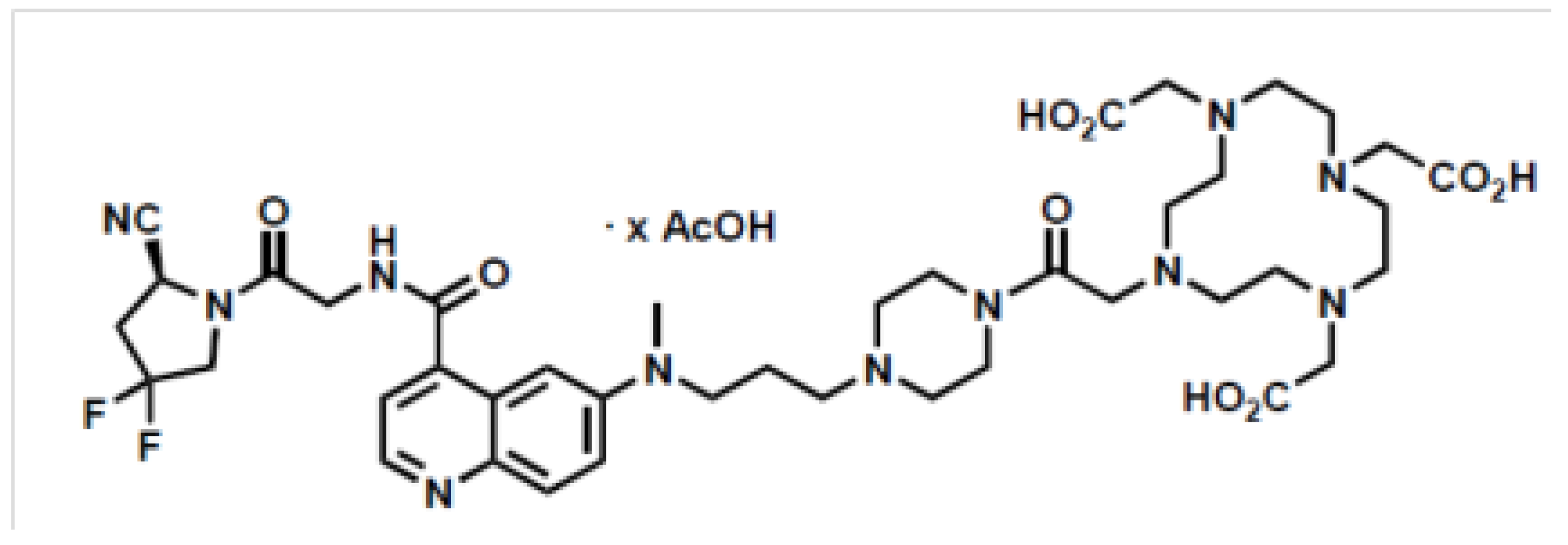
Figure 2.
Gallium decay scheme.
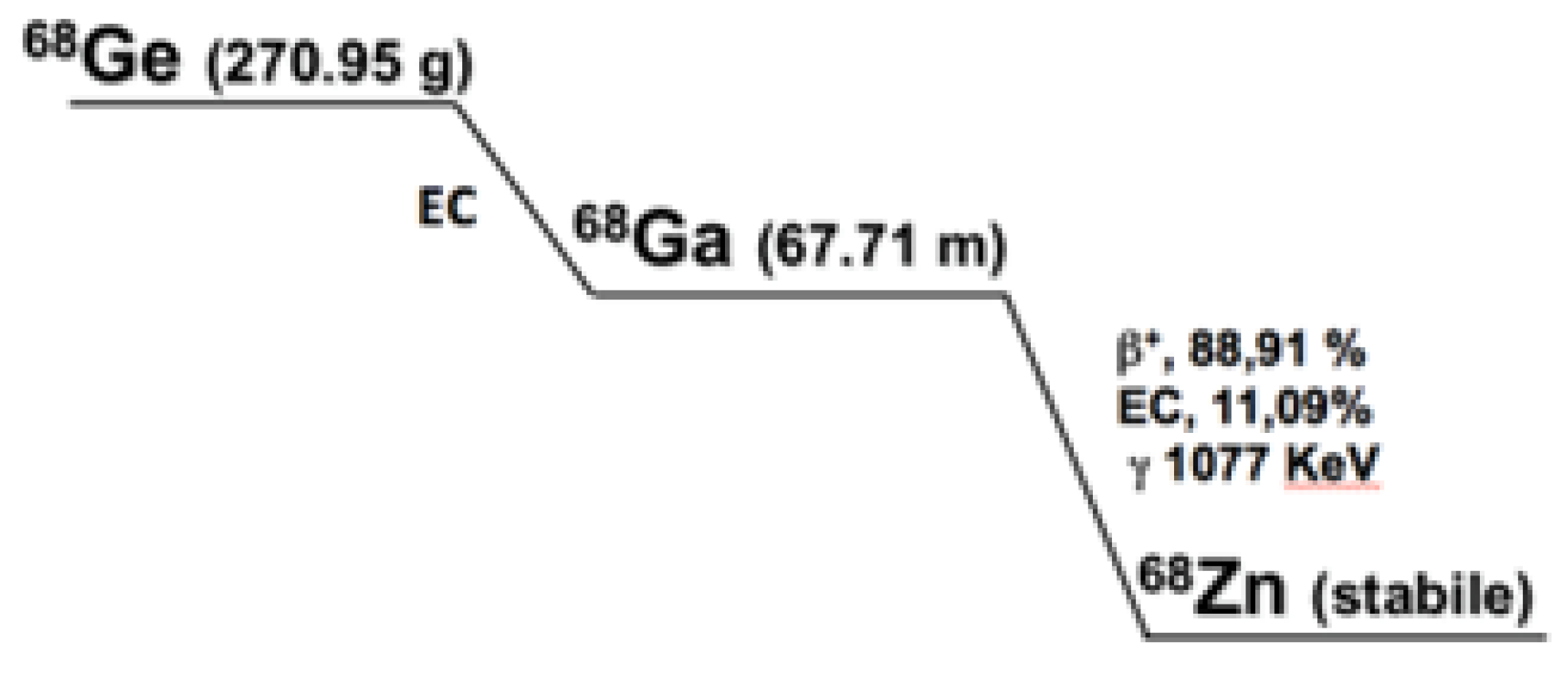
Figure 3.
Relevant chromatograms of the final products of [68Ga]Ga-FAPI-46 with radiometric (a) and UV detector (b).
Figure 3.
Relevant chromatograms of the final products of [68Ga]Ga-FAPI-46 with radiometric (a) and UV detector (b).
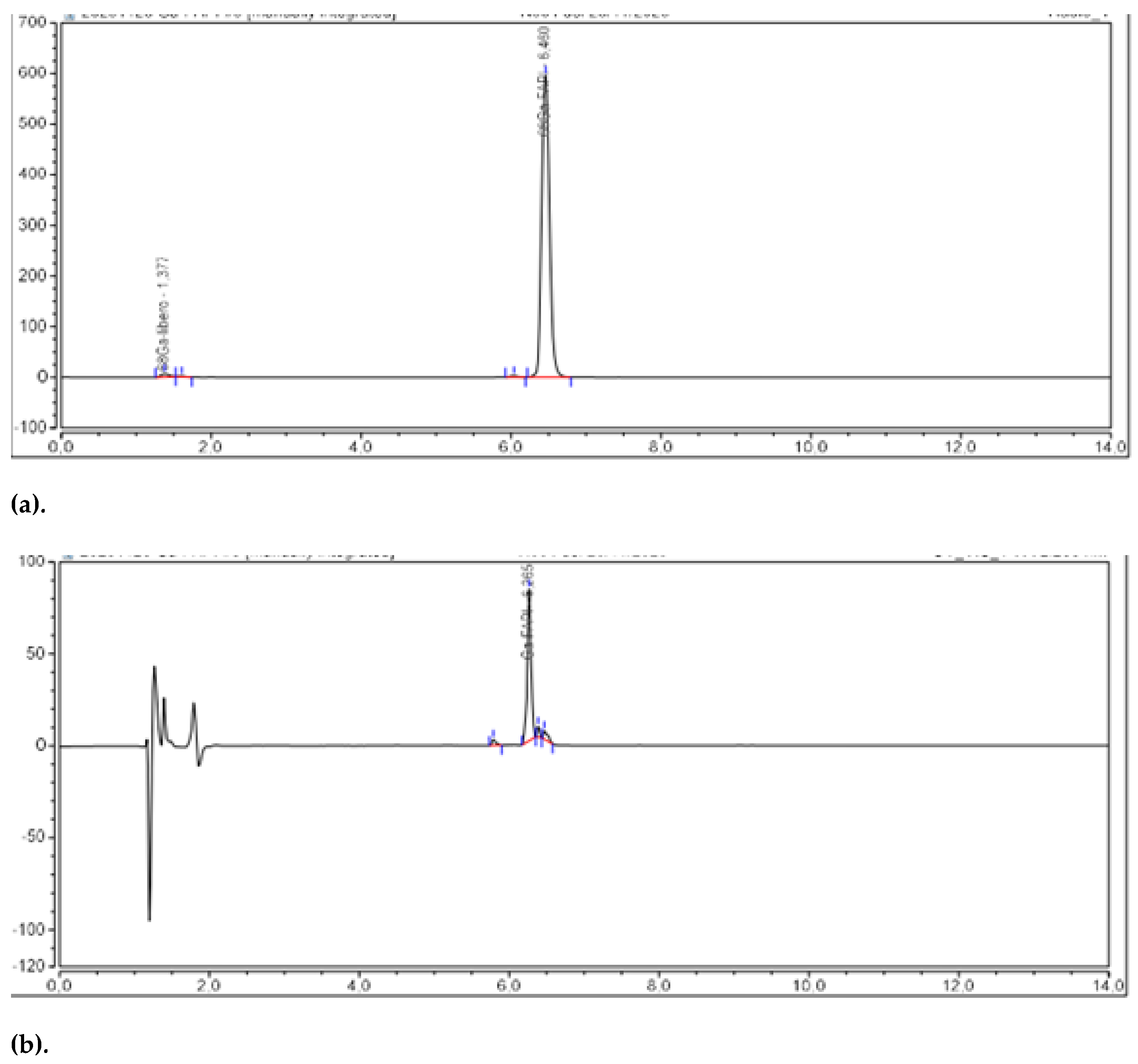
Figure 4.
Chromatograms of standard solution of natGa-FAPI-46 (20 µl of a 0.1 mg/ml solution - a) and FAPI-46 (20 µl of a 0.04 mg/ml solution - b). Rt of natGa-FAPI-46 is slightly lower than that of [68Ga]Ga-FAPI-46 with radiometric detection because it is positioned after the UV detector.
Figure 4.
Chromatograms of standard solution of natGa-FAPI-46 (20 µl of a 0.1 mg/ml solution - a) and FAPI-46 (20 µl of a 0.04 mg/ml solution - b). Rt of natGa-FAPI-46 is slightly lower than that of [68Ga]Ga-FAPI-46 with radiometric detection because it is positioned after the UV detector.
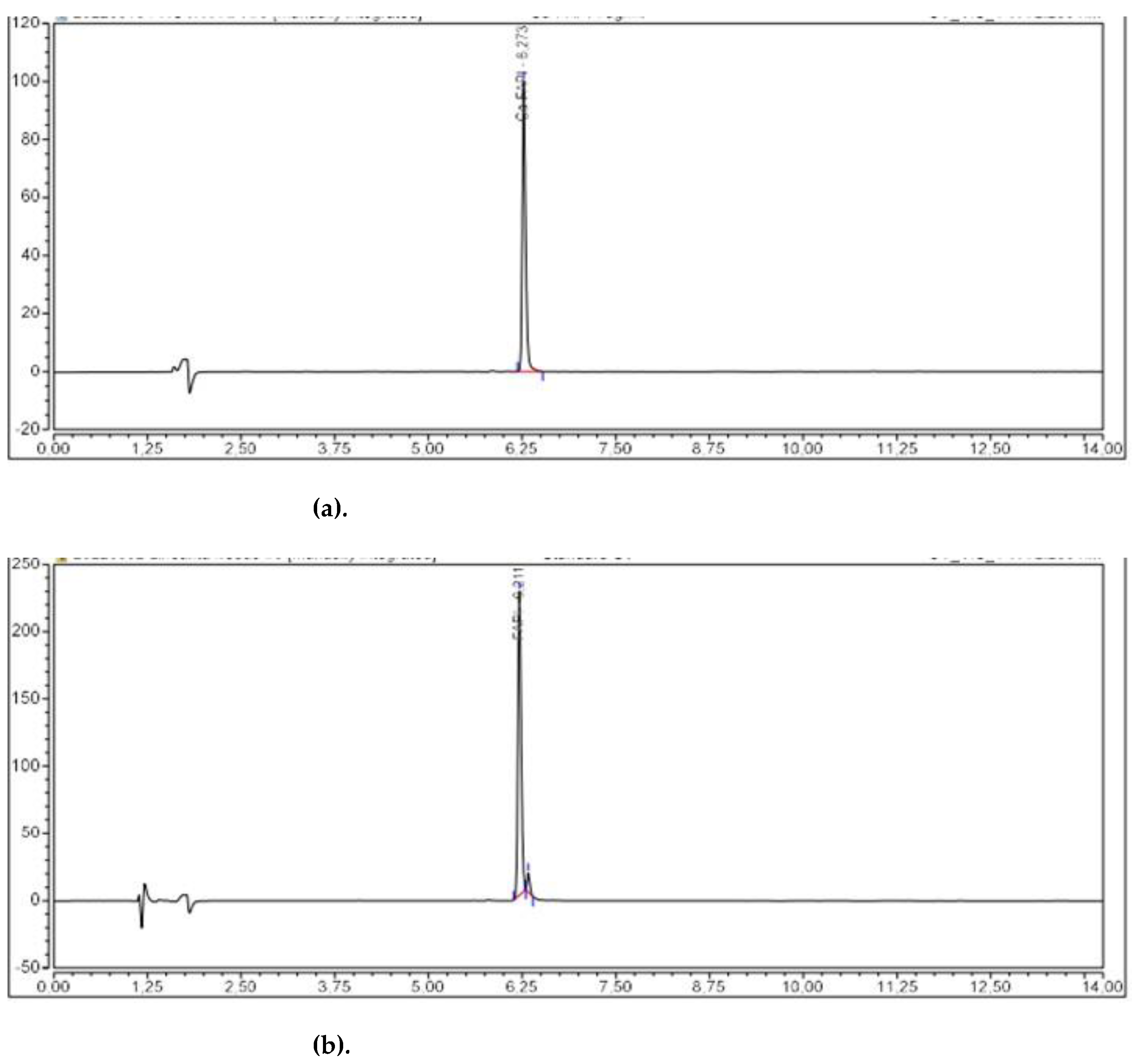
Figure 5.
User graphic interface of the synthesis cassette for the preparation of [68Ga]Ga-FAPI-46 for Laboratory 1 (a) and for Laboratory 2 (b).
Figure 5.
User graphic interface of the synthesis cassette for the preparation of [68Ga]Ga-FAPI-46 for Laboratory 1 (a) and for Laboratory 2 (b).
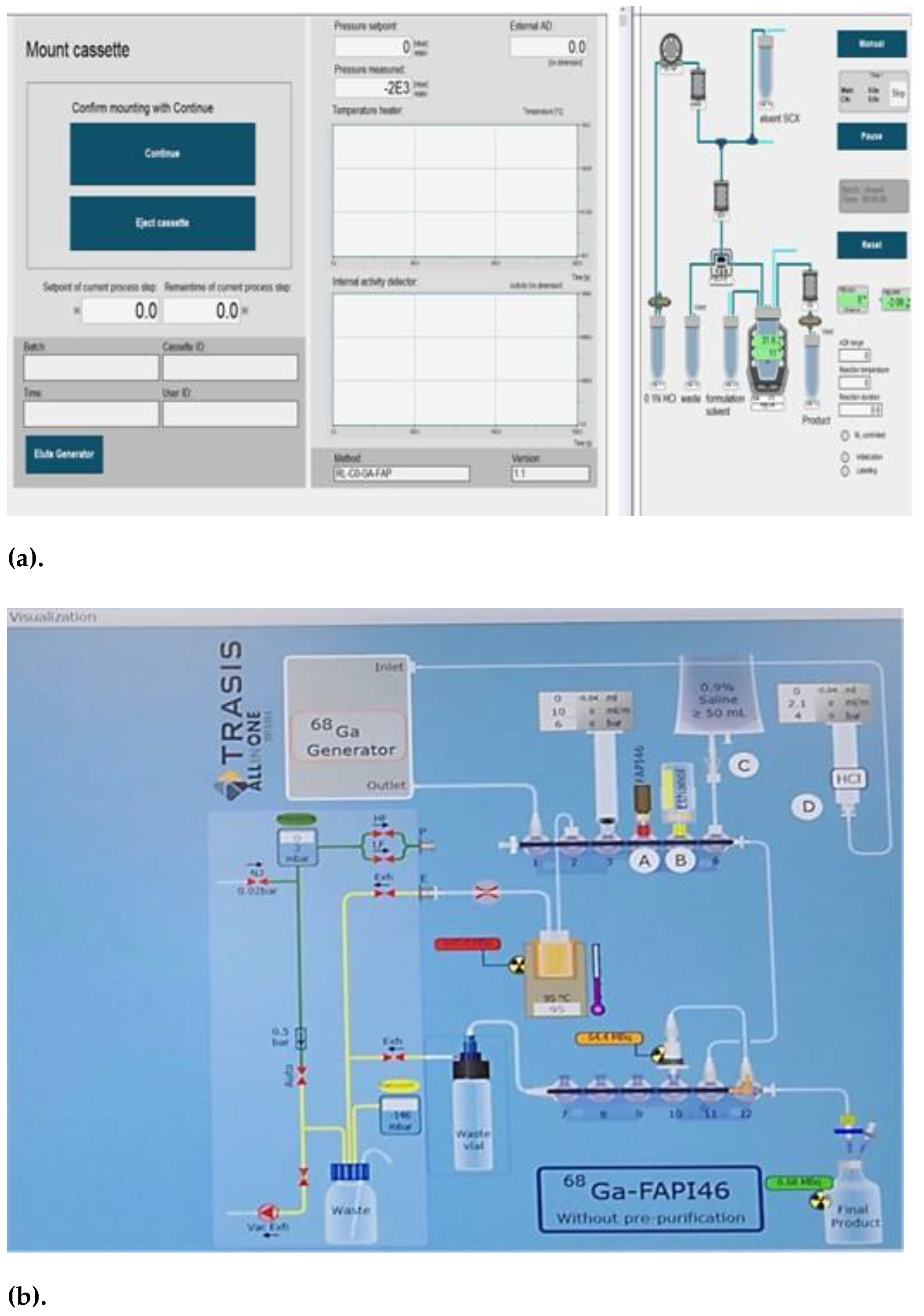

Table 1.
'Gallium (68Ga) Chloride Solution for Radiolabelling specifications'.
| Parameters | Acceptance Criteria |
| Appareance | Clear and colorless solution |
| Radionuclidic Putity | ≥ 99.9 % |
| 68Ge breakthorough | ≤ 0,001 % |
| Non-radioactive metals (ICP-EOS) | Iron: < 10 <g/GBq Zinc: < 10 <g/GBq |
| Identity | Gamma spectrometry: 0.511; 1.077 MeV (a sum peak may be observed at 1.022 MeV) |
| Half Life | 62-74 minute |
| Radiochemical purity | ITLC-SG; mobile phase: Methanol/ammonium acetate (1:1) ≥ 95 % |
| pH | ≤ 2 |
| Endotoxin Level | ≤ 175 EU/V |
Table 2.
Batch Formula of [68Ga]Ga-FAPI-46 for Laboratory 1.
| Components | Function | Amount/Activity |
| [68Ga]Ga-FAPI-46 | Active Pharmaceutical ingredient | 620-697 MBq ART |
| Sodium Chloride NaCl ≥ 99.99% Suprapur | Eluent | 312.4 mg |
| Chloridric acid HCl 30% TraceSELECT Ultra | 15 µl | |
| Ultrapure water TraceSELECT Ultra, ACS Reagent | 1.08 ml | |
| Chloridric acid HCl 30% TraceSELECT Ultra | Reaction Buffer | 8.8 µl |
| Acetic Acid ≥ 99.5% | 20 µl | |
| Sodium acetate trihydrate BioUltra ≥ 99.5% | 60.4 mg | |
| Ultrapure water TraceSELECT Ultra, ACS Reagent | 0.37 ml | |
| Ascorbic Acid | Radical Scavanger | 0.3 mg |
| Sodium Chloride 0.9% | Diluent/Excipient | 7.5 ml |
Table 3.
Batch Formula of [[68Ga]Ga-FAPI-46 for Laboratory 2.
| Components | Function | Amount/Activity |
| [68Ga]Ga-FAPI-46 | Active Pharmaceutical ingredient | 500-700 MBq ART |
| Ethanol Absolute 100%, EMSURE ACS, ISO, Eur Ph Reag. | Eluent | 0.7 ml |
| Sodium Ascorbate Ph Eur | Radical Scavanger | 0.1 g |
| Sodium chloride 0.9 % | Diluent/Excipient | 9.5 ml |
Table 4.
Recommended test for quality controls and pre/post-release time schedule.
| Parameter | Method | Acceptance criteria | Pre/Post Release |
| [68Ga]Ga-FAPI-46 activity | Dose calibrator | Lab 1:620-697 MBq Lab 2: 500-700 MBq |
pre |
| Radioactive concentration | Dose calibrator | Lab 1:68-78 MBq/ml Lab 2: 50-70 MBq/ml |
pre |
| Appearance | Visual inspection | Clear and colorless solution | pre |
| Identification | -spectrometry | Peaks at 0,511 and 1022 Mev | pre |
| Half-life | 62-74 min. | ||
| Identification | HPLC | TR [68Ga]Ga-FAPI-46 ± 0,2 min TR natGa-FAPI-46 | pre |
| Radiohemical purity | TLC | [68Ga]Ga-FAPI-46 ≥ 95% - [68Ga]Ga3+ ≤ 3% | pre |
| Radiohemical purity | HPLC | [68Ga]Ga-FAPI-46 ≥ 95% - [68Ga]Ga3+ and other radiolysis products ≤ 5% of which [68Ga]Ga3+ ≤ 2% | pre |
| System suitability | HPLC | symmetry factor [68Ga]Ga-FAPI-46 ≤ 2,5 | pre |
| pH | pH strips | 4.0 – 8.0 | pre |
| Filter Integrity | Bubble Point Test | ≥ 50 psi | pre |
| Radionuclidic purity | -spectrometry | ≤ 0,001% | post |
| Sterility | Sterility Test (Ph.Eur) | Sterile | post |
| Bacterial Endotoxin | Eur.Ph. | ≤ 175 EU/V | pre |
Table 5.
Parameters and acceptance criteria for the validation of the radio-HPLC method and the obtained results.
Table 5.
Parameters and acceptance criteria for the validation of the radio-HPLC method and the obtained results.
| Chemical Purity UV Detector | |||
| Parameters | Acceptance Criteria | Lab 1 results | Lab 2 results |
| Specificity | Rs natGa-FAPI-46 and FAPI-46 Rs ≥ 1,5 |
Comply | Comply |
| Precision | CV% FAPI-46 ≤ 5% CV% natGa-FAPI-46 ≤ 5% |
2% 2,6% |
2,3% 2,4% |
| Linearity | R2 FAPI-46 ≥ 0,99 R2 natGa-FAPI-46 ≥ 0,99 |
0,999 0,998 |
0,998 0,999 |
| Limit of quantification LOQ (g/ml) |
Experimental | FAPI-46 = 0,39 natGa-FAPI-46 = 0,74 |
FAPI-46 = 1,91 natGa-FAPI-46 = 0,58 |
| Limit of detection LOD (g/ml) |
Experimental | FAPI-46 = 0,13 natGa-FAPI-46 = 0,39 |
FAPI-46 = 0,63 natGa-FAPI-46 = 0,19 |
| Range Accuracy | Avarage bias < 5% | Comply | Comply |
| Radiochemical Purity Radiodetector | |||
| Parameters | Acceptance Criteria | Lab 1 results | Lab 2 results |
| Specificity | Not applicabile | NA | NA |
| Precision | CV% ≤ 5% | 3,1 % | 3,1% |
| Linearity | R2 ≥ 0,99 | 0,9983 | 0,992 |
| Limit of quantification LOQ (MBq/ml) |
Experimental | 30,01 | 4,5 |
| Limit of detection LOD (MBq/ml) |
Experimental | 9,9 | 1,5 |
| Range Accuracy | Avarage bias < 5% | Comply | Comply |
Table 6.
Results of [⁶⁸Ga]Ga-FAPI-46 representatives batches.
| Parameters | Method | Acceptance criteria | Laboratory 1 | Laboratory 2 | ||||
| Batch 1 08/04/2022 | Batch 2 12/05/2022 | Batch 3 18/05/2022 |
Batch 1 08/08/2023 |
Batch 2 10/08/2023 | Batch 3 11/08/2023 | |||
| [⁶⁸Ga]Ga-FAPI-46 activity | Dose calibrator | Lab 1:620-697 MBq Lab 2: 500-700 MBq |
628 MBq | 662 MBq | 697 MBq | 644 MBq | 662 MBq | 593 MBq |
| Radioactive concentration | Dose calibrator | Lab 1: 68-78 MBq Lab 2:50-70 MBq |
69,7 MBq/ml | 73,5 MBq/ml | 77.4 MBq/ml | 64.4 MBq/ml | 66.2 MBq/ml | 59,3 MBq/ml |
| Volume | - | Lab 1: 9 ml Lab 2: 10 ml |
Comply | comply | comply | comply | comply | Comply |
| Appearance | Visual test | Clear and colorless solution | Comply | comply | comply | comply | comply | Comply |
| Identification | HPLC | TR [⁶⁸Ga]Ga-FAPI-46 ± 0,2 min TR natGa-FAPI-46 | 0,157 min | 0,172 min | 0,144 min | 0,141 min | 0,160 min | 0,156 min |
| Radionuclidic identity | γ-spectrometry | Peaks at 0,511 and 1022 Mev | Comply | comply | comply | comply | comply | Comply |
| Half-life | 62-74 min. | 67,85 min | 69,39 min | 67,83 min | 68,2 min | 68,9 min. | 66,9 min. | |
| Radiohemical purity | TLC | [⁶⁸Ga]Ga-FAPI-46 ≥ 95% - [68Ga]Ga3+ ≤ 3% | 99,6 % | 99.9 % | 99.2 % | 99,2 % | 99,7 % | 99,6 % |
| 0,4 % | 0,1 % | 0,8 % | 0,8 % | 0,3 % | 0,4 % | |||
| Radiohemical purity | HPLC | [⁶⁸Ga]Ga-FAPI-46 ≥ 95% | 98,1 % | 99,0 % | 97,1 % | 99,9 % | 99,7 % | 99,9 % |
| [68Ga]Ga3+ and other radiolysis products ≤ 5% | 1,9 % | 1,0 % | 2,9 % | 0,1 % | 0,3 % | 0.0 % | ||
| [68Ga]Ga3+ ≤ 2% | 1,6 % | 0,7 % | 2.0 % | 0,1% | 0,3 % | 0,0 % | ||
| System suitability | HPLC | symmetry factor [⁶⁸Ga]Ga-FAPI-46 ≤ 2,5% | comply | comply | comply | comply | comply | Comply |
| pH | pH strips | 4.0 – 8.0 | 4.5 | 4.5 | 4.5 | 5.8 | 6.0 | 5.9 |
| Filter Integrity | Bubble Point Test | ≥ 50 psi | ≥ 50 psi | ≥ 50 psi | ≥ 50 psi | ≥ 50 psi | ≥ 50 psi | ≥ 50 psi |
| Radionuclidic purity | γ-spectrometry | ≤ 0,001% | 0,000035 % | 0,000018 % | 0,000034 % | < 2 . 10-5 % | < 2 . 10-5 % | < 2 . 10-5 % |
| Sterility | Sterility Test (Ph.Eur) | Sterile | comply | comply | comply | comply | comply | Comply |
| Bacterial Endotoxin | Eur.Ph. | ≤ 175 EU/V | comply | comply | comply | comply | comply | Comply |
Table 7.
Stability test of injectable solution of [⁶⁸Ga]Ga-FAPI-46.
| 1 h Stability test | ||||||||
| Parameters | Method | Acceptance criteria | Laboratory 1 | Laboratory 2 | ||||
| Batch 1 08/04/2022 | Batch 2 12/05/2022 | Batch 3 18/05/2022 |
Batch 1 08/08/2023 |
Batch 2 10/08/2023 | Batch 3 11/08/2023 | |||
| Appearance | Visual test | Clear and colorless solution | comply | comply | comply | comply | comply | Comply |
| Radiohemical purity | TLC | [⁶⁸Ga]Ga-FAPI-46 ≥ 95% - [68Ga]Ga3+ ≤ 5% | 99,6 % | 99.9 % | 99.6 % | 98,9 % | 99,6 % | 99,5 % |
| 0,4 % | 0,1 % | 0,4 % | 1,1 % | 0,4 % | 0,5 % | |||
| Radiohemical purity | HPLC | [⁶⁸Ga]Ga-FAPI-46 ≥ 95% | 98,0 % | 98,7 % | 97, % | 99,8 % | 99,7 % | 99,8 % |
| [68Ga]Ga3+ and other radiolysis products ≤ 5% | 2,0 % | 1,3 % | 3,0 % | 0,2 % | 0,3 % | 0.2 % | ||
| [68Ga]Ga3+ ≤ 2% | 1,7 % | 0,8 % | 2.0 % | 0,1% | 0,3 % | 0,1 % | ||
| pH | pH strips | 4.0 – 8.0 | 4.5 | 4.5 | 4.5 | 5.8 | 5.9 | 5.9 |
| 2 h Stability test | ||||||||
| Parameters | Method | Acceptance criteria | Laboratory 1 | Laboratory 2 | ||||
| Batch 1 08/04/2022 | Batch 2 12/05/2022 | Batch 3 18/05/2022 |
Batch 1 08/08/2023 |
Batch 2 10/08/2023 | Batch 3 11/08/2023 | |||
| Appearance | Visual test | Clear and colorless solution | comply | comply | comply | comply | comply | Comply |
| Radiohemical purity | TLC | [⁶⁸Ga]Ga-FAPI-46 ≥ 95% - [68Ga]Ga3+ ≤ 5% | 99,5 % | 99.7 % | 99.5 % | 98,6 % | 99,5 % | 99,3 % |
| 0,5 % | 0,3 % | 0,5 % | 1,3 % | 0,5 % | 0,6 % | |||
| Radiohemical purity | HPLC | [⁶⁸Ga]Ga-FAPI-46 ≥ 95% | 97,5 % | 98,5 % | 96,7 % | 99,3 % | 98,5 % | 99,3 % |
| [68Ga]Ga3+ and other radiolysis products ≤ 5% | 2,5 % | 1,5 % | 3,3 % | 0,7 % | 0,6 % | 0.7 % | ||
| [68Ga]Ga3+ ≤ 2% | 1,7 % | 0,8 % | 2.0 % | 0,6 % | 0,1 % | 0,1 % | ||
| pH | pH strips | 4.0 – 8.0 | 4.5 | 4.5 | 4.5 | 5.8 | 5.8 | 5.9 |
Disclaimer/Publisher’s Note: The statements, opinions and data contained in all publications are solely those of the individual author(s) and contributor(s) and not of MDPI and/or the editor(s). MDPI and/or the editor(s) disclaim responsibility for any injury to people or property resulting from any ideas, methods, instructions or products referred to in the content. |
© 2025 by the authors. Licensee MDPI, Basel, Switzerland. This article is an open access article distributed under the terms and conditions of the Creative Commons Attribution (CC BY) license (http://creativecommons.org/licenses/by/4.0/).
Copyright: This open access article is published under a Creative Commons CC BY 4.0 license, which permit the free download, distribution, and reuse, provided that the author and preprint are cited in any reuse.


