

Submitted:
26 August 2025
Posted:
27 August 2025
You are already at the latest version
Abstract
Sustainable vocational training can be defined as the continuous provision of trained personnel in a fast and appropriate manner to the country's economy and development. Therefore, it is imperative for nations to acknowledge the significance of this set of economically contributing activities, as they are instrumental in fostering economic growth and development. Consequently, research endeavors focused on the sustainability of the vocational education system in various countries are undergoing a rapid escalation. The objective of this study is to ascertain the components that are effective in ensuring the sustainability and effectiveness of the vocational education system in Turkey. To this end, the opinions of the academic staff working in vocational schools of higher vocational education in Turkey were considered. The results of the study are shared by means of an analysis of the survey data. The study's participants included 2,450 academicians employed in vocational schools throughout Turkey. In the context of the study, hypotheses were formulated and subjected to analysis. The SEM was utilized for hypothesis testing. The study's findings indicate the presence of four distinct component propositions for the sustainability of vocational education in Turkey. The following factors are believed to contribute to the enhancement of both the effectiveness and sustainability of vocational education: sustainable vocational education, increasing digitalization and access opportunities, raising awareness of energy and resource efficiency in education, reflecting data-based education policies in curricula, and integrating the online education system into vocational education. It is imperative for the nation's economic and developmental agenda that these four components be implemented in all vocational colleges offering vocational education.
Keywords:
Sustainable Vocational Education
; Educational Innovation
; Digital Transformation
; Energy and Resource Efficiency
; Data-Driven Education Policies
; Online Education
1. Introduction
Today, technological developments are seen as the most important developments affecting education systems in the world. Especially in vocational education, this importance increases even more. For example, many tools such as digitalization (Zhang, 2024), artificial intelligence (Yan, et. al., 2025), distance education are used. The reason for this situation is the need to meet sector-specific personnel who have completed their vocational education (UNESCO, 2019). In order to achieve sustainable education goals, vocational education is expected to contribute to both environmental and economic sustainability. However, for this process to be successful, it will only be possible with the active participation of stakeholders in the sector (OECD, 2021). Vocational education has been found to have a positive impact on employment quality (Wang, et. al., 2024).
One of the important issues of vocational education is sustainability. Sustainable vocational education is seen as the timely and appropriate training of students within the scope of vocational education. With sustainable vocational education, the foundations of regional development and economic development are laid. Therefore, sustainable vocational education is likely to be seen as the most important criterion for countries. The fact that sustainable education is so important causes it to be included in academic studies. The aim of this study is to investigate the factors that are effective in ensuring the effectiveness of sustainable vocational education. In line with this purpose, academicians in vocational colleges providing vocational education in Turkey.
2. Theoretical Background in Turkey and Literature Review
Beginning in the 18th century and continuing until the present, vocational education which aims to provide students with work and vocational skills (Aytaç, 2006) has been established under various names, including business school and production school. Vocational education is chiefly concerned with the provision of a specific profession to meet the demand for trained personnel and to establish a balance between the number of graduates and the number of individuals seeking employment (Bolat, 2016). Students receiving vocational education contribute to the global economy and production processes. Furthermore, it is regarded as the most efficacious approach for expeditious personnel training in alignment with business lines and personnel requirements (Lerman, 2013; Eichhorst et al., 2015). Its utilization is particularly prevalent in developing countries, particularly in the context of addressing issues of unemployment (Almeida et al., 2012). The adoption of practice-based education within the vocational and technical education framework is a strategic measure that aims to align the educational curriculum with the real-world needs and practices of the industry, thereby mitigating the discrepancy between educational outcomes and industry expectations.
Given the importance of education, particularly vocational education, it is essential that educational institutions are entrusted with the responsibility of imparting the necessary knowledge and skills in this field. Indeed, the history of vocational education in our country began with the Ahi organization as a non-formal education institution in the XIIIth century and persisted until the 1860s, when formal vocational art schools were established (Kılınç, 2012). The educational system of the Ahi organization is comprised of two distinct forms. Initially, training was administered in the workplace, encompassing the intricacies of the profession and the ethical principles that govern the tradesmen. The second component pertained to education beyond the confines of the workplace, wherein Islamic religious principles, etiquette, reading and writing skills, and the organizational code of conduct were imparted by trainers and educators within their respective unions. The age requirement for vocational training was ten years old or younger. Vocational training commenced with apprenticeship and subsequently transitioned to promotion to apprenticeship after a two-year period. The duration of apprenticeship training varied according to profession but averaged 1,100 days (Ak, 2006).
Following the decline of the Ahi organization, guilds emerged as a response to address these challenges. According to the guild order, the professional upbringing and training procedures were briefly as follows: In order to be enrolled as an apprentice in a tradesman's shop, it was necessary to be under the age of ten and to receive certification from one's father or guardian attesting to one's ability to work. Following a period of two years, during which time he engaged in both honorary and regular apprenticeships, he would be promoted to the rank of apprentice. A child who had been an apprentice for a period of three years was promoted to the rank of journeyman. Prior to 1860, guilds were responsible for providing vocational education through non-formal means. However, following 1860, this responsibility was transitioned to formal education institutions within the Ottoman Empire. The dissolution of the guild organization was precipitated by the enactment of the law in 1912 (Kılınç, 2012).
The Republic witnessed the adoption of a novel, school-based structure for vocational education. In 1927, the Ministry of National Education assumed responsibility for vocational and technical education, which was previously overseen by the Directorate General of Vocational and Technical Education. The latter was established within the Ministry in 1933. In 1934, the Inter-Ministerial Council convened and, in accordance with the reports presented by foreign experts, recommended that the need for qualified personnel be met through apprenticeship programs, evening art schools, and short-term courses (Akkutay, 1991; Yörük et al., 2002). The Vocational Tedrisatın İnkişaf Plan, formulated between 1934 and 1936, is a seminal document in the realm of vocational education and the collaboration between educational institutions and the employment sector. The plan was a collaborative effort between the Ministry of National Education, the Ministry of National Defense, the Ministry of Agriculture, the Ministry of Public Works, and the Ministry of Economy. The plan called for the establishment of apprentice schools, art and secondary art schools, evening art schools, technician schools, engineer schools, and mobile village courses. The measures delineated in the Plan were expeditiously executed, resulting in a substantial augmentation in the number of students, educators, and institutions offering vocational and technical education (Demir and Şen, 2009). In 1941, the General Directorate of Vocational and Technical Education was replaced by the Undersecretariat for Vocational and Technical Education. In 1960, the Undersecretariat for Vocational and Technical Education underwent a restructuring, resulting in the formation of the General Directorate of Technical Education for Boys, the General Directorate of Technical Education for Girls, and the General Directorate of Trade Education.
Following the enactment of Law No. 2089 in 1977, apprenticeship education was incorporated into the national vocational education framework. Legislation No. 3308 on Vocational Education, enacted in 1986, underwent a comprehensive reorganization of fundamental vocational education, encompassing the domains of "formal," "apprenticeship," and "non-formal" education. According to Law No. 3308, social partners are assigned pivotal roles in the planning, implementation, and evaluation of formal, apprenticeship, and non-formal vocational education. Consequently, Vocational Education Councils were established within the Ministry of National Education, functioning at the national level, and Provincial Vocational Education Councils, functioning at the provincial level (Akpınar, 2004). Law No. 3797 on the Organization and Duties of the Ministry of National Education, published in 1992, established the General Directorate of Technical Education for Boys, General Directorate of Technical Education for Girls, General Directorate of Trade and Tourism Education, Department of Health Affairs, Department of Apprenticeship, Development and Dissemination of Vocational and Technical Education, and Department of Educational Research and Development. With the 2011 Decree Law No. 652 on the Organization and Duties of the Ministry of National Education, six units responsible for the execution of vocational and technical education in the Ministry of National Education were merged under the name of General Directorate of Vocational and Technical Education. Non-formal vocational education and open education institutions were also gathered under the General Directorate of Lifelong Learning (MEB, 2018).
Subsequently, it assumed its contemporary form through educational institutions such as vocational high schools and vocational colleges, where vocational education is prioritized. In the contemporary educational landscape, there are institutions such as vocational and technical Anatolian high schools, multi-program high schools, vocational training centers, vocational open education high schools, fine arts high schools, and sports high schools. Vocational training centers are also in place to provide apprenticeship training. At the university level, vocational colleges and universities are the institutions primarily responsible for offering vocational education. In recent years, sustainable vocational education studies have been implemented in higher education by implementing vocational education projects in enterprises, especially in vocational colleges. The transition of associate degree institutions that provide vocational education to the 3 + 1 system and the transition of undergraduate institutions to the 7 + 1 system have increased the importance of sustainable vocational education. While enrolled in institutions that offer associate degrees, students receive three semesters of theoretical education. Concurrently, they are provided with the opportunity to receive practical training in workplaces for one semester. Similarly, at the undergraduate level, a total of seven semesters of theoretical instruction and one semester of practical training are provided. The implementation of data-based education policies is facilitated by this situation, concurrently ensuring the provision of adequate personnel training.
3. Research Hypotheses Development
The objective of this study is to ascertain the factors that may influence the efficacy of sustainable vocational education in universities with associate degree programs offering vocational education in Turkey. To this end, the objective was to formulate study hypotheses by taking into account a range of studies found in the extant literature. Concurrently, the objective is to formulate hypotheses that are consistent with the study and align with the findings reported in the extant literature.
Digitalization and the provision of access opportunities have brought about a number of positive impacts on society. In particular, sustainable development and education are some of these impacts. Ensuring the digital literacy of educators and trainees has become a prerequisite for the emergence of these positive effects (Roll & Ifenthaler, 2020; henderson & Corry, 2021; Delcker & Ifenthaler, 2022). Therefore, it is very important to provide digitalization and access opportunities to the development processes of educational institutions (Bellin-Mularski et al., 2016; Eickelmann & Gerick, 2018). In the studies conducted, it has been documented that increasing digitalization and access opportunities contributes to professional development. In particular, many studies have been conducted on the necessity of including digital literacy in the curricula of vocational colleges (Balsmeier & Woerter, 2019; Seeber & Seifried, 2019; Wild & Schulze Heuling, 2020; Wuttke et al., 2020). Based on these studies, the following hypothesis was developed:
H1.
Digitalisation and access opportunities have an impact on sustainable vocational education.
Zografakis et al. (2007) see education as an important factor in the development of energy-saving behaviors and attitudes at all levels of society. Hobley (2015) criticized that theoretical education in vocational education overshadows vocational and technical education. He also stated that students have deficiencies in energy and resource efficiency in education. He argues that this situation will cause students to be inadequate in business life. Hiim (2017) contributed to this debate by emphasizing the importance of work-life practice in vocational curricula. Another study revealed that energy efficiency is critical for mitigating climate change and promoting sustainable development at the corporate level (Nunoo et al., 2019). Barbero et al. (2023) emphasize the critical importance of educational accessibility and awareness as factors affecting energy efficiency outcomes and reveal the important role of vocational education in developing these competencies. In addition, the study states that there is a direct proportion between increasing energy efficiency and improving vocational competencies. Based on these studies, the following hypothesis was developed:
H2.
Energy and resource efficiency have an impact on sustainable vocational education.
Many studies on online education reveal the existence of an interaction between vocational education and technological developments, student behaviors and approaches. Maddison et al. (2016) stated that with online education, students participate more in the course and cause detailed topics to be covered. Collins (2017) also reported that online education leads to increased student engagement in the course. Canales et al. (2018), in his study, determined that online education increased student motivation and satisfaction. Kara et al. (2019) emphasized the disadvantages of online education and also stated that it plays an important role in adult education. Again, Saunders et al. (2020), focusing on the impact of online learning on academic staff, revealed the challenges faced by instructors who transition to online education. Based on these studies, the following hypothesis was developed:
H3.
Online education has an impact on sustainable vocational education.
In higher education institutions, data-driven educational policies are widely recognized as an important tool used by leading educational institutions. There are very few studies on this topic in the existing literature. Analyzing educational data is seen as a fundamental element in the implementation of new educational policies and will become increasingly important in the future (Williamson, 2016). Yan and Wu (2025) report the impact of technological developments on educational policies. As a result of the study, it was stated that technological developments cause curricula to be renewed and interdisciplinary development. In their study, Fodor et al. (2021) provided information about the usage areas of data-based education policies. In the study, it was stated that the creation of data-based policies in education will lead to the completion of deficiencies by providing feedback in education. Based on these studies, the following hypothesis was developed:
H4.
Data-driven education policies have an impact on sustainable vocational education.
4. Research Method
4.1. The Study’s Model
The goal of this study is to figure out what it takes to make sure that vocational education in Turkey is sustainable and effective. To this end, we asked academics working at associate degree institutions offering vocational education in Turkey for their opinions. A thorough review of existing literature and an analysis of current practices in the country were conducted to identify the factors affecting the effectiveness of sustainable vocational education. This analysis showed four key components. These are digital tools in education, using energy and resources efficiently, using data to make education policies, and using online tools in education. The ideas mentioned in this study were then checked using something called a “structural equation model” (or SEM for short). We chose to use SEM instead of other methods because it can look at the complex connections between hidden and visible factors at the same time. Furthermore, SEM is a great tool for research that wants to find out what happens because of different factors, both directly and indirectly. This issue is the main focus of our research on how to improve sustainable vocational training. However, a second reason to use SEM is its ability to manage multiple dependent variables and evaluate their relationships within a comprehensive model. It allows for the complete modeling of connected factors such as digital technology and easy access, energy and resource efficiency, data-driven education policies, and online education applications (Hair et al., 2017). Furthermore, the Structural Equation Modeling (SEM) approach allows us to test hypotheses about the relationships between variables. This helps to support the theoretical framework underpinning our research, particularly the SVE model. The SEM framework allows us to examine how perceived relative advantage and compatibility influence the adoption of sustainable SVE. This provides strong validation of the theoretical framework within the context of SVE.
The conceptual model of this study is illustrated in Figure 1. As demonstrated in Figure 1, the independent variable, sustainable vocational education (SVE), was measured based on the mean of seven concepts/items using a Likert five-point scale (1 = strongly disagree; 5 = strongly agree). A parallel methodology was employed to assess the dependent variables of digitalization and accessibility (DA), energy and resource efficiency (ERE), the implementation of data-driven education policies (DDEP), and online education (OE).
4.2. Data and Sample
Selecting Turkey as the main population for this study emphasizes the importance of vocational education in developing countries and its direct contribution to the national economy. It also highlights the critical role of vocational education in a country's development. Academicians, in particular, play an important role in sustainability by providing direct transfer of vocational education. Therefore, the opinions of these academics are of great importance in this study. This study aims to determine the perceptions of academic staff working in vocational education institutions (vocational colleges) regarding the criteria for ensuring the effectiveness of sustainable vocational education. To this end, a questionnaire was administered to 24,140 academics working in vocational education institutions in Turkey (statistics.yok.gov.tr/). The Google Docs website was used to collect the necessary data for the study. The questionnaire was created based on the opinions of various academics and practitioners. The questionnaire was presented as a 5-point Likert scale. To ensure the validity and reliability of our Likert scale, we took several steps and applied relevant statistical techniques. Thus, we strengthened the reliability of our research findings. To this end, we administered the questionnaire to 20 academics and five practitioners as a pretest. Based on the results, we added statements or clarified missing or incomprehensible ones.
The questionnaire has two parts. The first part consists of five questions designed to assess the demographic characteristics of academic staff. The second part consists of 40 carefully selected statements based on the scope of the study and existing literature that reflect the views of academics. Seven of these statements are related to vocational education, nine to digitalization, nine to energy and efficiency, seven to online education, and eight to educational policies. The questions were prepared using a 5-point Likert scale. Additionally, Cronbach's alpha value was calculated to assess the study's reliability. The result was 0.895, indicating a high degree of reliability. The entire study population of academicians working in vocational colleges in Turkey was targeted using the snowball sampling method. The questionnaire was distributed via email to academic staff email addresses listed on university websites. Of the 2,750 academics who filled out the questionnaire, it was determined that 2,450 did so in accordance with the scope of the study, yielding an 89% response rate. Correlation analysis was conducted on the 2,450 completed questionnaires to evaluate the study's hypotheses. Frequency analysis was also used to identify demographic factors. The results were then analyzed and interpreted.
5. Results
5.1. Descriptive Analysis
Table 1 presents the demographic characteristics of the participants. As indicated by the data presented in Table 1, the genders of the participating academics were selected to be quite similar. A subsequent analysis revealed that more than half of the participating academics fell within the 30-40 age range. It was determined that the vast majority of participants had 4-20 years of professional experience. Sixty-seven percent of the participants have a master's degree, while only 14% have a doctoral degree. While this percentage is low academically, it is normal considering that most educators at private schools in Turkey are lecturers. Academic staff with doctorates usually work at institutions that offer undergraduate programs. 93% of participants are academics teaching professional courses, while 7% are academic staff teaching service courses (Turkish, foreign languages, history, etc.). This result is important for understanding the effectiveness of sustainable vocational education, the main focus of our study.
The following investigation seeks to establish the relationships between vocational education, digitalisation and access, energy and resource efficiency, online education, and data-driven education policies (see Table 2). The table indicates that there are statistically significant and strong relationships between some variables. Specifically, the correlation between vocational education and energy and resource efficiency is significant (r=.702, p<.01). This finding indicates that vocational education plays a significant role in the development of skills focused on sustainability and resource management. In addition, a notable correlation was identified between vocational education and digitalisation, as well as access (r=.564, p<.01) and online education (r=.492, p<.01). The findings of this study suggest a correlation between vocational education and the development of digital skills, as well as the integration of technology-supported learning processes. A high level of correlation is evident between digitalization and access, and online education (r=.737, p<.01).
Consequently, it is posited that digital infrastructure and access are pivotal factors in the efficacy of online education processes. The positive relationship between digitalisation and energy and resource efficiency (r=.467, p<.01) highlights the contribution of digital transformation to sustainability policies. Furthermore, the relationships between data-driven education policies and other variables were found to be quite weak and statistically insignificant. To illustrate this point, consider the correlation between data-driven policies and online education, which is found to be negative and very low (r=-.042, p>.01). This finding suggests that data usage is not sufficiently integrated into education policies or is limited in practice.
5.2. Hypothesis Testing
Pursuant to the findings of the SEM results, it was ascertained that the general fit level of the study model was at a satisfactory level. This is particularly evident when examining the value of χ²/df, which is found to be 3.259. As the figure falls below 4, it is deemed to be at an acceptable level. Given that RMSEA = 0.06 < 0.08, it can be concluded that the model exhibits a satisfactory degree of fit. The values of the CFI, TLI, NFI, and GFI, which are 0.965, 0.973, 0.988, and 0.993, respectively, are all above 0.95, indicating an excellent fit. Finally, the AGFI was found to be equal to 0.872. Given that the result is above the 0.85 limit, it can be concluded that there is an acceptable fit at an adequate level. These values indicate that the theoretical structure of the model is in harmony with the study data, and the reliability of the findings will be high.
As indicated by Table 3, it has been ascertained that the independent variable, sustainable vocational education, in the model, exerts a statistically direct, significant, and substantial effect on the four variables specified in the study. The SVE → OE relationship demonstrated the highest level of correlation (β= 0.752). This finding underscores the pivotal role of online education processes in ensuring the efficacy of sustainable vocational education. The correlation between SVE and OE is significant (β= 0.715). This finding indicates that institutional initiatives focused on energy and resource efficiency play a pivotal role in the efficacy of sustainable vocational education. The SVE → DA relationship (β= 0.701) indicates that increasing access to digital infrastructure, ensuring equal opportunities in education, and leveraging digital tools are of strategic importance. Furthermore, the integration of digital technologies and the facilitation of access to educational resources through information and communication technologies are pivotal in ensuring the sustainability of vocational education. Although SVE → DDEP exhibits the lowest standardized effect (β= 0.653), its effect is nevertheless robust and statistically significant. The findings of this study indicate that the implementation of data-driven education policies within educational institutions exerts a significant yet less pronounced impact on the efficacy of sustainable vocational education when compared to the other three variables. In line with these results, all of the study hypotheses were accepted.
6. Discussion
The model developed within the scope of the study comprehensively reveals that digitalization and access, energy and resource efficiency, online education and data-based education policies have an important place in sustainable vocational education. The findings of this study demonstrate that multidimensional constructs such as digitalization, energy efficiency, and data-based approaches in sustainable vocational education can be significantly influenced by a single central variable. Furthermore, the present study will furnish ideas for vocational education planners and programmers, as well as managers and decision makers involved in vocational education activities. These individuals will be able to implement concrete improvements, especially in areas such as online education infrastructure and energy efficiency. This will be especially relevant in cases where strategies to strengthen vocational education will be implemented. Furthermore, data-based education policy-making, despite its apparent absence from the realm of sustainable vocational education, underscores the necessity for the development of data literacy, analytical infrastructure, and analytical systems integrated into the education system.
A statistically significant result was found between sustainable vocational education and digitalization and access opportunities. The OECD (2022) asserts that the success of sustainable vocational education is contingent upon the reconstruction of education methods on a digital foundation. However, as the European Commission (2021) has indicated, vocational education institutions are obligated to provide not only technical skills within the scope of sustainability but also transversal skills such as digital literacy, information management, and online communication. The Digital Competence Framework (DigComp), a product of the European Commission, offers a reference model for CVET systems. The model delineates five core competence areas, including access to information, digital content production, security, collaboration, and problem solving (Vuorikari et al., 2016). These competencies are regarded as fundamental rights that should be imparted to trainees by educational institutions to ensure the sustainability of vocational education. In the context of Turkey, the Ministry of Education's (MEB) Distance Education Platform and e-Certificate programs have been adopted as models of digital CVET practices in the aftermath of the pandemic (MEB, 2022). In addition to the challenges posed by digitalization and the effective provision of sustainable vocational education, significant issues have emerged concerning the provision of these systems and access. For instance, Yalçinkaya and Kuzu (2021) highlighted this outcome in their study. The study indicated a pressing need for the professional development of teachers and educators in the effective use of technological equipment.
A substantial body of research has established a nexus between energy and resource efficiency in education and the efficacy of sustainable vocational education. Among these studies, Sterling (2011) demonstrates that energy and resource efficiency are critical components of sustainable development and education. It has been asserted that this component fulfills an awareness-raising and implementing role in achieving sustainability goals in educational institutions (Leal Filho et al., 2018). The study's findings suggest that enhancing energy and resource efficiency in vocational education can lead to several key outcomes. These include the enhancement of sustainable education effectiveness, the optimization of energy performance within educational institutions, and the increased adoption of renewable energy systems. Consistent with this finding, analogous results were reported in the studies of Azhar et al. (2011), and Hwang et al. (2013). However, within the scope of sustainable vocational education, courses and practices that are suitable for sustainable vocational education in today's conditions are being added to the curricula of educational institutions. For instance, Tilbury (2011) and Barth & Michelsen (2013) discovered analogous outcomes in their respective studies, including sustainable campus practices (Cortese, 2003; Filho et al., 2015), environmental education and sustainable development (Yang & Milagros, 2024; Hamid et al., 2024), energy conservation (Drozich, 2025), awareness of renewable energy technologies and resources (Kacan, 2015), climate change (Stein et al., 2022; Oyedeji et al., 2023; Eilam, 2025), and resource management (Kovernuk, 2016).
Moore et al. (2011) stated that the distance education system has emerged as an important method that increases accessibility, flexibility, and learning opportunities in continuing education with technological developments. As stated in the results of the study, distance education system is an important component in sustainable vocational education. The biggest advantage of the distance education model is seen as the absence of time and space restrictions in providing sustainable education, allowing employees to receive education from wherever they want (Means et al., 2010; Lopez Soblechero et al., 2014), providing accessibility and flexibility (Hrastinski, 2008), encouraging individualized learning (Rovai & Jordan, 2004), and providing cost-effectiveness (Zawacki-Richter et al., 2009). In Turkey, distance education in all education systems, especially in sustainable vocational education, has started to be implemented after the pandemic (Demiray, 2020).
Another important component of sustainable vocational education is the development of data-driven education policies, as stated in my study results. Data-based education policies are of great importance in ensuring effectiveness in sustainable vocational education, improving quality and accessibility (Mandinach & Gummer, 2016; CNAES 2024), addressing students' achievement levels and needs (Schildkamp, et al., 2017), training personnel suitable for the needs of the labor market (Boud & Hager, 2012; Conejero et al., 2021) and feedback (Siemens & Long, 2011). Especially in ensuring the effectiveness of sustainable vocational education, needs analysis (Tan & Cao 2025), program evaluation (Guskey, 2002), personalized learning (Kallick & Zmuda, 2017) and policy development (Datnow & Park, 2018) play an important role in the creation of many strategic education systems. In Turkey, the Ministry of National Education and the Council of Higher Education play an important role in providing these systems. With the sensitive education policies of these institutions, it is ensured that the effectiveness of sustainable vocational education in Turkey is increased and personnel are trained for the needs of the labor market (Koçak, 2019).
7. Conclusions
In line with sustainable vocational education, vocational education is transforming into a multi-dimensional, efficient and effective structure through digitalization and ease of access, energy and resource efficiency, implementation of data-based education policies and integration of online education applications. Digitalization and accessibility increase the accessibility of vocational education, making learning processes more flexible and accessible, while data-based education policies improve quality by continuously analyzing the effectiveness of educational content and methods. These approaches contribute to achieving the sustainable development goals of vocational education.
The transition to digitalization in sustainable vocational education has precipitated the migration of learning materials to digital platforms and the adoption of interactive and multimedia formats. This process has been demonstrated to enhance both the quality and accessibility of educational processes. Furthermore, geographical and temporal limitations are eradicated, facilitating the continuity of professional development for working individuals and thereby promoting lifelong learning processes. Furthermore, the prominence of digital skills in vocational education is of great importance to meet the requirements of the modern labor market (Achtenhagen & Achtenhagen, 2019). A multidimensional perspective is imperative for the purpose of achieving energy and resource efficiency in sustainable vocational education. The integration of sustainable and energy-efficient technologies within the physical infrastructure of educational institutions is imperative. It is imperative that content pertaining to energy and other disciplines, particularly environmental awareness, be incorporated into educational curricula. Of paramount importance is the necessity of cultivating a comprehensive awareness among educators and trainees with regard to sustainable vocational education. Another salient point of sustainable vocational education is the integration of distance education. The integration of distance education systems has the potential to enhance the quality, accessibility, and motivational resources of sustainable vocational education. The implementation of data-driven education policies, complemented by sustainable vocational education, plays a pivotal role in addressing the quality and individual learning requirements in the context of vocational education. The most salient point pertains to achieving an equilibrium in data utilization, while concurrently endeavoring to inculcate all trainees with the competencies of data literacy.
Consequently, this study has determined that within the context of sustainable vocational education in Turkey, endeavors are underway to ensure development in alignment with global trends in vocational education. In particular, academics working in higher education institutions offering vocational education have stated that significant progress has been made, or is underway, in the universities where they work in terms of digitalization and ease of access in vocational education, awareness of the importance given to energy and resource efficiency, implementation of data-based education policies, and integration of online education applications. The prevailing hypothesis suggests that the effective implementation of sustainable vocational education is contingent upon the effective and efficient operation of these four critical criteria.
References
- Achtenhagen, C.; Achtenhagen, L. The impact of digital technologies on vocational education and training needs. Educ. Train. 2019, 61, 222–233. [Google Scholar] [CrossRef]
- Ak, M. II. Meşrutiyet Döneminde Mesleki ve Teknik Eğitim Okulları. In Yüksek Lisans Tezi, Pamukkale Üniversitesi, Sosyal Bilimler Enstitüsü; Denizli, 2006. [Google Scholar]
- Akkutay, Ü. Türkiye’de çıraklık eğitimi; Ankara; Erek Ofset, 1991. [Google Scholar]
- Akpınar, A. Türkiye’de temel meslekî ve teknik eğitim; Avrupa Eğitim Vakfı (AEV), 2004. [Google Scholar]
- Almeida, R.; Behrman, J.; Robalino, D. The right skills for the job?: Rethinking training policies for workers; Washington, DC; World Bank Publications, World Bank, 2012. [Google Scholar]
- Anderson, T. The Theory and Practice of Online Learning; Athabasca University Press, 2008. [Google Scholar]
- Aytaç, K. Çağdaş eğitim akımları (Yabancı ülkelerde); Ankara; Mevsimsiz Yayınları, 2006. [Google Scholar]
- Azhar, S.; Carlton, W. A.; Olsen, D.; Ahmad, I. Building environmentally sustainable construction projects. Journal of Cleaner Production 2011, 19(12), 1340–1347. [Google Scholar] [CrossRef]
- Balsmeier, B.; Woerter, M. Is this time different? How digitalization influences job creation and destruction. Research Policy 2019, 48(8), 103765. [Google Scholar] [CrossRef]
- Barbero, I; Rezgui, Y; Petri, I. A European-wide exploratory study to analyse the relationship between training and energy efficiency in the construction sector. Environ Syst Decis 2023, 15, 1–21. [Google Scholar] [CrossRef] [PubMed] [PubMed Central]
- Barth, M.; Michelsen, G. Learning for change: An educational contribution to sustainability. Journal of Cleaner Production 24 2013, 38–46. [Google Scholar] [CrossRef]
- Bates, A. W. Teaching in a Digital Age: Guidelines for Designing Teaching and Learning. BCcampus. 2015. Available online: https://opentextbc.ca/teachinginadigitalage/.
- Bellin-Mularski, N.; Mah, D.-K.; Ifenthaler, D. Pre-service teachers’ perceptions of school development. In Competencies in Teaching, Learning and Educational Leadership in the Digital Age; Springer International Publishing, 2016; pp. 57–76. [Google Scholar] [CrossRef]
- Bolat, Y. Türkiye’de meslekî ve teknik eğitimin mevcut durumu ve farklı ülkelerle karşılaştırılması; Ankara; Pegem Akademi Yayınları, 2016. [Google Scholar]
- Boud, D.; Hager, P. Re-thinking continuing professional development through changing metaphors and location in professional practices. Studies in Continuing Education 2012, 34(1), 17–30. [Google Scholar] [CrossRef]
- Canales, D.G.; Aquila, J.E.; Rosales, T.M. Effectiveness of distance education in the students' motivation and satisfaction in the advanced grammar course of the bachelor in English teaching of the Foreign Languages Department at the University of El Salvador, semester II/2017, 2018.
- China National Academy of Educational Sciences (CNAES). Practical Cases of Smart Education in China: Data-Driven Curriculum and Research Innovation in Higher Education and Vocational Education. In Report on China Smart Education 2023. Research in Chinese Education; Springer: Singapore, 2024. [Google Scholar] [CrossRef]
- Collins, E. K. Asynchronous Video and the Development of Instructor Social Presence and Student Engagement. 2017. Chromeextension://efaidnbmnnnibpcajpcglclefindmkaj/https://core.ac.uk/download/198512606.pdf.
- Conejero, J.M. J.C. A.E.; Preciado; Prieto; Bas, M.C.; Bolós, V.J. Applying data driven decision making to rank vocational and educational training programs with TOPSIS. In Decision Support Systems; ISSN 0167-9236, 2021; Volume 142, 2021, p. 113470. [Google Scholar] [CrossRef]
- Cortese, A. D. The critical role of higher education in creating a sustainable future. Planning for Higher Education 2003, 31(3), 15–22. [Google Scholar]
- Datnow, A.; Park, V. Data use for equity: Implications for teaching, leadership, and policy. Journal of Educational Change 19 2018, 111–125. [Google Scholar] [CrossRef]
- Delcker, J.; Ifenthaler, D. Digital Distance Learning and the Transformation of Vocational Schools From a Qualitative Perspective. Front. Educ 2022, 7, 908046. [Google Scholar] [CrossRef]
- Delcker, J. Digitalisation in the Curricula of Vocational Schools: Text Mining as an Instrument of Curricula Analysis. Technology, Knowledge and Learning 2022, 2023(28), 999–1014. [Google Scholar] [CrossRef]
- Demir, E.; Şen, H. Ş. Cumhuriyet dönemi meslekî ve teknik eğitim reformları. Ege Eğitim Dergisi 2009, 10(2), 39–59. [Google Scholar]
- Demiray, U. Türkiye’de uzaktan eğitim ve sürekli eğitim. Eğitim Teknolojisi Araştırmaları Dergisi 2020, 2(2), 45–55. [Google Scholar]
- Drozich, I. Using energy efficiency educational cases in the professional training of skilled workers . In The University of Technology in Katowice Press; c. Katowice, Poland, 2025; pp. 48–59. ISBN 978-83-68422-02-3. [Google Scholar]
- Eichhorst, W.; Rodríguez-Planas, N.; Schmidl, R.; Zimmermann, K.F. A roadmap to vocational education and training in industrialized countries. Industrial and Labor Relations Review 2015, 68, 314–337. [Google Scholar] [CrossRef]
- Eickelmann, B.; Gerick, J. Herausforderungen und Zielsetzungen im Kontext der Digitalisierung von Schule und Unterricht (II). Fünf Dimensionen der Schulentwicklung zur erfolgreichen Integration digitaler Medien. Schulverwaltung. Nordrhein-Westfalen 2018, 29(4), 111–115. [Google Scholar]
- Eilam, E. What does it take to develop an eective climate change curriculum? Front. Educ 2025, 10, 1572965. [Google Scholar] [CrossRef]
- European Commission. Digital Education Action Plan 2021–2027, 2021.
- Filho, W. L.; Shiel, C.; Paço, A. Integrating sustainability into higher education; Springer, 2015. [Google Scholar]
- Fodor, S.; Szabó, I.; Ternai, K. Competence-Oriented, Data-Driven Approach for Sustainable Development in University-Level Education. Sustainability 2021, 13(17), 9977. [Google Scholar] [CrossRef]
- Guskey, T. R. Does it make a difference? Evaluating professional development. Educational Leadership 2002, 59(6), 45–51. [Google Scholar]
- Hair, J.F., Jr.; Matthews, L.M.; Matthews, R.L.; Sarstedt, M. PLS-SEM or CB-SEM: Updated guidelines on which method to use. International Journal of Multivariate Data Analysis 2017, 1(2), 107–123. [Google Scholar] [CrossRef]
- Hamid, A. N.; Rasul, M. S.; Kamaruzaman, F. M. Circular Economy and Sustainable Technology in Technical and Vocational Education and Training: A Bibliometric Analysis. International Journal of Learning, Teaching and Educational Research 2024, 23(9), 141–160. [Google Scholar] [CrossRef]
- Henderson, J.; Corry, M. Data literacy training and use for educational professionals. J. Res. Innov. Teach. Learn. 2021, 14, 232–244. [Google Scholar] [CrossRef]
- Hiim, H. Ensuring Curriculum Relevance in Vocational Education and Training: Epistemological Perspectives in a Curriculum Research Project. International Journal for Research in Vocational Education and Training (IJRVET) 2017, 4(1), 1–19. [Google Scholar] [CrossRef]
- Hobley, J. Vocational pedagogies: The science of teaching or the teaching of science? Journal of Education and Training Studies 2015. Available online: https://radar.brookes.ac.uk/radar/items/ef9f1008-227a-400a-8d7d-baab861e5b61/1/. [CrossRef]
- Hrastinski, S. Asynchronous and synchronous e-learning. Educause Quarterly 2008, 31(4), 51–55. [Google Scholar]
- https://istatistik.yok.gov.tr/.
- Hwang, B. G.; Zhao, X.; Yim, S. Green building energy efficiency improvement. Energy Policy 52 2013, 784–791. [Google Scholar] [CrossRef]
- Indrawati, S.M.; Kuncoro, A. Improving competitiveness through vocational and higher education: Indonesia’s vision for human capital development in 2019–2024. Bulletin of Indonesian Economic Studies 2021, 57(1), 29–59. [Google Scholar] [CrossRef]
- Kacan, E. Renewable energy awareness in vocational and technical education. Renewable Energy 2015, 76(2015), 126–134. [Google Scholar] [CrossRef]
- Kallick, B.; Zmuda, A. Students at the center: Personalized learning with habits of mind; ASCD, 2017. [Google Scholar]
- Kara, M.; Erdoğdu, F.; Kokoç, M.; Cagiltay, K. Challenges Faced by Adult Learners in Online Distance Education: A Literature Review. Open Praxis 2019, 11(1), 5–22. [Google Scholar] [CrossRef]
- Kılınç, M. Türkiye’de meslekî eğitim tarihi (1886-1986); Ankara; Pegem Akademi Yayıncılık, 2006. [Google Scholar]
- Kılınç, M. Türkiye’de Mesleki Teknik Eğitimi Şekillendiren Eğitim Kurumlarından, Ahilik, Gedik, Lonca, Enderun Mektebinin Tarihsel Gelişimleri, ISSN:1306-3111. e-journal of New World Sciences Academy 2012, 7((4) Article Number:2c0045). [Google Scholar]
- Koçak, N. Türkiye’de veri temelli eğitim politikalarının gelişimi. Eğitim ve Bilim 2019, 44(197), 1–20. [Google Scholar] [CrossRef]
- 49. Kovernuk, N. Efficiency financial resources in vocational education. Baltic Journal of Economic Studies 2016, 2(4), 53–58. [Google Scholar] [CrossRef]
- Laurillard, D. Teaching as a Design Science: Building Pedagogical Patterns for Learning and Technology; Routledge, 2012. [Google Scholar]
- Leal Filho, W.; Shiel, C.; Paço, A. Sustainability at universities: Opportunities and challenges for higher education institutions; Springer, 2018. [Google Scholar]
- Lerman, R. I. Expanding apprenticeship in the United States: Barriers and opportunities. In Contemporary Apprenticeship International Perspectives on an Evolving Model of Learning; Fuller, A., Unwin, L., Eds.; Oxon; Routledge, 2013; pp. 105–124. [Google Scholar]
- López Soblechero, MV; González Gaya, C; Hernández Ramírez, J.J. A Comparative Study of Classroom and Online Distance Modes of Official Vocational Education and Training. PLoS ONE 2014, 9(5), e96052. [Google Scholar] [CrossRef]
- Maddison, T.; Doi, C.; Lucky, S.; Kumaran, M. Chapter 2 - Literature Review of Online Learning in Academic Libraries. In Distributed Learning; Maddison, Tasha, Kumaran, Maha, Eds.; Chandos Publishing, 2016; pp. Pages 13–46. ISBN 9780081005989. [Google Scholar] [CrossRef]
- Mandinach, E. B.; Gummer, E. S. Data literacy for educators: Making it count in teacher preparation and practice. In Teachers College Press; 2016. [Google Scholar]
- Means, B.; Toyama, Y.; Murphy, R.; Bakia, M.; Jones, K. Evaluation of evidence-based practices in online learning: A meta-analysis and review of online learning studies. In US Department of Education; 2010. [Google Scholar]
- MEB - Milli Eğitim Bakanlığı. Eğitim Analiz ve Değerlendirme Raporları Serisi - Türkiye’de Meslekî ve Teknik Eğitimin Görünümü. 2018, No:1 • Kasım 2018. [Google Scholar]
- Moore, J. L.; Dickson-Deane, C.; Galyen, K. e-Learning, online learning, and distance learning environments: Are they the same? The Internet and Higher Education 2011, 14(2), 129–135. [Google Scholar] [CrossRef]
- Nunoo, E.K.; Mariwah, S.; Shafic Suleman, S. Energy Efficiency Processes and Sustainable Development in HEIs. In Encyclopedia of Sustainability in Higher Education; Filho Leal, W., Ed.; Springer, Cham, 2019. [Google Scholar] [CrossRef]
- OECD. Future of Education and Skills 2030. 2021. Available online: https://www.oecd.org/education/.
- OECD. Skills Outlook: Learning for Life; 2022. [Google Scholar]
- Oyedeji, M. E.; Aseyan, B. S.; Ajijola, S.; Adedire, F.; Obaleye, O. J. Energy Efficiency Principles in the Design of a Vocational Training Center. Archiculture 2023, 5(2), 38–50. [Google Scholar]
- Redecker, C. European Framework for the Digital Competence of Educators: DigCompEdu; Publications Office of the European Union, 2017; Available online: https://publications.jrc.ec.europa.eu</u>.
- Roll, M.; Ifenthaler, D. Lernort übergreifende Kompetenzentwicklung in der Industrie 4.0: Die Entwicklung digitaler Handlungskompetenz in der dualen Berufsausbildung aus der Ausbilderperspektive. Zeitschrift Für Berufs- Und Wirtschaftspädagogik, Beiheft 29 2020, 185–209. [Google Scholar]
- Rovai, A. P.; Jordan, H. M. Blended learning and sense of community: A comparative analysis with traditional and fully online graduate courses. The International Review of Research in Open and Distributed Learning 2004, 5(2). [Google Scholar] [CrossRef]
- Saunders, F. C.; Brooks, J.; Dawson, M. Exploring staff attitudes to distance learning – what are the opportunities, challenges and impacts on engineering academics and instructional designers. European Journal of Engineering Education 2019, 45(5), 675–690. [Google Scholar] [CrossRef]
- Schildkamp, K.; Poortman, C. L.; Handelzalts, A. Data use in education: An overview of international research. School Effectiveness and School Improvement 2017, 28(4), 499–511. [Google Scholar] [CrossRef]
- Schwab, K. The Fourth Industrial Revolution; World Economic Forum, 2017. [Google Scholar]
- Seeber, S.; Seifried, J. Herausforderungen und Entwicklungsperspektiven der beruflichen Bildung unter veränderten Rahmenbedingungen. Zeitschrift Für Erziehungswissenschaft 2019, 22(3), 485–508. [Google Scholar] [CrossRef]
- Siemens, G.; Long, P. Penetrating the fog: Analytics in learning and education. EDUCAUSE Review 2011, 46(5), 30–40. [Google Scholar]
- Stein, S.; Andreotti, V.; Suša, R.; Ahenakew, C.; Cajková, T. From education for sustainable development to education for the end of the world as we know it. Educ. Philos. Theor. 2022, 54, 274–287. [Google Scholar] [CrossRef]
- Sterling, S. Transformative learning and sustainability. In Sustainability education: Perspectives and practice across higher education ; Sterling, S., Ed.; Earthscan, 2011; pp. 55–70. [Google Scholar]
- Tan, K.; Cao, W. Data-Driven Decision Support System Analysis in Vocational Education. 2025 International Conference on Education, Cultural Communication and Social Development (ICECCSD 2025); 2025; 13. [Google Scholar]
- Tilbury, D. Education for sustainable development: An expert review of processes and learning; UNESCO Publishing, 2011. [Google Scholar]
- UNESCO. Education for Sustainable Development Goals: Learning Objectives; Paris; UNESCO Publishing, 2017. [Google Scholar]
- UNESCO. Transforming Technical and Vocational Education and Training for Sustainable Development; Paris; UNESCO Publishing, 2019. [Google Scholar]
- Vuorikari, R.; Punie, Y.; Carretero, S.; Van den Brande, L. DigComp 2.0: The Digital Competence Framework for Citizens. Update Phase 1: the Conceptual Reference Model; Luxembourg PublicationOffice of the European Union, 2016; EUR 27948 EN. [Google Scholar] [CrossRef]
- Wahyuni, S.; Nurhayati, M.; Sulistyanto, T.H.; Marlina, A. Achieving green performance through green human resources management, green knowledge management and green competency. International Journal of Applied Management and Business 2023, 1(2), 81–94. [Google Scholar] [CrossRef]
- Wang, N.; Pasawano, T.; Sangsawang, T.; Pigultong, M. Data-Driven Analysis of Teaching Quality Impact on Graduate Employment in Higher Vocational Colleges of Hefei. Journal of Applied Data Sciences 2024, 5(1), 242–255. [Google Scholar] [CrossRef]
- Wild, S.; Schulze Heuling, L. How do the digital competences of students in vocational schools differ from those of students in cooperative higher education institutions in Germany? Empirical Research in Vocational Education and Training 2020, 12(1), 5. [Google Scholar] [CrossRef]
- Williamson, B. Digital education governance: data visualization, predictive analytics, and ‘real-time’ policy instruments; <i>J. Education Policy</i>, 2016; Volume 31, 2, pp. 123–141. [Google Scholar] [CrossRef]
- Wuttke, E.; Seifried, J.; Niegemann, H. M. Editorial. In Vocational education and training in the age of digitization; Verlag Barbara Budrich, 2020; pp. 9–14. [Google Scholar]
- Yalçınkaya, M.; Kuzu, A. Türkiye’de Mesleki Eğitimde Dijitalleşme: Öğretmen Görüşleri. Eğitim Teknolojisi Kuram ve Uygulama 2021, 11(2), 95–110. [Google Scholar]
- Yan, J.; Tian, H.; Sun, X.; Song, L. Role of artificial intelligence in enhancing competency assessment and transforming curriculum in higher vocational education. Front. Educ 2025, 10, 1551596. [Google Scholar] [CrossRef]
- Yan, Y.; Wu, J. Digital Transformation of Vocational Education in South China: Challenges, Breakthroughs, and Data-Driven Insights Using Machine Learning Models. In Proceedings of the 2025 International Conference on Big Data and Informatization Education (ICBDIE '25); Association for Computing Machinery: New York, NY, USA, 2025; pp. 56–61. [Google Scholar] [CrossRef]
- Yang, C.; Milagros, L.T. Analysis of Synergistic Effect of Energy Efficiency Improvement and Vocational Competence Development. EAI Endorsed Transactions on the Energy Web 2024, 11(1), 1–10. [Google Scholar] [CrossRef]
- Yörük, S.; Dikici, A.; Uysal, A. Bilgi Toplumu ve Türkiye’de Mesleki Eğitim. Fırat Üniversitesi Sosyal Bilimler Dergisi 2002, 12(2), 299–312. [Google Scholar]
- Zawacki-Richter, O.; Bäcker, E. M.; Vogt, S. Review of quality approaches in distance education worldwide. International Review of Research in Open and Distributed Learning 2009, 10(3), 1–29. [Google Scholar]
- Zhang, X.; Qian, W.; Chen, C. The effect of digital technology usage on higher vocational student satisfaction: the mediating role of learning experience and learning engagement. Front. Educ 2024, 9, 1508119. [Google Scholar] [CrossRef]
- Zografakis, N.; Dasenakis, D.; Katantonaki, M.; Kalitsounakis, K.; Paraskaki, I. Strengthening of energy education in Crete. Proceedings of SECOTOX Conference and the International Conference on Environmental Management, Engineering, Planning and Economics, Skiathos; 2007; pp. 2933–2938. [Google Scholar]
Figure 1.
The conceptual model of the study. Source: Created by the authors.
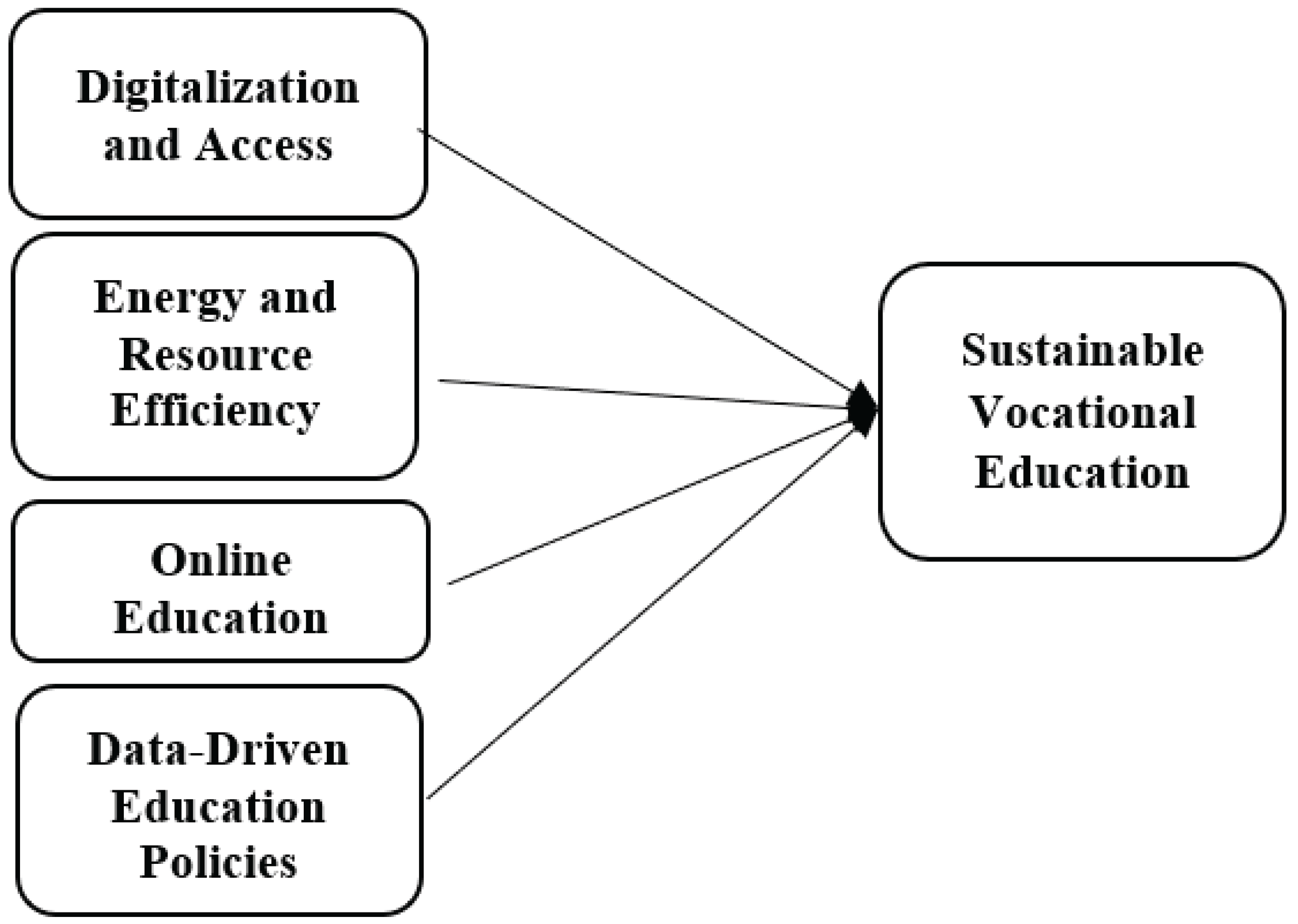

Table 1.
Statistical Information on Participants’ Demographic Characteristics.
| Gender | n | % | Age | n | % |
| Female | 1150 | 47 | 30 years old and under | 654 | 27 |
| Male | 1300 | 53 | 30 - 40 years old | 1296 | 53 |
| Total | 2450 | 100,0 | 41 - 50 years old | 300 | 12 |
| Professional Experience | n | % | 51 years old and over | 204 | 8 |
| 3 years and under | 263 | 11 | Total | 2450 | 100,0 |
| 4–10 years | 998 | 41 | Level of Education | n | % |
| 11–20 years | 1030 | 42 | Bachelor's | 474 | 19 |
| 21 years and over | 159 | 6 | Master's | 1639 | 67 |
| Total | 2450 | 100,0 | PhD | 337 | 14 |
| Vocational Field | n | % | Total | 2450 | 100,0 |
| Vocational Courses | 2289 | 93 | |||
| Service Courses | 161 | 7 | |||
| Total | 2450 | 100,0 | |||
Table 2.
Statistical summary of the constructs: means, standard deviations, and correlations (N = 2,450).
Table 2.
Statistical summary of the constructs: means, standard deviations, and correlations (N = 2,450).
| Mean | Std. Dev. | 1 | 2 | 3 | 4 | 5 | ||
| (1) | Sustainable Vocational Education | 4,0005 | ,56938 | 1 | ,564** (0.000) |
,702** (0.000) |
,492** (0.000) |
,019 |
| (2) | Digitalization and Access | 3,9876 | ,49672 | ,564** (0.000) |
1 | ,467** (0.000) |
,737** (0.000) |
-,024 |
| (3) | Energy and Resource Efficiency | 3,9428 | ,55537 | ,702** (0.000) |
,467** (0.000) |
1 | ,343** (0.000) |
,066 |
| (4) | Online Education | 4,0821 | ,56120 | ,492** (0.000) |
,737** (0.000) |
,343** (0.000) |
1 | -,042 |
| (5) | Data-Driven Education Policies | 3,9527 | ,46873 | ,019 | -,024 | ,066 | -,042 | 1 |
**. Correlation is significant at the 0.01 level (2-tailed).
Table 3.
SEM Analsis Result.
| Variables and description | Estimate | S.E. | C. R. | p |
| DA←SVE | 0.785 | 0.048 | 14.458 | *** |
| ERE←SVE | 0.791 | 0.050 | 14.756 | *** |
| OE←SVE | 0.815 | 0.055 | 15.685 | *** |
| DDEP←SVE | 0.701 | 0.042 | 13.678 | *** |
| Mean for SVE | 3.721 | 0.173 | 35.899 | *** |
| x 2 /df = 3.259, RMSEA = 0.06, RMR= 0.05, CFI= 0.965, NFI= 0.988, GFI= 0.993, AGFI=0.872, TLI=0.973 | ||||
| Intercepts | ||||
| DA | 2.383 | 0.198 | 9.164 | *** |
| ERE | 2.645 | 0.215 | 9.525 | *** |
| OE | 2.433 | 0.201 | 9.287 | *** |
| DDEP | 2.339 | 0.162 | 9.111 | *** |
| Variances | ||||
| SVE | 2.924 | 0.259 | 9.775 | *** |
| e1 | 2.256 | 0.152 | 9.775 | *** |
| e2 | 2.226 | 0.143 | 9.775 | *** |
| e3 | 1.976 | 0.135 | 9.775 | *** |
| e4 | 2.153 | 0.139 | 9.775 | *** |
| Effects of EV - Estimates | DA | ERE | OE | DDEP |
| Total effects | 0.785 | 0.791 | 0.815 | 0.701 |
| Standardised total effects | 0.701 | 0.715 | 0.752 | 0.653 |
| Direct effects | 0.785 | 0.791 | 0.815 | 0.701 |
| Standardised direct effects | 0.701 | 0.715 | 0.752 | 0.653 |
***correlation is significant at the 0.01 level (two-tailed), Source: Created by the authors.
Disclaimer/Publisher’s Note: The statements, opinions and data contained in all publications are solely those of the individual author(s) and contributor(s) and not of MDPI and/or the editor(s). MDPI and/or the editor(s) disclaim responsibility for any injury to people or property resulting from any ideas, methods, instructions or products referred to in the content. |
© 2025 by the authors. Licensee MDPI, Basel, Switzerland. This article is an open access article distributed under the terms and conditions of the Creative Commons Attribution (CC BY) license (http://creativecommons.org/licenses/by/4.0/).
Copyright: This open access article is published under a Creative Commons CC BY 4.0 license, which permit the free download, distribution, and reuse, provided that the author and preprint are cited in any reuse.


