Preprint
Article

This version is not peer-reviewed.

Building a Governance Reference Model for a Specific Enterprise: Addressing Social Challenges Through Structured Solution

A peer-reviewed article of this preprint also exists.

Submitted:

25 August 2025

Posted:

26 August 2025

You are already at the latest version

Abstract

Societal challenges are inherently complex and multi-tiered, arising from the interplay of diverse stakeholders with a spectrum of purposes and different perceptions and expectations, interdependent systems, and dynamic contextual factors that transcend single domains or disciplines. This paper presents a novel approach to developing a Reference Model of Governance tailored to a specific complex, multi-organisational enterprise facing socially complex challenges. Drawing on Angyal’s systems framework, the model introduces a three-dimensional structure with vertical, progression, and transverse dimensions, integrated within a holistic contextual whole. By mapping selected systems methodologies, including Soft Systems Methodology (SSM), Viable System Model (VSM), System Dynamics (SD), and Dependency Modelling, to these dimensions, the model offers a pragmatic, structured way to explore and regulate complex organisational behaviour. It enables collaborative inquiry, supports adaptive governance, and enhances the enterprise’s ability to address dynamic societal problems such as health, education, and public service delivery. The result is a governance reference model that captures both the operational and contextual realities of the enterprise, providing actionable insight for strategic design or diagnostic intervention. The novel approach is grounded in systemic and critical systems thinking and emphasises the use of methods for understanding to develop a common and shared understanding of the enterprise context and to surface multiple stakeholder perspectives.

Keywords: 
;  ;  ;  ;  
Subject: 
Social Sciences  -   Other

1. Introduction

Societal challenges abound and organisations come together to address them, either through deliberate coordination or through being available ‘on demand’ [1]. Such challenges may be law and order, health, ageing, accessible education, etc. In such contexts, no central authority within the enterprise holds responsibility for ensuring successful outcomes. Social systems from families and communities, through educational institutions and organisations to countries and cultures also include maladapted systems. These include the homeless, infirm, socially deprived and malnourished. Each of these systems exhibits an element of stability [2]. The latter are difficult to address as a result. These outcomes are emergent properties of complex systems, which, by their nature, resist direct control and evolve over time reflecting changes in their environment as well as attempts to resolve adverse situations. Dilthey (1833-1911) challenged the scientific method that considered the evidence-based cause and effect relationships to address social situations and, because he regarded human behaviour as unpredictable and based on individuals’ perceptions and motivations, he moved to apply hermeneutics to uncover the drivers for social action [3]. At the same time philosophers such as James built on Kant’s view of pragmatic belief. James’ proposition [4] was to employ ideas that are effective over time to realise goals and bring benefits, acknowledging that the world is in constant flux [3].
However, this does not imply that governance is unattainable within formal social systems such as countries and organisations or attempts to resolve undesirable social situations. Rather, it requires a shift toward adaptive and distributed forms of governance suited to complexity [5]. Governance reference models generally comprise those factors to be considered when governing an organisation or enterprise [6,7,8]. Van der Heijden [9] developed an evidence synthesis on systems thinking in regulatory governance which reviews the value of taking a systems thinking approach for and in regulatory governance. Though this is aimed at regulating organisations, its findings are equally applicable to governance within organisations. Many authors have explored cybernetics, specifically VSM, as a means of developing governance frameworks [10,11,12,13,14,15,16,17] . However, this only results in a partial perspective of the factors required for governance [9]. Conant and Ashby [18] posit that “Every good regulator of a system must be a model of that system”, where the regulator of the system (the organisation) is taken to be the management action exercising internal governance as well as regulating activities in response to an internal or external disturbance. The governance reference model considered within this paper is a model of the organisation, sufficient to identify the activities to be regulated. Such a model will enable sufficient understanding to ensure requisite governance and only has relevance to a specific organisation or enterprise and is unique. It comprises the governance structure, the management roles, responsibilities, processes and procedures deemed necessary by the organisation and equates to a model of the organisation.
A number of terms used in this paper are clarified here (and included in Appendix A). Organisation is taken to mean a formally constituted association, company or public agency operating under a single constitution. An enterprise is taken to mean a collection of organisations working together collaboratively, whether formally or informally where each is established under their own constitution but may operate under a collaboration agreement to achieve an agreed outcome. Management is the process of dealing with or controlling things or people, whereas governance is taken to mean the oversight (control) and direction (guidance) provided by the governing body of an organisation, as well as the framework for managing the organisation, frequently to ensure compliance with external regulations, extended through the senior management and across the organisation. The governing body includes the board of directors of a company, the governing body of an institution such as a school, hospital, or prison, or the steering group of a programme or project.
Therefore, there is an hierarchy of governance. That determined by a governing body, and the levels of governance determined by senior management to ensure compliance with governance requirements and translate them into internal governance, or management, which is then disseminated and expanded throughout the organisation. Governance is exercised by management action (at all levels), processes, procedures, regulations, and documentation used within an organisation or enterprise to ensure the desired outcome of the organisation or enterprise is achieved. It equates to the internal management of the organisation or enterprise.
The Reference Model of Governance is a unique model of the organisation, at a sufficient level of detail to identify the activities that need to be regulated to enable the organisation to sustain its desired outcomes. Regulate is taken to mean the control actions taken by managers to address variances from a defined goal, within acceptable tolerance, resulting from an unplanned disturbance (either internal or external). Management regulation equates to the subset of governance that shapes conditions (events) and behaviours as opposed to management (providing and distributing resources etc.). It provides a complete and coherent understanding of what management actions are appropriate across the organisation such that it can be used as the basis of inquiry into the governance structure of the organisation. It is achieved by a set of systems models and is used to support decision-making within an organisation with regard to governance and management.
Organisations evolve their management and governance models over time, progressively refining roles, responsibilities, policies, processes, and procedures in response to contextual demands and emerging challenges [19]. Where multiple organisations come together to achieve a common purpose (project, collaborative provision of services, etc.), they establish ways of working to meet their commitments. Accordingly, examining the collaboration arrangements of the organisations within the enterprises is of paramount importance. However, there will always be situations that are unforeseen and require management action to mitigate impacts that detract from achieving the desired enterprise outcome.
In addition, the relationship between an organisation and its environment is an important aspect of the ongoing resilience and sustainability of any organisation within a society. An organisation shapes its environment and is, in turn, shaped by it [20]. Sommerhoff [21] explored the impact the environment can have on a system in some depth, and Ashby [22] Incorporated this into his work on cybernetics, as did Conant and Ashby [23] when they developed their theorem on the regulation of systems. Emery and Trist have developed a range of environmental ‘causal textures’ with which to assess environmental impact [24,25]. Within their research, they have recognised the contribution Angyal has made to organisational systems thinking through his systems model of the individual and note its relevance to the social aspects of organisations [26,27,28]. The additional complexity within enterprises is that each constituent organisation is autonomous, and their relationship may or may not be contractually agreed. Consequently, there may not be a single point of control or authority.
There are a variety of systems methods that are applicable to the development of organisations [3] though no single approach is deemed sufficient [29]. Historically, they have been applied individually, but subsequent research undertaken [30,31,32] has developed approaches to applying multiple methods. However, they are usually applied in series and the data generated is rarely linked except in the minds of the practitioners. They are selected for specific contexts [3, p. 155] and applied in distinct phases without the linkage of findings from one systems approach to another [33].
This paper considers organisations and enterprises as complex systems and, as such, building on an understanding of complexity [20], they share a range of factors. These are explored in detail in [34] and are summarised here. They have a conceptual boundary that is generated by the inter-relationships and interactions between those ‘inside’ the organisation and those ‘outside’, which requires analysis [35,36,37]. The organisation and the enterprise have a history that has led to their current ways of working, which need to be acknowledged [20]. This includes an understanding of the adaptations resulting from environmental changes. The societal context is perceived differently by those involved, and these differing perceptions (frames) must be understood as they guide the behaviours of those involved [38,39,40,41,42,43]. Consequently, the different organisations within the enterprise may have varying contributions or purposes to resolve highly complex societal challenges [44,45]. These need to be understood, the relationships and dependencies between them agreed and aligned. Ultimately, understanding the environmental interactions and influences is crucial [46,47,48,49,50]. From a systems perspective, a set of methods is proposed with which to model complex enterprises, such that even if not fully understood, they can be regulated.
These factors constitute requirements to be met by a Reference Model of Governance. These are shown in Table 1.
This paper proposes a novel approach to developing a Reference Model of Governance tailored to a specific enterprise, which addresses the requirements to be met by a reference model. This proposed approach to developing a Reference Model of Governance could be tailored to the specific characteristics and social challenges of a particular enterprise. The approach is informed by Midgley’s concept of Systemic Intervention [51], Jackson’s Critical Systems Practice [52,53], and Angyal’s dimensional framework [37,54,55]. While Angyal is best known for his work on personality, it is his systemic model—aimed at understanding the structure of wholes—that underpins its inclusion [26]. Therefore, this paper offers a contribution by integrating systemic and critical systems thinking with a structured set of modelling requirements to develop a Reference Model of Governance that could be tailored to complex, multi-organisational enterprises facing societal challenges. This level of methodological synthesis and holistic perspective remains underexplored in the current body of literature.

2. Materials and Methods

The overall methodological approach is an injunctive approach based on generating a common and shared understanding of the enterprise’s context, considering and including relevant social and human factors, informed by Angyal’s systemic dimensions, and applying systems approaches accordingly. The systems approaches are not integrated but can be applied pragmatically and in the context of the specific application to organisations within the enterprise. This enables a picture, however vague, of the entire enterprise to provide a common basis for informing an appropriate governance structure. It is a synthetic method that offers a conceptualisation of the key control factors, enabled by the use of a set of systems approaches, each with a different ontology and epistemology. These are captured within systems models, allowing information to be linked between the models, and, as Conant [56], p. 336 states, “regulation demands abundant transformation”.
This section begins by tracing the development of methodological pluralism over recent decades, reviewing the contemporary theories of social systems and critically examining governance models, before moving on to introduce a foundational framework and systemic dimensions based on Angyal’s model, followed by the selection of methods appropriate for mapping onto its dimensions as a holistic set. Each technique is retained with its underlying philosophical assumptions, ensuring a diversity of perspectives essential for systemic inquiry. Particular attention is given to the development of mechanisms for linking information across methods

2.1. The Trajectory of Methodological Pluralism Developments

The journey of methodological pluralism has been one of progressive opening, where the boundaries between paradigms have become less rigid and more permeable. The strength of methodological pluralism lies not in eclecticism, but in cultivating a considered openness to multiple forms of inquiry.
Over the past decades, methodological pluralism has become more widely recognized as a way of responding to the complexity of organisational and social life. It does not position itself as a compromise but as a purposeful choice that acknowledges the value of both interpretive and systemic perspectives. Methodological pluralism allows for the integration of hermeneutic interpretation, systems thinking, and pragmatic orientation, forming a coherent research pathway.
Previously in the 1940s, 1950s and 1960s, there was a consolidation of systems science [37,57,58], cybernetics [59,60,61,62] and complexity science [63]. Many of these became embodied into the systems field within methodologies to support systems design and social change. They included system dynamics [64,65,66], systems engineering [67] and the Viable System Model [68,69]. Each of these authors were primarily practitioners who saw the need for the modelling of real-world complex problems by experts.
Academics during the 1960s and 1970s were critical of the assumptions built into these methods, leading to the emergence of new methodologies in the 1980s. This new paradigm with its own methodologies [70,71,72] was based on very different assumptions. It introduced the softer, qualitative aspects of problems reflecting the involvement of people. Also, the expert was replaced by the facilitator to surface the different perspectives held by different stakeholders [73,74,75]. It was focused on a better understanding between stakeholders [76,77,78,79], dialogue [80] and learning [81,82,83].
This new paradigm did not replace the old and the paradigm wars that followed were divisive for a while before a new paradigm of ‘critical systems thinking’ and ‘methodological pluralism’ emerged [31,84,85,86,87,88,89,90,91,92,93,94,95,96,97,98], Mingers [99] also proposed that the philosophy of Critical Realism can provide a way forward.
Some development in systems approaches in social research is emerging [100,101], the principal method being 6SQuID proposed by Wight et al. [102]. This creates a challenge when introducing multiple systems methods into current public health research because there is rarely time to introduce new methods that are both unfamiliar and have different philosophical underpinnings. A Critical Realist approach is beginning to emerge in social science and public health research [33,103,104,105,106,107], but the prime systems method is still the use of Group Model Building and Causal Loop Modelling to explore mechanisms.
It is also to be highlighted that interest in multimethodology, the use of a combination of methodologies and methods, possibly from different paradigms, and pluralism emerged in the 1980s [91,108]. It continued to develop through the 1990s [93,97,109] and by 2002 the use of multiple methods by Operational Research/Management Science practitioners was widespread [32].
There are five main reasons why multimethodology thinking and practice is desirable and has become widespread [3]:
  • The social context within which problematical situations exist is multidimensional [33]. Different paradigms focus on different aspects, each highlighting some and omitting others, indicating the benefit of using a variety of methodologies.
  • Interventions are generally phased with stages on discovery, approach design, execution and review. Each stage will incorporate different tasks and perspectives, each benefitting from a different methodology or method [33].
  • Postmodernism argued against “grand narratives” where “the truth” can be determined [33,110].
  • The lack of success of traditional methods and methodologies to resolve issues in practice leading to the consideration of new ways of thinking and entertaining the thought of multiple methodologies [110].
  • Multiple methodologies enable a form of ‘triangulation’ that provided more confidence in findings if the same results were obtained from different methodologies [111].
Our approach adopts this understanding of methodological pluralism, positioning it as a resource that enables the researcher to move beyond prescriptive or singular frameworks toward a richer appreciation of governance as a phenomenon embedded in evolving social contexts.

2.2. Contemporary Theories of Social Systems

Since Parsons’ structural functionalism, theories of social systems have shifted toward understanding them as dynamic, communicative, and reflexive rather than static [112]. Luhmann’s systems theory emphasizes social systems as self-referential communication processes, framing governance as the recursive management of complexity [44]. Giddens’ structuration theory highlights the duality of structure, where governance arises from the interplay between agency and structural constraints, shaping how practices persist over time [113]. Habermas’ theory of communicative action focuses on communicative rationality, viewing governance as rooted in dialogue that sustains legitimacy through consensus and shared understanding [114].
This positions social systems as living, evolving realities that cannot be reduced to static structures. Contemporary theories highlight communication, interpretation, and reflexivity as central to the constitution of social systems. From a systems perspective, organisations and enterprises are not mechanical machines but evolving entities that reproduce themselves through interaction.

2.3. Conceptual Critique of Governance Models

A conceptual critique can better help address the limitations of existing approaches to multimethodology. As introduced above, most discussions of method application treat the method as if it can only be used in one prescribed way, without taking into account the practitioner’s perspective or skill in applying it. This narrow framing places the method at the centre rather than the problem situation, which undermines the value of multimethodology as a pragmatic response to the inherent complexity of real-world organisational contexts.
In addition, frameworks like SOSM [3] and the three-worlds mapping [33] help structure methods but fail to show how findings transfer between them, leaving practitioners’ knowledge and understanding as the bridge and weakening the rigor of results. Moreover, empirical studies show that while practitioners widely mix methods, challenges arise, including limited paradigm reflection, reliance on individual facilitators, the heavy demands of mastering multiple methods, and a tendency to mix based on familiarity, highlighting both the promise of multi-method practice and its weaknesses in validation and transferability.
Thus, the conceptual critique demonstrates that while multimethodology offers necessary pluralism, it suffers from practitioner dependence, and limited transparency in linking outputs across methods. The empirical evidence, while supportive of its value in practice, also reveals the methodological and cognitive challenges practitioners face. Together, these critiques suggest the need for a more robust methodology that explicitly connects conceptual foundations with empirical applicability, thereby enhancing the scientific value of multimethodological research.

2.4. Systemic Dimensions

As stated above, the systemic dimensions stem from Angyal’s model. A number of authors have acknowledged the contribution Angyal has made to systems thinking [115,116,117,118,119], though only certain aspects have been considered. These relate to maladaptation within systems [119,120,121].
The systems approach that he developed [26] has merit when seeking to understand an organisation. It provides a multi-dimensional framework with which we can determine what needs to be understood regarding an organisation and against which we can map methodologies. Also, his consideration of the subject/object relationship as a whole, a “Biosphere”, can be considered equivalent to Midgley’s process philosophy [122]
In his systems approach, Angyal [37] proposed three dimensions in addition to the totality of the individual or organisation within its environment, labelled as the “Biosphere”. These three dimensions are the vertical dimension, considering depth, the horizontal dimension, considering progression, and the transverse dimension, considering breadth and coordination. It is contended that, as an organisation comprises individuals working towards a common goal in collaboration (or through coercion), the patterns identified at the individual level will also be evident in the organisation. The lamination present within organisations, particularly the hierarchy of purpose, equates to Angyal’s depth perspective. The dimension of progression corresponds to processes and ways of working, while the transverse dimension corresponds to managerial control. The additional consideration within social challenges such as law and order, health, ageing, accessible education, etc, is that, though a number of organisations are included, there is no central control, so no formal enterprise.
  • The vertical dimension: The vertical dimension represents the association between the goals of the organisation as defined by its controlling board or owner and its operations. It incorporates its culture and ways of working. Some of these are explicit, while others are implicit
  • The dimension of progression: The dimension of progression represents the means-end processes of achievement. It is the series of observable actions that an organisation might undertake to achieve, or not, its goals. It may be taking place as observable behaviour but can equally be unobservable and represent strategic plans and intent. It is this dimension that really focuses on boundary critique and Midgley’s [122] process philosophy.
  • The transverse dimension: The transverse dimension represents the breadth of multiple concurrent actions and the necessary coordination between them. Within the organisation, it could be the individuals in a team, the various departments that need to work together to achieve successful service delivery, or the coordination of service deliveries and business units for optimal resource utilisation, or work packages within a research programme.
  • The Biosphere: The biosphere is the integration of the 3 perspectives placed within its environment and considered as a single reality. It is considered that there is no distinction between them, and they can only be separated by abstraction. This is the boundary critique proposed by Midgley. This abstraction incorporates both autonomous determination and environmental government “like two currents of opposing direction, inseparably united” [37, p. 101].

The Maladaptive Perspective

Though Angyal used his thinking to support his treatment of patients, Emery [123] and Babüroǵlu [119] believed his work applied to organisations and they used Angyal’s [124] “theory of disturbances of integration” to indicate an organisation’s passive maladaptation when it struggles to come to terms with a turbulent environment. The vertical dimension is the most challenging one to determine within the organisation. Generally, it is through building an understanding of the patterns of observable behaviour in the dimension of progression and the transverse dimension that the individual and collective priorities can be elucidated.

2.5. Mapping Methods to System’s Three Perspectives

The requirements expressed above and met by the methods proposed comprise the systems methods to employ when considering an enterprise through the dimensions described by Angyal, as discussed below:
The vertical dimension requires an approach that can relate observable actions to the strategy and goals of the organisations within the enterprise, possibly to the accepted ways of working within that organisation. It should also enable the mapping of opportunities, through plans to action including for potential development or an indication of possible future activity. Therefore, the method(s) to support this dimension must be able to link to or share knowledge with the method(s) that support the dimension of progression. (This also equates to Sommerhoff’s Directive Correlation [125].)
Next, Progression, or activity, follows when the organisation does something as a result of its strategy and plans. Therefore, one can argue that there is directed activity if the purpose is well defined or poorly directed if the purpose is ill-defined. Taking Angyal’s means-end description, the desired end corresponds to the purpose, and any systems method should contribute to an understanding of the appropriate means; an acceptable means being congruent with the inner goals and culture of the organisation.
It is important to recognise the significance of this dimension as it stands at the heart of boundary critique. The outcome desired is relevant to each level of the hierarchy in an organisation through the interactions external to the organisation at that level and will reflect the mental models of those in control at that level or, possibly, the level above. Mental models here are applicable from two perspectives. First, with regard to what is considered the right outcome at that level and second, what needs to be done to achieve that outcome. These conversations are rarely held, thus leading to confusion at best, and tension and failure at worst.
After that, the transverse dimension explores the breadth of activity undertaken, the need for coordination at each level of the hierarchy within the organisation and between levels of the hierarchy. The method(s) should enable the alignment of efficacious activities in parallel and/or in series to ensure a successful outcome. In addition, it should enable the coordination of multiple activity sets across the organisation, enabling the identification of arrangements that will impact the overall success of the enterprise. At a deeper level within the organisation, planning, research and development, service improvement activities, and staff development and training will all need to be aligned and coordinated to maintain the viability of the organisation. This extends beyond just the services and products of the organisation. It also ensures resilience and sustainability.
The biosphere focuses attention on the organisation within its environment as an integrated whole. It makes no assumptions about a defined boundary but supports thinking according to context and perspective. For example, it includes external dependencies and inter-dependencies on other organisations for supply, distribution, and utilities. It also includes customer experience, competition, and wider environmental factors that may directly and indirectly act on the organisation.
It is proposed that this structured alignment of systemic methods with Angyal’s dimensional framework creates a clear base for analysing enterprise dynamics and prepares for applying systems thinking-based methods. Consequently, the relevant systems thinking-based methods are systematically associated with the discussed materials, modelling considerations, and governance reference model requirements, as detailed in the following section.

3. Result

Consideration of the systemic framework enables the identification of key organisational dynamics across Angyal’s dimensions, leading to the recommendation of specific systems thinking methods tailored to each. These methods address strategic alignment (vertical), operational processes and intent (progression), and coordination across units (transverse), while also considering the broader organisational environment (biosphere). The outcome is the proposal of a candidate set of methods that support holistic understanding and informed governance.

3.1. Candidate Methods

The main systems methods considered are Soft Systems Methodology (SSM) as developed by both Checkland and Scholes [76] and Wilson [126], System Dynamics (SD) (causal loop diagramming) [127,128], the Viable System Model (VSM) [129], and Dependency Modelling [130,131]. The principal methodologies identified are insufficient in themselves to address all aspects of the 3-dimensional model, as they do not necessarily reflect the broader contextual understanding of the organisation or enterprise as a whole. Indeed, each methodology addresses multiple aspects of the model.
There are also a variety of other systemic methods and tools proposed, referred to as methods for understanding, to augment the required thinking as identified within the requirements set included above at Table 1. These include rich pictures [76,132], the Multi-Perspective Approach (MPA) (Pig Model) [133], Cognitive Maps [134,135], Context Diagram [136] and 6 Cohering Questions [136]. The assignment of methods to specific requirements is informed by both the theoretical discussion of methodological approaches and insights gained through practical application [34]. This dual foundation ensures that the selected methods are not only conceptually appropriate but also effective in real-world contexts.

3.2. Philosophical Commitments

Methodological pluralism highlights the importance of being transparent about the philosophical ground on which the research stands. This study recognises three interrelated commitments:
  • Ontological commitment: Social reality is understood as dynamic and emergent, constituted by processes of interaction, interpretation, and systemic adaptation.
  • Epistemological commitment: Knowledge arises through hermeneutic engagement, where understanding develops in a circular movement between the part and the whole, between pre-understanding and new interpretation.
  • Axiological commitment: Inquiry is not value-neutral. Pragmatism, as emphasised in the extract, requires acknowledgment that values shape both the questions asked and the solutions sought. Governance research, therefore, must bring its value-laden character into the open.

An examination of the sample of systems methods contained in Table S.1 (please refer to Appendix B) illustrates their variety of underlying philosophies and, therefore, the challenge in linking the findings from the different systems methods (incoherent ontologies, epistemologies and axiologies). By articulating these commitments, the study aligns with contemporary expectations of methodological rigour and makes explicit the interpretive and pragmatic foundations of the work.
Table 2. Allocation of Systems Methods to Dimensions.
Orientation Match to Requirements Suitable Systems Method Use of Method Secondary contributions
Biosphere
Preprints 173838 i001
R1. The Reference Model of Governance for a Specific Organisation must enable boundary analysis. Extended MPA
6 Questions / SSM (Checkland)
Capture perspectives
Develop consensus on purpose and key high-level activities (‘what’ should be done to achieve purpose)
Use of Appreciative Inquiry in a World Café construct.
R3. Changes within the system (organisation) can be identified with regard to necessary activities as the organisation adapts to environmental changes. SSM (Wilson)
Dependency Modelling
Re-model CPTM with revised Root Definitions. Enables identification of activities no longer relevant and additional activities to be include.
Map the internal and external dependencies contributing to the organisation working well
May result from periodic re-visit of Purpose (6 Questions, SSM (Checkland) PQR.
Specific events captured by CLD
Scenario Thinking/Planning exercise
R10. The Reference Model of Governance for a Specific Organisation must be able to represent the non-linearity of relationships. SSM (Wilson) Logical dependencies between activities
VSM Exploration of the environmental interactions and internal connections Consideration of Angyal’s autonomy and heteronomy.
R11. The Reference Model of Governance for a Specific Organisation can capture the feedbacks within the system, between the system and environment and within the environment. System Dynamics
Causal Loop Diagrams Informed by E&T Causal Textures
R12. The Reference Model of Governance for a Specific Organisation must enable one to capture / integrate the environmental inter-relationships as well as internal peer-peer inter-relationships. SSM (Wilson) Modelling ‘System Served’ and detailed analysis of logical dependencies.
VSM Exploration of the environmental interactions and internal connections Consideration of Angyal’s autonomy and heteronomy.
Informed by E&T Causal Textures
R13. The organisation can be modelled in its wider context. SSM (Wilson) Modelling ‘System Served’
Vertical Dimension
Preprints 173838 i002
R2. It must be possible to see the effects of history, corporate memory and drives to act. Cognitive Maps With respect to personal constructs (Kelly) seek to capture the organisational constructs Kinston’s Hierarchy of purpose
Explore stories
R4. The Reference Model of Governance for a Specific Organisation must be able to represent ‘frames’, the perspective taken by the relevant management team according to differing levels of abstraction. The Reference Model of Governance for a Specific Organisation is likely to be recursive (nested) with increasing granularity both horizontally and vertically. Extended MPA
6 Questions / SSM (Checkland)
Capture perspectives
Develop consensus on purpose and key high-level activities (‘what’ should be done to achieve purpose)
Small group conversations
Cognitive Maps With respect to personal constructs (Kelly) seek to capture the organisational constructs Kinston’s Hierarchy of purpose
R11. The Reference Model of Governance for a Specific Organisation can capture the feedbacks within the system, between the system and environment and within the environment. SD
Causal Loop Diagrams informed by E&T Causal Textures
Progression Dimension
Preprints 173838 i003
R3. Changes within the system (organisation) can be identified with regard to necessary activities as the organisation adapts to environmental changes. SSM (Wilson)
Dependency Modelling
Re-model CPTM with revised Root Definitions. Enables identification of activities no longer relevant and additional activities to be include.
Map the internal and external dependencies contributing to the organisation working well
May result from periodic re-visit of Purpose (6 Questions, SSM (Checkland) PQR.
Specific events captured by CLD
Scenario Thinking/Planning exercise
R5. The Reference Model of Governance for a Specific Organisation must be able to determine holistically activities relevant to the agreed frames but maintain logical dependencies and capture the richness of interaction. SSM (Wilson) Consensus Primary Task Model, either Enterprise Model or ‘W’ Decomposition MPA, 6 Questions, Cognitive Maps
Dependency models?
R7. It should be possible to determine clusters of elements collaborating at short range as well as indicate the longer-range inter-relationships. SSM (Wilson) RACI analysis Mapping to VSM
VSM Initial construction of relevant VSMs Informed by SSM analysis
R8. Dependencies between elements must be captured. SSM (Wilson) RACI analysis Mapping to VSM
VSM
Dependency Models?
Initial construction of relevant VSMs Informed by SSM analysis
R9. Measures of performance can be identified. SSM (Wilson) Activity Analysis Also consideration of metrics
SD modelling might inform up-stream and down-stream points of measurement and optimisation
R10. The Reference Model of Governance for a Specific Organisation must be able to represent the non-linearity of relationships. SSM (Wilson) Logical dependencies between activities
VSM Exploration of the environmental interactions and internal connections Consideration of Angyal’s autonomy and heteronomy.
R11. The Reference Model of Governance for a Specific Organisation can capture the feedbacks within the system, between the system and environment and within the environment. SD
Causal Loop Diagrams informed by E&T Causal Textures
Transverse Dimension
Preprints 173838 i004
R3. Changes within the system (organisation) can be identified with regard to necessary activities as the organisation adapts to environmental changes. SSM (Wilson)
Dependency Modelling
Re-model CPTM with revised Root Definitions. Enables identification of activities no longer relevant and additional activities to be include.
Map the internal and external dependencies contributing to the organisation working well
May result from periodic re-visit of Purpose (6 Questions, SSM (Checkland) PQR.
Specific events captured by CLD
Scenario Thinking/Planning exercise
R4. The Reference Model of Governance for a Specific Organisation must be able to represent ‘frames’, the perspective taken by the relevant management team according to differing levels of abstraction. The Reference Model of Governance for a Specific Organisation is likely to be recursive (nested) with increasing granularity both horizontally and vertically. Extended MPA
6 Questions / SSM (Checkland)
Capture perspectives
Develop consensus on purpose and key high-level activities (‘what’ should be done to achieve purpose)
Small group conversations
Cognitive Maps With respect to personal constructs (Kelly) seek to capture the organisational constructs Kinston’s Hierarchy of purpose
R6. Sub-organisations within the organisation or enterprise can be identified that have their own discrete properties (purpose). SSM (Wilson) Consensus Primary Task Model, either Enterprise Model or ‘W’ Decomposition MPA, 6 Questions, Cognitive Maps
Mapping to VSM
VSM Discrete VSMs within the VSM ‘set’ Informing and informed by SSM
R7. It should be possible to determine clusters of elements collaborating at short range as well as indicate the longer-range inter-relationships. SSM (Wilson) RACI analysis Mapping to VSM
VSM Initial construction of relevant VSMs Informed by SSM analysis
R8. Dependencies between elements must be captured. SSM (Wilson) RACI analysis Mapping to VSM
VSM
Dependency Model?
Initial construction of relevant VSMs Informed by SSM analysis
R10. The Reference Model of Governance for a Specific Organisation must be able to represent the non-linearity of relationships. SSM (Wilson) Logical dependencies between activities
VSM Exploration of the environmental interactions and internal connections Consideration of Angyal’s autonomy and heteronomy.
R11. The Reference Model of Governance for a Specific Organisation can capture the feedbacks within the system, between the system and environment and within the environment. SD
Causal Loop Diagrams Informed by E&T Causal Textures
R12. The Reference Model of Governance for a Specific Organisation must enable one to capture / integrate the environmental inter-relationships as well as internal peer-peer inter-relationships. SSM (Wilson) Modelling ‘System Served’ and detailed analysis of logical dependencies.
VSM Exploration of the environmental interactions and internal connections Consideration of Angyal’s autonomy and heteronomy.
Informed by E&T Causal Textures

4. Discussion

This section is divided into two parts: how candidate methods for building a shared understanding across stakeholders may be used; and the main systems methods that are from within the System of Systems Methodologies [3].

4.1. Methods for Understanding

The starting point for reviewing any situation, including the governance of an organisation, is to confirm a shared understanding of the wider context of the organisation and the desired purpose and identity of the organisation. An organisation exists to make money and be profitable or, at least in most cases, not operate at a loss. It is intended to provide a return on investment, either to its shareholders, its owner(s), or both. This is not always the most helpful way of thinking about the organisation. Also, an institution such as a local authority, school, hospital or emergency service does not have an owner or shareholders per se. They exist to serve the community. What is common, however, is that both have a purpose and cannot be operated at a financial loss.
Building this shared understanding of context and purpose is an active, injunctive exercise. Everyone involved will have their own perspective, generally developed from their position and role within the organisation. There are approaches for enabling large group conversations and providing the opportunity for everyone’s voice to be heard, which include World Café [137] and Appreciative Inquiry [138]. The consideration of these is out of scope, but all of the methods for understanding may be used within them. Generally, building a shared understanding is undertaken with key stakeholders, and the inclusion of a wider group in the conversation may be considered when deciding to take action for change.
The understanding phase is primarily focused on consolidating the knowledge and perspectives of key stakeholders. Not for any discussion of solutions or to develop a way forward, but to surface what each person thinks is occurring that is relevant to the enterprise context.
The Rich Picture, MPA and Context Diagram are frequently used to begin the development of a shared understanding of a problem situation. Generally, guided by facilitation, the group would iterate between the methods to explore and share different perspectives. The intent here is not to change anyone’s perspective or seek a resolution, but to build a collaborative understanding of the context and wider environment.
Continuing on the theme of surfacing mental models and perspectives, the Cognitive Map is used to draw out, in an unstructured way, the factors and dynamics present and how they are perceived by those present. It helps to surface what they see as significant factors and how they contribute to the situation, both positively and negatively.
The 6 Cohering Questions can be used formally or informally as a convergent technique to begin to align thinking. In formal use, you would consciously work through the questions, bearing in mind that you only wish to have a single answer to question 1. If there is more than one answer, then you would have multiple sets of 6 questions.

4.2. The Main Systems Methods

All previous thinking, clarifications, and agreements contribute to the next stage of developing the Reference Model of Governance for a specific enterprise, incorporating the main systems and methods.

Soft Systems Methodology

The primary value of Checkland’s SSM lies in its ability to facilitate dialogue among stakeholders within complex problem situations, enabling resolution through shared understanding. However, in enterprise contexts where a unitary or broadly agreed purpose exists, the use of specific methods for understanding—namely the Six Cohering Questions, the Multi-Perspective Approach, and Context Diagrams—to enrich stakeholder engagement and foster deeper insight are employed. Within the Reference Model of Governance for a Specific Organisation, SSM is best applied in line with Wilson’s interpretation, which presumes prior agreement on organisational purpose established during the initial understanding phase.
Once the activities have been identified and validated, they would be analysed against the criteria in an SSM activity analysis table which include the following headings: (1) Activity ID; (2) Activity; (3) Root Definition; (4) Subsystem; (5) Organizational Unit; (6) Output; (7) Quality Criteria; (8) How Achieve; and (9) Who By?. This Analysis Table will also serve as the integration point between SSM, VSM, and SD/CLD (See Appendix C for an example of an SSM Activity table and Description of SSM activity analysis table headings).
Where appropriate, this method of SSM will be repeated where useful for each organisation in the enterprise and at each level of the organisation’s hierarchy of purpose. A VSM will be developed at each level in the hierarchy, together with a CLD. Linkages across the hierarchy will be identified in the set of VSMs and, potentially, in the CLD.

Viable System Model

VSM is employed to position the activities within the functional areas of the model and to indicate the communication between functional areas within a layer of the hierarchy and between layers. It provides the capability to position the SSM activities into a 3-dimensional representation of the organisation and enterprise according to the levels of the organisation.
A relevant set of VSMs will be constructed from the SSM activity analysis to guide the diagnosis or design of the enterprise’s governance. If the intent of the Reference Model of Governance for a specific enterprise is to inform the design of the enterprise, then the SSM activities will be used to construct a blueprint for the enterprise’s development. If the intent is to review the organisation’s governance, then the SSM activities, once mapped to the VSMs, will be used to support the diagnosis and provide a basis for enquiry.

System Dynamics, Including Causal Loop Modelling

It is important to capture the dynamics at play both within the enterprise’s wider context and within the enterprise itself as well as the organisations involved in the enterprise. As well as informing the environmental interactions, it helps to identify potential upstream and downstream measures of success. It relates to the cognitive mapping undertaken in the understanding phase, and in scenario planning, but generally is more detailed.
‘Soft SD’ enables the modelling of a notion of causality, enabling an understanding of the interrelationship between variables, so the variables are defined such that they can be quantified. This is so the pairwise interactions can be considered and the correlations between them with regard to the behaviours determined.
Developing a CLD of the wider context places the organisation within its environment (see Figure 1 below) so that the impact of wider factors can be explored and suitable indicators of potential disturbances determined. In line with scenario planning [139], appropriate responses can be developed to mitigate their impact.
Building on this, the development of a CLD for the enterprise allows for the integration of relevant external variables. From the qualitative CLD, key feedback loops can be identified and subsequently translated into quantitative models if required, enabling the analysis of stocks and flows. This progression supports the optimisation of enterprise performance through dynamic simulation and scenario analysis.

Dependency Modelling

Dependency modelling is a valuable approach for identifying critical dependencies that underpin an enterprise’s success, thereby highlighting key areas requiring effective control. This method enables a comprehensive view of the enterprise by incorporating both internal functions and external dependencies, such as suppliers, distributors, utilities, cash flow, and the availability of skills for recruitment.

4.3. Shaping with Respect to the Causal Texture of Organisational Environments

According to Emery and Trist [141], it is crucial to consider the causal texture relevant to the enterprise, taking into account its size, scale, and level of maturity. As Ashby argues [142], the system (organisations within the enterprise in this context) inevitably differentiates by developing internal variety to match the variety of its environment. A small organisation may not require a marketing department and research and development section. A large organisation will and will also need the requisite variety to adapt to the turbulence in the environment.
This paper argues that SSM, as we propose to use it, combined with causal loop modelling, following the employment of the understanding techniques, enables such collaborative design and the positioning of the enterprise according to its superordinate goals.

4.4. Augmenting Thinking with Generic SSM Models

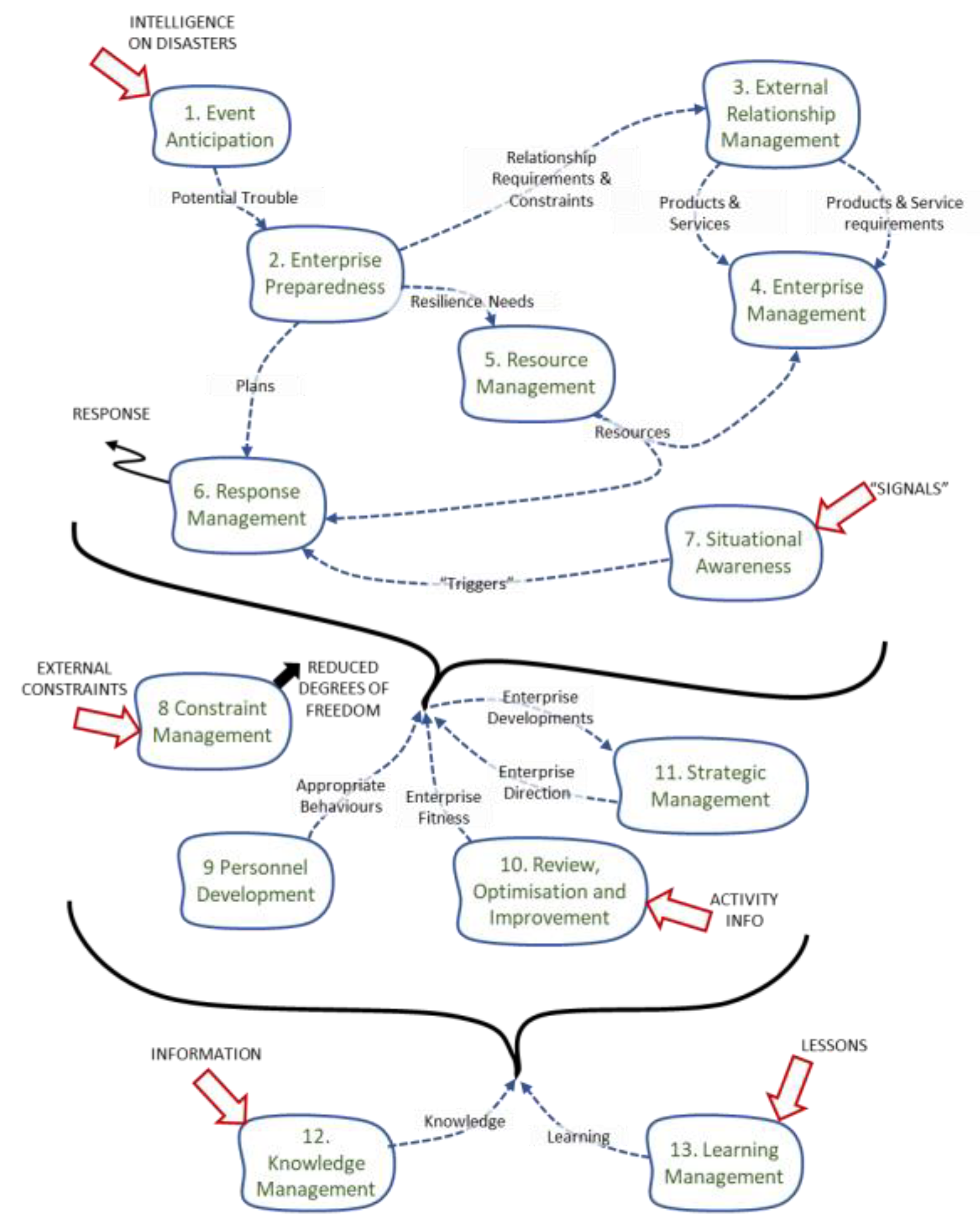
An advantage of Wilson’s SSM approach is that generic conceptual models can be developed. For example, within the EPSRC-funded IDEAS Factory – Curative Resilience Scoping Study project (EP/I005919/1), a conceptual model of resilience was developed. This model can be analysed by any organisation to consider what additional activities in addition to those relevant for its primary purpose, may be relevant to improve resilience. [143,144,145]
The model was revised and updated [34] and the subsystem model is included at Figure 2.
The activities identified can be used as a means of exploring the organisation’s level of preparedness in addition to the capability to meet their organisational goals.

4.5. Utility of Methods

The systems methods proposed here differ in their ontological and epistemological roots as discussed in detail by Jackson [3]. Understanding and incorporating the differing perspectives of those involved in the enterprise is important for successful governance as their perspectives drive their behaviour [146]. Therefore, utilizing different methods in concert generates a more holistic model [147,148].
Applying Checklands’ approach to SSM results in simple root definitions and simlisitic conceptual models which help to determine enterprise boundaries [149,150]. It doesn’t consider environmental interactions, nor aid the identification of measures of performance [76]. Wilson’s Consensus Primary Task Model (CPTM) approach can develop large-scale enterprise models once the purpose has been agreed [126,132]. A detailed activity analysis is possible enabling the identification of requisite management controls and measures of performance. In addition, environmental interactions can be identified through modelling the ‘system served’ [151], pp. 57–58. Wilson’s approach does require significant practitioner expertise, assumes a relatively stable organization, though adaptation to change is possible, and produces a 2-dimensional model of an organization. It does not easily capture an hierarchy of purpose within the CPTM.
VSM is valuable in diagnosing enterprises and can be used to develop 3-dimensional models of the enterprise, in that multiple recursive VSMs can capture the hierarchy of purpose within the enterprise [129,152,153]. It considers linkages between management functions and information flows can be explored; critical to understand between the organisations within the enterprise. Significantly, organizational pathologies can be identified through reflection on archetypes [153]. VSM requires practitioner expertise, the Systems 1 need to be determined and agreed, and current use does not consider environmental interactions well.
Causal Loop Diagrams (CLDs) help capture the perceived dynamics of a context and help identify underlying patterns [128,154,155,156,157]. However, facilitation is frequently through Group Model Building exercises based on scripts [127,158,159]. Using scripts, though helpful, can limit the time spent building a shared understanding of the full problem context [159]. Expert facilitation is required to surface the range of mental models present in an GMB workshop, and CLDs can result in inconsistencies in the definition of variables. They are also difficult to validate.
System Dynamics models are valuable for simulating the potential future behaviour of a system. The purpose of the model must be clear and requires relevant variables to be identified [160,161]. However, careful iterative model building is required to generate confidence in the model to avoid model failures, and validation is difficult. The models are often taken to be predictive and not for indicating potential future behaviour [64].

5. Assumptions and Limitations of the Reference Model

Developing and maintaining a governance reference model for an enterprise requires commitment from the senior managers within the enterprise as well as a broad range of systems thinking knowledge and skills. This is especially true in social contexts where many organisations come together to address social challenges. Consequently, the scope and scale of use of the methods should be limited to that which is sufficient for effective governance, and the appropriate method of employment of each systems approach should be defined. Often, organisations collaborate cooperatively and not contractually, generally without a specific owner of the challenge. Therefore, the enterprise would benefit from an element of formal establishment and agreed governance. The basis of this would be the agreement of the purpose of the enterprise, the agreed beneficiaries and measures of success committed to by all organisations involved.
Commitment is required from senior managers as they should be involved collaboratively in model development and not have them presented to them. The injunctive approach generates a common and shared understanding across the enterprise as well as aligning mental models and acknowledgement of the various perspectives and motivations held by the different organisations. Consequently, the operationalisation of the agreed governance methods is specific to each of the organisations within the enterprise and fits their capabilities, whilst maintaining the overall governance of the enterprise. Quality measures are agreed relevant to each organisation and within the context of the overall enterprise performance.
Each systems method is employed within its own ontological and epistemological context. The conceptual activity (the agreed ‘what’ should be done) within the SSM activity analysis table is the common factor across the methods, and then knowledge gained by each method (generally the ‘how’ and ‘who by’ it is done as well as the relevant variables) is related to these activities. Generating this knowledge is time consuming, so should be limited to that which is of value for governance. Therefore, periodic reviews of the value gained, and the scope and scale of systems methods use should be undertaken, at least annually.
When analysing the conceptual activities to determine what should actually be undertaken, by who and with what quality measures, other contextually relevant information can be incorporated. These include benchmarks, standards and other relevant (generic) models. They are tailored to the organisations in the specific context of the enterprise and reflected in the VSM, CLD and SD models.
A significant current challenge in maintaining the governance reference model is the lack of computer software tools. The linkage between methods is through the SSM activity analysis table and this could be maintained via a database tool.

6. Conclusion

This paper has proposed a novel 3-dimensional structure, based on Angyal’s system approach to understanding the enterprise, for combining the use of systems methods. This framework integrates vertical, progression, and transverse dimensions—mapped respectively to purpose, activity, and coordination—within a contextual whole referred to as the biosphere. By aligning systems methodologies such as SSM, VSM, SD, and Dependency Modelling with these dimensions, the approach offers a practical means to model and analyse complex organisational settings, including (multi-organisation) enterprise collaboration, for enhancing the capacity of organisations to tackle complex and multidimensional social problems.
Crucially, the proposed model enables organisations and enterprises to navigate and respond to socially complex challenges—such as public health, education, or community resilience—by fostering shared understanding, surfacing divergent perspectives, and identifying interdependencies both within and across organisational boundaries. The structured synthesis of qualitative and quantitative methods ensures that solutions are not only technically feasible but also socially legitimate and contextually grounded. This integrative approach supports adaptive governance, allowing for more responsive and coordinated action in dynamic, uncertain environments.
By facilitating deeper insight into purpose, coordination, and environmental interaction, the model enhances the enterprise’s capacity to co-create value with stakeholders, manage systemic risk, and deliver sustainable outcomes. Future research might extend this approach through case-based validation, refinement of method combinations, and digital tooling to support practical application in evolving socio-technical systems.

Supplementary Materials

The following supporting information can be downloaded at the website of this paper posted on Preprints.org,
  • Appendix A – Core Terms
  • Appendix B - Comparison of Systems Methods
  • Appendix C - Example of an SSM Activity table and Description of SSM activity analysis table headings

Author Contributions

“Conceptualisation; methodology; validation; formal analysis; investigation; resources, writing—original draft preparation.; writing—review and editing; visualisation; funding acquisition, all by J.H. The author has read and agreed to the published version of the manuscript.”

Funding

This research received no external funding.

Acknowledgements

The author acknowledges the valuable conversations held with may apprentices across a range of organisations who studied the Systems Thinking Practice Apprenticeship and MSc at Cranfield University.

Conflicts of Interest

The author declares no conflicts of interest.

Abbreviations

The following abbreviations are used in this manuscript:
CLD Causal Loop Diagram
CPTM Consensus Primary Task Model
MPA Multi-Perspective Approach
SD System Dynamics
SSM Soft Systems Methodology
VSM Viable System Modelling

References

  1. G. George, J. Howard-Grenville, A. Joshi, and L. Tihanyi, “Understanding and tackling societal grand challenges through management research,” Academy of management journal, vol. 59, no. 6, pp. 1880–1895, 2016.
  2. J. Mingers, Self-producing systems: implications and applications of autopoiesis. London & New York: Plenum Press, 1995.
  3. M. C. Jackson, Critical Systems Thinking and the Management of Complexity. Chichester, UK: John Wiley & Sons Ltd, 2019.
  4. W. James, Pragmatism: a new name for some old ways of thinking. New York: Longmans, 1907.
  5. P. Vivo, D. M. Katz, and J. B. Ruhl, “A complexity science approach to law and governance,” 2024, The Royal Society.
  6. C. B. Keating, P. F. Katina, and J. M. Bradley, “Complex system governance: Concept, challenges, and emerging research,” International Journal of System of Systems Engineering, vol. 5, no. 3, pp. 263–288, 2014. [CrossRef]
  7. R. J. Rabelo, S. N. Costa, and D. Romero, “A Governance Reference Model for Virtual Enterprises,” in 15th Working Conference on Virtual Enterprises (PROVE), Nether-lands, 2014, pp. 60–70. [CrossRef]
  8. C. B. Keating, P. F. Katina, C. W. Chesterman, and J. C. Pyne, Eds., Complex System Governance: Theory and Practice, 1st ed. Springer, Cham, 2022. [CrossRef]
  9. J. van der Heijden, “The Value of Systems Thinking for and in Regulatory Governance: An Evidence Synthesis,” Sage Open, vol. 12, no. 2, Apr. 2022. [CrossRef]
  10. R. Espejo, “Cybernetics of Governance: The Cybersyn Project 1971–1973,” no. September, pp. 71–90, 2014. [CrossRef]
  11. E. Lewis and G. Millar, “The viable governance model - A theoretical model for the governance of IT,” Proceedings of the 42nd Annual Hawaii International Conference on System Sciences, HICSS, pp. 1–10, 2009. [CrossRef]
  12. J. Baijens, T. Huygh, and R. Helms, “Establishing and theorising data analytics governance: a descriptive framework and a VSM-based view,” Journal of Business Analytics, vol. 5, no. 1, pp. 101–122, 2022. [CrossRef]
  13. R. Espejo, “Cybersyn, big data, variety engineering and governance,” AI Soc, vol. 37, no. 3, pp. 1163–1177, 2022. [CrossRef]
  14. Espinosa, “Governance for sustainability: learning from VSM practice,” Kybernetes, vol. 44, no. 6–7, pp. 955–969, 2015. [CrossRef]
  15. M. Schwaninger, “Governance for intelligent organizations: a cybernetic contribution,” Kybernetes, vol. 48, no. 1, pp. 35–57, 2019. [CrossRef]
  16. J. Davies, “Models of Governance - A Viable Systems Perspective,” Australasian Journal of Information Systems, vol. 9, no. 2, pp. 57–66, 2002. [CrossRef]
  17. T. Huygh and S. De Haes, “Investigating IT Governance through the Viable System Model,” Information Systems Management, vol. 36, no. 2, pp. 168–192, 2019. [CrossRef]
  18. R. C. Conant and W. Ross Ashby, “Every good regulator of a system must be a model of that system,” Int J Syst Sci, vol. 1, no. 2, pp. 89–97, 1970. [CrossRef]
  19. N. Ulibarri, K. Emerson, M. T. Imperial, N. W. Jager, J. Newig, and E. Weber, “How does collaborative governance evolve? Insights from a medium-n case comparison,” Policy Soc, vol. 39, no. 4, pp. 617–637, 2020.
  20. P. Cilliers, Complexity and Postmodernism. Understanding complex systems. London & New York: Routledge, 1998.
  21. G. Sommerhoff, Analytical Biology. London: Oxford University Press, 1950.
  22. W. R. Ashby, An Introduction to Cybernetics, Internet. London: Chapman and Hall, 1956.
  23. R. C. Conant and W. Ross Ashby, “Every good regulator of a system must be a model of that system,” Int J Syst Sci, vol. 1, no. 2, pp. 89–97, 1970. [CrossRef]
  24. F. Emery and E. Trist, “The Causal Texture of Organizational environments,” Human Relations, vol. 18, no. 1, pp. 21–31, 1965.
  25. E. Trist, “The environment and system-response capability,” Futures, vol. 12, no. 2, pp. 113–127, 1980. [CrossRef]
  26. Angyal, Foundations for a science of personality, 4th printi. Cambridge, Massachusetts: Harvard University Press, 1941.
  27. E. Trist, “Andras Angyal and Systems Thinking,” in Planning for Human Systems, J.-M. Choukroun and R. Snow, Eds., Philadelphia: Busch Centre, The Wharton School of the Uniersity of Pannsylvania, 1992, ch. 9, pp. 111–132.
  28. F. E. Emery, “Adaptation to Turbulent Environments,” in Towards a Social Ecology, F. E. Emery and E. L. Trist, Eds., London: Plenum Publishing Company Ltd, 1973, ch. 5, pp. 57–67.
  29. M. C. Jackson, “Critical systems practice 2: Produce—Constructing a multimethodological intervention strategy,” Syst Res Behav Sci, vol. 38, no. 5, pp. 594–609, 2021. [CrossRef]
  30. G. Midgley, J. D. Nicholson, and R. Brennan, “Dealing with challenges to methodological pluralism: The paradigm problem, psychological resistance and cultural barriers,” Industrial Marketing Management, vol. 62, pp. 150–159, 2017. [CrossRef]
  31. J. Mingers, “Variety is the spice of life: Combining soft and hard OR/MS methods,” International Transactions in Operational Research, vol. 7, no. 6, pp. 673–691, 2000. [CrossRef]
  32. Munro and J. Mingers, “The use of multimethodology in practice—results of a survey of practitioners,” Journal of the Operational Research Society, vol. 53, no. 4, pp. 369–378, 2002. [CrossRef]
  33. Mingers and J. Brocklesby, “Multimethodology: Towards a framework for mixing methodologies,” Omega (Westport), vol. 25, no. 5, pp. 489–509, 1997. [CrossRef]
  34. Hilton, “A methodology for modelling organisational governance: building the ‘Good Regulator’ model for organisations through the application of multiple systems methods.,” Cranfield University, 2024. [Online]. Available: https://dspace.lib.cranfield.ac.uk/handle/1826/23723.
  35. N. Babüroǵlu, “Tracking the development of the Emery-Trist systems paradigm (ETSP),” Systems Practice, vol. 5, no. 3, pp. 263–290, 1992. [CrossRef]
  36. E. Trist, “Andras Angyal and Systems Thinking,” in Planning for Human Systems, J.-M. Choukroun and R. Snow, Eds., Philadelphia: Busch Centre, The Wharton School of the University of Pannsylvania, 1992, ch. 9, pp. 111–132.
  37. Angyal, Foundations for a science of personality, 4th printi. Cambridge, Massachusetts: Harvard University Press, 1941.
  38. G. A. Kelly, The Psychology of Personal Constructs: Volume One A Theory of Personality. New York, NY, US: W W Norton & Co, 1955.
  39. P. Checkland, Systems Thinking, Systems Practice: Includes a 30-year Retrospective. Chichester, UK: John Wiley & Sons Ltd, 1999.
  40. C. W. Churchman, The Systems Approach and its Enemies. New York: Basic Books, Inc., 1979.
  41. G. Morgan, Imaginization: The Art of Creative Management. Sage Publications, 1993.
  42. W. Ulrich and M. Reynolds, “Critical Systems Heuristics,” in Systems Approaches to Managing Change: A Practical Guide, M. Reynolds and S. S. Holwell, Eds., 2010, pp. 243–292. [CrossRef]
  43. C. Eden, “Analyzing cognitive maps to help structure issues or problems,” Eur J Oper Res, vol. 159, no. 3, pp. 673–686, 2004. [CrossRef]
  44. N. Luhmann, Social Systems. Stanford, CA: Stanfory University Press, 1995.
  45. J. Mingers, “Can social systems be autopoietic? Assessing Luhmann’s social theory,” Sociological Review, vol. 50, no. 2, pp. 278–299, 2002. [CrossRef]
  46. E. Jaques, “The Development of Intellectual Capability: A Discussion of Stratified Systems Theory,” J Appl Behav Sci, vol. 22, no. 4, pp. 361–383, 1986. [CrossRef]
  47. W. Kinston, “Purpose & Translation Of Values into Action,” Systems Research, vol. 3, no. 3, pp. 147–160, 1986.
  48. E. Jaques, Requisite Organization: A Total System for Effective Managerial Organization and Managerial Leadership for the 21st Century, Revised 2n. Oxford: Routledge, 2006.
  49. G. Stamp, “Levels and Types of Managerial Capability,” Journal of Management Studies, vol. 18, no. 3, pp. 277–298, 1981. [CrossRef]
  50. G. Stamp, “The individual, the organisation and the path to mutual appreciation,” First published in Personnel Management, amended BIOSS 2004.
  51. G. Midgley, Systemic Intervention: Philosophy, methodology, and practice. in Contemporary Systems Thinking. Boston, MA: Springer US, 2000. [CrossRef]
  52. C. Jackson, “Critical systems practice 1 : Explore - starting a multi- methodological intervention,” Syst Res Behav Sci, vol. 37, no. 5, pp. 839–858, 2020. [CrossRef]
  53. C. Jackson, “Critical systems practice 2: Produce—Constructing a multimethodological intervention strategy,” Syst Res Behav Sci, vol. 38, no. 5, pp. 594–609, 2021. [CrossRef]
  54. Angyal, “A Logic of Systems,” in Systems Thinking, Vol One (Ch1), Revised Ed., F. E. Emery, Ed., Harmondsworth: Penguin Books Ltd, 1981, ch. 1.
  55. D. C. Phillips, “The Methodological Basis of Systems Theory,” Academy of Management Journal, vol. 15, no. 4, pp. 469–477, 1972. [CrossRef]
  56. R. C. Conant, “The Information Transfer Required in Regulatory Processes,” IEEE Transactions on Systems Science and Cybernetics, vol. 5, no. 4, pp. 334–338, 1969. [CrossRef]
  57. L. von Bertalanffy, “General Systems Theory,” General Systems, vol. 1, pp. 1–10, 1956.
  58. K. E. Boulding, “General Systems Theory—the Skeleton of Science,” Manage Sci, vol. 2, pp. 197–208, 1956.
  59. W. R. Ashby, An Introduction to Cybernetics, Internet. London: Chapman and Hall, 1956.
  60. W. R. Ashby, Design for a Brain. London: Chapman and Hall, 1960.
  61. Rosenblueth, N. Wiener, and J. Bigelow, “Behavior, Purpose and Teleology,” Philos Sci, vol. 10, no. 1, p. 18, 1943. [CrossRef]
  62. Wiener, Cybernetics, 2nd Edn. Cambridge, MA: MIT Press, 1961.
  63. H. A. Simon, “The architecture of complexity,” Proc Am Philos Soc, vol. 106, no. 6, pp. 467–482, 1962.
  64. R. G. Coyle, System Dynamics Modelling: A practical approach. Springer-Science + Business Media, B.V., 1996. [CrossRef]
  65. J. W. Forrester, Industrial Dynamics. Cambridge, MA: MIT Press, 1961.
  66. J. W. Forrester, “The beginning of System Dynamics [paper],” in Banquet Talk at the International Meeting of the System Dynamics Society., Stuttgart, Germany, 1989, pp. 1–16.
  67. G. Al Jenkins, “The systems approach,” in Systems behaviour, J. Beishon and G. Peters, Eds., New York: Harper and Row, 1969, ch. 4, p. 56.
  68. S. Beer, Brain of the firm. Chichester, UK: John Wiley & Sons Ltd, 1981.
  69. S. Beer, The heart of enterprise. Chichester, UK: John Wiley & Sons Ltd, 1994.
  70. Checkland, “Information systems and systems thinking: Time to unite?,” Int J Inf Manage, vol. 8, no. 4, pp. 239–248, 1988. [CrossRef]
  71. Checkland, Systems Thinking, Systems Practice: Includes a 30-year Retrospective. Chichester, UK: John Wiley & Sons Ltd, 1999.
  72. M. C. Jackson, “Nature of ‘Soft’ Systems Thinking: the Work of Churchman, Ackoff and Checkland.,” Journal of applied systems analysis, vol. 9, no. April 1982, pp. 17–39, 1982.
  73. C. W. Churchman, The Systems Approach. New York: Delta/Dell Publishing, 1968.
  74. C. W. Churchman, “Perspectives of the Systems Approach,” Interfaces (Providence), vol. 4, no. 4, pp. 6–11, 1974. [CrossRef]
  75. C. W. Churchman and F. Emery, “On Various Approaches to the Study of Organizations,” in First International Conference of Operational Research and the Social Sciences, Cambridge, 1964, pp. 1–16.
  76. Checkland and J. Scholes, Soft Systems Methodology in Action. John Wiley & Sons, 1990.
  77. D. Cooperrider, D. Whitney, and J. M. Stavros, Appreciative Inquiry Handbook for Leaders of Change, 2nd Edn. Brunswick: Crown Custom Publishing, Inc, 2008.
  78. J. Varey, “Appreciative systems ∗,” pp. 1–6, 1998.
  79. G. Vickers, Freedom in a Rocking Boat: Changing Values in an Unstable Society. Harmondsworth: Penguin Books Ltd, 1972.
  80. William. Isaacs, Dialogue and the art of thinking together : a pioneering approach to communicating in business and in life. New York: Currency, 1999.
  81. L. Ackoff, “Resurrecting the Future of Operational Research,” J Oper Res Soc, vol. 30, no. 3, pp. 189–199, 1979.
  82. P. M. Senge and J. D. Sterman, “Systems thinking and organizational learning: Acting locally and thinking globally in the organization of the future,” Eur J Oper Res, vol. 59, no. 1, pp. 137–150, 1992. [CrossRef]
  83. W. Ulrich, “Beyond methodology choice: Critical systems thinking as critically systemic discourse,” Journal of the Operational Research Society, vol. 54, no. 4, pp. 325–342, 2003. [CrossRef]
  84. J. Brocklesby, “Let the jury decide: Assessing the cultural feasibility of total systems intervention,” Systems Practice, vol. 7, no. 1, pp. 75–86, 1994. [CrossRef]
  85. R. L. Flood and M. C. Jackson, Creative Problem Solving: Total Systems Intervention. Chichester, UK: John Wiley & Sons Ltd, 1991.
  86. Frandberg, “Systems Thinking - A Studie of Alternatives of R. Flood, M. Jackson, W. Ulrich, G. Midgley,” International Journal of Computers, Systems and Signals, vol. 4, no. 1, pp. 33–41, 2003.
  87. W. J. Gregory, “Critical systems thinking and pluralism : a new constellation,” 1992.
  88. W. J. Gregory, “Discordant pluralism: A new strategy for critical systems thinking,” Systems Practice, vol. 9, no. 6, pp. 605–625, 1996. [CrossRef]
  89. M. C. Jackson, Systems approaches to management. New York: Kluwer Academic - Plenum, 2000.
  90. M. C. Jackson, “The power of multi-methodology: Some thoughts for John Mingers,” Journal of the Operational Research Society, vol. 54, no. 12, pp. 1300–1301, 2003. [CrossRef]
  91. M. C. Jackson and P. Keys, “Towards a system of systems methodologies,” Journal of the Operational Research Society, vol. 35, no. 6, pp. 473–486, 1984. [CrossRef]
  92. G. Midgley, “The sacred and profane in critical systems thinking,” Systems Practice, vol. 5, no. 1, pp. 5–16, 1992. [CrossRef]
  93. G. Midgley, “Pluralism and the legitimation of system science,” Systems practice, vol. 5, no. 2, pp. 147–172, 1992.
  94. G. Midgley, “Science as Systemic Intervention: Some Implications of Systems Thinking and Complexity for the Philosophy of Science,” Syst Pract Action Res, vol. 16, no. 2, pp. 77–97, 2003. [CrossRef]
  95. J. Mingers, “Paradigm wars: Ceasefire announced who will set up the new administration?,” Journal of Information Technology, vol. 19, no. 3, pp. 165–171, 2004. [CrossRef]
  96. J. Mingers, “Classifying philosophical assumptions: A reply to ormerod,” Journal of the Operational Research Society, vol. 56, no. 4, pp. 465–467, 2005. [CrossRef]
  97. J. Mingers and A. Gill, Eds., Multimethodology: The theory and practice of combining management science methodologies. Chichester, UK: John Wiley & Sons Ltd, 1997.
  98. J. C. Oliga, “Methodological foundations of systems methodologies,” Systems Practice, vol. 1, no. 1, pp. 87–112, 1988. [CrossRef]
  99. J. Mingers, “Real-izing information systems: Critical realism as an underpinning philosophy for information systems,” Information and Organization, vol. 14, no. 2, pp. 87–103, 2004. [CrossRef]
  100. M. Egan et al., “Guidance on Systems Approaches to Local Public Health Evaluation Part 1 : Introducing systems thinking,” no. March, pp. 1–19, 2019, [Online]. Available: https://sphr.nihr.ac.uk/wp-content/uploads/2018/08/NIHR-SPHR-SYSTEM-GUIDANCE-PART-1-FINAL_SBnavy.pdf.
  101. M. Egan et al., “Guidance on Systems Approaches to Local Public Health Evaluation Part 2 : What to consider when planning a systems evaluation,” no. March, pp. 1–20, 2019.
  102. D. Wight, E. Wimbush, R. Jepson, and L. Doi, “Six steps in quality intervention development (6SQuID),” J Epidemiol Community Health (1978), vol. 70, no. 5, pp. 520–525, 2015. [CrossRef]
  103. P. Edwards, J. O’Mahoney, and S. Vincent, Studying Organizations using Critical Realism: A Practical Guide. Oxford: Oxford University Press, 2014.
  104. J. Longhofer and J. Floersch, “The Coming Crisis in Social Work: Some Thoughts on Social Work and Science,” Res Soc Work Pract, vol. 22, no. 5, pp. 499–519, 2012. [CrossRef]
  105. R. Pawson, “Evidence-based Policy: The Promise of ‘Realist Synthesis,’” Evaluation, vol. 8, no. 3, pp. 340–358, 2002.
  106. S. Porter, “Realist evaluation: An immanent critique,” Nursing Philosophy, vol. 16, no. 4, pp. 239–251, 2015. [CrossRef]
  107. P. Shannon-Baker, “Making Paradigms Meaningful in Mixed Methods Research,” J Mix Methods Res, vol. 10, no. 4, pp. 319–334, 2016. [CrossRef]
  108. M. Jackson, “Present positions and future prospects in management science,” Omega (Westport), vol. 15, no. 6, pp. 455–466, 1987. [CrossRef]
  109. R. J. Ormerod, “The design of organisational intervention: Choosing the approach,” Omega-International Journal of Management Science, vol. 25, no. 4, pp. 415–435, 1997. [CrossRef]
  110. M. C. Jackson, “Pluralism in systems thinking and practice,” in Multimethodology, J. Mingers and A. Gill, Eds., Chichester, UK: John Wiley & Sons Ltd, 1997, ch. 13, pp. 347–378.
  111. J. Mingers, Systems thinking, critical realism and philosophy: A confluence of ideas. Taylor and Francis, 2014. [CrossRef]
  112. Parsons, The social system. New York: Free Press, 1951.
  113. Giddens, The constitution of society: Outline of the theory of structuration. Polity Press, 1984.
  114. J. Habermas, The theory of communicative action volume 2: The critique of functional reason, McCarthy, T. (transl.). London: Heinemann, 1987.
  115. C. Wright, “Multiple Systems Thinking Methods for Resilience Research,” Cardiff University, 2012.
  116. E. Trist, “Andras Angyal and Systems Thinking,” in Planning for Human Systems, J.-M. Choukroun and R. Snow, Eds., Philadelphia: Busch Centre, The Wharton School of the Uniersity of Pannsylvania, 1992, ch. 9, pp. 111–132.
  117. G. Hughes, “A systems approach to student’s motivation and academic achievement,” University of Aston in Birmingham, 1975.
  118. D. C. Phillips, “The Methodological Basis of Systems Theory,” Academy of Management Journal, vol. 15, no. 4, pp. 469–477, 1972. [CrossRef]
  119. N. Baburoglu, “The Vortical Environment: The Fifth in the Emery-Trist Levels of Organizational Environments,” Human Relations, vol. 41, no. 3, pp. 181–210, 1988. [CrossRef]
  120. F. E. Emery, “Adaptation to Turbulent Environments,” in Towards a Social Ecology, F. E. Emery and E. L. Trist, Eds., London: Plenum Publishing Company Ltd, 1973, ch. 5, pp. 57–67.
  121. E. Trist, “The environment and system-response capability: A futures perspective,” Futures, vol. 12, pp. 113–127, 1979. [CrossRef]
  122. G. Midgley, Systemic Intervention: Philosophy, methodology, and practice. in Contemporary Systems Thinking. Boston, MA: Springer US, 2000. [CrossRef]
  123. F. E. Emery, “Active Adaptation,” in Futures we are in, Martinus Nijhoff, Ed., Leiden, 1977, pp. 67-131`.
  124. Angyal, Neurosis and treatment: a holistic theory. New York: The Viking Press, 1965.
  125. G. Sommerhoff, Analytical Biology. London: Oxford University Press, 1950.
  126. B. Wilson, Systems: Concepts, Methodologies, and Applications. John Wiley & Sons, 1990.
  127. D. F. Andersen, J. A. M. Vennix, G. P. Richardson, and E. A. J. A. Rouwette, “Group model building: Problem structuring, policy simulation and decision support,” Journal of the Operational Research Society, vol. 58, no. 5, pp. 691–694, 2007. [CrossRef]
  128. D. Meadows, Thinking in Systems: A primer. London: Earthscan, 2008.
  129. S. Beer, Diagnosing the system for organizations. John Wiley and Sons Ltd, 1985.
  130. D. Slater, “A Dependency Modelling Manual,” 2016.
  131. The Open Group, “Dependency Modeling (O-DM): Constructing a Data Model to Manage Risk and Build Trust between Inter-Dependent Enterprises,” pp. 1–50, 2012, [Online]. Available: https://publications.opengroup.org/downloadable/download/link/id/MC45MTQ2MTgwMCAxNTE1NjgxOTMwNjgyMTI3NDc1NDU3Ng,,/.
  132. B. Wilson and K. Van Haperen, Soft systems thinking, methodology and the management of change. London: Palgrave Macmillan, 2015.
  133. G. Morgan, Imaginization: The Art of Creative Management. Sage Publications, 1993.
  134. C. Eden, “Cognitive mapping,” Eur J Oper Res, vol. 36, pp. 1–13, 1988.
  135. C. Eden, “Analyzing cognitive maps to help structure issues or problems,” Eur J Oper Res, vol. 159, no. 3, pp. 673–686, 2004. [CrossRef]
  136. J. Hilton, “A Summary Report on the Systems Approach to the development of The GroundsWell Consortium,” pp. 1–18, 2020, [Online]. Available: www.cranfield.ac.uk.
  137. J. Brown, D. Isaacs, and T. W. C. Community, The World Café: Shaping our futures through conversations that matter. San Francisco: Berrett-Koehler Publishers, Inc, 2005.
  138. D. Cooperrider, D. Whitney, and J. M. Stavros, Appreciative Inquiry Handbook for Leaders of Change, 2nd Edn. Brunswick: Crown Custom Publishing, Inc, 2008.
  139. G. Cairns and G. Wright, Scenario Thinking: Preparing your organization for the future in an unpredictable world., 2nd Edn. Palgrave Macmillan, 2011.
  140. J. Hilton, “Using systems techniques to define information requirements,” The Open Group, Barcelona, 1996.
  141. F. E. Emery and E. L. Trist, “The causal texture of organizational environments,” Human relations, vol. 18, no. 1, pp. 21–32, 1965.
  142. R. Ashby, Design for a Brain. London: Chapman and Hall, 1960.
  143. J. Hilton, T. Riley, and C. Wright, “Using multiple perspectives to design resilient systems for agile enterprises,” SysCon 2013 - 7th Annual IEEE International Systems Conference, Proceedings, pp. 437–441, 2013. [CrossRef]
  144. J. Hilton, C. Wright, and V. Kiparoglou, “Building resilience into systems,” SysCon 2012 - 2012 IEEE International Systems Conference, Proceedings, pp. 638–645, 2012. [CrossRef]
  145. C. Wright, V. Kiparoglou, M. Williams, and J. Hilton, “A framework for resilience thinking,” Procedia Comput Sci, vol. 8, pp. 45–52, 2012. [CrossRef]
  146. N. Luhmann, Introduction to Systems Theory. Cambridge: Polity Press, 2013.
  147. G. Ramírez-Gutiérrez, P. P. Cardoso Castro, and R. Tejeida-Padilla, “A Methodological Proposal for the Complementarity of the SSM and the VSM for the Analysis of Viability in Organizations,” Syst Pract Action Res, vol. 34, no. 3, pp. 331–357, 2021. [CrossRef]
  148. M. Zolfagharian, A. G. L. Romme, and B. Walrave, “Why, when, and how to combine system dynamics with other methods: Towards an evidence-based framework,” Journal of Simulation, vol. 12, no. 2, pp. 98–114, 2018. [CrossRef]
  149. P. Checkland, “Soft Systems Methodology: A Thirty Year Retrospective,” Systems Research and Behavioral ScienceSyst. Res, vol. 17, pp. S11–S58, 2000.
  150. P. Checkland and J. Poulter, Learning for Action: A Short Definitive Account of Soft Systems Methodology and Its Use for Practitioners, Teachers and Students. Chichester, UK: John Wiley & Sons Ltd, 2006.
  151. B. Wilson, Soft Systems Methodology: Conceptual model building and its contribution. Chichester, UK: John Wiley & Sons Ltd, 2001.
  152. R. Espejo and A. Reyes, Organizational Systems: Managing complexity with the Viable Systems Model. Berlin Heidelberg: Springer, 2011. [CrossRef]
  153. J. Perez Rios, Design and Diagnosis for Sustainable Organizations. Berlin Heidelberg: Springer-Verlag, 2012.
  154. S. Galea, M. Riddle, and G. A. Kaplan, “Causal thinking and complex system approaches in epidemiology,” Int J Epidemiol, vol. 39, no. 1, pp. 97–106, 2010. [CrossRef]
  155. P. Vandenbroeck, J. Goossens, and M. Clemens, “Tackling Obesities: Future Choices – Building the Obesity System Map,” Foresight, p. 80, 2007, [Online]. Available: www.foresight.gov.uk.
  156. D. Meadows, “Leverage Points Places to Intervene in a System,” Hartland VT, USA, 1999. Accessed: Jun. 06, 2025. [Online]. Available: http://www.donellameadows.org/wp-content/userfiles/Leverage_Points.pdf.
  157. D. P. Stroh, Systems Thinking for Social Change. White River Junction, Vermont: Chelsea Green Publishing, 2015.
  158. D. Besselink et al., “Uncovering the Dynamic System Driving Older Adults’ Vitality: A Causal Loop Diagram Co-Created With Dutch Older Adults,” Health Expectations, vol. 28, no. 4, Aug. 2025. [CrossRef]
  159. J. A. M. Vennix, Group Model Building: Facilitating team learning using system dynamics. Chichester, UK: John Wiley & Sons Ltd, 1996.
  160. J. D. Sterman, Business Dynamics: Systems thinking and modeling for a complex world. McGraw Hill, 2000.
  161. K. E. Maani and R. Y. Cavana, Systems Thinking and Modelling: Understanding Change and Complexity. Pearson Education, 2000.
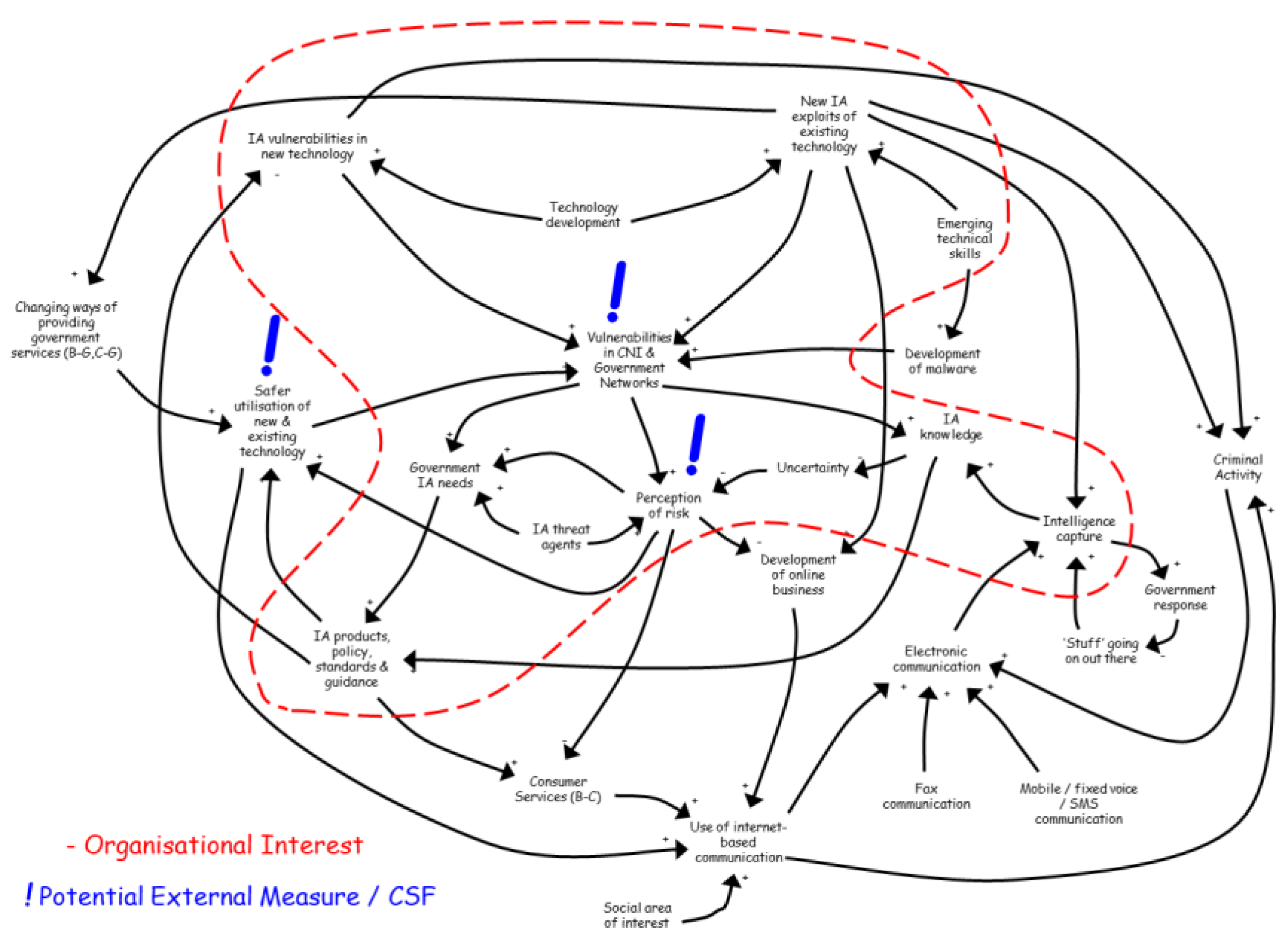
Figure 1. Modelling the organisation in its environment [140].
Preprints 173838 g001
Figure 2. An SSM Sub-system model of resilience [34].
Preprints 173838 g002
Table 1. Method requirements set.
No Requirement Statement
R1 The Reference Model of Governance for a Specific Organisation must enable boundary analysis.
R2 It must be possible to see the effects of history, corporate memory and drives to act
R3 Changes within the system (organisation) can be identified regarding necessary activities as the organisation adapts to environmental changes.
R4 The Reference Model of Governance for a Specific Organisation must be able to represent ‘frames’, the perspective taken by the relevant management team according to differing levels of abstraction. The Reference Model of Governance for a Specific Organisation is likely to be recursive (nested) with increasing granularity both horizontally and vertically.
R5 The Reference Model of Governance for a Specific Organisation must be able to determine holistically activities relevant to the agreed frames but maintain logical dependencies and capture the richness of interaction.
R6 Sub-organisations within the organisation or enterprise can be identified that have their own discrete properties (purpose).
R7 It should be possible to determine clusters of elements that collaborate at short range, as well as to indicate the longer-range interrelationships.
R8 Dependencies between elements must be captured.
R9 Measures of performance can be identified.
R10 The Reference Model of Governance for a Specific Organisation must be able to represent the non-linearity of relationships.
R11 The Reference Model of Governance for a Specific Organisation can capture the feedback within the system, between the system and the environment and within the environment.
R12 The Reference Model of Governance for a Specific Organisation must enable one to capture / integrate the environmental inter-relationships as well as internal peer-peer inter-relationships.
R13 The organisation can be modelled in its wider context.
Disclaimer/Publisher’s Note: The statements, opinions and data contained in all publications are solely those of the individual author(s) and contributor(s) and not of MDPI and/or the editor(s). MDPI and/or the editor(s) disclaim responsibility for any injury to people or property resulting from any ideas, methods, instructions or products referred to in the content.
Copyright: This open access article is published under a Creative Commons CC BY 4.0 license, which permit the free download, distribution, and reuse, provided that the author and preprint are cited in any reuse.
Prerpints.org logo

Preprints.org is a free preprint server supported by MDPI in Basel, Switzerland.

Subscribe

Disclaimer

Terms of Use

Privacy Policy

Privacy Settings

© 2026 MDPI (Basel, Switzerland) unless otherwise stated