

Submitted:
23 August 2025
Posted:
26 August 2025
You are already at the latest version
Abstract
Background/ Objectives: adjustment to aging is a key indicator of positive aging and psychological maturity, influenced by cultural and social contexts. This study aimed to translate and evaluate the psychometric properties of the Adjustment to Aging Scale (AtAS) among Iranian older adults. Material and methods: This cross-sectional study was conducted in Tehran, 2024. Following translation and cross-cultural adaptation, face validity, content validity, and reliability of the questionnaire were assessed. The WHO-5 well-being index was used to assess concurrent validity. A total of 328 older adults aged 60 years and above completed the study instruments. Data were analyzed using Confirmatory Factor Analysis (CFA), Cronbach’s alpha, Pearson correlation, in-dependent t-tests, and ANOVA via SPSS version 22 and AMOS 24. The significance level was set at p ≤ 0.05. Results: The mean (SD) age of the participants was 69.42 (6.8) years. Face and con-tent validity were confirmed by fourteen experts (CVI = 0.94). CFA supported the five-factor structure of the questionnaire (χ²/df = 2.06, GFI = 0.90, PCLOSE = 0.07, RMSEA = 0.05), indicating a good model fit. The total questionnaire showed acceptable internal consistency (Cronbach’s alpha = 0.80) and excellent test-retest reliability (ICC = 0.98). Pearson’s correlation revealed a significant positive relationship between the WHO-5 Well-Being Index and AtAS scores (r = 0.56, p < 0.05), supporting criterion validity. Conclusions: The Persian AtAS showed strong psychometric properties, supporting its use in both research and clinical settings, although further studies are recommended to strengthen evidence for its clinical application.
Keywords:
adjustment to aging
; psychometrics properties
; older adults
; scale validation
; Iranian population
1. Introduction
The global population of older adults is increasing rapidly. According to the World Health Organization (WHO), in 2019, the number of individuals aged 60 years and above was one billion. This figure is projected to rise to 1.4 billion by 2030 and 2.1 billion by 2050 [1].
Aging brings about distinct changes, challenges, needs, and opportunities [2]. As people age, multiple dimensions of life—physical, psychological, social, financial, and occupational—undergo significant changes [3,4] and older adults face diminished initial control capacity, personal and social resources [5].
Retirement as a significant milestone in the aging process, affecting daily routines, social connections, mental and physical health, and financial security [6]. Additionally, bereavement—particularly the loss of a spouse— can disrupt life stability and provoke prolonged periods of grief, stress, and fear [7,8]. Chronic diseases also become more prevalent with age, making older adults more vulnerable. Many experience depression, low self-esteem, reduced control over life aspects [9] and anxiety, particularly death anxiety [10]. Such challenges are exacerbated by changing family dynamics, such as the empty nest phenomenon [11] and an overall decline in functional capacities and independence [12]. Consequently, the ability to adjust to these evolving circumstances becomes a defining feature of aging [13] and serves as a foundational element of successful aging [14].
Adjustment to aging is a multidimensional concept that reflects how individuals respond to age-related changes. It entails the dynamic interaction of psychological resilience, social support, and adaptive behaviors. Beyond addressing physical limitations, this process encompasses the pursuit of meaning, purpose, and satisfaction in later life [15]. Adjustment to aging is largely achieved by maintaining equilibrium between personal experiences, standards, goals, motivations, and values, and the external circumstances encountered during later life [16,17].
In previous studies, various instruments have been used to assess this complex process, including the Philadelphia Geriatric Center (PGC) Morale Scale [18], the Life Satisfaction Index [19], the General Adjustment to Aging Scale (GAAS) and the Perceived Social Support Scale [20], Bell’s Social Adjustment Scale [21,22], the Adjustment to Aging Scale (AtAS), and measures of subjective well-being [23]. As physical, cognitive, and social roles evolve with age, so do the strategies for preserving well-being and adjusting to new realities. This necessitates a measurement approach that reflects the multidimensionality of adjustment [24]. Considering that prior research has highlighted the impact of cultural, national, and ethnic contexts on the aging process [25,26], the AtAS has gained recognition as a valuable cross-cultural tool for research, clinical practice, and program development in the field of healthcare [23].
Given that the applicability of measurement instruments is strongly influenced by socio-cultural context, it is necessary to evaluate the psychometric properties of tools developed elsewhere before their use in different populations. The AtAS was chosen for localization in Iran due to its comprehensiveness, assessing not only daily functioning and health but also broader aspects relevant to older adults’ well-being. Therefore, this study aimed to translate, culturally adapt, and validate the AtAS for use among Iranian older adults, providing a culturally appropriate instrument for both research and clinical applications.
2. Materials and Methods
2.1. Study Design
This cross-sectional study was conducted in 2025 to translate, culturally adapt and validate the Adjustment to Aging Scale (AtAS) for use among Iranian older adults.
2.2. Participants
A total of 330 older adults aged 60 years and above, residing in Tehran, Iran, participated in this study. For sampling, to ensure broad representation of the target population, the city of Tehran was divided into five areas based on socio-economic development levels [27]: developed, relatively developed, moderate development level, less developed, underdeveloped. one health center was randomly selected in each area. Older adults who attended these centers were invited to participate in the study. After obtaining informed consent and confirming their willingness to participate, eligible individuals completed the questionnaire.
2.3. Inclusion Criteria
Participants were eligible for the study if they met the following criteria: (1) aged 60 years or older; (2) willing to participate in the research; (3) Iranian nationality with the ability to understand and speak Persian; (4) capable of verbal communication and able to accurately respond to the questionnaire items; and (5) free from cognitive impairments. Exclusion Criteria: unwillingness to continue participation in the study and incomplete questionnaires.
2.4. Research Instrument
In this study, data were collected using a demographic information form, the Adjustment to Aging Scale (AtAS) and WHO 5 well-being index (for criterion validity).
- Adjustment to Aging Scale (AtAS): This Scale (AtAS) was originally developed and psychometrically validated by Sofia von Humboldt et al. in 2014 [23]. AtAS was administered to 1,291 community-dwelling older adults aged 75 to 102 years from both urban and rural areas across four nationalities (Angolan, Brazilian, English, and Portuguese). The AtAS is designed to measure the degree of adjustment to aging and consists of 22 items across five dimensions: Sense of Purpose and Ambition (SPA, 4 items), Zest and Spirituality (ZS, 5 items), Body and Health (BH, 5 items), Aging in Place and Stability (APS, 5 items), and Social Support (SS, 3 items). Items are rated on a 7-point Likert scale ranging from 1 (not important at all) to 7 (very important), with higher scores indicating greater adjustment to aging. The internal consistency of the original scale was reported to be 0.89.
- WHO 5 well-being index: This Index is a short, general measure developed by the World Health Organization to assess subjective well-being, focusing exclusively on positive statements [28]. The scale was first validated in Iran by Mortezavi et al. (2013), reporting a Cronbach’s alpha of 0.85 [29]. The scale consists of five items, each rated on a 6-point Likert scale based on how the respondent felt over the past two weeks. Response options range from “All of the time” (5) to “At no time” (0), with higher scores indicating greater well-being. The total raw score (ranging from 0 to 25) is multiplied by 4 to produce a final score between 0 and 100. A score above 52 is considered to indicate good well-being, whereas a score below 52 may reflect reduced well-being. Additionally, a raw score below 13 (before multiplication) may suggest poor emotional well-being and may warrant further assessment [28].
2.5. Description of the Procedure
Phase (1): Translation and Localization
In the translation and localization process of AtAS, initial approval was obtained from the original designer of the questionnaire, Sofia von Humboldt, by sending an email explaining the purpose of the psychometric evaluation and the preparation of the Persian version of the instrument. The translation process followed the guidelines proposed by Wild et al. (2005)[30] for cross-cultural adaptation of self-report measures. Initially, the original (English) version of the AtAS was independently translated into Persian by the researcher and two Persian speakers, who are proficient in the terminology and translation of gerontology texts. Subsequently, the three translated versions were compared, and the items were reconciled in terms of meaning and concept, resulting in a single preliminary Persian version. To ensure the complete alignment of the Persian translation with the original text and the fluency of the sentences, the preliminary Persian version of the questionnaire was back-translated into English by another translator who was fluent in English and had not previously seen the original questionnaire. The back-translated version was then compared with the original English version, and necessary revisions were made under the supervision of translators and experts (including four PhD-level gerontology specialists). Finally, the final Persian version of the AtAS was obtained. (Appendix A)
Phase (2): Psychometric Properties
After translating and preparing the Persian version of The Adjustment to Aging (AtAS), the psychometric properties of the questionnaire, including face and content validity, reliability (internal consistency and stability), construct validity (confirmatory factor analysis), and criterion validity, were evaluated and examined.
2.6. Data Analysis
In this study, descriptive statistics, including frequency distribution (percentage), mean, and standard deviation, were used to describe the demographic characteristics of the study sample. For inferential data analysis, considering the normal distribution of data based on skewness and kurtosis tests (in the range of −2 to +2), independent t-tests (to compare the means of two groups), one-way analysis of variance (ANOVA) (to examine differences between means in multiple groups), and Pearson correlation coefficient (to examine the relationship between variables) were used. Data analysis was performed using SPSS (version 22) and AMOS (version 24) software, and the statistical significance level was set at p < 0.05 for all tests.
3. Results
3.1. Data Management and Floor/Ceiling Effects
As part of the data management process, two cases with extreme scores (both scoring the minimum value of 22) were excluded from the analysis, resulting in a final sample size of 328 participants. After their removal, no floor or ceiling effects were observed, as none of the participants reached the minimum [22] or maximum (154) possible scores on the Adjustment to Aging Scale.
3.2. Descriptive Results
A total of 328 older adults participated in this study. The mean age of the participants was 69.42 years (SD = 6.8), with an age range of 60 to 90 years. Just over half of the sample were female (56.1%), and the majority were married (69.5%). Regarding education, 67% of participants had a high school diploma or lower level of education.
In terms of employment status, 47.9% were retired, while only 12 individuals were currently employed. Among those employed, 32.7% indicated that financial necessity was the main reason for continuing to work. Concerning economic conditions, more than half of the participants (57.9%) described their financial status as average, while only 1.5% reported it as very good.
With respect to living arrangements, 36% of the participants lived with their spouse and unmarried children. Most participants (77.7%) were residing in their own privately owned homes. Only 22% of the older adults rated their overall health status as excellent. Additionally, 46.6% were covered by both basic and supplementary health insurance plans (Table 1).
The mean (SD) overall Adjustment to Aging scale score was 108.27 (±15.77). The lowest mean score was for the social support (SS) subscale, and the highest mean score was for the Zest and Spirituality (ZS) subscale (Table 2).
The mean scores of adjustment to aging across different demographic variables presents in table 3. Results from Pearson correlation analysis showed a significant inverse correlation between age and adjustment to aging (r = –0.16, p = 0.002). An independent t-test indicated a significant difference in adjustment scores between men and women, with men reporting significantly higher adjustment than women (t (362) = 2.13, p = 0.03).
One-way ANOVA revealed significant associations between adjustment to aging and several demographic variables. Participants’ area of residence was significantly related to adjustment (F (4, 323) = 2.67, p < 0.05); post hoc Tukey tests indicated that older adults living in District 2 had significantly higher adjustment scores than those in District 5 (p < 0.05). Marital status was also significantly associated with adjustment (F (3, 324) = 8.24, p < 0.05), and married individuals showed significantly higher adjustment compared to those who were divorced (p < 0.05). Educational level showed a significant relationship with adjustment (F (6, 321) = 6.66, p < 0.05). Tukey post hoc analysis revealed that individuals with elementary, secondary, high school, or university education had significantly higher adjustment scores than those who were illiterate (p < 0.05). Employment status was also significant (p < 0.05), although pairwise comparisons did not reach significance (p = 0.053), indicating a potential trend for higher adjustment among full-time employed older adults compared to those who were disabled.
Living arrangements were significantly related to adjustment (p < 0.05); although post hoc results did not show statistically significant differences (p = 0.052), a trend was observed in which older adults living with their married children without a spouse had lower adjustment compared to those living only with their spouse. Economic status showed a significant association with adjustment (F (4, 323) = 8.25, p < 0.05). Older adults who reported their financial situation as "very good" or "good" had significantly higher adjustment than those with "poor" or "very poor" status (p < 0.05). Even those with an "average" financial status showed significantly higher adjustment than those with "poor" economic status (p < 0.05).
Insurance coverage was also significantly related to adjustment (F (3, 324) = 3.14, p < 0.05), with those covered by both basic and supplementary insurance reporting higher adjustment than those with only basic insurance (p < 0.05). No significant differences were found for reason of employment or home ownership (p > 0.05). However, self-rated health status was significantly associated with adjustment. Individuals who rated their health as excellent, very good, or good reported significantly higher adjustment than others (p < 0.05), and those who rated their health as “somewhat good” also had significantly higher adjustment than those who rated their health as poor (p < 0.05).

Table 3.
Adjustment to Aging Scores across sociodemographic subgroups.
| Variables | Mean (SD) | T/F Statistic | p-value | post hoc Tukey tests | |
|---|---|---|---|---|---|
| Age | R= 0.16- | 0.002* | - | ||
| Gender | Male Female |
110.29 (15.54) 106.57 (15.73) |
t (326)= 2.13 | 0.03* | - |
| Marital Status | Never Married Married Widowed divorced |
102.09 (14.69) 110.74 (15.14) 100.72 (14.93) 108.45 (17.59) |
F (3, 324) = 8.24 |
P<0.001* | 2>3, p<0.05 |
| Education Status | Illiterate Literate (no formal education) Primary Lower Secondary Upper Secondary Diploma University Education |
92.04 (15.75) 109.28 (17.31) 110.97 (17.28) 110.38 (13.84) 106.05 (14.13) 106.47 (15.21) 112.38 (13.95) |
F(6, 321)= 6.66 | P<0.001* | 3>1, p<0.05 4>1, p<0.05 6>1, p<0.05 7>1, p<0.05 |
| Employment Status | Employment Full-Time Employment Part-Time Homemaker Retired Disable/Unable to Work |
114.16 (14.13) 105.47 (13.07) 106.18 (15.97) 110.01 (15.20) 92.80 (26.95) |
F(4, 323)= 3.12 | 0.01* | - |
| Reason for Employment | Financial necessity Habit and leisure Both reasons |
107.41 (14.49) 111.57 (17.36) 109.82 (13.61) |
F(2, 49)= 0.25 | 0.77 | - |
| Economic Status | Very good Good Average Poor Very poor |
124.20 (5.89) 113.74 (14.79) 108.39 (15.36) 99.60 (13.66) 101.88 (18.05) |
F(4, 323)= 8.25 | P<0.001* | 1>4, p<0.05 1>5, p<0.05 2>4, p<0.05 2>5, p<0.05 3>4, p<0.05 |
| Home Ownership | Owned Rented/Mortgaged Child’s Home Relative’s or friend’s Home |
108.82 (15.42) 105.78 (16.53) 116 (12.56) 90 (26.87) |
F(3, 324)= 1.96 | 0.11 | - |
| Living Arrangements | Living alone With spouse only With spouse and unmarried children With spouse and married children Without spouse, with unmarried children Without spouse, with married children With relatives other |
104.22 (16.60) 110.70 (15.40) 110.23 (15.21) 100.16 (10.26) 101.62 (14.41) 92.57 (13.62) 114.25 (13.18) 121.66 (14.97) |
F(7, 320)= 3.88 | P<0.001* | - |
| Area of residence | Region 2 Region 4 Region 5 Region 14 Region 15 |
111.65 (14.49) 107.28 (17.19) 104.52 (15.95) 107.88 (13.57) 111.10 (15.13) |
F(4, 323)= 2.67 | 0.03* | 1>3, p<0.05 |
| general Health Status | Excellent Very good Good Fair poor |
121.18 (8.48) 121 (8.73) 113.69 (12.79) 103.35 (14.96) 90.33 (14.46) |
F(4, 323)= 29.52 | P<0.001* | 1>4, p<0.05 1>5, p<0.05 2>4, p<0.05 2>5, p<0.05 3>4, p<0.05 3>5, p<0.05 4>5, p<0.05 |
| Type of Insurance Coverage | Basic insurance Supplementary insurance Both none |
104 (15.29) 108.90 (16.32) 110.45 (15.05) 106.80 (17.20) |
F(3, 324)= 3.14 | 0.02* | 3>1, p<0.05 |
3.3. Face Validity
To assess face validity, feedback was obtained from four older adults who met the study’s inclusion criteria as well as from fourteen experts in the fields of gerontology, social work, psychology, and nursing. Participants were asked to evaluate the clarity, comprehensibility, and grammatical appropriateness of the items in the instrument. Based on their feedback, minor modifications were made in consultation with the research team. Specifically, items 11 and 15 were slightly revised to enhance clarity. Overall, all items were reported as understandable and appropriate by both the older adults and the experts, indicating that the instrument demonstrated satisfactory face validity.
3.4. Content Validity
The content validity of the questionnaire was assessed by evaluating fourteen experts in the fields of gerontology, social work, psychology, and nursing. Following the Waltz and Bausell method (31), the Content Validity Index (CVI) for each item was calculated. The average CVI across all items was 0.94, indicating that the Adjustment to Aging Scale has acceptable content validity.
3.5. Construct Validity (Confirmatory Factor Analysis)
The construct validity of the questionnaire was assessed using a confirmatory factor analysis (CFA). In the initial model, some of the goodness-of-fit indices suggested an inadequate model fit (table4). Based on the modification indices, error covariances were added between items belonging to the same latent construct, which is both theoretically and statistically justified. Following these modifications, the model was re-run, and the final model had an acceptable fit. the goodness-of-fit index of the chi-squared per the number of degrees of freedom (χ2/df) was 2.06, the Goodness-of-Fit Index (GFI) was 0.90, the Root Mean Square Error of Approximation (RMSEA) was 0.05, and the p-value for close fit (PClOSE) was 0.07, indicating an acceptable model fit. The final model is presented in the diagram (Figure 1).
Table 4.
Goodness-of-fit indices for the measured model of the Adjustment to Aging Scale.
| Model | X2/DF | GFI | RMSEA | PCLOSE |
|---|---|---|---|---|
| Recommended value | <3 | ≥0.9 | <0.1 | >0.05 |
| AtAS | 2.499 | 0.86 | 0.06 | 0.000 |
| AtAS (corrected) | 2.06 | 0.90 | 0.05 | 0.07 |
χ2/df: Chi-square test, GFI: goodness-of-fit index, RMSEA: root mean square error of approximation, PCLOSE: p-value for close fit.
3.5.1. Convergent Validity and Composite Reliability
Convergent validity was assessed using Average Variance Extracted (AVE), and composite reliability (CR) was calculated to evaluate internal consistency. The results indicated acceptable to strong reliability across all five subscales (CR = 0.47 to 0.79), with three dimensions exceeding the standard threshold of 0.70 (table5). While most subscales demonstrated acceptable levels of convergent validity, one subscale showed a lower AVE value (0.06), which may be due to cultural differences in how items within that dimension are interpreted. Overall, the scale exhibited sound reliability and partially acceptable convergent validity, suggesting that it is a psychometrically promising instrument. With cultural adaptations and refinement of specific items, the validity of the scale could be further enhanced. Nonetheless, the overall results support the construct validity of the instrument within the target population.
Table 5.
Psychometric Properties: Convergent Validity (AVE) and Reliability (CR) of the Scale Dimensions.
Table 5.
Psychometric Properties: Convergent Validity (AVE) and Reliability (CR) of the Scale Dimensions.
| Dimensions of AtAS | SPA | ZS | BH | APS | SS |
|---|---|---|---|---|---|
| AVE | 0.36 | 0.18 | 0.37 | 0.06 | 0.62 |
| CR | 0.70 | 0.47 | 0.71 | 0.19 | 0.79 |
Note: AVE: Average Variance Extracted, CR: Composite Reliability.
3.5.2. Discriminant Validity
Discriminant validity of the aging adjustment scale was examined using the Fornell–Larcker criterion, which posits that the square root of the Average Variance Extracted (√AVE) for each construct should exceed its correlations with other constructs. The results indicated that most dimensions met this requirement, supporting adequate discriminant validity (Table 4). However, Dimension 4 (Aging in Place and Stability) showed a √AVE of 0.24, which was lower than its correlations with some other dimensions (e.g., 0.29 and 0.38), indicating insufficient discriminant validity for this subscale. This may be attributed to conceptual overlap or cultural factors influencing how stability and place attachment in aging are perceived. Overall, the scale demonstrates satisfactory discriminant validity, though the fourth dimension may benefit from further refinement to improve its construct distinctiveness.
Table 6.
Discriminant Validity Assessment (Fornell- Larcker Criterion).
| √AVE | SPA | ZS | BH | APS | SS | |
|---|---|---|---|---|---|---|
| SPA | 0.60 | - | 0.36 | 0.38 | 0.17 | 0.21 |
| ZS | 0.42 | 0.36 | - | 0.19 | 0.32 | 0.12 |
| BH | 0.61 | 0.38 | 0.19 | - | 0.29 | 0.29 |
| APS | 0.24 | 0.17 | 0.32 | 0.29 | - | 0.19 |
| SS | 0.79 | 0.21 | 0.12 | 0.29 | 0.19 | - |
3.6. Criterion Validity
To assess criterion validity, the concurrent validity method was used, whereby the correlation between the Adjustment to Aging Scale and WHO 5 well-being index was evaluated. Pearson’s correlation analysis results showed that there is a positive and significant correlation between AtAS and WHO 5 well-being index scores (r = 0.56, p < 0.001), indicating that higher levels of adjustment to aging were associated with greater psychological well-being. These findings provide evidence for the criterion validity of the AtAS, indicating that the scale appropriately captures an aspect of aging adjustment that is meaningfully associated with well-being in older adults.
3.7. Reliability
The reliability of the instrument was assessed using two methods: internal consistency and test–retest reliability. Internal consistency was evaluated in the full sample of 328 older adults by calculating Cronbach’s alpha coefficient, which was found to be 0.80 for the entire scale, indicating good internal consistency. Test–retest reliability was assessed in a subsample of 30 participants using the intraclass correlation coefficient (ICC). The ICC was calculated based on responses obtained from a two-week interval between the two administrations of the scale. The result showed an ICC of 0.98 with a 95% confidence interval, suggesting excellent temporal stability of the Persian version of the Aging Adjustment Scale (ATAS). Furthermore, the standard error of measurement (SEM) for the total scale was calculated to be 0.12, and the relative measurement error (SEM%) was 14%. These values indicate that the instrument has a low level of measurement error, further supporting the precision and reliability of the scale.
4. Discussion
The present study aimed to examine the psychometric properties of the Adjustment to Aging Scale (AtAS) in an Iranian older adult population and to provide a valid Persian-language instrument. Various psychometric aspects of the questionnaire, including face validity, content validity, criterion validity, construct validity, and reliability, were assessed among older adults in Iran in 2024. A total of 328 participants aged 60 years and above took part in the study. The findings indicated that the Persian version of the AtAS demonstrated satisfactory translation quality and acceptable psychometric properties in Iranian older adults. Given the appropriate number of items, the questionnaire is easy to administer and requires minimal completion time.
In the present study, the mean score of adjustment to aging was 108.27 (SD = 15.77). Analysis of the results revealed that demographic variables such as age, gender, marital status, place of residence, education, economic status, type of insurance, and health status were significantly associated with the level of adjustment among older adults. In this study, increasing age was associated with lower adjustment to aging, which may be due to a decline in resources required for successful adaptation as age advances [32] One of these resources is both objective and subjective health status, which tends to decrease in older adults with increasing age [33]. Among the most important factors related to mental health are economic status and educational attainment [34] Consistent with our findings, higher education and better economic status were associated with greater adjustment to aging; previous studies have shown that better economic status and higher educational levels may enhance social participation and influence lifestyle, while also improving access to health resources and services, thereby promoting both physical and mental health [35,36].
Furthermore, our study demonstrated that older adults with better self-reported health reported higher adjustment scores. These findings suggest that cultural capital and financial resources can serve as effective tools for enhancing adjustment to aging. However, a cross-sectional study in Sweden found no significant relationship between economic status and education level with self-rated health [37] Similarly, Montross et al. reported that most community-dwelling older adults, even those with chronic physical illnesses and certain disabilities, perceived themselves as aging successfully and being well-adjusted [38] Nevertheless, other studies have emphasized that both physical and mental health are prerequisites for optimal adjustment to aging [39].
Gender also influences adjustment to aging. According to our findings, men scored higher on adjustment to aging compared to women. Similarly, Shi et al. reported that older men experience greater psychological well-being than older women [40]. This difference may stem from variations in social roles, the level of family support, or cultural attitudes toward aging. From the perspective of gender theory, biological differences between men and women, when shaped by cultural, social, and familial contexts, lead to distinct social roles and behavioral patterns [41], which in turn may affect adjustment to aging.
Marital status also showed a significant effect on adjustment. Older adults who were married demonstrated higher adjustment scores than their counterparts. Likewise, Gutierrez-Vega et al. found that marital status is associated with better physical, psychological, and social quality of life, and that being married serves as a protective factor against depressive symptoms and mental disorders by providing positive social support [42] In other words, married individuals, by receiving greater emotional support, are better equipped to adjust with the changes associated with aging.
The psychometric findings of the present study indicate that the Persian version of the Adjustment to Aging Scale (AtAS) demonstrates satisfactory validity and reliability, with most results aligning closely with the original version conducted by von Humboldt et al. [23]. Face validity assessment, performed by both experts and target respondents, is a well-established approach to ensure item clarity, comprehensibility, and linguistic appropriateness for the intended population [43]. In this study, all items were confirmed in terms of clarity and relevance, with only minor modifications applied to a few items, reflecting adequate face validity of the instrument. Similarly, von Humboldt et al. (23) utilized feedback from groups of older adults and experts to evaluate face validity, reporting the tool as linguistically suitable and comprehensible.
The mean content validity index (CVI) was 0.94, indicating strong content approval of the items from the perspective of experts [44]. The original version (23) also demonstrated content validity across all 22 items, highlighting concordance between the two studies. The high CVI values in both studies affirm the validity of the items in measuring various dimensions of adjustment to aging (31) These findings are consistent with previous research reporting high content validity for psychometric instruments related to aging [45,46].
In the confirmatory factor analysis (CFA), the five-factor model of the instrument, after modification based on adjustment indices, demonstrated acceptable fit indices including χ²/df, GFI, and RMSEA, indicating a good fit between the model and the data. These results conform to international standards for CFA [47] and confirm the construct validity of the scale. The findings are consistent with the factor structure reported in the original instrument validation by von Humboldt et al. (23), reflecting the stability of the factor structure across different cultures and languages.
Convergent validity was evaluated using the average variance extracted (AVE) and composite reliability (CR). Three dimensions of the scale showed CR values above 0.70, indicating strong internal consistency, and most dimensions exhibited acceptable AVE values. However, one dimension had an AVE below 0.5, which may reflect cultural differences in the perception of its items. Previous studies suggest that while the overall factor structure remains stable, certain dimensions require careful attention in cross-cultural translation and emphasize the necessity of cultural adaptation for psychometric tools (48, 49)
Regarding discriminant validity, results showed that for most dimensions, the square root of the AVE exceeded the correlations with other constructs, indicating adequate construct distinctiveness. Nevertheless, the fourth dimension (Stability and Staying in the Living Environment) exhibited a lower square root of AVE compared to some correlations, suggesting relative weakness in construct discrimination and potential need for conceptual revision. This finding aligns with the psychometric results from the original study (23), where the “Place Stability” dimension showed the least discriminant validity. Such issues are common in translated and culturally adapted instruments (50)and may stem from cultural differences or varied interpretations among older adults regarding the concept of place stability.
Criterion validity assessment revealed a significant positive correlation between the Adjustment to Aging Scale (AtAS) and the WHO-5 Well-Being Index (r = 0.56), indicating that adjustment to aging is associated with psychological well-being among older adults. In the original version (23), the AtAS demonstrated significant correlations with the Satisfaction with Life Scale (SwLS) and the Positive and Negative Affect Schedule (PANAS). These findings align with previous research reporting relationships between psychological adjustment to aging and subjective well-being (51), supporting the cross-cultural validity of the instrument in predicting mental health-related outcomes.
Finally, reliability analysis showed that the overall Cronbach’s alpha coefficient was 0.80, and the intraclass correlation coefficient (ICC) for test-retest reliability was 0.98, reflecting satisfactory internal consistency and excellent temporal stability. Additionally, the low standard error of measurement (SEM = 0.12) indicates high precision of the instrument over time. von Humboldt’s study (23) similarly reported a Cronbach’s alpha of 0.89 and an ICC of 0.98. Therefore, it can be concluded that the Persian version of the scale demonstrates reliability comparable to the original version, with results consistent with similar psychometric studies in older adult populations (52, 53).
4.1. Strengths and Limitations
One of the key strengths of this study is that it was conducted in Tehran, the capital of Iran, which is characterized by substantial cultural diversity, and included a relatively large sample size (n = 328). These factors collectively enhance the generalizability of the findings. However, although the Persian version of the AtAS demonstrated strong psychometric properties, one dimension showed weaker convergent and discriminant validity, indicating that further refinement may be necessary for optimal cultural adaptation.
5. Conclusions
This study confirms that the Persian version of the Adjustment to Aging Scale (AtAS) is a valid and reliable tool for assessing aging adjustment in Iranian older adults. The scale demonstrated strong validity across multiple domains and excellent reliability, consistent with the original version. Its stable five-factor structure and meaningful correlations with demographic and well-being indicators support its cultural relevance and practical utility. Despite minor limitations in one dimension, the Persian AtAS offers a valuable instrument for psychological research and clinical assessment in Iran, enabling better understanding and support of successful aging. Future studies should consider longitudinal evaluation and cultural refinement to further enhance its applicability.
Author Contributions
Conceptualization, Y.A-M. and P.M.; methodology, Y.A-M. and N.Z; software, P.M.; validation, P.M. and Y.A-M.; formal analysis, Y.A-M., P.M. and N.Z; investigation, P.M.; resources, Y.A-M. and M.S; data curation, P.M. and Y.A-M.; writing—original draft preparation, Y.A-M. and P.M.; writing—review and editing, P.M. and M.S.; visualization, P.M. an N.Z.; supervision, Y.A-M.; project administration, Y.A-M. All authors have read and agreed to the published version of the manuscript.
Funding
This research received no external funding.
Institutional Review Board Statement
The study was conducted in accordance with the Declaration of Helsinki, and approved by the Ethics Committee of University of Social Welfare and Rehabilitation Science (Ethics code: IR.USWR.REC.1402.264).
Informed Consent Statement
Informed consent was obtained from all subjects involved in the study.
Data Availability Statement
Data supporting the findings of this study are available upon reasonable request to the corresponding author.
Acknowledgments
The authors would like to thank all the participants in the study and also the health centers for their collaboration in the study. We also gratefully acknowledge the invaluable guidance and support provided by Sofia von Humboldt, the original developer of the Adjustment to Aging Scale (AtAS), throughout the process of adapting the instrument.
Conflicts of Interest
The authors declare no conflicts of interest.
Abbreviations
The following abbreviations are used in this manuscript:
| AtAS | Adjustment to Aging Scale |
| CVI | Content Validity Index |
| CFA | Confirmatory Factor Analysis |
| GFI | Goodness-of-Fit Index |
| RMSEA | Root Mean Square Error of Approximation |
| PCLOSE | P-value for Close fit |
Appendix A
Appendix A. Persian Version of the Adjustment to Aging Scale (AtAS)
| خیلی موافقم | موافقم | تاحدودی موافقم | نظری ندارم | تاحدودی مخالفم | مخالفم | خیلی مخالفم | بر اساس موقعیت خود در یک سال گذشته پاسخ دهید | ردیف |
| فعال هستم و در کار مورد علاقه ام فعالیت میکنم | 1 | |||||||
| کنجکاو هستم و به یادگیری علاقه دارم | 2 | |||||||
| خلاق هستم و چیزهای جدیدی درست میکنم | 3 | |||||||
| اثر گذار هستم و برای آینده تلاش میکنم | 4 | |||||||
| خنده رو و شوخ طبع و اهل تفریح هستم | 5 | |||||||
| به دین و معنویت اعتقاد دارم و آدم معنوی هستم | 6 | |||||||
| تغییرات زندگی را میپذیرم | 7 | |||||||
| از سن خود بهترین استفاده را میکنم | 8 | |||||||
| نسبت به آینده احساس آرامش دارم | 9 | |||||||
| سالم هستم و درد یا بیماری ندارم | 10 | |||||||
| بیرون از منزل ورزش میکنم و فعالیت بدنی دارم (پیاده روی و …) | 11 | |||||||
| با اصول خودم زندگی میکنم و مستقل هستم | 12 | |||||||
| به دارو یا درمان خاصی وابستگی ندارم | 13 | |||||||
| از بدن و ظاهر خود راضی هستم | 14 | |||||||
| بیرون از خانه تحرک و فعالیت دارم (خرید و....) | 15 | |||||||
| همسایه های حامی دارم | 16 | |||||||
| آب و هوای محل زندگی ام خوب و سالم است | 17 | |||||||
| بیرون از منزل امنیت دارم | 18 | |||||||
| ثبات و آسایش اقتصادی دارم | 19 | |||||||
| با همسرم/ شریک زندگی ام صمیمی هستم | 20 | |||||||
| همسر/ همراه خوبی دارم | 21 | |||||||
| برای خانواده ام عزیز هستم | 22 |
References
- WHO (WHO). overview of aging paopulation 2023. Available online: https://www.who.int/health-topics/ageing#tab=tab_1.
- Xu, J. A tripartite function of mindfulness in adjustment to aging: Acceptance, integration, and transcendence. The Gerontologist. 2018, 58(6), 1009–1015. [Google Scholar] [CrossRef]
- Palgi, Y.; Shrira, A.; Neupert, S.D. Views on aging and health: A multidimensional and multitemporal perspective; Oxford University Press US, 2021; pp. 821–824. [Google Scholar]
- Liu, C.; Bai, X.; Knapp, M. Multidimensional retirement planning behaviors, retirement confidence, and post-retirement health and well-being among Chinese older adults in Hong Kong. Applied Research in Quality of Life. 2022, 17(2), 833–849. [Google Scholar] [CrossRef]
- BaltesPB. Theoretical propositions of life-span developmental psychology: On the dynamics between growth and decline. Developmental psychology. 1987, 23(5), 611. [CrossRef]
- Van Solinge, H. The Oxford Handbook of Retirement (chapter 20: Adjustment to retirement); OUP: USA, 2013; 638p. [Google Scholar]
- Purrington, J. Psychological adjustment to spousal bereavement in older adults: A systematic review. OMEGA-Journal of Death and Dying. 2023, 88(1), 95–120. [Google Scholar] [CrossRef]
- Muroya, K.; Tabuchi, Y.; Kumagai, Y.; Sakamoto, M.; Tajima, T. Factors Contributing to Well-Being in Japanese Community-Dwelling Older Adults Who Experienced Spousal Bereavement. Research in Gerontological Nursing. 2024, 17(3), 121–130. [Google Scholar] [CrossRef] [PubMed]
- Xu, J.; Ji, Q.; Ji, P.; Chen, Y.; Song, M.; Ma, J.; et al. The relationship between sleep quality and quality of life in middle-aged and older inpatients with chronic diseases: Mediating role of frailty and moderating role of self-esteem. Geriatric Nursing. 2025, 61, 681–688. [Google Scholar] [CrossRef] [PubMed]
- Jangi Jahantigh, L.; Latifi, Z.; Soltanizadeh, M. Effect of self-healing training on death anxiety and sleep quality of older women living in nursing homes. Iranian Journal of Ageing. 2022, 17(3), 380–397. [Google Scholar] [CrossRef]
- Sadeghi, R.; Khodaparast, FS. Living arrangements of Iranian older adults and its socio-demographic correlates. Iranian Journal of Ageing. 2023, 18(1), 134–147. [Google Scholar] [CrossRef]
- Gonzalez-Mariscal, A.; Corral-Perez, J.; Vazquez-Sanchez, M.A.; Avila-Cabeza-de-Vaca, L.; Costilla, M.; Casals, C. Benefits of an educational intervention on functional capacity in community-dwelling older adults with frailty phenotype: A randomized controlled trial. International Journal of Nursing Studies. 2025, 162, 104955. [Google Scholar] [CrossRef]
- Shirmohammadian, E.; Naeimi, E.; Kazemian, S. Qualitative study of the role of family experiences in the elderly adjustment. journal of Cultural Psychology. 2020, 4(1), 35–56. [Google Scholar]
- Von Humboldt, S. Conceptual and methodological issues on the adjustment to aging. International Perspective on Aging (series 15); Springer: New York, NY, USA, 2016. [Google Scholar]
- von Humboldt, S.; Leal, I. Adjustment to aging in late adulthood: A systematic review. International Journal of Gerontology. 2014, 8(3), 108–113. [Google Scholar] [CrossRef]
- Charles, S.T. Strength and vulnerability integration: A model of emotional well-being across adulthood. Psychological bulletin. 2010, 136(6), 1068. [Google Scholar] [CrossRef]
- Cowan, H.R. Can a good life be unsatisfying? Within-person dynamics of life satisfaction and psychological well-being in late midlife. Psychological Science. 2019, 30(5), 697–710. [Google Scholar] [CrossRef]
- Niklasson, J.; Conradsson, M.; Hörnsten, C.; Nyqvist, F.; Padyab, M.; Nygren, B.; et al. Psychometric properties and feasibility of the Swedish version of the Philadelphia Geriatric Center Morale Scale. Quality of Life Research. 2015, 24(11), 27952–805. [Google Scholar] [CrossRef] [PubMed]
- Li, P.-S.; Hsieh, C.-J.; Tallutondok, E.B.; Shih, Y.-L.; Liu, C.-Y. Development and assessment of the validity and reliability of the short-form life satisfaction index (LSI-SF) among the elderly population. Journal of Personalized Medicine 2022, 12(5), 709. [Google Scholar] [CrossRef] [PubMed]
- Ilyas, Z.; Muazzam, A. Development and validation of a general adjustment to aging scale in Pakistan. J Art Soc Sci. 2015, 2(2), 81–96. [Google Scholar]
- Taghinezhad, Z.; Eghlima, M.; Arshi, M.; Pourhossein Hendabad, P. Effectiveness of Social Skills Training on Social Adjustment of Elderly People. Archives of Rehabilitation. 2017, 18(3), 230–241. [Google Scholar]
- Hajishhvirdi, M.; Khodabakhshi Kolaei, A.; Falsafinejad, MR. The Effectiveness of Mind Games in Improving the Psychological Adjustment in Older Men. Journal of Assessment and Research in Applied Counseling. 2020, 2(3), 1–16. [Google Scholar] [CrossRef]
- von Humboldt, S.; Leal, I.; Pimenta, F.; Maroco, J. Assessing adjustment to aging: A validation study for the Adjustment to Aging Scale (AtAS). Social Indicators Research. 2014, 119, 455–472. [Google Scholar] [CrossRef]
- Chaudhury, R.H. Ageing in Nepal. Asia Pacific Population Journal. 2004, 19, 61–80. [Google Scholar] [CrossRef]
- Lariscy, J.T.; Tasmim, S.; Collins, S. Racial and ethnic disparities in health. Encyclopedia of gerontology and population aging; Springer, 2022; pp. 4128–4136. [Google Scholar]
- Madarasmi, S.; Trinh, N.-H.; Ahmed, I. Culture and aging: The role of culture, race, and ethnicity. Mental Health in Older People Across Cultures 2024, 1. [Google Scholar]
- Sadeghi, R.; Zanjari, N. The inequality of development in the 22 districts of Tehran metropolis. Social Welfare Quarterly. 2017, 17(66), 149–184. [Google Scholar]
- Topp, C.W.; Østergaard, S.D.; Søndergaard, S.; Bech, P. The WHO-5 Well-Being Index: A systematic review of the literature. Psychotherapy and psychosomatics. 2015, 84(3), 167–176. [Google Scholar] [CrossRef]
- Mortazavi, F.; Mousavi, S.-A.; Chaman, R.; Khosravi, A. Validation of the World Health Organization-5 Well-Being Index; Assessment of Maternal Well-Being and its Associated Factors. Turk Psikiyatri Dergisi. 2015, 26(1). [Google Scholar]
- Severinsson, E. Evaluation of the Manchester clinical supervision scale: Norwegian and Swedish versions. Journal of Nursing Management. 2012, 20(1), 81–89. [Google Scholar] [CrossRef] [PubMed]
- Waltz, C.F.; Bausell, BR. Nursing research: Design statistics and computer analysis; Davis Fa, 1981. [Google Scholar]
- Zadworna, M. Pathways to healthy aging–exploring the determinants of self-rated health in older adults. Acta Psychologica. 2022, 228, 103651. [Google Scholar] [CrossRef]
- Shan, S.; Cao, J.; Tang, K.; Cheng, S.; Ren, Z.; Li, S.; et al. Self-rated health, interviewer-rated health, and objective health, their changes and trajectories over time, and the risk of mortality in Chinese adults. Frontiers in public health. 2023, 11, 1137527. [Google Scholar] [CrossRef] [PubMed]
- Achdut, N.; Sarid, O. Socio-economic status, self-rated health and mental health: The mediation effect of social participation on early-late midlife and older adults. Israel journal of health policy research. 2020, 9(1), 4. [Google Scholar] [CrossRef]
- Huang, Y.; Zhou, A.; Tang, P.; Ma, X. Socioeconomic status moderate the relationship between mental health literacy, social participation, and active aging among Chinese older adults: Evidence from a moderated network analysis. BMC Public Health. 2025, 25(1), 131. [Google Scholar] [CrossRef]
- Belachew, A.; Cherbuin, N.; Bagheri, N.; Burns, R. A systematic review and meta-analysis of the socioeconomic, lifestyle, and environmental factors associated with healthy ageing in low and lower-middle-income countries. Journal of Population Ageing. 2024, 17(2), 365–387. [Google Scholar] [CrossRef]
- Simonsson, B.; Molarius, A. Self-rated health and associated factors among the oldest-old: Results from a cross-sectional study in Sweden. Archives of Public Health. 2020, 78(1), 6. [Google Scholar] [CrossRef] [PubMed]
- Montross, L.P.; Depp, C.; Daly, J.; Reichstadt, J.; Golshan, S.; Moore, D.; et al. Correlates of self-rated successful aging among community-dwelling older adults. The American Journal of Geriatric Psychiatry. 2006, 14(1), 43–51. [Google Scholar] [CrossRef]
- Velaithan, V.; Tan, M.-M.; Yu, T.-F.; Liem, A.; Teh, P.-L.; Su, TT. The association of self-perception of aging and quality of life in older adults: A systematic review. The Gerontologist. 2024, 64(4), gnad041. [Google Scholar] [CrossRef] [PubMed]
- Shi, X.; Li, Y.; Sun, L.; Yu, Y.; Zhou, S. Gender differences in the subjective well-being of older adult learners in China. Frontiers in Psychology 2022, 13, 1043420. [Google Scholar] [CrossRef]
- Chafetz, JS. The varieties of gender theory in sociology. Handbook of the sociology of gender; Springer, 2006; pp. 3–23. [Google Scholar]
- Gutiérrez-Vega, M.; Esparza-Del Villar, O.A.; Carrillo-Saucedo, I.C.; Montañez-Alvarado, P. The possible protective effect of marital status in quality of life among elders in a US-Mexico border city. Community mental health journal. 2018, 54(4), 480–484. [Google Scholar] [CrossRef]
- Saw, Z.K.; Yuen, J.J.X.; Ashari, A.; Ibrahim Bahemia, F.; Low, Y.X.; Nik Mustapha, N.M.; et al. Forward-backward translation, content validity, face validity, construct validity, criterion validity, test-retest reliability, and internal consistency of a questionnaire on patient acceptance of orthodontic retainer. PLoS ONE. 2025, 20(1), e0314853. [Google Scholar] [CrossRef]
- Polit, D.; Beck, C.; Owen, S. Is the CVI an acceptable indicator of content validity? Appraisal and recommendations. Research in Nursing ana Health. 2007, 30(4), 459–467. [Google Scholar] [CrossRef]
- Polit, D.F.; Beck, CT. The content validity index: Are you sure you know what’s being reported? Critique and recommendations. Research in nursing & health 2006, 29(5), 489–497. [Google Scholar]
- Zamanzadeh, V.; Ghahramanian, A.; Rassouli, M.; Abbaszadeh, A.; Alavi-Majd, H.; Nikanfar, A.-R. Design and implementation content validity study: Development of an instrument for measuring patient-centered communication. Journal of caring sciences 2015, 4(2), 165. [Google Scholar] [CrossRef]
- Brown, T.A. Confirmatory factor analysis for applied research; Guilford publications: New York, NY, USA, 2015; 462p. [Google Scholar]
- Beaton, D.E.; Bombardier, C.; Guillemin, F.; Ferraz, MB. Guidelines for the process of cross-cultural adaptation of self-report measures. Spine. 2000, 25(24), 3186–3191. [Google Scholar] [CrossRef] [PubMed]
- Sousa, V.D.; Rojjanasrirat, W. Translation, adaptation and validation of instruments or scales for use in cross-cultural health care research: A clear and user-friendly guideline. Journal of evaluation in clinical practice. 2011, 17(2), 268–274. [Google Scholar] [CrossRef] [PubMed]
- Tsang, S.; Royse, C.F.; Terkawi, AS. Guidelines for developing, translating, and validating a questionnaire in perioperative and pain medicine. Saudi journal of anaesthesia. 2017, 11 (Suppl 1), S80–S89. [Google Scholar] [CrossRef] [PubMed]
- Barišić, M.; Mudri, Ž.; Farčić, N.; Čebohin, M.; Degmečić, D.; Barać, I. Subjective well-being and successful ageing of older adults in Eastern Croatia—Slavonia: Exploring individual and contextual predictors. Sustainability. 2024, 16(17), 7808. [Google Scholar] [CrossRef]
- DeVellis, R.F.; Thorpe, C.T. Scale development: Theory and applications; Sage publications, 2021. [Google Scholar]
- Streiner, D.L.; Norman, G.R.; Cairney, J. Health measurement scales: A practical guide to their development and use; Oxford university press, 2024. [Google Scholar]
Figure 1.
The final measurement model of the research and its parameters using standardized coefficients. SPA: Sense of Purpose and Ambition, ZS: Zest and Spirituality, BH: Body and Health, APS: Aging in Place and Stability, SS: Social Support.
Figure 1.
The final measurement model of the research and its parameters using standardized coefficients. SPA: Sense of Purpose and Ambition, ZS: Zest and Spirituality, BH: Body and Health, APS: Aging in Place and Stability, SS: Social Support.
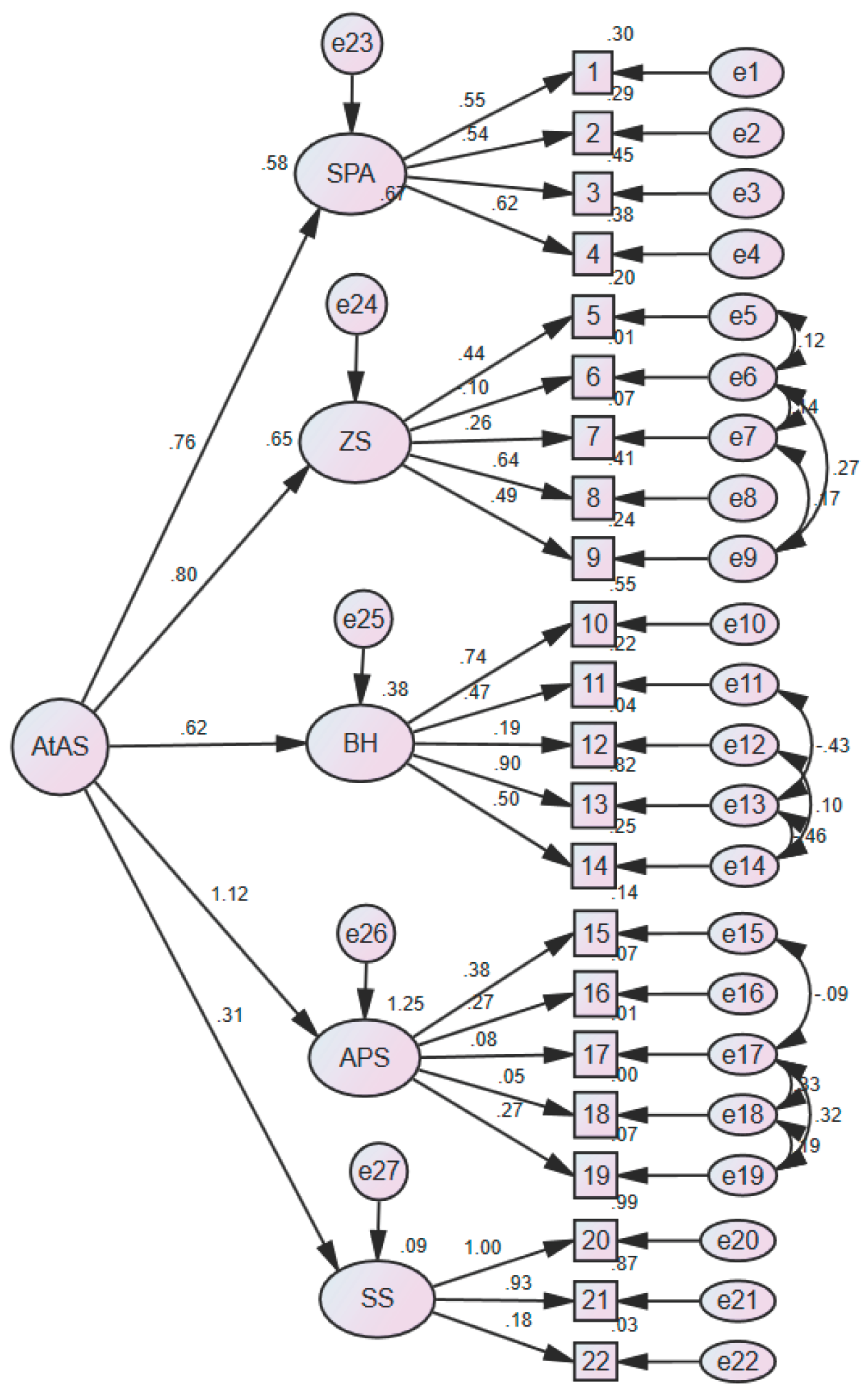
Table 1.
Demographic characteristics of the participants (N = 328).
| Variables | Frequency (%) | |
|---|---|---|
| Age | Mean (SD) | 69.42 (±6.8) |
| Gender | Male Female |
144 (43.9%) 184 (%56.1) |
| Marital Status | Never Married Married Widowed divorced |
11 (3.4%) 288 (69.5%) 69 (21%) 20 (6.1%) |
| Education Status | Illiterate Literate (no formal education) Primary Lower Secondary Upper Secondary Diploma University Education |
24 (7.3%) 7 (2.1%) 36 (11%) 26 (7.9%) 17 (5.2%) 110 (33.5%) 108 (33%) |
| Employment Status | Employment Full-Time Employment Part-Time Homemaker Retired Disable/Unable to Work |
18 (5.5) 21 (6.4) 127 (38.7) 157 (47.9) 5 (1.5) |
| Reason for Employment | Financial necessity Habit and leisure Both reasons |
17 (32.7) 7 (13.5) 28 (53.8) |
| Economic Status | Very good Good Average Poor Very poor |
5 (1.5) 70 (21.3) 190 (57.9) 46 (14) 17 (5.2) |
| Home Ownership | Owned Rented/Mortgaged Child’s Home Relative’s or friend’s Home |
255 (77.7) 66 (20.1) 5 (1.5) 2 (0.6) |
| Living Arrangements | Living alone With spouse only With spouse and unmarried children With spouse and married children Without spouse, with unmarried children Without spouse, with married children With relatives other |
49 (14.9) 102 (31.1) 118 (36) 6 (1.8) 35 (10.7) 7 (2.1) 8 (2.4) 3 (0.9) |
| general Health Status | Excellent Very good Good Fair poor |
22 (6.7) 14 (4.3) 126 (38.4) 139 (42.4) 27 (8.2) |
| Type of Insurance Coverage | Basic insurance Supplementary insurance Both none |
80 (24.4) 60 (18.3) 153 (46.6) 35 (10.7) |
Table 2.
Descriptive statistics of Adjustment to Aging across subscales.
| Dimension | Score range | Mean | SD |
|---|---|---|---|
| SPA | 4-28 | 18.70 | 5.21 |
| ZS | 5-35 | 26.32 | 4.50 |
| BH | 5-35 | 24.42 | 5.71 |
| APS | 5-37 | 22.90 | 5.05 |
| SS | 3-21 | 15.84 | 4.11 |
| Total | 22-154 | 108.27 | 15.77 |
Disclaimer/Publisher’s Note: The statements, opinions and data contained in all publications are solely those of the individual author(s) and contributor(s) and not of MDPI and/or the editor(s). MDPI and/or the editor(s) disclaim responsibility for any injury to people or property resulting from any ideas, methods, instructions or products referred to in the content. |
© 2025 by the authors. Licensee MDPI, Basel, Switzerland. This article is an open access article distributed under the terms and conditions of the Creative Commons Attribution (CC BY) license (https://creativecommons.org/licenses/by/4.0/).
Copyright: This open access article is published under a Creative Commons CC BY 4.0 license, which permit the free download, distribution, and reuse, provided that the author and preprint are cited in any reuse.


