

Submitted:
21 August 2025
Posted:
21 August 2025
You are already at the latest version
Abstract
What kind of learning philosophy can truly meet the demands of our time—where artificial intelligence reshapes cognition, ecological urgency challenges our values, and multiple ways of knowing coexist in tension and possibility? This question motivates the development of the Education Philosophy of Quintuple Learning Plus (PQL+), a future-facing framework that weaves together five enduring educational traditions: Naturalism, Idealism, Humanism, Constructivism, and Progressivism. Rather than treating these paradigms as relics of the past, PQL+ reanimates them through intelligent technologies, positioning learning as a co-evolutionary process between human insight and machine intelligence. It invites educators to rethink not just how we teach, but why we teach—and to do so with ethical clarity, epistemic humility, and adaptive imagination. In alignment with UNESCO’s Sustainable Development Goal 4, which calls for inclusive, equitable, and quality education and lifelong learning for all, PQL+ offers a trans-philosophical blueprint for educational renewal across disciplines, modalities, and cultural contexts. This article explores the philosophical architecture of PQL+, its theoretical grounding, and its pedagogical implications, positioning it as a globally resonant framework for education in an age of complexity, pluralism, and intelligent transformation.
Keywords:
co-evolution
; education philosophy
; human-AI
; PQL+
; quintuple learning
; trans-philosophical framework
I. Introduction
Contemporary education stands at a crossroads—splintered by competing imperatives and disjointed reforms. On one side lies the weight of tradition: classical pedagogies rooted in humanistic ideals, moral development, and the cultivation of reason. On the other, the accelerating tide of innovation: algorithmic personalization, data-driven instruction, and the mechanization of learning. Between these poles, education is pulled taut—oscillating between the soul and the system, between ethical intentionality and operational efficiency. In this tension, UNESCO’s Education 2030 Agenda, anchored in Sustainable Development Goal 4, calls for inclusive, equitable, and quality education that embraces both timeless human values and the transformative potential of intelligent technologies. It is within this global mandate that the Philosophy of Quintuple Learning Plus (PQL+) emerges—not as a compromise, but as a synthesis—reimagining education as a co-evolutionary process between enduring wisdom and adaptive intelligence.
Figure 1.
By: Microsoft Copilot. (2025).
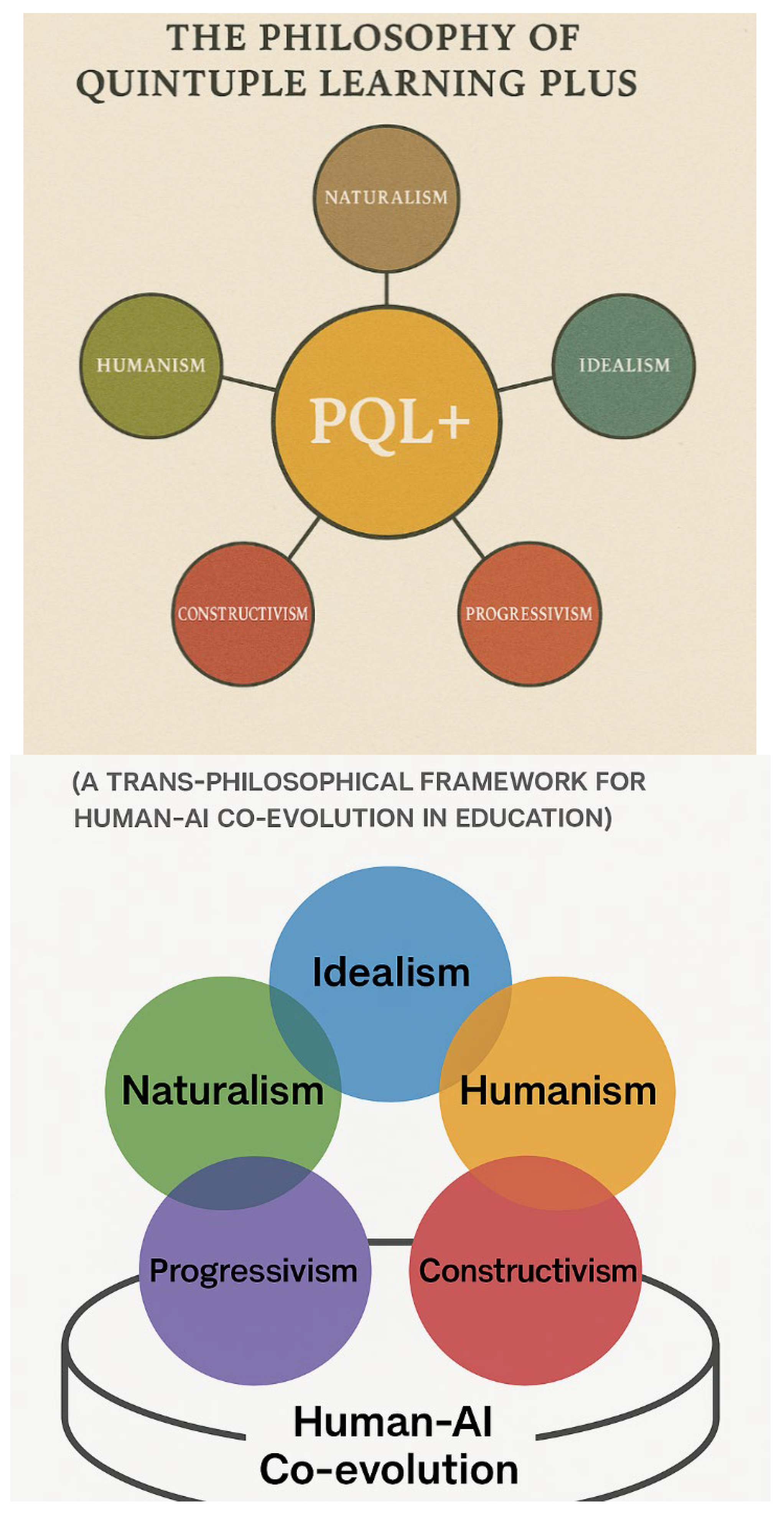
This fragmentation is not merely structural or procedural; it is philosophical. The coherence that once anchored educational thought—whether through Idealism’s pursuit of truth, Naturalism’s reverence for experience, or Humanism’s affirmation of dignity—has eroded under the pressure of technocratic reform. What remains is a patchwork of initiatives: competency frameworks divorced from context, digital tools deployed without epistemic grounding, and outcomes measured without ontological clarity (Biesta, 2010).
Moreover, global learning systems increasingly adopt standardized models that overlook the local epistemologies, linguistic identities, and cultural narratives that shape learners’ realities. In this climate, contextualization becomes not a luxury but a necessity—an ethical stance that insists education must speak to the lived experiences, sociohistorical conditions, and cognitive landscapes of its learners (Gay, 2010). Likewise, cross-cultural communication is no longer peripheral; it is central to cultivating empathy, global citizenship, and dialogic understanding in a pluralistic world (Banks, 2015).
In response to this crisis, PQL+ (Philosophy of Quintuple Learning Plus) emerges not as another pedagogical trend, but as a trans-philosophical synthesis—a framework that reclaims coherence by integrating five foundational paradigms: Naturalism, Idealism, Humanism, Constructivism, and Progressivism, each reinterpreted through the lens of technopedagogical ethics. The “Plus” signifies a transformative axis: the ethical integration of AI, digital tools, and global communication into the philosophical core of education (Selwyn, 2016).
PQL+ is both retrospective and prospective. It honors the wisdom traditions that shaped human learning across cultures and centuries, while boldly engaging the challenges posed by automation, algorithmic bias, and cultural homogenization. It advocates for a curriculum that is audit-ready yet culturally resonant, outcome-driven yet philosophically grounded, and technologically enhanced yet humanly attuned.
This framework offers concrete implications for both curriculum development and teaching practice:
- In curriculum design, PQL+ restores philosophical coherence, supports contextual relevance, and embeds cross-cultural competencies. It enables the construction of syllabi, learning outcomes, and rubrics that are not only accreditation-compliant but also culturally meaningful and epistemically sound (Tyler, 1949; Wiggins & McTighe, 2005).
- In teaching, PQL+ empowers educators to become philosophical practitioners—designing learning experiences that are ethically intelligent, emotionally literate, and transdisciplinary. It fosters pedagogical reflexivity, learner-centered design, and professional agency, elevating teaching from procedural compliance to intellectual leadership (Shulman, 1987; Freire, 1970).
In essence, PQL+ restores education’s soul—not by choosing sides in the tradition-versus-innovation debate, but by synthesizing them into a coherent, future-facing philosophy. It calls for learning that is context-sensitive, cross-culturally fluent, and ethically intelligent—a curriculum where coherence is restored, relevance is redefined, and education becomes a moral, intellectual, and intercultural act.
II. Literature Review: Situating PQL+ in Contemporary Educational Thought
Recent scholarship paints a vivid picture of a global educational landscape in fluidity. Across classrooms and institutions, educators are grappling with a growing tension: the enduring ideals of classical pedagogy—rooted in moral development, humanistic inquiry, and the cultivation of reason—are being challenged by the disruptive forces of globalization, digitalization, and artificial intelligence. These forces have not only reshaped how we teach and learn but have also unsettled the philosophical foundations that once gave education its soul. In this moment of uncertainty, UNESCO’s Education 2030 Agenda offers a steadying compass, calling for inclusive, equitable, and quality education that honors both timeless human values and the transformative potential of emerging technologies. It’s a call not just for reform, but for reimagining—an invitation to craft new educational philosophies, like the Philosophy of Quintuple Learning Plus (PQL+), that can bridge tradition and innovation with ethical clarity, cultural sensitivity, and adaptive imagination.
Rudenko and colleagues (2025) articulate this tension with urgency, calling for educational models that harmonize universal ethical principles with the rich diversity of local cultural identities. They emphasize the importance of integrating digital literacy with humanistic values—an approach that resonates deeply with the core commitments of PQL+. Their work affirms that technology must serve human flourishing, not override it.
Charlene Tan (2016), in her comprehensive review of traditional educational philosophies, highlights how these paradigms—Idealism, Realism, Pragmatism, and others—are often applied in isolation, stripped of their original coherence and disconnected from contemporary realities. Her critique underscores the need for a synthesized framework that can adapt these traditions to modern challenges without diluting their conceptual integrity. PQL+ responds to this need by weaving together five foundational paradigms—Naturalism, Idealism, Humanism, Constructivism, and Progressivism—into a unified, adaptive model, further enriched by a sixth strand: ethical technopedagogy.
In the South Asian context, Khanam and Islam (2024) explore the philosophical undercurrents of India’s National Education Policy (NEP) 2020. They highlight its emphasis on critical thinking, holistic development, and ethical reasoning—principles that echo the humanistic and constructivist dimensions of PQL+. Their analysis reveals a policy striving to balance tradition and innovation, much like PQL+ itself, which embeds human-AI co-agency and technopedagogical ethics into its philosophical core.
Taken together, these scholars illuminate a shared concern: the fragmentation of educational philosophy in the face of rapid change. Yet they also point toward a solution—one that restores coherence, honors cultural diversity, and prepares learners for the ethical complexities of a digital age. PQL+ stands as that solution: a future-facing framework that bridges tradition and innovation, integrates cultural identity with global citizenship, and redefines education as a moral, intellectual, and technological act.
III. The Quintuple Philosophical Core
PQL+ is rooted in five enduring educational philosophies, each contributing a vital dimension to holistic learning:
Naturalism emphasizes that education should align with the learner’s biological development and sensory experience. Rooted in the works of Rousseau and later Dewey, Naturalism advocates for learning that is experiential, age-appropriate, and organically paced. It resists rigid standardization and instead promotes environments where learners interact meaningfully with their surroundings. As Napenas (2019) explains, Naturalism views education as a natural unfolding of human potential, shaped by context and guided by the learner’s innate curiosity.
Idealism positions education as a moral and intellectual enterprise. Drawing from Plato’s vision of eternal truths and the cultivation of virtue, Idealism sees the classroom as a space for philosophical inquiry and ethical formation. Charlene Tan (2016) notes that Idealism remains relevant in shaping learners’ capacity for reason, reflection, and moral discernment, even as its application in modern contexts often lacks integration. Within PQL+, Idealism ensures that education is not merely functional but formative—anchored in timeless values and intellectual rigor.
Humanism brings the learner into full view as a whole person—emotional, moral, and autonomous. It emphasizes empathy, agency, and personal meaning as central to the educational experience. Aung (2020) argues that humanistic education fosters self-actualization and moral sensitivity, encouraging learners to develop both cognitive and emotional capacities. Humanism in PQL+ affirms that education must be relational and responsive, cultivating not just knowledge but character and conscience.
Constructivism asserts that knowledge is actively constructed through experience, reflection, and social interaction. Influenced by Piaget and Vygotsky, Constructivism promotes inquiry-based learning and collaborative meaning-making. As highlighted in the ERIC study on humanistic influences in constructivist teaching (ED393814), this approach values learner autonomy and contextual engagement over rote memorization. In PQL+, Constructivism ensures that learning is dialogic, adaptive, and intellectually rich—where students are co-creators of understanding.
Progressivism calls on education to stay alive to the present—responsive to change, rooted in relevance, and committed to shaping a better future. Inspired by Dewey’s pragmatism, it values interdisciplinary inquiry, civic engagement, and the thoughtful use of technology—not as distractions, but as tools for deep, meaningful learning. The Augsburg University comparison chart (n.d.) captures this spirit well, showing how Progressivism prepares learners to meet real-world challenges through hands-on, future-facing pedagogy. Within the Philosophy of Quintuple Learning Plus (PQL+), Progressivism becomes a driving force for integrating AI, digital tools, and ethical responsiveness—ensuring that innovation never comes at the cost of our shared humanity. This vision echoes UNESCO’s Education 2030 Agenda, which urges us to build inclusive, equitable, and quality learning environments that empower individuals to navigate complexity with compassion, creativity, and purpose. In PQL+, Progressivism is not just a method—it is a moral stance, a reminder that education must evolve without losing its soul.
IV. The “Plus”: Technology and AI as Philosophical Agents
The “Plus” in PQL+ is not a mere add-on—it is a philosophical expansion. Artificial Intelligence and digital technologies are reframed not as tools, but as epistemic agents that reshape cognition, pedagogy, and ethics.

Table 1.
.
| Classical Philosophy | Contribution | AI/Tech Infusion |
| Naturalism | Organic development | Biometric feedback, neuroadaptive pacing |
| Idealism | Moral and intellectual refinement | AI-curated ethical simulations, virtual Socratic dialogues |
| Humanism | Emotional and personal growth | Emotion-aware AI tutors, personalized SEL platforms |
| Constructivism | Active knowledge construction | AR/VR environments, intelligent inquiry scaffolding |
| Progressivism | Innovation and social relevance | Real-time analytics, global collaboration platforms |
In PQL+, technology becomes a co-educator—responsive, ethical, and adaptive. Learners engage with intelligent systems not passively, but as co-agents in a shared epistemic journey.
V. Theoretical and Conceptual Frameworks
PQL+ rests on a layered, evolving foundation—one that listens to the rhythms of human learning while leaning into the possibilities offered by intelligent systems. It’s not a fixed model or a prescriptive formula, but a living philosophy that grows through experience, deepens through reflection, and stretches through technological augmentation. At its heart is a belief that education must remain human—even as it transforms. This echoes UNESCO’s call through the Education 2030 Agenda to build learning environments that are inclusive, equitable, and responsive to the world’s shifting realities. PQL+ takes up that call, offering a way forward that honors tradition, embraces innovation, and keeps the learner—fully human, fully evolving—at the center of it all.
1. Epistemological Pluralism. At its core, PQL+ recognizes that knowledge is not singular. People learn through sensation, reason, emotion, lived experience, and increasingly, through digital interaction. This pluralism resists the dominance of any one epistemology and instead invites a chorus of ways of knowing.
In the classroom, this means validating indigenous wisdom alongside scientific reasoning, honoring emotional insight as much as empirical data, and treating digital cognition not as a threat, but as an extension of human inquiry. It’s a philosophy that listens to many voices—and teaches learners to do the same.
2. Bio-cognitive Constructivism. Learning is both biological and cognitive. PQL+ draws from developmental psychology and constructivist theory, but adds a new layer: intelligent augmentation. Learners build knowledge actively, shaped by their developmental stage, social context, and now, by AI-enhanced feedback loops.
This strand sees AI not as a tool, but as a co-architect of cognition—supporting memory, scaffolding complexity, and adapting to individual learning rhythms. It’s a pedagogy that respects the brain’s natural growth while inviting intelligent systems to nurture it.
3. Ethical Technopedagogy. Technology in education must be more than efficient—it must be ethical. PQL+ insists that every digital intervention be designed with moral clarity: protecting privacy, promoting equity, and reflecting cultural sensitivity.
This isn’t just about compliance; it’s about conscience. When we embed AI into learning, we shape not only minds but values. Ethical technopedagogy ensures that technology serves humanity—not the other way around.
4. Human-AI Co-agency Theory. Perhaps the most future-facing strand, this theory positions learners and intelligent systems as partners in meaning-making. AI is no longer a passive assistant—it becomes a dialogical agent, capable of co-creating knowledge, sparking inquiry, and responding to human nuance.
In practice, this means learners engage with AI not just to receive answers, but to explore questions, test ideas, and reflect on their own thinking. It’s a pedagogy of partnership—where human intuition and machine intelligence learn from each other.
The Spiral Framework: Recursive, Adaptive, Alive
PQL+ does not unfold in straight lines. It spirals—each strand reinforcing the others, looping through reflection, adaptation, and intelligent augmentation. It is:
- Recursive: Learners revisit ideas through new lenses, deepening understanding.
- Adaptive: The system responds to context, learner needs, and evolving goals.
- Context-sensitive: Every learning moment is shaped by culture, cognition, and technology.
This spiral is not just a metaphor—it’s a method. It reflects how real learning happens: not once, but again and again, each time more richly.
VI. Scope of PQL+
PQL+ is designed for universal application across:
Figure 2.
By: Microsoft Copilot. (2025).
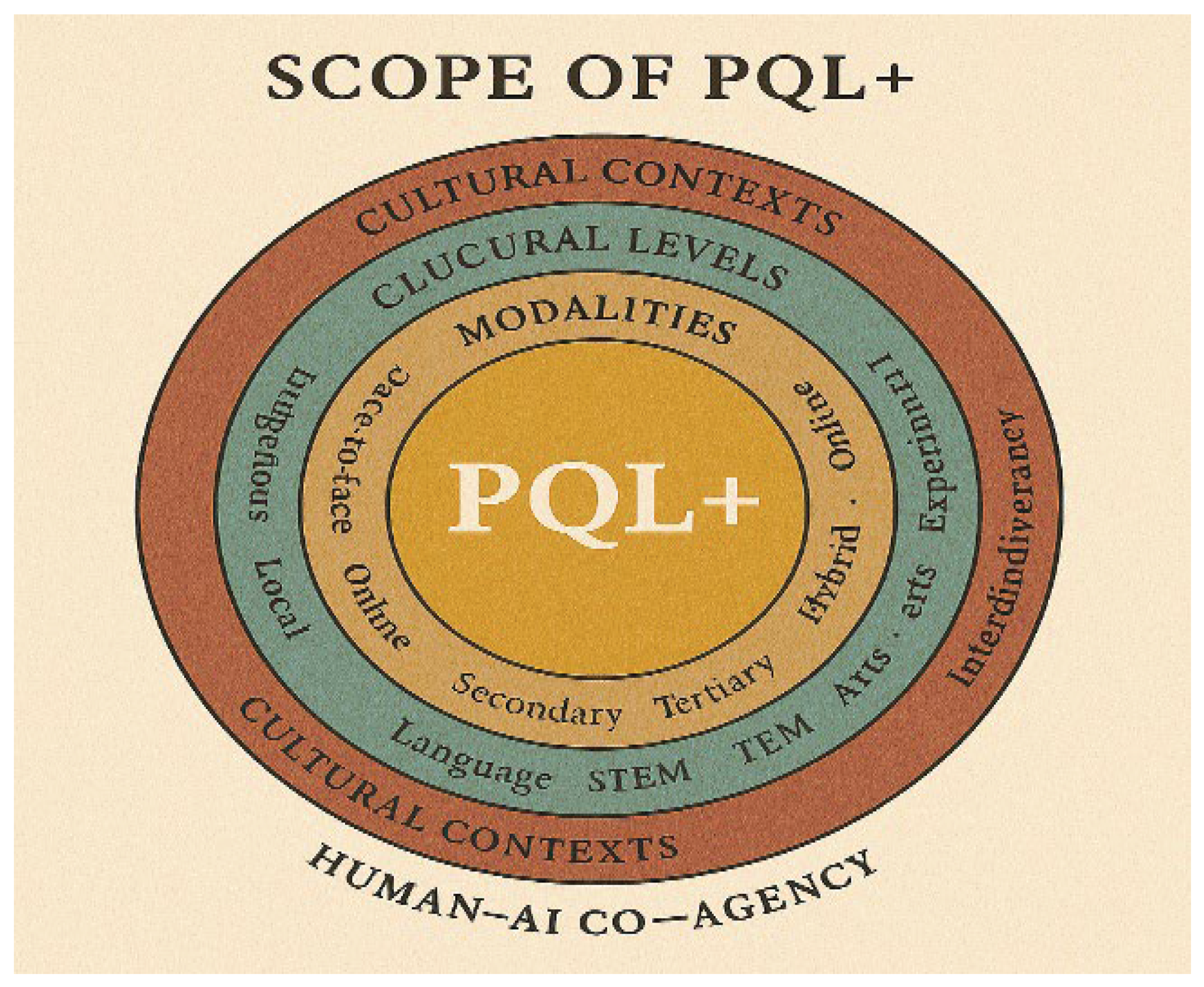
Educational Levels. PQL+ is designed to accompany learners across the entire educational journey—from the wonder-filled explorations of early childhood to the reflective depth of postgraduate study and the evolving demands of lifelong learning. It recognizes that learning is not a one-time event but a continuous, developmental process shaped by biological maturation, social interaction, and cognitive construction (Piaget, 1970; Vygotsky, 1978). By integrating intelligent systems that scaffold complexity and reduce cognitive overload, PQL+ supports learners in navigating increasingly sophisticated tasks without compromising conceptual clarity (Sweller & Chandler, 1991). Whether nurturing foundational literacy or guiding advanced research, PQL+ adapts to the learner’s stage with philosophical coherence and pedagogical precision.
Modalities. Learning today unfolds across a spectrum of modalities—formal classrooms, informal community spaces, hybrid platforms, and immersive digital environments. PQL+ embraces this diversity by offering a flexible framework that thrives in both structured and emergent contexts. It supports synchronous and asynchronous engagement, experiential learning, and AI-enhanced instruction, ensuring that pedagogy remains responsive and inclusive. By embedding ethical considerations into technological design and implementation, PQL+ safeguards the integrity of learning environments (Bynum, 2008; Scalzo, Fominykh, & Mørch, 2021). It also aligns with national data protection standards, such as the Philippines’ Data Privacy Act (Republic of the Philippines, 2012), reinforcing its commitment to learner dignity and institutional accountability.
Disciplines. PQL+ is not discipline-bound—it is philosophically and pedagogically expansive. It finds relevance in STEM fields, where precision and innovation are key; in the humanities and arts, where interpretation and creativity flourish; and in vocational and interdisciplinary programs, where practical competence meets ethical reflection. Its pluralistic epistemology allows it to bridge empirical inquiry with emotional intelligence, technical rigor with humanistic insight (Santos, 2007). By honoring multiple ways of knowing, PQL+ cultivates learners who are not only skilled but also thoughtful, adaptable, and globally attuned.
Cultural Contexts. At its heart, PQL+ is culturally responsive. It recognizes that education is never neutral—it is shaped by the values, histories, and epistemologies of the communities it serves. Drawing from Santos’ (2007) call for an “ecology of knowledges,” PQL+ affirms the legitimacy of indigenous wisdom, local pedagogical traditions, and global educational standards. It invites intercultural dialogue and fosters epistemic humility, allowing learners and educators to co-create meaning across diverse contexts. This adaptability makes PQL+ not just a framework for instruction, but a philosophy of inclusion—where learning is rooted in respect, relevance, and relational depth.
Human-AI Co-agency. Across all these dimensions, PQL+ is animated by a vision of co-agency—where learners and intelligent systems collaborate in the construction of knowledge. Rather than positioning AI as a passive tool, PQL+ treats it as a dialogical partner that supports inquiry, reflection, and creativity (Fryer, 2025; Katsenou, Papamitsiou, & Economides, 2025). This partnership enhances learner autonomy while expanding the boundaries of what’s pedagogically possible. In this way, PQL+ becomes not just a response to technological change, but a reimagining of what it means to learn, teach, and grow in an intelligent age.
Overall, its scope touches every corner of educational life—curriculum design, instructional strategy, assessment systems, teacher formation, and policy-making. These domains are no longer shaped by human insight alone. AI and other technologies—whatever names they may take in the future—have become woven into the very fabric of how we teach, learn, and lead. We may call them different things tomorrow, but we can no longer navigate education without them. What matters now is how we use these tools—with wisdom, with care, and with a clear sense of purpose. This is precisely the kind of balance UNESCO’s Education 2030 Agenda calls for: a commitment to inclusive, equitable, and quality education that embraces innovation while keeping humanity at its heart. Within PQL+, this balance is not just a goal—it is a guiding principle.
VII. Future Directions
PQL+ opens pathways for future research and innovation:
- AI-augmented curriculum design: Developing adaptive syllabi that evolve with learner data
- Philosophical audits of edtech: Evaluating digital tools against ethical and pedagogical benchmarks
- Global learning ecosystems: Building transnational platforms for collaborative, culturally responsive education
- Neuroethical pedagogy: Exploring the intersection of brain science, moral development, and intelligent systems
Indeed, PQL+ invites educators, technologists, and philosophers to co-create a future where learning is not just efficient—but meaningful, ethical, and transformative. As AI and other tools evolve in name and form, their role in education becomes indispensable. We may call them something else tomorrow, but we can’t move forward without them. What matters is how we use them—with care, clarity, and a deep respect for what makes learning truly human. This is the kind of future UNESCO envisions: one where innovation serves inclusion, equity, and lifelong growth.
VIII. Novelty, Significance, and Beneficiaries of PQL+
A. Why PQL+ Is Novel and New. PQL+ is novel because it does what no single educational philosophy has done before: it synthesizes five classical traditions into a unified, adaptive framework, then augments that synthesis with the epistemic force of Artificial Intelligence and emerging technologies.
Unlike traditional philosophies that operate within fixed historical contexts, PQL+ is trans-temporal and trans-technological. It is designed not only to respond to the present but to evolve with the future, making it the first educational philosophy to explicitly position human-AI co-agency as a pedagogical principle.
B. Significance in the Flooded Body of Educational Philosophy. In a landscape saturated with fragmented theories, PQL+ offers philosophical coherence and pedagogical clarity. It does not compete with existing models—it integrates and transcends them. Its significance lies in its ability to:
- Bridge classical wisdom and digital innovation
- Unify epistemological diversity into a single learning ethos
- Provide a scalable framework for global, ethical, and adaptive education
- Serve as a philosophical compass for curriculum designers, policy makers, and AI developers
PQL+ is not just another entry in the canon—it is a meta-framework that redefines what educational philosophy can be in the intelligent age.
C. Why PQL+ Is Unique
PQL+ is unique because it:
- Treats technology as a philosophical agent, not merely a tool
- Positions learners and intelligent systems as co-constructors of knowledge
- Embeds ethical reasoning, emotional intelligence, and cognitive adaptability into its core
- Operates across modalities, disciplines, and cultures, making it universally applicable
Its uniqueness lies in its fusion of depth and dynamism—a rare balance between classical rigor and futuristic flexibility.
D. Who Will Benefit from PQL+
PQL+ is designed to benefit a wide spectrum of stakeholders:
- Learners: Gain personalized, ethical, and meaningful learning experiences
- Educators: Acquire a coherent framework for designing adaptive, human-centered instruction
- Curriculum developers: Use PQL+ as a philosophical anchor for innovation and accreditation
- Technologists: Apply ethical and pedagogical principles to AI development in education
- Policy makers: Ground reforms in a philosophy that is both inclusive and future-proof
- Global communities: Build learning ecosystems that honor cultural diversity while embracing technological advancement
At its heart, PQL+ is for those who believe education must grow without losing its soul—where innovation deepens empathy, and intelligent systems support rather than replace human agency. Technology will keep changing names, but its presence in learning is here to stay. What matters is how we use it—with care, purpose, and a commitment to keeping education human. This is the kind of future UNESCO envisions: one where progress and compassion move forward together, shaping learning that is ethical, inclusive, and transformative.
IX. Limitations
Despite its integrative power, PQL+ faces several limitations:
Technological Inequity. While PQL+ envisions intelligent augmentation as a universal catalyst for learning, the reality of technological access remains uneven. Many regions and populations—particularly in underserved or rural areas—lack reliable infrastructure, digital tools, or AI-enabled platforms. This disparity risks deepening educational divides rather than bridging them. As Bynum (2008) cautions, emerging technologies must be evaluated not only for their capabilities but for their accessibility and ethical deployment. Without equitable access, the transformative promise of PQL+ may remain aspirational for many learners and institutions.
Ethical Ambiguity. The integration of AI into pedagogy introduces complex ethical questions that cannot be resolved through technical design alone. Issues of data privacy, algorithmic bias, learner autonomy, and digital dignity demand ongoing philosophical scrutiny. Scalzo, Fominykh, and Mørch (2021) emphasize the need for participatory and ethically grounded design in educational technology, while national frameworks like the Data Privacy Act of 2012 (Republic of the Philippines, 2012) underscore the legal imperatives of protecting learner information. PQL+ must therefore evolve alongside ethical discourse, ensuring that its implementation remains morally sound and socially responsible.
Cognitive Overload. The richness of PQL+, say, its fusion of epistemological pluralism, constructivist theory, technopedagogical ethics, and AI co-agency—can be demanding. Educators navigating this layered framework may experience cognitive overload, especially without adequate scaffolding or professional development. Sweller and Chandler’s (1991) cognitive load theory reminds us that instructional design must balance complexity with clarity. Without strategic support, the very depth that makes PQL+ powerful could become a barrier to adoption, leading to misalignment or superficial implementation.
Institutional Inertia. Educational systems are often slow to change. Deeply embedded traditions, bureaucratic structures, and accreditation protocols can resist paradigm shifts—even when those shifts are philosophically and pedagogically sound. Vygotsky (1978) and Piaget (1970) both emphasized the importance of developmental readiness, not only in learners but in systems. For PQL+ to take root, institutions must engage in strategic change management, cultivating openness to innovation while respecting the rhythms of organizational transformation. This requires visionary leadership, policy alignment, and sustained dialogue across stakeholders.
A Call for Thoughtful Implementation. These limitations do not diminish the value of PQL+; rather, they illuminate the conditions necessary for its success. As Santos (2007) reminds us, meaningful educational reform must embrace complexity, dissent, and contextual nuance. PQL+ is not a plug-and-play solution—it is a living philosophy that calls for thoughtful implementation, ethical vigilance, and continuous refinement. Its strength lies not in being flawless, but in its ability to evolve through dialogue, reflection, and a shared commitment to transformative learning. This vision echoes UNESCO’s call for inclusive, equitable, and quality education—one that is rooted in lifelong learning and shaped by local relevance and global responsibility. The real challenge now is not whether PQL+ can be adopted, but whether educators and institutions are ready to engage with it deeply, courageously, and collaboratively—to co-create futures where human wisdom and intelligent systems redefine the very meaning of learning.
Declaration
This manuscript presents the Philosophy of Quintuple Learning Plus (PQL+): A Trans-Philosophical Framework for Human-AI Co-evolution in Education. It synthesizes five foundational educational paradigms—Naturalism, Idealism, Humanism, Constructivism, and Progressivism—reframed to meet the demands of education across diverse contexts. Independently conceived, PQL+ provides a coherent basis for curriculum design that is pedagogically sound, audit-ready, and responsive to AI-integrated learning environments. In shaping this work, artificial intelligence served not merely as a tool but as a reflective partner in refining ideas and aligning philosophical depth with clarity. I extend my sincere gratitude to SMCII, Google Scholar, ResearchGate, Mendeley, and Academia.edu for their invaluable resources and scholarly networks that made this manuscript meaningfully complete.
References
- Andreotti, V. , Ahenakew, C., & Cooper, G. (2011). Epistemological pluralism: Ethical and pedagogical implications in higher education. AlterNative: An International Journal of Indigenous Peoples, 7(1), 40–50.
- Augsburg University. (n.d.). Educational philosophies definitions and comparison chart. Retrieved from web.augsburg.
- Aung, Y. M. (2020). Humanism and education. Research Explorer, 7(5), 1–12.
- Banks, J. A. (2015). Cultural diversity and education: Foundations, curriculum, and teaching (6th ed.). Routledge.
- Biesta, G.J.J. Good Education in an Age of Measurement; Taylor & Francis: London, United Kingdom, 2015. [Google Scholar]
- Bynum, T. W. (2008). Ethical challenges of emerging ICT applications. Ethics and Information Technology, 10(2–3), 109–113.
- ERIC. Humanistic influences on a constructivist approach to teaching and learning (ED39 3814.
- Freire, P. (1970). Pedagogy of the oppressed. Herder and Herder.
- Fryer, L. K. (2025). Co-agency in human-AI learning partnerships: A motivational perspective. Journal of Educational Technology and Society, 28(1), 15–29.
- Gay, G. (2010). Culturally responsive teaching: Theory, research, and practice (2nd ed.). Teachers College Press.
- Herman, W. E. (1995, April). Humanistic influences on a constructivist approach to teaching and learning (ED393814). ERIC. https://eric.ed.gov/? 3938. [Google Scholar]
- Holmes, W. (2022). Artificial intelligence in education: Promise, practices, and policy. Oxford Review of Education, 48(6), 701–720. [CrossRef]
- Katsenou, C. , Papamitsiou, Z., & Economides, A. A. (2025). Human-AI collaboration in education: A framework for dialogic learning. Computers & Education: Artificial Intelligence, 6, 100123.
- Khanam, T. A. , & Islam, M. (2024). Implication of philosophy in modern education: A review study on New Education Policy (NEP) in India. Research Explorer: A Blind Review & Refereed Quarterly International Journal, 13(44), 1–12. https://iaraindia.com/wp-content/uploads/2024/10/11-IMPLICATION-OF-PHILOSOPHY-IN-MODERN-EDUCATION-A-REVIEW-STUDY-ON-NEW-EDUCATION-POLOCY-NEP-IN-INDIA.
- Microsoft Copilot. (2025). Conversation with an AI assistant on the Philosophy of Quintuple Learning Plus (PQL+) [Generative AI output]. Retrieved , 2025, from https://copilot.microsoft. 20 August.
- Napenas, H. (2019). Traditional and contemporary educational philosophies. Academia.edu.
- Moore, G.T.; Piaget, J. Science of Education and the Psychology of the Child. J. Arch. Educ. (1947-1974) 1971, 25, 113. [Google Scholar] [CrossRef]
- Prasad, S. , & Kumara, S. (2025). NEP 2020 and its focus on holistic development and critical thinking. International Journal of Trend in Scientific Research and Development, 9(2), 635–642. https://www.ijtsrd.com/papers/ijtsrd78459.
- Republic of the Philippines. (2012). Data Privacy Act of 2012 (Republic Act No. 10173). https://privacy.gov.
- Rudenko, O.; Polishchuk, N.; Didenko, N.; Sadova, I.; Kalyta, N. Educational Challenges of the Future through the Prism of Philosophy in the Context of Globalisation: Systematic Literature Review. Int. J. Cult. Hist. Relig. 2025, 7, 585–610. [Google Scholar] [CrossRef]
- Santos, B. de S. (2007). Beyond abyssal thinking: From global lines to ecologies of knowledges. Eurozine.
- Scalzo, G. , Fominykh, M., & Mørch, A. I. (2021). Ethical design in educational technology: A participatory approach. British Journal of Educational Technology, 52(2), 778–793.
- Selwyn, N. (2016). Education and technology: Key issues and debates (2nd ed.). Bloomsbury Academic.
- Should robots replace teachers? AI and the future of education. Polity Press.
- Shulman, L. Knowledge and Teaching:Foundations of the New Reform. Harv. Educ. Rev. 1987, 57, 1–23. [Google Scholar] [CrossRef]
- Chandler, P.; Sweller, J. Cognitive Load Theory and the Format of Instruction. Cogn. Instr. 1991, 8, 293–332. [Google Scholar] [CrossRef]
- Tan, C. (2016). Philosophical perspectives on education. In C. Tan, B. Wong, J. S. Chua, & T. Kang (Eds.), Critical perspectives on education: An introduction (pp. 21–40). Prentice Hall. Routledge.
- Tyler, R. W. (1949). Basic principles of curriculum and instruction. University of Chicago Press.
- UNESCO. ; UNICEF.; The World Bank; UNFPA.; UNDP.; UN Women; UNHCR. Education 2030: Incheon Declaration and Framework for Action for the implementation of Sustainable Development Goal 4: Ensure inclusive and equitable quality education and promote lifelong learning opportunities for all. ED-2016/WS/28 W. In Proceedings of The World Education Forum 2015, Incheon, Korea, 22 May 2015. [Google Scholar]
- Vygotsky, L. S. (1978). Mind in society: The development of higher psychological processes. Harvard University Press.
- Wiggins, G. , & McTighe, J. (2005). Understanding by design (Expanded 2nd ed.). ASCD.
Disclaimer/Publisher’s Note: The statements, opinions and data contained in all publications are solely those of the individual author(s) and contributor(s) and not of MDPI and/or the editor(s). MDPI and/or the editor(s) disclaim responsibility for any injury to people or property resulting from any ideas, methods, instructions or products referred to in the content. |
© 2025 by the author. Licensee MDPI, Basel, Switzerland. This article is an open access article distributed under the terms and conditions of the Creative Commons Attribution (CC BY) license (https://creativecommons.org/licenses/by/4.0/).
Copyright: This open access article is published under a Creative Commons CC BY 4.0 license, which permit the free download, distribution, and reuse, provided that the author and preprint are cited in any reuse.


