
Submitted:
19 August 2025
Posted:
20 August 2025
You are already at the latest version
Abstract
For the first time, this communication is intended to perform the possible biological role of natural compounds in the crystal structure of botulinum neurotoxin (BoNT), a protein produced by the bacterium Clostridium botulinum. This is among the most potent biological toxins. It causes botulism, a serious illness, and represents a major public health concern. Developing natural inhibitors that can safely neutralize BoNT’s toxic effects is particularly appealing due to their low risk of adverse effects and therapeutic potential. In this study, we used molecular docking—a computational method to predict how molecules interact—to screen 50 naturally occurring compounds against multiple functional regions of BoNT/A. These regions included the catalytic domain, which mediates the cleavage of target proteins, and the receptor-binding domain, which facilitates the toxin’s attachment to neuronal cells. Predicted binding affinities, expressed in kilocalories per mole (kcal/mol) and calculated using AutoDock Vina, indicated that several plant-derived compounds exhibited strong interactions across different target sites. In particular, Hypericin (–10.0 kcal/mol), Hesperidin (–10.8 kcal/moland Silibinin (–10.1 kcal/mol) emerged as top multitarget lead compounds, demonstrating notable binding potential. Additional compounds, including Baicalin, Epicatechin Gallate, Scutellarin, Naringin, and Rutin, demonstrated strong binding specifically to the catalytic site, reinforcing the value of polyphenols and flavonoids as versatile scaffolds.These results highlight the promise of natural compounds as safe and effective BoNT inhibitors and provide a solid basis for future experimental validation and drug repurposing efforts. Overall, Hypericin emerged as the top candidate for disrupting BoNT/A activity due to its consistently high binding across receptor-binding and catalytic domains. These findings provide a strong computational foundation for experimental validation and suggest that safe, natural compounds—especially polyphenols—can serve as promising multitarget therapeutics against BoNT/A toxicity.
Keywords:
flavonoids
; botulinum neurotoxin
; autodock vina
; docking analysis
; hypericin
1. Introduction
Today, pharmacology plays a central role in understanding drugs and their interactions with living organisms. Numerous online platforms are now available that can reliably predict the chemical, physical, and pharmacological properties of compounds, helping to reduce production costs and enabling more focused, targeted research in therapeutic development. Among the approaches widely adopted by the scientific community, predictive software for biological properties and molecular docking stand out. Molecular docking estimates the preferred orientation of a molecule when it binds to a target, forming a stable complex. Using well-established scoring functions, such as those in AutoDock Vina and AutoDock 4, researchers can accurately predict binding energies (kcal/mol) and inhibition constants (Ki) for small molecules interacting with protein active sites, which are often overexpressed in various cancerous processes. Virtual screening and molecular docking are particularly valuable because they provide rapid preliminary insights, guiding experiments before conducting time- and resource-intensive in vitro or in vivo laboratory tests [1,2,3]. This short communication aims to investigate the potential biological activity of natural compounds in relation to the crystal structure of botulinum neurotoxin (BoNT), a protein synthesized by Clostridium botulinum, is of significant interest. BoNT is one of the most powerful biological toxins known, responsible for botulism, a severe and potentially life-threatening disease, and poses a serious public health threat. Designing natural inhibitors capable of safely counteracting BoNT’s toxic effects is especially attractive due to their minimal risk of side effects and promising therapeutic potential [4,5,6,7,8,9,10]. While BoNT has valuable clinical applications, including therapeutic and cosmetic uses, it also presents significant toxicological risks. Consequently, the search for effective inhibitors remains critical. Natural compounds offer a promising, low-toxicity avenue for developing novel therapeutic agents. In this study, we analyzed approximately 50 natural compounds against the crystal structure of Botulinum Neurotoxin Type A to identify potential inhibitory candidates. Molecular docking represents a crucial initial step, providing valuable insights for the scientific community before conducting in vitro and in vivo experiments [11,12,13].
2. Computational Methods
- Protein Targets
- Catalytic domain: 3BTA, 3C88
- Receptor-binding domain: 3AZV
- Light chain in complex with 4-chlorocinnamic hydroxamate: 2ILP
- Proteins were prepared by removing water molecules, adding hydrogens, and assigning Gasteiger charges.
- Docking Protocol
AutoDock Vina was employed for docking. Exhaustiveness was set to 8, and grid boxes were centered on the active or binding sites of each protein. Binding energies (kcal/mol) were recorded, and top poses were analyzed for hydrogen bonds, π-π stacking, and hydrophobic interactions [11,12,13].
2.1. Protein Preparation
PROTEIN (BOTULINUM NEUROTOXIN TYPE A), D/C mosaic neurotoxin, Botulinum neurotoxin A light-chain, were downloaded from Protein Data bank , https://www.rcsb.org (PDB CODE 3BTA: “ Crystal structure of botulinum neurotoxin type A) ; PDB CODE 3AZV: D/C mosaic neurotoxin), ( PDB CODE 2ILP: Botulinum neurotoxin A light-chain), ( PDB CODE 3C88: Botulinum neurotoxin A light chain)
The first step, was the removal of ligands and crystallized water molecules, using Chimera software (https://www.cgl.ucsf.edu/chimera/) [14] .Later, Polar Hydrogens, non-polar hydrogen are merged and Kollmann charges were added with AutoDock Tools,(https://ccsb.scripps.edu/mgltools) and converted to PDBQT format, before to run docking analysis [11,12,13]. Finally all macromolecule was minimized by swiss pdb viewer [15].
2.2. Ligand Preparation
A library of 50 natural compounds, including flavonoids, stilbenoids, polyphenols, and vitamins, was curated from the PubChem database (https://pubchem.ncbi.nlm.nih.gov/) in 2D SDF format. Each compound was processed using PyRx [16] (a virtual screening tool) for geometry optimization with the MMFF94 force field and a decrescent optimization algorithm. Following minimization, all hydrogen atoms and Gasteiger charges were added using AutoDock Tools. Finally, the ligands were converted into the PDBQT format, making them ready for docking simulations with AutoDock Vina [11,12,13].
2.2.1. Center Grid Box Settings for AutoDock Vina Using PyRx
- PDB: 3BTA – Blind docking
- Center Coordinates: X = 39.8533, Y = 43.6838, Z = 56.9189
- Grid Box Size: X = 135.34, Y = 96.37, Z = 82.09
- Exhaustiveness: 8
- PDB: 3AZV – Blind docking
- Center Coordinates: X = -1.6175, Y = 12.663, Z = -6.2017
- Grid Box Size: X = 48.73, Y = 86.24, Z = 66.17
- Exhaustiveness: 8
- PDB: 2ILP – Selective docking (ligand binding site)
- Center Coordinates: X = -3.261, Y = -9.413, Z = 22.006
- Grid Box Size: X = 12.64, Y = 12.64, Z = 12.64
- Exhaustiveness: 8
- PDB: 3C88 – Selective docking (ligand binding site)
- Center Coordinates: X = 27.330, Y = 21.208, Z = 56.022
- Grid Box Size: X = 17.28, Y = 17.28, Z = 17.28
- Exhaustiveness: 8
3. Results and Discussion
The aim of this computational study was to evaluate, using AutoDock Vina 1.2 within the PyRx platform (https://pyrx.sourceforge.io) [16], the binding potential of natural compounds against Clostridium botulinum. This paper focuses on exploring the capability of these natural compounds to act as multitarget inhibitors of Botulinum Neurotoxin (BoNT) through molecular docking analyses. Specifically, the study seeks to identify compounds with strong binding affinities to critical functional domains of BoNT/A, offering insights into their potential therapeutic applications and establishing a foundation for subsequent experimental validation. From docking results, our results highlight Hypericin, Hesperidin, Rutin, and Silibinin as top multitarget ligands, demonstrating strong binding affinities across catalytic, receptor-binding, and light chain domains (up to –10.8 kcal/mol). The predominance of flavonoids and polyphenols among high-affinity compounds is attributed to their multiple hydrogen bond donors/acceptors and aromatic systems capable of π-π stacking. Hypericin emerged as the most promising compound, potentially inhibiting both the catalytic activity and receptor binding of BoNT/A. Selective binders, such as Epicatechin Gallate and Xanthone, showed domain-specific affinities, offering insights for targeted inhibitor design. These findings suggest that natural compounds with multitarget binding potential could serve as safe, nutraceutical-based candidates for BoNT neutralization and provide a foundation for further experimental validation. In Table 1, we report the top binders with binding energies ≤ –10 kcal/mol in the crystal structure of Botulinum Neurotoxin Serotype A (BoNT/A, See below), evaluated by blind docking method with pyrx program.
In Table 2, we report the top binders with binding energies ≤ –10 kcal/mol in the crystal structure Crystal structure of the receptor binding domain, pdb code 3AZV See below), evaluated by blind docking method with pyrx program. From the docking analysis against the receptor-binding domain (3AZV) of Botulinum Neurotoxin, the natural compounds showing the strongest binding affinities (≤ –9 kcal/mol) are reported below. Other notable strong binders include Hypericin (–8.6 kcal/mol), Naringin (–8.3 kcal/mol), Folic Acid (–8.1 kcal/mol), Astringin (–8.1 kcal/mol), and Scutellarin (–8.1 kcal/mol). When comparing the binding affinities of natural compounds against the catalytic domain (3BTA) and the receptor-binding domain (3AZV) of BoNT/A, several patterns emerge. The catalytic domain generally shows stronger binding, with top compounds such as Hesperidin (–10.8 kcal/mol), Hypericin (–10.6 kcal/mol), Rutin (–9.9 kcal/mol), and Silibinin (–10.1 kcal/mol) achieving higher affinities compared to the receptor-binding domain, where the strongest binders reach slightly lower energies, e.g., Hesperidin (–9.5 kcal/mol), Rutin (–9.1 kcal/mol), and Silibinin (–9.0 kcal/mol).
This comparison highlights that while many flavonoids and polyphenols bind effectively to both domains, the catalytic domain provides a more favorable environment for stronger interactions, likely due to its active site geometry and availability of hydrogen bonding and hydrophobic contacts. Compounds like Hypericin and Hesperidin demonstrate consistent high affinities across both domains, supporting their potential as multitarget inhibitors capable of simultaneously interfering with catalytic activity and receptor binding.
Table 3 reports the top natural compounds with binding energies ≤ –10 kcal/mol in the crystal structure of the Botulinum Neurotoxin A light chain (PDB code 2ILP), calculated within the ligand-binding site using PyRx.
Table 4 presents the binding energies of natural compounds in the light chain (PDB code 3C88), with a focus on comparing and repurposing the results obtained in Table 3. Docking was performed using AutoDock Vina within the ligand-binding pocket through the PyRx program.
Comparison between two crystal structures, 2ILP and 3C88, revealed that Hypericin consistently exhibits the strongest binding (–10.0 kcal/mol in both structures), confirming its multitarget inhibitory potential. Hesperidin demonstrated high affinity across both targets (–8.7 kcal/mol in 2ILP vs –9.9 kcal/mol in 3C88), indicating effective inhibition across different light-chain conformations. Silibinin showed a stronger preference for 3C88 (–9.9 kcal/mol) over 2ILP (–6.3 kcal/mol), suggesting structural variations in the catalytic site influence binding. Other polyphenols, including Epicatechin Gallate, Scutellarin, and Naringin, maintained strong interactions in both structures, highlighting the importance of hydrogen bonding, π-π stacking, and hydrophobic contacts in stabilizing ligands. Overall, flavonoids and polyphenolic compounds dominate the top binders, underscoring their potential as multitarget BoNT/A catalytic inhibitors and providing a foundation for further experimental validation.
Table 4 report binding energies of natural compounds in the light chain ( pdb code 3C88), highlighting their potential as inhibitors targeting BoNT/A’s catalytic site calculated by autodock vina in ligand binding site pocket of this protein performed by pyrx program.
- Top Binders (≤ –9.0 kcal/mol):
- Hypericin (–10.0 kcal/mol)
- Hesperidin (–9.9 kcal/mol)
- Baicalin (–9.9 kcal/mol)
- Silibinin (–9.9 kcal/mol)
- Epicatechin Gallate (–9.8 kcal/mol)
- Silymarin (–9.8 kcal/mol)
- Scutellarin (–9.6 kcal/mol)
- Naringin (–9.3 kcal/mol)
- Daidzin (–9.3 kcal/mol)
- Astringin (–9.2 kcal/mol)
- Genistin (–9.2 kcal/mol)
- Rhaponticin (–9.2 kcal/mol)
Many of these compounds are flavonoids or polyphenols, capable of forming multiple hydrogen bonds, π-π stacking, and hydrophobic interactions. Their consistent high affinities suggest that beyond Hypericin, Hesperidin, and Silibinin, compounds like Baicalin, Epicatechin Gallate, and Scutellarin could serve as additional multitarget inhibitors or scaffolds for designing more potent BoNT/A catalytic inhibitors.
Our results identified several flavonoids and polyphenols as strong binders across multiple domains, with Hypericin consistently exhibiting the highest binding affinities in both blind docking (–10.6 kcal/mol, 3BTA) and selective docking at the catalytic site (–10.0 kcal/mol, 2ILP and 3C88), confirming its potential as a multitarget inhibitor capable of disrupting both receptor binding and catalytic activity. Hesperidin and Silibinin also showed robust interactions across domains (binding energies up to –10.8 kcal/mol), highlighting their multitarget inhibitory potential. Additional compounds, including Baicalin, Epicatechin Gallate, Scutellarin, Naringin, and Rutin, demonstrated strong binding specifically to the catalytic site, reinforcing the value of polyphenols and flavonoids as versatile scaffolds.
Overall, Hypericin emerged as the top candidate for disrupting BoNT/A activity due to its consistently high binding across receptor-binding and catalytic domains. These findings provide a strong computational foundation for experimental validation and suggest that safe, natural compounds—especially polyphenols—can serve as promising multitarget therapeutics against BoNT/A toxicity.
From all docking results, including both blind docking analysis (Table 1) and selective docking in the ligand-binding site of BoNT/A’s catalytic domain, we observed the following:
- Hypericin retains strong binding in both blind and selective docking (–10.6 → –10.0 kcal/mol), confirming its potential as a potent multitarget inhibitor.
- Hesperidin consistently shows high affinity (–10.8 → –9.9 kcal/mol), indicating effective interaction across multiple BoNT domains.
- Silibinin also demonstrates strong binding (–10.1 → –9.9 kcal/mol), supporting its potential as a catalytic site inhibitor.
These results highlight the ability of specific polyphenols and flavonoids to engage multiple functional sites of BoNT/A, reinforcing their promise as multitarget inhibitors for therapeutic development.
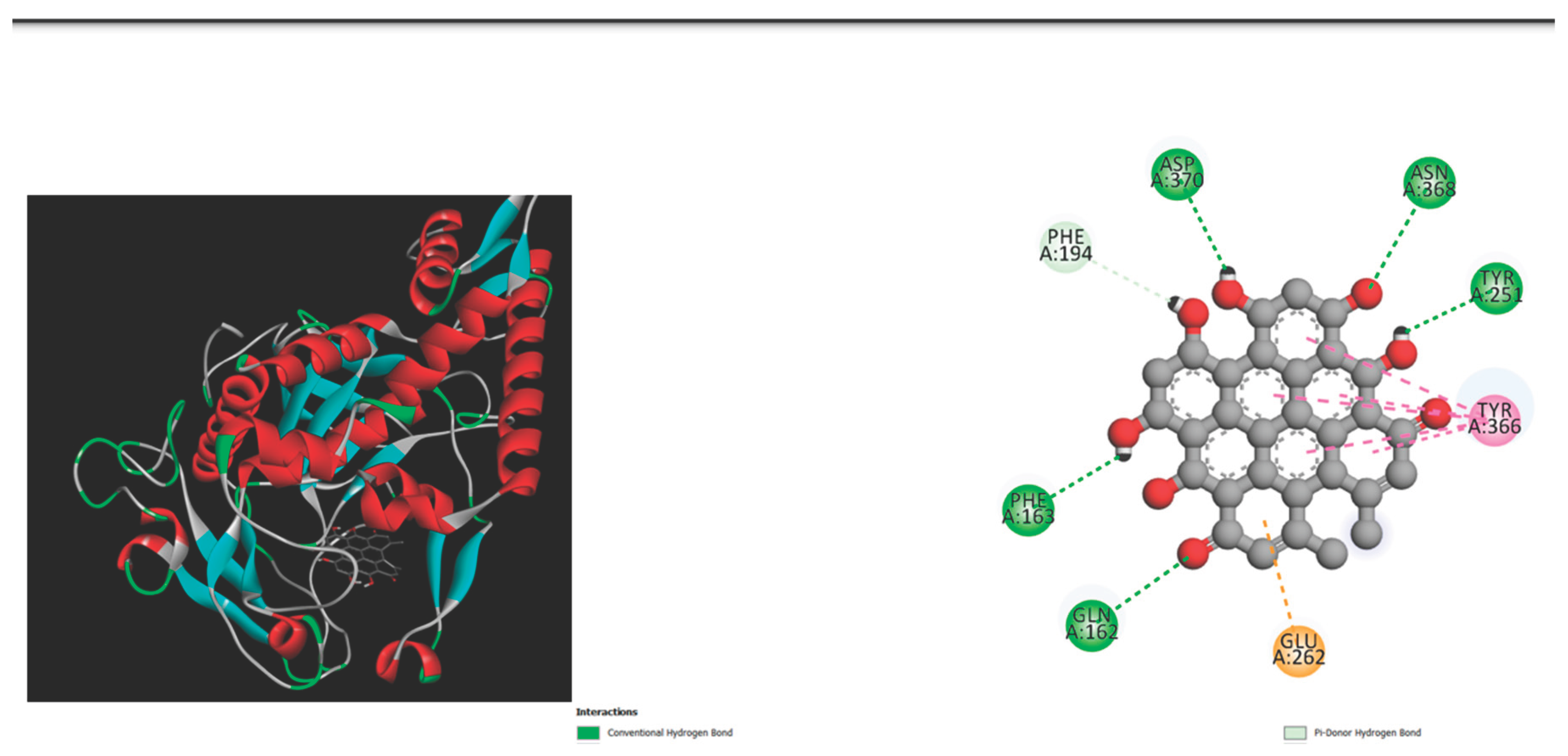
Figure 1.
3D structure and 2D interaction diagram of Hypericin docked in the catalytic domain of Botulinum Neurotoxin Serotype A (BoNT/A). The docking analysis illustrates key interactions, including hydrogen bonds, hydrophobic contacts, and π-π stacking, which stabilize the ligand within the active site. The figure was generated and analyzed using Discovery Studio.
Figure 1.
3D structure and 2D interaction diagram of Hypericin docked in the catalytic domain of Botulinum Neurotoxin Serotype A (BoNT/A). The docking analysis illustrates key interactions, including hydrogen bonds, hydrophobic contacts, and π-π stacking, which stabilize the ligand within the active site. The figure was generated and analyzed using Discovery Studio.
3.1. Final Top Results
3.1.1. Binding Energies
Top multitarget compounds demonstrated strong binding to all BoNT domains (Table 1). Hypericin, Hesperidin, Rutin, and Silibinin consistently showed high affinities across catalytic and receptor-binding domains and light chain complexes.

Table 5.
– Top multitarget natural compounds.
| Compound | 3BTA (kcal/mol) | 3AZV (kcal/mol) | 2ILP (kcal/mol) | 3C88 (kcal/mol) |
| Hesperidin | -10.8 | -9.5 | -8.7 | -9.9 |
| Hypericin | -10.6 | -8.6 | -10.0 | -10.0 |
| Silibinin | -10.1 | -9.0 | -6.3 | -9.9 |
3.1.2. Observations
- Flavonoids and polyphenols dominate the top binders due to multiple hydrogen bond donors/acceptors and aromatic systems capable of π-π stacking.
- Hypericin is the strongest multitarget ligand, suggesting both catalytic inhibition and interference with receptor binding.
- Compounds like Xanthone and Epicatechin Gallate showed selective high affinity for the light chain, mimicking inhibitor-like behavior.
3.1.3. Comparative Analysis Across Domains
- Catalytic domain (3BTA, 3C88) generally exhibited stronger binding (up to –10.8 kcal/mol) than receptor-binding domain (3AZV, up to –9.5 kcal/mol).
- Multitarget compounds may offer dual inhibition mechanisms, potentially enhancing neutralization efficacy.
3.1.4. Discussion
This study identifies Hypericin, Hesperidin, Rutin, and Silibinin as top multitarget inhibitors of BoNT/A. Their structural features, including glycosylation and polyphenolic rings, promote multiple interactions with the active site, receptor-binding residues, and light chain.
The findings support a strategy of drug repurposing of safe nutraceuticals, enabling rapid translation to experimental validation. Moreover, flavonoids’ multitarget binding is highly desirable, considering BoNT’s potent toxicity and multifaceted mechanism.
Selective binders like Epicatechin Gallate and Xanthone may serve as models for designing more potent inhibitors targeting specific domains.
4. Conclusion
This study demonstrates the potential of natural compounds, particularly polyphenols and flavonoids, as multitarget inhibitors of Botulinum Neurotoxin A (BoNT/A). Through comprehensive molecular docking analyses, including both blind docking and selective docking at the catalytic site, Hypericin, Hesperidin, and Silibinin consistently exhibited strong binding affinities across multiple BoNT/A domains. Hypericin emerged as the most promising multitarget ligand, maintaining high affinity for both the receptor-binding and catalytic domains, while Hesperidin and Silibinin also showed robust interactions, highlighting their capacity to inhibit BoNT/A effectively.
The results underscore the structural versatility of flavonoids and polyphenols—facilitating multiple hydrogen bonds, π-π stacking, and hydrophobic interactions—as a key factor in their multitarget potential. These findings provide a solid foundation for further experimental validation and support the exploration of safe, natural compounds as therapeutic or preventive agents against BoNT/A toxicity.
- Key Points
- Molecular docking highlights Hypericin, Hesperidin, and Silibinin as potent multitarget BoNT inhibitors.
- Flavonoids and polyphenols represent the most promising chemical classes for BoNT inhibition.
- The study provides a basis for further in vitro, in vivo, and pharmacokinetic studies to develop safe natural therapeutics against BoNT/A.
Author contributions: Ivan Vito Ferrari conceived the idea, designed the studies, carried out the research, interpreted the results, and wrote the manuscript.
References
- Jakhar, R., Dangi, M., Khichi, A., & Chhillar, A. K. (2020). Relevance of molecular docking studies in drug designing. Current Bioinformatics, 15(4), 270-278. [CrossRef]
- Scotti, L., JB Mendonca Junior, F., M Ishiki, H., F Ribeiro, F., K Singla, R., M Barbosa Filho, J., ... & T Scotti, M. (2017). Docking studies for multi-target drugs. Current drug targets, 18(5), 592-604.
- Abdelsattar, A. S., Dawoud, A., & Helal, M. A. (2021). Interaction of nanoparticles with biological macromolecules: A review of molecular docking studies. Nanotoxicology, 15(1), 66-95. [CrossRef]
- Tighe, A. P., & Schiavo, G. (2013). Botulinum neurotoxins: mechanism of action. Toxicon, 67, 87-93. [CrossRef]
- Davletov, B., Bajohrs, M., & Binz, T. (2005). Beyond BOTOX: advantages and limitations of individual botulinum neurotoxins. Trends in neurosciences, 28(8), 446-452. [CrossRef]
- Sugiyama, H. (1980). Clostridium botulinum neurotoxin. Microbiological reviews, 44(3), 419-448.
- Aoki, K. R., & Guyer, B. (2001). Botulinum toxin type A and other botulinum toxin serotypes: a comparative review of biochemical and pharmacological actions. European Journal of Neurology, 8, 21-29. [CrossRef]
- Peng Chen, Z., Morris Jr, J. G., Rodriguez, R. L., Shukla, A. W., Tapia-Núñez, J., & Okun, M. S. (2012). Emerging opportunities for serotypes of botulinum neurotoxins. Toxins, 4(11), 1196-1222. [CrossRef]
- Aoki, K. R. (2001). Pharmacology and immunology of botulinum toxin serotypes. Journal of Neurology, 248(Suppl 1), I3-I10. [CrossRef]
- Zhang, S., Masuyer, G., Zhang, J., Shen, Y., Lundin, D., Henriksson, L., ... & Stenmark, P. (2017). Identification and characterization of a novel botulinum neurotoxin. Nature communications, 8(1), 14130. [CrossRef]
- Trott, O., & Olson, A. J. (2010). AutoDock Vina: improving the speed and accuracy of docking with a new scoring function, efficient optimization, and multithreading. Journal of computational chemistry, 31(2), 455-461. [CrossRef]
- Eberhardt, J., Santos-Martins, D., Tillack, A. F., & Forli, S. (2021). AutoDock Vina 1.2. 0: new docking methods, expanded force field, and python bindings. Journal of chemical information and modeling, 61(8), 3891-3898.
- Seeliger, D., & de Groot, B. L. (2010). Ligand docking and binding site analysis with PyMOL and Autodock/Vina. Journal of computer-aided molecular design, 24(5), 417-422.
- Pettersen, E. F., Goddard, T. D., Huang, C. C., Couch, G. S., Greenblatt, D. M., Meng, E. C., & Ferrin, T. E. (2004). UCSF Chimera—a visualization system for exploratory research and analysis. Journal of computational chemistry, 25(13), 1605-1612. [CrossRef]
- Bhattacharjee, R., Devi, A., & Mishra, S. (2015). Molecular docking and molecular dynamics studies reveal structural basis of inhibition and selectivity of inhibitors EGCG and OSU-03012 toward glucose regulated protein-78 (GRP78) overexpressed in glioblastoma. Journal of molecular modeling, 21(10), 272. [CrossRef]
- Dallakyan, S., & Olson, A. J. (2014). Small-molecule library screening by docking with PyRx. In Chemical biology: methods and protocols (pp. 243-250). New York, NY: Springer New York.
Table 1.
highlights the top binders with binding energies ≤ –10 kcal/mol, calculated using the blind docking method in PyRx, for the crystal structure of Botulinum Neurotoxin Serotype A (PDB code: 3BTA).
Table 1.
highlights the top binders with binding energies ≤ –10 kcal/mol, calculated using the blind docking method in PyRx, for the crystal structure of Botulinum Neurotoxin Serotype A (PDB code: 3BTA).
| Ligand | Binding Energy (kcal/mol) |
| Folic_Acid | -10.2 |
| Hesperidin | -10.8 |
| Hypericin | -10.6 |
| Icariin | -10.3 |
| Silibinin | -10.1 |
Table 2.
highlights the top binders with binding energies ≤ –10 kcal/mol, calculated using the blind docking method in PyRx, for the crystal structure of Crystal structure of the receptor binding domain (PDB code: 3AZV).
Table 2.
highlights the top binders with binding energies ≤ –10 kcal/mol, calculated using the blind docking method in PyRx, for the crystal structure of Crystal structure of the receptor binding domain (PDB code: 3AZV).
| Ligand | Binding Energy (kcal/mol) |
| Hesperidin | -9.5 |
| Rutin | -9.1 |
| Silibinin | -9.0 |
Table 3.
report binding energies of natural compounds in the light chain ( pdb code 2ILP), highlighting their potential as inhibitors targeting BoNT/A’s catalytic site calculated by autodock vina in ligand binding site pocket of this protein performed by pyrx program.
Table 3.
report binding energies of natural compounds in the light chain ( pdb code 2ILP), highlighting their potential as inhibitors targeting BoNT/A’s catalytic site calculated by autodock vina in ligand binding site pocket of this protein performed by pyrx program.
| Ligand | Binding Energy (kcal/mol) |
| Hypericin | –10.0 |
| Quercitrin | –9.0 |
| Xanthone | –8.9 |
| Epicatechin Gallate | –8.8 |
| Hesperidin | –8.7 |
| Myricitrin | –8.6 |
| Rhaponticin | –8.6 |
Disclaimer/Publisher’s Note: The statements, opinions and data contained in all publications are solely those of the individual author(s) and contributor(s) and not of MDPI and/or the editor(s). MDPI and/or the editor(s) disclaim responsibility for any injury to people or property resulting from any ideas, methods, instructions or products referred to in the content. |
© 2025 by the authors. Licensee MDPI, Basel, Switzerland. This article is an open access article distributed under the terms and conditions of the Creative Commons Attribution (CC BY) license (http://creativecommons.org/licenses/by/4.0/).
Copyright: This open access article is published under a Creative Commons CC BY 4.0 license, which permit the free download, distribution, and reuse, provided that the author and preprint are cited in any reuse.


