

Submitted:
18 August 2025
Posted:
19 August 2025
You are already at the latest version
Abstract
Cotton is a significant cash crop globally, so optimizing the yield and quality of fibre is crucial for its sustainability. Managing canopy architecture and planting density in cotton is important because it affects light interception, humidity and temperature that are crucial for boll development and yield. Improper management adversely affects boll numbers, weight and boll setting rates. The present review highlights canopy management and planting density as the critical factors in enhancing productivity and optimizing the microenvironment in the cotton canopy. High-density planting maximizes light interception and lint yield by increasing bolls per unit area. However, excessive density can lead to reduced yield due to increased competition within plants. Furthermore, by managing canopy structure with pruning, chemical topping and manual topping, plant canopy can maintain a beneficial microclimate that is essential for higher yield. It also explains the importance of canopy microclimate, including air temperature, relative humidity and light interception in the development of bolls and fibre quality. By optimizing canopy architecture and planting density farmers can achieve higher yields and maintain fibre quality hence contributing to the global significance of cotton as a cash crop.
Keywords:
agronomic practices
; fibre quality
; light interception
; microclimate
; canopy architecture
1. Introduction
Cotton holds significant importance, contributing to many aspects of economies around the world. It is essential for global textiles and numerous industrial applications. Global production of cotton is projected to stand at 28.1 million metric tons by 2032, at a growth rate of 1.81% per annum and land expansion will contribute by 1.4% and 0.4% per annum, respectively (OECD-FAO, 2023). Cotton farming supports livelihood of 100 million farmers and almost 350 million people around the globe including ginning, labor, storage and baling (Fairtrade Foundation, 2022). Cotton is one of the main sources of income for millions of farmers around the world (Khan et al., 2020). In the textile industry, cotton is one of the most important raw materials used in production. The most used fabrics are the ones derived from cotton and are used in all fashion industries accounting for 70% of the apparel-making industries (Khanzada et al., 2020). This shows a strong demand for cotton and its by-products, hence promoting economic activities ranging from the cultivation by farmers, manufacturers and sellers. Cotton farming community faces significant challenges including rising production cost, market price volatility, declining yield and climate change which hinder their ability to maintain sustainable operations and provide fair wages (Li et al., 2021). These problems can be solved by applying optimal management practices in managing the crops to increase light penetration, modify microclimate and increase boll retention, thus increasing productivity and sustainable farming of cotton (Nadiruzzaman et al., 2021; Chabi Simin Najib et al., 2022). Some of the important management practices that can be implemented by the farmers include canopy management and the planting density in a particular agro-ecological condition.
Cotton shows different leaf types primarily as normal, okra and sub okra leaves. Normal leaves look board with multiple lobes gives more area for photosynthesis. Okra is lobed and narrower type which enhances light penetration also reduces pest infestation and sub okra leaves have reduced leaf area enhancing light distribution within the plant (Andres et al., 2016). Leaf area index was decrease in sub okra leaves by 11.24 to 22.84% and yield increased up to 5.72% as compared to normal leaves hence these morphological differences of leaves provide visual distinction as well as enhance cotton production efficiency (Jiang et al., 2024). These morphological differences influence yield hence playing important role in canopy management strategies. The key drivers in the demand for cotton and other eco-friendly fibres include the cost of production, accessibility of raw materials, technology and sustainable initiatives in the textile industry that involve the use of fibres such as organic cotton, hemp and jute among others. The present study emphasizes optimal planting density and canopy architecture for quality cotton production considering the above scenario. Recent developments and improvements in cotton agronomic practices and their impact on cotton quality and yield are thoroughly discussed in the present review.
2. Canopy Management Techniques
Canopy management is the major determinants of cotton yield and fibre quality. Canopy architecture and spatial distribution of cotton plants greatly influence light penetration, microclimate and resource use efficiency (Chapepa et al., 2020; Zhang et al., 2021). Radiation use efficiency (RUE) is an important agronomical factor that is affected by canopy management and planting density in the case of cotton cultivation (Ko et al., 2009). The size, shape and orientation of the shoot affect the rate of light interception in the cotton canopy (Bhattarai and Midmore, 2009). The response of cotton plants to different management practices allows the researchers to make conclusions about the efficiency of the specific interventions in increasing the yield of cotton and the quality of the fibres produced (Jiang et al., 2018). Different canopy management techniques such as chemical topping, pruning and manual topping as shown in Figure 1.
2.1. Pruning
Pruning of cotton is a management practice involving manually removing vegetative branches and unproductive plant parts to improve canopy architecture (Dai et al., 2014). By increasing light penetration, it helps to redistribute nutrients to the fruiting part. It is useful to prune the side branches of the plant to ensure compact canopy architecture and enhance plant height. It improves light penetration and increases air exchange, allowing crops to utilize light resources more efficiently. Pruning is a process of redistribution of the nutrients from the vegetative parts to the fruiting structures, thus enhancing the yield and fibre quality (Wang et al., 2021). Pruning is normally done 40-45 days after sowing when the plants have grown up to 40-45 centimeters in height (Dai et al., 2014; Ramkrushna G.I., 2023). Monopodial branches are pruned manually using secateurs, pruning shears, hand pruners, or knives depending on the size of the branch to be pruned. Therefore, pruning is one of the canopy management practices in cotton production that is used to control the outward growth of plants, improve light interception and distribution as well as optimize nutrients given to the fruiting structures (Nie et al., 2023). Thus, it was found that the use of pruning as a management practice at the right growth stage and in conjunction with other practices can significantly increase the cotton yield.
2.2. Chemical Topping
Mepiquat chloride is a plant growth regulator that is applied to control the height of the plant and provide a more compact structure of the canopy in cotton plants (Tung et al., 2020). It is applied at the rate of 1.0 ml/liter of water for the first spray and 1.2 ml/liter of water for the second and third sprays. The use of Mepiquat chloride decreases the plant height through the inhibition of cell division and promoting the cell division hence a dense canopy structure (Shekar, 2011). This leads to increased light penetration and nutrient distribution in the canopy layer leading to higher rates of photosynthesis and plant productivity (Liang et al., 2020). PGR’s such as Mepiquat chloride are used 2-3 times within a crop season with the first spray 40-45 days after sowing, when the plants are approximately 40-45 cm tall. Subsequent sprays are based on the length of the top five internodes; a spray is required when the average of these is more than 4 cm. Koudahe et al., (2021) also pointed out that MC is helpful in enhancing the canopy structure and boll retention. It also has the potential to increase the fibre quality through increasing the fibre length, strength and micronaire. Compared to other PGRs, Mepiquat chloride is more effective in reducing the height of plants and increasing the compactness of the canopy structure (Tung et al., 2020). The optimal time to apply Mepiquat chloride is at the early stages of plant growth especially at 40-45 days after sowing. When PGRs are used at the right growth stages together with the right decision criteria, farmers can optimize a desirable canopy architecture that will enhance light penetration, nutrient distribution and subsequently high yields of cotton with improved fibre quality (Ramkrushna G. I., 2023).
2.3. Manual Topping
Manual topping is one of the canopy management practices that is traditional in China (Wu et al., 2023) and has been used in cotton production whereby the terminal growing point of the cotton plant is removed to limit the growth of the plant height and promote lateral growth of the branches (Awan et al., 2022). Manual topping helps minimize the vegetative growth and enhances the yield and early production of cotton. It also reduces the use of insecticides, sucking insects and improves cotton yield (Brévault et al., 2024). Manual topping also involves the use of secateurs, pruning shears, hand pruners and a knife blade to remove the terminal bud. The crop height is managed to a height of about 90-100 cm through de-topping (Renou et al., 2011). Topping is done manually and this is labor-intensive and time-consuming hence making it a significant impediment to the full mechanization of cotton production. There is also a problem with the quality of the manual topping since skilled labor may be scarce and may also not be able to meet the production requirements. Mechanical topping has not been implemented frequently because it negatively impacts the cotton plants and their bolls (Renou et al., 2011; Tian et al., 2022). Manual topping is one of the promising and efficient methods of canopy management in cotton cultivation that is used to regulate vegetative growth, optimize the structure of the canopy and, thus, increase yield and fibre quality. Though it has been a labor-consuming method and has not been easily mechanized, it has paved the way for other techniques such as chemical topping using plant growth regulators. Wang et al. (2014) suggested that delaying the timing of shoot topping has been found to decrease fibre quality affecting the physiological age and development of individual cotton bolls.
2.4. Combing Chemical Topping with Pruning
To entrap more radiation canopy was reduced by observing chemical topping and removing side branches of cotton (Maiti et al., 2020). The major aim of this technique is to have a dense canopy structure to capture maximum light and nutrient distribution for fruit development. The combined strategy of pruning and chemical topping is a way to reduce boll rot, improve boll retention and increase green pigment in leaves as compared to control (Thind and Mahal, 2021). This consolidated approach tends to improve fibre quality and high cotton seed yields by manipulating the canopy cover and resource distribution within plant parts (Yang et al., 2008). For the chemical topping, when the crop is in the field apply the chemical 2-3 times, first application is done after sowing when the plant attains a height of 40-45 cm within 40 days. When the length of the top internodes exceed 4cm plant is ready for the next plant growth regulator spray. Manual pruning of vegetative parts is accomplished simultaneously or soon after the application of chemicals to develop a strong canopy further. The crop height is stopped by de-topping either chemically by using PGRs or manually at 90-100 cm (Yang et al., 2008).
The efficiency of this integrated management may vary and depends on many factors including nutrient availability, moisture content of the soil and the plant ecology (Bargaz et al., 2018). Thus, controlling plant growth and applying PGRs at the right time can help to increase the yield of cotton and improve the architecture of the canopy. The combined application of chemical topping and pruning is anchored on resource availability and other growth factors that define cotton cultivation (Eagan and Dhandayuthapani, 2018). Indeed, this strategy of chemical topping using PGRs with manual pruning is a significant technique for the achievement of the desired yield of cotton and a crucial method of preserving the dense canopy. Combined treatment can effectively reduce branch elongation to increasing yield chemical should be sprayed after 5 days of pruning which can enhance yield up to 15.28% (Cui et al., 2020). Different methods can be tailored to achieve targeted outcomes in cotton production system. Table 1 shows the application periods and field application methods and how it effects cotton performance. Among all Mepiquat chloride applied during flowering and squaring stage enhanced yield while limiting plant height making it leading choice for cotton improving.
2.5. Combing Manual Topping with Pruning
Manual topping promotes a compact canopy by removing the top growing points and helps control plant height. When vegetative parts are manually pruned, it increases light penetration and photosynthates assimilation in plants that store the nutrients in the fruiting structure of cotton (Sehrawat Dhankhar and Pannu, 2014). When combined the manual topping with pruning an increase observed in boll number due to a reduction in abscised fruiting site (Yang et al., 2008). Manual topping and pruning is another approach in cotton cultivation and are helpful for optimizing yield (Dai et al., 2014). Manual topping and pruning have increased the greenness of the leaf which is essential to enhance photosynthesis in the leaf for better growth and development of fruit. For manual pruning usually one-leaf secateurs is used (Yang et al., 2008; Renou et al., 2011). Manual pruning is either done with manual topping or shortly after topping operation to further process the canopy structure. Both these practices are laborious and demand highly skillful workers for proper implementation and to minimize the risk of damaging cotton crops. Integrated canopy management strategies effectively optimized light interception and resource distribution as shown in Figure 2.
The handling of manual practices may vary due to the large-scale production of cotton and may lead to inconsistency in manual operation and leads to damage to the cotton plant and bolls. Many factors are contributing to this manual strategy of increasing cotton production such as plant overall ecology, soil humidity, nutrient availability and translocation (Lopez Llandres et al., 2017). Though this is traditional management technique but it’s still very helpful in maintaining crop equal growth and development by maintaining canopy architecture for proper light penetration to increase overall cotton production.
3. Impact of Canopy Management on Cotton Radiation Use Efficiency, Yield and Quality
By altering the canopy structure of the plant. The light penetration can be modified which somehow to affect the quality parameters of cotton.
3.1. Cotton Radiation Use Efficiency
Many factors can affect the radiation use efficiency (RUE) of cotton like pruning and shoot topping which can ultimately enhance the light-capturing capacity and resource storage in the fruiting part of the plant (Liang et al., 2020). Pruning has improved cotton seed yield by up to 34% through the accumulation of photosynthates within the plant and increased the light interception rate of the plant (Reta-Sánchez and Fowler, 2002). This practice leads light to penetrate lower leaves and boosts the overall photosynthesis rate for better development of the boll. Many studies have shown that seed cotton yield is high by pruning as the number and weight of bolls increased due to nutrient allocation as compared to control. Shoot topping is another helpful technique for canopy management as it removes the terminal bud and promotes growth in the lateral bud to maintain a uniform structure of the canopy (Khalil et al., 2023). These changes increase the boll retention of plants as the photosynthesis rate is high due to more light penetration. Research has indicated that these management practices are important to maintain a favorable microclimate for efficient light interception and nutrient distribution in cotton for optimal boll development. For sustainable cotton cultivation such integrated techniques contribute to boll development and increase in number of cotton seeds (An et al., 2023).
3.2. Seed Cotton Yield Enhancement
Cotton defoliants can help in the early shedding of leaves and opening of bolls and hence affect the quality of the bolls by influencing the time of boll maturity and harvesting (Ubaydullaev et al., 2021). Cotton leaf abscission and boll opening are processes that influence the physiological parameters of the cotton plants, including boll formation and maturation. Defoliation can alter the height of the canopy which may impact the microclimate of the canopy, in turn affecting boll characteristics and yield formation (Wu et al., 2022). The spatial position of bolls within the canopy may also be affected by canopy management practices such as defoliation and pruning about factors such as boll-setting rate and boll weight at various positions of fruiting branches. The position of bolls in the canopy also affects the quality and quantity of the cotton bolls, the weight of the bolls and the boll setting percentage. Zhang et al. (2021) study reveals that canopy management practices like pruning and planting density influence the quality of the cotton bolls in terms of boll maturation, spatial distribution, microclimate conditions and boll characteristics.
3.3. Fibre Quality Improvement
Parameters like temperature and relative humidity affect the fibre development and quality of the cotton (Yang et al., 2014). This means that with higher plant density, the canopy microclimate of the field is changed and it influences some of the parameters such as the fibre length, fibre strength and micronaire (Altundag and Karademir, 2021). Thus, the findings in the literature are that canopy management techniques, particularly shoot topping, which is the removal of the main stem and branch tips, can influence cotton fibre quality. In particular, the plant density and the canopy microclimate which is formed can also influence the fibre quality parameters such as the fibre length, strength and the micronaire (Altundag and Karademir, 2021).
4. Planting Density Management in Cotton Cultivation
Planting density is also a crucial factor in the management of cotton production since it affects the plants’ growth, light interception (Khan et al., 2017). It means that the planting density can affect boll development, nutrient distribution and general health of the plant. Plant with densities greater than 40,000 plants per hectare may lead to competition for light, water and nutrients among the plants (Kavya et al., 2023). This competition sometimes results in smaller boll sizes since a plant will allocate resources to the development of fewer bolls which in this case will be smaller and lighter. Higher planting density indicates better opportunities to maximize the interception of radiation by the crop canopy with more light intercepted in different parts of the canopy (Shakarami and Rafiee, 2009). However, the vertical penetration of light into the canopy layer is not equal and uniform. The lower canopy layer receives maximum amount of light while the upper canopy layer receives minimum amount of light because of the dense structure of the canopy. A suitable planting density ensures increased light penetration and gaseous exchange to enhance the utilization of light resources for high crop yields (Zhang et al., 2021). The planting density changes the distribution of the leaf azimuthal and the sizes of the plants and therefore, the light interception. Plant density is one of the important crop management practices that affect canopy light distribution and canopy photosynthetic capacity in cotton and the increase in plant density generally increases the value of leaf area index (LAI) to an optimum population density is reached, beyond which it has no significant effect on yield (Chapepa et al., 2020). Furthermore, denser canopy offers high humid microclimate and this is likely to encourage diseases such as fungal and pest infestations (Monteiro et al., 2006). Shading at high densities can also lower the photosynthetic rates and thus reduce light penetration and negatively influence the yield. Plants with planting density below 30,000 plants per hectare have some advantages such as higher light interception and better air circulation (Yada, 2011). Since it reduces the number of plants, the light can reach the lower leaves and promote better photosynthesis and thus the bolls are larger and heavier due to better distribution of nutrients. Due to increased airflow in a less dense canopy helps in the reduction of the humidity and the risk of disease is also lower. However, very low densities may lower the total yield due to a reduced number of plants as well as enhance the competition with weeds, which in turn influences the availability of resources (Sylla et al., 2013). Moderate planting density ranging from 30,000-40,000 plants per hectare may be considered optimal because they are between the extremes of higher and lower densities (Kgasago, 2006). This density range ensures that the plants intercept light to the greatest degree and capture light while minimizing competition between the plants. It favors an appropriate number of bolls with the right size and weight and a standard microclimate, better airflow and disease control. In this regard, medium planting densities enable the development of good bolls and general productivity (Zhou et al., 2021).
Optimizing planting densities enables the plants to effectively capture light in the canopy leading to improved photosynthetic capacity, thus increasing the yields (Li et al., 2021b). Other microclimates of the canopy also affect boll number per unit area (Zhang et al., 2021). The type of growing environment and the cultivar affect the optimal density of planting for boll characteristics. Planting densities that result in higher plant populations intercept more light, humidity and temperature which in turn influence boll number, weight and boll-setting rate (Yang et al., 2014). Optimal planting densities are crucial in determining high boll yield and fibre quality (Feng et al., 2014).
5. Effects of Planting Density on Cotton Agronomic Parameters
Many factors affect the agronomic characteristics of the crop while growing cotton and among these are the planting density. Stress factors such as light, water and nutrients become limited at high planting densities and this results in a higher boll per hectare (Zhi et al., 2016). However, increase competition can compromise the formation of individual bolls, as they may be formed in smaller sizes and with lower weights. On the other hand, low planting density usually produces fewer bolls per plant, but the bolls are large and heavy because of lower competition and efficient partitioning of nutrients. Moderate planting density can balance the number of bolls produced with the balanced size of the bolls hence increasing the yield quality.
5.1. Boll Weight
Boll weight is important factor influenced by the planting density (Zhang et al., 2021). Higher planting density also reduces the size of the boll produced due to competition for the plant’s resources which are detrimental to the yield. Lower planting density, on the other hand, results in larger bolls as the plants get to compete less on the available nutrients hence each boll gets bigger and heavier. Medium planting densities generally favor the optimal boll weight, which is a result of the advantages of both large and small planting densities and helps to increase seed cotton yield by making bolls of the desirable size and weight.
5.2. Boll-Setting Rate
Another factor that is also affected by planting density is the boll-setting rate which is the ratio of flower buds that fully develop into mature bolls. Higher population densities may reduce the boll setting rate because plants are stressed and competition among plants; hence, fewer boll formations are likely to occur (Khan et al., 2017). Lower planting densities usually have a better boll-setting rate since plants have more resources to support each boll’s growth. Moderate planting densities are usually associated with a high rate of boll setting because of proper resource distribution and competition, which optimize the number of bolls as well as their quality (Khan et al., 2019). Planting density management is crucial for the achievement of high yield and quality of cotton crops. It is possible to make better decisions that increase yields and efficiency of growing cotton through the knowledge of the impacts of higher, lower and medium planting densities on boll number, weight and setting rates.
5.3. Cotton Yield
The higher planting density provides the best light interception and canopy architecture (Li et al., 2023). The shaded ground in high plant densities and higher evapotranspiration contribute to cooling and humidifying effect. All these factors should therefore be well managed to achieve a sustainable and efficient production of cotton. The planting density that will help to get the highest yield and better fibre quality which varies among different varieties and geographical locations. Cotton yield normally increases with the increase in plant density to a certain level after which it starts to decline (Vaughan, 2005). For example, in the research on hybrid cotton, the yield of cotton raised with plant density up to the level of 3.0 plants m-2 (Yang, et al., 2014). The relationship between plant density and yield in cotton crops is a multifaceted one depending on factors such as the type of cotton, the regional conditions and yield parameters. Optimal planting density must be established depending on the conditions of the cotton crop to increase the yield and quality of the fibres (Ul-Allah et al., 2021). It is established that appropriate planting density that will help increase the yield and quality of the fibre depends on the type of cotton and the area in which it will be planted. Canopy management and planting density are the important factors that influenced the yield of cotton and its fibre quality. Canopy architecture and spatial arrangement of the cotton plants affect light penetration, microclimatic conditions and efficiency with which resources are used. Some of the planting patterns like high density and wide-narrow row spacing have been observed to increase the yield stability and fibre quality of cotton. Higher planting density such as 100,000 plants ha-1 increased 70 percent yeid in venzuela. Growth regulators also demonstrated high yield when DPC dimethylpiperidinium chloride increased yield by 4.7%. The importance of selecting plant per hectare and use of PGR in yield improvements as compared to control is shown in Table 2.
6. Challenges and Discussion
Despite owning several benefits of canopy management, it also faces challenges like labor intensive work, labor can only prune limited number of plants per day which can delay over all farming schedule (Yue and Sun, 2019). Manual toping heavily relies on labor skill to top at same height and same timing inconsistency can result in plant hormone irregulating (TIAN et al., 2022) Hinderance that farmer faces while topping with chemical includes sourcing these chemical and proper training to get efficient results. Soil moisture and weather condition also cause drift in ineffectiveness (Dai et al., 2022). With time plant can become resistant to these chemicals, that’s why it’s crucial to monitor and adopt sustainable practice to mitigate the risk. Improper pruning can increase risk stress in plants. Pruning during wet conditions can increase risk of wilting or disease due to fresh cut exposure to humidity (Iqbal et al., 2024). To sustain cotton production different future directions can be explored to enhance effectiveness of these methods including remote sensing that can be used to monitor the crops optimal time for topping pruning, proper workshops m extension service can help bridging gap to latest method and in implementing innovative methods to enhance yield as shown in Figure 3. The cotton industry can increase productivity and sustainability by adopting these improved strategies while reducing labor costs and environmental impact.
By focusing on innovative canopy management methods like integrating remote sensing and plant modelling promising yield can be obtained. Cotton plays a crucial role in the world’s economy, a means of earning for millions of families. Future prospect of cotton production increasingly relies on advanced canopy management techniques such as advance canopy management such as planting density, applying topping, pruning strategies. Demand for achieving higher yield while maintaining fibre quality is increasing while area for cotton production is decreasing due to floods and inheritance fragmentation. Optimizing plant density will play a crucial role in maximizing yield per unit area while balancing the number of plants within available resources like water and nutrients. Efficient canopy management is also vital to control unwanted growth of cotton plant. Topping control plant height and encourage lateral branches promoting air circulation within canopy. Pruning selective single or double will help in balancing vegetative and reproductive growth for optimal plant structure. This technique will become important as farmer seeks to enhance productivity by ensuring sustainable agriculture practices and maintain fibre quality in an increasingly demanding global market.
7. Conclusions
Cotton contributes to many aspects of economies around the world. Light interception in cotton crops is highly influenced by plant density and spatial arrangement of the plants. Present review indicated that proper plant density can improve the distribution of light within the canopy as well as the photosynthetic ability of the plant. Canopy management and planting density are the influential factors for the enhancement of cotton yield and fibre quality. The recommended planting density for obtaining higher yields and better quality of the fibres depends on the type of the cotton and the region crop is growing. It is crucial to establish the correlations between canopy management, planting density, cotton yield and fibre quality to improve the cotton production system
8. Patents
Author Contributions
Conceptualization, Muhammad Abu Bakar Hayat and Jinhu Zhi; methodology, Muhammad Abu Bakar Hayat and Fahd Rasul; validation, Jinhu Zhi, Xinlu Bai and Runze Wang; formal analysis, Muhammad Zia Ul Haq; investigation, Muhammad Abu Bakar Hayat and Fahd Rasul; resources, Xinlu Bai and Runze Wang; data curation, Muhammad Zia Ul Haq; writing original draft preparation, Muhammad Abu Bakar Hayat; writing review and editing, Jinhu Zhi, Fahd Rasul, Xinlu Bai, and Runze Wang; visualization, Muhammad Zia Ul Haq; supervision, Jinhu Zhi; project administration, Jinhu Zhi. All authors have read and agreed to the published version of the manuscript.
Funding
This research received no external funding.
Data Availability Statement
No new data were created or analyzed in this study. Data sharing is not applicable to this article.
Acknowledgments
The authors sincerely thank the College of Agriculture, Tarim University, Alar, and the Department of Agronomy, University of Agriculture Faisalabad, for their academic support.
Conflicts of Interest
The authors declare no conflicts of interest. The funders had no role in the design of the study; in the collection, analyses, or interpretation of data; in the writing of the manuscript; or in the decision to publish the results.
References
- Ahmed, S., G.R. Sarwar, A.M. Khan, K. Mahmood, S. Munir and G.M. Siddiqui, 2015. Effect of plant growth regulators on seed cotton yields and fibre traits.
- Altundag, R., Karademir, E. (2021): Plant spacing and its effect on yield, fibre quality and physiological parameters in cotton.
- An, J., Zhang, Z., Li, X., Xing, F., Lei, Y., Yang, B., Li, Y. (2023): Loose and tower-type canopy structure can improve cotton yield in the Yellow River basin of China by increasing light interception. –Achieves of Agronomy and Soil Science 69(6): 920-933. [CrossRef]
- Andres, R.J., D.T. Bowman, D.C. Jones and V. Kuraparthy. 2016. Major leaf shapes of cotton: Genetics and agronomic effects in crop production. J Cotton Sci 20(4): 330-340. [CrossRef]
- Awan, Z., Saleem, M., Khan, L. and Imran, A. 2022. Effects of shoot apex removal on growth and yield attributes of cotton. European Journal of Biology and Biotechnology, 3(2). [CrossRef]
- Bargaz, A., Lyamlouli, K., Chtouki, M., Zeroualand, Y., Dhiba, D. (2018): Soil microbial resources for improving fertilizers efficiency in an integrated plant nutrient management system. – Frontiers in microbiology 9:1606. [CrossRef]
- Bhattarai. S. P., Midmore, D. J. (2009): Oxygation enhances growth, gas exchange and salt tolerance of vegetable soybean and cotton in a saline vertisol. – Journal of Integrative Plant Biology 51:675-688. [CrossRef] [PubMed]
- Brévault, T., Maïga, D. S., Coulibaly, M., Traoré, A., Badiane, D., Sodio, B., Tereta, I. (2024): Effect of manual topping on insect pest incidence and cotton yield. –Available at SSRN 4862182.
- Chabi, S. N.D., Fei, C., Dilanchiev, A., Romaric, S. (2022): Modeling the Impact of Cotton Production on Economic Development in Benin: A Technological Innovation Perspective. – Frontiers in Environmental Science 10.
- Chapepa, B., N. Mudada Mapuranga, (2020): The impact of plant density and spatial arrangement on light interception on cotton crop and seed cotton yield: an overview. – Journal of Cotton Research 3:18. [CrossRef]
- Cui, Y., Zhang, L., Zhang, T., Kang, Z., Zhao, Q. (2020): Effects of combining cotton artificial detopping with chemical detopping on cotton agronomic and yield traits. Xinjiang Agric. Sci., 57(12): 2197.
- Dai, J., Luo, Z., Li, W., Tang, W., Zhang, D., Lu, H., Li, Z., Xin, C., Kong, X., Eneji, A., & Dong, H. (2014). A simplified pruning method for profitable cotton production in the Yellow River valley of China. Field Crops Research, 164, 22-29. [CrossRef]
- Dai, J., Tian, L., Zhang, Y., Zhang, D., Xu, S., Cui, Z., Li, Z., Li, W., Zhan, L. Li, C. (2022): Plant topping effects on growth, yield and earliness of field-grown cotton as mediated by plant density and ecological conditions. – Field Crops Research 275: 108337. [CrossRef]
- Eagan, S., Dhandayuthapani, U. N. (2018): Organic agriculture: techniques to improve crop production. Eco-friendly agro-biological techniques for enhancing crop productivity:1-24.
- Fairtrade Foundation (2022). Cotton farmers.
- Fang, S., K. Gao, W. Hu, S. Wang, B. Chen and Z. Zhou. 2019. Foliar and seed application of plant growth regulators affects cotton yield by altering leaf physiology and floral bud carbohydrate accumulation. Field Crops Research 231: 105-114. [CrossRef]
- Feng, L., Mathis, G., Ritchie, G., Han, Y., Li, Y., Wang, G., Zhiand, X., Bednarz, C.W. (2014): Optimizing irrigation and plant density for improved cotton yield and fibre quality. – Agronomy journal 106:1111-1118.
- Guzman, M., Vilain, L., Rondon, T., Sanchez, J. (2019): Sowing density effects in cotton yields and its components. – Agronomy 9:349. [CrossRef]
- Iqbal, M., Iqbal, S., Jahangeer, A., Arshad, M., Akhtar, N., Hussain, A., Hussain, M., Shahid, M. and Abbas, Q. 2024. Optimizing seed cotton yield: Exploring the synergistic effects of de-topping stage and plant spacing. Sarhad Journal of Agriculture, 40(4): 1277-1287. [CrossRef]
- Ji, Y., J. Liu, B. Hao, R. Xu, J. Zhang, H. Xiao, S. Wan, G. Chen and H. Dong. 2023. Effect of chloride salicylic acid ionic liquids on cotton topping and high-temperature resistance. Agronomy 13(12): 2905. [CrossRef]
- Jiang, H., X. Ma, J. Shi, M. Gao, X. Zhang, C. Zhang, Q. Chai, Y. Wang, X. Wang and J. Wang. 2024. Sub-okra leaf shape conferred via chromosomal introgression from gossypium barbadense l. Improves photosynthetic productivity in short-season cotton (gossypium hirsutum l.). Frontiers in Plant Science 15: 1393396. [CrossRef] [PubMed]
- Jiang. Y., Li, C., Paterson, A. H., Sun, S., Xu, R., Robertson, J. (2018): Quantitative analysis of cotton canopy size in field conditions using a consumer-grade RGB-D camera. – Frontiers in plant science 8:2233. [CrossRef]
- Kavya, D., Kumari, C. P., Sreenivas, G., Prakash, T. R., Triveni, S. (2023): Optimisation of Planting Densities and Nitrogen Requirement for Bt Cotton under High Density Planting System. – International Journal of Bio-resource and Stress Management, 14(1), AR3309a. [CrossRef]
- Kgasago, H. (2006): Effect of planting dates and densities on yield and yield components of short and ultra-short growth period maize (Zea mays L.). University of Pretoria (South Africa).
- Khalil, A., Mir, M., Nabi, S., Mir, M. M., Iqbal, U., Nazir, N., Banday, S. A., Bhat, R., Khan, S. Q., Wani, T. F. (2023): Canopy Management, Temperate Nuts. Springer. p. 209-245.
- Khan, A., J. Zheng, D.K.Y. Tan, A. Khan, K. Akhtar, X. Kong, F. Munsif, A. Iqbal, M.Z. Afridi and A. Ullah. 2019a. Changes in leaf structural and functional characteristics when changing planting density at different growth stages alters cotton lint yield under a new planting model. Agronomy 9(12): 859. [CrossRef]
- Khan, A., Kong, X., Najeeb, U., Zheng, J., Tan, D. K. Y., Akhtar. K., Munsif, F., Zhou, R. (2019): Planting density induced changes in cotton biomass yield, fibre quality and phosphorus distribution under beta growth model. – Agronomy 9(9): 500. [CrossRef]
- Khan, A., Najeeb, U., Wang, L., Tan, D. K. Y., Yang, G., Munsif, F., Ali, S., Hafeez, A. (2017): Planting density and sowing date strongly influence growth and lint yield of cotton crops. – Field Crops Research 209:129-135. [CrossRef]
- Khan, A., Wang, L., Ali, S., Tung, S. A., Hafeez, A., Yang, G. (2017): Optimal planting density and sowing date can improve cotton yield by maintaining reproductive organ biomass and enhancing potassium uptake. – Field crops research 214: 164-174. [CrossRef]
- Khan, M. A., Wahid, A., Ahmad, M., Tahir, M. T., Ahmed, M., Ahmad, S., Hasanuzzaman, M. (2020): World cotton production and consumption: An overview. Cotton production and uses: Agronomy, crop protection and postharvest technologies:1-7.
- Khanzada, H., Khan, M. Q., Kayani, S. (2020): Cotton based clothing. Cotton science and processing technology: Gene, ginning, garment and green recycling:377-391.
- Ko, J., Piccinni, G., Guo, W., Steglich, E. (2009): Parameterization of EPIC crop model for simulation of cotton growth in South Texas. – The Journal of Agricultural Science 147:169-178. [CrossRef]
- Koudahe, K., Sheshukov, A. Y., Aguilarand, J., Djaman, K. (2021): Irrigation-water management and productivity of cotton: A review. – Sustainability 13:10070. [CrossRef]
- Li, F. R., Zhao, W. C., Zhang, D. L., Dong, L. Y., Wang, R. M., Qi, H. X., Zhang, C., Zhang, G.J., Yang, X. F., Shi, J. L. (2023): Density and row spacing of short-season cotton suitable for machine picking in the cotton region of Yellow River Basin. – Ying Yong Sheng tai xue bao=The Journal of Applied Ecology 34:1002-1008. [PubMed]
- Li, N., Yao, N., Li, Y., Chen, J., Liu, D., Biswas, A. Li, L., Wang, T., Chen, X. (2021): A meta-analysis of the possible impact of climate change on global cotton yield based on crop simulation approaches. –Agricultural Systems 193: 103221. [CrossRef]
- Li, R., Zhang, G., Liu, G., Wang, K., Xie, R., Hou, P., Ming, B., Wang, Z., Li, S. (2021b): Improving the yield potential in maize by constructing the ideal plant type and optimizing the maize canopy structure. – Food and Energy Security 10: e312. [CrossRef]
- Liang, F. B., Yang, C. X., Sui, L. L., Xu, S. Z., Yao, H. S., Zhang, W. F. (2020): Flumetralin and dimethyl piperidinium chloride alter light distribution in cotton canopies by optimizing the spatial configuration of leaves and bolls. – Journal of Integrative Agriculture 19(7): 1777-1788. [CrossRef]
- Liang, F., Yang, C., Sui, L., Xu, S., Hesheng, Y. and Zhang, W. 2020. Flumetralin and dimethyl piperidinium chloride alter light distribution in cotton canopies by optimizing the spatial configuration of leaves and bolls. Journal of Integrative Agriculture, 19: 1777-1788. [CrossRef]
- Lopez Llandres, A., Renou, A., Jean, J., Goebel, F.-R. and Brévault, T. 2017. Chemical ecology underlying cotton topping. CNRS.
- Maiti, R., Kumari, C. A., Huda, A. K. S., Mandal, D., Begum, S. (2020). Physiological Basis of Cotton Growth and Productivity, Advances in Cotton Science. – Apple Academic Press. p. 65-169.
- Monteiro, J., Sentelhas, P. C., Chiavegato, E. J. (2006): Microclimate and ramulosis occurrence in a cotton crop under three plant population densities in southern brazil. – Agriscientia 23(2): 45-53. [CrossRef]
- Nadiruzzaman, M., Rahman, M., Pal, U., Croxton, S., Rashid, M. B., Bahadur, A., Huq, S. (2021): Impact of climate change on cotton production in Bangladesh. – Sustainability 13:574. [CrossRef]
- Nie, J., Sun, L., Zhan, L., Li, X., Hou, W., Zhang, Y., Li, W., Zhang, D., Cui, Z., Li, Z. (2023): Terminal removal at first square enhances vegetative branching to increase seedcotton yield at low plant density. – Field Crops Research 302:109096. [CrossRef]
- OECD-FAO. (2023): Agricultural Outlook 2023-2032. OECD Publishing, Paris.
- Ramkrushna, G. I., MVVYGP (2023): Plant Growth Regulator (PGR) Sprays in High Density Planting System (HDPS) & Closer Planted Cotton – Decision Criteria, ICAR- CENTRAL INSTITUTE FOR COTTON RESEARCH, P. B No. 2, Shankar Nagar P.O., Nagpur- 440010.
- Renou, A., Téréta, I., Togola, M. (2011): Manual topping decreases bollworm infestations in cotton cultivation in Mali. – Crop Protection 30:1370-1375. [CrossRef]
- Reta-Sánchez, D. G., Fowler, J. L. (2002): Canopy light environment and yield of narrow-row cotton as affected by canopy architecture. Agronomy Journal 94(6): 1317-1323. [CrossRef]
- Sehrawat, S., Dhankharand, S. S., Pannu, R. (2014): ICAR-JRF (PGS).
- Shakarami, G., Rafiee, M. (2009): Response of corn (Zea mays L.) to planting pattern and density in Iran. – Agric. J. and Environment. Sci 5:69-73.
- Shekar, K. (2011): Effect of growth regulator chloro mepiquat chloride and high-density planting on growth and yield of Bt cotton. M. Sc.(Agric) Thesis, Acharya NG Ranga Agricultural University, Rajendranagar, Hyderabad.
- Shi, F., Y. Tian, X. Shi, X. Hao, N. Li, J. Li, H. Zhang, Y. Chen, Q. Liang and H. Han. 2022. Chemical topping with 1, 1-dimethylpiperidinium chloride increases lint yield and defoliation of cotton by improving canopy development. Crop and Environment 1(4): 251-261. [CrossRef]
- Sylla, N., Maleia, A. M. P., Abudo, J. (2013): Effect of plant density on seed cotton yield. – African Crop Science Conference Proceedings, 11, 101-104.
- Thind, S. K., Mahal, J. (2021): Package of practices for cultivation of fruits. Additional Director of Communication for Punjab Agricultural University: Ludhiana, India:1-188.
- Tian, Y., Liao, B., Han, H., Wang, F., Du, M., Tian, X., Li, Z. (2022): The efficacy of chemical topping in field-grown cotton is mediated by drip irrigation amount in irrigated agricultural area. – Journal of Cotton Research 5(1): 16. [CrossRef]
- Tung, S. A., Huang, Y., Hafeez, A., Ali, S., Liu, A., Chattha, M. S., Ahmad, S., Yang, G. (2020): Morpho-physiological effects and molecular mode of action of mepiquat chloride application in cotton: a review. – Journal of Soil Science and Plant Nutrition 20: 2073-2086. [CrossRef]
- Ubaydullaev, M. M. U., Askarov, K. K., Mirzaikromov, M. A. U. (2021): Effectiveness of new defoliants. – Theoretical & applied science Учредители: Теoретическая и прикладная наука (12): 789-792.
- Ul-Allah, S., Rehman, A., Hussain, M., Farooq, M. (2021): Fibre yield and quality in cotton under drought: Effects and management. – Agricultural Water Management 255:106994. [CrossRef]
- Vaughan, A. M. (2005). Factors affecting plant density and cotton yields in Turkmenistan.
- Wang, S. H., Mao, L. I., Shi, J.l., Nie, J. J., Song, X. l., Sun, X. Z. (2021): Effects of plant density and nitrogen rate on cotton yield and nitrogen use in cotton stubble retaining fields. – Journal of Integrative Agriculture 20:2090-2099. [CrossRef]
- Wang, X., Zhang, L., Evers, J. B., Mao, L., Wei, S., Pan, X., Zhao, X., Van der, W. W., Li, Z. (2014): Predicting the effects of environment and management on cotton fibre growth and quality: a functional–structural plant modelling approach. – AoB Plants 6: plu040. [CrossRef]
- Wu, J., Wen, S., Lan, Y., Yin, X., Zhang, J., Ge, Y. (2022): Estimation of cotton canopy parameters based on unmanned aerial vehicle (UAV) oblique photography. – Plant Methods 18:129. [CrossRef]
- Wu, Y., Tang, J., Tian, J., Du, M., Gou, L., Zhang, Y., Zhang, W. (2023): Different concentrations of chemical topping agents affect cotton yield and quality by regulating plant architecture. – Agronomy 13:1741. [CrossRef]
- Yada, G. L. (2011): Establishing optimum plant populations and water use of an ultra-fast maize hybrid (Zea Mays L.) under irrigation, University of the Free State.
- Yang, F., M. Du, X. Tian, A.E. Eneji, L. Duan and Z. Li. 2014. Plant growth regulation enhanced potassium uptake and use efficiency in cotton. Field Crops Research 163: 109-118. [CrossRef]
- Yang, G. Z., Luo, X. J., Nie Y. C., Zhang, X. l. (2014): Effects of plant density on yield and canopy micro environment in hybrid cotton. – Journal of Integrative Agriculture 13:2154-2163. [CrossRef]
- Yang, Y., Ouyang, Z., Yang, Y., Liu, X. (2008): Simulation of the effect of pruning and topping on cotton growth using COTTON2K model. – Field crops research 106:126-137. [CrossRef]
- Yue, H., Sun, C. (2019): Analysis on the key problems of Chinese cotton full mechanization based on system engineering theory. In: IOP Conference Series: Materials Science and Engineering. – IOP Publishing: pp: 055077.
- Zhang, J., Han, Y., Li, Y., Li, X., Wang, G., Wang, Z., Du, W., Feng, L. (2021): Inhibition of apical dominance affects boll spatial distribution, yield and fibre quality of field-grown cotton. – Industrial Crops and Products 173:114098. [CrossRef]
- Zhang, N., Tian, L., Feng, L., Xu, W., Li, Y., Xing, F., Wang, F., et al. 2021. Boll characteristics and yield of cotton in relation to the canopy microclimate under varying plant densities in an arid area. PeerJ, 9: e12111. [CrossRef] [PubMed]
- Zhi, X. Y., Han, Y. C., Li, Y. B., Wang, G.P., Du, W. l., Li, X. X., Mao, S.C., Lu, F. (2016): Effects of plant density on cotton yield components and quality. – Journal of Integrative Agriculture 15(7): 1469-1479. [CrossRef]
- Zhou, M., Chen, C., Tambel, L. I., Chen, Y., Zhang, X., Chen, Y., Chen, D. (2021): Increasing plant density increases bt toxin concentration of boll wall in cotton by decreasing boll setting speed. – Journal of Cotton Research 4: 1-10. [CrossRef]
Figure 1.
Different canopy management techniques.
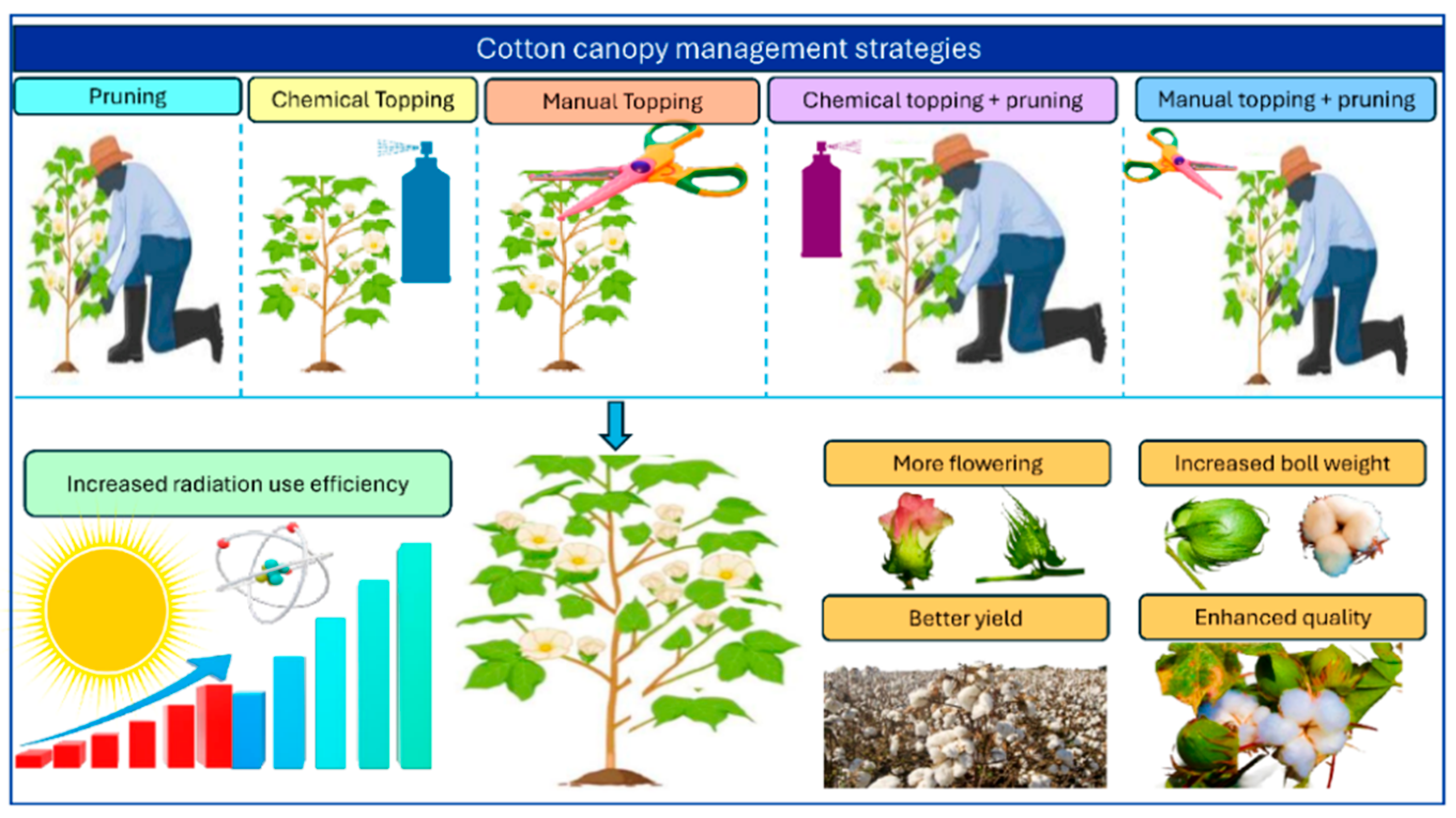
Figure 2.
Integrated approaches for canopy management techniques are mentioned; like manual topping, chemical topping and pruning show difference through control.
Figure 2.
Integrated approaches for canopy management techniques are mentioned; like manual topping, chemical topping and pruning show difference through control.
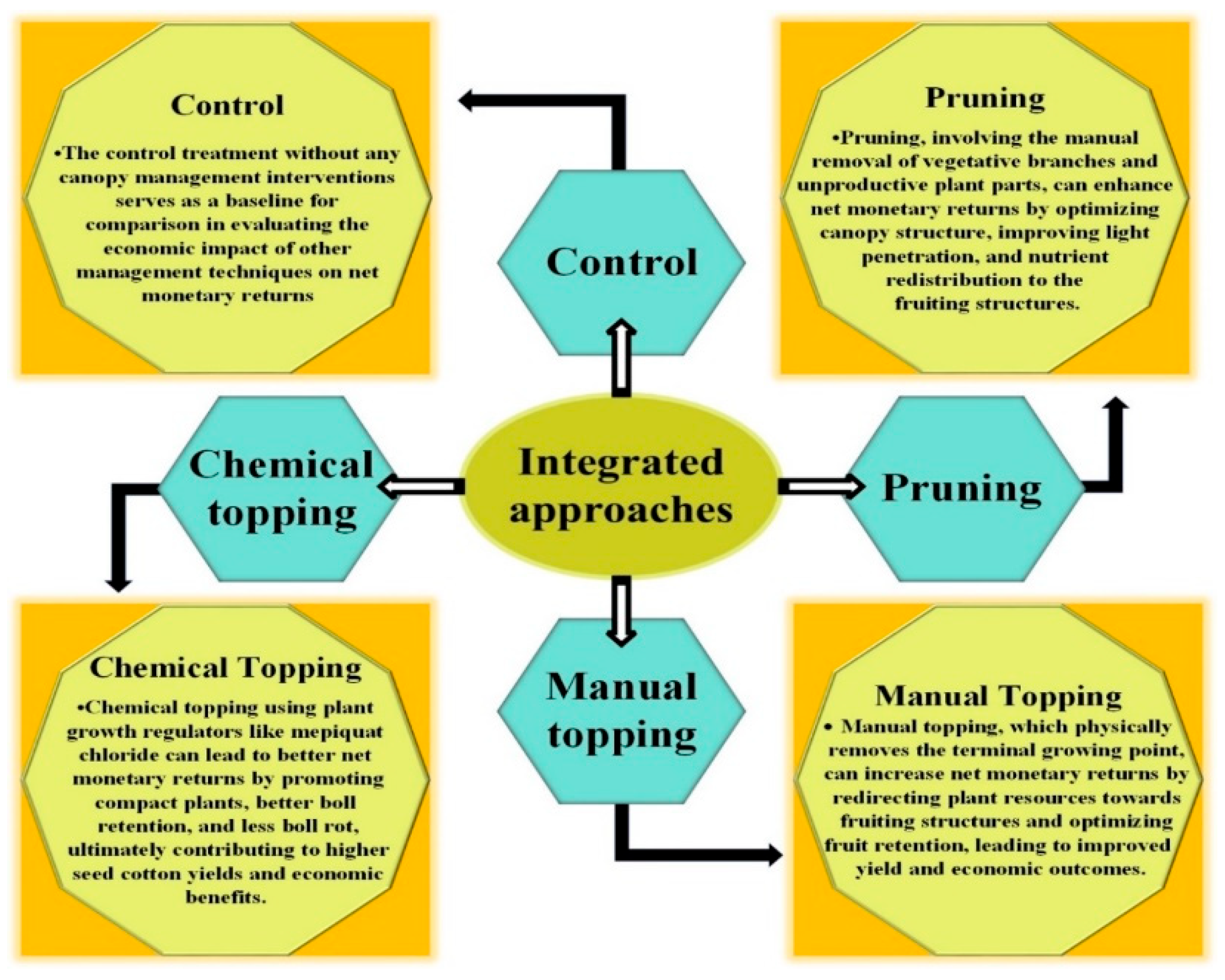
Figure 3.
Emerging research areas in cotton canopy management.
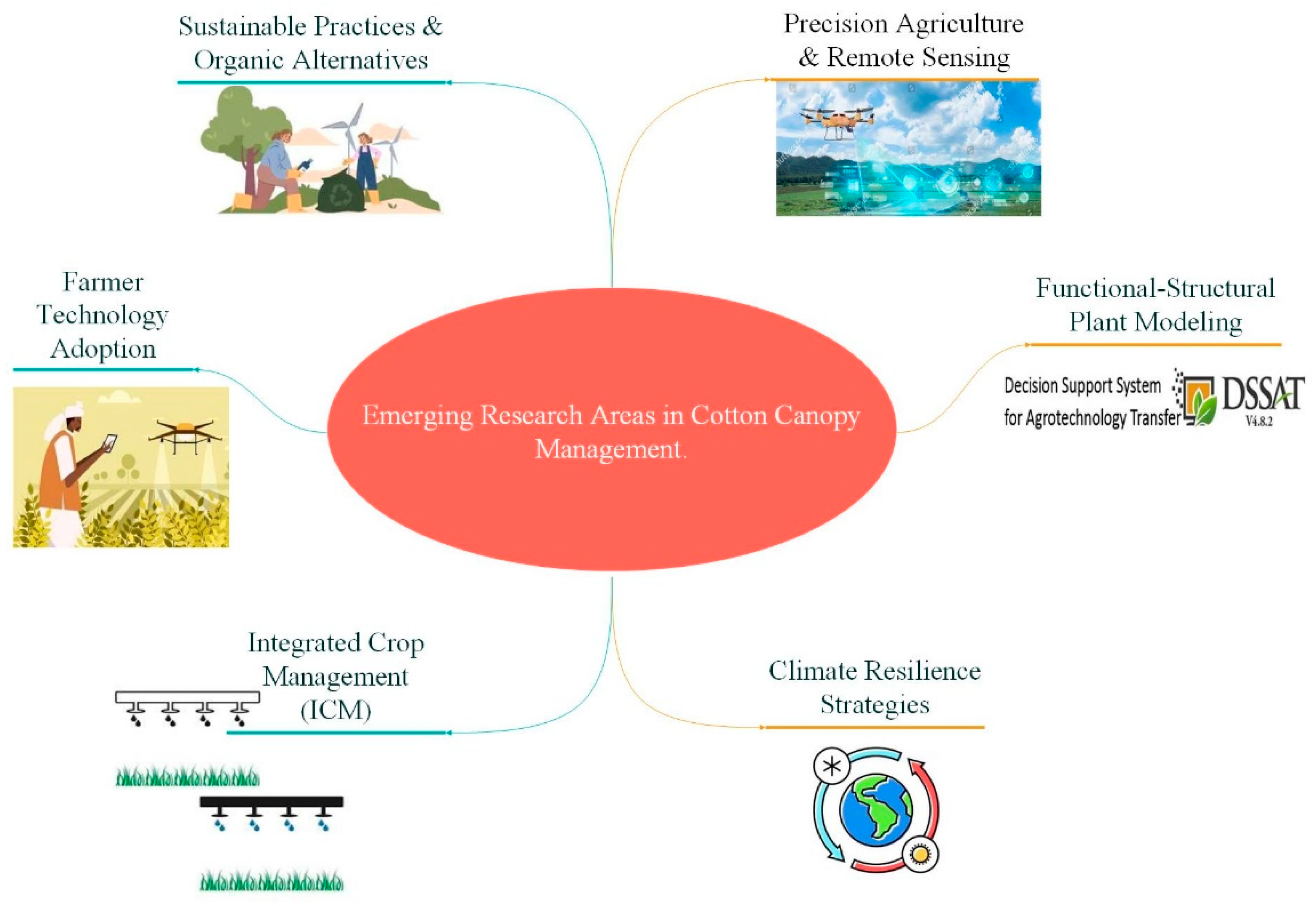

Table 1.
Comparison of PGR active ingredients and effects on cotton.
|
PGR (Plant Growth Regulator) |
Active Ingredient | Application Period | Effects on cotton | Reference |
| Miantaijin (MTJ) | Mepiquat chloride + DA-6 | Foliar applied during flowering and squaring | Recover efficiency of Potassium uptake | (Yang et al., 2014) |
| Mepiquat Chloride (MC) | Mepiquat chloride | Foliar applied during flowering and squaring periods | Increase lint yield and agronomic efficiency of K | (Yang et al., 2014) |
| Gibberellic Acid (GA3) | Gibberellic acid | Foliar spray at squaring stage or by soaking seed | Yield enhancement up to 7.5% and also enhance carbohydrate content. | (Fang et al., 2019) |
| N6 benzyadenine (6-BA) | N6-benzyadenine | Foliar spray at squaring stage or by soaking seed | Increase square numbers, boll retention especially with seed soaking | (Fang et al., 2019) |
| Cytokinin’s | zeatin | Apply at flowering and boll formation stage at 200 ppm rate | Reduce CLCuV incidence and enhance fibre fineness | (Ahmed et al., 2015) |
Table 2.
Effect of different canopy management techniques impact on yield of cotton.
| Canopy management | Treatment | Country | Variety | Yield | Citation |
| Planting Density |
100000 pl ha-1 | Venezuela | SN-290 | 70% increase |
(Guzman et al., 2019) |
| 83333 pl ha-1 | Venezuela | Delta Pine 16 | 58.33% increase |
||
| 51000 pl ha-1 | China | CR175 | 161.3 % increase | (Zhi et al., 2016) | |
| 87000 pl ha-1 | China | CR175 | 165.3 % increase | ||
| 6x10⁴ pl ha-1 | China | J-4B | 28.9% increase |
(Khan et al., 2019a) | |
| 9x10⁴ pl ha-1 | China | J-4B | 24.1% increase |
||
| Application of Plant growth regulator | DPC (1,1 dimethylpiperidinium chloride) | China | Xinluzao 60 (L60) |
4.7% increase |
(Ji et al., 2023) |
| DPC (1,1 dimethylpiperidinium chloride) | China | Jinken 1402 (JK1402) |
11.8% increase |
||
| CSILs (Chlormequat chloride salicylic acid iconic liquids)) |
China | Xinluzhong 75 | 11% increase |
(Shi et al., 2022) |
Disclaimer/Publisher’s Note: The statements, opinions and data contained in all publications are solely those of the individual author(s) and contributor(s) and not of MDPI and/or the editor(s). MDPI and/or the editor(s) disclaim responsibility for any injury to people or property resulting from any ideas, methods, instructions or products referred to in the content. |
© 2025 by the authors. Licensee MDPI, Basel, Switzerland. This article is an open access article distributed under the terms and conditions of the Creative Commons Attribution (CC BY) license (http://creativecommons.org/licenses/by/4.0/).
Copyright: This open access article is published under a Creative Commons CC BY 4.0 license, which permit the free download, distribution, and reuse, provided that the author and preprint are cited in any reuse.


