

Submitted:
18 August 2025
Posted:
19 August 2025
You are already at the latest version
Abstract
In principle, transit signal priority (TSP) should be able to reduce bus delay to near zero; however, in U.S. practice, bus delay reductions from TSP are often meager. This may be because in the U.S., active TSP (green extension and early green) is often applied within an underlying traffic signal control framework that is not TSP-friendly. TSP-friendly signal control encompasses passive transit signal priority techniques that minimize the bus phase red as well as control logic that provides flexibility in shifting the bus phase’s green to match the bus arrival time and compensation mechanisms for phases with overflow queues caused by priority actions, which is necessary to have aggressive active priority settings. Practically, TSP-friendly signal control is defined in this study as (1) control logic that is either fully actuated or coordinated to bus trajectories, and (2) phasing and timing plans that avoid long red intervals for the bus phase by (a) minimizing the cycle length, (b) allowing phase rotation, and (c) including multiple bus phases within the cycle, where the bus movement is a left turn or queue jump. Simulation tests at four sites in Boston find that applying active TSP together with TSP-friendly underlying control reduces bus delay 2.0 to 3.1 times as much as applying active TSP is applied on top of existing traffic signal control, with bus delay falling below 5 s per intersection at two of the sites and below 9 s per intersection at the other two sites.
Keywords:
urban traffic signal control
; bus priority
1. Introduction
To meet societal goals of sustainability, livability, productivity, and equity, cities need high quality public transportation, which, for surface transit, demands minimizing delay at traffic signals. For travelers, minimal delay at intersections reduces both travel time and travel time variability, improving service reliability [1]; for providers, a shorter and less variable running time reduces operating cost by reducing needed recovery time and cycle time [2,3].
To this end, transit signal priority (TSP) holds great promise [4,5,6]. In principle, it should be feasible to control traffic signals in such a way that buses pass through with nearly zero delay because buses need only a short window of green and tend to be infrequent relative to the signal cycle. For example, if buses arrive every three minutes, and each one needs a 10 s window of green time, that leaves 170 out of every 180 s to serve other traffic, which at most intersections is plenty. The challenge is to control the traffic signals so that the bus phase is green when the bus arrives rather than making it wait. The primary active TSP tactics are green extension (GX) and early green (EG), which can make the bus phase end later or start earlier than it would normally.
For the most part, TSP in the U.S. is far from achieving its promise. Where TSP applications have been documented in the literature, delay reductions are often less than 3 s per intersection; a recent survey of North American transit agencies that have used TSP found that most have seen only marginal improvements in bus travel time [7], and a simulation study found that while aggressive TSP could reduce bus delay by up to 19 s per intersection, average delay reduction was only 2 s per intersection with commonly used TSP settings [8].
Yet evidence from several cities and from simulation experiments suggests that achieving near-zero transit delay is feasible. Zurich’s streetcars famously have virtually no delay at almost all intersections, and their bus lines likewise have very little delay [9]; the same is true of many other cities in Switzerland, Netherlands, and Scandinavia [10,11]. To be sure, those cities have strong policy favoring transit priority; but in terms of technology that makes this performance feasible, these European cities stand out for three things. First, they have aggressive and cleverly programmed TSP tactics; second, transit often runs in dedicated lanes, though very low delay is also where buses and streetcars are in mixed traffic; and third, the underlying traffic signal is fully actuated, which is especially amenable to active TSP because it is flexible in the sense of being free from coordination constraints, and can allow aggressive TSP actions because it naturally compensates traffic streams that were interrupted for TSP, resulting in almost no lasting impact to traffic general traffic [12].
In the U.S., light rail lines in Portland, Oregon and San Diego get green waves that carry them from station to station with no signal delay except while waiting for a green to depart a station [13]. San Diego’s South Bay BRT (line 225) stands out for having achieved an average bus delay of only 3.3 s per intersection [14]. It operates in exclusive lanes, and all but one of its signals uses fully actuated traffic signal control. Its large stop spacing allows buses to be detected well in advance, which extends the reach of GX and EG.
Low bus delay has also proven achievable where buses operate in mixed traffic. Portland, Oregon was able to reduce bus delay per intersection in its Division corridor to 11 s (from a base of 20 s) using advanced detection, aggressive settings for early green and green extension, and liberal use of phase rotation and phase insertion. Benefits were strongest at major intersections, whose average bus delay fell from 42 to 13 s. The underlying traffic signal control is coordinated-actuated, but coordination is turned off for buses that request early green or green extension [15].
In simulation, [12] found that with European-inspired traffic signal control called self-organizing control and aggressive TSP, delay for buses in mixed traffic could be reduced to 4.9 s per intersection (from a base of 22 s) while still providing good service to other traffic and pedestrians. Self-organizing control uses fully actuated control logic that adds a secondary, vehicle-based green extension that promotes coordination without imposing hard coordination constraints.
2. TSP-Friendly Underlying Traffic Signal Control and Hypothesis
Near-zero bus delay occurs when the bus phase’s signal is green when the bus arrives or shortly thereafter. This can be achieved by a combination of active TSP and TSP-friendly underlying signal control in three ways, illustrated in Figure 1. The first is if the underlying control gives the bus phase a short red interval, and active TSP is able to shrink that red interval when needed – at the early end with GX, and at the late end with EG, also called red truncation, resulting in a small or vanishing “uncovered red window,” that is, the part of the bus phase’s red interval that active TSP cannot reach.
If the base-level red interval can’t be short, a second way to achieve near-zero bus delay is for active TSP to be especially aggressive, with long green extensions and red truncations. However, aggressive TSP is acceptable only if traffic signal control has the flexibility to substantially shift the position of the bus green and a compensation mechanism that allows phases cut short by a priority interruption to get extra green time in the following cycle so that can recover from overflow queues that resulted from a TSP action. Fully actuated control logic is inherently TSP-friendly because it naturally minimizes the cycle length (which minimizes the red interval), is free from coordination constraints, and inherently provides compensation because its logic is to continue a phase’s green until the queue dissipates. Aggressive TSP settings also require advanced detection.
A third way to achieve short bus delay is to use bus-based coordination to concentrate bus arrivals in the bus phase’s green window or the parts of its red window that can be reached by active TSP.
In the U.S., the predominant logic used in traffic signal control is arterial coordination with long cycle lengths, “optimized” using methods and tools that don’t recognize transit. Conventional coordination logic puts strict limits on when in the cycle each phase can run, limiting flexibility, and the long cycle lengths that are typically required for coordination result in large base-level red intervals. Coordination logic constrains recovery from TSP interruptions by putting highest priority on getting back in sync and adhering to clock-based forceoffs, which limits the degree to which phases that were cut short by a priority interruption can be compensated in the following cycle. Effective TSP needs to have underlying signal control that is highly interruptible. The lack of a compensation mechanism is a reason that TSP in the U.S. often uses timid settings (short GX and EG) and lockout provisions that disable TSP for several minutes or cycles after a TSP action [6].
2.1. Hypothesis
Our hypothesis is that bus delay reductions will be substantially greater if active TSP is applied along with making the underlying traffic signal control TSP-friendly, compared to applying active TSP on top existing signal control that is not TSP-friendly. We further stipulate that whatever underlying signal control is applied, it should provide reasonably good service to other traffic.
For this purpose, TSP-friendly traffic signal control is defined as follows.
- TSP-friendly traffic signal control is fully actuated and thus free from coordination constraints, or, if coordinated, coordinated to the expected bus trajectory.
A common theme of highly effective TSP applications is that they use fully actuated TSC. It naturally minimizes cycle length because it terminates phases as soon as their queue is dissipated, is highly flexible because it has no coordination constraints, and it naturally compensates traffic streams whose interruption results in long queues, allowing active TSP to be aggressive without serious impact on traffic flow.
However, where signalized intersection spacing is short, coordination is necessary to prevent spillback into upstream intersections. If coordination must be used, progression offsets should be tailored to the expected trajectory of buses. Progression should be based on expected bus travel time between segments, accounting for dwell time at any stops along that segment. For example, on San Diego’s El Cajon Boulevard BRT, signals were retimed to provide progression for buses in the busy direction of travel, allowing 29 s of additional travel on segments with a BRT station. As a result, bus travel times between stations fell by 11% [16], without the aid of active TSP. Likewise, bus-based progression should account for when buses turn onto or off the arterial, as opposed to conventional coordination that aims to provide green waves for through traffic only.
Adding active TSP on top of bus-based coordination can improve performance still more. Bus dwell time is variable, and so buses whose dwell time is shorter or longer than expected can be helped by active TSP to stay within the green band. In 2017, San Francisco adjusted coordination offsets following the expected trajectory of their light rail trains. They had already been applying active TSP, but with little benefit; when transit-based coordination was added, train arrivals on red fell from 81% to 51%, and train average delay fell from 32 to 12 s per signal [Britt Tanner and Edward Tang, San Francisco Municipal Transportation, personal communication, 4/6/2021].
Where a bus route turns onto or off of the arterial, transit-based progression follows the bus route, unlike standard arterial progression that follows only thru traffic. Where buses have to turn at two consecutive intersections to enter or leave a bus terminal, [17] found that changing the progression to follow the buses’ turns reduced average bus delay without active TSP by 50 s in one direction and 30 s in the other direction, with no change in delay to thru traffic on the main arterial. With active TSP, bus delay was reduced still more.
- 2.
- TSP-friendly traffic signal control minimizes the base-level bus red interval by keeping the cycle short and/or by offering multiple positions in the cycle in which the bus phase may start.
Minimizing the cycle length helps minimize the bus red, because needed green time for conflicting phases is proportional to cycle length. With fully actuated control, cycle length is minimized by using snappy settings that minimize lost time – short minimum green, short critical gap, and upstream extension detectors, and non-simultaneous gap-out logic [18].
Having pedestrians cross concurrently with through vehicle traffic rather than in an exclusive phase can substantially reduce the bus red interval and needed cycle length. The main drawback of concurrent crossings is if they involve too many conflicts with permitted right turns and sometimes permitted left turns, which is why many intersections in Massachusetts and nearly all intersections in Quebec City use exclusive pedestrian phases. Strategies to make concurrent crossings safe for pedestrians, thus allowing shorter cycles that are more TSP-friendly, include concurrent-protected phasing, also called signal separation, in which right turns and left turns are made from dedicated lanes in phases that do not overlap the pedestrian phase, and leading pedestrian intervals, which give pedestrians a head start and thus enable them to better establish their priority over turning traffic [19]. Boston’s guidelines for traffic signal timing limit the average number of permitted right turn conflicts per cycle to 5.5 if there is a leading pedestrian interval and to 3.5 otherwise, and they limit the number of permitted left turn conflicts to 2.5 per cycle where left turns are across a single through lane [20].
The base-level bus red can also be reduced by phasing plans that give the bus movement multiple start times in the cycle. One such tactic is phase rotation, which typically involves changing a leading left to lagging. Phase rotation not only helps buses turning left, it can also help through-going buses because phase rotation swaps the position of through and left turn phases. Another is phase insertion, especially attractive where buses run during a short, exclusive phase such as a queue jump phase or minor left turn. At several intersections in Portland, Oregon with queue jumps, the phasing plan has three queue jump phases per cycle: before mainline leading left, between mainline left and mainline through, and after mainline through [15]. Because bus phases are skipped except when a bus is detected, inserting multiple bus phases into the cycle has nearly no impact on other traffic. In one sense, phase insertion and phase rotation can be classified as active TSP, but in another sense they can be viewed as a form of passive TSP because the controller follows standard control logic for actuated phases.
2.2. TSP-Friendly Transit Operations
Along with TSP-friendly traffic signal control, effective TSP needs a TSP-friendly transit operation that (1) makes it possible to predict a bus’s arrival time well in advance and (2) uses an aggressive running time schedule that does not often force buses to hold because they are running ahead of schedule. GX depends on the prediction horizon because the length of a green extension is limited by the prediction horizon; likewise EG, because only with advanced detection can early green shorten multiple phases in advance of a bus arrival. With near-side stops, the prediction horizon is typically very short (3 or 4 s), and so the most critical aspect of a TSP-friendly transit operation is having far-side stops [21]. One study found that with active TSP, bus delay was 30 s greater with near-side stops than with far-side [8]. Other factors that can improve arrival prediction are greater stop spacing, bus lanes, and policies that make dwell time shorter and less variable including off-board fare collection and multiple door boarding.
3. Methodology and Case Studies
At four sites in Boston with high frequency bus service, traffic simulations were run for the current form of traffic signal control and for two treatment cases: adding active TSP only, and adding active TSP as well as making the underlying traffic signal control TSP-friendly. These case studies began as project assignments in a Northeastern University graduate course in advanced traffic control and were further refined afterwards. The study sites include between 1 and 5 intersections that were treated, with 1 to 3 bus stops per direction. At two sites, traffic signal control is coordinated-actuated, while at the other two control is semi-actuated (running free, with detectors for the minor street pedestrian crossing and a fixed green time for the major street). “Current” conditions are as of 2017-2018.
Peak hour traffic volumes were either measured in the field or obtained from the City of Boston from recent traffic counts. Traffic signal control parameters were obtained from the City and verified in the field. Pedestrian phases were modeled as being on recall because they are called anyway in most peak period cycles. The simulation tool was Vissim. Stop dwell time was modeled with a uniform distribution with parameters chosen to fit observed mean and variance of dwell time. Signal control was programmed with Vissim’s RBC controller for study site 2 and with VAP (Vissim Actuated Programming) for the other study sites. Simulation results are based on an aggregate of 10 replications, each lasting for 1.5 hours after a 5-minute warm-up period.
4. Study Site 1: Silver Line Waterfront at D Street
Silver Line Way (SLW) is a transitway that, in the AM peak, carries 42 buses per hour eastbound and 31 per hour westbound. Its intersection with D Street causes notoriously large bus delay because traffic signals are timed for arterial progression on D Street, and SLW has only a short phase in a 110 second cycle. The modeled area consists of four coordinated intersections along D Street (Figure 2), though only the intersection at SLW is changed in the treatment cases.
4.1. Adding Active TSP Only
Active TSP tactics added were GX and EG. Upstream detectors enable a 12 s notification horizon, thus allowing green extensions of up to 12 s. EG was limited to 12 s in order to prevent spillback on the short block to Congress Street.
4.2. Transit-Friendly Underlying Signal Control and Active TSP
One way considered for making the underlying control more TSP friendly was retaining coordination while creating multiple SLW phases within the cycle, avoiding times when a green for SLW would create a spillback problem on D Street. However, it turns out that the dominant inflow that can cause spillback comes from a turning movement that, in the current coordination plan, is released at the worst possible moment for creating spillback. Therefore, having no coordination could not be any worse (for spillback) than having coordination, and so there is no compelling reason against having fully actuated control, which would allow the bus phase to be green at any time in the cycle. In the plan we propsed, the signal rests in green for D Street, running a short SLW phase only when a bus is detected, subject to a minimum green on D Street.
Active TSP works within this framework as follows. SLW’s bus detectors are 12 s upstream of the intersection, just after the upstream bus stop. If a bus is detected while SLW’s signal is green, green will be extended, subject to a maximum green of 24 s. If a bus is detected while SLW’s signal is red, no action is taken (i.e., the D Street green continues) for 2 seconds plus as much additional time in needed until D Street has been green for at least 16 s. Then, pedestrian clearance for the crosswalk parallel to D Street (which needs 9 s) is initiated; 4 s into pedestrian clearance, D Street’s signal is changed to yellow, and 5.5 s after that, the bus green begins, usually 11.5 s after the bus passed the detection point. Approaching bus drivers will face a red until the last moment, forcing them to slow down and causing a bit of delay. That bit of delay could be eliminated by skipping the initial 2 second hold; however, from Zurich’s experience with transit priority, keeping the signal red just long enough to force drivers to slow down a bit as they approach the intersection improves safety [A. Mathis, Verkehrsbetriebe Zürich, personal communication, April 27, 2005].
5. Study Site 2: Silver Line 5 on Tremont Street, Downtown Boston
The second study examines Silver Line 5 (SL5) as it passes through five intersections along Tremont Street, which is one-way southbound, beginning at Temple Street. The simulation model also includes a sixth, upstream intersection, Tremont at Park (Figure 3). All of the intersections are coordinated with a common cycle of 100 s except where the route reaches Stuart Street, where Stuart is the coordinated arterial with a cycle of 110 s. A bus stop on Temple Street 200 ft from Tremont Street is the origin terminal for SL5 southbound. The heaviest traffic is during the PM peak, when the SL5 headway is 6.7 minutes and Tremont Street carries 1435 veh/h. Pedestrian crossing volumes are extremely high at several of the intersections, and exclusive pedestrian phases (EPPs) are used at Park, Boylston, and Stuart due to heavy turn conflicts.
Currently, the average bus delay through these five intersections is 100 s. Delays are greatest at Temple, where buses turn left from a side street, and at Stuart, where buses arrive as part of an uncoordinated traffic movement. Bus delay at these two intersections is highly variable – it can be up to 84 s at Temple and up to 102 s at Stuart – increasing headway variability, contributing to bus bunching.
The current signal timing already has one feature of passive priority – good progression for buses turning onto Tremont Street and traveling along Tremont. Figure 4 shows the progression diagram for buses and southbound traffic through the five northernmost intersections. Progression lines are based on minor street average (not maximum) green. One can see that buses that depart from Temple during the first 12 seconds of Temple’s green – as do most buses – pass through West and Avery without delay. There is a bus stop just after Avery, and the time the bus spends there lies in the shadow of Tremont Street’s red time at the following intersection, Boylston, so that buses usually reach Boylston around when Tremont Street’s green begins.
5.1. Adding Active TSP Only
GX was added at every intersection. Early green is not applied because it would not be compatible with pedestrian phases. At Stuart, phase rotation was added; it reverses the sequence of the southbound phase (the bus phase) with the EPP, providing a form of early green. The coordinated phase, which is Stuart, is unchanged. GX durations are limited by the prediction horizon from the previous stop or signal: 6 s at Temple and West, 10 s at Boylston, 12 s at Stuart, and 6 s at Avery, whose green is in the shadow of West’s green. Check-out bus detectors ensure that green time is not wasted after a bus passes through.
5.2. Transit-Friendly Underlying Signal Control and Active TSP
Coordination was retained along Tremont Street; however, the coordination plan was made more transit-friendly by double cycling at Temple and adjusting offsets to ensure a green band for buses whether they turn from Temple onto Tremont Street during the early or late green interval at Temple (see Figure 5). As Figure 8 shows, approaching Boylston, buses that left Temple during its early green interval get the same good progression as in the base case, and buses that leave Temple in its late green interval will be able to invoke GX to pass through Boylston with no delay unless their dwell time at the intervening stop is unusually long. With the proposed offsets, through traffic on Tremont still has good progression, and with double cycling at Temple, pedestrian delay for the heavily used concurrent crossign is sharply reduced.
At Stuart, the signal is removed from coordination and instead follows fully actuated logic. All phases, including the EPP, are on recall, but phase lengths can vary according to demand. This intersection is well under-saturated (capacity analysis shows that a cycle as short as 70 s would suffice), and distant enough from neighboring intersections that queues will not spill back. As in the previous case, GX and phase rotation applied. The natural compensation mechanism of fully-actuated control helps limit the impact of active TSP to traffic. Figure 6 shows the proposed timing plan for the Stuart intersection in the normal sequence and with phase rotation. The sketch for the normal timing sequence also indicates the time intervals within which, when a bus that’s 12 s away is detected upstream, GX and phase rotation are invoked.
6. Study Site 3: South Huntington Avenue at Perkins and Bynner Streets, Boston
The third study site is South Huntington Avenue at its intersections with Perkins and Bynner Streets in Boston’s Jamaica Plain district (Figure 7). Bus route 39 operates there with a 5-minute headway in both the AM and PM peaks. Each intersection has a far-side stop and a near-side stop. The intersections are 850 ft apart. All of the streets involved have one lane per direction. None of the approaches has a turn lane, because the side streets are too narrow, and because left turn volumes from South Huntington Ave. are very low.
Both intersections have a strong, reversing pair of turning flows – eastbound left turns in the AM peak and southbound right turns in the PM peak. To help facilitate eastbound left turns, an eastbound-only phase precedes the general east-west phase, and due to these turning flows, there are exclusive pedestrian phases (EPPs). The signals run free, with a fixed green time for the mainline while the EPPs and side street phases are actuated, though during peak periods, the side streets usually run to their maximum green. Observed peak period cycle lengths range from 100 to 134 seconds.
6.1. Adding Active TSP Only
GX was applied, with upstream detectors that provide a 20-second prediction horizon at the far-side stops and a 3-second prediction horizon at the near-side stops. EG was not applied for pedestrian safety, since pedestrians often cross concurrently with the side streets instead of waiting for the EPP.
6.2. Transit-Friendly Underlying Signal Control and Active TSP
Two general signal control options were tested. One was coordinating the two intersections following bus travel times; the other was letting the intersections continue to run free, but with a shorter cycle. The latter offered substantially lower delay for bus, general traffic, and pedestrians, and so only this option is described.
Large bus delays are due mainly to the EPPs, which make the cycle long and result in red intervals for the bus that are far too long to be overcome with GX. The proposed plan replaces the EPP with concurrent pedestrian phases on recall (Figure 8), with cycle design done carefully to keep the numbers of permitted right-turn and left-turn conflicts per cycle below the limits specified in the city’s traffic signal policy [20]. In the AM peak, when eastbound left is the heavy turning movement, the leading eastbound phase was made long enough that only 2 permitted left turns per cycle would be made when pedestrians have a concurrent crossing. (It can also be noted during the early part of the pedestrian phase, when pedestrian activity is greatest, westbound traffic being released from its queue will effectively protect the pedestrian crossing from left turns.) In the PM peak, the low left turn volumes make a leading eastbound phase unnecessary; instead, to manage conflicts with the heavy right turn flow, a 4-second leading pedestrian interval (Stage 2A) is provided.
With concurrent crossings, cycle lengths could be reduced to between 40 s and 68 s, even with pedestrian phases on recall. These short cycle lengths help keep the number of permitted turn conflicts per cycle within the limits of the city’s traffic signal policy, which puts a limit on conflicting turns per cycle rather than per hour.
Two complementary physical changes were also made to improve TSP’s effectiveness. One was relocating the two bus stops from the near side to the far side so that green extensions can last up to 20 s instead of only 3 s. The other was striping a short left-turn pocket in the northbound approach at both intersections. While a left turn pocket would not normally be provided where left turn volumes are this low (73 left turns per hour at Perkins, 44 at Bynner in the busiest period), simulations showed that buses often suffered long delays when the approach was blocked by a left-turning vehicle waiting for a gap. The turn lanes do not make the pedestrian crossings any longer and involve a sacrifice of only one or two parking spaces each.
7. Study Site 4: Route 23 on Washington Street, Dorchester
This site involves Route 23 buses in Boston’s Dorchester district traveling along Washington Street through signalized intersection at Park St. and Melville Ave. (Figure 9). Both signals have EPPs that are called in almost all cycles during AM peak. Signal control is semi-actuated with variable cycle length (the side street may gap out early), usually lasting around 100 s. Bus stops at the two intersections are far-side except at Melville southbound. Bus headway in the AM peak is 5 minutes. The simulation study area includes a third bus stop in each direction, upstream from the intersections studied.
7.1. Adding Active TSP Only
GX is added to both intersections, limited by the prediction horizon to 12 s at three of the stops and to 3 s at Melville southbound, where the stop is near-side. EG was not added for pedestrian safety because pedestrians often walk with the concurrent phase.
7.2. Transit-Friendly Underlying Signal Control and Active TSP
The underlying signal control is made TSP-friendly by replacing the EPPs at both intersections with concurrent crossings on recall and making both signals fully actuated. While concurrent crossings involve some permitted conflicts, the narrow roads force turns to be made at low speed, and the low turn volumes are such that with short cycles, the number of conflicting turns per cycle falls within the limits allowed by Boston’s traffic signal policy. This alternative also involves relocating the southbound stop at Melville to the far side, allowing this approach to also have a 12 s GX.
8. Results
Changes in bus delay are shown in Figure 10. At every study site, adding TSP alone reduces bus delay; however, complementing it with TSP-friendly signal control reduces bus delay 2 to 3.1 times as much. For example, at the first site, adding TSP alone reduces bus delay by 13 s, while bus delay is reduced by 41 s with both TSP and TSP-friendly signal control. The results at these four sites confirm the study’s hypothesis.
It is also interesting to see how close the results come to the goal of “near-zero” bus delay. With TSP plus TSP-friendly control, average bus delay per intersection is less than 5 s (4.5 and 2.5 s) at sites 1 and 3, and less than 10 s (8.6 and 8.1 s) at sites 2 and 4, respectively.
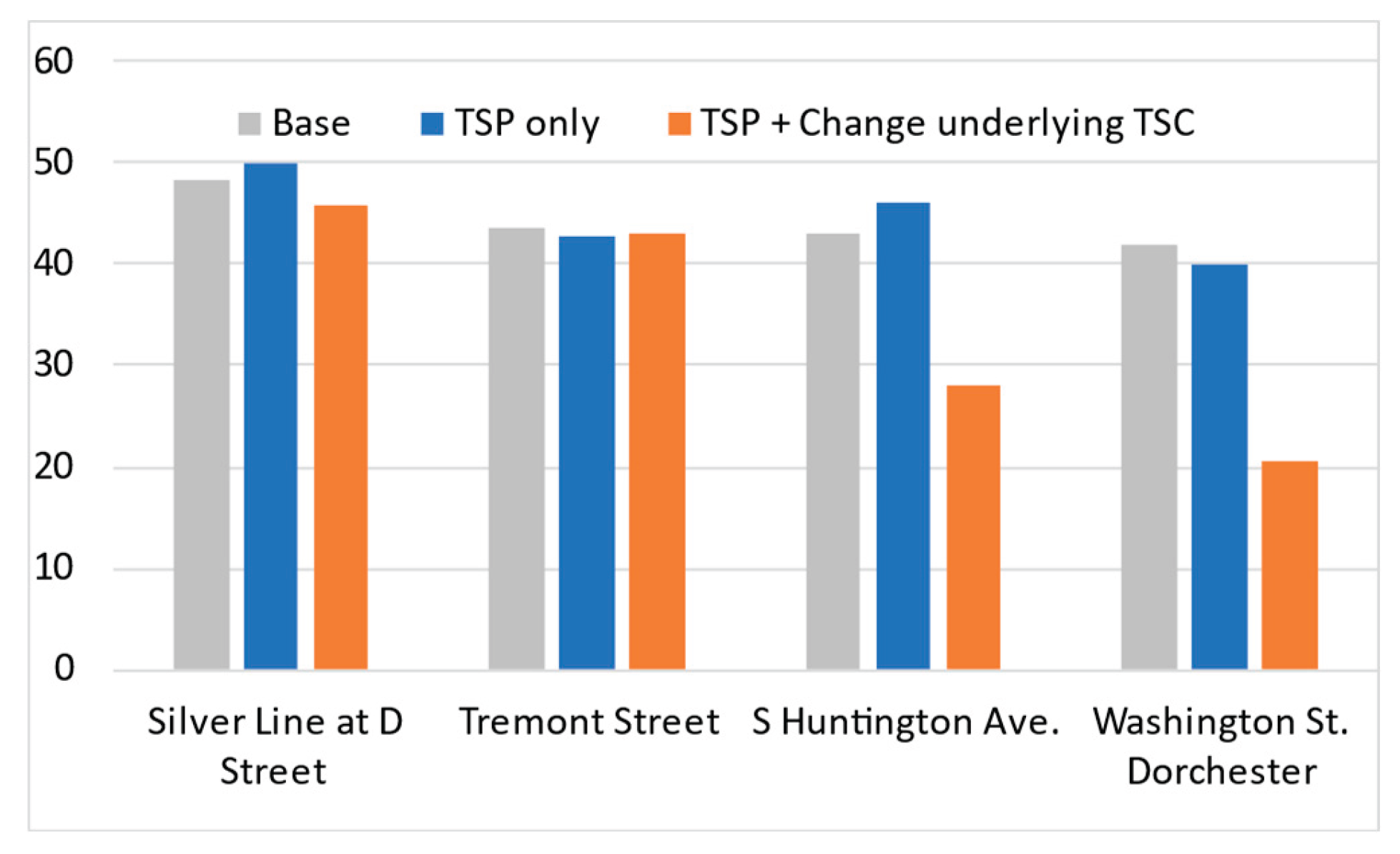
This study’s hypothesis stipulated that traffic signal control should also serve other traffic reasonably well. Figure 11 shows that auto delay was virtually unchanged, except that at the last two sites, auto delay fell substantially with TSP-friendly signal control. The delay reduction at those sites comes from converting pedestrian phases from exclusive to concurrent, resulting in much shorter cycle lengths. Pedestrian delay likewise shows no substantial adverse impacts. Adding TSP alone increased pedestrian delay a little (about 5%). Providing both TSP and TSP-friendly signal control reduced pedestrian delay by 62% and 52% at sites 3 and 4, respectively, and by 45% at two of site 2’s intersections, while it was unchanged at site 2’s other intersections and at site 1.
Further case study detail can be found at https://peterfurth.sites.northeastern.edu/2024/12/16/transit-signal-priority-could-reduce-silver-line-delay-by-90-where-it-crosses-d-street-in-the-seaport/ and https://peterfurth.sites.northeastern.edu/2024/06/04/bus-friendly-traffic-signals-can-reduce-bus-delay-by-90-on-south-huntington-avenue.
9. Conclusions and Discussion
This paper’s case studies confirm the hypothesis that for TSP to be the powerful tool it should be to nearly eliminate bus delay, it needs to be complemented with an underlying traffic signal control framework that is TSP-friendly. With TSP together with TSP-friendly underlying signal control, bus delay reductions were 2 to 3.1 times larger than when TSP was overlaid on the existing traffic signal control, and in some cases achieved the ideal of near-zero bus delay.
The case studies demonstrate several methods of making underlying traffic control TSP-friendly. One is switching to fully actuated control, demonstrated at sites 1, 2 and 4. In all of these cases, pedestrian crossings were on recall; only vehicle phases were actuated. Fully actuated control results in naturally short cycle lengths that automatically adapt to traffic demand, resulting in the shortest possible base-level bus red. Its lack of coordination constraints gives it flexibility to match the bus phase green to the bus arrival time, and it has a natural compensation mechanism that allows TSP to be aggressive without creating persistent queues on approaches that are interrupted by a priority action. A second is making the bus red and the cycle length shorter by changing exclusive pedestrian phases to concurrent, demonstrated at sites 3 and 4. With concurrent crossings, it is important to ensure that the number of conflicting permitted turns per cycle is low enough for pedestrian safety and comfort; as the case studies demonstrate, with short cycles, the number of conflicting turns per cycle can be rather low even where there is a moderate turn volume. A third and fourth method are double cycling (a form of phase insertion) and phase rotation, demonstrated at site 2; these treatments shrink the part of the cycle in which the bus phase would normally be red so that, when green extension further shrinks the “uncovered windows,” little bus delay results. However, case study 1 shows that where there is a 2-phase operation, fully actuated control can be superior to reservice or phase insertion because it can allow the bus phase to be actuated at any time.
Finally, a fifth method of making underlying traffic control TSP-friendly, coordinating signals to the bus’s trajectory, is demonstrated at site 2. Coordination to the bus trajectory accounted for bus dwell time at stops and for buses turning onto the arterial. And because reservice at the initial intersection gives buses two windows per cycle to enter the arterial, bus coordination provided two bus green waves per cycle. With bus-based coordination, most buses arrive on green without a need for active priority; for those who miss the scheduled green, green extension holds the green for the bus, resulting in very little bus delay.
TSP is often imagined as a tradeoff – for things to get better for bus, they must get worse for other road users. These case studies demonstrate that this is a myth – that with TSP-friendly underlying signal control, TSP can be aggressive without unduly harming other users. In several cases, auto and pedestrian delay fell substantially as a result of making the signal control TSP-friendly.
The need for TSP to be coupled with changes in underlying traffic signal control poses a challenge to industry practice and to education. In most U.S. cities, standard practice is that experts in traffic signal control optimize underlying traffic signal control for autos, using software and methods that ignore transit and TSP, and then a different set of experts are brought in to add TSP functionality, without the authority to change the underlying control and often constrained to add restrictive settings and lockout periods so that the underlying traffic signal control plan isn’t disturbed much. This arrangement will not deliver the high quality public transportation society needs. Society needs traffic signal control experts who also have expertise in TSP and are willing to accept the challenge of serving general traffic well while giving buses near-zero delay. And it needs TSP experts who deeply understand traffic flow and traffic signal control. It is notable that in European cities with a strong reputation for TSP such as Zurich, Stockholm, and Amsterdam, the city’s traffic control engineers implement TSP as an integral part of every intersection’s traffic signal control. In their culture, TSP is not an outside specialty, but is considered an essential part of traffic signal control.
The challenge for education is likewise to integrate TSP into teaching about traffic signal control, and to teach that priority for transit means not merely adding bus-specific elements like bus lanes and TSP, but creating a signal control and bus operations framework that, together with TSP, will result in buses almost always getting a green when or very soon after they arrive, while serving other road users well. Instruction in intersection design and traffic signal control logic should directly incorporate the objective of minimizing delay for buses as not just another vehicle but one deserving priority, and it should include transit delay as a key performance measure along with vehicle and pedestrian delay.
References
- Turnquist, M. A. (1974). Strategies for improving reliability of bus transit service. Computers and Operations Research, 1, 201-211.
- King County Metro, 2017. Transit speed and reliability guidelines and strategies. King County Metro, Seattle, WA.
- Lin, W. H., & Bertini, R. L. (2004). Modeling schedule recovery processes in transit operations for bus arrival time prediction. Journal of Advanced Transportation, 38(3), 347-365. [CrossRef]
- Smith, H.R., Hemily, B., Ivanovic, M., 2005. Transit signal priority (TSP): a planning and implementation handbook. ITS America and US Department of Transportation.
- Chang, J., Collura, J., Dion, F., & Rakha, H. (2003). Evaluation of service reliability impacts of traffic signal priority strategies for bus transit. Transportation research record, 1841(1), 23-31. [CrossRef]
- Anderson, P., & Daganzo, C. F. (2020). Effect of transit signal priority on bus service reliability. Transportation Research Part B: Methodological, 132, 2-14. [CrossRef]
- Anderson, P., Walk, M.J. and Simek, C., 2020. Transit signal priority: Current state of the practice. TCRP Synthesis 149, National Academies of Sciences, Engineering, and Medicine.
- Cesme, B., Altun, S. Z., & Lane, B. (2015). Queue jump lane, transit signal priority, and stop location evaluation of transit preferential treatments using microsimulation. [CrossRef]
- Nash, A., 2003. Implementing Zurich’s transit priority program. Transportation Research Record, 1835(1), pp.59-65. [CrossRef]
- van Oort, N., Sparing, D., Brands, T., & Goverde, R. M. (2015). Data driven improvements in public transport: the Dutch example. Public transport, 7(3), 369-389. [CrossRef]
- Wahlstedt, J., 2014. Evaluation of bus priority strategies in coordinated traffic signal systems. Doctoral Dissertation, KTH Royal Institute of Technology.
- Moghimidarzi, S.B., Furth, P.G., Cesme, B., 2016. Predictive-tentative transit signal priority with self-organizing traffic signal control. Transportation Research Record, 2557(1): 77-85. Celniker, S., Terry, E.W., 1992. Trolley priority on signalized arterials in downtown San Diego. Transportation Research Record, 1361(1): 184-184. [CrossRef]
- Fox, G. D. (1992). Light Rail/Traffic Interface in Portland: The First Five Years. Transportation Research Record 1361, 176-183.
- SANDAG, 2020. South Bay bus rapid transit traffic signal priority, field test results. San Diego Association of Governments (SANDAG). Prepared by IBI Group.
- Cesme, B., J.A. Barrios, P.J. Koonce, M. Haines, P.G. Furth, C. Bame, and M. Dobrota (2025). Next-generation transit signal priority with advanced arrival time prediction and custom traffic signal control logic. Transportation Research Record, under review. [CrossRef]
- SANDAG, 2018. Mid-city rapid bus corridor traffic signal coordination. San Diego Association of Governments (SANDAG). Prepared by IBI Group.
- Furth, P. G., Cesme, B., & Rima, T. (2010). Signal priority near major bus terminal: Case study of Ruggles Station, Boston, Massachusetts. Transportation Research Record, 2192(1), 89-96.
- Moghimi, B., Safikhani, A., Kamga, C., & Hao, W. (2018). Cycle-length prediction in actuated traffic-signal control using ARIMA model. Journal of Computing in Civil Engineering, 32(2), 04017083. [CrossRef]
- NCHRP. Traffic signal control strategies for pedestrians and bicyclists. Research report 969, National Academy of Sciences, Engineering, and Medicine, 2022.
- Boston Transportation Department, 2023. Signal Operations Design Policy, https://www.boston.gov/sites/default/files/file/2023/05/BTD%20Signal%20Policy%205-19-2023.pd.
- Danaher, A.R., 2010. Bus and rail transit preferential treatments in mixed traffic (Vol. 83). Transportation Research Board.
Figure 1.
Near-zero bus delay can be achieved (a) with a short base red plus active TSP, (b) with a longer base red with more aggressive, or (c) with bus-based coordination plus TSP.
Figure 1.
Near-zero bus delay can be achieved (a) with a short base red plus active TSP, (b) with a longer base red with more aggressive, or (c) with bus-based coordination plus TSP.
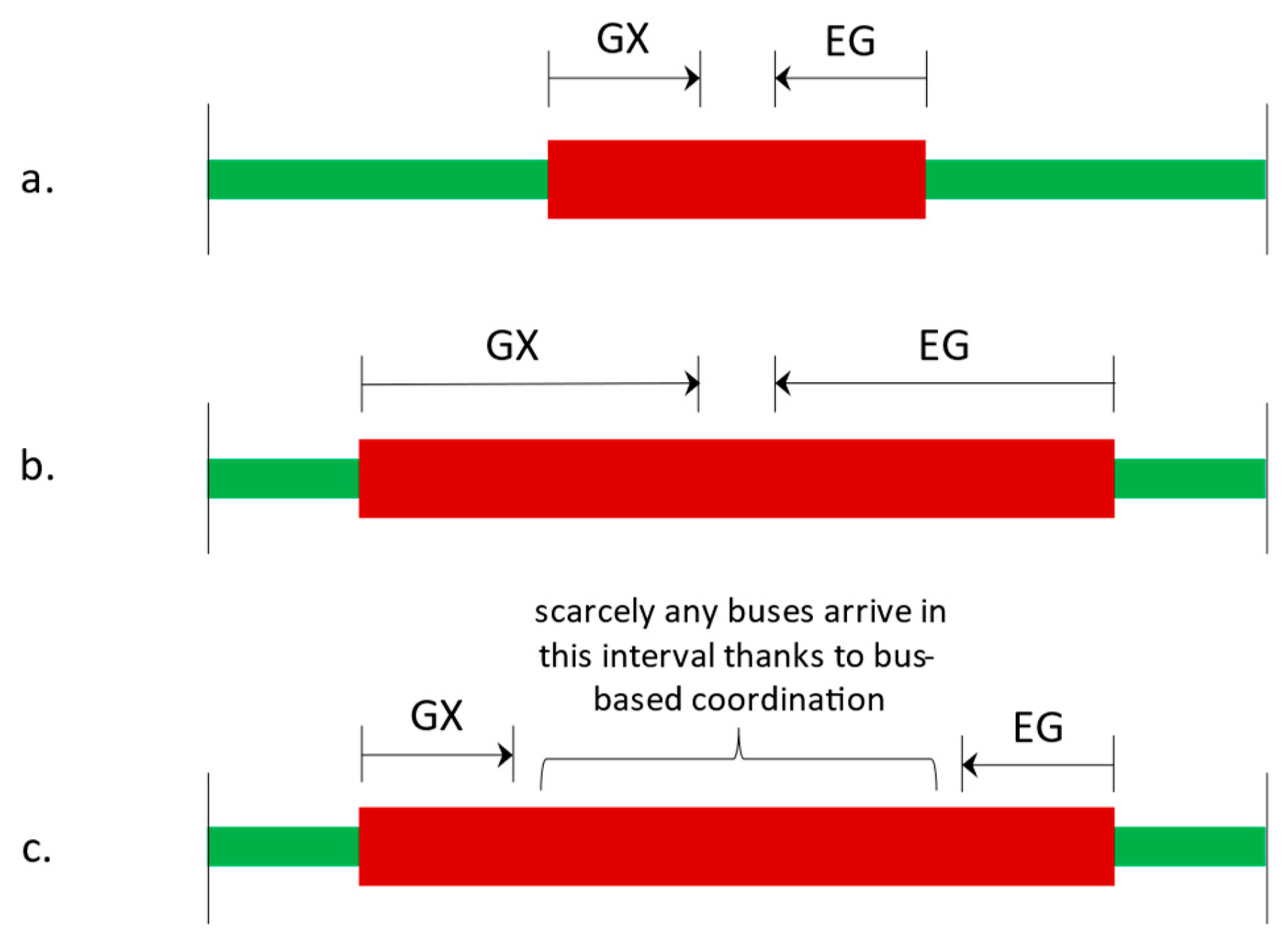
Figure 2.
Study area, site 1.
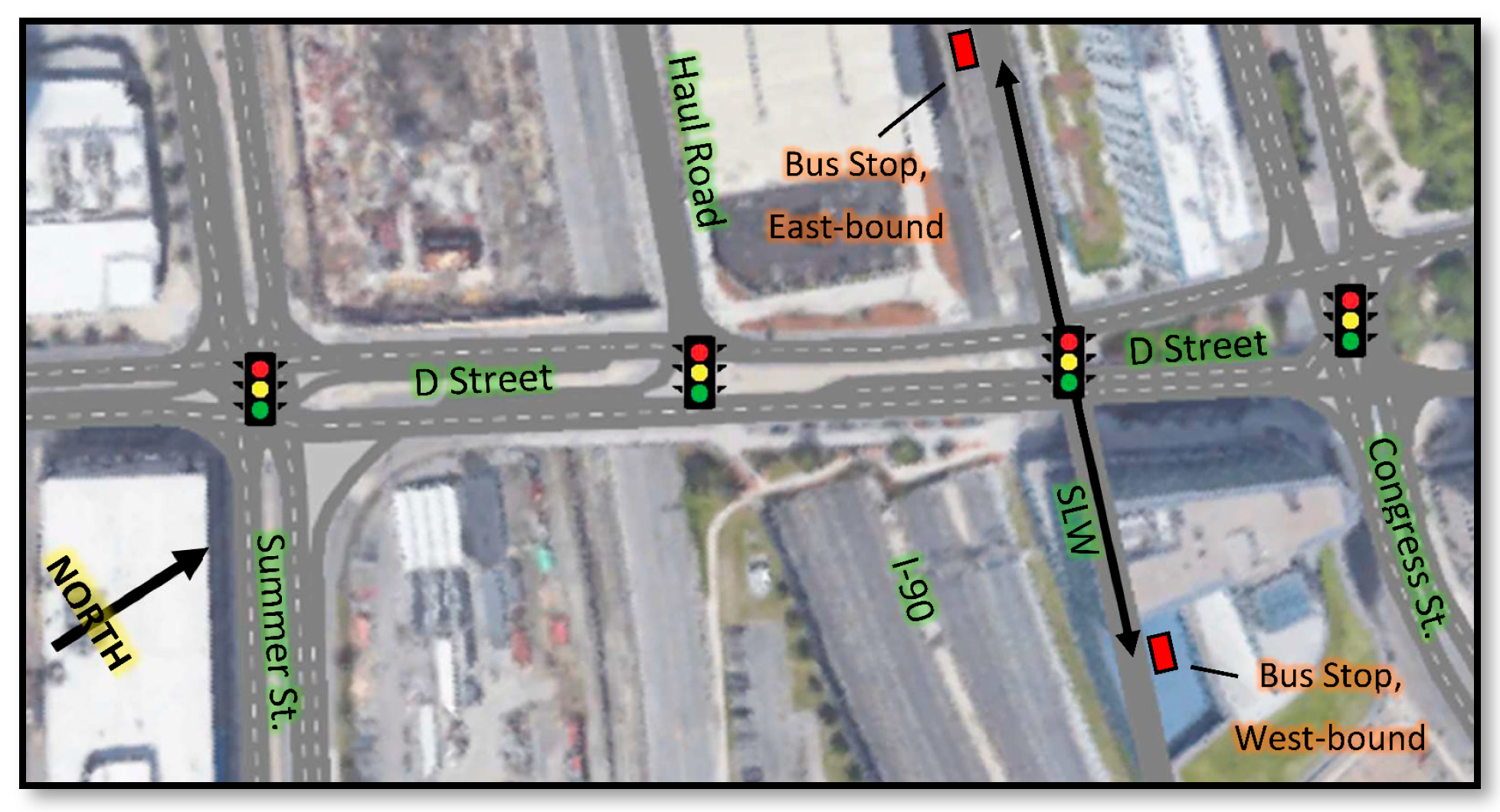
Figure 3.
Study area, site 2.
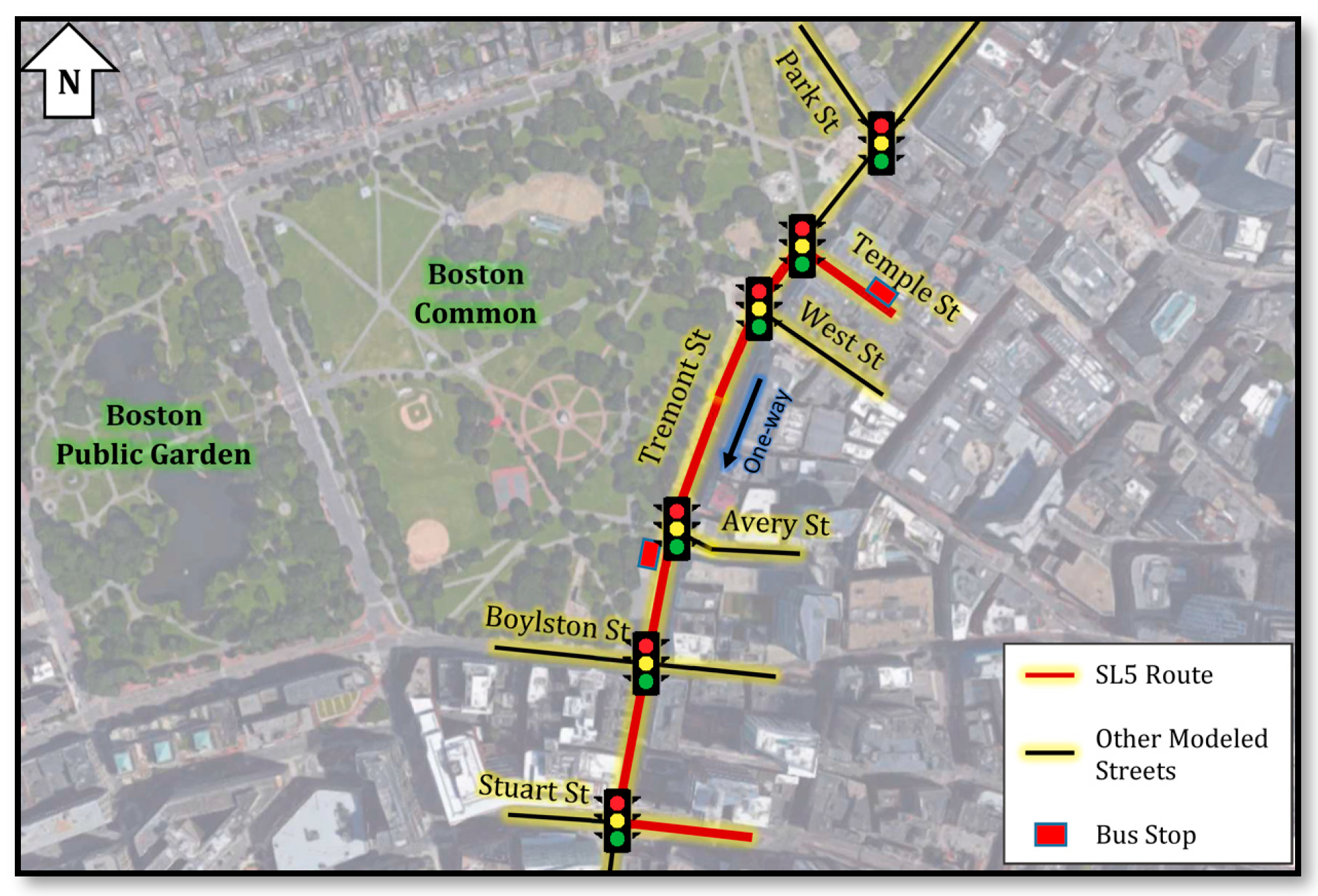
Figure 4.
Bus and traffic progression, current timing plan.
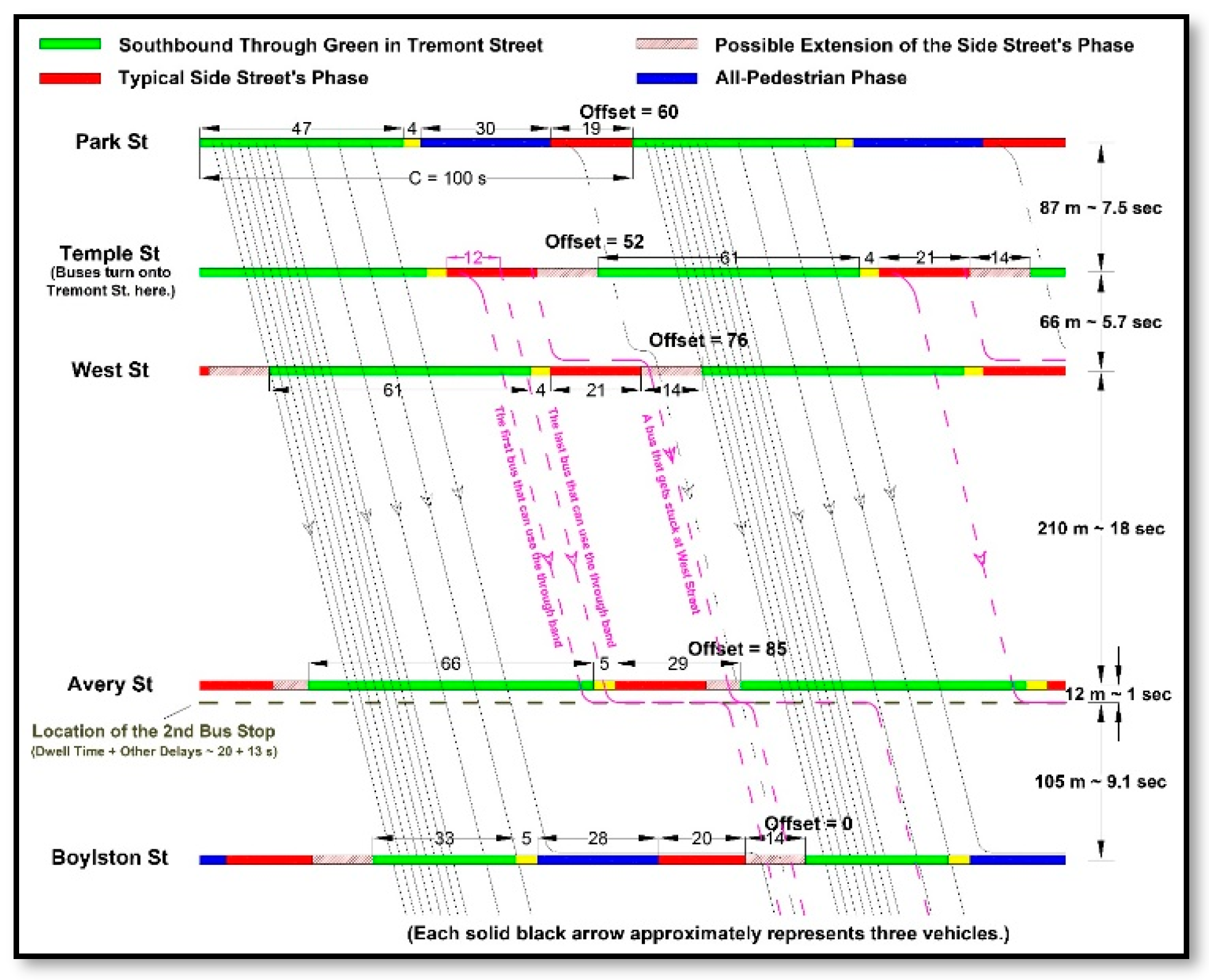
Figure 5.
Proposed progression (GE = green extension).
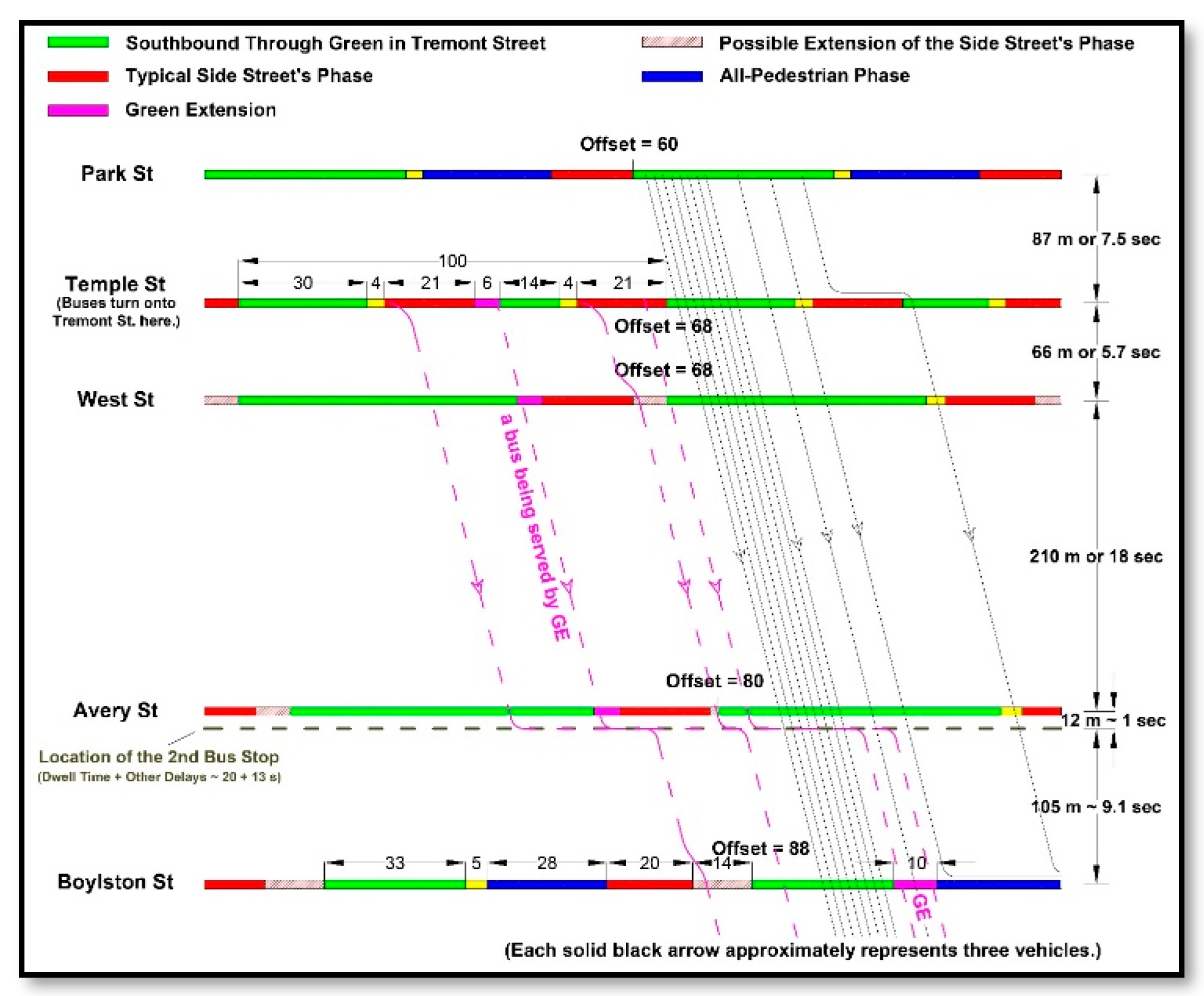
Figure 6.
Active TSP action at Stuart, with phase rotation depending on when a bus (southbound) is detected.
Figure 6.
Active TSP action at Stuart, with phase rotation depending on when a bus (southbound) is detected.
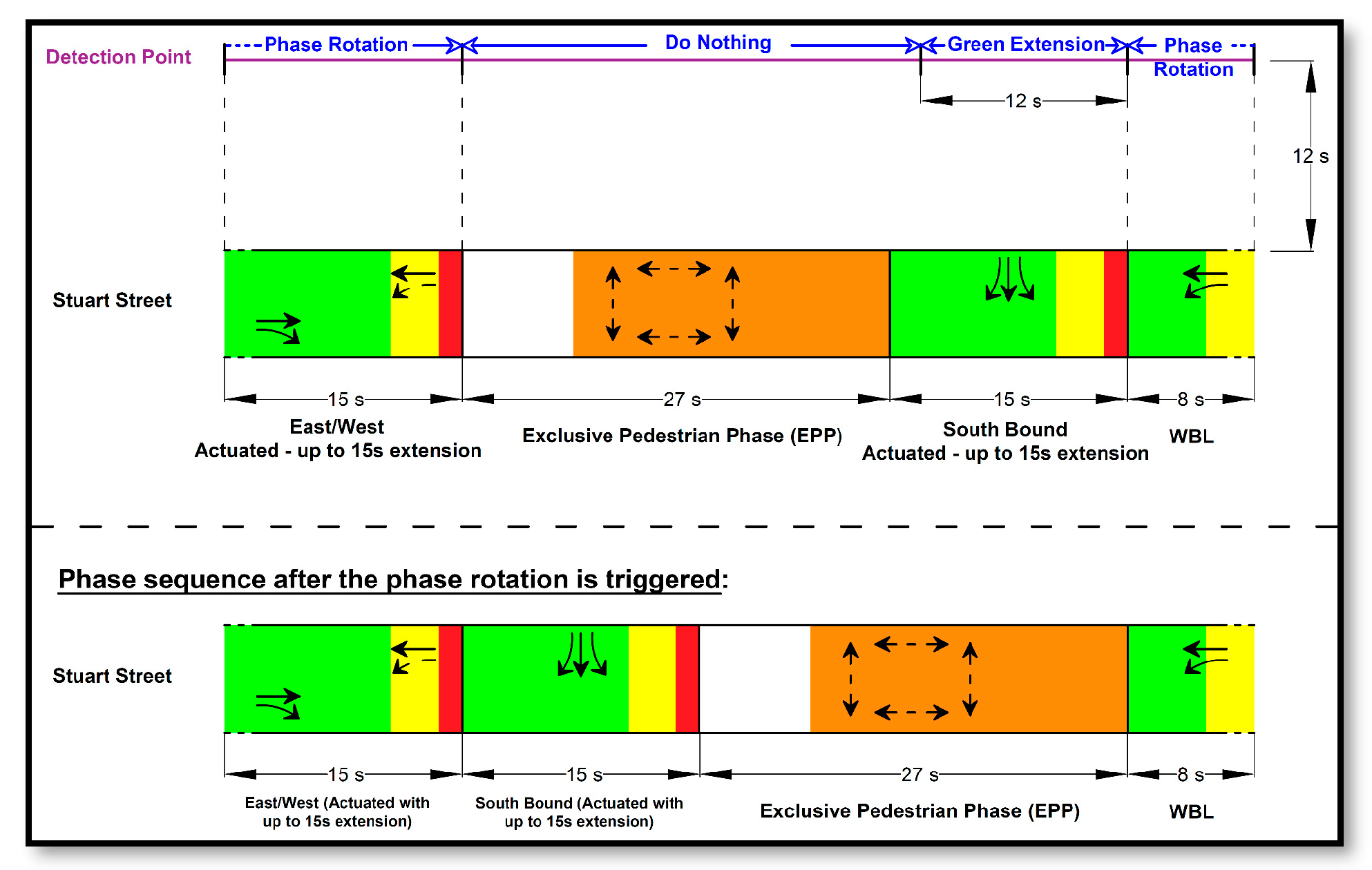
Figure 7.
Study site 3, South Huntington Avenue with intersections at Perkins Street and Bynner Street.
Figure 7.
Study site 3, South Huntington Avenue with intersections at Perkins Street and Bynner Street.
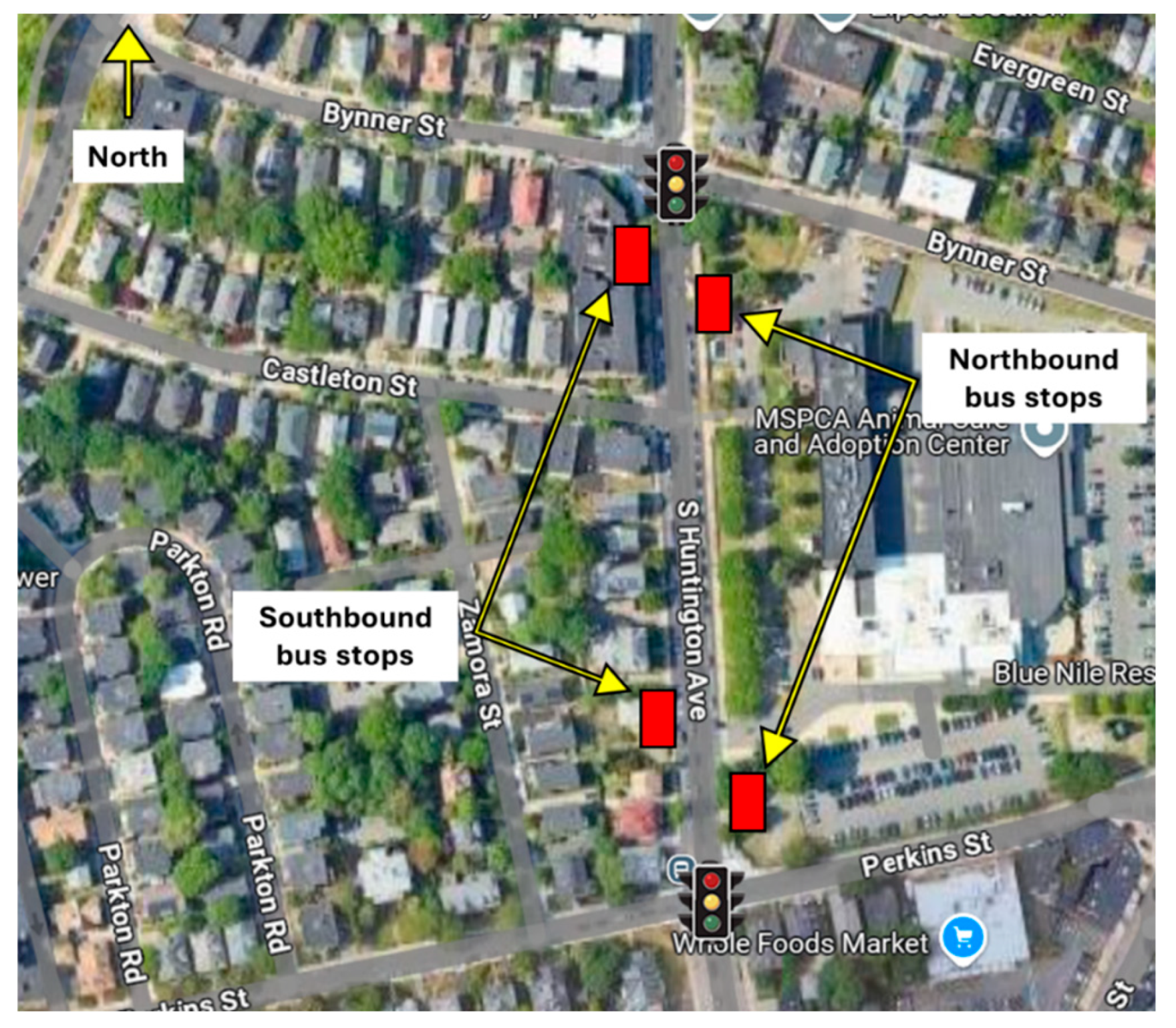
Figure 8.
Current and proposed phasing plans for both S. Huntington intersections.
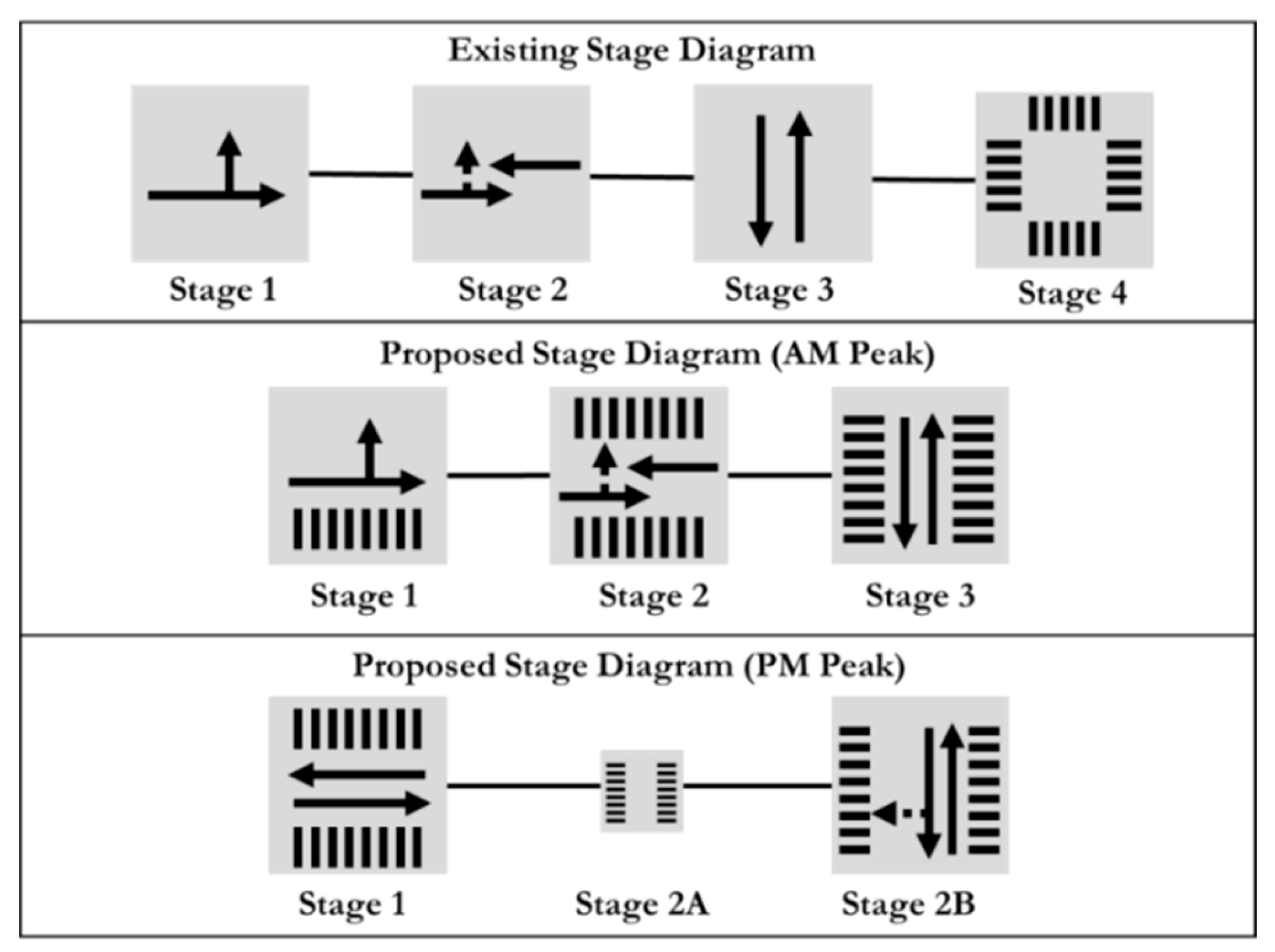
Figure 9.
Study site 4, Washington Street (Dorchester).
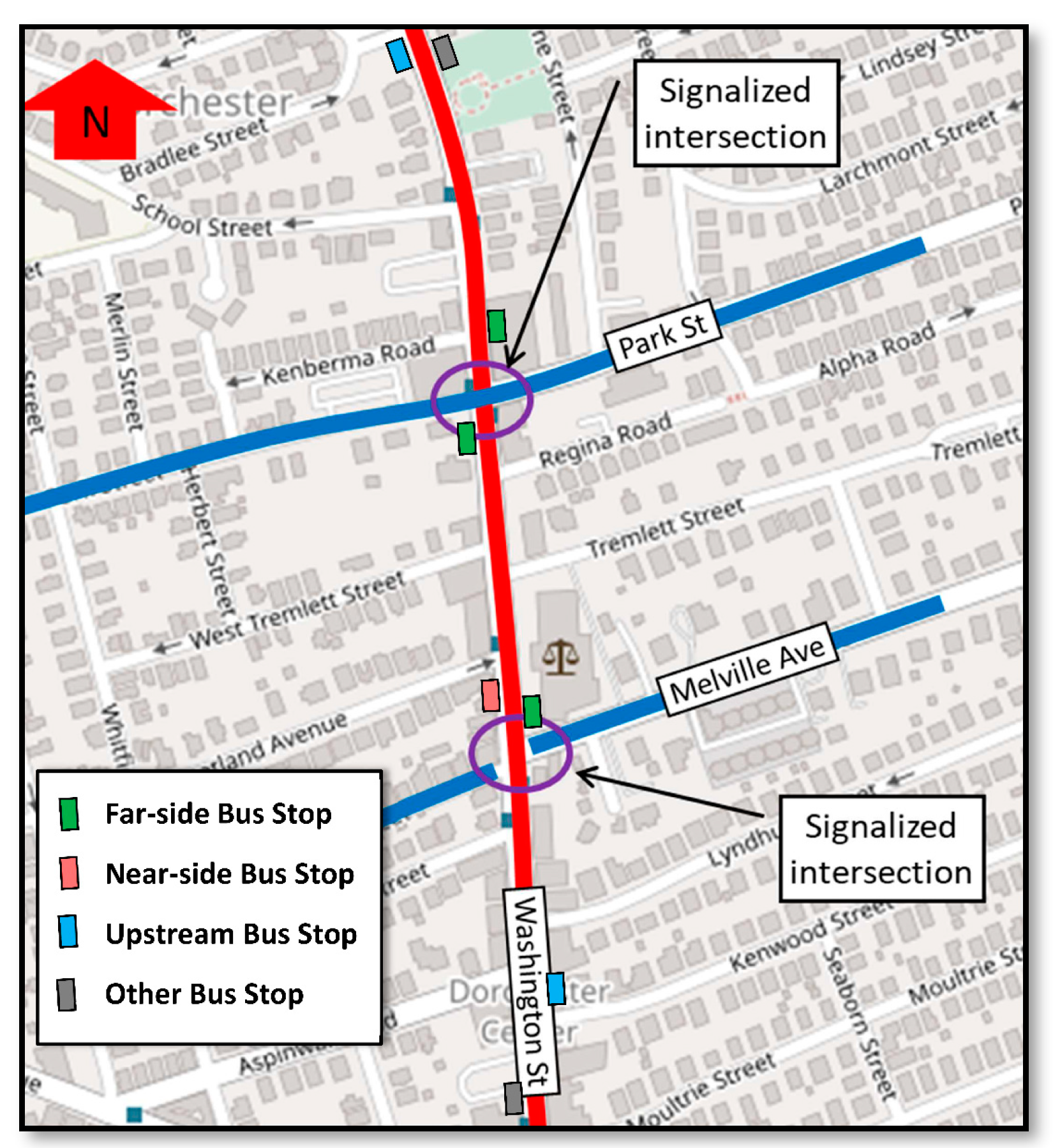
Figure 10.
Changes in bus delay (s).
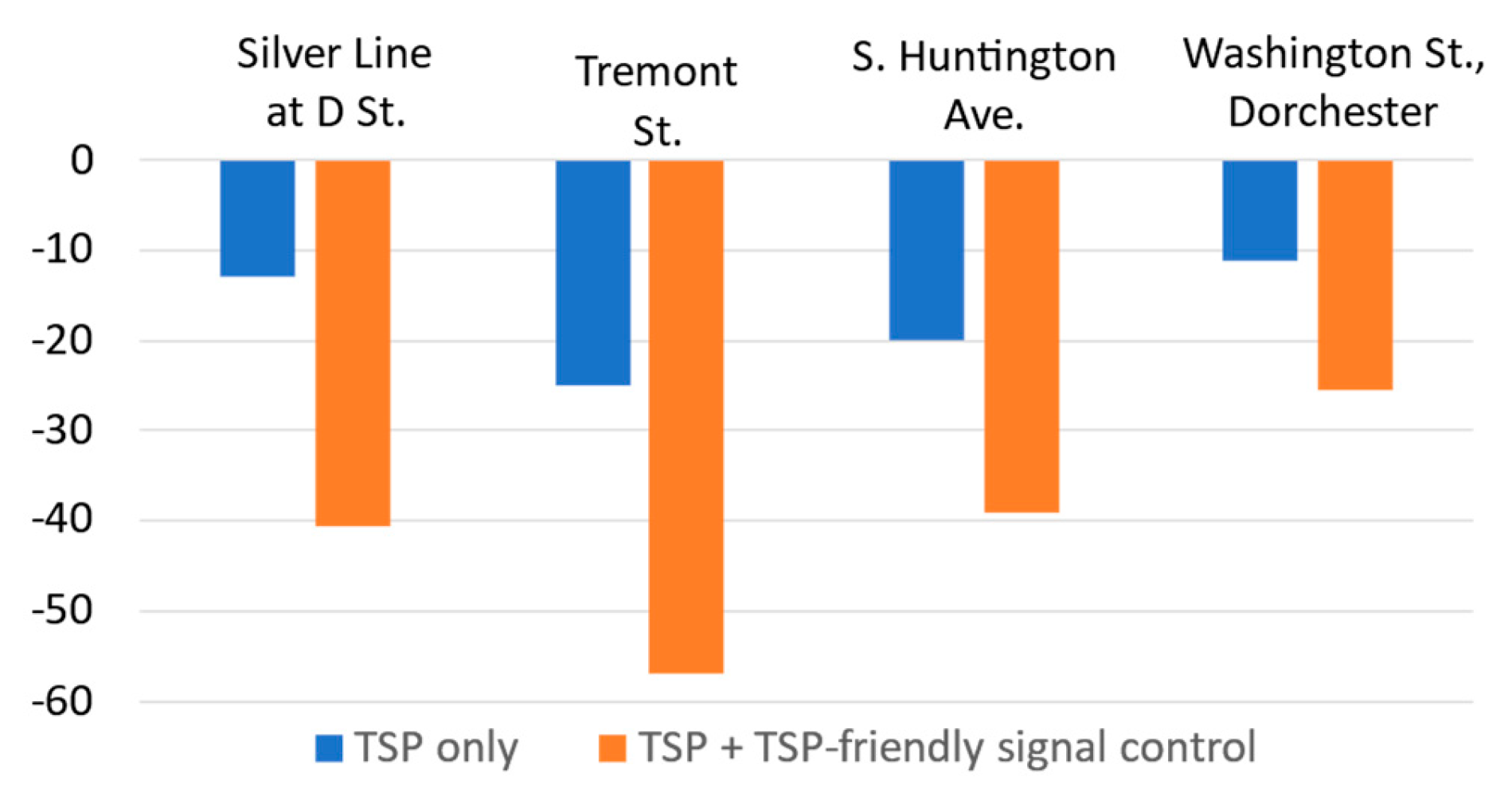
Figure 11.
Average vehicle delay (s).
Disclaimer/Publisher’s Note: The statements, opinions and data contained in all publications are solely those of the individual author(s) and contributor(s) and not of MDPI and/or the editor(s). MDPI and/or the editor(s) disclaim responsibility for any injury to people or property resulting from any ideas, methods, instructions or products referred to in the content. |
© 2025 by the authors. Licensee MDPI, Basel, Switzerland. This article is an open access article distributed under the terms and conditions of the Creative Commons Attribution (CC BY) license (http://creativecommons.org/licenses/by/4.0/).
Copyright: This open access article is published under a Creative Commons CC BY 4.0 license, which permit the free download, distribution, and reuse, provided that the author and preprint are cited in any reuse.


