

Submitted:
18 August 2025
Posted:
28 August 2025
You are already at the latest version
Abstract
The addition of sea-buckthorn (Hippophae rhamnoides L.) fruits as well as their extracted juice or related by-products into chocolate results in manufacturing an innovative func-tional food rich in bioactive substances. The effects of twelve treatments derived from the factorial combination of three types of H. rhamnoides materials (total fruit powder; fruit by-product powder; fruit juice), plus an untreated control, and four concentrations (10 %, 15 %, 20 %, and 25 %), were assessed on rheological, quality, colour, antioxidant, mineral and sensorial properties of white chocolate. The untreated control showed the highest values of rheological parameters, except for adhesiveness and cohesion, as well as of pH, dry matter, soluble solids and colour component ‘L’. The colour component ‘b’ was best influenced by the 10% by-product addition to chocolate, whereas mineral substances, ash and colour component ‘a’ augmented with increasing concentration of added H. rhamnoides materials. Compared to the untreated control, protein and fat contents in chocolate showed decreasing values with rising the added concentration of sea buckthorn fruit juice, and opposite trend under the integration of the whole fruit and its by-products. The anti-oxidant compounds and activity attained the lowest values in the untreated chocolate and increasing levels with rising concentration of added sea buckthorn materials. The juice addition to chocolate led to the highest contents of vitamin C, total carotenoids, β-carotene and lycopene, whereas the whole fruit integration fostered the top levels of flavonoids, polyphenols and antioxidant activity. Potassium and zinc contents were the highest in the untreated control and decreased with rising the H. rhamnoides material addition, whereas opposite trends were shown by calcium, magnesium, sodium and phosphorus, which in-creased with rising the sea buckthorn material addition. The integration of H. rhamnoides fruit materials into chocolate represents a valuable strategy to produce innovative health beneficial functional food.
Keywords:
Hippophae rhamnoides L.
; functional food
; innovative products
; texture
; colour
; antioxidants
; mineral composition
1. Introduction
Consumer demand for functional foods [1,2] has been increasing for the last decades due to the health beneficial effects of these products rich in bioactive compounds [3]. Indeed, manufacturing innovative foods has modernized the confectionary industry providing new attractive proposals of quality and sensory characteristics to meet the requirements of consumers [4].
The use of sea buckthorn fruits to produce original products led to successful solutions, such as novel milk-derived items [3], jam, jelly and drinks [5]. Additionally, several antioxidants, either phenolics or plant extracts, have been inserted inside chocolate chains and the replacement of sugar with various plant mixtures have contributed to prevent many diseases [6,7,8,9,10,11,12,13]. Plant-derived polyphenols added to chocolate, from carob [6], or Hippophae rhamnoides material showed beneficial antimicrobial and antioxidant activity to manufacture premium quality natural foods. Particularly, white chocolate derives from the combination of cocoa butter, milk or milk products and sugars, containing: ≥ 20 % cocoa butter, ≥ 14 % dry milk solids, at least 3.5 % as milk fat [14].
Hippophae rhamnoides is a shrub of Elaeagnaceae family, widely diffused in Asia and Europe [15], well growing even in poorest and dry soils [16], and its fruits are very health beneficial [17,18].
Hippophae rhamnoides fruits have a high content of antioxidants and therapeutic substances, like the flavonoids rutin, quercetin, kaempferol, myricetin and isorhamnetin [19], tocopherols and carotenoids [20], acid L-ascorbic, volatile oils, vitamins, aminoacids and minerals [21], and a remarkable antioxidant activity [22]. Sea buckthorn fruits are rich in essential healthy compounds showing nutraceutical effects against inflammation and toxicity, and fostering hair and skin regrowth [15]. The remarkable concentrations of vitamin C and n-3, n-6 and n-9 polyunsaturated fatty acids make it beneficial to integrated Hippophae rhamnoides in several foods, like juice, alchohol beverages like wine, liquer, beer additive, jam, jelly, marmalade, sauce, oil, syrup, soft drink [23], freeze-dried powder, milk tablet, tea, preserved fruit [5].
As the mentioned manufacturing chains give rise to high amounts of wastes and by-products [15], the present study has been planned to valorise the sea buckthorn industry by-products under the perspective of sustainably manage the food systems and to solve possible lack of related resources. In this respect, our target of preventing waste negative environmental impact coincides with that of the European Green Deal [24] and, additionally, the sea buckthorn industry can be boosted [18].
In this research, sea buckthorn powder and juice by-products have been used as they both are versatile products with therapeutic and antioxidant properties that can be effectively employed for manufacturing innovative chocolate products with improved quality and nutritional characteristics. The formulation of the mentioned wastes derived from the sea buckthorn fruit pressing to obtain juice at the Elexius unit, in combination with the concentration and the presence or absence of oil, was assessed to identify the best performing recipe of sea buckthorn added novel chocolate, in terms of rheological, quality, colour, antioxidant and mineral characteristics.
2. Materials and Methods
2.1. Experimental Protocol and Raw Materials
Research was conducted at Iasi University ‘Ion Ionescu de la Brad’ in 2025, to compare twelve treatments derived by the factorial combination of 3 types of sea buckthorn (Hippophae rhamnoides L.) material (total fruit powder; fruit by-product powder; fruit juice), and 4 concentrations of addition to white chocolate (10 %; 15 %; 20 %; and 25 %), plus an untreated control, using a randomized complete block design with three replicates, in terms of: rheological, quality, colorimetric, antioxidant, mineral and sensorial characteristics of chocolate.
Sea buckthorn berries (SBB - Hippophea rhamnoides L.), grown in organically conditions, were used entirely or as juice extracted in Elexius manufacturing from Bacău region (Romania) or as by-products following the mentioned extraction, to produce innovative white chocolate. The premium quality of Hippophea rhamnoides L. fruits relates to the high levels of antioxidant compounds and capacity, lipids and proteins, mineral elements, physical-chemical and colorimetric characteristics [15].
2.2. Sea Buckthorn Material, Fruit Processing, Chocolate Preparation and Processing
The fruits were harvested in August, quickly frozen (in 27 minutes) at -40°C, then stored until processing (about 3 months) at -25°C.
The fruit processing was carried out as previously described [25].
White chocolate is melted in the mouth and, to avoid perceiving solid particles, the latter must be smaller than 20-25 µm (the threshold for olfactory organ detection); accordingly, pleasant aroma and taste arise upon processing the main ingredients such as milk and sea buckthorn powder, cocoa butter, sugar and flavourings.
In the present research, the 12 experimental chocolate samples, plus the untreated control, were manufactured in the form of bars, and were added with 30% sugar, referring to the international classification [26], with 26% fat of powdered milk and 15% from cocoa butter. Chocolate quality is correlated with the particle finesse of H. rhamnoides powder, sugar and possibly milk powder; moreover, its unctuousness, taste and smell also depend on fat content and flavouring.
The chocolate processing has been managed as previously described [25].
2.3. Determination of Textural Properties
In order to determine the texture of white chocolate samples, a Mark 10® (USA) texturometer was used. The diameter of the texturemeter cilindric probe TA5 type with 12.7 mm in diameter and 35 mm of hight used for the measurements has a range of 100 with a resolution of 0.05 N. Warner Bratzler V-knife was used to cut the cobblestone samples. The moving velocity in the time of the insertion into the sample was 200 mm per minute which means 3.33 mm per second. The MeasurePlus software of the texturemeter allowed to record the graphs in force-deformation and force-time. The graphs were interpreted with the GraphPad Prism 9 software and the results obtained helped to calculate the texture parameters of the analysed chocolate samples.
To determine the texture, three bars with the following geometrical characteristics: 22±1 mm average value for high, 87±1 mm for length, 37±1 mm for width were used from each chocolate sample, and each sample was tested in triplicate. Each sample was tested at temperature 20±1°C.
The mentioned rheological determinations were repeated three months after the production of Hippophae ramnoides added chocolate, but the results have not been reported because they are not significantly different from those recorded at the first determination.
2.4. Determination of Total Dry Matter Content
The total dry matter content was determined by the oven drying method (103–105 °C) until constant weight in a forced air-drying oven (Biobase®, Jinan, China), and the results were expressed as percentage of dry matter [27].
The dry matter determination as well as all the following quality analyses were repeated three months after the production of Hippophae rhamnoides added chocolate, but the results have not been reported because they are not significantly different from those recorded at the first determination.
2.5. Determination of Protein Content
2.6. Determination of Fat Content
2.7. Determination of the Colour Components
The colour components of white chocolate samples were determined in replicate using a Konica Minolta Colorimeter-400 trichomatric reflectance colorimeter with Spectra Magic NX 1.3 software (Konica Minolta Sensing INC.®, Osaka, Japan), at ambient temperature. The results were expressed according to the CIE Lab system components L*, a*, b* [29]. Measurements were made with an 8 mm optical glass aperture. Before the measurements, the equipment was calibrated using a standard white plate. The samples were evenly levelled and placed in a clear glass container for colorimetric analysis. The measurements were repeated three times at distinct points on the sample to ensure the accuracy of the results.
2.8. Extraction of Bioactive Substances from Chocolate Samples Added with Hippophae rhamnoides L. By-Products
The phytochemicals from the white chocolate samples with the addition of sea buckthorn powder were extracted using the ultrasound-assisted extraction method. One g of sample was mixed with 10 ml of n-hexane/acetone solvent mixture (3:1, v/v, for ABTS method antioxidant activity, carotenoids) or 70% ethanol (only for total polyphenol extraction and antioxidant activity by DPPH method), was subjected to an ultrasound treatment for 30 minutes at a maximum of 32°C and a frequency of 40 kHz. After recovering the resulting of crude extract, it was centrifuged for 10 minutes at 5000 rpm at 4°C. The supernatant was collected after separation and then analysed to determine the amount of β-carotene, total carotenoids and total polyphenols as well as the antioxidant activity (ABTS and DPPH).
The following antioxidant determinations were repeated three months after the production of Hippophae ramnoides added chocolate, but the results have not been reported because they are not significantly different from those recorded at the first determination.
2.9. Determination of Carotenoid Compounds
The content in carotenoids (β-carotene and lycopene) was determined by the spectrophotometric method, measuring the absorbance at 450 nm, at 470 nm and 503 nm [30], and calculated using the formula:
Carotenoids (mg/g) = (A x Mw x DF)/(m x l x ε) mg/g T.D.M.
Where: A – absorbance of the sample; Mw – molecular weight (536.88); DF – dilution factor (if the sample was diluted); m – the weight/mass of the concentrated extract; l – the length of the optical path of the cuvette (1 cm for the quartz cuvette); ε – extinction coefficient which is 2500 for the total carotenoids, 2590 for β-carotene and 3450 for lycopene.
2.10. Determination of Total Polyphenol Content
The total polyphenols content was evaluated using Folin-Ciocâlteu’s reagent method [31].
2.11. Determination of Vitamin C Content
2.12. Determination of Antioxidant Activity
The antioxidant activity was determined by the DPPH (2.2-diphenyl-1-picryhydrazyl) method. The preparation of the DPPH stock solution was carried out by dissolving 3.5 mg of DPPH in 100 ml of methanol. Then, 100 µL of the prepared sample extract were added with 3.9 mL of DPPH, with the blank consisting of the mixture of 100 µL methanol and 3.9 mL DPPH. It was left to stand for 30 minutes and then the readings were done at the absorbance at 515 nm. The determination of the antioxidant activity consisted in determining the inhibition for each sample to be analysed using the equation (1), respectively by analysing the variation of the antioxidant capacity corresponding to the different samples.
I (%) = (Ablank-Asample)/Ablank*100 (1)
Where: Ablank - the absorbance of the control sample; Asample – the absorbance of the sample.
The results can also be expressed as µmol Trolox g-1 dry substance.
The determination of the antioxidant capacity using the radical cation ABTS+ is based on the ability of antioxidants to neutralize the ABTS+ radical, compared to a standard antioxidant, i.e., the vitamin E analogue Trolox [34]. The results are expressed as inhibition (%ABTS) (2):
Inhibition (%ABTS) = (Ablank-Asample)/Ablank x 100 (2)
Where: A – absorbance of the sample; Asample – absorbance of the control sample (control sample).
The results can also be expressed as µmol Trolox/g dry matter substance.
2.13. Determination of Mineral Elements
For the evaluation of mineral components, the atomic absorption spectrometry (ContrAA 700, Analytik Jena, Jena, Germany) was used, with a flame atomizer system. The results were expressed in mg 100 g-1 d.w.
The measures of the mineral element contents (K, Ca, Mg, Na, P, Zn, Fe) of the samples of white chocolates added with sea buckthorn were carried out using a MiniWAVE Microwave (SCP Science, Baie-d’Urfé, QC, Canada) digestion system equipped with a 50 mL Teflon vessel. A total of 1 g of the homogenized sample was weighed into a Teflon vessel and digested using a nitric (HNO3) and hydrogen peroxide H2O2 mixture (7:3). The digestion was performed under the following conditions: temperature, 190°C; digestion time, 30 min; microwave power, 1000 W. After cooling, the samples were carefully transferred into a 50 mL volumetric flask and diluted with ultrapure water until the mark. A blank sample was added in every digestion run, and each sample was prepared in triplicate.
2.14. Sensory Features
The sensory features were evaluated based on the previously reported description [25].
2.15. Statistical Analysis
Data were processed by analysis of variance (ANOVA) and mean separations were performed through the Duncan’s test, with reference to 0.05 probability level, using SPSS software version 29.
3. Results and Discussion
3.1. Rheological Parameters
As reported in Table 1 and Table 2, the untreated control showed the highest values of all the measured rheological variables, except adhesiveness and cohesiveness which increased with rising concentration of the integrated sea buckthorn fruit materials. As for the comparison between the H. rhamnoides materials, all the analysed parameters attained the highest levels upon the addition to chocolate of fruit by-products and the lowest with the juice fortification.
In previous research [9], the addition of microencapsulated or microalgae containing forms of omega 3 fatty acids (EPA/DHA) did not have a strong impact on rheological characteristics of chocolate, particularly plastic viscosity, and did not show manufacturing process change. The highest chocolate yield stress and plastic viscosity corresponded to the microencapsulated form. Notable, the omega 3 integration led to shear thinning behaviour of chocolate, likely due to the structural breakdown occurring upon the applied shear force [34] and alignment of the constituent molecules [35].
Chocolate rheological properties [36] and plastic viscosity [37] influence the efficiency of production chain and, particularly, yield stress is affected by material surface and structure [38]. The manufacturing system modulates chocolate hardness as well as the ingredients, among which fats and sugars confer softness [39]. The relation between hardness and fatty acid profile reported in the form V of cocoa butter [39], relates to the crystallization of fat triglycerides in triple chains with greater thermodynamic stability compared to the double ones [38].
In previous investigation [9], the addition of omega 3 fatty acids on chocolate reduced its hardness, with negligible effect in terms of melting properties and temperature, the latter showing inverse correlation with the polyunsaturated fatty acid content (PUFAs).
In previous study [10], sugars were replaced with inulin and maltitol to produce an innovative health beneficial chocolate as a no palm oil functional food fortified with nanoparticles of vitamin D and magnesium-calcium carbonate; the latter enhanced the viscosity similarly to the water content increase presumably fostered by nanoparticles. The lower value of viscosity, compared to that recorded in palm oil and sugar added chocolate, was likely due to the 33% fat content. The consistency index showed the same trend as plastic viscosity and yield stress, the latter influenced by interparticle interactions [40] which are reduced by the hydrophobic vitamin D addition into the formulate, because of the higher fat-like material content coating all the particles [10]. The integration of Vitamin D + calcium into No Palm No sugar chocolate led to lower viscosity, compared to the Ca addition [10], due to enhanced interparticle interactions consequent to lower availability of fats coating them [41].
3.2. Quality and Colour Parameters
Regarding the quality characteristics of chocolate added with Hippophae rhamnoides materials (Table 3), the untreated control showed the highest values of pH, dry matter, soluble solids and colour component ‘L’; the mentioned parameters displayed decreasing trends with rising concentration of the integrated sea buckthorn parts. Similar trend was recorded for the colour component ‘b’, but the highest value was obtained upon the treatment with the 10% fruit by-product. On the contrary, mineral substances, ash and colour component ‘a’ augmented with increasing concentration of added H. rhamnoides material. Compared to the untreated control, protein and fat contents in chocolate showed decreasing values with rising the added concentration of sea buckthorn fruit juice, whereas the integration of the whole fruit and its by-products led to opposite trend.
3.3. Antioxidant Compounds and Activity
The antioxidant compounds and activity (Table 3) showed the lowest values in the untreated chocolate, mainly referred to vitamin C which was almost absent. The rising concentration of added H. rhamnoides material resulted in increased levels of all the antioxidants measured as well as the antioxidant activity. Among the compounds examined, vitamin C showed the highest content, whereas the values of lycopene and flavonoids were the lowest. Regarding the different sea buckthorn materials, the juice addition to chocolate led to the highest contents of vitamin C, total carotenoids, β-carotene and lycopene, whereas the top levels of flavonoids, polyphenols and antioxidant activity were recorded upon the whole fruit integration. All the mentioned parameters attained the lowest contents in the H. rhamnoides by-product added chocolate.
In the latter respect, the high pigment content in sea buckthorn material added to chocolate influences the colour during the product processing [15].
The whole H. rhamnoides fruit has a greater polyphenol content, compared to the structural constituents [15], thus influencing antioxidant compounds in chocolate.
Previous authors recorded the increase of total polyphenols and antioxidative capacity upon the integration of either grape seeds or pomace into chocolate [11,46,47], which enhanced the phenol content already present in cocoa particles. Moreover, grape pomace and seed powders can be adequately valorised as the prevailing polyphenol source following juice extraction [48]. Grape peels fostered both the polyphenol accumulation as well as darker colour and fruity taste in chocolate, compared to more neutral-tasted seeds. Notably, pomaces can be effectively replaced by purified extracts [46,49]. Interestingly, metabolizing phenolic compounds encouraged antioxidant activity in plasma and urea of tested people [50].

Table 4.
Antioxidant characteristics of chocolate added with H. rhamnoides fruit materials.
| Type of Hippophae rhamnoides fruit material (TP) x Percentage of addition (PA) | Vitamin C (mg g-1) | Flavonoids | Polyphenols | Antioxidant activity | Total carotenoids | β-carotene (mg g-1) |
Lycopene (mg g-1) |
|---|---|---|---|---|---|---|---|
| Chocolate with no addition | 0.1 h | 0.08 h | 0.19 il | 4.8 l | 0.10 f | 0.51 g | 0.04 h |
| Chocolate with 10% juice addition | 24.6 f | 0.15 g | 0.26 h | 7.0 i | 0.85 e | 0.68 f | 0.18 e |
| Chocolate with 15% juice addition | 28.2 de | 0.18 f | 0.32 g | 9.2 h | 1.23 d | 0.96 e | 0.19 e |
| Chocolate with 20% juice addition | 29.9 d | 0.20 e | 0.37 f | 15.3 f | 2.34 b | 1.81 c | 0.24 c |
| Chocolate with 25% juice addition | 42.2 a | 0.25 d | 0.44 e | 19.5 d | 2.61 a | 1.97 b | 0.34 b |
| Chocolate with 10% fruit addition | 21.1 g | 0.26 d | 0.48 d | 17.6 e | 0.73 e | 0.55 g | 0.15 f |
| Chocolate with 15% fruit addition | 28.2 de | 0.29 c | 0.52 c | 23.6 c | 1.21 d | 0.91 e | 0.16 f |
| Chocolate with 20% fruit addition | 33.4 c | 0.38 b | 0.65 b | 27.6 b | 1.74 c | 1.31 d | 0.21 d |
| Chocolate with 25% fruit addition | 37.0 b | 0.48 a | 0.84 a | 35.0 a | 2.75 a | 2.07 a | 0.39 a |
| Chocolate with 10% by-product addition | 21.1 g | 0.09 h | 0.17 l | 4.6 l | 0.13 f | 0.09 i | 0.12 g |
| Chocolate with 15% by-product addition | 24.6 f | 0.13 g | 0.21 i | 6.1 il | 0.13 f | 0.10 i | 0.12 g |
| Chocolate with 20% by-product addition | 26.4 ef | 0.14 g | 0.24 h | 10.5 h | 0.18 f | 0.13 hi | 0.13 g |
| Chocolate with 25% by-product addition | 29.9 d | 0.18 f | 0.31 g | 12.2 g | 0.24 f | 0.19 h | 0.15 f |
n.s. not significant; within each column, mean values followed by different letters are significantly different at p ≤ 0.05 according to Duncan test. Chocolate fortification with vitamin D and magnesium-calcium carbonate nanoparticles elicited a remarkable increase of polyphenol concentration in previous investigation [10], whose level depends on the ration between cocoa and hazelnut, the latter showing a high content of the mentioned antioxidant compounds [51]. Chocolate high antioxidant content is beneficial to enhance flow-mediated dilatation, thus reducing the cardiovascular disease risk in smokers [52]. Several factors, such as mechanical destruction, food matrix and processing, permanence in different gastrointestinal conditions, interactions with other diet constituents, influence the enzymatic hydrolyzation of polyphenol forms in food, such as esters, glycosides and polymers, prior to their absorption [53]. Notably, the reported bioaccessibility of polyphenols [54] triggers changing trend of these compounds content, with initial increase, subsequent reduction and final rise in the Simulated Salivary, Simulated Gastric and Simulated Intestinal Phases, respectively [10]. Similarly, pH significant reduction and subsequent increase were recorded in the stomach and neutral-basic intestine, respectively. Similar results were reported in previous research regarding vegetable juices [55] and fruits [56]. The bioaccessibility of grape polyphenols was higher in Simulated Salivary Phase than in Simulated Gastric Phase and Simulated Intestinal Phase (50% vs. 20%) [57]. Moreover, polyphenol bioaccessibility decrease was caused by the interaction between milk caseins and black tea polyphenols resulting in protein–polyphenol complexes characterized by hydrogen or hydrophobic bonds [58]. The matrix degradation enhancement is due to the simulated gastric phase acidity and intestinal tract lipase activity, and the fortification process did not influence in vitro digestibility of the derived products.
The addition of Moring oleifera leaf extracts improved nutritional and functional properties of white chocolate [59].
The addition of plant parts/extracts to chocolate enhances its health beneficial properties, including bioactive compounds and nutrients [60,61]. In previous research [62], the integration of green tea extract in chocolate increased the total concentration of phenolic compounds and reduced the sugar content. Other research showed the high antioxidant value of peanut peel to valorise chocolate [63].
The addition of blueberry, blackberry, raspberry, and pomegranate juice significantly enhanced the phenolic content of white chocolate [64,65,66].
The addition of plant extracts of elderberry (Sambucus nigra) and even more chokeberry (Aronia melanocarpa) enhanced the antioxidant activity, moisture, fat content, viscosity and antimicrobial properties of chocolate [67,68].
Seaweed extracts, such as spirulina and kelp, were effective to fortify chocolate thus producing a functional food, due to their remarkable content of antioxidants, polysaccharides, nutrients, fatty acids, amino acids, and vitamins [69,70,71].
Chocolate limited cadmium-induced toxicity in mice, by reducing DNA damage, apoptosis, cell necrosis, oxidative stress and restoring mitochondrial function [72].
A recent investigation highlighted the chocolate effect on neurocognitive functions, i.e., modulating memory, attention, and flexibility [73].
Chocolate showed to foster butyrate-producing bacteria growth, improving gut health [74].
3.4. Mineral Elements
As for the mineral elements analysed (Table 5), potassium and zinc contents were the highest in the untreated control and under the lowest concentration of sea buckthorn fruit juice added chocolate and decreased with rising the H. rhamnoides material addition. As for the comparison between the sea buckthorn materials, the juice integration resulted in the highest values of K and Zn and the by-products in the lowest ones. Opposite trends to those described for potassium and zinc, were shown by calcium, magnesium, sodium and phosphorus, which increased with rising the sea buckthorn material addition and attained the highest contents in by-product integrated chocolate.
The mineral elements analysed showed different trends as a response to the experimental treatments applied which can be explained by the adsorption and cation exchange laws. Indeed, the retention of bivalent cations like Ca2+ and Mg2+ is stronger than that related to the monovalent cation K+, because of their smaller ray and lower hydration degree with consequent higher electrostatic field.
Minerals are essential nutrients with different vital functions connected with important human metabolic activities and maintenance. In previous research [10], the addition of Mg Ca carbonate nanoparticles to chocolate led to 9-fold and over twice higher content of calcium and magnesium, respectively, compared to other formulations. The latter differences in ingredients and their production patterns influence the mentioned variations [75]. Notably, the percentage of hazelnut can significantly affect the chocolate content in K, P, Ca, Mg, B, Cu and Mn [76]. Vitamin D integrated into chocolate was retained by over 90%, thus eliciting its content increase up to almost 15 times.
3.4. Sensorial Features
Regarding the sensorial characteristics of chocolate (Figure 1), the untreated control showed the highest values of outer and inner colour, fineness of the additive particles, coherence, cocoa butter flavour and taste, animal fat flavour and taste, milk flavour and taste, chocolate flavour, breaking perception, general acceptance, satisfaction degree and recommendation, in some cases not significantly different from some applied treatments.
Increasing the H. rhamnoides fruit part addition, significant or tendential decreases were recorded of inner aspect, outer and inner colour, fineness of the additive particles, taste, coherence, cocoa butter flavour and taste, animal fat flavour and taste, milk aroma and taste, chocolate flavour, intense sweet taste, mastication perception, general acceptance, satisfaction degree, and recommendation. Opposite trend was showed by astringency, citrus and fruit flavour, sour, bitter, astringency, fruit, rancid and acid taste, tasteless, breaking perception, adhesiveness and hardness.
No significant differences were recorded for outer aspect, bar thickness, and probability of buying.
4. Conclusions
From research carried out on white chocolate, it arose that the addition of sea-buckthorn (Hippophae rhamnoides L.) fruit, entirely or as juice or by-products into chocolate at four concentrations (10 %, 15 %, 20 %, and 25 %), significantly affected the final product characteristics. Most of rheological parameters, pH, dry matter, soluble solids and colour component ‘L’ were the highest in the untreated control, whereas mineral substances, ash and colour component ‘a’ augmented with increasing concentration of added H. rhamnoides materials. Contrasting trends of protein and fat contents in chocolate were recorded depending on the sea buckthorn fruit part added, but any integration type increased the antioxidant compounds and activity of chocolate with rising concentration of added sea buckthorn materials. The effect of H. rhamnoides fruit material addition into chocolate had a controversial effect on the mineral composition. The positive outcome of the sea buckthorn fruit material addition to white chocolate obtained in the present research may have an interesting impact on the related industry to create a healthy innovative product.
Author Contributions
Conceptualization, O.C.M.; methodology, E.U. and P.M.C.; software, F.M. and M.M.C.; validation, O.C.M., F.D.L., E.U. and G.C.; formal analysis, G.F., P.M.C. and F.S.; investigation, F.M. and N.D.; resources, O.C.M.; data curation, O.C.M. and G.C.; writing—original draft preparation, O.C.M.; writing—review and editing, O.C.M., F.D.L. and G.C.; visualization, O.C.M.; supervision, O.C.M.; project administration, O.C.M.; funding acquisition, O.C.M. All authors have read and agreed to the published version of the manuscript.
Funding
This research received no external funding.
Data Availability Statement
All the data obtained in the present research have been included in the present manuscript and available upon request to the corresponding authors.
Conflicts of Interest
The authors declare no conflicts of interest.
References
- https://publications.europa.eu/resource/cellar/238407ee-0301-4309-9fac-e180e33a3f89.0001.
- Baker, M.T.; Lu, P.; Parrella, J.A.; Leggette, H.R. Consumer acceptance toward functional foods: A scoping review. Int. J. Environ. Res. Public Health 2022, 19, 1217. [Google Scholar] [CrossRef]
- Terpou, A.; Gialleli, A.I.; Bosnea, L.; Kanellaki, M.; Koutinas, A.A.; Castro, G.R. Novel cheese by incorporation of sea buckthorn berries (Hippophea rhamnoids L.) supported probiotic cells. LWT – Food Sci. Tech. 2017, 79, 616–624. [Google Scholar] [CrossRef]
- Tarahi, M.; Tahmouzi, S.; Kianini, M.R.; Ezzati, S.; Hedayati, S.; Niakousari, M. Current innovations in the development of functional gummy candies. Foods 2024, 13, 76. [Google Scholar] [CrossRef]
- Wang, Z.; Zhao, F.; Wei, P.; Chai, X.; Hou, G.; Meng, Q. Phytochemistry, health benefits, and food applications of sea buckthorn (Hippophae rhamnoides L.): A comprehensive review. Front. Nutr. 2022, 9, 1036295. [Google Scholar] [CrossRef]
- Corsi, L.; Avallone, R.; Cosenza, F.; Farina, F.; Baraldi, C.; Baraldi, M. Antiproliferative effects of Ceratonia siliqua L. on mouse hepatocellular carcinoma cell line. Fitoterapia 2002, 73, 674–684. [Google Scholar] [CrossRef] [PubMed]
- Almeida, P.F.; Silva Lannes, C.S. Effects of chicken by-prodduct gelatin on the physicochemicalproperties and texture of chocolate spread. J. Texture Studies 2017, 48, 392–402. [Google Scholar] [CrossRef] [PubMed]
- Konar, N.; Toker, O.S.; Pirouzian, H.R.; Oba, S.; Polat, D.G.; Palabiyik, I.; Poyrazoglu, E.S.; Sagdic, O. Enrichment of milk chocolate by using EPA and DHA originated from various origins: Effects and products quality. Sugar Tech. 2018, 20, 745–755. [Google Scholar] [CrossRef]
- Toker, O.S.; Konar, N.; Pirouzian, H.R.; Oba, S.; Polat, D.G.; Palabiyik, I.; Poyrazoglu, E.S.; Sagdic, O. Deveeloping functional white chocolate by incorporating different forms of EPA and DHA – Effects on products quality. LWT – Food Science and Technol. 2018, 87, 177–185. [Google Scholar] [CrossRef]
- Tolve, R.; Tchuenbou-Magaia, F.L.; Verderese, D.; Simonato, B.; Puggia, D.; Galgano, F.; Zamboni, A.; Favati, F. Physico-chemical and sensory acceptability of no added sugar chocolate spreads fortified with multiple micronutrients. Food Chemistry 2021, 364, 130386. [Google Scholar] [CrossRef]
- Bolenz, S.; Glöde, L. Technological and nutritional aspects of milk chocolate enriched with grape pomace products. Eur. Food Res. Technol. 2021, 247, 623–636. [Google Scholar] [CrossRef]
- Lipșa, F.D.; Stoica, F.; Rațu, R.N.; Ionuț Dumitru Veleșcu, Petru Marian Cârlescu, Iuliana Motrescu, Marius Giorgi Usturoi, Gabriela Râpeanu. Red Onion Peel Powder as a Functional Ingredient for Manufacturing Ricotta Cheese. Foods 2024, 13, 182. [Google Scholar] [CrossRef]
- Murariu, F.; Voda, A.D.; Murariu, O.C. Researches on food safety assessment - supporting a healthy lifestyle for the population from NE of Romania. Journal of Biotechnology 2019, 305, s68. [Google Scholar] [CrossRef]
- https://eur-lex.europa.eu/legal-content/IT/TXT/?uri=celex%3A32000L0036.
- Luntraru, C.M.; Apostol, L.; Oprea, O.B.; Neagu, M.; Popescu, A.F.; Tomescu, J.A.; Mulțescu, M.; Susman, I.E.; Gaceu, L. Reclaim and valorization on sea buckthorn (Hippophea rhamnoides) by-products: antioxidant activity and chemical characterization. Foods 2022, 11, 462. [Google Scholar] [CrossRef]
- Bendorf, F.; Georgesc, A.; Marchidan, A. The valorization in food main the sea buckthorn fruits. Technical Guide No. 28, București 1977.
- Stobdan, T.; Phunchok, T. Value Chain Analysis of Seabuckthorn (Hippophae rhamnoides L.) in Leh Ladakh; Ministry of Agriculture and farmer Welfare, Government of India: New Dehli, India, 2017.
- Janceva, S.; Andersone, A.; Lauberte, L.; Bikovens, O.; Nikolajeva, V.; Jashina, L.; Zaharova, N.; Telysheva, G.; Senkovs, M.; Rieksts, G.; Ramata-Stunda, A.; Krasilnikova, J. Sea buckthorn (Hippophea rhamnoides) waste biomass after harvesting as a source of valuable biologically active compounds with nutraceutical and antibacterial potential. Plants 2022, 115, 1–20. [Google Scholar]
- Hibasami, H.; Mitani, A.; Katsuzaki, H.; Imai, K.; Ypshioka, K.; and Komiya, T. Isolation of five types of flavonol from seabuckthorn (Hippophea rhamnoides) and induction of apoptosis by some of the flavonols in human promyelotic leukemia HL-60 cells. Int. J. Mol. Med. 2005, 15, 805–809. [Google Scholar]
- Chaman, S.; Nawazish-I-Husain, S.; Danish, Z.; Farrackh, Z.K. Phytochemical analysis, antioxidant and antibacterial effects of sea buckthorn berries. Pak. J. Pharm. Sci. 2011, 24, 345–351. [Google Scholar]
- Sabir, S.M.; Maqsood, H.; Hayat, I.; Khan, M.Q.; Khaliq, A. Elemental and nutritional analysis of seabuck thorn (Hippophea rhamnoides ssp. Turkestanica) berries of Pakistani origin. J. Med. Food 2005, 8, 518–522. [Google Scholar] [CrossRef]
- Chauhan, A.S.; Negi, P.S.; Ramteke, R.S. Antioxidant and antibacterial activities of aqueous extract of sea buckthorn (Hippophea rhamnoides) seeds. Fitoterapia 2007, 78, 590–592. [Google Scholar] [CrossRef] [PubMed]
- Tkacz, K.; Wojdyło, A.; Turkiewicz, I.P.; Bobak, Ł.; Nowicka, P. Antioxidant and anti-enzymatic activities of sea buckthorn (Hippophae rhamnoides L.) fruits modulated by chemical components. Antioxidants 2019, 8, 618. [Google Scholar] [CrossRef] [PubMed]
- Gâtlan, A.M.; Gutt, G. Sea Buckthorn in Plant Based Diets. An Analytical Approach of Sea Buckthorn Fruits Composition: Nutritional Value, Applications, and Health Benefits. Int. J. Environ. Res. Public Health 2021, 18, 8986. [Google Scholar] [CrossRef]
- Murariu, O.C.; Lips, F.D.; Cârlescu, P.M.; Frunză, G.; Ciobanu, M.M.; Cara, I.G.; Murariu, F.; Stoica, F.; Albu, A.; Tallarita, A.V.; et al. The Effect of Including Sea Buckthorn Berry By-Products on White Chocolate Quality and Bioactive Characteristics under a Circular Economy Context. Plants 2024, 13, 2799. [Google Scholar] [CrossRef] [PubMed]
- Banu, C. Food Industry Treaty, Ed. ASAB Bucuresti, ISSN 978-973-7725-62-2, 578-589.
- AOAC. Official Methods of Analysis of AOAC International, 21st ed.; AOAC: Gaithersburg, MD, USA, 2005. [Google Scholar]
- Aroyeun, S.O.; Okunade, A.F.; Obatoye, A.O.; Olalekan Adeniran, M.A. Nutritional Profile and Organoleptic Qualities of Milk Chocolate Incorporated with Different Spices. Asian Food Sci. J. 2019, 13, 1–8. [Google Scholar] [CrossRef]
- Rada, M.; Lalescu, D.; Alda, L.M.; Stoin, D.; Riviş, A.; Velciov, A.-B. Preliminary research on some nutritional parameters of homemade chocolate with added spices. J. Agroalimentary Proc. Technol. 2020, 26, 223–228. [Google Scholar]
- Ciobanu, M.M.; Postolache, A.N.; Lipşa, F.D.; Munteanu, M.; Rațu, R.N.; Murariu, O.C.; Boișteanu, P.C. Meat Fatty Acid Composition of Wild Boars Hunted in Romania in Relationship to Gender and Age-Class. Animals 2022, 12, 810. [Google Scholar] [CrossRef]
- Sindireva, A.; Golubkina, N.; Bezuglova, H.; Fedotov, M.; Alpatov, A.; Erdenotsogt, E.; Sekara, A.; Murariu, O.C.; Caruso, G. Effects of High Doses of Selenate, Selenite and Nano-Selenium on Biometrical Characteristics, Yield and Biofortification Levels of Vicia faba L. Cultivars. Plants 2023, 12, 2847. [Google Scholar] [CrossRef]
- Ðnç, E.; Segliòa, D.; Galoburda, R.; Krasnova, I. Content of phenolic compounds in various sea buckthorn parts. Proc. Latv. Acad. Sci. 2013, 67, 411–415. [Google Scholar]
- Jones, E.; Hughes, R.E. Foliar ascorbic acid in some angiosperms. Phytochemistry 1983, 22, 2493–2499. [Google Scholar] [CrossRef]
- Brezeanu, C.; Brezeanu, P.M.; Stoleru, V.; Irimia, L.M.; Lipșa, F.D.; Teliban, G.-C.; Ciobanu, M.M.; Murariu, F.; Puiu, I.; Branca, F.; Murariu, O.C. Nutritional Value of New Sweet Pepper Genotypes Grown in Organic System. Agriculture 2022, 12, 1863. [Google Scholar] [CrossRef]
- Fernandes, V.A.; Müller, A.J.; Sandoval, A.J. Thermal, structural and rheological characteristics of dark chocolate with different compositons. J. Food Eng. 2013, 116, 1226–1231. [Google Scholar] [CrossRef]
- Izidoro, D.R.; Scheer, A.P.; Sierakowski, M.-R.; Haminiuk, C.W.I. Influence of green banana pulp on the rheological behaviour and chemical characteristics of emulsions (mayonnaises). LWT - Food Sci. Technol. 2008, 41, 1018–1028. [Google Scholar] [CrossRef]
- Servais, C.; Jones, R.; Roberts, I. The influence of particle size distribution on the processing of food. J. Food Eng. 2002, 51, 201–208. [Google Scholar] [CrossRef]
- Aidoo, R.P.; Afoakwa, E.O.; Dewettinck, K. Rheological properties, melting behaviours and physical quality characteristics of sucrose-free chocolates processed using inulin/polydextrose bulking mixtures sweetened with stevia and thaumatin extracts. LWT - Food Sci. Technol. 2015, 62, 592–597. [Google Scholar] [CrossRef]
- Afoakwa, E.; Paterson, A.; Fowler, M. Factors infuencing rheological and textural qualities in chocolate—review. Trends Food Sci. Technol. 2007, 18, 290–298. [Google Scholar] [CrossRef]
- Aidoo, R.P.; Afoakwa, E.O.; Dewettinck, K. Industrial manufacture of sugarfree chocolates applicability of alternative sweeteners and carbohydrate polymers as raw materials in product development. Trends Food Sci. Technol. 2013, 32, 84–96. [Google Scholar] [CrossRef]
- Wolf, B. Chocolate flow properties Beckett’s industrial chocolate manufacture and use. Beckett S. T., Fowler M. and Ziegler G. R. (Eds.), John Wiley & Sons Inc 2017, 274–297.
- Glicerina, V.; Balestra, F.; Dalla Rosa, M.; Romani, S. Microstructural and rheological characteristics of dark, milk and white chocolate: A comparative study. J. Food Eng. 2016, 169, 165–171. [Google Scholar] [CrossRef]
- Afaokwa, E.O. Chocolate science and technology. Oxford, UK: Wiley-Blackwell, 2010.
- Zyzelewicz, D.; Krysiak, W.; Nebesny, E.; Budryn, G. Application of various methods for the determination of the color of cocoa beans roasted under variable process parameters. Eur. Food Res. Technol. 2014, 238, 549–563. [Google Scholar] [CrossRef]
- Aidoo, R.P.; Afoakwa, E.O.; Dewettinck, K. Optimization of inulin and polydextrose mixtures as sucrose replacers during sugar-free chocolate manufacture rheological, microstructure and physical quality characteristics. J. Food Eng. 2014, 226, 1259–1268. [Google Scholar] [CrossRef]
- Lindecrantz, A. Investigation of seedpowder technology for pre-crystallization processing for dark chocolate- Effect on fat crystal structure and storage stability. Master of Science Thesis in the Master Degree Program Biotechnology 2014.
- Muhammad, D.; Saputro, A.; Rottiers, H.; Van de Walle, D.; Dewettinck, K. Physicochemical properties and antioxidant activities of chocolates enriched with engineered cinnamon nanoparticles. Eur. Food Res. Technol. 2018, 244, 1185–1202. [Google Scholar] [CrossRef]
- Miller, K.B.; Stuart, D.A.; Smith, N.L.; Lee, C.Y.; McHale, N.L.; Flanagan, J.A.; Ou, B.; Hurst, W.J. Antioxidant activity and polyphenol and procyanidin contents of selected commercially available cocoa-containing and chocolate products in the United States. J. Agric. Food Chem. 2006, 54, 4062–4068. [Google Scholar] [CrossRef]
- Yang, C.; Han, Y.; Tian, X.; Sajid, M.; Mehmood, S.; Wang, H.; Li, H. Phenolic composition of grape pomace and its metabolism. Crit. Rev. Food Sci. Nutr. 2022. [Google Scholar] [CrossRef]
- Maier, T.; Göppert, A.; Kammerer, D.R.; Schieber, A.; Carle, R. Optimization of a process for enzyme-assisted pigment extraction from grape (Vitis vinifera L.) pomace. Eur. Food Res. Technol. 2008, 227, 267–275. [Google Scholar] [CrossRef]
- Netzel, M.; Netzel, G.; Maier, T.; Kammerer, D.R.; Carle, R.; Schieber, A.; Bitsch, I.; Bitsch, R. Polyphenole aus trauben—erste ergebnisse aus metabolisierungsstudien mit traubentresterextrakten und probanden. Flüssiges Obst 2008, 75, 240–246. [Google Scholar]
- Orem, A.; Yucesan, F.B.; Orem, C.; Akcan, B.; Kural, B.V.; Alasalvar, C.; et al. Hazelnut-enriched diet improves cardiovascular risk biomarkers beyond a lipidlowering effect in hypercholesterolemic subjects. J. Clin Lipidol. 2013, 7, 123–131. [Google Scholar] [CrossRef]
- Loffredo, L.; Perri, L.; Battaglia, S.; Nocella, C.; Menichelli, D.; Cammisotto, V.; et al. Hazelnut and cocoa spread improves flow-mediated dilatation in smokers. Intern. Emerg. Med. 2018, 13, 1211–1217. [Google Scholar] [CrossRef] [PubMed]
- Paz-Yépez, C.; Peinado, I.; Heredia, A.; Andr´es, A. Influence of particle size and intestinal conditions on in vitro lipid and protein digestibility of walnuts and peanuts. Food Res. Int. 2019, 119, 951–959. [Google Scholar] [CrossRef]
- Ross, K. Concepts important in understanding the health benefits of phenolics in fruits and vegetables: Extractables and non-extractables phenolics and the influence of cells wall polysaccarides on bioaccessibility and bioavailability. Res. Health Nutr. 2014, 2, 29–43. [Google Scholar]
- Wootton-Beard, P.C.; Moran, A.; Ryan, L. Stability of the total antioxidant capacity and total polyphenol content of 23 commercially available vegetable juices before and after in vitro digestion measured by FRAP, DPPH, ABTS and Folin Ciocalteu methods. Food Res. Int. 2011, 44, 217–224. [Google Scholar] [CrossRef]
- Chen, G.-L.; Chen, S.-G.; Zhao, Y.-Y.; Luo, C.-X.; Li, J.; Gao, Y.-Q. Total phenolic contents of 33 fruits and their antioxidant capacities before and after in vitro digestion. Ind. Crops Prod. 2014, 57, 150–157. [Google Scholar] [CrossRef]
- Tagliazucchi, D.; Verzelloni, E.; Bertolini, D.; Conte, A. In vitro bioaccessibility and antioxidant activity of grape polyphenols. Food Chem. 2010, 120, 599–606. [Google Scholar] [CrossRef]
- Hasni, I.; Bourassa, P.; Hamdani, S.; Samson, G.; Carpentier, R.; Tajmir-Riahi, H.-A. Interaction of milk α- and β-caseins with tea polyphenols. Food Chem. 2011, 126, 630–639. [Google Scholar] [CrossRef]
- Gomes, S.M.; Miranda, R.; Santos, L. Enhancing the Biological Properties of White Chocolate: Moringa oleifera Leaf Extract as a Natural Functional Ingredient. Foods 2025, 14, 359. [Google Scholar] [CrossRef]
- Sarıtas, S.; Duman, H.; Pekdemir, B.; Rocha, J.M.; Oz, F.; Karav, S. Functional chocolate: exploring advances in production and health benefits. Int. J. Food Sci. Technol. 2024, 59, 5303–5325. [Google Scholar] [CrossRef]
- Tuigunov, D.; Smagul, G.; Sinyavskiy, Y.; Omarov, Y.; Barmak, S. Functionalization of Chocolate: Current Trends and Approaches to Health-Oriented Nutrition. Processes 2025, 13, 1431. [Google Scholar] [CrossRef]
- Martini, S.; Conte, A.; Tagliazucchi, D. Comprehensive evaluation of phenolic profile in dark chocolate and dark chocolate enriched with Sakura green tea leaves or turmeric powder. Food Res. Int. 2018, 112, 1–16. [Google Scholar] [CrossRef]
- Dean, L.L.; Klevorn, C.M.; Hess, B.J. Minimizing the negative flavor attributes and evaluating consumer acceptance of chocolate fortified with peanut skin extracts. J. Food Sci. 2016, 81, S2824–S2830. [Google Scholar] [CrossRef]
- Jovanovic, P.; Pajin, B.; Loncaric, A.; Jozinovic, A.; Petrovic, J.; Fišteš, A.; Zaric, D.; Šaponjac, V.T.; Ackar, D.; Loncarevic, I. Whey as a carrier material for blueberry bioactive components: Incorporation in white chocolate. Sustainability 2022, 14, 14172. [Google Scholar] [CrossRef]
- Zyzelewicz, D.; Oracz, J.; Bilicka, M.; Kulbat-Warycha, K.; Klewicka, E. Influence of freeze-dried phenolic-rich plant powders on the bioactive compounds profile, antioxidant activity and aroma of different types of chocolates. Molecules 2021, 26, 7058. [Google Scholar] [CrossRef]
- Huaman-Rojas, D.; Maicelo-Quintana, J.L.; Mori-Mestanza, D.; Auquiñivin-Silva, E.A.; Medina-Mendoza, M.; Cayo-Colca, I.S.; Maldonado-Ramirez, I.; Castro-Alayo, E.M.; Balcázar-Zumaeta, C.R. Enriching white chocolates with native Amazonian blackberries improves its physicochemical properties. Appl. Food Res. 2024, 4, 100433. [Google Scholar] [CrossRef]
- Polinski, S.; Kowalska, S.; Topka, P.; Szydłowska-Czerniak, A. Physicochemical, antioxidant, microstructural properties and bioaccessibility of dark chocolate with plant extracts. Molecules 2021, 26, 5523. [Google Scholar] [CrossRef] [PubMed]
- Kotzekidou, P.; Giannakidis, P.; Boulamatsis, A. Antimicrobial activity of some plant extracts and essential oils against foodborne pathogens in vitro and on the fate of inoculated pathogens in chocolate. LWT- Food Sci. Technol. 2008, 41, 119–127. [Google Scholar] [CrossRef]
- Kumar, Y.; Tarafdar, A.; Badgujar, P.C. Seaweed as a source of natural antioxidants: Therapeutic activity and food applications. J. Food Qual. 2021, 5753391. [Google Scholar] [CrossRef]
- De Oliveira, T.T.B.; dos Reis, I.M.; de Souza, M.B.; da Silva Bispo, E.; Maciel, L.F.; Druzian, J.I.; Guimarães Tavares, P.P.L.; de Oliveira Cerqueira, A.; dos Santos Boa Morte, E.; Glória, M.B.A.; et al. Microencapsulation of Spirulina sp. LEB-18 and its incorporation in chocolate milk: Properties and functional potential. LWT 2021, 148, 111674. [Google Scholar] [CrossRef]
- Mohamed, H.R.H. Alleviation of cadmium chloride–induced acute genotoxicity, mitochondrial DNA disruption, and ros generation by chocolate coadministration in mice liver and kidney tissues. Biol. Trace Elem. Res. 2022, 200, 3750–3761. [Google Scholar] [CrossRef]
- Murariu, O.C.; Caruso, G.; Frunză, G.; Lipșa, f.d.; UlEA, E.; Tallarita, A.V.; Calistru, A.E.; Jităreanu, G. Effect of wheat flour integration with blueberry fruits on rheological, quality, antioxidant, and sensory attributes of ʹFrenchʹ bread. Foods. 2025, 14, 1189. [Google Scholar] [CrossRef]
- Shateri, Z.; Kooshki, A.; Hormozi, R.; Hosseini, S.A.; Mousavi, R.; Foroumandi, E. Effects of chocolate on cognitive function in healthy adults: A systematic review and meta-analysis on clinical trials. Phytotherapy Research 2023, 1–10. [Google Scholar] [CrossRef]
- Uchida, A.; Imai, K.; Miki, R.; Hamaguchi, T.; Nishiwaki, H.; Ito, M.; Ueyama, J.; Hattori, S.; Tano, S.; Fuma, K.; Matsuo, S.; Ushida, T.; Ohno, K.; Kajiyama, H.; Kotani, T. Butyrate-producing bacteria in pregnancy maintenance: mitigating dysbiosis-induced preterm birth. J. Trans. Med. 2025, 23, 1–18. [Google Scholar] [CrossRef] [PubMed]
- Pedro, N.A.R.; de Oliveira, E.; Cadore, S. Study of the mineral content of chocolate flavoured beverages. Food Chem. 2006, 95, 94–100. [Google Scholar] [CrossRef]
- Dobhal, K.; Singh, N.; Semwal, A.; Negi, A. A brief review on: Hazelnuts. Int. J. Recent Sci. Res. 2018, 9, 23680–23684. [Google Scholar] [CrossRef]
Figure 1.
Sensorial features of chocolate added with H. rhamnoides fruit materials.
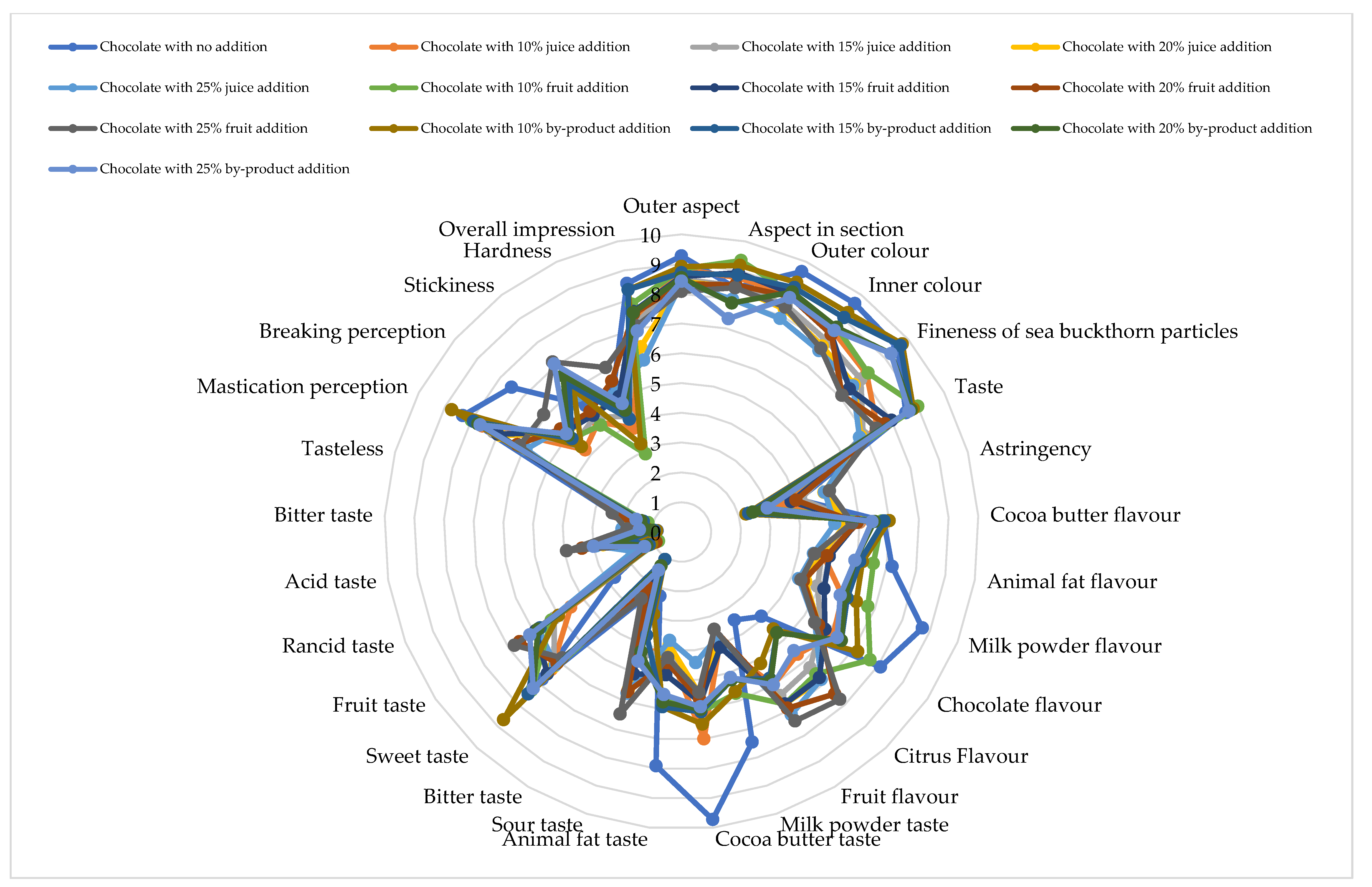
Table 1.
Rheological characteristics of chocolate added with H. rhamnoides fruit materials.
| Type of Hippophae rhamnoides fruit material (TP) x Percentage of addition (PA) | Fmax - maximum compression force (N) |
Lp – plastic coefficient (mJ) |
Le – elastic coefficient (mJ) |
k – elasto-plastic coefficient |
Hardness | Consistency |
|---|---|---|---|---|---|---|
| Chocolate with no addition | 37.6 a | 131.9 a | 3.29 a | 0.63 a | 28.1 a | 184.5 a |
| Chocolate with 10% juice addition | 20.1 e | 65.3 d | 3.03 ab | 0.18 cd | 14.1 de | 95.6 e |
| Chocolate with 15% juice addition | 16.6 f | 48.1 e | 2.08 e | 0.13 e | 12.4 ef | 80.7 f |
| Chocolate with 20% juice addition | 12.7 g | 30.4 g | 1.62 f | 0.05 f | 9.9 gh | 65.9 g |
| Chocolate with 25% juice addition | 12.7 g | 23.3 h | 1.42 f | 0.05 f | 9.7 h | 57.0 g |
| Chocolate with 10% fruit addition | 30.2 b | 95.8 c | 3.08 ab | 0.20 c | 18.1 c | 142.3 bc |
| Chocolate with 15% fruit addition | 14.8 f | 65.9 d | 2.60 cd | 0.15 de | 14.6 d | 139.0 c |
| Chocolate with 20% fruit addition | 10.3 h | 54.4 e | 2.25 de | 0.04 f | 13.5 de | 130.7 c |
| Chocolate with 25% fruit addition | 9.2 h | 30.5 g | 1.44 f | 0.03 f | 10.2 gh | 107.8 d |
| Chocolate with 10% by-product addition | 37.2 a | 126.2 b | 3.15 ab | 0.26 b | 26.9 a | 180.2 a |
| Chocolate with 15% by-product addition | 26.3 c | 92.7 c | 2.69 bc | 0.15 de | 21.2 b | 153.0 b |
| Chocolate with 20% by-product addition | 15.3 f | 54.2 e | 2.48 cd | 0.04 f | 12.6 ef | 92.9 e |
| Chocolate with 25% by-product addition | 10.8 h | 28.1 gh | 2.40 cd | 0.04 f | 11.5 fg | 64.1 g |
n.s. not significant; within each column, mean values followed by different letters are significantly different at p ≤ 0.05 according to Duncan test.
Table 2.
Rheological characteristics of chocolate added with H. rhamnoides fruit materials.
| Type of Hippophae rhamnoides fruit material (TP) x Percentage of addition (PA) | Adhesiveness | Cohesiveness | Elasticity | Chewability | Resilience | Fmax cutting (N) |
Mechanical work (mJ) |
|---|---|---|---|---|---|---|---|
| Chocolate with no addition | 1.03 i | 0.147 g | 1.74 a | 8.10 a | 1.80 a | 23.3 a | 48.5 a |
| Chocolate with 10% juice addition | 1.19 hi | 0.161 g | 1.31 b | 4.61 f | 0.26 e | 20.4 bc | 28.6 d |
| Chocolate with 15% juice addition | 1.33 h | 0.214 f | 1.07 df | 4.28 fg | 0.22 ef | 11.7 d | 26.2 de |
| Chocolate with 20% juice addition | 1.50 g | 0.221 f | 1.06 ef | 3.02 h | 0.17 f | 10.7 df | 23.7 ef |
| Chocolate with 25% juice addition | 1.72 f | 0.297 de | 0.95 f | 2.53 i | 0.12 g | 9.4 eg | 23.2 ef |
| Chocolate with 10% fruit addition | 1.29 h | 0.214 f | 1.69 a | 7.19 c | 0.43 d | 21.9 ab | 41.0 b |
| Chocolate with 15% fruit addition | 1.44 gh | 0.285 e | 1.34 b | 5.43 e | 0.26 e | 18.6 c | 34.5 c |
| Chocolate with 20% fruit addition | 2.01 e | 0.310 cd | 1.23 bc | 3.32 h | 0.21 ef | 10.9 de | 23.0 ef |
| Chocolate with 25% fruit addition | 2.38 bc | 0.338 b | 1.15 ce | 2.69 i | 0.06 i | 10.7 df | 22.0 fg |
| Chocolate with 10% by-product addition | 2.19 d | 0.288 de | 1.74 a | 7.63 b | 0.64 b | 22.6 a | 47.5 a |
| Chocolate with 15% by-product addition | 2.23 cd | 0.292 de | 1.66 a | 6.52 d | 0.55 c | 12.0 d | 25.1 df |
| Chocolate with 20% by-product addition | 2.51 b | 0.321 bc | 1.19 cd | 4.06 g | 0.18 f | 8.8 fg | 18.9 gh |
| Chocolate with 25% by-product addition | 2.91 a | 0.427 a | 0.95 f | 2.57 i | 0.09 gh | 7.7 g | 16.6 h |
n.s. not significant; within each column, mean values followed by different letters are significantly different at p ≤ 0.05 according to Duncan test.
Table 3.
Quality and colour characteristics of chocolate added with H. rhamnoides fruit materials.
| Type of Hippophae rhamnoides fruit material (TP) x Percentage of addition (PA) | Dry matter (%) |
Soluble solids (°Brix) |
pH | Proteins | Fats | Mineral Substances | Ash | L* | a* | b* |
|---|---|---|---|---|---|---|---|---|---|---|
| Chocolate with no addition | 91.0 a | 7.0 a | 6.67 a | 11.1 cf | 18.5 fg | 2.19 d | 0.076 bc | 88.3 a | 2.30 g | 35.5 b |
| Chocolate with 10% juice addition | 89.2 ac | 5.0 b | 5.79 c | 10.9 dg | 18.2 g | 2.49 bc | 0.082 bc | 86.1 ab | 3.51 g | 25.4 cd |
| Chocolate with 15% juice addition | 88.2 ad | 4.9 b | 5.54 e | 10.8 eg | 18.0 g | 2.62 ab | 0.081 bc | 85.2 ab | 4.02 f | 24.5 d |
| Chocolate with 20% juice addition | 86.9 bd | 4.8 bc | 5.01 f | 10.7 fg | 17.7 g | 2.63 ab | 0.088 ac | 84.9 b | 4.56 e | 22.4 e |
| Chocolate with 25% juice addition | 85.9 cd | 4.8 bc | 4.80 g | 10.5 g | 17.5 g | 2.64 ab | 0.086 b | 83.7 b | 4.63 e | 20.5 ef |
| Chocolate with 10% fruit addition | 89.7 ab | 5.0 b | 5.79 c | 11.3 ce | 19.6 ef | 2.36 cd | 0.067 c | 70.3 c | 4.76 e | 27.2 c |
| Chocolate with 15% fruit addition | 88.7 ac | 4.9 b | 5.70 d | 11.4 bd | 20.5 ce | 2.37 cd | 0.077 bc | 64.8 d | 5.46 d | 26.3 cd |
| Chocolate with 20% fruit addition | 84.8 d | 4.6 c | 5.56 e | 11.6 bc | 21.3 cd | 2.73 ab | 0.081 bc | 57.7 e | 6.35 c | 22.2 e |
| Chocolate with 25% fruit addition | 84.7 d | 4.4 d | 5.56 e | 11.9 ab | 22.8 b | 2.91 ab | 0.093 ab | 55.4 e | 6.90 b | 19.7 f |
| Chocolate with 10% by-product addition | 90.2 ab | 5.0 b | 5.86 b | 11.4 bd | 20.3 de | 2.27 cd | 0.075 bc | 69.2 c | 5.43 d | 39.4 a |
| Chocolate with 15% by-product addition | 89.7 ab | 4.9 b | 5.53 e | 11.6 bc | 21.5 c | 2.40 cd | 0.083 bc | 66.2 d | 6.42 c | 36.5 b |
| Chocolate with 20% by-product addition | 89.5 ac | 4.9 b | 5.02 f | 11.9 ab | 23.0 b | 2.54 bc | 0.076 bc | 57.4 e | 7.81 a | 35.7 b |
| Chocolate with 25% by-product addition | 87.2 ad | 4.8 bc | 4.81 g | 12.4 a | 24.7 a | 3.05 a | 1.105 a | 55.4 e | 8.09 a | 35.1 b |
n.s. not significant; within each column, mean values followed by different letters are significantly different at p ≤ 0.05 according to Duncan test.Among the several chocolate appearance parameters, such as brightness, shape, surface smoothness and translucency, colour is one of the most impacting aspects on consumer choices [37]. Sea buckthorn material strongly influences the ‘a’ and ‘b’ colour components of chocolate because of their high pigment content [15], whereas the addition of other fruits were not found to importantly change the colour components of food products [9,42]. The addition of omega 3 fatty acids to chocolate elicited a darker [9] or redder colour [43], compared to control, though the mentioned parameter also depends on ingredients and manufacturing system [44,45]. Moreover, the fat bloom has also significant effect on the Whiteness Index, i.e., chocolate visual and textural properties [9].
Table 5.
Mineral characteristics of chocolate added with H. rhamnoides fruit materials.
| Type of Hippophae rhamnoides fruit material (TP) x Percentage of addition (PA) | K (mg 100 g-1) |
Ca (mg 100 g-1) |
Mg (mg 100 g-1) |
Na (mg 100 g-1) |
P (mg 100 g-1) |
Zn (mg 100 g-1) |
|---|---|---|---|---|---|---|
| Chocolate with no addition | 86.7 a | 121.9 e | 51.7 f | 110.0 bc | 37.5 g | 1.56 |
| Chocolate with 10% juice addition | 84.0 a | 132.1 de | 54.2 ef | 110.8 bc | 38.9 fg | 1.53 |
| Chocolate with 15% juice addition | 77.3 bc | 136.1 cd | 58.1 de | 116.1 ac | 42.7 df | 1.50 |
| Chocolate with 20% juice addition | 76.8 bc | 139.5 bd | 60.3 cd | 117.8 ac | 45.5 cd | 1.49 |
| Chocolate with 25% juice addition | 71.8 ce | 144.3 ad | 63.5 bd | 123.9 a | 48.9 bc | 1.47 |
| Chocolate with 10% fruit addition | 81.7 ab | 136.4 cd | 59.0 de | 107.2 c | 39.1 fg | 1.50 |
| Chocolate with 15% fruit addition | 76.9 bc | 139.2 bd | 62.7 bd | 110.5 bc | 43.2 df | 1.48 |
| Chocolate with 20% fruit addition | 73.8 cd | 144.5 ad | 65.6 ac | 112.7 bc | 47.9 bc | 1.44 |
| Chocolate with 25% fruit addition | 66.7 e | 149.5 ab | 68.7 ab | 118.1 ab | 50.3 ab | 1.42 |
| Chocolate with 10% by-product addition | 70.1 de | 140.9 bd | 61.3 cd | 107.4 c | 40.6 eg | 1.47 |
| Chocolate with 15% by-product addition | 60.7 f | 145.3 ac | 65.2 ac | 111.5 bc | 43.7 de | 1.44 |
| Chocolate with 20% by-product addition | 55.8 f | 150.0 ab | 68.2 ab | 114.7 ac | 48.0 bc | 1.42 |
| Chocolate with 25% by-product addition | 49.6 g | 155.5 a | 70.4 a | 116.8 ac | 53.2 a | 1.40 |
| n.s. |
n.s. not significant; within each column, mean values followed by different letters are significantly different at p ≤ 0.05 according to Duncan test.
Disclaimer/Publisher’s Note: The statements, opinions and data contained in all publications are solely those of the individual author(s) and contributor(s) and not of MDPI and/or the editor(s). MDPI and/or the editor(s) disclaim responsibility for any injury to people or property resulting from any ideas, methods, instructions or products referred to in the content. |
© 2025 by the authors. Licensee MDPI, Basel, Switzerland. This article is an open access article distributed under the terms and conditions of the Creative Commons Attribution (CC BY) license (http://creativecommons.org/licenses/by/4.0/).
Copyright: This open access article is published under a Creative Commons CC BY 4.0 license, which permit the free download, distribution, and reuse, provided that the author and preprint are cited in any reuse.


