

Submitted:
30 September 2025
Posted:
30 September 2025
You are already at the latest version
Abstract
This study aimed to formulate probiotic beverages using underutilized tropical fruit pulp, such as sincuya (Annona purpurea Moc. & Sessé ex Dunal), urraco (Licania platypus (Hemsl.) Fritsch), matasano (Casimiroa edulis La Llave y Lex), and jaboticaba (Plinia cauliflora Mart. Kausel), along with whey. Evaluations of color, vitamins, minerals, ˚Brix, pH, and titratable acidity (TA) were performed on the fruit pulps. Subsequently, four beverages inoculated with a mixed culture (Streptococcus thermophilus, Lactobacillus delbrueckii and Bulgaricus) were produced, and ˚Brix, pH, TA, acceptability index (AI), and colony-forming units (CFU) were measured after 9 hours of fermentation. Sincuya pulp was highlighted for its content of vitamin A (334.37 UI mg/100 g) and potassium (444.49 mg/100 g). In terms of sensory characteristics, the sincuya drink was best evaluated in terms of color, aroma, flavor, and general acceptability, with scores of 78%, 71%, 70%, and 71%, respectively. Uraco, sincuya, and matasano drinks exhibited values of 10.9, 10.4, and 9.7 Log10 CFU/mL, respectively. These results demonstrate that the fruits and formulated beverages have technological potential, functional and probiotic benefits, and sensory characteristics that are attractive to consumers. This innovative approach suggests an alternative for improving nutrition using local resources and agroindustrial byproducts.
Keywords:
fermentation
; acceptability
; micronutrients
; sensory evaluation
; Lactobacillus
1. Introduction
Probiotics are living organisms that, when consumed in adequate quantities, provide multiple benefits to consumers [1]. Their characteristics produce health benefits primarily by improving the functionality of the digestive system [2]. For these reasons, the production of nutritious food and beverages rich in probiotics has become a trend in recent years [3,4].
In addition to the above, the consumption of fruits has been associated with multiple health benefits due to their important compounds, such as minerals, essential amino acids, vitamins, carotenoids, phenolic compounds, fiber, and other phytochemicals [3,5,6]. However, in most Latin American countries, the use and consumption of fruits by the population are lower than recommended. Faced with this problem, the floristic richness of the tropics can serve as an option to improve food security, given its great diversity of edible species and that many of these species continue to be collected from their natural environment and consumed directly. Therefore, this resource represents significant potential for the communities where they are native and available, as well as for agroindustry [7,8].
Specifically, the sincuya (Annona purpurea) is one of the most representative fruits of the Annonaceae family. Its fruits are spherical with projections on the exocarp and have a sweet, orange, fibrous, and fragrant pulp. This species is characterized by numerous bioactive compounds associated with traditional medicine [9]. The urraco (Licania platypus) is a fruit with importance due to its biotic interaction in tropical forests with terrestrial mammals and is traditionally known for its gastroprotective properties, featuring a coriaceous exocarp and a sweet and aromatic pulp [8]. The matasano (Casimiroa edulis) is valued for its sleep-inducing properties and the sweet flavor of its ovoid fruits, which have a smooth exocarp and a meaty, yellow pulp when mature [10]. The jaboticaba (Plinia cauliflora) produces spherical purple berries valued for their bittersweet taste and soft consistency [11]. All of these fruits can be used in the production of healthy foods due to their nutritional and technological characteristics.
On the other hand, whey is a byproduct of the dairy industry, generating about 200 million tons of waste per year. It contains several amino acids, sugars, proteins, and most of the water-soluble vitamins found in milk. Therefore, whey is currently being considered for its significant technological potential in the food industry [12]. For the above, the objective of this study was to formulate probiotic beverages from the pulps of sincuya, urraco, matasano, and jaboticaba, combined with whey.
2. Materials and Methods
2.1. Obtention of Primary Materials
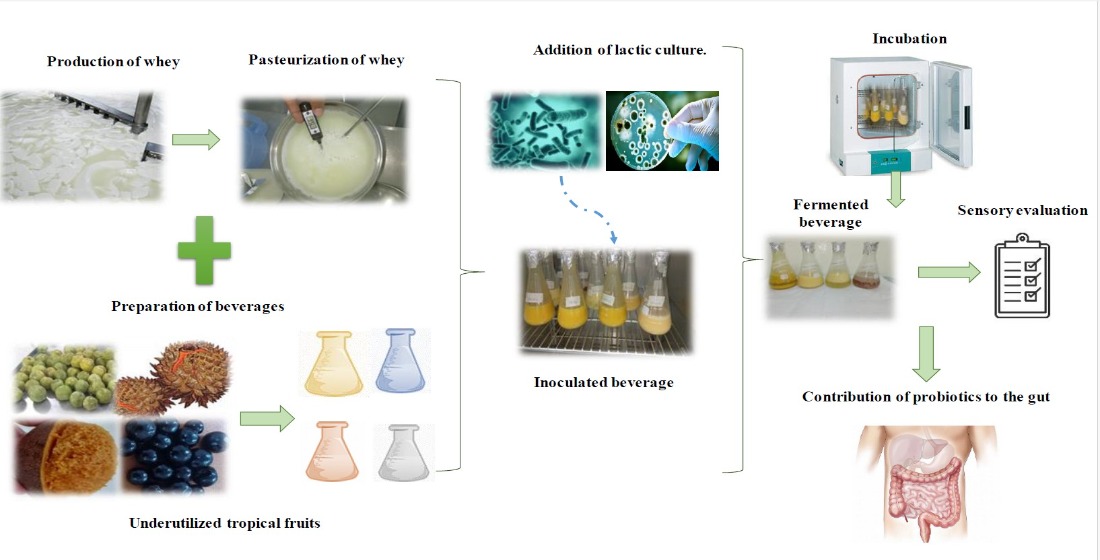
Sincuya fruits were collected from the Río Plátano Biosphere in Honduras; matasano from the department of El Paraíso; and urraco and jaboticaba from La Paz. The fruits were harvested at the appropriate stage of maturation and transported at room temperature for 5 hours to the Dairy Processing Plant of the Universidad Nacional de Agricultura (UNAG), where they were processed using a food processor and a sieve. Subsequently, the fruit pulps were pasteurized at 85˚C for 30 minutes and stored at -18˚C until use. Cow's milk and whey were obtained from UNAG’s Dairy Processing Plant and pasteurized at 70˚C for 15 minutes.
2.2. Growing Conditions of Probiotic Cultures
A mixed probiotic culture of Lactobacillus delbrueckii, Lactobacillus bulgaricus, and Streptococcus thermophilus was commercially obtained as freeze-dried form from“Yoflex® Mild 1.0”. For activation, 1 g of the freeze-dried culture was inoculated in 200 mL of milk at 45˚C in a 250 mL flask and incubated for 21 hours at 45˚C.
2.3. Preparation of Fermented Beverages with Whey and Fruits
Initially, a whey-milk base (75:25) was prepared to improve the organoleptic characteristics and consistency [13]. The whey-milk base was mixed with sincuya, urraco, matasano, and jaboticaba pulps using a 500 mL precipitated glass beaker and manually stirred with a glass rod to prepare the beverages.
The formula for the four beverages comprised 64.5% whey-milk base, 32.3% fruit pulp, and 3.2% sugar. For fermentation, the probiotic culture was added to the liquid portion of the formulated mixture, with 1.5 mL of active culture inoculum added to a 150 mL whey-milk and fruit pulp mixture in a 250 mL flask. The concentration of probiotic bacteria prior to being added to the formulated beverages was 8.62 Log CFU/mL. Subsequently, the drinks were incubated in a stirring incubator (model ON-12G) at 45˚C for 9 hours. After fermentation, the samples were aseptically collected and stored at 4˚C [14].
2.4. Determination of pH, Titratable Acidity, and Soluble Solids
The pH of the samples was measured at 25 ± 1˚C using an OHAUS STARTER 2100 pH meter, which had been previously calibrated. The pH value was measured in triplicate by inserting the pH meter electrode into a beaker containing the sample. Titratable acidity was measured using phenolphthalein as an indicator, by titrating 10 mL of the fermented beverage with a standard NaOH solution (0.1 N) 0.1 mol/L. The results were expressed as a percentage of acidity [15].
To measure the soluble solids content, a BOECO GERMANY manual refractometer was used. Measurements were performed in triplicate, and the results were expressed in ˚Brix [16]
2.5. Determination of Vitamin C
The detection and quantification of ascorbic acid in fruit pulps were performed at the Food Analysis Laboratory of the Panamerican School of Agriculture (Zamorano in Honduras), using high-performance liquid chromatography (HPLC, model 1100, Agilent Technologies) equipped with a diode array detector (HPLC-DAD). A 250 mm × 4.6 mm PLRP-S 100 Å 5 µm column was used. The mobile phase consisted of deionized water with a molarity of 0.05 and a pH of 1.89 (acidified with phosphoric acid), with a flow rate of 0.05 mL/min. UV detection was performed at 244 nm and 230 nm [17,18]
For sample preparation, 2 g of fruit pulp was weighed and added to a 100 mL flask, then diluted with the mobile phase. The pulp was homogenized at 500 rpm for 10 minutes in a magnetic stirrer to solubilize and extract vitamin C. The solution was filtered through an Acro disc with a pore size of 0.2 µm and transferred to 2 mL vials. The analysis was conducted at 45˚C with a 20 µL injection and a runtime of 20 minutes per sample.
2.6. Determination of Vitamin A
The determination of vitamin A was carried out at the Food Analysis Laboratory of the Panamerican School of Agriculture, Zamorano in Honduras. The methodology described by Sanchez-Camargo and collaborators was used with slight modifications. [19]. The analysis was performed using an Agilent Technologies Cary 8454 UV-Visible spectrophotometer. For data collection, a hexane-acetone solution with a ratio of 1.5:1 was prepared. Then, 2 g of the sample was weighed into a beaker, and 20 mL of the prepared solution was added. The beaker was covered with parafilm and aluminum foil and stirred for 15 minutes. The supernatant was then read at 453 nm in the UV-visible spectrophotometer, and the absorbance was recorded. The result was expressed as IU/100 g of fresh fruit.
2.7. Determination of Minerals
The analysis of the minerals potassium (K), iron (Fe), magnesium (Mg), copper (Cu), zinc (Zn), manganese (Mn), and calcium (Ca) was performed using the AOAC 985.35 method with an atomic absorption spectrophotometer (Thermo Scientific ICE 3000 series) [20]. For data collection, the porcelain crucibles were first cleaned by immersion in 20% nitric acid for five hours and then washed three times with deionized water. Afterwards, the method was carried out AOAC 923.03 to obtain ashes. Next, 5 mL of 1 M nitric acid was added to the ashes contained in the crucible and heated in a steam bath at 95 °C for three minutes to dissolve it. Then, the solution was added to a 50 mL volumetric flask and the crucible was washed with two 5 mL portions of 1 M nitric acid by adding it to the same flask and making up with the same acid until the flask was full. Next, the concentrations of each sample were prepared within the linear range of the instrument, in the case of iron the concentration must be in a range of 0.06 – 1.5 ppm and for calcium the range must be 0.01 – 3 ppm. Then, it was diluted with nitric acid to 1 M and the calibration curve was prepared for each mineral. Afterwards, the test solutions were determined in a similar way in the atomic absorption spectrophotometer, and the calculation was carried out with the equation 1 taking into account the weight of the sample and the dilutions made.
Where:
L: concentration detected
df: dilution factor
B: white average
P: sample weight
2.8. Color Determination
Color analysis was conducted using the AN 1018.00 method by spectrophotometry with Hunterlab ColorFlex equipment [21]. The CIELab scale was used, where the L value indicates luminosity (ranging from 0 for black to 100 for white); the a coordinate ranges from positive values (red) to negative values (green); and the b coordinate ranges from positive values (yellow) to negative values (blue). The equipment was calibrated before each measurement. Before each repetition, the equipment was calibrated with the black standard, then the white standard, then the standard (green glass) was read and the reading data were observed, which should agree with those established by the standard. The data from the different repetitions continued to be taken, obtaining three different readings per sample and three from each repetition
2.9. Microbiological Evaluation of the Fermented Beverages
CFU counts were conducted in the Microbiology Laboratory of the National University of Agriculture. Counts were obtained by serial dilutions in sterile peptone water up to 10-6. Aliquots of 1 mL were plated in duplicate on CRITERION orange agar serum using the plate spreading method. The plates were incubated in a incubator (Lanceta Hg) at 42˚C for 48 hours. Plates with 20 to 300 CFU/mL were quantified [22].
2.10. Sensory Evaluation
The drinks were evaluated by 15 semi-trained panelists aged 20-30 years, who assessed sensory attributes including color, aroma, flavor, and general acceptability [23]. An unstructured linear scale of 15 points was used, where 0 represented "absence of liking" and 15 indicated "very high liking" for the evaluated characteristics.
2.11. Acceptability Index
The acceptability index for color, aroma, flavor, and general appearance of the formulated fermented beverages was calculated using Equation 2 [15,24]:
A characteristic is considered to have good acceptability if the AI% is ≥ 70% [24].
2.12. Statistical Analysis
Data were analyzed using InfoStat version 2013 (National University of Córdoba, Argentina) with a one-way analysis of variance (ANOVA). When significant differences between formulations were detected, the Tukey's multiple comparison test at 95% confidence was used.
3. Results and Discussion
3.1. Physicochemical Characterization of Fruit Pulp
Table 1 presents the results of the physicochemical parameters of the pulp from underutilized fruits. Significant differences (p ≤ 0.05) were observed in soluble solids, pH, titratable acidity, and the ratio between soluble solids and titratable acidity among the fruit pulps studied. In terms of soluble solids and pH, the pulps of matasano and urraco showed statistically significant differences compared to the other two pulps, with values exceeding 15 ˚Brix and a pH higher than 6. The ˚Brix for matasano is consistent with previous studies, [10] reported a ˚Brix of 15.60. For titratable acidity, the jaboticaba pulp exhibited higher values, which directly affected the ratio between soluble solids and titratable acidity, resulting in the lowest ratio for this fruit. Soluble solids, acidity, and particularly the overall value of the soluble solids/titratable acidity ratio correlate with consumer acceptability of the fruits or their derivatives [25,26]. Fruits with higher levels of soluble solids tend to be more acceptable, additionally, these parameters, along with pH, indicate the maturation, quality, and technological properties of the fruits [24].
Regarding the CIELab color parameters, L (lightness), a (redness), and b (yellowness) for all the pulps were positive (Table 1). The general color of the pulps of sincuya and urraco could be described as intense orange or yellow, with matasano having a slightly less intense color. The luminosity values for these fruits were close to 50 (average L values around 48.24, on a scale from 0 for black to 100 for white). The pigmentation of these three fruits was weak, with relatively high chroma (average C values were 47.1), suggesting a high purity of color. The values of the hue angle (h), with an average of 71.29, matched the orange/yellow nuance of these fruits. In contrast, for most color parameters, the jaboticaba pulp displayed different results, reflecting its characteristic purple hue. Color can serve as an indicator of food quality and defects, visual perception plays a key role in selecting nutritious and healthy foods [27]. In the case of fruits, color reflects the presence of different pigmented components [28]. Carotenoids are generally responsible for orange or yellow hues, while the blue, purple, and red colors in fruits and vegetables are attributed to anthocyanins. These pigment bioactive compounds play a significant role in the beneficial activities of fruits and their derivatives[28].The tones observed in these fruits suggest the presence of phytochemicals such as carotenoids and anthocyanins, molecules known for their high biological activity.
3.2. Vitamins and Minerals from Fruits
Micronutrients are essential for maintaining good health and preventing disease. A balanced and varied diet that includes a wide range of foods rich in vitamins and minerals is crucial to ensure an adequate supply of these essential nutrients. Regarding minerals, the fruits exhibited significant concentrations, with urraco containing 504.37 mg/100 g and sincuya with 444.49 mg/100 g of potassium. Potassium plays a fundamental role in the body by helping to maintain fluid balance and osmotic equilibrium, as well as aiding in the regulation of nerve signals and muscle contractions [29]. Additionally, urraco had 12.17 mg/100 g and matasano had 8 mg/100 g of magnesium. Magnesium helps relax the muscles of the airways, which can ease breathing for asthmatics [30]. Some studies reports that magnesium is beneficial for various aspects of health, including bones, energy levels, cardiovascular health, the cerebrovascular system, the muscular system, dental health, diabetes management, emotions, calcification, stress, depression, anxiety, and asthma [31]. Magnesium deficiency can lead to fatigue, irritability, nervousness, muscle stiffness, and difficulty concentrating. Calcium levels in these pulps ranged between 5.92 mg/100 g and 2.41 mg/100 g, calcium is crucial for bone and tooth formation, muscle contraction regulation, and nerve impulse transmission, making its presence in food important for overall health [32].
Proper nutrition, including a balanced intake of nutrients, is essential for preventing malnutrition and promoting healthy growth and development. Weight gain, when necessary, should be achieved in a gradual and healthy manner. Additionally, ensuring adequate calcium intake is crucial, especially during the early stages of development and growth [33]. Vitamins are essential organic compounds necessary for the normal functioning of the human body. These substances must be obtained through the diet, as they cannot be produced in sufficient quantities by the body. Vitamins play key roles in various biological functions and are essential for maintaining health. Vitamin A is a vital nutrient known for its role in vision, gene expression, and the strengthening of the immune system [34]. The highest content of vitamin A was found in sincuya, with 334.37 mg/100 g. Matasano had the highest content of vitamin C (Table 2), an important antioxidant that helps protect cells by eliminating reactive oxygen species generated by oxidative stress [35]. Positioning these fruits in a privileged place for their vitamin A and B values, being an alternative to improve the nutrition of consumers, mainly in regions where there is food and nutritional insecurity.
3.3. Properties of Probiotic Beverages
Probiotics are commonly found in fermented foods such as yogurt, kefir, and other dairy products. Milk and its fermented derivatives contain high-quality proteins and can also be beneficial for growth and development. To maximize the health and growth benefits of probiotics, it’s important to consume a balanced and diverse diet that includes fruits, dairy products, fermented foods, and other essential nutrients [36]. Table 3 presents the physicochemical parameters before and after fermentation, highlighting changes in ˚Brix, pH, and percentage of titratable acidity. Significant differences (p ≤ 0.05) were observed in these parameters for the four beverages after 9 hours of fermentation. The initial ˚Brix values for the beverage were 15.9, 13.2, and 11.3 for urraco, matasano, and sincuya, respectively. These initial ˚Brix values provide a technological advantage in developing fermented beverage, as simple sugars are directly related to flavor, which primarily determines food acceptability [37]. Additionally, fruit juices are an excellent option for incorporating probiotics because they are rich in vitamins and minerals that support the growth of beneficial microorganisms [38]. Moreover, using plant-based juices/beverages to deliver probiotics not only offers an alternative to functional foods but also helps with lactose intake for people with intolerance [36]. After 9 hours of fermentation, ˚Brix values decreased by approximately 1% in all dairy beverage. This decrease is characteristic of lactic fermentation processes, where lactic acid bacteria convert sugars into energy and primarily lactic acid [39].
Regarding pH, the beverage had initial values between 6.3 and 4.7, after 9 hours of fermentation, the final pH ranged between 4.4 and 3.9, values that suggest sensory characteristics pleasing to the consumer. Other studies of fermented beverage with whey and mango, guava, and apple pulp with final pH values between 4.0 and 4.5 reported acceptability index values greater than 80% [13,22,23]. pH values between 4.0 and 4.4 have been deemed acceptable in determining the sensory quality of fermented dairy products, classifying them as non-excessively acidic [40]. Titratable acidity increased by 152, 71, 41, and 19 after 9 hours of fermentation in the sincuya, urraco, matasano, and jaboticaba beverage, respectively (Table 3). Similar titratable acidity values have been reported for fermented dairy beverage with added mango and cerrado fruit pulps [23,41]. The titratable acidity and pH values in matasano, urraco, and sincuya beverageare characteristic of stable fermented products. A 14-day stability study of a caja-mango pulp (Spondias dulcis) flavored milk drink reported pH ranges between 4.13 and 4.31, with an acidity close to 0.80% lactic acid [42]. pH and titratable acidity are properties that influence the stability of fermented products.
A concordance between pH and titratable acidity was evident, as expected in all beverage. The decrease in pH corresponded with an increase in titratable acidity. The increase in acidity is due to the constant production of lactic acid, as lactic bacteria consume sugars in the environment, producing more lactic acid, which increases the concentration of H+, thereby lowering pH [40]. This decrease in pH creates an optimal environment for lactic bacteria to thrive, given their preference for acidic conditions [36]. Table 3 also presents the total count of colony-forming units (CFU) of lactic acid bacteria cultures (Lactobacillus delbrueckii sp., Lactobacillus bulgaricus, and Streptococcus thermophilus) after 9 hours of fermentation of the beverages, showing significant differences in CFU counts. The highest CFU counts were found in urraco, sincuya, and matasano beverage, with values of 10.9, 10.4, and 9.7 Log10 CFU/mL, respectively. These values are higher than those reported in other studies, where initial counts close to 8 and 9 Log10 CFU/mL were observed for fermented dairy beverage made with cagaita, tamarind, umbu, araçá boi, pineapple, papaya, and orange fruits [1,41,43]. Figueiredo et al., (2019), using cagaita, tamarind, and umbu to make fermented beverage, reported initial counts greater than 8.2 Log10 CFU/mL, noting a decrease in lactic bacteria throughout a 21-day storage period. The initial CFU counts in probiotic beverage are crucial for their functionality. Islam et al., (2021), demonstrated in feasibility studies of probiotic cells during in vitro gastrointestinal digestion that about 15% of the probiotic cell population is lost due to the effect of gastric juices in the stomach.
For probiotic fermented beverages a minimum number of live cells is recommended 6-8 Log10 CFU/mL [44,45]. The CFU counts of lactic acid bacteria in urraco, sincuya, and matasano beverage in our study exceed 6 Log10 CFU/mL, suggesting clear probiotic potential. The strains Lactobacillus delbrueckii sp., Lactobacillus bulgaricus, and Streptococcus thermophilus are known for their probiotic activity [46,47] and are associated with protecting the digestive system from harmful microorganisms, improving digestion, nutrient assimilation, intestinal function, and providing other health benefits [2], in addition, it improves the bioaccessibility, bioavailability, and bioactivity of the bioactive compounds present in foods [48]. The consumption of probiotics also contributes to regulating neuropsychological functions of the central nervous system, with the bidirectional gut-brain connection being influenced by intestinal microflora [36]. For example, a recent study suggests that probiotic consumption may release certain compounds capable of reducing corticosterone levels in the blood, potentially influencing neuropsychological functions and alleviating symptoms of depression and other mental disorders [49]. Therefore, the high counts of probiotic bacteria in urraco, sincuya, and matasano beverages, meeting the minimum values required for probiotic products [43,45], suggest that these products are beneficial for promoting health benefits in consumers.
3.4. Sensory Characteristics of Beverages
Figure 1 shows the averages of the sensory parameters of the beverages, Sincuya, urraco, and jaboticaba did not present significant differences among them for the characteristics of color, aroma, flavor, and general acceptability, and were considered acceptable to consumers.
On the other hand, the matasano beverage showed significant differences compared to the other beverages, obtaining the lowest average (7.9) for general acceptability. To determine the beverage with the greatest acceptability, the acceptability index (AI) was calculated [15,24], as shown in Figure 2. For the formulations of fermented beverage evaluated for sensory characteristics, the sincuya beverage obtained AI values of 78%, 71%, 70%, and 71% for color, aroma, flavor, and general acceptability, respectively. These values are within the acceptable range, as an AI of over 70% is considered acceptable for sensory qualities [24]. These results are similar to those obtained in other studies where beverage made with fruit pulps of mango, pineapple, guava, mangaba, and whey reported AI values ranging between 72% and 98% [12,13,15,23]. In contrast, the matasano beverage obtained lower AI values of 59%, 58%, 49%, and 53% for color, aroma, flavor, and general appearance, respectively. Considering that the formulations of the beverage in this study differ only in the type of pulp used, the sensory acceptability of fermented beverage is associated with the sensory characteristics of each fruit pulp; however, more evidence is needed to confirm this hypothesis.
From a food technology perspective, the vitamins, minerals, and other bioactive compounds found in fruit pulp support the growth of probiotics, along with the nutrients present in whey and milk. The use of fruit pulp from sincuya, urraco, and jaboticaba in the production of fermented dairy beverage is feasible because they have probiotic potential that could help protect the digestive system from harmful microorganisms and improve digestion and intestinal function. They also provide significant nutritional value, including vitamins A and C, and minerals such as potassium and magnesium, which stimulate the immune system, promote growth and normal development, and support the proper functioning of cells and organs. Additionally, these beverages are sensory acceptable for their attributes of color, aroma, flavor, and general acceptability, indicating that their consumption has a positive effect on the health of consumers.
4. Conclusions
It is possible to formulate functional dairy drinks with sincuya and urraco, as they have acceptable physicochemical, probiotic, and sensory characteristics. The fermented drinks with sincuya pulp were highlighted, showing the highest acceptability and high biological value due to its content of vitamin A, potassium, and CFU count of probiotic culture. On the other hand, the use of tropical fruit pulp and whey in the formulation of beverages represents an alternative to mitigate the environmental pollution generated by the dairy industry. In this way, dairy fermented drinks with underutilized tropical fruits can represent an option not only to encourage the consumption of native local fruits but also as an opportunity for agribusiness to contribute to reducing malnutrition and hunger in the tropics, since they are easily accessible, rich in bioactive compounds, and have enormous nutritional value.
Author Contributions
F.E.S. Rosales: Writing – original draft, Methodology, Supervision, K.M.C. Reyes: Writing – original draft, Formal analysis, Validation, L.P.M. Bu: Writing – original draft, Conceptualization, Software, R.E.M. Martinez: Investigation, Methodology, L.P.C. Alfaro: Writing – original draft, C.O.I. Lizardo: Writing – review and editing, Visualization, H.A.G. Gomez: Writing – review and editing, Project administration, Supervision.
Institutional Review Board Statement
The research protocol was approved by the Ethics and Research Committee of the Faculty of Technological Sciences at the Universidad Nacional de Agricultura, under ethical approval number CEI/0029/2022 for studies involving humans.
Informed Consent Statement
Informed consent was obtained from all subjects involved in the study.
Data Availability Statement
The raw data supporting the conclusions of this article will be made available by the authors on request.
Acknowledgments
This research was supported by the Research and Graduate Studies Direction of the Universidad Nacional de Agricultura (UNAG). The authors thank the staff of the microbiology laboratory, the milk quality laboratory of the Universidad Nacional de Agricultura (UNAG) and the producers for providing the fruits for this research.
Conflicts of Interest
The authors declare no conflict of interest.
Abbreviations
ANOVA, analyses of variance; CIELab, Commission Internationale de l'Éclairage L* (lightness). a* (redness: green to red). b* (yellowness: blue to yellow). h (hue value. color angle). C* (chroma value. color saturation) color space; HPLC, high-performance liquid chromatography; pH, potential of hydrogen; TA, titratable acidity; AI, acceptability index; W/W: weight/ weight, CFU; colony-forming units, mL; Milliliters, IU; international unity. UNAG; Universidad Nacional de Agricultura.
References
- B. T. Nguyen, E. Bujna, N. Fekete, and A. T. M. Tran, “Probiotic beverage from pineapple juice fermented with Lactobacillus and Bifidobacterium strains,” Front Nutr, vol. 6, no. 54, pp. 1–7, 2019. [CrossRef]
- B. Shori, “Proteolytic activity, antioxidant, and α-Amylase inhibitory activity of yogurt enriched with coriander and cumin seeds,” Lwt, vol. 133, no. 109912, pp. 1–10, 2020. [CrossRef]
- M. Meenu et al., “The golden era of fruit juices-based probiotic beverages: Recent advancements and future possibilities,” Process Biochemistry, vol. 142, pp. 113–135, Jul. 2024. [CrossRef]
- M. & Markets., “Probiotic market – advanced technologies and global market (2022-2027),” 2022, Web. [Online]. Available: https://www.marketsandmarkets.com/Market-Reports/probiotics-market-69.html.
- K. O. P. Inada et al., “Screening of the chemical composition and occurring antioxidants in jabuticaba (Myrciaria jaboticaba) and jussara (Euterpe edulis) fruits and their fractions,” J Funct Foods, vol. 17, pp. 422–433, 2015. [CrossRef]
- E. M. Yahia, M. Maldonado, and M. Svendsen, “Chemistry and biological functions,” in Fruit and vegetable phytochemicals: chemistry and human health, E. M. Yahia, Ed., 2017, pp. 3–52.
- J. Harris et al., “Fruit and vegetable biodiversity for nutritionally diverse diets: Challenges, opportunities, and knowledge gaps,” Glob Food Sec, vol. 33, p. 100618, Jun. 2022. [CrossRef]
- A. Camargo-Sanabria and E. Mendoza, “Interactions between terrestrial mammals and the fruits of two neotropical rainforest tree species,” Acta Oecologica, vol. 73, pp. 45–52, May 2016. [CrossRef]
- L. M. Anaya-Esparza et al., “Annonas: underutilized species as a potential source of bioactive compounds,” Food Research International, vol. 138, no. 109775, pp. 1–18, 2020. [CrossRef]
- S. F. Khalil, H. A. Ismail, and W. F. Elkot, “Physicochemical, functional and sensory properties of probiotic yoghurt flavored with white sapote fruit (Casimiroa edulis),” J Food Sci Technol, vol. 59, no. 9, pp. 3700–3710, Sep. 2022. [CrossRef]
- de A. A. Fernandes, G. M. Maciel, W. V. Maroldi, D. G. Bortolini, A. C. Pedro, and C. W. I. Haminiuk, “Bioactive compounds, health-promotion properties and technological applications of Jabuticaba: A literature overview,” Measurement: Food, vol. 8, p. 100057, Nov. 2022. [CrossRef]
- Z. Islam, S. Tabassum, G. Elisabeth, S. Alam, and M. Ashiqul, “Development of probiotic beverage using whey and pineapple ( Ananas comosus ) juice : Sensory and physico-chemical properties and probiotic survivability during in-vitro gastrointestinal digestion,” J Agric Food Res, vol. 4, no. 100144, pp. 1–7, 2021. [CrossRef]
- M. N. F. Hamad and M. K. El-Nemr, “Development of guava probiotic dairy beverages : application of mathematical modelling between consumer acceptance degree and whey ratio,” Int J Sci Res Sci Technol, vol. 1, no. 5, pp. 186–193, 2015, doi: IJSRST151544.
- L. Meena, B. Malini, T. S. Byresh, C. K. Sunil, A. Rawson, and N. Venkatachalapathy, “Ultrasound as a pre-treatment in millet-based probiotic beverage: It’s effect on Fermentation kinetics and beverage quality,” Food Chemistry Advances, vol. 4, no. 100631, pp. 1–10, 2024. [CrossRef]
- S. de Matos Reis et al., “Development of milk drink with whey fermented and acceptability by children and adolescents,” J Food Sci Technol, vol. 58, no. 7, pp. 2847–2852, Jul. 2021. [CrossRef]
- P. Gunness, O. Kravchuk, S. M. Nottingham, B. R. D. Arcy, and M. J. Gidley, “Postharvest biology and technology sensory analysis of individual strawberry fruit and comparison with instrumental analysis,” vol. 52, no. 2, pp. 164–172, 2009. [CrossRef]
- L. Lloyd, F. Warner, J. Kennedy, and C. White, “Quantitative analysis of vitam c (L-Ascorbic Acid) by ion suppression Reversed phase cromatography,” Food Chem, vol. 28, no. 4, pp. 257–268, 1998. [CrossRef]
- M. M. Wall, “Ascorbic acid, vitamin A, and mineral composition of banana (Musa sp.) and papaya (Carica papaya) cultivars grown in Hawaii,” Journal of Food Composition and Analysis, vol. 19, no. 5, pp. 434–445, Aug. 2006. [CrossRef]
- del P. Sánchez-Camargo, L.-F. Gutiérrez, S. M. Vargas, H. A. Martinez-Correa, F. Parada-Alfonso, and C.-E. Narváez-Cuenca, “Valorisation of mango peel: Proximate composition, supercritical fluid extraction of carotenoids, and application as an antioxidant additive for an edible oil,” J Supercrit Fluids, vol. 152, p. 104574, Oct. 2019. [CrossRef]
- G. Jr Latimer, Official methods of analysis of AOAC International, 20ed ed., vol. 2. AOAC International, Rockville, MD, 2016, 2016.
- H. Santana, A. J. V. Alvarado, S. K. Espinoza, and S. B. L. Aguilar, “Sensorial Evaluation and Physical Chemical Characterization of a Beverage Based on Whey and <i>β</i>-Glucans as a Potential Prevention of Nonalcoholic Steatohepatitis,” Food Nutr Sci, vol. 15, no. 08, pp. 770–789, 2024. [CrossRef]
- L. de Souza Neves Ellendersen, D. Granato, K. Bigetti Guergoletto, and G. Wosiacki, “Development and sensory profile of a probiotic beverage from apple fermented with Lactobacillus casei,” Eng Life Sci, vol. 12, no. 4, pp. 1–11, 2012. [CrossRef]
- R. Resende Maldonado et al., “Study of the composition of mango pulp and whey for lactic fermented beverages,” Journal of Biotechnology and Biodiversity, vol. 9, no. 4, pp. 350–358, 2021. [CrossRef]
- E. de F. Silva et al., “Acceptability of tropical fruit pulps enriched with vegetal/microbial protein sources: viscosity, importance of nutritional information and changes on sensory analysis for different age groups,” J Food Sci Technol, vol. 56, no. 8, pp. 3810–3822, 2019. [CrossRef]
- V. Jayasena and I. Cameron, “°Brix/acid ratio as a predictor of consumer acceptability of crimson seedless table grapes,” J Food Qual, vol. 31, no. 6, pp. 736–750, 2008. [CrossRef]
- A. Mennella, A. R. Reiter, and L. M. Daniels, “Vegetable and fruit acceptance during infancy: impact of ontogeny, genetics, and early experiences,” Advances in Nutrition, vol. 7, no. 1, pp. 211–219, 2016. [CrossRef]
- E. D. Cömert, B. A. Mogol, and V. Gökmen, “Relationship between color and antioxidant capacity of fruits and vegetables,” Curr Res Food Sci, vol. 2, pp. 1–10, Jun. 2020. [CrossRef]
- E. D. Cömert, B. A. Mogol, and V. Gökmen, “Relationship between color and antioxidant capacity of fruits and vegetables,” Curr Res Food Sci, vol. 2, pp. 1–10, 2020. [CrossRef]
- F. Palmer, “Regulation of potassium homeostasis,” Clin J Am Soc Nephrol, vol. 10, no. 6, pp. 1050–1060, 2015. [CrossRef]
- M. O. Bello, O. S. Falade, S. R. A. Adewusi, and N. O. Olawore, “Fruits, Studies on the chemical compositions and anti nutrients of some lesser known Nigeria,” Afr J Biotechnol, vol. 7(21), pp. 3972–3979, 2008.
- Q. Faryadi, “The magnificent effect of magnesium to human health: a critical review,” International Journal of Applied, vol. 2, no. 3, pp. 118–126, 2012.
- H. E. Theobald, “Dietary calcium and health,” Nutr Bull, vol. 30, no. 4, pp. 237–277, 2005. [CrossRef]
- M. Saavedra and A. M. Prentice, “Nutrition in school-age children: a rationale for revisiting priorities,” Nutr Rev, vol. 81, no. 7, pp. 823–843, Jun. 2023. [CrossRef]
- F. Aslam, S. M. Muhammad, S. Aslam, and J. A. Irfan, “Vitamins: key role players in boosting up immune response-a mini review,” Vitamins & Minerals, vol. 6(1), pp. 1–8, 2017. [CrossRef]
- S. Choudhary, K. Sharma, and O. Silakari, “The interplay between inflammatory pathways and COVID-19: A critical review on pathogenesis and therapeutic options,” Microb Pathog, vol. 150, no. 104673, pp. 1–20, Jan. 2021. [CrossRef]
- F. Mojikon, M. Kasimin, A. Molujin, J. Gansau, and R. Jawan, “Probiotication of nutritious fruit and vegetable juices: an alternative to dairy-based probiotic functional products,” Nutrients, vol. 14, no. 3457, pp. 1–26, 2022. [CrossRef]
- Ventura and J. Mennella, “Innate and learned preferences for sweet taste during childhood,” Curr Opin Clin Nutr Metab Care, vol. 14, no. 4, pp. 379–384, 2011. [CrossRef]
- F. Worku, H. Kurabachew, and Y. Hassen, “Probiotication of fruit juices by suplemented culture of lactobacillus acidophilus,” Inernational Journal of Advanced Biotechnology and Research, vol. 4, no. 1, pp. 935–940, 2013. [CrossRef]
- P. M. Malo and E. A. Urquhart, “Fermented foods: use of starter cultures,” in Encyclopedia of food and health, B. Caballero, P. M. Finglas, and F. Toldrá, Eds., Oxford: Academic Press, 2016, pp. 681–685. [CrossRef]
- A. Rodrigues, M. B. T. Ortolani, and L. A. Nero, “Microbiological quality of yoghurt commercialized in Viçosa, Minas Gerais, Brazil,” Afr J Microbiol Res, vol. 4, no. 3, pp. 210–213, 2010.
- J. S. B. Figueiredo et al., “Sensory evaluation of fermented dairy beverages supplemented with iron and added by Cerrado fruit pulps,” Food Science and Technology (Brazil), vol. 39, no. 2, pp. 410–414, 2019. [CrossRef]
- F. Souza et al., “Elaboration, evaluation of nutritional information and physical-chemical stability of dairy fermented drink with caja-mango pulp,” Ciência Rural, vol. 50, no. 1, pp. 1–7, 2020. [CrossRef]
- Rodrigues de Andrade, T. Rodrigues Martins, A. Rosenthal, J. Tiburski Hauck, and R. Deliza, “Fermented milk beverage : formulation and process,” Ciência Rural, vol. 49, no. 03, pp. 1–12, 2019. [CrossRef]
- K. Neffe-Skocińska, A. Rzepkowska, A. Szydłowska, and D. Kołożyn-Krajewska, “Trends and Possibilities of the Use of Probiotics in Food Production,” in Alternative and Replacement Foods, Elsevier, 2018, pp. 65–94. [CrossRef]
- S. Koirala and A. K. Anal, “Probiotics-based foods and beverages as future foods and their overall safety and regulatory claims,” Future Foods, vol. 3, p. 100013, Jun. 2021. [CrossRef]
- N. Donkor, A. Henriksson, T. Vasiljevic, and N. P. Shah, “Probiotic strains as starter cultures improve angiotensin-converting enzyme inhibitory activity in soy yogurt,” J Food Sci, vol. 70, no. 8, pp. 375–381, 2005. [CrossRef]
- B. Shori, G. S. Aljohani, A. J. Al-zahrani, O. S. Al-sulbi, and A. S. Baba, “Viability of probiotics and antioxidant activity of cashew milk-based yogurt fermented with selected strains of probiotic Lactobacillus spp.,” Lwt, vol. 153, no. 112482, pp. 1–8, 2022. [CrossRef]
- Q. Zhao et al., “The bioaccessibility, bioavailability, bioactivity, and prebiotic effects of phenolic compounds from raw and solid-fermented mulberry leaves during in vitro digestion and colonic fermentation,” Food Research International, vol. 165, no. 112493, pp. 1–13, Mar. 2023. [CrossRef]
- Q. Liu et al., “Effect of probiotic administration on gut microbiota and depressive behaviors in mice,” DARU J. Pharm. Sci., vol. 28, no. 1, pp. 181–189, 2020. [CrossRef]
Figure 1.
Sensory parameters of underutilized fruit fermented beverages.
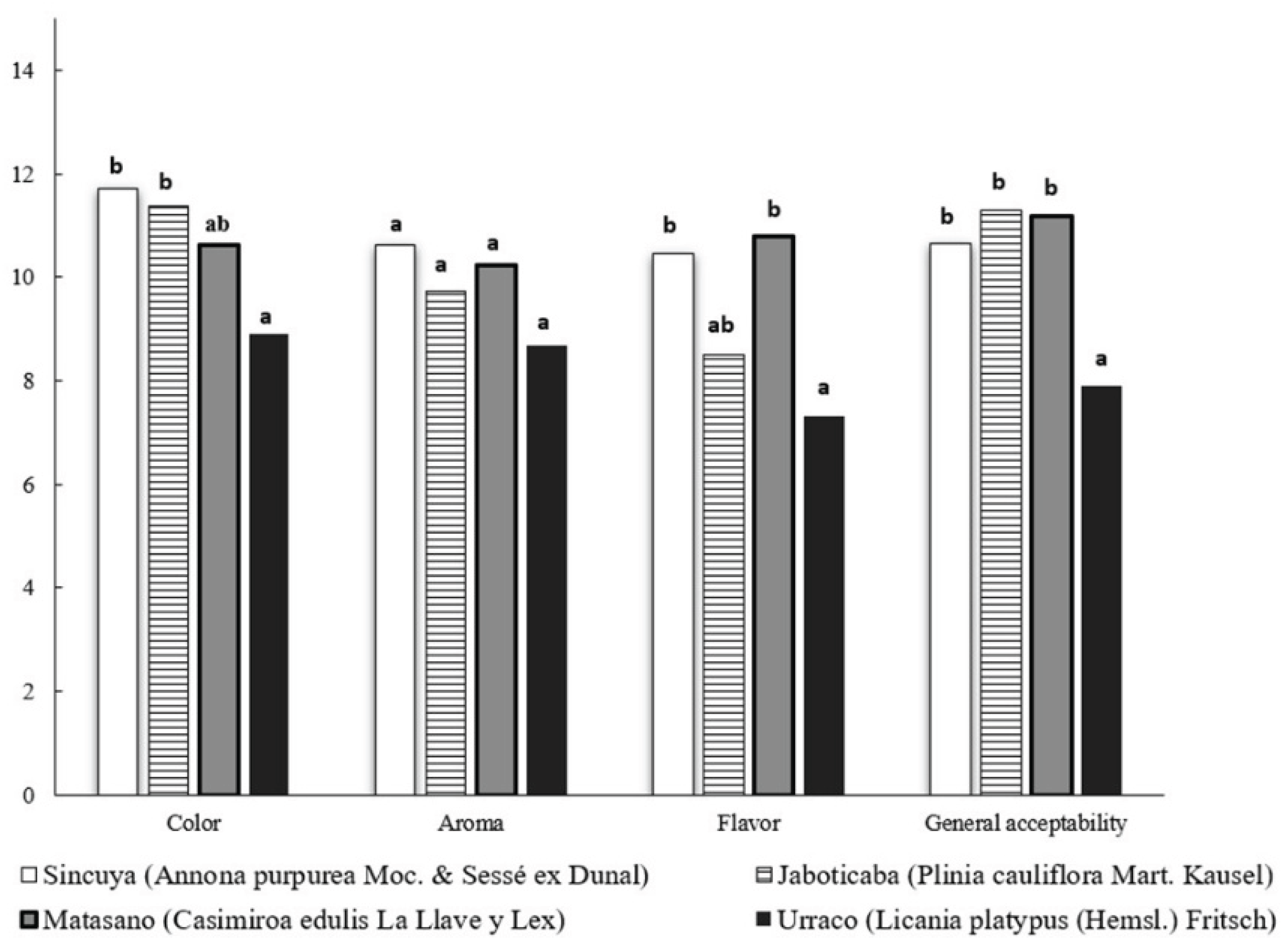
Figure 2.
Acceptability index of sensory characteristics of underutilized fruit fermented beverages.
Figure 2.
Acceptability index of sensory characteristics of underutilized fruit fermented beverages.
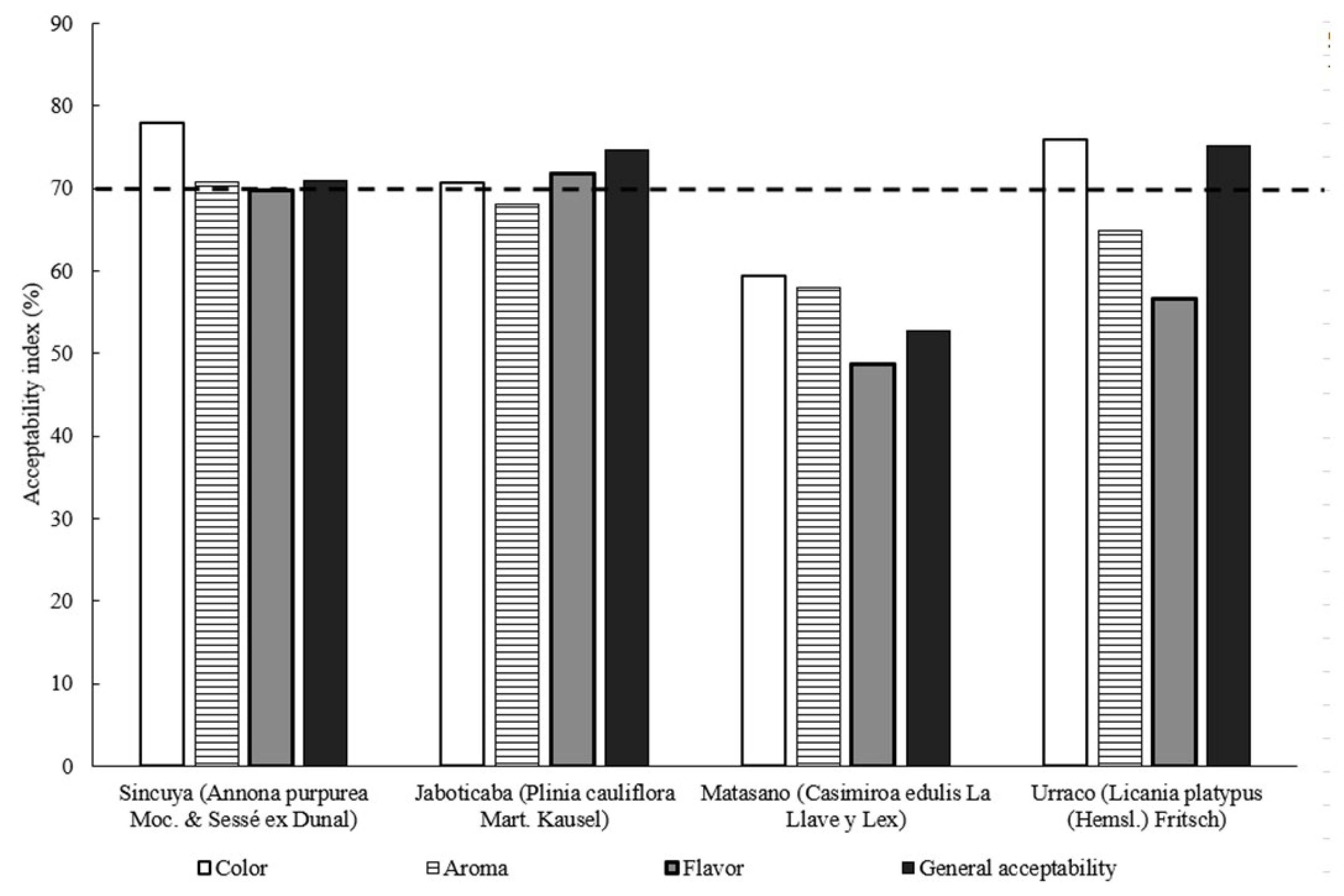

Table 1.
Physicochemical parameters of underutilized fruit pulp.
| Fruits | °Brix | pH | % Titratable acidity (w/w)a | °Brix/Titratable acidity | Color | ||||
|---|---|---|---|---|---|---|---|---|---|
| L* | a* | b* | C* | h | |||||
| Sincuya (Annona purpurea Moc. & Sessé ex Dunal) | 10.1 ± 0.1 b | 4.5 ± 0.1 c | 0.25 ± 0.01 c | 39.90 ± 1.25 b | 55.42 | 18.6 | 46.11 | 49.72 | 1.19 |
| Jaboticaba (Plinia cauliflora Mart. Kausel) | 11.2 ± 0.5 b | 3.2 ± 0.1 d | 1.28 ± 0.03 a | 8.70 ± 0.31 d | 15.04 | 18.33 | 8.22 | 20.09 | 0.42 |
| Matasano (Casimiroa edulis La Llave y Lex) | 16.0 ± 0.5 a | 6.2 ± 0.1 b | 0.25 ± 0.01 c | 65.80 ± 0.31 a | 41.16 | 11.05 | 33.87 | 35.63 | 1.26 |
| Urraco (Licania platypus (Hemsl.) Fritsch) | 15.4 ± 0.4 a | 6.5 ± 0.1 a | 0.40± 0.02 b | 30.60 ± 0.74 c | 48.14 | 15.55 | 53.75 | 55.95 | 1.29 |
a Expressed as % (w/w) citric acid of pulp. L* (lightness). a* (redness: green to red). b* (yellowness: blue to yellow). h (hue value. color angle). C* (chroma value. color saturation). *The same lower case letters do not differ by Tukey test (5%).
Table 2.
Content of vitamins and minerals in pulp of underutilized fruits. .
| Nutrient | Sincuya (Annona purpurea Moc. & Sessé ex Dunal) | Jaboticaba (Plinia cauliflora Mart. Kausel) | Matasano (Casimiroa edulis La Llave y Lex) | Urraco (Licania platypus (Hemsl.) Fritsch) | |
| Minerales (mg/100 g) K |
444.49 | 56.72 | 238.32 | 504.37 | |
| Fe | 0.68 | 0.28 | 0.67 | 0.49 | |
| Mg | 7.49 | 2.74 | 8 | 12.17 | |
| Cu | 0.17 | 0.12 | 0.15 | 0.32 | |
| Zn | 0.63 | 0.23 | 0.23 | 0.45 | |
| Mn | 0.05 | 0.05 | 0.05 | 0.1 | |
| Ca | 5.26 | 2.41 | 4.1 | 5.92 | |
| P | 2.03 | 0.52 | 1.96 | 2.52 | |
| Vitamin C (mg/100 g) | 2.21 | 4.42 | 5.19 | 2.31 | |
| Vitamin A (UI/100 g) | 334.37 | 5.82 | - | 25.63 | |
IU: international unity. - not identified.
Table 3.
Changes in physicochemical parameters of beverages before and after fermentation.
| Beverage | ||||
| Sincuya (Annona purpurea Moc. & Sessé ex Dunal) | Jaboticaba (Plinia cauliflora Mart. Kausel) | Matasano (Casimiroa edulis La Llave y Lex) | Urraco (Licania platypus (Hemsl.) Fritsch) | |
| Before fermenting | ||||
| °Brix | 11.3 ± 0.2 c | 8.3 ± 0.0 d | 13.2 ± 0.2 b | 15.9 ± 0.1 a |
| pH | 5.7 ± 0.0 b | 4.7 ± 0.0 d | 4.9 ± 0.0 c | 6.3± 0.0 a |
| % Titratable acidity (w/w)a | 0.25 ± 0.0 d | 0.31 ± 0.0 c | 0.54 ± 0.0 a | 0.38 ± 0.0 b |
| °Brix/Titratable acidity | 44.9 ± 0.33 d | 26.6 ± 0.53 b | 24.5 ± 0.14 a | 29.8 ± 1.0 c |
| After fermenting | ||||
| °Brix | 10.5 ± 0.3 b | 7.9 ± 0.2 c | 10.2 ± 0.2 b | 15.1 ± 0.2 a |
| pH | 3.9 ± 0.0 d | 4.4 ± 0.0 a | 4.1 ± 0.0 c | 4.3± 0.0 b |
| % Titratable acidity (w/w)a | 0.63 ± 0.0 b | 0.37 ± 0.0 c | 0.76 ± 0.0 a | 0.65 ± 0.0 b |
| °Brix/Titratable acidity | 16.8 ± 0.94 b | 21.3 ± 0.67 c | 13.5 ± 0.69 a | 16.6 ± 0.41 b |
| Log CFU/mL (after 9 hours) | 10.4 ± 0.0 b | 4.3 ± 0.2 d | 9.7 ± 0.1 c | 10.9 ± 0.0 a |
a Expressed as % (w/w) citric acid of pulp. *The same lower case letters do not differ by Tukey test (5%).
Disclaimer/Publisher’s Note: The statements, opinions and data contained in all publications are solely those of the individual author(s) and contributor(s) and not of MDPI and/or the editor(s). MDPI and/or the editor(s) disclaim responsibility for any injury to people or property resulting from any ideas, methods, instructions or products referred to in the content. |
© 2025 by the authors. Licensee MDPI, Basel, Switzerland. This article is an open access article distributed under the terms and conditions of the Creative Commons Attribution (CC BY) license (http://creativecommons.org/licenses/by/4.0/).
Copyright: This open access article is published under a Creative Commons CC BY 4.0 license, which permit the free download, distribution, and reuse, provided that the author and preprint are cited in any reuse.


