

Submitted:
18 August 2025
Posted:
19 August 2025
You are already at the latest version
Abstract
The steady-state quantum dynamics of a compound sample consisting of a semiconductor double quantum dot (DQD) system, non-linearly coupled with a leaking superconducting transmission line resonator, is theoretically investigated. Particularly, the transition frequency of the DQD is taken equal to the doubled resonator frequency, whereas the inter-dot Coulomb interaction is being considered weak. As a consequence, the steady-state quantum dynamics of this complex non-linear system exhibits sudden changes of its features, occuring at a critical DQD-cavity coupling strength, respectively. We have shown that above the threshold, the electrical current through the double quantum dot follows the mean photon number into the microwave mode inside the resonator. This might not be the case anymore below that critical coupling strength. Furthermore, the photon quantum correlations vary from super-Poissonian to Poissonian photon statistics, i.e. towards single-qubit lasing phenomena at microwave frequencies.
Keywords:
double quantum dot
; microwave cavity
; inter-dot Coulomb interaction
; two-photon resonance
; photon statistics
Dedication to Professor Viktor Dodonov for his 55 Years in Quantum Physics
1. Introduction
The various examples of hybrid circuit quantum electrodynamics (QED) structures exhibit a variety of quantum effects previously achieved mainly in the quantum optical setups, while presenting unquestionable advantage in the form of low-size on-chip implementation [1,2,3,4,5]. An emblematic example is the optical cavity coupling natural atoms and photons, where also lasing phenomena are accomplished by additionally optically pumping the atom. A successful QED alternative system playing the role of the active medium that may induce light amplification in the resonant cavity are the artificial atoms, i.e. semiconducting double quantum dots (DQDs) attached to normal metal leads assuring the pumping via applied biased voltage [6,7,8,9]. The circuit considered is driven by single-electron tunneling leading to a population inversion in the DQD energy levels such that, in the resonance condition with the cavity, the electron transport takes place via the emission of energy quantum into the cavity [10,11,12]. In consequence, also the excited microwave oscillator in the cavity may facilitate the current flow in the DQD [13,14].
The advantage of studying DQD-microwave resonator systems is twofold. First of all, the semiconducting DQDs are perfect candidates for qubits due to their higher degree of tunability and to the experimentally attainable strong-coupling regime with the electromagnetic cavity demonstrated in Refs. [15,16,17,18]. Secondly, DQDs are very efficient detectors of single itinerant microwave photons, which is a desirable trait of a quantum system for the realisation of quantum information processing tasks [19,20]. Needless to say that an electronic interface for the manipulation of the photon statistics represents a promising environment for the implementation of various applications in nano-device technology [4,10,21].
The DQDs coupled to a leaking resonator and immersed in various environments still show unexplored physics fueling an increasing theoretical interest and further investigations [14,20,22,23,24,25,26,27]. Also different practical configurations may include weak Coulomb interaction between the charges [28,29,30,31,32], Kerr nonlinearity and signal driven cavity or DQD [14,33,34,35,36]. Thus, numerous theoretical inquiries demonstrate the control of photon emission via transport properties in the DQD and a variety of lasing resonances and their signatures in the transport current [28,37,38,39,40,41]. In addition, the Markovian master equation approach is applied which incorporates the dissipation and decoherence processes deteriorating the performance of the device due to the interaction with the degrees of freedom of the electronic and bosonic baths [42,43].
In this work we analyse the quantum dynamics of a complex system formed of a leaking superconducting transmission line resonator mode coupled with a semiconductor DQD qubit, while focusing on the two-photon resonance between the cavity mode and the energy separation levels of the DQD. Additionally, the interdot Coulomb interaction is considered weak, allowing for the simultaneous presence of two electrons in DQD, but only one in each dot. Compared to the strong Coulomb interaction, under the two photon resonance condition covered recently [44,45], in the current study an additional incoherent electronic tunneling channel is established, contributing to the population of the DQD and facilitating stronger lasing effects in the resonator as a result. In the framework of open quantum systems we employ the master equation for this system configuration and deduce the photon number characteristics and the average electronic current in the asymptotic limit of the steady state. We have found a critical value for the qubit-cavity coupling strengths such that the mean-number of the cavity photons substantially enhances or suppresses, and so does the electric current through the DQD sample. This suggests a convenient conversion mechanism of electric current into a microwave photon flux, or reciprocally. Furthermore, above threshold the electrical current through the double quantum dot follows the behaviours of mean photon numbers into the microwave mode inside the resonator, while this might not be the case below that critical point. Finally, the photon correlations vary from super-Poissonian to Poissonian photon statistics, that is, towards single-qubit lasing effects at microwave frequencies.
This paper is organized as follows. In Section 2 we describe the analytical approach and the system of interest, while in Section 3 we present the equations of motion characterising the considered system. Section 4 presents and analyses the obtained results. The article concludes with a summary given in Section 5.
2. Analytical Approach
We consider a hybrid setup made of a semiconducting DQD qubit which is coupled to an electromagnetic microwave resonator such as a superconducting transmission line. Furthermore, the DQD system is pumped incoherently via electron tunneling through the dots, by means of the bias voltage that is assumed to be high. The Coulomb interaction is considered weak, meaning that the DQD is described by the following possible states, see e.g. Ref. [28]: the null-electron subspace or the empty-dot state, i.e. , together with the single-electron subspaces, where the electron is localized either on the left, , or the right dot, , respectively, as well as the mixed state denoting the situation when simultaneously two electrons are localised separately in each of the two quantum dots, with .
Assuming that the corresponding resonator as well as the DQD interaction with the photon or electronic environmental reservoirs are weak, in the Born-Markov approximations and low temperatures limit [22,28,44,45,46,47], one obtains the following master equation for the reduced density matrix describing the qubit plus leaking resonator mode subsystem only, i.e.,
where the entire Hamiltonian, describing the investigated system, is given by
Here, see e.g. [22,28],
is the Hamiltonian of two quantum dots, forming the DQD qubit, with being their energy separation, while is the inter-dot tunnelling amplitude, whereas u denotes the inter-dot Coulomb interaction and . The Hamiltonian
describes the microwave resonator free energy and qubit-cavity interaction, respectively, with and g being the corresponding resonator frequency and coupling strength. The cavity photon creation (annihilation) operators, , obey the standard commutation relations: , . On the other side, the qubit operators are defined as follows: , and , which obey the commutation relations for su(2) algebra, that is, and . The damping terms, entering in the right-side part of the master equation (1), are represented as follows:
where , and are the corresponding electron tunneling rates and the cavity decay rate, while [28]: and .
Diagonalizing the first two terms of the Hamiltonian (3), using the transformation
with , and , one arrives at a Hamiltonian H represented via new qubit quasispin operators, namely, = , , satisfying the commutation relations: =-, that is,
with being the inversion operator.
In the following we assume that the semiconductor DQD exchanges energy with the resonator mode when its generalized frequency is equal approximately to the doubled value of the cavity frequency . Then in the interaction picture, given by the unitary operator with , we will arrive at a time-dependent Hamiltonian, , oscillating fastly in time. Its contribution to the established quantum dynamics can be obtained via the relation:
when , see e.g. [48,49]. As a result, the master equation (1) transforms as:
where
Here , , , , and . The corresponding rates are:
Notice that the master equation (9) was obtained under the secular approximation, i.e., we have considered that .
In the following Section we shall make use of Eq. (9) in order to obtain the corresponding equations of motion describing the quantum dynamics of the combined resonator-DQD subsystem.
3. The Equations of Motion
Using the master equation (9), one can obtain the following exact system of equations of motion describing the entire sample incorporating a semiconductor DQD qubit coupled respectively in two-photon resonance to the cavity boson-mode, i.e.,
The system of equations (11) can be easily obtained using the master equation (9), if one first gets the equations of motion for =, , see also Refs. [50,51], and then writing the corresponding equations for the following variables: , , , , , , , , and . The projection on the Fock states , i.e. , with and , will lead us to the system of equations (11), where .
Generally, to solve the infinite system of equations (11), one truncates it at a certain maximum value so that a further increase in its value, i.e. , does not modify the obtained results. As a consequence, the steady-state cavity-mode photon mean number, i.e. , is expressed as:
with
The current through the DQD qubit is proportional to the population in the state and , that is,
where e is the electron charge. In Exp. (13) we have applied the transformation (6) and the secular approximation.
The corresponding steady-state second-order cavity photon correlation function is defined in the usual way [52], namely,
Note that means sub-Poissonian, super-Poissonian, and Poissonian photon statistics.
4. Results and Discussion
Figure 1(a) shows the steady-state dependence of the mean cavity photon number as a function of the DQD-resonator coupling strength, near two-photon resonance, i.e. , extracted from the system of equations (11). Particularly, the decay rates were selected within the secular approximation, that is, smaller than qubit frequency , in concordance with the valability of the master equation (9). As a result, we observe a threshold transition when the mean-photon number abruptly changes from lower to higher values, or conversely, by slightly varying the qubit-resonator coupling strength. Actually, this behaviour is typical for an externally coherently pumped and leaking cavity mode, containing a Kerr-like non-linearity [33,34], for instance. Here, however, this behaviour is due to the unilateral electronic pumping of the DQD sample, i.e. from the left to the right.
On the other side, Figure 1(b) depicts the steady-state current through the DQD qubit, which is proportional to the populations in the state and . It follows the same behaviour as the mean photon number, compare Figure 1(b) and Figure 1(a). Therefore, measuring the current through the DQD one can estimate the photon flux leaking out from the cavity mode, or vice versa. Practically, the described process is a useful tool to convert electric current into microwave photons in DQD-cavity systems. Moreover, the cavity photons obey the super-Poissonian statistics below the threshold, i.e. , see Figure (Figure 2), which changes to Poissonian photons statistics above the threshold, i.e. to microwave photon lasing effects where . Furthermore, around the threshold, the photon correlation evidently enhances. Also, does not converge for , since , so one should proceed with non-zero values for DQD-cavity coupling strengths in this particular case.
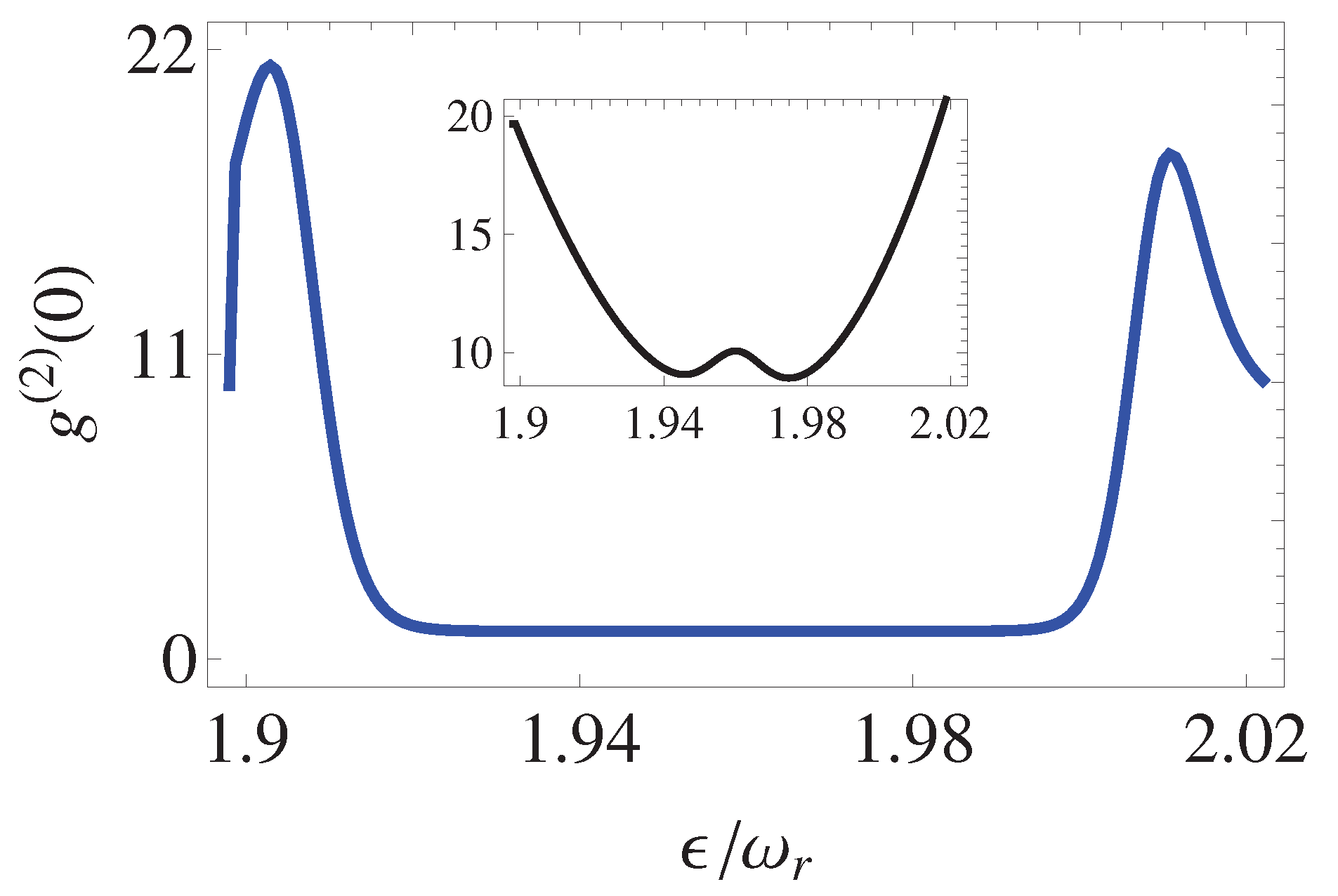
We proceed further by describing the corresponding quantum dynamics versus the experimentally controllable DQD energy separation , while all other parameters are being fixed. The resonator-DQD coupling strength g will be selected below or above the threshold, see Figure 1(a) and Figure 1(b), respectively. Thus, Figure 3(a) depicts the mean cavity photon number in these situations. Particularly, near resonance condition, i.e. when , one can observe a plateau where the mean cavity photon number varies not much, while the scaled energy separation is scanned around the resonance. Then it drops to zero out of the resonance. Above the threshold, i.e. when , the current again follows the resonator mean photon number, see Figure 3(b). However, this is not longer the case below the threshold, that is when , compare the insets in Figure 3(a) and Figure 3(b), respectively. Furthermore, within the plateau region, the photon statistics is a Poissonian one, since , see Figure (Figure 4) above the threshold. On the other side, below the threshold condition, the photon statistics is highly super-Poissonian, see the inset in Figure (Figure 4). So, one has stable single-qubit lasing effects above the critical value of the cavity-DQD coupling strength, that is, above the threshold.
5. Summary
Summarizing, we have investigated a semiconducting DQD qubit coupled in two-photon resonance with a leaking microwave resonator where the pumping of the qubit is achieved via the environmental electronic reservoirs. Particularly, the inter-dot Coulomb interaction is assumed weak, while the focus is on calculating the mean photon cavity number, under the secular approximation, with a corresponding accent on an obtained critical value for the qubit-resonator coupling strength where the steady-state photon number changes abruptly. Moreover, the corresponding photon statistics vary from super-Poissonian to Poissonian photon statistics. Also, the electric current through the DQD system follows the cavity-mode steady-state photon number behaviours, particularly, above the threshold. This way, one achieves lasing effects in microwave frequency domains, while converting electric current in a photon flux. Respectively, one can estimate the intensity of the photon flux, generated in the cavity mode, via measuring the electric current, or conversely.
Acknowledgments
We highly appreciate the financial support from the Romanian Ministry of Research, Innovation and Digitization, CNCS-UEFISCDI, via the PN-IV-P8-8.3-ROMD-2023-0013 research grant, within PNCDI IV. MM is grateful for the nice hospitality of the Department of Theoretical Physics at the Horia Hulubei National Institute of Physics and Nuclear Engineering as well as for partial support from the Moldavian Ministry of Education and Research, through grant No. 011205.
References
- Bruhat, L. E.; Cubaynes, T.; Viennot, J. J.; Dartiailh, M. C.; Desjardins, M. M.; Cottet, A.; Kontos, T. Circuit QED with a quantum-dot charge qubit dressed by Cooper pairs. Phys. Rev. B 2018, 98, 155313. [Google Scholar] [CrossRef]
- Burkard, G.; Gullans, M. J.; Mi, X.; Petta, J. R. Superconductor-semiconductor hybrid-circuit quantum electrodynamics. Nat. Rev. Phys. 2020, 2, 129–140. [Google Scholar] [CrossRef]
- Haldar, S.; Barker, D.; Havir, H.; Ranni, A.; Lehmann, S.; Dick, K. A.; Maisi, V. F. Continuous Microwave Photon Counting by Semiconductor-Superconductor Hybrids. Phys. Rev. Lett. 2024, 133, 217001. [Google Scholar] [CrossRef] [PubMed]
- Stanisavljević, O.; . Philippe, J.-C.; Gabelli, J.; Aprili, M.; Estéve, J.; Basset, J. Efficient Microwave Photon-to-Electron Conversion in a High-Impedance Quantum Circuit. Phys. Rev. Lett. 2024, 133, 076302. [Google Scholar] [CrossRef] [PubMed]
- de Sá Neto, O.P.; de Oliveira, M.C. Signal, detection and estimation using a hybrid quantum circuit. Sci. Rep. 2024, 14, 15225. [Google Scholar] [CrossRef]
- Brandes, T. Coherent and collective quantum optical effects in mesoscopic systems. Phys. Rep. 2005, 408, 315. [Google Scholar] [CrossRef]
- Kulkarni, M.; Cotlet, O.; Türeci, H. E. Cavity-coupled double-quantum dot at finite bias: analogy with lasers and beyond. Phys. Rev. B 2014, 90, 125402. [Google Scholar] [CrossRef]
- Liu, Y.-Y.; Stehlik, J.; Eichler, C.; Mi, X.; Hartke, T. R.; Gullans, M. J.; Taylor, J. M.; Petta, J. R. Threshold Dynamics of a Semiconductor Single Atom Maser. Phys. Rev. Lett. 2017, 119, 097702. [Google Scholar] [CrossRef]
- Tabatabaei, S. M.; Neda, J. Lasing in a coupled hybrid double quantum dot-resonator system. Phys. Rev. B 2020, 101, 115135. [Google Scholar] [CrossRef]
- Gu, X.; Kockum, A.F.; Miranowicz, A.; Liu, Y.X.; Nori, F. Microwave photonics with superconducting quantum circuits. Phys. Rep. 2017, 1, 718–719. [Google Scholar] [CrossRef]
- Scarlino, P.; van Woerkom, D. J.; Stockklauser, A.; Koski, J. V.; Collodo, M. C.; Gasparinetti, S.; Reichl, C.; Wegscheider, W.; Ihn, T.; Ensslin, K.; Wallraff, A. All-Microwave Control and Dispersive Readout of Gate-Defined Quantum Dot Qubits in Circuit Quantum Electrodynamics. Phys. Rev. Lett. 2019, 122, 206802. [Google Scholar] [CrossRef] [PubMed]
- Khan, W.; Potts, P. P.; Lehmann, S.; Thelander, C.; Dick, K. A.; Samuelsson, P.; Maisi, V. F. Efficient and continuous microwave photoconversion in hybrid cavity-semiconductor nanowire double quantum dot diodes. Nat. Commun. 2021, 12, 5130. [Google Scholar] [CrossRef] [PubMed]
- Havir, H.; Haldar, S.; Khan, W.; Lehmann, S.; Dick, K. A.; Thelander, C.; Samuelsson, P.; Maisi, V. F. Quantum dot source-drain transport response at microwave frequencies. Phys. Rev. B 2023, 108, 205417. [Google Scholar] [CrossRef]
- Nian, L.-L.; Hu, S.; Xiong, L.; Lü, J.-T.; Zheng, B. Photon-assisted electron transport across a quantum phase transition. Phys. Rev. B 2023, 108, 085430. [Google Scholar] [CrossRef]
- Wallraff, A.; Schuster, D. I.; Blais, A.; Frunzio, L.; Huang, R.- S.; Majer, J.; Kumar, S.; Girvin, S. M.; Schoelkopf, R. J. Strong coupling of a single photon to a superconducting qubit using circuit quantum electrodynamics. Nature 2004, 431, 162. [Google Scholar] [CrossRef]
- Stockklauser, A.; Scarlino, P.; Koski, J. V.; Gasparinetti, S.; Andersen, C. K.; Reichl, C.; Wegscheider, W.; Ihn, T.; Ensslin, K.; Wallraff, A. Strong Coupling Cavity QED with Gate-Defined Double Quantum Dots Enabled by a High Impedance Resonator. Phys. Rev. X 2017, 7, 011030. [Google Scholar] [CrossRef]
- Gu, S.-S.; Kohler, S.; Xu, Y.-Q.; Wu, R.; Jiang, Sh.-L.; Ye, Sh.-K.; Lin, T.; Wang, B.-Ch.; Li, H.-O. Probing Two Driven Double Quantum Dots Strongly Coupled to a Cavity. Phys. Rev. Lett. 2023, 130, 233602. [Google Scholar] [CrossRef]
- Ungerer, J. H.; Pally, A.; Kononov, A.; Lehmann, S.; Ridderbos, J.; Potts, P. P.; Thelander, C.; Dick, K. A.; Maisi, V. F.; Scarlino, P.; Baumgartner, A.; Schönenberger, C. Strong coupling between a microwave photon and a singlet-triplet qubit. Nat. Commun. 2024, 15, 1068. [Google Scholar] [CrossRef]
- Wong, C. H.; Vavilov, M. G. Quantum efficiency of a single microwave photon detector based on a semiconductor double quantum dot. Phys. Rev. A 2017, 95, 012325. [Google Scholar] [CrossRef]
- Ghirri, A.; Cornia, S.; Affronte, M. Microwave photon detectors based on semiconducting double quantum dots. Sensors 2020, 20, 4010. [Google Scholar] [CrossRef]
- Nian, L.-L.; Zheng, B.; Lü, J.-T. Electrically driven photon statistics engineering in quantum-dot circuit quantum electrodynamics. Phys. Rev. B 2023, 107, L241405. [Google Scholar] [CrossRef]
- Brandes, T. Coherent and collective quantum optical effects in mesoscopic systems. Phys. Rep. 2005, 408, 315. [Google Scholar] [CrossRef]
- Sánchez, R.; Platero, G.; Brandes, T. Resonance Fluorescence in Transport through Quantum Dots: Noise Properties. Phys. Rev. Lett. 2007, 98, 146805. [Google Scholar] [CrossRef]
- Xu, C.; Vavilov, M. G. Full counting statistics of photons emitted by a double quantum dot. Phys. Rev. B 2013, 88, 195307. [Google Scholar] [CrossRef]
- Agarwalla, B. K.; Kulkarni, M.; Mukamel, S.; Segal, D. Tunable photonic cavity coupled to a voltage-biased double quantum dot system: Diagrammatic nonequilibrium Green’s function approach. Phys. Rev. B 2016, 94, 035434. [Google Scholar] [CrossRef]
- Chen, C.-C.; Stace, T. M.; Goan, H.-S. Full-polaron master equation approach to dynamical steady states of a driven two-level system beyond the weak system-environment coupling. Phys. Rev. B 2020, 102, 035306. [Google Scholar] [CrossRef]
- Hazra, S. K.; Addepalli, L.; Pathak, P. K.; Dey, T. N. Nondegenerate two-photon lasing in a single quantum dot. Phys. Rev. B 2024, 109, 155428. [Google Scholar] [CrossRef]
- Jin, J.; Marthaler, M.; Jin, P.-Q.; Golubev, D.; Schön, G. Noise spectrum of a quantum dot-resonator lasing circuit. New J. Phys. 2013, 15, 025044. [Google Scholar] [CrossRef]
- Lambert, N.; Flindt, C.; Nori, F. Photon-mediated electron transport in hybrid circuit-QED. EPL 2013, 103, 17005. [Google Scholar] [CrossRef]
- Shi, P.; Hu, M.; Ying, Y.; Jin, J. Noise spectrum of quantum transport through double quantum dots: Renormalization and non-Markovian effects. AIP Adv. 2016, 6, 095002. [Google Scholar] [CrossRef]
- Karlewski, C.; Heimes, A.; Schön, G. Lasing and transport in a multilevel double quantum dot system coupled to a microwave oscillator. Phys. Rev. B 2016, 93, 045314. [Google Scholar] [CrossRef]
- Jin, J. Nonequilibirum noise spectrum and Coulomb blockade assisted Rabi interference in a double-dot Aharonov-Bohm interferometer. Phys. Rev. B 2020, 101, 235144. [Google Scholar] [CrossRef]
- Drummond P., D.; Walls, D. F. Quantum theory of optical bistability. I. Nonlinear polarisability model. J. Phys. A 1980, 13, 725. [Google Scholar] [CrossRef]
- Macovei, M. A. Measuring photon-photon interactions via photon detection. Phys. Rev. A 2010, 82, 063815. [Google Scholar] [CrossRef]
- Zenelaj, D.; Potts, P. P.; Samuelsson, P. Full counting statistics of the photocurrent through a double quantum dot embedded in a driven microwave resonator. Phys. Rev. B 2022, 106, 205135. [Google Scholar] [CrossRef]
- Zenelaj, D.; Samuelsson, P.; Potts, P. P. Wigner-function formalism for the detection of single microwave pulses in a resonator-coupled double quantum dot. Phys. Rev. Research 2025, 7, 013305. [Google Scholar] [CrossRef]
- Jin, P.-Q.; Marthaler, M.; Cole, J. H.; Shnirman, A.; Schön, G. Lasing and transport in a quantum-dot resonator circuit. Phys. Rev. B 2011, 84, 035322. [Google Scholar] [CrossRef]
- Rastelli, G.; Governale, M. Single atom laser in normal-superconductor quantum dots. Phys. Rev. B 2019, 100, 085435. [Google Scholar] [CrossRef]
- Mantovani, M.; Armour, A. D.; Belzig, W.; Rastelli, G. Dynamical multistability in a quantum-dot laser. Phys. Rev. B 2019, 99, 045442. [Google Scholar] [CrossRef]
- Agarwalla, B. K.; Kulkarni, M.; Segal, D. Photon statistics of a double quantum dot micromaser: Quantum treatment. Phys. Rev. B 2019, 100, 035412. [Google Scholar] [CrossRef]
- Tabatabaei, S. M.; Jahangiri, N. Lasing in a coupled hybrid double quantum dot-resonator system. Phys. Rev. B 2020, 101, 115135. [Google Scholar] [CrossRef]
- Stace, T. M.; Doherty, A. C.; Barrett, S. D. Population Inversion of a Driven Two-Level System in a Structureless Bath. Phys. Rev. Lett. 2005, 95, 106801. [Google Scholar] [CrossRef] [PubMed]
- Müller, C.; Stace, Th. M. Deriving Lindblad master equations with Keldysh diagrams: Correlated gain and loss in higher order perturbation theory. Phys. Rev. A 2017, 95, 013847. [Google Scholar] [CrossRef]
- Mihaescu, T.; Isar, A.; Macovei, M. A. Two-quanta processes in coupled double-quantum-dot cavity systems. arXiv 2025, arXiv:2501.05967v1. [Google Scholar]
- Nian, L.-L.; Wang, Y.-Ch.; Wang, J.-Y.; Xiong, L.; Zheng, B.; Lü, J.-T. Dissipative quantum phase transitions in electrically driven lasers. arXiv 2025, arXiv:2501.10997v2. [Google Scholar]
- Agarwal, G. S. Quantum Statistical Theories of Spontaneous Emission and their Relation to Other Approaches; Springer: Berlin, 1974. [Google Scholar]
- Kiffner, M.; Macovei, M.; Evers, J.; Keitel, C. H. Vacuum induced processes in multilevel atoms. Prog. Opt. 2010, 55, 85. [Google Scholar]
- James, D. F. V. Quantum Computation with Hot and Cold Ions: An Assessment of Proposed Schemes. Fort. Phys. 2000, 48, 823. [Google Scholar] [CrossRef]
- Tan, R.; Li, G.-X.; Ficek, Z. Squeezed single-atom laser in a photonic crystal. Phys. Rev. A 2008, 78, 023833. [Google Scholar] [CrossRef]
- Quang, T.; Freedhoff, H. Atomic population inversion and enhancement of resonance fluorescence in a cavity. Phys. Rev. A 1993, 47, 2285. [Google Scholar] [CrossRef]
- Mihaescu, T.; Cecoi, E.; Macovei, M. A.; Isar, A. Geometric discord for a driven two-qubit system. Rom. Rep. Phys. 2021, 73, 101. [Google Scholar]
- Glauber, R. J. The Quantum Theory of Optical Coherence. Phys. Rev. 1963, 130, 2529. [Google Scholar] [CrossRef]
Figure 1.
The steady-state behaviour of (a) the cavity mean photon number and (b) the steady-state dependence of the current through the DQD system, as a function of . Here , , , .
Figure 1.
The steady-state behaviour of (a) the cavity mean photon number and (b) the steady-state dependence of the current through the DQD system, as a function of . Here , , , .
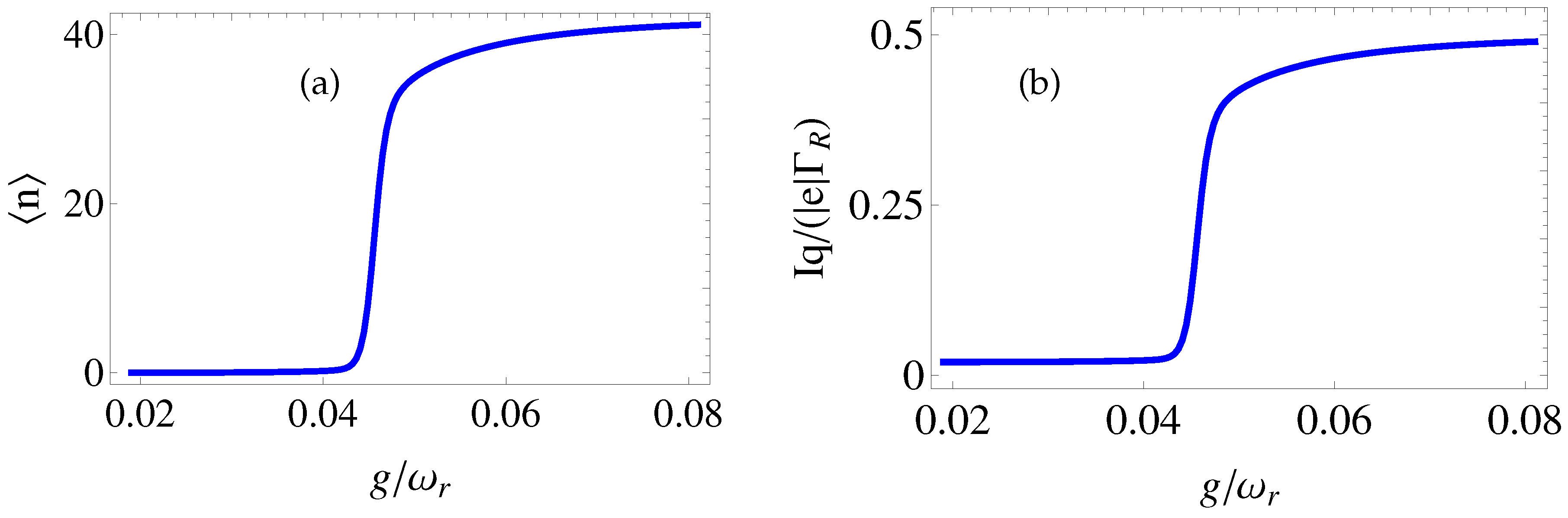
Figure 2.
The normalized steady-state second-order photon-photon correlation function versus the ratio . Other parameters are as in Figure 1.
Figure 2.
The normalized steady-state second-order photon-photon correlation function versus the ratio . Other parameters are as in Figure 1.
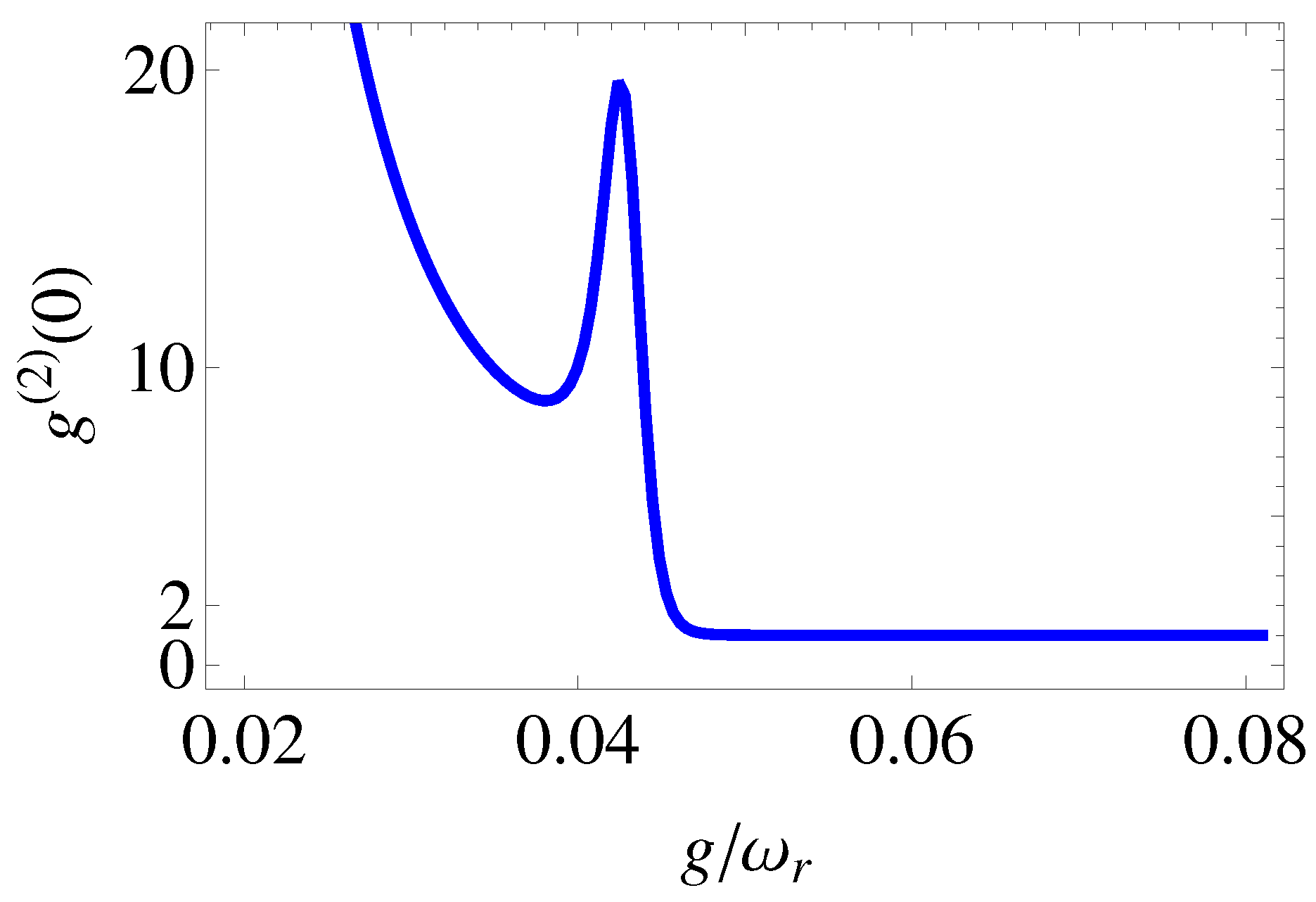
Figure 3.
The steady-state behaviours of (a) the mean cavity photon number and (b) the current through the DQD system, as a function of . Here and , while the inset depicts the case when , i.e. below the threshold. Other parameters are as in Figure 1.
Figure 3.
The steady-state behaviours of (a) the mean cavity photon number and (b) the current through the DQD system, as a function of . Here and , while the inset depicts the case when , i.e. below the threshold. Other parameters are as in Figure 1.
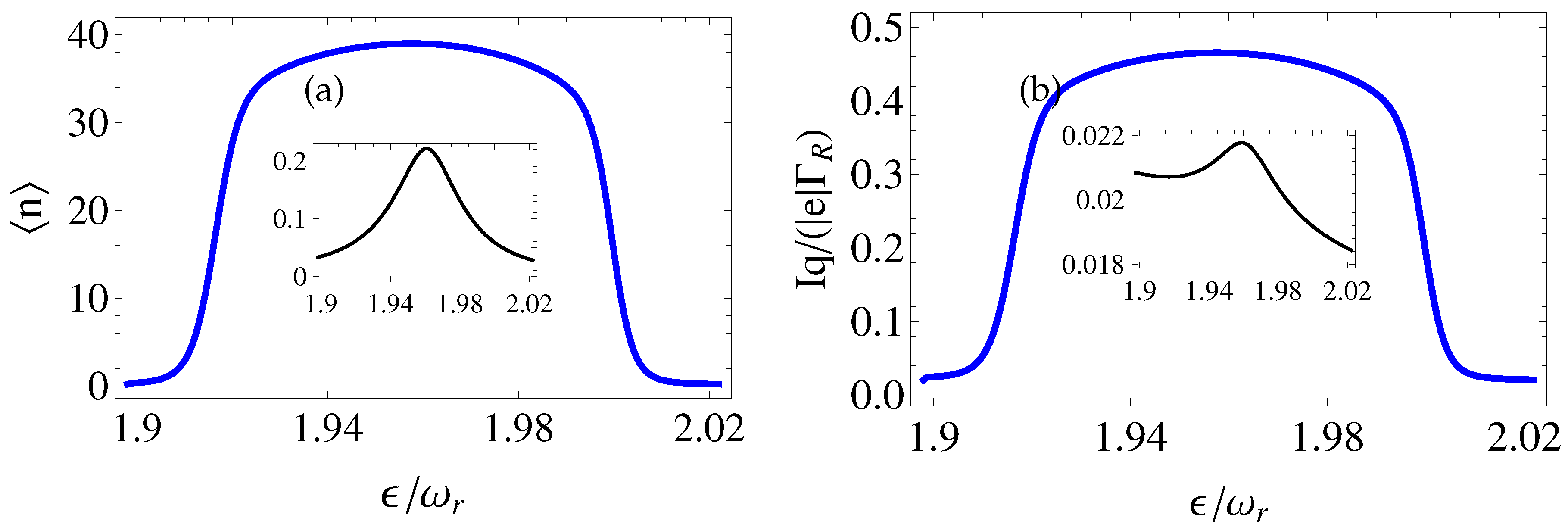
Figure 4.
The normalized steady-state second-order photon-photon correlation function versus the ratio . Other parameters are as in Figure (Figure 3).
Figure 4.
The normalized steady-state second-order photon-photon correlation function versus the ratio . Other parameters are as in Figure (Figure 3).
Disclaimer/Publisher’s Note: The statements, opinions and data contained in all publications are solely those of the individual author(s) and contributor(s) and not of MDPI and/or the editor(s). MDPI and/or the editor(s) disclaim responsibility for any injury to people or property resulting from any ideas, methods, instructions or products referred to in the content. |
© 2025 by the authors. Licensee MDPI, Basel, Switzerland. This article is an open access article distributed under the terms and conditions of the Creative Commons Attribution (CC BY) license (http://creativecommons.org/licenses/by/4.0/).
Copyright: This open access article is published under a Creative Commons CC BY 4.0 license, which permit the free download, distribution, and reuse, provided that the author and preprint are cited in any reuse.


