
Submitted:
17 August 2025
Posted:
18 August 2025
You are already at the latest version
Abstract
The global drive toward a circular bioeconomy is accelerating the demand for sustainable, high-performance materials. Filamentous fungi offer a compelling solution, functioning as living foundries that transform low-value biomass into advanced materials via self-assembly. Mycelium-based composites have proven potential, yet progress has been dominated by empirical screening of fungal species and substrates. Realizing their full capabilities requires a paradigm shift toward rational design. This review introduces a conceptual framework centered on the biochemical programming of the fungal cell wall. Viewed through a materials science lens, the cell wall is a dynamic, hierarchical nanocomposite whose properties can be deliberately tuned. We analyze the contributions of its principal components—the chitin-glucan structural scaffold, the glycoprotein functional matrix, and surface-active hydrophobins—to the bulk characteristics of mycelium-derived materials. We then identify biochemical levers for controlling these properties. External factors such as substrate composition and environmental cues (e.g., pH) modulate cell wall architecture through conserved signaling pathways. Complementing these, an internal synthetic biology toolkit enables direct genetic and chemical intervention. Strategies include targeted engineering of biosynthetic and regulatory genes (e.g., CHS, AGS, GCN5), chemical genetics to dynamically adjust synthesis during growth, and modification of surface chemistry for specialized applications like tissue engineering. By integrating fungal cell wall biochemistry, materials science, and synthetic biology, this framework moves the field from incidental discovery toward the intentional creation of smart, functional, and sustainable mycelium-based materials—aligning material innovation with the imperatives of the circular bioeconomy.
Keywords:
mycelium materials
; fungal cell wall
; synthetic biology
; myco-fabrication
; biomaterials
; biochemical programming
; chitin
; β-glucan
; living functional materials
; tissue engineering
1. Introduction: Fungi as Master Builders of Programmable Matter
The transition from a linear, petroleum-based economy to a circular bioeconomy represents one of the most significant scientific and industrial challenges of the 21st century [1,2]. This paradigm shift necessitates the development of a new generation of materials that are not only sustainable, renewable, and biodegradable but also possess advanced functionalities rivaling their synthetic counterparts [3]. In this pursuit, the kingdom Fungi has emerged as a particularly promising source of innovation [4,5]. Filamentous fungi, the organisms that form mycelium, are nature's master decomposers and builders, possessing an innate ability to transform low-value organic waste into complex, structured, and functional materials [6]. This process, often termed myco-fabrication [7], leverages the fungus's vegetative growth—a network of interconnected hyphal filaments—to bind and consolidate substrates like agricultural byproducts into solid composites [8,9].
The applications for these mycelium-based materials are rapidly expanding, with significant investments and new companies exploring their use as replacements for unsustainable products in diverse sectors [10], including construction, packaging, textiles, and even food. Mycelium composites can be engineered into insulation panels with low thermal conductivity, acoustic dampers, fire-retardant building materials, and biodegradable packaging foams that offer an alternative to polystyrene [11]. Furthermore, pure mycelium mats can be processed into "myco-leather," providing a sustainable substitute for animal and synthetic leathers in the fashion industry [5]. This capacity to upcycle waste into value-added products positions fungi as key players in a circular economy, offering a low-energy, low-cost, and environmentally benign manufacturing platform [12].
However, to date, the development of mycelium materials has been largely empirical, relying on the screening of different fungal species and lignocellulosic substrates [13]to achieve desired properties. While this approach has yielded promising results, it lacks the precision and predictability required for high-performance engineering applications [14]. The properties of mycelium-based materials are known to be highly variable, depending on the fungal species, the composition of the growth substrate, and the post-growth processing methods.13 This variability, while a challenge for standardization, also hints at a deeper, more powerful potential: that mycelium is not a static material but a programmable one [15,16].
The central thesis of this review is that the key to unlocking this programmability lies in the fungal cell wall. Far from being a simple, inert container, the cell wall is a dynamic, plastic, and biochemically complex organelle that mediates every interaction between the fungus and its environment [17]. It is a living, hierarchical nanocomposite whose architecture and composition are constantly remodeled in response to developmental and environmental cues [18]. The mechanical strength, surface chemistry, and ultimately the bulk properties of any mycelium-based material are direct reflections of the biochemical makeup of the millions of hyphal cell walls that constitute it [19].
Therefore, a paradigm shift is required—from treating the fungus as a black-box binder to understanding it as a genetically and biochemically programmable micro-foundry [14,20]. To achieve this, we must bridge the disciplines of fundamental biochemistry, materials science, and synthetic biology [5,11,21]. The aim of this review is to provide the first comprehensive framework for this interdisciplinary synthesis. We will deconstruct the fungal cell wall from a materials engineering perspective, systematically linking its biochemical components to specific material properties. We will then explore the external (environmental) and internal (genetic) levers that can be used to manipulate cell wall assembly and, by extension, program the final material. This review will demonstrate that by applying the principles of synthetic biology—a field that has revolutionized the use of microbes as cell factories but has been underutilized for fungi—we can move from the incidental discovery of mycelium materials to their rational, predictive design [14,22]. By providing a blueprint for the "biochemical programming" of the fungal cell wall, we aim to lay the foundation for a new generation of smart, functional, and truly sustainable materials.
2. The Fungal Cell Wall: A Hierarchical Nanocomposite Blueprint
To rationally engineer mycelium-based materials, one must first understand the fundamental building block from which they are constructed: the fungal cell wall. From a materials science perspective, the cell wall is not merely a biological structure but a sophisticated, self-assembling, and hierarchical nanocomposite [23,24]. Its design principles have been refined over a billion years of evolution to provide a structure that is simultaneously robust and plastic, capable of withstanding immense internal turgor pressure while allowing for rapid, polarized growth [18]. The wall's architecture consists of a load-bearing scaffold of crystalline microfibrils embedded within an amorphous, functional matrix [25]. The precise composition, organization, and cross-linking of these components vary between species, developmental stages, and environmental conditions, giving rise to the vast diversity of properties observed in fungal materials [15,26]. This section will deconstruct the cell wall into its principal components, analyzing each not only for its biological function but for its direct contribution to the physical, chemical, and mechanical properties of mycelium as a bulk material [8,21,27].
2.1. The Chitin-Glucan Scaffold: The Structural Backbone
The primary structural integrity of the fungal cell wall, and by extension, mycelium materials, is derived from a core scaffold of interlinked polysaccharides: chitin and β-glucans. This scaffold is responsible for the wall's mechanical strength, resisting both tensile and compressive forces [19].
Chitin is a linear homopolymer of β-(1,4)-linked N-acetyl-D-glucosamine (GlcNAc) residues, making it structurally analogous to cellulose [13,28], the primary structural polymer in plants. These linear chains self-assemble through extensive hydrogen bonding [29] to form highly crystalline microfibrils, which act as the wall's principal tensile elements, providing rigidity and preventing catastrophic failure under stress [23]. The predominant allomorph found in fungi is α-chitin, characterized by an anti-parallel arrangement of polymer chains [25]. This arrangement maximizes intermolecular hydrogen bonding, resulting in a particularly stiff and stable crystalline structure that contributes significantly to the mechanical strength of the material [30]. The amount of chitin in the cell wall is a critical determinant of material properties and varies widely, from as low as 1–2% of the dry weight in yeast-form cells to as high as 10–20% or more in the hyphae of filamentous fungi [19,31]. A higher chitin content is directly correlated with increased mechanical strength and has been proposed to prevent the propagation of cracks during compression of mycelium-based foams. Chitin biosynthesis is catalyzed by a family of integral membrane enzymes known as chitin synthases (CHS) [32], which polymerize GlcNAc from a UDP-GlcNAc precursor in the cytoplasm and extrude the nascent chain into the cell wall space.
Complementing the chitin microfibrils is a pervasive matrix of β-glucans. The most abundant of these is a linear polymer of β-(1,3)-linked glucose units, which forms the main structural backbone of the glucan network. This β-(1,3)-glucan backbone is itself cross-linked and decorated with shorter, flexible side chains of β-(1,6)-linked glucose [17]. This branching is essential for creating a three-dimensional, viscoelastic network that fills the space between chitin fibrils and resists compressive forces. The biosynthesis of β-(1,3)-glucan is carried out by a plasma membrane-associated enzyme complex, β-(1,3)-glucan synthase (encoded by
FKS or GLS genes), which, like CHS, uses a UDP-sugar precursor (UDP-glucose).
Crucially, the mechanical properties of the cell wall arise not from the simple sum of its parts, but from the synergistic integration of these two polymers into a covalently cross-linked composite [23,33,34]. The β-(1,3)-glucan chains are covalently attached to the chitin microfibrils, forming a robust, alkali-insoluble core that constitutes the fundamental load-bearing structure of the wall. The importance of this composite structure is highlighted by studies on materials derived from fungal biomass. For instance, nanopapers fabricated from fungal chitin that intentionally retained a high percentage of its native, associated glucans (50–65%) exhibited exceptionally high tensile strengths of over 200 MPa [27,28]. This value far surpasses that of nanopapers made from purified crustacean chitin [28,33], demonstrating that the glucan component is not merely a filler but an integral part of a high-performance natural composite, enhancing stiffness and strength. Therefore, the ratio of chitin to glucan, the degree of chitin crystallinity, and the extent and nature of β-glucan branching are all fundamental biochemical parameters that dictate the intrinsic mechanical properties—such as stiffness, tensile strength, and elasticity—of mycelium-based materials [35,36].
2.2. The Glycoprotein Matrix: A Functional and Adaptive Interface
Embedded within and layered upon the chitin-glucan scaffold is an amorphous matrix composed predominantly of proteins, most of which are heavily glycosylated and are thus referred to as glycoproteins. These molecules, particularly mannoproteins (proteins with extensive mannose polymer modifications), can constitute a significant portion of the cell wall, ranging from 20% to 50% of its dry weight, and are concentrated in the outermost layers. This external positioning means that the glycoprotein matrix defines the material's surface chemistry and mediates its direct interactions with the surrounding environment, governing critical properties such as hydrophilicity, surface charge, and bioadhesion.
The protein components of the cell wall endow the material with intrinsic bioreactive and ion-exchange capabilities. Recent studies have shown that the cell wall of Schizophyllum commune can bind a wide array of cations (e.g., Ca2+, Mg2+, Mn2+, Zn2+) and anions (e.g., NO3−, PO43−). This binding is reversible and highly dependent on pH, with sorption of many cations being promoted at alkaline pH and their release favored under acidic conditions. Solid-state NMR spectroscopy revealed that the primary binding sites for these ions are the mobile, charged amino acid side chains within the cell wall proteins, effectively turning the mycelium surface into a pH-responsive ion-exchange resin [29]. This capability could be harnessed for applications in bioremediation or for creating materials that can sequester and release nutrients or other molecules in a controlled manner.
Perhaps the most significant function of the glycoprotein matrix from a materials perspective is its role in adhesion. Many of the proteins displayed on the fungal surface are adhesins, specialized molecules that mediate the attachment of the fungus to both abiotic and biological surfaces. For example, the initial adhesion of Candida albicans to tooth enamel is mediated by strong interactions between yeast cell wall adhesins and the salivary pellicle covering the tooth surface, with adhesion forces in the nanonewton range [37]. These adhesive properties are not static and can be modulated. The presence and composition of mannoproteins on the surface of one microbe can influence the bioadhesion of other microbes, suggesting a role in structuring polymicrobial communities. This intrinsic adhesiveness, conferred by the glycoprotein matrix, is thought to be a key factor in how mycelium binds so effectively to lignocellulosic substrates in composites; the chitin-glucan scaffold provides the mechanical integrity for attachment, but specific molecular adhesion to substrates is primarily mediated by glycoproteins (adhesins) on the outer cell wall surface. Furthermore, these molecules can be exploited in biomedical applications; decorating synthetic particles with fungal mannoproteins has been shown to increase their bioadhesion to intestinal tissues, enhancing their potential as oral drug or vaccine delivery systems (Figure 1). Thus, the type, density, and glycosylation state of the proteins in the outer wall layer represent a critical design parameter for tuning the surface properties and adhesive behavior of mycelium materials.
2.3. Hydrophobins: Nature's Amphipathic Surfactants
A specialized class of small, secreted proteins known as hydrophobins plays a unique and powerful role in determining the surface properties of many fungal materials, particularly their wettability. These proteins are characterized by a conserved pattern of eight cysteine residues [38] that form four intramolecular disulfide bonds, creating a compact and highly stable structure. Their defining feature is their amphipathicity, allowing them to spontaneously self-assemble at hydrophobic:hydroph [39], such as the boundary between water and air or water and a solid surface.
Hydrophobins are broadly divided into two classes based on the properties of the monolayers they form. Class II hydrophobins form assemblies that are less stable and can be dissociated with relative ease. In contrast, Class I hydrophobins, such as EAS from Neurospora crassa, DewA from Aspergillus nidulans, and RolA from Aspergillus oryzae, undergo a remarkable transformation.42 Upon encountering an interface, these proteins self-assemble into extremely robust, insoluble, and highly ordered monolayers known as "rodlets" [38,40]. These rodlet layers have a fibrillar, amyloid-like structure, with a core of β-sheets oriented perpendicular to the fiber axis, and are so stable that they can only be dissociated by harsh solvents like concentrated formic acid [38,41].
This self-assembly process is a dynamic, programmable phase transition, not a static property. It involves significant conformational rearrangements of the protein monomers and is triggered and guided by the interface itself.42 The resulting rodlet layer effectively coats the fungal hyphae, inverting the wettability of the surface [42]. This is responsible for the extreme hydrophobicity observed in many mycelial materials, which can exhibit water contact angles greater than 120° [43,44]. The kinetics of this assembly and the morphology of the final structure are not fixed; they are highly dependent on environmental factors. For example, studies with the hydrophobin RolA have shown that solution pH and the surface chemistry of the solid substrate (e.g., hydrophobic, anionic, or cationic) dramatically affect the rate of protein adsorption [45] and the type of self-assembled structures that form, which can range from spherical aggregates to rod-like filaments or mesh-like networks. This programmability makes hydrophobins a powerful tool. By controlling the expression of specific hydrophobins and the environmental conditions during growth, it is possible to precisely tune the surface energy and wettability of a mycelium material, engineering it to be either highly water-repellent or, by using different hydrophobins or modifying them, more hydrophilic [16,42].
2.4. Architectural Plasticity and Interspecies Variation
The fungal kingdom is characterized by immense diversity, and this is reflected in the composition and architecture of the cell wall. The choice of fungal species for myco-fabrication is therefore a primary design decision, as it pre-determines a suite of baseline material properties (Figure 2) [36]. Significant variations in the relative amounts of chitin, the degree and type of glucan branching, the composition of the glycoprotein matrix, and the hyphal system organization exist between species, leading to measurable differences in the performance of the materials derived from them.
For instance, comparative studies have shown that while Ganoderma lucidum exhibits superior properties in insulation board composites , material superiority is application-dependent [32]. For pure mycelium films, Schizophyllum commune shows significantly higher tensile strength, and for lightweight applications, Pleurotus ostreatus offers a higher specific strength-to-weight ratio [46]. This difference can be traced back to their fundamental biology. G. lucidum is known for its complex, highly branched β-glucan structures and triterpenoid secondary metabolites, which contribute to the properties of the resulting material [35,47]. P. ostreatus cell walls, while also rich in β-1,3 and β-1,6 glucans, possess a high density of carboxylic, amino, and other functional groups that make them particularly effective for biosorption applications [48,49].
Another critical factor is the hyphal system of the fungus. Fungal mycelium can be classified as monomitic (containing only thin-walled generative hyphae), dimitic (containing generative hyphae plus either thick-walled skeletal hyphae or highly branched binding hyphae), or trimitic (containing all three types) [13]. Species that produce tough, leathery, or woody fruiting bodies, such as Trametes versicolor, typically possess dimitic or trimitic hyphal systems [50]. The presence of the tough skeletal and binding hyphae results in a much stronger and more resilient mycelial network [13]. Consequently, these species are preferred for fabricating composites with higher mechanical strength compared to monomitic species.
Even within the same species, the source of the biomass can matter. Chitosan derived from the cell walls of the fungus Agaricus bisporus has been shown to have lower crystallinity and a more porous surface morphology than the chemically similar chitosan extracted from crustacean shells, which may make it more suitable for certain biomedical applications requiring higher porosity or different dissolution kinetics [21].
This inherent diversity underscores the importance of a biochemical and materials-based approach to fungal selection. By understanding the links between a species' cell wall biochemistry, its hyphal architecture, and the properties of the final material, researchers can move beyond trial-and-error and make informed choices to select the optimal fungal "chassis" for a given application [14]. Table 1 provides a comparative summary of key cell wall characteristics and reported material properties for several fungal species commonly used or of high potential in myco-fabrication. This collation of disparate data from biochemical, mycological, and materials testing literature provides a data-driven tool for rational species selection [51,52].
3. Biochemical Levers for Tuning Mycelium Material Properties
The properties of a mycelium-based material are not solely determined by the genetic blueprint of the chosen fungal species. The fungus is a living, responsive system, and its growth, morphology, and biochemistry are profoundly influenced by its surroundings. The cell wall, in particular, is a highly dynamic organelle that undergoes constant remodeling in response to external chemical and physical signals. This responsiveness provides a powerful set of external, non-genetic levers that can be manipulated during the fabrication process to program the final material properties. By carefully designing the growth substrate, harnessing the fungus's own enzymatic toolkit, and controlling environmental parameters like pH, we can guide the construction of the cell wall and, consequently, the entire mycelial network. This section explores these biochemical levers, reframing the myco-fabrication process as a controllable, multi-stage pipeline.
3.1. Substrate-Driven Morphogenesis and Composition
The growth substrate is far more than just a source of nutrients; it is a primary programming input that dictates the morphology, density, and biochemical composition of the resulting mycelial material [1,15]. Even subtle changes in the chemical makeup of the substrate can trigger significant and predictable shifts in fungal metabolism, leading to altered hyphal growth patterns and cell wall architecture.13
In the fabrication of pure mycelium mats, where the fungus is grown in a liquid medium, the composition of that medium is paramount. A study on Ganoderma lucidum demonstrated that slight modifications to a standard potato dextrose broth (PDB) medium induced dramatic changes in the final material. When the PDB was enriched with D-glucose, the resulting mycelium mat was highly porous, thicker, and more hydrophilic [16]. In contrast, when the same medium was supplemented with a small amount of lignin, the fungus grew much faster in a distinct concentric pattern, producing a material that was denser and less hydrophilic. This illustrates a direct link between a specific chemical input (simple sugar vs. complex polyphenol) and the macro-scale properties of the material, likely mediated by shifts in metabolic pathways and the composition of the cell wall.
In the context of mycelium-based composites, where the fungus grows on a solid lignocellulosic substrate, both the chemical and physical nature of that substrate are critical. Chemical pretreatment of the substrate can significantly enhance material properties. For example, pretreating wheat straw with a 1% sodium hydroxide (NaOH) solution prior to inoculation improved the mechanical properties of the final insulation boards [32]. This is likely because the alkaline treatment helps to break down the complex lignocellulosic structure, making cellulose and hemicellulose more accessible to the fungus and potentially improving the adhesion between the mycelium and the substrate fibers [55].
The physical form of the substrate also plays a crucial role. Research has shown that the mechanical performance of mycelium composites depends more on the condition and size of the substrate fibers than on their precise chemical composition. Using chopped fibers with a particle size of less than 5 mm and pre-compressing the substrate before inoculation were both found to significantly improve the compressive stiffness and strength of the final composite [8]. Loosely packed substrates result in materials with lower density and lower thermal conductivity, making them better insulators, whereas densely packed substrates yield denser, stronger materials [56]. This demonstrates that the substrate acts as both a biochemical programmer and a physical template for the growing mycelial network. The cell wall's inherent plasticity allows it to respond to these cues, making substrate selection and preparation a key control step in the fabrication pipeline.
3.2. The Fungal Secretome as an In-Situ Modification Toolkit
Filamentous fungi are not passive binders; they are active agents of transformation that remodel their environment through the secretion of a vast arsenal of enzymes and proteins, collectively known as the secretome [54,57]. This secretome functions as a sophisticated, mobile toolkit for the in-situ modification and processing of the substrate, allowing the fungus to break down complex polymers into usable nutrients. By selecting fungi with specific enzymatic capabilities, we can harness this toolkit to precisely tailor the composition of the final composite material.60
A key distinction in this regard is between white-rot and brown-rot fungi. Brown-rot fungi primarily degrade cellulose and hemicellulose, leaving behind a modified, brittle lignin structure. In contrast, white-rot fungi, such as Trametes versicolor and Ganoderma lucidum, are particularly valued for myco-fabrication because they possess a powerful suite of lignocellulolytic enzymes, including laccases and peroxidases, that allow them to efficiently degrade lignin [58]. This selective delignification is highly advantageous for creating composites. The fungus removes the amorphous lignin "glue" from the plant biomass while leaving the strong, reinforcing cellulose fibers largely intact. The mycelium then grows around and binds these preserved fibers, creating a strong, fiber-reinforced composite material [59].
The composition of the secretome is not fixed; it is highly responsive to the substrate, meaning the fungus produces the specific enzymes needed to break down the available polymers. This adaptive capability can be further enhanced through the use of fungal co-cultures, where two or more species are grown together [60]. Co-culturing can produce more diverse and potent "enzymatic cocktails" than any single species could alone. For example, a co-culture of Trichoderma reesei (a prolific cellulase producer) and Aspergillus brasiliensis can be used to generate a secretome rich in a wide range of carbohydrate-active enzymes (CAZymes). Proteomic analysis of such systems reveals that the final composition of the secretome can be controlled by the order and timing of inoculation of the different species. Inoculating T. reesei first results in a secretome dominated by its proteins, while simultaneous inoculation yields a different blend. This approach allows for the on-site production of customized enzyme mixtures tailored to the specific lignocellulosic feedstock being used, optimizing the degradation process and the properties of the resulting material without the need for costly downstream enzyme purification and mixing [60]. The secretome, therefore, represents a dynamic and programmable processing tool that is deployed by the fungus itself during fabrication.
3.3. Environmental Signaling as a Control Mechanism: The Role of pH
Beyond the substrate, the fungus is highly sensitive to ambient environmental conditions, which can be used as powerful, non-invasive control mechanisms to dynamically regulate cell wall synthesis during growth . Among these, environmental pH stands out as a "master switch" that governs a wide range of cellular processes, including morphogenesis and cell wall assembly. Fungi possess a highly conserved signaling pathway, known as the PacC pathway in filamentous fungi and the Rim101 pathway in yeasts, that allows them to sense and adapt to changes in external pH [61].
This pathway is a complex signaling cascade that translates the external pH signal into a global change in gene expression. In general, the process begins at the plasma membrane, where a complex of sensor proteins (including PalH and PalI) detects the shift to neutral or alkaline pH. This triggers a series of events, often involving the ESCRT endosomal machinery, that culminates in the proteolytic activation of the master transcription factor, PacC (or Rim101) [61,62]. The processed, active form of PacC then translocates to the nucleus, where it acts as both an activator of alkaline-expressed genes and a repressor of acid-expressed genes, thereby rewiring the cell's transcriptome to match the external environment.
Critically, this pH-sensing pathway directly controls the expression of key enzymes involved in cell wall remodeling. The canonical example is found in the human pathogen Candida albicans, which must survive in diverse pH environments within the host.66
C. albicans possesses a family of five β-(1,3)-glucanosyltransferase genes (homologs of the GAS genes in Saccharomyces), which are responsible for elongating and branching the β-1,3-glucan chains in the cell wall. The expression of two of these genes, PHR1 and PHR2, is strictly and oppositely regulated by pH via the Rim101 pathway [63]. PHR1 is expressed only at neutral to alkaline pH (pH ≥ 6), while PHR2 is expressed only at acidic pH. Deletion of either gene results in severe growth and morphological defects, including a disorganized cell wall, but only at its restrictive pH. This pH-dependent regulation is further reinforced by the fact that the Phr1 and Phr2 enzymes themselves have different pH optima for their activity, creating a robust, dual-layered control system [63,64].
This conserved pH-responsive regulatory network represents a prime target for the dynamic programming of mycelium materials. By controlling the pH of the substrate or growth medium during fabrication, it is theoretically possible to selectively activate or repress specific cell wall-modifying enzymes. This could be used to create materials with spatially or temporally varying properties, for example, by growing a material first under acidic conditions to favor one type of wall architecture, and then shifting to alkaline conditions to induce a different set of enzymes and alter the wall structure. This transforms pH from a simple growth parameter into a dynamic control input for real-time material design [65].
4. A Synthetic Biology Toolkit for Designing "Smart" Mycelium Materials
While manipulating external factors provides a powerful means of guiding fungal growth, the true frontier of myco-fabrication lies in the direct engineering of the fungus's own biological machinery. The principles of synthetic biology—which involve the design and construction of new biological parts, devices, and systems—offer a pathway to move beyond simply using the fungus's natural responses and toward the rational design of mycelium materials with precisely specified, enhanced, or entirely novel properties (Figure 3) [14,66]. This involves creating a "toolkit" of genetic and chemical methods to rewrite the biochemical programs governing cell wall construction. By implementing this toolkit, we can aspire to create "smart" materials that are not just sustainable but also functional, responsive, and even living [20].
4.1. Rational Design Through Genetic Engineering of Cell Wall Architecture
The most direct approach to programming material properties is to genetically modify the pathways responsible for synthesizing and regulating the cell wall. By targeting key genes, we can directly alter the composition and architecture of the wall, leading to predictable changes in the bulk material.
A compelling proof-of-concept for this strategy comes from the morphological engineering of Aspergillus oryzae, an oleaginous fungus used for industrial production. In submerged fermentation, the filamentous growth of A. oryzae leads to high culture viscosity, which hinders mass and oxygen transfer and complicates downstream processing. To overcome this, researchers targeted genes involved in cell wall biosynthesis. The effect of disrupting the α-1,3-glucan synthase gene is species-dependent. While it can lead to dispersed hyphae in species like Aspergillus nidulans , in Aspergillus oryzae, small pellets still form due to the functional redundancy of another adhesive polysaccharide, galactosaminogalactan (GAG) [67]. This engineered morphology dramatically improved the bioprocess, leading to higher biomass and lipid production, while the strain remained robust and tolerant to stress . This study provides a clear and successful example of how modifying a single cell wall gene can translate into a desirable change in a bulk material property (in this case, culture rheology).
Targeting the synthases of the primary structural components offers another powerful strategy. Fungi possess multiple chitin synthase (CHS) genes, often belonging to different classes with distinct functions in processes like septum formation, hyphal wall synthesis, and cell wall repair. Deleting specific CHS genes, such as csmA and csmB (which contain myosin motor-like domains) in Aspergillus fumigatus, leads to a significant disorganization of the cell wall structure. Interestingly, while the total amount of chitin in the mycelium was not significantly reduced, the surface properties of the conidia were altered from hydrophobic to hydrophilic [28]. This demonstrates that it is not just the quantity of a polymer that matters, but also how and where it is assembled. Targeting specific synthases allows for fine-tuning of the wall's structural organization, which could be used to control properties like flexibility, porosity, or surface chemistry.
Beyond individual synthases, one can target master regulators that orchestrate complex, multi-faceted changes in the cell wall. A prime candidate is the histone acetyltransferase Gcn5, a highly conserved chromatin-modifying enzyme. Gcn5 regulates the expression of a vast network of genes by acetylating histone proteins, which alters chromatin structure and makes genes accessible for transcription. Studies in pathogenic fungi like Candida albicans and Candida auris have shown that Gcn5 is a critical hub for cell wall integrity. Deleting GCN5 has pleiotropic effects: it alters the cell wall composition, leading to increased exposure of β-glucans and higher chitin content; it affects the expression of adhesins; it modulates signaling through the cell wall integrity MAP kinase pathway; and it regulates the expression of the β-1,3-glucan synthase gene FKS1 [68,69]. Because Gcn5 controls so many downstream pathways relevant to material properties (composition, adhesion, stress response), it represents a powerful, high-level control node for engineering complex material phenotypes [6].
4.2. Chemical Genetics: Dynamic and Reversible Control of Material Properties
While genetic knockouts provide permanent modifications, many applications may require dynamic or spatially controlled properties. Chemical genetics—the use of small molecules to perturb protein function—offers a powerful alternative that provides temporal and reversible control over cell wall synthesis during the fabrication process [70].
A well-established approach is the use of specific enzyme inhibitors. Chitin synthase inhibitors, such as the naturally occurring polyoxins and nikkomycins, are well-characterized compounds that act as competitive inhibitors of CHS enzymes [71]. Because chitin synthesis is concentrated at the actively growing hyphal tips, these inhibitors can be used to achieve localized disruption of cell wall construction. Application of nikkomycin Z to growing oomycete hyphae, for example, causes the tips to burst, halting growth [24]. In a myco-fabrication context, such inhibitors could be applied in a spatially patterned manner (e.g., printed onto the substrate) to control the direction of growth, create regions of lower density, or engineer zones of weakness or flexibility into the final material. The development of novel, more stable, and cost-effective CHS inhibitors is an active area of research that could provide a rich toolkit for this purpose.
A more recent and potentially transformative approach is the use of chemical epigenetic modifiers. Fungal genomes contain a large number of "silent" or cryptic biosynthetic gene clusters that are not expressed under standard laboratory conditions [62]. These clusters hold the genetic blueprints for a vast diversity of secondary metabolites, including novel polymers, pigments, and bioactive compounds. Epigenetic modifiers, such as histone deacetylase (HDAC) inhibitors (e.g., SAHA, TSA) and DNA methyltransferase (DNMT) inhibitors (e.g., 5-azacytidine), can be used to derepress these silent gene clusters. Treating a fungus with these small molecules can induce the production of a whole new suite of compounds that could be incorporated into the mycelial material, imparting novel functionalities. This strategy offers a way to dramatically expand the chemical diversity and functional potential of a mycelium material without any permanent genetic modification, allowing for the dynamic activation of new properties during the growth phase.
4.3. Programming Functionality: Engineering Surfaces and Bioreceptivity
The applications of mycelium materials extend beyond bulk structural roles into high-value fields like biomedicine, where the surface properties and biocompatibility of the material are paramount. The inherent structure of a mycelial network—an interwoven, porous, three-dimensional mesh of fibers—naturally mimics the architecture of the native extracellular matrix (ECM) of human tissues [72,73]. This makes mycelium an exceptionally promising candidate for use as a scaffold in tissue engineering, designed to support cell attachment, proliferation, and the regeneration of damaged tissues like skin.
Studies have already demonstrated the feasibility of this approach. Entire, inactivated fibrous mats of mycelium from edible fungi like G. lucidum and P. ostreatus have been shown to be biocompatible, supporting the adhesion and growth of primary human dermal fibroblasts [72]. The material for these applications can be obtained sustainably, grown in liquid culture without the need for toxic solvents or complex fabrication techniques, and its properties can be tuned. For example, using pure cellulose micro- and nanofibrils as the primary carbon source and growth template for a fungus like
Trametes hirsuta allows for the production of cellulose/mycelium composite fibers with a controlled, narrow diameter distribution and a well-defined network architecture, ideal for scaffold design [74].
The true potential of synthetic biology in this area lies in moving beyond passive, biocompatible scaffolds to create active, bioreceptive, and even instructive materials. By engineering the fungus, it is possible to program the mycelial surface to display specific biochemical cues that actively guide tissue regeneration [73]. This could involve:
Surface Display of Adhesion Ligands: Engineering the fungus to express and display specific peptides (like the RGD sequence) or proteins on its surface that promote the adhesion of specific human cell types (e.g., fibroblasts, osteoblasts).
Controlled Release of Growth Factors: Modifying the fungus to synthesize and secrete human growth factors that stimulate cell proliferation and differentiation within the scaffold.
Tuning Biodegradability: Altering the expression of cell wall cross-linking enzymes to control the rate at which the scaffold degrades in vivo, ensuring that it persists long enough to support tissue formation but is eventually cleared by the body.
This level of biochemical programming would transform the mycelium scaffold from a simple structural support into an active participant in the healing process [75].
4.4. Inducible Systems and Biosensors: Towards Living Functional Materials (LFMs)
The ultimate frontier in myco-fabrication is the creation of true Living Functional Materials (LFMs)—materials that retain their biological activity post-fabrication and can dynamically respond to their environment [20]. This requires the integration of synthetic gene circuits, such as inducible expression systems, into the fungal chassis. By placing genes for specific functions (e.g., enzyme production, pigment synthesis, biopolymer modification) under the control of promoters that respond to external stimuli like light, temperature, or specific chemicals, the material itself could be made to change its properties on demand [76].
Imagine a mycelium composite that, when exposed to a specific wavelength of light, begins to produce a self-healing polymer to repair damage. Or a mycelium-based water filter that, upon sensing a particular contaminant, expresses enzymes to degrade it. This vision of responsive, "smart" materials is rapidly moving from science fiction to reality, driven by advances in synthetic biology.
A key enabling technology for creating such complex, patterned LFMs is the convergence of synthetic biology with additive manufacturing principles. A recent patent application describes a groundbreaking method for the fabrication of mycelial scaffolds that embodies this convergence. The system uses a device analogous to a 3D printer printhead to deposit precise, micrometer-scale doses of signaling molecules (e.g., hormones, growth enhancers, growth retarders) onto the surface of a growing mycelial culture [77]. By calibrating the deposition rate to the fungal growth rate, this technology allows for the creation of a pre-determined, three-dimensional pattern of tissue morphology and metabolism. It enables the programming of features like hyphal branching rate, cell wall thickness, and the types of proteins secreted, all within a defined (x, y, z) envelope. This method could be used to create complex macro-geometries, such as a honeycomb pattern with high-density walls and low-density cores, or to pattern a scaffold to mimic the intricate micro-architecture of a human organ. This technology represents a paradigm shift: it is not 3D printing with a biomaterial, but rather using a printing process to deliver biochemical information that guides the growth of a living tissue into a functional, pre-programmed structure [77]. This is the technological foundation upon which the smart mycelium materials of the future will be built.
To facilitate the rational design of such materials, a systematic understanding of the available control levers is essential. Table 2 provides a functional "toolkit" for the material designer, cataloging known genetic and chemical modulators of the fungal cell wall and linking them to their biochemical effects and potential impact on material properties.
5. Conclusions and Future Perspectives
This review has sought to establish a new conceptual framework for the field of myco-fabrication, moving beyond empirical discovery towards the rational, predictive design of advanced materials. The central argument presented is that the fungal cell wall is not a static entity but a biochemically programmable, hierarchical nanocomposite. By understanding and manipulating the biological processes that govern its assembly, we can precisely control the properties of mycelium-based materials. We have deconstructed the cell wall into its key components—the chitin-glucan scaffold, the glycoprotein matrix, and surface hydrophobins—and linked their biochemical nature to specific material characteristics such as mechanical strength, surface chemistry, and wettability.
We have systematically cataloged the control levers available to the material designer. These range from external, process-based controls, such as the design of the physical and chemical substrate and the dynamic manipulation of environmental signals like pH, to internal, biology-based controls enabled by a synthetic biology toolkit. This toolkit allows for the direct genetic engineering of cell wall architecture by targeting biosynthetic or regulatory genes, the use of chemical genetics for dynamic and reversible modulation of material properties, and the programming of novel functionalities for advanced applications in fields like biomedicine. The ultimate vision is the convergence of these approaches with additive manufacturing principles to create true Living Functional Materials (LFMs) with pre-programmed, responsive behaviors. This integrated perspective transforms myco-fabrication from a simple "grow-and-dry" process into a sophisticated, multi-stage, programmable manufacturing pipeline.
Despite the immense potential, significant challenges must be addressed to translate these concepts from the laboratory to industrial-scale reality. The path forward will require a concerted, interdisciplinary research effort focused on several key areas.
Future Research Directions:
Development of Predictive Models: The relationship between fungal genetics, substrate composition, growth conditions, and final material properties is extraordinarily complex. A major bottleneck is the slow, iterative nature of the design-build-test-learn cycle (Figure 4). There is a critical need for the development of computational and machine learning models that can predict bulk material properties based on input parameters. Such models would dramatically accelerate the design process, allowing for the in silico screening of fungal strains and growth conditions before committing to physical fabrication.
Expanding the Fungal Toolkit: The vast majority of research in myco-fabrication has focused on a handful of well-characterized fungal species, primarily white-rot basidiomycetes like Ganoderma, Pleurotus, and Trametes.53 However, the fungal kingdom comprises millions of species, representing an enormous, untapped reservoir of genetic diversity, novel enzymatic toolkits, and unique cell wall architectures.3 Systematic bioprospecting efforts, aided by modern genomic and proteomic techniques, are needed to explore this diversity and identify new fungal chassis with inherently superior or novel material properties.
Harnessing Multi-Kingdom Interactions: Nature rarely operates in monoculture. Fungi exist in complex communities, constantly engaging in physical and chemical dialogues with bacteria and other microbes.81 These bacterial-fungal interactions (BFIs) can lead to emergent behaviors, including altered growth, secondary metabolite production, and biofilm formation.81 Exploring the use of defined fungal-bacterial co-cultures to create hybrid composites is a promising, yet largely unexplored, avenue of research. The biochemical interplay between kingdoms could lead to materials with combined functionalities that neither organism could produce alone.
Addressing Scalability and Standardization: A major hurdle for the commercialization of mycelium materials is the challenge of scalable and reproducible manufacturing. Maintaining consistent quality control over large-scale production runs is difficult, and there is a lack of standardized testing methods specifically developed for these unique biological composites.53 Significant engineering research is required to develop bioreactor technologies, processing protocols, and universal standards for characterizing the mechanical, thermal, and physical properties of these materials to ensure they meet the performance and safety requirements of industries like construction and medicine.
Ensuring Safety and Public Acceptance: As mycelium products become more integrated into our daily lives, from building materials to consumer goods, ensuring their safety is paramount. Research must prioritize the use of non-pathogenic, non-mycotoxic fungal strains. Thorough characterization is needed to ensure that the final, inactivated materials do not pose allergenic risks or release harmful compounds into the environment. Furthermore, transdisciplinary collaborations involving social scientists will be crucial to understand and foster public acceptance of these novel, living-derived materials, ensuring that society becomes an active participant in the transition to a sustainable bioeconomy.
In conclusion, the biochemical programming of the fungal cell wall offers a clear and powerful roadmap for the future of sustainable materials. By combining the precision of synthetic biology with the inherent elegance of fungal self-assembly, we can begin to design and cultivate a new class of materials that are not only grown from waste but are also smart, functional, and fully integrated into the planet's natural cycles.
Author Contributions
Conceptualization, V.C.-R.; methodology, V.C.-R.; formal analysis, V.C.-R.; investigation, V.C.-R.; resources, V.C.-R.; data curation, V.C.-R.; writing—original draft preparation, V.C.-R.; writing—review and editing, V.C.-R.; visualization, V.C.-R.; supervision, V.C.-R.; project administration, V.C.-R. All authors have read and agreed to the published version of the manuscript.
Funding
This research received no external funding.
Institutional Review Board Statement
Not applicable.
Data Availability Statement
All the research data can be found in the text.
Conflicts of Interest
The authors declare no conflicts of interest.
Abbreviations
The following abbreviations are used in this manuscript:
| AGS | α-1,3-glucan synthase |
| BFI | Bacterial-Fungal Interactions |
| CAZymes | Carbohydrate-Active enzymes |
| CHS | Chitin Synthases |
| DNMT | DNA Methyltransferase |
| DOAJ | Directory of Open Access Journals |
| ECM | Extracellular Matrix |
| FKS / GLS | Genes encoding β-(1,3)-glucan synthase |
| GAG | Galactosaminogalactan |
| GlcNAc | N-acetyl-D-glucosamine |
| HDAC | Histone Deacetylase |
| LD | Linear Dichroism |
| LFM | Living Functional Materials |
| MDPI | Multidisciplinary Digital Publishing Institute |
| NaOH | Sodium Hydroxide |
| PDB | Potato Dextrose Broth |
| PSK | Polysaccharide-K |
| PSP | Polysaccharopeptide |
| SAHA | Suberanilohydroxamic acid |
| TLA | Three Letter Acronym |
| TSA | Trichostatin A |
| WCA | Water Contact Angle |
References
- Antinori, M.E.; Contardi, M.; Suarato, G.; Armirotti, A.; Bertorelli, R.; Mancini, G.; Debellis, D.; Athanassiou, A. Advanced mycelium materials as potential self-growing biomedical scaffolds. Sci. Rep. 2021, 11, 12630. [Google Scholar] [CrossRef] [PubMed]
- Roth, M.G.; Westrick, N.M.; Baldwin, T.T. Fungal biotechnology: From yesterday to tomorrow. Front. Fungal Biol. 2023, 4. [Google Scholar] [CrossRef] [PubMed]
- Meyer, V. Connecting materials sciences with fungal biology: a sea of possibilities. Fungal Biol. Biotechnol. 2022, 9, 5. [Google Scholar] [CrossRef]
- Goldman, G.H. New Opportunities for Modern Fungal Biology. Front. fungal Biol. 2020, 1, 596090. [Google Scholar] [CrossRef]
- Corbu, V.M.; Gheorghe-Barbu, I.; Dumbravă, A. Ștefania; Vrâncianu, C.O.; Șesan, T.E. Current Insights in Fungal Importance—A Comprehensive Review. Microorganisms 2023, 11, 1384. [Google Scholar] [CrossRef]
- Daâssi, D.; Bouassida, M.; Almaghrabi, F.; Chamkha, M. Mycoremediation: An Innovative and Sustainable Approach. In; 2025.
- Madusanka, C.; Udayanga, D.; Nilmini, R.; Rajapaksha, S.; Hewawasam, C.; Manamgoda, D.; Vasco-Correa, J. A review of recent advances in fungal mycelium based composites. Discov. Mater. 2024, 4, 13. [Google Scholar] [CrossRef]
- Elsacker, E.; Vandelook, S.; Brancart, J.; Peeters, E.; De Laet, L. Mechanical, physical and chemical characterisation of mycelium-based composites with different types of lignocellulosic substrates. PLoS One 2019, 14, e0213954. [Google Scholar] [CrossRef] [PubMed]
- Alemu, D.; Tafesse, M.; Mondal, A.K. Mycelium-Based Composite: The Future Sustainable Biomaterial. Int. J. Biomater. 2022, 2022, 1–12. [Google Scholar] [CrossRef] [PubMed]
- Javadian, A.; Le Ferrand, H.; E. Hebel, D.; Saeidi, N. Application of Mycelium-Bound Composite Materials in Construction Industry: A Short Review. SOJ Mater. Sci. Eng. 2020, 7, 1–9. [Google Scholar] [CrossRef]
- Yang, L.; Park, D.; Qin, Z. Material Function of Mycelium-Based Bio-Composite: A Review. Front. Mater. 2021, 8. [Google Scholar] [CrossRef]
- Antinori, M.E.; Ceseracciu, L.; Mancini, G.; Heredia-Guerrero, J.A.; Athanassiou, A. Fine-Tuning of Physicochemical Properties and Growth Dynamics of Mycelium-Based Materials. ACS Appl. Bio Mater. 2020, 3, 1044–1051. [Google Scholar] [CrossRef]
- Gow, N.A.R.; Latge, J.-P.; Munro, C.A. The Fungal Cell Wall: Structure, Biosynthesis, and Function. Microbiol. Spectr. 2017, 5. [Google Scholar] [CrossRef] [PubMed]
- Garcia-Rubio, R.; de Oliveira, H.C.; Rivera, J.; Trevijano-Contador, N. The Fungal Cell Wall: Candida, Cryptococcus, and Aspergillus Species. Front. Microbiol. 2020, 10. [Google Scholar] [CrossRef] [PubMed]
- Billerbeck, S.; Oliveira, A.G.; Gonçalves, A.P. Editorial: Fungi as cell factories: Genetic engineering and applications. Front. Bioeng. Biotechnol. 2022, 10. [Google Scholar] [CrossRef]
- Zou, G.; Li, T.; Mijakovic, I.; Wei, Y. Synthetic biology enables mushrooms to meet emerging sustainable challenges. Front. Microbiol. 2024, 15. [Google Scholar] [CrossRef]
- Jo, C.; Zhang, J.; Tam, J.M.; Church, G.M.; Khalil, A.S.; Segrè, D.; Tang, T.-C. Unlocking the magic in mycelium: Using synthetic biology to optimize filamentous fungi for biomanufacturing and sustainability. Mater. Today Bio 2023, 19, 100560. [Google Scholar] [CrossRef]
- Kirtika Padalia, B. BIOLOGY AND DIVERSITY OF VIRUSES, BACTERIA AND FUNGI (PAPER CODE: BOT 501).
- Wessels, J.G.H. DEVELOPMENTAL REGULATION OF FUNGAL CELL WALL FORMATION. Annu. Rev. Phytopathol. 1994, 32, 413–437. [Google Scholar] [CrossRef]
- Fuertes-Rabanal, M.; Rebaque, D.; Largo-Gosens, A.; Encina, A.; Mélida, H. Cell walls: a comparative view of the composition of cell surfaces of plants, algae, and microorganisms. J. Exp. Bot. 2025, 76, 2614–2645. [Google Scholar] [CrossRef]
- Nawawi, W.M.F.B.W.; Jones, M.; Murphy, R.J.; Lee, K.-Y.; Kontturi, E.; Bismarck, A. Nanomaterials Derived from Fungal Sources—Is It the New Hype? Biomacromolecules 2020, 21, 30–55. [Google Scholar] [CrossRef] [PubMed]
- Li, R.; Hsueh, P.-H.; Ulfadillah, S.A.; Wang, S.-T.; Tsai, M.-L. Exploring the Sustainable Utilization of Deep Eutectic Solvents for Chitin Isolation from Diverse Sources. Polymers (Basel). 2024, 16, 3187. [Google Scholar] [CrossRef]
- Jones, M.; Huynh, T.; Dekiwadia, C.; Daver, F.; John, S. Mycelium Composites: A Review of Engineering Characteristics and Growth Kinetics. J. Bionanoscience 2017, 11, 241–257. [Google Scholar] [CrossRef]
- Guerriero, G.; Avino, M.; Zhou, Q.; Fugelstad, J.; Clergeot, P.-H.; Bulone, V. Chitin Synthases from Saprolegnia Are Involved in Tip Growth and Represent a Potential Target for Anti-Oomycete Drugs. PLoS Pathog. 2010, 6, e1001070. [Google Scholar] [CrossRef]
- Joo, S.-M.; Kim, Y.-G.; Kwak, Y.-J.; Yoo, D.J.; Jeong, C.-U.; Park, J.; Oh, M.-S. Enhanced Long-Term Reliability of Seal DeltaSpot Welded Dissimilar Joint between 6061 Aluminum Alloy and Galvannealed Steel via Excimer Laser Irradiation. Materials (Basel). 2021, 14, 6756. [Google Scholar] [CrossRef] [PubMed]
- Cortina-Escribano, M.; Pihlava, J.-M.; Miina, J.; Veteli, P.; Linnakoski, R.; Vanhanen, H. Effect of Strain, Wood Substrate and Cold Treatment on the Yield and β-Glucan Content of Ganoderma lucidum Fruiting Bodies. Molecules 2020, 25, 4732. [Google Scholar] [CrossRef]
- Fazli Wan Nawawi, W.M.; Lee, K.-Y.; Kontturi, E.; Murphy, R.J.; Bismarck, A. Chitin Nanopaper from Mushroom Extract: Natural Composite of Nanofibers and Glucan from a Single Biobased Source. ACS Sustain. Chem. Eng. 2019, 7, 6492–6496. [Google Scholar] [CrossRef]
- Jiménez-Ortigosa, C.; Aimanianda, V.; Muszkieta, L.; Mouyna, I.; Alsteens, D.; Pire, S.; Beau, R.; Krappmann, S.; Beauvais, A.; Dufrêne, Y.F.; et al. Chitin Synthases with a Myosin Motor-Like Domain Control the Resistance of Aspergillus fumigatus to Echinocandins. Antimicrob. Agents Chemother. 2012, 56, 6121–6131. [Google Scholar] [CrossRef]
- Kleijburg, F.E.L.; Safeer, A.A.; Baldus, M.; Wösten, H.A.B. Binding of micro-nutrients to the cell wall of the fungus Schizophyllum commune. Cell Surf. 2023, 10, 100108. [Google Scholar] [CrossRef]
- Free, S.J. Fungal Cell Wall Organization and Biosynthesis. In; 2013; pp. 33–82.
- Book of abstracts of all the posters : Barcelona, Spain, 29th June - 3rd July 2025 : precision agriculture: a reality for everyone; Universitat Politècnica de Catalunya, 2025; ISBN 979138761357.
- Kuştaş, S.; Gezer, E.D. Physical and mechanical properties of mycelium-based insulation materials produced from desilicated wheat straws - Part A. BioResources 2024, 19, 1330–1347. [Google Scholar] [CrossRef]
- Terauchi, Y.; Nagayama, M.; Tanaka, T.; Tanabe, H.; Yoshimi, A.; Nanatani, K.; Yabu, H.; Arita, T.; Higuchi, T.; Kameda, T.; et al. Adsorption Kinetics and Self-Assembled Structures of Aspergillus oryzae Hydrophobin RolA on Hydrophobic and Charged Solid Surfaces. Appl. Environ. Microbiol. 2022, 88. [Google Scholar] [CrossRef] [PubMed]
- Zangi, R.; de Vocht, M.L.; Robillard, G.T.; Mark, A.E. Molecular Dynamics Study of the Folding of Hydrophobin SC3 at a Hydrophilic/Hydrophobic Interface. Biophys. J. 2002, 83, 112–124. [Google Scholar] [CrossRef]
- Chau, H.W.; Si, B.C.; Goh, Y.K.; Vujanovic, V. A novel method for identifying hydrophobicity on fungal surfaces. Mycol. Res. 2009, 113, 1046–1052. [Google Scholar] [CrossRef]
- Morris, V.K.; Ren, Q.; Macindoe, I.; Kwan, A.H.; Byrne, N.; Sunde, M. Recruitment of Class I Hydrophobins to the Air:Water Interface Initiates a Multi-step Process of Functional Amyloid Formation. J. Biol. Chem. 2011, 286, 15955–15963. [Google Scholar] [CrossRef]
- Gunaratnam, G.; Dudek, J.; Jung, P.; Becker, S.L.; Jacobs, K.; Bischoff, M.; Hannig, M. Quantification of the Adhesion Strength of Candida albicans to Tooth Enamel. Microorganisms 2021, 9, 2213. [Google Scholar] [CrossRef] [PubMed]
- Sousa, I.C.G.; Teixeira, S.C.; Souza, M.V. de; Conde, M.B.M.; Bailon, G.R.; Cardoso, S.H.S.; Araújo, L.D.; Oliveira, E.B. de; Ferreira, S.O.; Oliveira, T.V. de; et al. Sustainable Extraction and Multimodal Characterization of Fungal Chitosan from Agaricus bisporus. Foods 2025, 14, 2785. [Google Scholar] [CrossRef]
- Habtemariam, S. Trametes versicolor (Synn. Coriolus versicolor) Polysaccharides in Cancer Therapy: Targets and Efficacy. Biomedicines 2020, 8, 135. [Google Scholar] [CrossRef]
- Tovar-Herrera, O.E.; Martha-Paz, A.M.; Pérez-LLano, Y.; Aranda, E.; Tacoronte-Morales, J.E.; Pedroso-Cabrera, M.T.; Arévalo-Niño, K.; Folch-Mallol, J.L.; Batista-García, R.A. Schizophyllum commune : An unexploited source for lignocellulose degrading enzymes. Microbiologyopen 2018, 7. [Google Scholar] [CrossRef]
- Adav, S.S.; Sze, S.K. Fungal Secretome for Biorefinery: Recent Advances in Proteomic Technology. Mass Spectrom. Lett. 2013, 4, 1–9. [Google Scholar] [CrossRef]
- Ballen Sierra, L.A.; Mendes-Pereira, T.; García, G.J.Y.; Werkhaizer, C.Q.; de Rezende, J.B.; Rodrigues, T.A.B.; Badotti, F.; Cardoso, E.S. de C.; da Costa, A.M.; Uetanabaro, A.P.; et al. Current situation and future perspectives for the use of fungi in the biomaterial industry and proposal for a new classification of fungal-derived materials. PeerJ Mater. Sci. 2023, 5, e31. [Google Scholar] [CrossRef]
- Mattern, D.J.; Valiante, V.; Unkles, S.E.; Brakhage, A.A. Synthetic biology of fungal natural products. Front. Microbiol. 2015, 6. [Google Scholar] [CrossRef]
- Varriale, L.; Ulber, R. Fungal-Based Biorefinery: From Renewable Resources to Organic Acids. ChemBioEng Rev. 2023, 10, 272–292. [Google Scholar] [CrossRef]
- Vieira, R.I.M.; Peixoto, A. da S.; Monclaro, A.V.; Ricart, C.A.O.; Filho, E.X.F.; Miller, R.N.G.; Gomes, T.G. Fungal Coculture: Unlocking the Potential for Efficient Bioconversion of Lignocellulosic Biomass. J. Fungi 2025, 11, 458. [Google Scholar] [CrossRef]
- van den Brandhof, J.G.; Hansen, N.; Hou, C.; Broers, S.C.; Tegelaar, M.; Wösten, H.A.B. Characterization of pure mycelium materials from different mushroom-forming fungi. Antonie Van Leeuwenhoek 2025, 118, 121. [Google Scholar] [CrossRef]
- Peñalva, M.A.; Tilburn, J.; Bignell, E.; Arst, H.N. Ambient pH gene regulation in fungi: making connections. Trends Microbiol. 2008, 16, 291–300. [Google Scholar] [CrossRef]
- Lara-Martínez, D.; Tristán-Flores, F.E.; Cervantes-Montelongo, J.A.; Silva-Martínez, G.A. Fungal Stress Responses and the Importance of GPCRs. J. Fungi 2025, 11, 213. [Google Scholar] [CrossRef]
- Cornet, M.; Gaillardin, C. pH Signaling in Human Fungal Pathogens: a New Target for Antifungal Strategies. Eukaryot. Cell 2014, 13, 342–352. [Google Scholar] [CrossRef]
- Kováčová, K.; Degani, G.; Stratilová, E.; Farkaš, V.; Popolo, L. Catalytic properties of Phr family members of cell wall glucan remodeling enzymes: implications for the adaptation of Candida albicans to ambient pH. FEMS Yeast Res. 2015, 15. [Google Scholar] [CrossRef]
- Brown, H.E.; Telzrow, C.L.; Saelens, J.W.; Fernandes, L.; Alspaugh, J.A. Sterol-Response Pathways Mediate Alkaline Survival in Diverse Fungi. MBio 2020, 11. [Google Scholar] [CrossRef]
- Jeennor, S.; Anantayanon, J.; Panchanawaporn, S.; Chutrakul, C.; Laoteng, K. Morphologically engineered strain of Aspergillus oryzae as a cell chassis for production development of functional lipids. Gene 2019, 718, 144073. [Google Scholar] [CrossRef]
- Haneef, M.; Ceseracciu, L.; Canale, C.; Bayer, I.S.; Heredia-Guerrero, J.A.; Athanassiou, A. Advanced Materials From Fungal Mycelium: Fabrication and Tuning of Physical Properties. Sci. Rep. 2017, 7, 41292. [Google Scholar] [CrossRef]
- Appels, F.V.W.; Camere, S.; Montalti, M.; Karana, E.; Jansen, K.M.B.; Dijksterhuis, J.; Krijgsheld, P.; Wösten, H.A.B. Fabrication factors influencing mechanical, moisture- and water-related properties of mycelium-based composites. Mater. Des. 2019, 161, 64–71. [Google Scholar] [CrossRef]
- Sayfutdinova, A.; Samofalova, I.; Barkov, A.; Cherednichenko, K.; Rimashevskiy, D.; Vinokurov, V. Structure and Properties of Cellulose/Mycelium Biocomposites. Polymers (Basel). 2022, 14, 1519. [Google Scholar] [CrossRef]
- Manan, S.; Ullah, M.W.; Ul-Islam, M.; Atta, O.M.; Yang, G. Synthesis and applications of fungal mycelium-based advanced functional materials. J. Bioresour. Bioprod. 2021, 6, 1–10. [Google Scholar] [CrossRef]
- Guarro, J.; Gené, J.; Stchigel, A.M. Developments in Fungal Taxonomy. Clin. Microbiol. Rev. 1999, 12, 454–500. [Google Scholar] [CrossRef] [PubMed]
- Deveau, A.; Bonito, G.; Uehling, J.; Paoletti, M.; Becker, M.; Bindschedler, S.; Hacquard, S.; Hervé, V.; Labbé, J.; Lastovetsky, O.A.; et al. Bacterial–fungal interactions: ecology, mechanisms and challenges. FEMS Microbiol. Rev. 2018, 42, 335–352. [Google Scholar] [CrossRef]
- Steffan, B.N.; Venkatesh, N.; Keller, N.P. Let’s Get Physical: Bacterial-Fungal Interactions and Their Consequences in Agriculture and Health. J. Fungi 2020, 6, 243. [Google Scholar] [CrossRef]
- Nogueira, F.; Sharghi, S.; Kuchler, K.; Lion, T. Pathogenetic Impact of Bacterial–Fungal Interactions. Microorganisms 2019, 7, 459. [Google Scholar] [CrossRef]
- Corrêa-Moreira, D.; Baptista, B. de O.; Giosa, D.; Oliveira, M.M.E. Editorial: Emerging fungal pathogens: perspectives. Front. Fungal Biol. 2024, 5. [Google Scholar] [CrossRef]
- El-Gendi, H.; Saleh, A.K.; Badierah, R.; Redwan, E.M.; El-Maradny, Y.A.; El-Fakharany, E.M. A Comprehensive Insight into Fungal Enzymes: Structure, Classification, and Their Role in Mankind’s Challenges. J. Fungi 2021, 8, 23. [Google Scholar] [CrossRef] [PubMed]
- Alapan, D.; Bisweswar, O.; Prasenjit, S.; Prasanjit, D.; Arkapal, B. Recent advances in the clinical development of antifungal vaccines: a narrative review. Front. Trop. Dis. 2024, 5. [Google Scholar] [CrossRef]
- Eagan, J.L.; Keller, N.P. Fungal secondary metabolism. Curr. Biol. 2025, 35, R503–R508. [Google Scholar] [CrossRef]
- Kordana, N.; Johnson, A.; Quinn, K.; Obar, J.J.; Cramer, R.A. Recent developments in Aspergillus fumigatus research: diversity, drugs, and disease. Microbiol. Mol. Biol. Rev. 2025, 89. [Google Scholar] [CrossRef]
- Elshafie, H.S.; Camele, I.; Mohamed, A.A. A Comprehensive Review on the Biological, Agricultural and Pharmaceutical Properties of Secondary Metabolites Based-Plant Origin. Int. J. Mol. Sci. 2023, 24, 3266. [Google Scholar] [CrossRef]
- Miyazawa, K.; Yoshimi, A.; Sano, M.; Tabata, F.; Sugahara, A.; Kasahara, S.; Koizumi, A.; Yano, S.; Nakajima, T.; Abe, K. Both Galactosaminogalactan and α-1,3-Glucan Contribute to Aggregation of Aspergillus oryzae Hyphae in Liquid Culture. Front. Microbiol. 2019, 10. [Google Scholar] [CrossRef]
- Chauhan, M.; Shivarathri, R.; Aptekmann, A.A.; Chowdhary, A.; Kuchler, K.; Desai, J. V.; Chauhan, N. The Gcn5 lysine acetyltransferase mediates cell wall remodeling, antifungal drug resistance, and virulence of Candida auris. mSphere 2025, 10. [Google Scholar] [CrossRef]
- Mapplebeck, J.C.S.; Lorenzo, L.-E.; Lee, K.Y.; Gauthier, C.; Muley, M.M.; De Koninck, Y.; Prescott, S.A.; Salter, M.W. Chloride Dysregulation through Downregulation of KCC2 Mediates Neuropathic Pain in Both Sexes. Cell Rep. 2019, 28, 590–596.e4. [Google Scholar] [CrossRef] [PubMed]
- Krüger, W.; Vielreicher, S.; Kapitan, M.; Jacobsen, I.; Niemiec, M. Fungal-Bacterial Interactions in Health and Disease. Pathogens 2019, 8, 70. [Google Scholar] [CrossRef]
- Baert, K.; de Geest, B.G.; de Rycke, R.; da Fonseca Antunes, A.B.; de Greve, H.; Cox, E.; Devriendt, B. β-glucan microparticles targeted to epithelial APN as oral antigen delivery system. J. Control. Release 2015, 220, 149–159. [Google Scholar] [CrossRef]
- Caruso, D.J.; Palombo, E.A.; Moulton, S.E.; Zaferanloo, B. Exploring the Promise of Endophytic Fungi: A Review of Novel Antimicrobial Compounds. Microorganisms 2022, 10, 1990. [Google Scholar] [CrossRef]
- Vadivel, D.; Cartabia, M.; Scalet, G.; Buratti, S.; Di Landro, L.; Benedetti, A.; Auricchio, F.; Babbini, S.; Savino, E.; Dondi, D. Innovative chitin-glucan based material obtained from mycelium of wood decay fungal strains. Heliyon 2024, 10, e28709. [Google Scholar] [CrossRef]
- de Lima Batista, A.C.; de Souza Paiva, W.; de Souza Neto, F.E. Chitosan. In Polysaccharides of Microbial Origin; Springer International Publishing: Cham, 2021; pp. 1–18. [Google Scholar]
- Izadi, H.; Asadi, H.; Bemani, M. Chitin: a comparison between its main sources. Front. Mater. 2025, 12. [Google Scholar] [CrossRef]
- Martínez, J.P.; Gil, M.L.; López-Ribot, J.L.; Chaffin, W.L. Serologic Response to Cell Wall Mannoproteins and Proteins of Candida albicans. Clin. Microbiol. Rev. 1998, 11, 121–141. [Google Scholar] [CrossRef]
- Güler, P.; Kutluer, F.; Kunduz, İ. Screening to Mycelium Specifications of Ganoderma lucidum (Fr.) Karst (Reishi). 2011.
- Xue, M.; Hou, X.; Fu, J.; Zhang, J.; Wang, J.; Zhao, Z.; Xu, D.; Lai, D.; Zhou, L. Recent Advances in Search of Bioactive Secondary Metabolites from Fungi Triggered by Chemical Epigenetic Modifiers. J. Fungi 2023, 9, 172. [Google Scholar] [CrossRef]
- Angelova, G.; Brazkova, M.; Mihaylova, D.; Slavov, A.; Petkova, N.; Blazheva, D.; Deseva, I.; Gotova, I.; Dimitrov, Z.; Krastanov, A. Bioactivity of Biomass and Crude Exopolysaccharides Obtained by Controlled Submerged Cultivation of Medicinal Mushroom Trametes versicolor. J. Fungi 2022, 8, 738. [Google Scholar] [CrossRef]
Figure 1.
The Goal of N-Glycan Humanization in Yeast. This simplified diagram illustrates the fundamental concept of glycoengineering. The starting point is shown on the left: the native, high-mannose-type glycan produced by yeast, which is potentially immunogenic. The desired final product is shown on the right: a complex, human-like glycan, terminated with galactose and sialic acid, which is achieved through a multi-step genetic engineering process in the Golgi apparatus.
Figure 1.
The Goal of N-Glycan Humanization in Yeast. This simplified diagram illustrates the fundamental concept of glycoengineering. The starting point is shown on the left: the native, high-mannose-type glycan produced by yeast, which is potentially immunogenic. The desired final product is shown on the right: a complex, human-like glycan, terminated with galactose and sialic acid, which is achieved through a multi-step genetic engineering process in the Golgi apparatus.
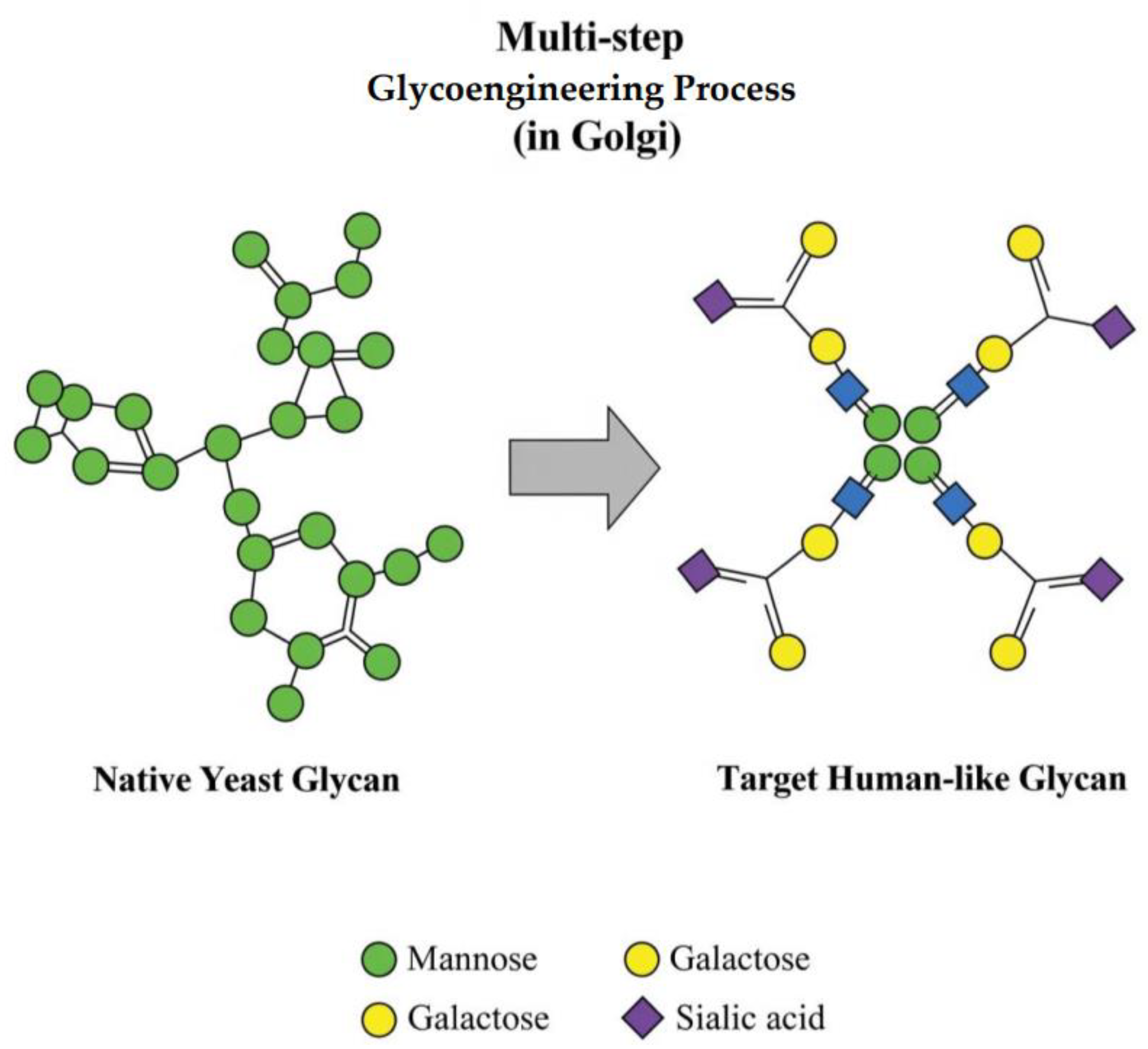
Figure 2.
The Landscape of Fungal and Yeast Expression Hosts. A conceptual map positioning the major expression systems based on two critical axes for industrial production: volumetric productivity/metabolic efficiency (X-axis) and protein processing complexity/secretion capacity (Y-axis). Each organism is placed in a quadrant that reflects its characteristic strengths and limitations, providing a general overview of the trade-offs inherent in host selection.
Figure 2.
The Landscape of Fungal and Yeast Expression Hosts. A conceptual map positioning the major expression systems based on two critical axes for industrial production: volumetric productivity/metabolic efficiency (X-axis) and protein processing complexity/secretion capacity (Y-axis). Each organism is placed in a quadrant that reflects its characteristic strengths and limitations, providing a general overview of the trade-offs inherent in host selection.
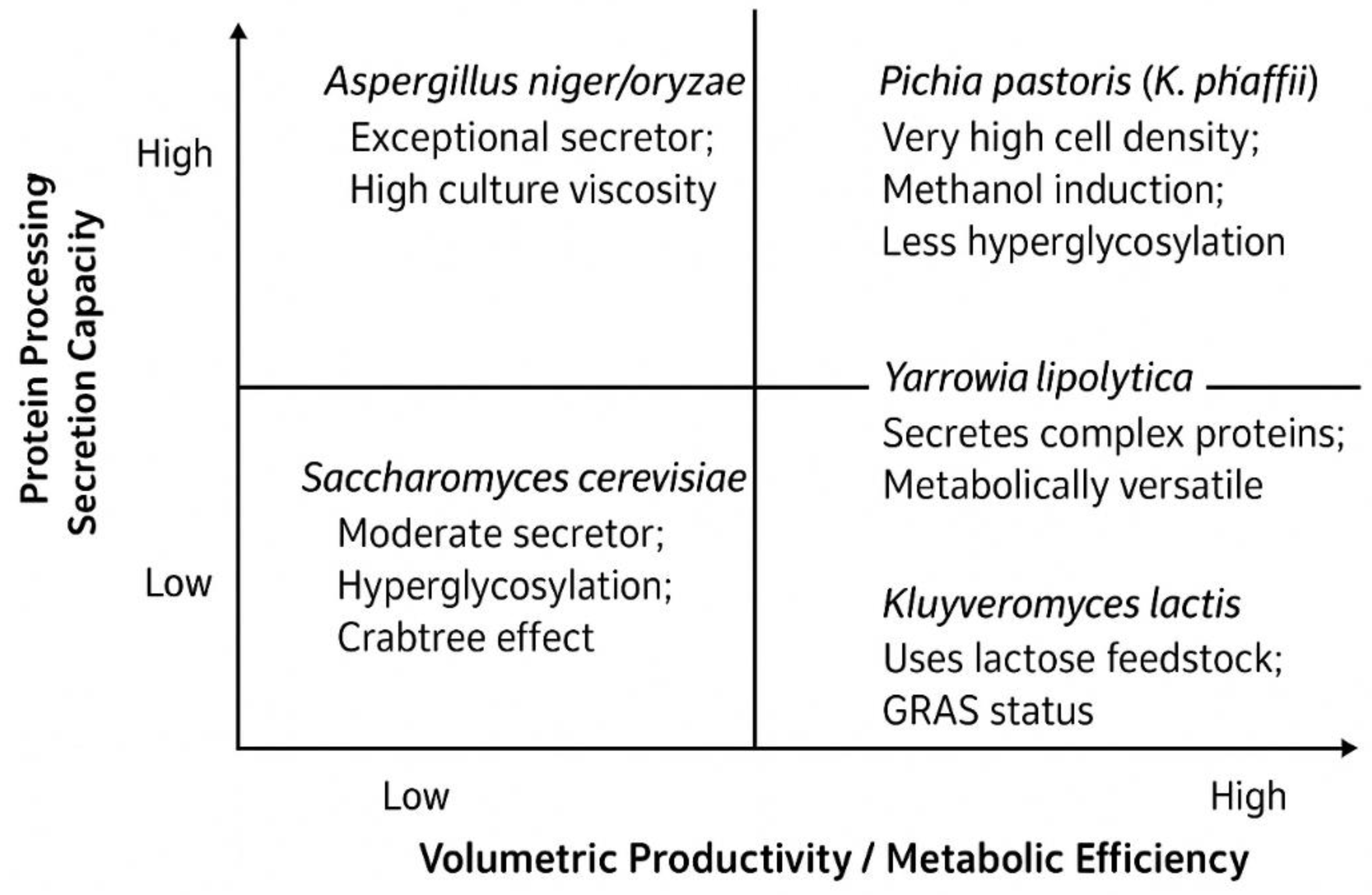
Figure 3.
Strategies to Mitigate Universal Production Bottlenecks. (A) Combating Proteolysis. Product degradation can occur via two primary routes: the release of potent vacuolar proteases from lysed cells and the action of cell-surface-anchored proteases, such as Yps1. Solutions include the engineering of protease-deficient strains and the optimization of process conditions. (B) Managing Metabolic Burden. The overexpression of a heterologous protein diverts essential cellular resources (e.g., ATP, NADPH, amino acids) from normal processes like growth, leading to physiological stress and the accumulation of misfolded proteins. Mitigation strategies include chaperone co-expression to improve folding and tuning promoter strength to balance production with cell health.
Figure 3.
Strategies to Mitigate Universal Production Bottlenecks. (A) Combating Proteolysis. Product degradation can occur via two primary routes: the release of potent vacuolar proteases from lysed cells and the action of cell-surface-anchored proteases, such as Yps1. Solutions include the engineering of protease-deficient strains and the optimization of process conditions. (B) Managing Metabolic Burden. The overexpression of a heterologous protein diverts essential cellular resources (e.g., ATP, NADPH, amino acids) from normal processes like growth, leading to physiological stress and the accumulation of misfolded proteins. Mitigation strategies include chaperone co-expression to improve folding and tuning promoter strength to balance production with cell health.
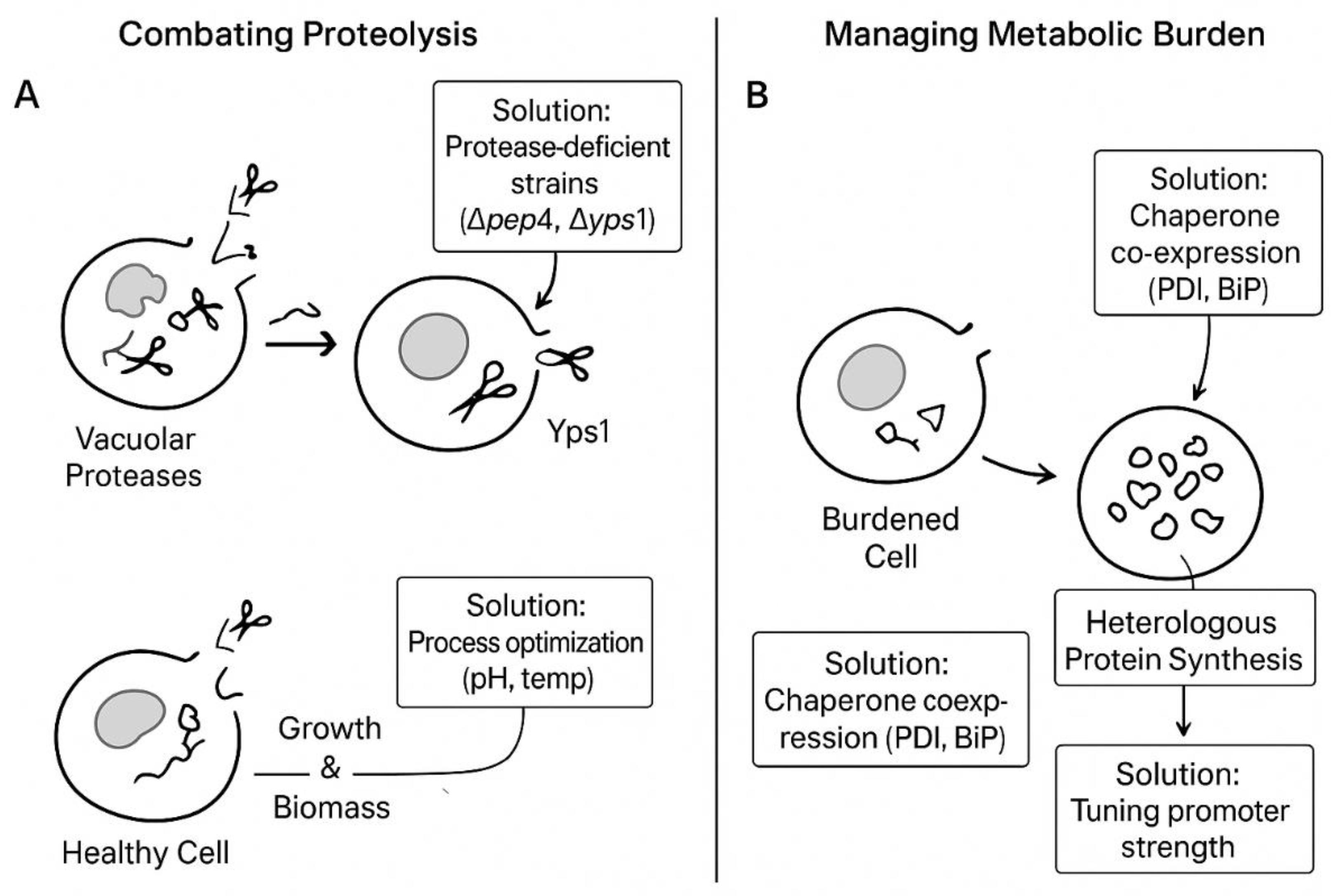
Figure 4.
The Modern Design-Build-Test-Learn (DBTL) Cycle for Cell Factory Engineering. This circular diagram illustrates the iterative approach of modern bioengineering. The cycle begins with the Design phase, utilizing computational models and AI predictions. This is followed by the Build phase, where tools like CRISPR/Cas9 are employed for genome editing. In the Test phase, strains are characterized through fermentation and 'omics' analysis. Finally, in the Learn phase, data are integrated to identify bottlenecks and refine models, thereby informing the next round of design in a continuous improvement loop.
Figure 4.
The Modern Design-Build-Test-Learn (DBTL) Cycle for Cell Factory Engineering. This circular diagram illustrates the iterative approach of modern bioengineering. The cycle begins with the Design phase, utilizing computational models and AI predictions. This is followed by the Build phase, where tools like CRISPR/Cas9 are employed for genome editing. In the Test phase, strains are characterized through fermentation and 'omics' analysis. Finally, in the Learn phase, data are integrated to identify bottlenecks and refine models, thereby informing the next round of design in a continuous improvement loop.
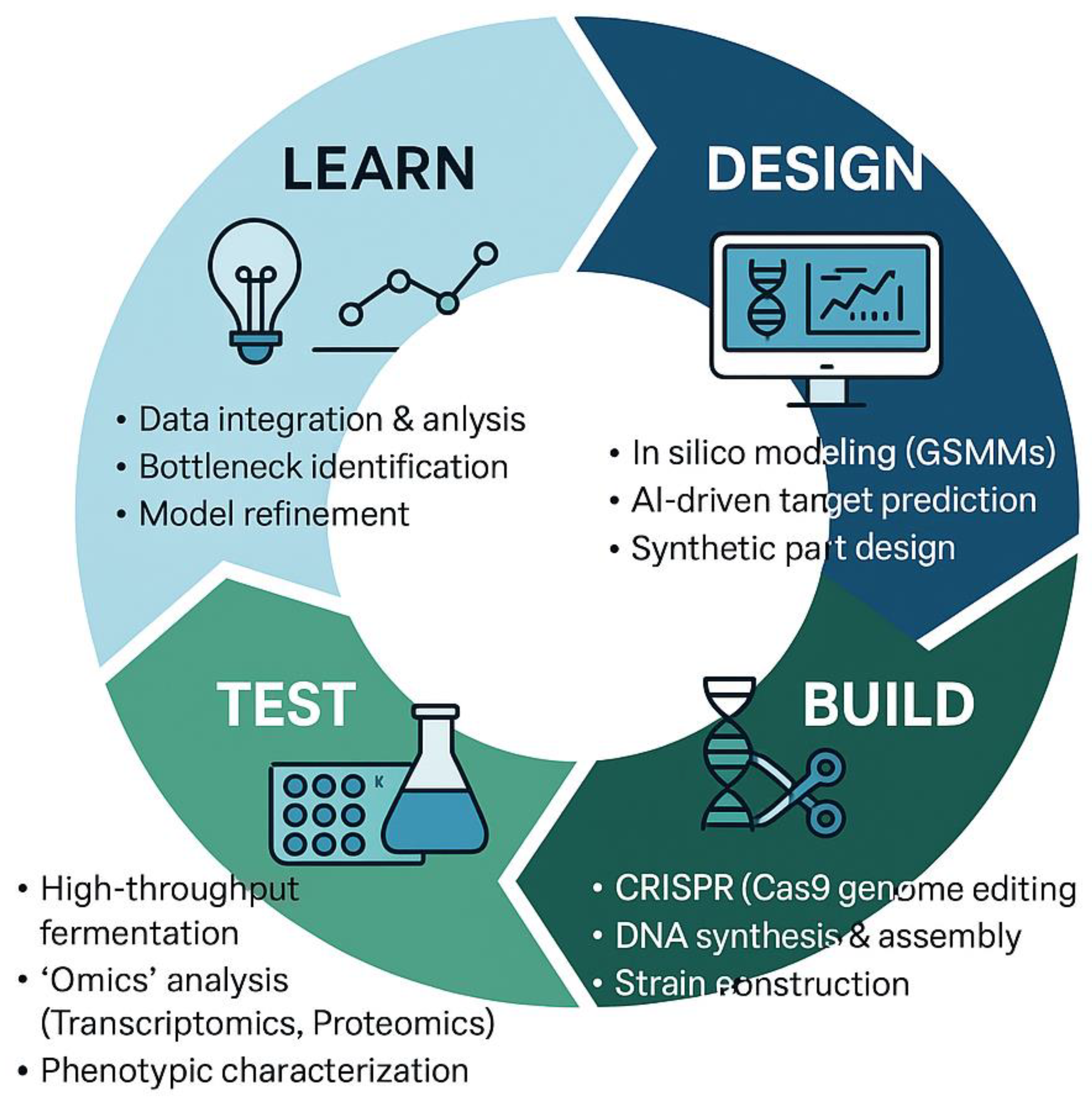

Table 1.
Comparative Analysis of Cell Wall Composition and Resultant Material Properties in Key Fungal Species.
Table 1.
Comparative Analysis of Cell Wall Composition and Resultant Material Properties in Key Fungal Species.
| Fungal Species | Primary Hyphal System | Key Cell Wall Components | Reported Mechanical Properties (Example Values) | Reported Physical/Thermal Properties (Example Values) | Key References |
|---|---|---|---|---|---|
| Ganoderma lucidum | Dimitic/Trimitic | High β-glucan content, complex branching; chitin; triterpenoids. | Superior physical and mechanical properties compared to P. ostreatus. Compressive strength can be tuned by substrate. | Hydrophobic (WCA ~120°). Mycelium mats can be tuned for porosity and density. | [12,32,53] |
| Pleurotus ostreatus | Monomitic | β-1,3 and β-1,6 glucans; chitin; high density of surface functional groups. | Lower mechanical properties than G. lucidum. Compressive strength of composites: 0.03–0.3 MPa | High water absorption capacity. Effective for biosorption of heavy metals. | [9,32] |
| Trametes versicolor | Trimitic | Polysaccharide-K (PSK) and Polysaccharopeptide (PSP); high glucan content. | Trimitic system implies high intrinsic strength. Used for strong composites. Flexural modulus (pressed): ~34-80 MPa depending on substrate. | Good insulation and fire-retardant properties. | [23,54] |
| Schizophyllum commune | Monomitic | High levels of secreted hydrolytic enzymes (xylanases, glucanases). Cell wall binds various micronutrients. | Tensile strength (pure sheet): ~9.5 MPa. Mechanical properties depend heavily on substrate and processing. | Cell wall acts as a pH-dependent ion-exchange material. | [29,46] |
| Agaricus bisporus | Monomitic | Chitin-glucan complexes. Chitosan derived from it has lower crystallinity than crustacean source. | Nanopapers from its chitin-glucan have tensile strength >200 MPa. | Chitosan films show good film-forming ability and porosity. | [27] |
Table 2.
Genetic and Chemical Modulators of Fungal Cell Wall Synthesis and Their Impact on Material-Relevant Phenotypes.
Table 2.
Genetic and Chemical Modulators of Fungal Cell Wall Synthesis and Their Impact on Material-Relevant Phenotypes.
| Modulator Category | Specific Target | Agent/Method | Observed Biochemical Effect on Cell Wall | Potential Impact on Material Properties | Key References |
|---|---|---|---|---|---|
| Genetic | Gcn5 Lysine Acetyltransferase | Gene Deletion (gcn5Δ) | ↑ β-glucan exposure, ↑ chitin content, altered expression of FKS1 and adhesins. | Altered adhesion, stress response, and potentially flexibility/strength. Broad-spectrum control. | [69] |
| α-1,3-Glucan Synthase | Gene Deletion (agsΔ) | ↓ α-1,3-glucan content. | Altered morphology (e.g., smaller pellets or dispersed growth, species-dependent) ; ↓ culture viscosity, improved bioprocessing. | [52,67] | |
| Chitin Synthase (Class V/VII) | Gene Deletion (csmΔ) | Disorganization of wall structure, altered surface rodlet layer. | Altered surface properties (e.g., hydrophilicity), modified mechanical integrity. | [28] | |
| pH-Sensing Pathway (PacC/Rim101) | Gene Deletion (pacCΔ) | Inability to adapt wall structure to ambient pH, defective expression of pH-regulated enzymes. | Loss of pH-dependent programmability, defects in material formation under specific pH. | [61] | |
| Chemical | Chitin Synthases (all classes) | Nikkomycin Z, Polyoxins | Competitive inhibition of chitin synthesis at hyphal tips. | Localized growth inhibition, creation of zones of weakness/flexibility, patterned growth. | [71] |
| Histone Deacetylases (HDACs) | SAHA, Trichostatin A (TSA) | Chromatin de-repression, activation of silent biosynthetic gene clusters. | Induction of novel secondary metabolites (pigments, polymers), adding new functionalities. | [78] | |
| DNA Methyltransferases (DNMTs) | 5-Azacytidine | DNA demethylation, activation of silent gene clusters. | Similar to HDAC inhibitors; induction of novel chemical functionalities in the material. | [78] | |
| β-1,3-Glucan Synthase | Echinocandins (e.g., Caspofungin) | Inhibition of β-1,3-glucan synthesis. | Weakened cell wall, increased sensitivity to stress, potential for controlled lysis or softening. | [79] |
Disclaimer/Publisher’s Note: The statements, opinions and data contained in all publications are solely those of the individual author(s) and contributor(s) and not of MDPI and/or the editor(s). MDPI and/or the editor(s) disclaim responsibility for any injury to people or property resulting from any ideas, methods, instructions or products referred to in the content. |
© 2025 by the authors. Licensee MDPI, Basel, Switzerland. This article is an open access article distributed under the terms and conditions of the Creative Commons Attribution (CC BY) license (http://creativecommons.org/licenses/by/4.0/).
Copyright: This open access article is published under a Creative Commons CC BY 4.0 license, which permit the free download, distribution, and reuse, provided that the author and preprint are cited in any reuse.