

Submitted:
16 August 2025
Posted:
18 August 2025
You are already at the latest version
Abstract
Hydrodynamic cavitation usually occurs in the marine and ocean engineering and hydraulic systems and may leads to destructive effects such as increasing in hydrodynamic drag, noise, vibration, erosion and performance degradation. In the previous studies, different passive and active control methods are used by the researchers to control the unsteady cavitation and its undesirable effects. In this work, different cavitation passive and active control methods for controlling the sheet cavitation, partial cavitation, cloud cavitation and tip-vortex cavitation are reviewed. Regarding the passive methods, different passive flow control methods, including sweep angle of foil, roughness, bio-inspired riblets, V-shaped, J-grooves, obstacles, surface roughness, blunt trailing edge, slits, various vortex generators and triangular slot are discussed. Regarding the active methods, various active flow control technologies, including air injection, water injection, polymer injection, synthetic jet actuator, piezoelectric actuators and so on are reviewed. It can be concluded that the passive and active methods separately able to control the unsteady cavitation. However, in the severe conditions of the cavitation and higher angles of attack, the passive control methods can only mitigate some re-entrant jets expanding in the streamwise direction and proper control of the cavity structure can not be achieved. In addition, active control methods mostly requires additional energy and, consequently, leads to higher costs. Combined passive-active control technologies was suggested by author, using the strengths of both methods, to suppress cavitation and control the cavitation instability for broad range of cavitating flows efficiently in the future works.
Keywords:
cavitation
; hydrodynamic cavitation
; passive control methods
; active control methods
; hydrofoil
1. Introduction
Cavitation is a physical phenomenon which consists of vaporization, bubble formation, and collapse of the cluster of the bubbles near the solid boundaries. The cavitation can be formed on the suction side of the hydrofoils and blades operating at the flow with high speeds [1,2,3,4,5]. In addition, the cavitation can increase hydrodynamic drag, noise, vibration, and erosion and induced a performance degradation of the ship rudders and propellers, turbine blades, and other fluid machinery systems. Different types of the cavitation may occur in various flow conditions such as cavitation inception, sheet cavitation, partial cavitation, cloud cavitation and supercavitation [6,7,8,9,10,11]. In the case of the supercavitating flows, there are numerous papers which used different active and passive control methods for drag reduction of the immersible bodies. However, the focus of the present review is the works regarding the control of the sheet, partial, cloud cavitation, tip-vortex cavitation using passive or active control methods. One of the most destructive types of the cavitation is unsteady cloud cavitation which usually accompanied by auto-oscillations of the attached cavity on the surface of the components of the underwater vehicles or hydraulic systems.
The collapse of the cloud cavities on the surface of the immersible bodied may generate high pressure and velocity pulsations which lead to mechanical damage on the surfaces in ship and hydraulic system components. Considering the destructive reasons mentioned above, the unsteady cavitation plays a serious problem in different industrial applications. Therefore, it is essential to find a method to control these destructive effects in ship rudders and propellers, pump impellers, turbine blades, guide vanes and various other applications. In the previous works by researchers, various methods for control of the cavitation and its undesirable effects under different conditions have been investigated, and in the present work, most of the well-known publications are reviewed to provide some general knowledge about the cavitation, its complex nonlinear behavior and the existing means to control the unsteady cavitating flows. In general, there are two types of the cavitation control methods which known as passive and active methods to control cavitation. Figure 1 shows some of the destructive effects of unsteady cloud cavitation, which are usually occur in the marine applications and hydraulic systems.
2. Hydrodynamic Cavitation Passive Control Methods
Before dealing with the passive flow control method in this section, the reasons that cause the unsteady cavitation mechanism are briefly discussed so that the readers can better understand how these mechanisms of unsteady cavitation formation may be controlled. The unsteady cloud cavitation and mechanisms of the associated cavitation instabilities have been widely studied experimentally and numerically by the researchers [14,15,16,17,18,19]. In the results of the previous works, a re-entrant jet was mentioned as the main role in the transition of the cavitation to the unsteady cloud cavitation [20,22,23,24]. The re-entrant jet flow moves usually upstream underneath an attached cavity due to an adverse pressure gradient in the vicinity of the closure region of the attached cavity. In other words, the re-entrant jet was directed perpendicular to the terminus of an attached cavity interface [21]. The re-entrant jet can cut off the attached cavity near its leading edge of a hydrofoil and after the rolling up of the attached cavity structure, a cavitation cloud can be formed in the downstream.
Regarding the previous works of the passive control methods of the unsteady cavitation, the following works are discussed. Crimi [25] experimentally investigated study of the effects of sweep angle of a hydrofoil on the hydrofoil performance due to cavitation. He found that the sweep angle of the hydrofoil may alleviate the problem of cavitation-induced erosion. Kawanami et al. [22] experimentally studied the dynamics of the cloud cavitation and control of cavitation using obstacles mounted on the suction surface of the hydrofoil. In this work, the obstacle was used to suppress the re-entrant jet and preventing the generation of cloud cavitation downstream of the hydrofoil. In addition, they presented that the cavitation-induced noise intensity and the hydrofoil drag were significantly reduced. Pham et al. [53] performed an experimental work to study the unsteady sheet cavitation and cloud cavitation mechanisms. In addition, they used a tiny obstacle (barrier) on the hydrofoil to control cloud cavitation. Their results revealed that the amplitude of the cavitation instabilities can be mitigated through the effects of the control method. Hofmann [26] experimentally studied different measures to control cloud cavitation. He examined various geometries of the blunt trailing edgeading edges of a semicircular leading edge flat plate. He analyzed the effects of an obstacle mounted on the suction side of the flat plate on the reduction of the cavitation-induced erosion.
Coutier-Delgosha et al. [28] experimentally studied the effect of the wall roughness on the dynamics of unsteady cavitation. They demonstrated that the surface roughness mounted on the immersed hydrofoil can rearrange the cavitation cycle in the sheet cavity structure. Choi et al. [27] developed a passive method of controlling and mitigating cavitation in an inducer using shallow grooves referred to as J-Grooves. They found that the suction performance of the inducer can be improved significantly at most of the flow regimes. Ausoni et al. (2007) [55,56] performed an experiment to study the effects of a hydrofoil on the dynamics of the cavitation. Their results revealed that a more organized vortex shedding with the reduction of the vortex shedding frequencies was obtained using the blunt trailing edge. Zhao et al. [41] numerically investigated the cavitating flow of a 2D NACA0015 foil with and without obstacles. They used different arrangements of the obstacles on the hydrofoil to control the unsteady cavitation. They found that the lift and drag may be decreased, however the lift to drag ratio can be increased for the hydrofoil with a proper size and position of the obstacles. Kim et al. [29] considered the effect of an axis-asymmetrical obstacle plate mounted upstream of an inducer inlet on the cavitation surge unsteadiness to suppress cavity instability.
Danlos et al. [30,31] investigated the effects of surface roughness such as grooves on the cavitation in a venturi-type geometry. They used a proper orthogonal decomposition to study the effects of the grooves on the cavitation dynamics. They found that the surface roughness may suppress the flow unsteadiness linked with the cloud cavitation shedding on a venturi-type geometry. In addition, a reduction in the cavity sheet length and mitigation of the cloud cavitation shedding can be obtained by an optimal size of the grooves. Ganesh et al. (2015) [57] experimentally investigated the interaction of a compressible bubbly flows with an obstacle placed within a shedding partial cavity. They utilized X-ray densitometry as a flow visualisation mechanism to study the dynamics of bubbly shock fronts in the cavitating flow. Their results showed that the effect of low speed of sound is felt locally once the cavity length crosses the obstacle. Javadi et al. [42] numerically studied the application of bubble generators on cavitation control via a two-dimensional cavitation modelling. They utilized a vortex generator mounted on the suction surface of the hydrofoil and showed that the vortex generator may induce a low pressure recirculation region behind the vortex generator. Their results revealed that the whole cavitation process, including vaporization, bubble generation, and bubble implosion may be affected and the force fluctuations may be mitigated. Onishi et al. [58] studied the effects of hydrophilic and hydrophobic coatings on the cavitation dynamics over a hydrofoil. They observed that the hydrophilic coating may reduce the incipient cavitation number. In addition, the hydrophilic of textures can lead to a lower growth of cavitation at small attack angles.
Hao et al. [60] investigated the influence of a surface roughness on the unsteady cloud cavitation flow around hydrofoils using high-speed video and particle image velocimetry (PIV). They indicated that the cloud cavitation mechanism, cavity structure and velocity and vorticity distribution of the cloud cavitation may be changed compared to the hydrofoil without roughness. Zhang et al. [61] experimentally studied the cloud cavitation dynamics on a flat hydrofoil using the placement of an obstacle downstream of the hydrofoil. They found that the shedding of cloud cavitation in the case with obstacle is much weaker than the shedding of cloud cavitation for the case without obstacle. In addition, they observed from the numerical results that the obstacle as a passive control method can reduce the strength and direction of the transient re-entrant jet and the pressure fluctuations on the flat hydrofoil. Custodio et al. [62] performed an experimental work to analyze the cavitation characteristics and hydrodynamic forces of hydrofoils without and with wavy leading edges in a cavitation tunnel. They utilized different sinusoidal leading edge geometries by three amplitudes of 2.5%, 5%, and 12% and two wavelengths of 25% and 50% of the mean chord length. Their results showed that the cavitation on the modified hydrofoils can appear at a lower angles of attack than on the hydrofoil without wavy leading edges. Furthermore, the lift coefficient for the simple hydrofoil was generally comparable to or greater than that of the hydrofoils with wavy leading edges. The drag for the modified hydrofoils with lower amplitude of the wavy leading edges was equal to the unmodified hydrofoil.
Kamikura et al. [33] numerically studied the control of the cavitation instabilities using asymmetric slits on the inducer blades. They indicated that the asymmetric slits can play as a passive cavitation control method for controlling of the cavitation instabilities. Petkovsek et al. [63,70] experimentally investigated the unsteady cavitation dynamics on the surface of a cylinder without and with passive control methods. They used different laser processing parameters to texture five various surface topographies such as dimpled, velvet, oxidized, waved and grooved on the surface of the cylinder. They indicated that the cavitation characteristics may significantly depend on the surface roughness and also the surface wettability. They concluded that cavitation on the cylinder can be mitigated using an appropriate laser-texturing parameter. Kadivar et al. [34,36,38,64], Kadivar and el Moctar [35] and Kadivar and Javadi [43] numerically and experimentally investigated the effects of a passive control method on suppression of the cloud cavitation over a benchmark hydrofoil. They utilized a wedge-type vortex generator to control the unsteady cloud cavitation on the surface of the hydrofoil. Their results indicated that choosing a proper size and location of the wedge-type vortex generator on the hydrofoil, the wall-pressure peaks and turbulent velocity fluctuations can be mitigated on the hydrofoil. They showed that the large-scale cloud cavitation can be changed to a quasi-stable attached cavity on the surface of the hydrofoil with a wedge-type vortex generator. In addition lift to drag ration was improved for the hydrofoil with the optimal size and location of the vortex generator. Figure 2 shows a schematic view of mesoscale bio-inspired riblets which are employed on the suction side of a hydrofoil adjacent to the leading edge for passive cavitation control.
Kadivar et al. [39,40] adapted a passive control method from the aerospace engineering application and used it to control cavitation in the marine engineering contexts. They used a cylindrical type of the miniature vortex generators know as cylindrical cavitating-bubble generators to control the unsteady behavior of the cloud cavitation. Their results showed that the cloud cavitation instabilities and the pressure pulsations can be mitigated using the cylindrical cavitating-bubble generators. In other words, the could cavity structure was changed to a stable cavity structure on the suction side of the hydrofoil at different cloud cavitating regimes. Amini et al. [37] performed an experiment to study a passive control method for suppressing of the tip vortex cavitation. They used different winglets on the hydrofoils and demonstrated that the winglets may effectively increase the radius of the tip vortex and delay the initial inception of the cavitation. Zhao and Wang [44] numerically investigated the passive control of cloud cavitation using a bionic fin-fin structure on a NACA 0015 hydrofoil. They indicated that the average drag of the hydrofoil may be reduced but the lift was decreased. In other words, the lift to drag ratio was increased using the bionic structure on the surface of the hydrofoil. In addition, the bionic structure can effectively mitigate the turbulent kinetic energy and make the flow more stable compared with the hydrofoil without bionic structure. Che et al. [59,65,66,67] studied the control effects of micro vortex generators on the unsteady cavitation dynamics on a NACA0015 hydrofoil. Their results revealed that the micro vortex generators have high potential to control the attached cavitation dynamics. In addition, they showed that the micro vortex generators may suppress the laminar separation under non-cavitating conditions and can fix the cavitation inception causing more stable sheet cavitation and cloud cavity shedding. Furthermore, they indicated that the hydrofoil modification can have a little impact under the transitional cavity oscillation due to the high inherently unstable flow. Figure 3 shows a schematic view of a cylinder without cavitation control and with the vertical and horizontal scalloped riblets which can be used as a passive control method for cavitation control. The geometry and construction of the riblets may play an important role on the flow control.

Table 1.
Summary of researches for cavitation passive control methods.
| Investigators | Type of Work | Control Method | Achievements |
|---|---|---|---|
| Crimi (1970) [25] | Experiment | Sweep angle of hydrofoil | Alleviating problem of cavitation-induced erosion. |
| Kawanami et al. (1997) [22] | Experiment | Obstacles | Reduction in cavitation-induced noise and hydrofoil drag, suppression of re-entrant jet. |
| Pham et al. (1999) [53] | Experiment | Obstacles | Reduction in amplitude of cavitation instabilities. |
| Hofmann et al. (2001) [26] | Experiment | Obstacles | Reduction in cavitation-induced noise. |
| Coutier-Delgosha et al. (2005) [28] | Experiment | Surface roughness | Rearranging cavitation cycle in sheet cavity structure. |
| Choi2007 et al. (2005) [27] | Experiment | J-Grooves | Improvement of suction performance of the inducer. |
| Ausoni et al. (2007) [55] | Experiment | Blunt trailing edge | Reduction in vortex shedding frequencies. |
| Kim et al. (2010) [29] | Experiment | Obstacles | Mitigation in cavity instability. |
| Ausoni et al. (2012) [56] | Experiment | Blunt trailing edge | Obtaining more organized vortex shedding. |
| Danlos et al. (2014) [30] | Experiment | Surface roughness/Grooves | Mitigation in flow unsteadiness linked with cloud cavitation shedding, reduction in cavity sheet length. |
| Danlos et al. (2014) [31] | Experiment | Surface roughness/Grooves | Reduction in cloud cavitation shedding, reduction in cavity sheet length. |
| Ganesh et al. (2015) [57] | Experiment | Obstacles | Observation of low speed of sound once the cavity length crosses the obstacle. |
| Onishi et al. (2017) [58] | Experiment | Hydrophilic and hydrophobic coatings | Reduction in growth of cavitation at small attack angles. |
| Che et al. (2017) [59] | Experiment | Micro vortex generators | Potential to control the attached cavitation dynamics. |
| Hao et al. (2018) [60] | Experiment | Surface roughness | Changing the cavity structure, velocity and vorticity distribution of the cloud cavitation. |
| Zhang et al. (2018) [61] | Experiment | Obstacles | Reduction of strength and direction of the transient re-entrant jet. |
| Custodio et al. (2018) [62] | Experiment | Wavy leading edge | Lift coefficient for simple hydrofoil was comparable to or greater than that of the hydrofoils with wavy leading edges. |
| Petkovsek et al. (2018) [63] | Experiment | Surface topographies: dimpled, velvet, oxidized, waved, grooved | Mitigation in cavitation on the cylinder using an appropriate laser-texturing parameter. |
| Kadivar et al. (2019b) [64] | Experiment | Wedge-type vortex generator | Mitigation in wall-pressure peaks and turbulent velocity fluctuations. |
| Che et al. (2019) [65] | Experiment | Micro vortex generators | Suppression of laminar separation under non-cavitating conditions, fixing cavitation inception causing. |
| Che et al. (2019) [66] | Experiment | Micro vortex generators | Obtaining more stable sheet cavitation and cloud cavity shedding. |
| Che et al. (2019) [67] | Experiment | Micro vortex generators | Obtaining more stable sheet cavitation and cloud cavity shedding. |
| Amini et al. (2019) [37] | Experiment | Winglets | Increasing radius of the tip vortex and delay initial inception of the cavitation. |
| Kadivar et al. (2020) [36] | Experiment | Wedge-type vortex generator | Mitigation in wall-pressure peaks and turbulent velocity fluctuations, mitigation of cloud cavity shedding. |
| Kadivar et al. (2020) [40] | Experiment | Cylindrical type of vortex generators | Mitigation in cloud cavitation instabilities and the pressure pulsations. |
| Qiu et al. (2020) [69] | Experiment | Micro vortex generators | Reduction in maximum pressure fluctuation by 32%, reduction in acoustic power by 10.8 dB, mitig erosion at the leading edge. |
| Petkovsek et al. (2020) [70] | Experiment | Surface topographies: dimpled, velvet, oxidized, waved, grooved | Mitigation in cavitation on the cylinder using an appropriate laser-texturing parameter. |
| Chen et al. (2020) [71] | Experiment | Leading edge roughness | Control the formation of the incipient cavitation, delay in maximum lift-to-drag ratio angle. |
| Huang et al. (2020) [72] | Experiment | Vortex generator (VG) | Changing of propeller cavitation, reduction in the pressure fluctuations. |
| Cheng et al. (2020) [73] | Experiment | Overhanging grooves | Suppression in tip-leakage vortex cavitation. |
| Svennberg et al. (2020) [74] | Experiment | Surface roughness | Reduction in cavitation number for tip vortex cavitation inception by 33%, increasing of drag force by 2%. |
| Kadivar et al. (2021) [76] | Experiment | Hemispherical vortex generators | Mitigation in amplitude of the pressure pulsations. |
| Arab et al. (2022) [78] | Experiment | Leading and trailing edge flaps | Enhancement of lift coefficient, reduction in cavitation volume. |
| Kadivar et al. (2024) [81] | Experiment | Biomimetic riblets | Reduction in lift force fluctuations, mitigation in cavitation-induced vibration amplitudes by about 41% and 43% for sawtooth and scalloped riblets, respectively. |
| Nichik et al. (2024) [82] | Experiment | Surface morphology/roughness | Suppression of cavity structure on cylinder, affecting on turbulence structure of the wake flow, including the mean velocity, dispersion and higher-order moments of turbulent fluctuations. |
| Lin et al. (2024) [48] | Experiment | Bio-inspired riblets | Reduction of noise at low frequency domain, reduction in the re-entrant jet momentum and unsteady cavity. |
| Li et al. (2025) [86] | Experiment | Spanwise obstacles | Suppression of development of unsteady cavitation, mitigation in cavitation-induced noise, reduction in maximum negative torque. |
| Kumar et al. (2025) [83] | Experiment | Sawtooth and scalloped mesoscale riblets | Reduction in cavitation-induced vibrations of the cylinder. |
| Kumar et al. (2025) [87] | Experiment | Bio-inspired riblets | Reduction of noise at low frequency domain, reduction in the re-entrant jet momentum and unsteady cavity. |
| Çelik et al. (2025) [90] | Experiment | Leading-edge tubercle and surface corrugation | Lowest cavitation area and period for tubercled hydrofoil by 70% and 50% of those of baseline and corrugated hydrofoils, respectively. |
| Kadivar et al. (2020) [38] | Exp/Num | Wedge-type vortex generator/Cylindrical type vortex generator | Changing large-scale cloud cavitation to a quasi-stable attached cavity, enhancement of lift to drag ratio, mitigation in wall-pressure peaks and turbulent velocity fluctuations. |
| Zhao et al. (2021) [77] | Exp/Num | Tandem obstacles | More resistance against the incipient and development of leading-edge cavities. |
| Chen et al. (2021) [75] | Exp/Num | Micro vortex generator (mVG) | mVG-1 configuration can promote the earlier inception cavitation, mVG-2 configuration can delay the inception. |
| Qiu et al. (2023a) [80] | Exp/Num | Micro vortex generator (mVG) | Improvement of lift-to-drag ratio, enhancement of stability of the flow field. |
| Qiu et al. (2024a) [84] | Exp/Num | Micro vortex generator (mVG) | Mitigation of unsteady cavity structure, Improvement of lift-to-drag ratio. |
| Qiu et al. (2024b) [85] | Exp/Num | Slits | Reduction in primary frequency of cavitation pulsations by 48.5%, diminishing momentum of the re-entrant jet. |
| Zhu et al. (2025) [89] | Exp/Num | Vortex generators: micro-VG and large-VG | Alteration of pressure fluctuation period, reduction of main frequency amplitude, reduction in erosion risk on the hydrofoil. |
| Xue et al. (2025) [91] | Exp/Num | Bionic leading-edge protuberances | Suppression in formation of large vortices near the hydrofoil’s leading edge. |
| Zhao et al. (2010) [41] | Numerical | Obstacles | Enhancement of lift to drag ratio. |
| Javadi et al. (2017) [42] | Numerical | Vortex generator | Mitigation of force fluctuations and cloud cavity structures. |
| Kadivar et al. (2017) [43] | Numerical | Wedge-type vortex generator | Mitigation in wall-pressure peaks and turbulent velocity fluctuations on the hydrofoil. |
| Kadivar et al. (2018) [34] | Numerical | Wedge-type vortex generator | Changing large-scale cloud cavitation to a quasi-stable attached cavity, enhancement of lift to drag ratio, mitigation in wall-pressure peaks and turbulent velocity fluctuations. |
| Kadivar et al. (2018) [35] | Numerical | Wedge-type vortex generator | Increasing of lift to drag ratio, mitigation in wall-pressure peaks and turbulent velocity fluctuations. |
| Kamikura et al. (2018) [33] | Numerical | Asymmetric slits | Mitigation in cavitation instabilities. |
| Zhao and Wang (2019) [44] | Numerical | Bionic fin-fin structure | Increasing of lift to drag ratio using the bionic structure, mitigation in turbulent kinetic energy. |
| Kadivar et al. (2019) [39] | Numerical | Cylindrical type of vortex generators | Mitigation in unsteady behavior of the cloud cavitation, obtaining more stable attached cavity on the foil’s surface. |
| Li et al. (2021) [45] | Numerical | Wavy leading-edge | Reduction in cavitation volume by approximately 30%, mitigation in pressure amplitude by approximately 60%. |
| Lin et al. (2021) [46] | Numerical | Arc obstacles | Obtaining more stabilization in cavitation behavior, inhibiting evolution of cavitation through the effects of the arc obstacles. |
| Jia et al. (2022) [47] | Numerical | V-shaped groove | Reduction in average cavitation volume during a cavitation cycle by 17.46%, decreasing average dipole noise by 5.07% and average quadrupole noise by 6.86%. |
| Yang et al. (2024) [49] | Numerical | Two bionic structures | Reduction in total volume of cavitation by 43%, enhancement of stability of the flow field, reduction in standard deviation of the pressure coefficient by 46%. |
| Kumar et al. (2025) [88] | Numerical | Surface cavity | Enhancement of about 7% and 3.1% in lift to drag ratio. |
| Usta et al. (2025) [50] | Numerical | Leading-edge tubercles and surface corrugations | Obtaining delay of stall and less cavitation area for the tubercled hydrofoil. |
| Velayati et al. (2025) [51] | Numerical | Semi-spherical VG | Reduction in cloud cavitation shedding frequency, increasing frequency of cavity shedding by 19.4% and increasing lift-to-drag ratio by 2.5% for semi-spherical VG located near trailing edge. |
| Biswas et al. (2025) [52] | Numerical | Triangular slot | Avoiding stalling for the hydrofoil with slot, better control of cavitation for modified hydrofoil at lower cavitation numbers. |
Qiu et al. [69] experimentally studied the effects of the micro vortex generators on the cavitation-induced erosion over a NACA0015 hydrofoil. They demonstrated that the periodic cavity shedding was mitigated through the effects of the micro vortex generators. According to this study, the maximum impact energy of the hydrofoil with passive control method was about 48% of that of the hydrofoil without vortex generators. In addition, the maximum pressure fluctuation was reduced by 32%, the acoustic power was reduced by 10.8 dB and the erosion at the leading edge was alleviated using the vortex generators on the hydrofoil. Chen et al. [71] experimentally investigated the control of the cavitation patterns and corresponding hydrodynamics of the NACA66 hydrofoil using a leading edge roughness. They indicated that the leading edge roughness may affect on the hydrodynamic performance at the sub cavitation and can control the formation of the incipient cavitation. Furthermore, the lift coefficient of the hydrofoil without leading edge roughness was larger than that of the hydrofoil with leading edge roughness and the maximum lift-to-drag ratio angle was delayed for the hydrofoil with leading edge roughness. Huang et al. [72] experimentally studied a passive control method on the transient turbulent cavitating flow around a marine propeller behind a ship. They used vortex generator (VG) to control propeller cavitation and hull pressure fluctuations. The results indicated that the vortex generator with proper geometry may contribute the highly nonuniform wake to be more uniform. In addition, the vortex generator can make the change of propeller cavitation and may reduce the pressure fluctuations. Cheng et al. [73] investigated the suppressing tip-leakage vortex cavitation by overhanging grooves. Their results demonstrated that the fluctuation of the tip-leakage vortex cavitation may be effectively suppressed by overhanging grooves. However, no significant alteration of the time-averaged drag and lift can be observed by overhanging grooves. Svennberg et al. [74] performed an experimental analysis of tip vortex cavitation mitigation by controlled surface roughness. Their results revealed that the cavitation number for tip vortex cavitation inception can be reduced by 33% in the optimized roughness pattern compared with the unmodified hydrofoil condition where the drag force may be increased by 2%. Chen et al. [75] experimentally investigated the influence of the micro vortex generator (mVG) on the inception cavitation number on a NACA66 hydrofoil. They employed two different mVGa knwon as mVG-1 which was located upstream of the laminar separation point of the hydrofoil and the mVG-2 which was located in the laminar separation zone of the hydrofoil. Their results indicated that the mVG-1 can promote the earlier inception cavitation and the mVG-2 may delay the inception, especially for the cases with smaller attack angles compared to the hydrofoil without cavitation control. Figure 4 shows a schematic view of a cylinder without cavitation control and with two different surface morphologies such as rough surface and finned surface. Figure 5 represents the photographs of the cavity structures on the surface and in the wake of the cylinders for three types of wall morphology, smooth, rough and finned.
Zhao et al. [77] implemented a pair of tandem obstacles on the suction side of the pump to control baled cavitation in water jet pumps. Their results showed a more resistance against the incipient and the development of leading-edge cavities after using obstacles. However. the hydraulic performance loss, including 6% head drop and 5.6% efficiency drop was seen due to the violent pressure fluctuations by using obstacles on the blade. Kadivar et al. [76] experimentally studied the effects of hemispherical vortex generators on the cavitation dynamics around a hydrofoil surface. Their results indicated that the amplitude of the pressure pulsations in the hydrofoil wake location behind the hydrofoil was noticeably mitigated through the effects of hemispherical vortex generators at the cloud cavitation and transient cavitation regimes. Li et al. [45] numerically studied the hydrofoil cavitation using the leading-edge protuberances of humpback whale flippers and its effect on the cavitation dynamics. Their results revealed that the wavy leading-edge may improve the lift–drag characteristics and can reduce the cavitation volume on the hydrofoil by approximately 30%. In addition, they found that the increasing of the amplitude of the wavy leading-edge can reduce the pressure amplitude by approximately 60%. Lin et al. [46] performed a numerical simulation to study the cavitation over flat hydrofoils using arc obstacles. They used a large edgy simulation for simulating the cavitating flows around the hydrofoil. Their results demonstrated that the obstacles of different structures may affect the frequency of cavitation shedding and distribution of air content on the flat hydrofoils. Furthermore, their results showed a more stabilization in the cavitation behavior and also inhibiting the evolution of cavitation through the effects of the arc obstacles on the flat hydrofoil. Jia et al. [47] numerically investigated the cavitation flow and broadband noise source characteristics of a NACA66 hydrofoil using a V-shaped groove on the hydrofoil surface. They indicated that the V-shaped groove can extend a cavitation cycle and reduce the average cavitation volume during a cavitation cycle by 17.46%. In addition, they found that the groove may decrease the average dipole noise on the hydrofoil surface by 5.07% and the average quadrupole noise on the middle longitudinal section by 6.86% during a cavitation cycle.
Arab et al. [78] performed an experimental work to study the solutions to control the onset of cavitation using a combination of leading edge and trailing edge flaps on a NACA 0012 hydrofoil which was manufactured using an additive 3D printing technique. Their results presented that the lift coefficient may be increased and the cavitation volume may be decreased with the flaps deflection. In addition, the hydrofoil with a parabolic flap can lead to a more lift than the traditional flap and may enlarge the non-cavitation domain to some extent of the lift coefficients. Qiu et al. [80,84] investigated the effect of the micro vortex generators on cavitation collapse and pressure pulsation on a NACA0015 hydrofoil. Their results indicated that the lift-to-drag ratio can be improved and the stability of the flow field may be enhanced through the effects of the micro VGs. In addition, a suppression of the pressure pulsation can be observed for the hydrofoil with micro VGs locating at the hydrofoil’s leading edge. Furthermore, the shedding and collapse of the cloud cavity on the smooth hydrofoil are replaced by the partial separation and collapse of sheet cavitation on the hydrofoil with micro-VGs at the cloud cavitating regime. Yang et al. [49] numerically studied a passive control method for hydrofoil cavitation by combining the two bionic structures on a hydrofoil. They indicated that the novel bionic combined hydrofoil may achieved a cavitation inhibition effect and reduced the total volume of cavitation by 43%. In addition, the passive control method enhanced the stability of the flow field and reduced the standard deviation of the pressure coefficient on the hydrofoil suction surface by up to 46.55%. Figure 6 shows schematic view of a polished cylinder and laser-textured cylinders with various surface morphologies such as dimpled, velvet, oxidized, waved and grooved surface by using scanning electron microscope (SEM) and 3D optical Infinite-Focus Measuring (IFM) device.
Qiu et al. [85] used slits to control the periodic characteristics of unstable cloud cavitation on a hydrofoil. They showed that the high-speed jet induced from the slit can diminish the momentum of the re-entrant jet and may significantly reduce the complete detachment of the attached cavitation. In addition, their finding revealed that the primary frequency of cavitation pulsations can be reduced 48.5% for the hydrofoil with cavitation control. Kadivar et al. [81] and Kumar et al. [83] experimentally examined the cavitation dynamics behind a smooth cylinder and cylinders with sawtooth and scalloped mesoscale riblets by high-speed visualization and measuring forces fluctuations. Their results demonstrated that the riblets can control the flow dynamics and von Karman vortex characteristics, and reduce the cavitation-induced vibrations of the cylinder. Furthermore, both riblets notably decreased the lift force fluctuations and mitigated the cavitation-induced vibration amplitudes by about 41% and 43% for sawtooth and scalloped riblets, respectively. Nichik et al. [82] experimentally investigated the cavitation control and transformation of turbulence structure in the cross flow around a circular cylinder using surface morphology and wettability effects. They indicated that the roughness promoted a significant cavitation suppression on the cylinder. Their results revealed that the smaller the scale of irregularities is, the more pronounced this effect occurs to be for the considered wall morphologies. In addition, they showed that both types of roughness can affect the turbulence structure of the wake flow, including the mean velocity, dispersion and higher-order moments of turbulent fluctuations.
Li et al. [86] performed an experimental study to control the unsteady cavitation around oscillating hydrofoils using spanwise obstacles near trailing edge. They indicated that the presence of spanwise obstacles may generate a positive torque on the hydrofoil and can reduce the maximum negative torque experienced by the hydrofoil. In addition, it is found that the spanwise obstacles may effectively suppress the development of unsteady cavitation and can mitigate the cavitation-induced noise in the flow field. Lin et al. [48] and Kumar et al. [87] experimentally studied the control of the partial and cloud cavitation on a NACA0015 hydrofoil using bio-inspired riblets. For this aim, they implemented two different kinds of bio-inspired riblets, known as scalloped riblets and sawtooth riblets, on the suction side of the hydrofoil close to the leading edge. According to this study, a noise reduction was observed for the hydrofoil with scalloped and sawtooth riblets at low frequency domain and for some cases at higher frequency range. Their results showed that the cavitation oscillation mechanism can be manipulated and the large-scale cavitation structures may be elimination using the passive control method. They indicated that the cloud cavitation shedding on the hydrofoil suction surface was mitigated significantly due to the reduction in the re-entrant jet momentum. Çelik et al. [90] experimentally studied the leading-edge tubercle and surface corrugation effects on the cavitation and cavitation-induced noise in partially cavitating twisted hydrofoils. Their results showed that the Tubercled model produced a noise level almost the same or slightly higher than the Corrugated model in the mid-frequency range. In addition, they indicated that the Tubercled hydrofoil may exhibit the lowest cavitation area and period, approximately 70% and 50% of those of the baseline and corrugated models, respectively. Figure 7 shows schematic view of a basic hydrofoil model based on the NACA634–021 airfoil and bionic hydrofoils with a fin spine structure, sinusoidal leading edge and a combined hydrofoil model constructed by combining two single bionic structures with sinusoidal leading edge.
Zhu et al. [89] investigated the cavitation-induced erosion and cavitation control using a microstructure at different scales on a NACA0015 hydrofoil. For this aim, they applied the vortex generators (VGs) with heights of 0.25 mm (micro-VG) and 2.5 mm (large-VG), installed at the leading edge of the NACA0015 hydrofoil. From the results of the pressure signal, it can be observed that the VGs may alter the pressure fluctuation period and reduce the main frequency amplitude compared to the hydrofoil without control method. In addition, they showed that a superior suppression of pressure fluctuations can be obtained using the larger VGs. Furthermore, a reduction in erosion risk on the hydrofoil can be seen for the hydrofoil with the VGs due to the reduction in the large-scale cloud cavitation. The larger VGs showed a better effectiveness in preventing cavitation erosion. Xue et al. [91] numerically studied the cavitating flow around a NACA0015 hydrofoil with bionic leading-edge protuberances using Large Eddy Simulations (LES). It was shown that the bionic hydrofoil surface contained more small vortex cores, which hindered the formation of large vortices near the hydrofoil’s leading edge. In other words, the vortex intensity induced by cavity shedding was stronger for the baseline hydrofoil compared to the bionic hydrofoil. Kumar et al. [88] numerically investigated the cavitation control on a NACA0018 hydrofoil using a surface cavity mounted on the suction surface of the foil. According to this study, an enhancement of about 7% and 3.1% in the lift to drag ratio was obtained for the hydrofoil with surface cavity compared to the unmodified hydrofoil at high and low cavitation numbers, respectively.
Usta et al. [50] performed a numerical simulation to investigate the effect of leading-edge tubercles and surface corrugations on the performance and cavitation characteristics of a twisted NACA 0015 hydrofoil. Their results revealed that the corrugated hydrofoil may achieve higher efficiency than the other configurations at various angles of attack under non-cavitating conditions. They showed that the corrugated and tubercled hydrofoils may progressively approach its performance at higher angles of attack under cavitating conditions. In addition, they presented that the tubercled hydrofoil can effectively delay stall and has less cavitation area for various angles of attack than that of baseline hydrofoil. Velayati et al. [51] numerically studied the influence of surface microstructures on the cavitation dynamics over a Clark Y hydrofoil to control the unsteady cloud cavitation by utilizing a Large Eddy Simulation (LES) approach. For this aim, they applied rows of semi-spherical microstructures, strategically placed at three different locations on the hydrofoil’s suction side. The results showed that placing the microstructures near the leading edge may prolong the sheet cavity and can reduce the cloud cavitation shedding frequency by 5%. However, a 11.45% reduction in the lift-to-drag ratio was obtained from the microstructures near the leading edge. In addition, the results revealed that the semi-spherical surface microstructures located near the trailing edge can increase the frequency of cavity shedding by 19.4% and increase the lift-to-drag ratio by 2.5%. Biswas et al. [52] performed a numerical simulation to study the unsteady cavitation on hydrodynamic performance of NACA4412 hydrofoil with a triangular slot. They indicated that the modified hydrofoil was better able to control cavitation phenomena compared to the unmodified hydrofoil at lower cavitation numbers. However, at higher cavitation numbers, the base hydrofoil may exhibit slightly better performance than the hydrofoil with triangular slot in terms of lift-to-drag ratio. In addition, they showed that the stalling can be avoided for the hydrofoil using passive control method.
3. Hydrodynamic Cavitation Active Control Methods
In several previous studies, active methods of cavitation control were studied. Arndt et al. [92] performed an experimental study the control of cavitation-induced erosion on the surface of an elliptic hydrofoil using an active control technique. They injected air through small holes in the leading edge of the hydrofoil. Their results revealed that the cavitation-induced erosion can be mitigated using the air injection method. Reisman et al. [93] experimentally investigated an air injection method to manipulate the dynamics of cloud cavitation to reduce the magnitude of pressure pulsations in the small frequency range. Pham et al. [53] experimentally investigated the control of the unsteady sheet cavitation and cloud cavitation mechanisms. They used an air injection through a slit on the hydrofoil surface to control cloud cavitation. Their results indicated that the amplitude of the cavitation instabilities can be reduced through the effects of air injection. Hofmann [26] experimentally studied the effects of an air injection on cavitation instability. He showed that the cavitation-induced erosion can be mitigated using the air injection in the cavitation zone. The effects of polymer injection on the dynamics of vortex cavitation in the past studies [94,95,96]. Their results revealed that the pressure in the vortex core can be increased with this control technique by reducing the maximum tangential velocity along the vortex, thus delaying the cavitation inception.
The friction drag can be also reduced using gas injection Ceccio et al. [97], which leads to the creation of a bubbly mixture and modifies the flow structure within the turbulent boundary layer. They showed that the partial cavity flows can also be used to reduce the friction drag on the nominally two-dimensional portions of a horizontal surface. They presented that the application of the active techniques can be used for underwater vehicles and surface ships. Zhang et al. [98] studied the influence of air injection on the unsteady cloud cavitating flow dynamics. They found that the ventilation method can damp pressure pulses induced by cloud cavity collapses in a converging-diverging channel and stabilize the attached cavity. Wang et al. [99] studied the effects of the water injection on the cavitation suppression over a NACA0066 hydrofoil. They analyzed the position and angle of the water jet on the cavitation dynamics over the hydrofoil. Their results showed that the water injection can increase the velocity gradient in the boundary layer and may reduce the extent of the flow separation on the foil. In addition, they presented that the velocity of the re-entrant jets can be mitigated due to the effects of the water injection. Mäkiharju et al. [32] studied the effects of injection of non-condensable gas on the dynamics of partial cavity formation. Their experimental results illustrated that the gas injected near the apex of a convergent-divergent channel may increase the pressure near the suction peak and, thereby, suppress the vapor formation and reduce the overall cavity void fraction. Wang et al. [100] investigated the vortex shedding dynamics in a ventilated cavitating flow and indicated that the gas injection has significant effect on the velocity and vorticity distributions. Using a proper orthogonal decomposition (POD) analysis, they found that the gas injection mainly affects the first mode of vortex shedding in the wake. Figure 8 shows schematic view of a hydrofoil without injection and with water injection as an active cavitation control method.
Wang et al. [101] found that air injection may promote the growth of the attached cavity length and the size of the cloud cavity structures under unsteady cloud cavitation conditions. This effect becomes more pronounced with increasing the air injection rate. The effects of active cavitation control using injection of a liquid along the surface were studied by Timoshevskiy et al. [102]. They demonstrated that an active control method can mitigate cavitation and reduce the amplitude of pressure pulsations using water injection. They made an attempt to control cavitation on the surface of a scaled-down model of guide vanes of a hydraulic turbine and, depending on the injection rate, using a wall jet of water that was injected through a spanwise slot nozzle along the wall. In addition, their results revealed that the active control method based on water injection is capable to mitigate cavitation and reducing the amplitude of pressure pulsations caused by the unsteady cavitating flow. They presented that the attached cavity length can be reduced by 25% compared to the case without injection. Wang et al. [103] experimentally studied the effects of a water injection on the cavitation control on a NACA66 (MOD) hydrofoil. They analyzed the effects of water injection on cavity evolution with four kinds of jet flow at two different jet positions. It can be observed from their results that the water injection can block the re-entrant jet moving upstream and may mitigate the momentum of re-entrant jet. In addition, the maximum sheet cavity length was reduced by 79.4% and the cavity shedding is mitigated with the injection at flow rate coefficient of 0.0245 and jet position of 0.45C.
Malekshah et al. [110] experimentally studied the dynamic/morphological quality of the cavitation induced by different air injection rates and sites. Their results showed that the injection site has a significant effect on the cavitation dynamic features and morphology but the effectiveness of the air injection may depend on the flow conditions. Hilo et al. [111] experimentally studied the cavitating flow control on the cavitation-induced noise using an air injection. They assessed the location of the air injection, the rate of air injection, and the cavitation number on the control of the cavitation. Their results indicated that the injecting air closer to the leading edge may have the most significant effect on the reduction of the vapor cavitation and noise. In addition, they found that the injecting air at the middle of the foil’s chord may reduce the length of the vapor sheet cavity by 27%. However, the volume of the ventilated cavitation may be increased by increasing the air injection rate. Figure 9 shows schematic representation of a test section of an air injection as an active cavitation control method on a convergent–divergent channel.
Table 2.
Summary of researches for cavitation active control methods.
| Investigators | Type of Work | Control Method | Achievements |
|---|---|---|---|
| Arndt et al. (1995) [92] | Experiment | Air injection through small holes | Mitigation of cavitation-induced erosion. |
| Reisman et al. (1997) [93] | Experiment | Air injection | Reduction in the magnitude of pressure pulsations. |
| Pham et al. (1999) [53] | Experiment | Air injection through a slit | Reduction in amplitude of the cavitation instabilities. |
| Hofmann et al. (2001) [26] | Experiment | Air injection | Mitigation of cavitation-induced erosion. |
| Ceccio et al. (2010) [97] | Experiment | Bubble and gas injection | Reduction in friction drag. |
| Hsiao et al. (2010) [95] | Experiment | Polymer injection | Delaying the cavitation inception. |
| Chahine et al. (2012) [96] | Experiment | Polymer injection | Delaying the cavitation inception. |
| Wang et al. (2018) [100] | Experiment | Gas injection | Effect on the velocity and vorticity distributions. |
| Wang et al. (2018) [101] | Experiment | Air injection | Promotion in growth of attached cavity and size of the cloud cavity. |
| Timoshevskiy et al. (2018) [102] | Experiment | Water injection | Mitigation in cavitation volume and amplitude of pressure pulsations. |
| Wang et al. (2020) [103] | Experiment | Water injection | Block the re-entrant jet. |
| Malekshah et al. (2023) [110] | Experiment | Air injection | Significant effect on the cavitation dynamic features. |
| Hilo et al. (2024) [111] | Experiment | Air injection | Reduction in length of the vapor sheet. |
| Singh et al. (2024) [112] | Experiment | Air injection | Optimizing cavitation efficiency in the converging–diverging nozzle. |
| Hilo et al. (2025) [116] | Experiment | Air injection | Less fluctuation in sheet cavity pulsation, Increasing sound pressure level at lower frequencies. |
| Zhang et al. (2009) [94] | Numerical | Polymer injection | Reduction in maximum tangential velocity along the vortex, delaying cavitation inception. |
| Wang et al. (2017) [99] | Numerical | Water injection | Increasing velocity gradient in boundary layer, reduction in flow separation, mitigation of re-entrant jet. |
| Wang et al. (2020) [104] | Numerical | Water injection holes | Potential for cavitation suppression, higher pressure at leading edge with reducing of lift in some condition. |
| Sun et al. (2020) [105] | Numerical | Ventilation | Reduction in turbulence intensity and turbulence integral scale in the wake region. |
| De Giorgi et al. (2020) [106] | Numerical | Single synthetic jet actuator | Reduction in average vapor and average torsional load by 34.6% and 17.8%, respectively. |
| Yan et al. (2022) [107] | Numerical | Active jet | Increasing lift-drag ratio by 11.4% and reduction in cavitation volume about 30% with optimal jet scheme. |
| Luo et al. (2022) [108] | Numerical | Ventilation | Interaction between turbulence and gas-liquid interfacial fluctuations for the ventilated wake flow. |
| Gu et al. (2023) [109] | Numerical | Bionic jet-shark gill slit jet structure | Reduction in time-averaged volume fraction by 46% compared at jet position of 0.6C, improvement of lift-to-drag ratio. |
| Wang et al. (2024) [113] | Numerical | Water injection | Reduction in cavitation volume by 49.34% and lift–drag ratio enhancement by 8.55% for water injection at 0.30C and jet of 60 degrees. |
| Li et al. (2024) [114] | Numerical | Water injection combined with barchan dune vortex generators | Reduction in cavitation volume, increasing lift-to-drag ratio by 64.54% for the hydrofoil using water injection combined with barchan dune VG. |
| Li et al. (2025) [115] | Numerical | Water injection | Increasing lift-to-drag ratios for configurations H019C, H030C, and H045C by 0.30%, 8.44%, and 12.30%, respectively. |
| Ji et al. (2025) [117] | Numerical | Water injection | Reduction in drag coefficient by 3.5%, reduction of 15.40% in the maximum circumferential velocity of the tip leakage vortex. |
| Wang et al. (2025) [118] | Numerical | Piezoelectric actuators | Changing cavity shedding mode from a large-scale shedding near the leading edge to a small-scale shedding. |
Singh et al. [112] performed an experiment to study the cavitation dynamics in a converging–diverging nozzle using air injection at different injection positions. They estimated the cavitation length, cavity area, and energy distribution by an image processing. Their results indicated that the bubble lengths and distributions along the channel can be changed by altering the injection points. In other words, they showed the crucial role of the injection location in optimizing cavitation efficiency in the converging–diverging nozzle. Hilo et al. [116] experimentally investigated the effect of air injection around the leading edge of a three-dimensional hydrofoil for cavitation noise reduction. From the results can be observed that the shedding frequency of the sheet cavity may decrease linearly with the increasing of the air injection rates which indicates a less fluctuation by high injection rates. A slight increase in drag force with air injection was observed. In addition, it is noted that the air injection can increase sound pressure level at lower frequencies smaller than 1 KHz. Figure 10 shows schematic view of a hydrofoil with water injection as an active control method for control of the cavitation.
In the case of numerical simulation, different works are performed by the researchers. Wang et al. [104] studied the impact of water injection holes arrangement on the cavitation flow control over the NACA66(MOD) hydrofoil. Their results showed that the effectiveness of cavitation suppression is closely related to the porosity of the jet hole. They demonstrated that the double row jet holes setting in forward trapezoidal arrangement may have a great potential for cavitation suppression and hydrodynamic performance. In addition, jet holes arranged in the leading edge produced higher pressure with reducing of the lift of the hydrofoil. Sun et al. [105] performed the numerical simulation of cavitating flow around a NACA66 hydrofoil with focus on the effects of ventilation on cavitation dynamics such as cavity dynamics, vortex structure, and the wake field. They used the Schnerr-Sauer cavitation model, and the Large Eddy Simulation (LES) method to calculate the unsteady natural and ventilated cavitation. Their results revealed that the shedding frequency of the ventilated cloud structures may be higher than the natural cavitation. In addition, the ventilation can effectively reduce the turbulence intensity and turbulence integral scale in the wake of the hydrofoil. In other words, the ventilation may improve the velocity pulsation and instability of the cavitation.
De Giorgi et al. [106] numerically investigated an active control method of unsteady cavitation using a single synthetic jet actuator around a NACA0015 hydrofoil. Their results indicated that the synthetic jet control method can lead to a reduction of the average vapor content and the average torsional load in the amount of 34.6% and 17.8%, respectively. Yan et al. [107] numerically studied the influence of active jet parameters on the cavitation performance of Clark-Y hydrofoil. They used the large eddy simulation combined with the Zwart-Gerber-Belamri cavitation model to simulate the cavitating flows. Theirs results showed that the active jet can block the re-entrant jet and reduce the cavity volume on the hydrofoil when the jet position was located to the leading edge of the hydrofoil. However, this effect may reduce the lift coefficient of the hydrofoil. According to this study, the optimal jet scheme may increase the lift-drag ratio of the hydrofoil by 11.4%. Furthermore, the cavitation volume fraction was reduced about 30% compared to the original hydrofoil. Luo et al. [108] performed a numerical simulation to study the complex interaction of gas-vortex-turbulence in ventilated cavitation over a NACA0015 hydrofoil using large eddy simulation. They presented the interaction mechanism between turbulence and gas-liquid interfacial fluctuations for the ventilated wake flow.
Gu et al. [109] numerically studied the control of the cavitation phenomenon of the fluid machinery at high-velocity flow conditions using a shark gill slit jet structure based on the principle of bionics. The jet direction is consistent with the mainstream direction with different jet positions on the hydrofoil. The results indicated that the time-averaged volume fraction was reduced by 46% compared with the main hydrofoil at jet position of 0.6C. The lift-to-drag ratio of the jet hydrofoil was improved compared to the main hydrofoil and the obvious shock wave mitigated significantly. Furthermore, the lift-drag pulsation can be changed from low-frequency large-amplitude to a small high-frequency amplitude using the cavitation control. Wang et al. [113] numerically investigated the control of the cloud cavitation around a NACA66 hydrofoil using active water injection. They demonstrated that the cavitation volume was reduced by 49.34% and the lift–drag ratio was increased by 8.55% at the optimal parameter of the water injection which is located at 0.30C with the jet of 60 degrees. Li et al. [114] numerically studied the cavitating flow around a NACA66 hydrofoil using large eddy simulation and the acoustic analogy method. They used a active water injection combined with barchan dune vortex generators to control the cavitation-induced noise. They found that the cavitation volume can be decreased over 90% in some cavitating regimes and the monopole and dipole noise can be reduced by 9.25 dB and 5.23 dB, respectively. In addition, an enhancement of the lift-to-drag ratio by 15.47% can be observed for the hydrofoil with passive control barchan dune vortex generators. Furthermore, the lift-to-drag ratio was increased by 64.54% for the hydrofoil using water injection combined with barchan dune vortex generators to control.
Li et al. [115] performed a numerical simulation to control cloud cavitation using an control active method. They used water jet at various stages of attached cavitation development on a NACA66 (MOD) hydrofoil to analyze the effects of intervention position and jet dynamics on cavitation control. They set the jet positions on the hydrofoil at 0.19C (named as H019C), 0.30C (named as H030C), and 0.45C(named as H045C) from the leading edge. Their results revealed that the re-entrant jet strength for H019C, H030C, and H045C are reduced by 43.44%, 54.96%, and 49.47% respectively, compared to the original hydrofoil without control method. Furthermore, an improvement of the lift-to-drag ratios for H019C, H030C, and H045C can be observed by 0.30%, 8.44%, and 12.30%, respectively. Ji et al. [117] numerically studied the water injection on tip leakage vortex cavitation for a NACA0009 hydrofoil with medium clearance. For the numerical simulation of the cavitating flows, they used a large eddy simulation combined with the Schnerr-Sauer cavitation model. According to this study, the tip leakage vortex was significantly reduced using the water injection and the drag coefficient was mitigated by 3.5%. In addition, a reduction of about 15.40% in the maximum circumferential velocity of the tip leakage vortex was obtained with the cavitation control. Wang et al. [118] investigated the mitigation effects of an actively controlled flexible surface on a cloud cavitating flow over a hydrofoil. The flexible surfaces driven by piezoelectric actuators with different actuation frequencies and amplitudes at three representative regions along the hydrofoil. They indicated that the cavity shedding mode from a large-scale shedding near the leading edge was changed to a small-scale shedding at the cavity closure with the cavitation control.
4. Conclusions and Perspectives
In this review, an overview of the previous numerical and experimental works on the cavitation control using passive and active methods was performed. As presented in the state-of-the-art, there are different methods of passive and active flow control methods including sweep angle of foil, roughness, bio-inspired riblets, V-shaped, J-grooves, obstacles, surface roughness, blunt trailing edge, slits, various vortex generators and triangular slot, air injection, water injection, polymer injection, synthetic jet actuator, piezoelectric actuators are reviewed. The following achievements can be summarized from the numerical and experimental works in the field of cavitation control in marine engineering applications:
Based on the literature review, it can be concluded that the passive or active cavitation control methods can affect the dynamics of cavitation in various cavitation regimes. In the case of moderate cavitation such as sheet cavitation and partial cavitation, different passive control methods were successfully used to stabilize the cavitation by control of the re-entrant jet and by keeping the collapse zone away from the hydrofoil surface. In the case of highly-unstable cavitating flows such as unsteady cloud cavitation, the mitigation of the cloud cavitation can hardly be achieved using only passive control methods. This condition can be usually occurred at higher propeller loading and higher ship speeds or at larger rudder angles during manoeuvres. However, the advantage of the passive flow control methods is that there is no need to supply energy to the system, and a desired effect can be achieved by modifying the geometry or physicochemical properties of a body surface.
Under the severe cavitating conditions such as cloud cavitation and cavitation surge regime, the cavitation-induced instability can be happened due to the re-entrant jets expanding in the streamwise and spanwise directions and also significant associated pressure waves propagating inside the cavity structures on the immersible bodies. In these severe conditions of the cavitation, the passive control methods can only mitigate some re-entrant jets expanding in the streamwise direction, however the stabilization of the cavity structure on the hydrofoil and the mitigation of the pressure pulsation on the hydrofoils can not be achieved. In addition to the passive control techniques, the active control methods also require additional energy and, consequently, leads to higher costs for control of cavitation.
Therefore, it will be suggested in this work to develop a combined passive-active control method, using the strengths of both methods, to suppress cavitation and cavitation instability for broad range of cavitating flows efficiently in the future works. In the combined control method, the active cavitation control can be only used for the severe cavitation regimes, where the passive cavitation control method is not able to control the cavitation undesirable effects. In other words, the optimal position of the passive control methods should be determined and the injection rates and optimal location of the air or water should be defined for the optimal configuration of the comnined active-passive control method to suppress cavitation and mitigate its negative effects. To the knowledge of author, passive-active control techniques and related physical effects have not been studied yet.
Furthermore, the hydrodynamic efficiency and lift to drag ratio of the immersible bodies which using the control methods should be considered in the future works. Because in many previous works, this issue has been studied by few researchers, along with the control of the cavitation-induced erosion, vibration and noise. There are still significant research gaps which can be affected the cavitation control in real cases. The following parameters could also be considered for the future works such as manufacturing processes of the passive, active or combined control methods, cost of combined methods, lifetime and durability, scale effects, exchange information and identification of cavitating flows on immersible bodies and transfer it to a combined active-passive control method for optimal cavitation control.
Funding
This research received no external funding.
Data Availability Statement
The data presented in this study are available in the article.
Conflicts of Interest
The author declares no conflict of interest.
References
- Knapp, R.T.; Daily, J.W.; Hammitt, F.G. Cavitation; McGraw-Hill: New York, NY, USA, 1970.
- Brennen, C. E. Cavitation and bubble dynamics. Oxford University Press, 1995.
- Reisman, G.; Wang, Y.; Brennen, C. Observations of shock waves in cloud cavitation. J. Fluid Mech. 355 pp. 255–283 (1998). [CrossRef]
- Blake, W.K. Mechanics of Flow-Induced Sound and Vibration; Academic Press: New York, NY, USA, 1986; Volumes I & II.
- Franc, J.-P.; Michel, J.-M. Fundamentals of cavitation. Springer, 2005.
- Kuiper, G. Theoretical and experimental investigations on the flow around cavitating hydrofoils. PhD Thesis, Delft University of Technology, 1981.
- Arndt, R.E.A. Cavitation in fluid machinery and hydraulic structures. Annu. Rev. Fluid Mech. 34, 143–175 (2002).
- Dular, M.; Bachert, B.; Stoffel, B.; Sirok, B. Relationship between cavitation structures and cavitation damage. Wear 2004, 257, 1176–1184. [CrossRef]
- Patella, R.; Choffat, T.; Reboud, J.; Archer, A. Mass loss simulation in cavitation erosion: Fatigue criterion approach. Wear 2013, 300, 205–215. [CrossRef]
- Huang, B.; Zhao, Y.; Wang, G. Large eddy simulation of turbulent vortex-cavitation interactions in transient sheet/cloud cavitating flows. Comput. Fluids 2014, 92, 113–124. [CrossRef]
- Lin, Y.; Kadivar, E.; Moctar, O.; Neugebauer, J.; Schellin, T. Experimental investigation on the effect of fluid–structure interaction on unsteady cavitating flows around flexible and stiff hydrofoils. J. Phys. Fluids 2022, 34, 083308. [CrossRef]
- Ganz, S. 2012, Cavitation: causes, effects, mitigation and application, friction and wear of materials, Rensselaer Polytechnic Institute, Hartford, Connecticut, USA.
- Oh, J., Lee, H.B., Shin, K., Lee, C., Rhee, S.H., Suh, J.C., Kim, H. 2009. Rudder gap flow control for cavitation suppression, Proceedings of the 7th International Symposium on Cavitation CAV2009, Ann Arbor, Michigan, USA.
- Arndt, R.E.A., Song, C.C.S., Kjeldsen, M., Keller, A., 2000. Instability of partial cavitation: A numerical/experimental approach, proceedings of the twenty-third symposium on naval hydrodynamics, Val de Reuil, France.
- Kim, S.E., 2009. A numerical study of unsteady cavitation on a hydrofoil, in: Proceedings of the 7th International Symposium on Cavitation, Michigan, USA.
- Peng, X.X., Ji, B., Cao, Y., Xu, L., Zhang, G., Luo, X., Long, X., 2016. Combined experimental observation and numerical simulation of the cloud cavitation with U-type flow structures on hydrofoils, Int. J. Multiphase Flow Vol. 79. [CrossRef]
- Leroux, J., Coutier-Delgosha, O., Astolfi, J., 2005. A joint experimental and numerical study of mechanisms associated to instability of partial cavitation on two-dimensional hydrofoil, Physics of fluids. Vol. 17, pp. 052101-20. [CrossRef]
- Coutier-Delgosha, O., Deniset, F., Astolfi, J., Leroux, J., 2007. Numerical prediction of cavitating flow on a two-dimensional symmetrical hydrofoil and comparison to experiments, Journal of Fluids Eng. 129 (3), pp. 279-292. [CrossRef]
- Lu, N., Bensow, R.E., Bark, G., 2010. LES of unsteady cavitation on the delft twisted foil, J. Hydrodyn. B Vol. 22(5). [CrossRef]
- Le, Q., Franc, J.P., Michel J.M., 1993. Partial mean pressure distribution, J. Fluids Eng. Vol. 115 (2), pp. 243-248.
- Pelz, P.F., Keil, T., Ludwig, G., 2014. On the kinematics of sheet and cloud cavitation and related erosion, Advanced experimental and numerical techniques for cavitation erosion prediction, Vol. 106 of the series Fluid Mechanics and Its Applications, pp. 221-237.
- Kawanami, Y.; Kato, H.; Yamaguchi, H.; Tanimura, M.; Tagaya, Y. Mechanism and control of cloud cavitation.J. Fluids Eng. 119 pp. 788 (1997). [CrossRef]
- Sato, K.; Tanada, M.; Monden, S.; Tsujimoto, Y. Observations of oscillating cavitation on a flat plate hydrofoil. JSME Int. J. Ser. B. 45 pp. 646 (2002). [CrossRef]
- Saito, Y., Nakamori, I., Ikohagi, T., 2003. Numerical analysis of unsteady vaporous cavitating flow around a hydrofoil, in: Proceedings of the Fifth International Symposium on Cavitation, Osaka, Japan.
- Crimi, P., 1970. Experimental study of the effects of sweep on hydrofoil loading and cavitation (Sweep angle relationship to cavitation inception on hydrofoils and to hydrofoil performance deterioration due to cavitation), J. of Hydronautics, Vol. 4, No. 1, pp. 3-9. [CrossRef]
- Hofmann, M., 2001, Ein Beitrag zur Verminderung des erosiven Potenzials kavitierender Strömungen. PhD Thesis Technischen Universität Darmstadt.
- Choi, Y.D., Kurokawa, J., Imamura, H. 2007, Suppression of cavitation in inducers by j-grooves, J. Fluids Eng., Vol.129. [CrossRef]
- Coutier-Delgosha, O.; Devillers, J.-F.; Leriche, M.; Pichon, T. Effect of wall roughness on the dynamics of unsteady cavitation. J. Fluids Eng. 127 pp. 726-733 (2005). [CrossRef]
- Kim, J.H., Ishzaka, K., Watanabe, S., Furukawa, K. 2010, Cavitation surge suppression of pump inducer with axi-asymmetrical inlet plate, International Journal of Fluid Machinery and Systems, Vol. 3 No. 1, pp. 50-57. [CrossRef]
- Danlos, A.; Ravelet, F.; Coutier-Delgosha, O.; Bakir. F. Cavitation regime detection through proper orthogonal decomposition: Dynamics analysis of the sheet cavity on a grooved convergent–divergent nozzle. Int. J. Heat Fluid Flow. 47 pp. 9 (2014). [CrossRef]
- Danlos, A.; Mehal, J.-E.; Ravelet, F.; Coutier-Delgosha, O.; Bakir. F. Study of the cavitating instability on a grooved venturi profile. J. Fluids Eng. 136 pp. 101302 (2014). [CrossRef]
- Mäkiharju, S. A., Ganesh, H., Ceccio S.L., 2017. The dynamics of partial cavity formation, shedding and the influence of dissolved and injected non-condensable gas, J. Fluid Mech. Vol. 829, pp. 420-458. [CrossRef]
- Kamikura, Y., Kobayashi, H., Kawasaki, S., Iga, Y. 2018, Three dimensional numerical analysis of inducer about suppression of cavitation instabilities by asymmetric slits on blades, IAHR Symposium, Kyoto, Japan.
- Kadivar, E.; el Moctar, O.; Javadi, K. Investigation of the effect of cavitation passive control on the dynamics of unsteady cloud cavitation. Applied Mathematical Modelling. 64 pp. 333-356 (2018). [CrossRef]
- Kadivar, E.; el Moctar, O. Investigation of cloud cavitation passive control method for hydrofoils using Cavitating-bubble Generators (CGs). International Cavitation Symposium (CAV2018), Baltimore, MD, USA. (2018).
- Kadivar, E.; Timoshevskiy, M.V.; Nichik, M.Y.; el Moctar, O.; Schellin, T.E.; Pervunin, K.S. Control of unsteady partial cavitation and cloud cavitation in marine engineering and hydraulic systems. Phys. Fluids. 32 pp. 052108 (2020). [CrossRef]
- Amini, A.; Reclari, M.; Sano, T.; Iino, M.; Farhat, M. Suppressing tip vortex cavitation by winglets. Exp. Fluids. 60 pp. 159 (2019). [CrossRef]
- Kadivar, E. Experimental and Numerical Investigations of Cavitation Control Using Cavitating-bubble Generators, PhD Thesis, University of Duisburg-Essen, Duisburg, Germany (2020).
- Kadivar, E.; el Moctar, O.; Javadi, K. Stabilization of cloud cavitation instabilities using cylindrical cavitating-bubble generators (CCGs). International Journal of Multiphase Flow. 115 pp. 108-125 (2019). [CrossRef]
- Kadivar, E.; Timoshevskiy, M.V.; Pervunin, K.S.; el Moctar, O. Cavitation control using cylindrical cavitating-bubble generators (CCGs): Experiments on a benchmark CAV2003 hydrofoil. Int. J. Multiphase Flow. 125 pp. 103186 (2020). [CrossRef]
- Zhao, W.-G.; Zhang, L.-X.; Shao, X.-M.; Deng, J. Numerical study on the control mechanism of cloud cavitation by obstacles. J. Hydrodyn., Ser. B. 22 pp. 792 (2010). [CrossRef]
- Javadi, K.; Mortezazadeh Dorostkar, M.; Katal. A. Cavitation passive control on immersed bodies. Journal of Marine Science and Application. 16 pp. 33–41 (2017). [CrossRef]
- Kadivar, E.; Javadi, K. Effect of Cavitating-bubble Generators on the Dynamics of Unsteady Cloud Cavitation, The 19th Marine Industries Conference, Kish, Iran (2017).
- Zhao, W. G.; Wang, G. Research on passive control of cloud cavitation based on a bionic fin-fin structure. Eng. Comput. 37 pp. 863 (2019). [CrossRef]
- Li, D.; Yang, Q.; Yang, W.; Chang, H.; Wang, H. Bionic leading-edge protuberances and hydrofoil cavitation. Phys. Fluids. 33 pp. 093317 (2021). [CrossRef]
- Lin, Z.; Tao, J.; Yin, D.; Zhu, Z. Numerical study on cavitation over flat hydrofoils with arc obstacles. Phys. Fluids. 33 pp. 085101 (2021). [CrossRef]
- Jia, J.; Zhang, J.; Huang, Z. Cavitation flow and broadband noise source characteristics of NACA66 hydrofoil with a V groove on the suction surface. Ocean Engineering. 266 pp. 112889 (2022). [CrossRef]
- Lin, Y.; Kadivar, E.; el Moctar, O.; Schellin, T.E. Experimental investigation of partial and cloud cavitation control on a hydrofoil using bio-inspired riblets. Physics of Fluids. 36 pp. 053338 (2024). [CrossRef]
- Yang, Q.; Li, D.; Xiao, T.; Chang, H.; Fu, X.; Wang. H. Control mechanisms of different bionic structures for hydrofoil cavitation, Ultrasonics Sonochemistry. 102 pp. 106745 (2024). [CrossRef]
- Usta, O.; Öksüz, S.; Celik. F. Effect of leading-edge tubercles and surface corrugations on the performance and cavitation characteristics of twisted hydrofoils. Ocean Engineering. 335 pp. 121663 (2025). [CrossRef]
- Velayati, V.; Javadi, K.; el Moctar, O. Exploring the influence of surface microstructures on cloud cavitation control: A numerical investigation. Ocean Engineering. 188 pp. 105206 (2025). [CrossRef]
- Biswas, S.; Harish, R. Effect of unsteady cavitation on hydrodynamic performance of NACA 4412 Hydrofoil with novel triangular slot. Heliyon. 11 pp. e42266 (2025). [CrossRef]
- Pham, T.; Larrarte, F.; Fruman, D. Investigation of unsteady sheet cavitation and cloud cavitation mechanisms. ASME. J. Fluids Eng. 121 pp. 289–296 (1999). [CrossRef]
- Watanabe, S.; Enomoto, N.; Ishizaka, K.; Furukawa, A.; Kim, J.-H. Suppression of cavitation surge of a helical inducer occurring in partial flow conditions. Turbomachinery. 32 pp. 94 (2004).
- Ausoni, P.; Farhat, M.; Avellan, F. Hydrofoil roughness effects on von Karman vortex shedding. in 2nd IAHR International Meeting of the Workgroup on Cavitation and Dynamic Problems in Hydraulic Machinery and Systems (2007).
- Ausoni, P.; Zobeiri, A.; Avellan, F.; Farhat. M. The effects of a tripped turbulent boundary layer on vortex shedding from a blunt trailing edge hydrofoil. J. Fluids Eng. 134 pp. 051207 (2012). [CrossRef]
- H. Ganesh, S. Makiharju, and S. Ceccio, “Interaction of a compressible bubbly flow with an obstacle placed within a shedding partial cavity. J. Phys.: Conf. Ser. 656 pp. 012151 (2015).
- Onishi, K.; Matsuda, K.; Miyagawa, K. Influence of hydrophilic and hydrophobic coating on hydrofoil performance. in International Symposium on Transport Phenomena and Dynamics of Rotating Machinery (ISROMAC) (2017).
- Che, B.; Wu, D. Study on vortex generators for control of attached cavitation. in Fluids Engineering Division Summer Meeting (2017).
- Hao, J.; Zhang, M.; Huang, X. The influence of surface roughness on cloud cavitation flow around hydrofoils. Acta Mech. Sin. 34 pp. 10 (2018). [CrossRef]
- Zhang, L.; Chen, M.; Shao, X. Inhibition of cloud cavitation on a flat hydrofoil through the placement of an obstacle. Ocean Eng. 155 pp. 1–9 (2018). [CrossRef]
- Custodio, D.; Henoch, C.; Johari, H. Cavitation on hydrofoils with leading edge protuberances. Ocean Eng. 162 pp. 196 (2018). [CrossRef]
- Petkovsek, M.; Hocevar, H.; Gregorcic, P. Cavitation Dynamics on Laser-Textured Surfaces. ASME Press, (2018).
- Kadivar, E.; Timoshevskiy, M.; Pervunin, K.; el Moctar, O. Experimental investigation of the passive control of unsteady cloud cavitation using miniature vortex generators (MVGs). IOP Conf. Ser.: Earth Environ. Sci. 405 pp. 012002 (2019).
- Che, C.; Chu, N.; Cao, L.; Schmidt, S.J.; Likhachev, D.; Wu, D. Control effect of micro vortex generators on attached cavitation instability. Phys. Fluids. 31 pp. 064102 (2019). [CrossRef]
- Che, B.; Chu, N.; Schmidt, S.J.; Cao, L.; Likhachev, D.; Wu, D. Control effect of micro vortex generators on leading edge of attached cavitation. Phys. Fluids. 31 pp. 044102 (2019). [CrossRef]
- Che, B.; Cao, L.; Chu, N.; Likhachev, D.; Wu. D. Effect of obstacle position on attached cavitation control through response surface methodology. J. Mech. Sci. Technol. 33 pp. 4265 (2019). [CrossRef]
- Kadivar, E.; Timoshevskiy, M. V.; Pervunin, K. S.; el Moctar, O. Experimental and numerical study of the cavitation surge passive control around a semi-circular leading-edge flat plate. J. Mar. Sci. Technol. 25, 1010–1023 (2020). [CrossRef]
- Qiu, N.; Zhou, W.; Che, B.; Wu, D.; Wang, L.; Zhu, H. Effects of microvortex generators on cavitation erosion by changing periodic shedding into new structures. Phys. Fluids. 32 pp. 104108 (2020). [CrossRef]
- Petkovsek, M.; Hocevar, M.; Gregorcic, P. Surface functionalization by nanosecond-laser texturing for controlling hydrodynamic cavitation dynamics. Ultrasonics Sonochemistry. 67 pp. 105126 (2020). [CrossRef]
- Chen, Q.; Liu, Y.; Wu, Q.; Wang, Y.; Liu, T.; Wang, G. Global cavitation patterns and corresponding hydrodynamics of the hydrofoil with leading edge roughness. Acta Mech. Sin. 36 pp. 1202 (2020). [CrossRef]
- Huang, H.-B.; Long, Y.; Ji, B. Experimental investigation of vortex generator influences on propeller cavitation and hull pressure fluctuations. J. Hydrodyn. 32 pp. 82 (2020). [CrossRef]
- Cheng, H.; Long, X,; Ji, B.; Peng, X.; Farhat, M. Suppressing tip-leakage vortex cavitation by overhanging grooves. Exp. Fluids. 61 pp. 159 (2020). [CrossRef]
- Svennberg, U.; Asnaghi, A.; Gustafsson, R.; Bensow, R. Experimental analysis of tip vortex cavitation mitigation by controlled surface roughness. J. Hydrodyn. 32 pp. 1059 (2020). [CrossRef]
- Chen, J.; Hu, C.; Zhang, M.; Huang, B.; Zhang, H. The influence of micro vortex generator on inception cavitation. Phys. Fluids. 33 pp. 103312 (2021). [CrossRef]
- Kadivar, E.; Ochiai, T.; Iga, Y.; el Moctar, O. An experimental investigation of transient cavitation control on a hydrofoil using hemispherical vortex generators. J Hydrodyn. 33 pp. 1139–1147 (2021). [CrossRef]
- Zhao, G.; Cao, L.; Che, B.; Wu, R.; Yang, S.; Wu, D. Towards the control of blade cavitation in a waterjet pump with inlet guide vanes: Passive control by obstacles. Ocean Engineering. 231 pp. 108820 (2021). [CrossRef]
- Arab, F.M.; Augier, B.; Deniset, F.; Casari, P.; Astolfi, J.A. Effects on cavitation inception of leading and trailing edge flaps on a high-performance hydrofoil. Applied Ocean Research. 126 pp. 103285 (2022). [CrossRef]
- Kadivar, E.; Lin, Y.; el Moctar, O. Experimental investigation of the effects of cavitation control on the dynamics of cavitating flows around a circular cylinder. Ocean Engineering. 286 pp. 115634 (2023). [CrossRef]
- Qiu, N.; Xu, P.; Zhu, H.; Gong, Y.; Che, B.; Zhou, W. Effect of micro vortex generators on cavitation collapse and pressure pulsation: An experimental investigation. Ocean Engineering. 288 pp. 116060 (2023). [CrossRef]
- Kadivar, E.; Dawoodian, M.; Lin, Y.; el Moctar, O. Experiments on Cavitation Control around a Cylinder Using Biomimetic Riblets. J. Mar. Sci. Eng. 12 pp. 293 (2024). [CrossRef]
- Nichik, M.Y.; Ilyushin, B.B.; Kadivar, E.; el Moctar, O.; Pervunin. K.S. Cavitation suppression and transformation of turbulence structure in the cross flow around a circular cylinder: Surface morphology and wettability effects. Ultrasonics Sonochemistry. 106 pp. 106875 (2024). [CrossRef]
- Kumar, P.; Kadivar, E.; el Moctar, O. Experimental investigation of passive cavitation control on a cylinder using proper orthogonal decomposition. Applied Ocean Research. 158 pp. 104569 (2025). [CrossRef]
- Qiu, N.; Zhu, H.; Che, B.; Zhou, W.; Bai, Y.; Wang, C. Interaction mechanism between cloud cavitation and micro vortex flows. Ocean Engineering. 297 pp. 117004 (2024). [CrossRef]
- Qiu, N.; Xu, P.; Zhu, H.; Zhou, W.; Xun, D.; Li, M.; Che, B. Cavitation morphology and erosion on hydrofoil with slits. International Journal of Mechanical Sciences. 275 pp. 109345 (2024). [CrossRef]
- Li, H.; Li, S.; Wang, P.; Wang, L.; Huang, B.; Wu, D. Suppression of unsteady cavitation around oscillating hydrofoils using spanwise obstacles near trailing edge. Energy. 330 pp. 136754 (2025). [CrossRef]
- Kumar, P.; Kadivar, E.; el Moctar, O. Experimental study of cavitation control on a hydrofoil with bio-inspired riblets using proper orthogonal decomposition. Ocean Engineering. 334 pp. 121500 (2025). [CrossRef]
- Kumar, P.; Kadivar, E.; el Moctar, O. Numerical Analysis of Cavitation Suppression on a NACA 0018 Hydrofoil Using a Surface Cavity. J. Mar. Sci. Eng. 13 pp. 1517 (2025). [CrossRef]
- Zhu, H.; Qiu, N.; Xu, P.; Zhou, W.; Gong, Y.; Che, B. Cavitation erosion characteristics influenced by a microstructure at different scales. International Journal of Mechanical Sciences. 285 pp. 109842 (2025). [CrossRef]
- Çelik, F.; Usta, O.; Öksüz, S; Delikan, M.; Kara, E.; Özsayan, S.; Ünal, U.O. Experimental investigation of leading-edge tubercle and surface corrugation effects on cavitation and noise in partially cavitating twisted hydrofoils. Ocean Engineering. 324 pp. 120646 (2025). [CrossRef]
- Xue, H.; Lin, P.; Dou, W.; Jin, Z.; Zhu, Z.; Li, X. Investigation of cavitation control mechanism around bionic hydrofoil from multi-perspective vortex identification methods. Ocean Engineering. 339 pp. 122079 (2025). [CrossRef]
- Arndt, R. E. A.; Ellis, C. R., Paul, S. Preliminary Investigation of the Use of Air Injection to Mitigate Cavitation Erosion. J. Fluids Eng.. 117 pp. 498-504 (1995).
- Reisman, G. E., Duttweiler, M. E., Brennen, C. E., 1997. Effect of air injection on the cloud cavitation of a hydrofoil, ASME Fluids Engineering Division Summer Meeting FEDSM’97.
- Zhang, Q., Hsiao, C. T., Chahine, G.L., 2009. Numerical study of vortex cavitation suppression with polymer injection, 7th International Symposium on Cavitation CAV2009, Ann Arbor, Michigan, USA.
- Hsiao, C.-T., Zhang, Q., Wu, X., Chahine, G. L., 2010. Effects of polymer injection on vortex cavitation inception, 28th Symposium on Naval Hydrodynamics Pasadena, California.
- Chahine, G. L., Hsiao, C.-T., Wu, X., Zhang, Q., Ma, J., 2012, Vortex cavitation inception delay by local polymer injection, 29th Symposium on Naval Hydrodynamics Gothenburg, Sweden.
- Ceccio, S. L., 2010, Friction drag reduction of external flows with bubble and gas injection, Annu. Rev. Fluid Mech. [CrossRef]
- Zhang, N., Zhao, Y., Wei, H., Chen, G., 2016, Experimental study on the influence of air injection on unsteady cloud cavitating flow dynamics, Advances in Mechanical Engineering, Vol. 8, pp.1-7. [CrossRef]
- Wang, W.; Yi, Q.; Lu, S.; Wang, X. Exploration and research of the impact of hydrofoil surface water injection on cavitation suppression. In Turbo Expo: Power for Land, Sea, and Air. 50817 pp. V02DT46A013 (2017).
- Wang, Z., Huang, B., Zhang, M., Wang, G., Zhao, X., 2018a, Experimental and numerical investigation of ventilated cavitating flow structures with special emphasis on vortex shedding dynamics, Int. J. Multiphase Flow, Vol. 98, pp. 79. [CrossRef]
- Wang, C., Huang, B., Zhang, M., Wang, G., Wu, Q., Kong, D., 2018b. Effects of air injection on the characteristics of unsteady sheet/cloud cavitation shedding in the convergent-divergent channel. Int. J. Multiphase Flow, Vol. 106. [CrossRef]
- Timoshevskiy, M.V.; Zapryagaev, I.I., Pervunin, K.S.; Maltsev, L.I.; Markovich, D.M.; Hanjalic, K. Manipulating cavitation by a wall jet: Experiments on a 2D hydrofoil. International Journal of Multiphase Flow. 99 pp. 312–328 (2018). [CrossRef]
- Wang, W.; Tang, T.; Zhang, Q. D.; Wang, X. F.; An, Z. Y.; Tong, T. H.; Li, Z. J. Effect of water injection on the cavitation control:experiments on a NACA66 (MOD) hydrofoil. Acta Mechanica Sinica. 36 pp. 999–1017 (2020). [CrossRef]
- Wang, W.; Zhang, Q.; Tang, T.; Lu, S.; Yi, Q.; Wang, X. Numerical study of the impact of water injection holes arrangement on cavitation flow control. Science Progress. 103 pp. 1–23 (2020). [CrossRef]
- Sun, T.; Wang, Z.; Zou, L.; Wang, H. Numerical investigation of positive effects of ventilated cavitation around a NACA66 hydrofoil. Ocean Engineering. 197 pp. 106831 (2020). [CrossRef]
- De Giorgi, M.G.; Fontanarosa, D.; Ficarella, A. Active Control of Unsteady Cavitating Flows Over Hydrofoil. ASME. J. Fluids Eng. 142 pp. 111201 (2020). [CrossRef]
- Yan, H.; Li, J.; Wu, M.; Xie, C.; Liu, C.; Qi, F. Study on the influence of active jet parameters on the cavitation performance of Clark-Y hydrofoil. Ocean Engineering. 261 pp. 111900 (2022). [CrossRef]
- Luo, X., Qian, Z.; Wang, X.; Yu, A. Mode vortex and turbulence in ventilated cavitation over hydrofoils. International Journal of Multiphase Flow. 157 pp. 104252 (2022). [CrossRef]
- Gu, Y.; Yin, Z.; Yu, S.; He, C.; Wang, W.; Zhang, J.; Wu, D.; Mou, J.; Ren, Y. Suppression of unsteady partial cavitation by a bionic jet. International Journal of Multiphase Flow. 164 pp. 104466 (2023). [CrossRef]
- Malekshah, E.H.; Wróblewski, W.; Bochon, W.; Majkut, M. Experimental analysis on dynamic/morphological quality of cavitation induced by different air injection rates and sites. Phys. Fluids. 35 pp. 013335 (2023). [CrossRef]
- Hilo, A.K.; Go, Y-J.; Kim, G-D.; Ahn, B-K.; Park, C.; Kim, G-D.; Moon, I-S. Cheolsoo Park. Cavitating flow control and noise suppression using air injection. Phys. Fluids. 36 pp. 087146 (2024). [CrossRef]
- Singh, S.K.; Duth, P.S.; Kumar, P.; Kadivar, E.; el Moctar, O. Experimental investigation of the cavitation control in a convergent–divergent nozzle using air injection. Phys. Fluids. 36 pp. 113348 (2024). [CrossRef]
- Wang, W.; Li, Z.; Ji, X.; Wang, Y.; Wang, X. Water Injection for Cloud Cavitation Suppression: Analysis of the Effects of Injection Parameters. J. Mar. Sci. Eng. 12 pp. 1277 (2024). [CrossRef]
- Li, Z.; Wang, W., Ji, X.; Wang, Y.; Wang, X. Active water injection combined with barchan dune vortex generators for cavitating flow noise suppression. Ocean Engineering. 312 pp. 119123 (2024). [CrossRef]
- Li, Z.; Wang, W., Ji, X.; Wang, Y.; Wang, X. Water injection for cloud cavitation suppression: Focusing on intervention position and jet dynamics. Ocean Engineering. 321 pp. 120437 (2025). [CrossRef]
- Hilo, A.K.; Kim, Y-J.; Hong, J-W.; Ahn, B-K. An experimental study on the effect of air injection around the leading edge of a three-dimensional hydrofoil for cavitation noise reduction. Ocean Engineering. 333 pp. 121430 (2025). [CrossRef]
- Ji, X.; Wang, W.; Li, Z.; Wang, X. Effect of water injection on tip leakage vortex cavitation for a NACA0009 hydrofoil with medium clearance. Ocean Engineering. 320 pp. 120349 (2025). [CrossRef]
- Wang, W.; Liu, S.; Qu, Y.; Gao, P.; Peng, Z. Inhibition of cloud cavitation with actively controlled flexible surface driven by piezoelectric actuator. International Journal of Multiphase Flow. 192 pp. 105347 (2025). [CrossRef]
Figure 1.
Destructive effects caused by unsteady cavitation observed in marine applications and hydraulic systems: a) cavitation-induced erosion on a ship rudder, b) cavitation-induced erosion on a propeller, c) propeller exhibiting cavitation damage. Adapted from Ref. [12,13].
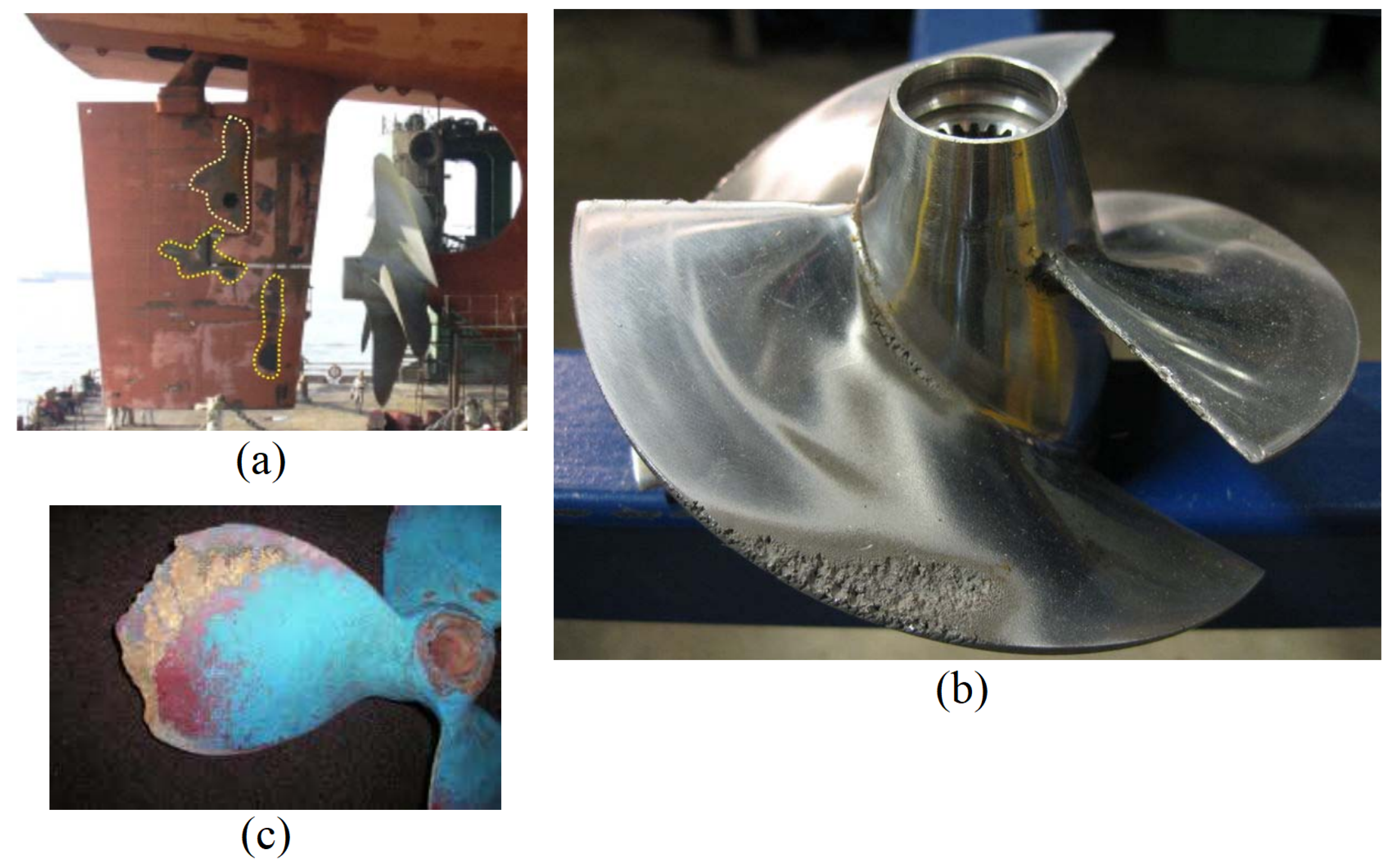
Figure 2.
Schematic view of mesoscale bio-inspired riblets which are employed on the suction side of a hydrofoil adjacent to the leading edge as a passive control method. Adapted from Ref. [87].
Figure 2.
Schematic view of mesoscale bio-inspired riblets which are employed on the suction side of a hydrofoil adjacent to the leading edge as a passive control method. Adapted from Ref. [87].
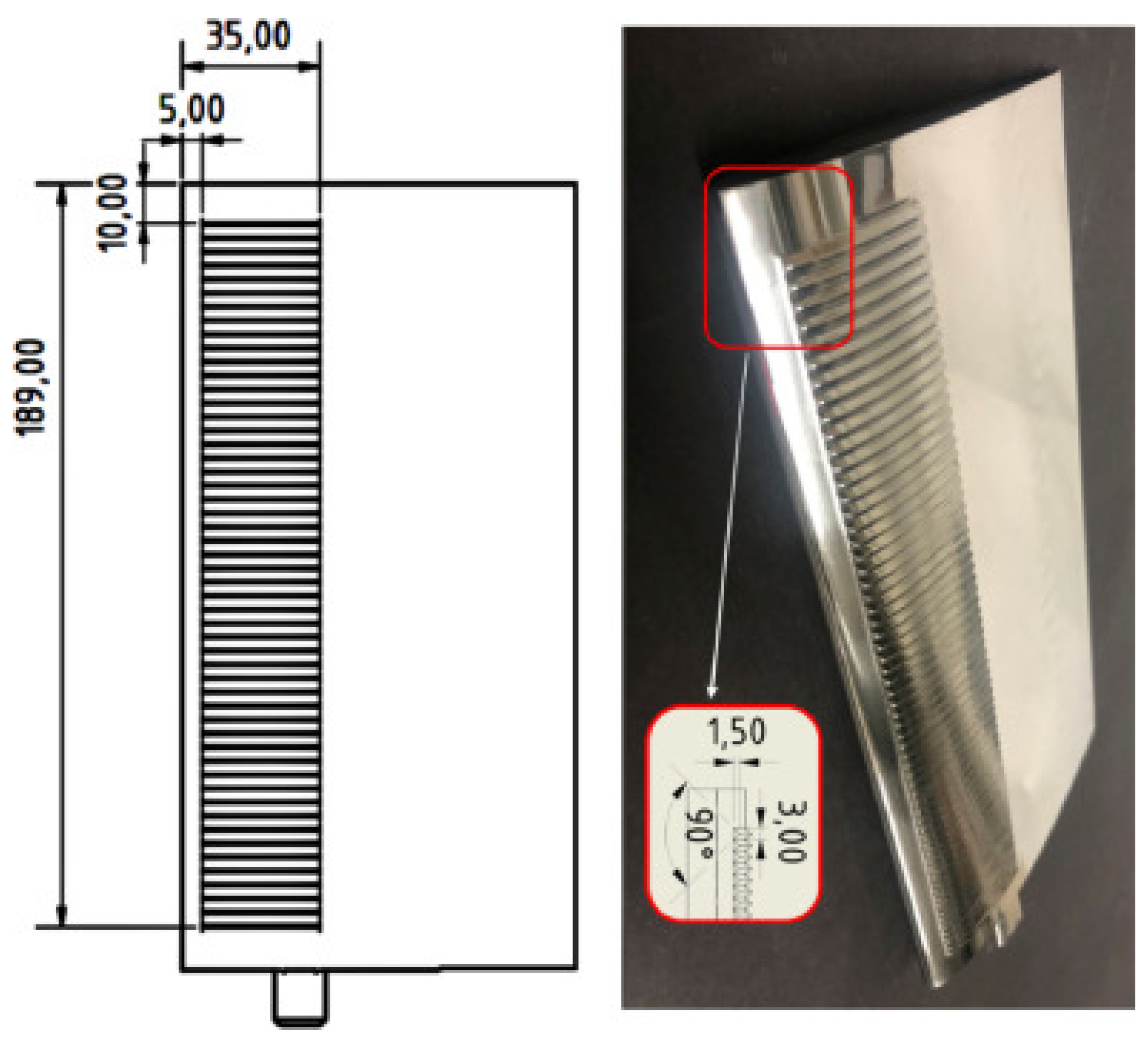
Figure 3.
Schematic view of a cylinder, 1) without cavitation control, 2) with vertical scalloped riblets cylinder and 3) with horizontal scalloped riblets. Adapted from Ref. [83].
Figure 3.
Schematic view of a cylinder, 1) without cavitation control, 2) with vertical scalloped riblets cylinder and 3) with horizontal scalloped riblets. Adapted from Ref. [83].
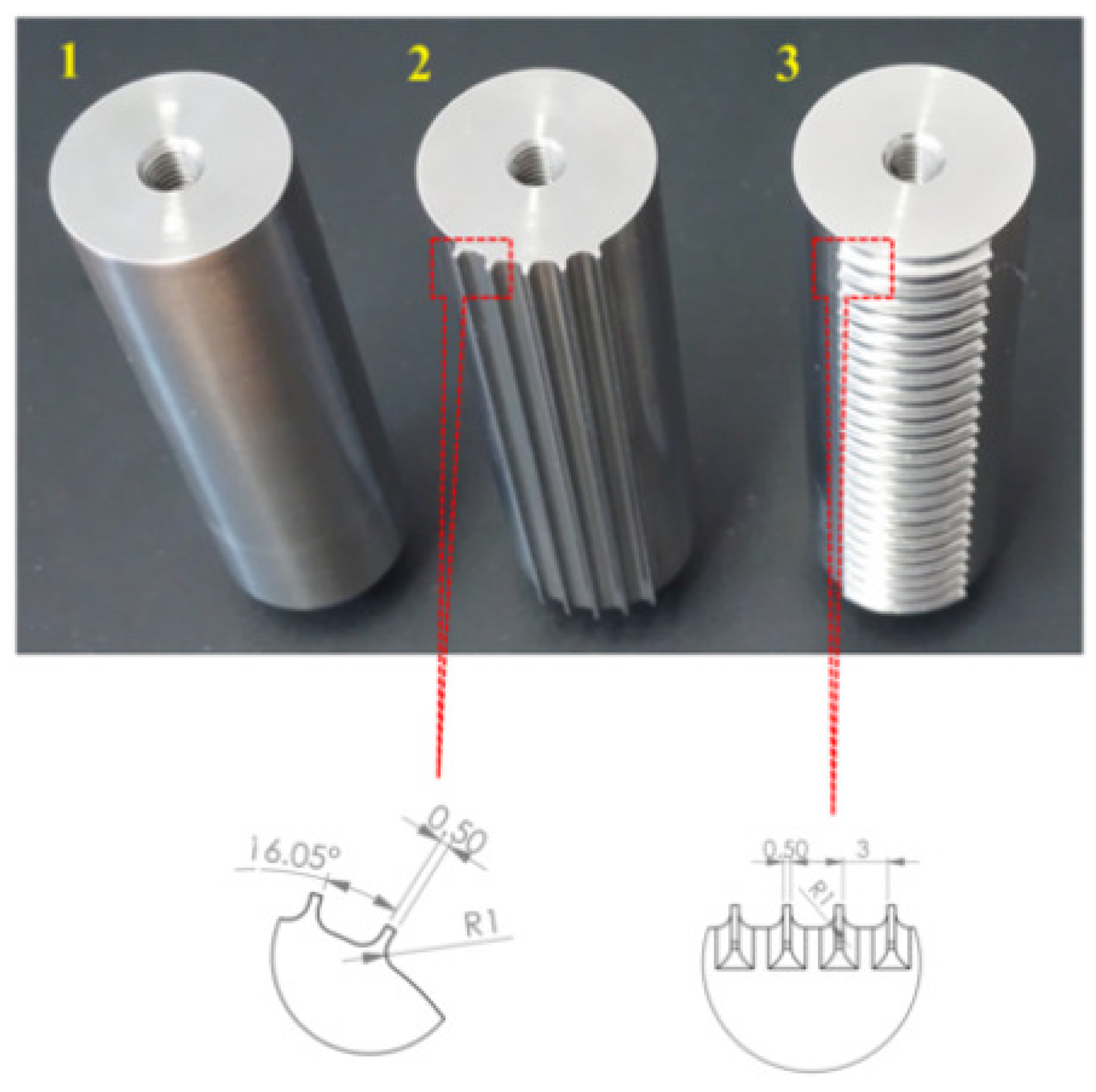
Figure 4.
Schematic view of a cylinder without control methods and with different surface morphologies as passive cavitation control methods. Visual appearance (top row), close-up view (middle row) and characteristic surface profiles (bottom row) of the (a) smooth cylinder, (b) rough cylinder and (c) finned cylinder. Adapted from Ref. [82].
Figure 4.
Schematic view of a cylinder without control methods and with different surface morphologies as passive cavitation control methods. Visual appearance (top row), close-up view (middle row) and characteristic surface profiles (bottom row) of the (a) smooth cylinder, (b) rough cylinder and (c) finned cylinder. Adapted from Ref. [82].
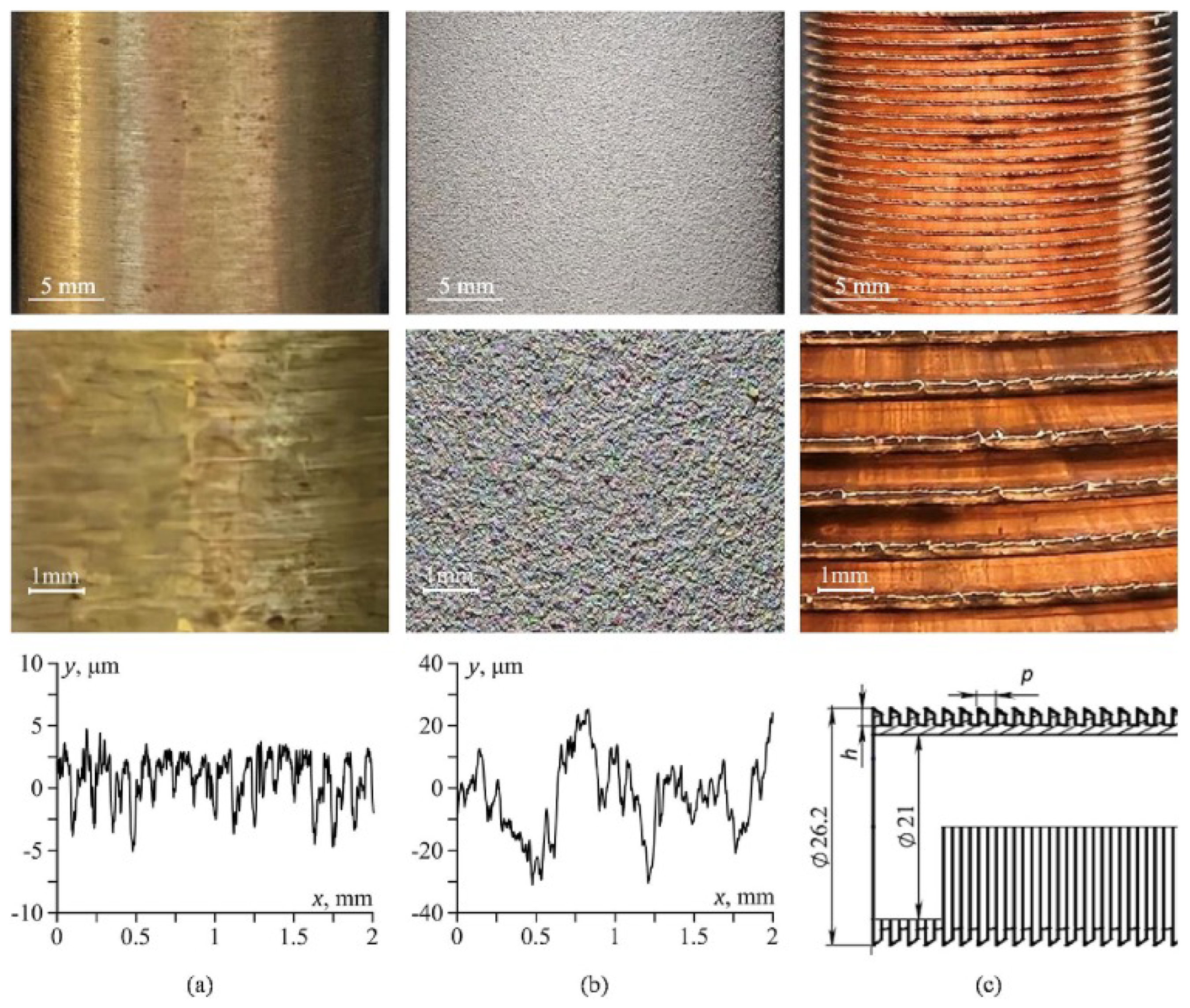
Figure 5.
Photographs of the cavitation dynamics on the surface and in the wake of the cylinders for three wall morphologies, (a) smooth; (b) rough and (c) finned. Adapted from Ref. [82].
Figure 5.
Photographs of the cavitation dynamics on the surface and in the wake of the cylinders for three wall morphologies, (a) smooth; (b) rough and (c) finned. Adapted from Ref. [82].
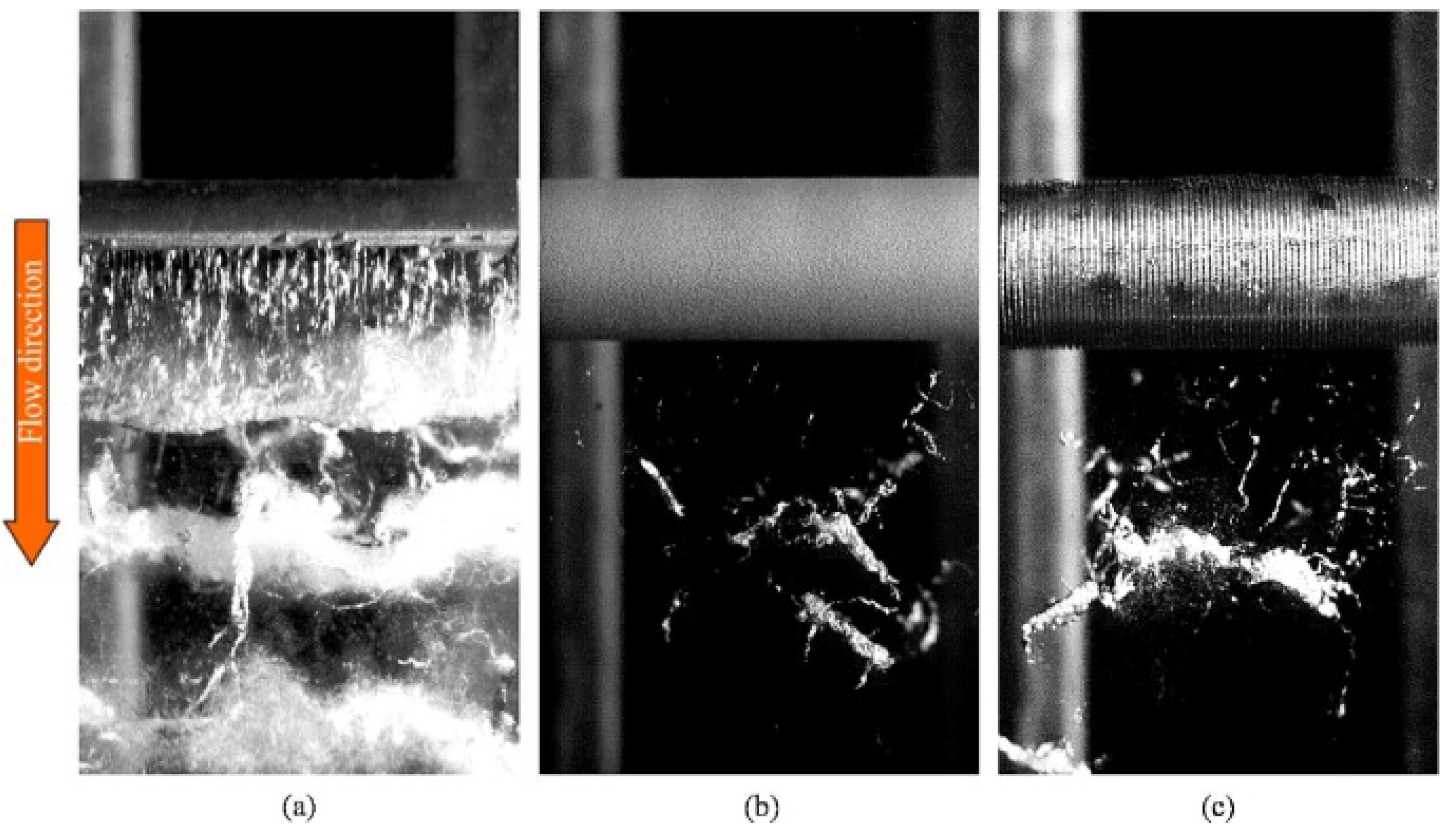
Figure 6.
Schematic view of a polished cylinder and laser-textured cylinders with various surface morphologies such as dimpled, velvet, oxidized, waved and grooved surface by using scanning electron microscope (SEM) and 3D optical Infinite-Focus Measuring (IFM) device. Adapted from Ref. [70].
Figure 6.
Schematic view of a polished cylinder and laser-textured cylinders with various surface morphologies such as dimpled, velvet, oxidized, waved and grooved surface by using scanning electron microscope (SEM) and 3D optical Infinite-Focus Measuring (IFM) device. Adapted from Ref. [70].
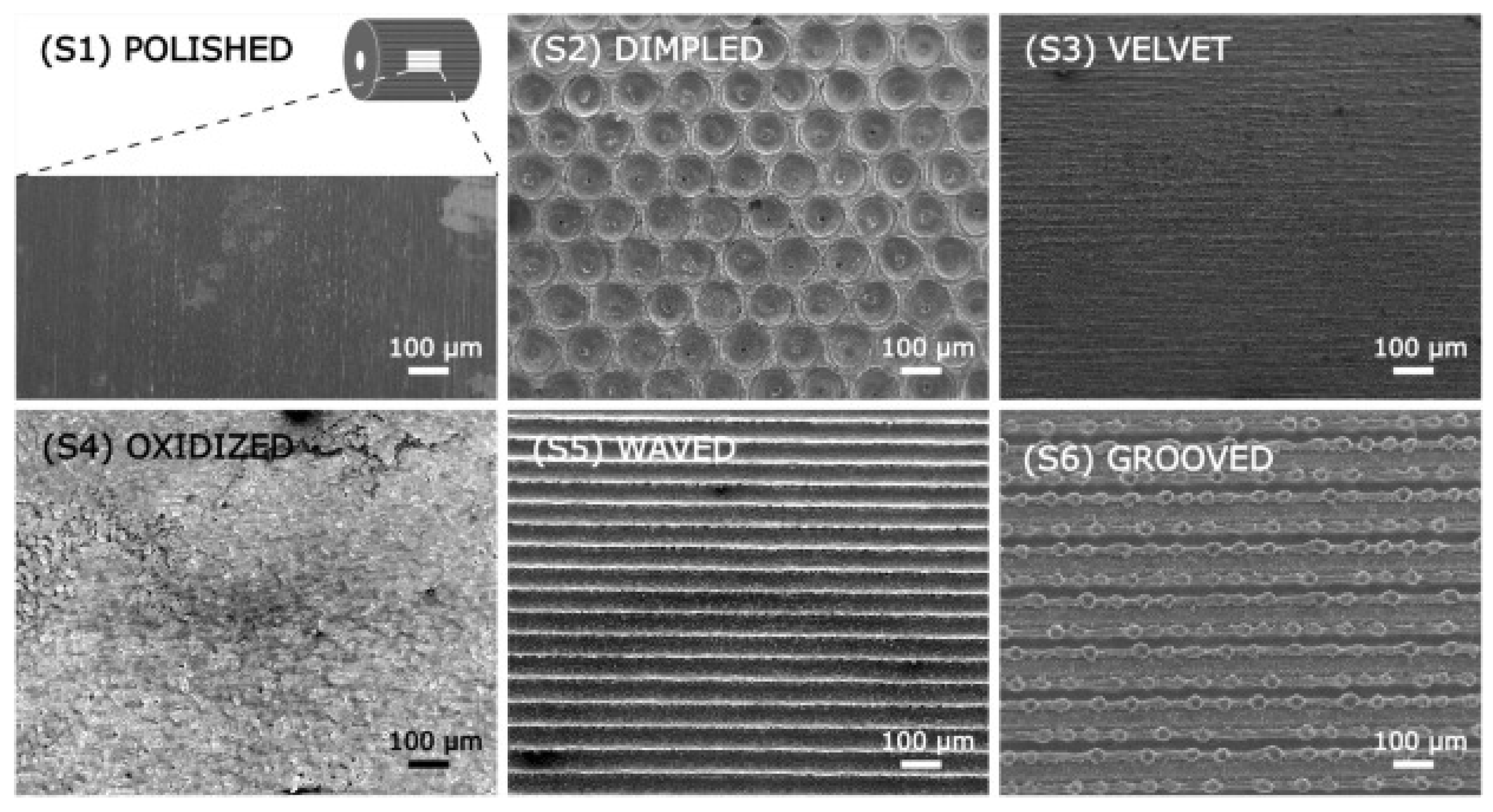
Figure 7.
Schematic view of a basic hydrofoil model (a) based on the NACA634–021 airfoil and bionic hydrofoils with a fin spine structure (b) and sinusoidal leading edge (c) and a combined hydrofoil model constructed by combining two single bionic structures with sinusoidal leading edge (d). Adapted from Ref. [49].
Figure 7.
Schematic view of a basic hydrofoil model (a) based on the NACA634–021 airfoil and bionic hydrofoils with a fin spine structure (b) and sinusoidal leading edge (c) and a combined hydrofoil model constructed by combining two single bionic structures with sinusoidal leading edge (d). Adapted from Ref. [49].
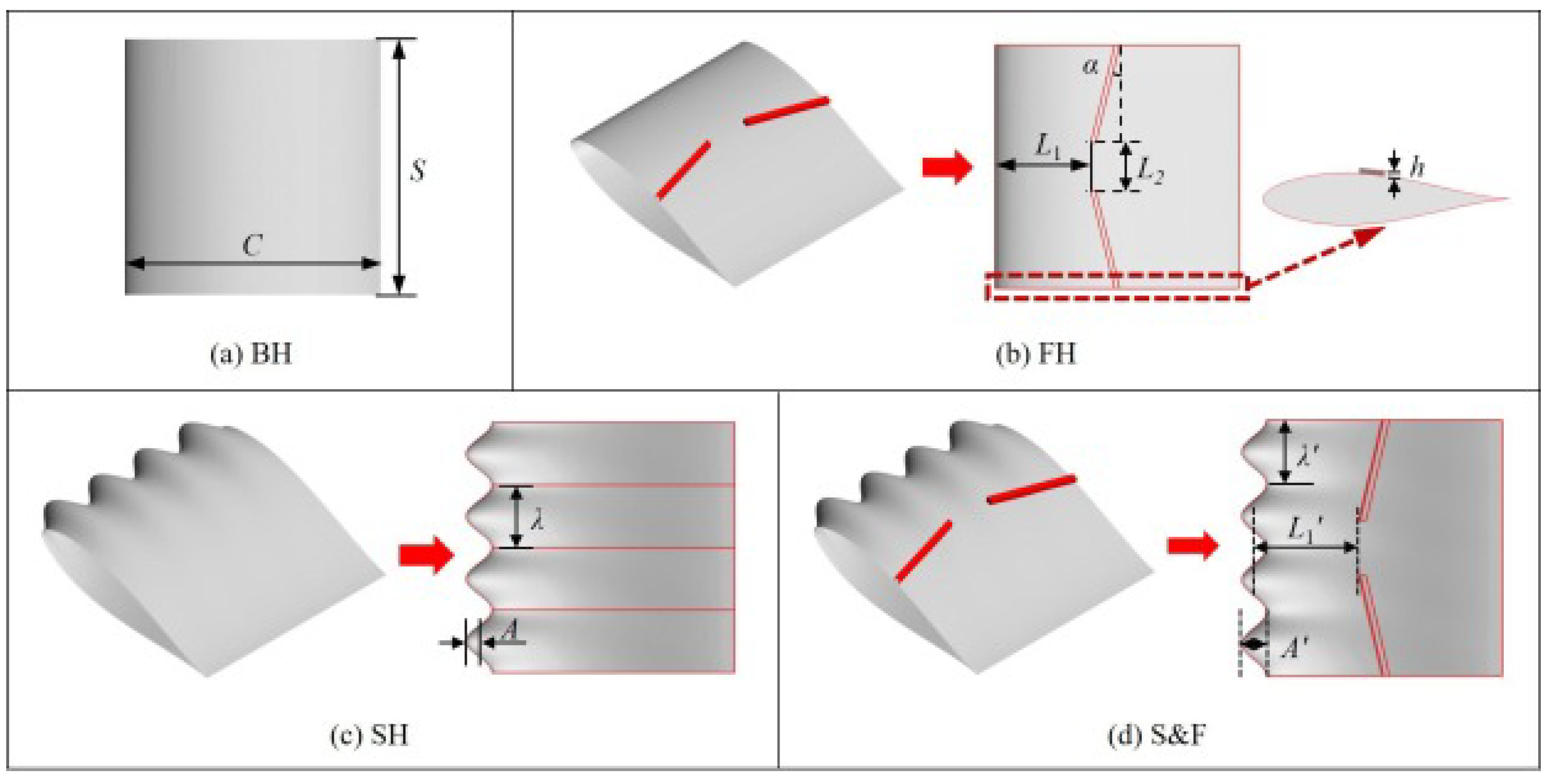
Figure 8.
Schematic view of a hydrofoil with water injection as an active cavitation control method. (a) Original hydrofoil without injection, (b) Modified hydrofoil with water injection, (c) Details of the jet hole distance, (d) Diameter of the jet hole and (e) Graphical interpretation for three variable parameters. Adapted from Ref. [113].
Figure 8.
Schematic view of a hydrofoil with water injection as an active cavitation control method. (a) Original hydrofoil without injection, (b) Modified hydrofoil with water injection, (c) Details of the jet hole distance, (d) Diameter of the jet hole and (e) Graphical interpretation for three variable parameters. Adapted from Ref. [113].
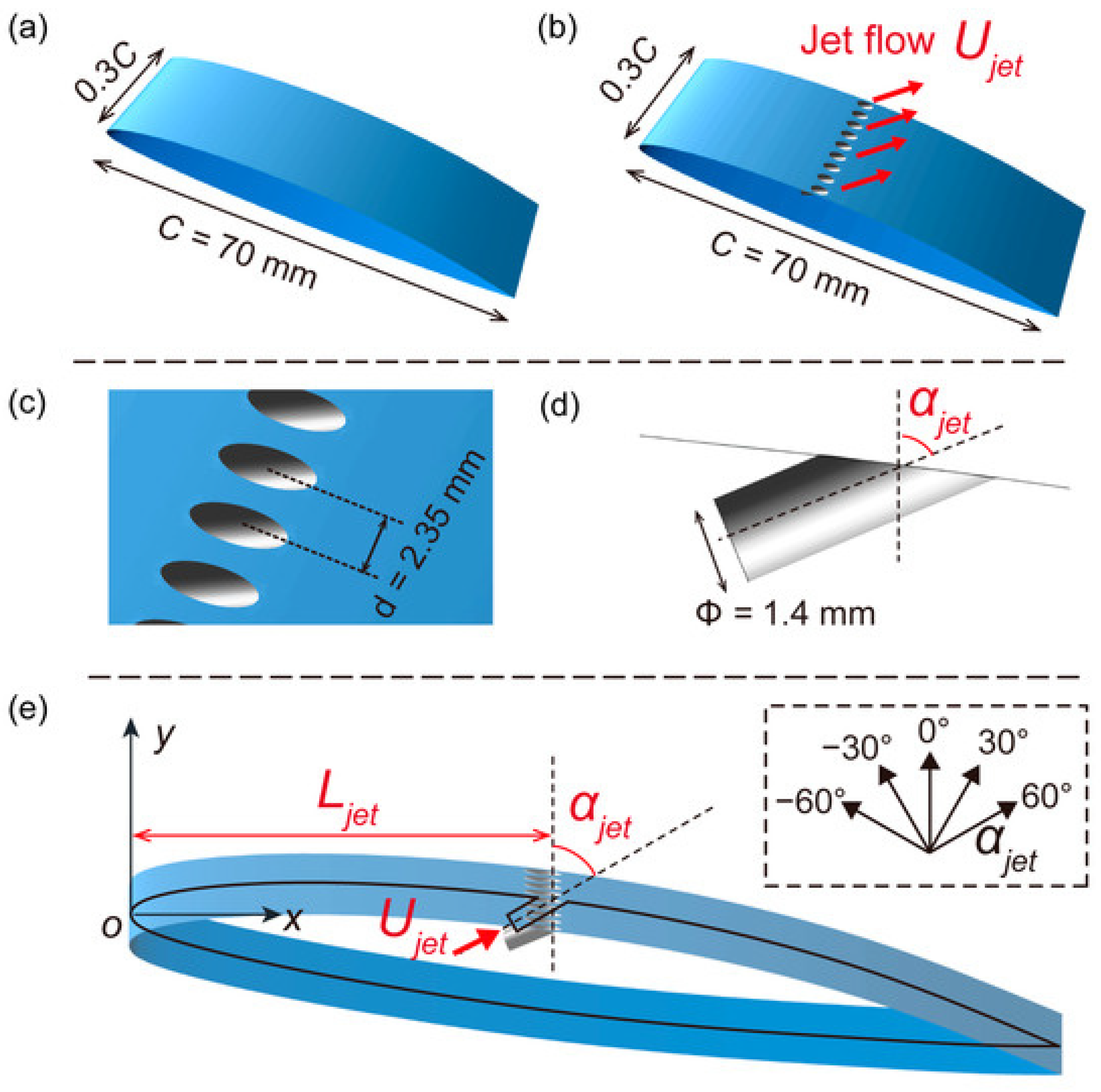
Figure 9.
Schematic view of a test section of an air injection as an active cavitation control method on a convergent–divergent channel. (a) A transducer mounting and ventilation slit and (b) test section and test model of convergent–divergent channel. Adapted from Ref. [98].
Figure 9.
Schematic view of a test section of an air injection as an active cavitation control method on a convergent–divergent channel. (a) A transducer mounting and ventilation slit and (b) test section and test model of convergent–divergent channel. Adapted from Ref. [98].
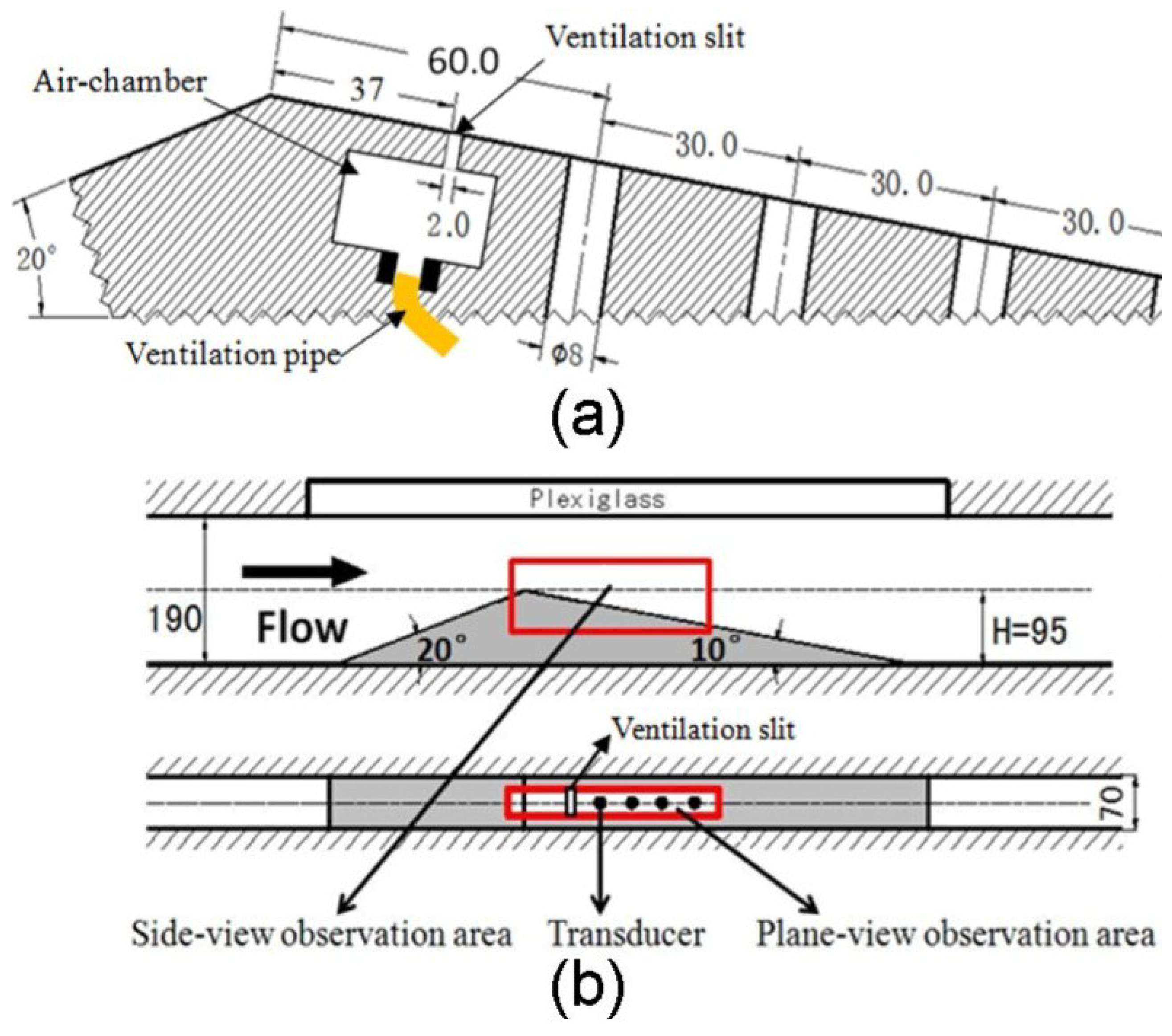
Figure 10.
Schematic view of a modified NACA66(MOD) hydrofoil with water injection as an active control method for control of the unsteady cavitation. Adapted from Ref. [104].
Figure 10.
Schematic view of a modified NACA66(MOD) hydrofoil with water injection as an active control method for control of the unsteady cavitation. Adapted from Ref. [104].
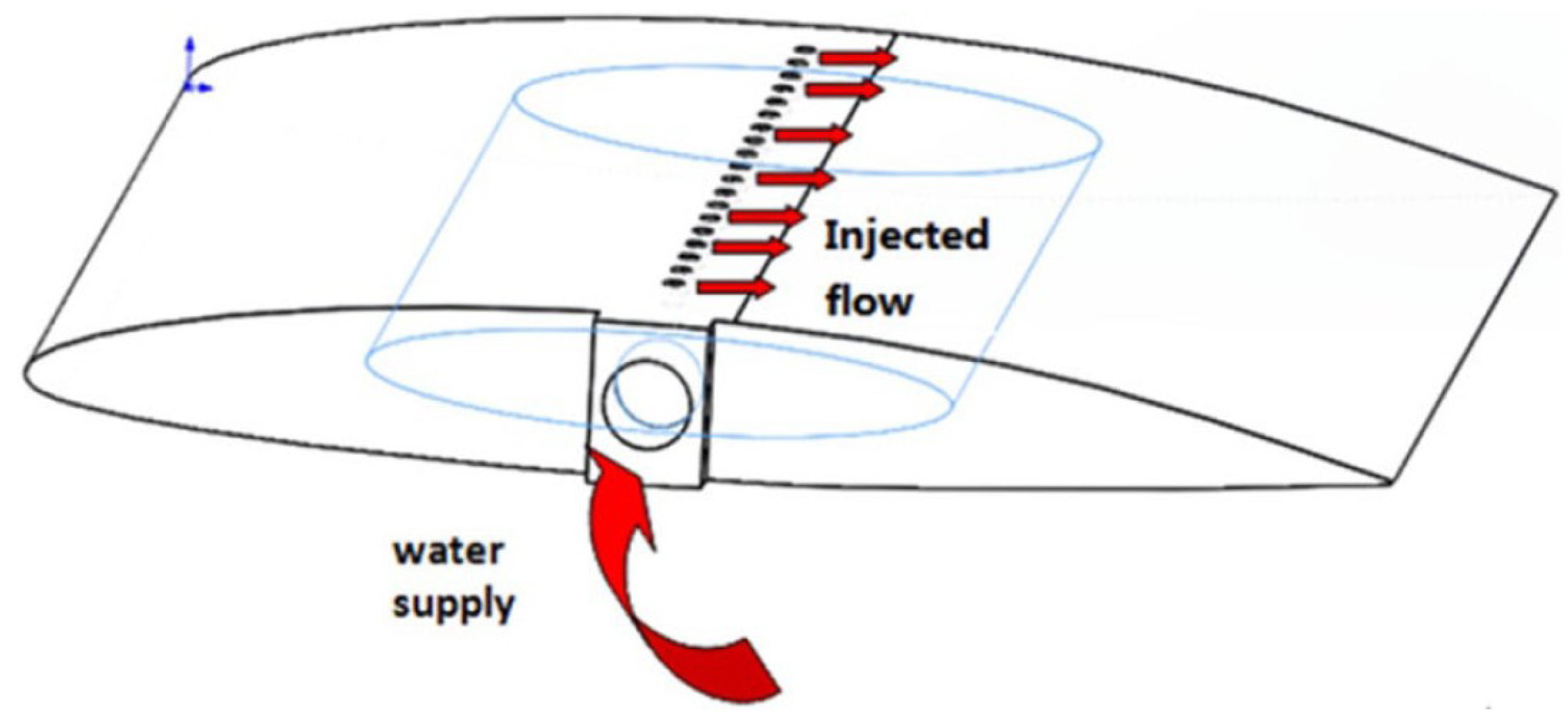
Disclaimer/Publisher’s Note: The statements, opinions and data contained in all publications are solely those of the individual author(s) and contributor(s) and not of MDPI and/or the editor(s). MDPI and/or the editor(s) disclaim responsibility for any injury to people or property resulting from any ideas, methods, instructions or products referred to in the content. |
© 2025 by the authors. Licensee MDPI, Basel, Switzerland. This article is an open access article distributed under the terms and conditions of the Creative Commons Attribution (CC BY) license (http://creativecommons.org/licenses/by/4.0/).
Copyright: This open access article is published under a Creative Commons CC BY 4.0 license, which permit the free download, distribution, and reuse, provided that the author and preprint are cited in any reuse.


