

Submitted:
13 August 2025
Posted:
14 August 2025
Read the latest preprint version here
Abstract
All deep-space probes seem to experience small anomalous acceleration. It is assumed that these anomalies arise from the anisotropic thermal radiation associated with radioisotope thermoelectric generators, however, with all anomalous behaviour considered, this may not be the best explanation. Here, an alternative and exact solution is proposed, in remarkable agreement with measurements. In addition, the solution provides an alternative explanation for the Schwarzschild radius of the observable universe and could potentially explain different cosmological anomalies.
Keywords:
gravity
; force
; graviton
; photon
1. Introduction
The analysis of motion of deep-space probes shows anomalous constant weak long-range acceleration [1] on the order of - m/s2 (deceleration relative to the Sun) for which no satisfactory explanation has been found initially. A solution has been proposed in the form of anisotropic thermal radiation [2] and it has even been shown eventually that that this could completely resolve the Pioneer anomaly [3]. However, while the anisotropic thermal radiation could certainly have a role, there are certain properties of these anomalies that cannot be explained by this radiation. One is the observed annual periodicity [4], and the other is the apparent onset of the anomaly [5] only once the giant planets have been reached [6], at least in case of the Pioneer anomaly. Here, an exact solution in the form of a massive photon is proposed, a solution compatible with the Schwarzschild radius of the observable universe.
2. The Hypothesis
Assume that the photon is propagating as an expanding spherical wave, with mass concentrated at the expanding sphere surface (spherical shell). As such, the photon is affected by the gravitational potential of the enclosed mass (with the assumption of homogeneous/isotropic distribution, per the shell theorem, the outer mass would have no net effect) - with the gravitational coupling proportional to photon mass. Therefore, its linear momentum is converting to angular momentum, and, upon reaching its range, the photon’s linear (radial) velocity becomes equal to zero. Effectively, thus, the photon is experiencing relatively constant negative radial acceleration (or, increasing curvature in the context of General Relativity). This acceleration is the equivalent of inverse free fall, and on a return trip (assuming the photon is not absorbed and falls back upon reaching the range) it would be equivalent to free fall. The negative radial acceleration of photons (or, more precisely, the blueshift due to increasing curvature) will then be misinterpreted as a decrease in velocity (Doppler shift) of the moving source of emission if the mass of the photon is assumed to be zero. But in reality, there is no change in velocity of the source, the frequency shift occurs because the photon paths are curved and curvature changes for each new photon emitted. Note that the reference frame of the observer of an photon with the range and radius on the order of the radius of the observable universe would effectively be near an event horizon, as the enclosed mass-energy/density forms a black hole for the photon (although the photon is localized with the absorption).
Thus, the source of anomalous acceleration detected in deep-space probes is here proposed to be the massive photon. With such photon, the onset (proper term here would be "inflation") of the anomaly at particular distance can be explained with mass oscillation, settling of photons in higher mass eigenstates.

The detected annual periodicity could then be explained by the motion of Earth about the Sun, as this is the place of photon absorption. Since the distance to the spacecraft is oscillating annually due to Earth’s motion, the maximal radius the photon can have before absorption is oscillating as well - hence the annual oscillation of the anomaly (this correlation, however, is not further analysed in this paper).
Note that the solution provided here also goes in favour of physical interpretation of the wave-function - the collapse of the wave-function is the collapse (localization) of the mass forming the propagating spherical waveform to the point of photon absorption.
It can be shown easily that, for a spatially flat expanding universe (where the observable radius is a Hubble radius), the observable radius is equal to the Schwarzschild radius of the total mass-energy inside the observable universe, which seems to be the case with our universe [7]. The solution presented here provides an alternative interpretation for the Schwarzschild radius, one that doesn’t require expanding universe (note, however, that the two interpretations are not mutually exclusive). If the enclosed mass grows exponentially with the expanding photon radius (dM/dr ≠ const.) - which is the case for a spherical photon and a large scale homogeneous/isotropic universe, at some point of the photon expansion the enclosed mass will effectively become a black hole for the photon, and as the photon radius becomes equal to the event horizon further expansion becomes impossible - this is the point where its radial velocity is completely converted to angular velocity.
Of course, on large distances (scales), the blueshift will be cancelled by the redshift due to universe’s expansion. The blueshift may also be negligible for the lowest mass eigenstates and may also be limited with the partial localization of photons, constraining their radii - which may be more likely for higher frequencies.
3. The Solution and Discussion
In established quantum physics photon is assumed to have zero rest mass, however, this doesn’t have to be the case in reality, and there are reasons to believe it is not. Localized photon mass in experiments is on the order of to kg [8]. This is usually interpreted as the upper limit on its rest mass. However, it can also be interpreted as the actual photon mass associated with particular photon scale and correlated density/pressure. If the photon has mass the electro-magnetic potential is a Yukawa potential and the photon also has a range, equal to the [reduced] Compton wavelength, i.e.:
where ℏ is the reduced Planck constant, c is the standard vacuum speed of light, and mp is photon mass. This range should be, obviously, equal or larger than the observable universe for cosmological photons, which translates to the upper limit on the order of ∼ kg. Others have calculated this mass, with the assumption of dS vacuum and a Ricci scalar of 4 (where is a positive cosmological constant), to be ≈2 × kg [9]. Using matter density and pressure of the Solar System (Sun magnetosphere) in the Ricci scalar instead, and a zero cosmological constant, one obtains photon mass of ≈2 × kg [9]. The author has obtained similar values in a different approach [10], where 3 mass eigenstates of the photon are hypothesized as well. In example, the mass of 6.335 × kg was obtained as the cosmological photon tau equivalent eigenstate, and 1.822 × kg as the lowest mass eigenstate. Using the higher mass, one obtains the radial acceleration:
c = standard vacuum speed of light = 2.99792458 × m/s
ℏ = reduced Planck constant = 1.054573 × Js
= tau photon mass = 6.335 × kg
which is in remarkable agreement with the observed Pioneer 10 anomaly of -8.09±0.20 × m/s2 [1]. Similarly, if one assumes a superposition (sum) of tau and muon photon eigenstates, one obtains:
= tau photon mass = 6.335 × kg
= muon photon mass = 3.767 × kg
which is in remarkable agreement with the observed Pioneer 11 anomaly of -8.56±0.15 × m/s2 [1]. The obtained results are also in agreement with the observed Galileo acceleration of -8±3 × m/s2 [1].
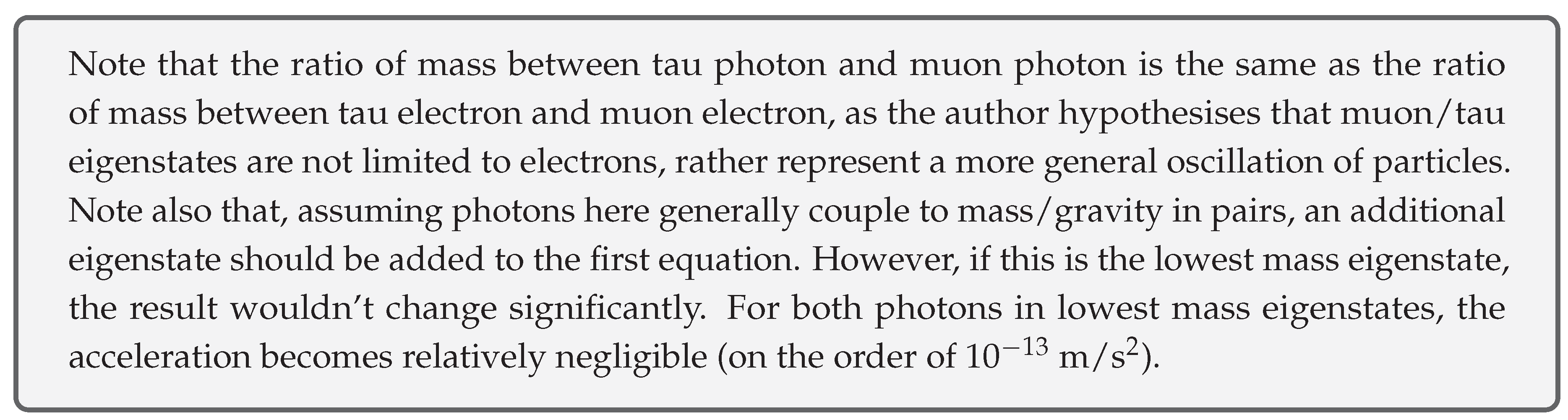
With different mass (coupling) configurations one could also obtain solutions in agreement with anomalies of other probes (e.g., detected Ulysses anomaly of 12±3 × m/s2 [1], New Horizons anomaly of 13.2±0.6 × m/s2 [11]). However, even though the results above suggest the anisotropy is likely to be negligible, anisotropy of thermal dissipation in the probes cannot be ruled out, especially since the detailed thermal modelling is in strong agreement with data.
In any case, at smaller distances gravitational coupling prevails, however, in an expanding universe, at larger distances the deceleration (blueshift) will be counteracted by the acceleration (redshift) due to the expansion. Therefore, if photons are generally propagating by the proposed mechanism, expansion of the universe may be underestimated, however, blueshift can also be limited by smaller mass eigenstates and partial localization of photons during propagation.
Note that the proposed mechanism of photon propagation can potentially explain some other anomalies. By the hypothesis, a photon emitted from an celestial object may be reflected back towards the original point of emission upon reaching the range. Since celestial objects are generally in motion, an observer receiving both direct light from the object and reflected light will observe two images of the same object at different points in time, which could then be interpreted as two different but highly correlated objects even if they appear far away from each other. This could explain, for example, the alignment of many quasar polarization vectors over extremely large regions of the sky - billions of light-years apart, even though the quasars are not gravitationally bound [12]. Another potential example is the Huge Large Quasar Group [13]. Here, part of the group may be formed by reflections, so the actually physical group is smaller. However, the examination of the plausibility of the proposed explanation for these particular cases is beyond the scope of this paper.
3.1. Is the Universe Contracting?
It has been hypothesized that the observed effect depends on the enclosed mass. If the enclosed mass is increasing with each photon emitted, a blueshift is produced. With constant energy density of space, the enclosed mass is increasing with each photon emitted if the source and absorber are moving apart. Thus, a blueshift is expected (although it will be counteracted with the redshift produced with motion of objects, or universe’s expansion).
Conversely, if the universe is contracting, without increasing energy density, the enclosed mass should be decreasing with each photon emitted. Thus, a redshift would be produced instead of blueshift, even for otherwise relatively stationary sources. If, however, the contraction of the universe dominates on larger scales (just like dark energy), on smaller scales, for two objects moving apart, a blueshift would be produced instead (the effect depends solely on eclosed mass and photon mass/range, so as long as the enclosed mass is increasing with each new photon a blueshift is produced).
Note that, since this is effectively a gravitational frequency shift, it includes other relativistic effects, such as time dilation. If one now assumes there is no partial localization of photons during propagation (affecting enclosed mass), the observed increasing redshift with distance in the observable universe may have been misinterpreted. Instead of expanding, the universe may be actually contracting.
4. Conclusions
It has been shown that anomalous acceleration of deep-space spacecraft can be fully explained with massive photons propagating by the proposed mechanism, which also provides an alternative interpretation for the Schwarzschild radius of the observable universe - without excluding the established one. Additionally, the solution could potentially explain anomalous cosmological correlation and some other cosmological anomalies. While the ideas presented here may be considered highly speculative from the perspective of established science, they are based on more comprehensive works of the author. Since the anomalies of deep-space probes can be explained by conventional physics, this solution may even be considered as unnecessary. However, the proposed solution can solve multiple problems, some of which are still unexplained. Furthermore, while the detailed thermal modelling can explain probe anomalies, it has not been done for all spacecraft and has not been experimentally verified. Experimental verification of proposed solutions is desirable, as any deviation from conventional physics could have large implications for cosmology, astrophysics and particle physics. A deep-space probe, for example, designed in such way to minimize or rule out anisotropic thermal dissipation could provide an unambiguous confirmation or refutation of alternative solutions, so it would be useful even in the case the solution proposed here doesn’t hold up to scrutiny.
References
- Indication, from Pioneer 10/11, Galileo, and Ulysses Data, of an Apparent Anomalous, Weak, Long-Range Acceleration (1998), J. D. Anderson et al., Phys. Rev. Lett. 81, 2858. [CrossRef]
- The constancy of the Pioneer anomalous acceleration (2007), Ø. Olsen, A&A 463, 393-397. [CrossRef]
- Support for the Thermal Origin of the Pioneer Anomaly (2012), S. G. Turyshev et al., Phys. Rev. Lett. 108(24), a 241101. [CrossRef]
- Study of the anomalous acceleration of Pioneer 10 and 11 (2002), J. D. Anderson et al., Phys. Rev. D 65(8), a 082004. [CrossRef]
- Using early data to illuminate the Pioneer anomaly (2005), M. M. Nieto and J. D. Anderson, Class. Quantum Grav. 22(24), a 5343. [CrossRef]
- New Horizons and the onset of the Pioneer anomaly (2008), M. M. Nieto, Physics Letters B 659(3), 483-485. [CrossRef]
- All objects and some questions (2023), C. H. Lineweaver and V. M. Patel, American Journal of Physics 91(10), 819-825. [CrossRef]
- Rest mass of photon on the surface of matter (2020), M. Goray et al., Results Phys. 16, 102866. [CrossRef]
- Photon mass as a probe to extra dimensions (2016), G. Alencar et al., Physics Letters B 759, 138-140. [CrossRef]
- Complete Relativity: Nature of Observables (2025), M. Ljubičić, [preprint]. [CrossRef]
- When leaving the Solar system: Dark matter makes a difference (2022), E. Belbruno and J. Green, Mon. Not. R. Astron. Soc. 510(4), 5154-5163. [CrossRef]
- Alignment of quasar polarizations with large-scale structure (2014), D. Hutsemékers et al., Astronomy and Astrophysics 572, A18. [CrossRef]
- A structure in the early Universe at z ∼ 1.3 that exceeds the homogeneity scale of the R-W concordance cosmology (2013), R. G. Clowes et al., Mon. Not. R. Astron. Soc. 429(4), 2910–2916. [CrossRef]
Disclaimer/Publisher’s Note: The statements, opinions and data contained in all publications are solely those of the individual author(s) and contributor(s) and not of MDPI and/or the editor(s). MDPI and/or the editor(s) disclaim responsibility for any injury to people or property resulting from any ideas, methods, instructions or products referred to in the content. |
© 2025 by the authors. Licensee MDPI, Basel, Switzerland. This article is an open access article distributed under the terms and conditions of the Creative Commons Attribution (CC BY) license (http://creativecommons.org/licenses/by/4.0/).
Copyright: This open access article is published under a Creative Commons CC BY 4.0 license, which permit the free download, distribution, and reuse, provided that the author and preprint are cited in any reuse.