

Submitted:
13 August 2025
Posted:
14 August 2025
You are already at the latest version
Abstract
Carbon dioxide (CO₂), the primary anthropogenic greenhouse gas, drives significant and potentially irreversible impacts on ecosystems, biodiversity, and human health. Achieving the Paris Agreement target of limiting global warming to well below 2 °C ideally 1.5 °C requires rapid and substantial global emission reductions. While recent decades have seen advances in clean energy technologies, carbon capture, utilization, and storage (CCUS) remain essential for deep decarbonization. Despite proven technical readiness, large-scale carbon capture and storage (CCS) deployment has lagged initial targets. This review evaluates CCS technologies and their contributions to net-zero objectives, with emphasis on sector-specific applications. We found that, in the iron and steel industry, post-combustion CCS and oxy-combustion demonstrate potential to achieve the highest CO₂ capture efficiencies, whereas cement decarbonization is best supported by oxy-fuel combustion, calcium looping, and emerging direct capture methods. For petrochemical and refining operations, oxy-combustion, post-combustion, and chemical looping offer effective process integration and energy efficiency gains. Direct air capture (DAC) stands out for its siting flexibility, low land-use conflict, and ability to remove atmospheric CO₂, but it’s hindered by high costs (~$100–$1,000 /t CO₂). Conversely, post-combustion capture is more cost-effective (~$47–$76 /t CO₂) and compatible with existing infrastructure. CCUS could deliver ~8% of required emission reductions for net-zero by 2050, equivalent to ~6 Gt CO₂ annually. Scaling deployment will require overcoming challenges through material innovations aided by artificial intelligence (AI) and machine learning, improving capture efficiency, integrating CCS with renewable hybrid systems, and establishing strong, coordinated policy frameworks.
Keywords:
Carbon capture technologies
; net zero emissions
; decarbonization
; low carbon energy
; Artificial Intelligence
; climate change mitigation
1. Introduction
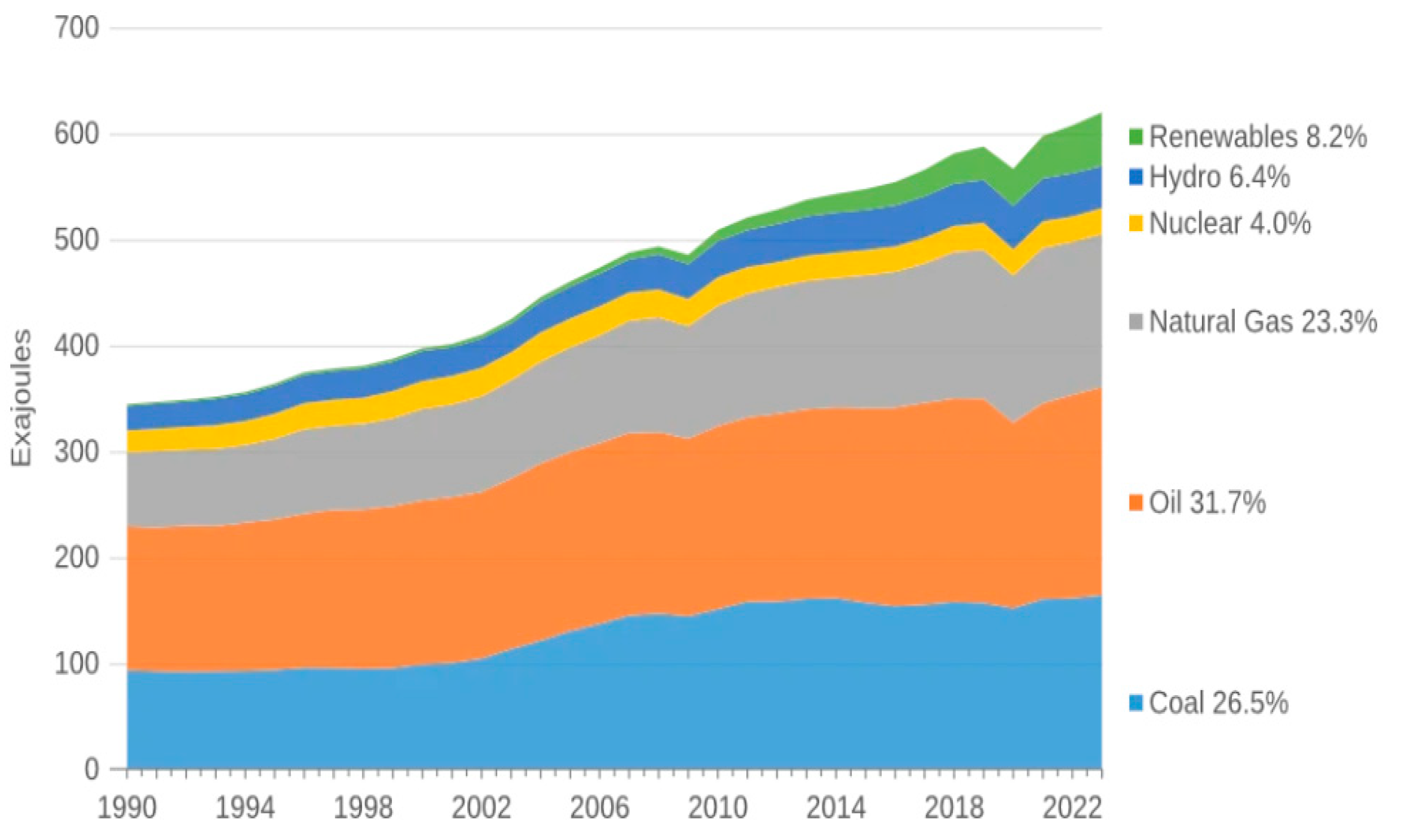
The growing global population continuously drives higher energy demand and consumption. The 2024 Statistical Review of World Energy by the Energy Institute showed in Figure [1] indicates that fossil fuels including coal, oil, and natural gas still dominate energy production and use worldwide. Global consumption of fossil fuels hit a new peak of 505 exajoules (EJ), increasing by 1.5%, with coal rising by 1.6%, oil growing by 2% surpassing 100 million barrels per day for the first time, while natural gas consumption remained steady. Fossil fuels accounted for 81.5% of total primary energy supply, a slight decline from 81.9% in the previous year. Meanwhile, energy-related emissions grew by 2%, surpassing 40 gigatonnes of CO₂ for the first time. CO₂, a principal greenhouse gas mainly emitted from burning fossil fuels, has increased sixfold since 1950 due to human activities [2].
Figure 1.
The Energy Institute’s 2024 Statistical Review of World Energy global energy consumption [1].
Figure 1.
The Energy Institute’s 2024 Statistical Review of World Energy global energy consumption [1].
The continuous burning of fossil fuels has led to significant increases in CO₂ emissions in the atmosphere, as illustrated in Figure 2. Elevated CO₂ concentrations contribute to serious environmental issues, including global warming, acid rain, degradation of ecosystems, and deforestation. According to projections by the Intergovernmental Panel on Climate Change (IPCC), if greenhouse gas emissions such as CO₂ are not actively reduced, the average global surface temperature could rise between 1.8 °C and 4.0 °C this century, potentially reaching as high as 6.4 °C under the most severe scenario [3].
Climate change represents one of the most significant anthropogenic threats faced globally, profoundly impacting political, social, and economic systems. The challenges posed are multifaceted and severe, involving substantial risks, economic uncertainties, contested scientific findings, complex governance issues, and profound psychological and societal effects. These impacts extend beyond environmental domains, influencing various interconnected sectors. Effective public health strategies and policy interventions are essential to address current and future pollution and climate-related challenges. The critical question remains whether responses should prioritize mitigation by reducing carbon emissions from economic activities or adaptation to the inevitable consequences of climate change [5].
The influence of climate change on meteorological patterns and environmental phenomena is extensively documented [5]. It disrupts established climate regimes, leading to more frequent and intense extreme weather events, such as heatwaves, rising sea levels, altered precipitation cycles, cold spells, heavy rainfall, floods, storms, droughts, snowstorms, tropical cyclones and changes in oceanic patterns including sea level rise and freshwater inflows [6,7]. These extreme events produce severe, interconnected consequences, contributing to increased mortality, injuries, and outbreaks of infectious diseases [5]. Climate change impacts manifest both directly, through events like heatwaves and storms, and indirectly, via ecosystem alterations that reduce agricultural productivity, exacerbate food insecurity and malnutrition, degrade air quality, and modify disease transmission patterns. Socioeconomic repercussions include population displacement, migration, mental health disorders, and conflicts [8]. Additional consequences include rising ocean temperatures and acidification, pollution of air and water resources, and increased incidence of wildfires [9].
Robust scientific evidence attributes numerous changes in the Earth’s climate system to human-induced greenhouse gas (GHG) emissions. Since the onset of the Industrial Revolution in 1760, atmospheric GHG concentrations have steadily increased, primarily due to fossil fuel combustion, industrial activities, deforestation, and agriculture [10]. Elevated levels of CO₂ and other GHGs have already triggered higher global temperatures, intensified floods and droughts, and increased the frequency and severity of tornadoes and tropical storms. If the persistent rise in atmospheric CO₂ is not curtailed, it risks crossing critical thresholds leading to catastrophic events such as drastic changes in ocean circulation, accelerated sea-level rise, and the melting of glaciers and polar ice caps, with dire consequences for humanity [10].
Therefore, reducing CO₂ emissions alongside the implementation of carbon capture and sequestration technologies is essential for climate change mitigation. Such efforts can limit detrimental effects like sea-level rise, extreme weather events, and ecological disruptions. Moreover, decreasing carbon emissions improves air quality, thereby enhancing public health outcomes and contributing to socio-economic stability.
Carbon capture, utilization, and storage (CCUS) encompasses the process of capturing carbon dioxide (CO₂) emissions from large stationary sources like power generation plants and industrial installations. The captured CO₂ is then transported commonly through pipelines, ships, or trucks to specific storage locations, where it is securely injected into deep geological formations underground, ensuring long-term containment and preventing atmospheric release. The fundamental concept behind CCS is to intercept CO₂ produced during fossil fuel combustion before atmospheric emission occurs. A key challenge is the management of the captured CO₂, with prevailing strategies focusing on deep geological injection, effectively creating a "closed carbon loop" where carbon extracted as fossil fuels is ultimately returned underground in gaseous form. Currently, CCS operations sequester approximately 45 million tonnes of CO₂ annually, equivalent to emissions from around 10 million passenger vehicles. Capture predominantly occurs at large, fixed emission sources such as power generation plants and industrial producers of cement, steel, and chemicals. Most existing CCS projects employ liquid solvents to chemically absorb CO₂ prior to its release from smokestacks, although novel capture technologies are under active development [11].
CCS technologies facilitate substantial reductions in gross CO₂ emissions and form a critical basis for carbon dioxide removal (CDR) methods. These methods enable the compensation of both historic and residual emissions by achieving net removal of CO₂ from the atmosphere. Natural carbon sinks alone are insufficient to offset residual emissions, necessitating engineered solutions such as bioenergy combined with CCS (BECCS), which captures CO₂ from biomass-derived processes, and direct air capture (DAC) or ocean-based direct capture technologies. CDR approaches are frequently characterized as “negative emissions” or “climate-positive” strategies. Robust analyses of pathways toward net-zero emissions underscore the importance of deploying a diverse suite of technologies. Both CCS and CDR are integral to achieving net-zero targets, complementing other sustainable measures within a coordinated global decarbonization framework by mid-century [12].
Figure 3 presents a simplified depiction of the Carbon Capture and Storage (CCS) process, outlining the entire sequence of CO₂ handling from its initial release at emission points to its secure, long-term sequestration in subterranean geological formations.
The CCS process begins with the generation of CO₂ from diverse sources such as industrial process emissions, fossil fuel combustion, and biogenic origins like biomass. These sources constitute significant contributors to human-induced CO₂ emissions and are primary targets for capture within climate mitigation frameworks.
CO₂ capture occurs at industrial or power generation facilities using various technologies, including membrane separation, chemical absorption and cryogenic techniques. The objective is to separate and compress CO₂ to enable efficient transportation to storage sites. Chemical absorption, often employing aqueous amine solvents, has been extensively used for CO₂ removal from natural gas and forms the basis for commercial post-combustion capture plants such as the Boundary Dam [13,14] and Petra Nova facilities [15,16]. Commercially available membrane technologies, like the Polaris membrane, have been successfully applied to CO₂ separation from syngas [17]. Additionally, Air Products licenses a polymeric membrane developed at the Norwegian University of Science and Technology (NTNU), applicable to coal-fired plants and other combustion sources [18].
Captured CO₂ is transported through pipelines, ships, trucks, or trains. Pipelines are the preferred transport mode for large-scale operations due to their cost efficiency and reliability, while shipping and other land transport methods are employed where pipelines are impractical or for smaller projects. Globally, there are over 6,500 km of CO₂ pipelines, mainly supporting CO₂-enhanced oil recovery (EOR) operations in the United States [19]. Ship-based CO₂ transport technologies are also well developed and operational in commercial settings [20].
The final stage involves injecting CO₂ into geological formations onshore or offshore for long-term sequestration. Suitable storage reservoirs include depleted oil and gas fields and deep saline aquifers, capable of securely retaining CO₂ for millennia and preventing atmospheric release. CCS thus plays a crucial role in reducing emissions from sectors that are challenging to decarbonize. Presently, CO₂-EOR is integrated into 13 of the 17 active commercial CCS projects. Saline aquifers are also utilized for storage in notable projects such as Sleipner, Snohvit, and Quest. Conversely, enhanced gas recovery (EGR) [21] and CO₂ storage in depleted oil and gas fields have yet to be demonstrated at commercial scale. Alternative storage methods, including oceanic and mineral storage, remain in early development phases.
Several facilities currently utilize captured CO₂ for various industrial applications, primarily within the food and beverage sector, as well as in chemical manufacturing processes such as urea and methanol production [22]. For example, mineral carbonation is being pursued at the Searles Valley facility in the United States, while in Saga City, Japan, CO₂ recovered from waste incineration is repurposed to enhance the growth of crops and algae [23]. Most of the CO₂ used in these projects originates from industrial sources including fertilizer, ammonia, and ethylene glycol plants, though some initiatives also capture CO₂ directly from power plant flue gases [22].
Despite extensive research on CCS technologies, there remains a significant gap in comprehensive analyses that combine techno-economic assessments with sector-specific applications to optimize CCS deployment across diverse industries. Furthermore, challenges associated with integrating CCS alongside renewable energy and negative emissions technologies such as BECCS are underexplored, particularly regarding cost, scalability, and supportive policy frameworks. Additionally, more in-depth investigations are needed into real-world case studies that assess the long-term performance, safety, and economic viability of CCS projects across various geographic and industrial contexts.
Nevertheless, CCS represents a complex but essential suite of technologies that, when effectively integrated, can play a pivotal role in achieving global net-zero emission targets and mitigating the adverse impacts of climate change.
This manuscript presents a thorough analysis of Carbon Capture and Storage (CCS) technologies, emphasizing their critical contribution to global decarbonization initiatives. It reviews recent technological advancements spanning the entire CCS value chain, from CO₂ capture at various emission sources to transportation logistics and secure long-term geological storage. Through detailed case studies, the manuscript evaluates real-world applications, highlighting cost estimates and economic feasibility across different CCS technologies. It also addresses the technical, financial, and policy challenges limiting widespread adoption, while showcasing innovative approaches and emerging trends aimed at improving CCS efficiency, safety, and scalability. Additionally, the integration of CCS with complementary low-carbon hydrogen and renewables such as wind, solar, geothermal biofuel production and negative emissions technologies like bioenergy with carbon capture and storage (BECCS) is examined to assess CCS’s potential role in achieving net-zero emissions and mitigating climate change.
This manuscript contributes to the growing body of literature on climate change mitigation by providing a comprehensive and interdisciplinary analysis of Carbon Capture and Storage (CCS) technologies, with a particular emphasis on cost evaluation, performance, and deployment feasibility. It systematically compares various CCS approaches, including post-combustion, pre-combustion, oxy-fuel combustion, and direct air capture (DAC), highlighting their cost ranges, technological maturity, energy requirements, and integration potential. The manuscript further discusses the role of CCS within specific industrial sectors: post-combustion CCS and oxy-combustion exhibit the highest CO₂ capture efficiency in the iron and steel industry, while cement production can be best decarbonized by oxy-fuel combustion, calcium looping and emerging direct capture technologies to address process-related emissions. In the petrochemical and refining sectors, oxy-combustion, post-combustion, and chemical looping combustion could provide effective pathways for process integration and improved energy efficiency, illustrating the need for tailored CCS applications to sector-specific decarbonization challenges.
Through detailed case studies, the economic viability of each method is critically assessed, identifying post-combustion capture as a relatively cost-effective solution for retrofitting existing power plants, while acknowledging that DAC, despite currently higher costs, shows potential for cost reduction through innovation and scaling. The analysis also evaluates technical advantages and limitations, such as the operational complexity associated with oxy-fuel combustion and the infrastructural demands of pre-combustion systems. Additionally, the study explores synergies between CCS and low-carbon energy systems, including renewables and negative emissions technologies like BECCS, offering a holistic view of CCS’s potential role within broader decarbonization pathways. The manuscript also outlines the technological, policy, and investment challenges that must be addressed to accelerate widespread CCS adoption. By integrating techno-economic assessments with policy and system-level considerations, it provides actionable insights to inform strategic decision-making for large-scale CCS deployment and long-term climate policy development.
2. Carbon Capture Technologies
2.1. Pre-Combustion Capture
Pre-combustion carbon capture primarily targets removing CO₂ from fossil or biomass fuels before they are combusted for energy production. This approach is commonly utilized during the gasification of coal, natural gas, or biomass to generate synthesis gas (syngas), as well as in natural gas-fired power plants [24]. In a standard pre-combustion capture process, the fuel is gasified to produce syngas composed primarily of hydrogen, carbon monoxide, and carbon dioxide. The CO₂ is then separated from the syngas prior to its use in driving turbine generators for electricity generation [25].
To facilitate this, the syngas undergoes a water-gas-shift (WGS) reaction, which converts carbon monoxide into additional CO₂ while producing more hydrogen. This reaction increases the concentration of CO₂, thereby enhancing the efficiency of the capture process. The overall sequence is illustrated in Figure 4. Post-combustion capture technologies generally fall into four categories: solvent-based, sorbent-based, membrane-based, and emerging novel methods [24].
Pre-combustion CO₂ capture is a core component of Integrated Gasification Combined Cycle (IGCC) plants, which support low-carbon electricity and hydrogen production (as depicted in Figure 2). This approach converts fossil fuels or biomass into syngas, enabling key chemical processes to separate CO₂ before combustion, which improves capture efficiency and facilitates integration with existing energy and industrial infrastructures [26].
Pre-combustion CO₂ capture is generally regarded as an environmentally sustainable and energy-efficient approach. It converts carbon-based fuels into hydrogen through gasification, producing water rather than CO₂ upon combustion, and avoids emissions of pollutants like sulfur oxides (SOx) that are typical in conventional fossil fuel combustion [27]. Despite its complexity and higher costs compared to other capture methods, the elevated pressure (2–7 MPa) and CO₂ concentration (15%–60%) in the gas stream reduce the energy required for CO₂ separation and compression relative to alternative technologies [28].
This method offers technical benefits, including high capture efficiency and comparatively favorable capital expenditure. However, its widespread adoption faces obstacles such as significant energy consumption, challenges in integration with existing systems, substantial capital and operational expenses, and the need for enabling policy frameworks and infrastructure development. Consequently, pre-combustion capture is predominantly suited for newly constructed Integrated Gasification Combined Cycle (IGCC) facilities in regions with robust carbon pricing mechanisms and supportive infrastructure [29]. Its application in retrofitting existing power plants is limited due to the complexity of the process. The use of gasifiers entails high costs and can reduce overall plant efficiency, highlighting key limitations of this technology [30].
2.2. Post-Combustion Capture
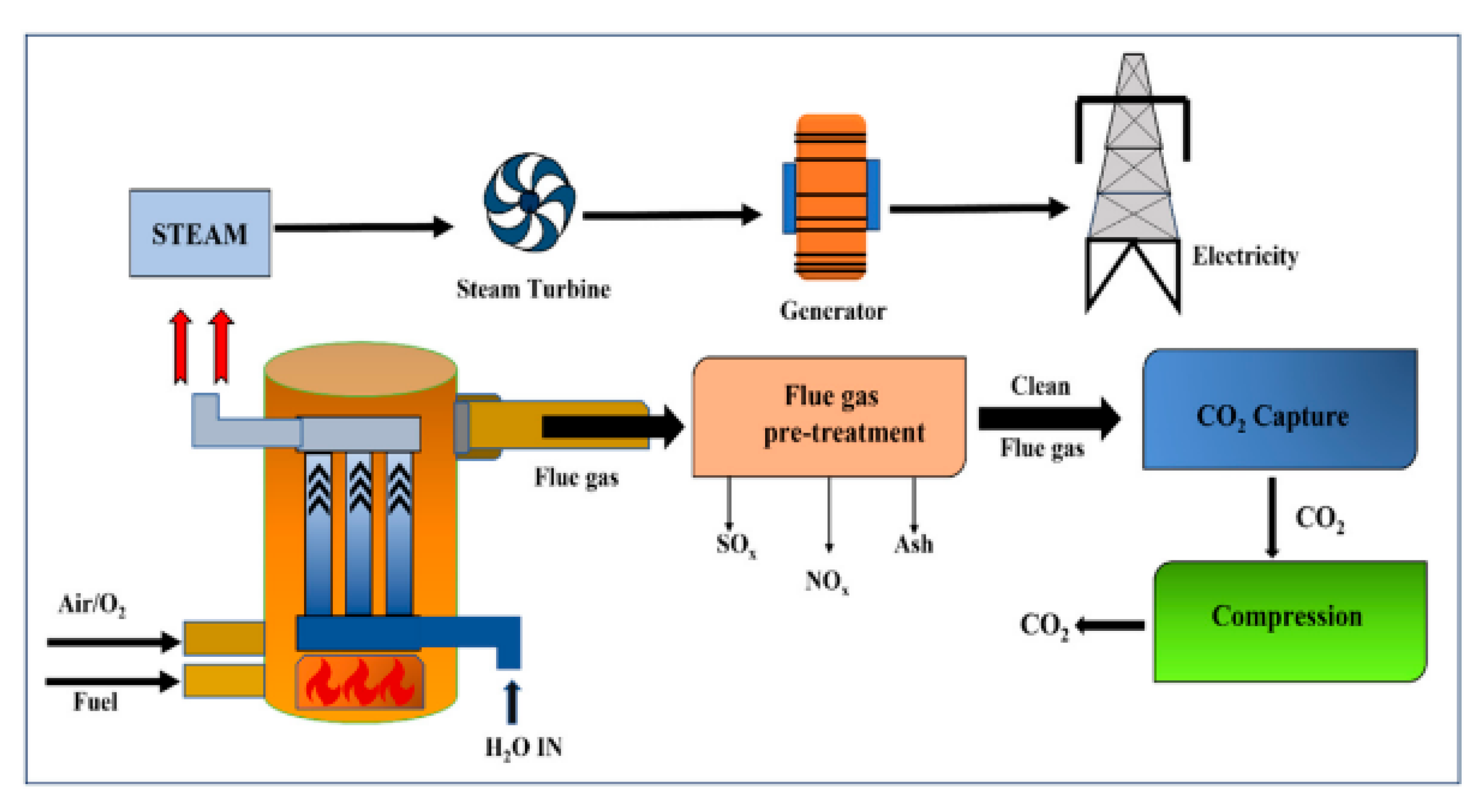
Post-combustion CO₂ capture is a well-established method widely employed in power plants that generate electricity or heat by burning fossil fuels such as coal, natural gas, or oil, while simultaneously reducing CO₂ emissions. During combustion, hot flue gas is produced containing approximately 3–20% CO₂ by volume (partial pressure ~0.03–0.20 bar) at temperatures exceeding 400 °C [31]. This flue gas is initially cooled using heat exchangers or cooling towers to create optimal conditions for efficient CO₂ capture. As illustrated in Figure 5, the removal of CO₂ from the flue gas predominantly involves adsorption, absorption, and membrane separation techniques [32]. The captured CO₂ is subsequently compressed and conveyed through pipelines, ships, or trucks to specific storage locations. Meanwhile, the steam produced during the process is utilized to power turbines for electricity generation. Coal combustion also generates multiple pollutants, including fly ash, hazardous gases, trace elements like mercury (Hg), sulfur oxides (SOx), nitrogen oxides (NOx), and non-condensable gases such as oxygen (O₂). Effective removal of these pollutants is essential before releasing the flue gas into the atmosphere to comply with environmental protection standards [33].
The primary distinctions between pre-combustion and post-combustion capture lie in the separation technologies employed and the composition of the flue gas. The selection of either method depends largely on implementation costs and the specific characteristics of the power plant or industrial process [34].
Post-combustion capture is valued for its operational flexibility and simplicity, as it can be retrofitted to existing power plants at the stack without disrupting upstream processes which is one of its key advantages [35]. However, challenges include lower capture efficiency and energy-intensive capture and regeneration steps, leading to limited overall performance and increased operational costs. Consequently, achieving higher-purity CO₂ streams necessitates larger-scale equipment and infrastructure, which further raises costs [36].
Figure 5.
Schematic representation of various steps involved in post-combustion capture. [37].
Figure 5.
Schematic representation of various steps involved in post-combustion capture. [37].
2.3. Oxy-Fuel Combustion
Among the various carbon capture technologies, oxy-fuel combustion is considered highly promising due to its potential for integration with existing power plants with minimal modifications, as well as its applicability in new plant designs. Two primary methods for implementing oxy-fuel combustion are the air separation unit (ASU) and the ion transport membrane reactor (ITMR) approaches [38]. In the ASU method, oxygen is separated from air and subsequently used to oxidize fuel within conventional combustion systems, as illustrated in Figure 6. This oxygen separation via cryogenic or membrane techniques, however, requires additional energy input.
In contrast, the ITMR method integrates oxygen separation and combustion processes within a single unit. Oxygen transport membrane reactors (OTMRs) utilize ion transport membranes (ITMs) that enable oxygen to permeate at high temperatures ranging from 650 to 950 °C. A variety of membrane materials have been investigated for oxy-fuel combustion applications, including lanthanum cobaltite-based perovskite ceramics, modified perovskite ceramics [39], and ceramics with a brownmillerite structure [40]. Furthermore, advanced thin dual-phase membranes, such as chemically stable yttria-stabilized zirconia (YSZ), metal-carbonate dual-phase membranes, and ceramic-metal dual-phase membranes, have also been developed to enhance performance [41].
Future oxy-fuel combustion technologies under investigation encompass syngas production via ITMs, integration of oxy-combustion with oxygen transport reactors (OTRs) for power generation, utilization of liquid fuels during combustion, and the development of third-generation technologies aimed at enhancing CO₂ capture efficiency [42].
Figure 6.
Oxy-fuel combustion [43].
Figure 6.
Oxy-fuel combustion [43].
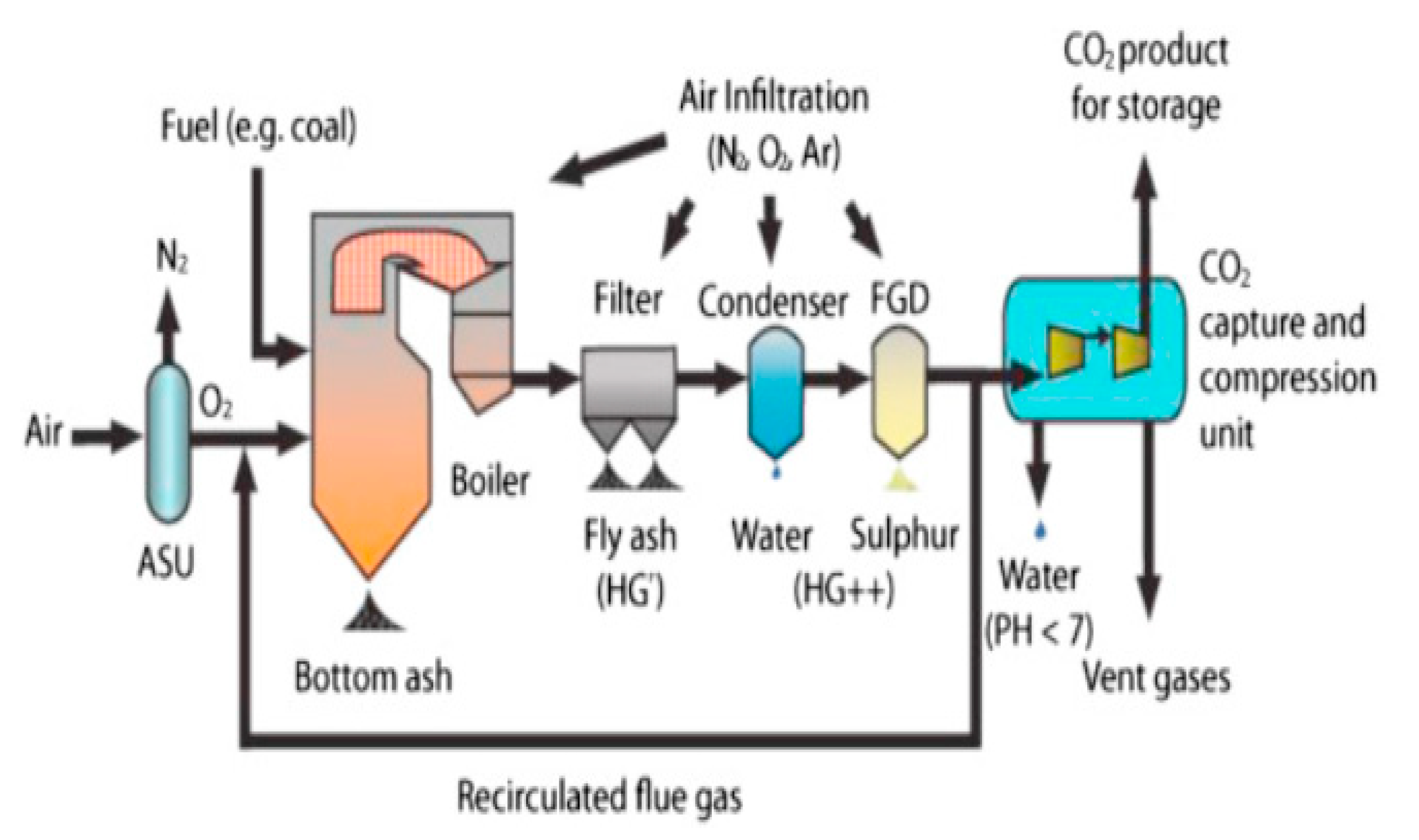
In oxy-fuel combustion, fuel is burned using a mixture of pure oxygen and recycled flue gas rather than atmospheric air, effectively removing nitrogen from the oxidant stream. The exclusion of atmospheric nitrogen significantly reduces the formation of thermal NOₓ, as minimal nitrogen is available to oxidize at high temperatures [44]. As a result, NOₓ emissions, measured per unit of energy (e.g., mg/MJ), are typically reduced by 20% to 90% compared to traditional air combustion, depending on operating conditions and coal type [45].
A major limitation of oxy-fuel combustion is the high cost associated with producing pure oxygen to replace air in the combustion process. Industrial oxygen is primarily produced through cryogenic air separation, a process characterized by high energy consumption and capital costs. This oxygen production can represent as much as 50–70% of the total incremental cost of an oxy-fuel system. Yuan et al. (2024) report that the levelized cost of electricity (LCOE) for oxy-fuel combustion systems is substantially higher than conventional systems, with CO₂ avoidance costs potentially exceeding USD 40 per tonne, reducing economic viability in markets lacking carbon pricing mechanisms [46].
2.4. Direct Air Capture (DAC)
Direct air capture (DAC) is a process that extracts CO₂ directly from ambient air using chemical means. Large volumes of air are passed through a DAC system containing a sorbent material designed to selectively bind CO₂ molecules, as illustrated in Figure 7. In a subsequent stage, the captured CO₂ is released from the sorbent and collected for either utilization or long-term storage. Currently, two primary DAC technologies dominate the field: systems utilizing solid sorbents and those employing liquid sorbents [47]. Solid sorbent DAC employs highly porous materials with extensive surface area to adsorb CO₂, whereas liquid sorbent DAC uses chemical solutions to absorb CO₂.
While existing DAC systems require both heat and electricity to operate components such as rotating equipment, solid sorbent DAC (S-DAC) can potentially run entirely on electricity, which may be sourced from renewables. In contrast, liquid sorbent DAC (L-DAC) typically requires an external heat source commonly natural gas to reach the high temperatures (approximately 900°C) necessary in the regeneration calciner. Without the availability of a low-carbon heat source, which is not yet commercially viable, reliance on natural gas would necessitate capturing and storing its associated CO₂ emissions along with the CO₂ extracted from the air to ensure maximal net carbon removal [48].
DAC technology, originally developed in the late 1950s for applications such as submarines and spacecraft, has matured significantly. Presently, about 130 DAC plants are operational or under construction globally, with leading developers including Global Thermostat (USA), Carbon Engineering (Canada), and Climeworks (Switzerland). Recent progress has focused on optimizing sorbent materials to enhance CO₂ capture efficiency [49].
Figure 7.
Direct Air Capture [50].
Figure 7.
Direct Air Capture [50].
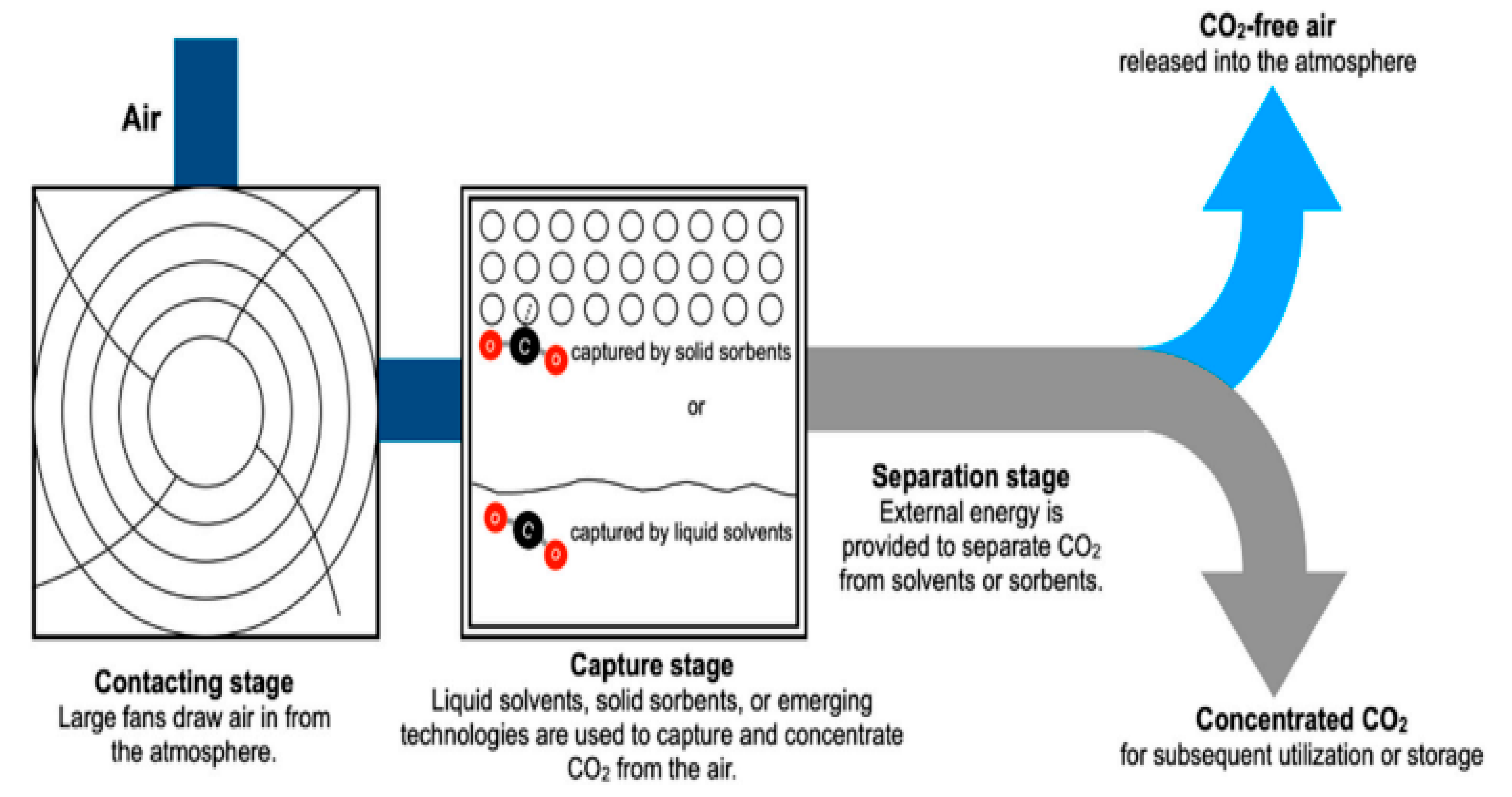
Direct air capture (DAC) technology offers flexible deployment options, functioning effectively in diverse environments including deserts, urban settings, and proximity to renewable energy or storage sites, without dependence on emission sources or competition for agricultural land. DAC systems are highly scalable, ranging from small, decentralized units to large, centralized facilities capable of capturing millions of tonnes of CO₂ annually [51].
Despite its promise for climate mitigation, DAC faces several significant challenges. The process is energy-intensive due to the inherently low concentration of CO₂ in ambient air, leading to high operational costs currently estimated between $100 and $1000 per tonne of CO₂ captured [52,53]. Its large-scale implementation is constrained, particularly because DAC must be powered by low-carbon energy to ensure net climate benefits. Furthermore, the development of robust infrastructure for CO₂ transport and secure long-term storage remains a critical logistical challenge. The gradual degradation of capture materials over time also increases maintenance requirements. Crucially, DAC should complement, rather than replace, direct emission reduction efforts as part of comprehensive climate mitigation strategies [54].
Table 1 summarizes key carbon capture technologies, their applications, advantages, disadvantages, and overall feasibility. Pre-combustion capture offers flexible deployment and the ability to capture low-concentration CO₂, with the added benefit of integration with renewable energy systems. However, it remains limited by high capital and operational costs, as well as technological complexity, making it moderately feasible mostly in settings with appropriate infrastructure [55].
Post-combustion capture is a mature and widely adopted technology, especially suited for retrofitting existing power plants such as IGCC systems. Its ease of separation and high capture efficiency contribute to its high feasibility. Nonetheless, its application can be limited by the specific plant configuration and often requires energy-intensive solvent regeneration processes [56].
Oxy-fuel combustion, applicable to pulverized coal and natural gas combined cycle plants, enables high purity CO₂ streams that facilitate easier capture. Despite its technical maturity and retrofit potential, this method experiences generation inefficiencies and energy penalties, affecting overall plant efficiency and cost-effectiveness. Recent advances have focused on optimizing oxygen production methods to reduce energy consumption [57].
Direct Air Capture (DAC) represents a promising long-term approach capable of capturing CO₂ directly from ambient air, enabling negative emissions. DAC technologies offer high purity CO₂ and modular deployment options, but current high investment and operational energy costs limit widespread feasibility. Recent innovations in sorbent materials and process integration with renewable energy are improving DAC economics and energy efficiency [58]
Overall, while post-combustion capture remains the most feasible for near-term deployment, advances in oxy-fuel combustion and DAC technologies are progressively addressing their respective challenges, improving the prospects of broader carbon capture adoption.
2.5. Case Studies and Real-World Application of CCS Technologies
A range of carbon capture technologies have been developed and demonstrated at various scales across the globe, with each offering unique benefits and challenges based on their design and application as presented in Table 2. Direct Air Capture (DAC), a technology designed to remove CO₂ directly from ambient air, has seen significant advancements through facilities like Climeworks’ Mammoth plant in Iceland, which began operations in 2024. This facility can capture approximately 36,000 tons of CO₂ per year using geothermal energy and modular solid sorbent units, demonstrating scalability and integration with renewable energy sources [59]. Its predecessor, Climeworks Orca, launched in 2021, was the first large-scale DAC plant and has a capacity of around 4,000 tons of CO₂ annually, storing captured CO₂ underground via mineralization in basaltic rock formations, an innovative and permanent sequestration pathway [60]. While DAC offers a pathway to negative emissions, its energy intensity and operational costs remain significant challenges.
Post-combustion capture, in contrast, is more mature and has been deployed in operational power plants. The Mikawa Post-Combustion Capture Plant in Japan exemplifies this, achieving a capture rate of 180,000 tons of CO₂ per year by retrofitting an existing power plant to include chemical absorption units [61]. This approach is especially attractive for decarbonizing current fossil-based infrastructure, though efficiency losses and solvent degradation must be managed.
Pre-combustion capture is used in projects like the GreenGen IGCC facility in Tianjin, China, which was designed to capture up to 1 million tons of CO₂ per year as part of an integrated gasification combined cycle (IGCC) power generation process. In this method, CO₂ is removed before combustion by converting fuel into syngas and separating the CO₂ at high pressures, enabling greater efficiency in capture and storage [62]. Although promising, pre-combustion systems typically require greenfield development, limiting their retrofit potential.
Another promising approach is oxy-fuel combustion, which involves burning fuel in pure oxygen instead of air, resulting in a CO₂-rich flue gas that simplifies separation. The Callide Oxy-fuel Project in Australia, a demonstration facility, successfully captured approximately 27,300 tons of CO₂ per year, achieving an impressive 80% CO₂ concentration in the flue gas stream [63]. However, high costs related to oxygen production and plant redesign remain obstacles to commercial deployment.
These diverse projects highlight both the progress and remaining hurdles in deploying carbon capture technologies. While post-combustion systems offer near-term feasibility, DAC and pre-combustion approaches hold transformative potential for deep decarbonization, particularly when aligned with renewable energy systems and geological storage solutions.
2.6. Cost Estimates for Carbon Capture and Storage Systems
The estimated cost for CCS technologies is presented in Table 3 for various carbon capture technologies highlight significant differences in their economic viability and technological readiness. Direct Air Capture (DAC) presents the broadest and highest cost range, between $100 and $1000 per ton of CO₂ as presented in Figure 8, with pilot projects potentially exceeding these figures. This high cost is primarily due to the technical challenge of extracting CO₂ from ambient air, where its concentration is extremely low. Despite its cost, DAC is highly valued for its ability to remove legacy emissions and its flexibility in deployment without location constraints. In contrast, post-combustion capture emerges as the most economically feasible option, with costs ranging from $47 to $76 per ton. This technology is well-established and suitable for retrofitting existing power plants and industrial facilities, particularly where flue gases contain high CO₂ concentrations.
Pre-combustion capture, with a cost range of $60 to $150 per ton, involves converting fuel into a mixture of hydrogen and CO₂ before combustion. While efficient in new plant designs, it is less suitable for retrofitting existing infrastructure due to its complexity and capital requirements. Oxy-fuel combustion costs between $70 and $160 per ton and involves burning fossil fuels in pure oxygen, producing a CO₂-rich exhaust that simplifies capture. However, the energy demands of producing pure oxygen and redesigning combustion systems pose economic and operational challenges. Overall, while post-combustion capture currently offers the most practical and cost-effective solution, DAC represents a promising long-term pathway for achieving negative emissions. Future developments must focus on reducing the cost and improving the scalability of all technologies to meet global decarbonization goals.
3. The Role of Carbon Capture Technologies in Mitigating Emissions
Meeting the Paris Agreement target of keeping global temperature rise “well below 2°C above pre-industrial levels” and striving to limit it to 1.5°C requires swift and substantial reductions in greenhouse gas (GHG) emissions. Numerous emissions pathways have been modelled that align with these climate goals, and in most cases, Carbon Capture and Storage (CCS) emerges as a pivotal component. CCS contributes in two key ways: (1) it mitigates direct CO₂ emissions from fossil fuel use in power generation and industrial operations, and (2) when combined with bioenergy, direct air capture, or similar technologies, it enables large-scale atmospheric CO₂ removal, achieving net negative emissions. Without deploying CCS in both capacities, modelled scenarios indicate that achieving sufficient and timely CO₂ reductions to meet the “well below 2°C” target becomes extremely challenging [69].
According to the International Energy Agency’s Net Zero by 2050 roadmap, Carbon Capture, Utilisation, and Storage (CCUS) is expected to contribute about 8% of the total emissions reductions required, equivalent to approximately 6 Gt of CO₂ annually by 2050. Likewise, hundreds of climate scenarios assessed by the Intergovernmental Panel on Climate Change (IPCC) underscore CCS as a critical factor in nearly all projections that successfully meet the Paris Agreement objectives [70].
The strategic role of CCS within the green transition is most evident for emissions that are not easily eliminated through other measures such as energy efficiency improvements, electrification, hydrogen deployment, or expanded renewable energy production. Specifically, CCS is essential for:
- Retrofitting existing industrial facilities or power plants to continue operation while capturing their CO₂ emissions.
- Substantially lowering emissions from energy-intensive sectors that are difficult to decarbonize, including cement, steel, and chemicals.
- Supporting the low-carbon hydrogen economy, which can facilitate decarbonization across industry, heavy transport, and shipping.
- Removing CO₂ from the atmosphere to offset unavoidable or hard-to-abate emissions, for instance, through Bioenergy with CCS (BECCS) or Direct Air Capture (DAC).
3.1. CCS Role in Decarbonizing the Industrial Sector
Industrial processes are a major source of greenhouse gas (GHG) emissions, accounting for about 25% of global CO₂ output [71]. Achieving the emission reduction targets set by the IPCC therefore requires substantial decarbonization of this sector. Carbon capture technologies play a critical role in reducing emissions from hard-to-abate industries, including iron and steel production, cement manufacturing, petroleum refining, and power generation. Collectively, these sectors contribute a considerable share of global CO₂ emissions, with cement production alone responsible for nearly 8%. According to the International Energy Agency, carbon capture could deliver up to 15% of the total emission reductions required by 2050, reinforcing its importance as a complementary measure to renewable energy expansion and energy efficiency improvements [72,73].
3.1.1. Decarbonizing the Iron and Steel Industry
The iron and steel industry is the largest emitter of CO₂ within the industrial sector, responsible for approximately 31% of total industrial CO₂ emissions [74]. This high emission intensity arises from the sector’s substantial energy requirements, reliance on coal, and the vast scale of global steel production [75]. Steel manufacturing is primarily carried out via two routes: integrated steel mills and mini mills. Large integrated steel mills are the dominant emission sources, producing on average 3.5 Mt of CO₂ per year, while smaller mini-mills typically emit around 200 kt annually. On a per-production basis, a conventional steel mill releases about 1.8 tCO₂ for every tonne of crude steel, with the majority originating from coal and coke combustion (1.7 tCO₂) and a smaller fraction from limestone use (0.1 tCO₂) [76].
The adoption of Carbon Capture and Storage (CCS) could substantially reduce these emissions. In integrated mills, potential capture points include flue gases from the sinter plant, lime kiln, coke blast furnace, oven plant, basic oxygen furnace and stove. For mini mills, the primary capture source is the electric arc furnace. Post-combustion capture systems can be applied to these streams without disrupting steelmaking operations. Alternatively, “in-process” capture strategies can integrate steel production with CO₂ capture, such as employing oxy-combustion in blast furnaces to generate flue gases with a higher CO₂ concentration, improving capture efficiency [76].
Several commercial iron and steel facilities have incorporated CO₂ capture within their operations; however, the captured carbon dioxide is frequently vented through flaring instead of being stored. Notable examples of such integration include specific Direct Reduced Iron (DRI) plants [75], the Saldanha steelworks in South Africa [77], the Finex process facility in South Korea [78], and the HIsarna process plants located in Germany and Australia [79].
3.1.2. Decarbonizing from the Cement Industry
Concrete is the second most produced material globally after clean water [80]. Cement, a key ingredient of concrete, generates approximately 880 kg of CO₂ per tonne produced, with emissions varying between 600 and 1000 kg depending on the manufacturing process. Consequently, cement production contributes to more than 5% of global CO₂ emissions. Approximately 60% of these emissions arise from the calcination of limestone (CaCO₃) to form calcium oxide (CaO), which is the primary raw material in cement production [81], while the remainder results from the combustion of fuels used to heat kilns and facilitate clinker formation.
A range of CCS technologies can be adapted for the cement sector, including several post-combustion approaches such as solid sorbents, solvent-based scrubbing, oxy-fuel combustion, calcium looping and “direct capture” [82]. Unlike in power generation, pre-combustion capture methods are unsuitable for cement manufacturing due to the significant share of process emissions released during limestone calcination, which pre-combustion systems cannot address. Most applicable CCS options except direct capture are conceptually similar to those in the power sector. Notably, calcium looping offers process synergies because it uses CaO, a feedstock already integral to cement production, as the primary sorbent. Direct capture, which has no direct equivalent in power generation, involves indirect radiative heating of the raw meal containing limestone to directly produce a pure CO₂ stream. Both direct capture and oxy-fuel systems offer potential efficiency advantages—either from thermodynamic improvements (direct capture) or by reducing thermal ballast through the elimination of nitrogen from the combustion air [55].
3.1.3. Decarbonizing the Petrochemical and Oil Refining Industries
The petroleum industry is responsible for approximately 6% of global CO₂ emissions [83], with emissions generated across the entire value chain, from exploration and extraction to refining and downstream petrochemical production. Importantly, the use of petroleum-derived products in electricity generation, heating, and transportation accounts for about 50% of worldwide emissions. Various carbon capture technologies have been explored for refinery applications, including traditional post-combustion capture. Andersson et al. [84] investigated the utilization of excess waste heat for carbon capture, while Escudero et al. [85] evaluated the economic feasibility of oxy combustion in utility boilers under specific conditions. Additionally, chemical looping combustion (CLC) has shown significant potential, as refinery light gases are suitable fuels for CLC, and refineries already have substantial expertise in engineering and controlling hot solids looping processes, such as those used in fluid catalytic cracking [86].
Carbon Capture, Utilisation, and Storage (CCUS) can play a pivotal role in global decarbonization strategies through several pathways: (i) lowering emissions in sectors that are difficult to decarbonize; (ii) generating low-carbon electricity and hydrogen to facilitate the transition to cleaner fuels across various industries; and (iii) extracting CO₂ already present in the atmosphere. By fulfilling these roles, CCUS can also diversify and enhance energy system flexibility, strengthening energy security a growing priority for many governments. In numerous regions, CCUS offers the most cost-effective pathway for achieving deep decarbonization in industries such as iron, steel, and chemicals. For cement production responsible for nearly 7% of global CO₂ emissions, CCUS is currently the only viable large-scale option for significant emissions reduction. Furthermore, integrating CCUS into coal-, gas-, biomass-, or waste-fired power plants enables the generation of low-carbon electricity, which can displace fossil fuel use across applications including transport, residential heating, and industrial low- to medium-temperature heat. Low-carbon hydrogen produced via CCUS can serve as a direct fossil fuel substitute for combustion, as a feedstock in industrial processes, and as a fuel for long-haul transport [87].
There are three main reasons why Carbon Capture and Storage (CCS) is likely essential for achieving the Paris Agreement’s target of keeping global warming “well below 2°C.” First, because CO₂ accumulates in the atmosphere over time, achieving net-zero emissions is necessary to halt further temperature increases. Without CCS whether applied to eliminate direct emissions or to remove CO₂ from the air it may be impossible to reach net-zero quickly enough. Second, cost-effective alternatives to fully decarbonize certain hard-to-abate sectors are currently unavailable and may never emerge. In such cases, CCS offers a more viable option, either through direct application in sectors like steel and cement or via CO₂ removal to compensate for residual emissions from areas such as long-distance shipping and aviation. Third, in some industries, CCS or CO₂ removal may provide a lower-cost pathway to emissions reduction, allowing the financial savings to be redirected toward other societal needs [69].
At present, over 50 commercial-scale CCS facilities are in operation worldwide, with an additional 44 under construction and more than 500 projects in various stages of development [88,89]. Technological advancements including improvements in solvent- and membrane-based capture systems, solid sorbents, and direct air capture are increasing both the efficiency and scalability of CCS solutions [90]. This positions CCS as a critical transitional technology, enabling continued operation of existing infrastructure while substantially mitigating its climate impact.
Although notable progress has been made, recent studies highlight that the pace of carbon capture deployment must accelerate significantly to align with international climate objectives. Without substantial scaling, current implementation rates will fall short of limiting global warming to 2°C and even further from the 1.5°C ambition outlined in the Paris Agreement [91]. Pioneering initiatives, such as Norway’s large-scale CCS infrastructure and advances in materials science for CO₂ adsorption and recycling, indicate promising pathways for broader adoption [73,90]. Nevertheless, persistent barriers remain, including high costs, substantial energy requirements, storage infrastructure complexities, insufficient regulatory frameworks, and challenges in integrating CCS within broader decarbonization strategies. End-to-end CCS systems encompassing capture, CO₂ transport, and geological storage remain both capital- and energy-intensive, restricting widespread uptake [72]. Furthermore, ensuring the long-term integrity and capacity of geological reservoirs demands rigorous monitoring and regulation to mitigate leakage risks and guarantee storage permanence. Unlocking the full mitigation potential of CCS will require sustained investment and coordinated action across industries and governments [72,89,91].
Recent innovations are transforming CCS capabilities, particularly through the development of advanced materials and integration with renewable energy systems. For example, metal-organic frameworks (MOFs) can achieve up to 99% CO₂ removal in laboratory trials, offering higher efficiency than conventional technologies and reducing energy consumption and operational costs by approximately 17% and 19%, respectively [72]. Flexible integration of CCS with renewable-dominated power grids enhances both resilience and cost-effectiveness, enabling fossil-based assets to provide essential grid stability while delivering substantial emissions reductions as renewable capacity expands [73,88,89]. These advances position CCS not merely as an emissions mitigation tool, but as a fundamental component in maintaining balanced, low-carbon energy systems worldwide.
While CCS has faced criticism for being costly, unproven, or unsafe, operational evidence demonstrates that the technology is both reliable and secure. The primary challenge lies not in its feasibility but in scaling the industry to achieve the multi-gigatonne levels of permanent CO₂ storage needed in the coming decades.
4. Integration of CCUS with Renewable Energy Systems
4.1. Solar and Wind Energy-Powered CCUS
Integrating carbon capture, utilization, and storage (CCUS) systems with renewable energy sources such as solar and wind offers a promising strategy for reducing the carbon intensity of industrial operations while overcoming the energy penalty typically associated with conventional CCUS processes. Traditional CCUS systems, especially direct air capture (DAC) and post-combustion capture, are energy-intensive and often rely on fossil-derived electricity or heat. Coupling these systems with intermittent renewables like solar and wind can decouple carbon capture from fossil energy inputs, enabling low- or even negative-emission pathways [92].
Solar energy, particularly concentrated solar power (CSP) and solar thermal systems can provide high-temperature heat needed for solvent regeneration in post-combustion capture or for driving chemical looping and sorbent regeneration processes. Solar-driven DAC systems have already been explored to improve sustainability by using solar heat for desorption in solid sorbent units, thereby reducing operational emissions (Keith et al., 2018). Additionally, photocatalytic CO₂ conversion using solar radiation has been proposed for the direct utilization of captured CO₂ into fuels or chemicals, creating a closed-loop system that supports circular carbon use [93].
Wind energy, on the other hand, is particularly suitable for powering electrochemical CO₂ conversion systems and supplying electricity for electrically driven DAC technologies. Wind-powered CCUS can also stabilize excess generation through power-to-gas applications, where surplus renewable electricity is used to convert captured CO₂ and water into synthetic methane or other fuels via electrolysis and methanation [94]. This not only provides a storage medium for intermittent energy but also contributes to the defossilization of the gas sector.
Several studies have demonstrated that integrating CCUS with variable renewables is technically feasible and economically promising when supported by appropriate energy storage and smart grid infrastructure [95]. However, the main challenges remain in the variability of energy supply, high capital costs, and the need for hybrid system optimization to ensure consistent CCUS operation. Life cycle assessment (LCA) studies confirm that the use of renewable energy in CCUS significantly improves the overall environmental performance and carbon avoidance efficiency [58].
As the world transitions toward net-zero targets, renewable-powered CCUS represents a critical convergence of clean energy and climate mitigation technologies. Continued research and policy support are essential to scale these integrated systems and enable their role in a sustainable low-carbon energy future.
4.2. Geothermal Energy and CO₂ Utilization
Integrating carbon dioxide (CO₂) as a working fluid in geothermal power systems offers a dual advantage of enhancing geothermal energy extraction while providing a pathway for long-term CO₂ storage. In CO₂-Plume Geothermal (CPG) systems, captured CO₂ is injected into deep geologic formations where it acts as both a heat extraction medium and a permanently stored greenhouse gas. Compared to water-based geothermal systems, CO₂ has favorable thermophysical properties, such as lower viscosity and higher expansivity, which allow for more efficient circulation and energy recovery from geothermal reservoirs [96]. This makes CPG systems especially promising in low-permeability formations where water-based geothermal systems underperform. Moreover, the supercritical state of CO₂ at reservoir depths enhances heat transfer rates, improving the thermodynamic performance of the geothermal cycle.
Recent studies have demonstrated that using CO₂ instead of water can increase electricity generation by up to 50%, depending on reservoir characteristics and system design. Additionally, the integration of geologic CO₂ storage with geothermal energy reduces the environmental footprint of carbon sequestration by co-producing clean energy, thereby improving the economic viability of both technologies. This approach supports a circular carbon economy, where CO₂ is captured, utilized for energy generation, and sequestered permanently underground. However, successful deployment of CPG systems depends on careful reservoir characterization, pressure management, and long-term monitoring to ensure operational safety and containment integrity [97,98]. Overall, geothermal-CO₂ hybrid systems represent a promising innovation at the intersection of renewable energy and carbon management.
4.3. Bioenergy with Carbon Capture and Storage (BECCS)
Bioenergy with Carbon Capture and Storage (BECCS) involves capturing and permanently sequestering CO₂ emitted during the conversion of biomass into energy or material products. Common applications include biomass-powered electricity plants, pulp mills for paper production, cement kilns, and biofuel facilities. Waste-to-energy plants using biogenic feedstocks can also generate negative emissions. Theoretically, when biomass is sustainably grown and converted into fuel for combustion, the process is carbon-neutral; however, capturing and storing some or all CO₂ emissions during combustion renders the process carbon-negative by removing more CO₂ from the atmosphere than is emitted. Validating true negative emissions requires comprehensive life cycle assessments considering biomass sustainability, application scope, land-use changes, and the timing of emissions and removals [99].
Among carbon removal strategies, BECCS is the most technologically advanced, given that both bioenergy generation and CCS have been commercially proven separately. BECCS is operational in fuel transformation and power generation sectors, with varying degrees of maturity; the most advanced projects focus on CO₂ capture from ethanol production or biomass power plants, whereas industrial applications remain in prototype phases [100]. Currently, more than ten global facilities capture CO₂ from bioenergy production (see Table 4), with the Illinois Industrial CCS Project being the largest at 1 MtCO₂ annually and the only one with dedicated geological storage, while most others are pilot projects utilizing captured CO₂ for enhanced oil recovery (EOR) or other applications.
4.4. CCUS in Low-Carbon Hydrogen Production
Carbon Capture, Utilization, and Storage (CCUS) plays a critical role in facilitating the large-scale generation of low-carbon hydrogen for widespread energy applications. Hydrogen serves as a flexible, low-carbon energy carrier or feedstock, capable of being utilized without direct emissions of greenhouse gases (GHGs) or air pollutants. It offers a promising decarbonization solution for sectors where direct electrification is either technically infeasible or economically impractical, including long-haul transportation, chemical production, iron and steel manufacturing, as well as power and heat generation
CCUS aids in hydrogen decarbonization primarily by:
Mitigating emissions from existing hydrogen production facilities: Currently, global hydrogen output is approximately 75 million tonnes per year, predominantly derived from natural gas (76%) and coal (23%), with smaller contributions from oil and electricity. This production results in over 800 million tonnes of CO₂ emissions annually, a figure comparable to the total energy sector emissions of countries such as Indonesia and the United Kingdom [102]. Unabated hydrogen production emits approximately 9 tCO₂ per tonne of hydrogen when using natural gas, and around 20 tCO₂ per tonne when using coal. At present, seven large-scale projects produce hydrogen from fossil fuels with CCUS integration, collectively generating just over 0.4 Mt of hydrogen per year while capturing close to 6 MtCO₂. Of these, four operate within oil refineries and three within fertiliser plants. There is significant opportunity to retrofit existing facilities with CCUS, allowing them to operate more sustainably. This is among the lower-cost CCUS applications and given that many facilities are located in coastal industrial hubs, they could share CO₂ transport and storage infrastructure with other industries[102].
Providing a cost-effective pathway for scaling new hydrogen production: In many regions, producing hydrogen from natural gas or coal paired with CCUS remains cheaper than water electrolysis using renewable energy, particularly where low-cost fossil fuels and CO₂ storage options are available. This cost advantage is likely to persist in the near term, offering a practical route to expanding low-carbon hydrogen supply [101].
4.5. Scalability and Commercialization
The deployment of large-scale CCS projects has progressed gradually. Among 37 significant CCS initiatives, 17 are currently operational, 4 are under construction, and the rest are at various phase of planning and development, as illustrated in Figure 9.
The majority of large-scale commercial CCS projects are concentrated in the United States, which also leads in the proportion of projects that have progressed through the full project life cycle—from identification and evaluation to definition, execution, and operation. In almost all U.S. projects, enhanced oil recovery (EOR) serves as the primary method for CO₂ storage. Additionally, U.S. facilities have the highest CO₂ capture capacities globally, with the Century Plant capturing 8.4 MtCO₂ annually and the Shute Creek Gas Processing Facility capturing 7 MtCO₂ per year [103].
China holds the second-largest number of CCS projects, but most remain in preliminary stages such as pre-feasibility and front-end engineering design (FEED) studies. Only the Yanchang Integrated CCS Demonstration has reached the execution phase. The CO₂ capture capacities of Chinese projects generally range from 0.4 to 2 MtCO₂ annually[104].
In Europe, Norway operates several CCS initiatives, including the Sleipner CO₂ Storage Project with an annual capture capacity of 1 MtCO₂, and the Snohvit CO₂ Storage Project, which captures approximately 0.7 MtCO₂ each year. Canada hosts five CCS projects, three of which are currently operational: the Great Plains Synfuel Plant and Weyburn-Midale Project capturing 3 MtCO₂ per year, the Boundary Dam CCS Project with a capacity of 1 MtCO₂ annually, and the Quest Project capturing close to 1 MtCO₂ per year.
Additionally, active CCS facilities are present in Brazil, Saudi Arabia, and the United Arab Emirates, each with capture capacities ranging from 0.8 to 1 MtCO₂ per year [104].
A critical factor for the successful implementation of these CCS projects is the availability of secure geological storage sites for the captured CO₂. Moreover, progress toward operational phases depends on reliable financial backing and robust policy and regulatory support frameworks [104].
5. Challenges of CCS Technologies
5.1. High Costs and Energy Demand of CCUS Technologies
One of the most frequently noted challenges of CCUS is its high cost. Establishing CCUS facilities requires substantial capital investment, while their operation demands significant energy input making the technology especially costly when energy prices are elevated. Additionally, uncertainties remain regarding the technological performance of CCUS systems. Nonetheless, with increasingly stringent climate targets and rising carbon prices, emission reductions are unavoidable. As such, the costs and risks of CCUS should be assessed relative to other decarbonization strategies rather than against the option of taking no action. Restricting CCUS deployment would likely increase dependence on alternative technologies that are presently more expensive and less mature. For instance, integrating CO₂ capture into steelmaking increases production costs by less than 10%, whereas switching to renewable hydrogen-based methods could increase costs by 35–70% compared to conventional processes [87,105].
Costs for CCUS are expected to decline as technology matures and deployment scales up. In the power sector, for example, the cost of CO₂ capture fell by 35% between the first and second large-scale CCUS plants. Moreover, cost evaluations should also account for broader economic benefits. CCUS can enable energy-intensive industries to remain operational while aligning with net-zero goals, thereby safeguarding associated jobs and infrastructure from becoming stranded assets. While CO₂ leakage from storage sites could potentially cause environmental harm and negate intended emissions reductions, robust regulatory frameworks are already in place—and continue to evolve—to guide site selection, operation, and monitoring. Many candidate storage locations are geologically well-characterized and have naturally stored gases, including CO₂, for millions of years, indicating that overall leakage risks are relatively low [87,105].
5.2. Infrastructure Challenges
Captured CO₂ is generally injected into underground storage formations, often in depleted oil and gas reservoirs that have demonstrated the ability to securely contain hydrocarbons for millions of years. However, the storage capacity of these geological formations is finite, and not all locations are suitable for long-term sequestration. Identifying and evaluating viable storage sites is both time-intensive and costly. In many cases, these sites are situated in remote areas, necessitating the transportation of CO₂ over long distances via extensive pipeline networks. The construction and upkeep of such pipelines involve substantial expenses, and their development can face opposition from the public. Similar cost challenges apply to the storage facilities themselves, as even pre-existing geological formations typically require modifications to ensure secure CO₂ containment and must be continuously monitored to prevent leakage. Furthermore, the integration of CCS infrastructure with existing industrial operations, such as power plants, adds another layer of complexity and expense [105].
5.3. Need for Improved Materials and Energy Efficiency
Direct Air Capture (DAC) is among the latest CO₂ capture technologies and holds promise for achieving negative emissions; however, its widespread adoption is currently constrained by significant energy and material demands, primarily due to the need to handle large volumes of ambient air [106]. The process is not only highly energy-intensive but also dependent on advanced materials with superior adsorption and desorption capabilities to improve operational efficiency. Advancing DAC performance requires a stronger understanding of the capture mechanisms and reaction kinetics in both solid sorbents and liquid solvents, enabling the creation of materials that are highly selective, easily regenerable, and operable under mild conditions [107].
Similarly, post-combustion capture where CO₂ is separated from flue gases after fuel combustion faces limitations such as solvent degradation, low CO₂ concentrations in exhaust streams, and the substantial energy required for solvent regeneration. These factors emphasize the need to refine capture materials and optimize process integration to lower operational expenses. For pre-combustion capture, which removes CO₂ from fuel gas before combustion, and oxy-fuel combustion, which uses pure oxygen instead of air to generate a concentrated CO₂ stream, the challenges shift toward achieving high process efficiency and developing robust high-temperature materials, long-lasting membranes, and effective heat management systems. While these approaches are generally more thermodynamically favorable, their commercial viability depends on further improvements in material durability and system efficiency. Across all capture pathways, progress in producing stable, scalable, and environmentally sustainable materials—such as next-generation solvents, sorbents, and membranes is essential [108]. Enhancements in materials science and energy efficiency will not only help reduce the levelized cost of CO₂ capture but also increase the public and political acceptance of carbon capture technologies, thereby supporting their deployment at commercial scale.
6. Policies and Incentives for Widespread Adoption of CCS
6.1. Public Funding
In 2023, government backing for CCUS remained robust, with subsidy programs in the United States and Europe allocating over USD 20 billion to various initiatives. In the U.S., USD 1.7 billion was designated for carbon capture demonstration projects, alongside USD 1.2 billion earmarked for Direct Air Capture (DAC) hubs under the 2021 Infrastructure Investment and Jobs Act. The Netherlands’ SDE++ scheme committed more than USD 7.3 billion to CCS projects connected to the extensive Aramis CO₂ transport and storage network. Denmark’s CCUS Fund granted USD 1.2 billion to Ørsted for implementing capture technology at the Asnæs Power Station. Additionally, at the European regional level, the European Commission contributed around USD 1.5 billion through its Innovation Fund to support industrial CCUS projects, and over USD 500 million toward CO₂ transport and storage infrastructure under the Connecting Europe Facility [109].
In the United States, CCUS deployment has benefited from grant programs and an extensive research and development agenda. The expanded 45Q tax credit scheme has proven particularly effective in encouraging new project proposals. As a well-established policy tool successfully applied to accelerate renewable energy deployment tax credits are widely understood in the U.S. market. However, they may be less impactful in regions where CCUS is still emerging or where industrial applications carry higher costs [101].
In Europe, despite only two operational CCUS facilities at present, a significant number of projects are planned, primarily concentrated within industrial clusters that utilize shared CO₂ storage infrastructure. These initiatives cover sectors including cement production, gas-fired power plants, waste-to-energy operations, and hydrogen generation. Existing policy support encompasses competitive funding programs such as the EUR 10 billion Innovation Fund and the GBP 800 million UK CCS Infrastructure Fund, alongside direct government investments with risk-sharing arrangements exemplified by Norway’s Longship CCS project, and operational subsidies through schemes like the Dutch SDE++ program [101].
In regions with significant state-owned enterprise activity such as China and the Middle East direct public investment has played a central role in supporting early CCUS initiatives. In these contexts, state-owned entities could drive broader adoption of CCUS and, in some cases, stimulate demand for low-carbon products through strategic procurement policies [101].
6.2. Strategic Signalling
Amid increasing global recognition of the need to accelerate CCUS development, 2023 witnessed the initiation of several key programs. Notably, the Carbon Management Challenge was launched at the Major Economies Forum in April 2023, calling on governments to fast-track CCUS technology deployment. By early 2024, Bahrain became the newest member, expanding the coalition to 20 countries plus the European Commission. Concurrently, several nations have advanced their national CCUS strategies: Canada finalized its Carbon Management Strategy at the end of 2023, while the European Commission released its Industrial Carbon Management Strategy in early 2024, setting targets to develop at least 50 Mt of capacity by 2030 and 280 Mt by 2040. France and Germany are also actively preparing their respective CCUS frameworks [109].
6.3. Cross-Border Collaboration
Multiple regions are promoting cross-border cooperation to advance carbon capture, utilization, and storage (CCUS) efforts. In the North Sea, Denmark, Belgium, the Netherlands, and Sweden established formal agreements with Norway in April 2024 to enable the transnational transport and storage of CO₂. Additionally, Sweden and Denmark finalized a bilateral arrangement, and Denmark and France signed a similar pact in March 2024. These accords comply with the London Protocol, the international treaty regulating cross-border CO₂ transport for offshore sequestration. Meanwhile, Japan is actively pursuing amendments to the London Protocol and exploring CO₂ export possibilities. Two of Japan’s seven government-supported CCS projects focus on shipping captured CO₂ to Southeast Asia, bolstered by a cooperation agreement signed in September 2023 between Japan and Malaysia’s national oil company, PETRONAS, to facilitate cross-border CO₂ transport and storage [109].
Within the European Union, regulatory measures are setting clear and ambitious carbon capture goals, targeting the capture of at least 100 million tonnes of CO₂ annually by 2040 and 300 million tonnes by 2050. These objectives are driving increased investment in demonstration and commercial-scale projects, encouraging advancements in capture technologies, and accelerating the development of supporting transport and storage infrastructure. Coupled with expanding public and private sector funding and greater regulatory certainty, carbon capture is positioned to play a pivotal role in comprehensive climate change mitigation strategies [72].
7. Conclusion and Outlook
Carbon capture, utilization, and storage (CCUS) technologies are anticipated to account for roughly 8% of the total emissions reductions necessary to reach net-zero emissions by 2050, corresponding to an annual CO₂ reduction of about 6 gigatonnes. Given the practical challenges in fully eliminating fossil fuel use, CCUS remains a critical component of the carbon-neutral technology mix and serves as a fundamental technical strategy to support the temperature stabilization targets outlined in the Paris Agreement.
Post-combustion CCS and oxy-combustion offer the greatest CO₂ capture efficiency for the iron and steel sector. Cement production is optimally suited to calcium looping, oxy-fuel combustion, and emerging direct capture systems to address process emissions. In the petrochemical and refining industries, post-combustion CCS, oxy-combustion, and chemical looping combustion provide effective pathways for process integration and enhanced energy efficiency.
Direct Air Capture (DAC) demonstrates variable capacity, with modular solid sorbent systems capturing ≈36,000 t CO₂/year and large-scale units achieving 4,000 t CO₂/year via underground mineralization. Post-combustion capture at Mikawa plant in Japan reaches 180,000 t CO₂/year from power generation sources. Pre-combustion capture, as seen in China’s GreenGen IGCC project, is designed for up to 1 million t CO₂/year at full scale. The Callide oxy-fuel project in Australia captured ~27,300 t CO₂/year, benefiting from a high ~80% CO₂ flue gas concentration. DAC emerges as a promising solution due to its deployment flexibility, lack of competition for land use, and capacity to remove legacy atmospheric CO₂. Moreover, DAC systems can support the production of synthetic clean fuels, offering pathways to reduce dependence on fossil energy sources. However, DAC remains capital-intensive, with current cost estimates ranging from $100 to over $1,000 per tonne of CO₂.
For Direct Air Capture (DAC), further investigations are needed to design and optimize novel solvents and sorbents that maintain high performance under varying humidity conditions, thereby reducing energy consumption and operational costs. Additionally, efforts should be directed towards scaling up lab-scale technologies through targeted studies aimed at improving their efficiency and cost-effectiveness. Moreover, it is essential to conduct comprehensive lifecycle assessments of CO₂ capture, storage, and conversion technologies to evaluate their overall environmental impact, economic viability, and sustainability across different deployment scenarios.
Geological formations, particularly deep saline aquifers, and oceanic injection sites offer significant potential for long-term CO₂ storage, with an estimated global capacity of approximately 2200 gigatonnes of carbon (GtC). However, to ensure optimal performance and environmental safety, further advancements are required in leakage prevention, long-term integrity assessment, and robust monitoring technologies.
The research community should emphasize the integration of artificial intelligence (AI) and machine learning (ML) in optimizing cost-reduction strategies for Carbon Capture and Storage. These advanced computational tools can accelerate material discovery, process optimization, and predictive maintenance, thereby enhancing the overall efficiency and economic feasibility of CO₂ capture technologies.
Stronger collaboration among policymakers, government agencies, environmental scientists, and industry stakeholders is crucial for the successful deployment and large-scale implementation of CCS technologies. Such coordinated efforts can facilitate informed decision-making, enable supportive regulatory frameworks, and ensure alignment with national and global climate mitigation goals.
Author Contributions
Conceptualization, I.E.; methodology, I.E.; validation, I.E., F.E. and O.O.; formal analysis, I.E.; investigation, I.E.; resources, I.E., F.E. and O.O.; data curation, I.E., writing-original draft preparation, I.E.; writing—review and editing, I.E., F.E. and O.O.; visualization, I.E., F.E. and O.O.; supervision, O.O. All authors have read and agreed to the published version of the manuscript.
Funding
This research received no external funding.
Conflicts of Interest
The authors declare no conflicts of interest.
References
- Energy Institute. Energy Institute Releases 2024 Statistical Review of World Energy. Available online: https://www.energyinst.org/statistical-review (accessed on 7 August 2025).
- Romm, J. Climate Change: What Everyone Needs to Know; Oxford University Press: New York, NY, USA, 2016.
- Elegbeleye, I.F. Studies of Interaction of Dye Molecules with TiO₂ Brookite Clusters for Application in Dye Sensitized Solar Cells; Doctoral Dissertation, University of Fort Hare, Alice, South Africa, 2019.
- Elegbeleye, I.; Oguntona, O.; Elegbeleye, F. Green Hydrogen: Pathway to Net Zero Green House Gas Emission and Global Climate Change Mitigation. Hydrogen 2025, 6, 29. [CrossRef]
- Olaleru, S.A.; Kirui, J.; Elegbeleye, F.; Aniyikaiye, T. Green Technology Solution to Global Climate Change Mitigation. Energy, Environment, and Storage Journal 2021, 1, 26–41. [CrossRef]
- Doyle, T.; Chaturvedi, S. Climate Refugees and Security: Conceptualizations, Categories, and Contestations. In The Oxford Handbook of Climate Change and Society; Dryzek, J.S., Norgaard, R.B., Schlosberg, D., Eds.; Oxford University Press: Oxford, UK, 2012.
- Doney, S.C.; Ruckelshaus, M.; Duffy, J.E.; Barry, J.P.; Chan, F.; English, C.A.; Galindo, H.M.; Grebmeier, J.M.; Hollowed, A.B.; Knowlton, N.; Polovina, J. Climate Change Impacts on Marine Ecosystems. Annu. Rev. Mar. Sci. 2012, 4, 11–37.
- Watts, N.; Adger, W.N.; Agnolucci, P.; Blackstock, J.; Byass, P.; Cai, W.; Chaytor, S.; Colbourn, T.; Collins, M.; Cooper, A.; Cox, P.M. Health and Climate Change: Policy Responses to Protect Public Health. Lancet 2015, 386, 1861–1914.
- Hashim, J.H.; Hashim, Z. Climate Change, Extreme Weather Events, and Human Health Implications in the Asia Pacific Region. Asia Pac. J. Public Health 2016, 28, 8S–14S.
- United States Environmental Protection Agency. Climate Change Indicators: Atmospheric Concentrations of Greenhouse Gases, 2016. Available online: https://www.epa.gov/climate-indicators/climate-change-indicators-atmospheric-concentrations-greenhouse-gases (accessed on 7 August 2025).
- MIT Climate Portal. Carbon Capture. Available online: https://climate.mit.edu/explainers/carbon-capture (accessed on 7 August 2025).
- Marsh, N. The Significance of CCS in Achieving Net Zero Emissions. SINTEF Energy Research, 2024. Available online: https://blog.sintef.com/sintefenergy/the-significance-of-ccs-in-achieving-net-zero-emissions/ (accessed on 7 August 2025).
- Campbell, M. Energy Procedia 2014, 63, 801–807.
- Singh, A.; Stéphenne, K. Energy Procedia 2014, 63, 1678–1685.
- U.S. Department of Energy (DOE). Petra Nova–W.A. Parish Project, Office of Fossil Energy, U.S. Department of Energy (DOE). Available online: http://energy.gov/fe/petra-nova-wa-parish-project (accessed on 7 August 2025).
- Massachusetts Institute of Technology (MIT). Petra Nova W.A. Parish Fact Sheet: Carbon Dioxide Capture and Storage Project. Carbon Capture and Sequestration Technologies Program at MIT, 2016. Available online: https://sequestration.mit.edu/tools/projects/wa_parish.html (accessed on 7 August 2025).
- Membrane Technology & Research (MTR). Polaris™ Membrane: CO₂ Removal from Syngas. Available online: http://www.mtrinc.com/co2_removal_from_syngas.html (accessed on 7 August 2025).
- Chemical Processing. Air Products and NTNU Enter Licensing Agreement for Carbon Capture Technology, 2017. Available online: https://www.chemicalprocessing.com/environmental-protection/air-products-ntnu-carbon-capture (accessed on 7 August 2025).
- Noothout, P.; Wiersma, F.; Hurtado, O.; Roelofsen, P.; Macdonald, D. CO₂ Pipeline Infrastructure, IEA Greenhouse Gas R&D Programme (IEAGHG), 2014. Available online: http://ieaghg.org/docs/General_Docs/Reports/2013-18.pdf (accessed on 7 August 2025).
- Brownsort, P. Ship Transport of CO₂ for Enhanced Oil Recovery—Literature Survey; Scottish Carbon Capture & Storage (SCCS), January 2015. Available online: https://www.research.ed.ac.uk/en/publications/ship-transport-of-co-for-enhanced-oil-recovery-literature-survey (accessed on 7 August 2025).
- Gou, Y.; Hou, Z.; Liu, H.; Zhou, L.; Were, P. Acta Geotechnica 2014, 9, 49–58.
- CCSI. Projects Database: CO₂ Utilisation, Global CCS Institute. Available online: https://www.globalccsinstitute.com/projects/ co2-utilisation-projects (accessed on 7 August 2025).
- GCCSI. Saga City Waste Incineration Plant, Global CCS Institute, 2016. Available online: http://www.globalccsinstitute.com/sites/www.globalccsinstitute.com/files/content/page/122975/files/Saga%20City%20Waste%20Incineration%20Plant_0.pdf (accessed on 7 August 2025).
- Sackler Forum. Dealing with Carbon Dioxide at Scale; National Academy of Sciences: Washington, DC, USA, p. 5.
- Chen, Z. A Review of Pre-Combustion Carbon Capture Technology. In Proceedings of the 2022 7th International Conference on Social Sciences and Economic Development (ICSSED 2022), 22–24 April 2022; Atlantis Press: Paris, France, 2022; pp. 524–528.
- Pardemann, R.; Meyer, B. Pre-Combustion Carbon Capture. In Handbook of Clean Energy Systems; John Wiley & Sons: Hoboken, NJ, USA, 2015; pp. 1–28.
- Olabi, A.G.; Obaideen, K.; Elsaid, K.; et al. Assessment of the Pre-Combustion Carbon Capture Contribution into Sustainable Development Goals (SDGs) Using Novel Indicators. Renew. Sustain. Energy Rev. 2022, 153, 111710. [CrossRef]
- Lockwood, T. A Comparative Review of Next-Generation Carbon Capture Technologies for Coal-Fired Power Plant. Energy Procedia 2017, 114, 2658–2670.
- Krishnan, A.; Nighojkar, A.; Kandasubramanian, B. Emerging Towards Zero Carbon Footprint via Carbon Dioxide Capturing and Sequestration. Carbon Capture Sci. Technol. 2023, 9, 100137. [CrossRef]
- Allangawi, A.; Alzaimoor, E.F.; Shanaah, H.H.; Mohammed, H.A.; Saqer, H.; El-Fattah, A.A.; Kamel, A.H. Carbon Capture Materials in Post-Combustion: Adsorption and Absorption-Based Processes. C 2023, 9, 17.
- Liu, J.; Baeyens, J.; Deng, Y.; Tan, T.; Zhang, H. The Chemical CO₂ Capture by Carbonation–Decarbonation Cycles. J. Environ. Manag. 2020, 260, 110054. [CrossRef]
- Ghiat, I.; Al-Ansari, T. A Review of Carbon Capture and Utilisation as a CO₂ Abatement Opportunity within the EWF Nexus. Energy Environ. Sci. 2021. [Details needed for volume/pages if available].
- Gautam, A.; Mondal, M.K. Review of Recent Trends and Various Techniques for CO₂ Capture: Special Emphasis on Biphasic Amine Solvents. Fuel 2023, 334, 126616. [CrossRef]
- Mukherjee, A.; Okolie, J.A.; Abdelrasoul, A.; Niu, C.; Dalai, A.K. Review of Post-Combustion Carbon Dioxide Capture Technologies Using Activated Carbon. J. Environ. Sci. 2019, 83, 46–63.
- Dixit, F.; Zimmermann, K.; Alamoudi, M.; Abkar, L.; Barbeau, B.; Mohseni, M.; Kandasubramanian, B.; Smith, K. Application of MXenes for Air Purification, Gas Separation and Storage: A Review. Renew. Sustain. Energy Rev. 2022, 164, 112527. [CrossRef]
- Chao, C.; Deng, Y.; Dewil, R.; Baeyens, J.; Fan, X. Post-Combustion Carbon Capture. Renew. Sustain. Energy Rev. 2021, 138, 110490.
- Krishnan, A.; Nighojkar, A.; Kandasubramanian, B. Emerging Towards Zero Carbon Footprint via Carbon Dioxide Capturing and Sequestration. Carbon Capture Sci. Technol. 2023, 9, 100137.
- Farooqui, A.E.; Badr, H.M.; Habib, M.A.; Ben-Mansour, R. Numerical Investigation of Combustion Characteristics in an Oxygen Transport Reactor. Int. J. Energy Res. 2014, 38, 638–651.
- Zheng, C.; Liu, Z.; Xiang, J.; Zhang, L.; Zhang, S.; Luo, C.; Zhao, Y. Fundamental and Technical Challenges for a Compatible Design Scheme of Oxyfuel Combustion Technology. Engineering 2015, 1, 139–149.
- Shaula, A.L.; Pivak, Y.V.; Waerenborgh, J.C.; Gaczyñski, P.; Yaremchenko, A.A.; Kharton, V.V. Ionic Conductivity of Brownmillerite-Type Calcium Ferrite under Oxidizing Conditions. Solid State Ionics 2006, 177, 2923–2930.
- Chung, S.J.; Park, J.H.; Li, D.; Ida, J.I.; Kumakiri, I.; Lin, J.Y. Dual-phase metal−carbonate membrane for high-temperature carbon dioxide separation. Ind. Eng. Chem. Res. 2005, 44, 7999–8006.
- Ben-Mansour, R.; Habib, M.A.; Badr, H.M.; Azharuddin; Nemitallah, M. Characteristics of oxy-fuel combustion in an oxygen transport reactor. Energy Fuels 2012, 26, 4599–4606. [CrossRef]
- Carpenter, S.M.; Long, H.A., III. Integration of carbon capture in IGCC systems. In Integrated Gasification Combined Cycle (IGCC) Technologies; Woodhead Publishing: Cambridge, UK, 2017; pp. 445–463.
- Li, X.; Peng, Z.; Ajmal, T.; Aitouche, A.; Mobasheri, R.; Pei, Y.; Gao, B.; Wellers, M. A feasibility study of implementation of oxy-fuel combustion on a practical diesel engine at the economical oxygen-fuel ratios by computer simulation. Adv. Mech. Eng. 2020, 12, 1687814020980182.
- Senior, C.L.; Morris, W.; Lewandowski, T.A. Emissions and risks associated with oxyfuel combustion: State of the science and critical data gaps. J. Air Waste Manag. Assoc. 2013, 63, 832–843. [CrossRef]
- Yuan, Y.; Wang, L.; Zhuang, Y.; Wu, Y.; Bi, X. Energy and Economic Assessment of Oxy-Fuel Combustion CO₂ Capture in Coal-Fired Power Plants. Energies 2024, 17, 4626.
- Climeworks. Supercharging Carbon Removal: A Focus on Direct Air Capture Technology (Industry Snapshot). July 2023. Available online https://climeworks.com/uploads/documents/climeworks-industry-snapshot-3.pdf (accessed on 7 August 2025).
- IEA. World Energy Outlook 2019; IEA: Paris, France, 2019. Available online: https://www.iea.org/reports/world-energy-outlook-2019 (accessed on 7 August 2025).
- Shyam, A.; Ahmed, K.R.A.; Kumar, J.P.N.; Iniyan, S.; Goic, R. Path of carbon dioxide capture technologies: An overview. Next Sustain. 2025, 6, 100118.
- Li, G.; Yao, J. Direct air capture (DAC) for achieving net-zero CO₂ emissions: advances, applications, and challenges. Eng 2024, 5, 1298–1336.
- Simari, C. Nanomaterials for Direct Air Capture of CO₂: Current State of the Art, Challenges and Future Perspectives. Molecules 2025, 30, 3048.
- Realmonte, G.; Drouet, L.; Gambhir, A.; Glynn, J.; Hawkes, A.; Köberle, A.C.; Tavoni, M. An inter-model assessment of the role of direct air capture in deep mitigation pathways. Nat. Commun. 2019, 10, 3277.
- Keith, D.W.; Holmes, G.; Angelo, D.S.; Heidel, K. A process for capturing CO₂ from the atmosphere. Joule 2018, 2, 1573–1594.
- Fuss, S.; Lamb, W.F.; Callaghan, M.W.; Hilaire, J.; Creutzig, F.; Amann, T.; Beringer, T.; de Oliveira Garcia, W.; Hartmann, J.; Khanna, T.; Luderer, G. Negative emissions—Part 2: Costs, potentials and side effects. Environ. Res. Lett. 2018, 13, 063002.
- Bui, M.; Adjiman, C.S.; Bardow, A.; Anthony, E.J.; Boston, A.; Brown, S.; Fennell, P.S.; Fuss, S.; Galindo, A.; Hackett, L.A.; Hallett, J.P. Carbon capture and storage (CCS): the way forward. Energy Environ. Sci. 2018, 11, 1062–1176.
- Raganati, F.; Ammendola, P. CO₂ post-combustion capture: a critical review of current technologies and future directions. Energy Fuels 2024, 38, 13858–13905. [CrossRef]
- Yuan, Y.; Wang, L.; Zhuang, Y.; Wu, Y.; Bi, X. Energy and Economic Assessment of Oxy-Fuel Combustion CO₂ Capture in Coal-Fired Power Plants. Energies 2024, 17, 4626.
- Sanz-Pérez, E.S.; Murdock, C.R.; Didas, S.A.; Jones, C.W. Direct capture of CO₂ from ambient air. Chem. Rev. 2016, 116, 11840–11876.
- Climeworks. Mammoth: Our Newest Facility. Available online: https://climeworks.com/plant-mammoth (accessed on 7 August 2025).
- Climeworks. Orca: The first large-scale plant. Available online: https://climeworks.com/plant-orca (accessed on 7 August 2025).
- Kitamura, H.; Iwasa, K.; Fujita, K.; Muraoka, D. CO₂ Capture Project Integrated with Mikawa Biomass Power Plant. In Proceedings of the 16th Greenhouse Gas Control Technologies Conference (GHGT-16), October 2022; pp. 23–24. Available online: https://www.toshiba.com/taes/cms_files/Carbon_Capture_Mikawa_CaseStudy.pdf (accessed on 7 August 2025).
- Ziemkiewicz, P.; Stauffer, P.H.; Sullivan-Graham, J.; Chu, S.P.; Bourcier, W.L.; Buscheck, T.A.; Carr, T.; Donovan, J.; Jiao, Z.; Lin, L.; Song, L. Opportunities for increasing CO₂ storage in deep, saline formations by active reservoir management and treatment of extracted formation water: Case study at the GreenGen IGCC facility, Tianjin, PR China. Int. J. Greenh. Gas Control 2016, 54, 538–556.
- Spero, C.; Yamada, T. Callide Oxyfuel Project Final Results; Fortitude Valley, Queensland, 2018.
- Schmelz, W.J.; Hochman, G.; Miller, K.G. Total cost of carbon capture and storage implemented at a regional scale: Northeastern and midwestern United States. Interface Focus 2020, 10, 20190065. [CrossRef]
- U.S. Department of Energy. Pre-Combustion Carbon Capture Research. Available online: https://www.energy.gov/fecm/pre-combustion-carbon-capture-research (accessed on 7 August 2025).
- International Energy Agency (IEA). Current Cost of CO₂ Capture for Carbon Removal Technologies by Sector (Chart). Available online: https://www.iea.org/data-and-statistics/charts/current-cost-of-co2-capture-for-carbon-removal-technologies-by-sector (accessed on 7 August 2025).
- Yuan, Y.; Wang, L.; Zhuang, Y.; Wu, Y.; Bi, X. Energy and economic assessment of oxy-fuel combustion CO₂ capture in coal-fired power plants. Energies 2024, 17, 4626. [CrossRef]
- IEA Greenhouse Gas R&D Programme (IEAGHG). 2021 Annual Review; IEAGHG: Cheltenham, UK, 2021.
- Peters, G.; Sognnæs, I. The Role of Carbon Capture and Storage in the Mitigation of Climate Change; CICERO Report, 2019.
- International Energy Agency (IEA). Net Zero Roadmap: A Global Pathway to Keep the 1.5 °C Goal in Reach. Available online: https://www.iea.org/reports/net-zero-roadmap-a-global-pathway-to-keep-the-15-0c-goal-in-reach (accessed on 8 August 2025).
- Global CCS Institute. Global Status of CCS. Special Report: Introduction to Industrial Carbon Capture and Storage; Global CCS Institute: Melbourne, Australia, 2016.
- ClimateSeed. What Is Carbon Capture? Available online: https://climateseed.com/blog/what-is-carbon-capture (accessed on 8 August 2025).
- World Economic Forum. What Is Carbon Capture and Storage—And How Can It Help Tackle the Climate Crisis? Available online: https://www.weforum.org/stories/2024/10/carbon-capture-storage-climate-crisis/ (accessed on 8 August 2025).
- International Energy Agency; United Nations Industrial Development Organization. Technology Roadmap: Carbon Capture and Storage in Industrial Applications. Available online: https://www.iea.org/reports/roadmap-carbon-capture-and-storage-in-industrial-applications (accessed on 8 August 2025).
- Carpenter, A. CO₂ Abatement in the Iron and Steel Industry; Report CCC/193; IEA Clean Coal Centre: London, UK, 2012.
- Birat, J.P. Steel Sectoral Report: Contribution to the UNIDO Roadmap on CCS (Fifth Draft); Prepared for the UNIDO Global Technology Roadmap for CCS in Industry – Sectoral Experts Meeting: Amsterdam, The Netherlands, 24 September 2010.
- Kuramochi, T.; Ramírez, A.; Turkenburg, W.; Faaij, A. Techno-economic assessment and comparison of CO₂ capture technologies for industrial processes: Preliminary results for the iron and steel sector. Energy Procedia 2011, 4, 1981–1988. [CrossRef]
- Posco; Primetals Technologies. The Finex Process: Economic and Environmentally Safe Ironmaking. Available online: https://www.primetals.com/fileadmin/user_upload/content/01_portfolio/1_ironmaking/finex/THE_FINEX_R__PROCESS.pdf (accessed on 8 August 2025).
- Van der Stel, J.; Meijer, K.; Teerhuis, C.; Zeijlstra, C.; Keilman, G.; Ouwehand, M. Update to the Developments of HIsarna: An ULCOS Alternative Ironmaking Process. In Proceedings of the IEAGHG/IETS Iron and Steel Industry CCUS and Process Integration Workshop, IEA Greenhouse Gas R&D Programme, 2013.
- GlobalCement.com. Cement 101—An Introduction to the World’s Most Important Building Material. Available online: https://www.globalcement.com (accessed on 8 August 2025).
- Dean, C.C.; Blamey, J.; Florin, N.H.; Al-Jeboori, M.J.; Fennell, P.S. The calcium looping cycle for CO₂ capture from power generation, cement manufacture and hydrogen production. Chem. Eng. Res. Des. 2011, 89, 836–855.
- Hills, T.; Leeson, D.; Florin, N.; Fennell, P. Carbon capture in the cement industry: Technologies, progress, and retrofitting. Environ. Sci. Technol. 2016, 50, 368–377. [CrossRef]
- Nyquist, S.; Ruys, J. CO₂ Abatement: Exploring Options for Oil and Natural Gas Companies. McKinsey & Company, 2010.
- Andersson, V.; Franck, P.Ÿ.; Berntsson, T. Techno-economic analysis of excess heat driven post-combustion CCS at an oil refinery. Int. J. Greenh. Gas Control 2016, 45, 130–138. [CrossRef]
- Escudero, A.I.; Espatolero, S.; Romeo, L.M. Oxy-combustion power plant integration in an oil refinery to reduce CO₂ emissions. Int. J. Greenh. Gas Control 2016, 45, 118–129.
- Shah, M.T.; Utikar, R.P.; Pareek, V.K.; Evans, G.M.; Joshi, J.B. Computational fluid dynamic modelling of FCC riser: A review. Chem. Eng. Res. Des. 2016, 111, 403–448. [CrossRef]
- London School of Economics and Political Science. What Is Carbon Capture, Usage and Storage (CCUS) and What Role Can It Play in Tackling Climate Change? Available online: https://www.lse.ac.uk/granthaminstitute/explainers/what-is-carbon-capture-and-storage-and-what-role-can-it-play-in-tackling-climate-change/ (accessed on 7 August 2025).
- World Economic Forum. What’s Needed for Carbon Capture and Storage (CCUS) to Take Off. March 2025. Available online: https://www.weforum.org/stories/2025/03/carbon-capture-storage-essentials-uptake/ (accessed on 7 August 2025).
- Energy Central. Global Status of CCS 2024: Carbon Capture and Storage on the Rise. 21 October 2024. Available online: https://www.energycentral.com/energy-biz/post/global-status-ccs-2024-carbon-capture-and-storage-rise-uDYDYQajjV5JkTT (accessed on 7 August 2025).
- Shi, S.; Hu, Y.H. 2024, A Landmark Year for Climate Change and Global Carbon Capture, Utilization, and Storage: Annual Progress Review. Energy Sci. Eng. 2025.
- ScienceDaily. Major Boost in Carbon Capture and Storage Essential to Reach 2 °C Climate Target. Available online https://www.sciencedaily.com/releases/2024/09/240925123600.htm (accessed on 7 August 2025).
- Abanades, J.C.; Rubin, E.S.; Mazzotti, M.; Herzog, H.J. On the climate change mitigation potential of CO₂ conversion to fuels. Energy Environ. Sci. 2017, 10, 2491–2499.
- Al-Mamoori, A.; Krishnamurthy, A.; Rownaghi, A.A.; Rezaei, F. Carbon capture and utilization update. Energy Technol. 2017, 5, 834–849.
- Artz, J.; Müller, T.E.; Thenert, K.; Kleinekorte, J.; Meys, R.; Sternberg, A.; Bardow, A.; Leitner, W. Sustainable conversion of carbon dioxide: An integrated review of catalysis and life cycle assessment. Chem. Rev. 2018, 118, 434–504.
- Mac Dowell, N.; Fennell, P.S.; Shah, N.; Maitland, G.C. The role of CO₂ capture and utilization in mitigating climate change. Nat. Clim. Chang. 2017, 7, 243–249.
- Randolph, J.B.; Saar, M.O. Combining geothermal energy capture with geologic carbon dioxide sequestration. Geophys. Res. Lett. 2011, 38. [CrossRef]
- Loschetter, A.; Kervévan, C.; Stead, R.; Le Guénan, T.; Dezayes, C.; Clarke, N. Integrating geothermal energy and carbon capture and storage technologies: A review. Renew. Sustain. Energy Rev. 2025, 210, 115179.
- Cong, L.; Lu, S.; Jiang, P.; Zheng, T.; Yu, Z.; Lü, X. Research progress on CO₂ as geothermal working fluid: A review. Energies 2024, 17, 5415.
- IEA Bioenergy. Using a Life Cycle Assessment Approach to Estimate the Net Greenhouse Gas Emissions of Bioenergy. 2013. Available online: https://www.ieabioenergy.com/wp-content/uploads/2013/10/Using-a-LCA-approach-to-estimate-the-net-GHG-emissions-of-bioenergy.pdf (accessed on 7 August 2025).
- International Energy Agency. ETP Clean Energy Technology Guide. 2020. Available online: https://www.iea.org/articles/etp-clean-energy-technology-guide (accessed on 7 August 2025).
- International Energy Agency. CCUS in Clean Energy Transitions; IEA: Paris, France, 2020.
- International Energy Agency. The Future of Hydrogen. 2019. Available online: https://www.iea.org/reports/the-future-of-hydrogen (accessed on 7 August 2025).
- Global CCS Institute. Large-Scale CCS Projects. Available online: https://co2re.co/FacilityData (accessed on 7 August 2025).
- Global CCS Institute. Strategic Analysis of the Global Status of Carbon Capture and Storage: Report 1—Status of Carbon Capture and Storage Projects Globally; Global CCS Institute: Melbourne, Australia, 2009.
- Solartron ISA. Challenges of Carbon Capture and Storage (CCS). Available online: https://www.solartronisa.com/industries/clean-energy/carbon-capture/challenges-of-ccs (accessed on 7 August 2025).
- Castro-Pardo, S.; Bhattacharyya, S.; Yadav, R.M.; de Carvalho Teixeira, A.P.; Mata, M.A.C.; Prasankumar, T.; Kabbani, M.A.; Kibria, M.G.; Xu, T.; Roy, S.; Ajayan, P.M. A comprehensive overview of carbon dioxide capture: From materials, methods to industrial status. Mater. Today 2022, 60, 227–270. [CrossRef]
- Bhavsar, A.; Hingar, D.; Ostwal, S.; Thakkar, I.; Jadeja, S.; Shah, M. The current scope and stand of carbon capture storage and utilization—A comprehensive review. Case Stud. Chem. Environ. Eng. 2023, 8, 100368.
- Gür, T.M. Carbon dioxide emissions, capture, storage and utilization: Review of materials, processes and technologies. Prog. Energy Combust. Sci. 2022, 89, 100965. [CrossRef]
- International Energy Agency. Energy System: Carbon Capture Utilisation and Storage. Available online: https://www.iea.org/energy-system/carbon-capture-utilisation-and-storage (accessed on 7 August).
Figure 2.
World’s carbon emissions 2021 [4].
Figure 2.
World’s carbon emissions 2021 [4].
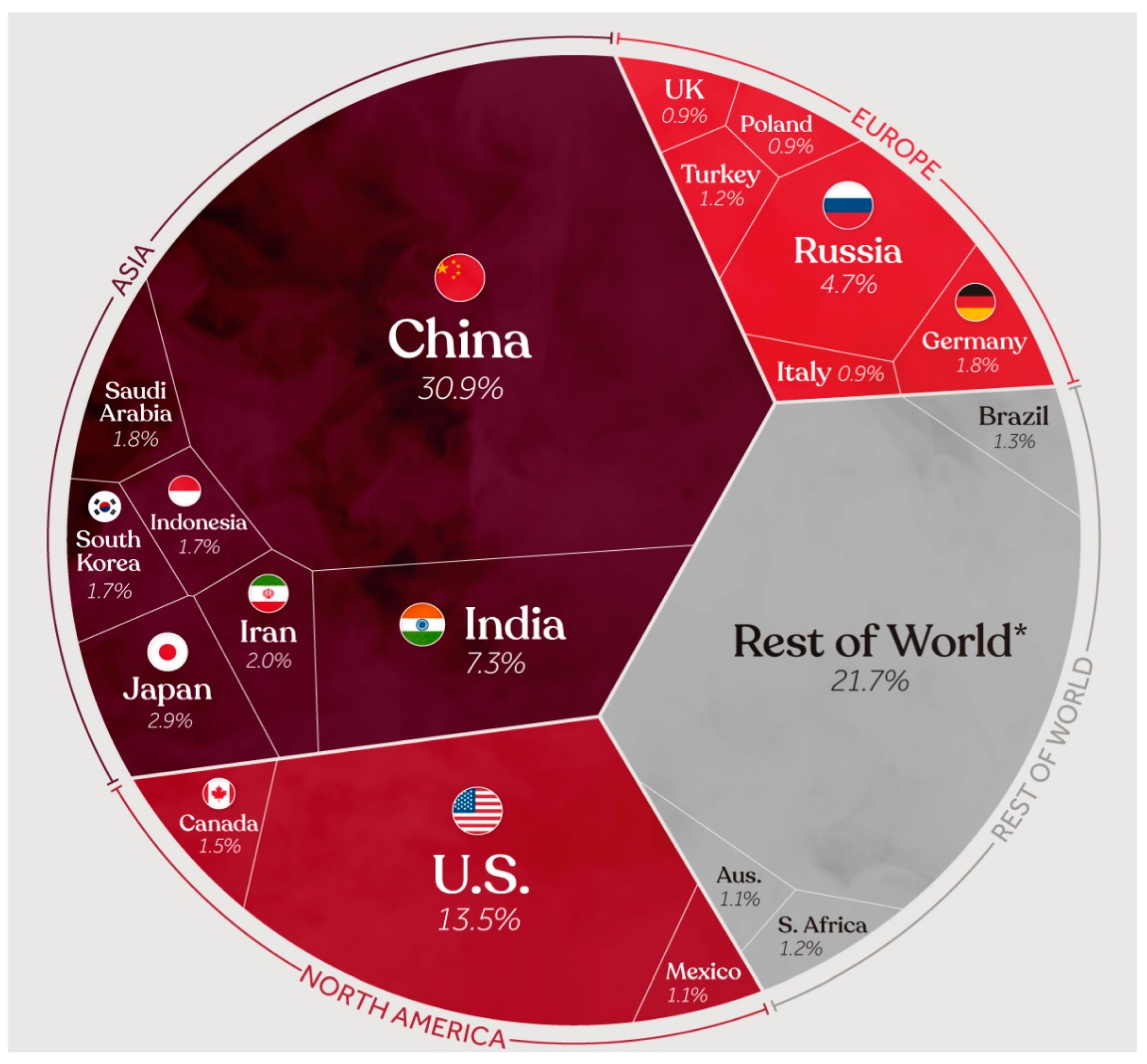
Figure 3.
An overview of the CCS value chain [12].
Figure 3.
An overview of the CCS value chain [12].
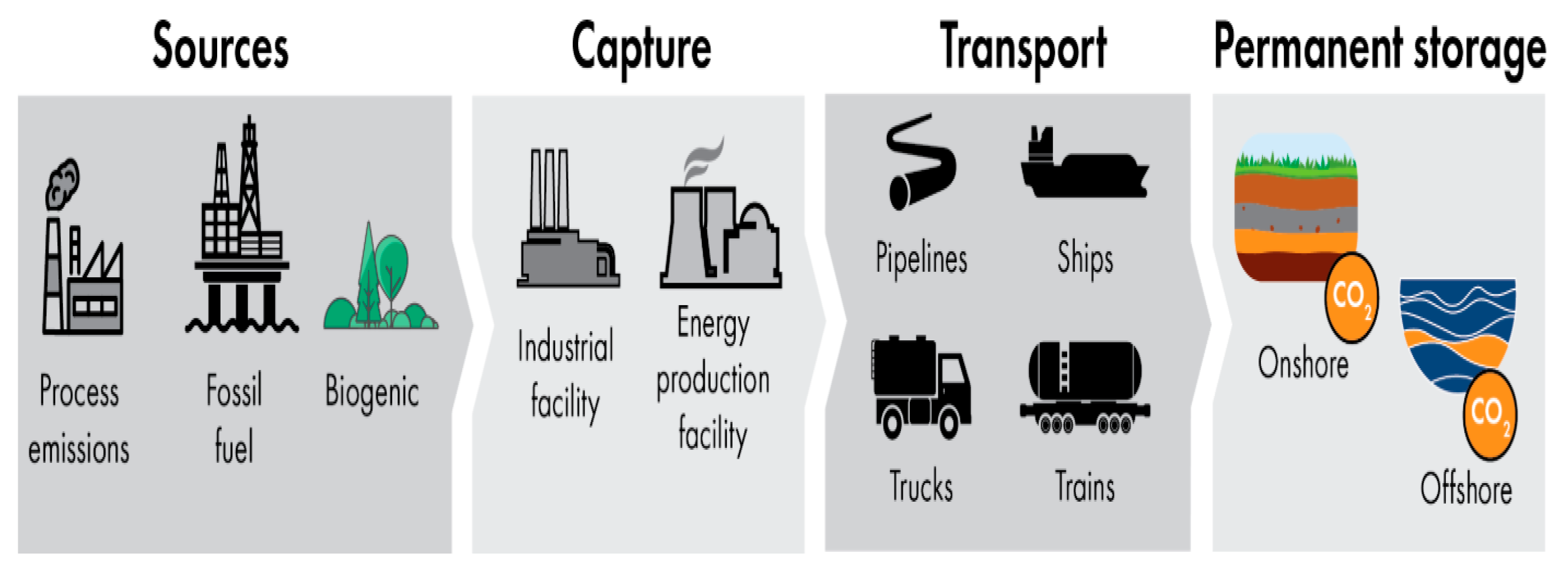
Figure 4.
Process diagram carbon capture and compression for an IGCC power plant[25].
Figure 4.
Process diagram carbon capture and compression for an IGCC power plant[25].
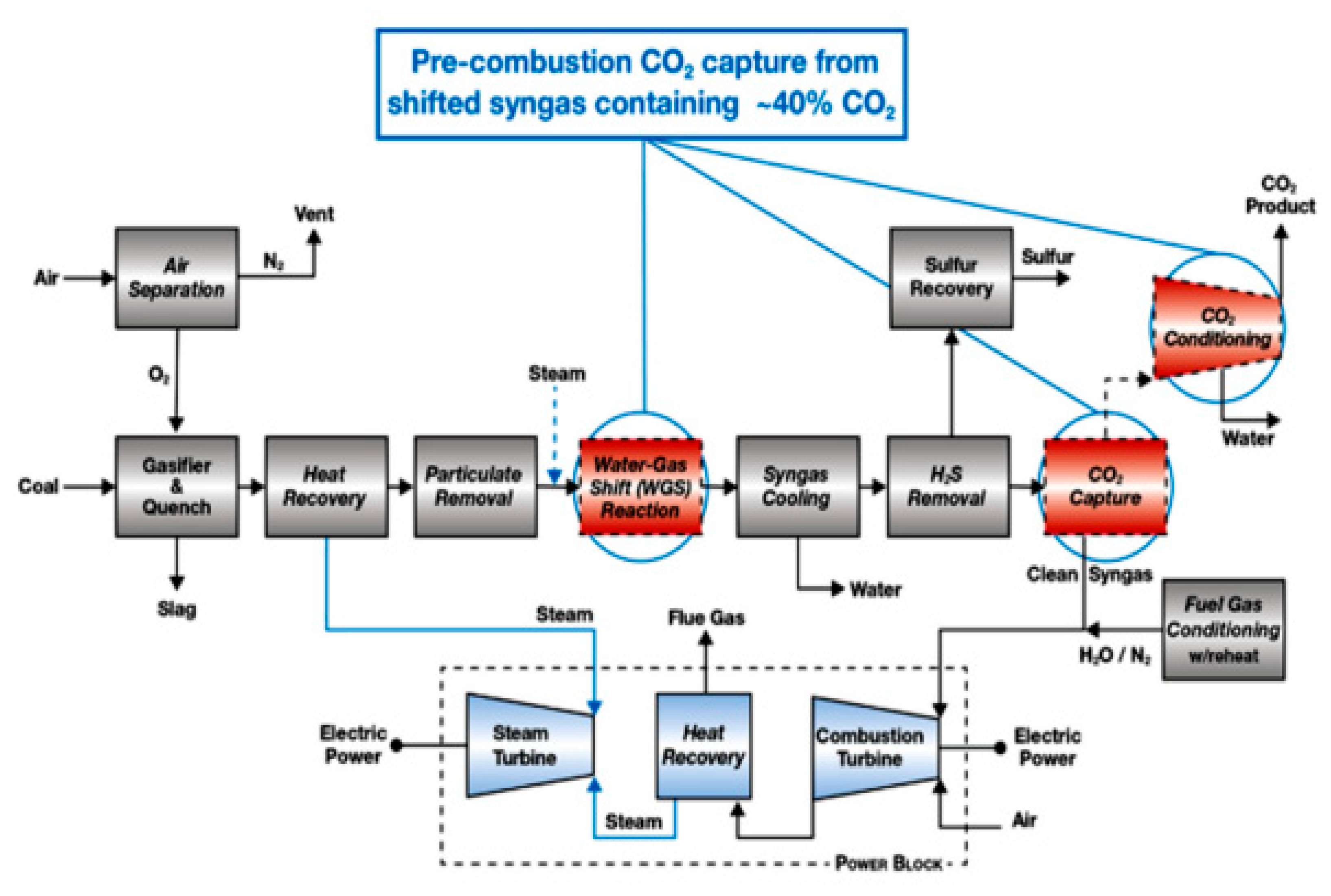
Figure 8.
Estimated cost of CO2 capture technologies.
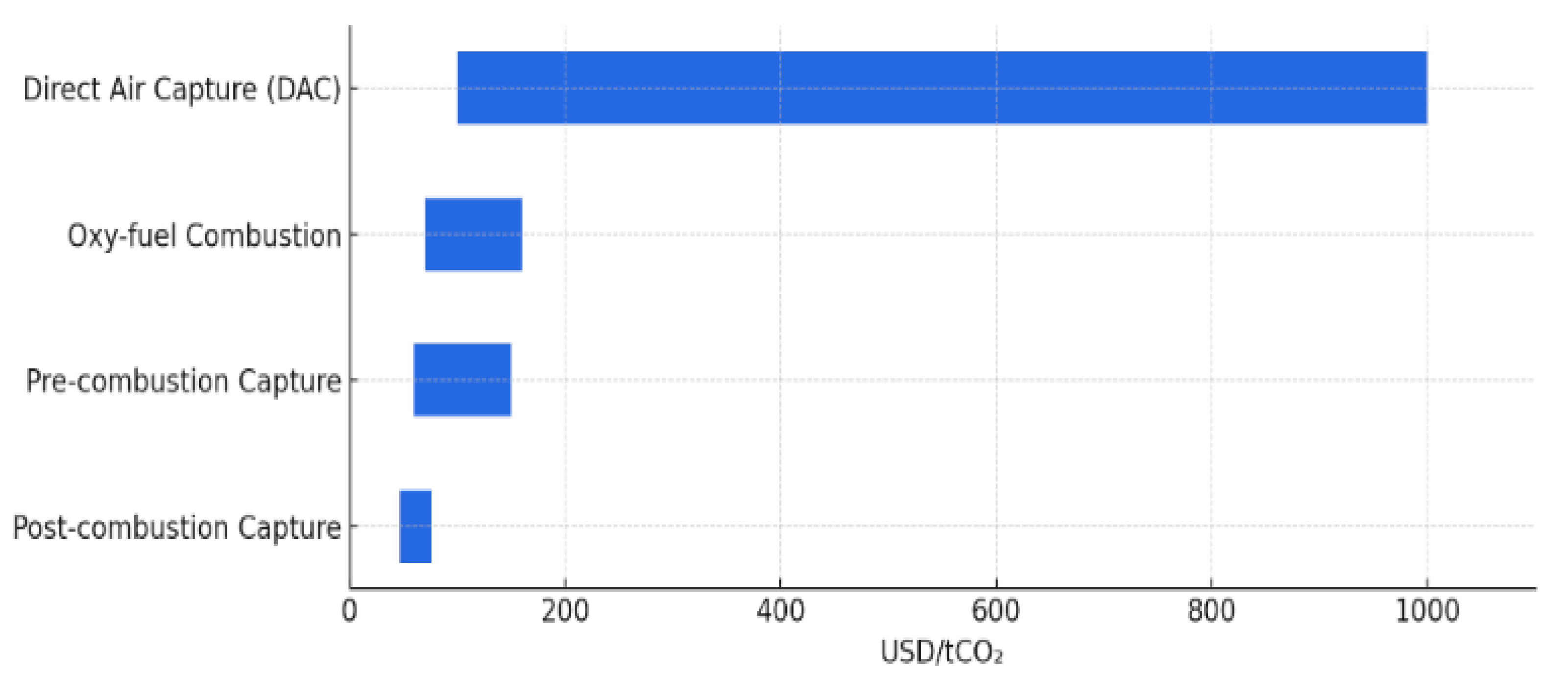
Figure 9.
Global CO₂ capture capacity of commercial-scale CCS installations[55].
Figure 9.
Global CO₂ capture capacity of commercial-scale CCS installations[55].
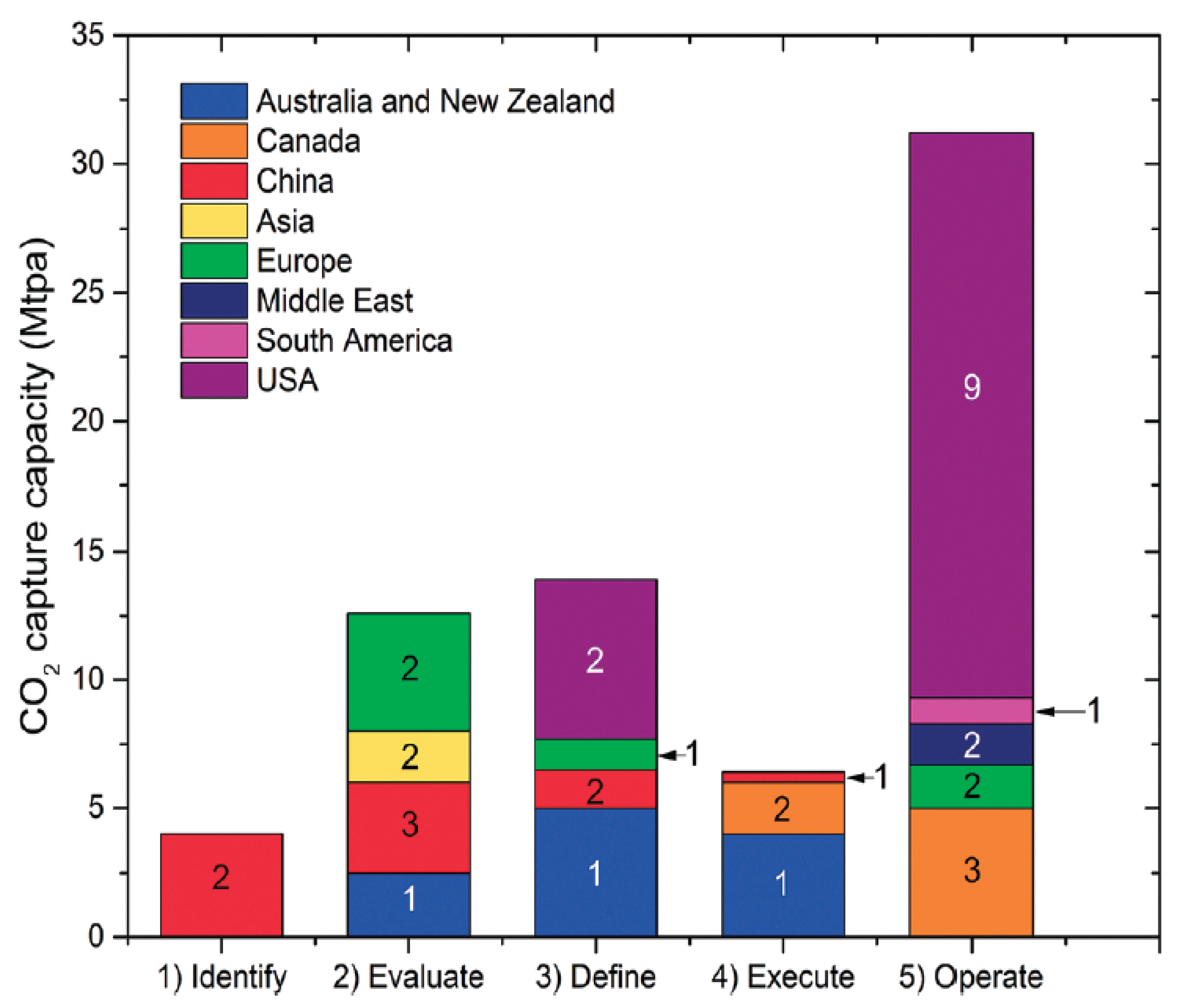

Table 1.
Comparison of different carbon capture storage technologies [50].
Table 1.
Comparison of different carbon capture storage technologies [50].
| Carbon Capture Technology | Applications | Advantages | Disadvantages | Feasibility |
|---|---|---|---|---|
| Pre-Combustion Capture | Broad applicability without major restrictions | Offers versatile deployment; capable of capturing CO₂ at low concentrations; can be integrated with renewable energy systems | Involves substantial capital expenditure and operational costs; technological challenges persist | Moderate Technically achievable but constrained by infrastructure and financial barriers |
| Post-Combustion Capture | Primarily used in Integrated Gasification Combined Cycle (IGCC) power plants | Established and mature technology; delivers high capture efficiency with straightforward separation processes | Applicability is limited to specific settings | High Most practical for retrofitting existing facilities with relatively lower initial costs |
| Oxy-Fuel Combustion | Suitable for pulverized coal power plants, natural gas combined cycle plants, and other fossil fuel power generation | Proven technology with broad applicability; suitable for retrofitting existing plants | Suffering from decreased thermal efficiency during operation | Moderate Technically reliable but challenged by energy penalties and efficiency reductions |
| Direct Air Capture (DAC) | Applicable to pulverized coal and IGCC power plants | Provides high purity and concentration of captured CO₂; relatively simple operational steps; can be used for retrofitting or repowering | Requires significant investment due to additional equipment and high energy consumption | Low to Moderate Holds promise for future application but currently limited by cost and energy intensity |
Table 2.
Real-world application of ccs technologies.
| Technology Type | Example Case Study | Scale / Features | Start-up Year | Reference |
|---|---|---|---|---|
| Direct Air Capture (DAC) | Climeworks Mammoth (Iceland) | ≈36,000 t CO₂/year using geothermal energy and modular solid sorbent units | 2024 | [59] |
| Direct Air Capture (DAC) | Climeworks Orca (Iceland) | ≈4,000 t CO₂/year; first large-scale DAC plant with underground mineralization | 2021 | [60] |
| Post-Combustion Capture | Mikawa post combustion capture plant (Japan) | Power generation 180Kt CO₂/year | ~2020 | [61] |
| Pre-Combustion | GreenGen IGCC Project, Tianjin, China | Designed to capture up to 1 Mt CO₂/year in full-scale implementation | ~2014 | [62] |
| Oxy-Fuel Combustion | Callide Oxy-Fuel Project (Australia) | Demo project captured ~27,300 t CO₂/year with ~80% CO₂ concentration flue gas | ~2020 | [63] |
Table 3.
Estimated COSTS of CCS Technologies.
| Technology | Estimated Cost (USD/ton CO₂) | Reference |
|---|---|---|
| Direct Air Capture (DAC) | $100–$1000/t CO₂ (may exceed $1,000/t in pilots) | [52] |
| Post-combustion Capture | $47–$76 /t CO₂ | [64] |
| Pre-combustion Capture | $60–$150 /t CO₂ | [65,66] |
| Oxy-fuel Combustion | $70–$160 /t CO₂ | [67,68] |
Table 4.
Major Bioenergy with Carbon Capture and Storage/Utilization (BECCS/CCU) Projects Currently in Operation Globally [101].
Table 4.
Major Bioenergy with Carbon Capture and Storage/Utilization (BECCS/CCU) Projects Currently in Operation Globally [101].
| Facility | Country | Sector | CO₂ Application | Commissioning Year | CO₂ Capture Capacity (kt/year) |
|---|---|---|---|---|---|
| Stockholm Exergi AB | Sweden | Combined heat and power | Not specified | 2019 | Pilot scale |
| Arkalon CO₂ Compression Facility | USA | Ethanol production | Storage (Enhanced Oil Recovery, EOR) | 2009 | 290 |
| OCAP | Netherlands | Ethanol production | Utilization | 2011 | Less than 400 |
| Bonanza Bioenergy CCUS EOR | USA | Ethanol production | Storage (EOR) | 2012 | 100 |
| Husky Energy CO₂ Injection | Canada | Ethanol production | Storage (EOR) | 2012 | 90 |
| Calgren Renewable Fuels CO₂ Plant | USA | Ethanol production | Utilization | 2015 | 150 |
| Lantmännen Agroetanol | Sweden | Ethanol production | Utilization | 2015 | 200 |
| Alco BioFuel Bio-refinery CO₂ Plant | Belgium | Ethanol production | Utilization | 2016 | 100 |
| Cargill Wheat Processing CO₂ Plant | UK | Ethanol production | Utilization | 2012 | 600 |
| Illinois Industrial CCS | USA | Ethanol production | Dedicated geological storage | 2017 | 1000 |
| Drax BECCS Plant | UK | Power generation | Not specified | 2020 | Pilot scale |
| Mikawa Post Combustion Capture | Japan | Power generation | Not specified | 2020 | 180 |
| Saga City Waste Incineration Plant | Japan | Waste-to-energy | Utilization | 2016 | 3 |
Disclaimer/Publisher’s Note: The statements, opinions and data contained in all publications are solely those of the individual author(s) and contributor(s) and not of MDPI and/or the editor(s). MDPI and/or the editor(s) disclaim responsibility for any injury to people or property resulting from any ideas, methods, instructions or products referred to in the content. |
© 2025 by the authors. Licensee MDPI, Basel, Switzerland. This article is an open access article distributed under the terms and conditions of the Creative Commons Attribution (CC BY) license (http://creativecommons.org/licenses/by/4.0/).
Copyright: This open access article is published under a Creative Commons CC BY 4.0 license, which permit the free download, distribution, and reuse, provided that the author and preprint are cited in any reuse.


