

Submitted:
11 August 2025
Posted:
13 August 2025
You are already at the latest version
Abstract
Microbial fuel cells (MFCs) are promising technologies for generating bioelectricity from organic waste through microbial catalysis. However, the high cost of membranes used in MFCs remains one of the major concerns limiting their widespread application. In this study, a low-cost and readily available bio-membrane fabricated from onion skin was developed and applied as the membrane component in MFCs. By using Shewanella oneidensis MR-1 as the model exoeletrogen, the onion skin membrane equipped MFC delivered even higher bioelectricity output (~133 mW/m2) compared to that equipped with the costly Nafion membrane (~74 mW/m2). This research demostrated that it is possible to use onion membrane as a cost-effective alternative to Nafion membrane for bioelectrochemical systems.
Keywords:
microbial fuel cell
; onion skin
; proton exchange membrane
; bioelectrochemistry
; cost-effective
1. Introduction
Microbial fuel cell (MFC) is an innovative device in which the chemical energy stored in the organic waste can be efficiently converted to bioelectricity with the assist of the metabolic catalysis by microorganisms (Lovley 2006, Zhao, Slade et al. 2009, Yong, Dong et al. 2012, Sun, Peter Kingori et al. 2015). Thus, MFC is considered to be a promising technology for energy-saving wastewater treatment (Yong, Yu et al. 2011, Tao, Wei et al. 2013, Xu 2013, Yong, Yu et al. 2013, Yong, Yu et al. 2014). More impressively, series of important and interesting applications derived from MFC have been developed in recent years, which including microbial electrolysis cells for efficient H2 production (Cheng and Logan 2007), microbial electrosynthesis cells for CO2 upgrading (Lovley and Nevin 2013), bioelectrochemical biosensors for wastewater monitoring (Lovley and Nevin 2013),etc. However, application is limited as materials of MFC are expensive, in particularly the proton/cation exchange membrane.
Nafion is the most widely used proton exchange membrane (Daud, Kim et al. 2015) however it has serious drawback in its applications for its high cost of production and hence high market price which normally goes for about $55 per 100cm2 (Tao, Sun et al. 2015). Researchers have recently developed alternative and cost effective material with the aim of increasing the economic feasibility of MFC by reducing the capital investment. Some of the membranes developed are Sulfonated poly-ether-ether-ketone (SPEEK) which shares a similar structure with Nafion, where ionic clusters co-exist with hydrophobic domains of the polymer backbones, Sulfonated polystyrene-ethylene-butylene-polystyrene(PSEBS)(Ayyaru, Letchoumanane et al. 2012) Ultrex CMI7000 made by membranes Inc. USA) and Hyflon Ion made by Solvay-solexis SPA. Ultrex CMI7000 is a strong, acid polymer membrane with a gel polystyrene backbone structure cross-linked with divinyl benzene containing a large amount of sulphonate groups(Ismail and Jaeel 2013) hyflon Ion is a copolymer of tetra fluoroethylene (TFE) and a short-side-side(SSC) perfluoroosulfonylfluoridevinyl ether(Arcella, Ghielmi et al. 2003). Porous separator materials that enable non-ion selective charge transfer have been used such as J-cloth(Fan, Hu et al. 2007) natural rubber(Winfield, Ieropoulos et al. 2013, Winfield, Chambers et al. 2014) earthen pot(Behera, Jana et al. 2010) and cellulose nanocrystals (CNC)(Rhim, Reddy et al. 2015). Another novel membrane that has been developed and exhibits voltage output is titanium dioxide (TiO2)-quaternised poly(vinyl alcohol) (QAPVA) hybrid anion membrane (Tao, Sun et al. 2015).
The food industry produces a significant amount of agricultural wastes, making it necessary to search for possible ways for their utilization, one of the major food crops is onions, it is estimated that more than 500,000 tonnes of onion waste are discarded every year within the European Union(Roldán, Sánchez-Moreno et al. 2008). Onion skin contains a high amount of bioaccessible and bioavailable compounds with well documented biological activity(Benítez, Mollá et al. 2011).One way could be to use these onion wastes as a natural source of high-value functional ingredients since onions are rich in several groups of compounds, which have perceived benefits to human health(Gawlik-Dziki, Kaszuba et al. 2015). Various research has noted that due to strong aroma of onion waste it is unsuitable for use in animal fodder, due to phytopathogens, it is not suitable for landfill disposal (Salak, Daneshvar et al. 2013) . Other research has found that the brown skin and top–bottom could be potentially used as functional ingredients rich in dietary fibre. Brown skin has a high concentration of quercetin aglycone and calcium (Benítez, Mollá et al. 2011) other research has shown onion skin as biosorbent which is effective in removal of methylene blue dye from contaminated waters (Saka and Sahin 2011) there has also been use of onion skins for development of sugars and quercetin by- products (Choi, Cho et al. 2015) the onion skins have also recently been evaluated as raw materials for the enzymatic production of pectic oligosaccharides (Babbar, Baldassarre et al. 2016).This study aimed at assessing the feasibility of onion skins (Allium cepa L.) for application in the microbial fuel cells as a cost-effective membrane.
2. Materials and Methods
2.1. Chemicals and Materials
All chemicals with analytical grade were purchased from Sinopharm Chemical Reagent Co. Ltd (Shanghai, China) and directly used without further purification. Nafion proton exchange membrane (Nafion 117, thickness of 117 μm) was purchased from DuPont (). Red onion were brought from a local market, the fresh skin was collected and washed three times with distilled water. The washed onion skin was then dried under 60 oC for 24 hours and then cut to 3*4 cm (the same size of Nafion membrane used in this study).
2.2. Bacteria and Culture Conditions
Shewanella oneidensis MR-1 was routinely cultured in LB broth (peptone 10 g/L, yeast extract 5 g/L, NaCl 5 g/L, pH 7.0) with shaking 150 rpm at 30 oC as described elsewhere ().The bacteria cells were then harvested by centrifugation and re-suspended in mixed medium containing M9 salt medium (Tian et al. 2002), 5% LB broth and 10 mM sodium lactate to an optical density of 1.5 (OD600). The bacteria suspension was further bubbled with nitrogen and employed as anodic electrolyte.
2.3. Membrane Characterization
Fourier transformation infrared (FT-IR) spectra of the samples obtained between 400 and 4000 cm-1 with AVATAR 360 FTIR (Madison, USA). The morphology of the prepared onion membrane was characterized with Thermal Field Emission SEM JSM-7001F (Joel, Japan).
2.4. MFC Set-Up and Analysis
A dual chamber MFC (inner size of 4 cm × 4 cm × 2 cm for both chamber) separated with onion skin membrane or Nafion 117 membrane was used in this experiment. Carbon cloth (2cm×3cm) was used for cathode and (1cm×2cm) for anode electrode. The anodic chamber was filled with the bacterial suspension electrolyte prepared above. The cathode chamber was filled with 0.05mol/L K3 [Fe (CN) 6] and KCl solution. The MFC operation started when a 2 kΩ external resistor was connected between the anode and the cathode. Operating temperature was maintained at 30⁰C. The voltage (V) across the external resistor (R) was monitored by a digital multimeter.(Zheng, Xu et al. 2015). The power output and polarization curves were obtained by varying the external resistor when the current output reached steady-state. The experiment was done in three triplicates, and the error bar for the power output in voltage was generated using Statistical software, notably SPSS.
3. Results and Discussion
3.1. Preparation and Characterization of Onion Skin Membrane
To apply the onion membrane for MFC utilization, fresh onion skin was peeled off and washed three times with DI water to remove possible contaminants. After that, the onion skin was dried at 60 oC for 24 hours and then cut to 4×3 cm (Figure 1). During the fabrication process, a major concern is the possible damage to the membrane. Optical microscopy was performed to check the membrane and make sure the intact membrane without damage and defect was selected for further characterization and application. The SEM images showed that the dried onion membrane has dense, compact, and smooth surface (Figure 2a). The surface of the onion skin is characterized as hydrophobic membrane .The dense structure and hydrophobic nature of the onion skin surface might be helpful to prevent diffusion of water or large molecules and avoid short-circuiting. From the SEM image from the cross-section of the onion skin membrane (Figure 2b), it is assembled layer-by-layer with the thickness of about 50-100 μm, which is comparable or even thinner than the commercially available Nafion membrane .Thinner membrane might result in faster proton diffusion and lower the internal resistance of the MFC, which might be beneficial to get higher output from MFC.
- Figure Legends
Figure 1.
Photograph of onin skin, prepared onion skin membrane and the prototype of onion skin membrane equiped MFC.
Figure 1.
Photograph of onin skin, prepared onion skin membrane and the prototype of onion skin membrane equiped MFC.
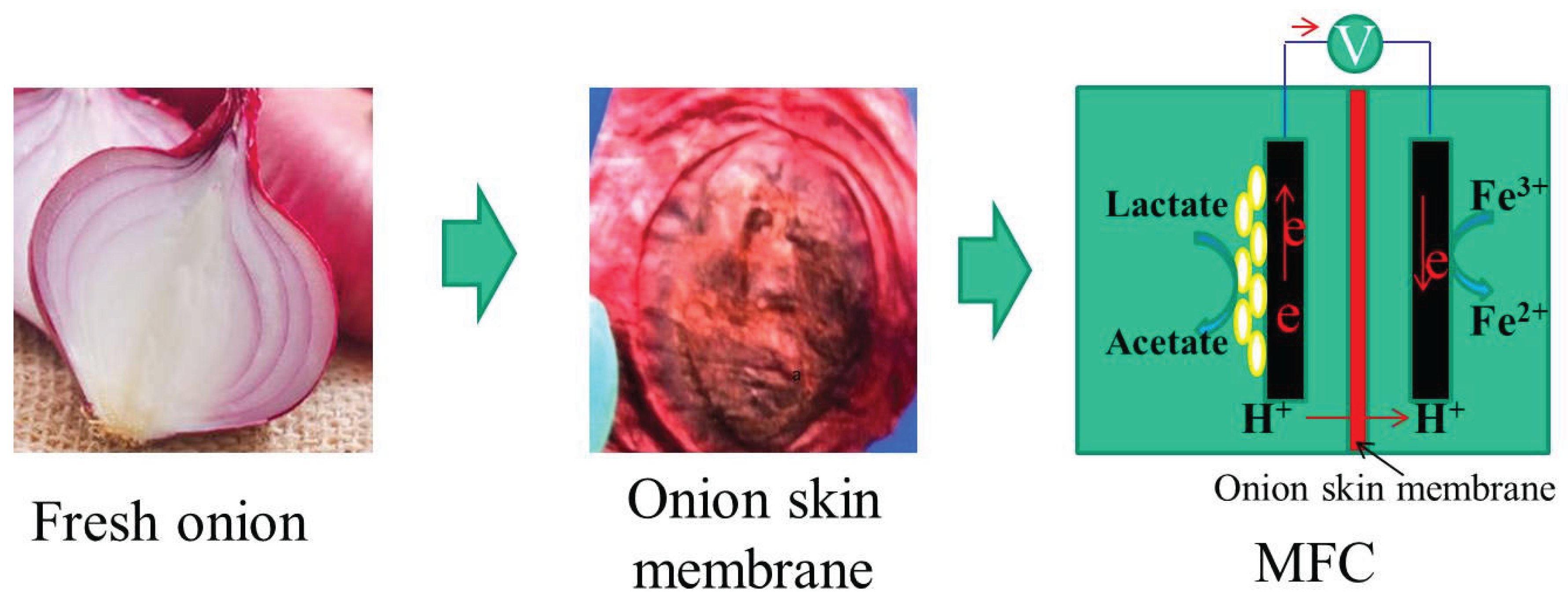
Figure 2.
SEM images of the prepared onion skin membrane (a) top view and (b) view of cross section. (c) FTIR spectrum of the onion skin membrane.
Figure 2.
SEM images of the prepared onion skin membrane (a) top view and (b) view of cross section. (c) FTIR spectrum of the onion skin membrane.
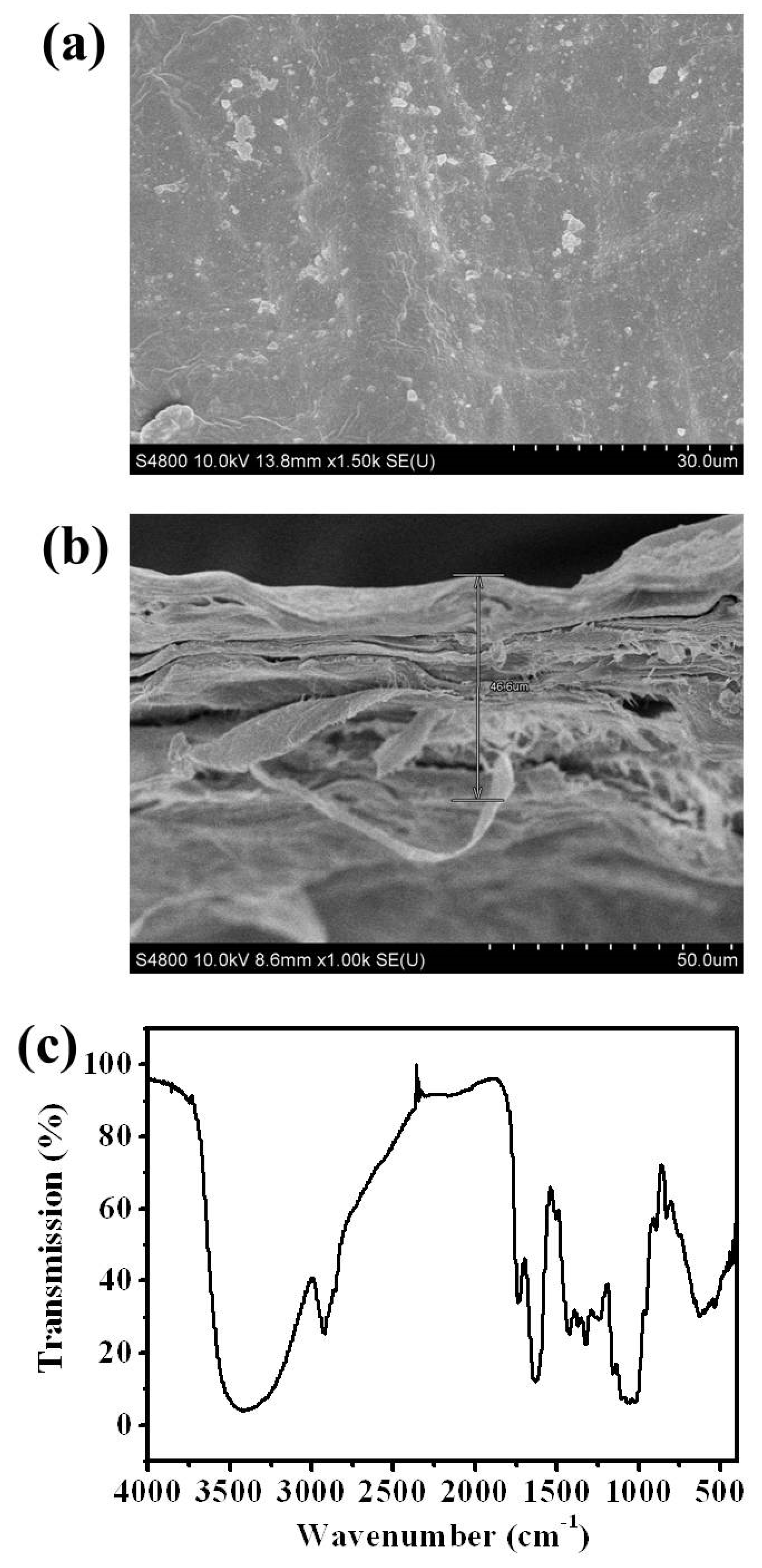
Alliums species contains various sulphur compounds such as thiosulfinates compounds (Lanzotti, Bonanomi et al. 2013, Lanzotti, Scala et al. 2014) that are known to have high proton affinities might attribute to proton exchange (Block, Dane et al. 2010, Kubec, Cody et al. 2010). Thus, the functional groups of the membrane were characterized with FTIR. According to the FTIR spectrum (Figure 2c), the onion membrane showed various bands, the broad absorption band 3382 cm2 is characteristic of the stretching vibration of hydrogen bonded hydroxyl groups, the bands at 2918 cm2 which arise due to aliphatic C-H stretching in an aromatic methoxyl group. Other band around 1620 cm2 were observed and are normally as a result of C=C vibrations in aromatic rings, C-O 1326 cm2. More impressively, the band with high adsorption at about 530 cm-1, 630 cm-1 and 1100 cm-1 might attribute to the characteristic peaks of sulfo-group. Sulfo-group was characterized its high proton exchange ability and was usually used as the functional groups for proton exchange membrane . Thus, the existence of the sulfonyl groups might provide the onion membrane with proton exchange capability and thus might be applied for MFC.
3.2. Performance of MFC with Onion Skin Membrane
To test the possible application of onion skin membrane in MFC, S. oneidensis MR-1 was selected as the model exoeletrogen and a dual chamber MFC was used. As shown in Figure 3, both of the MFCs equipped with Nafion 117 or onion skin membrane showed increased voltage output with similar trends after the bacteria inoculation at 0 h. The voltage outputs increased to their maximum value at about 30 h after bacteria inoculation and then decreased to baseline level at about 42 h due to substrate depletion. More interestingly, the highest voltage output obtained by the MFC with onion skin membrane is about 0.21 V, which is about 60% higher than that obtained by the MFC with Nafion 117 (0.13 V). The results substantiated that the onion skin membrane could act as the membrane for MFC.
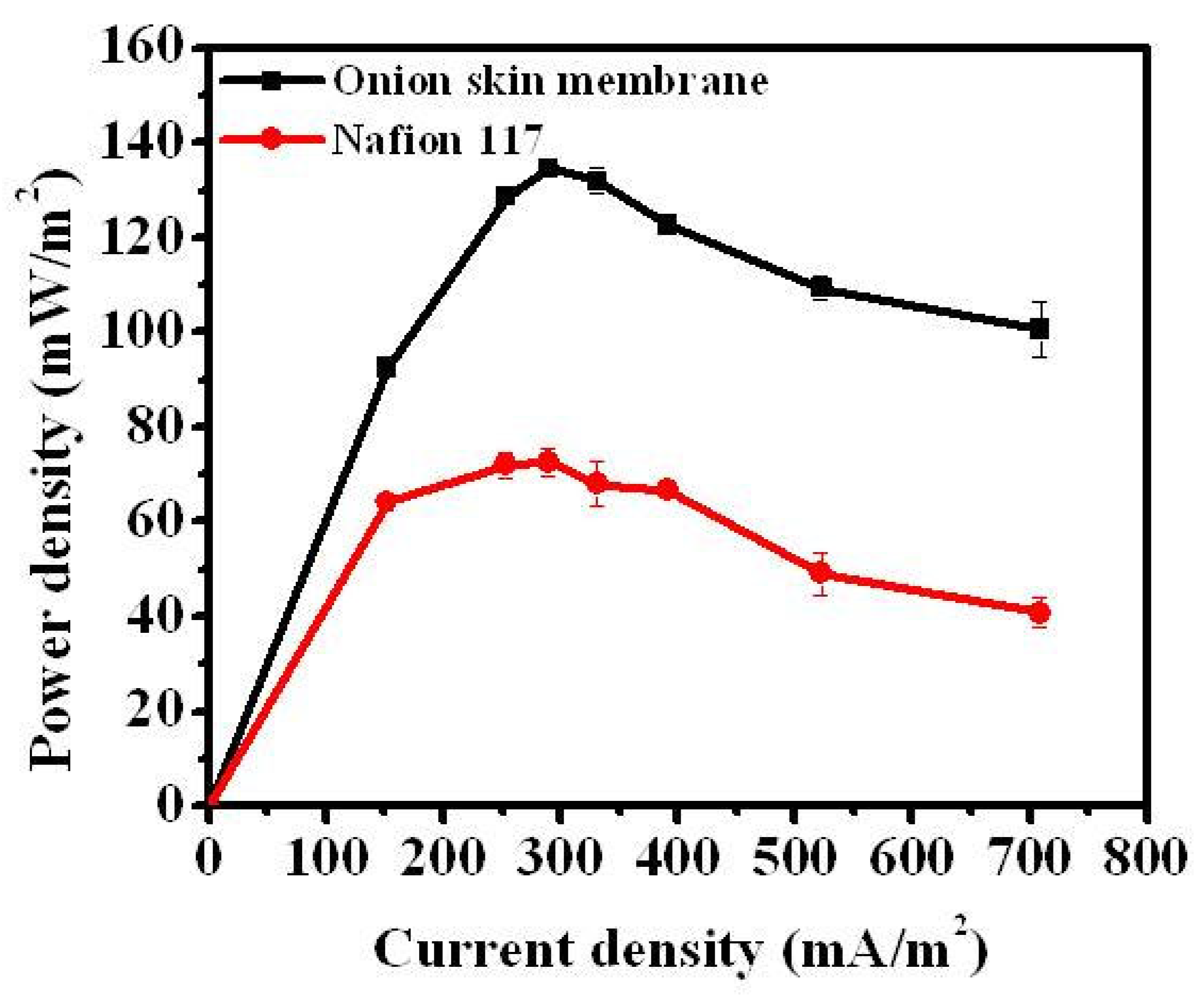
Maximum power density output was examined with power density curves. It was observed an increase in power density with a decrease in applied external resistance until a peak obtained (Figure 4). In good agreement with the voltage output, the MFC with onion skin membrane also showed higher (84% higher) power density output than that equipped with Nafion membrane. The MFC with onion skin membrane s was impressive with a power density of 134±1.9 mW/m2, while the MFC with Nafion 117 was 73±3 mW/m2.
As onion skin is biodegradable biomaterial, biodegradation generated pores might help proton transfer. However, long-term degradation might result in marco-size holes and hence short-circuiting. The long-term performance of the onion membrane was also tested. It was found that while the onion membrane showed superior to Nafion 117 in ~120 hours’ operation (~3 cycles of MFC operation), the function of the membrane was gradually lost due to excessive deteroration after 120 h. However, due to the advantages of low cost and enviroment compability, it can be used for short-term, disposable devices such as biosensor applications derived from MFC.
4. Conclusions
This work demonstrated that it is possible to employ onion skin membrane with simple pretreatment as membrane of MFC. It was found that the performance of MFC with onion skin membrane was even higher than that with the commercial Nafion membrane. Although this bio-membrane could not be used for long-term operation, the low cost and good environment compability guaranteed it holds great promise in short-term, disposable applications.
Acknowledgment
Gakai P.K, thanks the support from Chinese scholarship Council for the scholarship award (2013404011).
References
- Arcella, V., A. Ghielmi and G. Tommasi (2003). "High Performance Perfluoropolymer Films and Membranes." Annals of the New York Academy of Sciences 984(1): 226-244.
- Ayyaru, S., P. Letchoumanane, S. Dharmalingam and A. R. Stanislaus (2012). "Performance of sulfonated polystyrene–ethylene–butylene–polystyrene membrane in microbial fuel cell for bioelectricity production." Journal of Power Sources 217: 204-208.
- Babbar, N., S. Baldassarre, M. Maesen, B. Prandi, W. Dejonghe, S. Sforza and K. Elst (2016). "Enzymatic production of pectic oligosaccharides from onion skins." Carbohydrate Polymers 146: 245-252. [CrossRef]
- Bautista, D. M., P. Movahed, A. Hinman, H. E. Axelsson, O. Sterner, E. D. Högestätt, D. Julius, S.-E. Jordt and P. M. Zygmunt (2005). "Pungent products from garlic activate the sensory ion channel TRPA1." Proceedings of the National Academy of Sciences of the United States of America 102(34): 12248-12252.
- Behera, M., P. S. Jana and M. M. Ghangrekar (2010). "Performance evaluation of low cost microbial fuel cell fabricated using earthen pot with biotic and abiotic cathode." Bioresource Technology 101(4): 1183-1189. [CrossRef]
- Benítez, V., E. Mollá, M. Martín-Cabrejas, Y. Aguilera, F. López-Andréu, K. Cools, L. Terry and R. Esteban (2011). "Characterization of Industrial Onion Wastes (Allium cepa L.): Dietary Fibre and Bioactive Compounds." Plant Foods for Human Nutrition 66(1): 48-57.
- Block, E., A. J. Dane, S. Thomas and R. B. Cody (2010). "Applications of Direct Analysis in Real Time Mass Spectrometry (DART-MS) in Allium Chemistry. 2-Propenesulfenic and 2-Propenesulfinic Acids, Diallyl Trisulfane S-Oxide, and Other Reactive Sulfur Compounds from Crushed Garlic and Other Alliums." Journal of Agricultural and Food Chemistry 58(8): 4617-4625.
- Cheng, S. and B. E. Logan (2007). "Sustainable and efficient biohydrogen production via electrohydrogenesis." Proceedings of the National Academy of Sciences of the United States of America 104(47): 18871-18873.
- Choi, I. S., E. J. Cho, J.-H. Moon and H.-J. Bae (2015). "Onion skin waste as a valorization resource for the by-products quercetin and biosugar." Food Chemistry 188: 537-542. [CrossRef]
- Choi, T. H., Y.-B. Won, J.-W. Lee, D. W. Shin, Y. M. Lee, M. Kim and H. B. Park (2012). "Electrochemical performance of microbial fuel cells based on disulfonated poly(arylene ether sulfone) membranes." Journal of Power Sources 220(0): 269-279. [CrossRef]
- Cusick, R. D., Y. Kim and B. E. Logan (2012). "Energy Capture from Thermolytic Solutions in Microbial Reverse-Electrodialysis Cells." Science 335(6075): 1474-1477. [CrossRef]
- Daud, S. M., B. H. Kim, M. Ghasemi and W. R. W. Daud (2015). "Separators used in microbial electrochemical technologies: Current status and future prospects." Bioresource Technology 195: 170-179. [CrossRef]
- Fan, Y., H. Hu and H. Liu (2007). "Enhanced Coulombic efficiency and power density of air-cathode microbial fuel cells with an improved cell configuration." Journal of Power Sources 171(2): 348-354. [CrossRef]
- Gawlik-Dziki, U., K. Kaszuba, K. Piwowarczyk, M. Świeca, D. Dziki and J. Czyż (2015). "Onion skin — Raw material for the production of supplement that enhances the health-beneficial properties of wheat bread." Food Research International 73: 97-106. [CrossRef]
- Grzebyk, M. and G. Poźniak (2005). "Microbial fuel cells (MFCs) with interpolymer cation exchange membranes." Separation and Purification Technology 41(3): 321-328. [CrossRef]
- He, Y., H. Zhang, Y. Li, J. Wang, L. Ma, W. Zhang and J. Liu (2015). "Synergistic proton transfer through nanofibrous composite membranes by suitably combining proton carriers from the nanofiber mat and pore-filling matrix." Journal of Materials Chemistry A 3(43): 21832-21841. [CrossRef]
- Ismail, Z. Z. and A. J. Jaeel (2013). "Sustainable Power Generation in Continuous Flow Microbial Fuel Cell Treating Actual Wastewater: Influence of Biocatalyst Type on Electricity Production." The Scientific World Journal 2013: 7. [CrossRef]
- Jia, X., Z. He, X. Zhang and X. Tian (2016). "Carbon paper electrode modified with TiO2 nanowires enhancement bioelectricity generation in microbial fuel cell." Synthetic Metals 215: 170-175. [CrossRef]
- Kim, Y. and B. E. Logan (2011). "Series Assembly of Microbial Desalination Cells Containing Stacked Electrodialysis Cells for Partial or Complete Seawater Desalination." Environmental Science & Technology 45(13): 5840-5845. [CrossRef]
- Kim, Y., S.-H. Shin, I. S. Chang and S.-H. Moon (2014). "Characterization of uncharged and sulfonated porous poly(vinylidene fluoride) membranes and their performance in microbial fuel cells." Journal of Membrane Science 463: 205-214. [CrossRef]
- Kubec, R., R. B. Cody, A. J. Dane, R. A. Musah, J. Schraml, A. Vattekkatte and E. Block (2010). "Applications of Direct Analysis in Real Time−Mass Spectrometry (DART-MS) in Allium Chemistry. (Z)-Butanethial S-Oxide and 1-Butenyl Thiosulfinates and Their S-(E)-1-Butenylcysteine S-Oxide Precursor from Allium siculum." Journal of Agricultural and Food Chemistry 58(2): 1121-1128.
- Kumar, V., A. Nandy, S. Das, M. Salahuddin and P. P. Kundu (2015). "Performance assessment of partially sulfonated PVdF-co-HFP as polymer electrolyte membranes in single chambered microbial fuel cells." Applied Energy 137: 310-321. [CrossRef]
- Lanzotti, V., G. Bonanomi and F. Scala (2013). "What makes Allium species effective against pathogenic microbes?" Phytochemistry Reviews 12(4): 751-772.
- Lanzotti, V., F. Scala and G. Bonanomi (2014). "Compounds from Allium species with cytotoxic and antimicrobial activity." Phytochemistry Reviews 13(4): 769-791. [CrossRef]
- Leong, J. X., W. R. W. Daud, M. Ghasemi, K. B. Liew and M. Ismail (2013). "Ion exchange membranes as separators in microbial fuel cells for bioenergy conversion: A comprehensive review." Renewable and Sustainable Energy Reviews 28: 575-587. [CrossRef]
- Lovley, D. R. (2006). "Bug juice: harvesting electricity with microorganisms." Nature Reviews Microbiology 4(7): 497-508. [CrossRef]
- Lovley, D. R. (2006). "Bug juice: harvesting electricity with microorganisms (vol 4, pg 497, 2006)." Nature Reviews Microbiology 4(10): 797-797. [CrossRef]
- Lovley, D. R. and K. P. Nevin (2013). "Electrobiocommodities: powering microbial production of fuels and commodity chemicals from carbon dioxide with electricity." Current Opinion in Biotechnology 24(3): 385-390. [CrossRef]
- Min, B., S. Cheng and B. E. Logan (2005). "Electricity generation using membrane and salt bridge microbial fuel cells." Water Research 39(9): 1675-1686. [CrossRef]
- Quero, F., M. Nogi, K.-Y. Lee, G. V. Poel, A. Bismarck, A. Mantalaris, H. Yano and S. J. Eichhorn (2011). "Cross-Linked Bacterial Cellulose Networks Using Glyoxalization." ACS Applied Materials & Interfaces 3(2): 490-499. [CrossRef]
- Rabaey, K., G. Lissens, S. Siciliano and W. Verstraete (2003). "A microbial fuel cell capable of converting glucose to electricity at high rate and efficiency." Biotechnology Letters 25(18): 1531-1535. [CrossRef]
- Rhim, J.-W., J. Reddy and X. Luo (2015). "Isolation of cellulose nanocrystals from onion skin and their utilization for the preparation of agar-based bio-nanocomposites films." Cellulose 22(1): 407-420. [CrossRef]
- Roldán, E., C. Sánchez-Moreno, B. de Ancos and M. P. Cano (2008). "Characterisation of onion (Allium cepa L.) by-products as food ingredients with antioxidant and antibrowning properties." Food Chemistry 108(3): 907-916. [CrossRef]
- Saka, C. and Ö. Sahin (2011). "Removal of methylene blue from aqueous solutions by using cold plasma- and formaldehyde-treated onion skins." Coloration Technology 127(4): 246-255. [CrossRef]
- Salak, F., S. Daneshvar, J. Abedi and K. Furukawa (2013). "Adding value to onion (Allium cepa L.) waste by subcritical water treatment." Fuel Processing Technology 112: 86-92.
- Salvi, D. T. B., H. S. Barud, J. M. A. Caiut, Y. Messaddeq and S. J. L. Ribeiro (2012). "Self-supported bacterial cellulose/boehmite organic–inorganic hybrid films." Journal of Sol-Gel Science and Technology 63(2): 211-218. [CrossRef]
- Schroder, U., F. Harnisch and L. T. Angenent (2015). "Microbial electrochemistry and technology: terminology and classification." Energy & Environmental Science 8(2): 513-519. [CrossRef]
- Shao, W., S. Wang, H. Liu, J. Wu, R. Zhang, H. Min and M. Huang (2016). "Preparation of bacterial cellulose/graphene nanosheets composite films with enhanced mechanical performances." Carbohydrate Polymers 138: 166-171. [CrossRef]
- Singha, S., T. Jana, J. A. Modestra, A. Naresh Kumar and S. V. Mohan (2016). "Highly efficient sulfonated polybenzimidazole as a proton exchange membrane for microbial fuel cells." Journal of Power Sources 317: 143-152. [CrossRef]
- Sun, J.-Z., G. Peter Kingori, R.-W. Si, D.-D. Zhai, Z.-H. Liao, D.-Z. Sun, T. Zheng and Y.-C. Yong (2015). "Microbial fuel cell-based biosensors for environmental monitoring: a review." Water Science and Technology 71(6): 801-809. [CrossRef]
- Sun, J., Y. Hu, Z. Bi and Y. Cao (2009). "Improved performance of air-cathode single-chamber microbial fuel cell for wastewater treatment using microfiltration membranes and multiple sludge inoculation." Journal of Power Sources 187(2): 471-479. [CrossRef]
- Tao, H.-C., X.-N. Sun and Y. Xiong (2015). "A novel hybrid anion exchange membrane for high performance microbial fuel cells." RSC Advances 5(6): 4659-4663. [CrossRef]
- Tao, H. C., X. Y. Wei, L. J. Zhang, T. Lei and N. Xu (2013). "Degradation of p-nitrophenol in a BES-Fenton system based on limonite." Journal of Hazardous Materials 254: 236-241. [CrossRef]
- Tursun, H., R. Liu, J. Li, R. Abro, X. Wang, Y. Gao and Y. Li (2016). "Carbon Material Optimized Biocathode for Improving Microbial Fuel Cell Performance." Frontiers in Microbiology 7(6). [CrossRef]
- Winfield, J., L. D. Chambers, J. Rossiter, J. Greenman and I. Ieropoulos (2014). "Towards disposable microbial fuel cells: Natural rubber glove membranes." International Journal of Hydrogen Energy 39(36): 21803-21810. [CrossRef]
- Winfield, J., I. Ieropoulos, J. Rossiter, J. Greenman and D. Patton (2013). "Biodegradation and proton exchange using natural rubber in microbial fuel cells." Biodegradation 24(6): 733-739. [CrossRef]
- Xu, N. e. a. (2013). "Bio-electro-Fenton system for enhanced estrogens degradation." Bioresource Technology 138: 136-140. [CrossRef]
- Yong, Y.-C., Y.-Y. Yu, X. Zhang and H. Song (2014). "Highly Active Bidirectional Electron Transfer by a Self-Assembled Electroactive Reduced-Graphene-Oxide-Hybridized Biofilm." Angewandte Chemie International Edition 53(17): 4480-4483.
- Yong, Y. C., X. C. Dong, M. B. Chan-Park, H. Song and P. Chen (2012). "Macroporous and Monolithic Anode Based on Polyaniline Hybridized Three-Dimensional Graphene for High-Performance Microbial Fuel Cells." Acs Nano 6(3): 2394-2400. [CrossRef]
- Yong, Y. C., Y. Y. Yu, C. M. Li, J. J. Zhong and H. Song (2011). "Bioelectricity enhancement via overexpression of quorum sensing system in Pseudomonas aeruginosa-inoculated microbial fuel cells." Biosensors & Bioelectronics 30(1): 87-92. [CrossRef]
- Yong, Y. C., Y. Y. Yu, Y. Yang, J. Liu, J. Y. Wang and H. Song (2013). "Enhancement of extracellular electron transfer and bioelectricity output by synthetic porin." Biotechnology and Bioengineering 110(2): 408-416. [CrossRef]
- Zhang, H., Y. He, J. Zhang, L. Ma, Y. Li and J. Wang (2016). "Constructing dual-interfacial proton-conducting pathways in nanofibrous composite membrane for efficient proton transfer." Journal of Membrane Science 505: 108-118. [CrossRef]
- Zhao, F., R. C. Slade and J. R. Varcoe (2009). "Techniques for the study and development of microbial fuel cells: an electrochemical perspective." Chemical Society Reviews 38(7): 1926-1939. [CrossRef]
- Zheng, T., Y.-S. Xu, X.-Y. Yong, B. Li, D. Yin, Q.-W. Cheng, H.-R. Yuan and Y.-C. Yong (2015). "Endogenously enhanced biosurfactant production promotes electricity generation from microbial fuel cells." Bioresource Technology 197: 416-421. [CrossRef]
Figure 3.
Voltage output of MFCs equiped with onion membrane or Nafion 117.
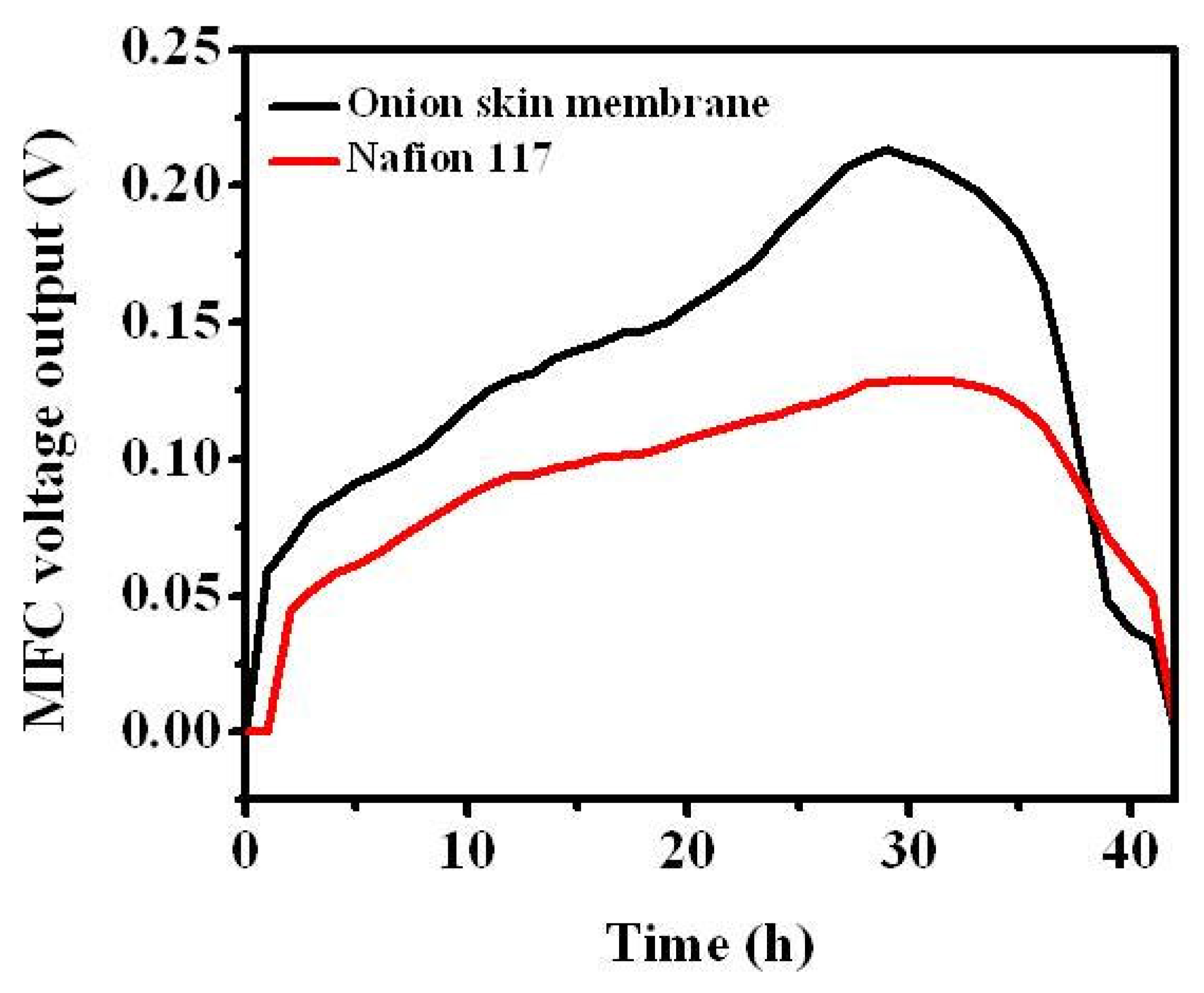
Figure 4.
Power density output of MFCs equiped with onion membrane or Nafion 117.
Disclaimer/Publisher’s Note: The statements, opinions and data contained in all publications are solely those of the individual author(s) and contributor(s) and not of MDPI and/or the editor(s). MDPI and/or the editor(s) disclaim responsibility for any injury to people or property resulting from any ideas, methods, instructions or products referred to in the content. |
© 2025 by the author. Licensee MDPI, Basel, Switzerland. This article is an open access article distributed under the terms and conditions of the Creative Commons Attribution (CC BY) license (https://creativecommons.org/licenses/by/4.0/).
Copyright: This open access article is published under a Creative Commons CC BY 4.0 license, which permit the free download, distribution, and reuse, provided that the author and preprint are cited in any reuse.


