

Submitted:
11 January 2026
Posted:
12 January 2026
You are already at the latest version
Abstract
This work offers formal proofs which were enabled by a change in perspective from studying individual integer iterations to analyzing how the conjecture's rules organize the positive integers. The proofs rigorously demonstrate the satisfaction of several critical criteria: the universal inclusion of all positive integers within the proof's scope; the disclosure of a simple and predictable pattern among the numbers; the conclusive absence of any major loops; the demonstration that no number continuously increases indefinitely without eventually decreasing; and the ultimate convergence of all positive integers to 1 when subjected to the Collatz iteration rules. Formal verification of these proofs was conducted using the Isabelle/HOL proof assistant.
Keywords:
Collatz conjecture
; proof
; rules
; dendritic pattern
MSC: Primary 11B83; Secondary 11Y16
1. Introduction
The Collatz conjecture was first proposed by Lothar Collatz in 1937. Additionally, the conjecture is called the problem, the conjecture, the Ulam conjecture, Kakutani’s, the Thwaites conjecture, and Hasse’s algorithm [9].
The Collatz conjecture states that if is an even Positive integer, then
If is an odd positive integer, then
Then repeated iterations of this process produces the value , where i is the iteration step.
Although the conjecture appears to be simple, it has remained unproven for almost 90 years. An issue is that the values of the intermediate steps can increase to very large values from the original starting value. It is unknown whether there is a starting value that may continue to increase up to infinity and never reach 1. Or, a closely related issue is whether there are values that form an endless loop without ever reaching 1. The Collatz conjecture applies to all positive integers, so even if mathematicians prove the conjecture true for a very large number, they still cannot determine with certainty whether the next number follows the same pattern.
Many mathematicians have attempted and failed to prove the Collatz conjecture. Paul Erdos stated “mathematics may not be ready for such problems [Collatz conjecture]” [5]. Jeffrey Lagarias stated the Collatz conjecture “is an extraordinarily difficult problem, completely out of reach of present-day mathematics” [7]. Since these renowned mathematicians have failed to prove the Collatz conjecture, experts believe that solving the conjecture will require a new type of mathematics.
Leading mathematicians make comments that convince many people the Collatz conjecture is unsolvable, especially for those without an advanced mathematics degree. This widespread belief causes many mathematicians to ignore papers submitted for publication, assuming they must be incorrect [1]. As a result, this mindset hinders efforts to develop a proof for the Collatz conjecture.
Previous studies of the Collatz conjecture focused on the pattern of positive integers in the iteration sequence and the number of steps each positive integer takes before reaching 1 [2,4,7,8,9]. The difficulty in studying these parameters is that they greatly vary even when the positive integers are close in value. The number of steps from the initial value until reaching 1 appears to be unpredictable. For example, the value 26 takes 10 steps, value 27 takes 111 steps, and value 28 takes 18 steps.
It may not be a case of needing a new mathematical method to solve the Collatz conjecture, but a new way of looking at the problem. Solving the Collatz conjecture is easier if it is not looked at as a mathematical problem but as a mathematical puzzle.
Currently, mathematicians try to prove the Collatz conjecture by advancing the attempts by previous researchers. This is the classical way of progressing science. Each new researcher tries to improve on the previous researcher until finding a solution. However, the Collatz conjecture is a case of “you cannot get there from here.” Solving the conjecture requires starting at the beginning and using a new perspective, just like all math puzzles. The solution does not require using more complicated math but just looking at the puzzle in a new way [3].
Analysis of the rules for even and odd positive integers shows that the inter-relationship of these rules is important for understanding the Collatz conjecture. Preliminary results reported by Hahn (2024) show a study of the Collatz conjecture does not require the development of new mathematical methods, but just a new perspective on the problem [6].
We prove the Collatz conjecture by examining how the two rules organize positive integers rather than tracing the pathways of individual values.
2. Results
2.1. Rule for Even Numbers
If is an even positive integer, then .
For every even positive integer the Collatz rule for even positive integers halves the positive integer repeatedly until reaching an odd positive integer. A set of positive integers that consist of even positive integers with the same odd base positive integer is called an “odd base number set” ().
Let denote the set containing all such subsets.
}
}
}
}
⋮
therefore,
The positive integers in have the formula:
where , .
The general formula for an odd base number set is also the general formula for a positive integer.
General formula for a positive integer:
where , .
Odd positive integers are generated when and even positive integers are generated when .
The set of all odd base number sets equals the set of positive integers.
Proof 1.
If , two things need to be shown:
- 1.
- : Every element in is also in . This is true because and X are integers, and their product is an integer. Since and X is a positive odd integer, is a positive integer.
- 2.
- : Every element in is also in . Every natural number , n can be written as , where a is a non-negative integer representing the highest power of 2 that divides n, and X is the odd base number of n (obtained by dividing n by ). Since and X is an odd positive integer, n fits the definition of an element in .
Let . Show that , where is the set of natural numbers .
Let . By definition, for some non-negative integer a and some odd positive integer X. Since and , y is a positive integer. Therefore, . This shows that .
Let . z can be expressed as , where is the largest integer such that divides z, and is the odd base of z. Since z is a positive integer, a is a non-negative integer, and X is a positive odd integer. By the definition of , . This shows that .
Since and :
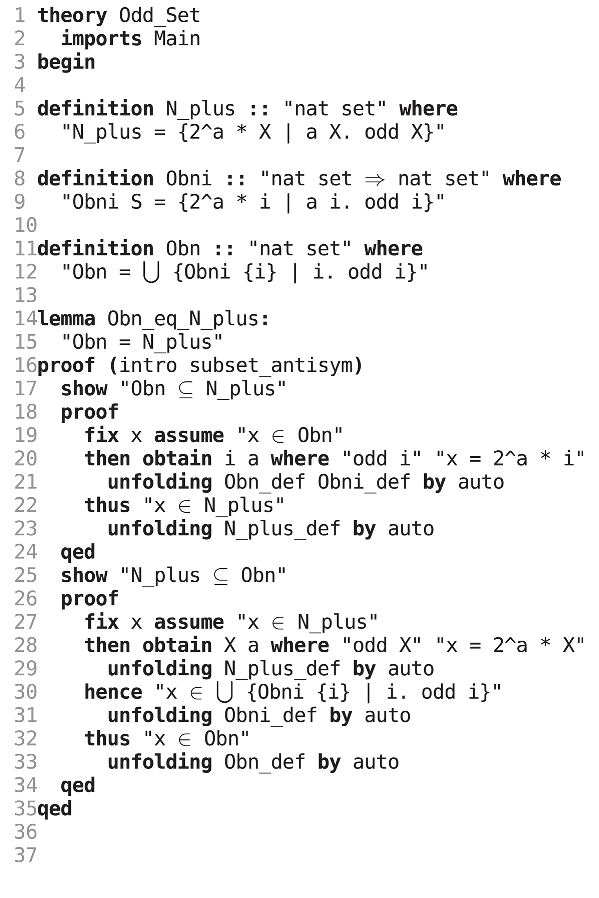
(see Appendix A for verification of proof with Isabelle/HOL proof assistant) □
The rule of even positive integers organizes all positive integers into one and only one odd base number set. Odd base number sets organize all positive integers; however, this is not enough to prove the Collatz conjecture since the rule only halves all even positive integers until reaching their odd base positive integer. The even number rule does not connect the odd base number sets into a path to eventually reach the positive integer “1.”
When examining the odd base number sets, an obvious dilemma appears. Each set has just a single odd positive integer with many even positive integers. However, there are equal quantities of even and odd positive integers. Therefore the key to developing a proof for the Collatz conjecture is to analyze how the odd number rule organizes the odd base number sets of positive integers.
2.2. Rule for Odd Numbers
If is an odd positive integer, then .
The Collatz rule for handling odd positive integers is , where is an odd positive integer. This rule causes the generation of an even positive integer after reaching an odd positive integer. Multiplying the odd positive integer by 3 creates an odd positive integer. The addition of 1 generates an even positive integer. Since each odd base number set has an odd positive integer as the base positive integer, the odd positive integer becomes linked to an even positive integer with the general formula of , where X is an odd positive integer and .
However, there must be a relationship between an odd base number and an even number.
The absence of a relationship could indicate a non-continuous connection between odd base number sets. In order to show a relationship, must be proven to be bijective.
Proof 2.
Let .
Define a function by . Then f is bijective.
Injectivity.
Suppose . Then
Subtracting 1 from both sides yields , and hence . Thus f is injective.
Surjectivity.
Let . By definition, there exists such that
Solving the equation gives
Since is odd, we have , and by construction . Hence f is surjective onto Y.
Conclusion. The function f is both injective and surjective as a map , and therefore bijective.
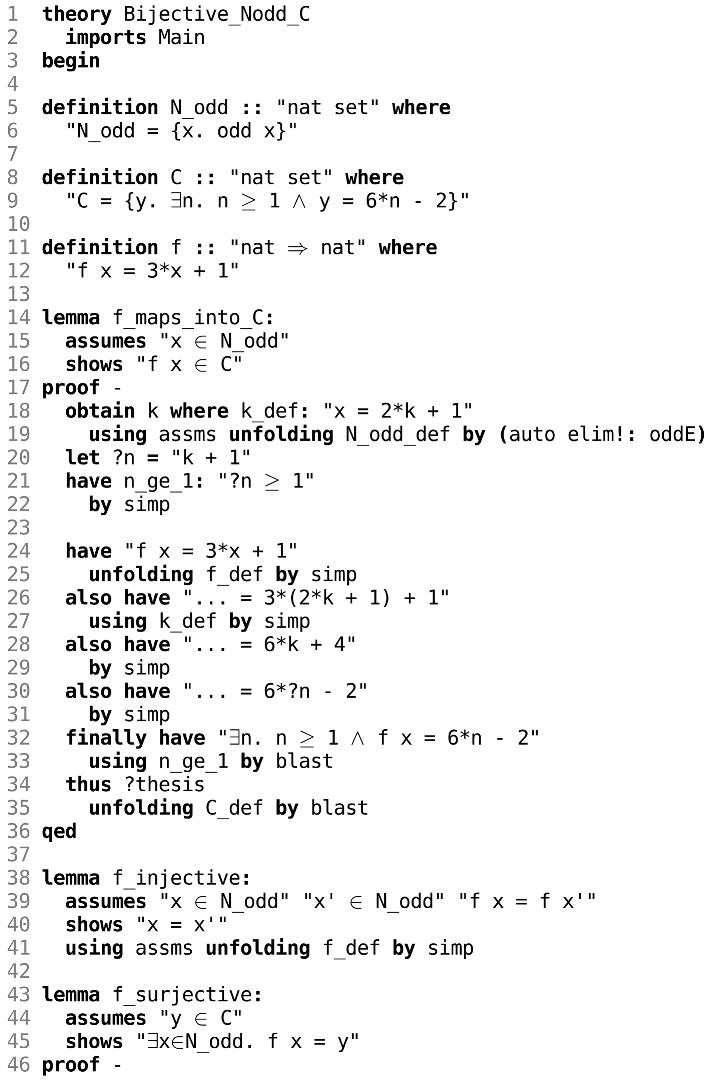
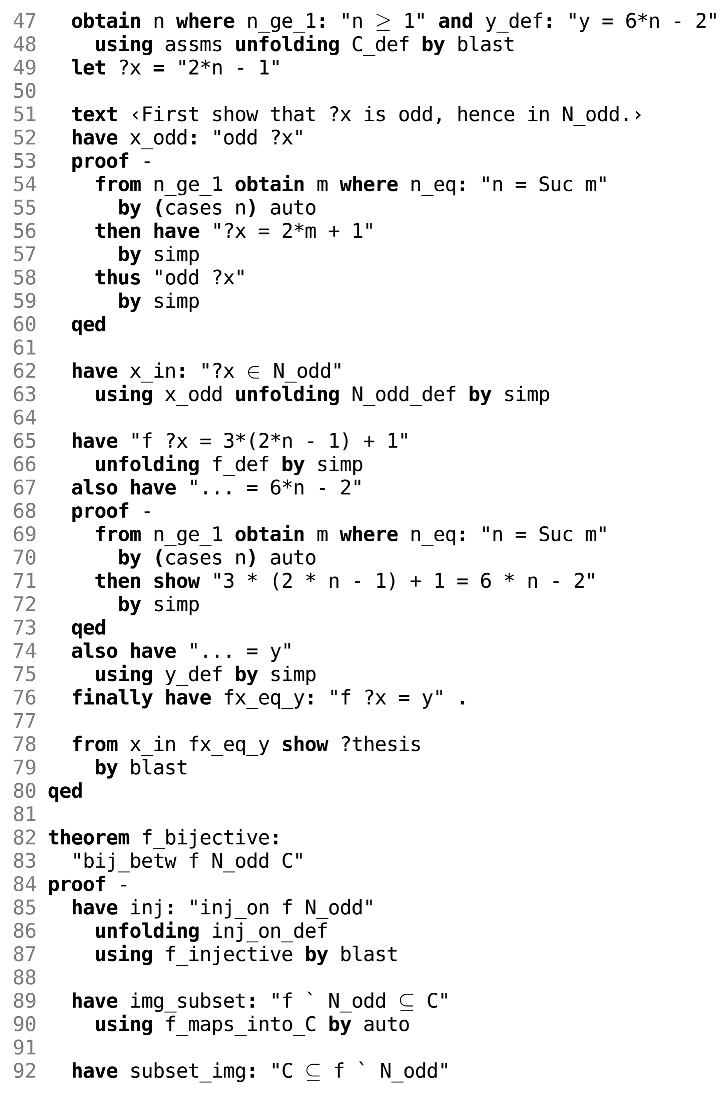
(see Appendix B for verification of proof with Isabelle/HOL proof assistant) □
We classify odd positive integers into three distinct categories based on their characteristics in odd base number sets. An odd positive integer is either one less than a positive multiple of 6 (e.g., (), where (N) is a positive integer), one more than a positive multiple of 6 (e.g., (), where (N) is a positive integer), or a number divisible by 3 (i.e., (), where X is a odd positive integer and the result is a positive integer).
Odd positive integers of the form , where X is an odd positive integer and N is a positive integer, create odd base number sets where every other positive integer starting from the first even positive integer (e.g., , , , …, where x is an odd positive integer) equals a positive integer written as (where and x are different odd positive integers). For example, if the odd base positive integer is 5 (e.g., ), then 10 [], 40 [], and 160 [] connect to odd base numbers 3, 13, and 53, respectively.
Odd positive integers of the form , where X is an odd positive integer and N is a positive integer, create odd base number sets where every other positive integer starting from the second even positive integer (e.g., , , ,…, where x is an odd positive integer) equals a positive integer written as (where and x are different odd positive integers). For example, if the odd positive integer is 7 (e.g., ), then 28 [(], 112 [(], and 448 [(] connect to odd base numbers 9, 37, and 149, respectively.
Odd positive integers divisible by 3 form the most interesting odd base number sets. Since each even positive integer in the odd base number set is divisible by 3, none of the even positive integers are expressed by the formula , where x is an odd positive integer. This results in none of the even positive integers in the set being connected to another odd base number set. Unless the initial positive integer selected for analysis with the Collatz conjecture is a positive integer divisible by 3, then none of the odd base number sets with an odd base positive integer divisible by 3 is reached during the iteration of positive integers.
Each odd positive integer forms a separate and unique odd base number set comprising the odd positive integer as the lowest integer in the set and then doubling the odd positive integer to generate the successive even positive integer of the set. Since each odd base number set contains a unique set of positive integers, the combination of the even [] and odd [] number rules essentially require the iteration down an odd base number set until reaching the odd positive integer at the base, then jumping to a different odd base number set. This continues until reaching the final odd base number set for 1.
2.3. Dendritic Structure of the Collatz Dynamics
At this stage, we have established that the rule for even integers separates the positive integers into odd base number sets, and that the rule for odd integers interconnects these sets. The remaining task is to show that this interconnected structure necessarily converges to the terminal node cycle , and hence to 1. The recognition that these interconnected sets form a dendritic (tree-like) structure provides a natural framework for addressing this final step.
A dendritic structure is characterized by branching complexity combined with global simplicity (Table 1). It may be visualized as a river system within a watershed: numerous small tributaries merge hierarchically into larger channels, all flowing irreversibly toward a single basin. Such systems exhibit three defining features: absence of nontrivial loops, universal convergence toward a common root, and strict directionality of flow. These properties align precisely with the structural criteria required to prove the Collatz conjecture.

Table 1.
Comparison of Characteristics.
| Dendritic Pattern | Collatz Conjecture |
|---|---|
| Branching growth | Branching trajectories of numbers |
| Self-similarity at multiple scales | Recursive parity-based rules create repeating structures |
| Convergence toward a root (river mouth, lightning strike) | Convergence toward the 4–2–1 cycle |
| Emerges from simple deterministic rules | Emerges from simple arithmetic rules |
| Complex global structure from local rules | Complex number trajectories from local parity rules |
Within the Collatz setting, the odd base number set with base 1 plays the role of the tree trunk, forming the primary () branch. Odd base number sets with bases attach to this trunk as secondary () branches. In turn, tertiary () branches attach to secondary branches, and this hierarchical attachment continues indefinitely. Each branch represents an odd base number set and contains infinitely many even integers, all of which flow downward to the odd base at the branch root.
In practice, starting from any positive integer, repeated application of the even rule drives the value downward until the odd base of its branch is reached. Application of the odd rule then transfers the trajectory to an even integer in a lower-degree branch. Iterating this process causes trajectories to descend monotonically through the hierarchy of branches until reaching the primary branch rooted at 1. Consequently, the particular magnitude of the starting integer is irrelevant; what matters is the odd base number set to which it belongs. For example, although is numerically large and 27 is small, the former lies in the primary branch while the latter resides in a much higher-degree branch.
This structure implies that all even integers within a given odd base number set share the same path to 1, since they collapse to the same odd base and subsequently follow identical inter-branch connections. Thus, all branches are connected, all paths are directed downward, and all trajectories ultimately converge to the primary branch and hence to 1.
Viewed through this lens, the Collatz conjecture can be restated as a claim about global structure rather than individual trajectories: the Collatz map induces a dendritic network on the positive integers. The absence of nontrivial cycles corresponds to the loop-free structure of dendrites; universal convergence reflects the funneling of all tributaries into a single basin; and the parity-driven iteration enforces a one-way flow analogous to gravity or electric potential in physical dendritic systems.
The dendritic perspective therefore provides more than an illustrative metaphor. It suggests a structural proof strategy: if one can rigorously establish that the Collatz dynamics form a loop-free, finite, convergent, and directionally consistent structure whose only cycle is , then the conjecture follows immediately. In this way, the apparent local complexity of Collatz trajectories is reconciled with a simple and predictable global organization, placing the conjecture within a broader class of systems where simple deterministic rules generate intricate branching patterns that nevertheless converge to a universal endpoint.
This analogy suggests that proving Collatz will require showing that all branches, no matter how complex, ultimately converge to a single terminal node — just as dendritic systems, despite their fractal complexity, always terminate in a predictable endpoint.
In other words, the dendritic pattern provides a visual metaphor for the Collatz conjecture by showing local branching doesn’t prevent global convergence and complexity at small scales doesn’t contradict simplicity at the final destination.
2.4. Rule for Odd Numbers Prevents Infinite Loops
We observed that the Collatz rule for odd numbers creates an equality between two odd numbers. The Collatz rule for odd numbers generates an even number. Therefore, the even number generated by the step also can be written as . For example, upon reaching 5 during an iteration, the odd number rule generates the equality of .
Selecting several equalities with the same odd number in different equalities allows the generation of an equation showing the equality between 1 (the termination of the Collatz conjecture) and every odd positive integer.
The following equations show several equalities with a common odd number:
Solving these equations for the common odd number:
enables the generation of a single equation by substitution.
Equation 25 is reduced and reversed so it is easier to read.
Equation 29 is generalized to generate an equation that represents the iteration of the Collatz conjecture. The numerator of the fractions increases as a power of 3 and the denominator of the fractions increases with larger powers of 2.
where
The general equation is powerful for studying the Collatz conjecture. The equation can be used to show that all iterations go to 1, which is the termination of the Collatz conjecture. Additionally, the equation can be solved to show the individual odd positive integers which form the connections from the selected positive integer to its termination. Finally, the equation can be solved for every odd positive integer to determine its location in the pattern and how many steps it takes to go from the odd positive integer down to 1.
There are three important parts of the equation.
A - odd positive integer calculated by the addition of the series of fractions in S and R. If the positive integer in A is 1 then the equation can show that every positive integer goes to 1, the endpoint of the Collatz conjecture.
S - a series of fractions that indicate the odd positive integers during iteration and the position of the even positive integers that connect to the odd positive integer. Solving the equation up to that fraction determines the value of the odd positive integer.
- a fraction with the exponent of 3 one positive integer higher than the previous fraction and with the exponent of 2 the same as the previous fraction multiplied by the odd positive integer that was initially selected or the odd positive integer which is the base number of the selected even positive number.
Mathematics defines an “equation structure” as the arrangement and relationship between the different components of an equation, including variables, constants, operations, and the equal sign, which together define how the equation is written and what information it conveys about the relationship between values.
Equations that have the same structure generally have similar relationships, even if the variables and constants differ. For example, if two equations are similar (e.g., ), mathematicians can always solve them using the same steps, regardless of specific values. The same mathematical methods solve equations with the same structure. In short, structurally similar equations imply a fundamental connection in the patterns or relationships they represent, which can lead to shared methods of analysis or interpretation.
Step 1
Proof 3.
Prove the equations have the same structure and can be expressed with the general equation:
Let:
Equation for two branches:
has:
Equation for three branches:
has:
Equation for four branches:
has:
Equation for five branches:
has:
Equation for ten branches:
has:
General equation for multiple branches:
has:
We show that every such equation has the structure of . Although the specific S and R differ in complexity and the number of terms, the underlying structure of the equations remains identical. The structural similarity implies that they belong to the same class of equations, and similar solution techniques can be applied to all equations.
Conclusion:
The equations have the same structure.
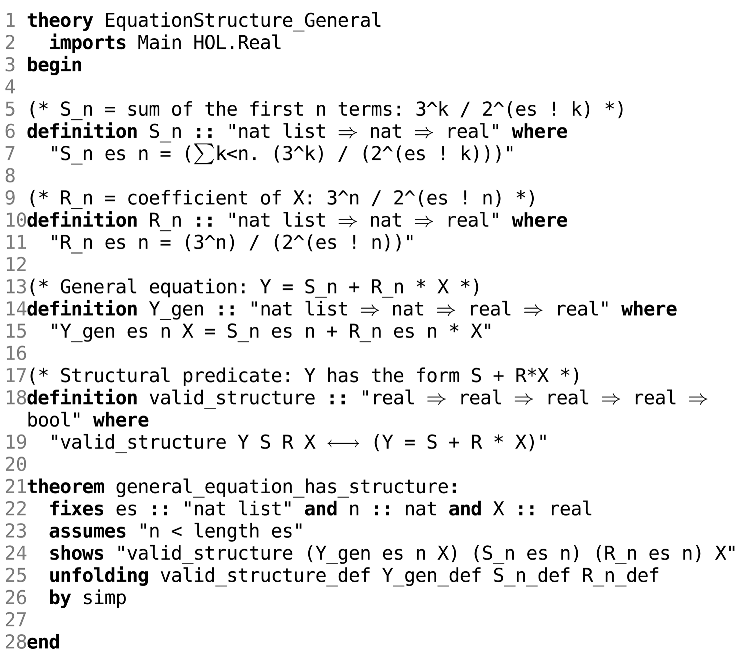
(see Appendix C for verification of proof with Isabelle/HOL proof assistant) □
Step 2
Proof 3 proved that the general equation, no matter how many branches were included in the equation, had the same structure and therefore, the same analytical techniques could be used on any of the equations to demonstrate there are no major loops. The equation for multiple branches was selected for the proof.
Proof 4.
Let be odd integers not divisible by 3 and . Let be positive integers. Prove there exists no integer solution under these conditions when .
Define:
Assume since must be larger than because the fraction must be less than 1. If was less than , the fraction would be greater than 1 and the equation could never equal X since would be greater than X.
Assume, for the sake of contradiction, that . Then
Rearranging,
so
and hence
Since , we may rewrite this as
or equivalently
We first show that . Suppose instead that . Then
so
Since , it follows that
which contradicts the assumption . Therefore we must have
Next, we analyze the divisibility condition implied by
Because X is an odd integer, the denominator must divide the numerator in :
We claim that . Indeed, if , then d divides any integer linear combination of and , in particular their difference:
Thus d divides both and . But is a power of 2 and is a power of 3, so , and therefore . This proves
From and , it follows that
in (i.e., S is an integer multiple of ).
We now show that S is not an integer, which contradicts this divisibility.
Since , each denominator is a power of 2, and is the largest among them. Writing all terms of S over the common denominator , we have
for some integer k. We show that , so that .
Indeed, the contribution to the numerator k from the first term is
which is a power of 2. Every other term in S has the form
with odd and . When written over the denominator , each such term contributes an integer multiple of to k, where is odd and is a power of 2. Thus every summand in k is of the form
for some . Consequently, k itself is an integer of the same form:
for some . In particular, the exact power of 2 dividing k is strictly less than , since the term already contributes the factor , and implies . Hence does not divide k.
Therefore is not an integer, i.e., . But we previously deduced that divides S, which is only possible if S is an integer (any integer divisor of a rational number forces that rational to be an integer). This is a contradiction.
Thus our assumption that there exist integers with the stated properties and leads to a contradiction. Hence no such integer solution exists, and in particular, under these conditions, the equality is impossible. □
Conclusion
S is a rational number with denominator a power of 2. Hence S is not an integer and cannot divide S. This contradiction shows that under the given assumptions, the equality is impossible, and consequently no major loops occur.
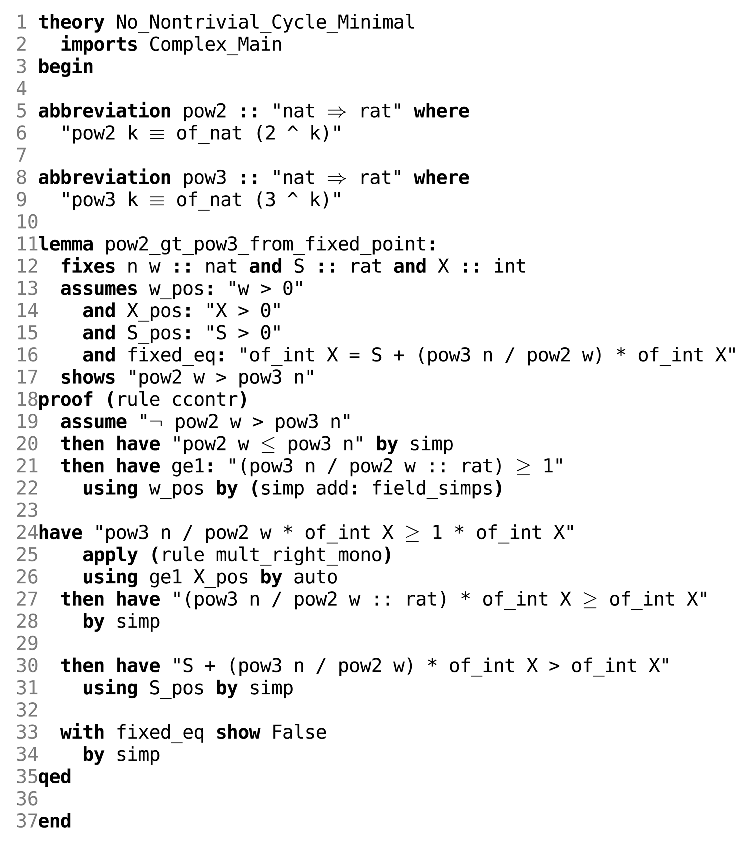
(see Appendix D for verification of proof with Isabelle/HOL proof assistant)
General equation still allows minor infinite loops
Even though the general equation shows there are no major loops when , the equation on rare occasions when can have , so , which forms the minor loop. The equation then discloses the number of loops rather than the number of branches.
For example,
Two loops of minor loop :
Four loops of minor loop :
Conclusion
Step 1 of the proof demonstrates that while the equations for different numbers of branches have S and R with varying numbers of terms and specific coefficients, their overall structure remains unchanged:
where S includes all constant terms independent of X and R is the coefficient for the linear X term. This consistency in structure implies that all equations belong to the same class of linear equations. Therefore, the same solution techniques can be applied uniformly across all equations.
Step 2 derives a contradiction by assuming that . Substituting into the general equation: leads to: . For to hold, then X must satisfy the equation. The contradiction arises when analyzing the general equation for multiple branches, where the inequality demonstrates that X does not satisfy the equation under normal conditions unless , which trivializes the equation to: . Thus, the assumption (and hence the presence of loops) is false in all cases except when .
The similarity of the equations highlights that they have the same “structure” and are analyzed using the same mathematical framework. Therefore, during iteration with the Collatz conjecture rules there are no odd positive integers that return to the same value to form a loop. There are no solutions to the general equation when and are not 1.
2.5. Rule for Odd numbers Prevents the Possibility of Numbers Continuously Increasing to Infinity
The next big challenge is to prove that no positive integers continue increasing toward infinity. The Collatz conjecture rule for even numbers restricts the ability of values to increase. The even number rule only decreases the previous value and thus, works against the ability to increase endlessly. Therefore, the rule for odd numbers is the only method of increasing the previous value. However, the rule for odd numbers produces an even number, so the value is automatically divided in half. The only way for a value to increase is for the value after the even number rule to be odd. For example, the value 7 goes , so the value increases from 7 to 11 to 17 in 2 steps. Then 17 goes to 26 in the next step (Table 2).
Table 2.
Sequences Have an Even Number After n Steps.
| n | Sequence | |
| 2 | 3 | 5, |
| 3 | 7 | 11, 17, |
| 4 | 15 | 23, 35, 53, |
| 5 | 31 | 47, 71, 107, 161, |
| 6 | 63 | 95, 143, 215, 323, 485, |
| 7 | 127 | 191, 287, 431, 647, 971, 1457, |
| 8 | 255 | 383, 575, 863, 1295, 1943, 2915, 4373, |
| 9 | 511 | 767, 1151, 1727, 2591, 3887, 5831, 8747, 13121, |
| 10 | 1023 | 1535, 2303, 3455, 5183, 7775, 11663, 17495, 26243, 39365, |
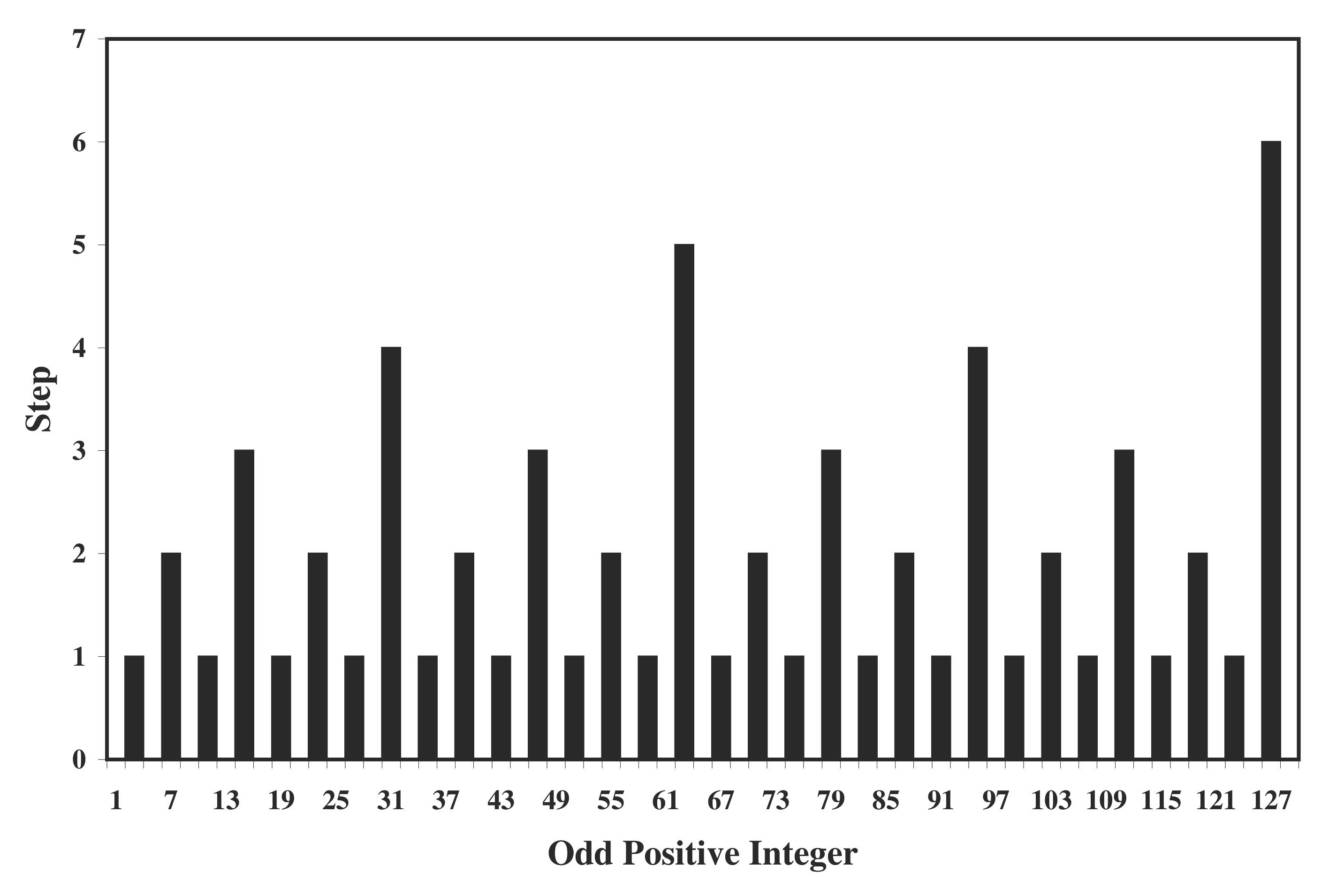
The observation indicates that the only way for a number continuously to increase towards infinity is to always reach an odd number after . Looking at the odd numbers and applying , we observed that the odd numbers form a pattern. The pattern is an alternating pattern of even and odd numbers. This eliminates half of the numbers since the next number must be odd if the value is to continue to increase. At each step of applying to the resulting odd numbers, the quantity of available odd numbers decreases from the previous values. For values ranging from 1 to , we observed that the value yields the maximum number of steps that generate an odd number when applying the transformation .
Figure 1 shows that all values of form will eventually generate an even number and thus decline in value from the previous value. Therefore, the number of steps of that produce an odd number is finite. Thus, there are no positive integers that continue to increase towards infinity.
Figure 1.
Steps before reaching an even number.
Proof 5.
Prove that if , then x is always finite no matter the value of positive integer n.
Let n be any positive integer, and define
We first observe that is a natural number. Indeed, by the definition of exponentiation on the natural numbers, for every , and since we have
Because , subtracting 1 yields
Thus x is an integer. More precisely, since the integers are closed under subtraction of a smaller natural number from a larger one, the expression is an element of .
Finally, any individual integer is, by definition, a finite number. The notion of “infinite” applies to sets with infinitely many elements, not to a single integer. Therefore, for each positive integer n, the corresponding value
is a finite integer.
This completes the proof. □
Conclusion:
Therefore, if n is a positive integer and , then x is finite. Even as n becomes arbitrarily large, n remains a specific, finite integer, leading to a finite value for and consequently for x.
As n increases, x grows incredibly large; however, the important issue is that x will never reach infinity. Infinity is not a number but a concept. Since n is always a specific, finite number, the resulting value of x is always a specific, although potentially very large, finite number.
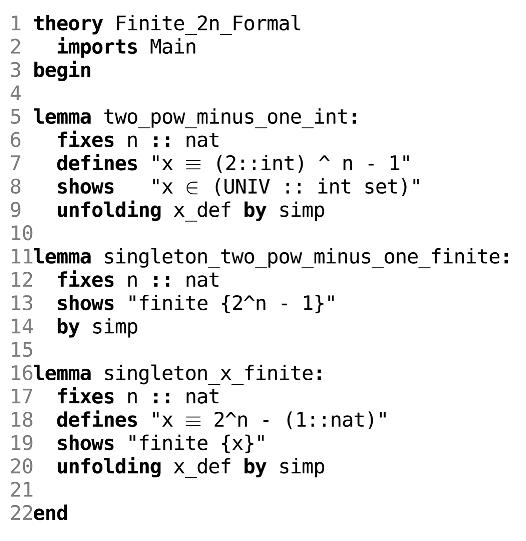
(see Appendix E for verification of proof with Isabelle/HOL proof assistant)
Proof 6.
Prove that the step of , when , is always even. Show by contradiction that the statement “the step of , when , is always odd” is false.
Show that is always even. First, obtain a general formula for using induction.
Base Case: For ,
Inductive Hypothesis: Assume that for some positive integer ,
Inductive Step: Show that .
The inductive step holds. Therefore, by induction, the formula: , is true for all .
Now, consider the step, i.e., :
Since n is a positive integer, is always odd. An odd number minus 1 is always an even number. Therefore, is always even.
Conclusion:
We show that the statement “the step of , when , is always odd” is false. The result shows that for , the step of the iteration is , which has been proven always to be even. This directly contradicts the statement that the step of , when , is always odd. Therefore, the statement is false.
(see Appendix E for verification of proof with Isabelle/HOL proof assistant) □
The proof establishes that for , the expression is always even for all non-negative integers n; which, indicates that the value decreases and no longer is increasing towards infinity.
The idea that the values of the numbers might continuously increase to infinity is an artifact of graphing the sequence of numbers during the Collatz conjecture process. The graphing suggests that when the values of the numbers get farther from 1 that this indicates the failure of the process, rather than just the process of proceeding down the number sets to reach each subsequent base number set that then connects to the next number set in series.
The finding was confirmed by Ren [10,11]. During a discussion of their data sets, they stated that the data set for begins with 100 steps of and the data set for begins with 10,000 steps of .
Therefore, no positive integer continuously increases towards infinity.
2.6. All Positive Integers Converge to 1 by Iteration Using Collatz Conjecture Rules
Proof 7.
Prove all positive integers go to 1 by iteration using the rules:
If is an even positive integer, then
If is an odd positive integer, then
For the sake of contradiction, suppose there exists an odd positive integer that represents a "final step" in the iteration, meaning the sequence initiated by reaches S and fails to reach 1.
For such an S to be the conclusion of a trajectory, it must satisfy one of two conditions:
- 1.
- S is part of a non-trivial cycle (a loop that does not include 1).
- 2.
- S is a terminal node that does not connect to any other positive integer.
Analysis of Case 1
By the results established in Proof 4, it is demonstrated that there are no non-trivial cycles in the Collatz dynamical system. The only cycle permitted by the rules of the iteration is the trivial cycle . Since we have assumed and S does not lead to 1, S cannot be a member of a loop. Thus, Case 1 is false.
Analysis of Case 2
By the definition of the map f and the results established in Proof 2, every odd positive integer has a well-defined successor. Specifically, for every odd S, there exists a mapping . Since is necessarily an even integer, and the relationship between odd integers and their even successors is shown to be , S cannot be a "terminal" point. Every integer S connects to a successor . Thus, Case 2 is false.
Conclusion:
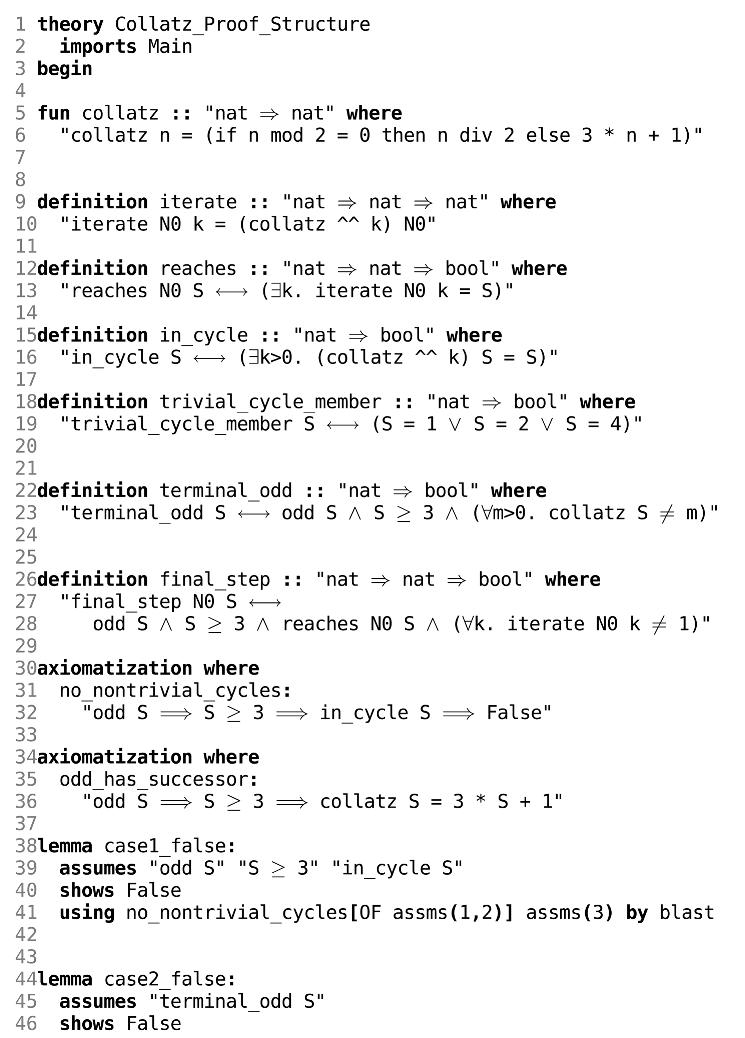
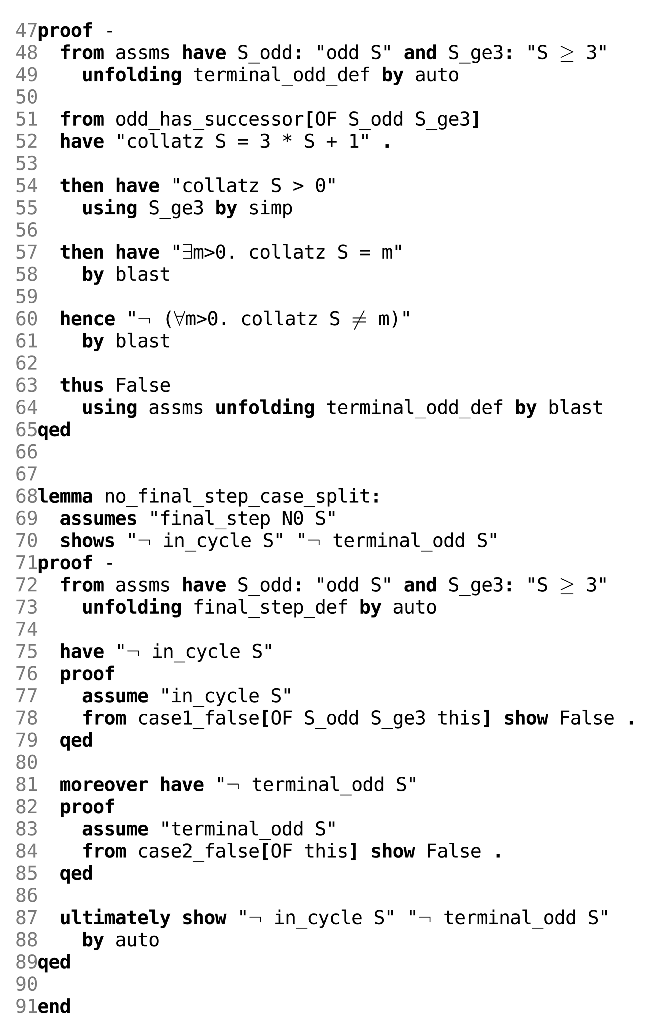
Since S can neither form a loop nor act as a terminal node, the assumption that there exists an odd integer which acts as a final non-1 step is false. Consequently, all trajectories initiated by a positive integer must eventually reach the unique final step: 1. (see Appendix F for verification of proof with Isabelle/HOL proof assistant)
□
3. Summary
The combined results of the seven proofs provide compelling evidence that the Collatz conjecture holds true for all positive integers.
Proof 1 confirms that the Collatz rule for even positive integers organizes all positive integers into odd base number sets comprising an odd number as the base and even numbers that are multiples of the base number (). The odd base number sets (, where , are subsets of the super set ). All the positive numbers are contained in ; therefore using the odd base number sets in the proofs includes all positive integers.
Proof 2 shows the Collatz rule for odd numbers () is bijective, which demonstrates the relationship between connections of odd base numbers and an even number in a different odd base number set. The only odd number to connect to an even number in the same odd number set is 1. The proof establishes there are no odd number sets not connected to the main pathways.
The combination of Proof 1 and Proof 2 produces a simple and predictable pattern; a dendritic pattern. The establishment of a dendritic pattern for the Collatz conjecture further confirms the results in the following proofs.
Proof 3 uses the observation that the even number rule and odd number rule form equalities between the odd numbers in different odd base number sets. Additionally, the rules allow forming different equalites with the same odd number. These equations are used to develop a single equation by substitution that is modified into a General Equation; which, represents the iteration of the Collatz conjecture with every positive integer.
Proof 4 first proves that the variations necessary in the General Equation to represent different iterations still produce equations with the same mathematical structure. Equations with the same structure can be manipulated with the same techniques to obtain the same results about the equations. Once the equations were proven to have the same structure, only one equation was used to show that and thus proving there are no major loops. Additionally, we show that the General Equation still demonstrates the minor loop, so there is confirmation that the General Equation is usable for every Collatz conjecture iteration.
Proof 5 is the first step in confirming that there are no positive integers that continue up towards infinity without eventually decreasing to 1. We observe that the only way for a positive integer to increase in value during iteration with the Collatz rules is for the result after to be an odd number and thus requiring another iteration with . If a number is going to continuously increase in value, the values need to repeatedly result in an odd number after iteration with . Iterating numbers from 1 to , we observe that the number with the longest series of odd numbers in a row is the number . Proof 5 demonstrates that is a finite number, so x is a finite number.
Proof 6 demonstrates that the step in is even, and thus begins to decrease in value after the step. The proof combined with Proof 5 demonstrates that there are no positive integers that continuously increase in value up towards infinity because eventually every positive integer during iteration with the Collatz rules begins to decrease in value, and eventually reaches 1.
Proof 7 is a logical conclusion from the results of Proofs 2 and 4. All positive integers go to 1, since 1 is the only value that forms a minor loop after reaching the goal of 1, and every odd positive integer, other than 1, connects to an even number in a different odd number set. The only positive integer with the necessary characteristics is 1, so we conclude that all positive integers eventually go to 1 by iteration with the Collatz rules.
The proof demonstrates that all positive integers eventually reach 1 when iterated using the Collatz conjecture rules. Resulting in the conclusion by eliminating two potential contradictions for every odd positive integer S, where . Proof 4 establishes that the only possible loop under the Collatz rules is the minor loop. An odd positive integer cannot form a larger loop that returns to itself. Proof 2 further shows that for an odd positive integer S, there exists a unique next integer under the Collatz rules, creating a relationship. This guarantees that no integer fails to connect to another positive integer.
By disproving both the possibility of additional loops and the existence of terminal integers, the proof eliminates all cases where a positive integer could fail to reach 1. Since every odd integer connects to another integer and no infinite loops exist, all positive integers follow a finite path toward 1. The proof reinforces the universality of the Collatz conjecture by showing that every positive integer, including odd integers , eventually reduces to 1.
Thus, the conclusion is that all positive integers go to 1 under the Collatz conjecture rules, with no exceptions. Taken together, these proofs confirm that:
- 1.
- All positive integers eventually reach 1 under the Collatz conjecture rules.
- 2.
- The conjecture applies universally to all positive integers, with no exceptions.
Author Contributions
These authors contributed equally to this work.
Acknowledgments
The proofs were verified with Isabelle/HOL proof assistant.
Conflicts of Interest
The author declares no conflicts of interest.
Appendix A. Verification of Proof 1 with Isabelle/HOL Proof Assistant
Appendix B. Verification of Proof 2 with Isabelle/HOL Proof Assistant
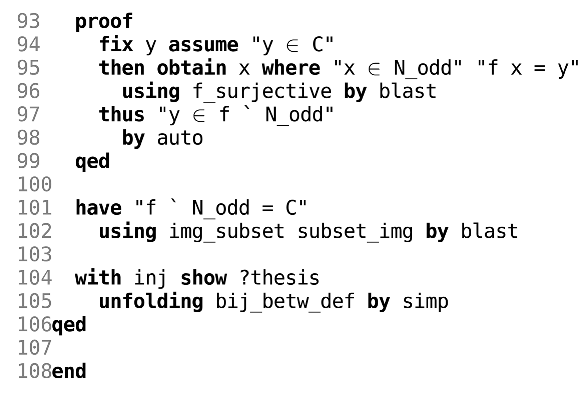
Appendix C. Verification of Proof 3 with Isabelle/HOL Proof Assistant
Appendix D. Verification of Proof 4 with Isabelle/HOL Proof Assistant
Appendix E. Verification of Proof 5 with Isabelle/HOL Proof Assistant
Appendix F. Verification of Proof 6 with Isabelle/HOL Proof Assistant
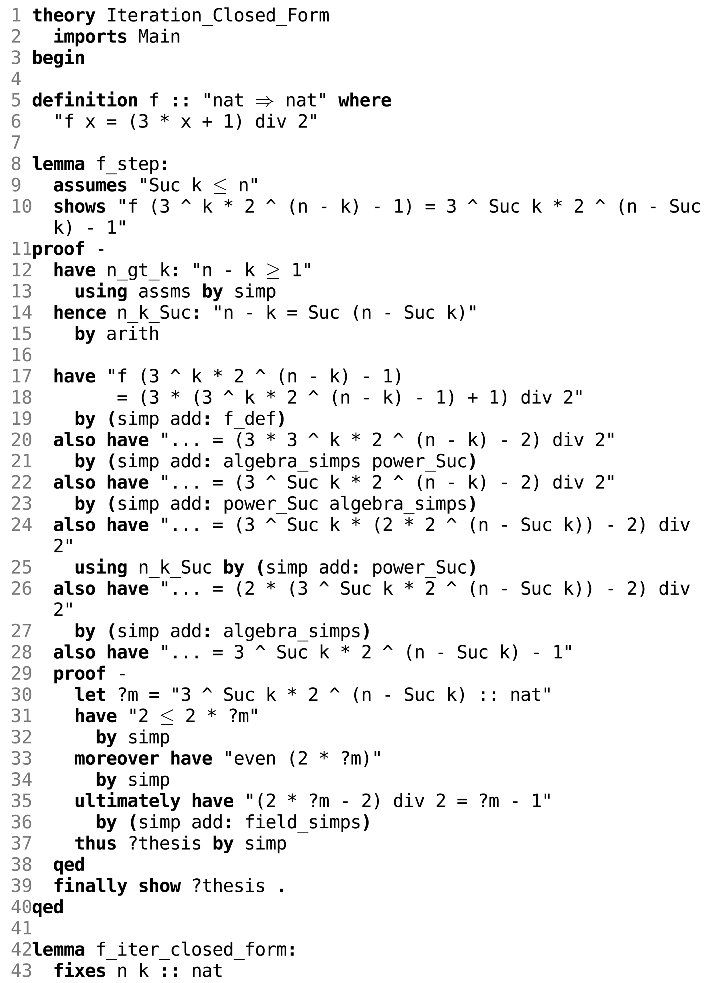
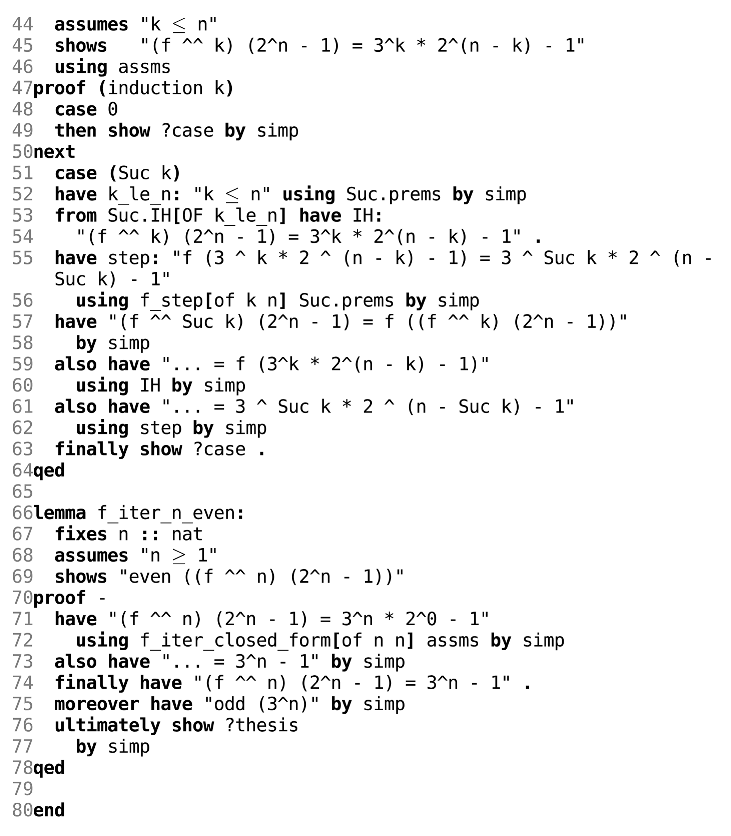
Appendix G. Verification of Proof 7 with Isabelle/HOL Proof Assistant
References
- A. Aaronson. Ten signs a claimed mathematical breakthrough is wrong, Blog of Scott Aaronson, https://scottaaronson.blog/?p=304, (2008).
- N. BOULKABOUL. "3n + 3k: New Perspective on Collatz Conjecture," arXiv, 2212.00073v1 (2022).
- E. De Bono. Lateral Thinking: Creativity Step by Step, Harper and Row, New York, (1970).
- M. FURUTA. Proof of Collatz conjecture using division sequence, Advances in Pure Mathematics, 12 (2022), 96–108.
- R. K. GUY. The 3x+1 problem, Unsolved problems in number theory, Series, 3rd, Springer-Verlag, (2004), 330–336.
- Hahn, K. O. Analysis of Collatz conjecture rules. Theoretical Mathematics and Applications 2024, 14, 1–76. [Google Scholar] [CrossRef]
- J. C., Lagarias. The Ultimate Challenge: The 3x + 1 Problem; Lagarias, J. C., Lagarias, Jeffrey, C., Eds.; American Mathematical Society, 1985; pp. 3–23. [Google Scholar]
- Monks, K.; Monks, R. G.; Monks, K. M.; Monks, M. Strongly sufficient sets and the distribution of arithmetic sequences in the 3x + 1 graph, arXiv: 1204.3904v2, (2022).
- Sternberg, L. Predictable trajectories of the reduced Collatz iteration and a possible pathway to the analysis of the Collatz Conjecture (Version 2), arXiv:2209.14230, (2022).
- Ren, W. Verifying whether extremely large integer guarantees Collatz conjecture (can return to 1 finally), IEEE Dataport, txop15.zip/ TXPO Data/ Dynamics2Seq/ 10000], (2018).
- Ren, W. Reduced Collatz dynamics data reveals properties for the future proof of Collatz conjecture. Data 2019, 4(2), 89. [Google Scholar] [CrossRef]
Disclaimer/Publisher’s Note: The statements, opinions and data contained in all publications are solely those of the individual author(s) and contributor(s) and not of MDPI and/or the editor(s). MDPI and/or the editor(s) disclaim responsibility for any injury to people or property resulting from any ideas, methods, instructions or products referred to in the content. |
© 2026 by the authors. Licensee MDPI, Basel, Switzerland. This article is an open access article distributed under the terms and conditions of the Creative Commons Attribution (CC BY) license (http://creativecommons.org/licenses/by/4.0/).
Copyright: This open access article is published under a Creative Commons CC BY 4.0 license, which permit the free download, distribution, and reuse, provided that the author and preprint are cited in any reuse.


