
Submitted:
21 October 2025
Posted:
22 October 2025
You are already at the latest version
Abstract
The Collatz conjecture states any positive integer will eventually reach 1 if you repeatedly apply a simple set of rules: if the number is even, divide it by two; if it is odd, multiply it by three and add one. The conjecture is till unproven due to its difficult binary nature between even and odd sequence values. However, a new trigonometric method is proposed to give a general proof that a Collatz sequence always end up at 1. The general path of the proof is similar to Euclid’s proof of the infinitude of primes by ascension.
Keywords:
Collatz conjecture
; trigonometric products
; invariance
1. Introduction
Cycles involving odd and even sequences can be tested by considering their behavior with certain trigonometric functions. For example, the odd and even expansion of the product sin function is given below.[3], p.41:
These two relations clearly separate odd and even values of n, irrespective of the values of y. If then there exists a sequence of Odd and Even numbers for the Collatz sequence such as
we can represent each odd and even value by where, for , in (1) and 2):
Odd→Even→Even→Odd→..., etc.
It so happens that the even values in the sequence exclusively produce the value , while the odd values of the first 100 values of seem to have a range such that:
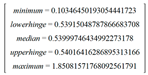

Table 1.
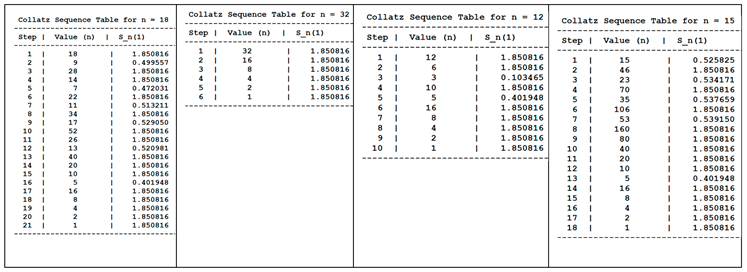
shows the Collatz sequence of the values of for various
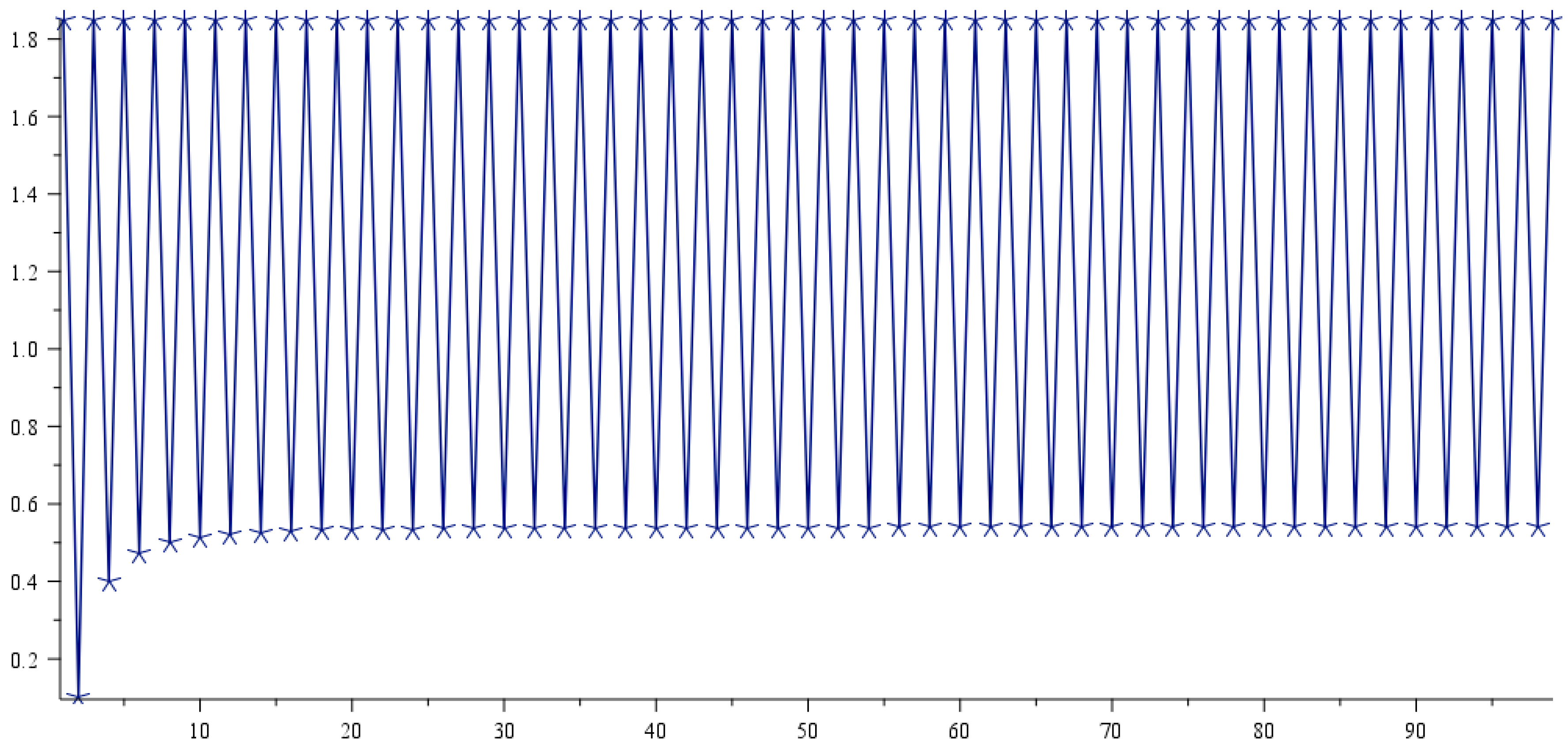
It is then possible to investigate the Collatz conjecture by trigonometric and algebraic means. Here is a graph showing the values of some numbers as the angle in radians and the rays measuring the radial vector for the value of n I in trigonometric space. A graph of the values of n=2..100 is shown below:
Figure 1.
As can be seen, the values in the overlayed graphs show the symmetry of 5 numbers in the Collatz trigonometric space. The transformations are periodically bounded between an upper value for sequentially arranged even numbers and lower values for odd numbers. Since for every odd number, there exist an upper bound that corresponds to an even number, one can surmise that the Collatz sequence for all numbers must result in either some lower bound or some sequences of upper that is a power of 2 and at least some lower but finite bounds. The lower bounds have no sequence degeneration since each odd number must hit an even number. It is convenient to demonstrate the rigid boundaries of the trigonometric constrains for the even and odd numbers in a Collatz sequence. As can be seen, the inner circle contains vectors that form a symmetry except for the final odd number that send the sequence to the maximum radius.
Figure 2.
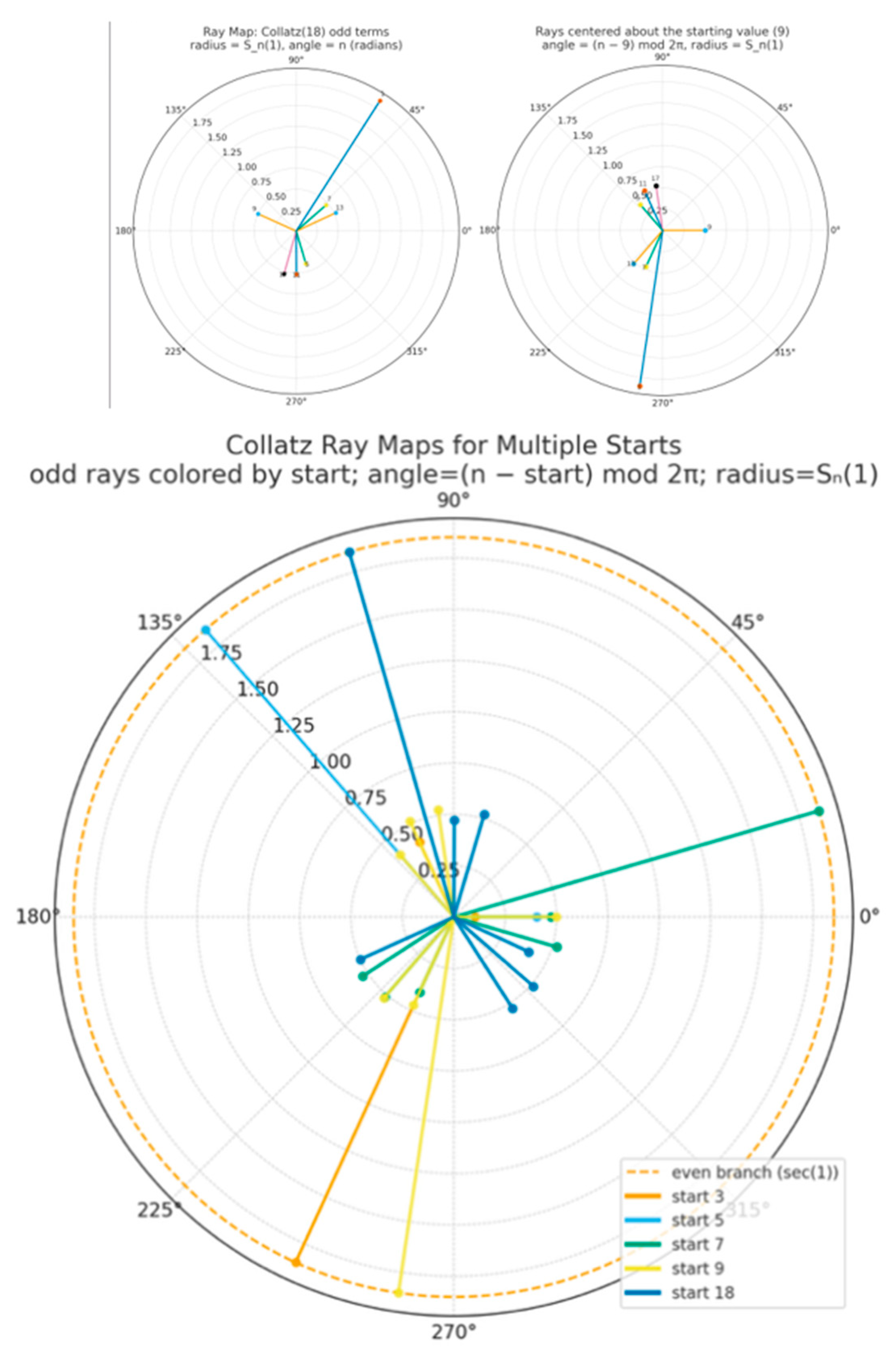
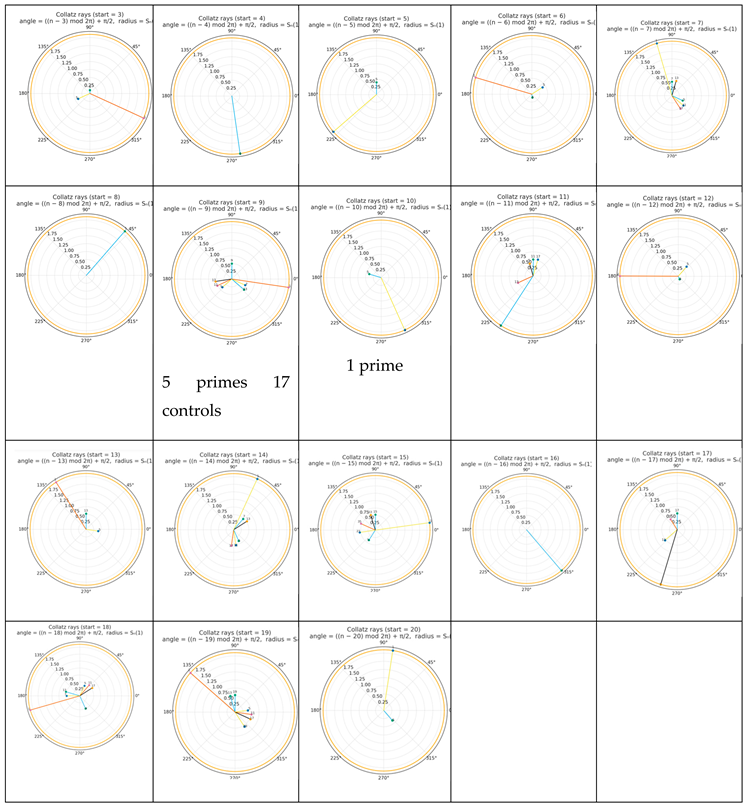
A radial vector chart of some sequences is shown in Table 2 below:
It is obvious that the rays have a symmetry, and the final values always fall on the vector that goes to .
From
We get:
The invariant circle is the even field,
2. The Symmetry Condition
The Collatz process alternates between the two transformations
In polar space, these correspond to
And angular shifts: , where represents the parity-dependent phase rotation. The closure condition of the Collatz orbit is
This geometry means the ray of the term intersects the invariant circle for radii
Consequence of invariance of the upper bound.
Because for all odd (since and for even we have
Hence the dynamics forces the sequences to oscillate between the interior of the boundary, and the boundary, producing the observed symmetry:
The convergence of the Collatz space in the geometric and trigonometric world means:
Thus, the angle of intersection determines the path’s rotational symmetry and phase. All valid sequences, regardless of starting points end up at some intersection of the invariant circle, i.e., they share the same final radius, only differing by a rotational angle.
Setup:
Fix
Then, with the top range being and, for every odd Write the Collatz trajectory:
Write for each odd the 2-adic valuation
Then, the block of consecutive evens that follows in the trajectory is its “even run”.
Lemma 1 (Bounds).
For all ,
Proposition 1.
The sequence 1,2,3…, maps to to hit infinitely many times, simply because there are infinitely many even integers.
Proposition 2.
Let be any Collatz trajectory until it terminates at 1. Then,
Every time the trajectory visits an odd value, the next value is which is even.; hence each odd step is immedietly followed by a top hit, . If the trajectory terminates, it certainly hit the top value, on the final chain; If it were infinite, it will encounter infinitely many top values, . Thus, Every Collatz trajectory touches the top value, infinitely many times.
3. Arithmetic Facts
Solvability mod
For every , the congruence
Has solutions, because 3 is invertible modulo Thus, there are infinitely many odd integers for which There are infinitely many targets, whose even run length, is at least
Lemma 1 (Infinite boundary contacts)
For every Collatz sequence the set is infinite and each member of the set maps to an odd integer, with .
Proof: Every odd step is immedietly followed by an even step, hence by a top value If the trajectory terminates, the final block is a chain of even values, otherwise the orbit contains infinitely many odds and so infinitely many top values.
All odd values of the sequence belong to at least one member of the infinite set of ordered odd chains, Every member of the {o} belongs to o. There is a one-one pairing of the Therefore the chain of the sequence must at least attain a top value. Hence every chain will either continue over extended sequences and at least must hit an even value that is a power of 2 when the chain will terminate at 1.
Let be a Collatz map
For define the forward Collatz sequence
Suppose a sequence collapses if it eventually reaches 1; equivalently, with Define the global set of all terms ever encountered as
Lemma 2 (Sub-sequence inclusion)
If for some , then the subsequence (tail) of from equals In particular,
Proof: for all
Theorem 1: (Union contains all finite sequences)
For every
Proof: By definition of each term belongs to the union.
Theorem 2: (Global collapse from local collapse)
If every collapses, then element of
Also collapses (hence the infinite union collapses in the sense that each of its elements has a finite path to 1.
Proof: Take any Then for some By hypotheses, reaches 1. So there exists with Then, also reaches 1 in further steps.
Theorem 3 (Collapse via a cofinal sequence-conditional).
Suppose there exists such that for every there is a with (i.e., meets every start point). If collapses, then all collapse.
Proof: From , and Lemma 2, Since reaches 1, every will reach 1.
4. Conclusions
Every Collatz sequence collapses to 1. The sequences have a 1:1 correspondence between odd and even integers. Every Collatz sequence is a sub-sequence of the infinite sequence. Every infinite sequence will collapse because a subset collapses, (similar to Euclid’s proof of infinitude of prime numbers).
Acknowledgments
GPT5 was of great resource in checking some aspects of this work. Especially in generating diagrams and providing references.
References
- Gradshteyn, I.S.; Ryzhik, I.M. Table of Integrals, Series, and Products, 7th ed.; Zwillinger, D., Jeffrey, A., Eds.; Academic Press: Cambridge, MA, USA, 2007. [Google Scholar]
- Michael, M. Anthony; Consequences of Invariant Functions for the Riemann hypothesis; SCIRP; Document ID: 5302512-20241007-102003-9957. 2024.
- Jeffrey, C. Lagarias, “The 3x+1 problem: An overview”. A wide-ranging survey covering history, known results, and the difficulties of the problem.
- Marc Chamberland, “An Update on the 3x+1 Problem”. A survey-style article that discusses modern approaches and open questions.
- T. Laarhoven, “The Collatz conjecture and De Bruijn graphs”. A paper studying the Collatz map via graph-theoretic / congruence-class methods.
- D. Mailland, “A Novel Approach to the Collatz Conjecture with Petri Nets”. A recent study modelling Collatz dynamics via Petri nets / reachability.
- B. Bairrington, “The Binary Projection of the Collatz Map”. Analyzes Collatz orbits using binary representations and structural properties.
- Dirichlet, P.G.L. — Beweis des Satzes, dass jede unbegrenzte arithmetische Progression, deren erstes Glied und Differenz ganze Zahlen ohne gemeinschaftlichen Faktor sind, unendlich viele Primzahlen enthält (1837).
Table 2.
Shows the rotational angular symmetry of the values of the lower trigonometric bound. The symmetry of the system breaks with the final odd number that send the sequence to the outer max radius. Note that the transformations are symmetric with respect to some axis for all the sequence vectors except for the final odd number that sends the sequence to the outer circle which has no symmetric partner. GPT5 generated diagrams.
Table 2.
Shows the rotational angular symmetry of the values of the lower trigonometric bound. The symmetry of the system breaks with the final odd number that send the sequence to the outer max radius. Note that the transformations are symmetric with respect to some axis for all the sequence vectors except for the final odd number that sends the sequence to the outer circle which has no symmetric partner. GPT5 generated diagrams.
Disclaimer/Publisher’s Note: The statements, opinions and data contained in all publications are solely those of the individual author(s) and contributor(s) and not of MDPI and/or the editor(s). MDPI and/or the editor(s) disclaim responsibility for any injury to people or property resulting from any ideas, methods, instructions or products referred to in the content. |
© 2025 by the authors. Licensee MDPI, Basel, Switzerland. This article is an open access article distributed under the terms and conditions of the Creative Commons Attribution (CC BY) license (http://creativecommons.org/licenses/by/4.0/).
Copyright: This open access article is published under a Creative Commons CC BY 4.0 license, which permit the free download, distribution, and reuse, provided that the author and preprint are cited in any reuse.


