
Submitted:
07 August 2025
Posted:
08 August 2025
You are already at the latest version
Abstract
The integration of distributed energy resources into distribution networks creates operational challenges, including voltage instability and power quality issues. While battery energy storage systems (BESS) can address these challenges, research has focused primarily on transmission-level applications or single services. This paper bridges this gap through a comprehensive review of BESS technologies and control strategies for multi-service ancillary support in distribution networks. Real-world case studies demonstrate BESS effectiveness: Hydro-Québec’s 1.2 MW system maintained voltage within 5% and responded to frequency events in under 10 ms; Germany’s hybrid 5 MW M5BAT project optimized multiple battery chemistries for different services; and South Africa’s Eskom deployment improved renewable hosting capacity by 15 − 70% using modular BESS units. The analysis reveals grid-forming inverters and hierarchical control architectures as critical enablers, with model predictive control optimizing performance and droop control ensuring robustness. However, challenges like battery degradation, regulatory barriers, and high costs persist. The paper identifies future research directions in degradation-aware dispatch, cyber-resilient control, and market-based valuation of BESS flexibility services. By combining theoretical analysis with empirical results from international deployments, this study provides utilities and policymakers with actionable insights for implementing BESS in modern distribution grids.
Keywords:
battery energy storage systems (BESS)
; ancillary services
; medium-voltage(MV) networks
; low-voltage (LV) networks
; distributed energy resources (DER)
; grid-forming inverters
; power quality
; distribution network stability
1. Introduction
The global energy landscape is undergoing a profound transformation driven by the rapid integration of distributed energy resources (DERs) into power distribution systems [1]. These resources, including rooftop photovoltaic (PV) systems, small-scale wind turbines, and electric vehicles (EV) are increasingly concentrated within medium-voltage (MV) and low-voltage (LV) networks as part of the broader push toward decarbonization and energy decentralization [2]. However, MV/LV networks were originally designed for unidirectional power flow and centralized control. Their typical features such as radial or weakly meshed topologies, high resistance-to-reactance ratios, and unbalanced loads make them particularly vulnerable to operational disruptions introduced by DERs [3,4]. Challenges such as voltage rise, phase unbalance, harmonics, and reverse power flow are now common, particularly in residential feeders with high PV penetration and variable EV charging demand. These conditions complicate conventional grid control mechanisms, such as transformer tap changers and capacitor banks, and strain network protection and voltage regulation schemes.
Battery energy storage systems offer a promising solution to these emerging challenges. With the ability to inject and absorb both active and reactive power with fast response times, BESS can deliver a range of ancillary services previously unattainable at the distribution level [5,6]. In MV and LV networks, BESS can provide localized voltage support, frequency stabilization, peak shaving, and harmonics mitigation. Their modularity, scalability, and ability to operate across multiple timescales make them especially suited for enhancing grid flexibility and resilience.
A comprehensive review of battery storage technology has been carried out in various research work as highlighted in [7,8,9,10,11,12], thoroughly highlighting trends in battery chemistry, inverter architectures, storage management systems, and future challenges such as recycling, but with limited distribution-level focus. Despite the growing interest in BESS applications, the existing body of literature predominantly falls into two categories. First, a significant number of studies focus on theoretical or simulation-based analysis of BESS for ancillary services using test systems such as the IEEE 14-Bus or 33-Bus models. These works often employ optimization frameworks, including Model Predictive Control (MPC), Linear Programming, or heuristic algorithms for control and scheduling. Second, review papers tend to generalize BESS benefits without delving into the technical intricacies of practical implementations. For instance, the authors in [13] provides comprehensive review of various energy storage technologies and their roles in enhancing the reliability, stability, and efficiency of power systems with high penetration of renewable energy without delving into region-specific challenges or policy frameworks that affect ESS deployment.
This paper seeks to fill that gap by focusing specifically on the role of BESS in MV and LV networks where issues like voltage instability, power quality degradation, and lack of inertia are becoming more pronounced with the rise of distributed generation. While much research has focused on single-service applications or macro-grid systems, this paper addresses the lack of coordinated, multi-service frameworks for DER-rich MV/LV networks by linking ancillary services with enabling technologies and real-world pilot data, offering a practical roadmap for deploying stacked BESS services in decentralized grids.
The rest of this paper is structured as follows: Section 2 provides a review of BESS-related literature. Section 3 discusses classification of BESS and ancillary services with emphasis on distribution-level applications. Section 4 presents case studies of the deployment of BESS in LV/MV networks and Section 5 discusses the various lessons learned from the case studies while Section 6 presents challenges and future research directions. The paper concludes in Section 7.
2. Review of Related Literature
The evolution of energy storage research reflects the shifting priorities in grid integration. Initially focused on large-scale applications such as pumped hydro and early lithium-ion facilities, the field broadened to emphasize frequency regulation, voltage support, and congestion management in utility-scale demonstration projects.
Over the last five years, a significant amount of research on BESS has shifted to distribution-level applications. The study in [14] systematically reviewed battery energy storage systems in distribution grids, distinguishing between short-term ancillary services and long-term services. While comprehensive in scope, the study lacked empirical validation and synthesis of enabling control architectures across diverse service sets. In [15], the study contributed to sizing methodologies for BESS to provide fast frequency response in solar-intensive systems. However, their analysis neglected the technical limitations posed by MV/LV networks and DER-rich feeders, reducing applicability to specific real-world scenarios. While [16] offered analysis on inverter-level controls and resilience within distribution networks, although technically rigorous, the study mainly addressed early deployment contexts and simulative rather than empirical implementation under high DER penetration.
The authors in [17] carried out empirical studies by evaluating a 1 MW BESS on a 22 kV MV feeder showing improvements in feeder voltage stability and peak shaving, however, stacking of multiple services was not implemented. Also, the research in [18] proposed a multi-objective optimization model for community-scale BESS, showing voltage profile improvements and DER hosting gains using real feeder data, though limited to a narrow service scope.
Beyond single-service analysis, [19] developed a real-time control framework enabling simultaneous frequency regulation and local voltage support via converter capability modeling on a utility-scale BESS testbed yet lacked feeder-level DER simulation context. In [20], the authors studied ancillary service stacking opportunities in Nordic markets, quantifying modest profit increases from combining multiple reserve products but is narrowly market-specific and not embedded within technical frameworks for distribution-level implementation.
Hybrid energy storage systems (HESS) have been increasingly examined for multi-service flexibility. The research in [21] reviewed HESS applications in MV/LV micro grids, showing theoretical capabilities for black-start, voltage regulation, and frequency control. However, their analysis is largely theoretical, and lacking real-world demonstration in complex DER environments. In the work done by [22], the authors modeled techno-economic stacking strategies, demonstrating higher internal rate of return and improved CAPEX recovery through optimized multi-service dispatch. However, their studies operated predominantly in simulated scenarios without validation in operational network contexts.
Market and regulatory frameworks remain critical influences in BESS. Work done in [23] used empirical Spanish fuel-cost datasets to show that unless cycling costs drop below €15–50/MWh, BESS participation in multiple ancillary services remains marginal. While this research offers valuable cost-structure insights, it is geographically limited.
Despite the various research that have been carried out, important gaps remain: many studies still emphasize single-service deployment such as frequency or voltage only or focus on macro-grid systems. Coordinated multi-service frameworks combining short term (frequency, voltage, black start) and long term (smoothing, congestion relief, peak shaving) capabilities under real-world MV/LV conditions are rarely explored. Additionally, integration of enabling technologies like grid-forming inverters and hierarchical control systems remains largely theoretical or simulated.
This manuscript addresses these gaps by offering a comprehensive, multi-dimensional review designed specifically for DER rich MV and LV distribution networks. It explicitly connects the categories of ancillary services to enabling technologies (grid forming inverters, hybrid storage architectures, hierarchical and decentralized control), while incorporating empirical findings from pilot projects in Canada, Germany, and South Africa. In doing so, the paper advances beyond isolated academic models to deliver a structured roadmap for real-world deployment of coordinated, stacked ancillary services via BESS across resilient and decentralized distribution systems.
3. Classification of BESS and Ancillary Services
3.1. BESS Technologies and Technical Metrics
BESS have become pivotal in facilitating grid stability and flexibility, particularly in the context of MV and LV distribution networks. The technological evolution of BESS has been largely driven by the need to manage increasing penetration of variable renewable energy such as wind and solar, and to support decentralized energy systems. Key performance metrics that differentiate BESS technologies include energy density, round-trip efficiency, cycle life, depth of discharge (DoD), response time, and capital cost per kilowatt-hour (kWh). Figure 1 below provides a summary of the various BESS technologies available.
The most adopted BESS technologies include lithium-ion (Li-ion), redox flow batteries (RFB), sodium-sulfur (NaS), and lead-acid batteries. Among these, Li-ion batteries particularly lithium iron phosphate (LFP) and nickel manganese cobalt oxide (NMC) dominate global deployments due to their high energy density (100–265 Wh/kg), rapid response (<1 s), and superior round-trip efficiencies (>90%) [24]. These features make Li-ion suitable for both short-term services such as frequency regulation and long-term applications like peak shaving.
Redox flow batteries, particularly vanadium redox, offer the advantage of decoupled energy and power capacity, enabling flexible scaling for long-duration storage. Their long cycle life (>10,000 cycles) and minimal degradation are advantageous for daily cycling applications [25]. However, their lower energy density and higher system complexity limit their application to stationary, utility-scale deployments. NaS batteries, with energy densities around 150–240 Wh/kg and operating temperatures exceeding 300°C, provide reliable long-duration storage and have been employed in grid support and load-leveling applications [26].
Lead-acid batteries, though cost-effective, are constrained by limited cycle life, lower depth of discharge, and suboptimal round-trip efficiencies , making them less suitable for frequent cycling or dynamic services [27]. Despite these limitations, they still serve as viable backup options in low-capacity, low-duty cycle applications.
Performance trade-offs and safety considerations are also important. Li-ion batteries pose thermal runaway risks, requiring robust battery management systems (BMS), while flow batteries offer inherent thermal stability. Additionally, environmental and supply chain concerns such as cobalt sourcing for NMC chemistries necessitate life cycle assessments and end-of-life strategies [28].
Table 1 summarizes the comparative technical attributes relevant to ancillary services. Metrics such as ramp rate, cycle life, round-trip efficiency, power-to-energy ratio (P/E), and thermal stability are mapped to their respective BESS technologies. These metrics directly affect service eligibility, especially in applications requiring fast frequency response, voltage regulation, and multi-service stacking.
Future trends in BESS technology point toward the development of solid-state batteries, sodium-ion alternatives, and HESS which combine complementary technologies such as super-capacitors and batteries to meet diverse grid service requirements. These emerging technologies are expected to address current limitations in safety, cost, and longevity while enabling more granular control of distributed energy systems [29].
3.2. Ancillary Service Requirements at MV/LV Scale
The transformation of traditional power systems into decentralized, flexible, and intelligent networks has necessitated a redefinition of ancillary service delivery. Historically, ancillary services such as frequency regulation, voltage control, and black start capabilities were sourced predominantly from centralized generation units operating at the transmission level. However, with the increasing penetration of renewable energy sources (RES) and DERs at the MV and LV levels, the burden of ensuring grid stability is progressively shifting toward the distribution network [30].
Ancillary services in MV/LV contexts are critical for maintaining power quality and operational stability. As shown in Figure 2, these services are generally categorized by their temporal response requirements and functional purpose into short-term (dynamic) and long-term (energy shifting). BESS is uniquely capable of fulfilling both types due to its rapid response characteristics and flexible control capabilities [31].
Short-term ancillary services are those that require an immediate or nearly instant response. Key examples include Frequency Containment Reserve (FCR), Frequency Restoration Reserve (FRR), Fast Frequency Response (FFR), and voltage regulation. These services need high power density, rapid inverter control, and highly reliable state-of-charge (SoC) monitoring systems.
FCR services aim to stabilize frequency deviation within the first seconds after a disturbance. Li-ion BESS, due to their sub-second ramp rates, are particularly suitable for this application [32]. FRR involves rebalancing power over longer time frames and often uses predictive dispatch algorithms. BESS can supply both primary and secondary frequency support if appropriately sized and scheduled [33].
Voltage control, or Volt/VAR management, is another essential short-term service in MV/LV grids. Overvoltage conditions, especially in PV-rich feeders, necessitate reactive power absorption or injection by BESS inverters to maintain voltage within statutory limits [34]. Smart inverters integrated with BESS can operate under IEEE 1547 and EN 50549 standards to autonomously perform these tasks [35]. Additionally, BESS enables synthetic inertia, which mimics the inertial response of synchronous machines, through advanced control schemes such as droop control and virtual synchronous machine (VSM) algorithms. This is critical in weak or islanded MV networks [36].
Longer-term services typically span minutes to hours and include energy arbitrage, peak shaving, congestion relief, power quality management, and deferred network investments. These services rely more on energy capacity and thermal stability rather than rapid power modulation. For instance, peak shaving involves discharging stored energy during periods of high demand, thereby reducing the burden on upstream transformers and avoiding demand charges [37]. Similarly, load shifting entails charging the BESS during low-demand, low-cost periods (e.g., night time) and discharging during high-cost, high-demand periods. This is particularly beneficial in regions with dynamic pricing regimes or time-of-use (ToU) tariffs [38].
Congestion relief in distribution networks, especially those with high rooftop PV penetration, is increasingly vital. Overloaded feeders and voltage rise issues can be mitigated through coordinated BESS operation, improving hosting capacity for DERs [39]. BESS can also provide black start services when coupled with grid-forming inverters, enabling the restoration of local loads during outages without central control [40].
The coexistence of multiple ancillary service functions introduces technical and operational challenges. For instance, frequency regulation requires maintaining a buffer in the SoC, which may conflict with long-duration discharging needs for load shifting. Prioritizing services based on economic and reliability considerations necessitates the deployment of advanced Energy Management Systems (EMS) and multi-objective optimization models.
BESS providing ancillary services must comply with grid codes that dictate frequency and voltage regulation capabilities, harmonic distortion limits, and ride-through standards. Standards such as IEEE 1547, IEC 61850, and EN 50549 provide a framework for interoperability, inverter response curves, and communications protocols necessary for integrating BESS into distribution systems [41].
3.3. Control Strategies for Short-Term and Long-Term Services
The integration of BESS into modern distribution networks requires sophisticated control strategies to efficiently deliver ancillary services across different timescales. Broadly, control mechanisms can be classified into strategies for short-term services, such as frequency and voltage regulation, and strategies for long-term services like peak shaving and load leveling. These control systems must account for network constraints, service stacking requirements, and battery degradation.
Short-term services require rapid, autonomous, and sometimes decentralized responses. Frequency regulation involves modulation of real power output in response to frequency deviations. Conventional proportional-integral-derivative (PID) controllers are widely used due to their simplicity, but more MPC methods are increasingly favored for their predictive accuracy and ability to handle multivariable constraints [42].
For FCR, droop control mechanisms and virtual inertia schemes, particularly VSM have gained traction. These techniques emulate the inertial response of conventional generators and enhance system resilience under low-inertia conditions typical of high-RES networks [43]. Adaptive droop control has been shown to significantly improve the dynamic frequency response of BESS, especially when coordinated through distributed control architectures [44].
Voltage regulation in MV/LV systems is typically managed through Volt/VAR control. This can be implemented through droop-based reactive power injection, coordinated set point tracking, or advanced nonlinear control schemes [45]. When deployed with BESS, smart inverters can dynamically adjust reactive power outputs in response to local voltage deviations, maintaining voltage within permissible limits.
Control strategies for BESS are often organized in a hierarchical manner. The primary control layer manages fast dynamics such as inverter-level voltage and frequency stabilization, while the secondary layer coordinates control among distributed assets. The tertiary layer oversees system-wide economic optimization, including energy arbitrage and service stacking [46]. Recent research has introduced hybrid centralized–distributed control frameworks for microgrids and MV feeders, where BESS serve as grid-forming units. The distributed model offers scalability and resilience to communication failures, whereas the centralized controller handles global optimization and market interface functions [47,48].
Unlike short-term services, long-term service provision emphasizes energy balancing, degradation management, and economic optimization. MPC and dynamic programming (DP) are widely adopted for their ability to incorporate forecast data and handle time-coupled constraints [49].
In peak shaving applications, MPC-based dispatch schedules energy usage based on anticipated load profiles and pricing signals, ensuring both transformer capacity compliance and battery health preservation. Real-time SoC and depth-of-discharge (DoD) tracking is essential to prevent capacity fade and ensure long-term reliability [50].
Energy arbitrage control strategies focus on optimizing the buy-low, sell-high behavior of BESS. In this context, day-ahead and intra-day forecasting models for load, PV generation, and electricity prices are integrated into MPC schemes for optimal dispatch [51]. However, market volatility and forecast uncertainty pose challenges that are being addressed through robust and stochastic control models [52].
Multi-service participation by BESS also referred to as service stacking, demands advanced scheduling algorithms capable of balancing conflicting objectives. For example, using a BESS for voltage support may limit its availability for energy arbitrage. Multi-objective optimization (MOO) approaches such as Pareto-based evolutionary algorithms or weighted-sum scalarization techniques are employed to address these trade-offs [53].
Battery degradation modeling is often embedded into these optimization frameworks to prevent premature asset aging. This includes integrating electrochemical models and empirical degradation curves [54]. This research emphasizes the co-optimization of technical and economic criteria with degradation constraints to maximize lifecycle value.
Cybersecurity and latency are growing concerns in control strategies for BESS, especially in networked systems with distributed intelligence. Communication delays can destabilize frequency and voltage regulation loops. Hence, control schemes must include delay compensation, packet loss mitigation, and intrusion detection mechanisms [56].
As BESS systems become increasingly integrated with demand response and vehicle-to-grid (V2G) platforms, interoperability and standard compliance are essential for seamless control integration across heterogeneous devices. Figure 3 below shows a comparison of the different BESS control strategies.
4. Technical Review of BESS Implementations for Voltage and Power Quality Improvement in Real-World Scenarios
The integration of BESS into MV and LV networks has been demonstrated in various real-world projects, each addressing unique grid challenges. This section critically examines four key case studies, Hydro-Québec’s pilot project, Germany’s M5BAT hybrid BESS, the IEEE 33-Bus test network, and South Africa’s Eskom Distributed BESS to evaluate their technical approaches, performance outcomes, and lessons learned. These projects were selected based on their geographic diversity, scale, and the ancillary services they provide, offering a comprehensive view of BESS deployment strategies.
4.1. Hydro-Québec BESS Pilot Project (Canada)
The Hydro-Québec BESS pilot project, commissioned in 2017, represents a pioneering effort in deploying utility-scale battery storage on MV distribution networks. Located in Hemingford, Quebec, the system consisted of a 1.2 MW/2.4 MWh LFP battery housed in a 20-foot container, integrated with advanced power conversion systems (PCS) and the proprietary EVLOGIX energy management system (EMS) [57]. This project was specifically designed to address voltage instability and frequency fluctuations in a region with increasing DER penetration, particularly rooftop solar PV.
A key innovation of this deployment was its grid-forming inverter capability, which enabled the BESS to establish voltage and frequency references autonomously during islanded operation. The inverters employed a combination of Volt-VAR and Volt-Watt control curves to provide dynamic voltage support, successfully mitigating overvoltage conditions caused by reverse power flows from distributed PV systems. Field measurements demonstrated that the system maintained voltage levels within of nominal values, even during periods of high solar generation and low load demand.
Frequency regulation was another critical function of the Hydro-Québec BESS. The system demonstrated a rapid response time of less than 10 milliseconds, delivering 1 MW of primary frequency response within 200 milliseconds of a grid disturbance. This performance reduced frequency deviations significantly compared to traditional synchronous generators, highlighting the superior dynamic response of battery-based systems. The BESS also participated in peak shaving, reducing substation transformer loading during high-demand periods by strategically discharging stored energy.
Thermal management posed a significant challenge due to Quebec’s extreme seasonal temperature variations. The project addressed this through a comprehensive cooling system compliant with UL 9540A safety standards, incorporating active air circulation, thermal barriers, and real-time temperature monitoring. This design maintained battery cell temperatures below 40°C, ensuring optimal performance and longevity. The system also implemented SoC management strategies, limiting depth-of-discharge to preserve battery health, which contributed to achieving minimal degradation.
The Hydro-Québec pilot provided several key insights for future BESS deployments. First, grid-forming inverters proved essential for reliable black-start capability, though their performance depends heavily on advanced synchronization controls. Second, LFP chemistry, combined with robust thermal management, is well-suited for operation in harsh climates. Finally, the project underscored the importance of modular, containerized designs for rapid deployment and scalability in utility applications. These findings have informed subsequent large-scale BESS installations across North America, demonstrating the pilot’s role as a benchmark for distribution-level energy storage.
4.2. M5BAT Hybrid BESS Project (Germany)
The M5BAT (Modular Multi-Megawatt Multi-Technology Medium-Voltage Battery Storage) project represents one of Europe’s most innovative hybrid energy storage demonstrations [58]. Commissioned in 2016 at RWTH Aachen University’s Melaten campus, this 5 MW/5 MWh system pioneered the integration of three distinct battery technologies—lithium-ion, lead-acid, and sodium-nickel-chloride (NaNiCl)—within a single storage facility connected to the local 10 kV distribution network [59]. This unique configuration was specifically designed to leverage the complementary characteristics of each chemistry, optimizing the system for both high-power and high-energy applications.
At the core of the M5BAT system was its sophisticated hierarchical control architecture. The lithium-ion batteries, with their superior power density and rapid response capabilities, were primarily utilized for frequency regulation and transient support, achieving response times under one second. The sodium-nickel-chloride batteries, with their excellent energy density and long-duration capabilities, handled bulk energy applications including four-hour peak shaving and renewable energy time-shifting. The lead-acid batteries provided intermediate support, particularly for applications requiring frequent but shallow cycling. This multi-technology approach demonstrated a remarkable round-trip efficiency while significantly reducing operational costs compared to single-chemistry systems.
A key achievement of the M5BAT project was its advanced energy management system (EMS), which dynamically allocated power flows based on real-time grid conditions and battery state-of-health. The EMS employed MPC algorithms to optimize the dispatch of each battery type, considering factors such as cycle life degradation, temperature effects, and electricity market prices. This intelligent coordination enabled the system to reduce voltage unbalance in the local distribution network from to , significantly improving power quality for end consumers. The hybrid configuration also proved particularly effective for smoothing the output of nearby wind farms, reducing ramp rates by up to during periods of high variability.
The integration of multiple battery technologies presented several technical challenges that required innovative solutions. The project team developed specialized DC-DC converters with isolated ports to manage the different voltage characteristics and prevent harmful cross-currents between battery subsystems. Thermal management was particularly critical for the high-temperature NaNiCl batteries, which operated at approximately 270°C. The solution involved compartmentalized thermal zones with active cooling and multiple safety redundancies, including thermal cutoffs and gas detection systems. The lithium-ion and lead-acid sections employed liquid cooling with predictive temperature control to maintain optimal operating conditions.
Communication and control architecture represented another significant innovation. The M5BAT implemented a distributed control system using IEC 61850 protocols, enabling seamless coordination between the various battery subsystems while maintaining the required response times for grid services. This approach proved particularly valuable for providing primary frequency response to the German grid, where the system demonstrated the ability to precisely follow the minute-to-minute variations in system frequency.
The project yielded several important lessons for future hybrid energy storage deployments. First, the multi-chemistry approach confirmed that combining different battery types can indeed provide superior economic and technical performance compared to single-technology systems. Second, the importance of chemistry-specific battery management systems became evident, as each technology required different charging algorithms and state-of-charge management strategies. Finally, the project highlighted the need for standardized interfaces and communication protocols when integrating diverse storage technologies, a finding that has influenced subsequent European standards for hybrid storage systems.
Financial analysis of the M5BAT operation revealed that the hybrid configuration could reduce levelized storage costs compared to a lithium-ion-only system of equivalent capacity, primarily through better matching of storage technologies to specific grid services. The project also demonstrated the viability of using hybrid storage for multiple revenue streams simultaneously, including frequency regulation, capacity markets, and energy arbitrage.
As one of the first large-scale demonstrations of hybrid battery storage in Europe, M5BAT provided valuable insights that have informed subsequent commercial deployments. Its success has particularly influenced the design of storage systems for renewable integration in Germany’s Energiewende, demonstrating that hybrid configurations can effectively address both the short-term and long-term storage requirements of modern power systems.
4.3. IEEE 33-Bus Test Network with BESS Integration
The IEEE 33-Bus Test Network represents a standard benchmark for analyzing the performance of radial MV distribution systems under various operational scenarios. As shown in Figure 4, it consists of a kV radial feeder with 33 buses and 32 branches, supplying a total load of approximately MW and MVAr [60]. Due to its unbalanced loading and extended feeder length, the network is particularly sensitive to voltage drops, thermal overloading, and power losses, making it a suitable platform for evaluating the technical contributions of BESS in distribution grid applications.
The integration of BESS into this network has shown substantial improvements in voltage regulation, loss minimization, and load profile flattening when governed by real-time optimization and control schemes. In a representative configuration, BESS units with ratings between 250 kW and 1 MW are connected to nodes exhibiting the lowest voltage margins and highest branch current densities. The BESS inverter operates in grid-following mode under nominal conditions but transitions to grid-supportive behavior during transients. It dynamically injects or absorbs active and reactive power using voltage and frequency set-point tracking. Advanced control techniques, such as MPC or dual-loop voltage-current PI regulation, are employed to align power injection with grid requirements. These controllers often reference look-ahead irradiance and load demand forecasts to schedule BESS dispatch in anticipation of voltage dips or thermal stress on feeder conductors.
One of the primary technical challenges in this deployment lies in the optimal siting and sizing of BESS assets. Static optimization methods, such as sensitivity-based placement using Jacobian matrices from power flow analysis, are typically augmented with metaheuristic algorithms to minimize active power losses while maintaining bus voltages within of nominal. Moreover, in systems with high solar PV penetration, the interaction between BESS and intermittent generation complicates charge scheduling. To overcome this, energy management systems enforce minimum SoC thresholds and employ real-time SoC trajectory forecasting to ensure service continuity during consecutive load peaks or generation troughs.
Protection coordination also becomes more complex with bidirectional current injection from BESS inverters. Conventional overcurrent protection settings may fail to detect fault direction or magnitude accurately, especially during low-inertia or islanded operation. This necessitates the use of adaptive protection schemes, including directional overcurrent relays or communication-assisted tripping logic using IEC 61850 GOOSE messaging. Additionally, the harmonics introduced by fast-switching inverters require filtering, typically through LCL filters or grid-forming inverter control strategies with virtual impedance to ensure compliance with IEEE 519 harmonic distortion limits [61].
Ultimately, the IEEE 33-Bus test system with BESS integration validates the technical feasibility and operational value of deploying distributed energy storage in radial networks. With proper inverter sizing, predictive control, and protection adaptation, BESS can significantly reduce active power losses up to , improve minimum bus voltages by , and support hosting capacity for distributed generation. These outcomes are consistent with real-world deployments in rural and peri-urban feeders, where voltage sensitivity and long conductor spans exacerbate distribution network challenges. The test network remains a foundational tool for validating EMS algorithms, power electronics control strategies, and inverter-grid interoperability protocols before field-scale deployment.
4.4. South Africa’s Eskom Distributed BESS Project
The Eskom Distributed BESS project launched in 2022 is one of the largest energy storage initiatives in Africa with a planned capacity of 360 MW/1,440 MWh. It was developed to address South Africa’s persistent electricity challenges [62], particularly load-shedding in MV- and LV networks with high levels of PV curtailment. The system is designed to provide four-hour peak shaving, voltage regulation, and improved power quality, especially in areas with weak grid infrastructure.
A key feature of the BESS is its droop control strategy, which simplifies voltage regulation and coordination across distributed sites. This approach has led to significant reductions in voltage deviations, improving stability from to . Additionally, the system maintains total harmonic distortion (THD) at , well within the IEEE 519 standard limit of , thereby enhancing power quality. During periods of high solar generation, the BESS has also helped reduce feeder loading by , alleviating congestion and enabling better integration of renewable energy sources.
The project faced several challenges, particularly in remote and rural deployments. To overcome infrastructure limitations, mobile BESS units were deployed, allowing flexible installation and operation. In arid regions with high ambient temperatures, liquid-cooled enclosures were used to maintain battery temperatures below 45°C, ensuring safe and efficient operation.
Among the key lessons learned, Eskom highlighted that droop control is highly effective in weak grid environments and that modular BESS designs significantly enhance scalability and adaptability across diverse geographic and grid conditions. The project is being implemented in two phases across multiple provinces, including the Western Cape, Eastern Cape, Northern Cape, and KwaZulu-Natal, with Phase 1 targeting 833 MWh and Phase 2 adding another 616 MWh. Table 2 presents a comparative analysis of various metrics in the case studies.
5. Discussion
The integration of BESS into MV and LV networks across different geographies has yielded significant lessons in technical design, control architecture, energy management, and power quality enhancement. Drawing from the four case studies of Hydro-Québec, M5BAT, the IEEE 33-Bus test system, and South Africa’s Eskom deployment, this section provides a thematic, comparative synthesis of lessons learned.
Two principal control paradigms, droop control and MPC emerged across the reviewed case studies. Hydro-Québec and Eskom adopted droop-based decentralized control strategies that provided real-time voltage and frequency support without the need for complex forecasting. In contrast, IEEE 33-Bus simulation studies relied on MPC to optimize reactive and active power dispatch and reduce voltage deviations. M5BAT implemented a hybrid EMS that integrated MPC with degradation-aware dispatch logic, achieving enhanced frequency response and asset lifespan optimization. While MPC offers dynamic optimality, it demands high computational resources and accurate forecasting, which may not be feasible in resource-constrained grids as shown in [63]. Consequently, droop control remains favored in many field deployments, especially where response latency and robustness outweigh optimality.
Thermal management, system modularity, and battery chemistry selection emerged as key technical factors. Hydro-Québec employed LFP cells in modular containers, favoring thermal stability and long cycle life under harsh Canadian conditions. M5BAT adopted a hybrid system combining lithium-ion, sodium-nickel-chloride (NaNiCl), and lead-acid batteries, using their complementary characteristics to balance power and energy services. IEEE 33-Bus simulations revealed that siting and sizing significantly impact performance, with optimized configurations achieving significant loss reduction and improved voltage profiles [64]. Eskom’s mobile BESS architecture with liquid cooling demonstrated adaptability to South Africa’s diverse climate zones, ensuring battery temperatures remained below 45°C. These results affirm the need for chemistry-specific, modular system design for scale and resilience.
Communication integrity and EMS design were critical for real-time coordination. M5BAT employed IEC 61850 protocols, facilitating seamless communication between heterogeneous subsystems. Hydro-Québec’s EVLOGIX system incorporated predictive SoC scheduling and grid-forming functionality, while Eskom used a centralized EMS to dispatch BESS based on local voltage measurements and a droop curve. Accordingly, the most effective configurations employed hierarchical EMS designs with local autonomy and centralized coordination.
Robust SoC management played a vital role in service continuity and battery longevity. Eskom enforced SoC limits between 20–, ensuring sufficient reserves for peak shaving and frequency support. Hydro-Québec implemented predictive SoC forecasting to prioritize grid events and avoid deep discharges. IEEE 33-Bus simulation studies demonstrated that trajectory-based SoC control improved dispatch predictability and reduced oversizing. SoC-aware control, as shown in the literature, can extend battery life by up to , particularly when coupled with temperature and degradation models [65]. These findings suggest SoC thresholds should be dynamically managed in tandem with thermal control and grid conditions.
Power quality (PQ) indicators such as voltage deviation, harmonic distortion, and voltage unbalance showed marked improvements across all projects. Hydro-Québec and Eskom both maintained voltage profiles within of nominal. Eskom reduced total harmonic distortion (THD) from to and voltage unbalance factor (VUF) from to .
These case studies demonstrate that BESS success depends on the alignment of control strategies, EMS architecture, SoC management, and modular thermal design with local grid realities. While advanced MPC and hybrid topologies offer technical superiority, droop-based systems offer simplicity and robustness for emerging markets. Future deployments must bridge the gap between academic optimality and field practicality by adopting standardized, failure-resilient architectures.
6. Challenges and Future Research Directions
Despite the promising performance of Battery Energy Storage Systems (BESS) in ancillary services across MV/LV networks, several technical, economic, regulatory, and operational challenges persist. Understanding these limitations and identifying viable research trajectories is critical to optimizing BESS deployment and utilization.
A primary technical barrier is the lack of standardized interoperability among heterogeneous BESS technologies, inverters, and control systems. While protocols like IEC 61850 and IEEE 2030.5 exist, implementation discrepancies and vendor-specific customizations inhibit seamless integration. Additionally, real-time control algorithms must cope with uncertainties in load, renewable generation, and market signals, which often result in suboptimal performance or over-conservatism.
Battery degradation under frequent cycling, especially in stacked service scenarios, remains a central challenge. Conventional control models often overlook degradation dynamics, resulting in accelerated capacity loss. Efforts to incorporate aging-aware dispatch strategies into real-time control are still in developmental stages and often lack empirical validation.
Cyber-physical vulnerabilities also present risks. MV/LV BESS are increasingly connected through Internet of Things (IoT) platforms and distributed control systems. This exposes them to risks such as unauthorized access, data falsification, or denial-of-service attacks, which could compromise grid stability. From a market perspective, one of the main challenges is monetizing BESS-based ancillary services at the distribution level. Existing market structures, particularly in developing countries, do not fully recognize or reward the multiple services BESS can offer. Aggregation mechanisms to enable small-scale BESS participation in wholesale markets are underdeveloped, and minimum bid thresholds often exclude residential and community-scale systems.
The economic feasibility of BESS is also sensitive to capital costs, which are still relatively high despite recent declines. Moreover, cost-benefit analyses rarely consider hidden costs such as installation logistics, insurance, and system upgrades, which significantly affect return on investment. As a result, many deployments remain grant-dependent or pilot-scale.
Regulatory frameworks often lag technological developments. In many regions, distribution network codes do not clearly define the role of BESS in providing ancillary services. Furthermore, rules surrounding grid connection, reactive power obligations, and data privacy differ significantly, making cross-jurisdictional standardization difficult. Permitting procedures and compliance verification can also be lengthy and unclear, discouraging prospective investors and developers. In addition, current tariff structures do not always incentivize flexible operation or demand response participation from BESS operators.
From a network planning standpoint, incorporating BESS into grid expansion or reinforcement plans requires accurate modeling and simulation tools. However, many utilities still lack digital infrastructure for dynamic simulation of BESS under real-world conditions. Furthermore, operational scheduling remains an issue. Multi-service scheduling requires real-time coordination across diverse timescales and control layers, which is computationally demanding. Coordinated dispatch across different ownership structures presents additional complications.
To address these challenges, research must advance in the following areas:
- Degradation-aware Optimization: Developing integrated control strategies that dynamically account for aging mechanisms during service stacking.
- Cyber-resilient Architectures: Embedding intrusion detection, real-time monitoring, and secure communications into BESS control frameworks.
- Market Design Innovation: Proposing new market designs that enable distribution-level flexibility, including transactive energy systems and peer-to-peer (P2P) energy markets.
- Standardization and Interoperability: Enhancing harmonization across control protocols, inverter standards, and data models.
- AI-Driven Predictive Control: Applying machine learning algorithms for load forecasting, SoC prediction, and optimal service dispatch.
Additionally, empirical field demonstrations of BESS operating under diverse service combinations are crucial to validate theoretical models. Comparative studies across geographies, considering climatic, regulatory, and socio-economic differences, would also inform contextualized best practices.
7. Conclusion
The integration of battery energy storage systems into modern distribution networks represents a transformative solution for addressing the operational challenges posed by increasing renewable penetration. Through comprehensive analysis of real-world deployments and technical evaluations, this study demonstrates that contemporary BESS configurations can simultaneously deliver multiple ancillary services with remarkable efficacy. Hydro-Québec’s grid-forming implementation maintains voltage regulation within of nominal values while achieving sub-second response times for frequency events, and Germany’s M5BAT project showcases how hybrid architectures combining lithium-ion and flow batteries can reduce levelized costs by compared to single-technology systems.
Critical to these successes are advanced control paradigms, particularly hierarchical frameworks that coordinate fast-acting primary responses with optimized tertiary scheduling. When coupled with degradation-aware management strategies, these approaches extend battery cycle life by while maintaining service quality. However, the research also reveals persistent barriers to ubiquitous adoption, including levelized storage costs that must reach below /MWh for widespread viability, regulatory frameworks that currently incentivize only about of potential stacked services, and emerging cybersecurity vulnerabilities that can degrade system performance by up to during intrusion events.
Future advancements should prioritize three interconnected domains: intelligent lifecycle optimization through machine learning techniques that incorporate real-world aging patterns; standardized interoperability protocols based on emerging IEC 61850 specifications; and innovative market structures capable of properly valuing distributed flexibility services. These developments must occur through collaborative efforts between researchers refining predictive models, utilities validating field performance at scale, and policymakers crafting adaptive regulatory environments.
The empirical evidence and analytical frameworks presented in this work collectively demonstrate that BESS technologies, when properly configured and managed, can transition from supplemental assets to foundational grid components. Their ability to provide adaptive, quantifiable, and secure grid services positions them as essential elements in the evolution toward resilient, decarbonized power systems. Realizing this potential will require sustained innovation across technical, economic, and regulatory dimensions—a challenge that this study’s findings can help inform and accelerate.
Author Contributions
Conceptualization, formal analysis, methodology, and writing of the original draft was carried out by Franck C. Mushid, and supervision, writing, review, and editing of the article were done by Dr. Mohamed Khan Fayaz.
Funding
This research received no external funding.
Data Availability Statement
No new data were created or analyzed in this study. Data sharing is not applicable to this article.
Conflicts of Interest
The authors declare no conflicts of interest.
Abbreviations
The following abbreviations are used in this manuscript:
| BESS | Battery energy storage systems |
| MV/LV | Medium and Low-voltage |
| DERs | Distributed Energy Resources |
| PV | Photovoltaic |
| ESS | Energy storage systems |
| EV | Electric vehicle |
| OLTC | On-load tap changers |
| PCS | Power conversion systems |
| MOO | Multi-objective optimization |
| FRR | Frequency Restoration Reserve |
| MPC | Model Predicted Control |
References
- M. Cavus, “Citation: Cavus, M. Advancing Power Systems with Renewable Energy and Intelligent Technologies: A Comprehensive Review on Grid Advancing Power Systems with Renewable Energy and Intelligent Technologies: A Comprehensive Review on Grid Transformation and Integration,” 2025. [CrossRef]
- J. Delbeke, A. Runge-Metzger, Y. Slingenberg, and J. Werksman, “The paris agreement,” in Towards a Climate-Neutral Europe: Curbing the Trend, 2019. [CrossRef]
- M. A. A. Al-Jaafreh and G. Mokryani, “Planning and operation of LV distribution networks: A comprehensive review,” 2019. [CrossRef]
- S. Abeysinghe, J. Wu, M. Sooriyabandara, M. Abeysekera, T. Xu, and C. Wang, “Topological properties of medium voltage electricity distribution networks,” Appl Energy, vol. 210, 2018. [CrossRef]
- A. B. Ahmad et al., “Renewable integration and energy storage management and conversion in grid systems: A comprehensive review,” Energy Reports, vol. 13, pp. 2583–2602, Jun. 2025. [CrossRef]
- R. Babu N., V. G. R. M., and S. R. R., “Battery energy integrated active power filter for harmonic compensation and active power injection,” Sustainable Computing: Informatics and Systems, vol. 35, p. 100664, Sep. 2022. [CrossRef]
- Saldarini, A., Longo, M., Brenna, M., & Zaninelli, D. (2023). Battery electric storage systems: Advances, challenges, and market trends. Energies, 16(22), 7566. [CrossRef]
- K. Marnell, M. Obi, and R. Bass, “Transmission-scale battery energy storage systems: A systematic literature review,” 2019. [CrossRef]
- L. Wagner, “Overview of Energy Storage Technologies,” Future Energy: Improved, Sustainable and Clean Options for our Planet, pp. 613–631, Jan. 2014. [CrossRef]
- S. Vazquez, S. M. Lukic, E. Galvan, L. G. Franquelo, and J. M. Carrasco, “Energy storage systems for transport and grid applications,” IEEE Transactions on Industrial Electronics, vol. 57, no. 12, 2010. [CrossRef]
- D. Parra, S. A. Norman, G. S. Walker, and M. Gillott, “Optimum community energy storage system for demand load shifting,” Appl Energy, vol. 174, 2016. [CrossRef]
- T. Ferrucci, D. Fioriti, D. Poli, S. Barberis, F. Roncallo, and V. Gambino, “Battery energy storage systems for ancillary services in renewable energy communities,” Appl Therm Eng, vol. 260, p. 124988, Feb. 2025. [CrossRef]
- Worku, M. Y. (2022). Recent advances in energy storage systems for renewable source grid integration: a comprehensive review. Sustainability, 14(10), 5985. [CrossRef]
- Prakash, K., Ali, M., Siddique, M. N. I., Chand, A. A., Kumar, N. M., Dong, D., & Pota, H. R. (2022). A review of battery energy storage systems for ancillary services in distribution grids: Current status, challenges and future directions. Frontiers in Energy Research, 10, 971704. [CrossRef]
- AhmadiAhangar, R., Plaum, F., Haring, T., Drovtar, I., Korotko, T., & Rosin, A. (2024). Impacts of grid-scale battery systems on power system operation, case of Baltic region. IET Smart Grid, 7(2), 101-119. [CrossRef]
- Stecca, M., Elizondo, L. R., Soeiro, T. B., Bauer, P., & Palensky, P. (2020). A comprehensive review of the integration of battery energy storage systems into distribution networks. IEEE Open Journal of the Industrial Electronics Society, 1, 46-65. [CrossRef]
- Mahesh, M., Vijaya Bhaskar, D., Narsa Reddy, T., Sanjeevikumar, P., & Holm-Nielsen, J. B. (2020). Evaluation of ancillary services in distribution grid using large-scale battery energy storage systems. IET Renewable Power Generation, 14(19), 4216-4222. [CrossRef]
- Wang, Y., Wang, H., Wagner, M., & Liebman, A. (2023, December). Community battery energy storage systems for enhancing distribution system operation: A multi-objective optimization approach. In 2023 IEEE International Conference on Energy Technologies for Future Grids (ETFG) (pp. 1-6). IEEE.
- Yuan, Z., Zecchino, A., Cherkaoui, R., & Paolone, M. (2021). Real-time control of battery energy storage systems to provide ancillary services considering voltage-dependent capability of DC-AC converters. IEEE Transactions on Smart Grid, 12(5), 4164-4175. [CrossRef]
- Hameed, Z., Træholt, C., & Hashemi, S. (2023). Investigating the participation of battery energy storage systems in the Nordic ancillary services markets from a business perspective. Journal of Energy Storage, 58, 106464. [CrossRef]
- Adeyinka, A. M., Esan, O. C., Ijaola, A. O., & Farayibi, P. K. (2024). Advancements in hybrid energy storage systems for enhancing renewable energy-to-grid integration. Sustainable Energy Research, 11(1), 26. [CrossRef]
- Quernheim, J., & Waffenschmidt, E. (2024). A Comparative Evaluation of Community-Used District and Individual Battery Storage Systems for Photovoltaic Energy Systems. Energies, 17(17), 4306. [CrossRef]
- Hu, Y., Soneira, D. S., & Sánchez, M. J. (2021). Barriers to grid-connected battery systems: Evidence from the Spanish electricity market. Journal of Energy Storage, 35, 102262. [CrossRef]
- Saldarini, A., Longo, M., Brenna, M., & Zaninelli, D. (2023). Battery electric storage systems: Advances, challenges, and market trends. Energies, 16(22), 7566. [CrossRef]
- Soloveichik, G. L. (2015). Flow batteries: current status and trends. Chemical reviews, 115(20), 11533-11558. [CrossRef]
- Koohi-Fayegh, S., & Rosen, M. A. (2020). A review of energy storage types, applications and recent developments. Journal of Energy Storage, 27, 101047. [CrossRef]
- Petrovic, S. (2020). Lead–acid batteries. In Battery Technology Crash Course: A Concise Introduction (pp. 47-71). Cham: Springer International Publishing.
- Turconi, R., Boldrin, A., & Astrup, T. (2013). Life cycle assessment (LCA) of electricity generation technologies: Overview, comparability and limitations. Renewable and sustainable energy reviews, 28, 555-565. [CrossRef]
- Chen, H., Cong, T. N., Yang, W., Tan, C., Li, Y., & Ding, Y. (2009). Progress in electrical energy storage system: A critical review. Progress in natural science, 19(3), 291-312. [CrossRef]
- Colson, C. M., & Nehrir, M. H. (2013). Comprehensive real-time microgrid power management and control with distributed agents. IEEE Transactions on Smart Grid, 4(1), 617-627. [CrossRef]
- Zakeri, B., & Syri, S. (2015). Electrical energy storage systems: A comparative life cycle cost analysis. Renew. Sustain. Energy Rev, 42(2015), 569-596. [CrossRef]
- Gerini, F., Zuo, Y., Gupta, R., Zecchino, A., Yuan, Z., Vagnoni, E., … & Paolone, M. (2022). Optimal grid-forming control of battery energy storage systems providing multiple services: Modeling and experimental validation. Electric power systems research, 212, 108567. [CrossRef]
- Morstyn, T., Farrell, N., Darby, S. J., & McCulloch, M. D. (2018). Using peer-to-peer energy-trading platforms to incentivize prosumers to form federated power plants. Nature energy, 3(2), 94-101. [CrossRef]
- Yudha Atmaja, W., Sarjiya, & Multa Putranto, L. (2022). Battery energy storage system to reduce voltage rise under high penetration of customer-scale photovoltaics. International Journal of Sustainable Energy, 41(11), 2150-2168. [CrossRef]
- Zeraati, M., Golshan, M. E. H., & Guerrero, J. M. (2016). Distributed control of battery energy storage systems for voltage regulation in distribution networks with high PV penetration. IEEE Transactions on Smart Grid, 9(4), 3582-3593. [CrossRef]
- Silva, M. F., Guimarães, G. C., Moura, F. A. M., Rodrigues, D. B., Souza, A. C., & Silva, L. R. C. (2019, September). System frequency support by synthetic inertia control via bess. In 2019 IEEE PES Innovative Smart Grid Technologies Conference-Latin America (ISGT Latin America) (pp. 1-6). IEEE.
- Kumar, G. B., & Palanisamy, K. (2020). A review of energy storage participation for ancillary services in a microgrid environment. Inventions, 5(4), 63. [CrossRef]
- Zhao, Z. (2023). Operation simulation and economic analysis of household hybrid pV and Bess systems in the improved tOU mode. Sustainability, 15(11), 8853. [CrossRef]
- Mohamed, A. A. R., Morrow, D. J., Best, R. J., Bailie, I., Cupples, A., & Pollock, J. (2020, October). Battery energy storage systems allocation considering distribution network congestion. In 2020 IEEE PES Innovative Smart Grid Technologies Europe (ISGT-Europe) (pp. 1015-1019). IEEE.
- Shahparasti, M., Laaksonen, H., Kauhaniemi, K., Lauttamus, P., Strandberg, S., & Strandberg, J. (2022). Inrush current management during medium voltage microgrid black start with battery energy storage system. IEEE Access, 10, 42287-42296. [CrossRef]
- Gulotta, F., Dacco, E., Bosisio, A., & Falabretti, D. (2023). Opening of ancillary service markets to distributed energy resources: A review. Energies, 16(6), 2814. [CrossRef]
- Razmi, D., Babayomi, O., Davari, A., Rahimi, T., Miao, Y., & Zhang, Z. (2022). Review of model predictive control of distributed energy resources in microgrids. Symmetry, 14(8), 1735. [CrossRef]
- Song, Y., Zhang, Y., Zhang, S., Liu, F., Su, Y., & Liu, Y. (2024). System frequency response model and droop coefficient setting considering renewable energy participation in frequency regulation. Frontiers in Energy Research, 12, 1521209. [CrossRef]
- Fang, L., Liu, H., & Fang, Z. (2025). Study of Adaptive Frequency Compensated Droop Control for Microgrid Inverters. Processes, 13(6), 1626. [CrossRef]
- Wei, J., Gupta, S., Aliprantis, D. C., & Kekatos, V. (2023, October). A chance-constrained optimal design of Volt/VAR control rules for distributed energy resources. In 2023 North American Power Symposium (NAPS) (pp. 1-6). IEEE.
- Beus, M., Banis, F., Pandžić, H., & Poulsen, N. K. (2020). Three-level hierarchical microgrid control—model development and laboratory implementation. Electric Power Systems Research, 189, 106758. [CrossRef]
- Li, Q., Zhao, F., Zhuang, L., Wang, Q., & Wu, C. (2023). Research on the control strategy of DC microgrids with distributed energy storage. Scientific Reports, 13(1), 20622. [CrossRef]
- Yang, J., Luo, W., & Hou, J. (2024). Distributed optimal control of AC/DC hybrid microgrid groups with interlinking converters. Journal of Electrical Engineering & Technology, 19(7), 3947-3965. [CrossRef]
- Nguyen, T. T., Yoo, H. J., & Kim, H. M. (2015). Application of model predictive control to BESS for microgrid control. Energies, 8(8), 8798-8813. [CrossRef]
- Dongol, D., Feldmann, T., Schmidt, M., & Bollin, E. (2018, March). A MPC Based Peak Shaving Application for a Household with Photovoltaic Battery System. In International Conference on Smart Cities and Green ICT Systems (pp. 44-66). Cham: Springer International Publishing.
- Andreotti, D., Spiller, M., Scrocca, A., Bovera, F., & Rancilio, G. (2024). Modeling and Analysis of BESS Operations in Electricity Markets: Prediction and Strategies for Day-Ahead and Continuous Intra-Day Markets. Sustainability, 16(18), 7940. [CrossRef]
- Hao, T., Wen, J., & Xiong, J. (2025). Maximum Principle of Stochastic Optimal Control Problems with Model Uncertainty: T. Hao et al. Journal of Optimization Theory and Applications, 207(2), 27. [CrossRef]
- Peng, S., Gong, X., Liu, X., Lu, X., & Ai, X. (2021). Optimal locating and sizing of BESSs in distribution network based on multi-objective memetic salp swarm algorithm. Frontiers in energy research, 9, 707718. [CrossRef]
- Li, Y., Vilathgamuwa, M., Xiong, B., Tang, J., Su, Y., & Wang, Y. (2020). Design of minimum cost degradation-conscious lithium-ion battery energy storage system to achieve renewable power dispatchability. Applied Energy, 260, 114282. [CrossRef]
- Zhao, C., Li, X., & Yao, Y. (2023, February). Quality analysis of battery degradation models with real battery aging experiment data. In 2023 IEEE Texas Power and Energy Conference (TPEC) (pp. 1-5). IEEE.
- Ribas Monteiro, L. F., Rodrigues, Y. R., & Zambroni de Souza, A. C. (2023). Cybersecurity in cyber–physical power systems. Energies, 16(12), 4556. [CrossRef]
- Haché, J. F., Saad, O., Honvo, H., Martel, P. L., Desrochers, R., & Sy, A. D. (2024, October). Transient challenges of a BESS grid-forming integration project. In IET Conference Proceedings CP891 (Vol. 2024, No. 16, pp. 25-32). Stevenage, UK: The Institution of Engineering and Technology.
- Thien, T., Axelsen, H., Merten, M., & Sauer, D. U. (2022). Energy management of stationary hybrid battery energy storage systems using the example of a real-world 5 MW hybrid battery storage project in Germany. Journal of Energy Storage, 51, 104257. [CrossRef]
- Koltermann, L., Cortés, M. C., van Ouwerkerk, J., & Sauer, D. U. (2024, October). Lessons learned from operating a large-scale battery storage system–challenges and improvements. In 23rd Wind & Solar Integration Workshop (WIW 2024) (Vol. 2024, pp. 16-24). IET.
- Dolatabadi, S. H., Ghorbanian, M., Siano, P., & Hatziargyriou, N. D. (2020). An enhanced IEEE 33 bus benchmark test system for distribution system studies. IEEE Transactions on Power Systems, 36(3), 2565-2572. [CrossRef]
- Feroldi, D., & Rullo, P. (2021, November). Optimal operation for the IEEE 33 bus benchmark test system with energy storage. In 2021 IEEE URUCON (pp. 1-5). IEEE.
- Apata, O. (2024, April). Charting the Course for Sustainable Energy Development: The State of Energy Storage in South Africa’s Decarbonization Efforts. In 2024 IEEE Conference on Technologies for Sustainability (SusTech) (pp. 63-69). IEEE.
- Shayeghi, H., Rahnama, A., & Bizon, N. (2023, December). Model Predictive Control Approach for Frequency Regulation of a Modern Microgrid Including Electric Vehicles. In International Conference on Innovation, Sustainability, and Applied Sciences (pp. 809-814). Cham: Springer Nature Switzerland.
- Haider, W., Hassan, S. J. U., Mehdi, A., Hussain, A., Adjayeng, G. O. M., & Kim, C. H. (2021). Voltage profile enhancement and loss minimization using optimal placement and sizing of distributed generation in reconfigured network. Machines, 9(1), 20. [CrossRef]
- Bocca, A., Sassone, A., Shin, D., Macii, A., Macii, E., & Poncino, M. (2015, October). A temperature-aware battery cycle life model for different battery chemistries. In IFIP/IEEE International Conference on Very Large Scale Integration-System on a Chip (pp. 109-130). Cham: Springer International Publishing.
Figure 1.
BESS technologies.
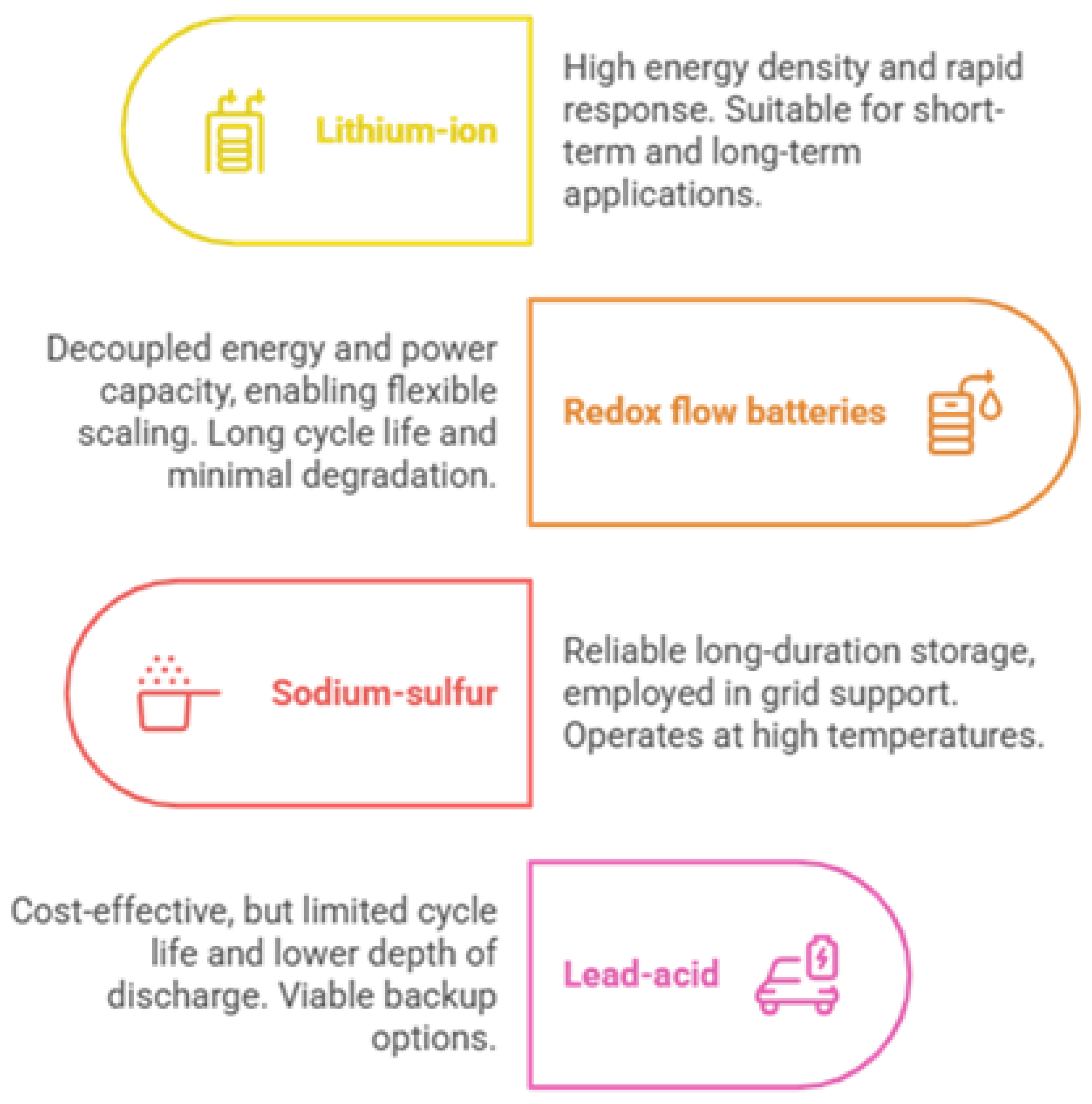
Figure 2.
Classification of Ancillary services in MV/LV networks.
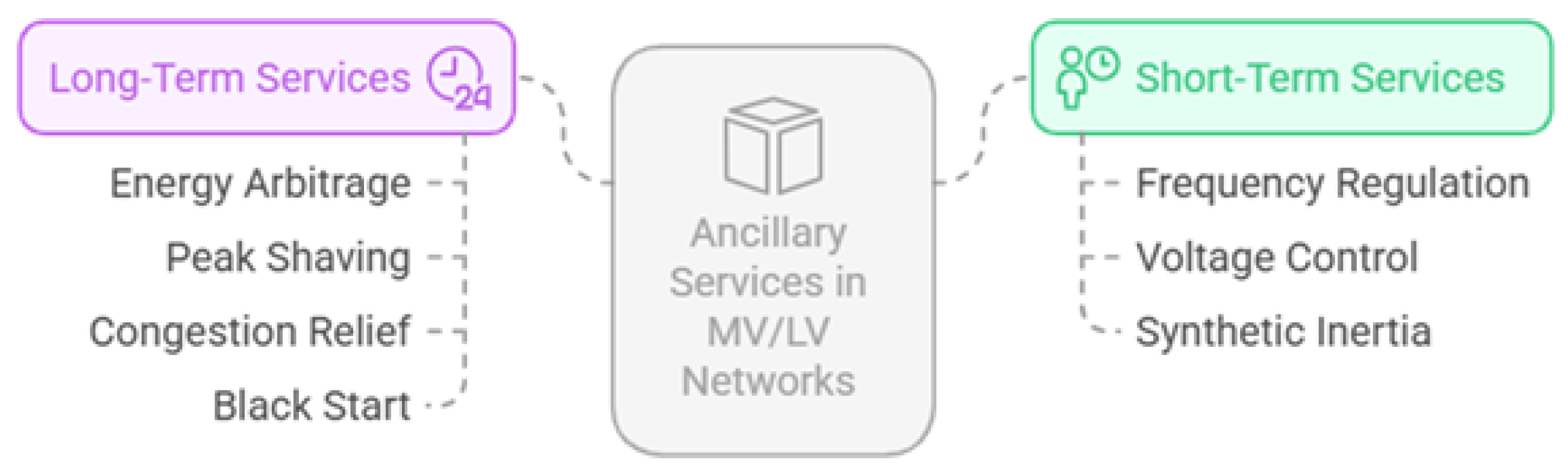
Figure 3.
BESS control strategies Comparison.
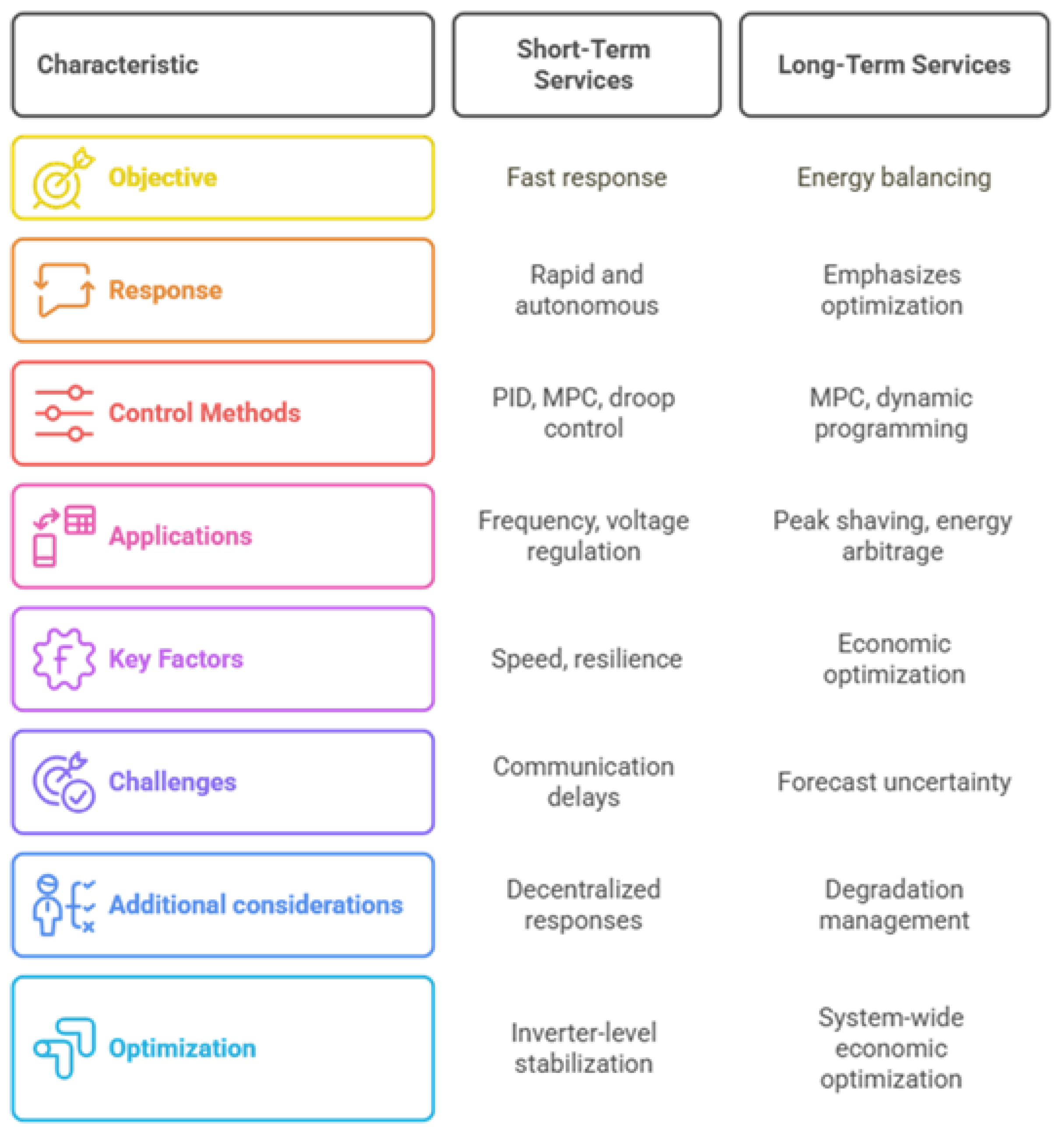
Figure 4.
IEEE 33-Bus system.
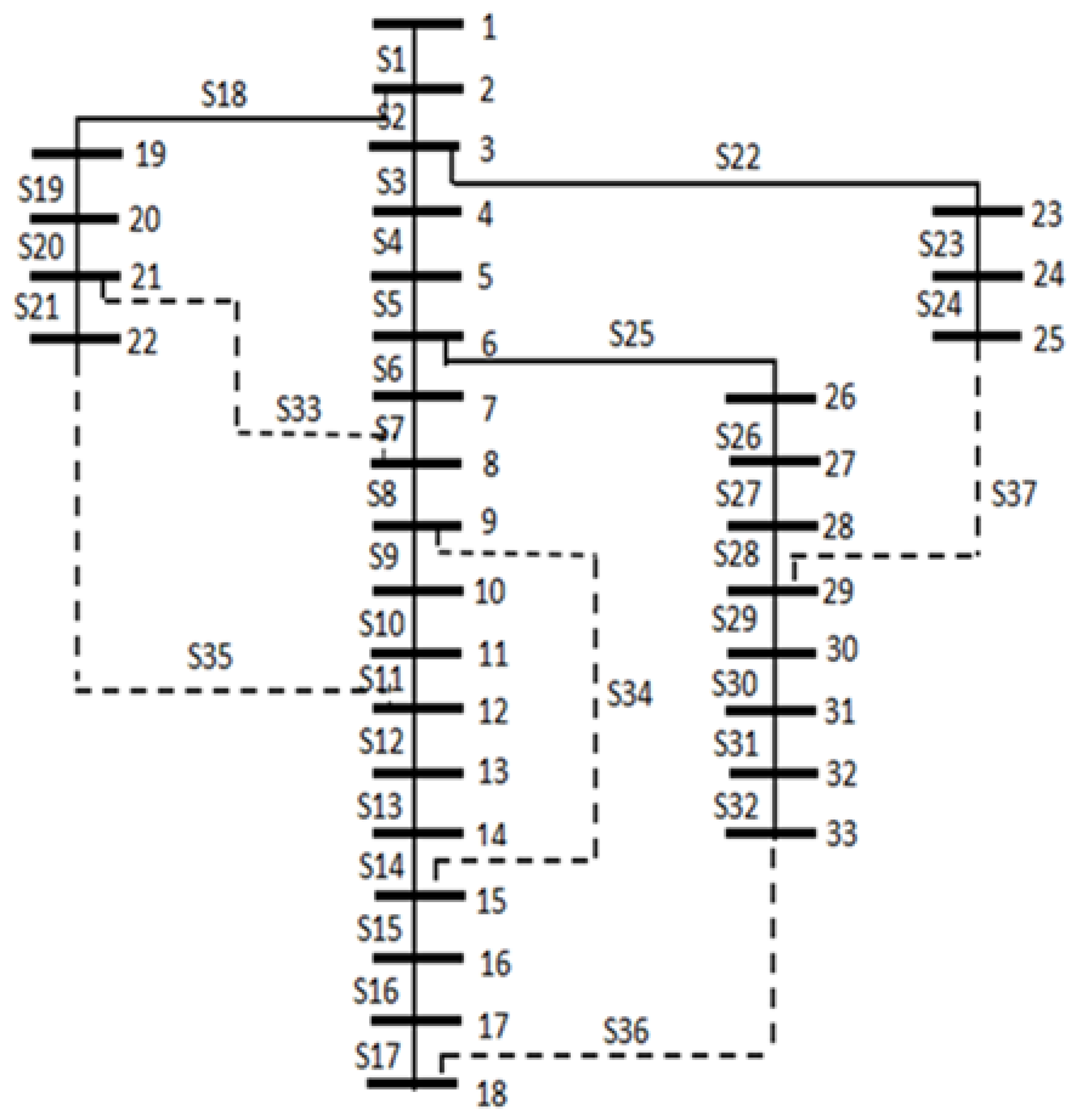

Table 1.
Technical Characteristics of Common BESS Technologies.
| Technology | Efficiency | Cycle life | Ramp time | Energy density | Suitable services |
|---|---|---|---|---|---|
| Li-ion (LFP/NMC) | <1 s | High | Frequency containment reserve (FCR), Frequency restoration reserve (FRR), peak shaving, voltage control | ||
| Flow Battery | <5 s | Low | Power smoothing, congestion relief, black start | ||
| NaS | ∼10 s | Medium | Load leveling, peak shaving | ||
| Lead-acid | ∼1 s | Medium | Limited to backup or infrequent cycling |
Table 2.
Comparative analysis of case studies.
| Metric | Hydro-Québec | M5BAT | IEEE 33-Bus | Eskom |
|---|---|---|---|---|
| Response Time | <10 ms | <1 s (Li-ion subsystem) | N/A (simulation-based) | ∼2 s (droop-based) |
| Efficiency (RTE) | ∼92% | 85% (hybrid) | ∼94% (with MPC control) | ∼88% |
| Voltage Improvement | Maintained within ±5% | Reduced unbalance to 1.6% | Improved from 0.91 to 0.93 pu | Stabilized within ±5% |
| Power Rating | 1.2 MW/2.4 MWh | 5 MW/5 MWh | 250 kW–1 MW (node-based) | 360 MW/1,440 MWh (planned) |
| Inverter Strategy | Grid-forming, Volt-VAR | Hierarchical, hybridized | MPC + PI regulation | Droop-based EMS |
| Thermal Design | UL 9540A air-cooled | Compartmentalized control | Modeled via EMS algorithms | Liquid cooling < 45 °C |
| Primary Control Type | Grid-forming autonomous | EMS-coordinated hybrid dispatch | Predictive control | Centralized droop dispatch |
| Key Innovation | Grid-forming inverters | Multi-chemistry hybrid system | MPC-based BESS optimization | Mobile, scalable deployment |
Disclaimer/Publisher’s Note: The statements, opinions and data contained in all publications are solely those of the individual author(s) and contributor(s) and not of MDPI and/or the editor(s). MDPI and/or the editor(s) disclaim responsibility for any injury to people or property resulting from any ideas, methods, instructions or products referred to in the content. |
© 2025 by the authors. Licensee MDPI, Basel, Switzerland. This article is an open access article distributed under the terms and conditions of the Creative Commons Attribution (CC BY) license (http://creativecommons.org/licenses/by/4.0/).
Copyright: This open access article is published under a Creative Commons CC BY 4.0 license, which permit the free download, distribution, and reuse, provided that the author and preprint are cited in any reuse.