

Submitted:
07 August 2025
Posted:
08 August 2025
You are already at the latest version
Abstract
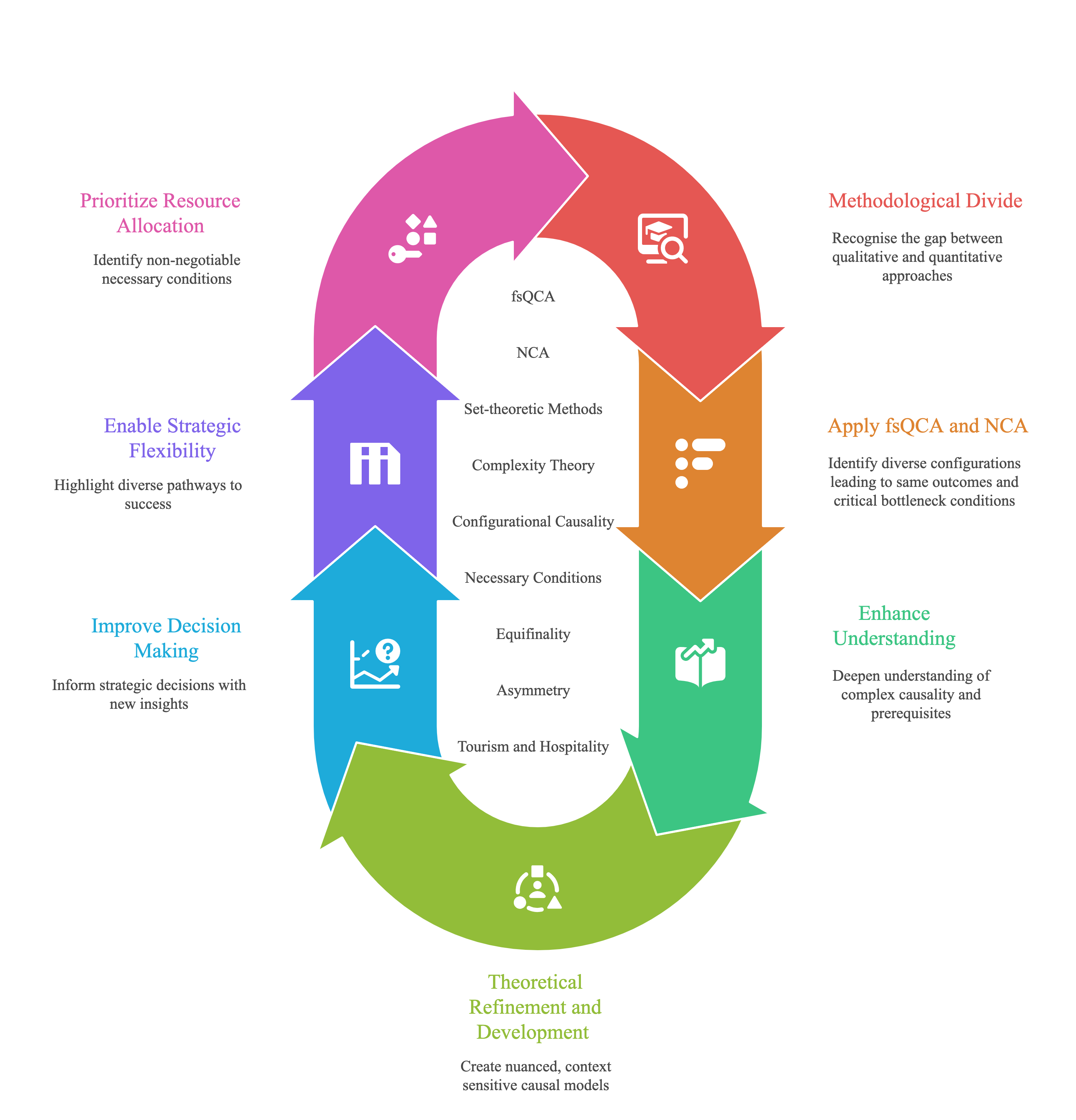
Tourism and hospitality studies struggle with a methodological divide, forcing scholars to choose between generalizability and contextual understanding while often failing to capture complex causal relationships like equifinality and conjunctural causation. This reliance on conventional approaches can obscure the critical insights needed for strategic decision-making and development within the industry. Thus, this review aims to demonstrate how fsQCA elucidates diverse configurations of conditions that lead to specific outcomes, while NCA identifies critical bottleneck conditions essential for achieving those outcomes, thereby enriching understanding of complex causality and effectively bridging bipolar methodological and analytical frameworks. To support this exploration, the authors conducted a systematic review of 89 articles. The results reveal that these set-theoretic methods effectively bridge long-standing methodological divides, integrating qualitative depth with quantitative rigour, moving beyond variable-oriented analyses to embrace case-oriented insights, explicitly modelling asymmetrical relation-ships, encouraging configurational thinking, enhancing causal inference, addressing data characteristics and limitations of traditional methods. It also enhances theoretical development by fostering more nuanced, context-sensitive causal models that align with the principles of complexity theory. Practically, the findings empower managers and policymakers with strategic flexibility by highlighting diverse pathways to success and enabling prioritised resource allocation by identifying non-negotiable necessary conditions. While acknowledging limitations such as a focus primarily on methodological application and the exclusion of grey literature, the study proposes future research directions, including integrated fsQCA-NCA frameworks, longitudinal studies, multi-level analyses, and exploring emerging phenomena and niche markets, to further advance scholarly understanding and practical applications in the field.
Keywords:
fuzzy-set Qualitative Comparative Analysis (fsQCA)
; Necessary Condition Analysis (NCA)
; set-theoretic methods
; complexity theory
; configurational causality
; necessary conditions
; equifinality
; asymmetry
; tourism and hospitality
1. Introduction
Tourism and hospitality studies often encounter a methodological divide, compelling scholars to choose between paradigms and risking a trade-off between generalizability and contextual understanding. In addition, the industry is inherently characterised by its complex, dynamic nature, intricate interdependencies, and diverse contextual factors (Akhshik et al., 2021; Olya & Akhshik, 2019; N. Pappas, 2017). Unlike simpler domains where cause-and-effect relationships might be linear and straightforward, the outcomes observed within this sprawling industry, ranging from nuanced tourist satisfaction and resilient destination competitiveness to optimal organisational performance and the practical implementation of sustainable practices, are rarely, if ever, the result of single, isolated causes. Instead, they typically emerge from complex, often non-linear, and asymmetric interactions among multiple contributing conditions (Eluwole et al., 2024; Woodside et al., 2018). This fundamental complexity presents a significant methodological challenge for traditional quantitative statistical approaches (Olya, 2020). Such conventional methods, which are primarily rooted in correlational logic and frequently assume linear, symmetrical relationships between variables, often prove insufficient in capturing the nuanced causal intricacies prevalent in the field’s research (Chaouali et al., 2022; Olya et al., 2020; Woodside, 2014). They particularly struggle with phenomena where certain factors act as indispensable prerequisites for an outcome to materialise, or where multiple, distinct, and sometimes contradictory recipes can ultimately result in similar outcomes (Dul, 2016; Ragin, 2014). This inherent methodological limitation has progressively spurred a growing scholarly interest in alternative, set-theoretic methodologies that possess a robust capability to bridge the long-standing “bi-polar” divide between qualitative, in-depth, case-oriented research traditions and quantitative, large-scale, variable-oriented analytical paradigms (Eluwole et al., 2024; Kumar et al., 2023; Ragin, 2014).
In this evolving and increasingly sophisticated methodological landscape, two powerful analytical tools have gained considerable traction and emerged as increasingly popular choices for researchers in tourism and hospitality: fsQCA and NCA. Both methods are grounded in the principles of complexity theory and neo-configurational thinking (Meyer et al., 1993; Ragin, 2000), offer distinct yet highly complementary perspectives on causality. fsQCA, a well-established method within the social sciences since its development by Charles Ragin (1998), systematically identifies sufficient configurations—often referred to as recipes of conditions that consistently result in a specific outcome (Ragin, 2000). Its profound strength lies in its ability to move beyond merely examining the individual net effects of variables to uncover instead how complex combinations of factors jointly and interactively produce a particular effect, thereby embracing equifinality and conjunctural causation (Schneider & Wagemann, 2012). Conversely, NCA, a more recent methodological development rigorously introduced by Jan Dul (2016), shifts the analytical focus to explicitly identify the conditions necessary for an outcome to occur. These necessary conditions function as bottlenecks or critical constraints, meaning that their absence, or their presence below a certain critical threshold, will unequivocally prevent the desired outcome from materialising, regardless of the presence of any other favourable conditions (Dul, 2016; Dul et al., 2023). The observable and increasing adoption, and indeed the growing integration, of fsQCA and NCA within tourism and hospitality study underscores a critical and widespread recognition among scholars of the pressing need for more sophisticated, holistic, and nuanced analyses of complex phenomena that transcend the inherent limitations of traditional, often reductionist, correlational interpretations (Eluwole et al., 2024; Kumar et al., 2023; W. Lee et al., 2023).
This structured literature review, therefore, aims to provide a comprehensive and detailed overview of the burgeoning application of fsQCA and NCA in tourism and hospitality studies. It thoroughly examines their distinct methodological underpinnings, synthesis key research themes and significant empirical findings gleaned from the existing body of literature, discuss the common types of results obtained, highlight prevalent conflicting viewpoints and ongoing debates within the scholarly community, outline their inherent limitations, and, critically, propose robust avenues for future research to further harness the transformative potential of these innovative methodologies within this dynamic, complex, and multifaceted field.
2. Literature Review
The social sciences’ study is often characterised by a “methodological divide,” a chasm separating quantitative and qualitative approaches. Quantitative methods, rooted in statistical analysis of large datasets, excel at identifying generalisable patterns and testing hypotheses, often emphasising breadth and external validity (King et al., 2021). Conversely, qualitative methods, involving in-depth exploration of more minor cases through interviews, observations, and textual analysis, prioritise rich understanding of context, nuance, and mechanisms, focusing on depth and internal validity (Creswell & Creswell, 2017). This division, while offering distinct strengths, can create an unproductive schism, hindering a holistic understanding of complex social phenomena. Scholars often find themselves forced to choose one paradigm over the other, potentially sacrificing either generalizability or contextual understanding, a tension long debated within the academic discourse (Goertz & Mahoney, 2012). However, innovative methods like fsQCA and NCA provide promising ways to bridge the methodological divide, as both focus on configuration and causality, transcending traditional quantitative and qualitative boundaries.
The pervasive adoption of fsQCA and NCA in the field’s study marks a significant epistemological shift towards embracing complexity theory and neo-configurational thinking. This theoretical lens, gaining increasing prominence in social sciences, explicitly acknowledges that phenomena within this dynamic field are frequently characterised by equifinality, where multiple distinct pathways or recipes of conditions can lead to similar results and conjunctural causation, where causes interact in specific combinations rather than acting in isolation to produce an effect (Ragin, 1998; Schneider & Wagemann, 2012). These principles are highly resonant with the multifaceted nature of the field, where successful outcomes often hinge on the intricate interplay of numerous factors (Eluwole et al., 2024; Kumar et al., 2023).
2.1. Fuzzy-Set Qualitative Comparative Analysis (fsQCA)
fsQCA, fundamentally building upon the pioneering and highly influential work of Charles Ragin (1998), particularly his seminal contributions in The Comparative Method (Ragin, 2014), Fuzzy-Set Social Science (Ragin, 2000), and Redesigning Social Inquiry (Ragin, 2009), has proven to be an indispensable and increasingly popular tool for systematically identifying the complex sufficient conditions that lead to various outcomes across the multifaceted landscape of the industry. A cornerstone of fsQCA is its ability to handle nuanced membership in sets through fuzzy logic, which allows for a sophisticated analysis of qualitative distinctions inherent within quantitative data, moving beyond the rigid binary classifications of traditional crisp-set QCA (Ragin, 2000; Schneider & Wagemann, 2012). This methodological approach is particularly well-suited for understanding “how” and “why” complex phenomena occur, rather than simply “how much” they occur (Woodside et al., 2018).
fsQCA Studies’ Themes and Theories
The application of fsQCA in the field has evolved significantly since its initial adoption, reflecting a broadening recognition of its utility in diverse sub-fields. Early applications, often drawing upon established behavioural and consumer-centric theories such as the theory of planned behaviour (Ajzen, 1991), the expectancy-disconfirmation theory (Oliver, 1980), or general consumer decision-making models (Engel et al., 2010), primarily focused on understanding intricate aspects of tourist behaviour and destination choice. For instance, scholars have utilised fsQCA to decipher how diverse configurations, such as specific combinations of perceived destination image, unique cultural experiences, and high-quality service encounters, coalesce to drive tourist satisfaction and foster long-term loyalty (Eluwole et al., 2024; Prayag, 2023). Pioneering studies by Woodside and colleagues extensively demonstrated fsQCA’s utility in modelling complex traveller decision processes, revealing the intricate interplay of factors that lead to destination selection or repeat visitation, often identifying alternative, equally compelling paths to the same outcome (Woodside, 2011; Woodside & Baxter, 2013). This highlights fsQCA’s ability to uncover equifinality, a core tenet of complexity theory (Woodside et al., 2018).
As the methodological understanding and computational tools for fsQCA matured and became more accessible, its scope of application significantly expanded beyond consumer behaviour to encompass more intricate organisational, strategic, and macro-level phenomena within the broader industry. This expansion includes rigorous analyses of configurations leading to enhanced destination competitiveness (Gössling et al., 2018; Küçükergin et al., 2021), superior hotel and restaurant performance (Eluwole et al., 2024; Shin & Nicolau, 2022), and the successful implementation of sustainability initiatives in tourism, identifying the specific combinations of organisational culture, management commitment, and external pressures that drive pro-environmental behaviours (Olya & Akhshik, 2019). Furthermore, fsQCA has been increasingly applied to understand the recipes for entrepreneurial success in tourism (Ciampi et al., 2021; Sarmazeh & Seidaiy, 2021), the drivers of innovation within hospitality firms (Harms et al., 2021), and the factors fostering resilience in tourism businesses and destinations when facing systemic shocks and crises, such as the COVID-19 pandemic (Prayag, 2023). Complexity theory is frequently invoked, either explicitly or implicitly, to provide the theoretical justification for employing fsQCA, emphasising its unique capacity to uncover equifinality and conjunctural causation, where conditions interact in specific combinations rather than acting in isolation to produce an effect (Woodside, 2014). Other prominent theoretical lenses, such as the resource-based view (Barney, 1991), institutional theory (Scott, 2005), stakeholder theory (Freeman et al., 2010), or dynamic capabilities theory (Teece et al., 1997), are often integrated with fsQCA when examining organisational performance, strategic configurations, and the complex pathways to competitive advantage or sustainability outcomes in the industry’s context.
2.2. Necessary Condition Analysis (NCA)
NCA, a distinct methodological innovation rigorously developed and articulated by Jan Dul (2016), directly complements fsQCA by specifically shifting the analytical focus to identifying recipes that must exist for a result to occur, irrespective of other contributing factors. NCA provides a unique and powerful lens to address the critical question: “Does X always need to be there for Y to occur, and if so, what is the threshold required level of X for a certain level of Y?” (Dul, 2016). It offers a different perspective on causality, emphasising constraints and bottlenecks rather than paths to sufficiency.
NCA Studies’ Themes and Theories
NCA’s core contribution lies in its ability to identify bottleneck conditions, which are critical prerequisites without which a desired outcome simply cannot materialise. Its application often draws upon theoretical frameworks such as the resource-based view (Barney, 1991), which helps identify critical resources, capabilities, or competencies that are indispensable for achieving competitive advantage, superior performance, or sustained success. Similarly, constraint-based theories (Goldratt, 1990; Goldratt & Cox, 2016), which focus on factors that limit or impede goal attainment, are highly compatible with NCA’s logic. In essence, NCA supports identifying those non-negotiable elements that must be in place. For instance, studies might rigorously investigate if a certain threshold level of perceived safety and security, baseline hygiene standards (a health perspective in hospitality), or core perceived value (a tourist decision-making perspective) is an absolute necessary condition for tourist satisfaction, for positive destination choice, or even for repeat visitation (Y.-J. Lee, 2024; Olya et al., 2021).
NCA is particularly instrumental in pinpointing factors that, if absent or below a defined critical threshold, will unequivocally prevent an outcome from happening, irrespective of the presence of other favourable conditions (Dul, 2016). This characteristic provides crucial, actionable insights for managers, allowing them to prioritise resources on removing fundamental deficiencies or ensuring baseline requirements are met before investing in factors that merely provide sufficiency (W. Lee et al., 2023). Its theoretical relevance is profound, as it allows scholars to establish critical prerequisites for various outcomes, thereby constructing a complete and more robust causal picture when integrated with methods that identify sufficient conditions (Dul et al., 2023). Beyond satisfaction and performance, NCA has been used to show necessary conditions for innovation in hotels (Sigala, 2020), for destination resilience in the face of disruptions (Prayag, 2023), for successful crisis management in the industry (Paraskevas et al., 2013), and sustainable development (Bramwell & Lane, 2011; Rasoolimanesh et al., 2021). This method is beneficial for policy makers and strategic planners who need to identify critical ‘no-go’ areas or essential building blocks (Dul et al., 2020).
3. Methodology
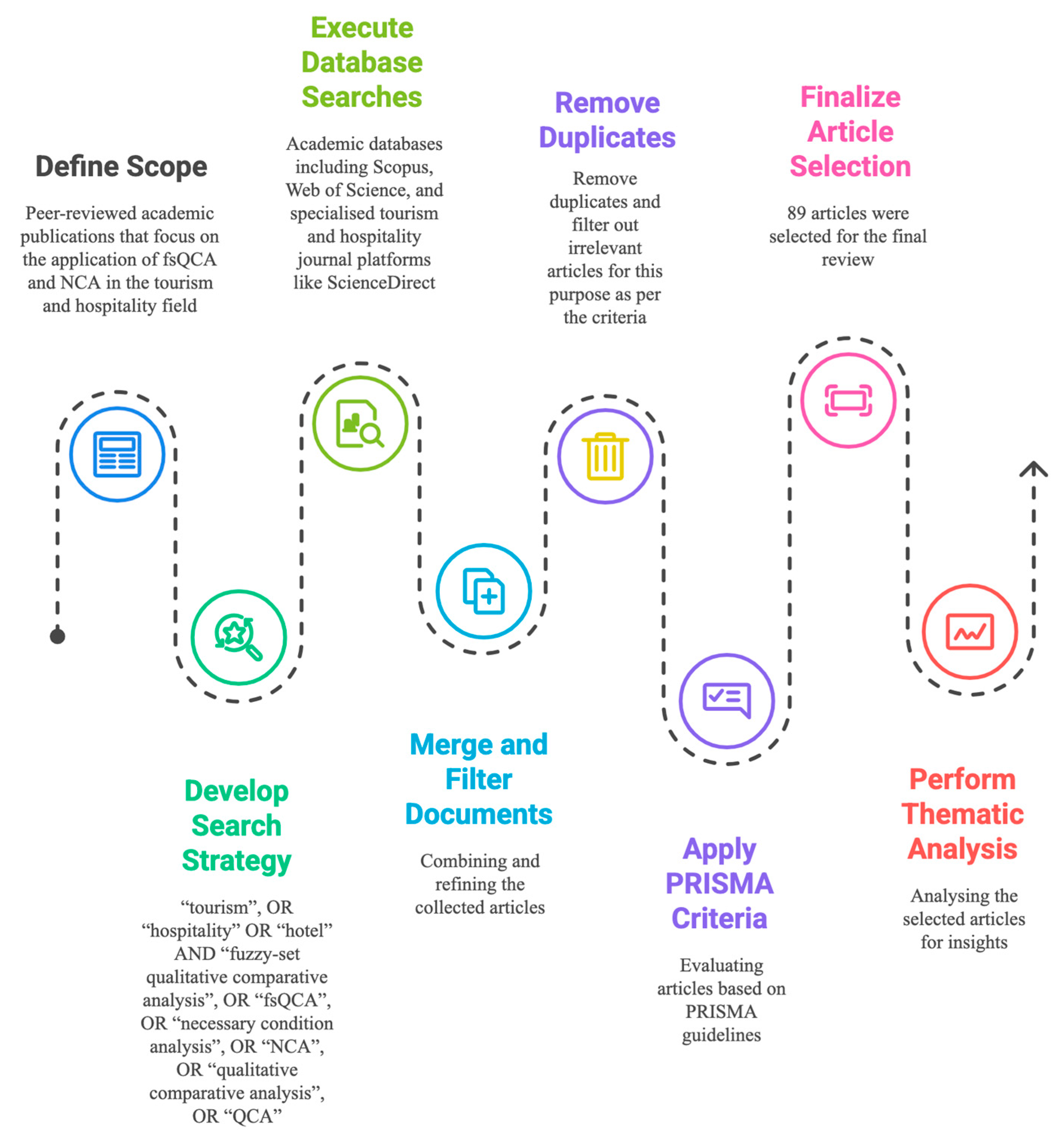
This literature review employs a rigorous, structured approach to systematically identify, analyse, and synthesise peer-reviewed academic publications that focus on the application of fsQCA and NCA specifically within tourism and hospitality studies. The methodological process encompassed several sequential and detailed steps to ensure comprehensive coverage and analytical depth.
3.1. Search Strategy
Authors executed a systematic search across multiple prominent academic databases to maximise the breadth of retrieved literature. These databases included Scopus, Web of Science, and specialised tourism and hospitality journal platforms like ScienceDirect. The search strategy incorporated a combination of carefully selected key terms, including: (tourism OR hospitality OR hotel*) AND (fsQCA OR NCA OR QCA) OR (tourism OR hospitality OR hotel*) AND (fuzzy-set qualitative comparative analy* OR necessary condition analy* OR qualitative comparative analy*). The search was not restricted by publication date, allowing for the tracing of the historical evolution of these methods’ application in the field. However, authors gave particular emphasis to studies published 2010 onwards, which largely coincides with the broader acceptance and increasing adoption of fsQCA and the subsequent emergence of NCA as distinct methodologies.
3.2. Inclusion and Exclusion Criteria
To ensure the relevance of the literature, the authors established explicit inclusion and exclusion criteria. Studies were included if they were peer-reviewed articles and demonstrated the direct application of fsQCA or NCA, or both, in the field. Publications focusing on significant methodological advancements or critical reviews within this context were also eligible. Conversely, the authors excluded conference abstracts, opinion pieces, editorials, and theoretical discussions that lacked empirical application of these methods. Additionally, studies that mentioned fsQCA or NCA without direct application, or used different methodologies, were omitted to maintain a focused review.
3.3. Data Extraction and Synthesis
The authors performed a systematic review of relevant articles by extracting critical information, including author names, publication details, research objectives, methodologies (fsQCA or NCA, or both), key variables, empirical findings, theoretical frameworks, managerial implications, and study limitations. Thematic synthesis of the data identified recurring themes in fsQCA and NCA applications across the tourism and hospitality sub-fields. This analysis highlighted common patterns, methodological debates, and research gaps, while also tracing the development of research themes and the trend toward methodological integration. This rigorous approach provided a thorough examination of the current framework of knowledge regarding fsQCA and NCA in the field from 89 selected articles as per Moher and colleagues’ PRISMA guidelines (2010).
Figure 1.
Methodological framework.
4. Results
The application of fsQCA and NCA in this field’s study has consistently yielded distinct patterns of results that fundamentally differ from those typically obtained through traditional correlational and regression-based analyses. These results offer a more nuanced and realistic understanding of causality, highlighting the complex, often asymmetrical, and conjunctural nature of relationships within this dynamic field.
4.1. Fuzzy-set Qualitative Comparative Analysis (fsQCA)
fsQCA studies in the industry consistently reveal that desirable outcomes are rarely caused by single, isolated factors but rather by multiple, often distinct, combinations of conditions (Ragin, 2009; Schneider & Wagemann, 2012). This phenomenon, a cornerstone of complexity theory, is known as equifinality, indicating that there are diverse recipes through which a specific outcome can be achieved. For instance, attaining high tourist satisfaction in a hotel might not stem from a single outstanding service dimension (just friendly staff). Still, it could emerge from varied configurations, such as the conjunction of highly efficient check-in processes with impeccably clean rooms, or a blend of personalised service with exceptional dining experiences, or even a combination of value-for-money pricing with a unique cultural immersion program (Eluwole et al., 2024; Geremew et al., 2024). Each of these distinct combinations, if present, can be sufficient to result in the same high level of satisfaction. This highlights the conjunctural nature of causation, where conditions do not act independently in an additive manner but interact in specific combinations to jointly produce an effect (Woodside et al., 2018). Scholars explicitly detail these recipes in their findings, often presenting them as Boolean expressions, such as (Set A * Set B) + (Set C * ~Set D) → Outcome.
A defining hallmark of fsQCA findings in the industry is the identification of asymmetry (Olya, 2020). This critical insight means that the conditions resulting in the presence of a desired outcome (high guest loyalty, successful sustainable tourism initiatives) are often different from, or even opposite to, those leading to its absence (low guest loyalty or defection, failure of sustainable initiatives). For example, while excellent service might lead to loyalty, poor cleanliness might be the primary driver of disloyalty, irrespective of other service dimensions (Shin & Nicolau, 2022). This contrasts sharply with symmetrical statistical methods (like regression) that implicitly assume the factors influencing the presence of an outcome are merely the inverse of those influencing its absence. fsQCA enables scholars to examine the conditions that contribute to both the presence and absence of an outcome, providing a more comprehensive understanding of the causal picture. Scholars routinely report multiple recipes that are sufficient for achieving an outcome (Kumar et al., 2023; Rasoolimanesh et al., 2021), thereby offering managers a repertoire of diverse strategic options rather than a singular, often elusive, optimal solution. The empirical quality and robustness of these identified solutions are rigorously assessed through established metrics such as “consistency” and “coverage.” Consistency quantifies how consistently a specific configuration or recipe leads to the outcome, reflecting the degree to which cases sharing the configuration also share the outcome (Geremew et al., 2024; Woodside, 2014). A high consistency score (above 0.8) indicates a strong subset relationship. Coverage, in contrast, signifies the ratio of outcome cases described by a particular configuration, reflecting its empirical relevance (Ragin, 2009; Woodside et al., 2018). High coverage (above 0.5) indicates that the configuration accounts for a substantial ratio of cases exhibiting the result. Both consistency and coverage, as well as unique coverage for each pathway, are presented in Table 1 to provide a comprehensive understanding of the findings.
Olya and colleagues (2021) applied fsQCA and NCA to analyse the intricate relationship between green practices and hotel performance in an emerging market context. The fsQCA component of their analysis effectively identified various distinct recipes (configurations of environmental management systems, waste reduction, and energy efficiency initiatives) through which different combinations of green practices could lead to high hotel performance, robustly showcasing the equifinality of achieving both environmental and economic benefits. Eluwole and colleagues (2024), in their recent and comprehensive bibliometric review study, provided a robust overview of fsQCA’s increasing prominence in hospitality and tourism research since 2011. It meticulously identifies key sectors of application, such as destination and hotel selections, tourist decision-making and behaviour, and entrepreneurial orientations within the industry. Crucially, it compellingly highlights the method’s unique and growing role in illuminating intricate decision-making paradigms and uncovering complex causal recipes that lead to highly desirable outcomes, such as customer loyalty, satisfaction, and positive word-of-mouth. Similarly, Kumar and colleagues (2023) revealed in their systematic review that further delineates the thematic structure of fsQCA applications in the field, providing a precise categorisation into six distinct knowledge clusters. These clusters include business competitiveness, entrepreneurship, the psychoanalysis of tourist behaviour, the tourism business ecosystem, and sustainable tourism. These scholars emphatically underscore fsQCA’s unparalleled power in examining complex causal relationships that traditional statistical methods often struggle to uncover, showcasing its versatile capacity to identify the necessary and sufficient conditions within a rigorous configurational framework.
4.2. Necessary Condition Analysis (NCA)
NCA studies typically present their results graphically, utilising scatterplots that illustrate the interplay between a condition and an outcome (Dul, 2016). These scatterplots are overlaid with “ceiling lines” (Ceiling Regression (CR) or Ceiling Envelopment (CE), which visually define the upper boundary of the data points. These lines indicate the maximum possible outcome level that can be observed given a certain level of the necessary condition, effectively showing the bottleneck (Dul et al., 2020). Key findings from NCA applications in tourism and hospitality include:
Identification of “Bottleneck” Factors: A primary and powerful result is the identification of specific conditions that are indispensable for an outcome. For example, a foundational level of perceived safety and security may be a necessary condition for tourists even to consider visiting a destination, irrespective of its attractions, cultural richness, or marketing efforts (Y.-J. Lee, 2024). Similarly, for a hotel to achieve high guest satisfaction, a minimum level of cleanliness and basic service functionality might be necessary (Olya et al., 2021). Without these prerequisites, achieving the desired outcome (tourism visit, high satisfaction) is impossible, providing critical insights into non-negotiable requirements.
Demonstration of Non-Substitutability: NCA results frequently demonstrate that necessary conditions cannot be easily compensated for or substituted by other factors (Dul, 2016; Dul et al., 2020). Suppose an essential condition is absent or falls below its required threshold. In that case, the desired outcome will not occur, even if all other contributing factors are optimally present and positively influence the outcome. For example, if a destination is perceived as unsafe, no amount of marketing expenditure or attraction development can overcome this fundamental barrier to attracting tourists. This highlights the critical, non-negotiable nature of necessary conditions, distinguishing them from mere contributing factors.
Complementarity to Sufficiency Analysis: When utilised in conjunction with fsQCA, NCA results often provide crucial pre-conditions that must be in place before the fsQCA-identified sufficient recipes can effectively result in a desired outcome. This layered approach provides an enriched and more thorough insight into the complex and multifaceted causal landscape. For example, specific green practices (basic waste segregation, energy-efficient lighting) might be identified as necessary for achieving a baseline of high hotel performance through NCA (Olya et al., 2021). Subsequently, fsQCA can reveal various distinct combinations of other marketing, service quality, and innovation practices that are sufficient to achieve even higher performance once the necessary green practices have been established (through innovative guest experiences or targeted marketing campaigns). This combined approach clarifies both what must be present and what can lead to success, offering invaluable strategic guidance (Dul, 2022). The strength and significance of a necessary condition are quantified using the “effect size” (d) of the bottleneck, which reflects the magnitude to which the outcome is constrained by the condition (Dul et al., 2020). Scholars also report the “accuracy” of the ceiling line in representing the necessity relationship (Dul, 2016) (see Table 2).
Y.-J. Lee (2024) compellingly demonstrated NCA’s unique ability to identify that certain hedonic elements (feelings of positive affect, carefreeness, pleasure, and joy) were necessary, though not sufficient, for tourists to achieve more profound and meaningful eudaimonic (well-being-related) experiences. This finding has significant implications for experience design in tourism, emphasising that while hedonic elements don’t guarantee eudaimonia, their absence prevents it. Similarly, Olya and his colleagues (2021) conducted an innovative fsQCA application, notably utilising NCA to determine that specific green practices (energy efficiency measures, and comprehensive waste management programs) were indeed necessary conditions for achieving high hotel performance in an emerging market. This robust study underscored their role as indispensable prerequisites, without which superior performance was unlikely, regardless of other positive factors, such as branding or service quality. This study serves as an excellent example of the powerful synergy between fsQCA and NCA, demonstrating how they provide distinct yet complementary causal insights of sufficiency and necessity.
Vis and Dul (2018) made a foundational study which played a crucial role in explicitly introducing NCA to the broader tourism research community. The study clearly articulated NCA’s distinct contribution by identifying “must-have” conditions and demonstrated how it fundamentally complements sufficiency-based methods. It provided a clear conceptualisation of necessity, its relevance for understanding complex tourism phenomena, and initial guidance for its application. Similarly, a study by Dul (2022) clarified the conceptual and analytical distinctions between “necessity” as understood and assessed in fsQCA, often referred to as “in-kind” or set-theoretic necessity and NCA focusing on ‘in-degree” or quantitative necessity. By highlighting common pitfalls and advocating for more precise and rigorous application, this study significantly advances the strengthening of the methodological foundation of fsQCA and NCA in future research.
5. Discussion
The increasing integration and thoughtful application of fsQCA and NCA in the field’s research represent a profound methodological evolution. This dual methodological approach has proven exceptionally effective in bridging long-standing “bi-polar methodological divides” that have historically constrained the comprehensive understanding of complex phenomena in the social sciences, leading to richer theoretical insights and more actionable managerial implications (see Figure 2).
5.1. Bridging Methodological Divides
The distinct yet complementary strengths of fsQCA and NCA enable scholars to transcend traditional dichotomies that have often limited the scope and depth of causal inquiry in the fields of tourism and hospitality (see Table 3).
5.1.1. Qualitative and Quantitative Research Integration
Perhaps the most significant contribution of fsQCA and NCA is their capacity to blend the strengths inherent in mixed research paradigms (Eluwole et al., 2024; Geremew et al., 2024). In fsQCA, the crucial process of calibration, which transforms raw empirical data into fuzzy-set membership scores (assigning degrees of membership to conditions and outcomes), demands a deep, theoretically informed qualitative understanding of the concepts being measured and the specific context of the study (Ragin, 2014; Schneider & Wagemann, 2012). This qualitative grounding ensures that the subsequent quantitative truth table analysis and Boolean minimisation are not merely statistical exercises but are imbued with substantive meaning. For instance, determining what constitutes “high” or “low” service quality for calibration requires qualitative judgment rooted in theory or expert knowledge (I. Pappas & Woodside, 2021). Similarly, NCA’s visual interpretation of scatterplots and ceiling lines often benefits immensely from qualitative insights into individual case behaviour and the theoretical meaning of the identified bottlenecks. For example, understanding why safety is a necessary condition for tourist arrivals might require qualitative exploration of past crises or tourist perceptions (Y.-J. Lee, 2024). This synergistic fusion enables researchers to conduct context-rich, case-sensitive analyses while maintaining the analytical rigour and potential for generalisation typically associated with quantitative methods, thereby moving beyond the false dichotomy often imposed between these approaches (Ragin, 2014).
5.1.2. Variable-Oriented and Case-Oriented Analysis
Traditional statistical methods (symmetrical analysis) are predominantly variable-oriented, focusing on the average effects of individual variables across large populations, often treating cases as interchangeable data points (Ragin, 2014). In contrast, fsQCA is uniquely described as “case-oriented in a variable-oriented way” (Geremew et al., 2024; Woodside & Baxter, 2013). This means it allows researchers to systematically identify general patterns (configurations of conditions) while crucially retaining a focus on the specific attributes and experiences of individual cases (Rihoux & Ragin, 2009). For example, while fsQCA may identify common pathways to hotel success, scholars can still examine specific “deviant” cases to understand why they did not fit the pattern (Schneider & Wagemann, 2012). NCA is also inherently case-focused, as it identifies conditions that must hold for each case for an outcome to take place (Dul et al., 2020). It doesn’t focus on averages but on the boundaries of possibility for individual observations (Dul, 2022). This dual capability enables research that provides both broad generalisations (identifying common, sufficient pathways or universal, and necessary conditions) and in-depth, nuanced understandings of specific instances, catering effectively to both nomothetic (law-seeking) and idiographic (particularistic understanding) research goals. This ability is particularly valuable in the highly diverse and context-dependent industry.
5.1.3. Symmetry and Asymmetry in Causality
A critical and often overlooked advantage of fsQCA and NCA is their explicit recognition and ability to model asymmetrical causality (Geremew et al., 2024; I. Pappas & Woodside, 2021). Unlike many traditional statistical methods that implicitly assume symmetrical relationships (where the conditions that facilitate an outcome are essentially the negation of those that prevent it), fsQCA thoroughly distinguishes between the factors contributing to an outcome’s existence and those causing its non-existence (Olya & Altinay, 2016; Rihoux & Ragin, 2009). For example, factors that lead to high tourist satisfaction may differ from those that lead to dissatisfaction. A lack of cleanliness might cause dissatisfaction, but its presence alone may not guarantee high satisfaction if other favourable conditions are missing (Shin & Nicolau, 2022). NCA, on the other hand, focuses on conditions that are unilaterally indispensable (necessary), meaning they are required for the outcome, yet the absence of the outcome does not definitively indicate that the condition is not present (Dul, 2022; Dul et al., 2020). This capability provides a far more realistic and sophisticated depiction of complex causal relationships that are prevalent in this dynamic industry, where problems are often asymmetric (poor service guarantees failure, but excellent service doesn’t guarantee success).
5.1.4. Correlation and Causation (Beyond Association)
By explicitly focusing on set-theoretic relationships and the rigorous identification of necessary and/or sufficient conditions, these methods enable scholars to move significantly beyond mere correlational statements, providing more robust insights into causal mechanisms. The identification of necessary conditions through NCA offers stronger causal claims by demonstrating a fundamental “no outcome without condition” relationship, which is a powerful form of causal inference (Dul et al., 2023; W. Lee et al., 2023). If a condition is truly necessary, the outcome cannot arise unless that condition is present. Similarly, fsQCA’s identification of sufficient pathways provides a direct causal recipe for an outcome to happen (Geremew et al., 2024; Ragin, 2014). While QCA does not claim to establish causality in the experimental sense, it identifies robust regularities that are consistent with causal claims under specific theoretical assumptions (I. Pappas & Woodside, 2021; Schneider & Wagemann, 2012). This capability is crucial for policy and management, where understanding how to produce desired outcomes, rather than just what correlates with them, is paramount.
5.2. Implications of the Study
The empirical results derived from fsQCA and NCA studies offer profound and actionable implications for the theoretical development of knowledge, methodological contribution and the strategic decision-making of practitioners within the industry (see Figure 3).
5.2.1. Theoretical Implication
This study enriches theoretical development in the field of study by enabling scholars to move beyond simplistic linear and additive models of causation towards a more nuanced understanding of complexity. (1) Advancing Complexity Theory and Configurational Thinking: The most significant theoretical contribution lies in explicitly integrating and empirically validating the tenets of complexity theory (Schneider & Wagemann, 2012; Woodside, 2014). By identifying multiple sufficient pathways (equifinality) through fsQCA and indispensable prerequisite conditions (necessity) through NCA, the study’s findings demonstrate that outcomes in the field are rarely the result of isolated variables but rather emerge from intricate combinations and interactions of conditions (Eluwole et al., 2024; Geremew et al., 2024; Kumar et al., 2023). This allows for the generation or refinement of theories that acknowledge the reality of conjunctural causation and asymmetric relationships, where having a condition may produce an outcome, yet lacking it does not guarantee the opposite outcome. This provides a more accurate theoretical representation of the complex causal patterns in the industry. (2) Refining Existing Theories and Building New Ones: This study allows for a more granular and context-specific refinement of established theories. For instance, rather than broadly asserting that “service quality” influences “customer satisfaction” (Oliver, 1980), fsQCA can delineate which specific configurations of service dimensions (highly empathetic staff, efficient processes, and pristine facilities) are sufficient for high satisfaction in a particular segment of hotels or destinations. This moves theory towards a more precise articulation of how and under what conditions theoretical constructs interact. NCA, by identifying bottleneck conditions, helps to establish critical boundary conditions for existing theories. For example, a theory on destination marketing effectiveness may need to be refined to state that its principles only hold when a necessary condition, such as “perceived safety,” is met (Y.-J. Lee, 2024). This leads to the development of more robust, context-dependent, and empirically grounded theoretical frameworks (Dul, 2022). (3) Exploring Asymmetry in Causal Relationships: This study can serve as a crucial departure from many traditional statistical methods. This enables scholars to theorise not just about what leads to success, but also about what leads to failure, acknowledging that the causal factors for one might not simply be the inverse of the other (Ragin, 2014; Woodside, 2014). For example, factors that lead to high tourist loyalty may differ from those that lead to disloyalty (Shin & Nicolau, 2022). This nuanced understanding of asymmetry allows for the development of more comprehensive and realistic causal theories that capture the full spectrum of outcomes.
5.2.2. Methodological Implications
This study is pushing the boundaries of analytical rigour and scope in different ways: (1) Promoting Methodological Integration: The application of fsQCA and NCA explicitly champions the powerful synergy between qualitative and quantitative research approaches (Dul et al., 2023; Ragin, 2017). This study serves as a strong advocate for mixed-methods designs, where qualitative data can inform the fuzzy-set calibration, provide context for interpreting configurations, or explain underlying mechanisms identified by necessary conditions, thereby enriching the quantitative analysis and offering a more holistic methodological framework (Rihoux & Ragin, 2009). (2) Encouraging Configurational Thinking: The study enables scholars to adopt a configurational mindset from the outset of their research design. This involves conceptualising outcomes as products of interacting conditions, rather than independent variables. It prompts scholars to theorise about combinations, pathways, and critical prerequisites, leading to research questions that are better aligned with the complex realities of the field (Schneider & Wagemann, 2012). (3) Enhancing Causal Inference: The study demonstrates how fsQCA and NCA contribute to stronger causal inference compared to purely correlational analyses. NCA provides a robust form of causal insight by identifying “must-have” conditions (Dul et al., 2023). If a condition is truly necessary, its absence definitively prevents the outcome. Similarly, fsQCA’s identification of sufficient pathways indicates a direct “recipe” for an outcome (Ragin, 2017). This moves beyond association towards mechanisms and prerequisites, elevating the rigour of causal claims in the field. (4) Addressing Data Characteristics and Limitations of Traditional Methods: The study highlights that fsQCA and NCA are particularly well-suited for medium-to-small datasets, a common characteristic in many in-depth studies of the industry and offer robust alternatives when extensive sample size data for traditional regression might be unavailable or inappropriate for the research question (Geremew et al., 2024). Furthermore, such methods and analyses effectively address multicollinearity and non-linearity that often plague conventional statistical methods when dealing with complex interactions.
5.2.3. Managerial Implications
The study offers highly actionable insights for practitioners, managers, and policymakers for strategic decision-making and resource allocation in the industry. (1) Strategic Flexibility and Diverse Pathways to Success: The identification of equifinal configurations by fsQCA is profoundly valuable for managers. It implies that there is no single “best practice” or “one-size-fits-all” solution for achieving desired outcomes (Eluwole et al., 2024; Geremew et al., 2024). Instead, managers have multiple, equally effective strategic pathways available to them. This empowers industry leaders to tailor strategies to their specific resource endowments, market segments, contextual constraints, and unique competitive advantages. (2) Prioritising Critical Investments and Avoiding Fatal Flaws: NCA’s ability to pinpoint necessary conditions is invaluable for efficient resource allocation and risk management (Dul, 2022). It compels managers to focus on ensuring that critical prerequisites are met first, before investing heavily in other areas. For instance, if perceived safety is a necessary condition for tourist arrivals, then investments in marketing or attractions will be largely ineffective if safety concerns are not addressed. It promotes a “must-have” rather than “more-is-better” approach to essential resources (Y.-J. Lee, 2024; Olya et al., 2021). (3) Tailored Policy Interventions: For policymakers and destination management organisations (DMOs), insights from fsQCA and NCA enable more targeted and effective policy interventions. Instead of generic policies, they can design initiatives that address specific necessary conditions (minimum sustainability standards and baseline infrastructure) or promote configurations known to lead to desired outcomes, such as sustainable tourism development or enhanced visitor experiences. This reduces wasteful spending on initiatives that might be “good” but not “necessary” or part of a sufficient pathway (Olya & Akhshik, 2019; Rasoolimanesh et al., 2022). (4) Enhanced Crisis Management and Resilience: In this industry, which is highly vulnerable to crises (pandemics and economic downturns), these methods can help identify necessary conditions for resilience or the configurations that enable rapid recovery (Atadil & Lu, 2021; Prayag, 2023). This allows practitioners to establish robust foundational elements and develop diversified strategies to mitigate future shocks more effectively.
6. Conclusions
The steadily growing body of literature utilising fsQCA and NCA in the field’s study unequivocally demonstrates their immense value and transformative potential in navigating, dissecting, and understanding the inherent complexities of this dynamic and multifaceted industry. These powerful set-theoretic methods have proven exceptionally effective in bridging traditional methodological divides that have historically fragmented the research, thereby offering a more holistic and robust approach to causal inquiry. Specifically, the application of fsQCA and NCA has successfully integrated the depth typically related to qualitative, case-oriented studies with the rigour and generalizability often sought in quantitative, variable-oriented analyses (Dul, 2016). This methodological synergy enables researchers to explore the nuanced details of individual cases while simultaneously identifying broader patterns of causality across a set of cases, a capability that is largely absent in traditional statistical tools. Furthermore, their explicit focus on asymmetrical and conjunctural causation moves beyond simplistic linear and additive models, providing a more accurate reflection of how conditions interact to produce outcomes in the real-world field’s context (Geremew et al., 2024; Schneider & Wagemann, 2012). Unlike conventional approaches that assume a single “best way” or symmetrical relationships, fsQCA reveals the existence of equifinality—multiple, distinct recipes that can lead to the same desirable outcome (Eluwole et al., 2024; Woodside, 2014). Simultaneously, NCA provides a critical lens for identifying necessary conditions—those bottleneck factors or indispensable prerequisites that are necessary for an outcome to happen, regardless of other influencing factors (Dul et al., 2020; Olya et al., 2021).
These methods and analyses collectively offer both profound theoretical depth and highly actionable practical relevance for managers, policymakers, and industry stakeholders. Theoretically, these methods facilitate the development of more robust, nuanced, and context-sensitive theories of the industry’s phenomena, moving beyond correlational statements to articulate complex causal mechanisms (Woodside & Baxter, 2013). Practically, the insights gleaned enable decision-makers to identify diverse strategic options for achieving desired outcomes (various combinations of strategies for enhancing destination competitiveness), while simultaneously pinpointing critical deficiencies or foundational requirements that must be addressed to avoid failure (minimum safety standards for tourist attractions). These combined insights foster a more comprehensive understanding of complex causality, leading to more informed, effective, and resilient strategies in the industry. This also supports advancing the knowledge of causal dynamics, enabling the field to move beyond more straightforward correlational explanations towards a richer, more actionable understanding of success and failure. Therefore, these implications underscore how these set-theoretic approaches not only enhance scholarly understanding of complex phenomena but also provide actionable insights for industry practitioners.
6.1. Limitations and Future Research Avenues
6.1.1. Limitations
A thorough understanding and transparent acknowledgement of the limitations are crucial for the responsible, rigorous, and effective use of this study, ensuring that findings are interpreted appropriately and future research efforts are well-directed. (1) Limited scope of reviewed studies: This literature review is limited to studies that explicitly use fsQCA and/or NCA as a primary method. Thus, it may not capture relevant insights from studies using alternative configurational approaches or from studies that implicitly discuss necessary or sufficient conditions without using these formal methods. (2) Focus primarily on methodological application, not substantive findings: The primary focus of this review is on how these methods have been applied, not on the specific substantive findings themselves. While authors discuss the key results, the analysis does not provide a comprehensive summary of all empirical findings related to, for example, hotel performance or tourist satisfaction. Instead, it highlights the methodological contributions and limitations within these applications. (3) Inherent limitations of the methods themselves: The review’s findings are constrained by the inherent limitations of fsQCA and NCA as discussed in the methodological literature. For instance, the subjectivity involved in the calibration of fuzzy sets in fsQCA studies and the choice of the ceiling line in NCA analyses means that the findings of the reviewed articles may not be perfectly comparable and are open to different interpretations. This limits the ability to draw definitive, overarching conclusions across the reviewed literature. (4) Publication bias: As is familiar with literature reviews, there may be a publication bias towards studies that found significant configurations or necessary conditions. Studies that applied these methods but found no clear results may be less likely to have been published, potentially skewing the understanding of their overall utility in this domain. (5) Exclusion of grey literature: This review focused on peer-reviewed academic articles to ensure a baseline of quality and rigour. However, this means that potentially valuable insights from conference proceedings, dissertations, or other grey literature that may have employed these methods were not included.
6.1.2. Future Research Avenues
Building on identified limitations and gaps in the literature, the following promising avenues for future research using fsQCA and NCA are proposed to enhance methodological rigour, expand thematic scope, and deepen theoretical insights: (1) Systematic integrated methodological frameworks: Actively pursue the integration of fsQCA and NCA within a coherent research design. This approach could start with NCA to identify necessary conditions, followed by fsQCA to explore sufficient configurations, offering robust causal explanations and insights into both bottlenecks and recipes for success. (2) Exploring emerging phenomena and niche markets: Broaden the application of fsQCA and NCA to emerging trends and niche sectors such as sustainable smart tourism, health and wellness tourism, and digital nomadism. These areas are complex and require nuanced analyses of stakeholder dynamics and successful strategies. (3) Longitudinal studies and process tracing: Conduct longitudinal research to understand how necessary conditions and configurations evolve, especially in response to external shocks. Integrating process tracing with fsQCA/NCA can provide insights into the causal mechanisms linking conditions to outcomes. (4) Multi-level applications and cross-level analysis: Investigate how configurations at individual, organisational, and macro levels interact to produce outcomes at different levels. This holistic approach can enhance understanding of complex phenomena in the industry. (5) Advanced calibration techniques and best practices development: Develop and validate objective calibration techniques tailored to the industry’s data. Establishing best practices for calibration will enhance the rigour and replicability of fsQCA studies. (6) Theoretical development and refinement: Use fsQCA and NCA as tools for theory building, identifying novel configurations and conditions that contribute to context-specific theories within the field, moving beyond mere hypothesis testing. (7) Addressing methodological challenges and enhancing transparency: Acknowledge and rigorously address methodological challenges, such as calibration choices and varying sample sizes. Enhance transparency in reporting methods to increase credibility and replicability. (8) Enhanced mixed-methods designs: Integrate fsQCA and NCA within mixed-methods designs, leveraging qualitative data to provide deeper contextual understanding and strengthen theoretical implications. By embracing these directions, the field’s scholars can fully leverage the transformative potential of fsQCA and NCA, yielding more profound insights into industry complexities and informing evidence-based management practices for a sustainable future.
Author Contributions
Conceptualisation, Y.M.G. and C.K.; methodology, Y.M.G. and C.K.; Software, Y.M.G.; Validation, Y.M.G. and C.K.; Formal Analysis, Y.M.G. and C.K.; Invistigation, Y.M.G. and C.K.; Resources, C.K.; Data curation, Y.M.G.; Writing-original draft preparation, Y.M.G. and C.K.; Writing-review and editing, Y.M.G. and C.K.; Visualisation, Y.M.G. and C.K.; Project Administration, Y.M.G. and C.K.; Funding acquisition, C.K..
Funding
Tshwane University of Technology.
Institutional Review Board Statement
Not applicable.
Informed Consent Statement
Not applicable.
Data Availability Statement
Data can be shared on request.
Conflicts of Interest
The authors declare no conflicts of interests.
References
- Ajzen, I. (1991). The theory of planned behavior. Organisational Behavior and Human Decision Processes, 50(2), 179–211. [CrossRef]
- Akhshik, A., Ozturen, A., & Rezapouraghdam, H. (2021). A passionate travel to mind green turtles—Unpacking the complexity of visitors’ green behaviour. International Journal of Tourism Research, 23(3), 301–318. [CrossRef]
- Atadil, H. A., & Lu, Q. (2021). An investigation of underlying dimensions of customers’ perceptions of a safe hotel in the COVID-19 era: Effects of those perceptions on hotel selection behavior. Journal of Hospitality Marketing & Management, 30(6), 655–672. [CrossRef]
- Barney, J. (1991). Firm Resources and Sustained Competitive Advantage. Journal of Management, 17(1), 99–120. [CrossRef]
- Bramwell, B., & Lane, B. (2011). Critical research on the governance of tourism and sustainability. Journal of Sustainable Tourism, 19(4–5), 411–421. [CrossRef]
- Chaouali, W., Hammami, S. M., Cristóvão Veríssimo, J. M., Harris, L. C., El-Manstrly, D., & Woodside, A. G. (2022). Customers who misbehave: Identifying restaurant guests “acting out” via asymmetric case models. Journal of Retailing and Consumer Services, 66(December 2021). [CrossRef]
- Ciampi, F., Demi, S., Magrini, A., Marzi, G., & Papa, A. (2021). Exploring the impact of big data analytics capabilities on business model innovation: The mediating role of entrepreneurial orientation. Journal of Business Research, 123(September 2020), 1–13. [CrossRef]
- Creswell, J. W., & Creswell, J. D. (2017). Research Design: Qualitative, Quantitative, and Mixed Methods Approaches. SAGE Publications.
- Dul, J. (2016). Necessary Condition Analysis (NCA): Logic and Methodology of “Necessary but Not Sufficient” Causality. Organisational Research Methods, 19(1), 10–52. [CrossRef]
- Dul, J. (2022). Problematic applications of Necessary Condition Analysis (NCA) in tourism and hospitality research. Tourism Management, 93, 104616. [CrossRef]
- Dul, J., Hauff, S., & Bouncken, R. B. (2023). Necessary condition analysis (NCA): Review of research topics and guidelines for good practice. Review of Managerial Science, 17(2), 683–714. [CrossRef]
- Dul, J., van der Laan, E., & Kuik, R. (2020). A Statistical Significance Test for Necessary Condition Analysis. Organisational Research Methods, 23(2), 385–395. [CrossRef]
- Eluwole, K. K., Lasisi, T. T., Parvez, M. O., & Cobanoglu, C. (2024). Application of fuzzy-set qualitative comparative analysis (fsQCA) in hospitality and tourism research: A bibliometric study. Journal of Hospitality and Tourism Insights, 7(5), 3032–3054. [CrossRef]
- Engel, J. F., Blackwell, R. D., & Miniard, P. W. (2010). Consumer Behavior (5th ed.). Dryden Press.
- Fiss, P. C. (2011). Building Better Causal Theories: A Fuzzy Set Approach to Typologies in Organization Research. Academy of Management Journal, 54(2), 393–420. [CrossRef]
- Freeman, R. E., Harrison, J. S., Wicks, A. C., Parmar, B. L., & Colle, S. de. (2010). Stakeholder Theory: The State of the Art. Cambridge University Press.
- Geremew, Y. M., Huang, W.-J. (Sabrina), & Hung, K. (2024). Fuzzy-Set Qualitative Comparative Analysis as a Mixed-Method and Analysis Technique: A Comprehensive Systematic Review. Journal of Travel Research, 63(1), 3–26. [CrossRef]
- Goertz, G., & Mahoney, J. (2012). A tale of two cultures: Qualitative and quantitative research in the social sciences. Princeton University Press. [CrossRef]
- Goldratt, E. M. (1990). What is this thing called theory of constraints and how should it be implemented? North River Press.
- Goldratt, E. M., & Cox, J. (2016). The goal: A process of ongoing improvement. Routledge.
- Gössling, S., Scott, D., & Hall, C. M. (2018). Global trends in length of stay: Implications for destination management and climate change. Journal of Sustainable Tourism, 26(12), 2087–2101. [CrossRef]
- Harms, R., Alfert, C., Cheng, C. F., & Kraus, S. (2021). Effectuation and causation configurations for business model innovation: Addressing COVID-19 in the gastronomy industry. International Journal of Hospitality Management, 95(February), 102896. [CrossRef]
- King, G., Keohane, R. O., & Verba, S. (2021). Designing social inquiry: Scientific inference in qualitative research. Princeton University Press.
- Kraus, S., Ribeiro-Soriano, D., & Schüssler, M. (2018). Fuzzy-set qualitative comparative analysis (fsQCA) in entrepreneurship and innovation research – the rise of a method. International Entrepreneurship and Management Journal, 14(1), 15–33. [CrossRef]
- Küçükergin, K. G., Çalışkan, C., Dedeoglu, B. B., & Birinci, M. C. (2021). Analysing the role of constraints and motivations behind traveling in the prediction of destination choice: Evidence from PLS-SEM and fsQCA. International Journal of Tourism Research, 23(6), 1191–1209. [CrossRef]
- Kumar, S., Sahoo, S., Ali, F., & Cobanoglu, C. (2023). Rise of fsQCA in tourism and hospitality research: A systematic literature review. International Journal of Contemporary Hospitality Management, 36(7), 2165–2193. [CrossRef]
- Lee, W., Dul, J., & Toth, Z. (2023). Application of Necessary Condition Analysis (NCA) in Hospitality and Tourism Research. In F. Okumus, S. M. Rasoolimanesh, & S. Jahani (Eds.), Cutting Edge Research Methods in Hospitality and Tourism (p. 0). Emerald Publishing Limited. [CrossRef]
- Lee, Y.-J. (2024). Destination fascination, well-being, and the reasonable person model of behavioural intention in heritage tourism. Current Issues in Tourism, 27(2), 288–304. [CrossRef]
- Meyer, A. D., Tsui, A. S., & Hinings, C. R. (1993). Configurational Approaches to Organisational Analysis. Academy of Management Journal, 36(6), 1175–1195. [CrossRef]
- Misangyi, V. F., & Acharya, A. G. (2014). Substitutes or Complements? A Configurational Examination of Corporate Governance Mechanisms. Academy of Management Journal, 57(6), 1681–1705. [CrossRef]
- Misangyi, V. F., Greckhamer, T., Furnari, S., Fiss, P. C., Crilly, D., & Aguilera, R. (2017). Embracing Causal Complexity: The Emergence of a Neo-Configurational Perspective. Journal of Management, 43(1), 255–282. [CrossRef]
- Moher, D., Liberati, A., Tetzlaff, J., & Altman, D. G. (2010). Preferred reporting items for systematic reviews and meta-analyses: The PRISMA statement. International Journal of Surgery, 8(5), 336–341. [CrossRef]
- Oliver, R. L. (1980). A Cognitive Model of the Antecedents and Consequences of Satisfaction Decisions. Journal of Marketing Research, 17(4), 460–469. [CrossRef]
- Olya, H. (2020). Towards advancing theory and methods on tourism development from residents’ perspectives: Developing a framework on the pathway to impact. Journal of Sustainable Tourism. [CrossRef]
- Olya, H., & Akhshik, A. (2019). Tackling the Complexity of the Pro-environmental Behavior Intentions of Visitors to Turtle Sites. Journal of Travel Research, 58(2), 313–332. [CrossRef]
- Olya, H., & Altinay, L. (2016). Asymmetric modeling of intention to purchase tourism weather insurance and loyalty. Journal of Business Research, 69(8), 2791–2800. [CrossRef]
- Olya, H., Altinay, L., Farmaki, A., Kenebayeva, A., & Gursoy, D. (2021). Hotels’ sustainability practices and guests’ familiarity, attitudes and behaviours. Journal of Sustainable Tourism, 29(7), 1063–1081. [CrossRef]
- Olya, H., & Gavilyan, Y. (2017). Configurational Models to Predict Residents’ Support for Tourism Development. Journal of Travel Research, 56(7), 893–912. [CrossRef]
- Olya, H., Jung, T. H., Tom Dieck, M. C., & Ryu, K. (2020). Engaging visitors of science festivals using augmented reality: Asymmetrical modelling. International Journal of Contemporary Hospitality Management, 32(2), 769–796. [CrossRef]
- Olya, H., & Nia, T. H. (2021). The Medical Tourism Index and Behavioral Responses of Medical Travelers: A Mixed-Method Study. Journal of Travel Research, 60(4), 779–798. [CrossRef]
- Pappas, I., & Woodside, A. G. (2021). Fuzzy-set Qualitative Comparative Analysis (fsQCA): Guidelines for research practice in Information Systems and marketing. International Journal of Information Management, 58(February), 102310. [CrossRef]
- Pappas, N. (2017). The complexity of purchasing intentions in peer-to-peer accommodation. International Journal of Contemporary Hospitality Management, 29(9), 2302–2321. [CrossRef]
- Paraskevas, A., Altinay, L., McLean, J., & Cooper, C. (2013). Crisis knowledge in tourism: Types, flows and governance. Annals of Tourism Research, 41, 130–152. [CrossRef]
- Prayag, G. (2023). Tourism resilience in the ‘new normal’: Beyond jingle and jangle fallacies? Journal of Hospitality and Tourism Management, 54, 513–520. [CrossRef]
- Ragin, C. (1998). The Logic of Qualitative Comparative Analysis. International Review of Social History, 43(S6), 105–124. [CrossRef]
- Ragin, C. (2000). Fuzzy-Set Social Science. University of Chicago Press.
- Ragin, C. (2009). Redesigning Social Inquiry: Fuzzy Sets and Beyond. University of Chicago Press.
- Ragin, C. (2014). The Comparative Method: Moving Beyond Qualitative and Quantitative Strategies. Univ of California Press.
- Ragin, C. (2017). User’s Guide to Fuzzy-Set / Qualitative Comparative Analysis. Manual Based on fsQCA 3.0. https://www.socsci.uci.edu/$\sim$cragin/fsQCA/software.shtml.
- Rasoolimanesh, S. M., Ringle, C. M., Sarstedt, M., & Olya, H. (2021). The combined use of symmetric and asymmetric approaches: Partial least squares-structural equation modeling and fuzzy-set qualitative comparative analysis. International Journal of Contemporary Hospitality Management, 33(5), 1571–1592. [CrossRef]
- Rasoolimanesh, S. M., Seyfi, S., Rather, R. A., & Hall, C. M. (2022). Investigating the mediating role of visitor satisfaction in the relationship between memorable tourism experiences and behavioral intentions in heritage tourism context. Tourism Review, 77(2), 687–709. [CrossRef]
- Rihoux, B., & Ragin, C. C. (2009). Configurational Comparative Methods: Qualitative Comparative Analysis (QCA) and Related Techniques. SAGE.
- Sarmazeh, H., & Seidaiy, S. (2021). Analysis of fundamental factors affecting the development of tourism entrepreneurship using qualitative comparative analysis of fuzzy set (Case study of Koohrang County). Journal of Geography and Planning, 25(77), 261–276. [CrossRef]
- Schneider, C. Q., & Wagemann, C. (2012). Set-Theoretic Methods for the Social Sciences: A Guide to Qualitative Comparative Analysis. Cambridge University Press.
- Scott, W. R. (2005). Institutional Theory Contributing To Atheoretical Research Program. In K. G. Smith & M. A. Hitt (Eds.), Great Minds in Management (pp. 460–484). Oxford University PressOxford. [CrossRef]
- Shin, S., & Nicolau, J. L. (2022). Identifying attributes of wineries that increase visitor satisfaction and dissatisfaction: Applying an aspect extraction approach to online reviews. Tourism Management, 91, 104528. [CrossRef]
- Sigala, M. (2020). Tourism and COVID-19: Impacts and implications for advancing and resetting industry and research. Journal of Business Research, 117, 312–321. [CrossRef]
- Teece, D. J., Pisano, G., & Shuen, A. (1997). Dynamic capabilities and strategic management. Strategic Management Journal, 18(7), 509–533.
- Vis, B., & Dul, J. (2018). Analysing Relationships of Necessity Not Just in Kind But Also in Degree: Complementing fsQCA With NCA. Sociological Methods and Research, 47(4), 872–899. [CrossRef]
- Woodside, A. G. (Ed.). (2011). Advances in culture, tourism and hospitality research. In Tourism sensemaking: Strategies to give meaning to experience (Vol. 5, p. 0). Emerald Group Publishing Limited. [CrossRef]
- Woodside, A. G. (2014). Embrace•perform•model: Complexity theory, contrarian case analysis, and multiple realities. Journal of Business Research, 67(12), 2495–2503. [CrossRef]
- Woodside, A. G., & Baxter, R. (2013). Achieving accuracy, generalisation-to-contexts, and complexity in theories of business-to-business decision processes. Industrial Marketing Management, 42(3), 382–393. [CrossRef]
- Woodside, A. G., Nagy, G., & Megehee, C. M. (2018). Applying complexity theory: A primer for identifying and modeling firm anomalies. Journal of Innovation & Knowledge, 3(1), 9–25. [CrossRef]
- Woosnam, K. M. K., Ribeiro, M. A., Research, T. D.-łdots of T., undefined 2021, Denley, T. J., Hehir, C., Boley, B. B., Research, T. D.-łdots of T., & undefined 2021. (2022). Psychological Antecedents of Intentions to Participate in Last Chance Tourism: Considering Complementary Theories. Journal of Travel Research, 61(6), 1342–1357. [CrossRef]
- Zhang, J., & Zhang, Y. (2021). A qualitative comparative analysis of tourism and gender equality in emerging economies. Journal of Hospitality and Tourism Management, 46(26), 284–292. [CrossRef]
Figure 2.
The role of fsQCA and NCA in bridging methodological divides.
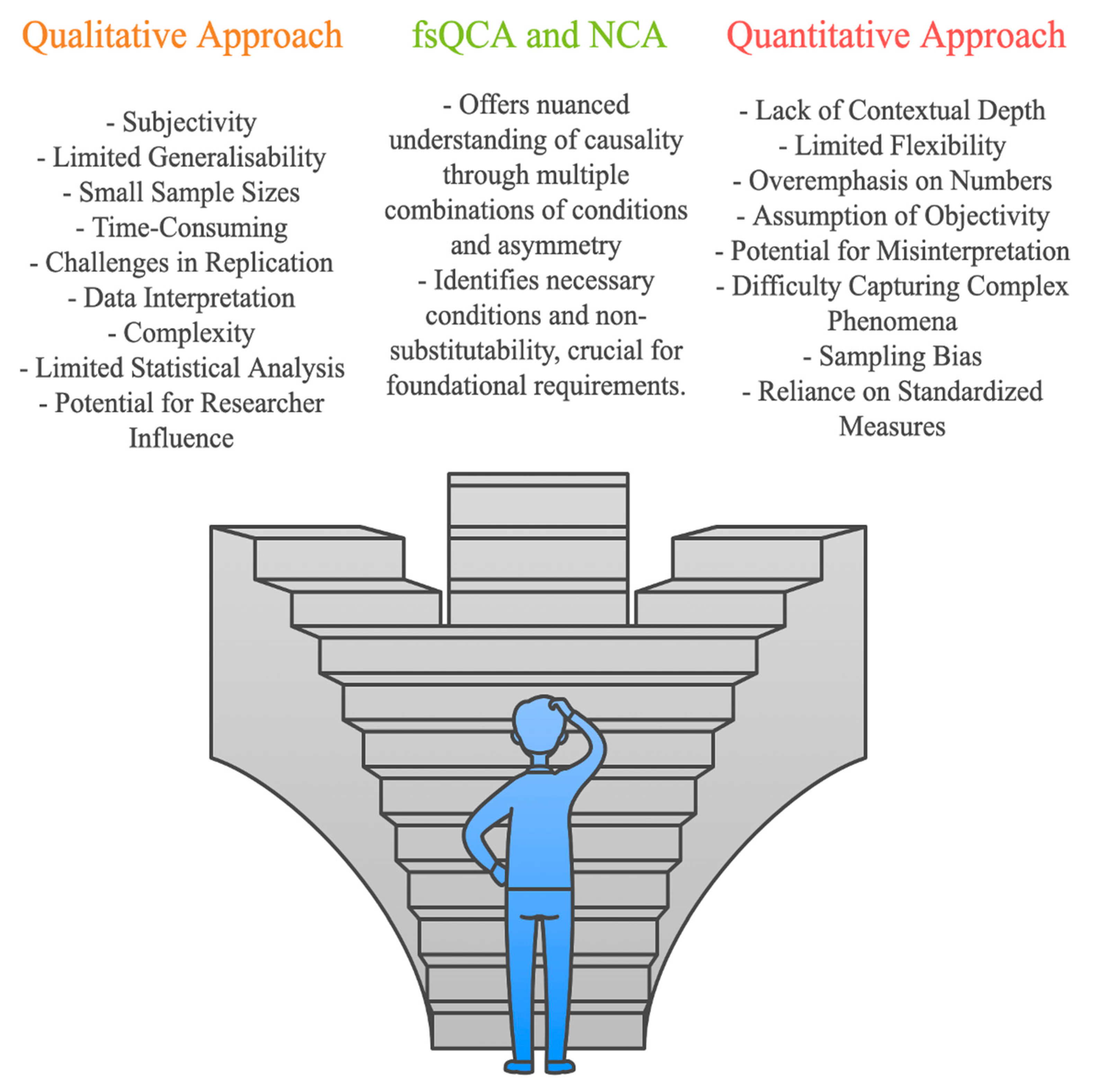
Figure 3.
Implications of the study.
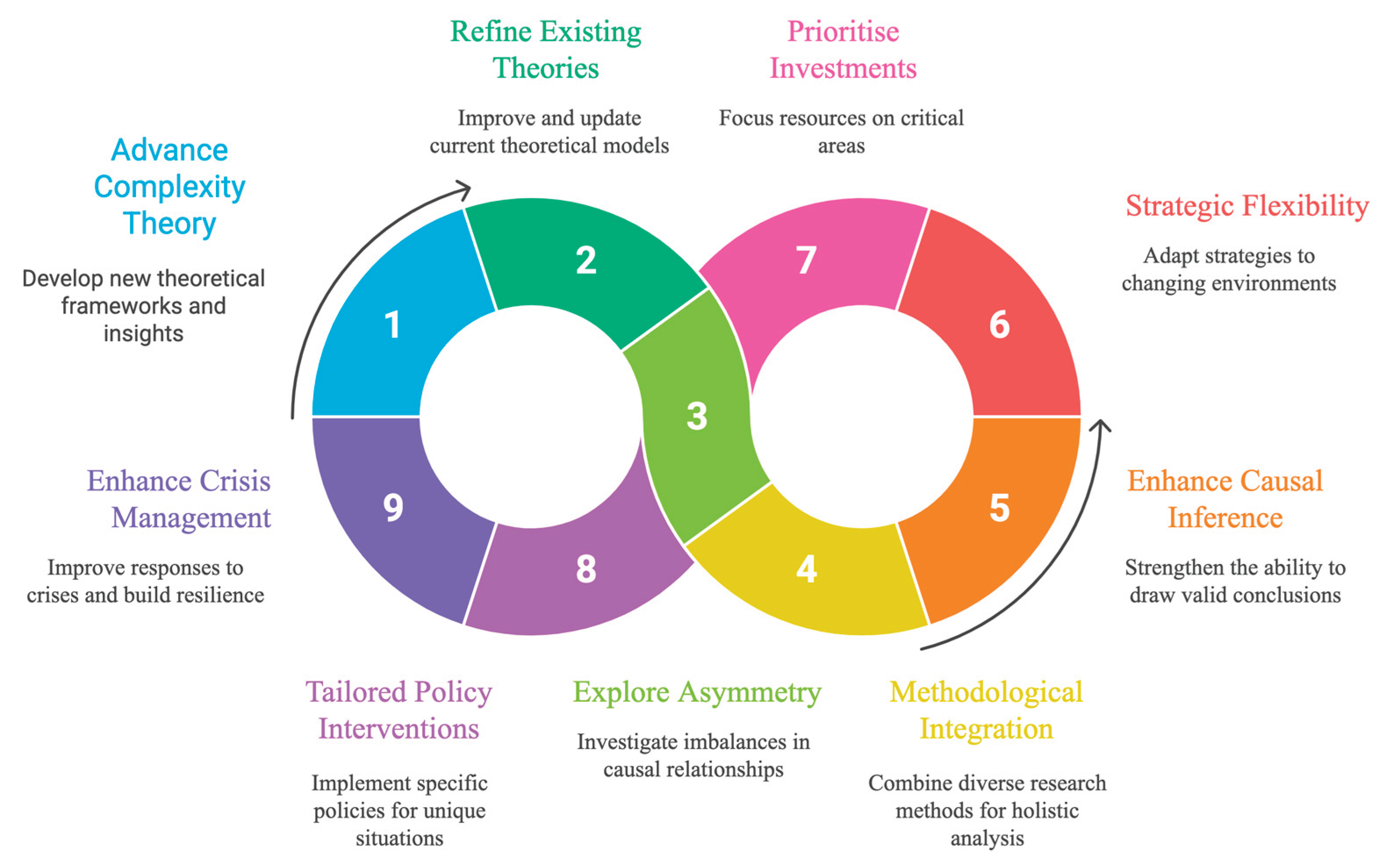

Table 1.
Studies on fuzzy-set qualitative comparative analysis (fsQCA).
| Author(s) | Theme(s) | Theory(ies) | Contributions | Methodology |
|---|---|---|---|---|
| Fiss (2011) | Building causal theories, typologies | Configurational theory, typology theory | Applied fsQCA to build better causal theories and identify typologies | Conceptual application of fsQCA |
| Kraus et al. (2018) | fsQCA in entrepreneurship and innovation | Entrepreneurship theory, innovation theory | Demonstrated fsQCA in entrepreneurship and innovation | Methodological discussion and overview of fsQCA |
| Meyer et al. (1993) | Configurational approaches to organisational analysis | Configurational theory, organisational theory | Introduced configurational approaches for organisational analysis | Foundational study for configurational methods |
| Misangyi & Acharya (2014) | Corporate governance mechanisms, substitutes or complements | Corporate governance theory, configurational theory | Examined corporate governance mechanisms configurationally to determine if they act as substitutes or complements | Application of configurational analysis |
| Misangyi et al. (2017) | Causal complexity, neo-configurational perspective | Configurational theory, causality | Introduced a neo-configurational perspective for understanding causal complexity | Conceptual study on configurational methods |
| Olya & Altinay (2016) | Asymmetric modelling of intentions, tourism weather insurance | Consumer behaviour, risk perception | Examined asymmetric modelling of intention to purchase tourism weather insurance and loyalty | Applied configurational analysis (implied fsQCA) |
| Olya & Gavilyan (2017) | “Configurational models to predict residents’ support for tourism development” | Resident perceptions, tourism development theory | Developed configurational models to predict residents’ support for tourism development | Applied configurational analysis |
| Olya & Akhshik (2019) | Pro-environmental behaviour intentions, turtle sites | Environmental psychology, conservation behaviour | Tackled the complexity of pro-environmental behaviour intentions of visitors to turtle sites | Applied fsQCA to analyse complex causal conditions |
| Pappas & Woodside (2021) | fsQCA guidelines for research practice | Information systems, marketing | Provided guidelines for the fsQCA study practice in specific domains | Methodological guidelines for fsQCA |
| Woodside et al. (2018) | Applying complexity theory, modelling firm anomalies | Complexity theory, firm theory | Provided a primer on applying complexity theory for identifying and modelling firm anomalies | Conceptual discussion on configurational methods |
| Woosnam et al. (2022) | Psychological antecedents of intentions to participate in last chance tourism | Environmental psychology, consumer behaviour | Explored psychological antecedents of intentions to participate in last chance tourism | Applied configurational analysis (implied QCA) |
| Zhang & Zhang (2021) | Tourism and gender equality in emerging economies | Gender studies, development studies | Conducted a QCA of tourism and gender equality | Direct application of QCA |
Table 2.
Studies on necessary condition analysis (NCA) .
| Author(s) | Theme(s) | Theory(ies) | Contributions | Methodology |
|---|---|---|---|---|
| Vis & Dul (2018) | NCA introduction to the field of study | Constraint theory, set theory | NCA to the field’s study and arguing for its distinct contribution | Advocating for NCA use alongside QCA in the field’s study |
| Olya et al. (2021) | Green practices, hotel performance | Resource-based view, environmental management | Combining NCA and fsQCA, identifying specific green practices as necessary conditions for hotel performance | Apply NCA to determine essential green practices as prerequisites for high hotel performance |
| Y.-J. Lee (2024) | Tourists’ eudaimonic experiences | Eudaimonic well-being, hedonic theory | Identified necessary conditions (e.g., hedonic elements) for tourists to achieve deeper, more meaningful eudaimonic experiences | Demonstrated that certain positive hedonic feelings were necessary for eudaimonic outcomes, not merely sufficient |
| Sigala (2020) | Tourism and COVID-19, crisis management | Resilience theory, crisis management | The role of necessary conditions in tourism’s response to the COVID-19 pandemic, emphasising critical prerequisites for recovery | Explored how fundamental conditions (e.g., health infrastructure, policy stability) were necessary for sectoral resilience. |
| Dul (2022) | Problematic NCA applications, methodological clarity | Set theory, causality | A conceptual and analytical distinction between “necessity” in fsQCA Vs NCA and addressing common pitfalls | Crucial for understanding the precise interpretation of NCA results and avoiding conceptual confusion with fsQCA’s necessity claims |
| Dul (2016) | NCA logic and methodology of “necessary but not sufficient” | Constraint theory, set theory | Discussed the fundamental reasoning and methods of NCA | Foundational methodological paper on NCA |
| Olya & Nia (2021) | Medical tourism index, behavioural responses of medical travellers | Medical tourism theory, consumer behaviour | Developed a medical tourism index and explored the behavioural responses of medical travellers | Implied use of NCA or similar necessary condition logic |
Table 3.
Comparison of fsQCA and NCA with traditional methods.
| Comparison Points | fsQCA | NCA | Traditional Statistical Methods |
|---|---|---|---|
| Theoretical framework | Grounded in complexity theory and social science | Based on necessity and sufficiency principles | Often rooted in classical statistical theories |
| Context sensitivity | Explicitly considers contextual factors | Sensitive to case-specific contexts | May overlook context |
| Role of contextual factors | Explicitly includes contextual factors | Emphasises context but may not analyse it deeply | Tends to isolate variables from context |
| Measurement | Blends qualitative and quantitative strengths | Benefits from qualitative insights into cases | Primarily quantitative, potential false dichotomy |
| Data requirements | Requires diverse data types | Needs specific case data | Often requires large sample sizes |
| Fuzzy logic | Utilises fuzzy sets for nuanced insights | Not applicable | Relies on binary or categorical measures |
| Variable and case orientation | Case-oriented in a variable-oriented way | Inherently case-focused, boundaries of possibility | Predominantly variable-oriented, interchangeable data points |
| Configurational analysis | Asymmetrical causality differentiates conditions | Unilaterally indispensable (necessary) conditions | Implicitly assumes symmetrical relationships |
| Complex causal relationships | Captures complex interactions effectively | Identifies essential conditions for outcomes | Often oversimplifies causal relationships |
| Correlation and causation | Moves beyond correlation, identifies sufficient pathways | Necessary conditions, stronger causal claims | Focus on correlational statements, associations |
| Interpretation of results | Requires careful interpretation of configurations | Precise interpretation of necessary conditions | Often straightforward, but may lack depth |
| Outcome focus | Examines multiple outcomes simultaneously | Concentrates on specific outcomes | Typically analyses one outcome at a time |
| Quantitative rigor | Integrates quantitative methods | Employs statistical assessments | Strong emphasis on statistical methods |
| Flexibility | Adaptable to various research contexts | Can be broadly applied | Limited flexibility in application |
| Iterative process | Encourages iterative analysis | Iterative refinement of necessary conditions | Often follows a linear analysis approach |
| Handling missing data | Can accommodate missing data through fuzzy sets | Sensitive to missing data in necessary conditions | Often requires complete data for accurate analysis |
| Researcher influence | Less susceptible to researcher bias | Potential for bias in defining necessary conditions | May reflect researcher bias in variable selection |
| Software and tools | Uses specialised software (fsQCA software, SmartPLS) | Requires specific tools for analysis (SmartPLS) | Widely available statistical software (SPSS, AMOS, SmartPLS) |
| Time and resource efficiency | Can be labour-intensive due to case analysis | Generally efficient once conditions are defined | May require significant resources for data collection |
| Generalizability | Limited by case-specific insights | Focused on specific contexts, less generalisable | Aims for broader generalizability |
| Contribution to theory building | Enhances theoretical insights via configurational analysis | Causal understanding of necessary conditions | Primarily tests existing theories |
| User accessibility | May require specialised training | Knowledge of necessary condition concepts | Accessible to a broader audience |
Disclaimer/Publisher’s Note: The statements, opinions and data contained in all publications are solely those of the individual author(s) and contributor(s) and not of MDPI and/or the editor(s). MDPI and/or the editor(s) disclaim responsibility for any injury to people or property resulting from any ideas, methods, instructions or products referred to in the content. |
© 2025 by the authors. Licensee MDPI, Basel, Switzerland. This article is an open access article distributed under the terms and conditions of the Creative Commons Attribution (CC BY) license (http://creativecommons.org/licenses/by/4.0/).
Copyright: This open access article is published under a Creative Commons CC BY 4.0 license, which permit the free download, distribution, and reuse, provided that the author and preprint are cited in any reuse.


