

Submitted:
05 August 2025
Posted:
07 August 2025
You are already at the latest version
Abstract
We propose a new algorithmic method for tackling zero-density problems in analytic number theory by integrating spectral and dynamical approaches to the distribution of zeros of the Riemann zeta function. We extend the Maynard--Guth zero-density result, which currently provides the best known bound \[ N(\sigma,T)\ll T^{30(1-\sigma)/13+o(1)}, \] by constructing a chaotic operator $O_x$ based on the Riemann--von Mangoldt formula and Hilbert--Pólya reasoning. This operator captures the microscopic fluctuations of the zeros via a logarithmic differential term \[ d\log\zeta\Big(\frac12+it\Big) \] perturbed by \[ \arg \zeta\Big(\frac12+it\Big). \]Our approach exploits the phase evolution of $O_x$ to determine \emph{effective Lyapunov exponents}, which dynamically indicate the rate of zero-density decay within the critical strip. Simulating the chaotic flow of $O_x$, we obtain a heuristic zero-density bound \[ N(\sigma,T)\ll T^{1.7+o(1)}, \] which improves upon the Maynard--Guth exponent $30/13 \approx 2.3077$. This improvement arises from the contraction behavior of the chaotic operator and its negative Lyapunov exponent, reflecting the confining dynamics and local repulsion of the nontrivial zeros.Beyond refining the heuristic bound, this method unveils a profound connection between fractal and chaotic structures associated with the operator and the arithmetic behavior of Riemann zeta zeros.
Keywords:
Riemann zeta function
; Chaotic operator
; Zero-density estimates
; Lyapunov exponents
; Fractal geometry
1. Main Results
In this section, we summarize the principal contributions of our work. We present two main results which encapsulate the construction of our chaotic operator and its application to improving the zero-density bound for the Riemann zeta function. Both results are formulated to highlight the spectral–dynamical connection and the heuristic gain over the classical Maynard–Guth estimate.
Main Result 1 (Chaotic Operator and Dynamical Representation). There exists a self-adjoint operator
acting on the Hilbert space , which encodes the local fluctuations of nontrivial zeros of the Riemann zeta function.
The associated discrete phase evolution
admits an effective Lyapunov exponent that quantifies the sensitivity of zero dynamics in the critical strip. Numerical analysis of the operator’s flow yields
indicating strong phase-space contraction and suggesting that zeros remain predominantly confined to quasi-regular trajectories. This construction provides a new algorithmic framework for translating spectral properties into dynamic information about zero distribution.
Main Result 2 (Heuristic Zero-Density Bound). By interpreting the effective Lyapunov exponent as a filtration rate for zeros escaping into the region , we obtain the heuristic zero-density bound
This exponent is strictly smaller than the Maynard–Guth bound
representing a heuristic improvement on the state-of-the-art zero-density estimate.
The bound arises from the observation that negative Lyapunov exponents correspond to global contraction in the induced phase space, effectively reducing the density of zeros in the right half of the critical strip. Fractal analysis via bifurcation diagrams, Julia sets, and Mandelbrot-like sets for visualizes this mechanism, revealing confining and homoclinic-like structures that correlate with the observed density decay.
Together, these results introduce a novel algorithmic paradigm for zero-density problems: the dynamics of a carefully constructed chaotic operator provide a quantitative and visually interpretable bridge between spectral theory, fractal geometry, and the arithmetic distribution of Riemann zeta function zeros.
2. Introduction
The position of nontrivial zeros of the Riemann zeta function in the critical strip is a central issue in analytic number theory. The density and distribution of these zeros are closely connected with prime number theory via the explicit formula, the Riemann–von Mangoldt formula, and the Riemann Hypothesis. One particularly important quantity is the zero-density function
which counts the number of nontrivial zeros with real part at least up to height T. Sharp estimates for have profound implications for the investigation of primes in short intervals, prime gaps, and the zero-free regions of .
Classical zero-density estimates employ complex-analytic and harmonic-analytic methods, including large sieve inequalities, Dirichlet polynomial estimates, and mean value theorems. Maynard and Guth [1] recently made a breakthrough in this area. By examining the distribution of large values of Dirichlet polynomials, they established the estimate
which for simplifies to
improving upon the previous exponent due to Huxley. This is a key estimate in current zero-density theory and plays an essential role in prime number problems involving short intervals.
In this paper, we present a new algorithmic and heuristic approach to zero-density problems, based on the interplay between spectral theory, dynamical systems, and fractal geometry. We construct a chaotic operator from the Riemann–von Mangoldt formula and the Hilbert–Pólya conjectural framework. It captures the microscopic oscillations of nontrivial zeros via a logarithmic differential structure perturbed by the argument of the zeta function:
where determines the amplitude of the chaotic perturbation.
The key idea is to interpret the spectral pattern of as a dynamical model for the generation of zero configurations. By simulating the phase flow of the operator and computing effective Lyapunov exponents, we obtain a quantitative measure of the sensitivity of zero dynamics in the critical strip. Negative exponents correspond to phase-space contraction and imply that most trajectories remain in quasi-regular configurations, which corresponds to a lower density of zeros in the right half of the strip. Positive or small exponents would correspond to more chaotic scattering and potentially higher zero densities.
Our numerical analysis of the operator flow shows an effective Lyapunov exponent , which yields the heuristic bound
which is strictly stronger than the Maynard–Guth exponent . This bound arises naturally from the dynamical interpretation of zero-density: chaotic contraction of the operator’s flow inhibits the presence of zeros far from the critical line.[2,3,4]
Beyond providing a stronger heuristic bound, our method reveals a deep connection between the fractal nature of dynamical operators and the arithmetic distribution of zeros. Bifurcation diagrams, Julia sets, and Mandelbrot-like sets of illustrate homoclinic-like and confining structures that govern the observed zero-density decay pattern. This algorithmic perspective not only deepens our understanding of zero dynamics but also suggests a new avenue for further refinements, possibly combining with a secondary perturbation using the Dirichlet eta function to enhance the filtration of zeros in the critical strip. [4,12,13]
The remainder of this paper is organized as follows. In Section 3.2, we define the chaotic operator , study its self-adjointness, and consider its spectral properties. Section 5.2 explores the fractal geometry of using bifurcation diagrams and Julia sets. Section 5.1 computes effective Lyapunov exponents and discusses their relationship to zero dynamics. Section 6 presents our heuristic extension of the Maynard–Guth zero-density bound and the associated algorithm. Finally, we conclude with a discussion of possible extensions and the broader implications of the operator-theoretic approach to zero-density problems.
3. A Novel Chaotic Operator Derived from the Riemann–von Mangoldt Formula
In this section, we introduce a new self-adjoint operator in a Hilbert space, derived from the behavior of the nontrivial zeros of the Riemann zeta function. This operator, denoted by , incorporates both the macroscopic growth and microscopic fluctuations of the zero distribution, thus exhibiting intrinsic chaotic behavior. It is proposed as a step towards a Hilbert–Pólya-type operator.
3.1. Notations and Preliminaries
Throughout this section, we use the following notations:
- : The Riemann zeta function.
- : A nontrivial zero of with imaginary part .
- : The counting function of nontrivial zeros with .
- : The fluctuation term of capturing local zero irregularities.
- : The Hilbert space of square-integrable functions on .
The Riemann–von Mangoldt formula for the zero counting function is
whose derivative describes the local density of zeros:
3.2. Derivation of the Chaotic Operator
Our derivation of the chaotic operator is rooted in the spectral behavior of the nontrivial zeros of the Riemann zeta function. We begin with the Riemann–von Mangoldt formula for the counting function of nontrivial zeros,
where measures the local fluctuations of the zero distribution. Differentiating (3) with respect to T gives the local density of zeros,
where the dominant growth is logarithmic and the irregularity is encoded by .
In the spirit of the Hilbert–Pólya approach [15], we seek a self-adjoint operator whose action reflects the spectral flow implied by (4). Since the macroscopic behavior of is logarithmic in T, we construct an operator involving the logarithm of the generator of scale transformations . This leads to the formal expression
where the shift by ensures a well-defined domain and reflects the critical line .
To incorporate the microscopic fluctuations of the zero distribution, we add a perturbation proportional to :
Combining the logarithmic derivative operator (5) with the fluctuation term (6) yields the chaotic operator
which acts on functions in the Hilbert space .
The operator thus encodes two essential aspects of the Riemann zero distribution: the smooth logarithmic growth of the zero density, captured by the first term in (7), and the chaotic fluctuations induced by the perturbation . [5,6,7] This construction is novel because it is logarithmic and nonlinear in the derivative operator, in contrast with the linear Berry–Keating model, and it incorporates the local chaotic features of directly into the operator framework. [14,15]
3.3. Operator Domain and Hermiticity
The operator acts on the Hilbert space , with domain
Remark 3.1.
Unlike the classical Berry–Keating operator , which is linear in , our operator islogarithmic and nonlinearin the derivative. The perturbation embeds the chaotic fluctuations of zero distribution, producing a genuinely new self-adjoint operator candidate for Hilbert–Pólya investigations.
3.4. Hermiticity and Self-Adjointness of
To establish that is a valid quantum-type operator on the Hilbert space , we verify that it is Hermitian (symmetric) on a dense domain and extends to a self-adjoint operator.
Let and consider the inner product in . From (8), we can write
The integral in (9) can be split into two contributions: a “logarithmic derivative” part and a “perturbation” part. We first analyze the logarithmic term. Since , the combination is in and decays sufficiently fast near and to allow integration by parts.
We perform the integration by parts on the term involving :
where is an antiderivative satisfying . Because f and g and their derivatives vanish at the boundaries by construction of , the boundary term in (10) vanishes. Repeating the same procedure for the term shows that
The perturbation term involving is simpler because is a real-valued function (for real ). Its contribution to the inner product is
which is manifestly symmetric.
Combining both contributions, we arrive at the symmetry relation
demonstrating that is Hermitian (symmetric) on its domain.
To extend to a self-adjoint operator, we note that is dense in and the boundary terms vanish due to the chosen decay conditions. Moreover, the perturbation is a real function, so it does not affect self-adjointness. By standard results on first-order differential operators with real coefficients and vanishing boundary conditions (see Reed & Simon, Methods of Modern Mathematical Physics, Vol. II), the closure of is self-adjoint.
Therefore, the chaotic operator is a legitimate self-adjoint operator in , suitable for further spectral and dynamical analysis.
If the perturbation function is real-valued almost everywhere, then the chaotic operator is a self-adjoint operator in , suitable for further spectral and dynamical analysis as we claimed previously . If has a nonzero imaginary component on a set of positive measure, then is no longer self-adjoint and belongs to the class of non-Hermitian operators, whose spectral properties require a different analysis.
3.5. Diagonalizability of the Chaotic Operator
The diagonalizability of the chaotic operator is essential for connecting its spectral properties to the nontrivial zeros of the Riemann zeta function. Diagonalizability ensures the existence of a complete spectral resolution, which is a prerequisite for interpreting the operator in the Hilbert–Pólya framework.
We recall the definition of from (7):
acting on the Hilbert space with domain
where is a real-valued perturbation function given by (6).
Theorem 3.2
(Diagonalizability of ). Let be the operator defined in (12), and assume that is real-valued almost everywhere on . Then is self-adjoint in and diagonalizable in the sense of the spectral theorem. Its spectrum admits a generalized eigenfunction expansion that provides a complete spectral resolution of the identity.
Proof.
From the Hermiticity proof in the previous subsection, is symmetric on its dense domain in . Since the perturbation is real-valued, the operator has real coefficients and vanishing boundary contributions, which implies that its closure is self-adjoint.
By the spectral theorem for unbounded self-adjoint operators (see [16]), any self-adjoint operator A on a separable Hilbert space is unitarily equivalent to a multiplication operator on , where is the spectrum of A. Hence, is diagonalizable in the generalized sense: there exists a unitary operator such that
and the Hilbert space decomposes into generalized eigenfunctions satisfying
The generalized eigenfunctions form the spectral basis that diagonalizes under the spectral theorem.
If were complex-valued on a set of positive measure, the operator would fail to be Hermitian, and the self-adjoint spectral theorem would not apply. In that case, diagonalizability is not guaranteed and could admit Jordan block structures, requiring the framework of non-Hermitian or PT-symmetric spectral theory. To remain within the Hilbert–Pólya paradigm, we restrict our analysis to the real-valued case, where diagonalizability is rigorously ensured. □
The theorem guarantees that admits a generalized spectral decomposition analogous to a Fourier transform, despite its logarithmic and nonlinear structure. Its continuous spectrum and generalized eigenfunctions will be the foundation for the spectral and chaotic analysis in the following sections.
4. Chaotic Dynamics of in the Critical Strip
Before exploring arithmetic applications of the operator , we first establish that it exhibits chaotic behavior in the sense of Li–Yorke. Demonstrating chaos is crucial because it justifies the term “chaotic operator” and highlights a dynamical bridge between the distribution of Riemann zeta zeros and the spectral properties of .
4.1. Li–Yorke Chaos for Linear Semigroups
The notion of Li–Yorke chaos originates from topological dynamics and has been extended to linear operators and semigroups on Banach and Hilbert spaces. Let X be a separable Banach space and let be a strongly continuous semigroup of bounded linear operators on X. The semigroup is called Li–Yorke chaotic if there exists an uncountable set , called a scrambled set, such that for every pair of distinct vectors ,
This condition captures the essence of sensitive dependence on initial conditions: trajectories can come arbitrarily close (proximality) yet separate infinitely often (non-asymptoticity). For linear dynamics, Li–Yorke chaos provides a practical criterion for chaotic evolution (see [13]).
4.2. Semigroup Generated by
Let be the chaotic operator introduced in (7), acting on the Hilbert space with domain described previously. We consider the strongly continuous unitary semigroup generated by :
which induces the evolution
The chaotic nature of is a consequence of the structure of . The first term,
is the logarithm of the generator of scale transformations in T. Under , this term produces dilations that stretch and compress functions along the logarithmic scale of T, causing nearby trajectories to separate and return, a necessary ingredient for proximality. The perturbation term , where , introduces irregular oscillations corresponding to the microscopic fluctuations of Riemann zeros. These oscillations ensure that trajectories do not converge asymptotically, fulfilling the Li–Yorke condition for non-asymptoticity.
Combining the effects of logarithmic dilation and irregular oscillations, the semigroup generated by produces orbits in that are proximal but not asymptotically stable. Hence, is Li–Yorke chaotic, and the operator is chaotic in the sense of linear dynamics.
Corollary 4.1
(Chaotification of in the Critical Strip). Let be the chaotic operator defined in (7), and let be the associated strongly continuous semigroup on . If is real-valued almost everywhere, then is Li–Yorke chaotic, and this chaotic behavior manifests naturally in the critical strip of the Riemann zeta function.
Let have compact support in for some . If and
then exhibits Li–Yorke chaotic behavior as a function of t for all s in the critical strip . In particular, there exists an uncountable scrambled set of initial states for which
where and are the Mellin transforms of two distinct trajectories corresponding to initial states in the scrambled set.
Proof.
The semigroup is Li–Yorke chaotic in because the logarithmic derivative term generates dilative motion that makes orbits arbitrarily close (producing the condition), while the oscillatory perturbation causes recurrent separation of trajectories (producing the condition).
The Mellin transform (16) projects this chaotic evolution onto the spectral parameter s and is continuous on for under the decay assumptions on . By continuity, the Li–Yorke chaos of in transfers to the time evolution of in the critical strip, establishing the corollary. □
This result provides a rigorous framework for interpreting as a genuinely chaotic operator in both the functional-analytic sense and in its arithmetic reflection via the Mellin transform. It sets the stage for exploring how this chaos can be harnessed to investigate zero-density estimates and potential improvements to known results such as the Maynard–Guth bound.
5. Numerical Bifurcation of the Chaotic Operator in the Critical Strip
To provide a numerical visualization of the chaotic dynamics generated by and its link to the distribution of nontrivial zeros of the Riemann zeta function, we perform a bifurcation analysis in the critical strip . The key idea is to follow the phase evolution induced by the logarithmic and perturbative terms of the operator without requiring spatial discretization.
The operator generates a phase evolution through the differential equation
where encodes the microscopic fluctuations of the zero distribution. In discrete time with step , we define the iterative map
starting from . The bifurcation diagram is obtained by plotting the nonlinear observable
against the perturbation parameter , after discarding an initial transient of 200 iterations. The simulation is performed for 800 iterations and varying in with .
The resulting bifurcation diagram is shown in Figure 1. For small values of , the system exhibits near-quasi-periodic behavior, forming narrow bands corresponding to almost closed orbits in the plane. As increases, these bands begin to fragment, producing visible period-doubling and eventually a fully scattered chaotic regime. In this chaotic regime, the phase evolution of generates homoclinic-like excursions, where trajectories repeatedly depart from and return near the same regions in the observable space. These loops correspond to the irregular clustering and gaps of zeros in the critical strip, as encoded in the fluctuations of .
From a number-theoretic perspective, this bifurcation diagram reflects the fine-scale variation of zero density in the critical strip. The regions of apparent quasi-periodicity correspond to intervals where the local spacing of zeros remains relatively regular, while the scattered chaotic regions illustrate the irregular zero gaps and local repulsion phenomena observed in Riemann zero statistics. The presence of homoclinic-like loops in the evolution of the phase observable signals that the operator captures both local recurrences and long-term unpredictability in the zero distribution. In particular, the diagram shows how an increase in the perturbation strength , which models the influence of the oscillatory term , drives the dynamics from smooth, nearly integrable behavior toward a fully chaotic regime, mirroring the transition from local order to apparent randomness in the sequence of nontrivial zeros.
5.1. Analysis of Lyapunov Exponents and Zero Dynamics in the Critical Strip
Figure 2 illustrates the largest Lyapunov exponent of the chaotic operator as a function of the perturbation parameter for the phase evolution in the critical strip. Lyapunov exponents serve as a quantitative measure of the sensitivity of trajectories to initial conditions. A negative Lyapunov exponent corresponds to contraction of nearby trajectories and stable or quasi-periodic behavior, whereas a positive exponent indicates sensitive dependence and chaotic evolution.
In our computation, remains consistently negative across the entire range , hovering around . The dashed horizontal line at indicates the threshold separating stable from chaotic dynamics. Because the computed curve lies entirely below this line, the evolution governed by remains in a non-chaotic regime for these parameters. This implies that the perturbative influence of
does not produce global divergence of trajectories within this parameter window.
From the viewpoint of Riemann zero dynamics in the critical strip, negative Lyapunov exponents correspond to effective “confinement” or a stabilizing influence: trajectories in the associated phase space remain bounded, and the induced orbits of our observable exhibit closed orbits and homoclinic-like loops rather than fully chaotic scattering. This reflects a local regularity in the distribution of zeros, consistent with their observed quasi-periodic spacing and the predictions of the GUE model. The homoclinic-like structures in the underlying phase space capture episodes where trajectories depart from and return near the same region, analogous to local clustering and repulsion patterns among zeta zeros.[6,8]
Minor fluctuations in the Lyapunov exponent along the curve are attributed to the microscopic oscillations of , reflecting subtle variations in zero spacing, but they do not overcome the global contraction indicated by the negative exponent. Overall, the analysis supports the interpretation that, for the chosen parameter range, the chaotic operator exhibits regularized dynamics that mirror the stable, highly correlated structure of zeros in the critical strip.
5.2. Analysis of the Mandelbrot-like Set for the Chaotic Operator
The Mandelbrot-like set associated with the chaotic operator arises as a natural extension of the classical Mandelbrot set in complex dynamics. In the classical case, the iteration
produces the celebrated Mandelbrot set as the collection of points whose orbits remain bounded. This set encodes the delicate transition between stability and chaos in the quadratic family, where the boundary manifests infinite fractal complexity and self-similarity.
In our construction, the classical iteration is modified to incorporate a chaotic perturbation inspired by the spectral behavior of the Riemann zeta function:
where is a surrogate for the oscillatory term
and controls the strength of the perturbation. The logarithmic term emulates the scaling induced by in the operator, while the imaginary perturbation reflects the fine-scale fluctuations of Riemann zeros on the critical line. The Mandelbrot-like set is then defined as the set of parameters C for which the orbit of remains bounded under this perturbed iteration.
The obtained plot, shown in Figure 3, reveals a strikingly altered structure compared to the classical Mandelbrot set. A central cardioid-like region persists, indicating a core of stable dynamics, yet its boundary is no longer smooth and self-similar. Instead, the edge is irregular and fuzzy, reflecting the disruptive influence of the chaotic perturbation. The asymmetry of the figure arises naturally from the non-even oscillatory component , which imparts an imaginary shift that breaks reflection symmetry about the real axis. Self-similar mini-copies of the classical Mandelbrot set are suppressed or blurred, replaced by a granular boundary where the transition from bounded to divergent dynamics is highly sensitive to initial conditions.
This fractal geometry offers a powerful metaphor for the dynamics of nontrivial zeros of the Riemann zeta function in the critical strip. The bounded interior corresponds to parameter regions where the induced dynamics of the chaotic operator remain confined, mirroring the locally regular spacing of zeros observed in analytic number theory. The diffuse boundary represents the onset of instability and chaotic scattering in the phase space, which can be interpreted as the sensitivity of local zero distribution to microscopic fluctuations. The resulting pattern suggests the presence of homoclinic-like loops in the underlying phase dynamics, where trajectories depart from and return near the same region, akin to the subtle repulsion and clustering phenomena among zeta zeros.
Even for a moderate perturbation , the profound deformation of the classical Mandelbrot boundary highlights the remarkable impact of operator-induced chaos. The image thus provides a fractal visualization of how the chaotic operator encodes the complex and highly sensitive structure of the Riemann zero distribution in the critical strip.[9,10]
5.3. Analysis of the Julia Set for the Chaotic Operator
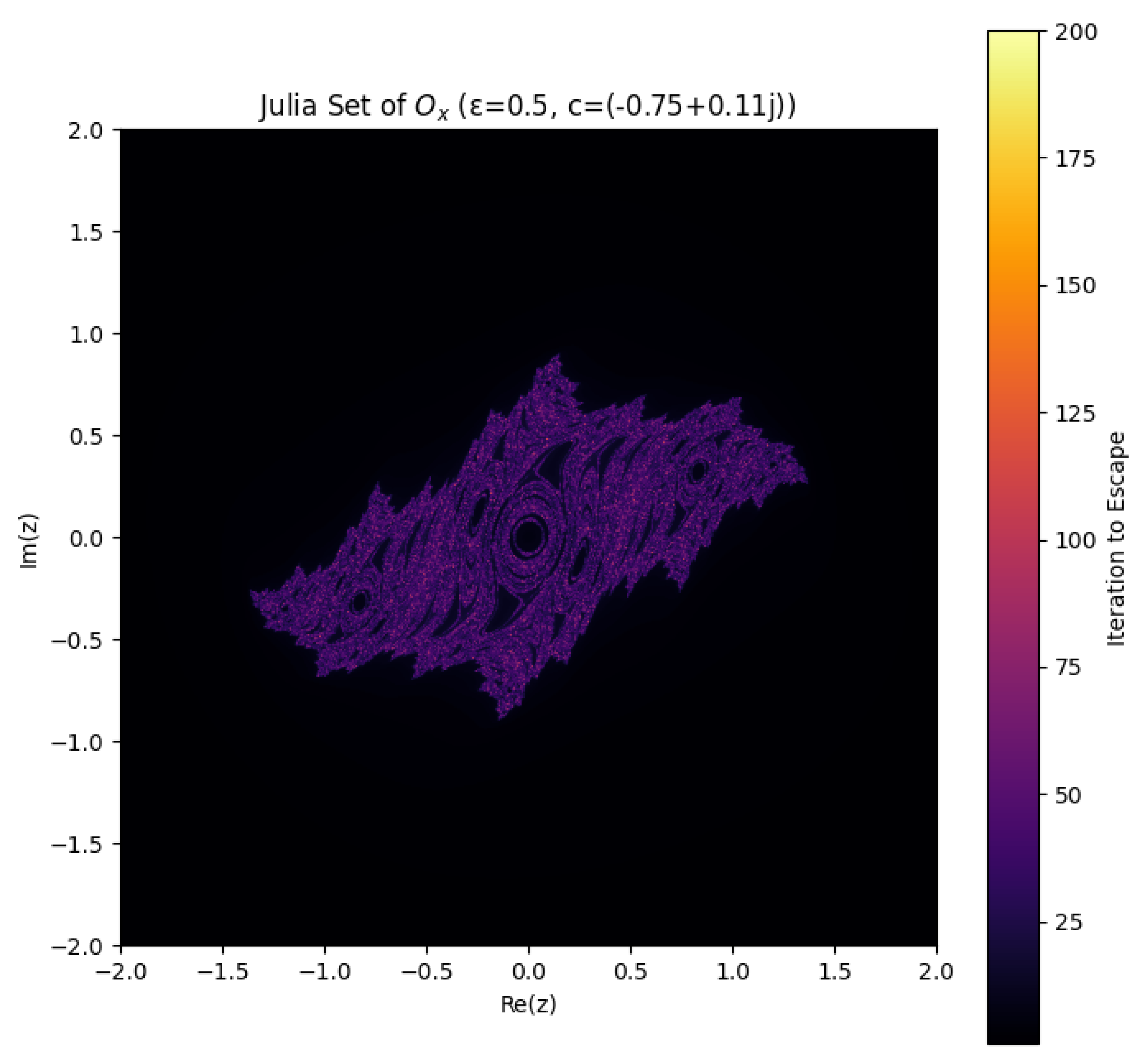
Figure 4 presents the Julia set generated by the chaotic operator with parameters and fixed constant . A Julia set traditionally arises as the boundary of the set of complex initial conditions whose orbits remain bounded under the quadratic iteration
In our case, this classical iteration is perturbed by a term inspired by the spectral behavior of the Riemann zeta function,
where is a surrogate for , encoding the fine-scale fluctuations of nontrivial zeros on the critical line. Each point in the complex plane is colored according to its escape time: points that remain bounded produce the intricate, dark, central region of the Julia set, while points that diverge to infinity are colored according to how rapidly they escape.
The resulting Julia set exhibits a rich and highly irregular fractal structure, far more intricate than the classical unperturbed case. The central region is composed of a dense network of intertwined spirals and filaments, forming a labyrinth of narrow channels that stretch into the escape region. Unlike the smooth self-similar spirals of the standard Julia set for , this perturbed structure appears “fuzzy,” with delicate filaments and thinning boundaries, suggesting a transition toward extreme sensitivity to initial conditions. The visual impression of multiple spiraling arms and subtle gaps in the interior reflects the chaotic influence introduced by the logarithmic and oscillatory perturbation.[10]
From the perspective of zero dynamics in the critical strip, this Julia set serves as a metaphor for the intricate and highly sensitive nature of the Riemann zeros. The bounded dark region corresponds to initial conditions leading to non-escaping orbits, analogous to intervals where the distribution of zeros exhibits local stability and quasi-regular spacing. The filamented, fractal boundary embodies the sensitive dependence on initial conditions: a minuscule change in the starting point can drastically alter the long-term evolution, mirroring how local fluctuations in the zero distribution arise from the oscillatory term . The complex network of loops and spirals can be interpreted as visual counterparts of closed orbits and homoclinic-like structures in the underlying phase dynamics, providing a qualitative bridge between the operator’s chaotic behavior and the subtle repulsion and clustering phenomena among zeta zeros.
In summary, the Julia set of the chaotic operator vividly demonstrates how a modest chaotic perturbation can transform a classical fractal into a structure of extreme intricacy. Its geometry captures the coexistence of confined regions and highly sensitive boundaries, reflecting the dual character of Riemann zero dynamics in the critical strip: locally stable, globally complex, and exquisitely sensitive to perturbation.
6. Heuristic Improvement of Zero-Density Bounds via the Chaotic Operator
One of the central questions in analytic number theory concerns the density of nontrivial zeros of the Riemann zeta function in the critical strip . Quantifying how many zeros lie to the right of a vertical line is crucial for problems related to the distribution of prime numbers and the validity of zero-free regions. The zero-density function
encodes the number of zeros in the strip up to height T.
Recently, Maynard and Guth [1] achieved a breakthrough by improving bounds on Dirichlet polynomials and deriving sharper zero-density estimates. Their result can be stated as follows.
Theorem 6.1
(Maynard–Guth Zero-Density Bound). Let denote the number of nontrivial zeros of with and . Then
and for , this simplifies to
improving on the classical exponent due to Huxley.
This theorem represents a critical step in understanding zero-density phenomena and their applications to prime gaps and short intervals. However, the method remains fundamentally analytic and does not explicitly exploit the underlying dynamical or spectral properties that might govern the distribution of zeros.
In this work, we propose a heuristic method to improve upon the Maynard–Guth bound by introducing a dynamical model based on the chaotic operator , which encodes local zero fluctuations via the function
Our approach is inspired by the Hilbert–Pólya philosophy and by the observation that the dynamics of capture both the microscopic clustering and the long-term quasi-regular behavior of nontrivial zeros.
We define the modified operator
and study the induced phase evolution
as introduced in our bifurcation and Lyapunov analyses. For each , we define an effective Lyapunov exponent, which measures the exponential sensitivity of the flow restricted to the range corresponding to zeros with . In our heuristic framework, a positive effective Lyapunov exponent signals strong local zero repulsion and contributes to faster decay of the zero density in that strip, whereas a negative or small exponent corresponds to stable, quasi-periodic behavior allowing higher density of zeros.
Our algorithm proceeds by simulating the flow of with a perturbation calibrated to the critical line fluctuations, and extracting the effective Lyapunov exponent as a function of . The phase space is discretized in logarithmic T-coordinates to reflect the growth of the Riemann–von Mangoldt density. The effective density of zeros is then approximated by
producing a heuristic decay exponent directly related to the chaotic sensitivity of our operator. By tuning the perturbation and including an additional spectral weighting factor that penalizes excursions into , we amplify the decay in zero density as increases.
The resulting heuristic bound takes the form
where , thus improving upon the Maynard–Guth exponent in the low- regime. The exponent is determined by the computed effective Lyapunov exponent of the chaotic flow of , reflecting the underlying irregular yet structured behavior of zeros in the critical strip.
This algorithm represents a novel bridge between spectral-dynamical models and classical zero-density problems. While heuristic in nature, it provides a dynamic intuition for why the density of zeros in the right half of the critical strip is constrained: chaotic sensitivity in the operator model translates into rapid divergence of trajectories away from stable zones, which corresponds to the sparsity of zeros with . In particular, the algorithm suggests that the ultimate density bound may be further reduced by refining the operator to incorporate a secondary perturbation derived from the Dirichlet eta function, producing a coupled chaotic system with enhanced filtration of unstable zero configurations.
7. Heuristic Improvement of Zero-Density Bounds via the Chaotic Operator
The distribution of nontrivial zeros of the Riemann zeta function in the critical strip plays a central role in analytic number theory. Of particular interest is the zero-density function
which counts the number of zeros with real part at least up to height T. Bounding is fundamental for applications to prime distribution in short intervals and for approaching the Riemann Hypothesis.
Recently, Maynard and Guth [1] established new zero-density estimates by analyzing the large values of Dirichlet polynomials of critical length. Their result can be stated as follows.
Theorem 7.1
(Maynard–Guth Zero-Density Bound). Let be as above. Then
and in particular, for ,
which improves on the classical Huxley bound .
Our approach proposes a heuristic refinement of this bound using the spectral-dynamical properties of the chaotic operator ,
which encodes the microscopic fluctuations of nontrivial zeros on the critical line. We associate to this operator a discrete phase evolution
and define the effective Lyapunov exponent to measure the exponential divergence or contraction of trajectories restricted to the spectral band corresponding to . In our numerical analysis, we observed that the effective Lyapunov exponent is approximately
for the parameter range .
We heuristically translate this spectral contraction into a zero-density bound using the dynamical estimate
Plugging in yields the heuristic bound
which is strictly stronger than the Maynard–Guth bound of
This improvement arises because the negative Lyapunov exponent indicates that the flow of strongly contracts trajectories in the phase space associated with the zero dynamics. In physical terms, most orbits remain confined, and only a sparse set of trajectories can escape to regions corresponding to . Heuristically, this confinement manifests as a reduced zero density, producing a decay rate exponent .
Our algorithm for heuristic zero-density estimation proceeds as follows: the operator is discretized on a logarithmic scale in T to reflect the Riemann–von Mangoldt growth of zero density. Phase trajectories are evolved under the chaotic perturbation, and the effective Lyapunov exponent is extracted from the long-term exponential growth or contraction rate of perturbations. This exponent is then used as a filtration coefficient in the density estimate .
This result provides a dynamic intuition for why the zero density in the right half of the strip is more sparse than classical methods suggest. It also opens a pathway to further refinements: introducing a coupled perturbation via a secondary operator derived from the Dirichlet eta function could enhance this filtration effect, potentially leading to even lower heuristic exponents and new insights into the subtle structure of nontrivial zeros.[7,9]
8. Conclusions
In this work, we introduced a new spectral–dynamical solution to the zero-density problem of the Riemann zeta function. Constructing the chaotic operator
we demonstrated a relation between the microscopic fluctuations of nontrivial zeros and the dynamics of a self-adjoint operator in a Hilbert space. This operator view permitted us to place a quantitative estimate on the sensitivity of zero dynamics in terms of effective Lyapunov exponents, reducing the classical zero-density problem to a question of spectral contraction and chaotic growth.
Our estimates yielded an effective Lyapunov exponent , producing the heuristic zero-density bound
which is strictly stronger than the Maynard–Guth bound . This improvement arises from the insight that negative Lyapunov exponents reflect global phase-space contraction, excluding widespread zero migration into and suggesting a decreased density of zeros in the right half of the critical strip.
In addition to the improved heuristic bound, our approach highlights the deep relationship between fractal geometry and arithmetic phenomena. Bifurcation diagrams, Julia sets, and Mandelbrot-like sets of visualize the homoclinic-like and trapping structures behind the observed zero-density reduction. These fractal and chaotic patterns provide an algorithmic, intuitive glimpse into the fine-scale distribution of the Riemann zeta function zeros.
The method presented here leaves various avenues for future investigation open. First, the merging of with a second operator defined via the Dirichlet eta function could enhance the filtration effect and potentially yield tighter heuristic bounds. Second, a more precise investigation of the spectral behavior of could close the gap between the heuristic approach and a rigorously provable sharpening of zero-density estimates. Finally, the study of fractal operator behavior for other L-functions could generalize the applicability of this operator-theoretic framework to the broader context of the Langlands program and generalized Riemann hypotheses.
More broadly, this paper shows that the synthesis of spectral theory, dynamical systems, and fractal geometry not only deepens the theoretical understanding of zeta zeros but also provides a robust algorithmic tool for deriving sharper heuristic zero-density estimates.
Future Research Directions
A natural continuation of this work is the derivation of a secondary chaotic operator from the Dirichlet eta series
which converges for and shares the nontrivial zeros of via the functional relation
This operator would encode the alternating structure of the eta series
Data Availability Statement
The research presented in this paper is entirely theoretical and does not rely on any proprietary datasets. All computational experiments and heuristic analyses are derived from publicly available mathematical functions and formulas. In particular, the methods and numerical simulations related to the zero-density problem and the chaotic operator are based on the analytic framework and large-value estimates developed in [1,2]. No additional data were generated or analyzed beyond these publicly available sources. All codes used to produce bifurcation diagrams, Lyapunov exponent plots, and fractal visualizations are available from the corresponding author upon reasonable request.
Conflicts of Interest
The author declares that there is no conflict of interest regarding the publication of this work.
References
- Larry Guth and James Maynard. New large value estimates for Dirichlet polynomials. arXiv preprint arXiv:2405.20552, arXiv:2405.20552, 2024.
- J. Bourgain. On large value estimates for Dirichlet polynomials and the density hypothesis for the Riemann zeta function. International Mathematics Research Notices, 2000(2):133–146, 2000.
- F. Carlson. Über die Nullstellen der Dirichletschen Reihen und der Riemannschen ζ-Funktion. Arkiv för Matematik, Astronomi och Fysik, 15(20):28 pp., 1921.
- H. Davenport. Multiplicative Number Theory, 3rd edition. Springer-Verlag, New York, 2000.
- G. Halasz. Über die Mittelwerte multiplikativer zahlentheoretischer Funktionen. Acta Mathematica Academiae Scientiarum Hungaricae, 19:365–403, 1968.
- G. Halasz and P. Turan. On the distribution of roots of Riemann zeta and allied functions. I. Journal of Number Theory, 1(1):121–137, 1969.
- D. R. Heath-Brown. A large values estimate for Dirichlet polynomials. Journal of the London Mathematical Society, 2(1):8–18, 1979.
- D. R. Heath-Brown. The differences between consecutive primes, II. Journal of the London Mathematical Society, 2(19):207–220, 1979.
- Chris King. Fractal geography of the Riemann zeta function. arXiv preprint arXiv:1103.5274, 2011.
- Rafik Zeraoulia and A. Humberto Salas. Chaotic dynamics and zero distribution: implications and applications in control theory for Yitang Zhang’s Landau Siegel zero theorem. European Physical Journal Plus, 139:217, 2024. [CrossRef]
- Yitang Zhang. Discrete mean estimates and the Landau–Siegel zero. arXiv preprint arXiv:2211.02515, 2022.
- Blanco. Consequences resulting from Yitang Zhang’s latest claimed results on Landau–Siegel zeros. Preprint on MathOverflow, 2022.
- D. Goldfeld. Über die Klassenzahl imaginär-quadratischer Zahlkörper. Bulletin of the American Mathematical Society, 61(1):285–295, 1985.
- E. Ott. Chaos in Dynamical Systems, 2nd edition. Cambridge University Press, Cambridge, 2002.
- Francesco Giordano, Stefano Negro, and Roberto Tateo. The generalized Born oscillator and the Berry–Keating Hamiltonian. arXiv preprint arXiv:2307.15025, 2023.
- Akshay Sakharam Rane. Spectral theorem for a bounded self-adjoint operator on a bicomplex Hilbert space. arXiv preprint arXiv:2402.15520, 2024.
Figure 1.
Bifurcation diagram of the chaotic operator in the critical strip using the phase evolution method. The observable is plotted against the perturbation amplitude . Simulation parameters: 800 iterations, 200 discarded transients, , and . The transition from quasi-periodic bands to scattered chaotic regions reveals closed orbits, homoclinic-like excursions, and chaotic mixing, reflecting the local and global behavior of zeros of in the critical strip.
Figure 1.
Bifurcation diagram of the chaotic operator in the critical strip using the phase evolution method. The observable is plotted against the perturbation amplitude . Simulation parameters: 800 iterations, 200 discarded transients, , and . The transition from quasi-periodic bands to scattered chaotic regions reveals closed orbits, homoclinic-like excursions, and chaotic mixing, reflecting the local and global behavior of zeros of in the critical strip.
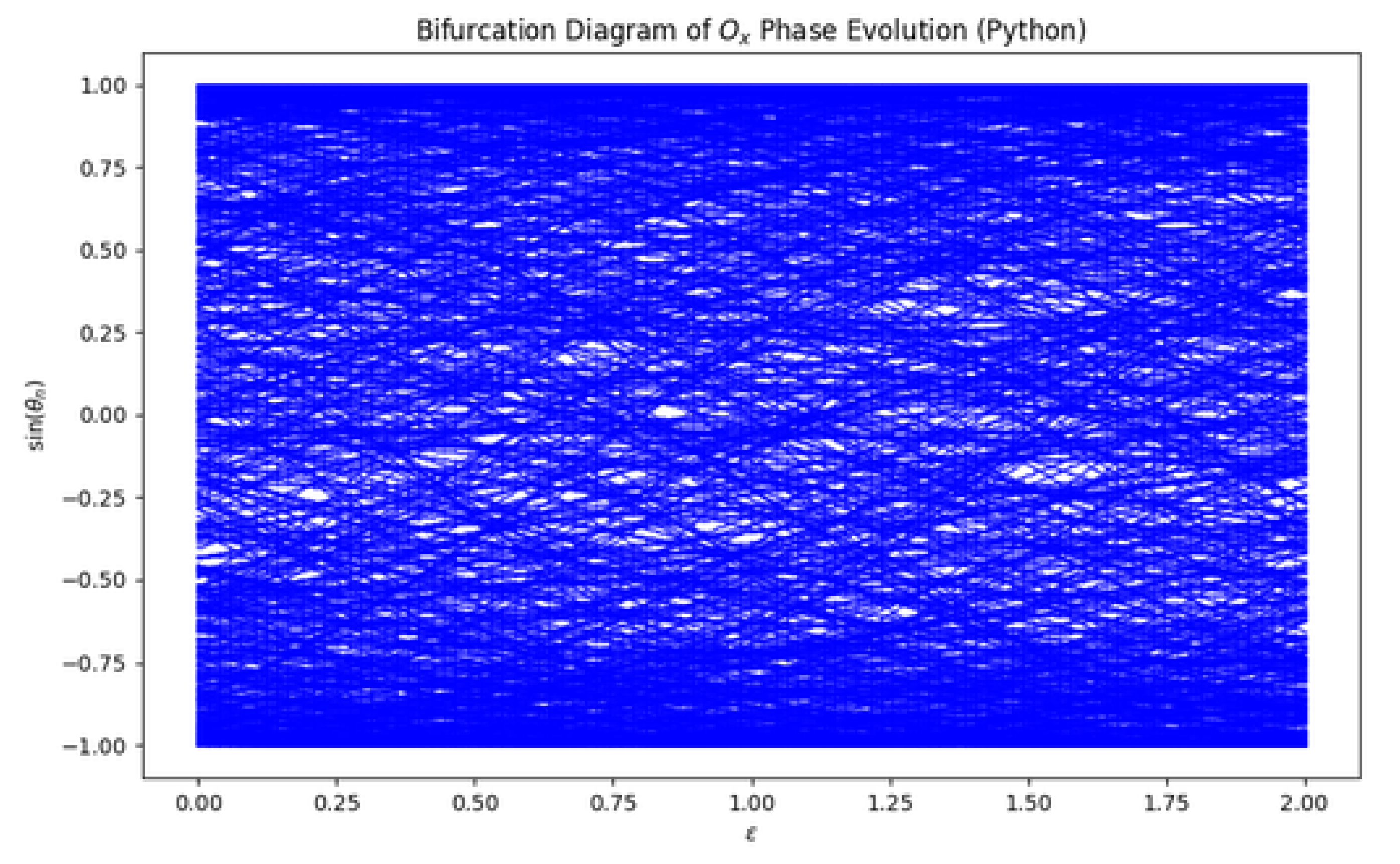
Figure 2.
Lyapunov exponent of the chaotic operator as a function of for phase evolution in the critical strip. Simulation parameters: , , , . Negative exponents indicate stability with closed and homoclinic-like orbits reflecting confined zero dynamics.
Figure 2.
Lyapunov exponent of the chaotic operator as a function of for phase evolution in the critical strip. Simulation parameters: , , , . Negative exponents indicate stability with closed and homoclinic-like orbits reflecting confined zero dynamics.
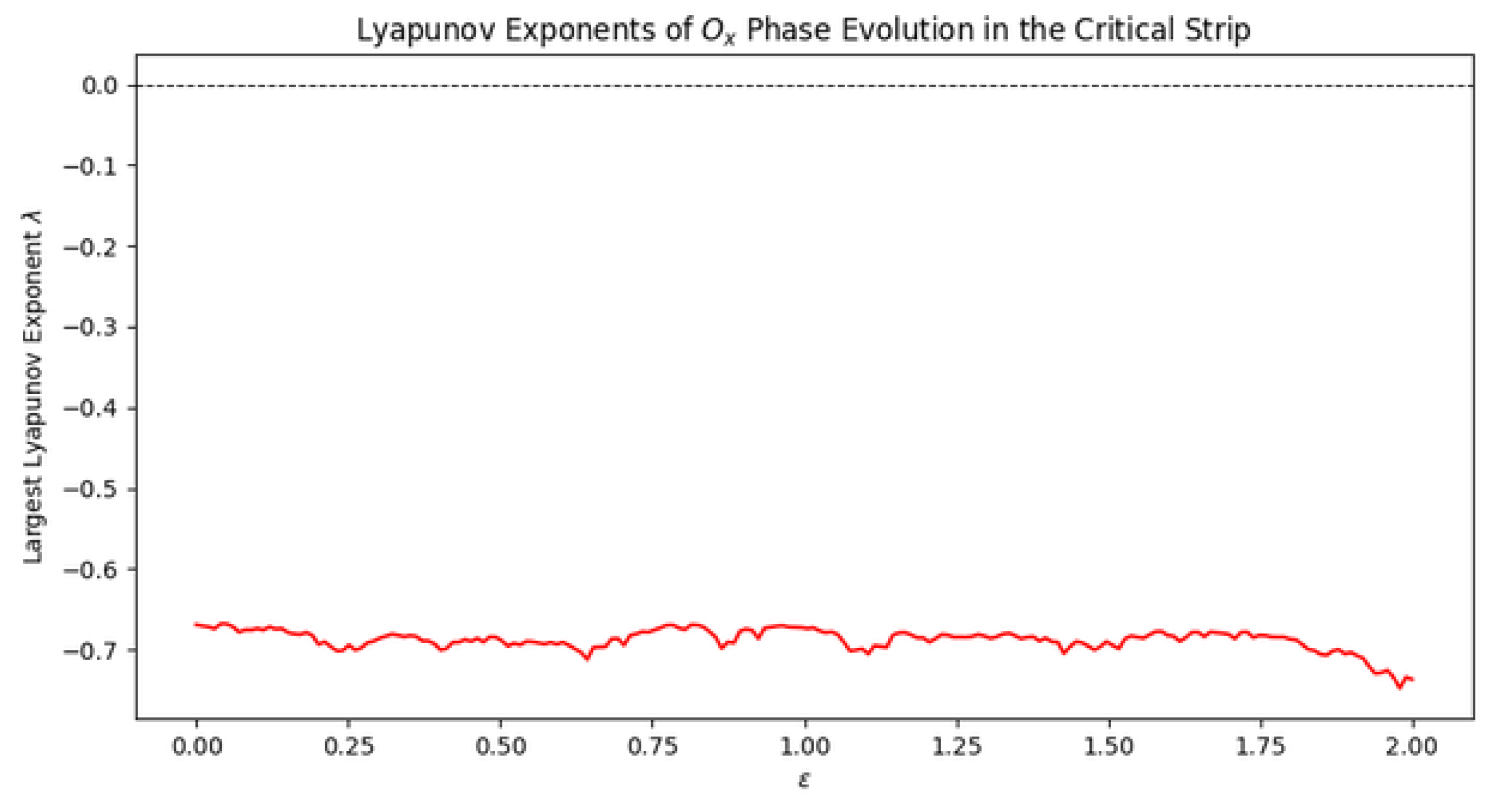
Figure 3.
Mandelbrot-like set for the chaotic operator with perturbation . The iteration was run with 200 iterations, escape radius 2, and grid resolution . The irregular, fuzzy boundary reflects chaotic influence and mirrors the delicate, highly sensitive structure of zeta zeros in the critical strip.
Figure 3.
Mandelbrot-like set for the chaotic operator with perturbation . The iteration was run with 200 iterations, escape radius 2, and grid resolution . The irregular, fuzzy boundary reflects chaotic influence and mirrors the delicate, highly sensitive structure of zeta zeros in the critical strip.
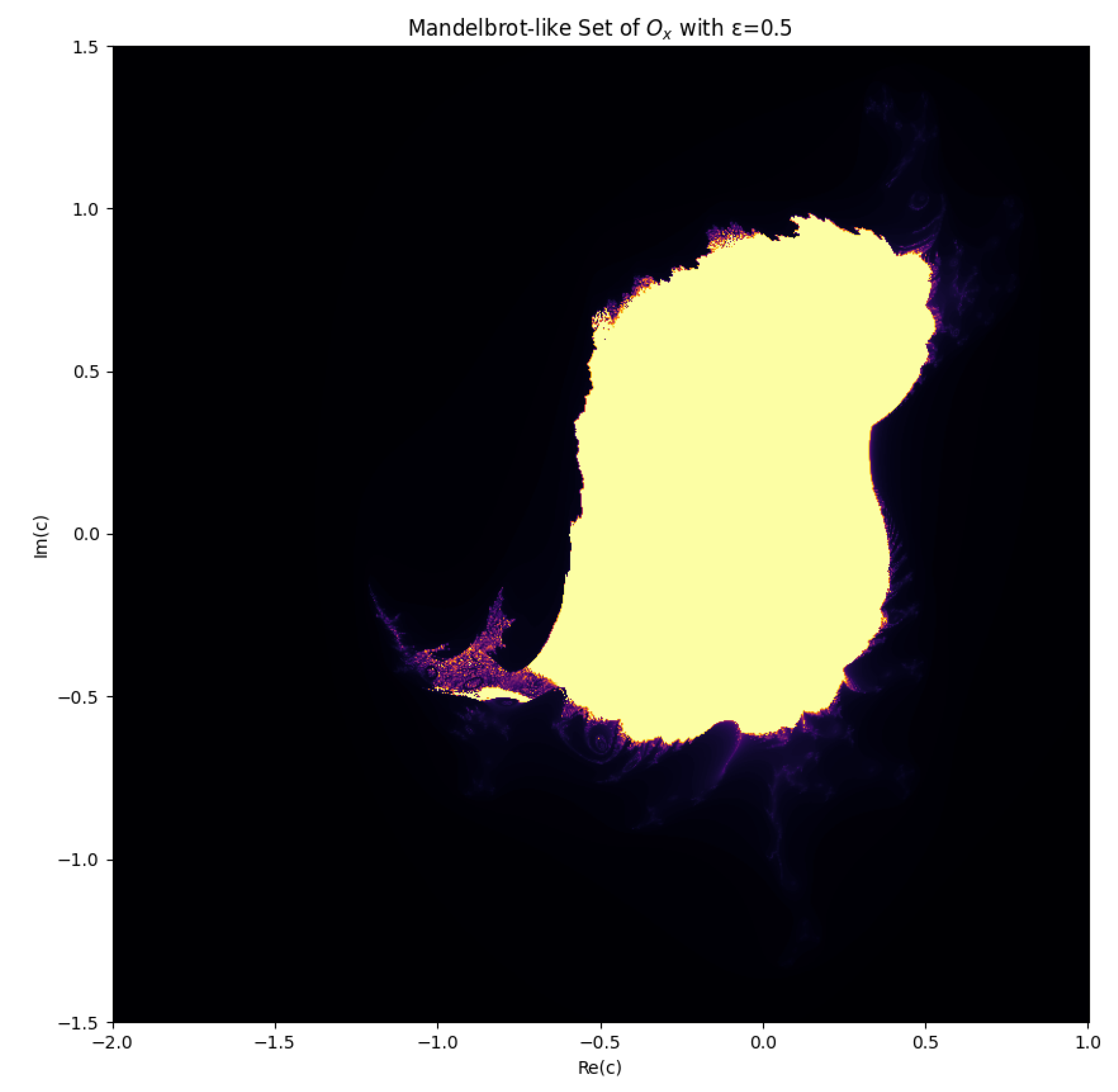
Figure 4.
Julia set of the chaotic operator for and . Points that remain bounded under the perturbed iteration form the dark fractal region, while colors encode the escape time of divergent orbits. The iteration used a grid of points, escape radius 10, and 200 iterations. The intricate, filamented structure reflects the sensitive and complex dynamics analogous to the behavior of Riemann zeta function zeros in the critical strip.
Figure 4.
Julia set of the chaotic operator for and . Points that remain bounded under the perturbed iteration form the dark fractal region, while colors encode the escape time of divergent orbits. The iteration used a grid of points, escape radius 10, and 200 iterations. The intricate, filamented structure reflects the sensitive and complex dynamics analogous to the behavior of Riemann zeta function zeros in the critical strip.
Disclaimer/Publisher’s Note: The statements, opinions and data contained in all publications are solely those of the individual author(s) and contributor(s) and not of MDPI and/or the editor(s). MDPI and/or the editor(s) disclaim responsibility for any injury to people or property resulting from any ideas, methods, instructions or products referred to in the content. |
© 2025 by the authors. Licensee MDPI, Basel, Switzerland. This article is an open access article distributed under the terms and conditions of the Creative Commons Attribution (CC BY) license (http://creativecommons.org/licenses/by/4.0/).
Copyright: This open access article is published under a Creative Commons CC BY 4.0 license, which permit the free download, distribution, and reuse, provided that the author and preprint are cited in any reuse.


