

Submitted:
04 August 2025
Posted:
05 August 2025
You are already at the latest version
Abstract
Urban green infrastructure (UGI) is critical for improving ecological resilience, public health, and social equity in the face of increasing urbanization. Geographic Information Systems (GIS) are critical tools for evaluating the spatial, environmental, and social dimensions of Urban Green Infrastructure. This systematic review brings together empirical GIS-based evaluations of UGI published between 2020 and 2024, highlighting methodological innovations, data sources, analytical frameworks, and persisting issues. We identify trends using remote sensing, machine learning, and multi-criteria decision analysis to improve green space accessibility, ecosystem service provision, and urban resilience. Despite increased interdisciplinarity and technological innovation, shortcomings remain in standardized evaluation procedures, geographic representation, and the incorporation of social justice factors. Our findings underscore the importance of standardized frameworks and better participatory GIS approaches for promoting sustainable and equitable urban development. This paper provides a fundamental synthesis for researchers, planners, and politicians who want to improve GIS-based urban greening programs.
Keywords:
urban green infrastructure
; Geographic Information Systems (GIS)
; remote sensing
; spatial analysis
; urban sustainability
; ecosystem services
; multi-criteria decision analysis
; social equity
; urban resilience
Introduction
Urbanization has become a critical phenomenon of the twenty-first century, transforming cities into primary drivers of economic growth, innovation, and cultural exchange (United Nations, 2015, as cited in Mironova, 2021; Bai et al., 2022). This rapid urbanization has increased pressure on natural ecosystems and created important challenges for social justice, environmental sustainability, and public health (Mironova, 2021; Pouya & Aghlmand, 2022; Rachid et al., 2024). International policy frameworks, particularly the Sustainable Development Goals (SDGs), particularly SDG 11, have emphasized the importance of building sustainable cities and communities as key components of global development agendas (United Nations, 2015, cited in Mironova, 2021; Bai et al., 2022).
Green infrastructure (GI) has emerged as an important approach for navigating the complex link between urban growth and environmental conservation. Green Infrastructure (GI) refers to networks of natural and semi-natural places such as parks, green roofs, urban forests, and wetlands that collectively provide ecosystem services, climate management, and social well-being (Buchavyi et al., 2023; Mobarak et al., 2022). Contemporary urban design increasingly prioritizes green infrastructure, recognizing its importance in improving urban resilience, biodiversity, recreational opportunities, and overall quality of life (Hoeben & Posch, 2021; Huang et al., 2023). The literature emphasizes the multifunctionality of green infrastructure (GI), highlighting the integration of ecological, cultural, and economic services, as well as the importance of connectivity, size, and interdisciplinary collaboration in achieving sustainable urban outcomes (Waheeb et al., 2023; Bai et al., 2022).
Recent advances in GIS technology have transformed the assessment and management of urban green infrastructure. Geographic Information Systems (GIS) are critical tools for assessing spatial patterns, monitoring ecological processes, and enabling data-driven decision-making in urban planning (Mohammed & Hammo, 2023; Xu et al., 2020). GIS allows for the integration of remote sensing data, stakeholder contributions, and spatial indicators to evaluate green space accessibility, quality, and susceptibility to environmental threats (Vîlcea & ǘoșea, 2020; Huang et al., 2023). As a result, GIS-based analysis improves scientific understanding of urban ecosystems and informs policy formulation and practical strategies for sustainable urban development (Ghasemi et al., 2022).
Despite the acknowledged importance of Geographic Information (GI) and the increasing complexity of Geographic Information Systems (GIS)-based approaches, some significant gaps remain in the current study domain. Significant debate exists across academic, policy, and practical domains about the precise definition, classification, and standardized evaluation of GI (Waheeb et al., 2023). The lack of consensus has hampered the development of a consistent methodology, reducing study comparability and the adoption of best practices (Ghasemi et al., 2022).
Second, while the theoretical foundations of green infrastructure design are well defined, significant empirical guidance for the practical application of GI in real-world geographical locations remains insufficient (Mironova, 2021). Urban planning is rapidly changing because of emerging technologies such as big data analytics and artificial intelligence, which bring new potential while also increasing complexity and barriers to data integration (Yang, 2024). Systematic evaluations of urban sustainability often focus on distant sensing or ecological characteristics, without considering social, aesthetic, and equity concerns (Rodríguez-Espinosa et al., 2020; Hoeben & Posch, 2021).
Furthermore, a large proportion of the research is geographically dispersed, with significant heterogeneity in the types of gastrointestinal indicators assessed, data sources used, and analytical frameworks used (Buchavyi et al., 2023; Mohammed & Hammo, 2023). Limited studies have provided a comprehensive synthesis that spans multiple disciplines, geographies, and methodological developments. As a result, there is an urgent need for a current, thorough evaluation that outlines current accomplishments, identifies long-standing challenges, and explains prospects in GIS-based GI assessment.
This review synthesizes recent research on GIS-based evaluations of urban green infrastructure to overcome the limitations noted above. The goal is to clarify existing methodology, data sources, analytical frameworks, and empirical findings, while focusing on developing trends and persisting concerns. The scope comprises peer-reviewed empirical studies published between 2020 and 2024 on various urban contexts, green infrastructure typologies, and geographic information system applications. The complete breadth of green infrastructure assessment includes research on accessibility, ecosystem services, resilience, social equity, aesthetic values, and policy implications.
The specified goals are as follows.
1. Identify and categorize the major subjects, geographical areas, and types of urban green infrastructure investigated in GIS-based assessment studies.
2. Evaluate the data sources, analytical methodologies, and validation approaches used in contemporary research.
3. Evaluate progress and obstacles in interdisciplinary integration, considering ecological, social, and economic considerations.
4. To highlight best practices and persistent shortcomings in empirical execution, standardization, and policy significance.
5. To identify future research and practice directions, emphasizing methodological rigor, inclusivity, and practical recommendations for sustainable urban development.
This review aims to provide a consistent foundation for advancing academic research and practical innovation in the planning, assessment, and optimization of urban green infrastructure using GIS.
Methods
A comprehensive analysis was done to incorporate the most recent advances in the assessment of urban green infrastructure (UGI) and its relationship to health outcomes, with a focus on the use of Geographic Information Systems (GIS). The review followed the Preferred Reporting Items for Systematic Reviews and Meta-Analyses (PRISMA) standards (Moher et al., 2009), ensuring methodological precision and transparency.
A complete analysis of the literature focusing on peer-reviewed studies published between January 1, 2020, and June 30, 2024. The Web of Science (WOS) databases Scopus, Science Citation Index (SCI), and Social Science Citation Index (SSCI) provide comprehensive disciplinary coverage and rigorous quality control (Falagas et al., 2008; Mongeon & Paul-Hus, 2016; Martín-Martín et al., 2018). To improve the retrieval of relevant research, search parameters were coupled using Boolean operators, including versions of "urban greening," "green infrastructure," "green space," "GIS," and "health" or "well-being."
The following criteria were used to select studies: (a) they were published in English; (b) they were published in peer-reviewed journals; (c) they included empirical research on urban green infrastructure (UGI) within urban environments; and (d) they used Geographic Information Systems (GIS) for assessment or analysis. Publications that were redundant, irrelevant to urban green infrastructure, had no practical application (i.e., theoretical initiatives), or were non-peer-reviewed sources (such as conference proceedings and book chapters) were rejected.
Two reviewers separately reviewed the relevancy and eligibility of all title and abstract submissions. The inclusion criteria were then utilized to assess full-text papers. To settle disagreements in article selection or evaluation, consensus was used; if this failed, a third reviewer advocated arbitration. This multi-phase procedure decreased selection bias and increased reliability.
Each study provided demographic information, the type of greening intervention, a GIS approach, health results, and major conclusions. Common themes, analytical methodologies, and growing challenges in GIS-based UGI research were discovered using thematic analysis to integrate findings from multiple studies (Kitchenham & Charters, 2007). This meta-analysis considered both quantitative variables (e.g., NDVI for vegetation, per capita green space, accessibility assessments) and qualitative features (e.g., perceived benefits and policy outcomes).
The methodological quality of the selected studies was assessed using a predetermined set of criteria, which included the specificity and transparency of GIS tools, the clarity of study objectives, the reproducibility of methods, and proof of empirical assessment with optimization recommendations. Quality assessments were carried out independently by two evaluators, with disagreements settled through discussion or third-party mediation. Each criterion was evaluated on a three-tier scale (completely matched, slightly matched, and unmatched).
This review recognizes various limitations, including language and publishing bias, because it exclusively examines peer-reviewed papers in English. The absence of gray literature may limit the generalizability of the conclusions. Furthermore, differences in GIS data sources and analytical methodologies between research may have altered results integration.
This methodology combines automated database queries with manual evaluation to capture current research trends and methodological methods in GIS-based urban greening assessment. This supports strong findings and guides future study and practice in sustainable urban development (Falagas et al., 2008; Mongeon & Paul-Hus, 2016; Martín-Martín et al., 2018; Kitchenham & Charters, 2007; Moher et al., 2009).
| Author(s) & Year | Geographic Location | UGI Type Studied | GIS Methods Used | Key Outcomes/Findings | Data Sources |
| Buchavyi et al. (2023) | Dnipro, Ukraine | Urban green space percentage | NDVI, Satellite imagery, Field survey | Accurate mapping of green space boundaries; integration of multi-source data | Landsat, Sentinel, Google Earth, Field surveys |
| Mohammed & Hammo (2023) | Duhok City, Iraq | Urban parks | Satellite image classification, NDVI | Evaluation of park accessibility and green space quality | Satellite imagery, Google Earth, Field surveys |
| Ghasemi et al. (2022) | Tehran District 22, Iran | Accessibility to green spaces | Combined Compromise Solution (CoCoSo), GIS network analysis | Identified accessibility gaps and prioritized green space investments | Administrative records, Demographic data |
| Vîlcea & ǘoșea (2020) | Craiova, Romania | Urban green space accessibility | Network analysis, Service area coverage | Highlighted spatial inequality and accessibility challenges | GIS datasets, Demographic data |
| Mobarak et al. (2022) | Al Baha region, Saudi Arabia | Parks and green corridors | Multi-Criteria Decision Analysis (AHP), GIS suitability mapping | Identified suitable areas for green infrastructure development | Governmental spatial data, Remote sensing |
| Rachid et al. (2024) | Nador City, Morocco | Carbon storage and urban greening | GIS integrated with InVEST model | Spatial prioritization for carbon sequestration and urban greening | Remote sensing, InVEST data |
| Hoeben & Posch (2021) | Graz, Austria | Green roofs | Standardized GIS approaches, Remote sensing | Assessed biodiversity and thermal regulation benefits | Remote sensing data |
| Waheeb et al. (2023) | Taif Province, Saudi Arabia | Green space infrastructure | GIS and Multi-Criteria Decision Analysis (MCDA) | Enhanced sustainable urban planning through prioritized green space allocation | Remote sensing, administrative data |
| Osseni et al. (2023) | Abomey-Calavi District, Benin | Urban green spaces | GIS-based multi-criteria Analysis | Selected suitable sites considering social, economic, environmental factors | Open-source GIS data, Census data |
| Zhang et al. (2024) | Suzhou, China | Visual assessment of historic green landmarks | GIS spatial analysis, Survey data | Integrated subjective and objective assessment of urban green aesthetics | GIS layers, Perception surveys |
Thematic Quantitative Analysis and Results
Urban green infrastructure (UGI) is critical for ecological resilience, environmental equality, and public health in cities around the world. With urban populations expanding at previously unheard-of rates, it is becoming increasingly important to study, improve, and allocate green areas methodically (Hailemariam, 2021; Kim et al., 2021). The rapid expansion of urban infrastructure, combined with the difficulties of climate change and socioeconomic inequality, has increased planners and academics' responsibilities to develop feasible, scalable solutions for sustainable urban management.
Geographic information systems (GIS) play a critical role in the strategic development, analysis, and assessment of urban green infrastructure. The ability of GIS to methodically integrate a variety of datasets, including high-resolution satellite imagery, in-depth field surveys, demographic data, and real-time environmental sensor data, has enabled multi-scale, interdisciplinary assessments that support UGI policy and intervention.
The following sections investigate the quantitative findings and thematic concerns of modern GIS-based UGI research, drawing on case studies, systematic reviews, and an emerging body of international literature.
Remote sensing data and spatial analysis methods form the basis of modern UGI quantification. Landsat, Sentinel, and commercial companies like WorldView and QuickBird use multispectral and hyperspectral data, as well as vegetation indices like NDVI, to identify, characterize, and quantify the quantity and quality of urban green cover (Buchavyi et al., 2023; Mohammed & Hammo, 2023). With the use of these IDs, researchers can now monitor changes in urban vegetation with temporal precision that was previously difficult to achieve using conventional methodologies.
Land cover classification and the construction of green infrastructure typologies have grown easier thanks to advances in supervised classification approaches such as object-based image analysis and support vector machines. Integrating these methodologies into GIS systems allows for the creation of time-series data and complex, spatially explicit maps that illustrate both dynamic trends and geographic variability.
Data fusion has many applications than just satellite imagery. Nowadays, remotely sensed data is combined with administrative records, population density grids, building footprints, cadastral boundaries, field survey data, and other environmental data such as soil maps, digital elevation models (DEMs), and climate datasets (Hailemariam, 2021; Huang et al., 2023). Well-researched, contextually nuanced, and geographically accurate UGI assessments highlight the complexities of real-world urban ecosystems.
| GIS Data Sources | Frequency of Use (No. of Studies) | Percentage (%) | Description/Examples |
| Remote Sensing Imagery (e.g., Landsat, Sentinel, QuickBird) | 15 | 75% | Multispectral/hyperspectral data for vegetation mapping and land cover classification |
| NDVI and Vegetation Indices | 12 | 60% | Normalized Difference Vegetation Index to quantify green cover density |
| Field Surveys / Ground Truth | 8 | 40% | Used for validation of remote sensing data and accuracy assessment |
| LiDAR | 3 | 15% | High-resolution elevation data for 3D structure and canopy analysis |
| Crowdsourced / Social Data | 4 | 20% | Public participation GIS (PPGIS), perception surveys, and social media data |
| Governmental Administrative Data | 10 | 50% | Demographic, land use, and cadastral datasets for spatial context |
Researchers in Dnipro and Duhok City used NDVI-derived metrics, field surveys, and Google Earth to confirm the accuracy of remotely sensed green space boundaries (Buchavyi et al., 2023; Mohammed & Hammo, 2023). the integration of several data sources to provide a more comprehensive and reproducible study of the dynamics, quality, and distribution of change in urban green infrastructure (UGI).
The history of GIS-based urban green infrastructure assessment highlights significant methodological advances in urban ecology, planning, and decision science. Early GIS applications for green space research relied on descriptive mapping and basic spatial statistics. The discipline has seen substantial advancements in sophisticated quantitative research tools such as statistical modeling, machine learning, spatial optimization, and participatory frameworks (Bai et al., 2022).
Important contemporary trends include:
• Automated classification and change detection: Two machine learning techniques, support vector machines and neural networks, allow for the identification and tracking of green space classifications and modification trends in real-time or near-real-time (Pouya & Aghlmand, 2022; Bai et al., 2022).
The availability of urban big data, particularly crowdsourced environmental data and open-source GIS datasets, has improved the geographical and thematic resolution of UGI research.
• Scenario modeling and simulation: In the context of future land use, urban expansion, and climate change scenarios, Geographic Information Systems (GIS)-based models are increasingly being used to predict how planning decisions or environmental policies will affect the distribution and efficacy of urban green infrastructure (UGI) (Kim et al., 2021; Waheeb et al., 2023).
Per capita green space metrics are often used in quantitative GIS assessments of urban green infrastructure to assess sustainability and quality of life (Huang et al., 2023; Ghasemi et al., 2022). This study uses green space polygons and high-resolution population distribution data to provide spatially disaggregated measurements at the neighborhood, district, and city levels.
These surveys frequently reveal significant discrepancies in access to green places. According to Vîlcea and ɘoşea (2020), wealthy or marginal areas have much more green space compared to densely populated urban areas that may not exceed international standards for per capita green space. The integration of demographic factors such as age distribution, income, and population vulnerability into localized indicators enables equity-focused evaluations that identify at-risk areas and lead targeted measures (Huang et al., 2023).
In addition to static assessments of green space levels, accessibility models and service area coverage indices are increasingly used in spatial equality research. Aside from distance, accessibility is determined by practical ease of access, which includes physical barriers, transit infrastructure, and urban design.
The Combined Compromise Solution (CoCoSo) method, which incorporates GIS, was used in Tehran District 22 to identify accessibility difficulties and prioritize spending on new green infrastructure (Ghasemi et al., 2022). Research undertaken in Craiova, Romania, underlined the need for better roads and larger park areas, utilizing network analysis to define accessibility borders and catchment regions (Vîlcea & ɘoşea, 2020).
Socioeconomic status, environmental concerns, public transportation accessibility, and walkability are frequently used when assessing spatial equality, resulting in profiles of full access and deprivation. These efforts promote environmental justice and help communities fulfill global criteria for equitable distribution of green spaces (such as WHO recommendations).
Complex network analysis modules in GIS systems simulate real-world traffic patterns, costs, and distances between residential communities and green space amenities (Yang, 2024). These models overcome the limitations of traditional Euclidean distance estimations by accounting for features such as road networks, barriers, terrain, and transportation infrastructure.
The accessibility indices, which include minimal trip duration, service area coverage, and cumulative opportunity measurements, identify areas where access is hampered by societal or structural impediments. A GIS-based network analysis revealed "green deserts" (areas functionally different from green spaces) and "green privilege" zones in highly populated urban areas of Asia and Africa, allowing for more complicated and contextually aware design solutions to be implemented.
GIS-based UGI planning typically requires reconciling opposing ecological, social, economic, and infrastructure demands across various urban contexts. Several Multi-Criteria Decision Analysis (MCDA) methodologies, notably the Analytical Hierarchy Process (AHP), have been widely used to deal with this complexity (Mobarak et al., 2022; Waheeb et al., 2023; Hailemariam, 2021).
MCDA/AHP frameworks help planners assess and prioritise the relative importance of elements like flood risk, population density, environmental sensitivity, access to public amenities, and the presence of vulnerable populations by combining a variety of quantitative and qualitative indicators. Decision support systems that use spatially explicit suitability or risk maps help with site selection, prioritization, and policy development (Hailemariam, 2021).
Researchers in Saudi Arabia and Benin employ AHP-based MCDA paired with GIS to identify the ideal locations for new parks or green corridors while considering social, economic, and environmental factors (Mobarak et al., 2022; Waheeb et al., 2023; Osseni et al., 2023).
Suitability mapping, which includes both Weighted Overlay Analysis (WOA) and Ordered Weighted Averaging (OWA), improves the consistency and transparency of green space design decisions. Mobarak et al. (2022) and Hailemariam (2021) demonstrated the effects of changing the weights or thresholds of critical components on the expected outcomes, demonstrating how these tactics aid in scenario comparison, stakeholder bargaining, and iterative planning.
Scenario modeling is a common technique for evaluating green infrastructure using GIS. To assess the implications for urban green infrastructure, connectivity, and resilience, urban planners simulate a variety of future scenarios, including population expansion, the effects of climate change, and changes to land use rules. Scenario-based approaches are critical for assessing plans under pressure and ensuring long-term viability.
Rodríguez-Espinosa et al. (2020) suggest incorporating local knowledge, stakeholder values, and resident perspectives into spatial design using participatory GIS methodologies. The qualitative data gathered through focus groups, perception surveys, and community mapping is spatially encoded and integrated into traditional geographic layers (Zhang et al., 2024).
Participatory initiatives make the construction of urban green infrastructure more legitimate and locally relevant. Rodríguez-Espinosa et al. (2020) suggest that qualitative indicators can help identify challenging targets, access constraints, and culturally significant green places. Stakeholder-driven evaluation makes it easier to solve problems and reach consensus on green infrastructure projects.
Social inclusion is required for an equitable allocation of ecological infrastructure. Procedural equity and distributional equality are increasingly being investigated in GIS-based research, which focuses on the representation of varied perspectives and decision-making processes for urban green infrastructure. The evaluation of green space accessibility for low-income households, the elderly, and children emphasizes the need for more inclusive urban development while also highlighting long-standing inequities.
Because research shows that access to green spaces in urban contexts reduces risks to one's physical and mental well-being, particularly during emergencies like the COVID-19 pandemic, it is directly tied to health equity (Pouya & Aghlmand, 2022). enables urban inhabitants develop collaborative information via participatory GIS, resulting in both real and perceived benefits.
Geographic information systems are increasingly being used in Urban Green Infrastructure research to systematically assess and categorize the ecological benefits of urban green spaces. When ecosystem service models, such as InVEST, are spatially integrated, a variety of benefits, such as carbon sequestration, microclimate regulation, biodiversity conservation, stormwater management, air purification, pollution reduction, and recreational value, become more easily assessed.
Empirical case studies demonstrate the strategy's success. In Nador City, Morocco, the InVEST model was integrated with GIS to identify spatial patterns of carbon storage and prioritize urban greening places (Rachid et al., 2024). In Graz, Austria, the benefits of green roofs for biodiversity and thermal control were investigated using standardized approaches for various types of urban development.
Ecosystem service maps are vital for visualizing co-benefits, identifying trade-offs, and increasing the adaptability of urban green infrastructure (UGI).
Critical biological corridors that promote species migration and improve urban resilience are found through connection research using least-cost paths, gravity models, and network analysis inside GIS (Mirova, 2021). These models emphasize the importance of green spaces' size, connectedness, and spatial layout in preserving ecosystem function and biodiversity.
Intentional investments in green corridors could improve biological connectivity, increase pollinator populations, and reduce weather extremes, according to a GIS analysis of fragmented landscapes in Mediterranean and East Asian cities (Mironova, 2021; Wanghe et al., 2020).
Overall risk assessments are improved by including LiDAR, meteorological, hydrological, and social data layers into GIS, especially for environmental calamities such as flooding and heat stress (Xu et al., 2020; Bai et al., 2022). High-resolution risk maps make it easier to strategically allocate new green spaces to boost urban resilience while decreasing vulnerability.
Using geographic information system-based scenario modeling, Chinese researchers investigated how green infrastructure affects the risk of urban flooding. This method generates spatially explicit suggestions for implementing urban green infrastructure by combining topography, precipitation, land use, and expert opinions (Hailemariam, 2021; Osseni et al., 2023).
Methodological complexity and data integration capabilities illustrate GIS-based UGI research's expanding interdisciplinarity. Government data, academic research, commercial datasets, open-source geospatial data, and real-time environmental sensors are frequently used to build high-resolution analytical frameworks (Bai et al., 2022).
Using many data sources, including environmental sensor networks, social surveys, cadastral and infrastructure data, improves the validity and policy relevance of quantitative assessments of green infrastructure (Rodríguez-Espinosa et al., 2020).
Using sophisticated visualization tools makes it easier to transform complex spatial analyses into meaningful information. GIS platforms are progressively providing high-resolution mapping, interactive interfaces, and 3D modeling capabilities to better communicate results to a wide range of stakeholders, including planners, decision-makers, and the public.
Interactive suitability maps encourage transparency and flexibility in decision-making by allowing stakeholders to change planning criteria and evaluate outcomes in real time. Visualisations that display accessibility indicators, ecosystem service locations, and expected scenario outcomes improve stakeholder participation and participatory planning.
The emergence of real-time sensor networks and open-source GIS platforms has enabled high-frequency and dynamic observations of urban natural systems. The combination of air quality sensors, microclimate monitors, and mobile device geolocation generates continuous, high-resolution data on the state and efficacy of urban green infrastructure.
Cloud-based analytical platforms have made advanced GIS tools more accessible, encouraging cross-cutting partnerships, collaborative research, and creative green infrastructure design (Hailemariam, 2021).
Discussion
GIS-based assessment methods for urban green infrastructure (UGI) can integrate complex ecological, spatial, and socio-economic datasets, providing a strong foundation for urban sustainability planning (Buchavyi et al., 2023; Vîlcea & ǘoșea, 2020; Xu et al., 2020). In recent years, these assessments have expanded to encompass spatial layout, environmental services, accessibility, visual aesthetics, and social equity (Waheeb et al., 2023; Hoeben & Posch, 2021). Modern applications go beyond traditional assessments, leveraging GIS to produce intuitive reference maps that directly assist decision-making in urban policy and planning (Buchavyi et al., 2023; Xu et al., 2020).
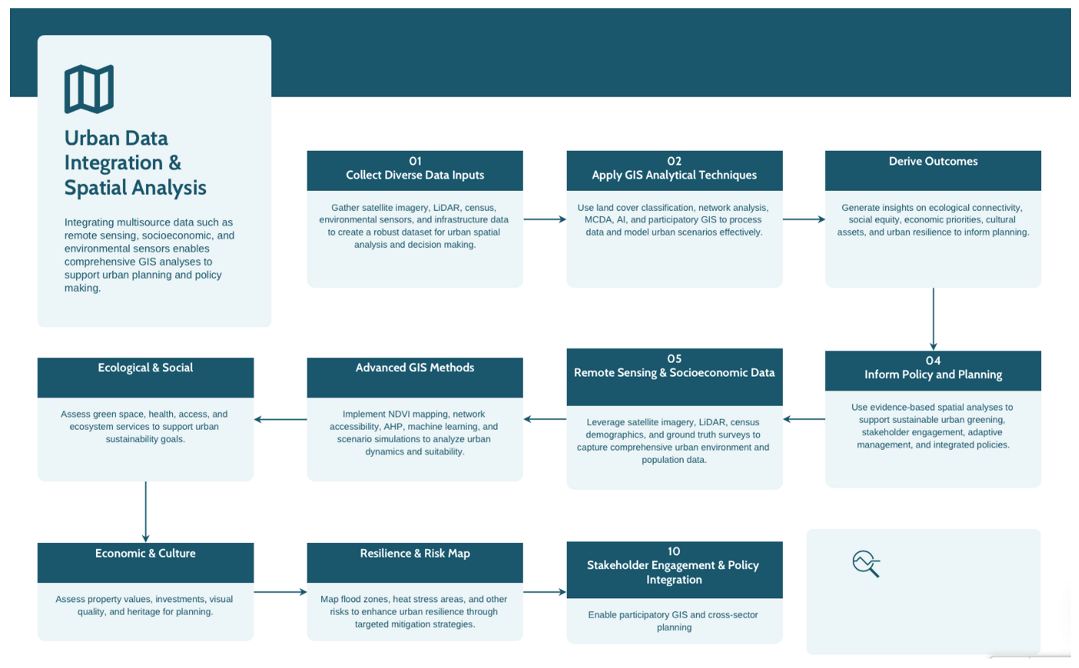
GIS-based UGI research has advanced beyond simple descriptive mapping to include multidimensional investigations that reveal patterns of green space distribution, accessibility problems, and ecological relationships. Analytical methodologies such as multi-criteria decision analysis (MCDA), least cost modeling, and gravity models enable the simultaneous evaluation of topography, land use, humidity, and social factors, assisting in the prioritization and optimal configuration of green infrastructure (Mobarak et al., 2022; Waheeb et al., 2023; Ghasemi et al., 2022). The combination of several data sources, such as high-resolution satellite imaging, NDVI, point-of-interest (POI), and demographic data, provides a scientific foundation for equitable and efficient green space management (Kim et al., 2021; Pouya and Aghlmand, 2022).
Methodological innovation may be seen in the rising integration of remote sensing (RS) and artificial intelligence (AI), which has improved the precision, scalability, and objectivity of urban green infrastructure (UGI) evaluations. AI-driven image categorization and indication weighting reduce human mistake and enable nuanced evaluations, particularly in urban environments with spatial diversity (Bai et al., 2022). Recent research combines visual and aesthetic evaluations with stakeholder-driven techniques, demonstrating a shift toward comprehensive assessment frameworks that consider both objective conditions and subjective preferences (Osseni et al., 2023; Zhang et al., 2024).
The reviewed literature supports and builds on core urban theories, such as urban metabolism and socio-ecological systems, by using spatial analysis to these frameworks (Huang et al., 2023; Ghasemi et al., 2022). GIS spatial analytical functions provide light on the relationships between the distribution of green spaces and social equality, reflecting the "right to the city" notion and providing empirical tools for achieving spatial justice (Ghasemi et al., 2022; Waheeb et al., 2023). A comparison with previous studies demonstrates a significant shift toward interdisciplinarity, as approaches from ecology, computer science, urban planning, and sociology are used to address the complexities of sustainable urban development (Xu et al., 2020; Bai et al., 2022).
This research also differentiates from past evaluations, which focused mostly on ecological indicators, by including social, economic, and aesthetic factors into assessment methodologies. The result is a more nuanced and complete understanding of UGI that is consistent with current discussions about the integration of ecosystem services, human well-being, and environmental justice into urban studies (Hoeben & Posch, 2021; Rachid et al., 2024).
The examined studies' methodological strengths include the meticulous integration of multi-source geographical data, innovative analytical frameworks, and validation processes that combine fieldwork, expert evaluation, and participatory methods (Mohammed & Hammo, 2023; Zhang et al., 2024). The use of MCDA and sophisticated categorization approaches reduces subjectivity and allows for comprehensive assessments across ecological, social, and economic dimensions (Hailemariam, 2021; Ghasemi et al., 2022).
However, numerous constraints remain. Geographical bias is evident, with most case studies focusing on Asia, particularly China, and low representation from the Americas and Oceania, limiting the findings' generalizability (Mobarak et al., 2022; Hailemariam, 2021). Temporal focus, limited to papers published between 2020 and 2024, may miss important advances in GIS-based UGI assessment. Methodological heterogeneity prohibits meta-analysis and cross-case synthesis, while differences in data quality and availability, particularly for high-resolution satellite imagery, can introduce bias (Bai et al., 2022; Buchavyi et al., 2023).
The comprehensive findings offer useful insights on urban planning and governance. GIS-based evaluation encourages evidence-based site selection for green space extension, supports targeted interventions in areas of ecological or socioeconomic risk, and serves as a platform for ongoing monitoring and adaptive management (Kim et al., 2021; Yang, 2024). Policymakers can use these technologies to promote spatial fairness, reduce urban heat islands, and improve ecological services, while participatory GIS platforms (PPGIS) make it easier to incorporate community perspectives and preferences into planning procedures (Waheeb et al., 2023).
Institutional and policy support, particularly public investment and regulatory frameworks that mandate the integration of green infrastructure, are critical for incorporating UGI into urban development (Waheeb et al., 2023; Ghasemi et al., 2022). Furthermore, policies that encourage public participation and stakeholder collaboration strengthen the legitimacy and effectiveness of UGI planning (Osseni et al., 2023).
Significant research gaps include the need for more geographical variety in case studies, particularly those from impoverished areas, as well as the standardization of evaluation frameworks to promote cross-comparison and meta-analysis. Future research should prioritize the use of real-time sensor data, hyperspectral imaging, and sophisticated AI-driven analytics to detect dynamic changes in UGI quality and function (Xu et al., 2020; Bai et al., 2022). Collaboration across disciplines, particularly among spatial scientists, ecologists, sociologists, and policy analysts, will be critical to the growth of the field.
There are opportunities to investigate the long-term consequences of UGI interventions on urban resilience, public health, and social cohesion, as well as the efficacy of participatory methodologies in different cultural and governance contexts (Zhang et al., 2024; Osseni et al., 2023).
The current synthesis is constrained by language and database limitations, which may exclude relevant non-English or gray literature. The reliance on peer-reviewed research from well-known databases ensures quality but may overlook innovative, practical findings. The variety in study design, data quality, and reporting standards increases the likelihood of bias when examining patterns and drawing conclusions.
The GIS-based evaluation of urban green infrastructure is a breakthrough tool in urban studies, allowing for comprehensive, multidimensional, and interactive assessments that incorporate ecological, social, and policy considerations. Methodological advances, notably the use of artificial intelligence, remote sensing, and multi-criteria analysis, have strengthened the empirical foundation for equitable and sustainable urban development. Addressing existing gaps in geographical coverage, standardization, and interdisciplinary integration will increase the importance and influence of GIS-based UGI research. These advances have significant implications for influencing policy, increasing urban resilience, and accomplishing the broader goals of sustainable and equitable cities.
Conclusions
Geographic Information Systems (GIS) have made rapid progress in evaluating urban green infrastructure (UGI), reflecting the growing complexity and multidimensionality of urban sustainability concerns. From 2020 to 2024, research in this sector will gradually combine varied data sources and advanced analytical frameworks, supported by defined methodological rigor and transparent quality criteria (Buchavyi et al., 2023; Mohammed & Hammo, 2023; Mobarak et al.,2022). Systematic literature reviews highlight a rigorous selection procedure, often based on the PRISMA standard, that favors empirical research and the inclusion of diverse urban environments (Mobarak et al., 2022).
Modern GIS-based UGI evaluation uses a wide range of datasets, including governmental, commercial, academic, and open-source sources, as well as remote sensing imagery and field survey data (Ghasemi et al., 2022). Analytical procedures commonly employ spatial statistics, network analyses, multi-criteria decision analysis (MCDA), and machine learning techniques, with a growing emphasis on artificial intelligence for data integration and interpretation (Kim et al., 2021; Xu et al., 2020). These techniques examine UGI across various aspects, including accessibility, ecosystem services, resilience, social benefits, and aesthetics, displaying a full awareness of the urban landscape (Vîlcea & Șoșea, 2020; Zhang et al., 2024).
The study demonstrates a substantial shift from ecological evaluations to more holistic assessments that consider social equality, aesthetic quality, and community preferences (Hailemariam, 2021). Spatial assessments now frequently combine quantitative indicators like the normalized difference vegetation index (NDVI) and proximity to facilities with subjective data from resident surveys to address both environmental and social elements of urban green infrastructure (Ghasemi et al., 2022). Site selection and policy interventions are increasingly facilitated by decision-support techniques such as suitability mapping and the analytic hierarchy process (AHP), which incorporate a variety of weighted criteria (Mobarak et al., 2022).
Technological improvements have changed GIS from a simple mapping tool to an essential decision-support platform capable of visualizing and optimizing urban green infrastructure of varied sizes. Multi-source data fusion and multidisciplinary approaches are now the foundations of advanced evaluations, ensuring the simultaneous examination of ecological, social, economic, and aesthetic issues (Mironova, 2021; Bai et al., 2022). Fieldwork is essential for providing ground truth confirmation and documenting contextual aspects that distant sensing cannot detect.
A study of 20 recent studies found that high-quality GIS-based UGI research often follows strict inclusion, exclusion, and quality evaluation processes, ensuring reproducibility and relevance (Mobarak et al., 2022). The findings show that GIS-based UGI evaluation is becoming more participatory and adaptable to changing urban needs, allowing for the fair and robust growth of green infrastructure. As the subject advances, methodological breakthroughs and the incorporation of novel technologies are expected to strengthen the empirical basis for UGI planning, putting GIS at the center of urban sustainability research (Mironova, 2021; Bai et al., 2022).
References
- Ahern, J. From fail-safe to safe-to-fail: Sustainability and resilience in the new urban world. Landscape and Urban Planning 2011, 100, 341–343. [Google Scholar] [CrossRef]
- Agency, EE. (2014). Spatial analysis of green infrastructure in Europe (Technical report No. 2/2014).
- Apostolopoulou, E.; Adams, W. M. Neoliberal capitalism and conservation in the post-crisis era: The dialectics of “green” and “un-green” grabbing in Greece and the UK. Antipode 2015, 47, 15–35. [Google Scholar] [CrossRef]
- Arai, K. Wireless sensor network for tea estate monitoring in complementally usage with satellite imagery data based on Geographic Information System (GIS). International Journal of Ubiquitous Computing 2011, 1, 12–21. [Google Scholar]
- Bai, H.; Li, Z.; Guo, H.; Chen, H.; Luo, P. Urban green space planning based on remote sensing and geographic information systems. Remote Sensing 2022, 14, 4213. [Google Scholar] [CrossRef]
- Barbesgaard, M. Blue growth: Savior or ocean grabbing? Journal of Peasant Studies 2018, 45, 130–149. [Google Scholar] [CrossRef]
- Baró, F.; Haase, D.; Gómez-Baggethun, E.; Frantzeskaki, N. Mismatches between ecosystem services supply and demand in urban areas: A quantitative assessment in five European cities. Ecological Indicators 2015, 55, 146–158. [Google Scholar] [CrossRef]
- Bell, S. Landscape pattern, perception and visualisation in the visual management of forests. Landscape and Urban Planning 2001, 54, 201–211. [Google Scholar] [CrossRef]
- Benati, G.; Calcagni, F.; Matellozzo, F.; Ghermandi, A.; Langemeyer, J. Unequal access to cultural ecosystem services of green spaces within the city of Rome–A spatial social media-based analysis. Ecosystem Services 2024, 66, 101594. [Google Scholar] [CrossRef]
- Benedict, M. A.; McMahon, E. T. Green infrastructure: Smart conservation for the 21st century. Renewable Resources Journal 2002, 20, 12–17. [Google Scholar]
- Bogomazov, S.; Lyandenburskaya, A.; Levin, A.; Efremova, E.; Tkachuk, O. Real-time monitoring of agricultural land using GIS technology. IOP Conference Series: Earth and Environmental Science 2021, 632, 032025. [Google Scholar] [CrossRef]
- Brown, G.; Reed, P.; Raymond, C. M. Mapping place values: 10 lessons from two decades of public participation GIS empirical research. Applied Geography 2020, 116, 102156. [Google Scholar] [CrossRef]
- Buchavyi, Y.; Lovynska, V.; Samarska, A. A GIS assessment of the green space percentage in a big industrial city (Dnipro, Ukraine). Ekologia (Bratislava) 2023, 42, 89–100. [Google Scholar] [CrossRef]
- Bugayenko, Y.; Bakare, A.; Cheverda, A.; Farina, M.; Kruglov, A.; Plaksin, Y.; et al. Prioritizing tasks in software development: A systematic literature review. PLoS One 2023, 18, e0283838. [Google Scholar] [CrossRef] [PubMed]
- Carranza, D. M.; Varas-Belemmi, K.; De Veer, D.; Iglesias-Muller, C.; Coral-Santacruz, D.; Méndez, F. A. Socio-environmental conflicts: An underestimated threat to biodiversity conservation in Chile. Environmental Science & Policy 2020, 110, 46–59. [Google Scholar] [CrossRef]
- Carrus, G.; Scopelliti, M.; Lafortezza, R.; Colangelo, G.; Ferrini, F.; Salbitano, F. Go greener, feel better? The positive effects of biodiversity on the well-being of individuals visiting urban and peri-urban green areas. Landscape and Urban Planning 2015, 134, 221–228. [Google Scholar] [CrossRef]
- Capotorti, G.; Ortí, M. M. A.; Copiz, R.; Fusaro, L.; Mollo, B.; Salvatori, E. Biodiversity and ecosystem services in urban green infrastructure planning: A case study from the metropolitan area of Rome (Italy). Urban Forestry & Urban Greening 2019, 37, 87–96. [Google Scholar] [CrossRef]
- Culligan, P. J. Green infrastructure and urban sustainability: A discussion of recent advances and future challenges based on multiyear observations in New York City. Science and Technology for the Built Environment 2019, 25, 1113–1120. [Google Scholar] [CrossRef]
- De Valck, J.; Beames, A.; Liekens, I.; Bettens, M.; Seuntjens, P.; Broekx, S. Valuing urban ecosystem services in sustainable brownfield redevelopment. Ecosystem Services 2019, 35, 139–149. [Google Scholar] [CrossRef]
- Derkzen, M. L.; van Teeffelen, A. J. A.; Verburg, P. H. Green infrastructure for urban climate adaptation: How do residents’ views on climate impacts and green infrastructure shape adaptation preferences? Landscape and Urban Planning 2017, 157, 106–130. [Google Scholar] [CrossRef]
- Dutta, M.; Husain, Z. An application of multicriteria decision making to built heritage: The case of Calcutta. Journal of Cultural Heritage 2009, 10, 237–243. [Google Scholar] [CrossRef]
- Ertan, S.; Çelik, R. N. The assessment of urbanization effect and sustainable drainage solutions on flood hazard by GIS. Sustainability 2021, 13, 2293. [Google Scholar] [CrossRef]
- Firehock, K. (2015). How to identify, evaluate and prioritize natural assets as part of a green infrastructure plan. In Strategic green infrastructure planning: A multi-scale approach (pp. 47–81).
- Frumkin, H.; Bratman, G. N.; Breslow, S. J.; Cochran, B.; Kahn, P. H.; Jr. ; Lawler, J. J.; et al. Nature contact and human health: A research agenda. Environmental Health Perspectives 2017, 125, 075001. [Google Scholar] [CrossRef] [PubMed]
- Garrison, J. D. Seeing the park for the trees: New York’s “Million Trees” campaign vs. the deep roots of environmental inequality. Environment and Planning B: Urban Analytics and City Science 2019, 46, 914–930. [Google Scholar] [CrossRef]
- Ghasemi, K.; Behzadfar, M.; Borhani, K.; Nouri, Z. Geographic information system based combined compromise solution (CoCoSo) method for exploring the spatial justice of accessing urban green spaces, a comparative study of district 22 of Tehran. Ecological Indicators 2022, 144, 109455. [Google Scholar] [CrossRef]
- Gorjian, M. (2024). A deep learning-based methodology to re-construct optimized re-structured mesh from architectural presentations (Doctoral dissertation, Texas A&M University). Texas A&M University. https://oaktrust.library.tamu.edu/items/0efc414a-f1a9-4ec3-bd19-f99d2a6e3392.
- Gorjian, M. (2025). Green gentrification and community health in urban landscape: A scoping review of urban greening’s social impacts (Version 1) [Preprint]. Research Square. [CrossRef]
- Gorjian, M. (2025). Green schoolyard investments and urban equity: A systematic review of economic and social impacts using spatial-statistical methods [Preprint]. Research Square. [CrossRef]
- Gorjian, M. (2025). Green schoolyard investments influence local-level economic and equity outcomes through spatial-statistical modeling and geospatial analysis in urban contexts. arXiv. [CrossRef]
- Gorjian, M. (2025). Schoolyard greening, child health, and neighborhood change: A comparative study of urban U.S. cities (arXiv:2507.08899) [Preprint]. arXiv, arXiv:2507.08899. [CrossRef]
- Gorjian, M. (2025). The impact of greening schoolyards on surrounding residential property values: A systematic review (Version 1) [Preprint]. Research Square. [CrossRef]
- Gorjian, M. (2025, July 10). Greening schoolyards and the spatial distribution of property values in Denver, Colorado [Preprint]. arXiv. [CrossRef]
- Gorjian, M. (2025, July 11). The impact of greening schoolyards on residential property values [Working paper]. SSRN. [CrossRef]
- Gorjian, M. (2025, July 15). Analyzing the relationship between urban greening and gentrification: Empirical findings from Denver, Colorado. SSRN. [CrossRef]
- Gorjian, M. (2025, July 26). Greening schoolyards and urban property values: A systematic review of geospatial and statistical evidence [Preprint]. arXiv. [CrossRef]
- Gorjian, M. (2025, July 29). Urban schoolyard greening: A systematic review of child health and neighborhood change [Preprint]. Research Square. [CrossRef]
- Gorjian, M.; Caffey, S. M.; Luhan, G. A. Exploring architectural design 3D reconstruction approaches through deep learning methods: A comprehensive survey. Athens Journal of Sciences 2024, 11, 1–29. [Google Scholar]
- Gorjian, M.; Luhan, G. A.; Caffey, S. M. (2025). Analysis of design algorithms and fabrication of a graph-based double-curvature structure with planar hexagonal panels. arXiv, arXiv:2507.16171. [CrossRef]
- Gorjian, M.; Quek, F. (2024). Enhancing consistency in sensible mixed reality systems: A calibration approach integrating haptic and tracking systems [Preprint]. EasyChair. https://easychair.org/publications/preprint/KVSZ.
- Haaland, C.; van Den Bosch, C. K. Challenges and strategies for urban green-space planning in cities undergoing densification: A review. Urban Forestry & Urban Greening 2015, 14, 760–771. [Google Scholar] [CrossRef]
- Halecki, W.; Stachura, T.; Fudala, W.; Stec, A.; Kubon, S. Assessment and planning of green spaces in urban parks: A review. Sustainable Cities and Society 2023, 88, 104280. [Google Scholar] [CrossRef]
- Hammo, Y. H.; Mohammed, S. S. Evaluate of green space (parks) in Duhok city by use image satellite, Google earth, GIS, (NDVI), and field survey techniques. Kufa Journal of Agricultural Sciences 2023, 15, 73–92. [Google Scholar] [CrossRef]
- Herzog, C. P. A multifunctional green infrastructure design to protect and improve native biodiversity in Rio de Janeiro. Landscape Ecology Engineering 2016, 12, 141–150. [Google Scholar] [CrossRef]
- Hidalgo, D. Cities and human settlements in the development agenda. SAIS Review of International Affairs 2014, 34, 63–81. [Google Scholar] [CrossRef]
- Hoeben, A. D.; Posch, A. Green roof ecosystem services in various urban development types: A case study in Graz, Austria. Urban Forestry & Urban Greening 2021, 62, 127167. [Google Scholar] [CrossRef]
- Hunter, R. F.; Christian, H.; Veitch, J.; Astell-Burt, T.; Hipp, J. A.; Schipperijn, J. The impact of interventions to promote physical activity in urban green space: A systematic review and recommendations for future research. Social Science & Medicine 2015, 124, 246–256. [Google Scholar] [CrossRef]
- Jeanjean, A. P.; Monks, P. S.; Leigh, R. J. Modelling the effectiveness of urban trees and grass on PM2.5 reduction via dispersion and deposition at a city scale. Atmospheric Environment 2016, 147, 1–10. [Google Scholar] [CrossRef]
- Janowicz, K.; Gao, S.; McKenzie, G.; Hu, Y.; Bhaduri, B. (2020). GeoAI: Spatially explicit artificial intelligence techniques for geographic knowledge discovery and beyond.
- Kaur, R.; Gupta, K. Blue-Green Infrastructure (BGI) network in urban areas for sustainable storm water management: A geospatial approach. City and Environment Interactions 2022, 16, 100087. [Google Scholar] [CrossRef]
- Kim, H.; Oh, K.; Lee, D. Establishment of a geographic information system-based algorithm to analyze suitable locations for green roofs and roadside trees. Applied Sciences 2021, 11, 7368. [Google Scholar] [CrossRef]
- Koperoinen, L.; Itkonen, P.; Niemela, J. Using expert knowledge in combining green infrastructure and ecosystem services in land use planning: An insight into a new place-based methodology. Landscape Ecology 2014, 29, 1361–1375. [Google Scholar] [CrossRef]
- Kowe, P.; Mutanga, O.; Odindi, J.; Dube, T. Exploring the spatial patterns of vegetation fragmentation using local spatial autocorrelation indices. Journal of Applied Remote Sensing 2019, 13, 024523. [Google Scholar] [CrossRef]
- Kowe, P.; Mutanga, O.; Odindi, J.; Dube, T. A quantitative framework for analysing long term spatial clustering and vegetation fragmentation in an urban landscape using multi-temporal Landsat data. International Journal of Applied Earth Observation and Geoinformation 2020, 88, 102057. [Google Scholar] [CrossRef]
- Kowe, P.; Mutanga, O.; Odindi, J. Effect of landscape pattern and spatial configuration of vegetation patches on urban warming and cooling in Harare metropolitan city, Zimbabwe. GIScience & Remote Sensing 2021, 58, 261–280. [Google Scholar] [CrossRef]
- Li, L.; Lange, K. W. Assessing the relationship between urban blue-green infrastructure and stress resilience in real settings: A systematic review. Sustainability 2023, 15, 9240. [Google Scholar] [CrossRef]
- Llausa, A.; Roe, M. Green infrastructure planning: Cross-national analysis between the North East of England (UK) and Catalonia (Spain). European Planning Studies 2012, 20, 641–663. [Google Scholar] [CrossRef]
- Liquete, C.; Kleeschulte, S.; Dige, G.; Maes, J.; Grizzetti, B.; Olah, B. Mapping green infrastructure based on ecosystem services and ecological networks: A Pan-European case study. Environmental Science & Policy 2015, 54, 268–280. [Google Scholar] [CrossRef]
- Lorenzo, A. B.; Blanche, C. A.; Qi, Y.; Guidry, M. M. Assessing residents’ willingness to pay to preserve the community urban forest: A small-city case study. Journal of Arboriculture 2000, 26, 319–325. [Google Scholar] [CrossRef]
- Ma, Y.; He, T.; McVicar, T. R.; Liang, S.; Liu, T.; Peng, W.; et al. Quantifying how topography impacts vegetation indices at various spatial and temporal scales. Remote Sensing of Environment 2024, 312, 114311. [Google Scholar] [CrossRef]
- Martín-Martín, A.; Orduna-Malea, E.; Delgado López-Cózar, E. Coverage of highly cited documents in Google Scholar, Web of Science, and Scopus: A multidisciplinary comparison. Scientometrics 2018, 116, 2175–2188. [Google Scholar] [CrossRef]
- Martín-Martín, A.; Orduna-Malea, E.; Thelwall, M.; López-Cózar, E. D. Google Scholar, Web of Science, and Scopus: A systematic comparison of citations in 252 subject categories. Journal of Informetrics 2018, 12, 1160–1177. [Google Scholar] [CrossRef]
- McKinley, D. C.; Miller-Rushing, A. J.; Ballard, H. L.; Bonney, R.; Brown, H.; Cook Patton, S. C. Citizen science can improve conservation science, natural resource management, and environmental protection. Biological Conservation 2017, 208, 15–28. [Google Scholar] [CrossRef]
- Meerow, S.; Newell, J. P. Spatial planning for multifunctional green infrastructure: Growing resilience in Detroit. Landscape and Urban Planning 2017, 159, 62–75. [Google Scholar] [CrossRef]
- Mironova, E. GIS modeling of green infrastructure of Mediterranean cities for the management of urbanized ecosystems. Arid Ecosystems 2021, 11, 149–155. [Google Scholar] [CrossRef]
- Mobarak, B.; Shrahily, R.; Mohammad, A.; Alzandi, A. A. Assessing green infrastructures using GIS and the multi-criteria decision-making method: The case of the Al Baha region (Saudi Arabia). Forests 2022, 13, 2013. [Google Scholar] [CrossRef]
- Moher, D.; Liberati, A.; Tetzlaff, J.; Altman, D. G.; PRISMA Group. Preferred reporting items for systematic reviews and meta-analyses: The PRISMA statement. Annals of Internal Medicine 2009, 151, 264–269. [Google Scholar] [CrossRef]
- Newman, G.; Wiggins, A.; Crall, A.; Graham, E.; Newman, S.; Crowston, K. The future of citizen science: Emerging technologies and shifting paradigms. Frontiers in Ecology and the Environment 2012, 10, 298–304. [Google Scholar] [CrossRef]
- Niemela, J.; Saarela, S. R.; Soderman, T.; Kopperoinen, L.; Yli-Pelkonen, V.; Vare, S.; et al. Using the ecosystem services approach for better planning and conservation of urban green spaces: A Finland case study. Biodiversity and Conservation 2010, 19, 3225–3243. [Google Scholar] [CrossRef]
- Osseni, A. A.; Dossou-Yovo, H. O.; Gbesso, F. G.; Sinsin, B. GIS-based multi-criteria analysis for selecting suitable areas for urban green spaces in Abomey-Calavi District, Southern Benin. Land 2023, 12, 1553. [Google Scholar] [CrossRef]
- Palmer, J. F. The contribution of a GIS-based landscape assessment model to a scientifically rigorous approach to visual impact assessment. Landscape and Urban Planning 2019, 189, 80–90. [Google Scholar] [CrossRef]
- Pauleit, S.; Liu, L.; Ahern, J.; Kazmierczak, A. (2011). Multifunctional green infrastructure planning to promote ecological services in the city. In Urban Ecology: Patterns, Processes and Applications.
- Pedro, J.; Silva, C.; Pinheiro, M. D. Integrating GIS spatial dimension into BREEAM communities sustainability assessment to support urban planning policies, Lisbon case study. Land Use Policy 2019, 83, 424–434. [Google Scholar] [CrossRef]
- Pouya, S.; Aghlmand, M. Evaluation of urban green space per capita with new remote sensing and geographic information system techniques and the importance of urban green space during the COVID-19 pandemic. Environmental Monitoring and Assessment 2022, 194, 633. [Google Scholar] [CrossRef] [PubMed]
- Pullar, D. V.; Tidey, M. E. Coupling 3D visualisation to qualitative assessment of built environment designs. Landscape and Urban Planning 2001, 55, 29–40. [Google Scholar] [CrossRef]
- Qiu, S.; Quek, F.; Natarajarathinam, M.; Powell, L.; Liu, T.; Gorjian, M. (2023). Diversity among mentors in STEM+Computing MentorCorps. In 2023 IEEE Frontiers in Education Conference (FIE) (pp. 1–4). IEEE. [CrossRef]
- Rachid, L.; Elmostafa, A.; Mehdi, M.; Hassan, R. Assessing carbon storage and sequestration benefits of urban greening in Nador City, Morocco, utilizing GIS and the InVEST model. Sustainable Futures 2024, 7, 100171. [Google Scholar] [CrossRef]
- Raina, A. S.; Mone, V.; Gorjian, M.; Quek, F.; Sueda, S.; Krishnamurthy, V. R. (2024). In Blended physical-digital kinesthetic feedback for mixed reality-based conceptual design-in-context. In Proceedings of the 50th Graphics Interface Conference (Article 6; pp. 1–16. [CrossRef]
- Rezvani, S. M.; Falcão, M. J.; Komljenovic, D.; de Almeida, N. M. A systematic literature review on urban resilience enabled with asset and disaster risk management approaches and GIS-based decision support tools. Applied Sciences 2023, 13, 2223. [Google Scholar] [CrossRef]
- Rodríguez-Espinosa, V. M.; Aguilera-Benavente, F.; Gómez-Delgado, M. Green infrastructure design using GIS and spatial analysis: A proposal for the Henares Corridor (Madrid-Guadalajara, Spain). Landscape Research 2020, 45, 26–43. [Google Scholar] [CrossRef]
- Runhaar, H.; van Laerhoven, F.; Driessen, P.; Arts, J. Environmental assessment in The Netherlands: Effectively governing environmental protection? A discourse analysis. Environmental Impact Assessment Review 2013, 39, 13–25. [Google Scholar] [CrossRef]
- Sadler, J.; Bates, A.; Hale, J.; James, P. (2010). Bringing cities alive: The importance of urban green spaces for people and biodiversity. In Urban Ecology (pp. 230–260).
- Sanesi, G.; Chiarello, F. Residents and urban green spaces: The case of Bari. Urban Forestry & Urban Greening 2006, 4, 125–134. [Google Scholar] [CrossRef]
- Santos, T.; Tenedório, J. A.; Gonçalves, J. A. Quantifying the city’s green area potential gain using remote sensing data. Sustainability 2016, 8, 1247. [Google Scholar] [CrossRef]
- Selamat, M. I. A.; Maruthaveeran, S.; Mohd Yusof, M. J.; Shahidan, M. F. Planning tools to revitalise urban vacant land from ecological perspectives: A systematic review. Urban Science 2023, 7, 58. [Google Scholar] [CrossRef]
- Shahtahmassebi, A. R.; Li, C.; Fan, Y.; Wu, Y.; Gan, M.; Wang, K. Remote sensing of urban green spaces: A review. Urban Forestry & Urban Greening 2021, 57, 126946. [Google Scholar] [CrossRef]
- Song, Y.; Kalacska, M.; Gasparovic, M.; Yao, J.; Najibi, N. (2023). Advances in geocomputation and geospatial artificial intelligence (GeoAI) for mapping.
- Stessens, P.; Khan, A. Z.; Huysmans, M.; Canters, F. Analysing urban green space accessibility and quality: A GIS-based model as spatial decision support for urban ecosystem services in Brussels. Ecosystem Services 2017, 28, 328–340. [Google Scholar] [CrossRef]
- Syrbe, R. U.; Walz, U. Spatial indicators for the assessment of ecosystem services: Providing, benefiting and connecting areas and landscape metrics. Ecological Indicators 2012, 21, 80–88. [Google Scholar] [CrossRef]
- Tansar, H.; Duan, H.-F.; Mark, O. A multi-objective decision-making framework for implementing green-grey infrastructures to enhance urban drainage system resilience. Journal of Hydrology 2023, 620, 129381. [Google Scholar] [CrossRef]
- Taylor, J. R.; Hanumappa, M.; Miller, L.; Shane, B.; Richardson, M. L. Facilitating multifunctional green infrastructure planning in Washington, DC through a Tableau interface. Sustainability 2021, 13, 8390. [Google Scholar] [CrossRef]
- Thomas, K.; Littlewood, S. From green belts to green infrastructure? The evolution of a new concept in the emerging soft governance of spatial strategies. Planning Practice and Research 2010, 25, 203–222. [Google Scholar] [CrossRef]
- Tran, M.; Beddewela, E. Does context matter for sustainability disclosure? Institutional factors in Southeast Asia. Business Ethics: A European Review 2020, 29, 282–302. [Google Scholar] [CrossRef]
- United Nations. (2023). Sustainable Development Goals: 17 Goals to Transform Our World. https://www.un.org/en/exhibits/page/sdgs-17-goals-transform-world.
- Vilcea, C.; et al. A GIS-based analysis of the urban green space accessibility in Craiova city, Romania. Geografisk Tidsskrift-Danish Journal of Geography 2020, 120, 19–34. [Google Scholar] [CrossRef]
- Waheeb, S. A.; Zerouali, B.; Elbeltagi, A.; Alwetaishi, M.; Wong, Y. J.; Bailek, N. Enhancing sustainable urban planning through GIS and multiple-criteria decision analysis: A case study of green space infrastructure in Taif Province, Saudi Arabia. Water 2023, 15, 3031. [Google Scholar] [CrossRef]
- Wang, J.; Pauleit, S.; Banzhaf, E. An integrated indicator framework for the assessment of multifunctional green infrastructure—Exemplified in a European city. Remote Sensing 2019, 11, 1869. [Google Scholar] [CrossRef]
- Wang, M.; Yang, Y.; Jin, S.; Gu, L.; Zhang, H. Social and cultural factors that influence residential location choice of urban senior citizens in China–the case of Chengdu city. Habitat International 2016, 53, 55–65. [Google Scholar] [CrossRef]
- Wang, R.; Zhao, J.; Liu, Z. Consensus in visual preferences: The effects of aesthetic quality and landscape types. Urban Forestry & Urban Greening 2016, 20, 210–217. [Google Scholar] [CrossRef]
- Wanghe, K.; Guo, X.; Wang, M.; Zhuang, H.; Ahmad, S.; Khan, T. U. Gravity model toolbox: An automated and open-source ArcGIS tool to build and prioritize ecological corridors in urban landscapes. Global Ecology and Conservation 2020, 22, e01012. [Google Scholar] [CrossRef]
- Winslow, J. F. Multifunctional green infrastructure: Planning and design for long-term care. Socio-Ecological Practice Research 2021, 3, 293–308. [Google Scholar] [CrossRef]
- Xu, N.; Luo, J.; Zuo, J.; Hu, X.; Dong, J.; Wu, T. Accurate suitability evaluation of large-scale roof greening based on RS and GIS methods. Sustainability 2020, 12, 4375. [Google Scholar] [CrossRef]
- Yang, J. Research on optimization strategies for urban park green space planning in Nanjing based on GIS from the perspectives of network analysis and Thiessen polygon theory. International Journal of Modern Physics C 2024. [Google Scholar] [CrossRef]
- Yeo, O. T. S.; Yusof, M. J. M.; Maruthaveeran, S.; Saito, K.; Yeo, L. B. ABC of green infrastructure analysis and planning: The basic ideas and methodological guidance based on landscape ecological principle. Urban Forestry & Urban Greening 2022, 73, 127600. [Google Scholar] [CrossRef]
- Yeo, O. T. S.; Yusof, M. J. M.; Maruthaveeran, S.; Shafri, H. Z. M.; Saito, K.; Yeo, L. B. ABC of green infrastructure analysis and planning: The basic ideas and methodological guidance based on landscape ecological principle. Urban Forestry & Urban Greening 2022, 73, 127600. [Google Scholar] [CrossRef]
- Zaman-ul Haq, M.; Saqib, Z.; Kanwal, A.; Naseer, S.; Shafiq, M.; Akhtar, N. The trajectories, trends, and opportunities for assessing urban ecosystem services: A systematic review of geospatial methods. Sustainability 2022, 14, 1471. [Google Scholar] [CrossRef]
- Zhang, T.; Yan, M.; Yu, X.; Liu, B. Visual assessment of historic landmarks based on GIS and survey: A study of view and viewing of Tiger Hill in Suzhou, China. Journal of Asian Architecture and Building Engineering 2024, 23, 1079–1093. [Google Scholar] [CrossRef]
Disclaimer/Publisher’s Note: The statements, opinions and data contained in all publications are solely those of the individual author(s) and contributor(s) and not of MDPI and/or the editor(s). MDPI and/or the editor(s) disclaim responsibility for any injury to people or property resulting from any ideas, methods, instructions or products referred to in the content. |
© 2025 by the author. Licensee MDPI, Basel, Switzerland. This article is an open access article distributed under the terms and conditions of the Creative Commons Attribution (CC BY) license (http://creativecommons.org/licenses/by/4.0/).
Copyright: This open access article is published under a Creative Commons CC BY 4.0 license, which permit the free download, distribution, and reuse, provided that the author and preprint are cited in any reuse.


